
Life, 1919-01-16 · page 20 of 34
Life — January 16, 1919 — page 20: what you’re looking at
What you’re looking at
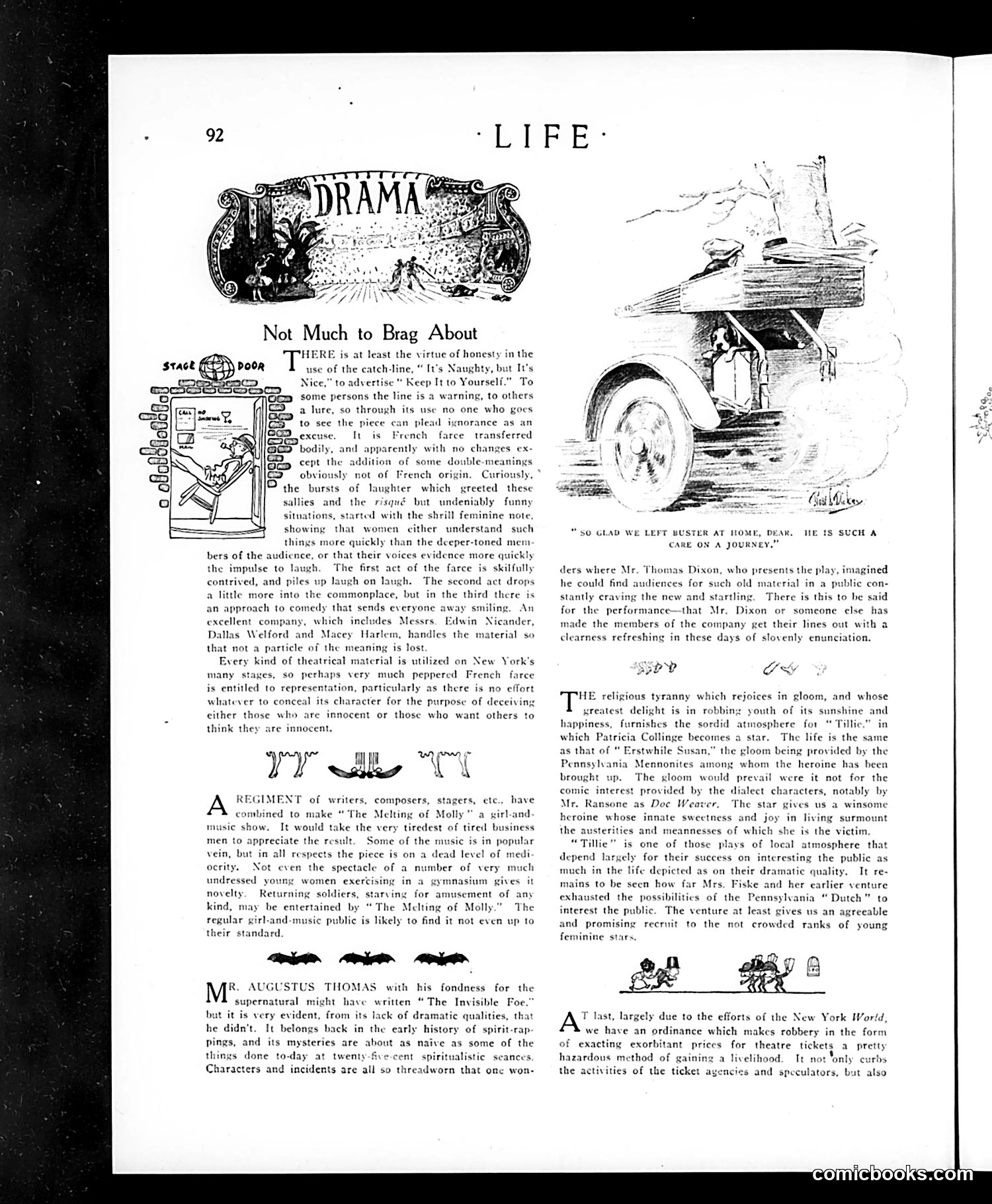
This page reviews three theatrical productions of the era (appears to be early 1900s, given references to "returning soldiers"): **"Keep It to Yourself"** — A French farce advertised with the risqué slogan "It's Naughty, but It's Nice." The reviewer notes it's honest about its bawdy nature, making audiences aware what they're getting. The sketch shows a car with the caption mocking someone bringing a child ("Buster") to such entertainment — the joke being adults shouldn't expose children to risqué plays. **"The Melting of Molly"** — A girl-and-music show featuring undressed women exercising. The reviewer dismisses it as mediocre, suggesting only exhausted soldiers and lowbrow audiences would find it entertaining. **"Tillie"** — A Mennonite-themed play dealing with religious strictness and gloom, redeemed by dialect-comedy characters and a sweet heroine (Patricia Collinge). The satire targets theatrical mediocrity and exploitative entertainment aimed at unsophisticated audiences during wartime.
📄 Transcribed text from this page (OCR, searchable)
Machine-transcribed from the original scan — historical spelling and the odd misread are preserved.
Stack 0 ofotGecatens Not Much to Brag About HERE is at least the virtue of honesty in the use of the catch-line, “ It’s Naughty, but It's Nice,” to advertise * Keep It to Yourself.” To. some persons the line is a warning, to others dooR ge a lure, so through its use no one who goes to see the piece can plead ignorance as an excuse, [tis French farce transferred bodily, and apparently with 1 cept the obviously me addition of some do: not of French origin. Curiously, the bursts of laughter which greeted these sallies and the undeniably funny started with the shrill feminine note. showing that cither understand such things more quickly than the dceper-toned mem bers of the audience, or that their voices evidenc the impulse to law The first act of the farce is skilfully contrived, and piles up laugh on laugh. a little an approach to comedy t excellent: company, wh Nicander, Dallas Welford and Macey handles the material so that not a particle of the meaning is lost Every kind of theatrical material is utilized on New so perhaps very og risqué but situations, women more quickly The second act drops more into the commonplace, but in the third there is sends everyone away smiling. An h includes Messrs. Edwin Harlem, York's farce is entitled to representation, particularly as there is no effort many stages, much peppered French whatever to conceal its character for the purpose of deceiving either those who are innocent or those who want others to think t '¢ innocent, have A REGIMENT of writers, composers, stagers, etc combined to make “ T © Melting of Molly It would take the very tiredest of tired business preciate the result in all respects the piece is on a dead level of medi Not even the spectacle undressed young women exercising in a gymnasium gives it novelty. Returning soldiers, starving for amusement of any kind, may be entertained by “The Melting of Molly.” The regular girl-and-music public is likely to find it not even up to their standard ai Ae R. AUGUSTUS THOMAS fondness for the supernatural might written “The Invisible Foe.” but it is very evident, from its lack of drai he didn’t. It belongs back in the early hi pings, and its mysteries are about as naive as some of the things done to-day at twemty-five-cent spiritualistic seances Characters and incidents are all so threadworn that one won- a xirl-and music show, men to Some of the music is in popular vein, bu ocrity. of a number of very much ~——_ with his have tic qualities, tha tory of spirit-rap Mice uh ee “SO GLAD WE LEFT BUSTER AT ILOME, DEAR, HE 18 SUCH A CARE ON A JOURNEY.” nagined he could find audiences for such old material in a public con- ders where Mr. Thomas Dixon, who presents the play, i the new startling. There is this to be said that Mr. made the members of the company get their lines out with a stantly cravir for the performance Dixon or someone else has clearness refreshing in these days of slovenly enunciation, Sw HE religious tyranny which rejoices in gloom, id whose youth of its sunshine and “Tillie.” in is the same kreatest delight is in robbin happiness, furnishes the sordid atmosphere for which Patri The lif as that of “ Erstwhile Susan,” the gloom being provided by the ia Collinge becomes a s the heroine has been brought up. he gloom would prevail were it not for the comic interest provided by the dialect characters, notably by Mr. Ransone as Doc W vr. The Pennsylvania Mennonites among who star gives us a winsome heroine whose innate sweetness and joy in living surmount the auster; annesses of which she is the victim. “Tillie” is one of those plays of local atmosphere that depend largely for their success on interesting the public as much in the life depicted as on their dramatic quality. It re- mains to be seen how far Mrs. Fiske and her earlier venture exhausted the possibilities of the Pennsylvania “Dutch” to interest the public. The venture at least gives us an agreeable and promising recruit to the not crowded ranks of young jes and m feminine stars A last, largely due to the efforts of the New York World, we have an ordinance which makes robbery in the form of exacting exorbitant theatre tickets a hazardous method of gaining a livelihood. Tt not the activities of the ticket prices for pretty ly curbs gencies and speculators, but also