
A complete issue · 34 pages · 1918
Life — November 21, 1918
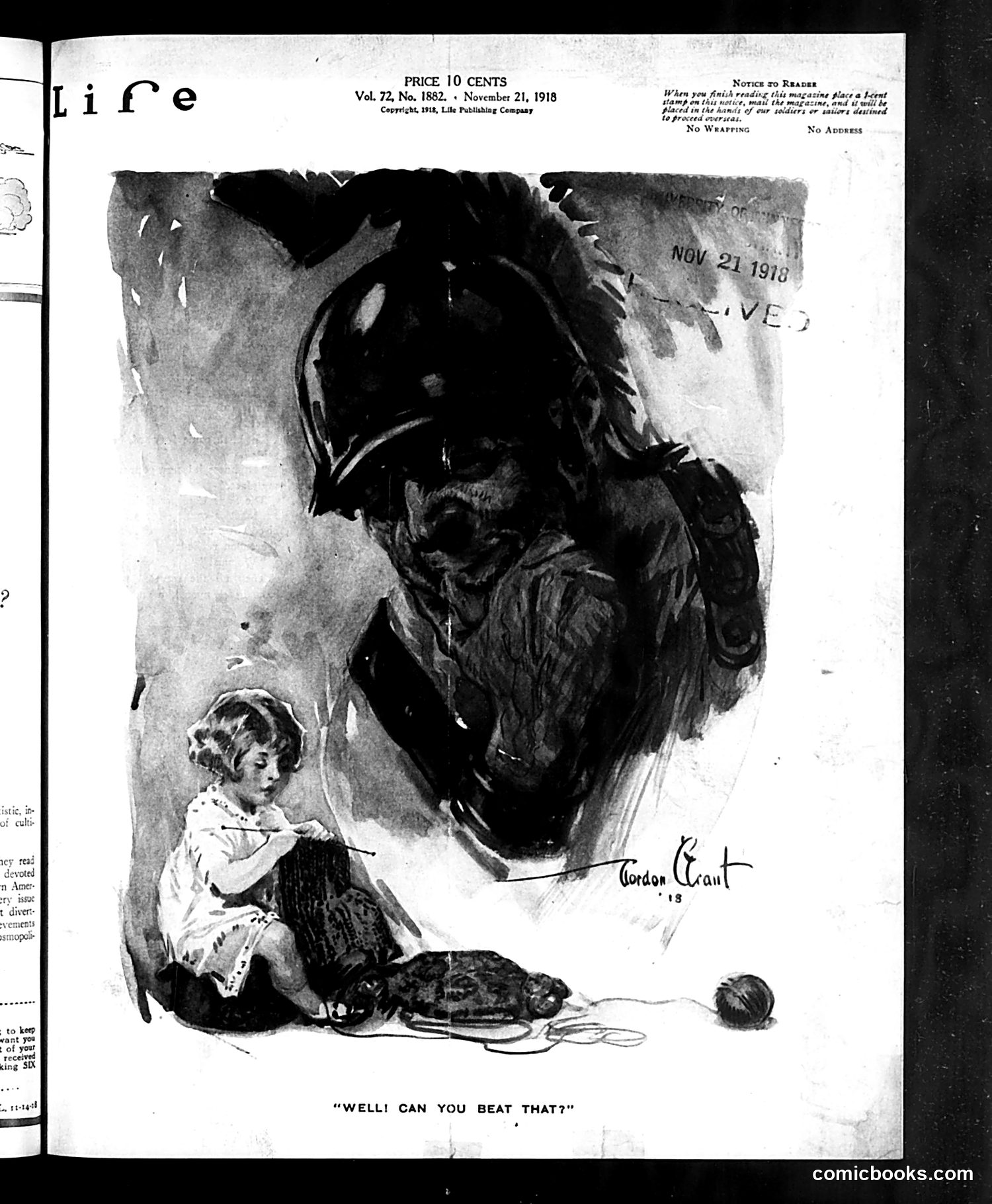
This Gordon Craik illustration depicts a small child artist painting or drawing a large, menacing rat or rodent. The caption reads "Well! Can You Beat That?" Given the November 1918 date—immediately following World War I's armistice (November 11)—this likely functions as political satire. The rat probably represents Germany or a German political/military figure, while the child artist suggests either Allied nations or perhaps American public opinion/media creating an unflattering portrait of the defeated enemy. The surprise and humor derive from the incongruity: a small, innocent child casually "beating" or surpassing what appears to be a formidable threat through simple artistic representation—possibly commentary on post-war diminishment of German power or the power of public perception in shaping the enemy's image.
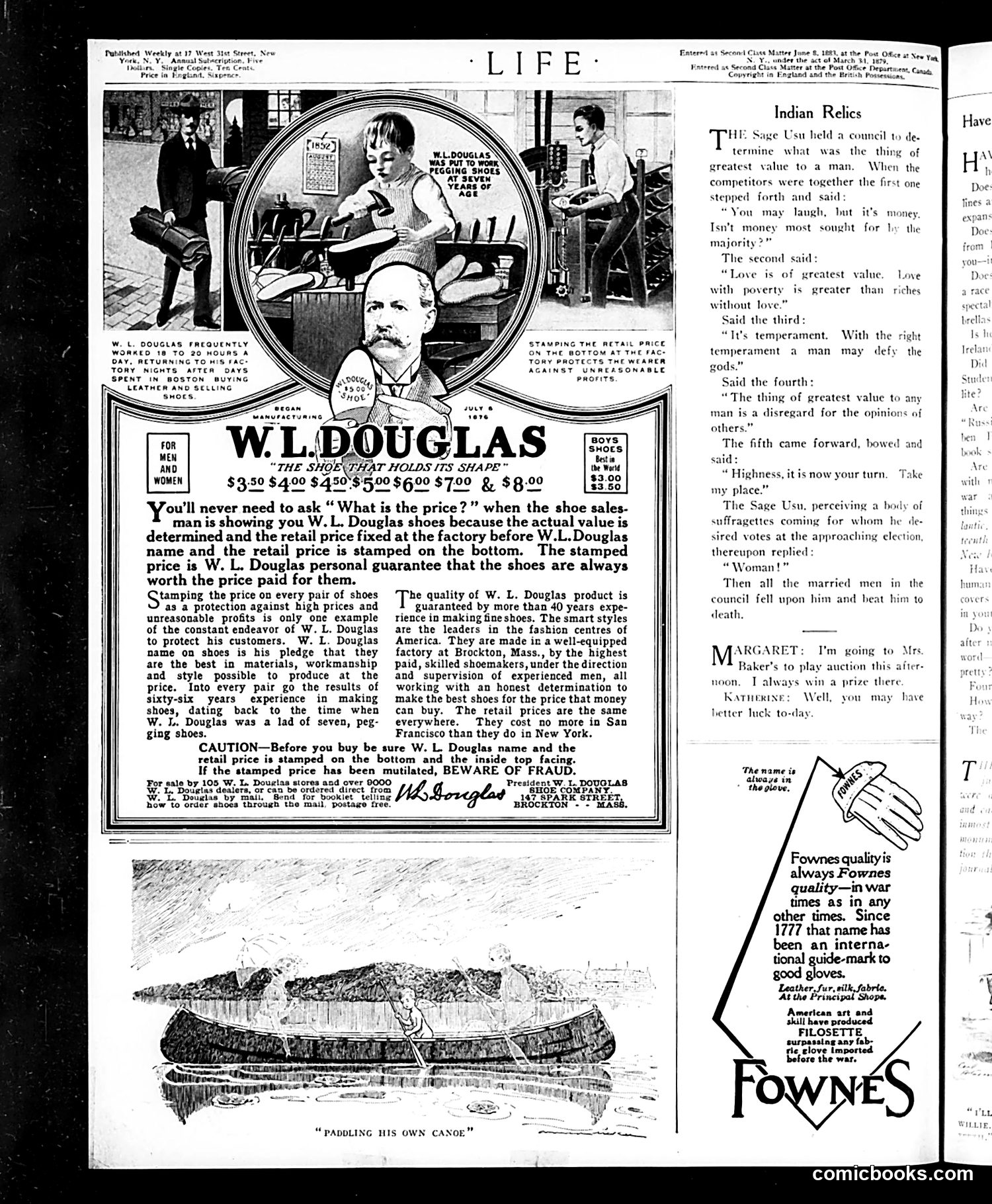
This page is primarily **advertising**, not political satire. The dominant content is a W.L. Douglas shoe advertisement featuring images of the company's factory operations and shoe styles with prices ranging from $3.00 to $8.00. The one narrative element—titled "Indian Relics"—appears to be a short story or filler piece unrelated to the advertisements. It depicts a philosophical debate among competitors about life's greatest value (money, love, temperament, disregard for others, and humility), concluding with a Woman silencing them all. A smaller advertisement for Fownes gloves appears on the right, emphasizing the brand's heritage since 1777. The page reflects early-20th-century magazine layout combining editorial content with prominent commercial advertising.
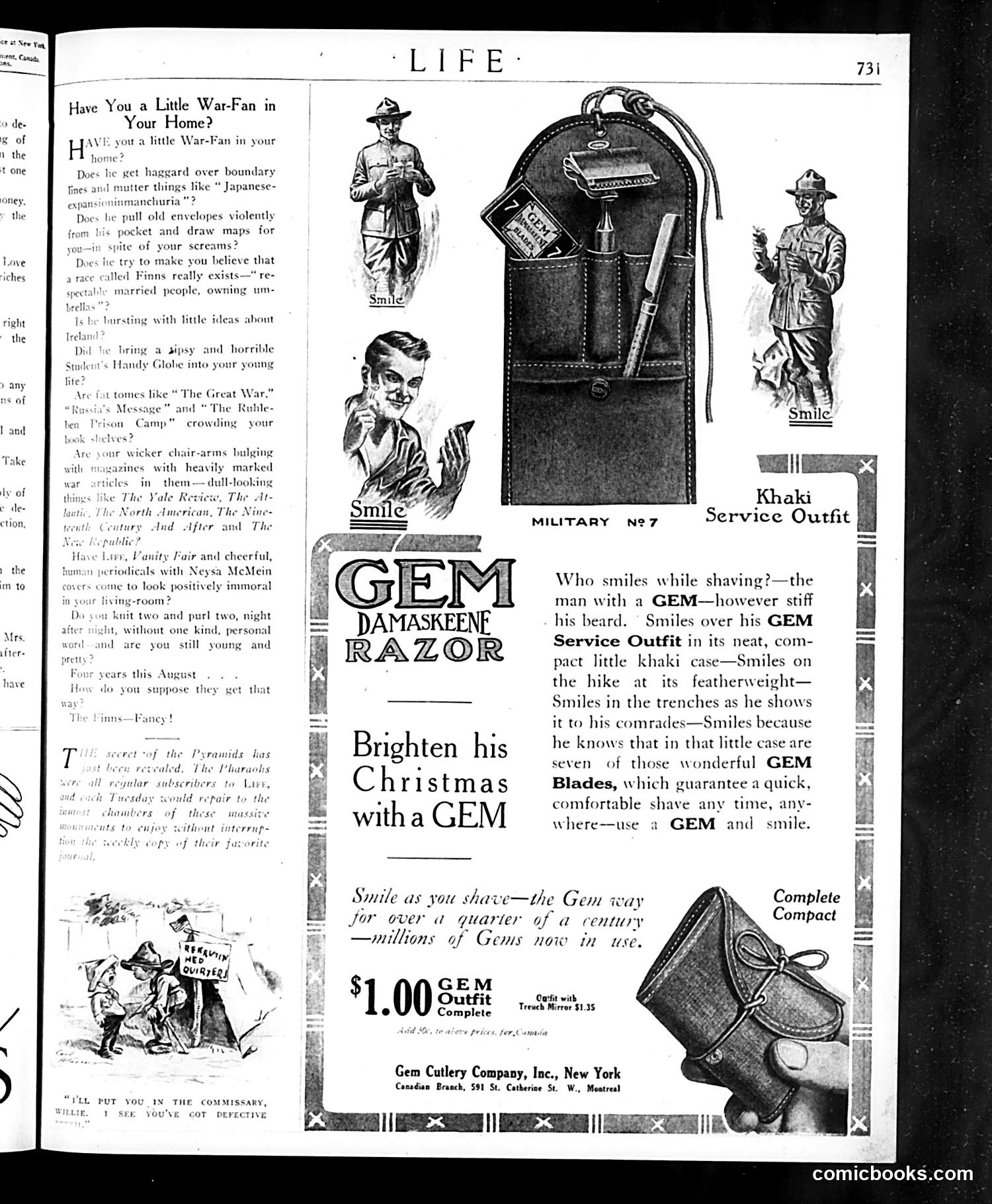
This page is primarily **commercial advertising** for GEM razors and shaving products, not political satire. The left column contains a humorous article titled "Have You a Little War-Fan in Your Home?" that satirizes Americans obsessed with World War I—mocking those who collect war maps, read sensationalist books about the conflict, and display military memorabilia. The ads feature military-themed imagery: soldiers in khaki uniforms advertising a "Khaki Service Outfit" alongside GEM razor products. The advertising copy cleverly connects wartime themes to shaving, suggesting soldiers "smile" while shaving with GEM razors in the trenches. The satire targets American **war enthusiasm and commercialization** of the conflict rather than critiquing the war itself—a common Life magazine theme during WWI.
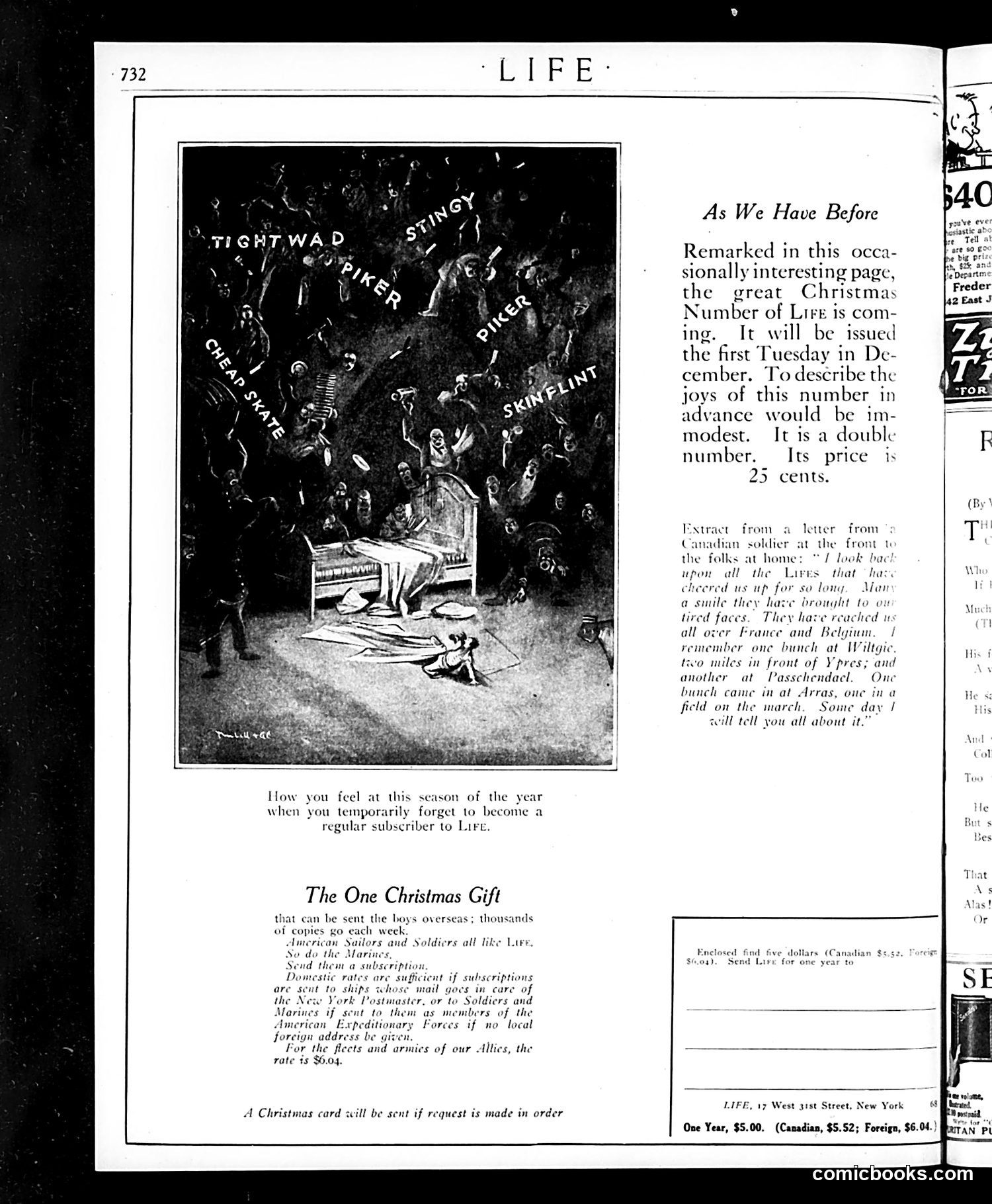
This page features a wartime cartoon depicting American soldiers reading Life magazine in a trench during World War I. The illustration shows soldiers sheltering in a dugout labeled with military terms ("tight wad," "stingy," "piker," "skinflint," "cheap skate"), surrounded by enemy fire and explosions. The cartoon's satirical point, stated below: "How you feel at this season of the year when you temporarily forget to become a regular subscriber to Life." The joke suggests that soldiers overseas desperately want Life magazine for morale and entertainment, making it "the one Christmas gift" worthy of sending to troops. The advertisement encourages Americans to subscribe and send copies to servicemen, framing magazine subscriptions as patriotic wartime support.
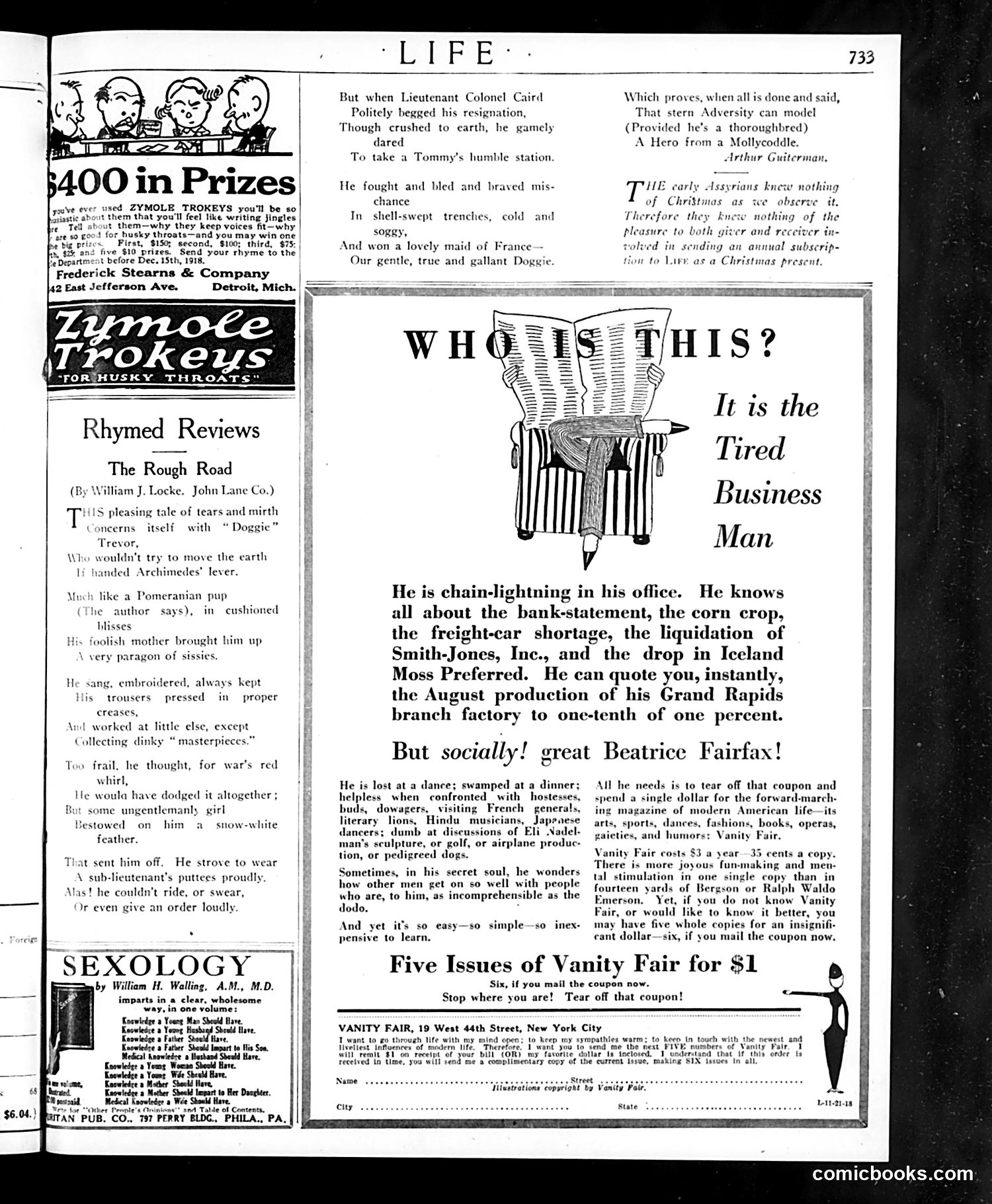
This page is primarily **advertising and feature content** rather than political satire. The main content includes: 1. **"$400 in Prizes" advertisement** for Zymole Trokeys (a throat lozenge), featuring a cartoon of four men at a table 2. **"Rhymed Reviews" section** critiquing "The Rough Road," a story about a character named "Doggie" Trevor—seemingly social commentary on an upper-class protagonist 3. **"Who Is This?" feature** satirizing "the Tired Business Man"—portraying him as overwhelmed by commercial trivia (bank statements, crop reports) yet socially inept at parties despite reading Vanity Fair 4. **Vanity Fair advertisement** promoting five issues for $1 The satire targets the gap between business competence and social sophistication among middle-class professionals of the era (approximately 1918, based on the magazine's publication date).
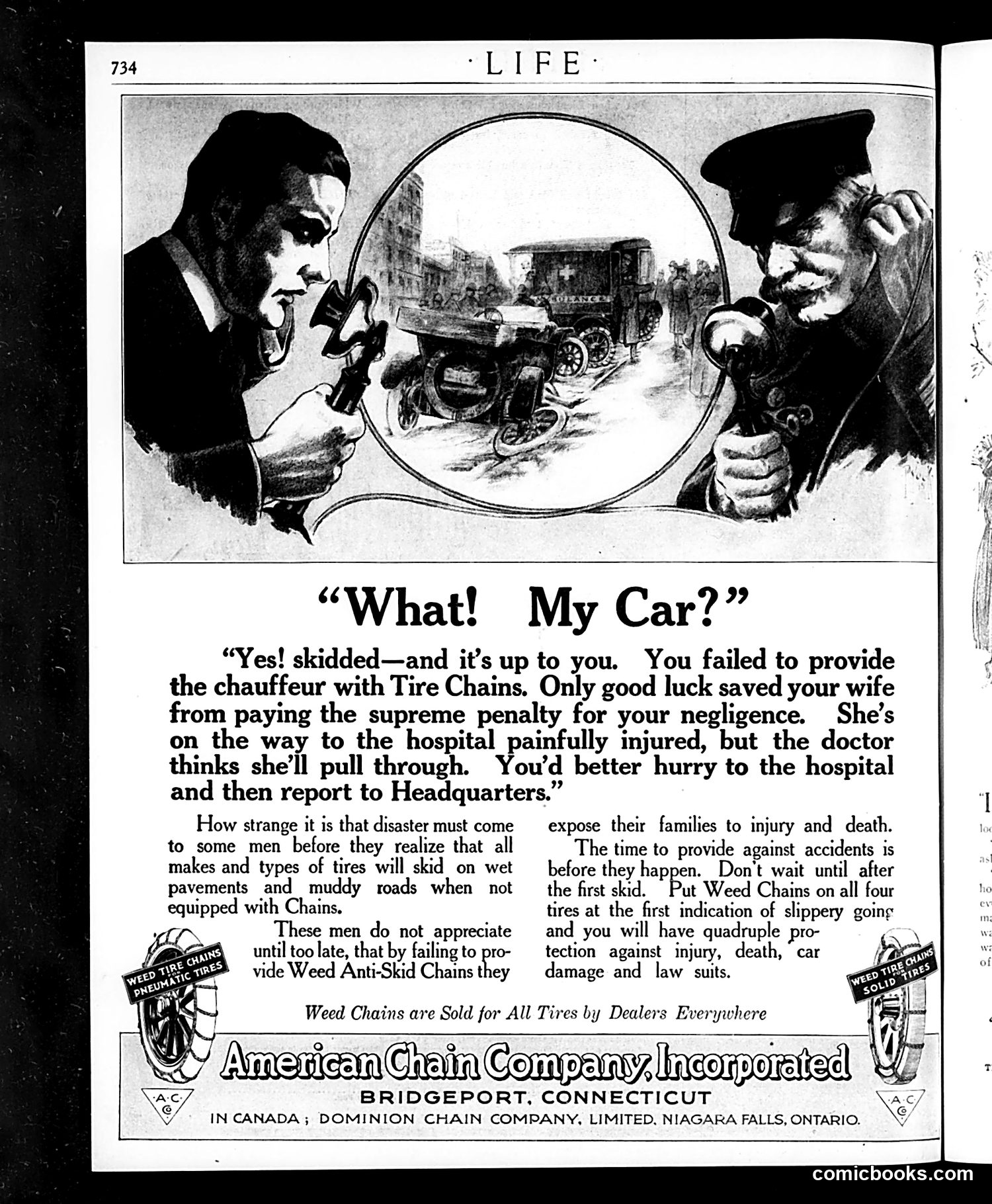
This is primarily a **safety advertisement for Weed Anti-Skid Tire Chains**, not political satire. The dramatized scenario shows two men on telephones discussing a car accident: one officer informing a negligent car owner that his vehicle skidded on wet pavement, injuring his wife, because he failed to equip it with tire chains. The advertisement's rhetorical strategy uses **fear and guilt**—emphasizing that the owner's negligence nearly caused his wife's death. The message is straightforward: installing tire chains before winter accidents happen prevents injury, death, vehicle damage, and legal liability. This reflects early 20th-century winter driving hazards, when tire chains were essential safety equipment. The ad targets middle-class car owners who might rationalize skipping this precaution.
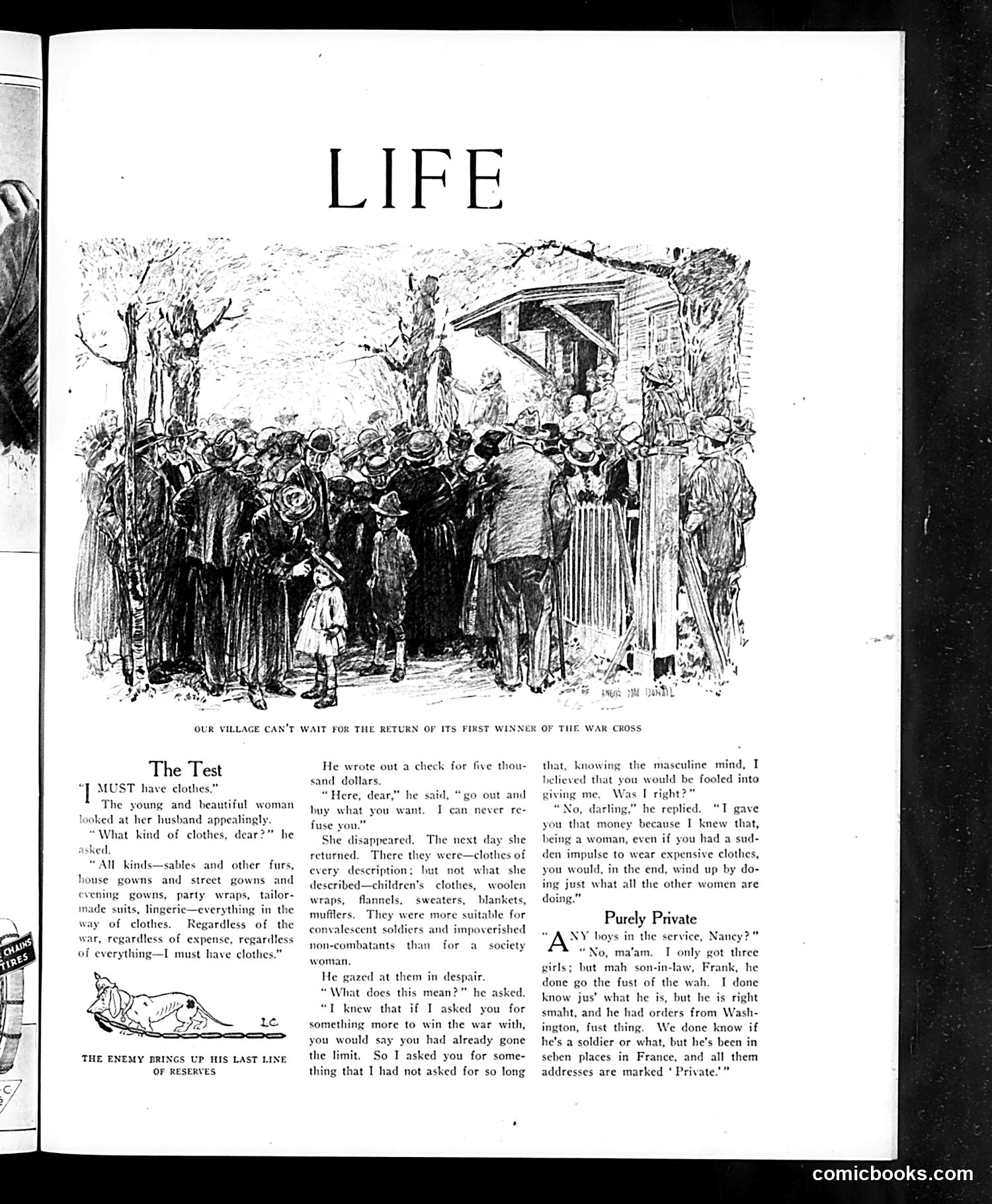
This is a **Life magazine content page** featuring two short stories: "The Test" and "Purely Private." The **top illustration** depicts a crowded village scene with the caption "OUR VILLAGE CAN'T WAIT FOR THE RETURN OF ITS FIRST WINNER OF THE WAR CROSS"—a reference to World War I. The image shows civilians gathered around what appears to be a homecoming or civic celebration. The **stories themselves** are domestic social commentary rather than political satire. "The Test" explores a husband-wife dynamic about wartime spending and sacrifice. "Purely Private" discusses a serviceman's letters marked "Private." This page reflects **WWI-era American concerns**: home-front patriotism, economic anxiety, and the emotional impact of soldiers' service. The magazine used such fiction to address contemporary civilian experiences during wartime, treating private domestic matters as relevant public interest.
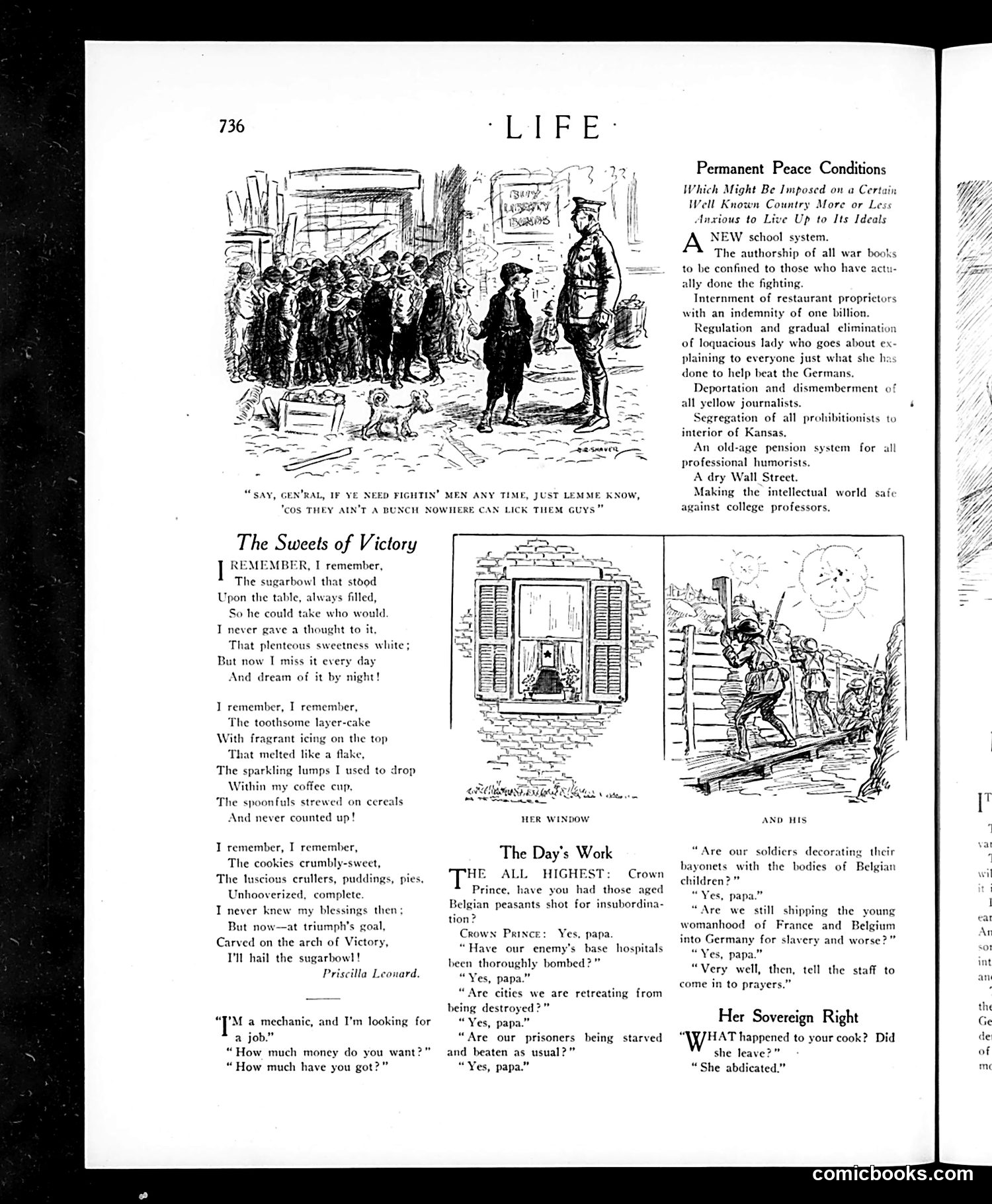
This page contains satirical commentary on post-WWI conditions. The top cartoon depicts a military officer telling civilians about fighting men, suggesting recruitment or military readiness themes common during the war period. "The Sweets of Victory" is a nostalgic poem contrasting pre-war luxuries (fancy desserts, fine dining) with current scarcity, reflecting post-war rationing and economic hardship. "The Day's Work" presents dialogue between a Crown Prince and Papa about wartime devastation—bombed hospitals, retreating armies, starving prisoners—indicating this addresses consequences of WWI from a German perspective (the "Crown Prince" likely refers to the Kaiser's son). The final section "Her Sovereign Right" appears to be a separate brief comedic exchange about a cook's departure. Overall, the page satirizes both wartime sacrifice and post-war realities.
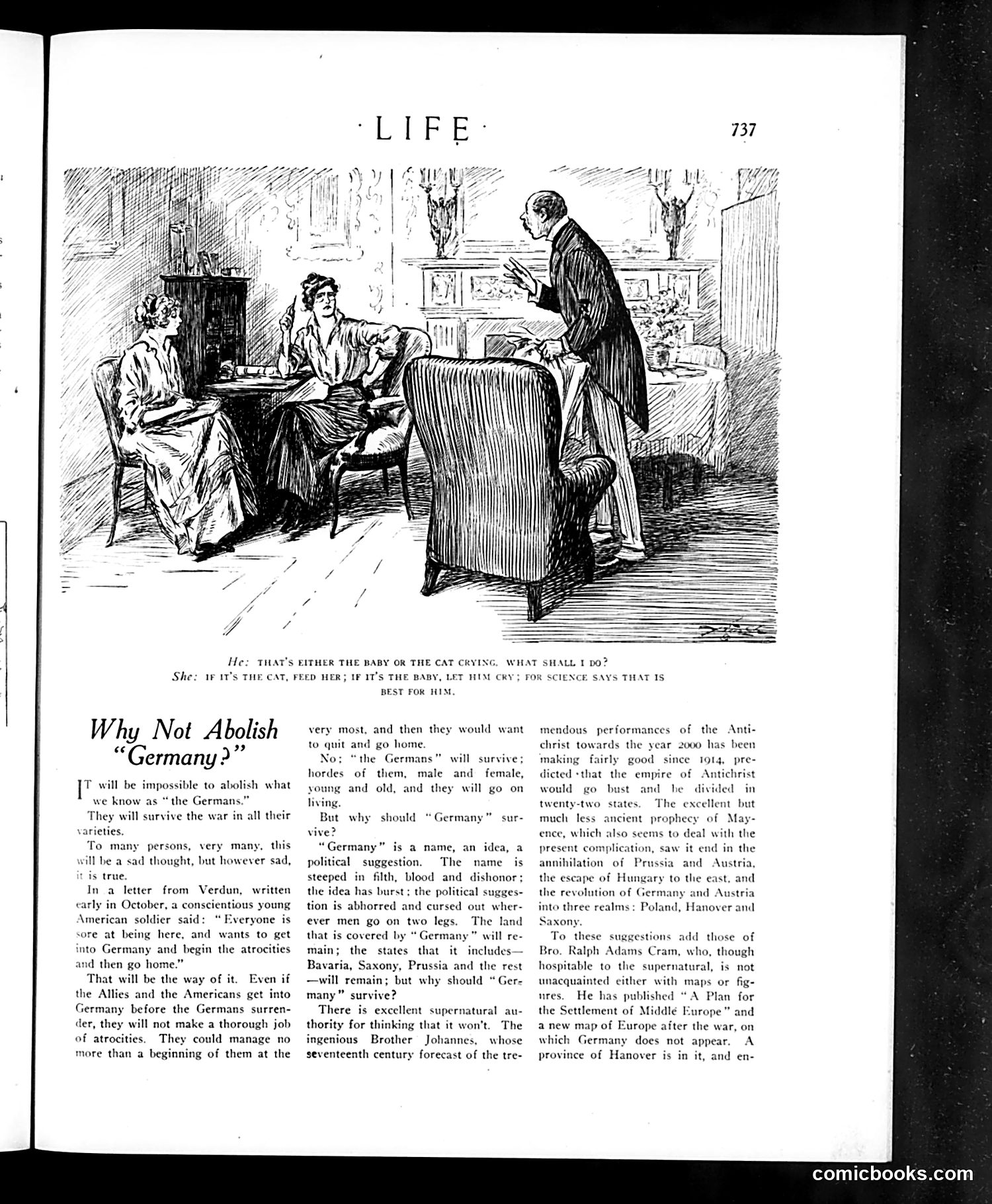
**The Cartoon:** The sketch depicts a domestic scene where a man and woman are in disagreement. The woman is seated while the man stands, gesturing argumentatively. A baby's crying is audible in the background. The caption reveals the joke: the man asks "That's either the baby or the cat crying. What shall I do?" The woman responds dismissively, suggesting he feed the cat if it's the cat, or let the baby cry since "science says that is best for him." **The Satire:** This mocks contemporary parenting advice from the early 20th century—likely referencing behaviorist theories that discouraged coddling babies. The humor lies in the woman's casual disregard for the baby's distress in favor of fashionable "scientific" child-rearing. It satirizes how uncritically people embraced modern parenting theories, even when they conflicted with maternal instinct.
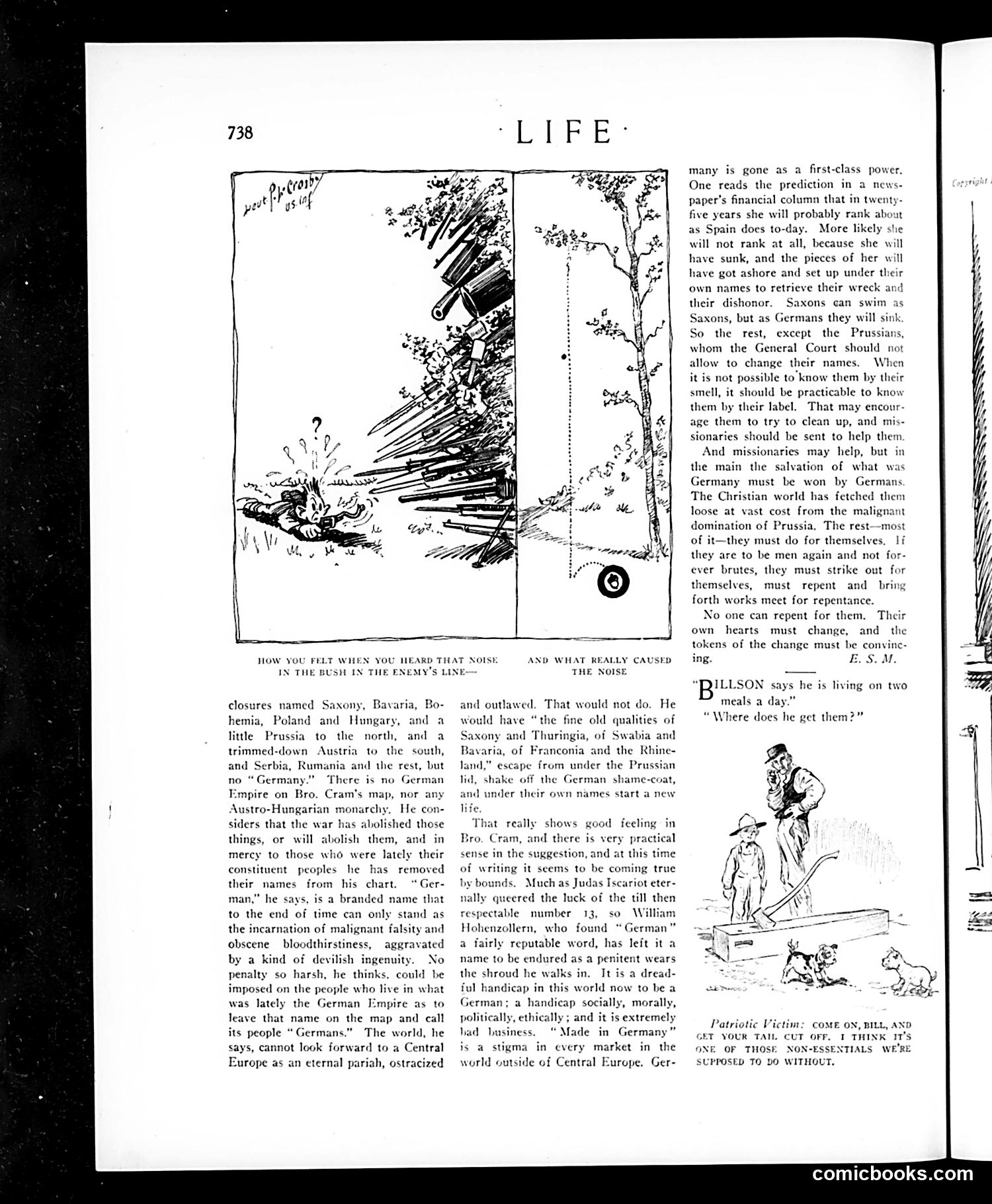
This page discusses changing the name "Germany" itself as punishment for German militarism. The text argues that Germany's name has become synonymous with brutality and must be eliminated—that Germans themselves must repent and "strike out for themselves" to create a new identity. The cartoons illustrate this concept: the upper sketch shows destruction/explosion (labeled as noise from enemy fire), while the lower cartoon depicts a figure labeled "Patriotic Victim" telling another character "Come on, Bill, and get your tail cut off. I think it's one of those non-essentials we're supposed to do without"—sarcastically suggesting that renaming Germany is an unnecessary hardship being imposed on Germans as post-war punishment. The satire critiques the vindictiveness of proposed peace terms.
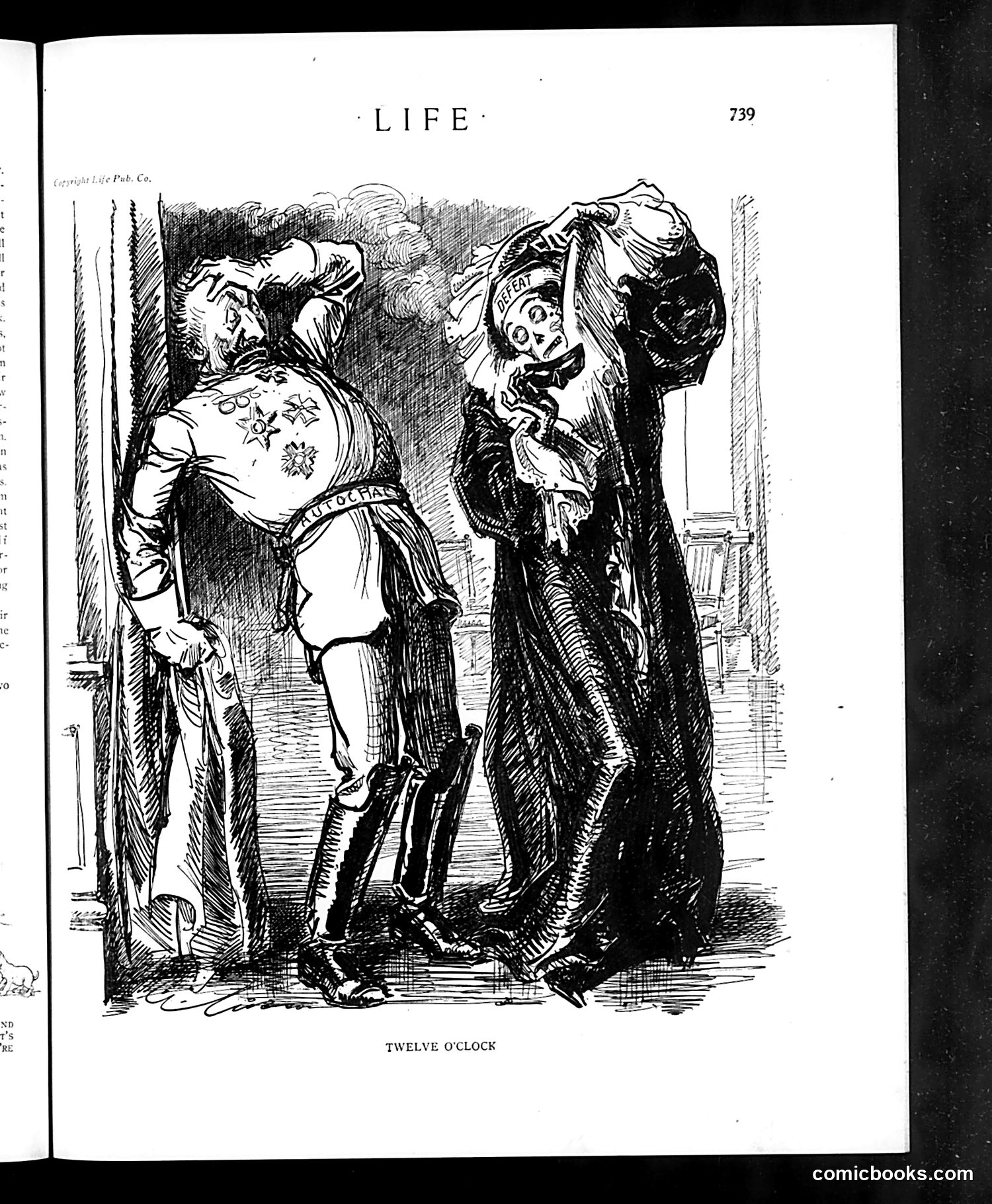
This satirical cartoon depicts three figures in what appears to be a formal interior setting. The central figure wears ornate military dress with decorative embroidery, while flanking figures are dressed in formal attire with elaborate headwear and clothing. The title "Twelve O'Clock" likely references a critical moment or deadline. Without additional context identifying these specific individuals or the historical moment depicted, the satire appears to concern high-ranking officials or dignitaries in a tense confrontation or negotiation. The exaggerated clothing and physical caricatures suggest mockery of their pretension or self-importance. The exact political or social reference remains unclear without more information about Life magazine's publication date and contemporary events.
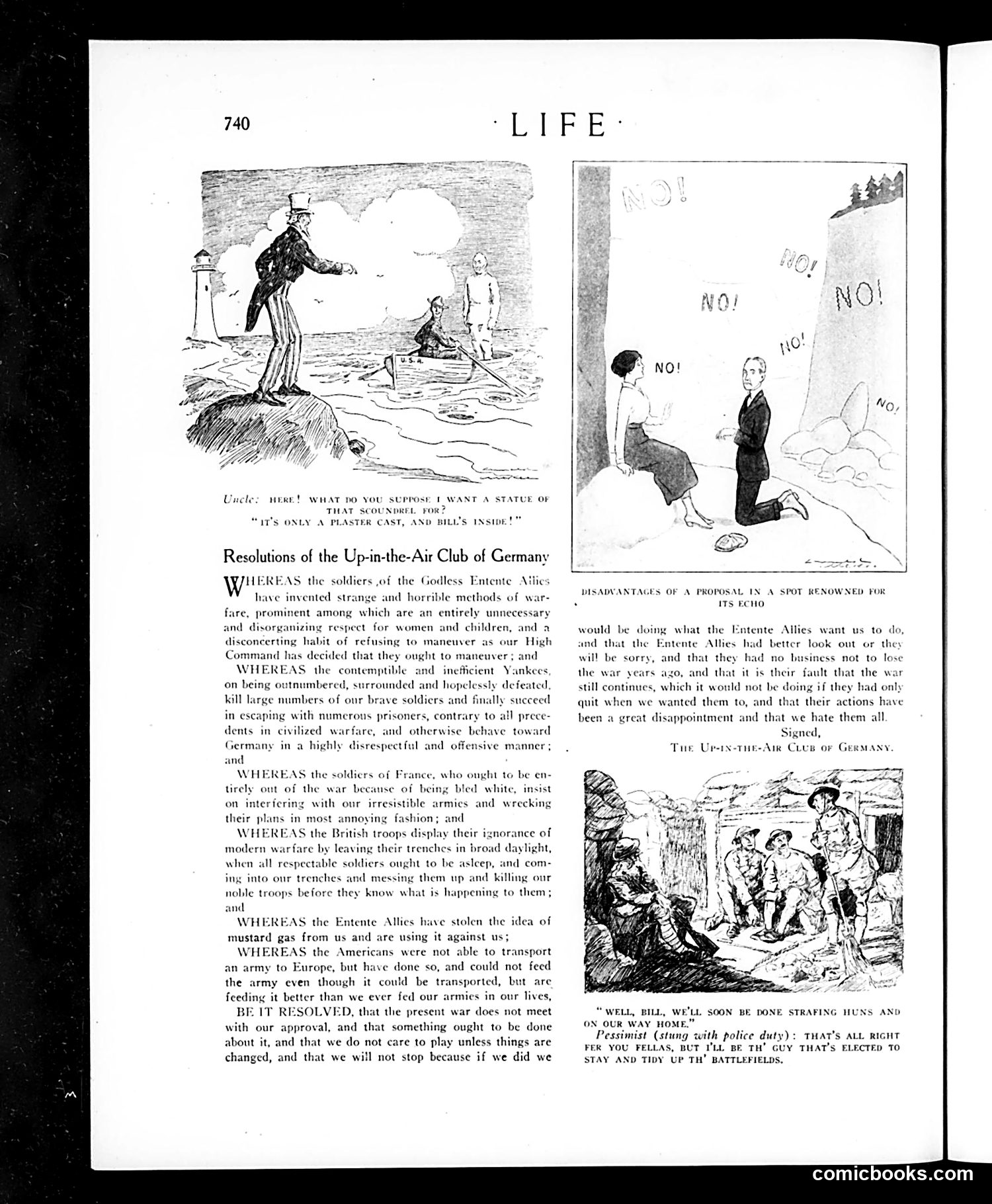
**Top Cartoon:** Shows a man in formal dress on a beach addressing a boy in the water. The caption quotes the uncle saying he wants "a statue of that scoundrel" Kaiser Wilhelm, calling it "only a plaster cast, and Bill's inside!" This is anti-German propaganda—the uncle fantasizes about imprisoning the German leader inside a statue, expressing wartime hostility toward Kaiser Wilhelm II. **Middle Section:** Prints "Resolutions of the Up-in-the-Air Club of Germany"—satirical complaints from German military leadership blaming Allied soldiers, French forces, British troops, and Americans for their military failures. It mocks German excuses rather than accepting responsibility for the war. **Bottom Cartoon:** Depicts soldiers discussing going home after "strapping Huss"—likely references capturing a German commander, with dark humor about military discipline during WWI demobilization.
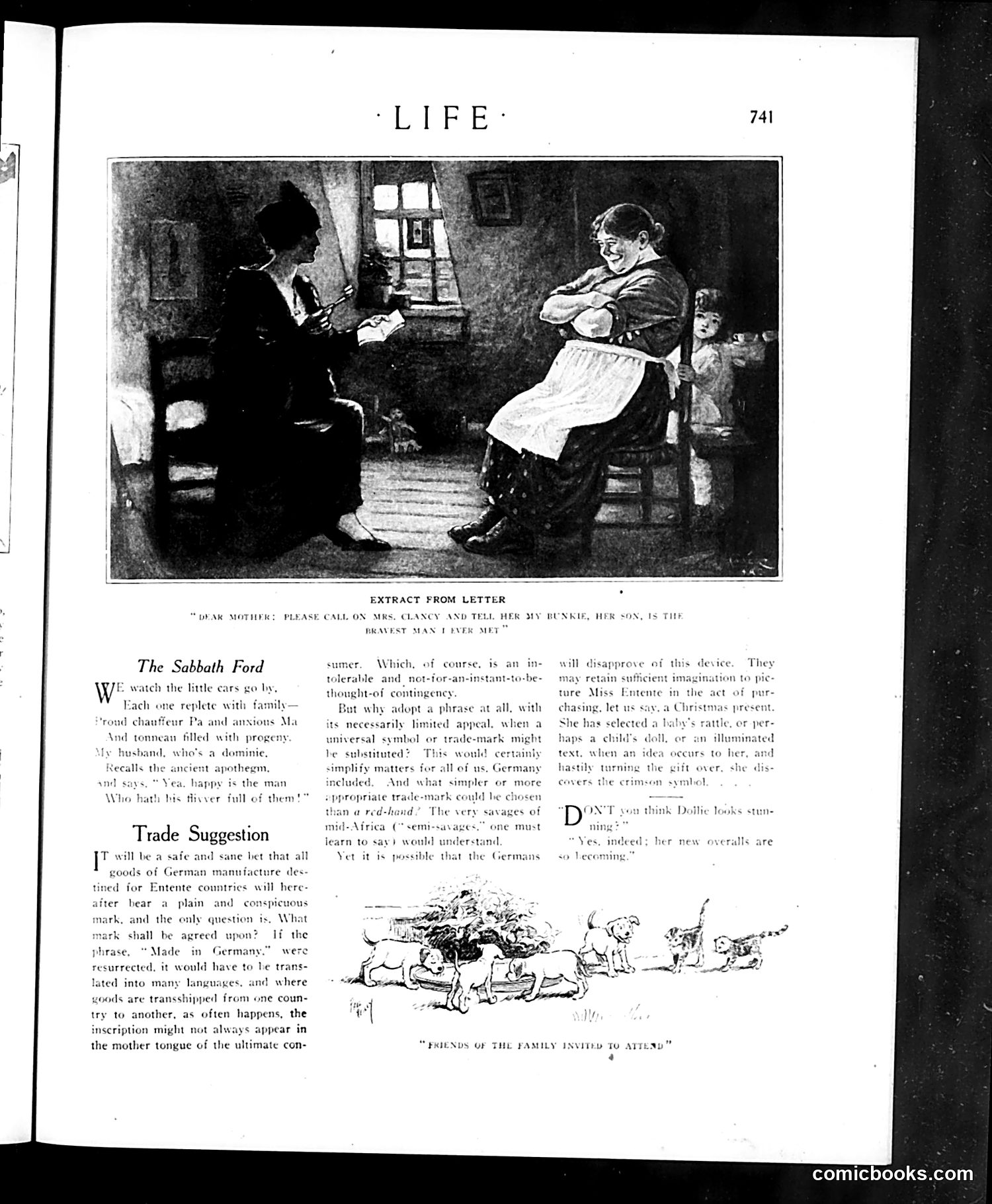
This page contains a domestic scene photograph at top showing two women and a child in what appears to be a modest home interior, captioned with a letter extract about calling on Mrs. Clancy. The text discusses **"The Sabbath Ford"** — likely referencing Henry Ford's Model T automobile and religious observance. It satirizes the tension between industrial mass production and traditional values. **"Trade Suggestion"** argues for standardizing German manufacturing marks on exported goods, suggesting this would simplify international commerce. The piece advocates for a plain "Made in Germany" label rather than complex, language-specific inscriptions that become lost in translation between countries. The bottom illustration shows dogs, captioned "Friends of the Family Invited to Attend." The overall content addresses early 20th-century consumer culture, manufacturing standards, and trade practices.
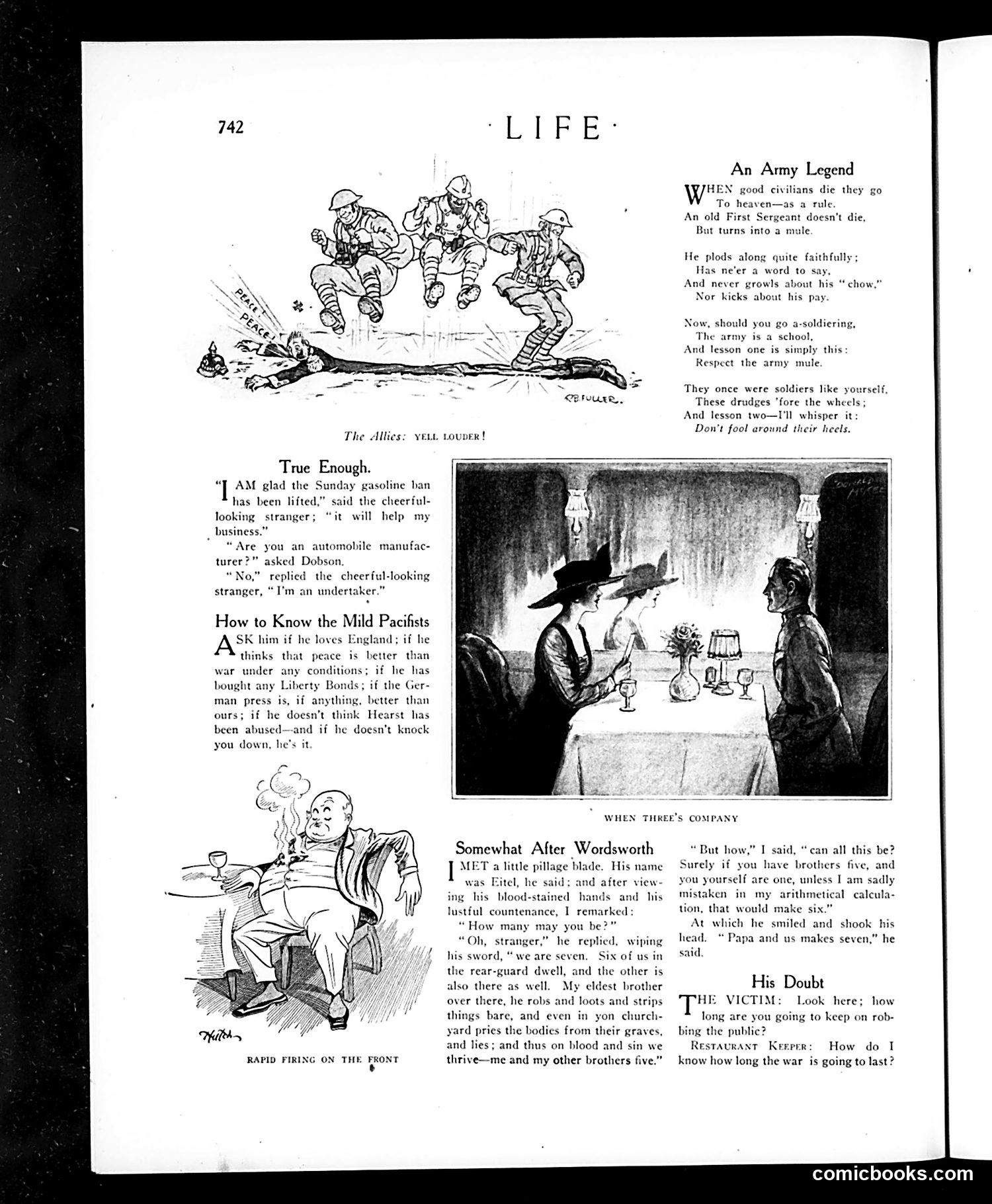
This page contains several short humor pieces satirizing World War I attitudes: **"An Army Legend"** (top): A poem mocking the romanticization of military service, suggesting soldiers should respect army mules more than they respect human chain-of-command. **"True Enough"**: A joke about a cheerful stranger who turns out to be an undertaker—dark humor about wartime deaths. **"How to Know the Mild Pacifists"**: A satirical definition attacking pacifists as hypocrites who claim to oppose war while profiting from it or supporting policies that enable it. **"When There's Company"**: A cartoon showing two women with fish, humorously depicting food rationing deception during wartime. **"Somewhat After Wordsworth"**: A story about meeting a bloodied soldier who claims seven family members are either dead or serving. The page reflects American WWI anxieties about sacrifice, pacifism, and home-front hardships.
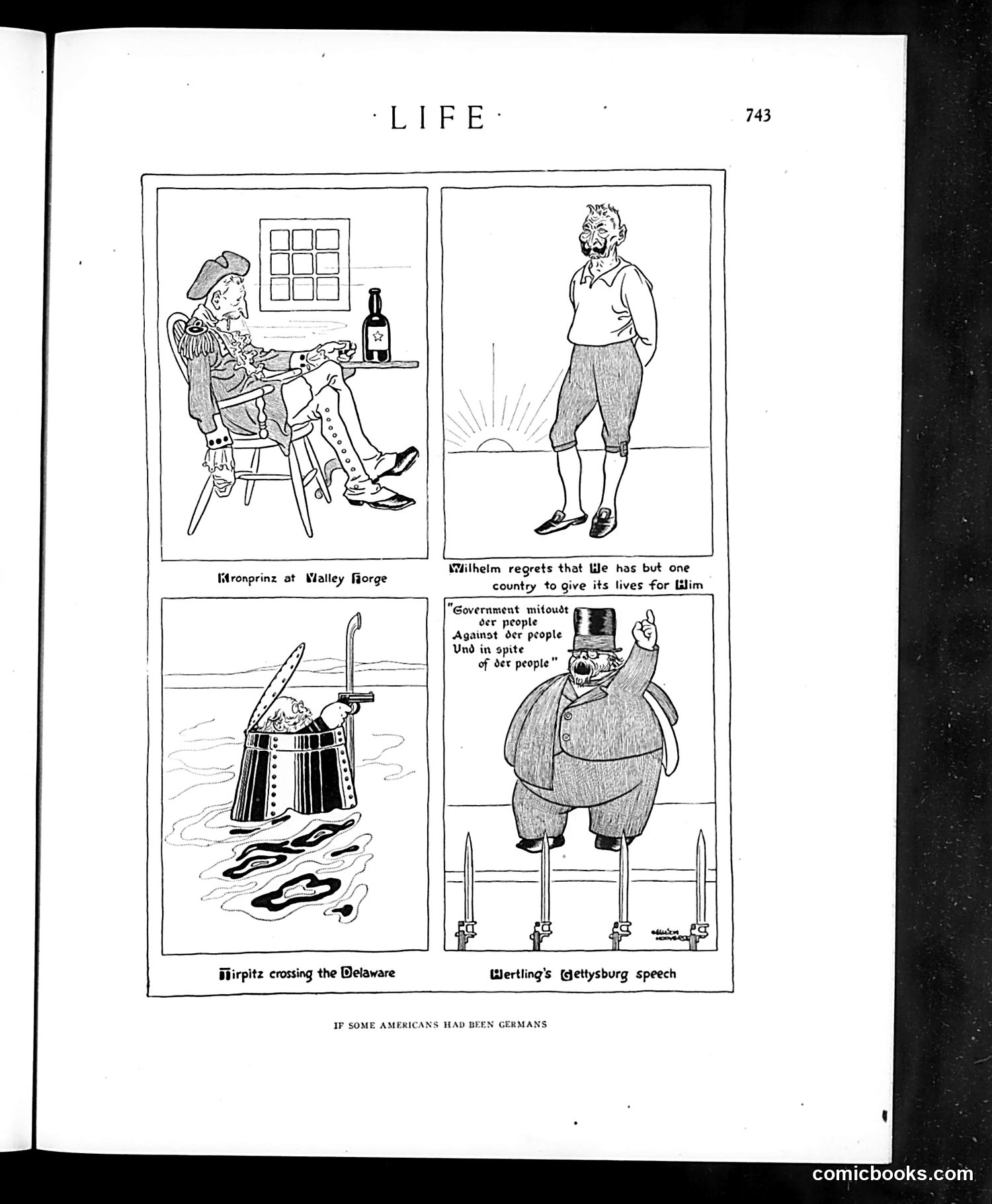
This Life magazine page presents four satirical panels imagining how famous American historical figures would have acted if they were German. The captions identify: 1. **Metternich at Valley Forge** - showing a figure relaxing with wine instead of suffering 2. **Wilhelm regrets that he has but one country to give its life for Wm** - depicting a standing figure 3. **Hirpitz crossing the Delaware** - parodying Washington's famous crossing with militaristic German elements 4. **Hertling's Gettysburg speech** - showing a portly figure making a patriotic speech with swords The satire contrasts American ideals of self-sacrifice and democratic patriotism with German militarism and authoritarianism (likely referencing WWI-era Germany). It suggests German leaders would prioritize power and comfort over genuine national service, mocking German military leadership and culture as fundamentally different from American values.
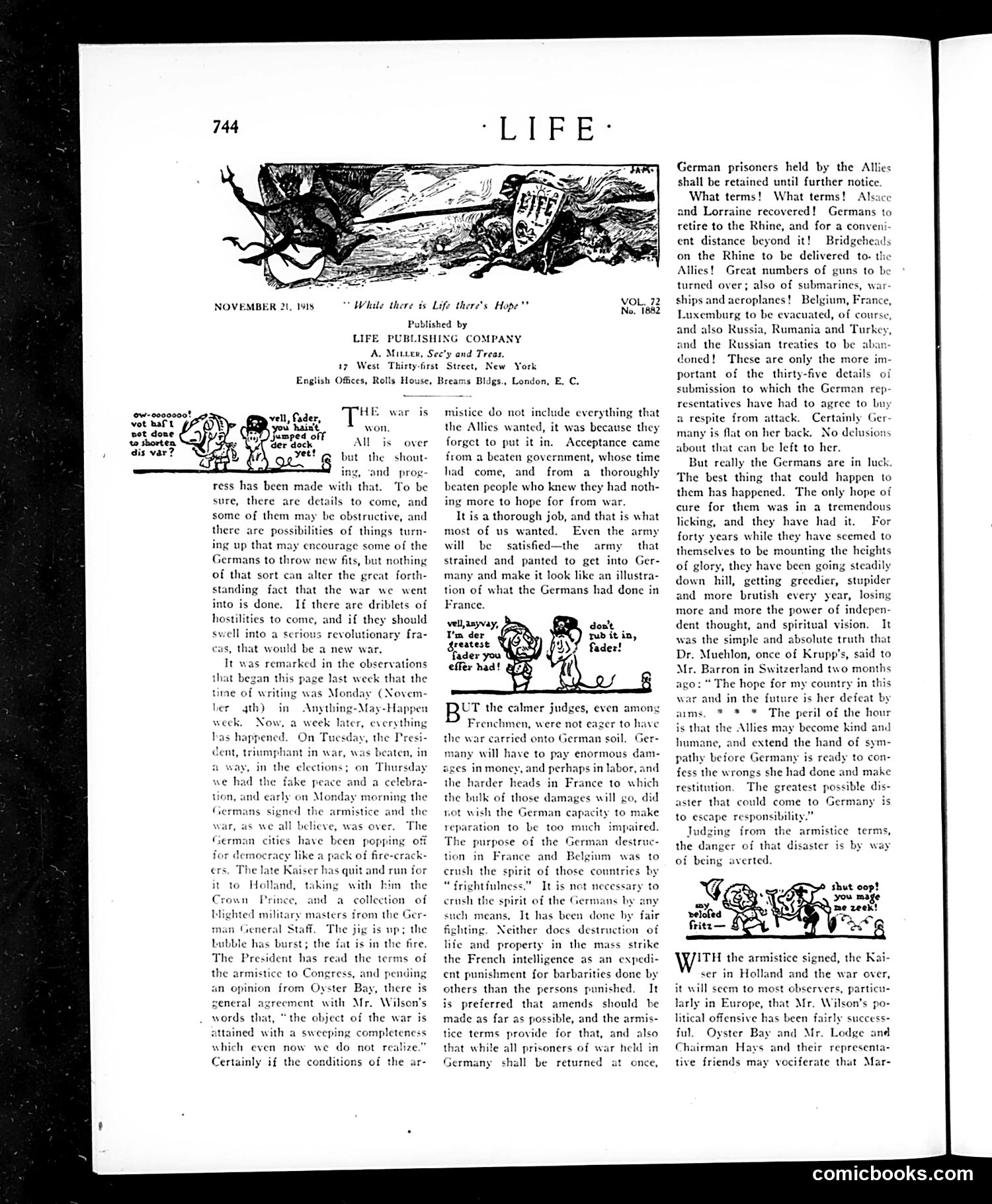
This page celebrates the armistice ending World War I. The main text details harsh peace terms imposed on defeated Germany: return of Alsace-Lorraine, Rhine retreat, surrender of weapons and vessels, evacuation of occupied territories, and dissolution of German alliances. The cartoons depict German soldiers or civilians in dialect-heavy speech, appearing defeated and bewildered by the armistice terms. The figures seem to represent common Germans grappling with their nation's collapse—one character says "I'm der greatest" sarcastically, suggesting delusion about Germany's actual position. The satire targets German resistance to accepting reality: despite military defeat, some Germans apparently harbored hopes of negotiating better terms or avoiding total submission. Life's message is clear—Germany is "flat on her back" with "no delusions" possible. The cartoons mock any remaining German defiance as pathetic self-deception. The overall tone celebrates Allied victory while ridiculing German denial of their total defeat.
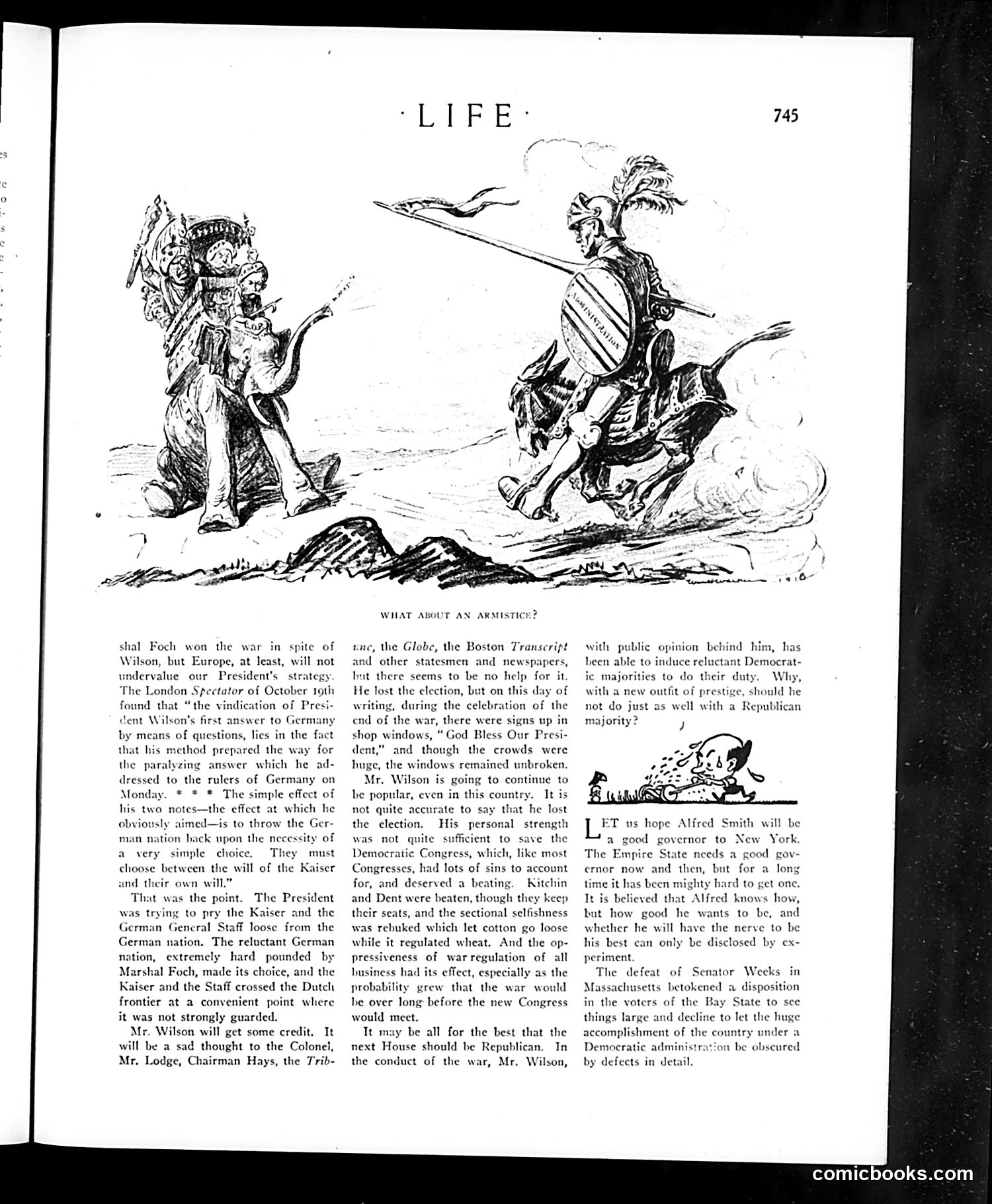
The main cartoon depicts a caricatured military figure (likely representing a German general or Kaiser) on horseback, being confronted by an ornately-dressed opponent on the left—apparently representing President Wilson or American authority. The exaggerated style and confrontational stance illustrate the text's discussion of Wilson's diplomatic strategy. The article credits Wilson with forcing Germany's surrender through diplomatic pressure rather than military force alone. It argues his "two notes" to Germany created a wedge between the Kaiser and the German people, forcing an impossible choice between the Kaiser's will and their own survival—ultimately leading to German surrender. The surrounding text discusses Wilson's political situation: despite losing the recent congressional election, he remains personally popular with the American public. The piece suggests a Republican Congress might actually *aid* Wilson's continued effectiveness, and comments on various state elections (Alfred Smith for New York governor, Senator Weeks's defeat in Massachusetts). The satire critiques both Wilson's political enemies and his supporters' willingness to overlook Democratic losses by celebrating the war's end.
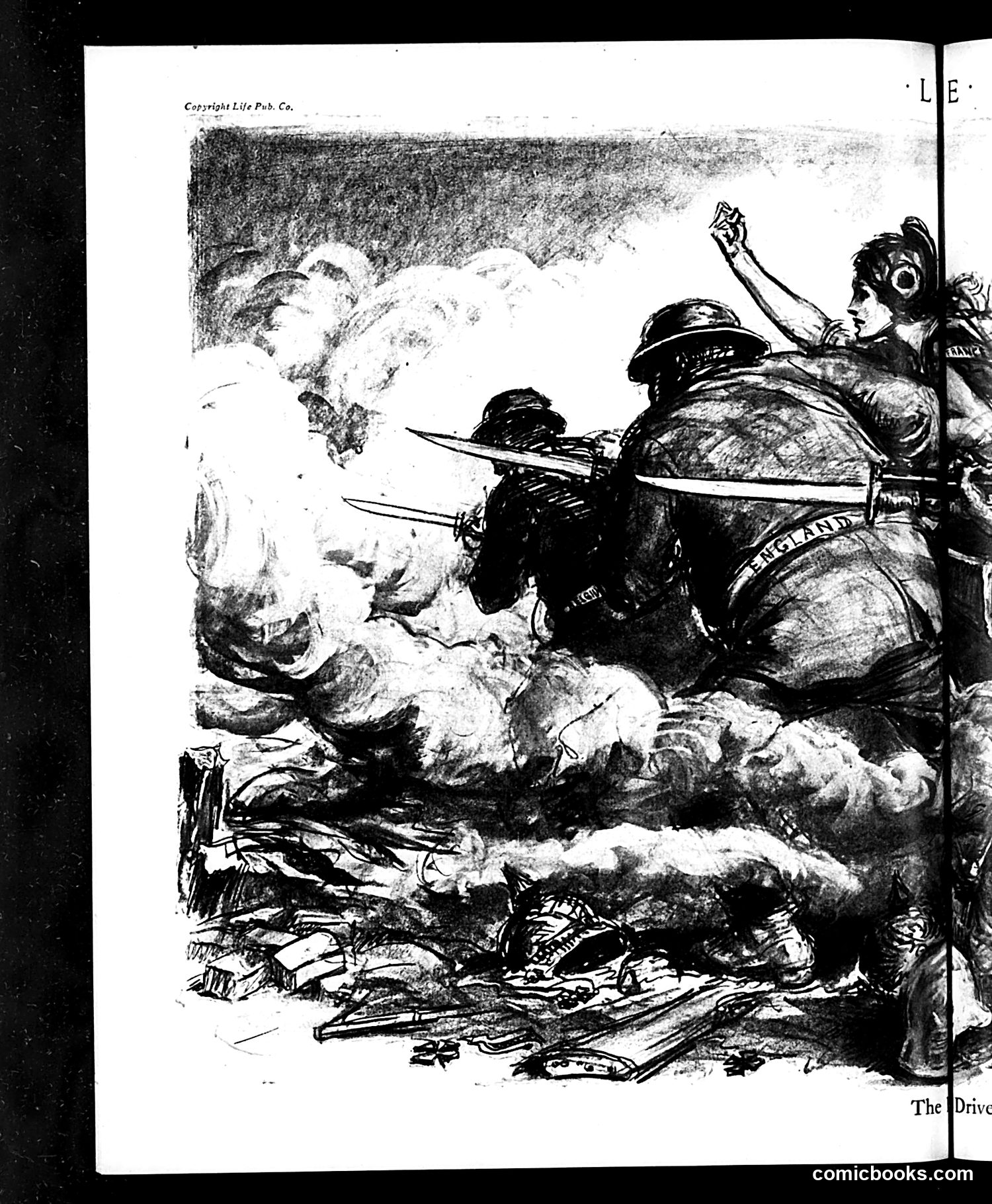
This appears to be a WWI-era satirical illustration showing armed soldiers in combat. The image depicts what seems to be British or Allied forces (identifiable by military uniforms and gear marked "SCOTLAND") actively engaged against enemy combatants on muddy, debris-strewn ground. The stark, dramatic rendering emphasizes the brutal realities of trench warfare—the chaos, casualties, and destruction evident in the scattered debris and bodies. The cartoon's purpose appears to be satirizing or commenting on the violence and human cost of the war, though the specific political message remains somewhat unclear from this reproduction alone. The "Life" magazine attribution suggests this was contemporary commentary on ongoing military conflict.
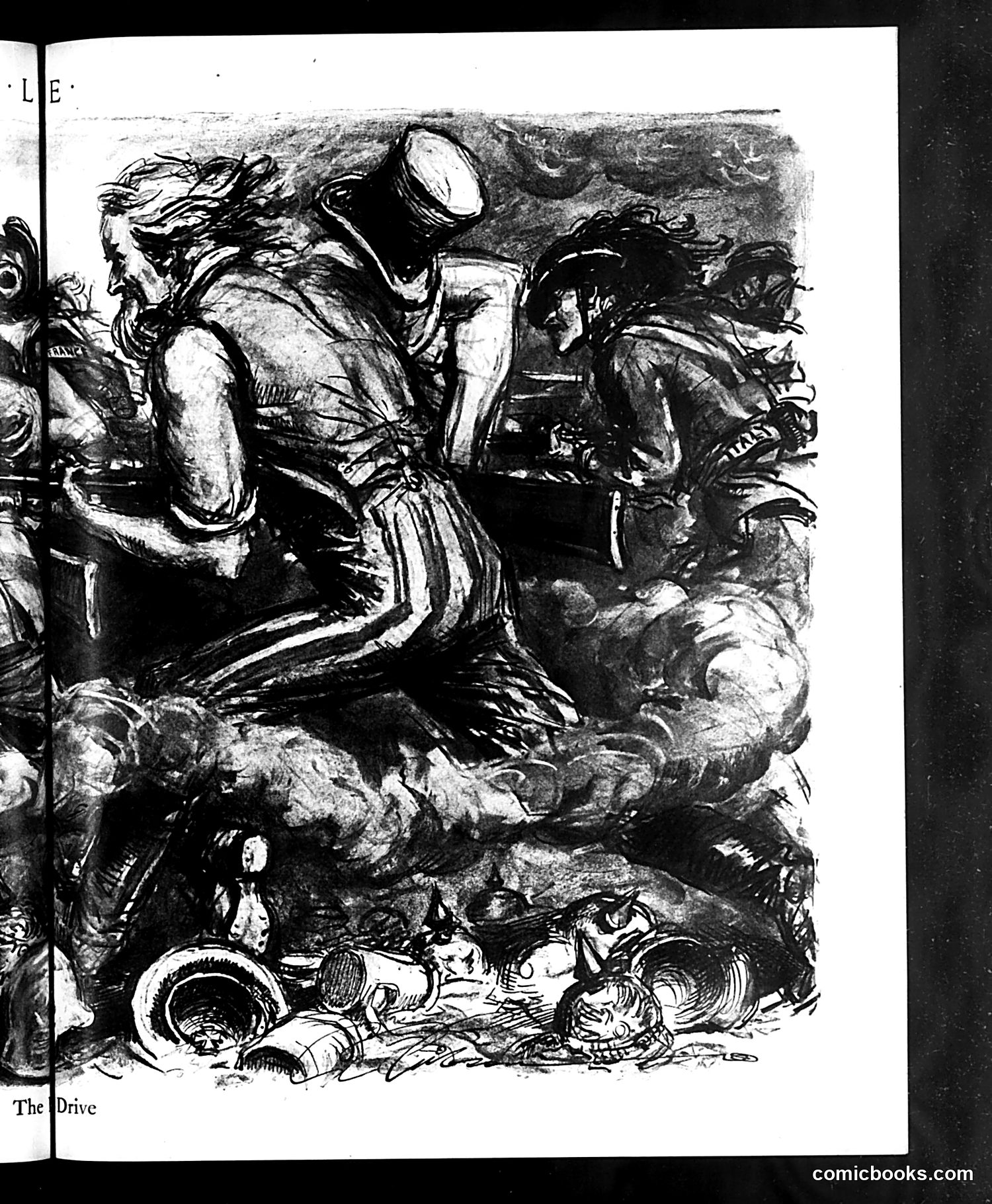
This appears to be a political cartoon from Life magazine satirizing some form of organized social or political campaign. The central figure—a woman wearing a hat and holding what appears to be a megaphone or speaking trumpet—seems to be leading or directing a group effort. The crowded composition and energetic sketching style emphasize chaotic activity or mass mobilization. Without more specific context or visible dates, the exact target of satire is unclear. However, the imagery suggests mockery of either a fundraising "drive," a social reform movement, or a political campaign featuring prominent female leadership. The chaotic arrangement of figures implies criticism of the effort's organization or legitimacy. The cartoonist's style is expressionistic, using bold lines to convey frenetic energy.
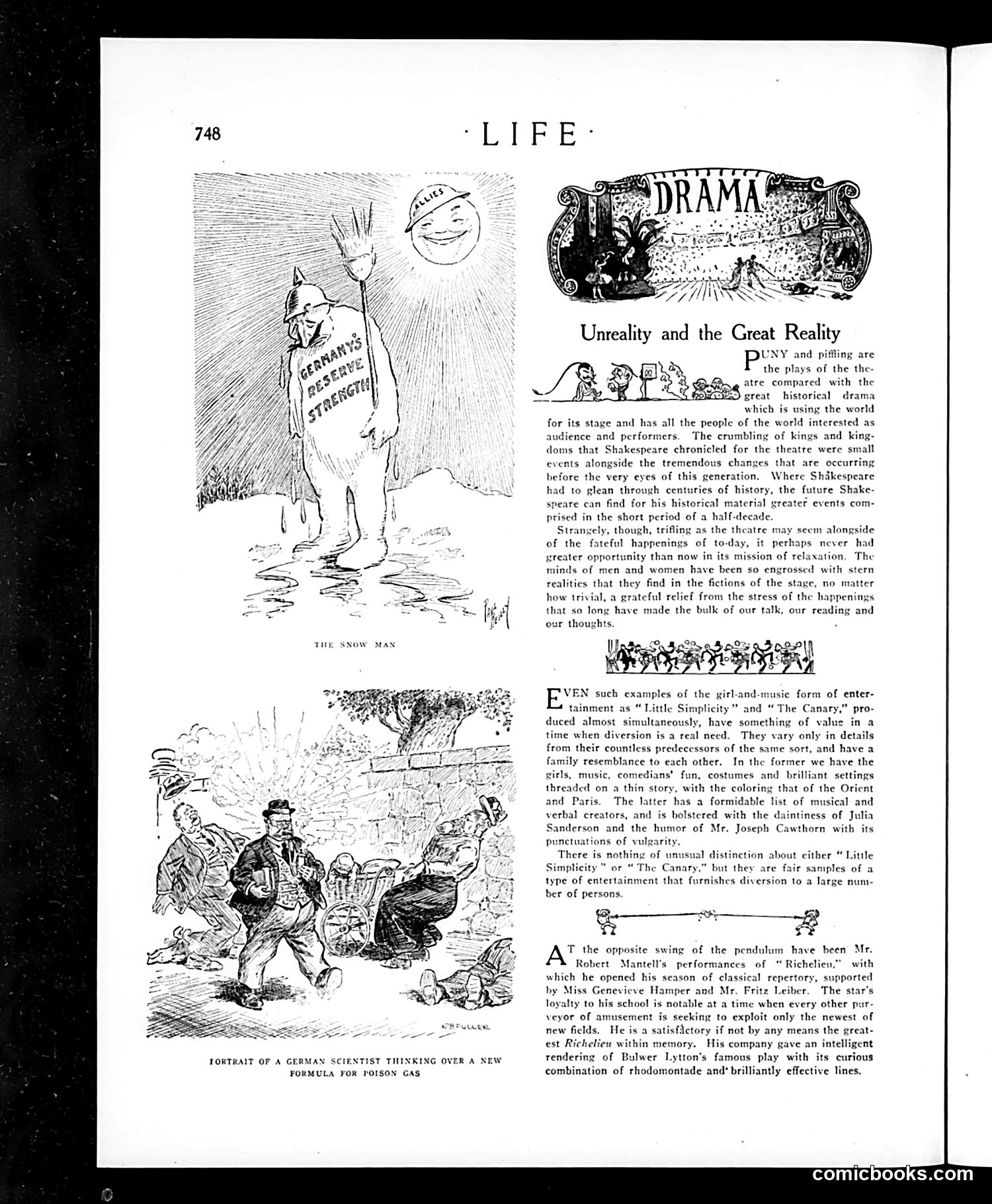
This page contains two editorial cartoons and drama criticism from what appears to be WWI-era Life magazine. **"The Snow Man"** (top left): A figure labeled "Germany's Peace Strength" stands in snow holding a trident, with a smiling sun above. This satirizes Germany's claimed military power during wartime—suggesting their "strength" is as insubstantial and melting as a snowman. **"Portrait of a German Scientist"** (bottom): Shows a caricatured figure "thinking over a new formula for poison gas." This references Germany's use of chemical weapons (gas attacks) in WWI, presenting German scientists as grotesque villains developing instruments of mass death. The **drama section** discusses how stage entertainment provides needed psychological relief during wartime's "stern realities." It reviews musicals like "Little Simplicity" and "The Canary," and praises actor Robert Mantell's classical performances of "Richelieu." The overall message: while Germans develop weapons of destruction, Allied culture offers civilizing entertainment and classical theater as counterweights to war's horrors.
This page contains theater reviews from Life magazine's "Confidential Guide" section, covering Broadway productions of the era. The text discusses several plays, most prominently "The Long Dash" (featuring a wireless cannon as a plot device) and "Home Again" (based on James Whitcomb Riley's life and verses). The reviews are standard theatrical criticism praising or critiquing performances, staging, and dramatic effect. Henry E. Dixey and Robert Edeson receive particular notice for their acting. The page includes a long list of other current theatrical productions with brief descriptive notes. There appear to be no political cartoons visible on this page—it is primarily text-based theater criticism and listings, typical of Life's cultural coverage during this period. The "Confidential Guide" was a regular Life feature surveying entertainment options for readers.
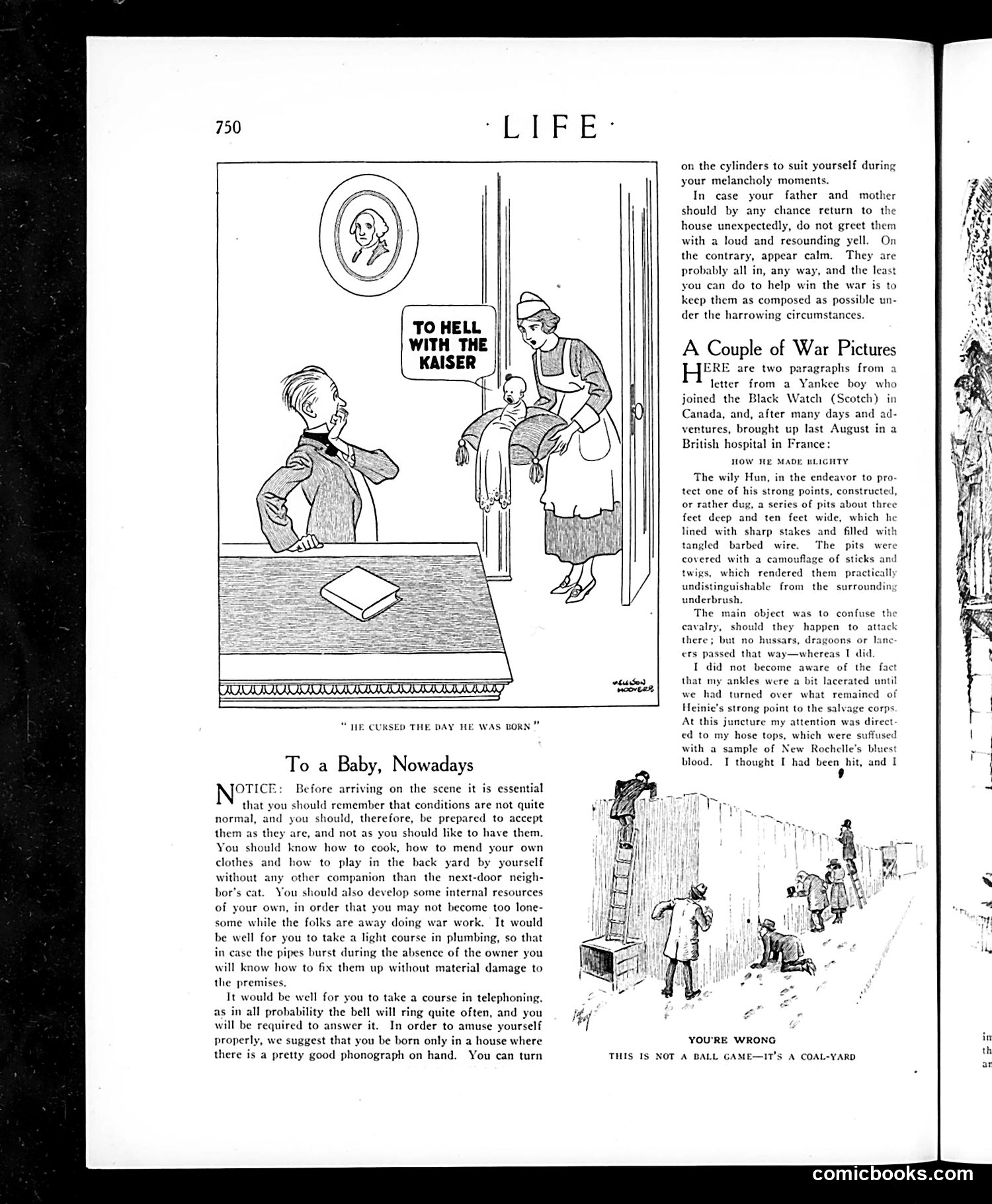
This WWI-era *Life* magazine page contains satirical advice and war stories. **Top cartoon**: Shows a caricatured German soldier ("the Kaiser" reference) cursing the day he was born, after encountering anti-German propaganda or military resistance. The "To Hell with the Kaiser" sign reflects American wartime sentiment. **"To a Baby, Nowadays"**: Mock-serious advice to newborns about adapting to WWI homefront conditions—parents away at war work, learning to cook and fix plumbing independently. The satire targets how civilian life was disrupted by the war. **"A Couple of War Pictures"**: Excerpts from a letter by an American soldier in the British Black Watch regiment describing trench warfare. He describes falling into German anti-cavalry pit traps lined with barbed wire and stakes, resulting in injury. "Blighty" (British slang for home/Britain) refers to getting wounded enough for hospital discharge. **Bottom cartoon**: Soldiers working in a coal-yard, captioned "You're Wrong—This Is Not a Ball Game." Likely satirizes the grim, laborious nature of military work disguised as recreation.
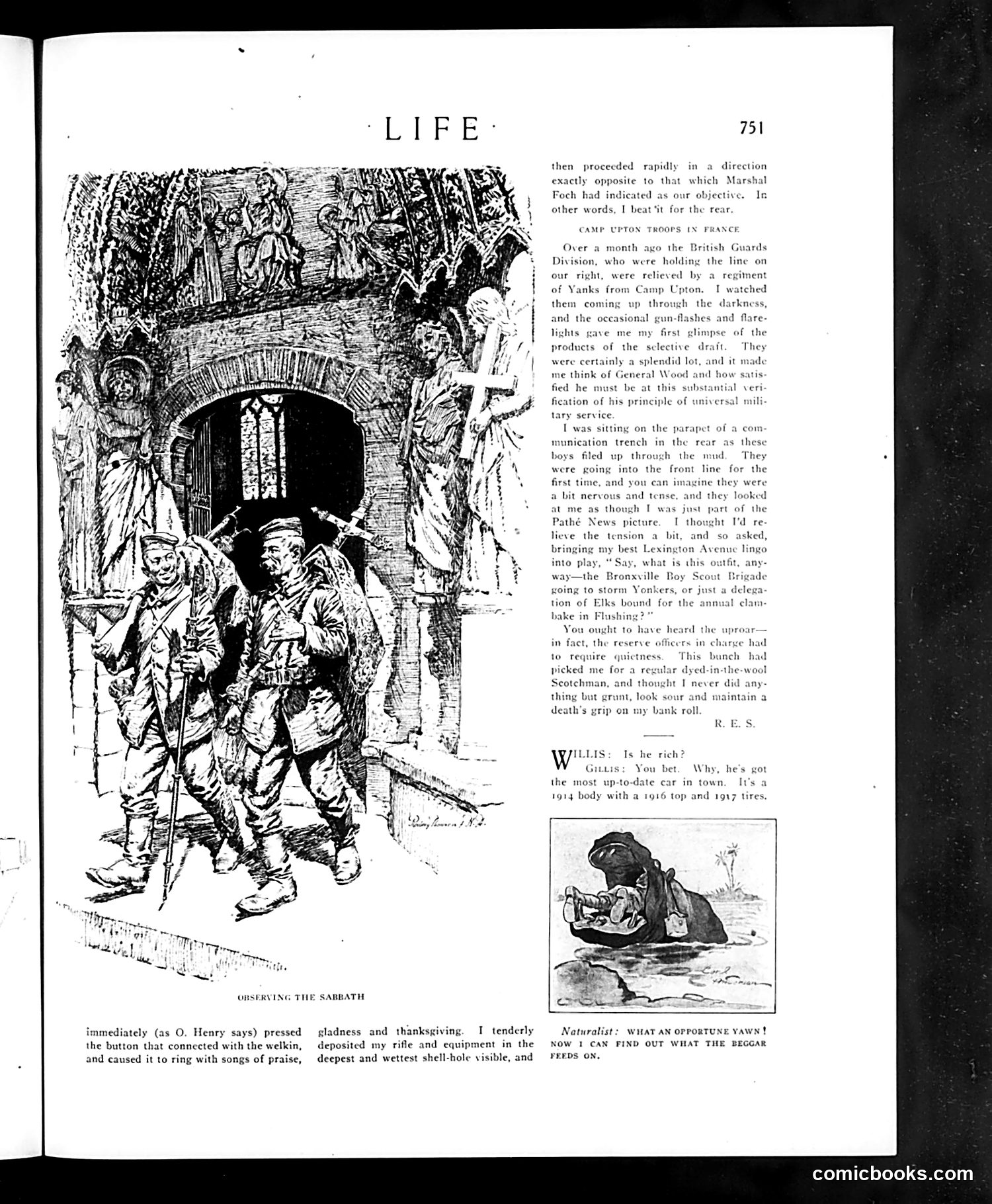
The main illustration, "Observing the Sabbath," depicts a soldier in a WWI trench abandoning his post during combat. The narrator humorously describes depositing his rifle in a shell-hole and retreating opposite to Marshal Foch's (the French commander's) orders—"I beat it for the rear." This is satirical cowardice masquerading as religious observance. The text section "Camp Upton Troops in France" discusses newly drafted American soldiers (from Camp Upton) arriving at the front for the first time. The author attempts to ease their anxiety with jokes, sarcastically asking if the "Bronxville Boy Scout Brigade" is storming Yonkers or attending an Elks gathering. This mocks both the untested recruits' nervousness and civilian disconnection from warfare. The bottom illustration shows a naturalist examining a yawning hippopotamus to determine its diet—a simple visual gag unrelated to the war material above.
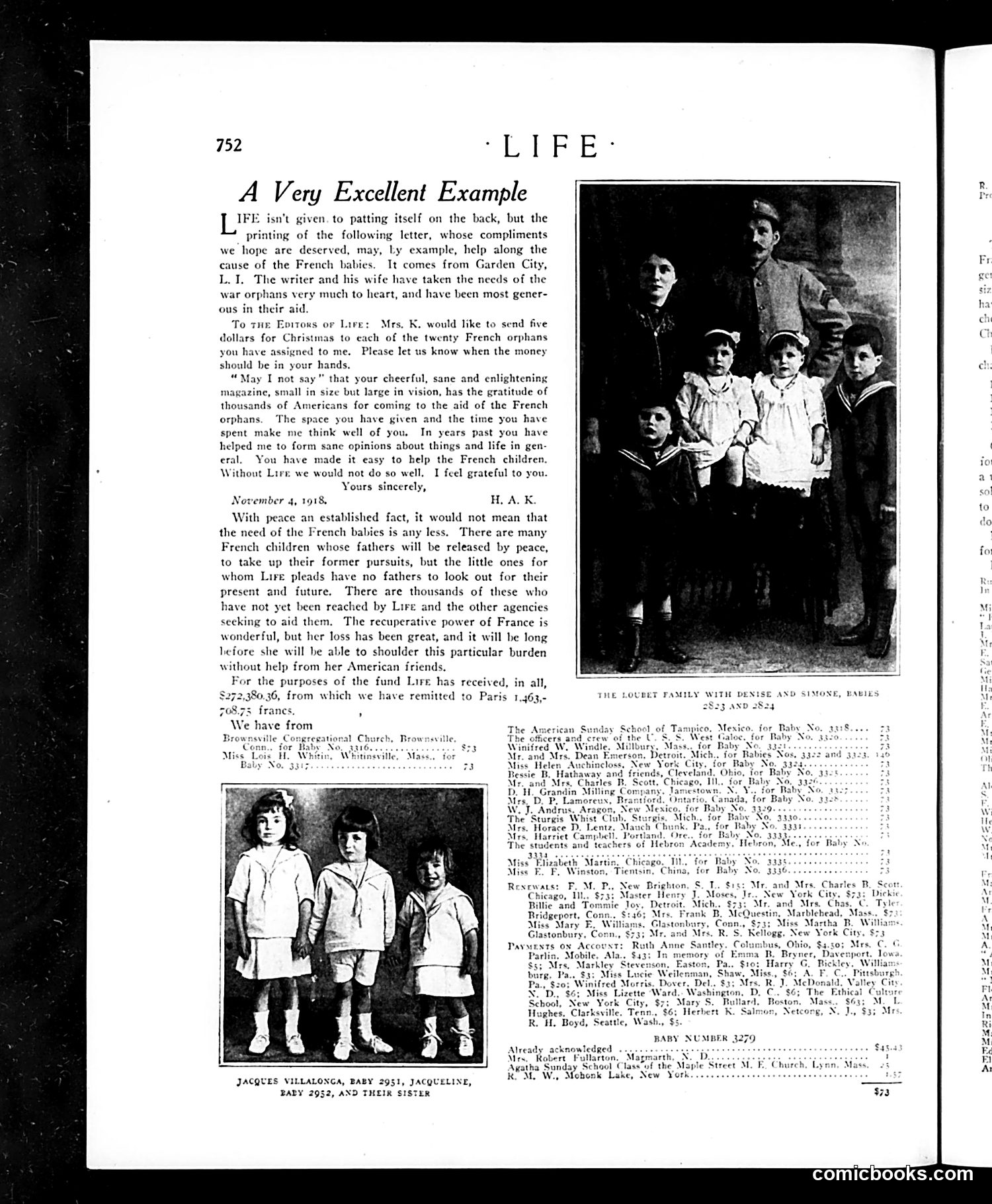
This page documents Life magazine's charitable fundraising campaign for French war orphans following World War I (which ended November 11, 1918—notably just before this November 4 letter's publication). The content centers on two photographs: a French family (the Loubets) with war orphans Denise and Simone, and three young French orphans. These images exemplify the human need the campaign addresses. The accompanying text presents a congratulatory letter to Life praising the magazine's advocacy work and announcing a significant donation ($100 total—five dollars each to twenty orphans). The editorial response emphasizes that peace hasn't eliminated French children's needs, as many fathers remain deceased and require ongoing American support. The extensive list below represents donors and their contributions to the fund, which had collectively remitted over 1.4 million francs to Paris. **The satire or humor is minimal here**—this is primarily earnest charitable advocacy, using donor testimonials and children's photographs to encourage continued American generosity toward postwar French relief.
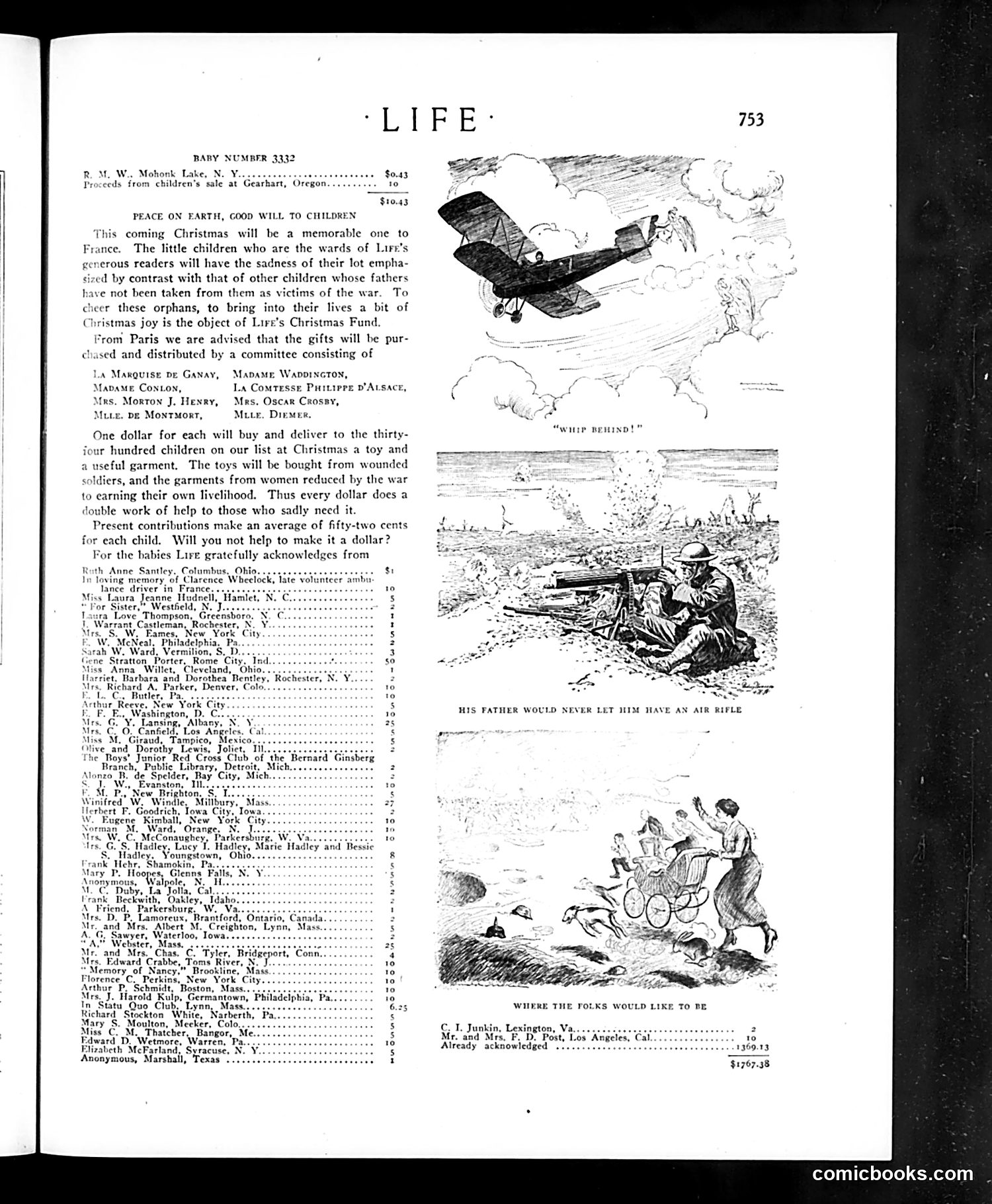
This page documents **Life magazine's Christmas charity drive for French war orphans**, likely from 1917-1918. The three accompanying illustrations show children's fantasies contrasting with wartime reality. The top cartoon depicts a child dreaming of flying an airplane ("Whip Behind!"). The middle illustration shows a child sitting alone on a beach, captioned "His Father Would Never Let Him Have an Air Rifle"—referencing a father killed in combat. The bottom image shows a child imagining where "the folks would like to be"—a happy family scene the war has destroyed. The appeal seeks $1 donations per child to buy toys from wounded soldiers and garments from war-widowed women, creating "double work of help." The satirical point is implicit: wealthy American readers can afford to cheer orphaned children while American soldiers' own families suffer similar losses. The listed donors (mostly women's names) suggest women's organizations led the fundraising effort.
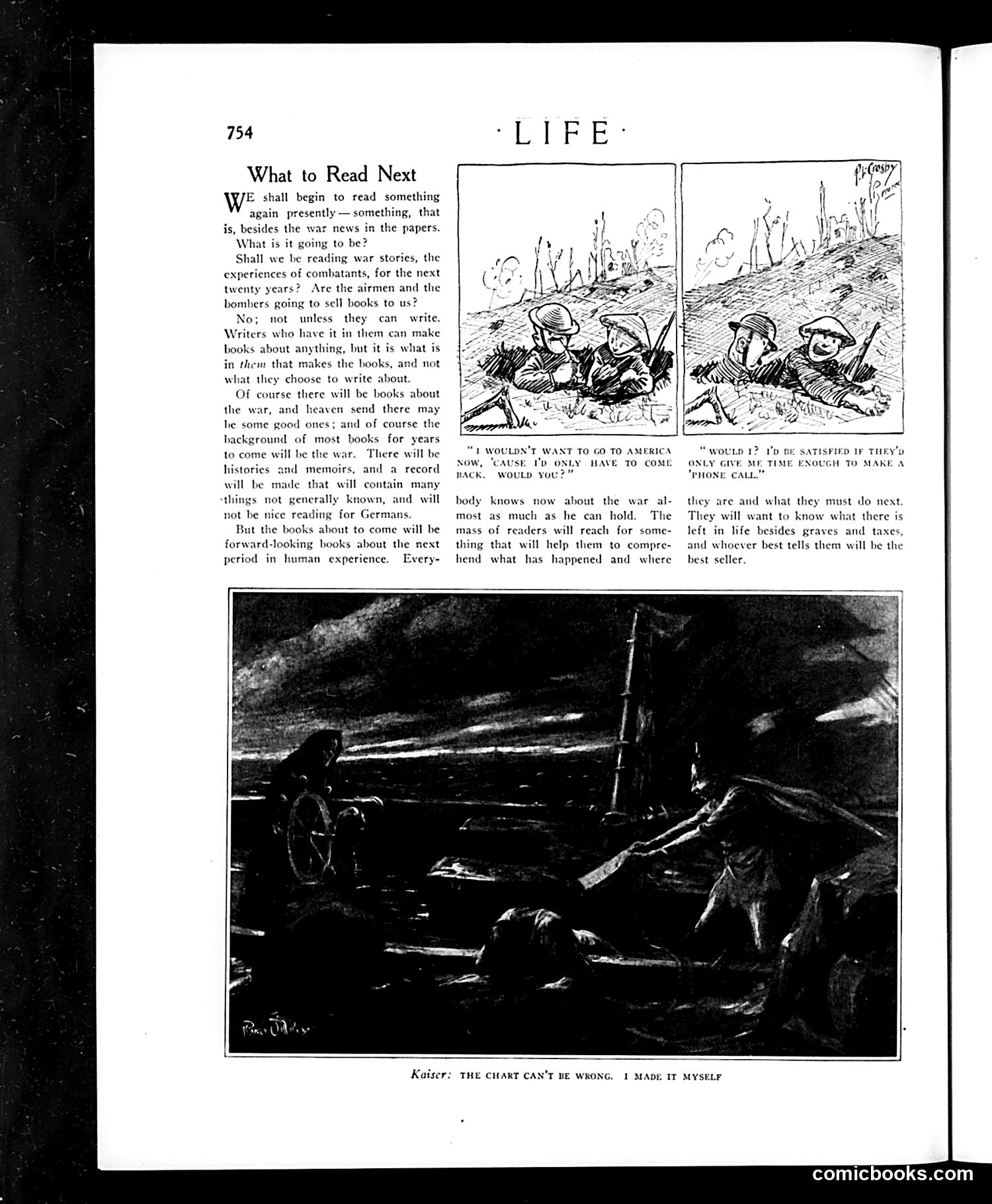
**The Two-Panel Comic (Top):** Shows soldiers in a trench discussing post-war plans. One won't go to America because he'd have to return; the other just wants time to make a phone call. This is dark humor about soldiers' modest hopes for survival and communication during WWI—reflecting the grim reality that many wouldn't survive to have any future at all. **The Large Illustration (Bottom):** Captioned "Kaiser: THE CHART CAN'T BE WRONG. I MADE IT MYSELF," this depicts German Kaiser Wilhelm II apparently studying a military chart or map in a bunker or command post, with dead soldiers visible. The satire mocks the Kaiser's confidence in his own military planning despite visible failure—suggesting his charts/strategy are worthless because they're based on his own (flawed) assumptions rather than reality. It's wartime propaganda satirizing German military leadership. **The Text Article:** Discusses what books readers will want after WWI ends—not just war stories, but forward-looking literature helping people comprehend what happened and what comes next.
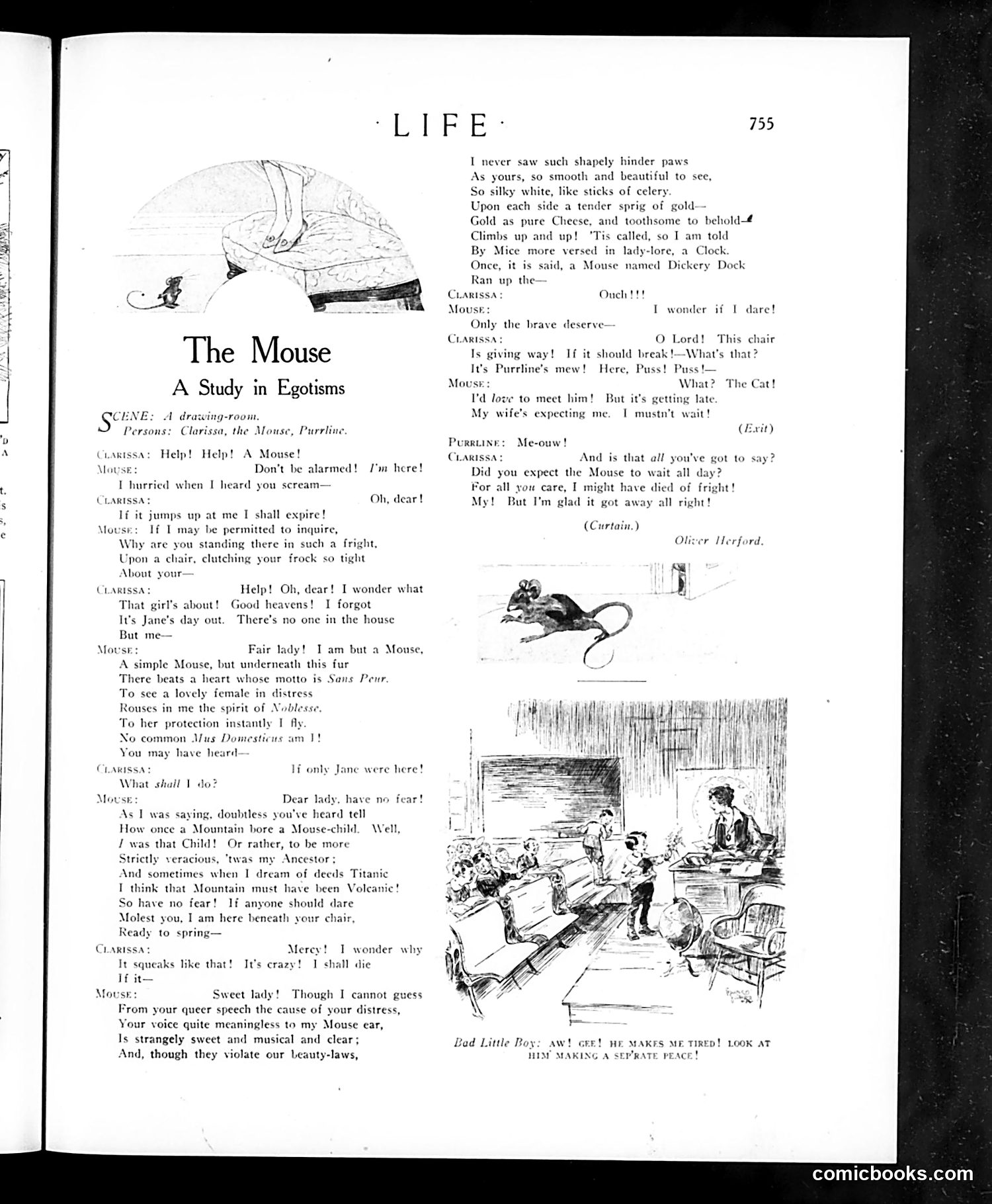
This is a satirical one-act play mocking excessive self-importance and theatrical pretension. A mouse rescues a woman (Clarissa) from a chair, but spends the entire encounter boasting about his noble ancestry, comparing himself to a legendary mouse-child of a mountain, and making grandiose declarations about his bravery—all while Clarissa remains terrified and unimpressed by his verbose self-aggrandizement. The satire targets pompous individuals who inflate their own significance through flowery language and exaggerated claims. The mouse's elaborate speeches about "Sans Peur" (fearlessness) and "Noblesse" contrast absurdly with his actual insignificance—he's merely a mouse making unwanted advances on Clarissa's leg before fleeing when a cat appears. The final panel's caption about a "Bad Little Boy" making a "separate peace" likely references WWI peace negotiations, though the connection remains unclear from this page alone.
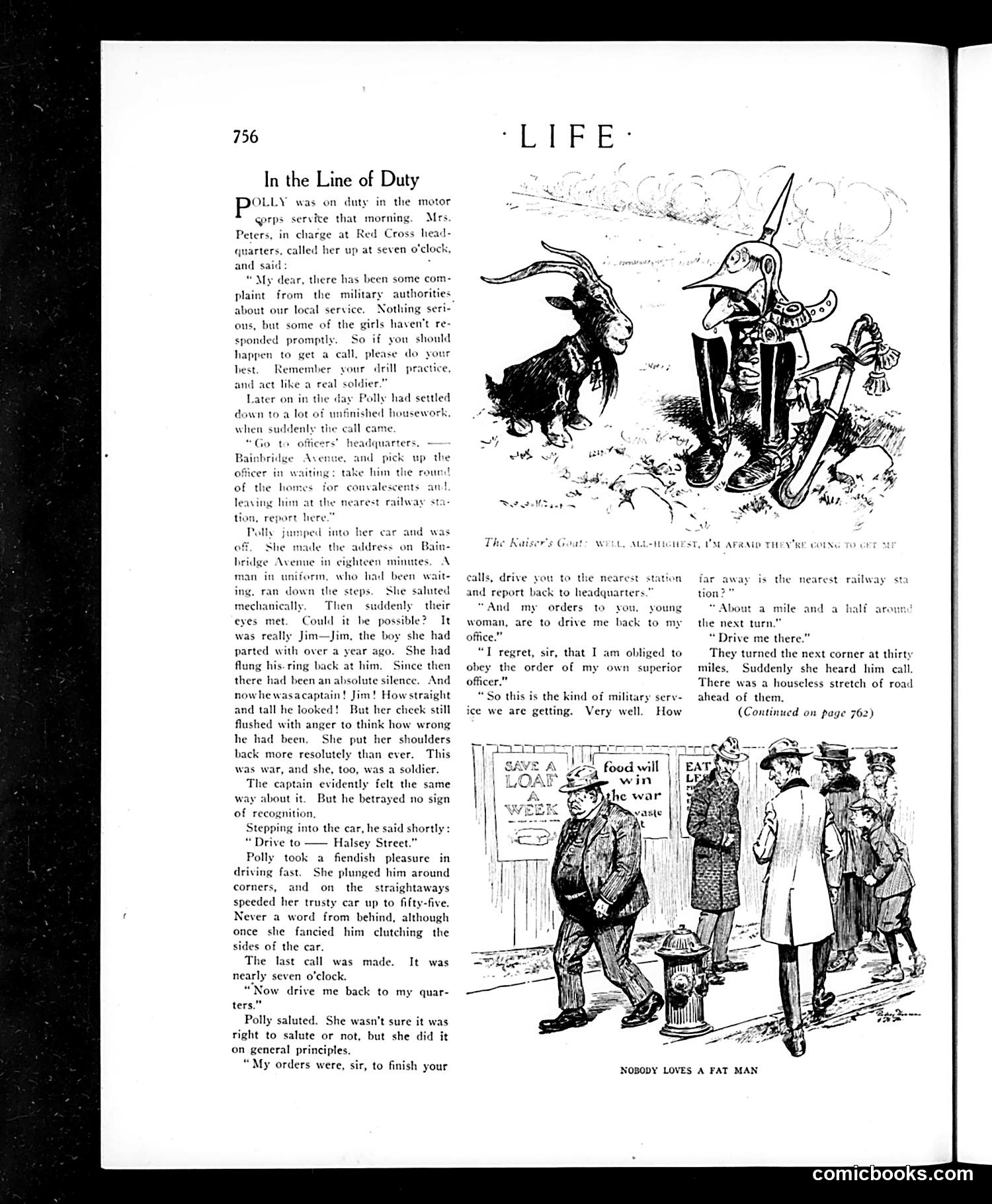
This is a romantic wartime narrative, not political satire. The story follows Polly, a Red Cross motor corps driver during World War I, who is called to pick up an officer. She discovers it's Jim, a former boyfriend who broke her heart a year earlier. The satire is *romantic* rather than political: Polly takes petty revenge by driving recklessly fast, clutching at the car's sides—a humorous payback for his past treatment. The accompanying cartoon "Nobody Loves a Fat Man" appears unrelated, showing civilians discussing food rationing during wartime, a common domestic humor topic. The story plays on 1910s-era themes: women's new wartime roles (motor service, military duty), class dynamics (officer and driver), and personal honor ("act like a real soldier"). The joke is that even in uniform, old romantic tensions resurface—Polly uses her official duties as cover for personal satisfaction.
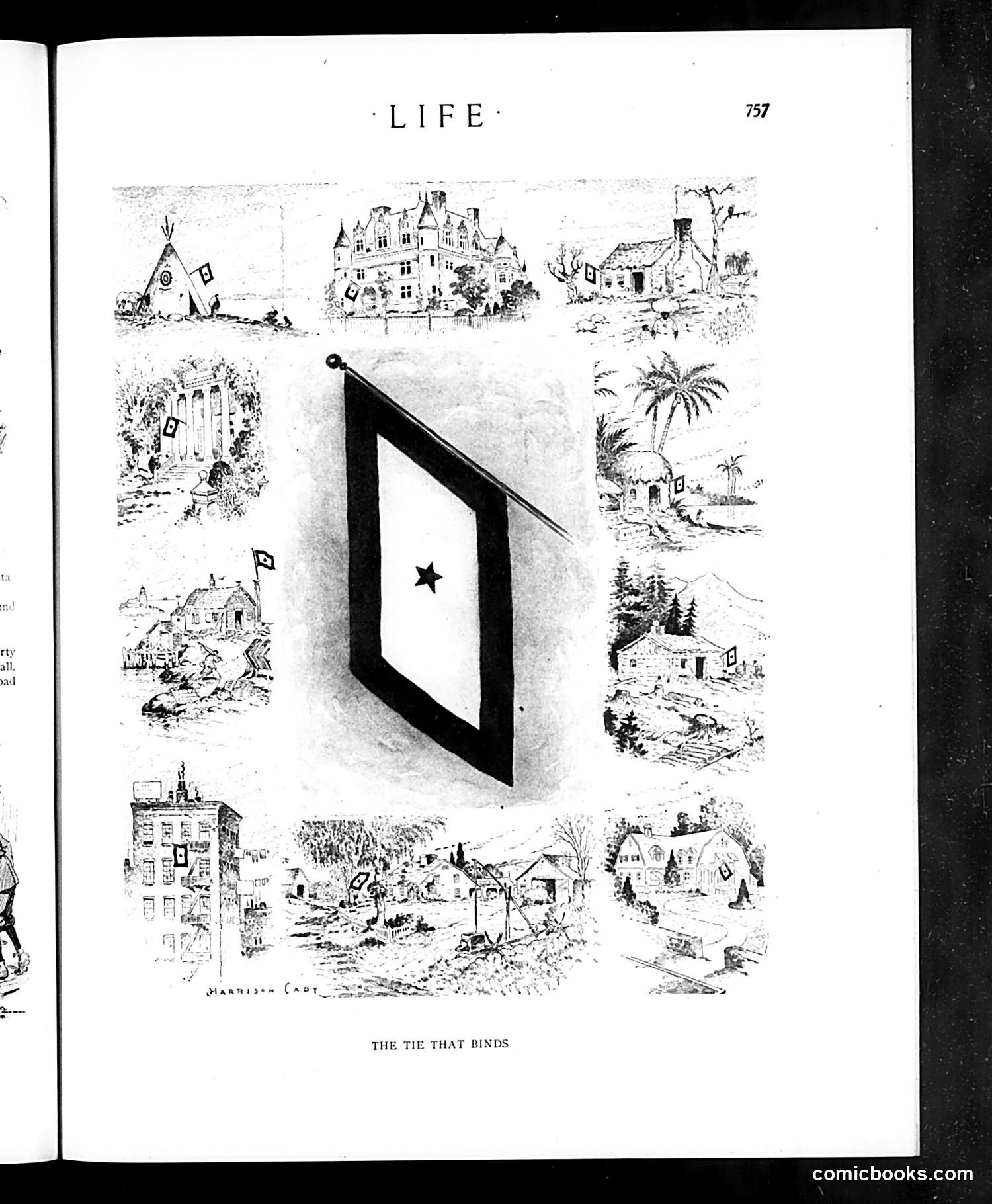
This page from *Life* magazine presents a visual essay on American homes and domestic life. The central image shows an open book or doorway with a star, symbolizing the American home as a unifying force. Surrounding it are sketches of diverse dwelling types: a Native American teepee, a grand Victorian mansion, a simple cottage, a tropical house, an urban apartment building, a log cabin, and other regional architecture styles. The title "The Tie That Binds" suggests that despite Americans' different economic circumstances and regional locations—ranging from wealthy estates to modest dwellings—the concept of home and domestic life serves as a common cultural bond. This is a sentimental, unifying message about American identity and values, typical of *Life* magazine's satirical yet patriotic commentary on American society.
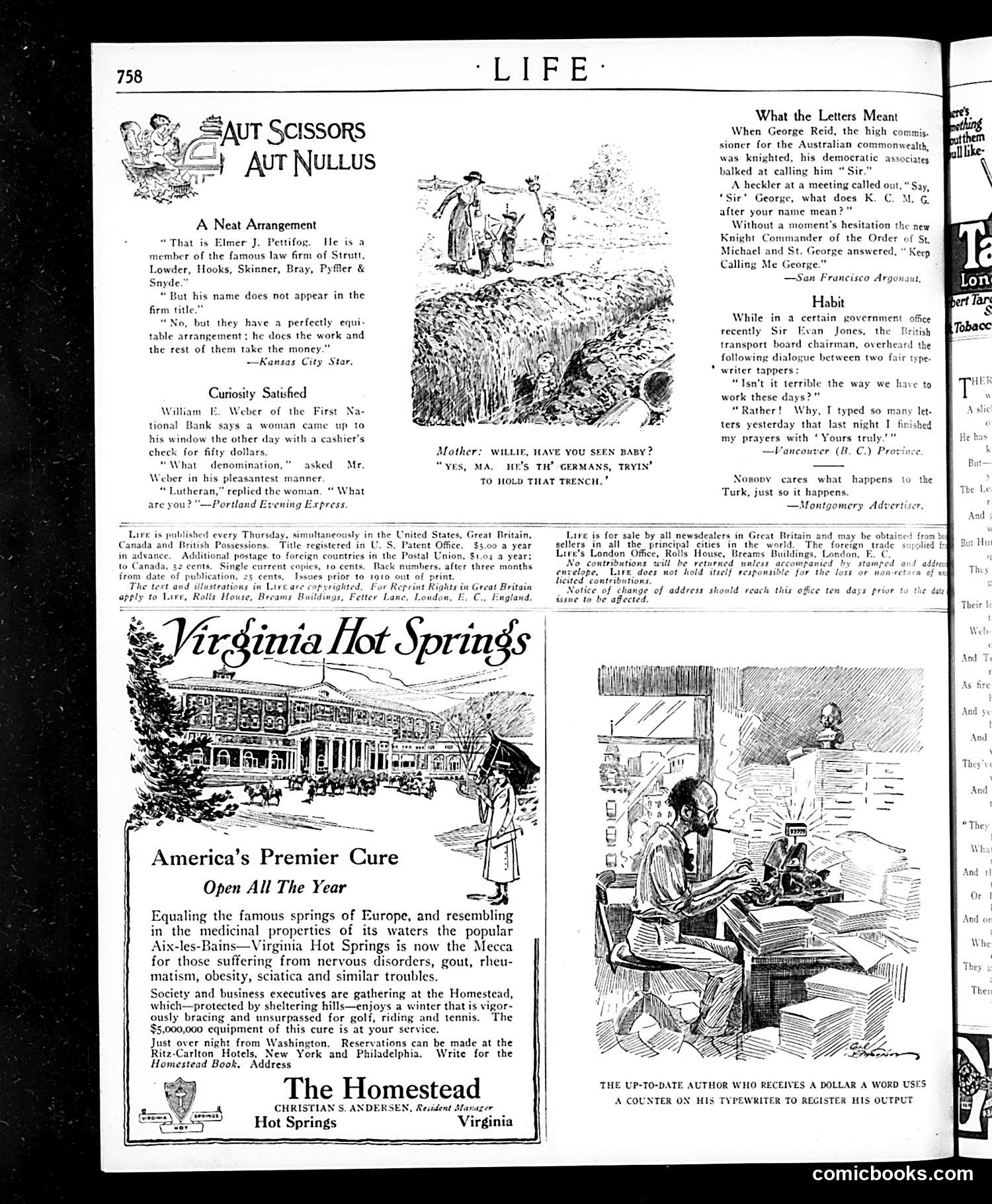
This page contains several short humor pieces and advertisements typical of Life magazine's satirical format. **"A Neat Arrangement"**: Mocks a law firm where one partner (Elmer J. Pettifog) does all the work while others collect profits—satire on unequal labor distribution in professional partnerships. **"What the Letters Meant"**: References George Reid, Australian High Commissioner, being knighted despite democratic objections to titles. The joke plays on "K.C.M.G." (Knight Commander of the Order of Michael and St. George) as Reid humorously explains it means "Keep Calling Me George"—satirizing tension between egalitarian values and formal honors. **"Curiosity Satisfied"** and other brief quips mock everyday absurdities: a bank teller's confusion about denominations, typists' exhaustion with their jobs. The cartoon showing an author with a typewriter counter satirizes writers paid "a dollar a word"—suggesting they use mechanical counters to track output for payment purposes. **Virginia Hot Springs advertisement** dominates the lower half, promoting the resort as a health cure. The content reflects early 20th-century American workplace dynamics and social hierarchies.
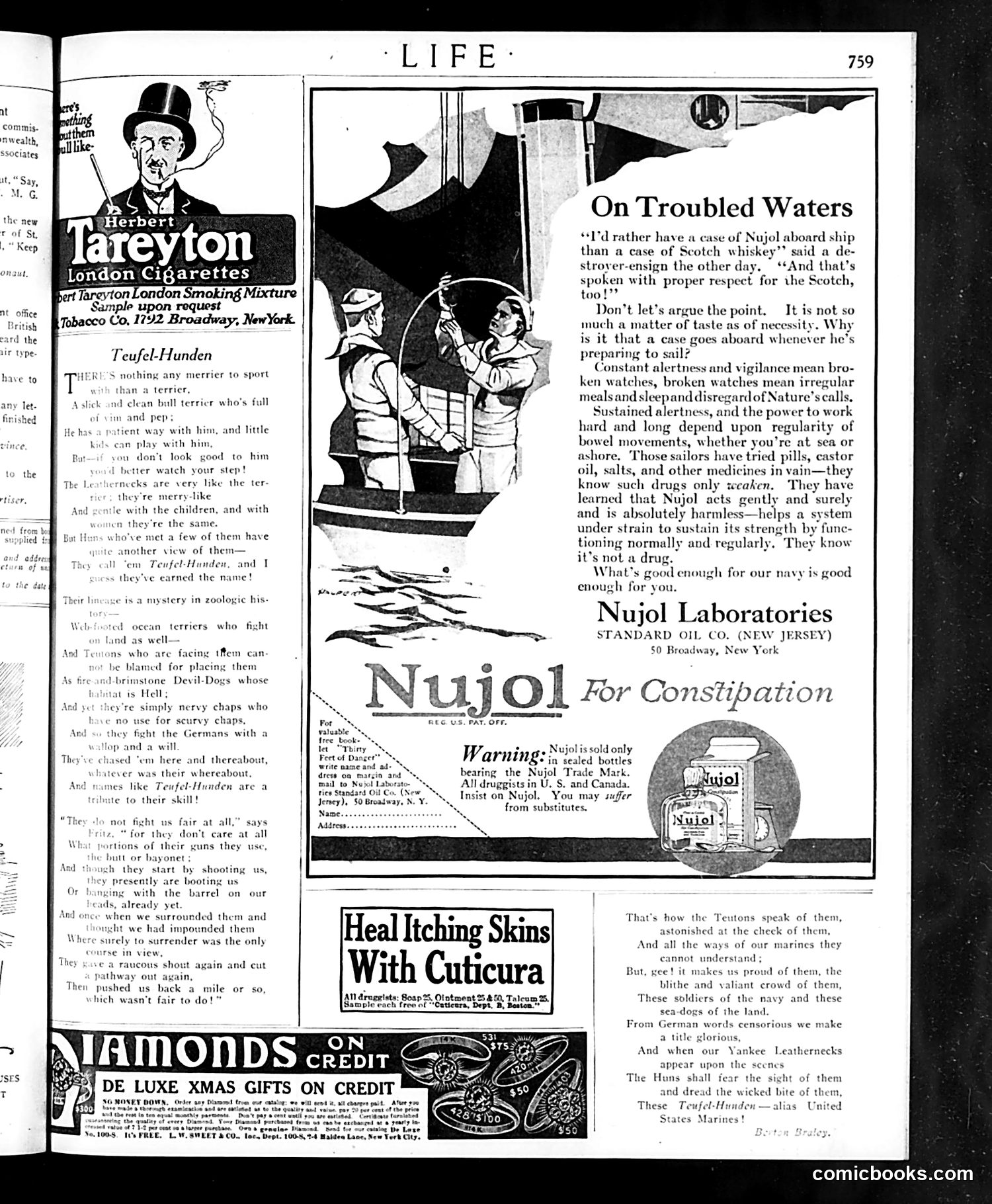
This page primarily contains **advertising** rather than political cartoons, though it includes one poem titled "Teufel-Hunden" (German for "Devil Dogs"). **The "Teufel-Hunden" poem** is a WWI-era tribute to American Marines, using the German nickname the enemy allegedly gave them. The poem celebrates Marine ferocity and tenacity in combat, describing them as relentless fighters who won't surrender and respond to German tactics with courage. This appears designed to boost morale and recruitment during World War I. **The advertisements** include Herbert Tareyton cigarettes, Nujol laxative, and Cuticura soap. Notably, the Nujol ad uses a naval angle—claiming sailors prefer it to whiskey for maintaining bowel regularity during demanding sea duty—linking a medical product to wartime naval service. The overall page reflects early-20th-century American attitudes: celebrating military aggression, using humor and poetry for morale, and marketing consumer products by connecting them to patriotic themes.
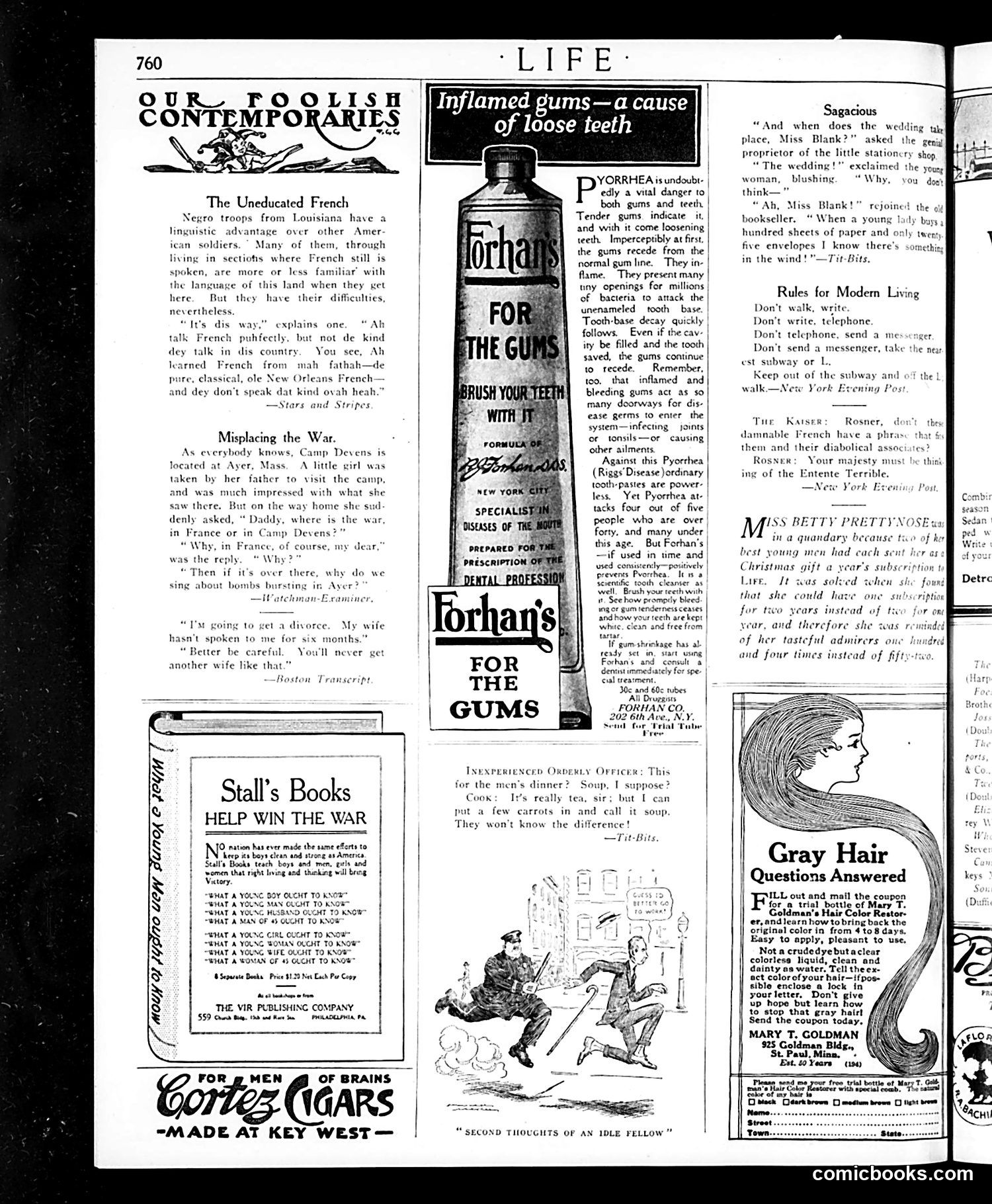
This page from *Life* magazine contains several satirical pieces reflecting WWI-era American concerns: **"The Uneducated French"** mocks African American soldiers from Louisiana, presenting their French-accented English as comedic dialect. The joke relies on period racial stereotyping, portraying them as linguistically confused despite their actual French fluency advantage. **"Misplacing the War"** satirizes a child's confusion about WWI's location—she asks why bombs are sung about in "Ayer" (the camp location) if the war is in France. The humor targets the disconnect between home-front rhetoric and actual geography. **"Inexperienced Orderly Officer"** presents a brief joke about military kitchen deception: an officer serves tea as "soup" to dinner guests, exploiting their assumed ignorance. The page is primarily **advertising and product placement** (Forhan's toothpaste, Stall's Books, Cortez Cigars, hair dye), typical of *Life's* format. The cartoons serve as content breaks between commercial messages rather than serious political commentary.
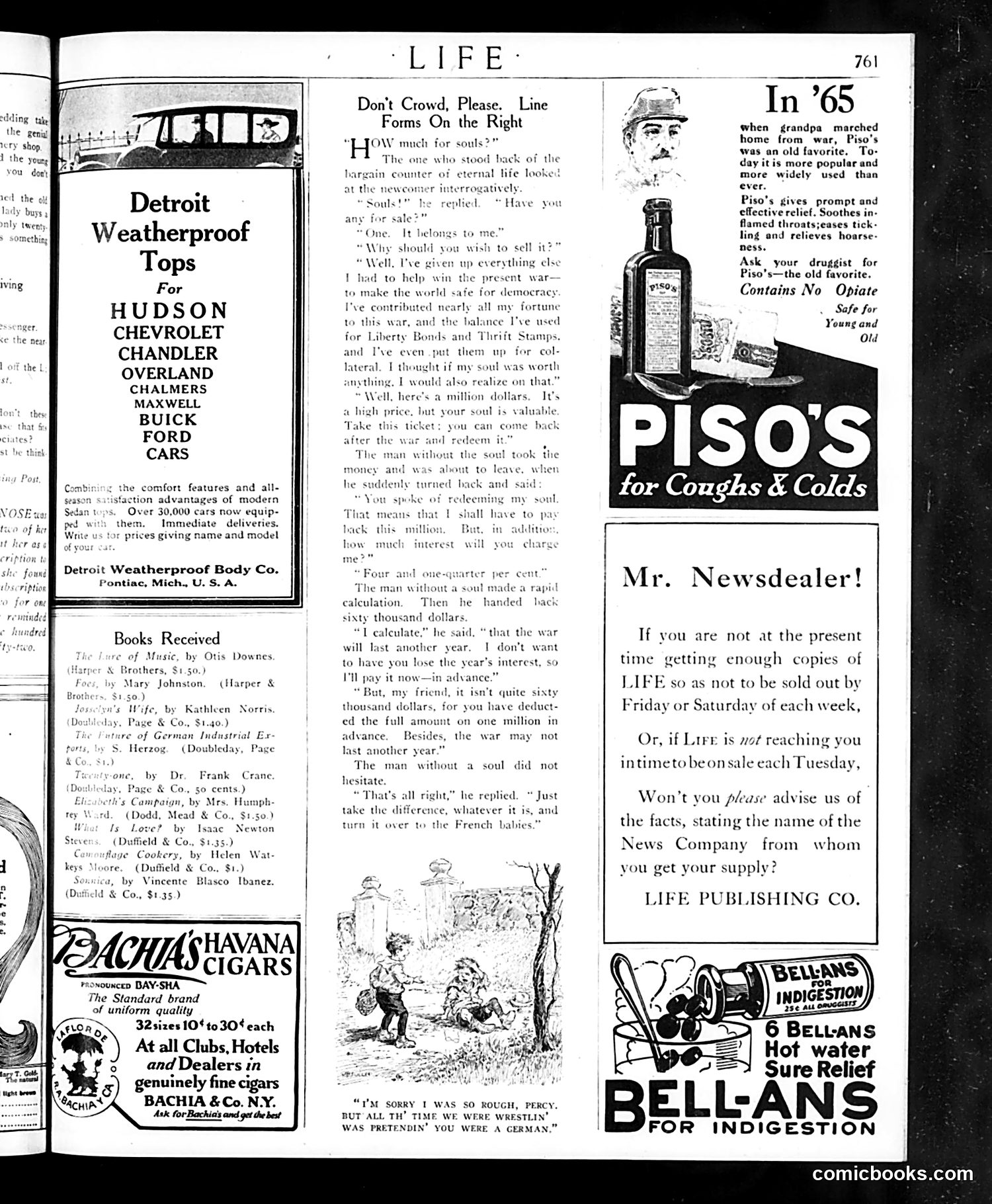
This page contains a satirical story titled "Don't Crowd, Please. Line Forms On the Right"—a WWI-era allegory about American sacrifice and profiteering. **The Satire:** A man selling his soul to a demonic figure (representing greed/war profiteering) negotiates a price. The man claims he's already sacrificed everything for the war effort: his fortune, Liberty Bonds, Thrift Stamps. The demon agrees to pay one million dollars but then deducts interest, calculating the war will last another year. The man realizes he's been exploited—he gave everything patriotically while others profited financially from the war's continuation. **The Point:** This critiques wealthy Americans who claimed patriotic sacrifice while actually benefiting financially from prolonged warfare, and those who genuinely sacrificed while the wealthy gained. The cartoon's final panel shows a German soldier, suggesting the irony that everyone—including enemies—suffered while speculators prospered. The page is primarily advertisements (car tops, cigars, patent medicines) surrounding this darker commentary on wartime economics.
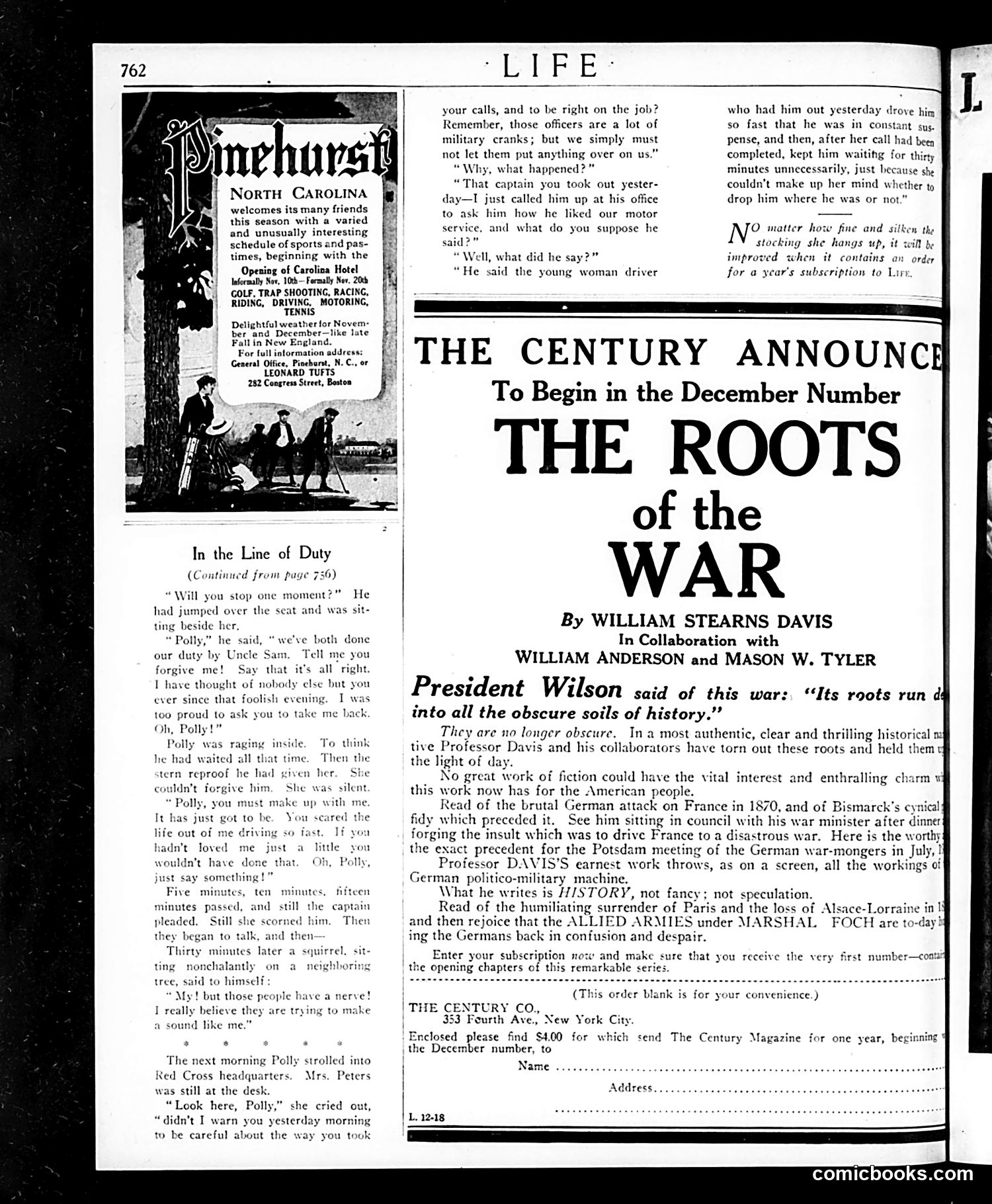
This page mixes fiction and advertising from *Life* magazine (likely early 1910s-1920s). **The Story ("In the Line of Duty")**: A sentimental narrative about a captain and a woman driver. The humor turns on class/gender: the woman drove the captain recklessly, then deliberately kept him waiting on a phone call—petty revenge for his earlier courtship behavior. The joke is that she weaponizes her newfound independence (as a driver) and power over his time, subverting traditional gender roles where women were passive. **The Advertisement**: *The Century* magazine announces a historical series called "The Roots of the War" by William Stearns Davis, examining causes of World War I. It promises authentic history—Bismarck's conspiracies, the Franco-Prussian War, the German attack on France—and celebrates Allied victory under Marshal Foch. This was wartime propaganda reinforcing American support for the Allies. **Context**: The page reflects early 20th-century anxieties about women's changing roles (driving, working) while promoting patriotic narratives about the Great War.