
Life, 1918-11-21 · page 14 of 34
Life — November 21, 1918 — page 14: what you’re looking at
What you’re looking at
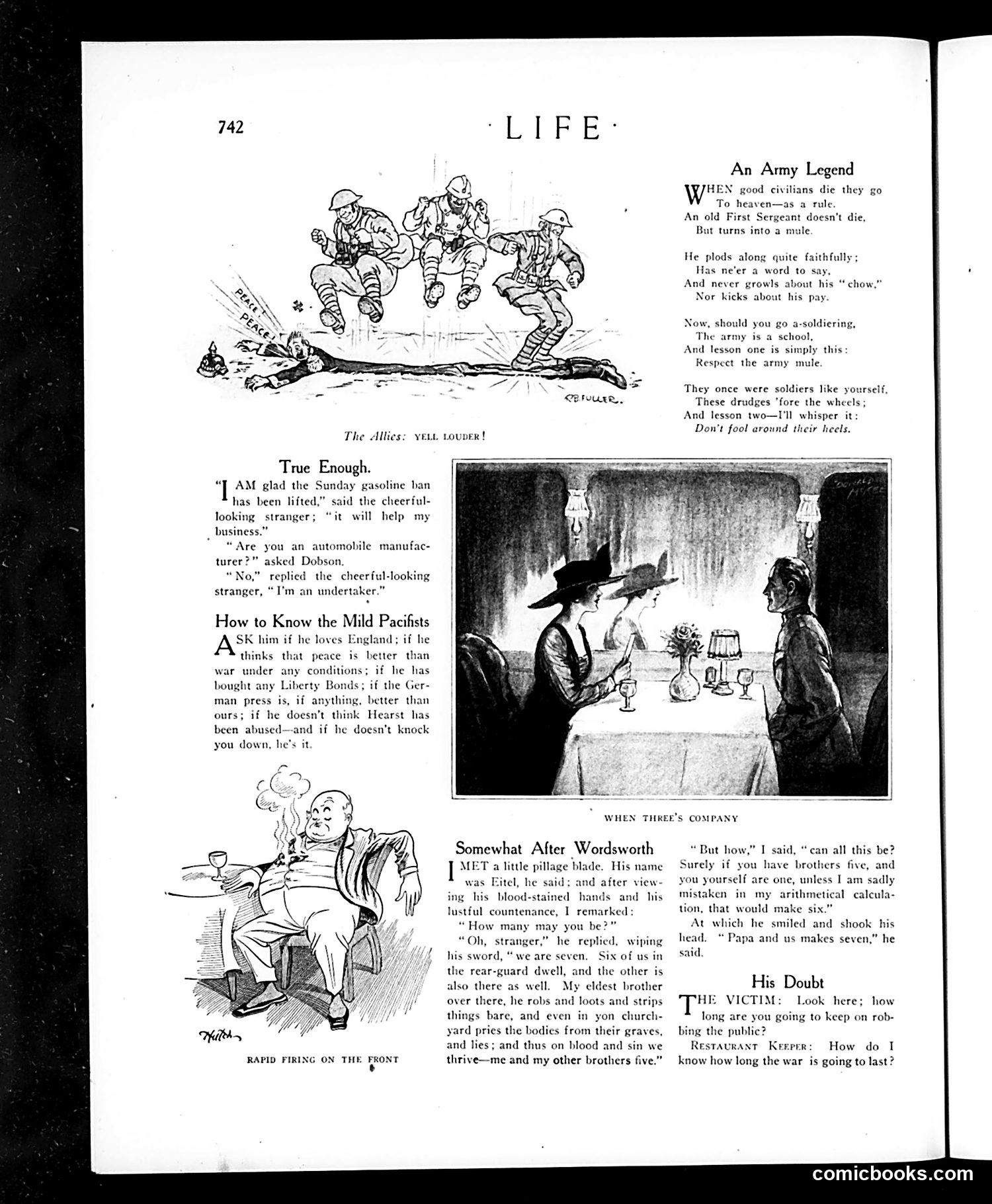
This page contains several short humor pieces satirizing World War I attitudes: **"An Army Legend"** (top): A poem mocking the romanticization of military service, suggesting soldiers should respect army mules more than they respect human chain-of-command. **"True Enough"**: A joke about a cheerful stranger who turns out to be an undertaker—dark humor about wartime deaths. **"How to Know the Mild Pacifists"**: A satirical definition attacking pacifists as hypocrites who claim to oppose war while profiting from it or supporting policies that enable it. **"When There's Company"**: A cartoon showing two women with fish, humorously depicting food rationing deception during wartime. **"Somewhat After Wordsworth"**: A story about meeting a bloodied soldier who claims seven family members are either dead or serving. The page reflects American WWI anxieties about sacrifice, pacifism, and home-front hardships.
📄 Transcribed text from this page (OCR, searchable)
Machine-transcribed from the original scan — historical spelling and the odd misread are preserved.
The Allies: True Enough. “I AM glad the Sunday gasoline ban has been lifted,” said the cheerful- looking stranger; “it will help my business.” “ “Are you an automobile manufa turer?” asked Dobson, “No,” replied the cheerful-looking stranger, “I'm an undertaker.” How to Know the Mild Pacifists SK him if he loves England; if he thinks that peace is better than war under any conditions; if he has bought any Liberty Bonds; if the Ger- man press is, if anything, better than ours; if he doesn’t think Hearst has been abused—and if he doesn’t knock you down, he’s it RAPID FIRING ON THE FRONT YELL Louver! An Army Legend W' N good civilians die they go To heaven—as a rule An old First Sergeant doesn't die, But turns into a mule. He plods along quite faithfully; Has ne'er a word to say And never growls about his Nor kicks about his pay * chow,” Now, should you go a-soldiering, The army is a school, And lesson one is simply this Respect the army mule. They once were soldiers like yourself, These drudges ‘fore the wheels; And lesson two—I'll whisper it: Don't fool around their heels. WHEN THREE’S COMPANY Somewhat After Wordsworth MET a little pillage blade. His name was Eitel, he said; and after view- ing his blood-stained hands and his lustful countenance, I remarked: “How many may you be?” “Oh, stranger,” he replied, wiping his sword, “we are seven. Six of us in the rear-guard dwell, and the other is also there as well. My eldest brother over there, he robs and loots and strips things bare, and even in yon church- yard pries the bodies from their graves, and lies; and thus on blood and sin we thrive—me and my other brothers five.” an all this be? Surely if you have brothers five, and you yourself are one, unless I am sadly mistaken in my arithmetical calcula- tion, that would make six At which he smiled and shook his “Papa and us makes seven,” he His Doubt TT’ VICTIM: long are you going to keep on rob- bing the put Restaurant Keeper: How do I know how long the war is going to last? Look here; how comicbooks.com