
Life, 1918-11-21 · page 20 of 34
Life — November 21, 1918 — page 20: what you’re looking at
What you’re looking at
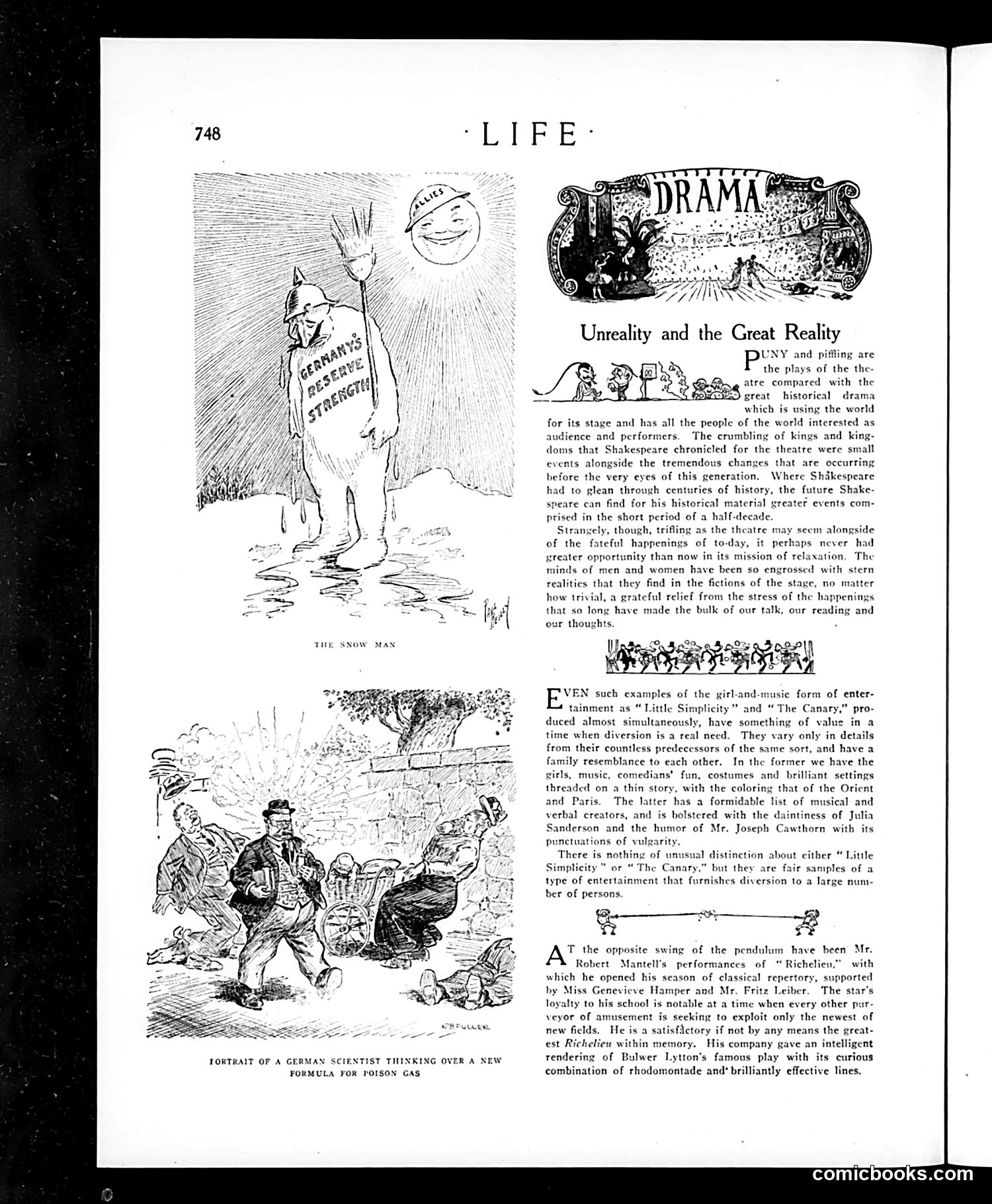
This page contains two editorial cartoons and drama criticism from what appears to be WWI-era Life magazine. **"The Snow Man"** (top left): A figure labeled "Germany's Peace Strength" stands in snow holding a trident, with a smiling sun above. This satirizes Germany's claimed military power during wartime—suggesting their "strength" is as insubstantial and melting as a snowman. **"Portrait of a German Scientist"** (bottom): Shows a caricatured figure "thinking over a new formula for poison gas." This references Germany's use of chemical weapons (gas attacks) in WWI, presenting German scientists as grotesque villains developing instruments of mass death. The **drama section** discusses how stage entertainment provides needed psychological relief during wartime's "stern realities." It reviews musicals like "Little Simplicity" and "The Canary," and praises actor Robert Mantell's classical performances of "Richelieu." The overall message: while Germans develop weapons of destruction, Allied culture offers civilizing entertainment and classical theater as counterweights to war's horrors.
📄 Transcribed text from this page (OCR, searchable)
Machine-transcribed from the original scan — historical spelling and the odd misread are preserved.
and pifiling are ON the plays of the the- Br atte compared with the “ Bees oc historical drama which is using the world for its stage and has all the people of the world interested as audience and performers. The crumbling of kings and king- doms that Shakespeare chronicled for the theatre were small events alongside the tremendous changes that are occurring before the very eyes of this generation. Where Shakespeare had to glean through centuries of history, the future Shake- are can find for his historical material greater events com- prised in the short period of a half-decade. Strangely, though, trifling as the theatre may seem alongside of the fateful happenings of to-day, it perhaps never had greater opportunity than now in its mission of relaxation. The ds of men and women have been so engrossed with stern realities that they find in the fictions of the stage, no matter how trivial, a grateful relief from the stress of the happenings that so long have made the bulk of our talk, our reading and our thoughts, THE SNOW MAN WH such examples of the girl-and-musie form of enter- tainment as “Little Simplicity” and “The Canary,” pro- duced almost simultaneously, have something of value in a time when diversion is a real need. They vary only in details from their countless predecessors of the same sort, and have a family resemblance to each other. In the former we have the irls, music, comedians’ fun, costumes and brilliant settings Jed on a thin story, with the coloring that of the Orient and Paris. The latter has a formidable list of musical and verbal creators, and is bolstered with the daintiness of Julia Sanderson and the humor of Mr. Joseph Cawthorn with its tions of vulgarity. There is nothing of unusual distinction about cither “Little Simplicity ” or “ The Canary,” but they are fair samples of a type of entertainment that furnishes diversion to a large num- ber of persons. e “_# A the opposite swing of the pendulum have been Mr. Robert Mantell's performances of “ Richelieu,” with which he opened his season of classical repertory, supported by Miss Genevieve Hamper and Mr. Fritz Leiber. The star's loyalty to his school is notable at a time when every other pur- veyor of amusement seeking to exploit only the newest of new fields. He is a satisfactory if not by any means the great- est Richelieu within memory. His company gave an intelligent TORTRAIT OF A GERMAN SCIENTIST THINKING OVER A NEW rendering of Bulwer Lytton’s famous play with its curious FORMULA FOR POISON GAS combination of rhodomontade and’ brilliantly effective lines. comicbooks.com