
Life, 1918-11-21 · page 17 of 34
Life — November 21, 1918 — page 17: what you’re looking at
What you’re looking at
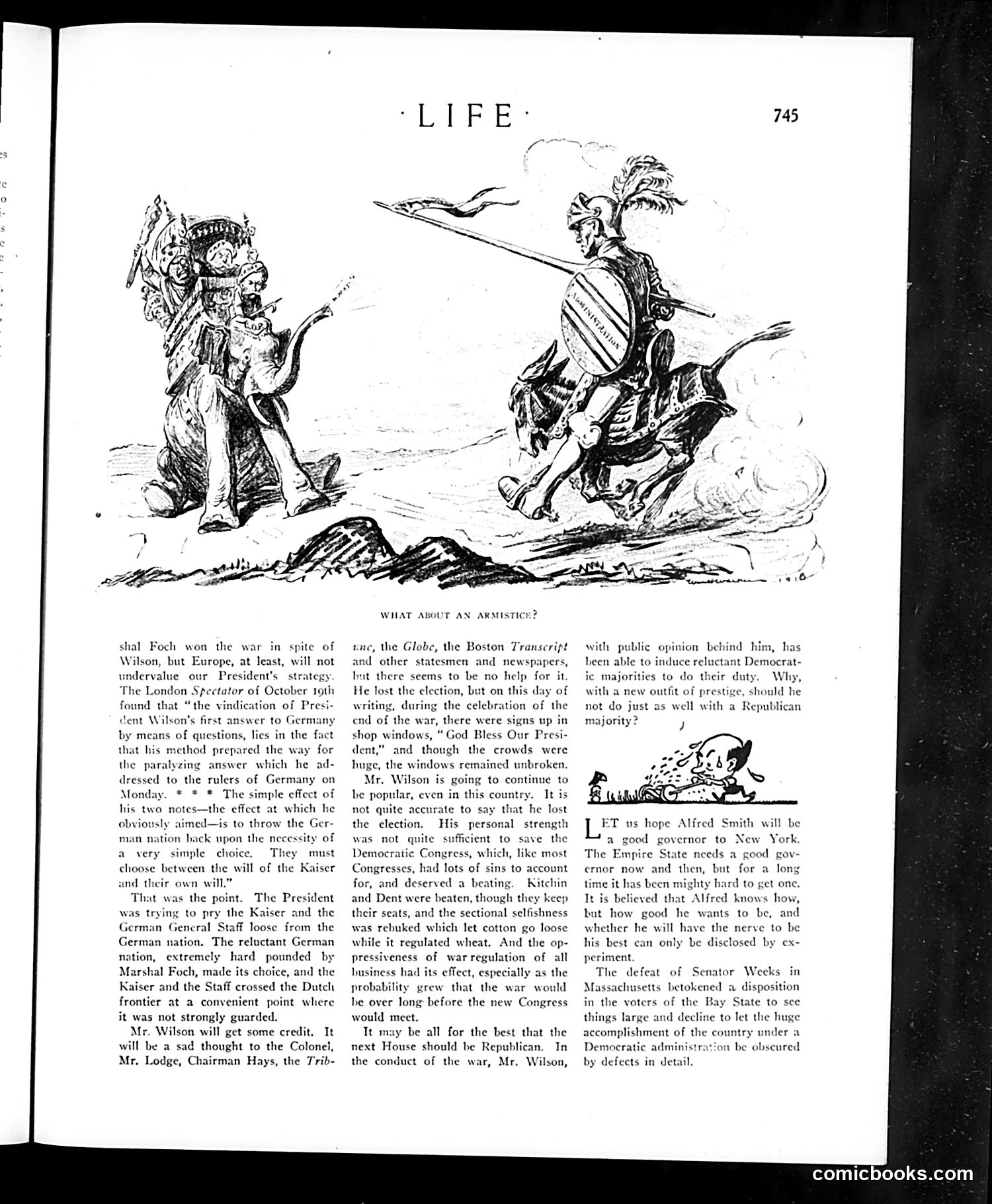
The main cartoon depicts a caricatured military figure (likely representing a German general or Kaiser) on horseback, being confronted by an ornately-dressed opponent on the left—apparently representing President Wilson or American authority. The exaggerated style and confrontational stance illustrate the text's discussion of Wilson's diplomatic strategy. The article credits Wilson with forcing Germany's surrender through diplomatic pressure rather than military force alone. It argues his "two notes" to Germany created a wedge between the Kaiser and the German people, forcing an impossible choice between the Kaiser's will and their own survival—ultimately leading to German surrender. The surrounding text discusses Wilson's political situation: despite losing the recent congressional election, he remains personally popular with the American public. The piece suggests a Republican Congress might actually *aid* Wilson's continued effectiveness, and comments on various state elections (Alfred Smith for New York governor, Senator Weeks's defeat in Massachusetts). The satire critiques both Wilson's political enemies and his supporters' willingness to overlook Democratic losses by celebrating the war's end.
📄 Transcribed text from this page (OCR, searchable)
Machine-transcribed from the original scan — historical spelling and the odd misread are preserved.
shal Foch won the war in spite of Wilson, but Europe, at least, will not undervalue our President’s strateg: The London Spectator of October roth found that “the vindication of Presi dent Wilson's first answer to Germany by means of questions, lies in the fact that his method prepared the way for the paralyzing answer which he ad- dressed to the rulers of Germany on Monday. * * * The simple effect of his two notes—the effect at which he obviously aimed—is to throw the Ger- k upon the necessity of a very simple choice. They must choose between the will of the Kaiser and their own will.” That was the point. The President was trying to pry the Kaiser and the German General Staff loose from the German nation. The reluctant German nation, extremely hard pounded by Marshal Foch, made its choice, and the Kaiser and the Staff crossed the Dutch frontier at a convenient point where it was not strongly guarded. Mr. Wilson will get some credit. It will be a sad thought to the Colonel, Mr. Lodge, Chairman Hays, the 71 man nation WHAT ABOUT AN ARMISTICE? une, the Globe, the Boston Transcript and other statesmen and newspapers, hut there seems to be no help for it He lost the election, but on this day of writing, during the celebration of the cnd of the war, there were signs up in shop windows, “God Bless Our Presi- dent,” and though the crowds were huge, the windows remained unbroken. Mr. Wilson is going to continue to be popular, even in this country, It is not quite accurate to say that he lost the election. His personal strength was not quite sufficient to save the Democratic Congress, which, like most Congresses, had lots of sins to account for, and deserved a beating. Kitchin and Dent were beaten, though they keep their seats, and the sectional selfishness was rebuked which let cotton go loose while it regulated wheat. And the op- pressiveness of war regulation of all business had its effect, especially as the probabi that the war would he over long before the new Congress would meet. It may be all for the best that the next House should be Republican. In the conduct of the war, Mr. Wilson, ity grew with public opinion behind him, has heen able to induce reluctant Democrat- ic majorities to do their duty. Why, with a new outfit of prestige, should he not do just as well with a Republican majority? ET us hope Alfred Smith will be a good governor to New York The Empire State needs a good gov- ernor now and then, but for a long time it has been mighty hard to get one, It is believed that Alfred knows how, but how good he wants to be, and whether he will have the nerve to be his best can only be disclosed by ex- periment. The defeat of Senator Weeks in Massachusetts betokened a disposition in the voters of the Bay State to see things large and decline to let the huge accomplishment of the country under a Democratic admin by defects in detail. tration be obscured. comicbooks.com