
A complete issue · 34 pages · 1918
Life — October 24, 1918
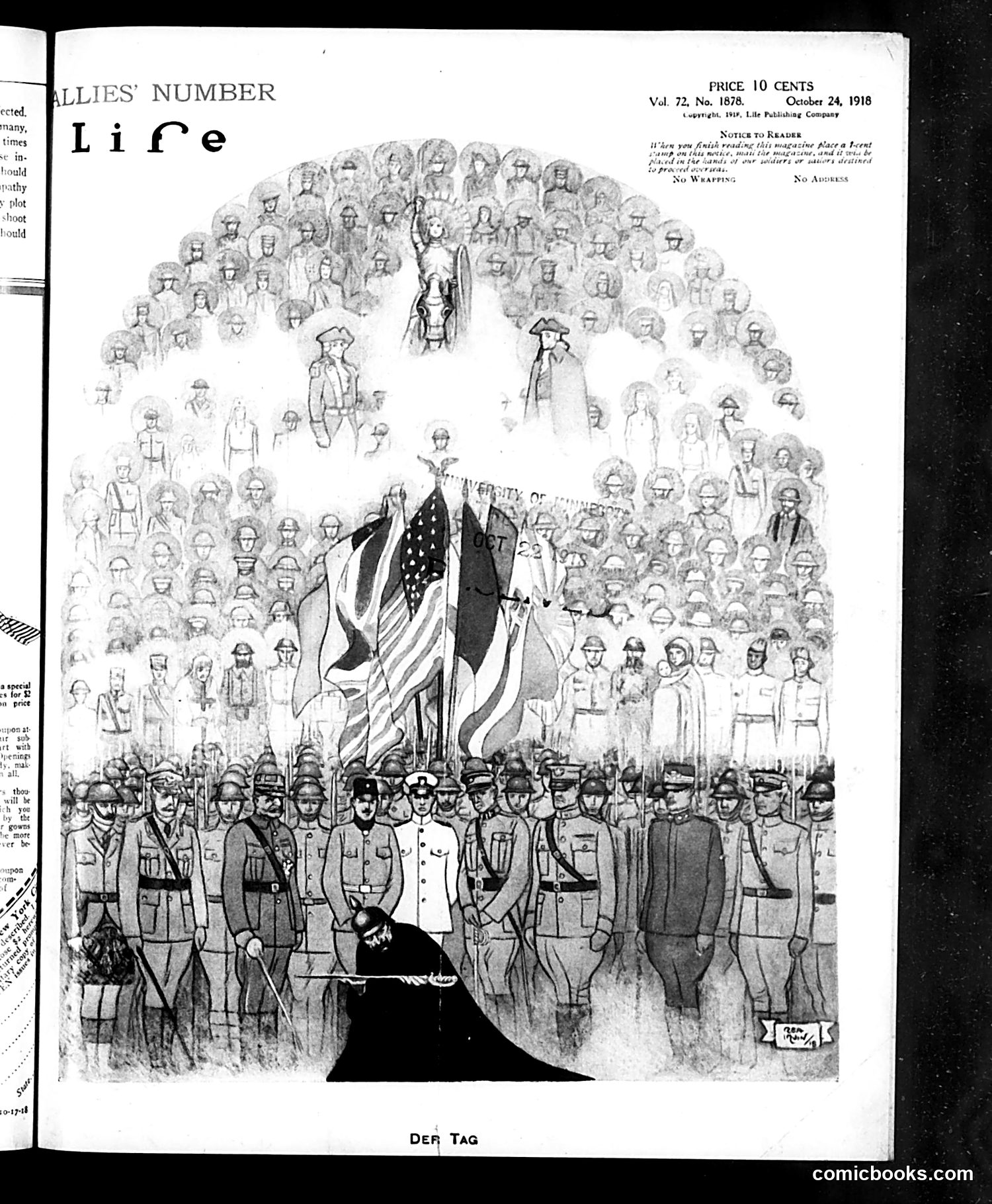
This is a German-language political cartoon ("Der Tag" means "The Day") published during the final weeks of World War I. The image depicts a vast crowd of soldiers surrounding flags, with a dark silhouetted figure looming over them in the foreground. The cartoon appears to satirize German militarism and the concept of "Der Tag"—a phrase associated with German imperial ambitions and the anticipated day of military victory. The enormous masses of soldiers and the dominating shadow figure likely represent German military authority and the subordination of individual soldiers to state power. Published just weeks before Germany's November 1918 armistice, the cartoon seems to critique German military culture and suggest the hollowness or tragedy of that system's grand ambitions.
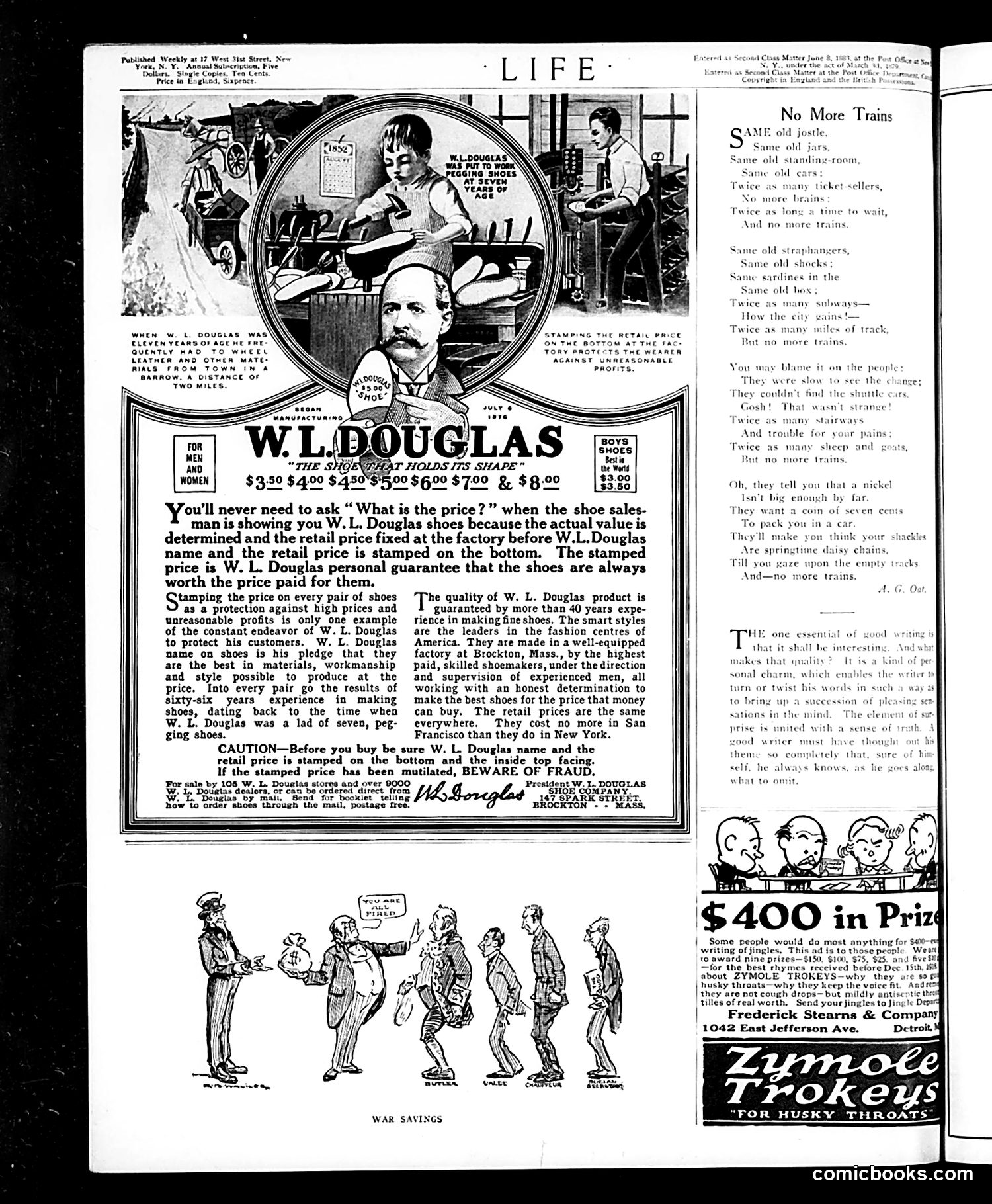
This Life magazine page is primarily an advertisement for W.L. Douglas shoes, with supporting editorial content. **The Main Advertisement:** The large central section advertises W.L. Douglas brand shoes, emphasizing their fixed factory prices ($3.50-$8.00) stamped on every pair to prevent fraud and price-gouging. The ad features a portrait of W.L. Douglas himself and includes a "caution" warning consumers to verify the stamped price to avoid counterfeit products. **"War Savings" Cartoon:** The small cartoon at bottom left shows men receiving money, satirizing war profiteering and financial manipulation during what appears to be WWI-era America. **Supporting Content:** The right side includes a poem "No More Trains" about post-war economic disruption, and an advertisement for Zymole Trokeys throat lozenges. The page reflects early 20th-century consumer concerns about product authenticity and wartime economic anxieties.
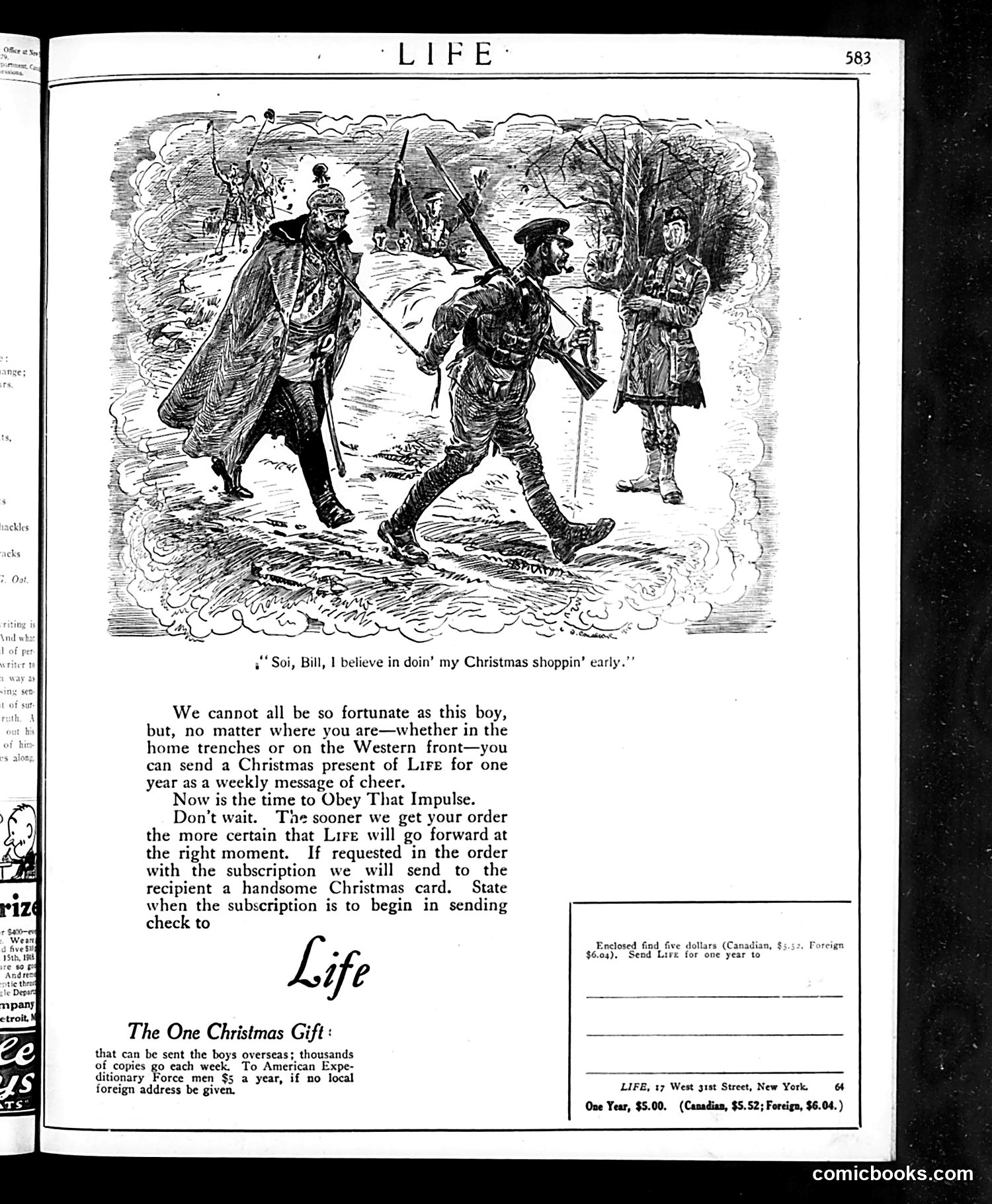
**The Content:** This page is primarily a **Christmas gift advertisement** for Life magazine subscriptions, not political satire. **The Cartoon:** The illustration depicts soldiers in what appears to be a WWI trench setting. The caption reads: "Soi, Bill, I believe in doin' my Christmas shoppin' early." **The Point:** The satire is gentle and patriotic rather than political. It uses humor to encourage readers to send Life magazine subscriptions to American soldiers serving overseas—described as "boys overseas" on the Western Front. The joke plays on the contrast between typical Christmas shopping and the wartime context. **The Pitch:** The ad emphasizes that Life makes an ideal gift for troops, costing $5 annually ($3 for American Expeditionary Force men). It's wartime morale-building advertising that frames magazine subscriptions as practical, uplifting gifts for distant soldiers.
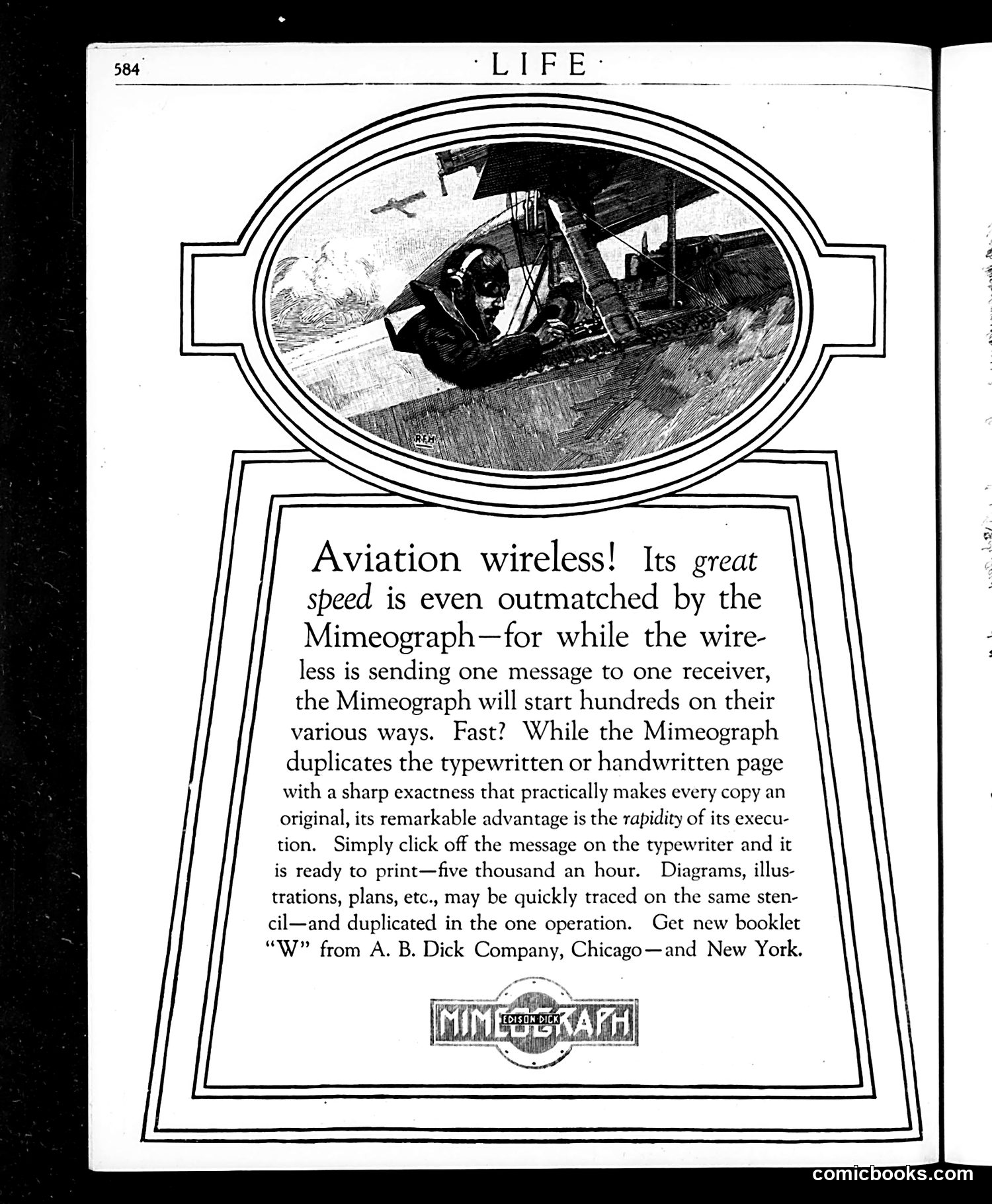
This is primarily **advertising, not satire or editorial content**. The page advertises the Mimeograph machine made by A.B. Dick Company (Chicago and New York). The oval illustration shows a pilot in an early airplane, used as a metaphor for speed and modernity. The ad's central claim compares the mimeograph's duplication speed favorably to "aviation wireless" (early radio communication). The pitch emphasizes rapid production: the machine can print 5,000 copies per hour and quickly duplicate typed or handwritten documents and diagrams. The reference to "aviation wireless" reflects the 1910s-1920s era when both aviation and wireless technology were cutting-edge innovations. The comparison suggests the mimeograph represents similarly impressive technological progress for office work.
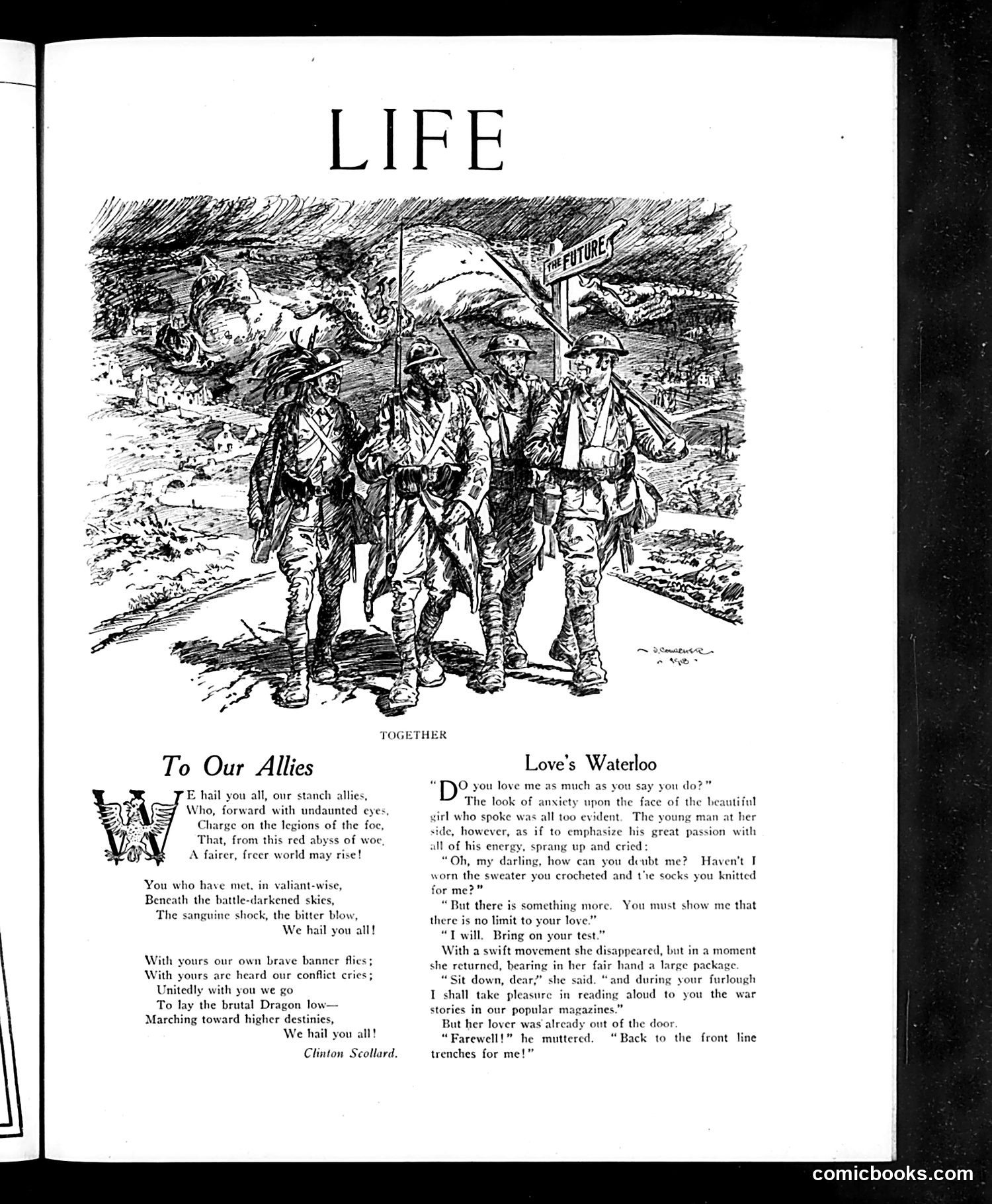
This WWI-era page contains a patriotic poem "To Our Allies" by Clinton Scollard, celebrating Allied soldiers marching toward "The Future." The illustration depicts four soldiers in military uniforms and helmets walking together, reinforcing Allied unity. The right column, "Love's Waterloo," is a short story about romantic separation during wartime—a soldier's girlfriend demands he prove his love transcends military duty. He ultimately returns to the front, choosing country over romance. Together, these pieces present WWI propaganda emphasizing sacrifice and duty. The "allies" reference suggests publication during American involvement (1917-1918). The juxtaposition of patriotic verse with a domestic romance subplot encourages readers to accept wartime separations as necessary and noble, normalizing sacrifice for the war effort.
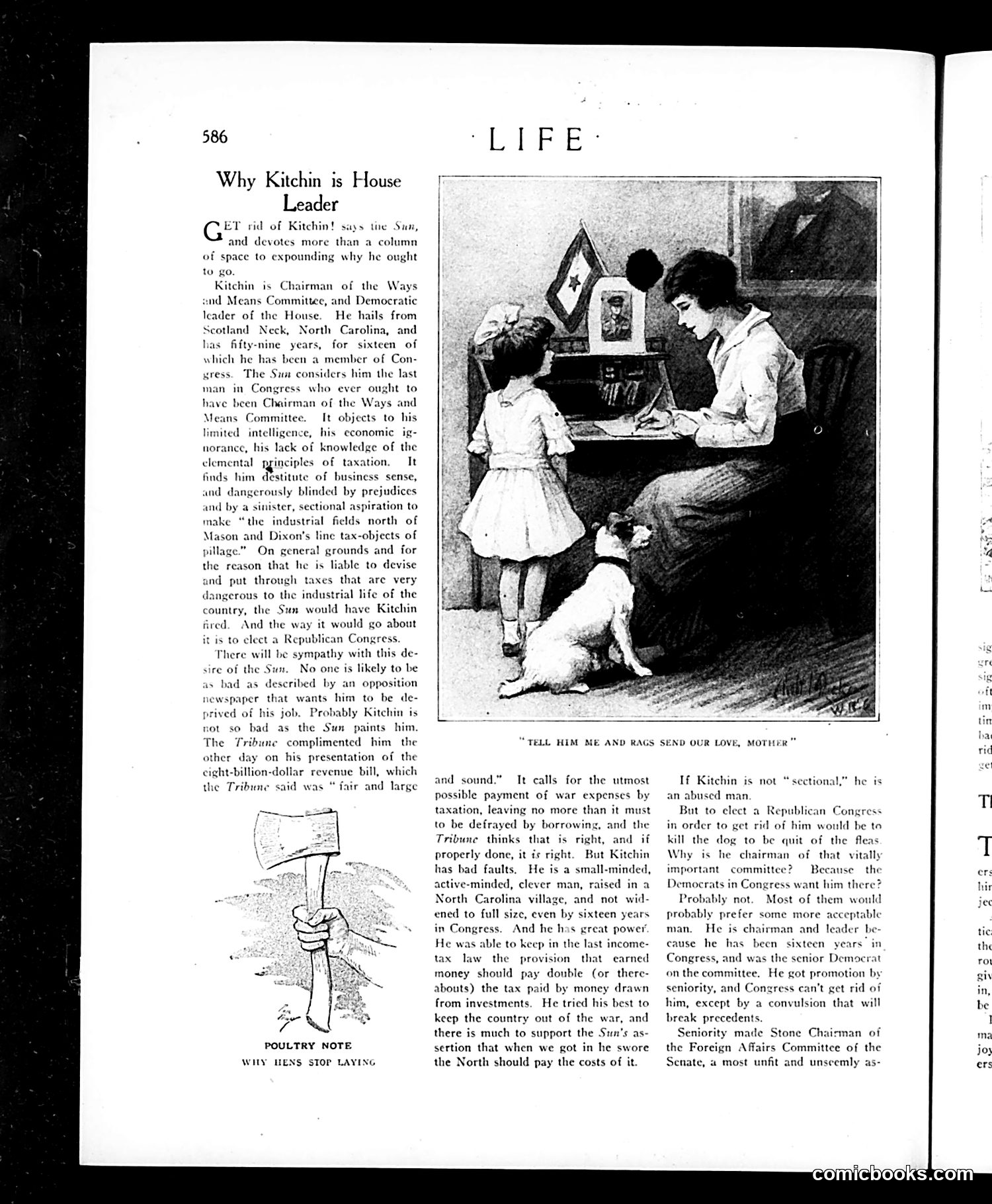
This page critiques **Claude Kitchin**, Chairman of the House Ways and Means Committee during WWI. The article attacks his fitness for the position, calling him "small-minded" and "active-minded" despite his sixteen years in Congress. The main photograph shows children and a dog, captioned "Tell him me and rags send our love, mother"—suggesting soldiers' families suffer while Kitchin manages war finances poorly. The cartoon below (labeled "Poultry Note: Why Hens Stop Laying") uses a hen as metaphor: just as hens stop producing under stress, the nation's economy suffers under Kitchin's tax policies. The Sun and Tribune newspapers apparently supported removing him, fearing his taxation schemes would damage industrial growth needed for the war effort. This is partisan Democratic criticism of a Democratic congressman's wartime financial stewardship.
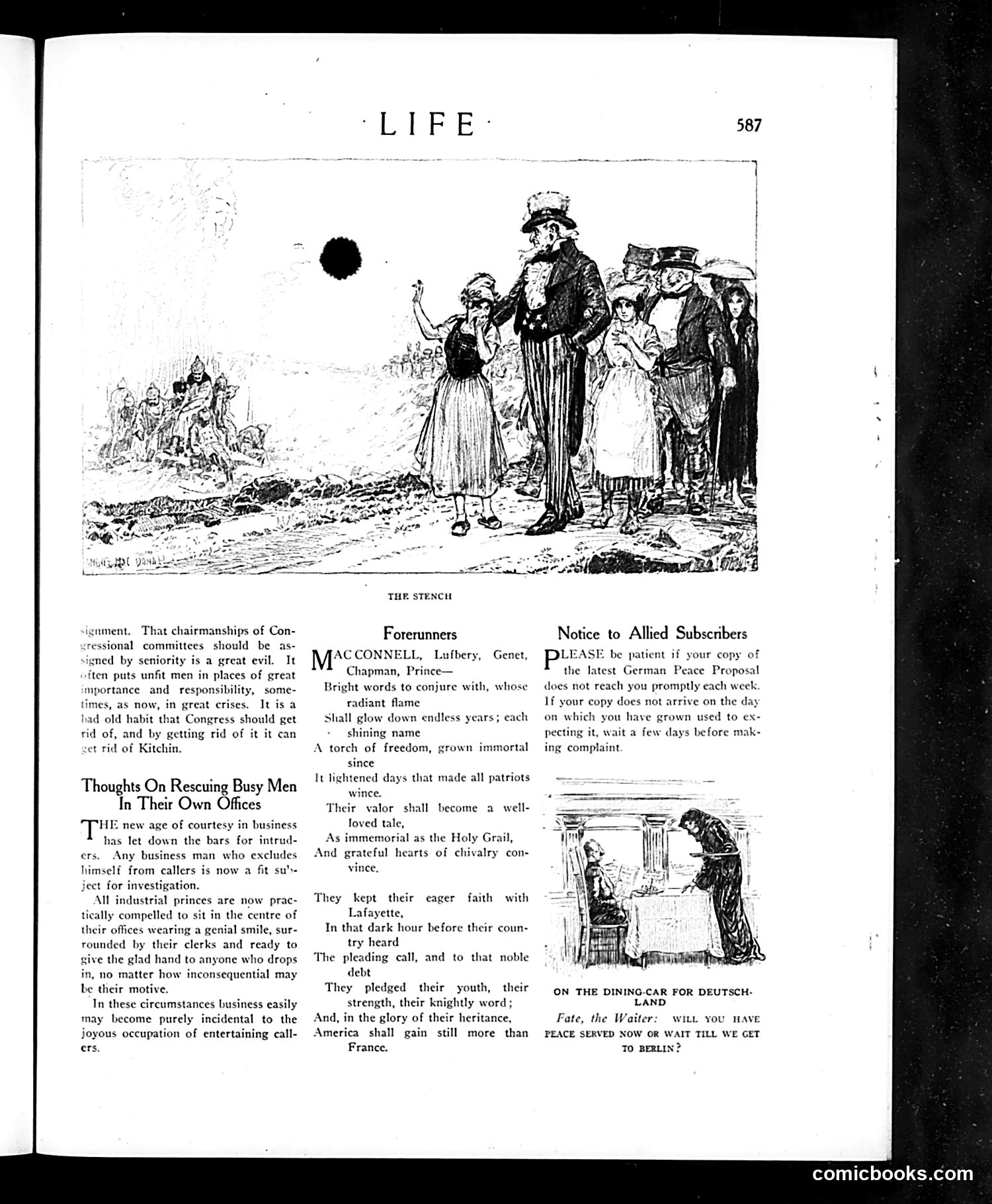
**"The Stench" (top illustration):** This political cartoon depicts a group of well-dressed figures recoiling from what appears to be foul odors, represented by the dark cloud. Given the page's context referencing "German Peace Proposal," this likely satirizes negative American/Allied reactions to German peace negotiations during World War I—portraying German diplomatic overtures as repugnant or dishonest. **"On the Dining-Car for Deutschland" (bottom illustration):** A waiter asks a diner about serving peace. This appears to mock German peace proposals as insincere, using dining-car service as metaphor: suggesting Germans want "peace" served conveniently, or questioning whether true peace negotiations are possible ("wait till we get to Berlin"). Both cartoons express Allied skepticism toward German wartime peace offerings.
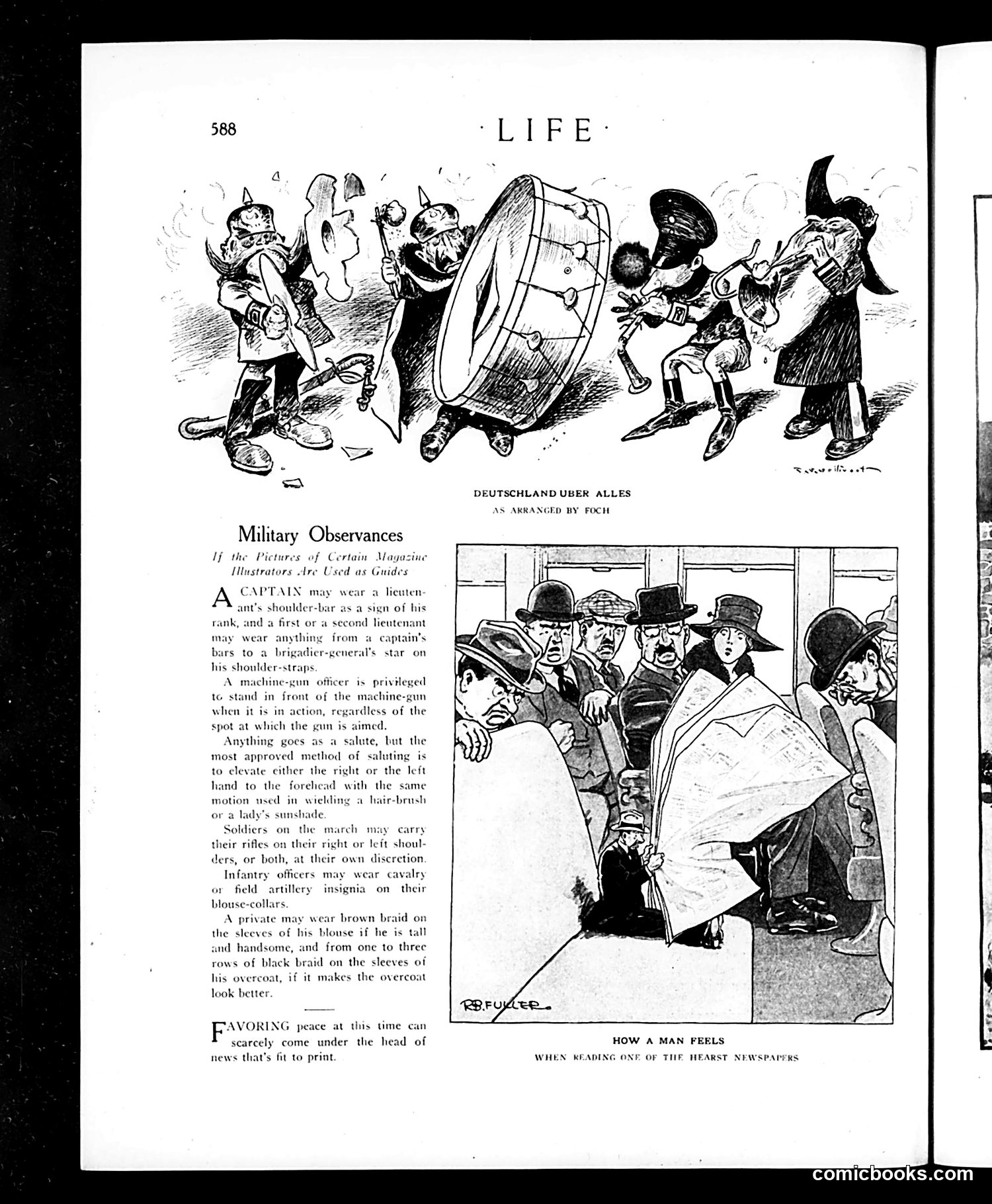
The top cartoon, titled "Deutschland Uber Alles as Arranged by Foch," depicts German military figures (identifiable by their spiked helmets) being manipulated like puppets or marionettes by what appears to be a larger controlling force—likely representing French General Foch and Allied powers post-WWI. The satire critiques German militarism and the post-war power dynamics, suggesting Germany's military ambitions are now controlled by Allied victors. The lower comic strip, "How a Man Feels When Reading One of the Heartiest Newspapers," shows crowded indoor scenes suggesting anxiety or distress from reading newspaper content—likely wartime or post-war news causing public emotional disturbance. Both pieces use satire to comment on military power, war consequences, and contemporary anxieties.
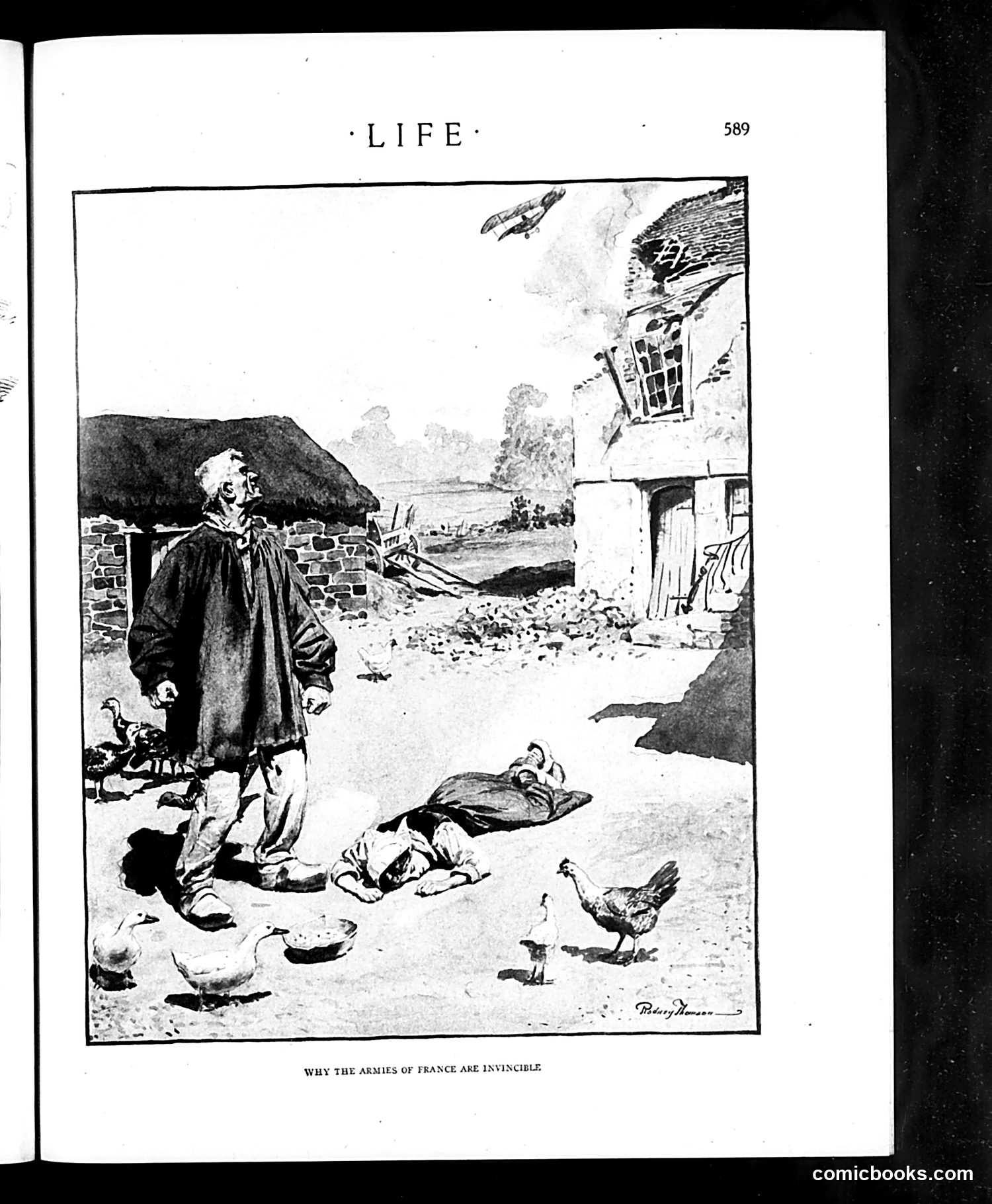
This is a satirical cartoon titled "Why the Armies of France Are Invincible." It depicts a rural French farm scene with an elderly peasant standing among chickens, ducks, and other farmyard animals, while bodies lie on the ground around him. The satire appears to work on multiple levels: it suggests French military strength derives not from formal armies but from the resilience and survival instincts of ordinary French rural people and their countryside resources. Alternatively, it may be darkly satirizing French confidence in their military superiority by showing indifference to warfare's casualties—bodies treated as casually as farmyard life continues around them. The specific historical moment is unclear without publication date context, though the style suggests early-to-mid 20th century.
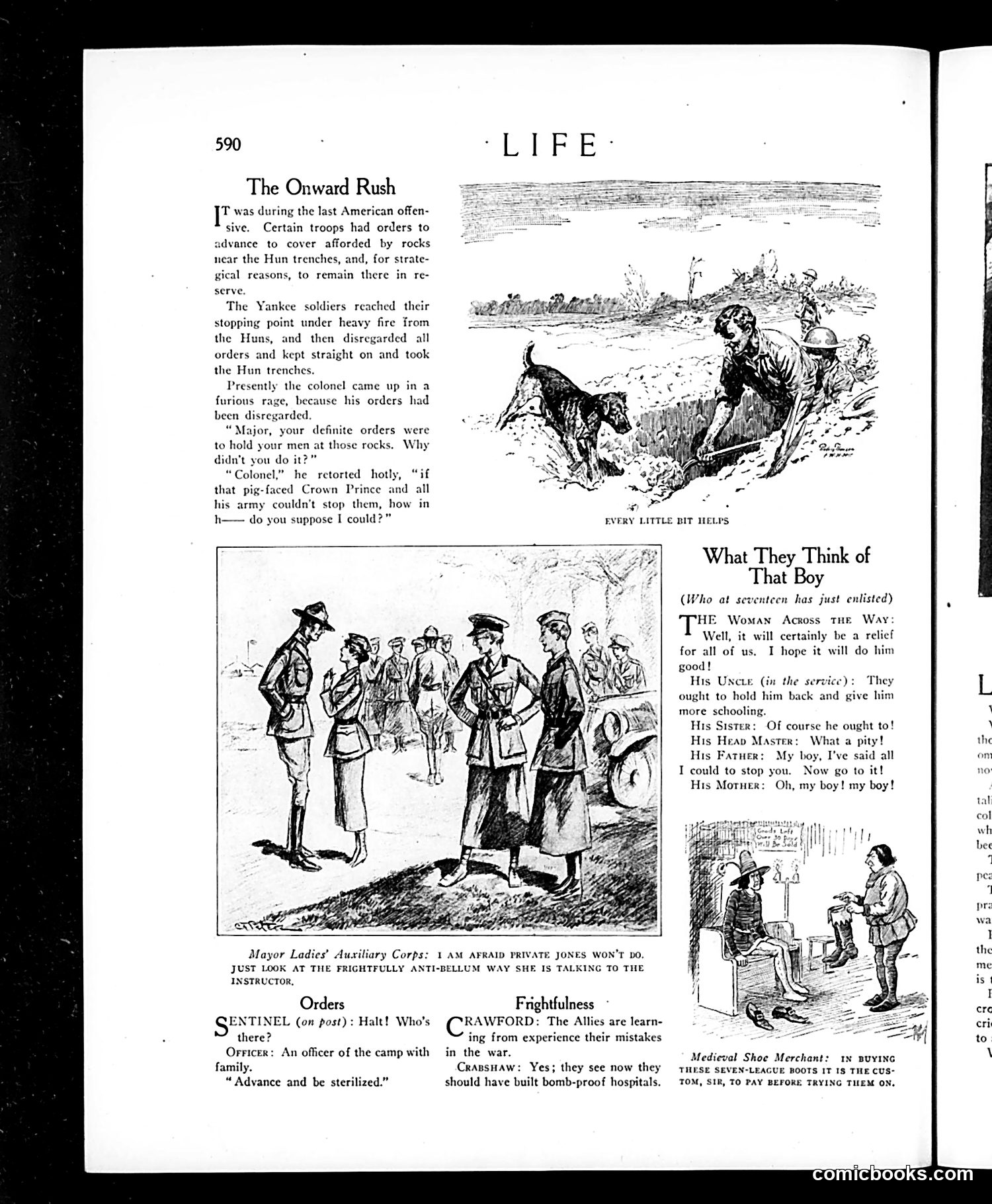
This page contains WWI-era satirical content depicting "The Onward Rush" - a narrative about American troops ordered to advance near Hun (German) trenches despite being told to hold position. A colonel becomes furious when his orders are disregarded. The central cartoon shows a Major confronting officers, criticizing their failure to follow orders to hold rocks near enemy lines. Below is a sketch titled "Mayor Ladies' Auxiliary Corps" satirizing women's military auxiliary groups, showing an instructor addressing recruits. The right section, "What They Think of That Boy," presents relatives' reactions to a seventeen-year-old's enlistment through brief quotes expressing relief, concern, and maternal worry. Additional small sketches address military topics like sentinel duty and shoe merchants selling boots to soldiers—typical wartime satirical commentary on civilian and military life.
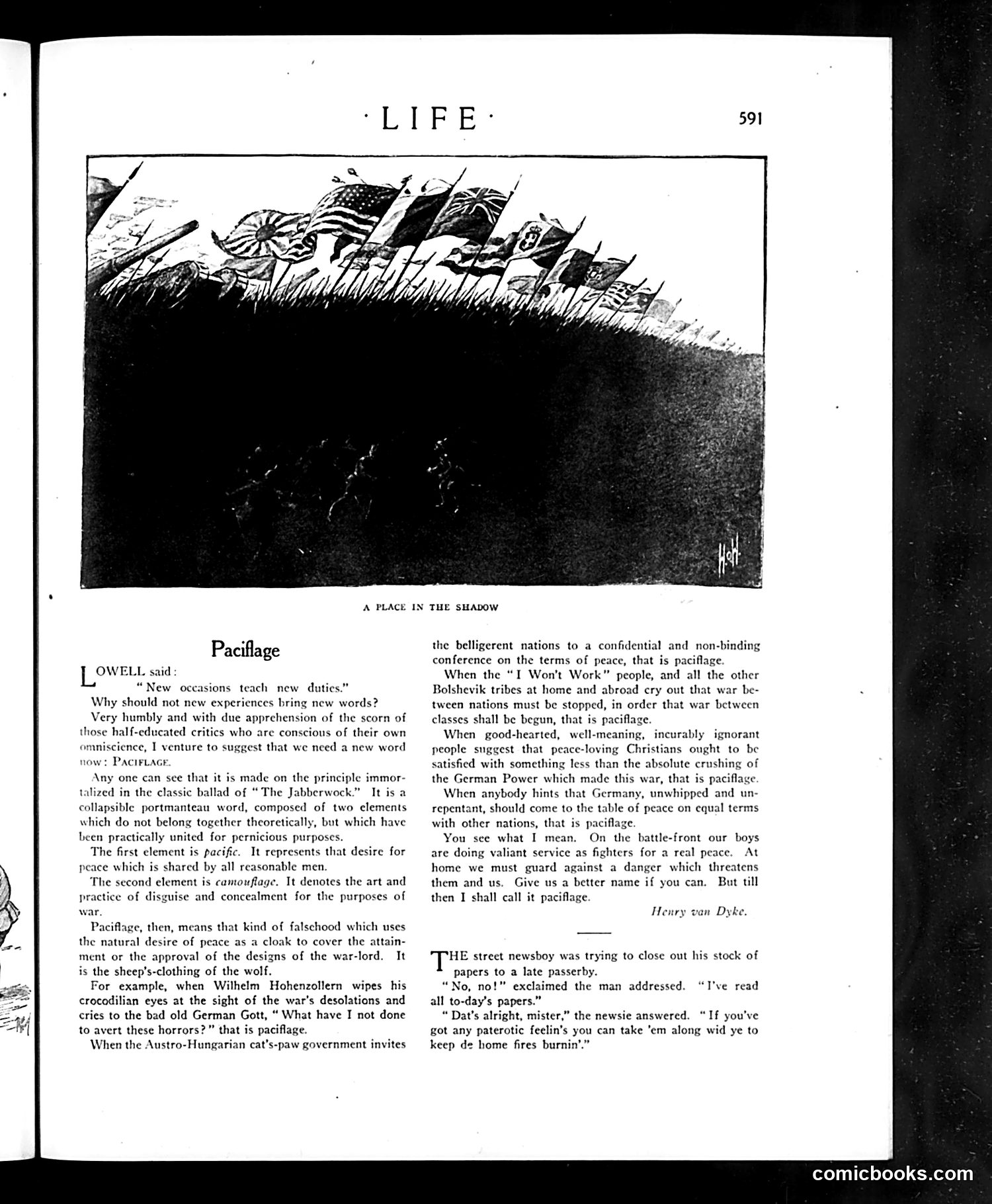
The cartoon depicts soldiers and flags along a trench line, with shadows below suggesting death or darkness. The accompanying article by Lowell attacks pacifism during World War I, using the term "Pacifage" (a neologism blending "peace" and "façade"). Lowell argues pacifism is false morality—a cloak for war profiteering. He mocks pacifists as naive, citing examples like Wilhelm II claiming innocence and Austria-Hungary seeking peace conferences while continuing aggression. The street newsboy anecdote at page's bottom reinforces this: a man tries avoiding war news by closing his ears, yet cannot escape reality. The satire targets American pacifists and neutrality advocates who, Lowell suggests, enable war through inaction and hypocrisy—a common pro-intervention argument during the WWI era.
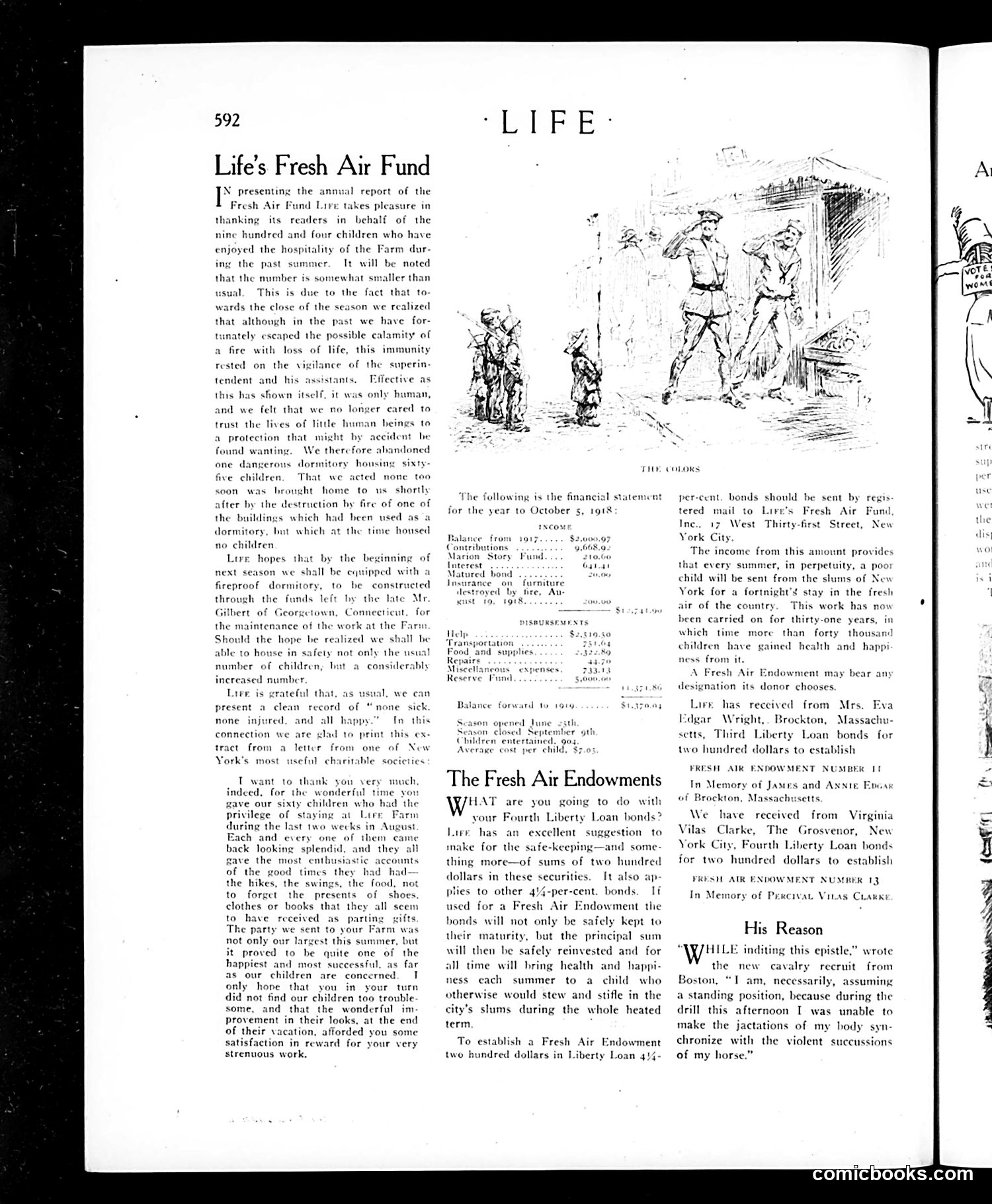
This page documents the Fresh Air Fund's annual report, celebrating support for poor children's summer stays in the countryside. The sketch titled "The Colors" depicts what appears to be soldiers or uniformed figures interacting with children, suggesting a military or institutional context for the children's care during summer 1918. The financial statement shows donations and expenditures, while accompanying text describes the Fund's mission: providing healthful respite for approximately 900 children from New York's slums. The page celebrates the program's thirty-one-year history and solicits further donations through Liberty Loan bonds. The content reflects Progressive Era charitable work and WWI-era fundraising appeals, positioning child welfare as a patriotic civic duty during wartime.
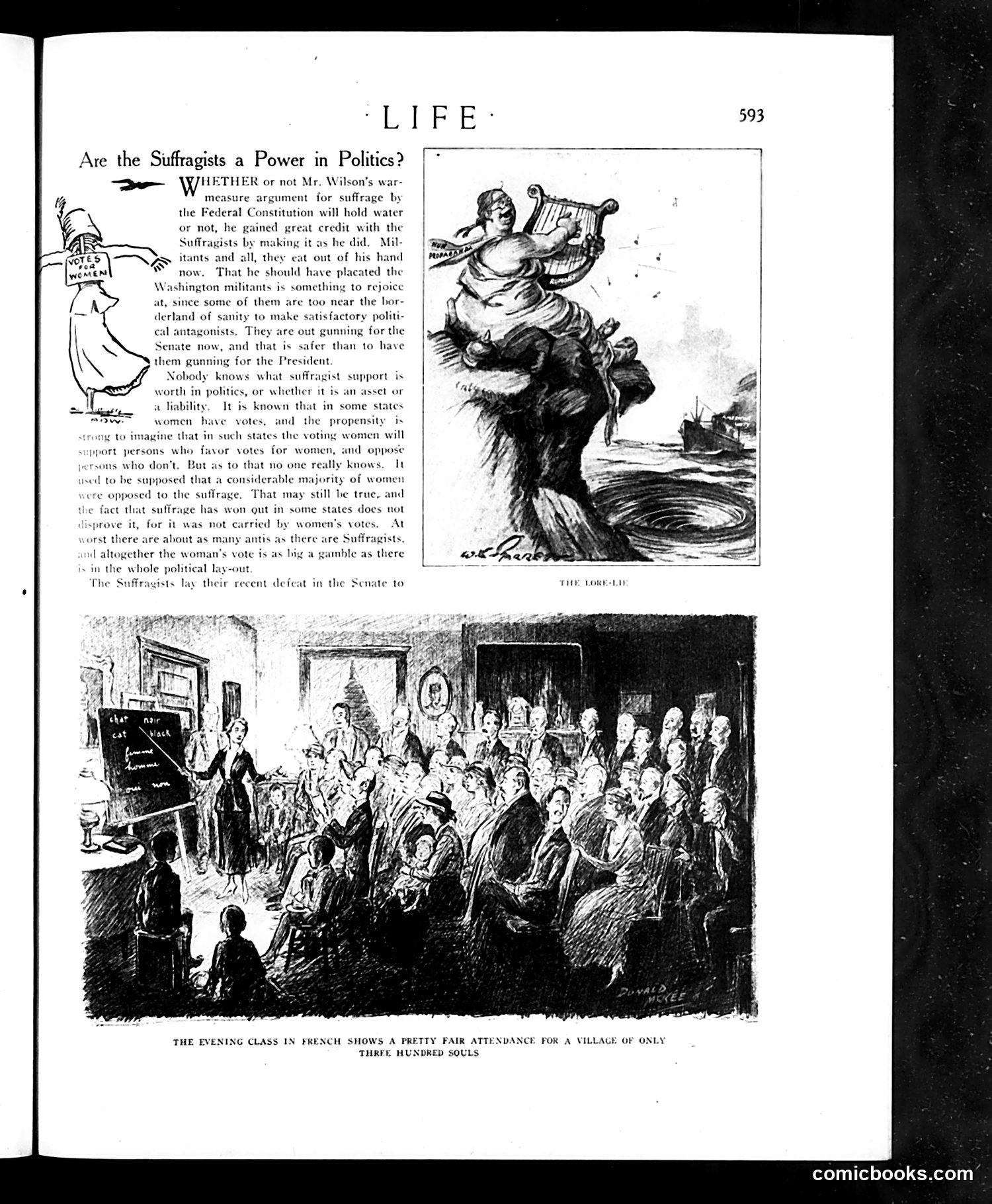
This page satirizes the women's suffrage movement. The article questions whether suffragists hold real political power, noting that Mr. Wilson's federal constitutional amendment strategy for women's voting rights has gained credit. The text suggests suffragists have defeated a Senate measure, implying they do wield influence—though whether this is an asset or liability remains debatable. The upper cartoon titled "The Lord-ly" depicts a rotund, reclining figure (likely representing political power or government) being serenaded by a lyre-player, possibly mocking how suffragists attempt to "charm" political institutions. The lower illustration shows a crowded evening class in France with "pretty fair attendance for a village of only three hundred souls," seemingly contrasting European and American political engagement.
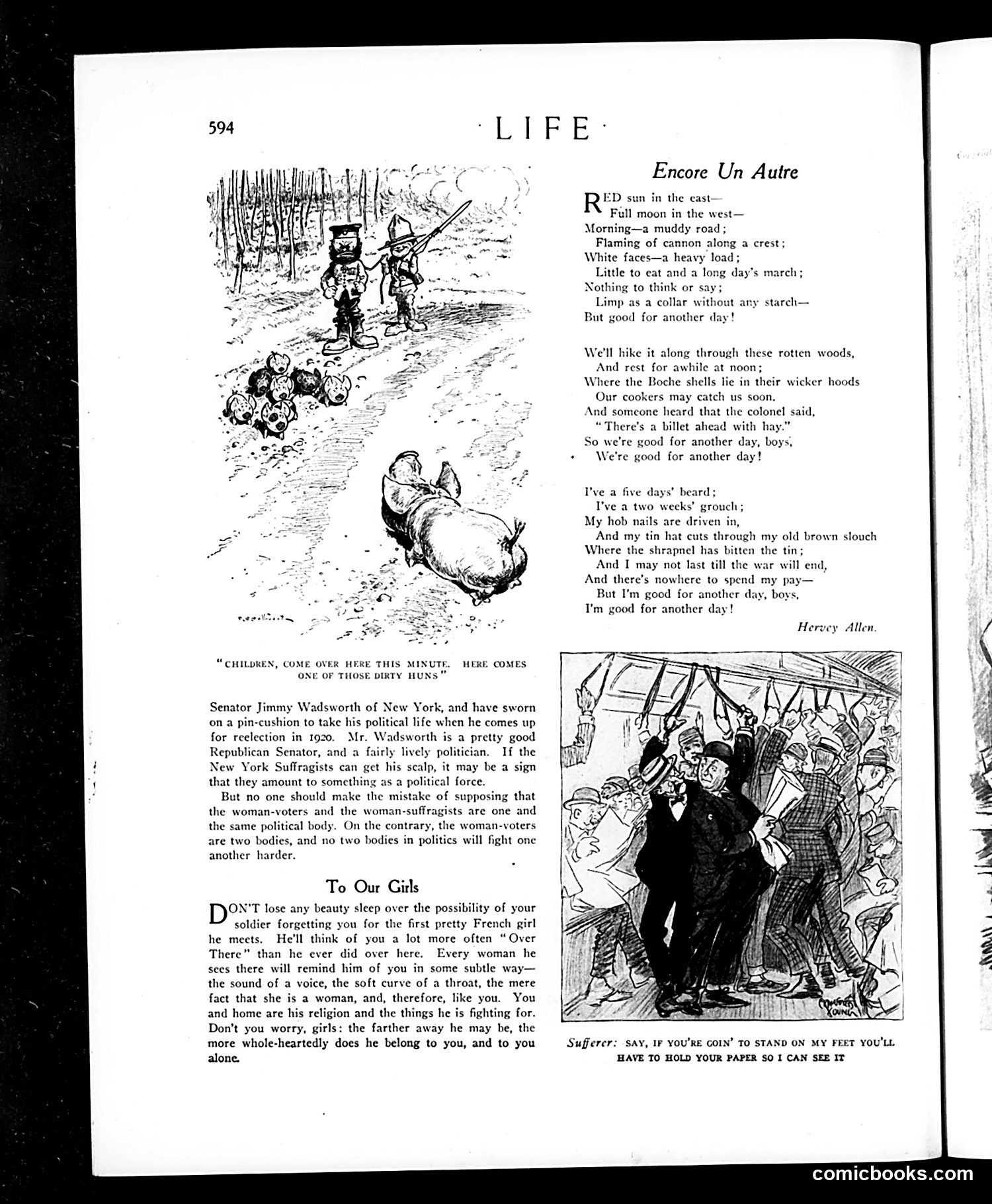
This page contains war-era content, likely from WWI (references to "the war will end"). The main illustration shows soldiers marching through woods with supplies. The poem "Encore Un Autre" by Hervey Allen expresses a soldier's exhausted resilience—he's worn out but declares "I'm good for another day." Below is commentary on Senator Jimmy Wadsworth of New York regarding women's political participation. The text argues that woman-voters and woman-suffragists are unified political forces, suggesting women's voting bloc could influence his 1920 reelection bid. "To Our Girls" warns women soldiers won't forget them, appealing to female patriotism and emotional bonds as reasons to support the war effort. The cartoon at bottom shows crowded troop transport conditions, with a soldier's complaint about standing room being joked away.
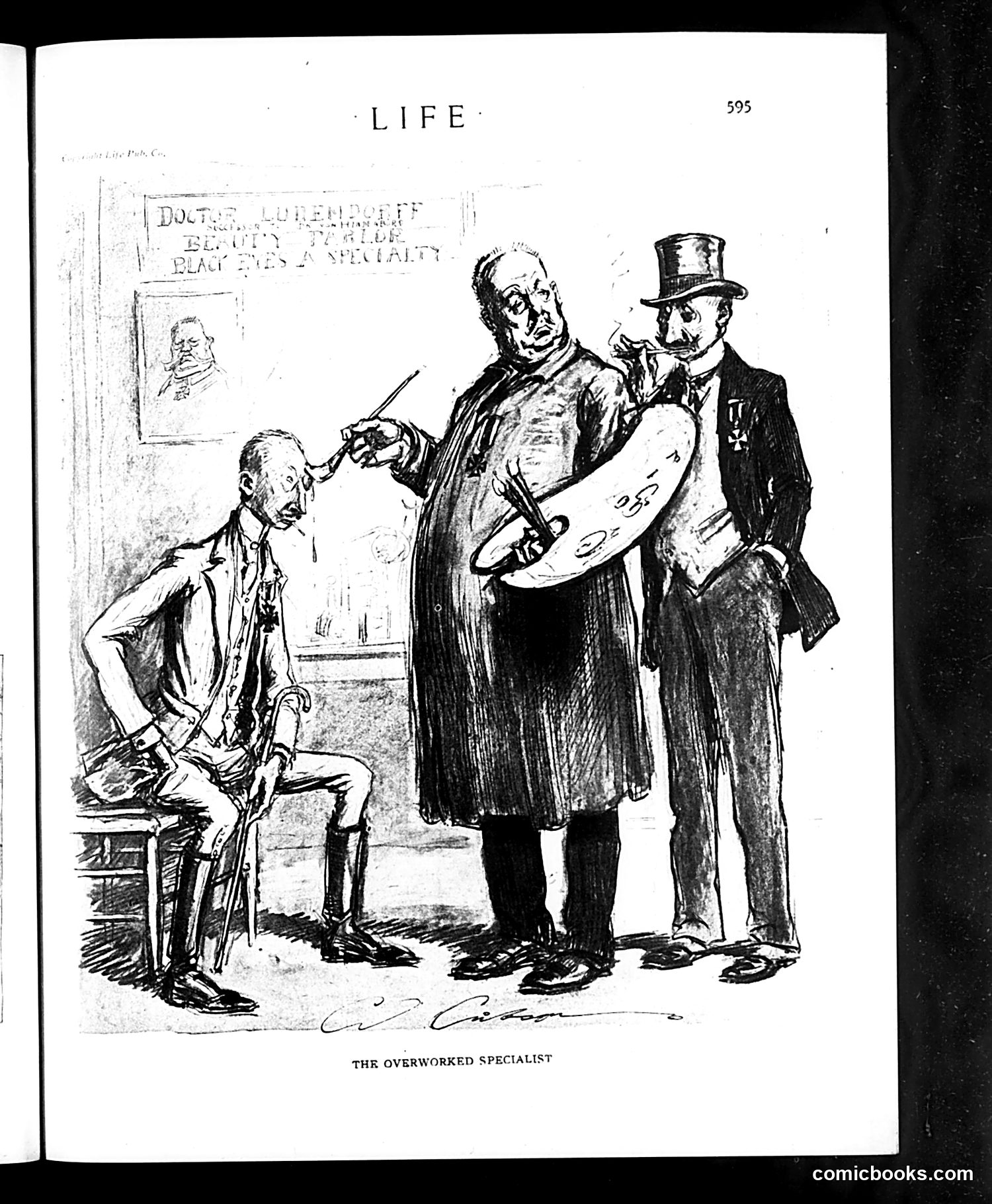
This cartoon satirizes the medical profession's increasing specialization. Three well-dressed men examine a seated patient, who appears exhausted or overwhelmed. The central figure holds what appears to be a medical palette or chart covered with markings—likely representing excessive diagnoses or treatments. The sign in the background reads "DOCTOR LURENDORFF" and mentions "DISEASES" and "SPECIALTY" (text partially obscured). The joke targets medical specialists who over-complicate diagnosis through excessive testing or subspecialization, potentially overtaxing the patient rather than helping them. The cartoon critiques how contemporary medical practice—increasingly fragmented among specialists—may burden rather than benefit patients. The patient's dejected posture suggests frustration with this proliferation of expert opinions and procedures.
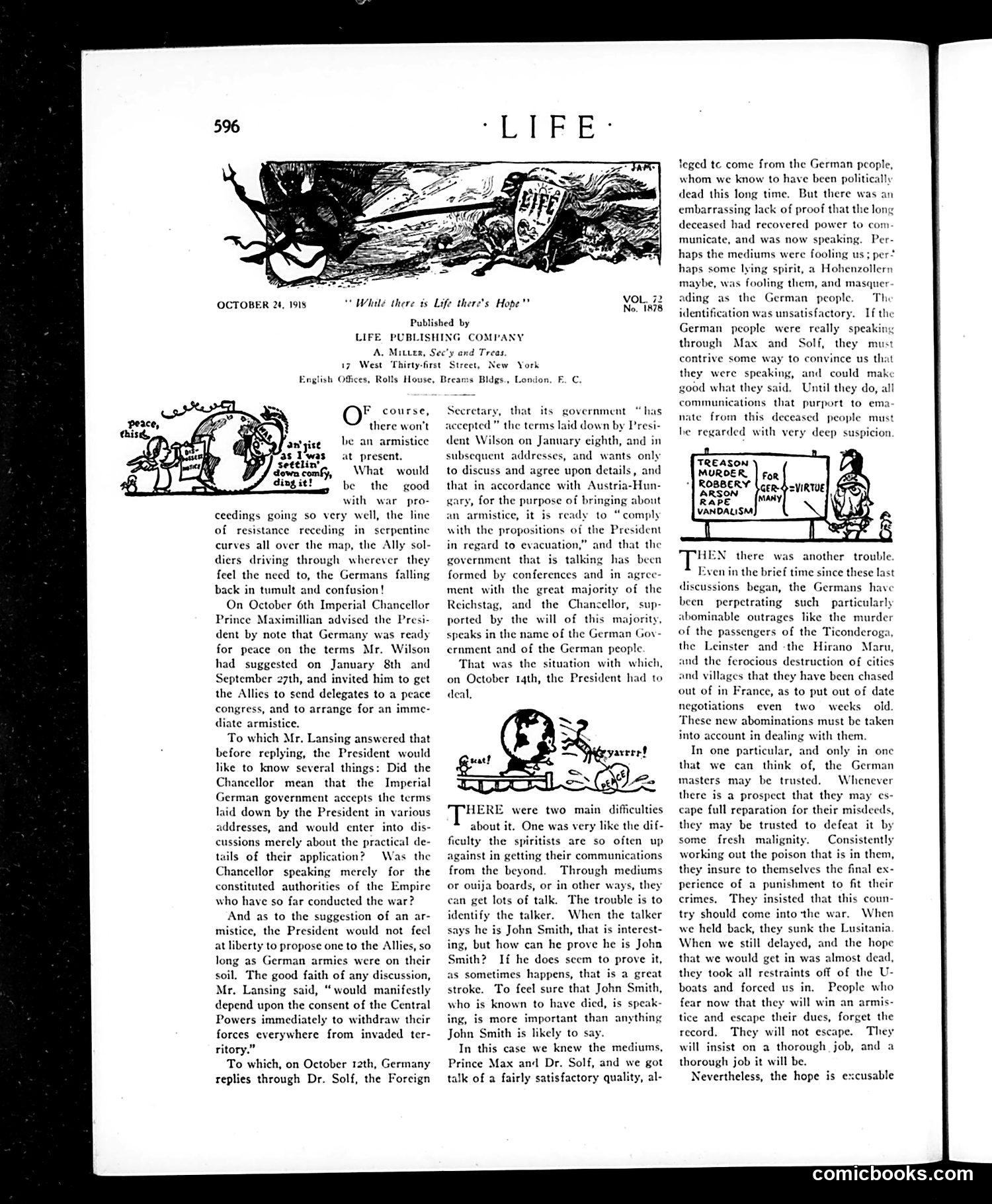
This page discusses German peace negotiations near World War I's end. The cartoons satirize the difficulty of verifying who actually speaks for Germany during armistice discussions. **The Setup:** Germany's Foreign Secretary Dr. Solf claims the German government and people accept President Wilson's peace terms. However, the text questions whether these "mediums" (Solf and Chancellor Prince Max) truly represent the German people or are fraudulent intermediaries—comparing it to spiritualist séances where mediums claim to contact the dead. **The Satire:** The cartoon depicts Germany as a corpse claiming to communicate. The joke is that Germany appears "politically dead" after military defeat, yet suddenly "speaks" through these officials. Can we trust they represent actual German will, or are they (or some hidden force like the Kaiser) deceiving the Allies? **Historical Context:** This reflects real anxiety about whether negotiations were genuine or German deception, just weeks before the November 1918 armistice ending WWI.
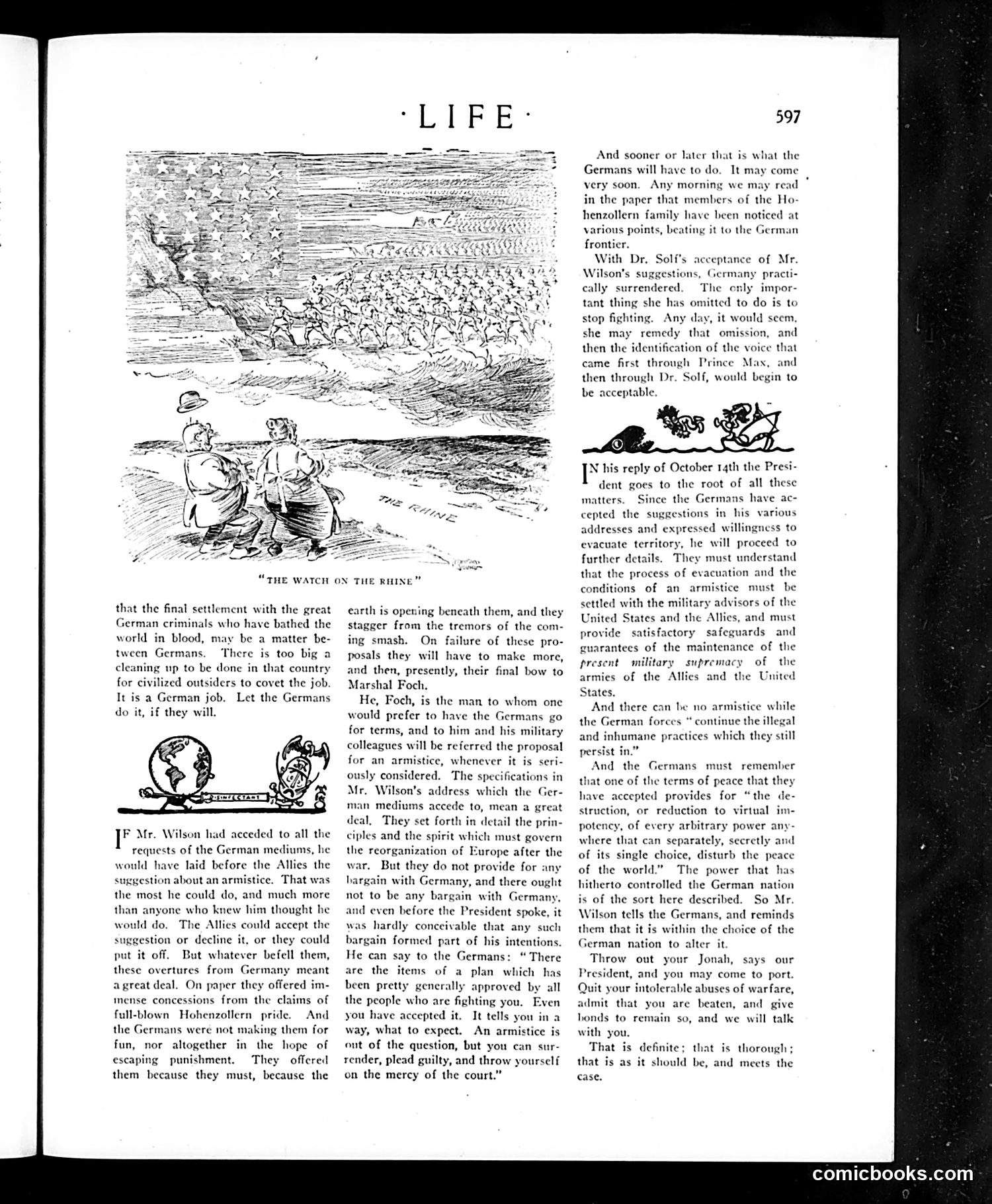
This Life editorial cartoon and text address Germany's armistice negotiations during the final weeks of World War I. The sketch depicts two figures observing across the Rhine River, symbolizing Allied vigilance over German surrender terms. The satire targets German diplomatic overtures through intermediaries (Dr. Solf, Prince Max) as desperate, insincere gestures. The author argues Germany cannot negotiate peace terms—only surrender unconditionally to Allied military commanders like Marshal Foch. The cartoon's title puns on the famous German song "Die Wacht am Rhein," inverting its meaning: instead of Germans guarding their border, the Allies now watch Germany's movements. The piece mocks German pride ("Hohenzollern pride") and predicts imminent German collapse. It emphasizes President Wilson's firm stance: Germany must stop fighting, accept Allied terms without bargaining, and face war crimes accountability—not negotiate as equals.
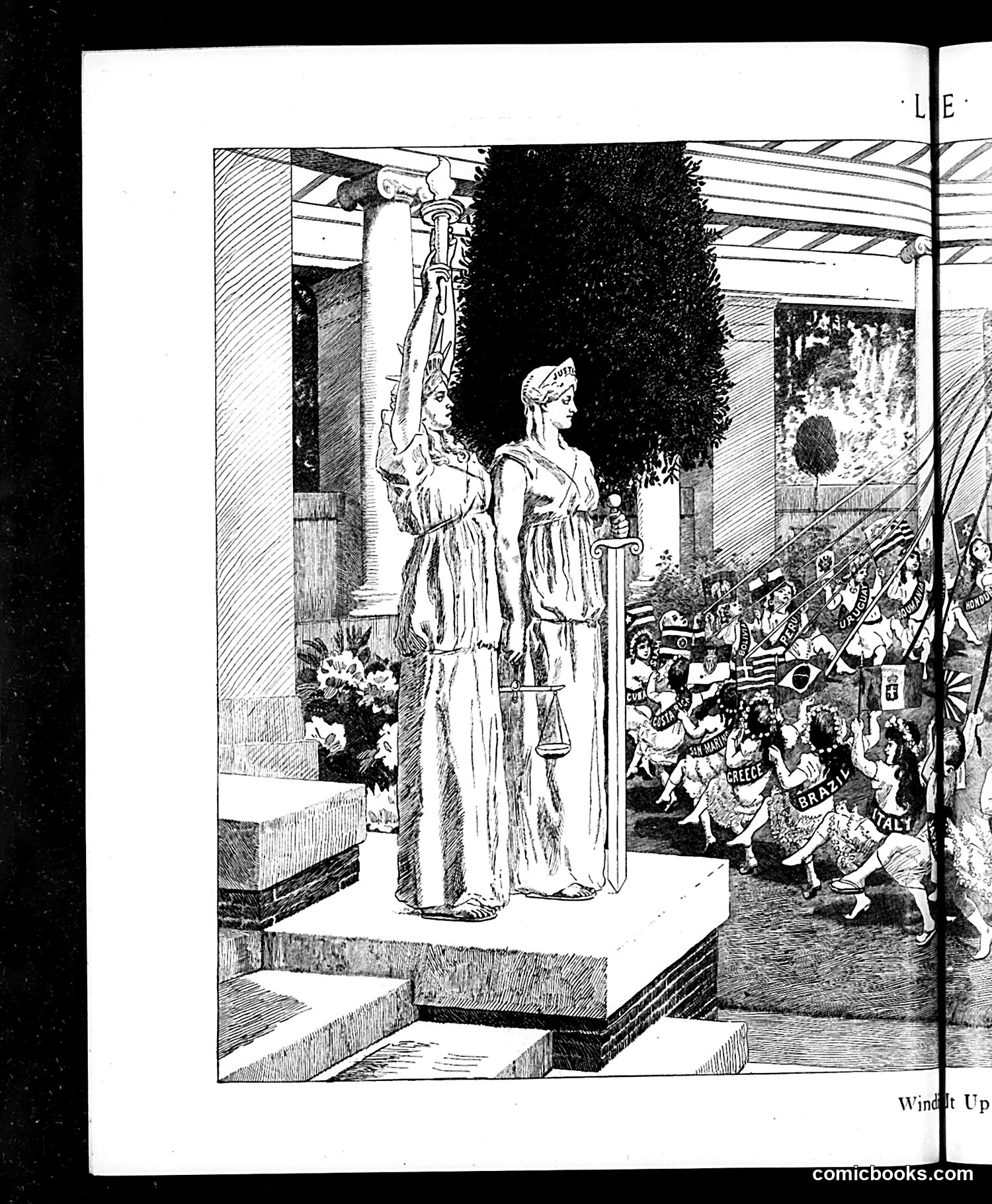
This appears to be a political allegory rather than a conventional cartoon. The image shows two classical female figures (likely representing Liberty or Justice) standing on a pedestal, addressing a crowd below carrying flags from multiple nations including Britain, France, Brazil, Italy, and Greece. The satire likely comments on international diplomacy or Allied relations, possibly during or after World War I (suggested by the multiple national flags). The classical female figures represent abstract ideals—perhaps democratic governance or international unity—addressing representatives of various nations. The caption "Wind It Up" suggests these figures are mechanical or puppet-like, satirizing the notion that international cooperation or diplomacy operates artificially or requires external manipulation rather than genuine accord.
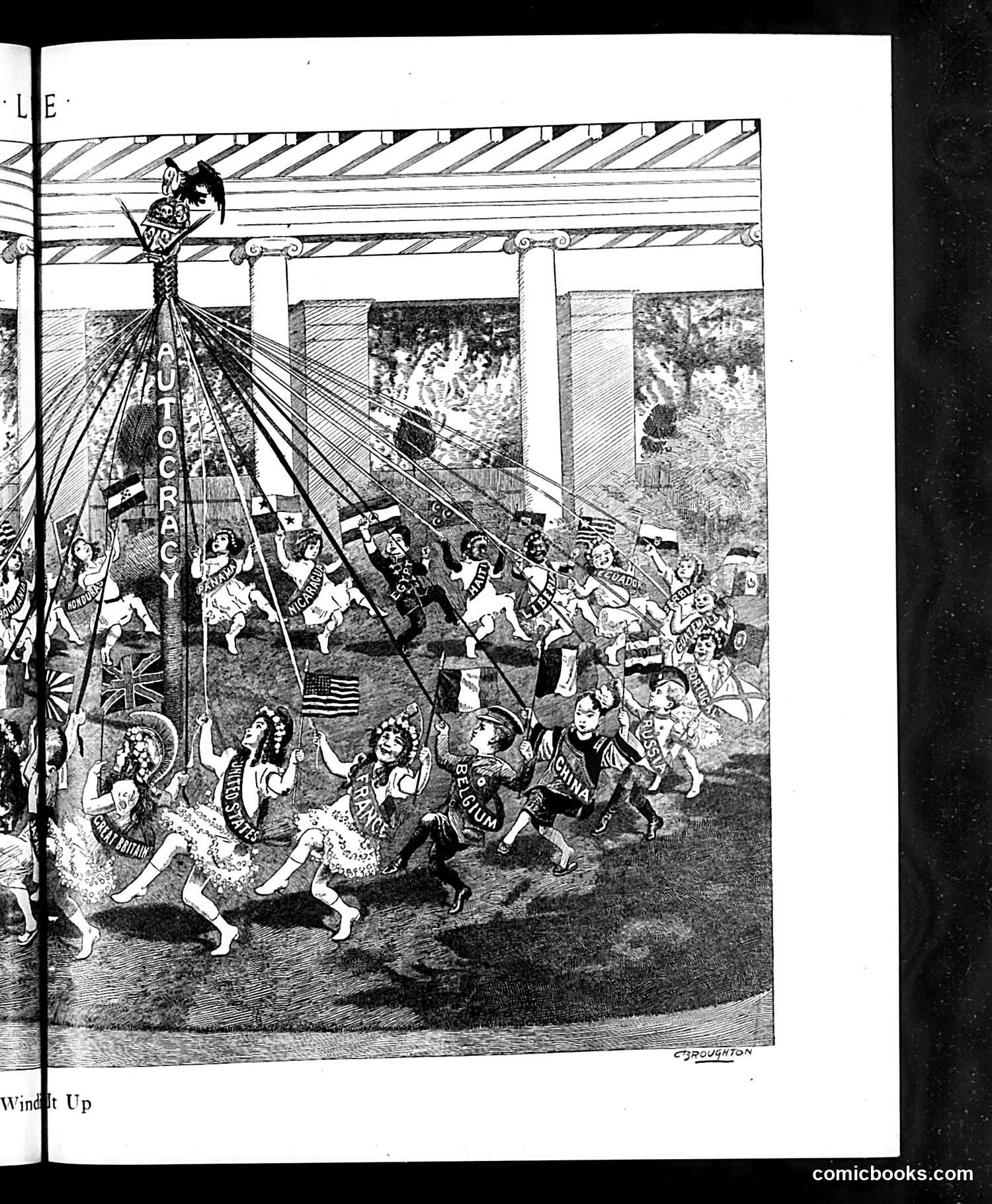
This satirical illustration depicts a carousel or merry-go-round scene with political overtones. At the center is a tall pole labeled "AUTOCRACY" supporting radiating strings attached to various figures arranged in a circle below. These figures appear to represent different nations or political entities, each holding flags—including what appears to be British, American, and other national symbols. The satire suggests that despite appearing to move freely on the carousel, these nations are actually controlled by the central "autocracy" pole through invisible strings. This is a commentary on imperialism or authoritarian control, illustrating how powerful nations (likely Germany or Austria-Hungary during the World War I era, given Life magazine's timeframe) manipulate ostensibly independent countries through political dominance. The artist's signature appears to be Broughton.
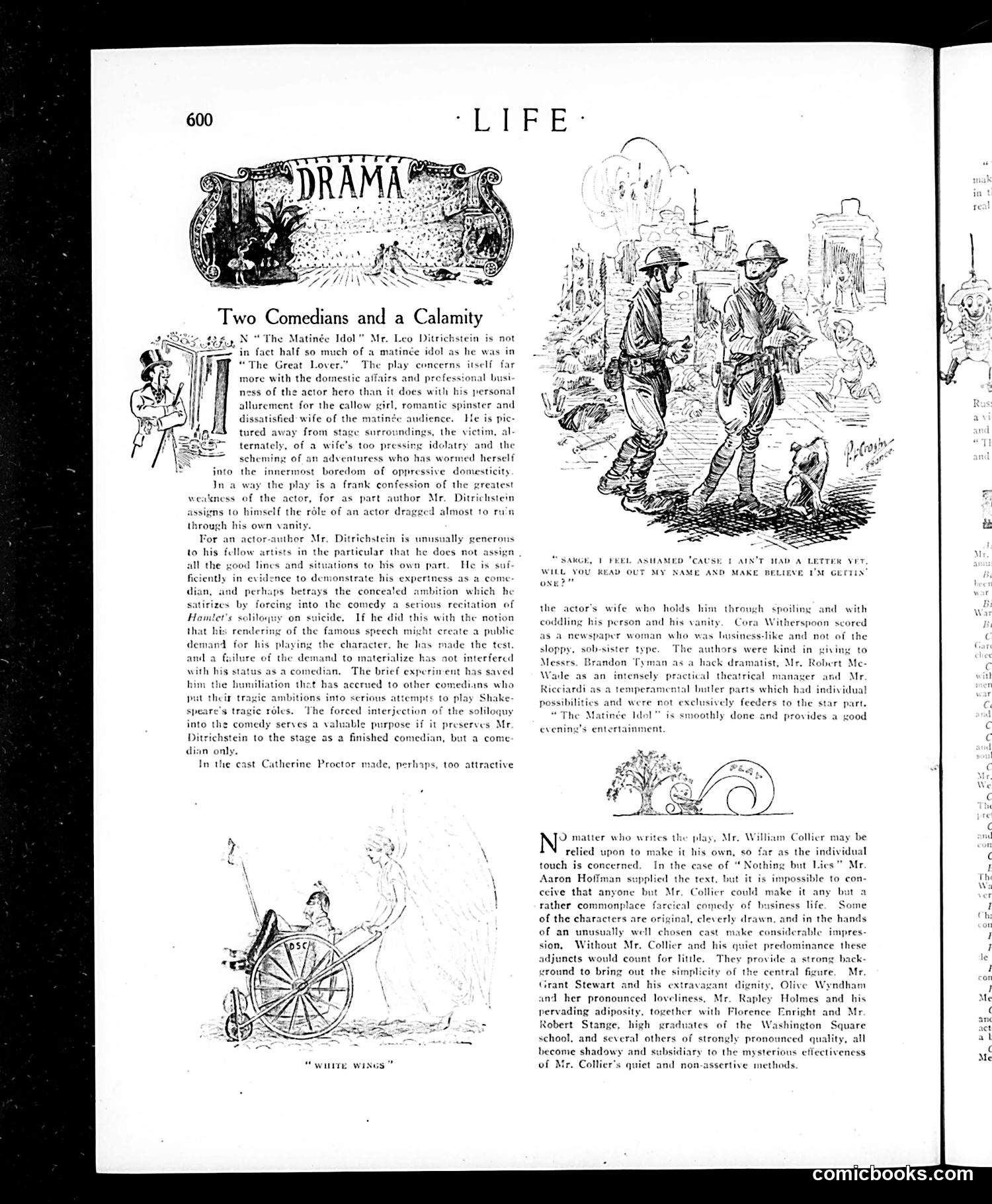
This page reviews two theatrical productions. The main article discusses "The Matinée Idol," starring Leo Ditrichstein, an actor-playwright who writes himself leading roles. The satire critiques his vanity—despite showing restraint by not hogging all good lines, he still indulges in serious dramatic moments (notably performing Hamlet's suicide soliloquy), undermining the comedy. Life suggests this reflects actors' fundamental weakness: prioritizing personal vanity over the play's success. The second review praises William Collier in "Nothing but Lies," arguing that regardless of who writes the script, Collier's quiet, understated comedic style elevates mediocre material. The accompanying sketches illustrate theatrical scenes and character types from these productions. The humor targets theatrical ego and the tension between actors' ambitions for serious dramatic roles versus their actual talent for comedy.
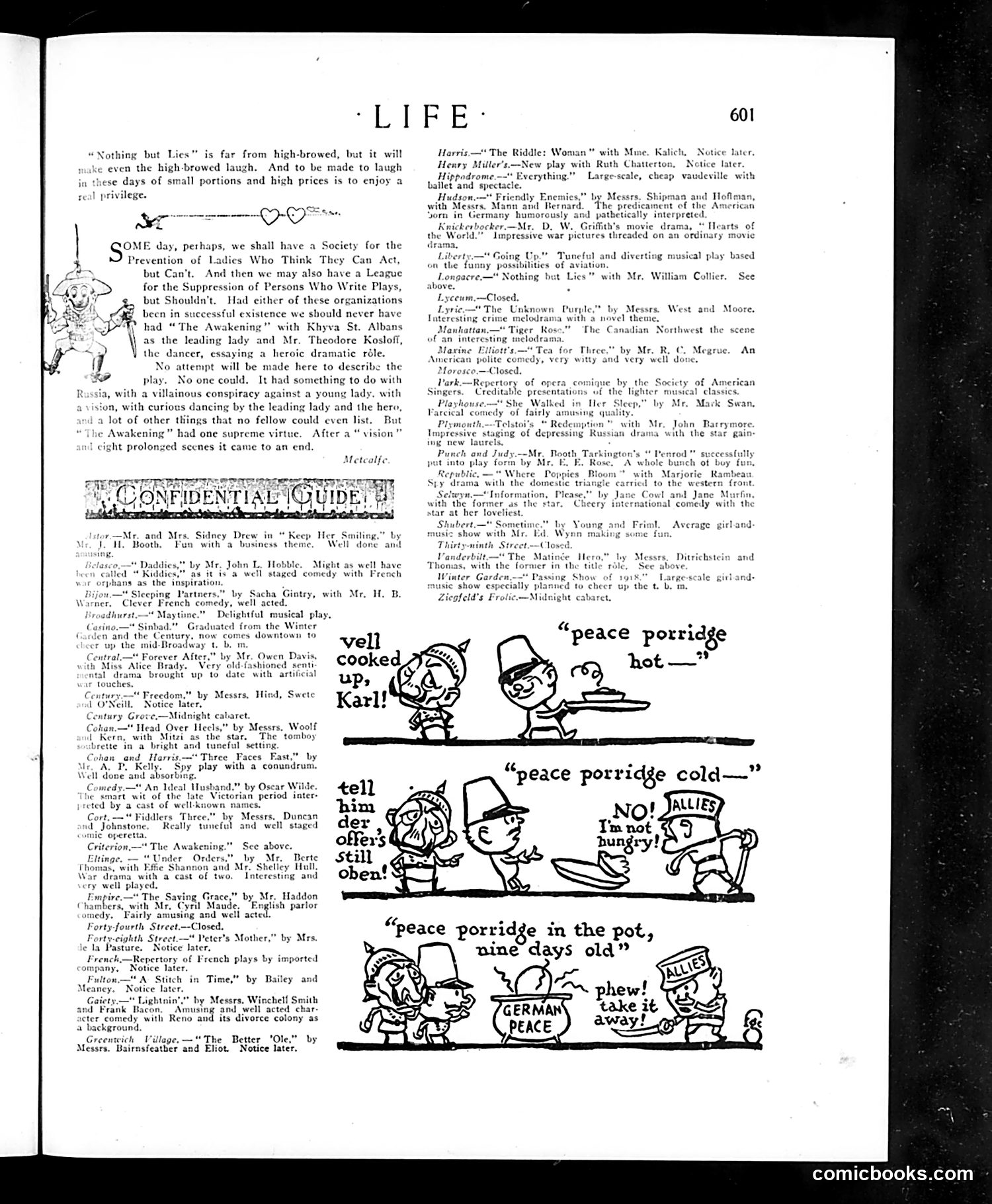
This page contains theater reviews alongside a three-panel comic strip satirizing World War I peace negotiations. **The Comic Strips:** The cartoons feature caricatured soldiers (appearing to represent Allied forces, marked "ALLIES") debating the merits of "peace porridge"—a metaphorical reference to the peace settlement being negotiated. The first panel shows enthusiasm for hot peace; the second shows resistance to cold peace; the third depicts them rejecting the pot entirely, with a "GERMAN PEACE" label visible. **The Satire:** This mocks post-WWI peace talks, likely referencing the Treaty of Versailles negotiations (1919). The "porridge" metaphor—derived from the nursery rhyme—suggests the peace agreement is being served in various unpalatable forms. The soldiers' complaints (too hot, too cold, must be taken away) satirize how different parties found the proposed peace terms unacceptable, whether too harsh or too lenient. **Context:** Published during active armistice/treaty discussions, the strip ridicules the diplomatic stalemate where no settlement satisfied all parties.
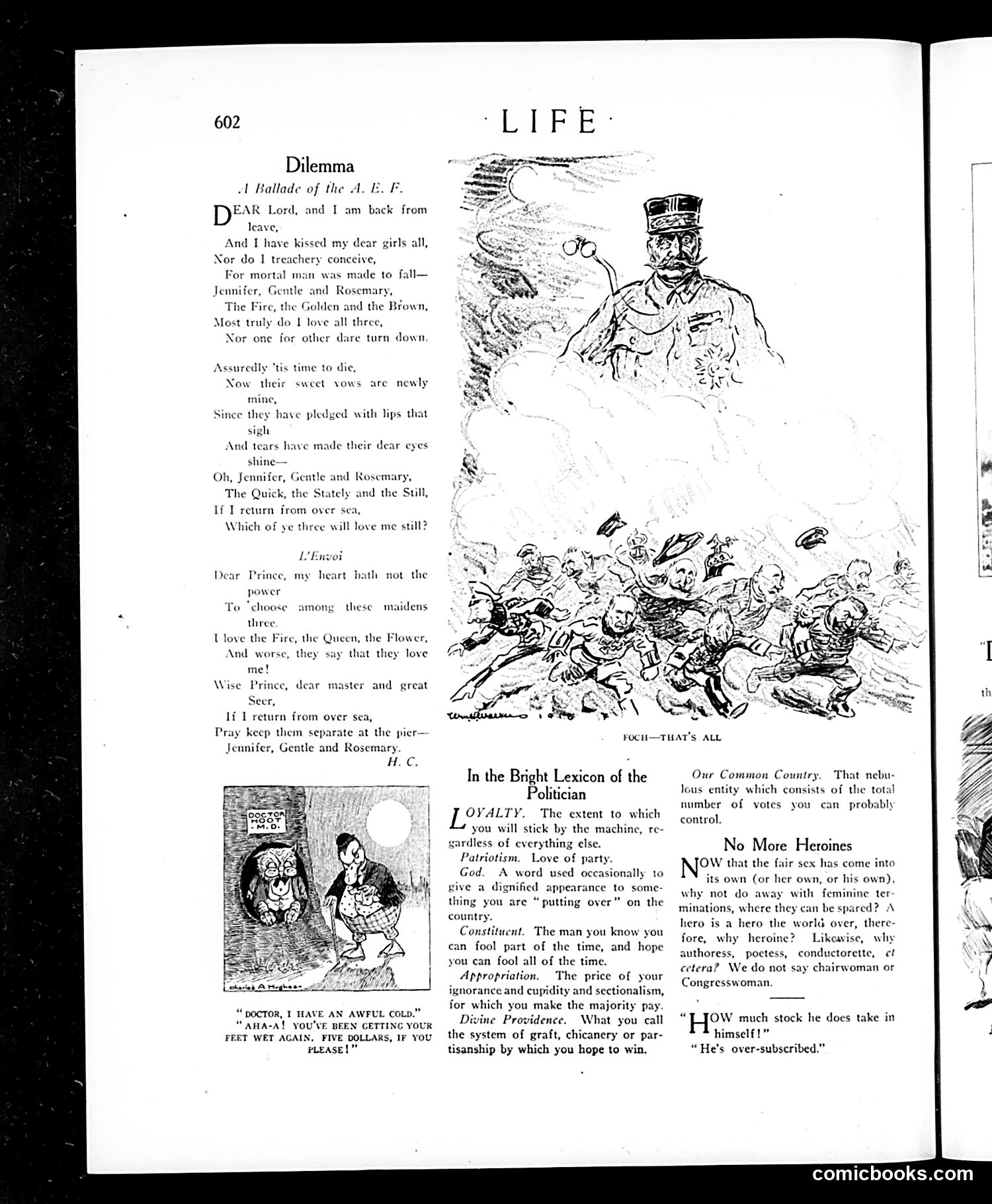
This page contains three distinct satirical pieces: **"Dilemma"** (top): A mock-serious poem about a Prince unable to choose among three women before departing overseas. The satire appears to mock romantic indecision and wartime separations—likely referencing WWI soldiers leaving sweethearts behind. **"FOCH—THAT'S ALL"** (center illustration): Shows a military officer amid chaos. "Foch" likely refers to French General Ferdinand Foch; the caption suggests ironic commentary on military leadership or decision-making. **"Bright Lexicon of the Politician"** (left): Cynical definitions mocking political hypocrisy—"Loyalty" means party obedience, "Patriotism" means party loyalty, "Divine Providence" means corruption. This directly attacks politicians' dishonest language. **Additional pieces**: A doctor joke about colds and wet feet; a brief satire titled "No More Heroines" arguing against gendered professional titles (heroine, authoress, conductorette); and a quip about someone being "over-subscribed" with self-importance. The overall tone is anti-politician and skeptical of wartime leadership.
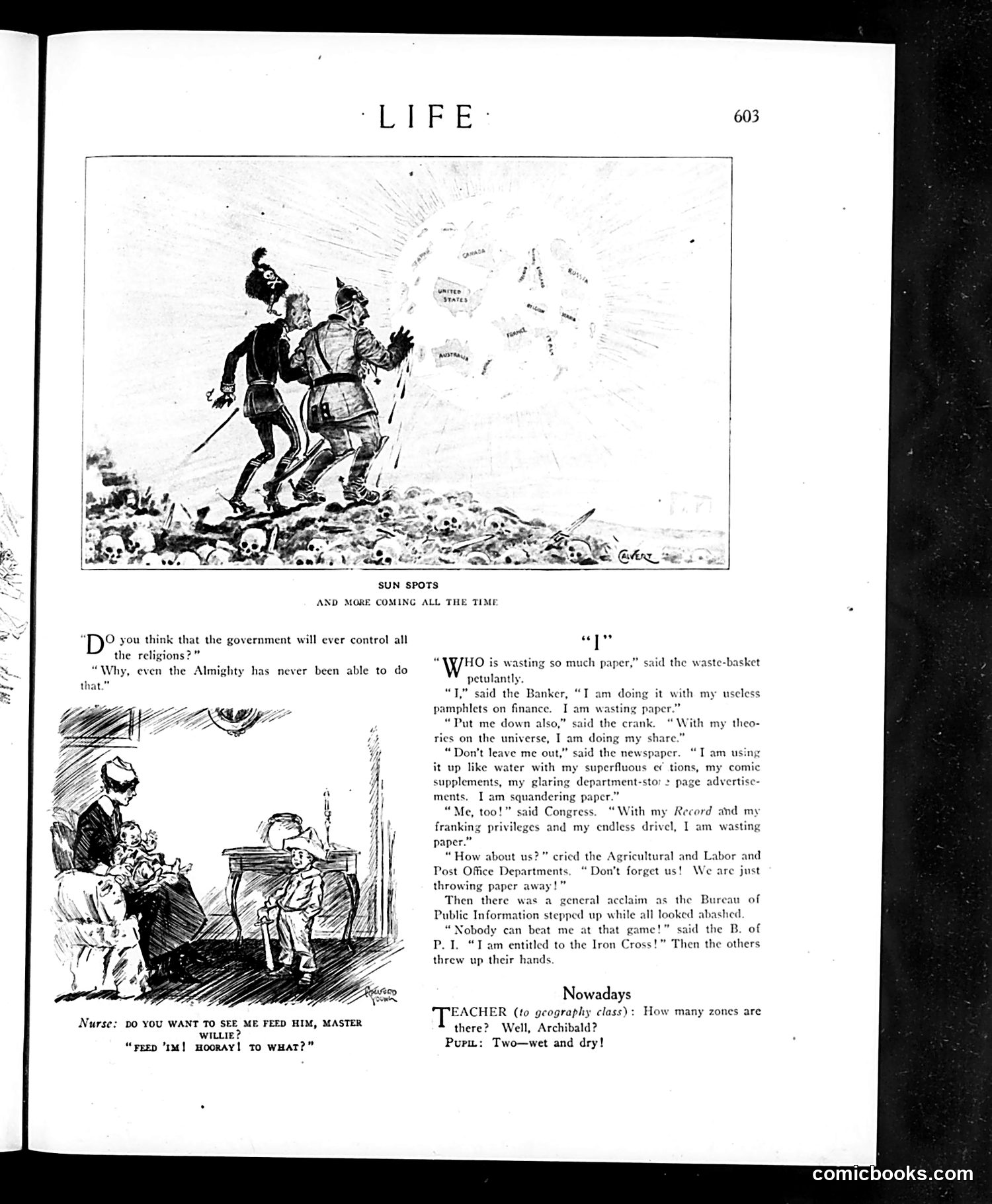
This page contains multiple cartoons satirizing early 20th-century American bureaucratic inefficiency and waste. The main cartoon depicts various government institutions and organizations personified as characters competing over who wastes the most paper. The Banker, Congress, newspapers, and multiple government departments (Agricultural, Labor, Post Office, Bureau of Public Information) all boast about their wasteful practices. The Bureau of Public Information "wins" the competition, claiming superiority in waste production. The satire mocks government bloat and the proliferation of useless paperwork and propaganda. The top cartoon references religious control—suggesting even God cannot control all religions, implying government attempts at such control are futile. The "Nowadays" joke at bottom is a simple schoolroom gag where a student answers a geography question about climate zones with "wet and dry"—a child's crude oversimplification.
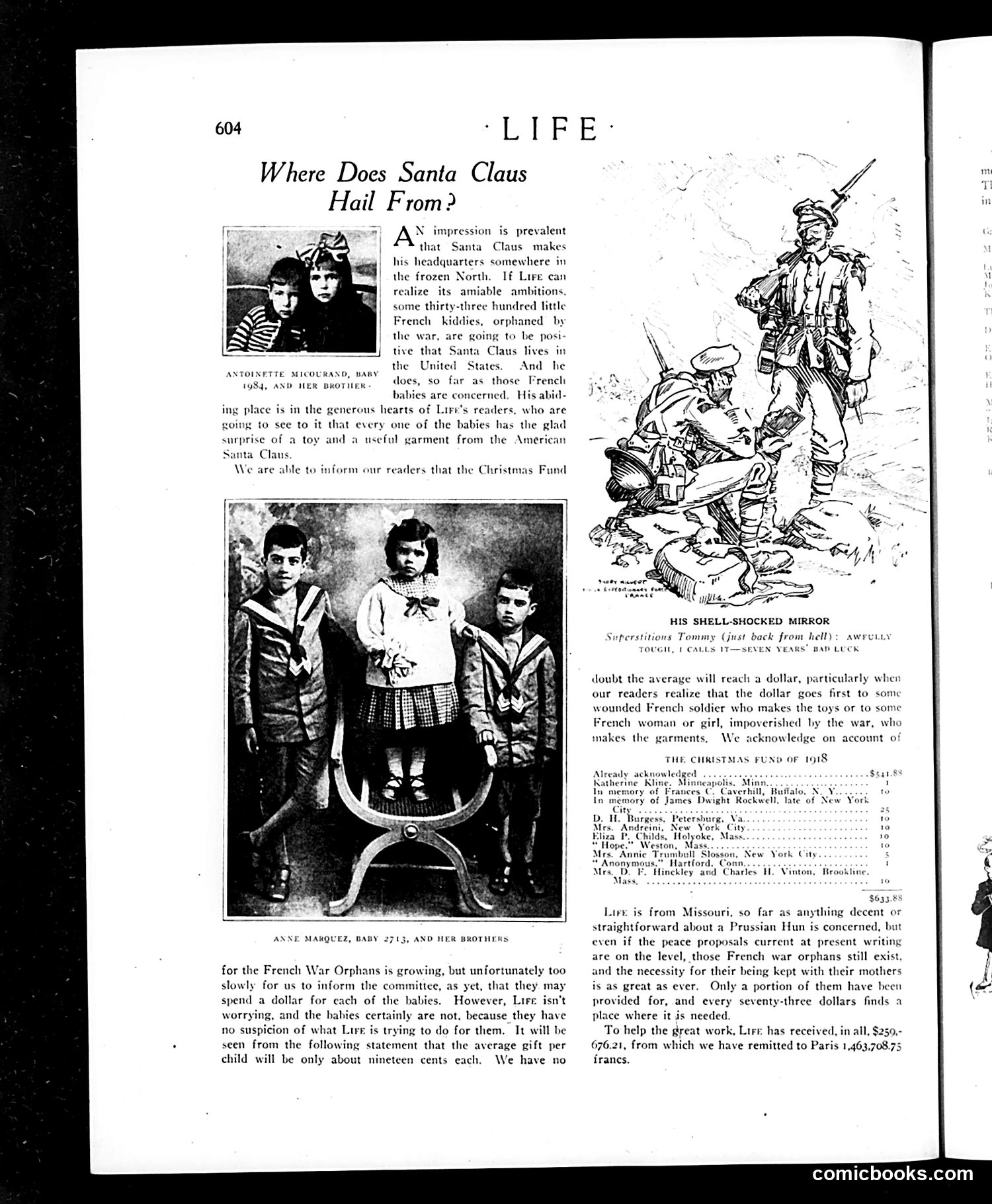
This page promotes Life's Christmas Fund for French War Orphans—children orphaned by World War I. The text and photographs aim to persuade American readers to donate money. The page includes two photographs of French children (Antoinette Micourand and Anne Marquez with their brothers) to personalize the appeal. Life promises that American donations will fund toys and clothing made by wounded French soldiers and impoverished French women, thereby supporting both orphans and adults economically devastated by the war. The small cartoon titled "His Shell-Shocked Mirror" depicts a shell-shocked British soldier (Tommy) expressing superstition about bad luck—a commentary on psychological trauma from combat. This reinforces the human cost of war that the fund addresses. The page reports $250,676.21 raised so far, with funds remitted to Paris. The appeal emphasizes that even small donations (averaging nineteen cents per child) help.
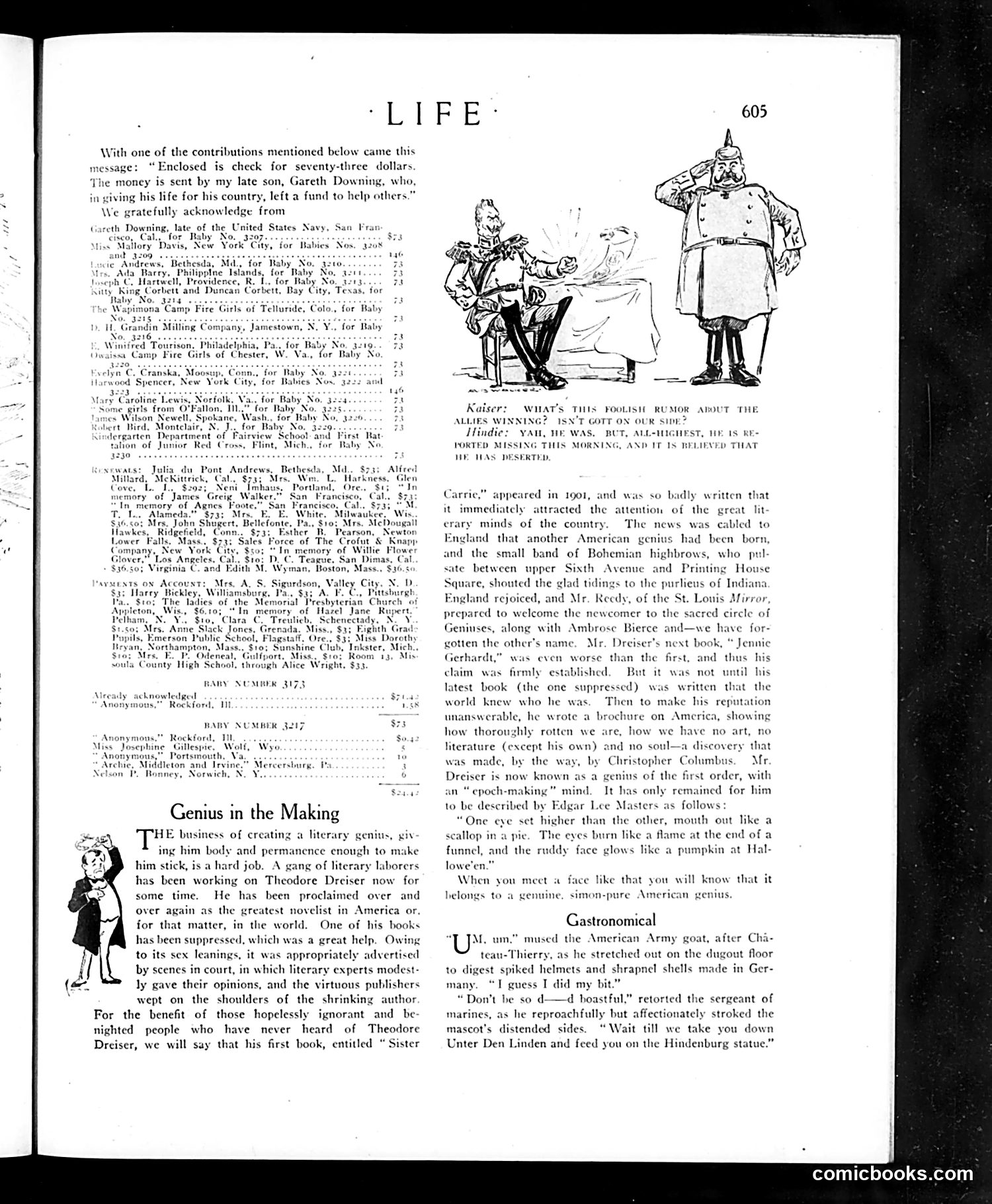
This page contains two distinct elements: **Left side:** A fundraising list for "Life's" baby welfare program, acknowledging donations (many $73, suggesting a standard contribution amount) from individuals and organizations. Notably, the first entry honors Gareth Downing, a Navy officer who died in service, whose family established a fund to help others. **Right side:** Two satirical pieces: 1. **Political cartoon** (top): A dialogue between the Kaiser and "Hindie" (likely his Hindu ally) mocking German military confidence. The Kaiser jokes that God is on Germany's side, but admits their best general has gone missing—a dark joke about military incompetence or desertion during World War I. 2. **Literary essay** (bottom): "Genius in the Making" ridicules novelist Theodore Dreiser's reputation. Life sarcastically credits literary critics and court suppression of his work (for sexual content) with creating his fame, suggesting his renown is manufactured hype rather than merit. The piece dismisses his early novels as poorly written.
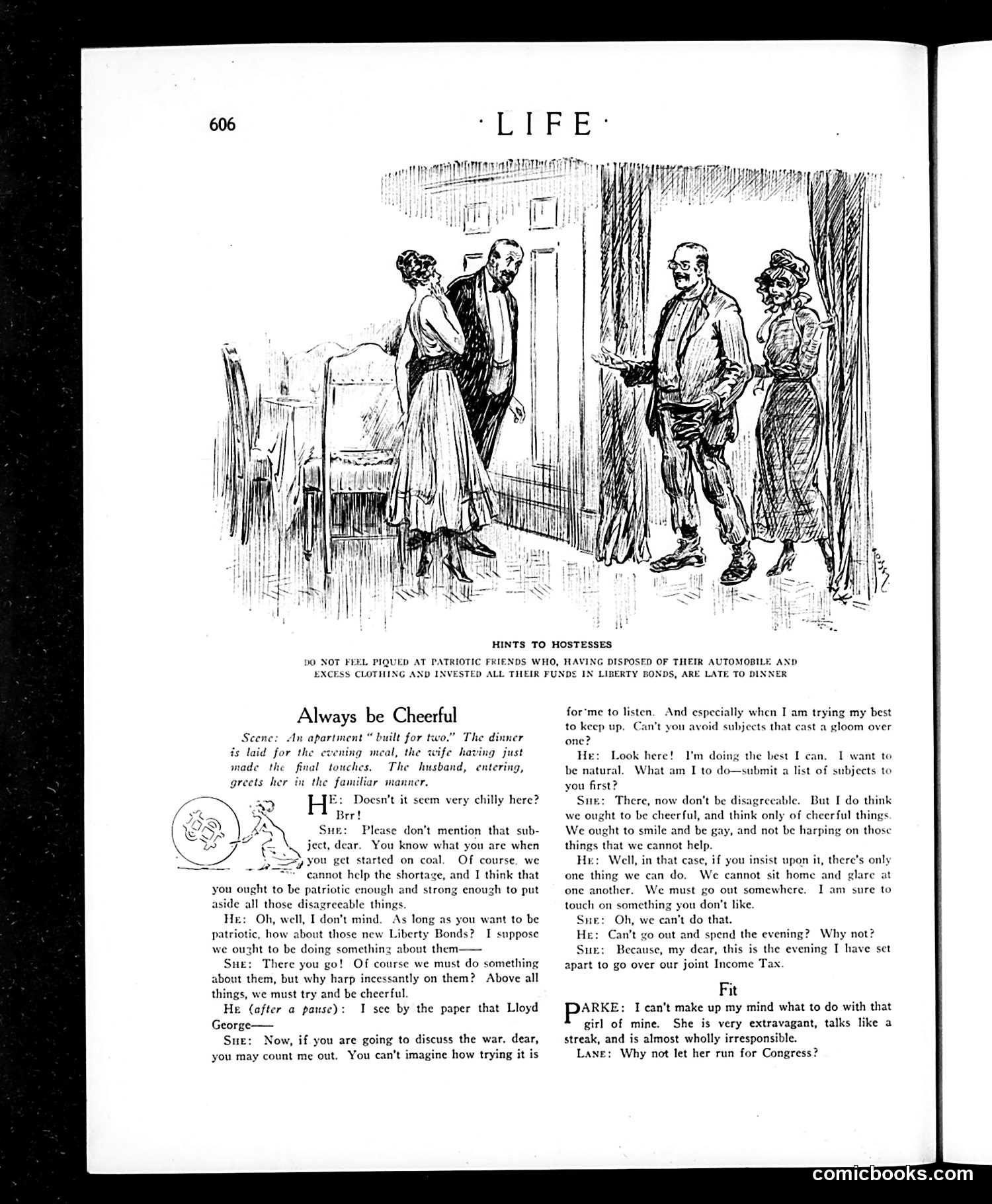
This page contains two satirical pieces about wartime sacrifice during World War I. **"Always be Cheerful"** depicts a domestic argument where a wife insists on maintaining cheerfulness despite real hardships. The husband mentions coal shortages, Liberty Bonds (war loans), and war news—all genuine wartime concerns—but the wife refuses to discuss anything "disagreeable." The joke's bitter irony: they've sacrificed their car, sold excess clothing, and invested in bonds, yet must pretend everything is fine. The punchline—she's too busy reviewing their joint income tax—suggests the actual stress undermining her forced optimism. **"Fit" (bottom right)** is a brief joke about an extravagant, irresponsible woman. One man jokes she should "run for Congress," implying women in politics are similarly frivolous. This reflects pre-19th Amendment attitudes dismissing women's political capability. The page's subtitle mocks patriotic friends who make financial sacrifices then arrive late to dinner—suggesting performative patriotism masking selfishness. The satire targets both wartime discomfort and the social pressure to maintain false cheer.
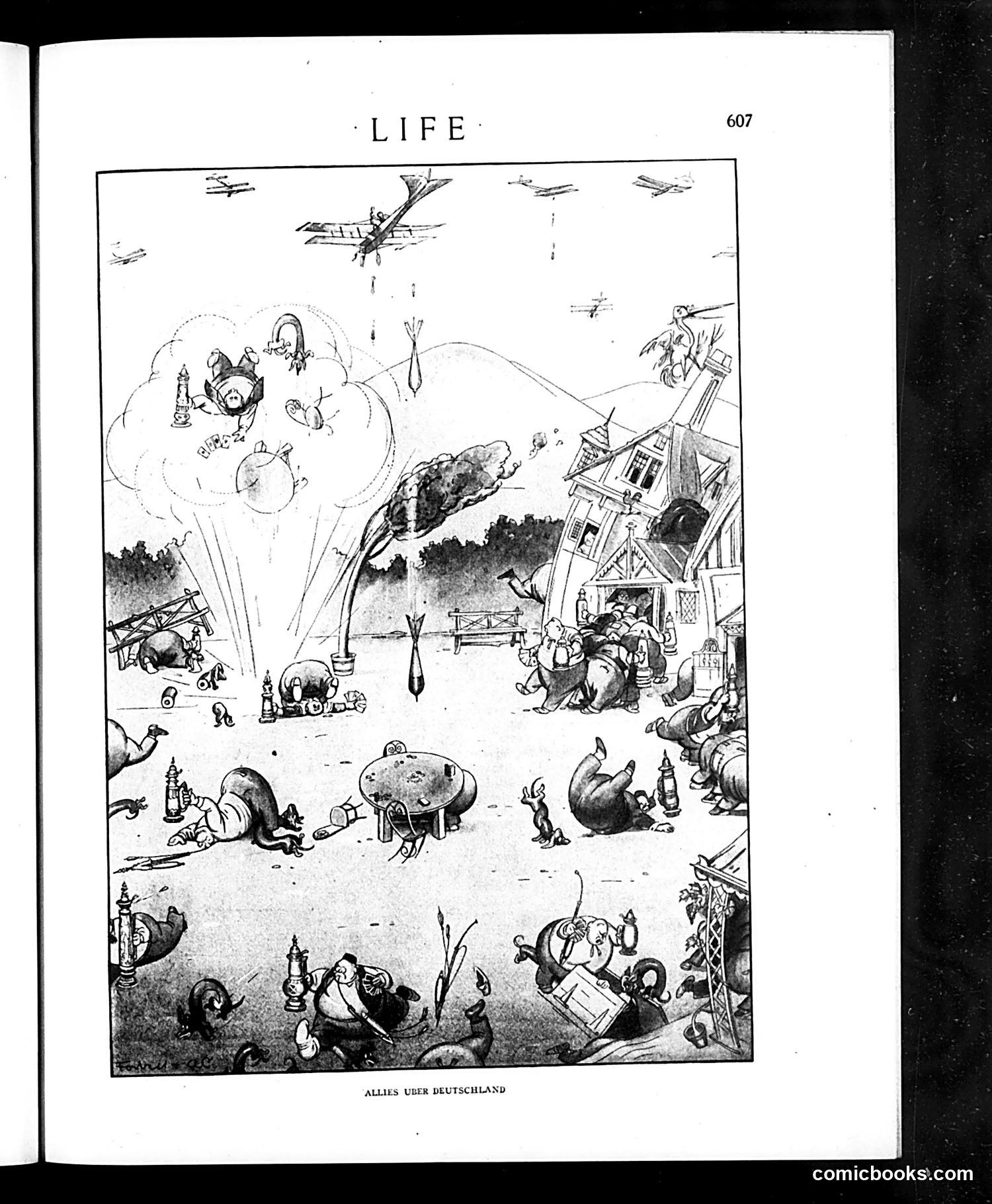
This is a German-language satirical cartoon titled "Allies Über Deutschland" (Allies Over Germany). The illustration depicts an apocalyptic aerial bombardment scene, likely from WWI or WWII era, showing Allied aircraft dropping bombs on German territory. The image includes military aircraft, explosions, falling bombs, a damaged windmill, and German civilians/soldiers in chaos below. The satire appears to be either: (1) German propaganda mocking Allied air superiority and destruction, or (2) Allied commentary on German vulnerability to bombing campaigns. The phrase "Über Deutschland" (Over Germany) plays on Nazi ideology's "Über alles" rhetoric, suggesting Allied dominance. Without a visible publication date, the exact historical context remains unclear, but the illustration's style and subject matter suggest early-to-mid 20th century conflict commentary.
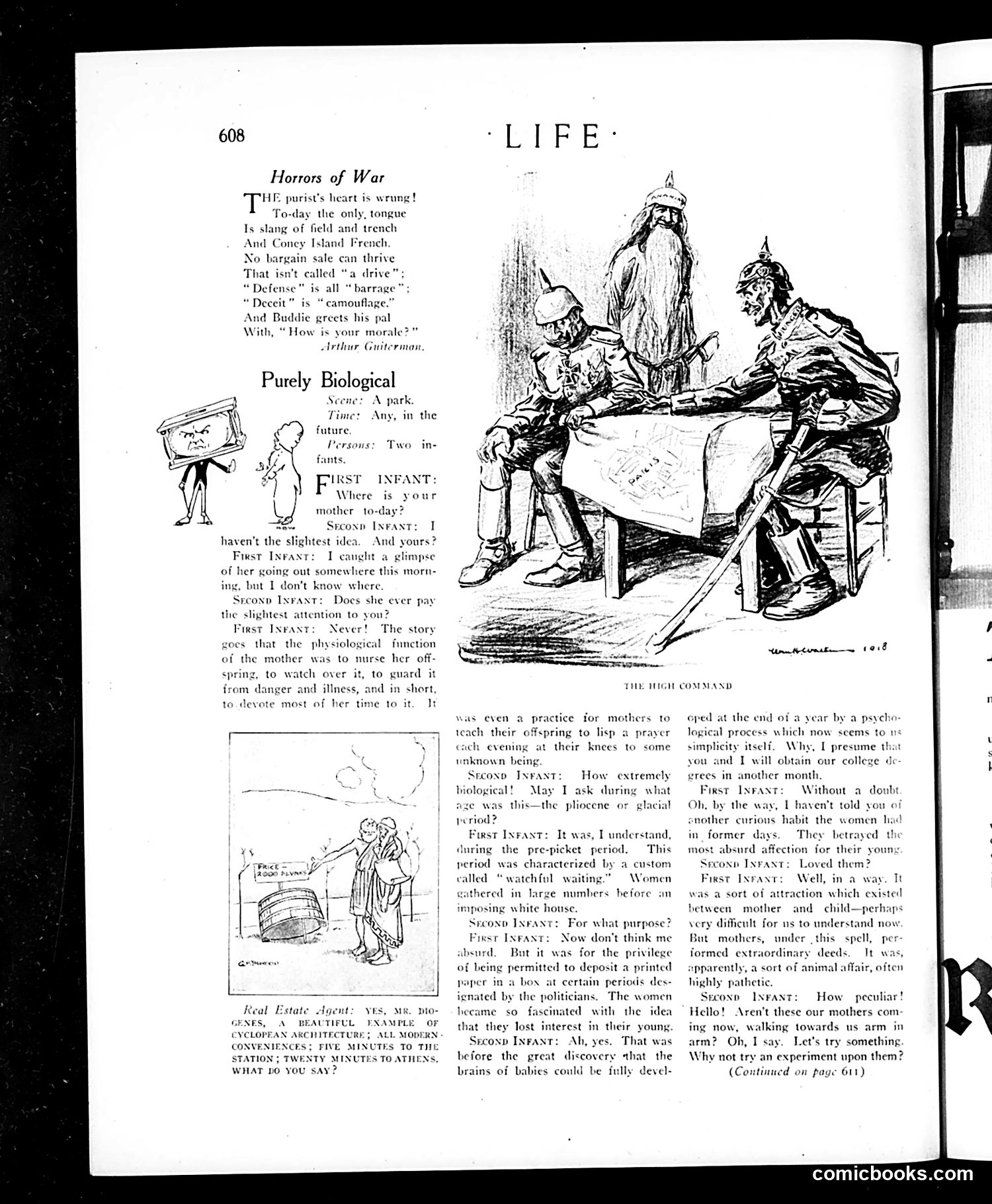
This comic dialogue features two infants discussing mothers as if they were extinct historical creatures, mocking contemporary attitudes toward motherhood during WWI-era America. The satire targets two shifts: First, **wartime social changes** that pulled women away from home—many entered the workforce or engaged in political activism (the "pre-picket period" references women's suffrage efforts). Second, **modern detachment** from traditional maternal roles, portrayed as the infants casually dismissing nurturing as outdated biological function. The joke's bite comes from **ironic reversal**: the babies speak like jaded academics analyzing a dead civilization, treating maternal love and child-rearing as quaint anthropological oddities rather than natural instincts. This reflects contemporary anxieties that war, industrialization, and women's liberation were eroding "natural" family structures—a conservative critique wrapped in absurdist humor.
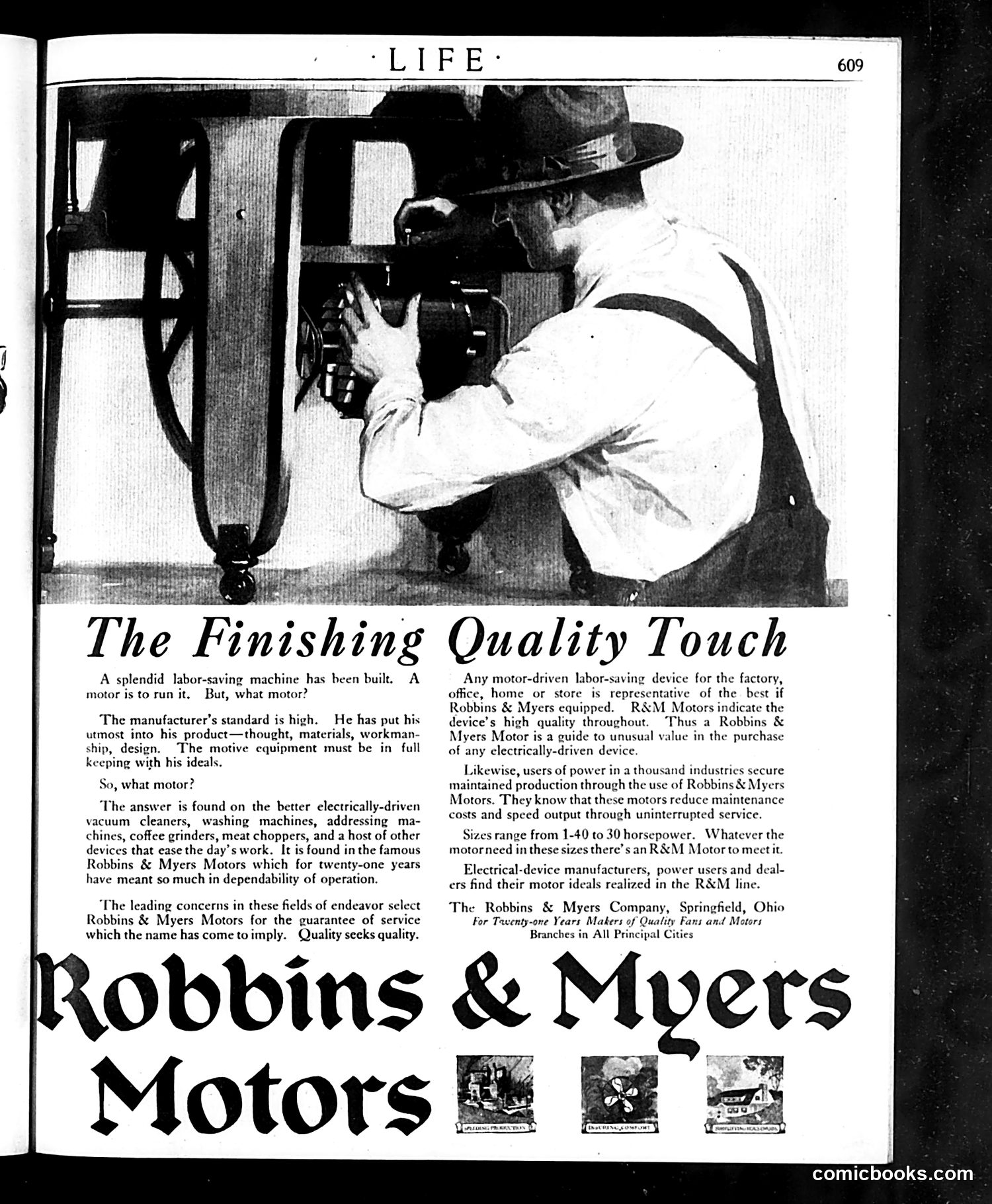
This is a **product advertisement**, not political satire or editorial cartoon. It promotes Robbins & Myers Motors, an electric motor manufacturer based in Springfield, Ohio. The image shows a man operating an early motion-picture camera—a contemporary reference to modern industrial and commercial equipment. The headline "The Finishing Quality Touch" uses this visual metaphor to suggest that R&M Motors represent the final element of quality in any machine. The advertisement's pitch is straightforward: quality manufacturers choose Robbins & Myers Motors because they guarantee reliability and durability. The text emphasizes that these motors power "vacuum cleaners, washing machines, addressing machines, coffee grinders"—labor-saving devices gaining popularity in the 1920s-era American home and factory. The advertisement claims 21 years of dependable operation and positions R&M Motors as a mark of quality comparable to "quality seeking quality." This is typical early 20th-century industrial advertising targeting manufacturers and businesses rather than consumers.
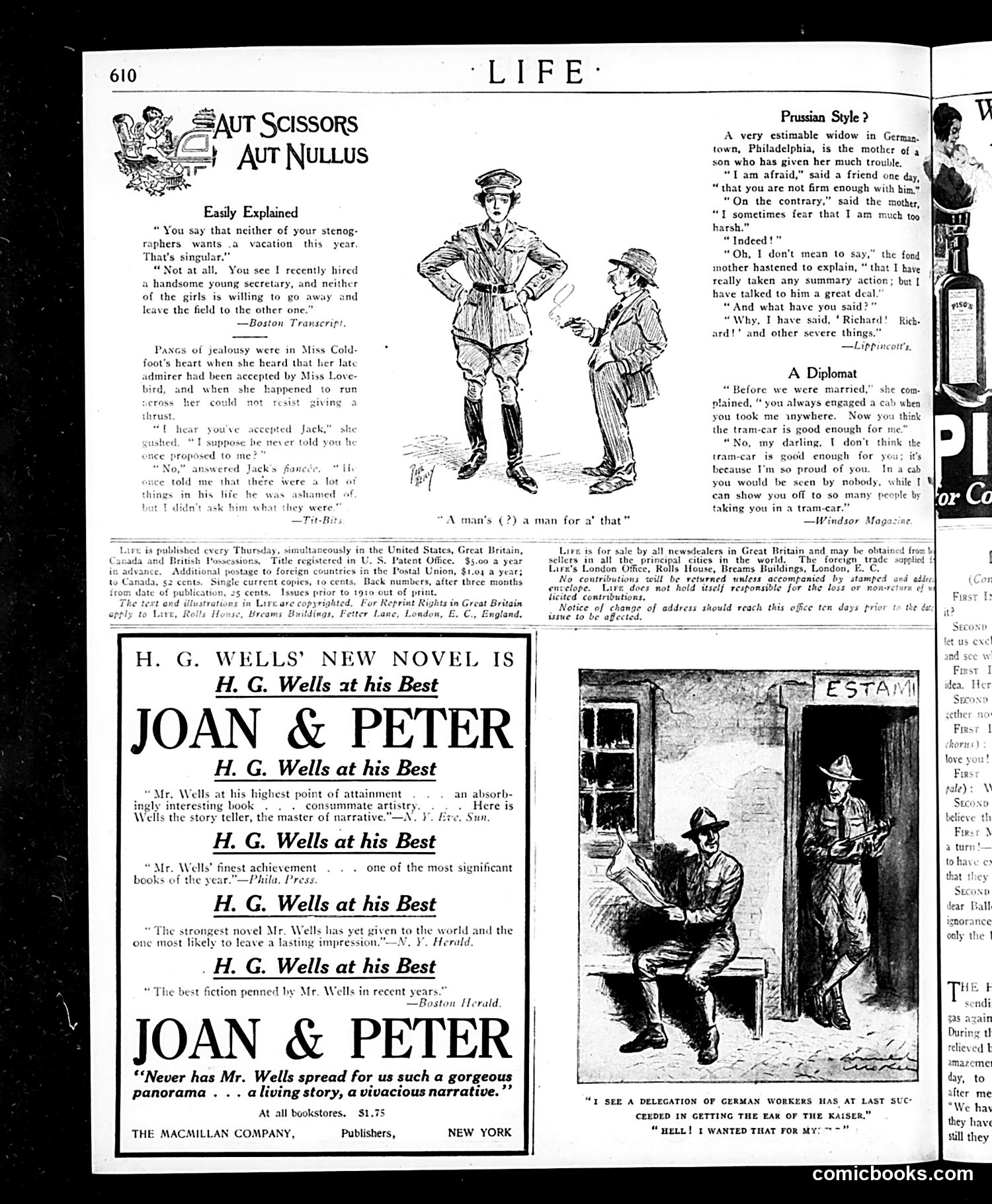
This page contains three brief satirical anecdotes and a large advertisement for H.G. Wells's novel *Joan & Peter*. **The Cartoons/Anecdotes:** 1. **"Aut Scissors Aut Nullus"** — A joke about office jealousy: an employer hired a handsome secretary, so now neither of his existing female stenographers will take vacation, each unwilling to leave the other alone with him. 2. **"Prussian Style?"** — A Philadelphia widow claims to be strict with her troublesome son, but her only "severe" discipline is repeatedly calling his name ("Richard!"). The satire mocks ineffectual parenting disguised as firmness. 3. **"A Diplomat"** — A husband refuses his wife's complaint about no longer taking cabs. He claims the tram-car is "good enough" because it lets him show her off to more people, flattering her vanity as a substitute for actual consideration. **The Advertisement** dominates the lower half, promoting Wells's novel with multiple enthusiastic critical quotes. The overall tone is light domestic satire targeting relationships, workplace dynamics, and social pretense.
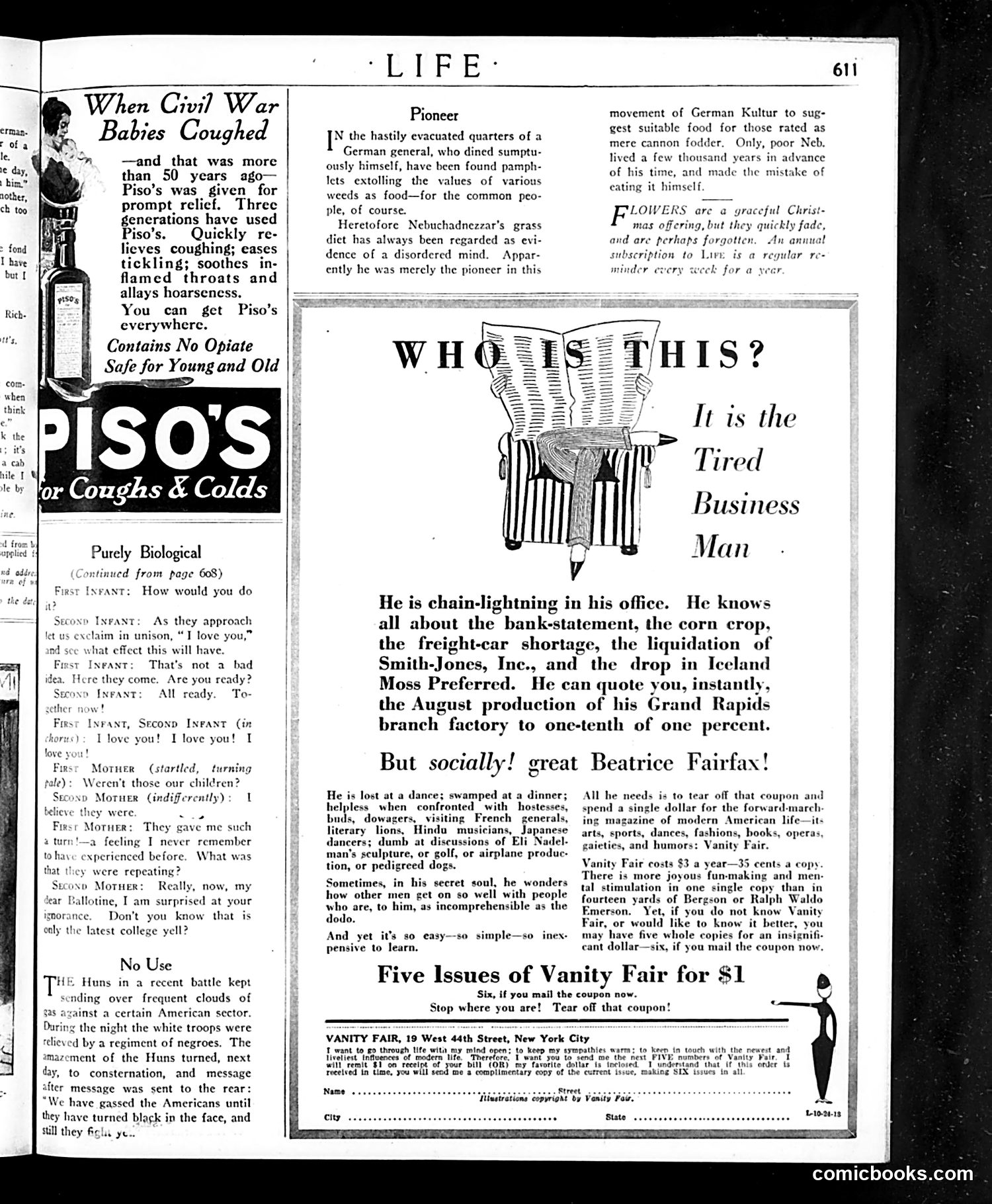
This page contains three satirical pieces typical of Life's early 20th-century style: **"The Tired Business Man"** is the main feature—a humorous character sketch about a corporate executive who excels professionally (knowing bank statements, production figures, commodity prices) but is socially inept and uncomfortable in social settings with "hostesses, buds, dowagers." The satire mocks the narrow specialization of modern business culture. An advertisement for *Vanity Fair* magazine follows, offering solutions to this social incompetence. The smaller pieces include: **"Purely Biological"**: A comedic dialogue where children say "I love you" as their "college yell," satirizing academic pretension. **"No Use"**: A WWI-era joke about German soldiers expressing shock that Black American troops continue fighting after gas attacks, implying racist surprise at their combat effectiveness. The page also contains period advertisements (Piso's cough medicine) and a "Pioneer" item about German generals distributing pamphlets promoting weeds as food—satirizing German wartime hardship and propaganda.
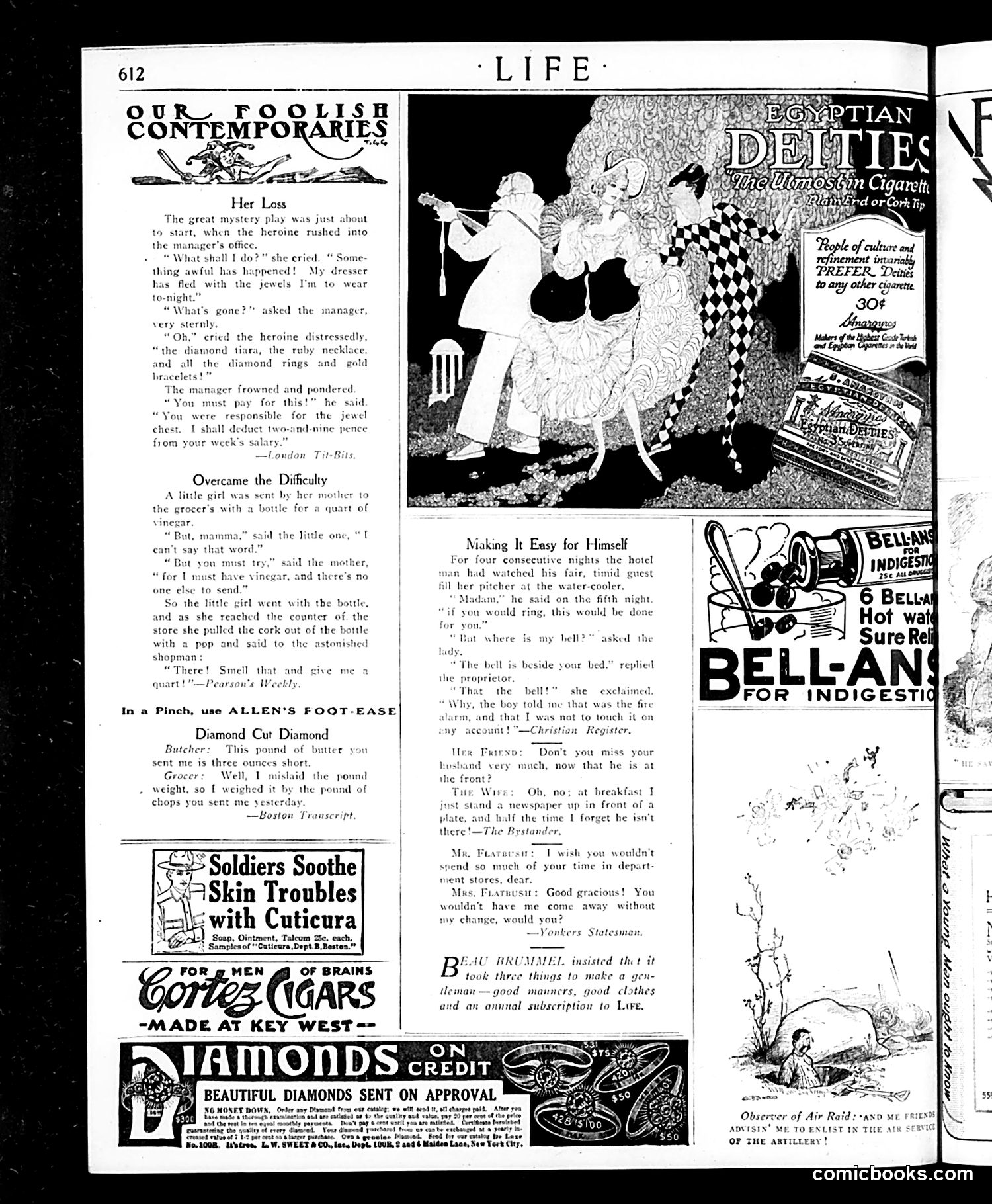
This page from *Life* magazine contains several brief humorous anecdotes typical of early 20th-century satirical humor, plus advertisements. The main stories mock everyday situations: a theater heroine loses her jewelry and must pay for it from her salary; a young girl sent to buy vinegar creates a commotion at a store; a hotel guest confused about which bell to ring (bed vs. fire alarm); and disputes between butchers and grocers over short weights. These sketches satirize class dynamics (servants blamed for losses), innocence (a child's misunderstanding), hotel management absurdities, and commercial dishonesty. The humor relies on wordplay and situational irony rather than political commentary. The page is predominantly filled with advertisements for products like Egyptian Deities cigarettes, Cuticura soap, Cortez cigars, and diamond sellers—typical commercial content for magazines of this era. The final item references artillery enlistment, likely reflecting WWI-era recruitment messaging common in American periodicals of the 1910s-1920s.
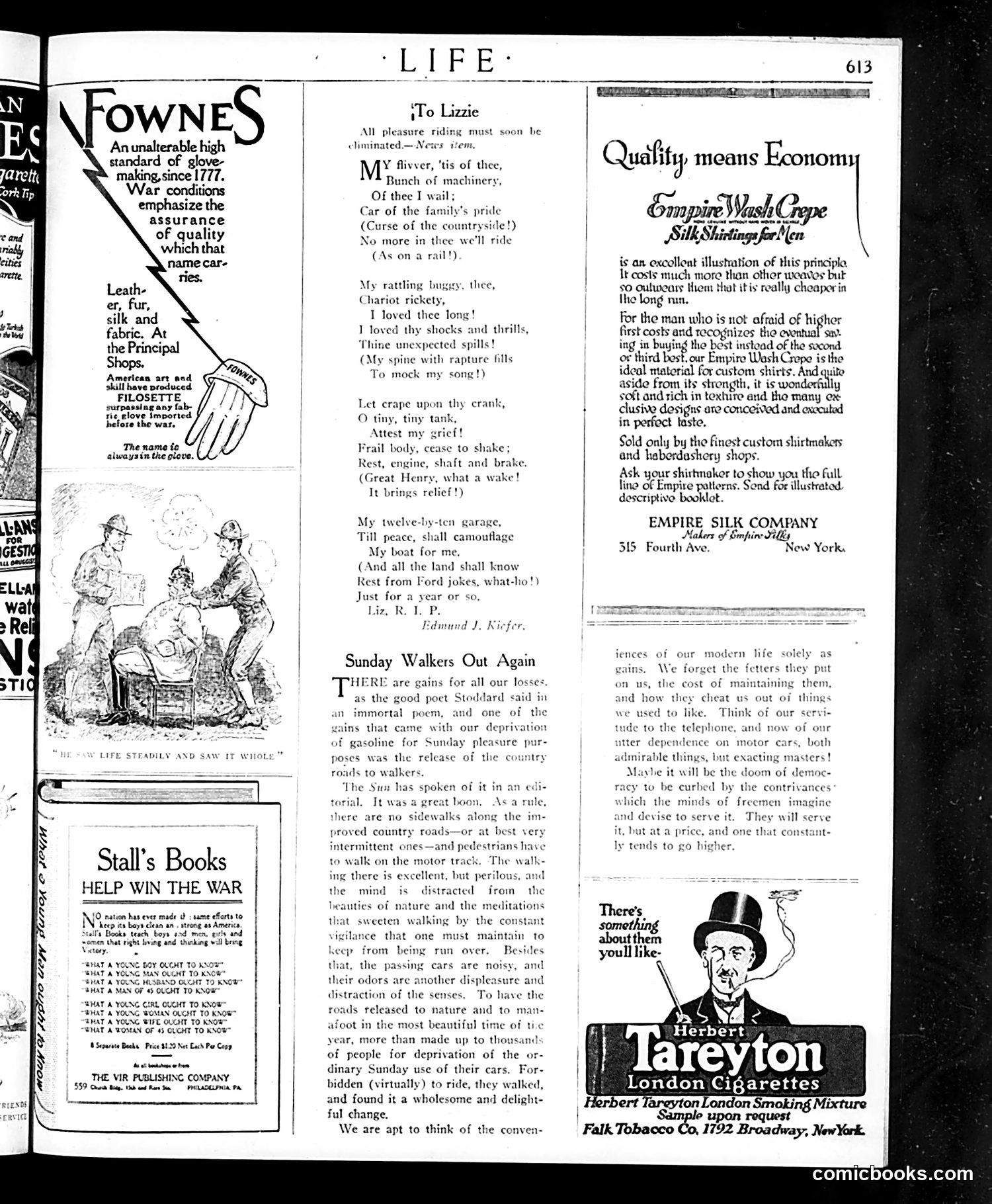
This page primarily consists of **advertisements and wartime content**, with limited political satire. The main illustrated piece is a **parody poem titled "To Lizzie,"** mourning the loss of automobile use during WWI gasoline rationing. It satirizes American car culture by having the speaker mourn their "flivver" (Model T Ford) in mock-heroic language ("My flivver, 'tis of thee"). The joke targets both automobile dependency and the inconvenience of wartime restrictions—Americans are asked to sacrifice their cars for the war effort, and this piece humorously exaggerates that loss. The accompanying article, "Sunday Walkers Out Again," celebrates a silver lining: with pleasure driving eliminated, country roads are now safe for pedestrians to enjoy nature without traffic hazards or noise pollution. The remaining content is **commercial advertising** (Fownes gloves, Stall's Books, Empire Silk Company, Herbert Tareyton cigarettes) typical of Life's revenue model. No specific political figures are caricatured; the satire targets middle-class American automobile culture during wartime rationing.
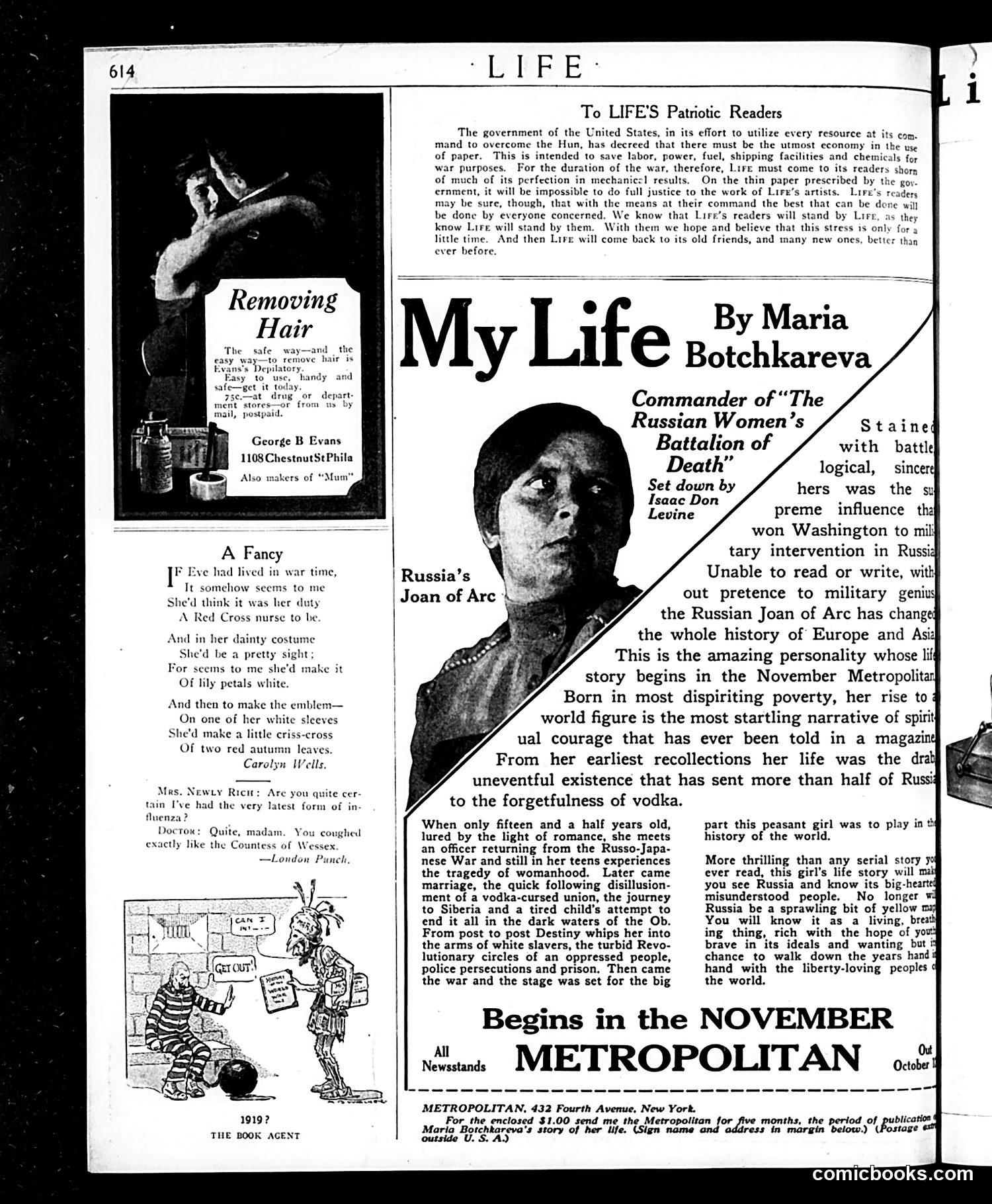
**What This Page Shows:** This is a wartime *Life* magazine page combining advertisements, poetry, and a major editorial notice with promotional content for an upcoming serialized story. **Key Elements:** 1. **War Economy Notice**: The prominent editorial addresses readers about paper rationing—the U.S. government required reduced paper use for the war effort, so *Life* apologizes for lower print quality while pledging its support for the cause. 2. **The "Joan of Arc" Story**: The main feature advertises Maria Botchkareva's autobiography in *Metropolitan* magazine. Botchkareva, commander of Russia's "Women's Battalion of Death," is framed as a transformative figure who influenced American military intervention in Russia. The text emphasizes her illiteracy and humble peasant origins before her rise to power—a narrative of spiritual courage meant to dramatize Russian identity for American readers. 3. **Advertisements and Light Content**: Hair removal ads, fashion poetry, and a London Punch joke about influenza fill remaining space—typical magazine filler of the period. **Context**: This reflects 1918-era American interest in Revolutionary Russia and the appeal of dramatic, romanticized female war heroes.