
Life, 1918-10-24 · page 11 of 34
Life — October 24, 1918 — page 11: what you’re looking at
What you’re looking at
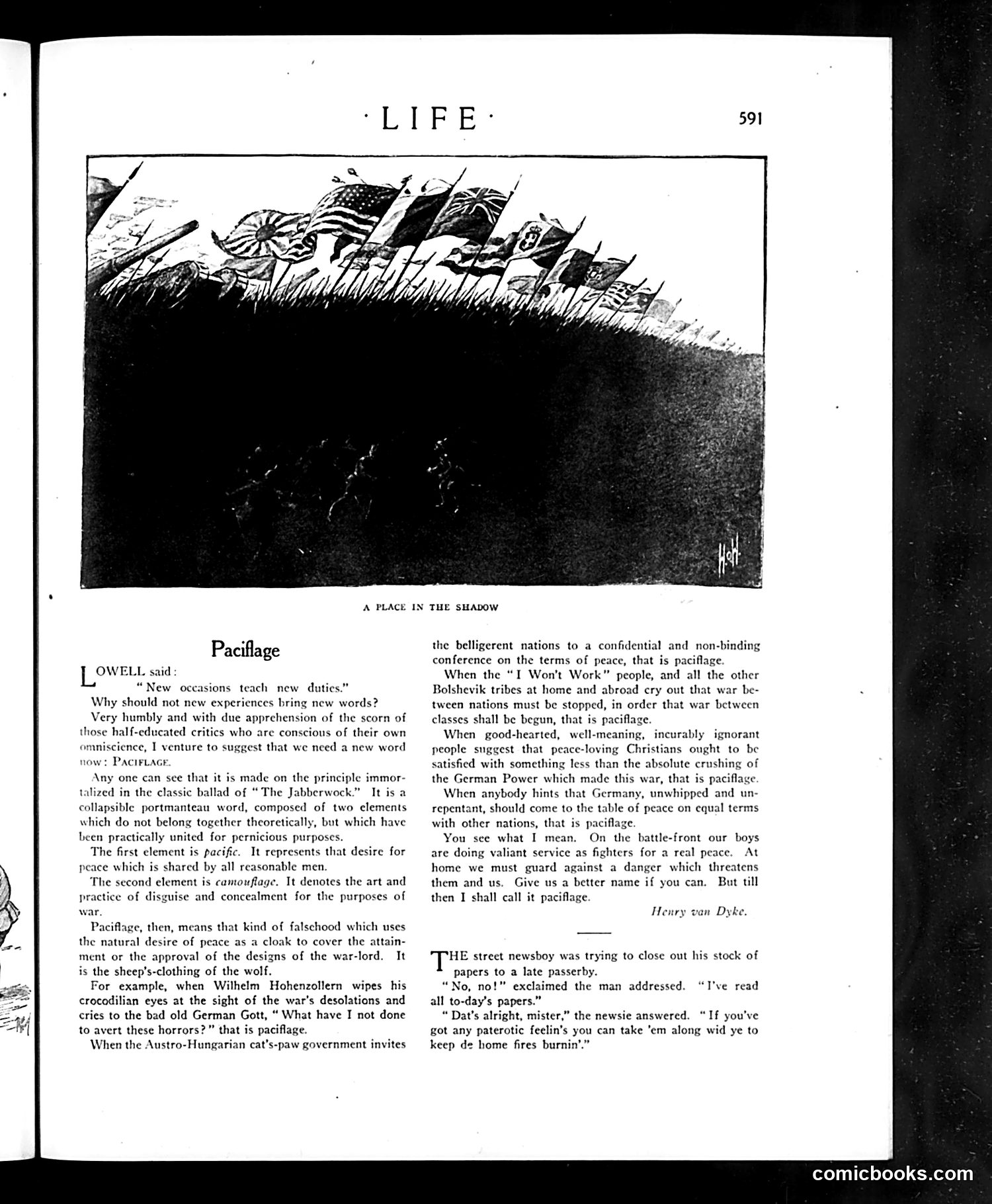
The cartoon depicts soldiers and flags along a trench line, with shadows below suggesting death or darkness. The accompanying article by Lowell attacks pacifism during World War I, using the term "Pacifage" (a neologism blending "peace" and "façade"). Lowell argues pacifism is false morality—a cloak for war profiteering. He mocks pacifists as naive, citing examples like Wilhelm II claiming innocence and Austria-Hungary seeking peace conferences while continuing aggression. The street newsboy anecdote at page's bottom reinforces this: a man tries avoiding war news by closing his ears, yet cannot escape reality. The satire targets American pacifists and neutrality advocates who, Lowell suggests, enable war through inaction and hypocrisy—a common pro-intervention argument during the WWI era.
📄 Transcribed text from this page (OCR, searchable)
Machine-transcribed from the original scan — historical spelling and the odd misread are preserved.
A PLACE IN THE SHADOW Paciflage Lovet said : “New occasions teach new dutic Why should not new experiences bring new words? Very humbly and with due apprehension of the scorn of those half-educated critics who are conscious of their own omniscience, I venture to suggest that we need a new word now: PACIFLAGE Any one can see that it is made on the principle immor- talized in the classic ballad of “ The Jabberwock.” It is a collapsible portmanteau word, composed of two elements which do not belong together theoretically, but which have Leen practically united for pernicious purposes. The first element is pacific. It represents that desire for peace which is shared by all reasonable men. The second element is camouflage. It denotes the art and practice of disguise and concealment for the purposes of war. Paciflage, then, means that kind of falschood which uses the natural desire of peace as a cloak to cover the attain- ment or the approval of the designs of the war-lord. It is the sheep’s-clothing of the wolf. For example, when Wilhelm Hohenzollern wipes his crocodilian eyes at the sight of the war's desolations and cries to the bad old German Gott, “ What have I not done to avert these horrors?” that is paciflage. When the Austro-Hungarian cat’s-paw government invites the belligerent nations to a confidential and non-binding conference on the terms of peace, that is paciflage. When the “I Won't Work” people, and all the other Bolshevik tribes at home and abroad cry out that war be- tween nations must be stopped, in order that war between classes shall be begun, that is paciflage. When good-hearted, well-meaning, incurably ignorant people suggest that peace-loving Christians ought to be satisfied with something less than the absolute crushing of the German Power which made this war, that is paciflage. When anybody hints that Germany, unwhipped and un- repentant, should come to the table of peace on equal terms with other nations, that is paciflage. You see what I mean. On the battle-front our boys are doing valiant service as fighters for a real peace. At home we must guard against a danger which threatens them and us. Give us a better name if you can. But till then I shall call it paciflage. Henry van Dyke. HE street newsboy was trying to close out his stock of papers to a late passerby. “No, no!" exclaimed the man addressed. “I've read all to-day’s papers.” “ Dat’s alright, mister,” the newsie answered. “If you've got any paterotic feelin’s you can take ’em along wid ye to keep de home fires burnin’. comicbooks.com