
Life, 1918-10-24 · page 16 of 34
Life — October 24, 1918 — page 16: what you’re looking at
What you’re looking at
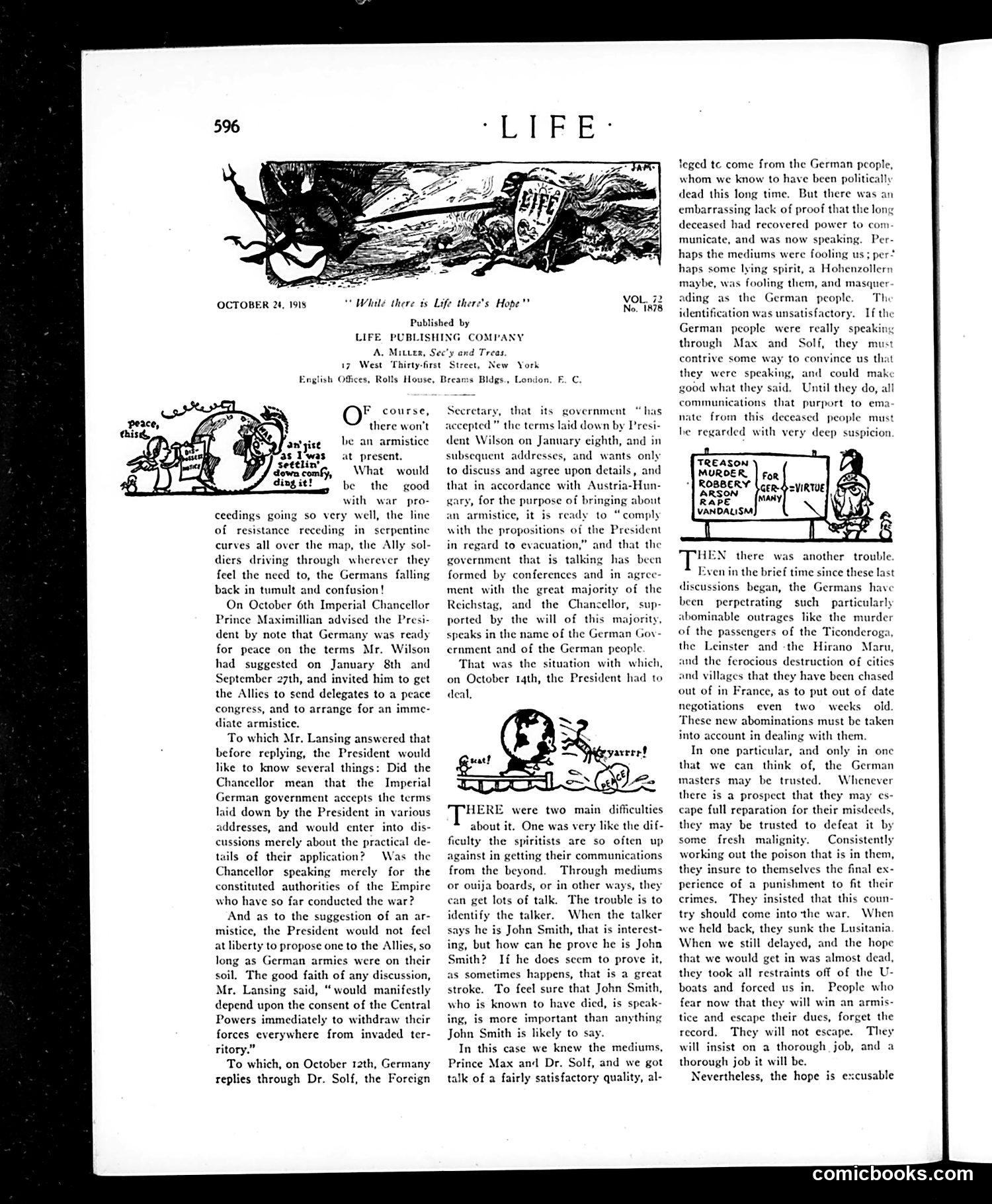
This page discusses German peace negotiations near World War I's end. The cartoons satirize the difficulty of verifying who actually speaks for Germany during armistice discussions. **The Setup:** Germany's Foreign Secretary Dr. Solf claims the German government and people accept President Wilson's peace terms. However, the text questions whether these "mediums" (Solf and Chancellor Prince Max) truly represent the German people or are fraudulent intermediaries—comparing it to spiritualist séances where mediums claim to contact the dead. **The Satire:** The cartoon depicts Germany as a corpse claiming to communicate. The joke is that Germany appears "politically dead" after military defeat, yet suddenly "speaks" through these officials. Can we trust they represent actual German will, or are they (or some hidden force like the Kaiser) deceiving the Allies? **Historical Context:** This reflects real anxiety about whether negotiations were genuine or German deception, just weeks before the November 1918 armistice ending WWI.
📄 Transcribed text from this page (OCR, searchable)
Machine-transcribed from the original scan — historical spelling and the odd misread are preserved.
OCTOBER 24, 1918 “* While there is Life there's Hope" VOL. 72 No. 1878 Published by ur A. Mittes, S 17 West. Thirty-first ish Offices, Rolls House, reams Bldgs., Lo course, there won't be an armistice at present. What would be the good with war pro- ceedings going so very well, the line of resistance receding in serpentine curves all over the map, the Ally sol- diers driving through wherever they feel the need to, the Germans falling back in tumult and confusion! On October 6th Imperial Chancellor Prince Maximillian advised the Presi- dent by note that Germany was ready for peace on the terms Mr. Wilson had suggested on January 8th and September 27th, and invited him to get the Allies to send delegates to a peace congress, and to arrange for an imme- diate armistice. To which Mr. Lansing answered that before replying, the President would like to know several things: Did the Chancellor mean that the Imperial German government accepts the terms laid down by the President in various addresses, and would enter into dis- cussions merely about the practical de- ils of their application? Was the Chancellor speaking merely for the constituted authorities of the Empire who have so far conducted the war? And as to the suggestion of an ar- mistice, the President would not feel at liberty to propose one to the Allies, so long as German armies were on their soil. The good faith of any discussion, Mr. Lansing said, “ would manifestly depend upon the consent of the Central Powers immediately to withdraw thcir forces everywhere from invaded ter- ritory.” To which, on October 12th, Germany replies through Dr. Solf, the Forcign ‘3s Iwas Settlin’ down com! ding it! PUBLISHI G COMPANY d Treas, Street, New York jon. F.C Secret that its government accepted ” the terms laid down by Presi- dent Wilson on January eighth, and in subsequent addresses, and wants only to discuss and agree upon details, and that in accordance with Austria-Hun- gary, for the purpose of bringing about an armistice, it is ready to “comply with the propositions of the President in regard to evacuation,” and that the government that is talking has been formed by conferences and in a ment with the great jority of the Reichstag, and the Chancellor, sup- ported by the will of this majority, speaks in the name of the German Gov- ernment and of the German people. That was the situation with which, on October 14th, the President had to deal, ree HERE were two main difficulties about it. One was very like the dif- ficulty the spiritists are so often up against in getting their communications from the beyond. Through mediums or ouija boards, or in other ways, they can get lots of talk. The trouble is to identify the talker, When the talker says he is John Smith, that is interest- ing, but how can he prove he is John Smith? If he does scem to prove it, as sometimes happens, that is it stroke. To feel sure t who is known to have died, is speak- ing, is more important than anything John Smith is likely to say. In this case we knew the mediums, Prince Max and Dr. Solf, and we got talk of a fairly satisfactory quality, al- teged te come from the German people, whom we know to have been politically dead this long time. But there was an embarrassing lack of proof that the long deceased had recovered power to com municate, and was now speaking. Per- haps the mediums were fooling us; per* haps some lying spirit, a Hohenzollern ybe, was fooling them, and masqu ading as the German people. Th: identification was unsatisfactory. If the German people were really speaking through Max and Solf, they must contrive some way to convince us that they were speaking, and could make good what they said, Until they do, all communications that purport to ema nate from this deceased people must he regarded with very deep suspicion TREASON s UROER OBBERY ‘cer G=VIRTUE ARSON = RAPE any VANDALISM, there was another trouble. Even in the brief time since these last discussions began, the Germans have been perpetrating such particularly abominable outrages like the murder of the passengers of the Ticonderoga, the Leinster and -the Hirano Maru, and the ferocious destruction of cities and villages that they have been chased out of in France, as to put out of date negotiations even two weeks old. These new abominations must be taken into account in dealing with them. In one particular, and only in once that we can think of, the German masters may be trusted. Whenever there is a prospect that they may es- cape full reparation for their misdeeds, they may be trusted to defeat it by some fresh gnity. Consistently working out the poison that is in them, they insure to themselves the final ex- perience of a punishment to fit their crimes. They insisted that this coun- try should come into ‘the war. When we held back, they sunk the Lusitania. When we still delayed, and the hope that we would get in was almost dead, they took all restraints off of the U- boats and forced us in, People who fear now that they will win an armis- tice and escape their dues, forget the record. They will not escape. They will insist on a thorough job, and a thorough job it will be. Nevertheless, the hope is excusable comicbooks.com