
Life, 1918-10-24 · page 20 of 34
Life — October 24, 1918 — page 20: what you’re looking at
What you’re looking at
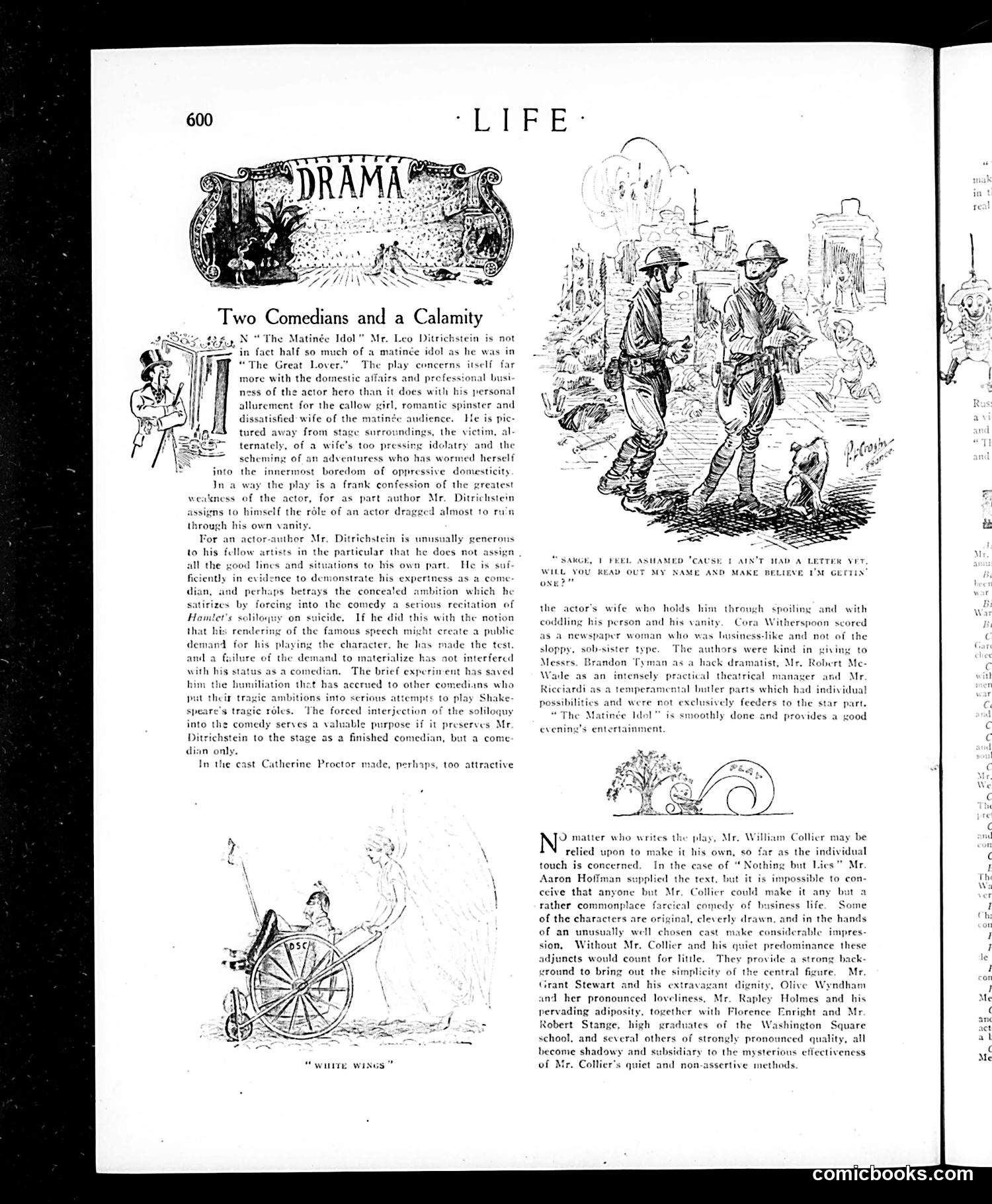
This page reviews two theatrical productions. The main article discusses "The Matinée Idol," starring Leo Ditrichstein, an actor-playwright who writes himself leading roles. The satire critiques his vanity—despite showing restraint by not hogging all good lines, he still indulges in serious dramatic moments (notably performing Hamlet's suicide soliloquy), undermining the comedy. Life suggests this reflects actors' fundamental weakness: prioritizing personal vanity over the play's success. The second review praises William Collier in "Nothing but Lies," arguing that regardless of who writes the script, Collier's quiet, understated comedic style elevates mediocre material. The accompanying sketches illustrate theatrical scenes and character types from these productions. The humor targets theatrical ego and the tension between actors' ambitions for serious dramatic roles versus their actual talent for comedy.
📄 Transcribed text from this page (OCR, searchable)
Machine-transcribed from the original scan — historical spelling and the odd misread are preserved.
Two Comedians and a Calamity N “The Matinée Idol” Mr. Leo Ditrichstein is not “The Great Lover.” The play concerns itself far more with the domestic a! and professional busi ness of the actor hero than it does with his personal allurement for the callow girl, romantic spinster and dissatisfied wife of the matinge andience. He is pic tured away from surround n, al ternately, of a wife's too ssin, nd the sche of an adventures who has wormed herself into the innermost boredom of oppressive domesticity In a way the play is a frank confession of the greatest weakness of the actor, for a author Mr. Ditrichstein assigns to himself the ré f J almost to ru'n through his own vanity. For an actor-author Mr, Ditrichstein is unusually generous to his fellow artists in the particular that he does not assign , . . SAKGE, 1 PEEL ASHAMED 'CAUSE 1 AIN'T HAD A LETTER Ver all the good lines and situations to his own part. He is suf WILL YOU READ OUT MY NAME AND MAKE BELIEVE UM GE ently in ev nee to dew rate his expertness as a come and perhaps betrays concealed ambition which he irizes by forcing © comedy a serious recitation of Hamiet's solil y on suicide, If he did this with the n ny that his rendering of the famous speech might create a public ors wife who holds him through spoiling and with person and his var Cora Witherspoon scored as a newspaper woman who was business-like and not of the demand for his playing the character, he has made the test. anda failure of the demand to materialize has aot interfered with his status as a comedian, The brief experiment has saved sob-sister type. a to Messrs. a tyn Wale as an intensely practical theatrical m him the humiliation that has accrued to other comedians who Ricciardi as a temperamental butler parts which had individual past the ic ambition: serious attempts to pl put theis tragic am i Pts to pl possibi nd were not exclusively feeders to the star part. speare’s tras interjection of the soliloquy is smoothly done provides a good into the comedy serves a ble purpose if it preserves Mr Ditrichstein to the stage as a finished comedian, but a co dian only. In the cast Catherine Proctor made, perhaps, too attractive O matter who writes the play, Mr. William Collicr may be relied upon to make it his own, so far as the individual touch is concerned. In the case of “Nothing but Lies” Mr Aaron Hoffman supplied the text, but it is impossible to con- ceive that anyone but Mr. Collier could make it any but a rather commonplace farcical comedy of business life. Some of the characters are original, cleverly drawn, and in the hands of an unusually well chosen cast make considerable impres- sion, Without Mr. Collier and his quict predominance these adjuncts would count for little. They prov strong back ground to bring out the simplicity of the central figure. Mr. Grant Stewart and his extravagant dignity, Olive Wyndham ind her pronounced loveliness, Mr. Rapley Holmes and his pervading adiposity, together with Florence Enright and Mr Robert Stange, high graduates of the Washington school, and several others of strongly pronounced quality, become shadowy and subsidiary to the mysterious effectiveness “wintre wines” of Mr. Collier's quiet and non-assertive methods comicbooks.com