
A complete issue · 33 pages · 1918
Life — October 10, 1918
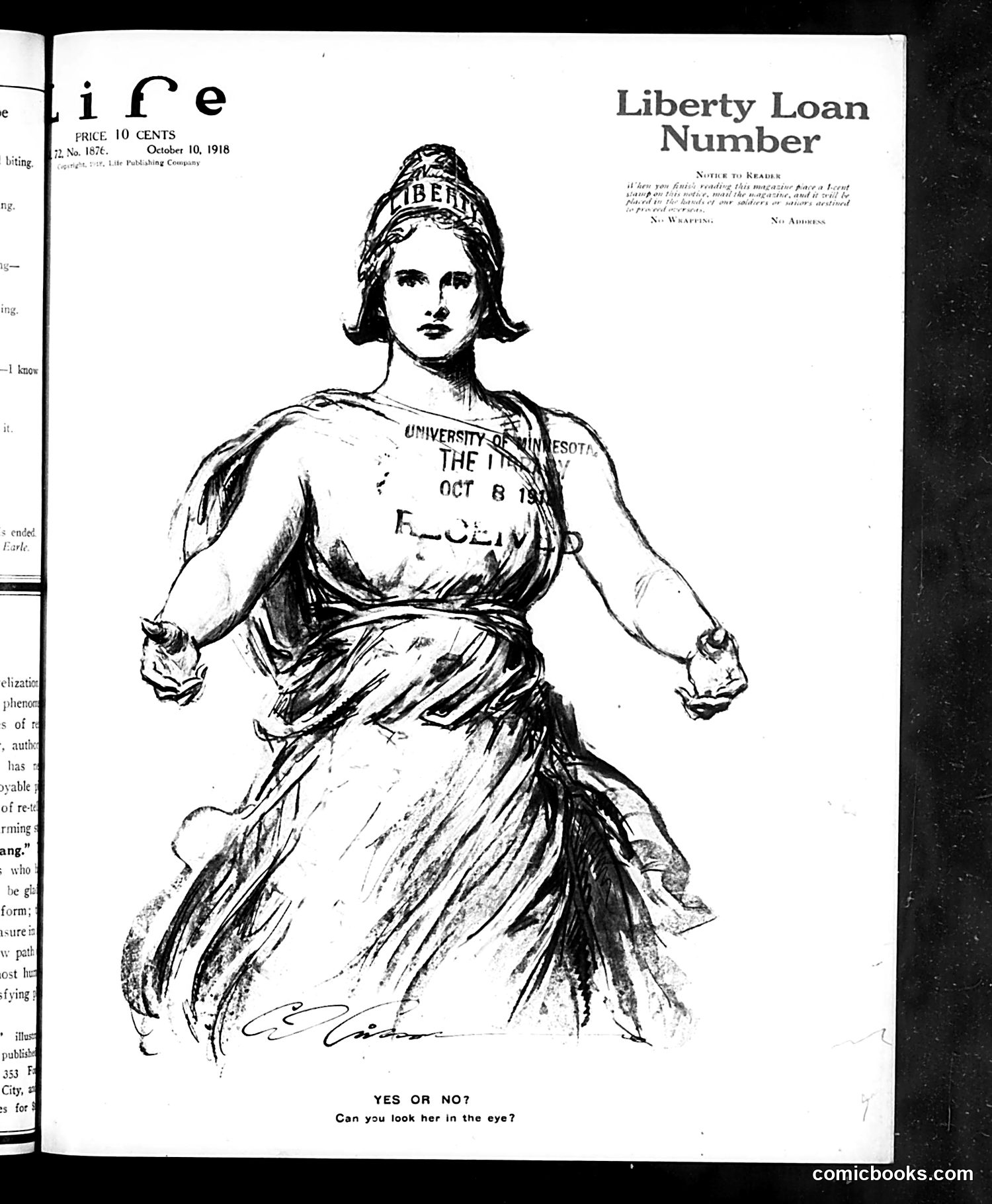
This is a propaganda piece for the Liberty Loan campaign, a WWI-era U.S. government bond drive (note the date: October 10, 1918, near war's end). The central figure is Lady Liberty, the allegorical personification of American freedom, depicted as a strong, determined woman wearing a liberty cap and holding clenched fists. The caption "YES OR NO? Can you look her in the eye?" directly addresses readers as potential bond purchasers, using patriotic pressure—essentially asking if they can face Lady Liberty while refusing to support the war effort financially. The library stamp and "Liberty Loan Number" header confirm this magazine page served as promotional material urging Americans to purchase government war bonds.
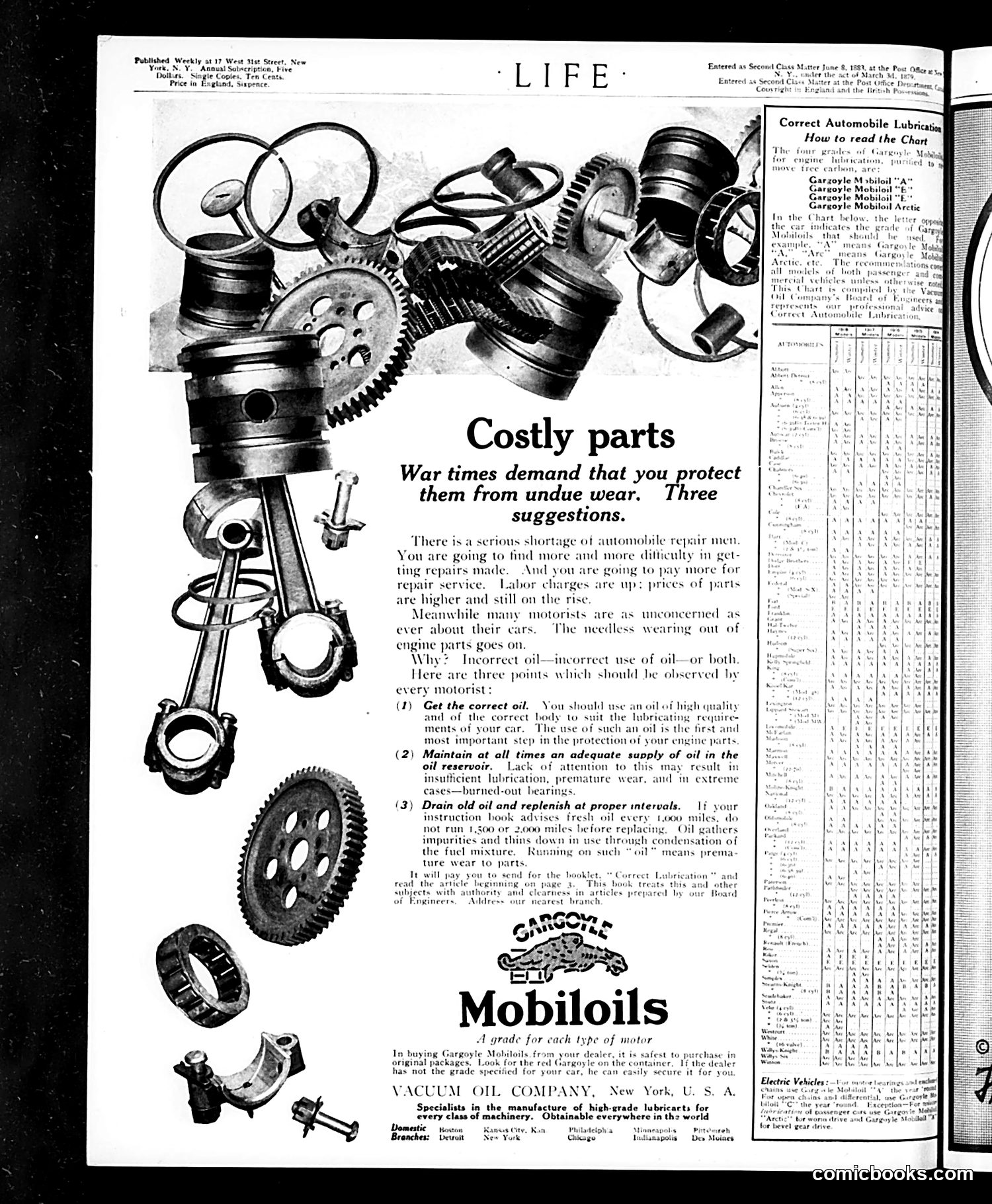
This page is primarily **advertising, not satire or political commentary**. The main content is a Gargoyle Mobiloils advertisement disguised as informational/editorial content. The large mechanical illustration shows automobile engine parts (pistons, gears, bearings, oil reservoir) with the headline "Costly parts" warning motorists about engine wear. The text presents three lubrication maintenance tips as if dispensing wisdom during "war times" when repair men are scarce and parts expensive. However, this is fundamentally a **product advertisement** for Gargoyle brand motor oils, positioned as a public service message. The "Correct Automobile Lubrication" chart on the right side is a sales tool recommending specific Gargoyle oil grades for different vehicle types. There is no political cartoon here—just commercial messaging dressed up as helpful guidance to consumers during the World War I era.
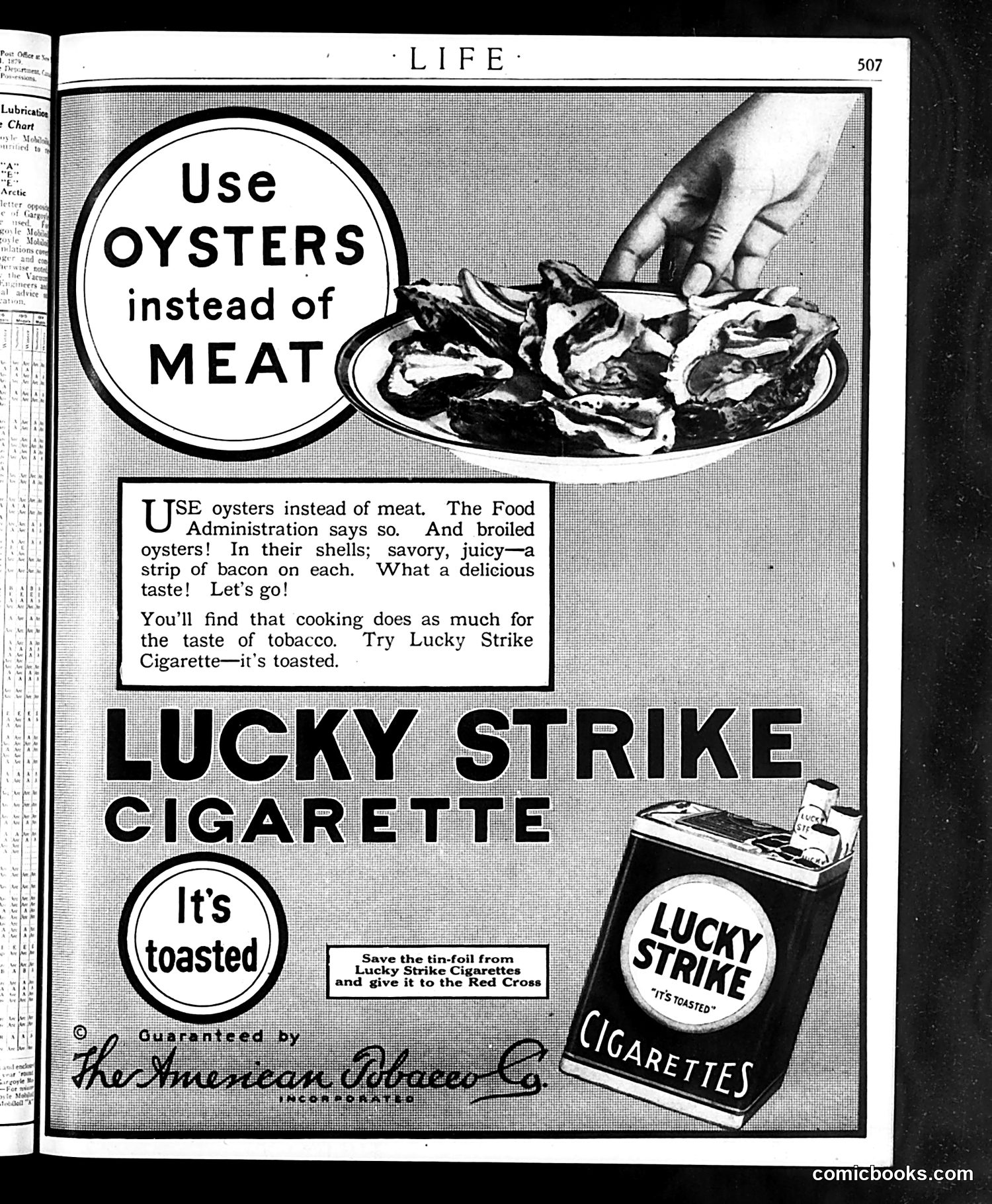
This is primarily a **Lucky Strike cigarette advertisement**, not political satire. The ad uses wartime rationing messaging to promote cigarettes by suggesting oysters as a meat substitute—appealing to Food Administration guidance during what appears to be a WWI-era conservation campaign. The advertisement's logic is absurd by design: it claims cooking enhances tobacco taste the same way it improves oysters, conflating food rationing advice with cigarette consumption. The ad also encourages saving tin-foil packaging "for the Red Cross," wrapping commercial promotion in patriotic duty. The humor lies in the transparent attempt to legitimize smoking through government authority, while the juxtaposition of oysters and cigarettes highlights advertising's creative (if illogical) persuasion tactics of the era.
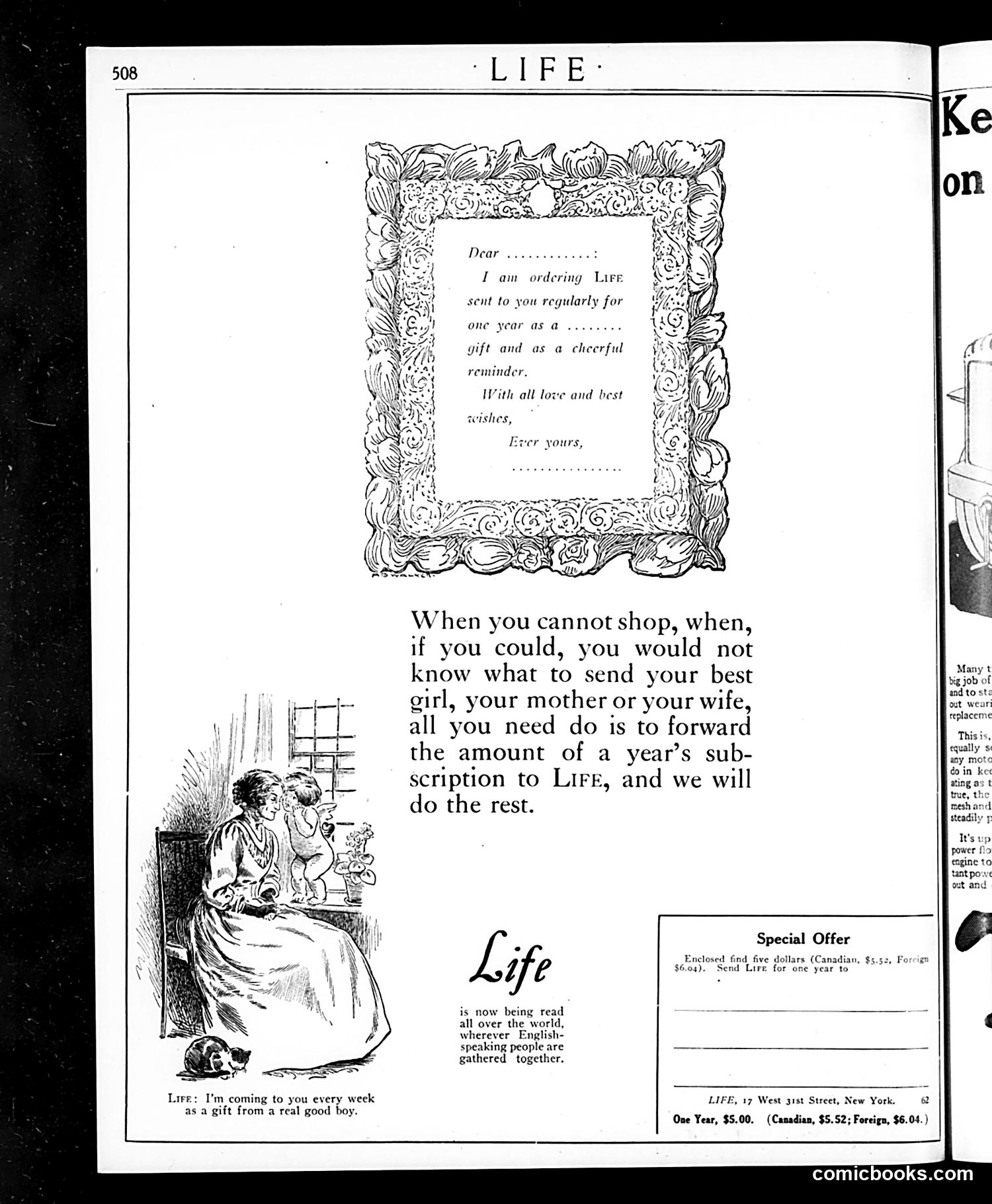
This page is primarily an **advertisement for Life magazine subscriptions**, not political satire. The decorative framed letter at top presents a gift-giving pitch: readers should subscribe to Life for loved ones (women explicitly mentioned: "best girl, your mother or your wife") as a convenient present when they "cannot shop." The illustration shows a woman with a child reading together, reinforcing Life's positioning as wholesome family entertainment. The accompanying text emphasizes Life's broad appeal: "is now being read all over the world, wherever thinking people are gathered together." The "Special Offer" box provides subscription pricing ($5.00 annually in the US; higher rates for Canada and foreign). This reflects early 20th-century marketing strategies targeting gift-givers and the domestic sphere, positioning magazine subscriptions as appropriate presents for female relatives.
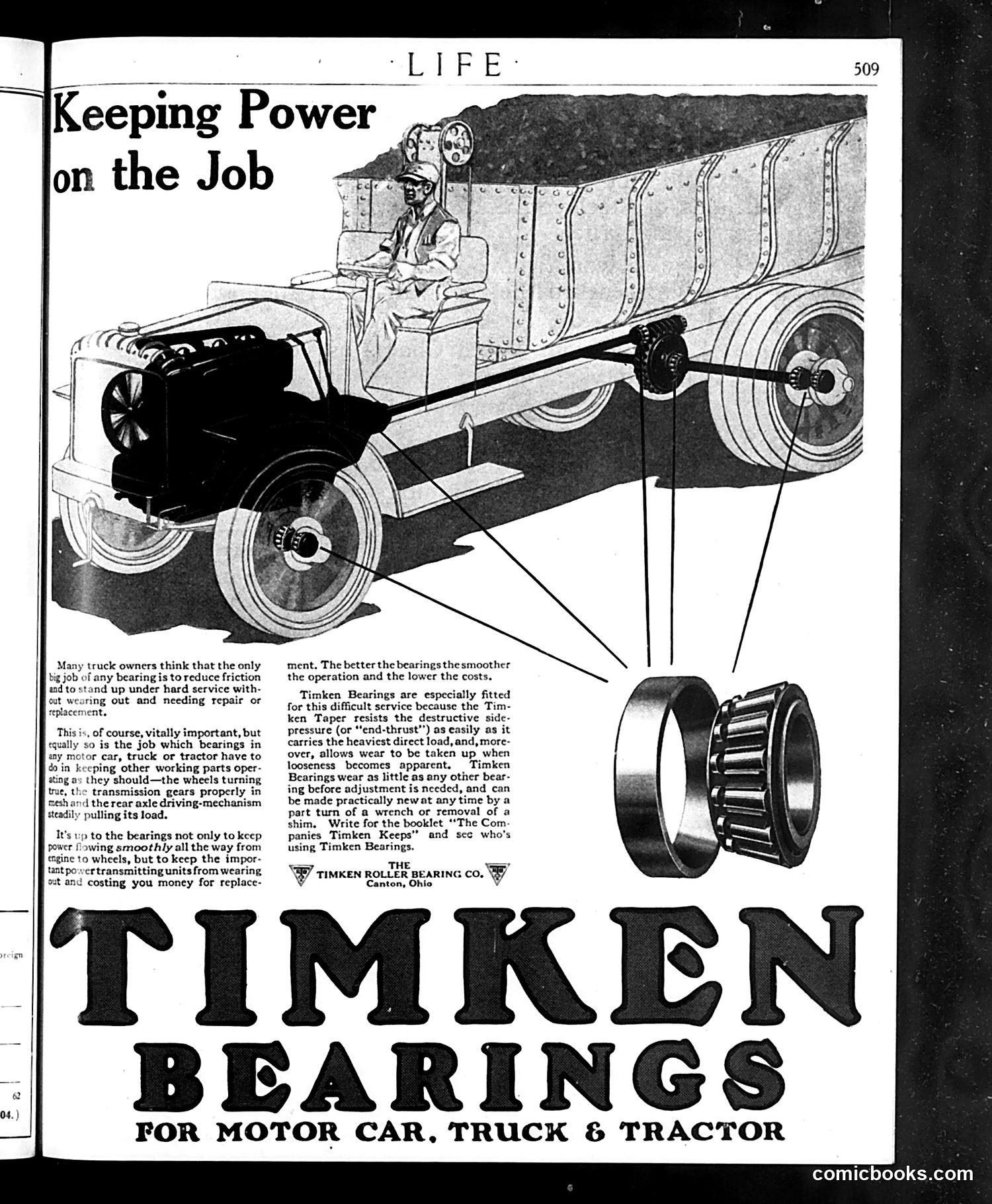
This is primarily **advertising, not satire or editorial content**. The page promotes Timken Roller Bearings for vehicles. The headline "Keeping Power on the Job" uses a double meaning: bearings literally keep mechanical power flowing, while metaphorically suggesting reliability during work. The illustration shows a truck being towed by a car, suggesting that proper bearings prevent breakdowns. The text argues that bearings do more than reduce friction—they must support transmissions, gears, and rear-axle mechanisms under heavy loads. Timken bearings supposedly resist "end-thrust" pressure and require minimal adjustment. The small bearing photograph demonstrates the product itself. This is a straightforward industrial advertisement from the early-to-mid 20th century, aimed at truck owners concerned with equipment longevity and repair costs. No political commentary or satire is present.
This is **not a satirical cartoon or joke page**, but rather a wartime public service advertisement from Life magazine (likely WWI or WWII era, based on the conservation messaging). The advertisement promotes conservation of Weed Chains—tire chains used for traction in snow and mud. The ad argues that steel chains are more valuable than gold because they perform essential work. It urges readers to: - Reserve chains only for trucks and essential vehicles - Use passenger cars sparingly in bad weather - Install chains at first rain, remove when roads dry The central message equates chain conservation with gasoline conservation and national security. Wasting chains risks shortages that would harm essential industries. The ad warns that shortages force use of inferior makeshift chains, damaging tires. This reflects genuine wartime resource rationing and industrial priorities.
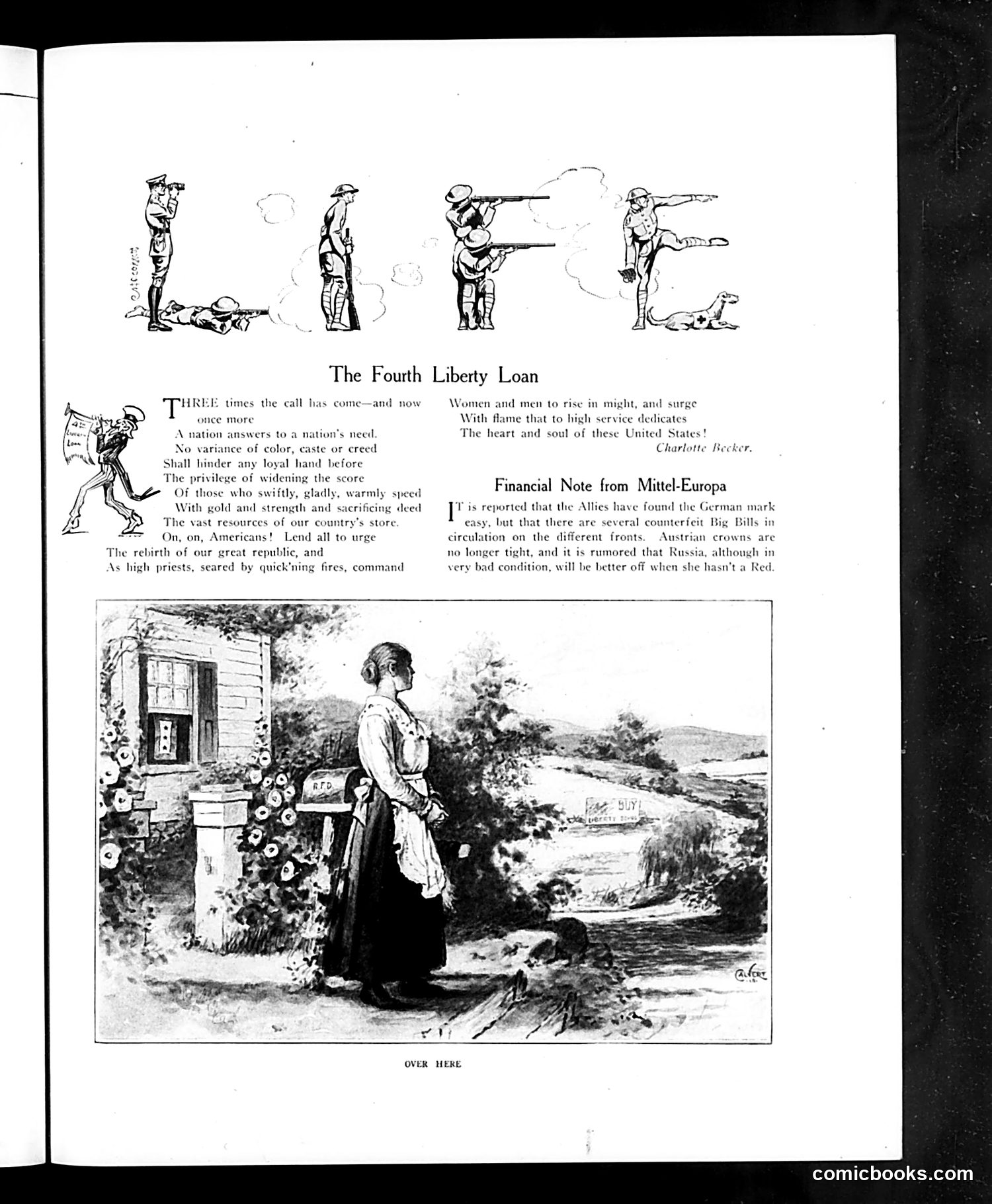
This WWI-era propaganda page promotes the Fourth Liberty Loan (a government bond campaign to fund the war effort). The top cartoon spells "LIFE" using soldiers in combat poses, depicting them as letters—a visual pun linking the magazine's name to military sacrifice. The accompanying poem urges Americans to lend money to support the war, emphasizing patriotic duty and the sacrifice of soldiers. The bottom illustration titled "OVER HERE" shows a woman tending her garden, likely representing the American home front. Her presence contrasts with the soldiers above, illustrating the civilian contribution to war efforts through bond purchases and rationing. The "Financial Note" mentions German marks and Austrian crowns losing value—propaganda suggesting Allied financial superiority and enemy economic collapse.
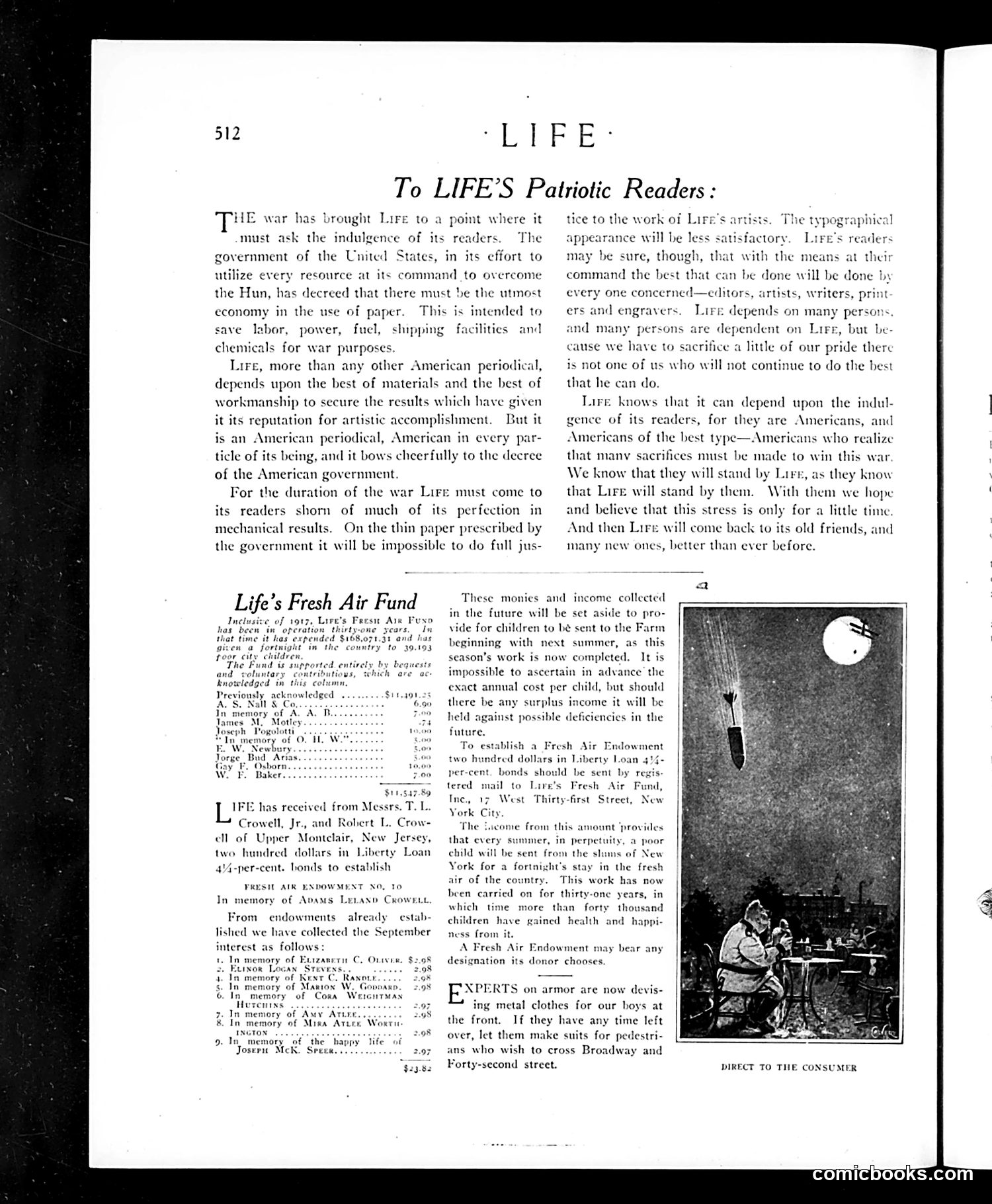
This page is primarily **editorial content rather than satire or cartoon**. It contains: 1. **"To LIFE's Patriotic Readers"** — an address explaining that Life magazine is reducing paper consumption to support WWI efforts, as the U.S. government has decreed maximum paper economy for war purposes. 2. **"Life's Fresh Air Fund"** — announcement of a charitable initiative sending poor children from New York City to farms for summer recuperation. The text notes this program has operated for over 40 years, benefiting 40,000+ children. 3. A small photograph showing what appears to be children at a farm or rural setting. The page reflects WWI-era American patriotism and Progressive-era charitable concerns. There is no significant political cartoon or satire visible — it's straightforward advocacy content aligned with government wartime priorities and established philanthropy.
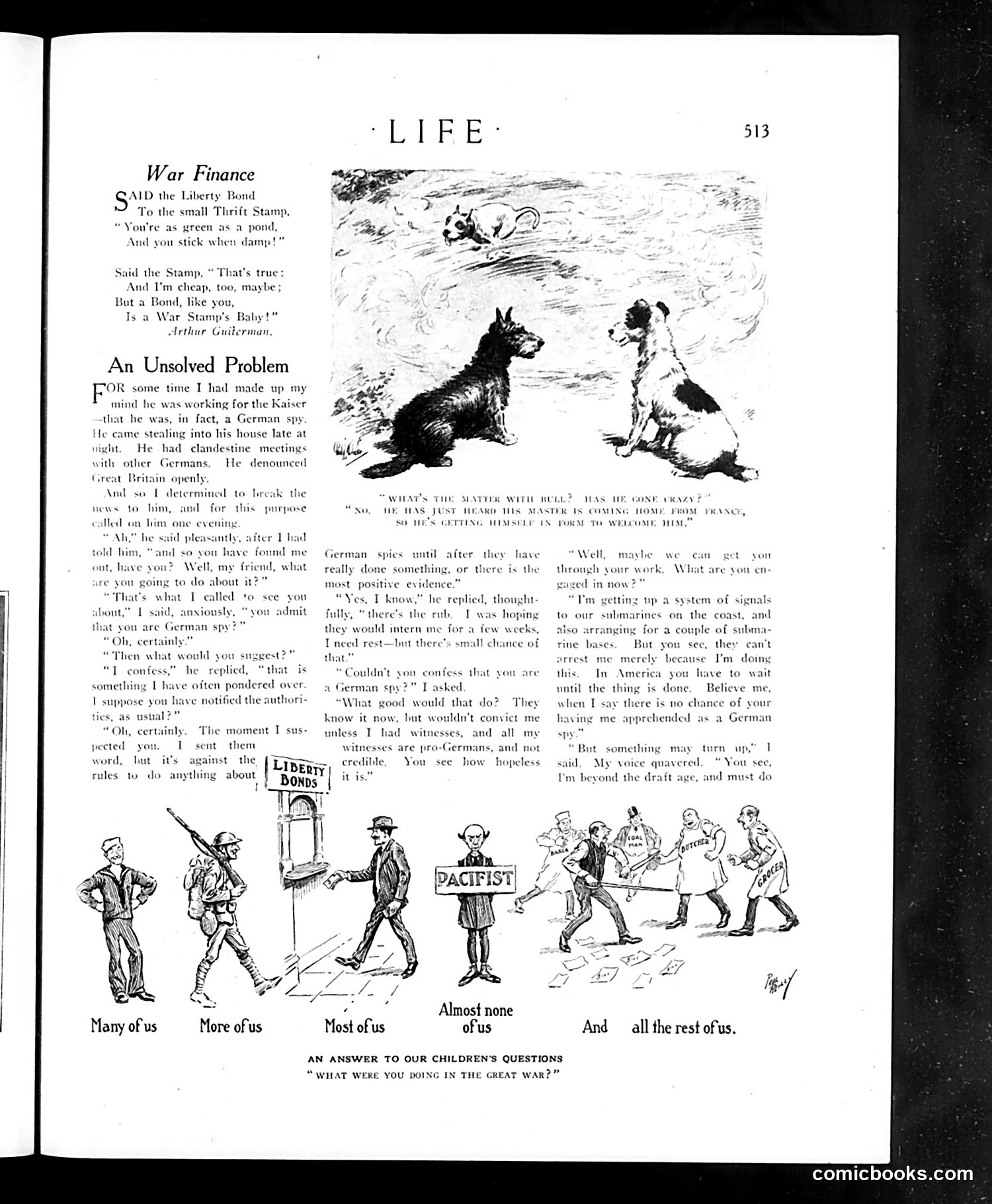
This page contains WWI-era satirical content attacking pacifism and draft resistance. The top story "War Finance" mocks the Liberty Bond and War Stamp programs through dialogue between a bond and stamp about their relative importance. The main narrative, "An Unsolved Problem," depicts a character accused of being a German spy—a common wartime paranoia theme. He admits to being a pacifist and conscientious objector, claiming he cannot confess to being German because "all my witnesses are pro-Germans." The bottom cartoon answers children's question "What were you doing in the Great War?" with figures labeled "Many of us," "More of us," "Most of us," "Almost none of us" (holding "Pacifist" sign), and "all the rest of us." This directly ridicules pacifists and draft resisters as a tiny, contemptible minority.
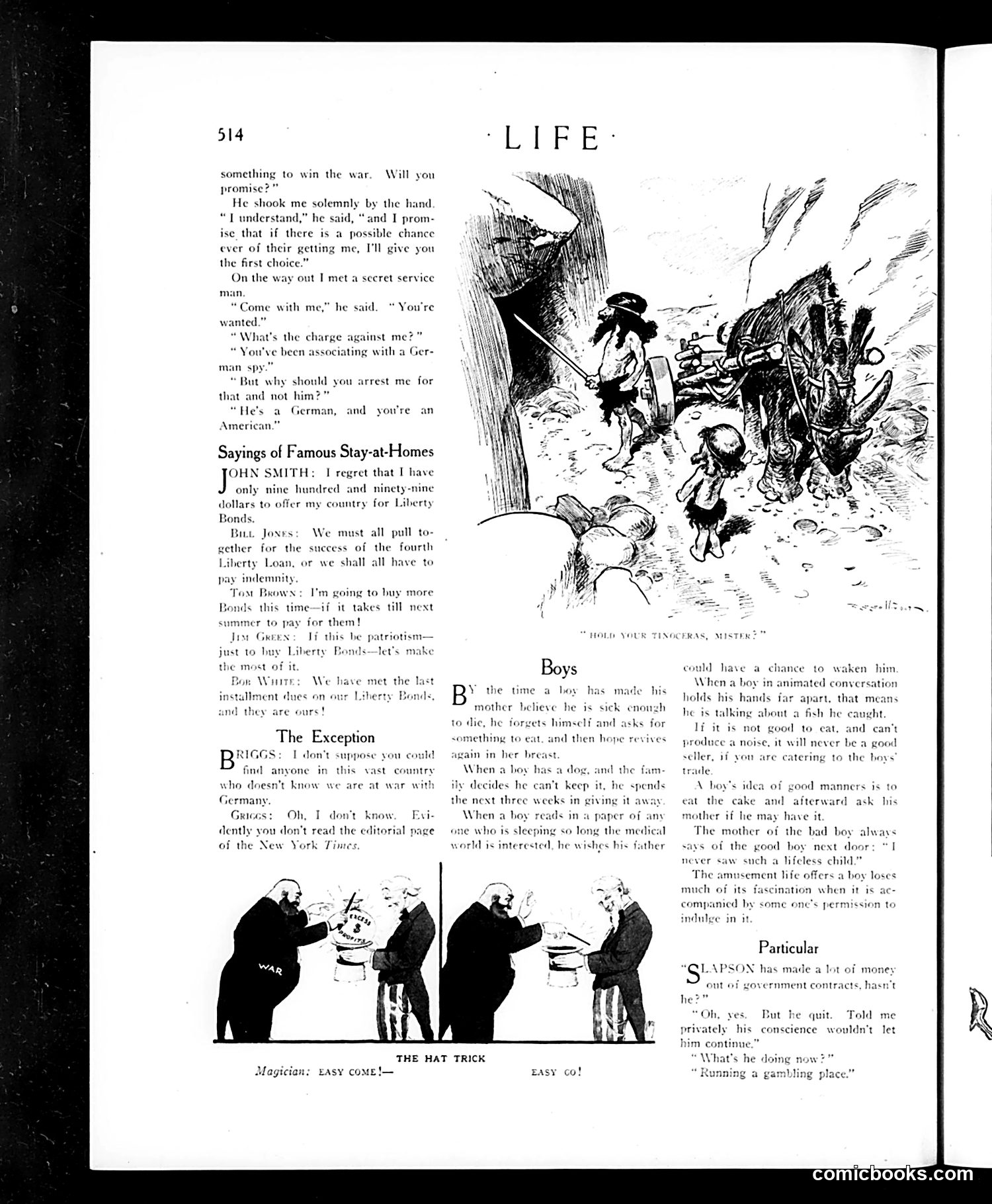
This page contains satirical content from WWI-era Life magazine. The upper section includes a dialogue about espionage and Liberty Bonds, with a character claiming to be "wanted" and accused of "associating with a German spy." The American character refuses to arrest him, establishing a patriotic theme. **"The Hat Trick"** cartoon at bottom shows a magician performing "Easy Come! Easy Go!" — likely satirizing how money disappears, possibly referencing government spending or financial manipulation during wartime. The **"Boys"** section discusses children's behavior and manners, appearing unrelated to the political content above. The **"Particular"** subsection mocks a character named Slapson who made money from government contracts but quit due to conscience — satirizing war profiteering and hypocritical patriotism.
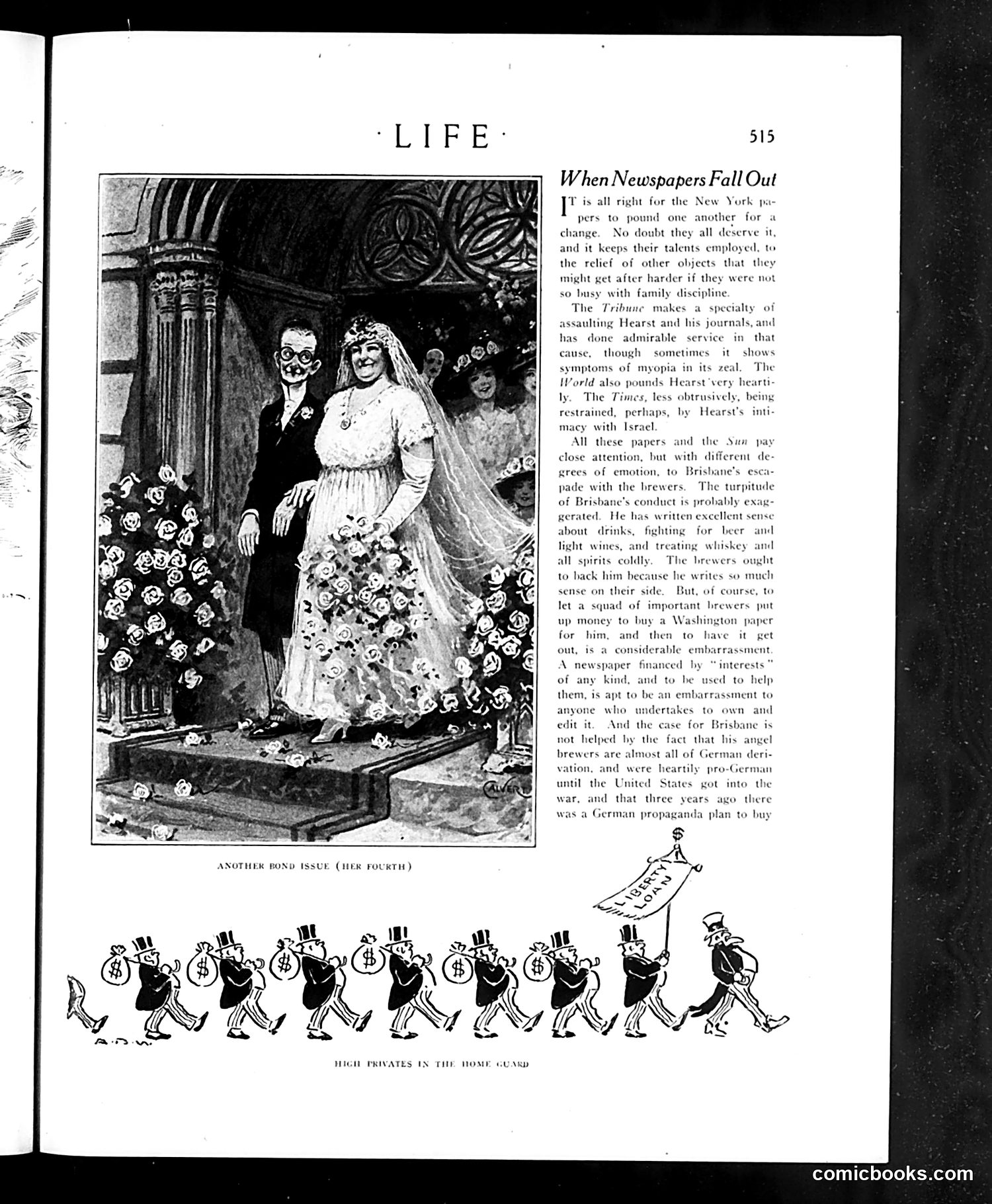
This satirical piece critiques New York newspapers' attacks on William Randolph Hearst and his *Journal*. The top illustration shows a bride and groom (likely representing Hearst and his wife) surrounded by skull-decorated flowers—symbolizing the "poisoned" coverage from rival papers like the *Tribune*, *World*, *Times*, and *Sun*. The article notes these papers compete fiercely in their opposition to Hearst, each with different motives. The bottom cartoon depicts men carrying money bags labeled with dollar signs, captioned "HIGH PRIVATES IN THE HOME GUARD"—satirizing wealthy brewers (many German-descended) who fund newspapers to advance their interests, particularly regarding alcohol regulation and German propaganda during the WWI period.
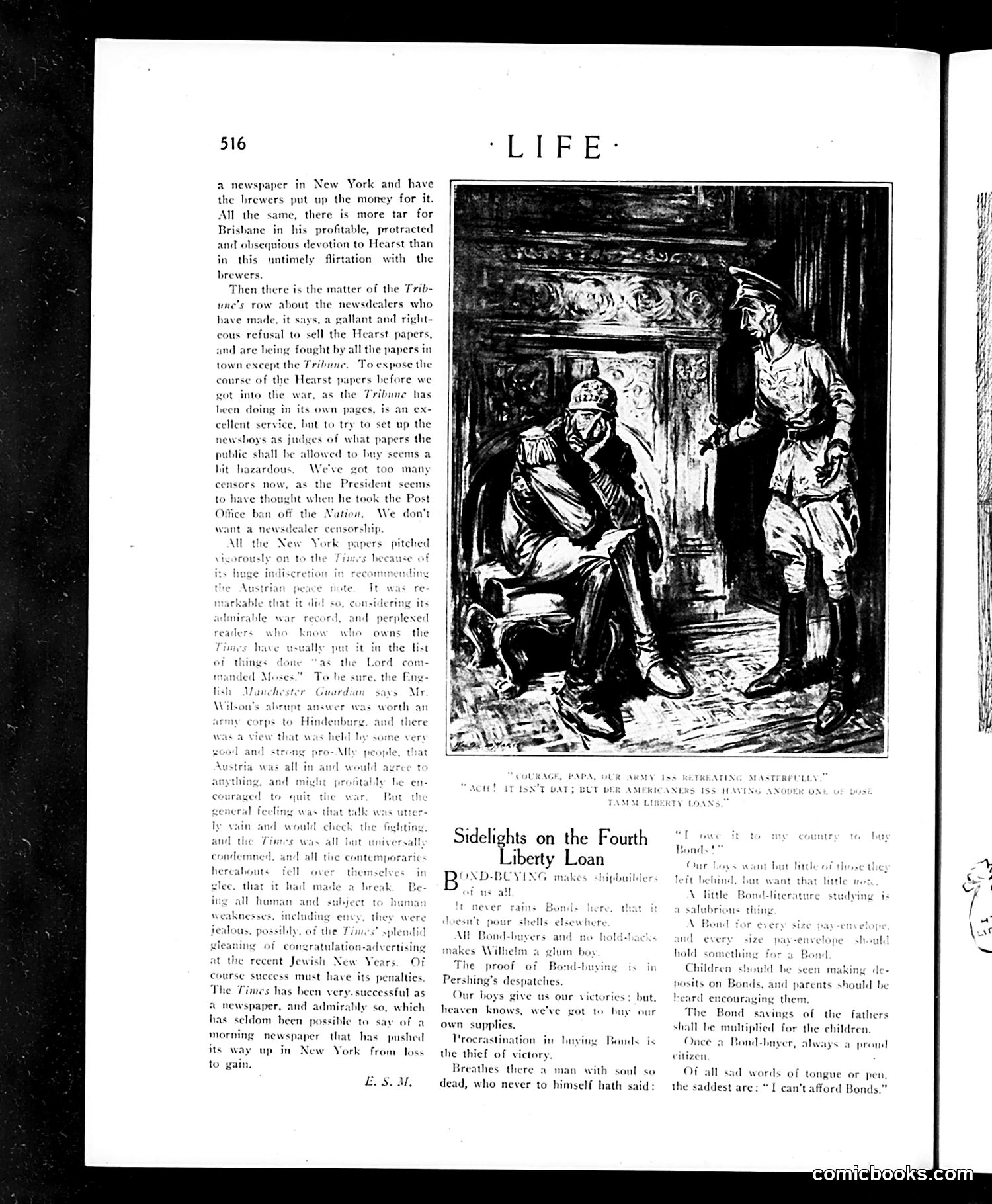
The main illustration depicts a WWI-era military scene with uniformed figures and a caption about "courage, papa, our army is retreating, masterfully." The accompanying article "Sidelights on the Fourth Liberty Loan" discusses bond-buying during wartime. The satire appears to target **procrastination in purchasing Liberty Bonds**—government war bonds meant to finance American involvement in World War I. The cartoon's ironic caption mocks military "retreat" while the article criticizes citizens who delay bond purchases, calling such delay "the thief of victory." The piece uses both gentle humor and patriotic pressure to encourage financial support for the war effort, a common propaganda technique during WWI. The "Sidelights" section employs witty observations to shame reluctant bond buyers into compliance.
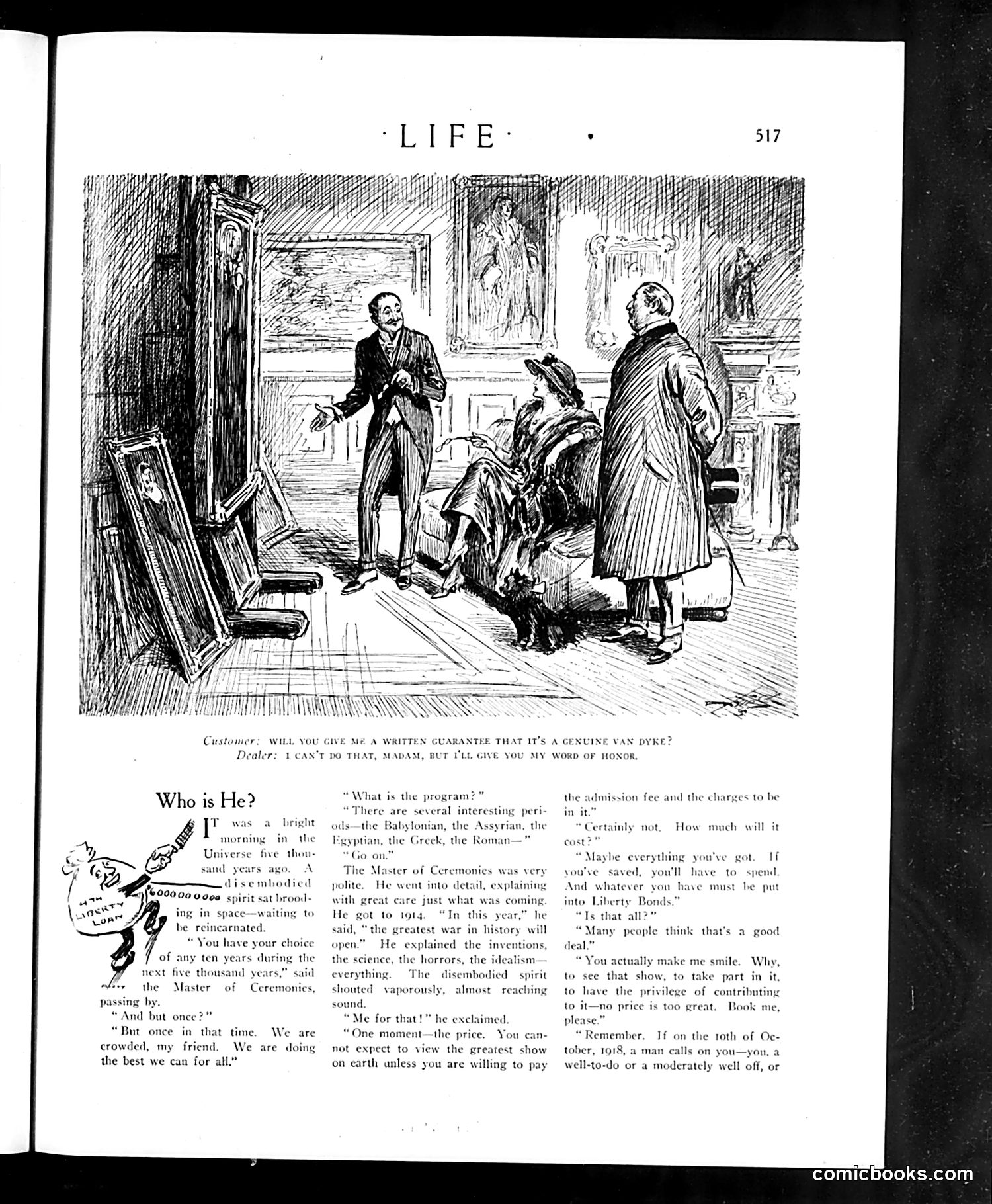
**The Cartoon:** The sketch depicts an art dealer and customer in a gallery. The customer asks for a written guarantee that a painting is a genuine "Van Dyke" (likely a misspelling or pun on "Van Dyk[e]" or similar master). The dealer refuses, offering only his "word of honor" instead—satirizing the dubious authenticity claims common in the art market and dealers' reluctance to provide legal protection for their sales. **The Story "Who is He?":** This appears to be a satirical narrative about a spiritualist or reincarnation believer claiming to have been "the Master of Ceremonies" in a past life. The text mocks spiritualism fads popular in the early 20th century, particularly the claim that one lived through "the greatest war in history" (likely WWI, suggesting this is from around 1918-1920). The dealer's skepticism reflects period cynicism about spiritualist charlatans.
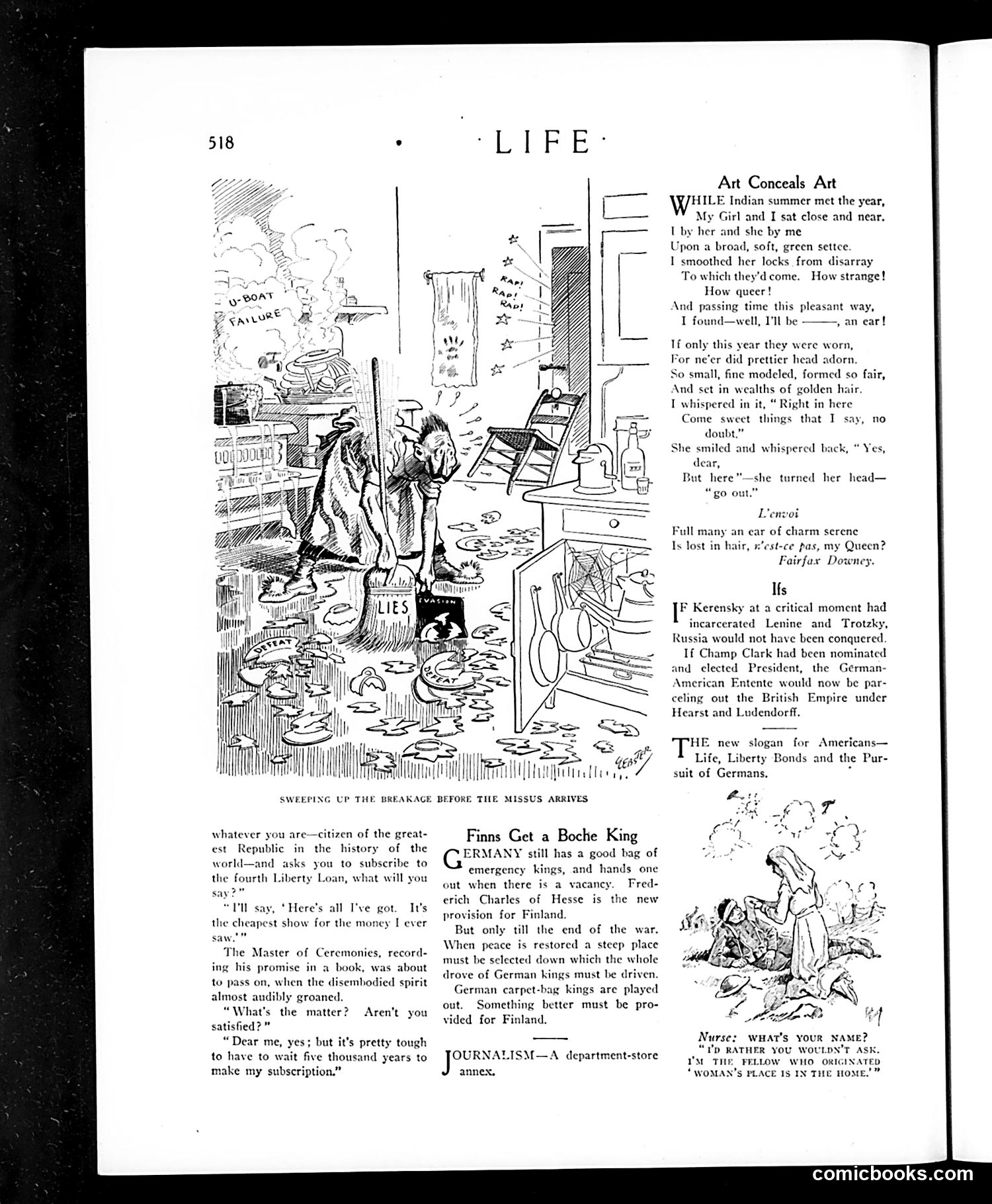
The main cartoon, "Sweeping Up the Breakage Before the Missus Arrives," depicts two men frantically cleaning up a chaotic domestic scene labeled "U-BOAT FAILURE" and "LIES." The image satirizes domestic disorder as a metaphor for wartime mismanagement—the men appear to be politicians or officials hastily concealing evidence of failed military operations (U-boat warfare) and propaganda before public scrutiny arrives. The accompanying text references competing American political figures and international concerns: mentions of Lenin, Trotsky, Champ Clark, and debates over Liberty Bonds and German-American relations indicate this is WWI-era satire criticizing government dishonesty about military failures and the home front's chaotic state. The secondary cartoon and "Nurse" caption appear to address gender roles and social disruption during wartime.
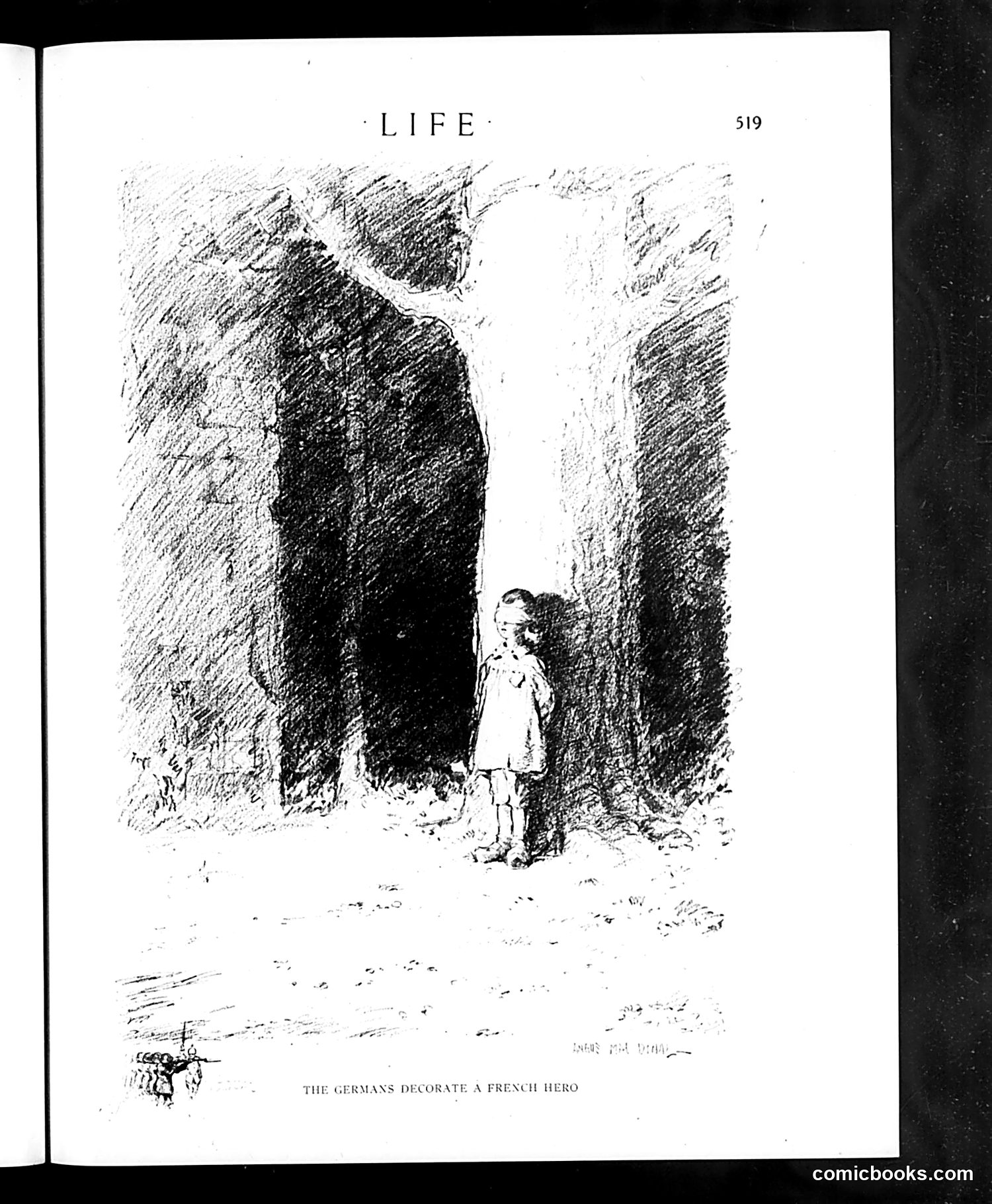
This sketch depicts a small child standing alone in a narrow stone passage or archway, facing what appears to be a dark, looming shadow or figure above. The title suggests this is satirical commentary on German military conduct during warfare against France—likely referencing World War I. The "decoration" reference appears ironic: rather than honoring a French hero through medals or official recognition, the Germans are instead threatening or harming them. The child's small, vulnerable figure contrasts sharply with the imposing shadow, emphasizing the brutality being satirized. This works as anti-German propaganda, portraying German military actions as cruel rather than honorable, particularly targeting civilians or the defenseless.
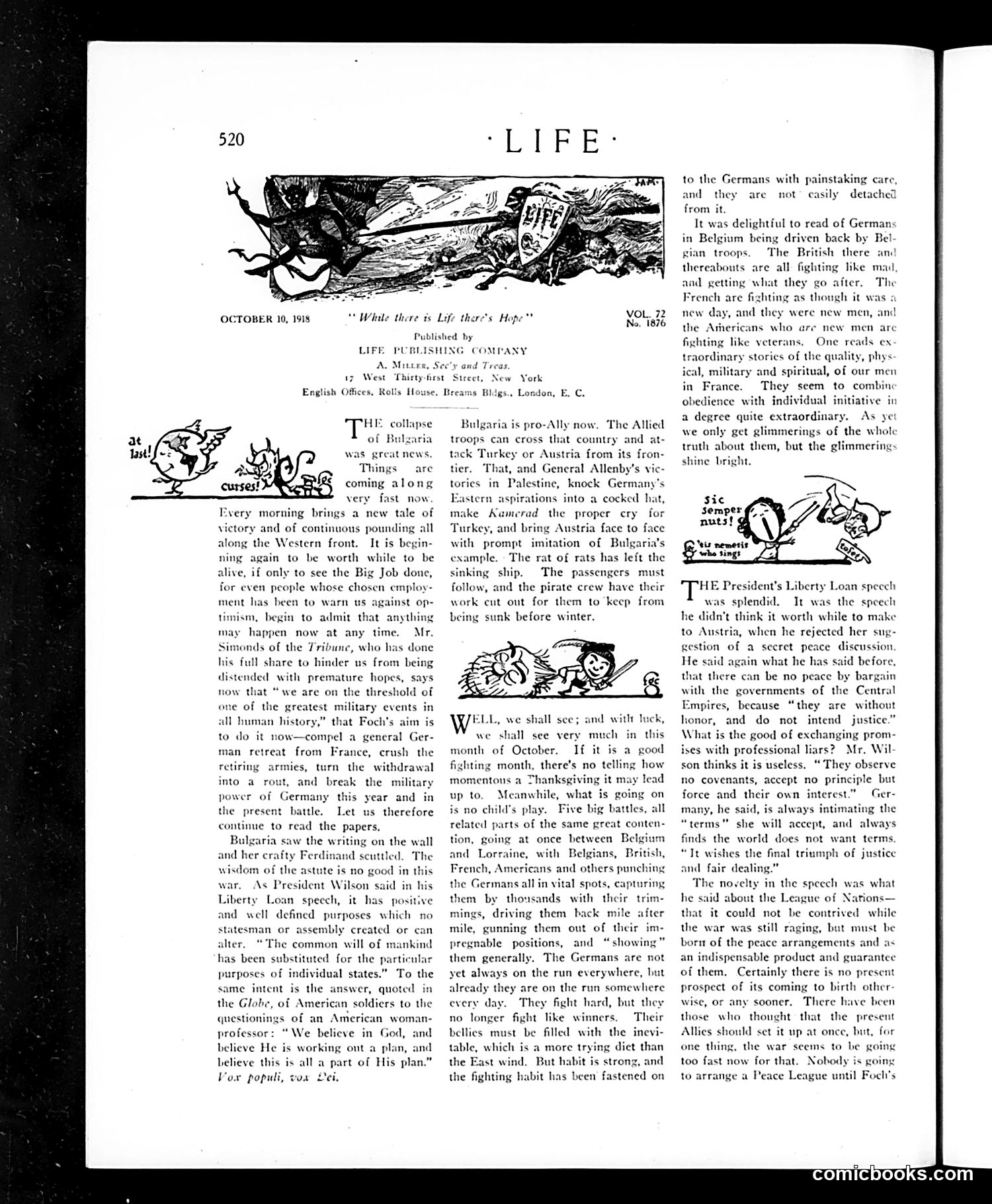
This page celebrates Allied military momentum in the final weeks of World War I. The main editorial discusses Bulgaria's recent surrender and withdrawal from the Central Powers—described as seeing "the writing on the wall"—which strategically opens pathways to attack Turkey and Austria. The cartoons (small illustrations throughout) appear to be satirical commentary on military and political figures, though specific identities are unclear from the image quality. The editorial praises General Foch's strategy to force a German retreat and crush their military power "this year." It notes the fighting continues intensely across Belgium, France, and Palestine, with Germans "no longer fight like winners" despite their "fighting habit." The piece invokes President Wilson's Liberty Loan speech about humanity's "common will," suggesting American soldiers fight for moral principles, not national interest alone. The overall tone is cautiously optimistic that the war's end approaches—hence the headline "While there is Life there's Hope."
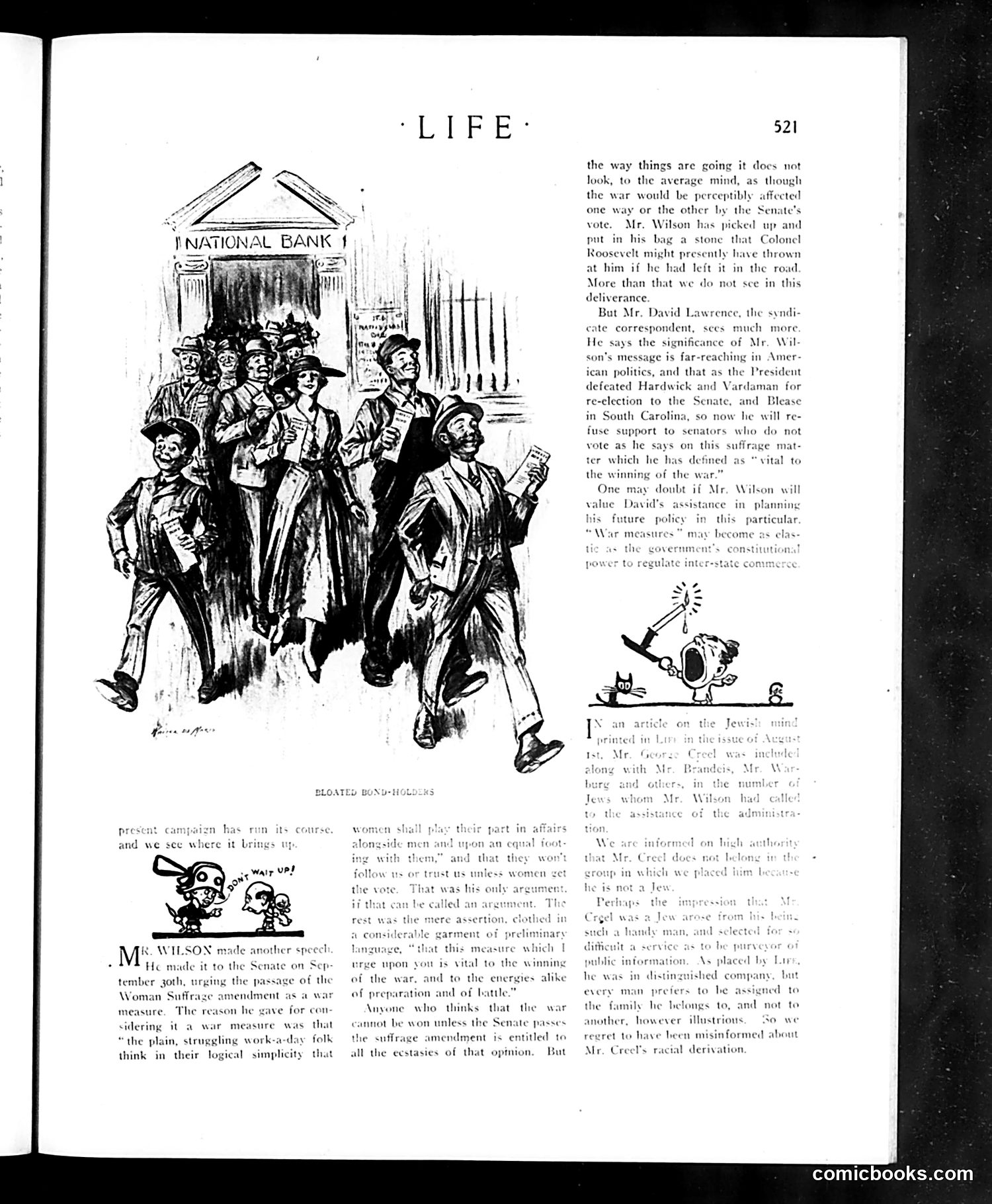
## Main Cartoon: "Bloated Bond-Holders" The large sketch shows well-dressed men emerging from a National Bank, depicted as corpulent and wealthy—caricatured as profiteers benefiting from war financing. The title "Bloated Bond-Holders" explicitly identifies them as financiers growing rich from government war bonds during World War I. ## Political Context The text discusses President Wilson's push for women's suffrage as a "war measure," arguing it's vital to winning WWI. The article notes Wilson is using political pressure against senators opposing the amendment, having already defeated certain candidates in re-election campaigns. The cartoon satirizes the apparent contradiction: while ordinary citizens sacrifice in war, wealthy bond-holders accumulate fortunes through financial instruments. The satire suggests that war profiteering by the financial elite undermines claims that suffrage is truly "vital" to winning—implying the war effort serves multiple interests beyond stated noble purposes. This reflects Progressive-era skepticism about whether wars primarily benefit working people or financial elites.
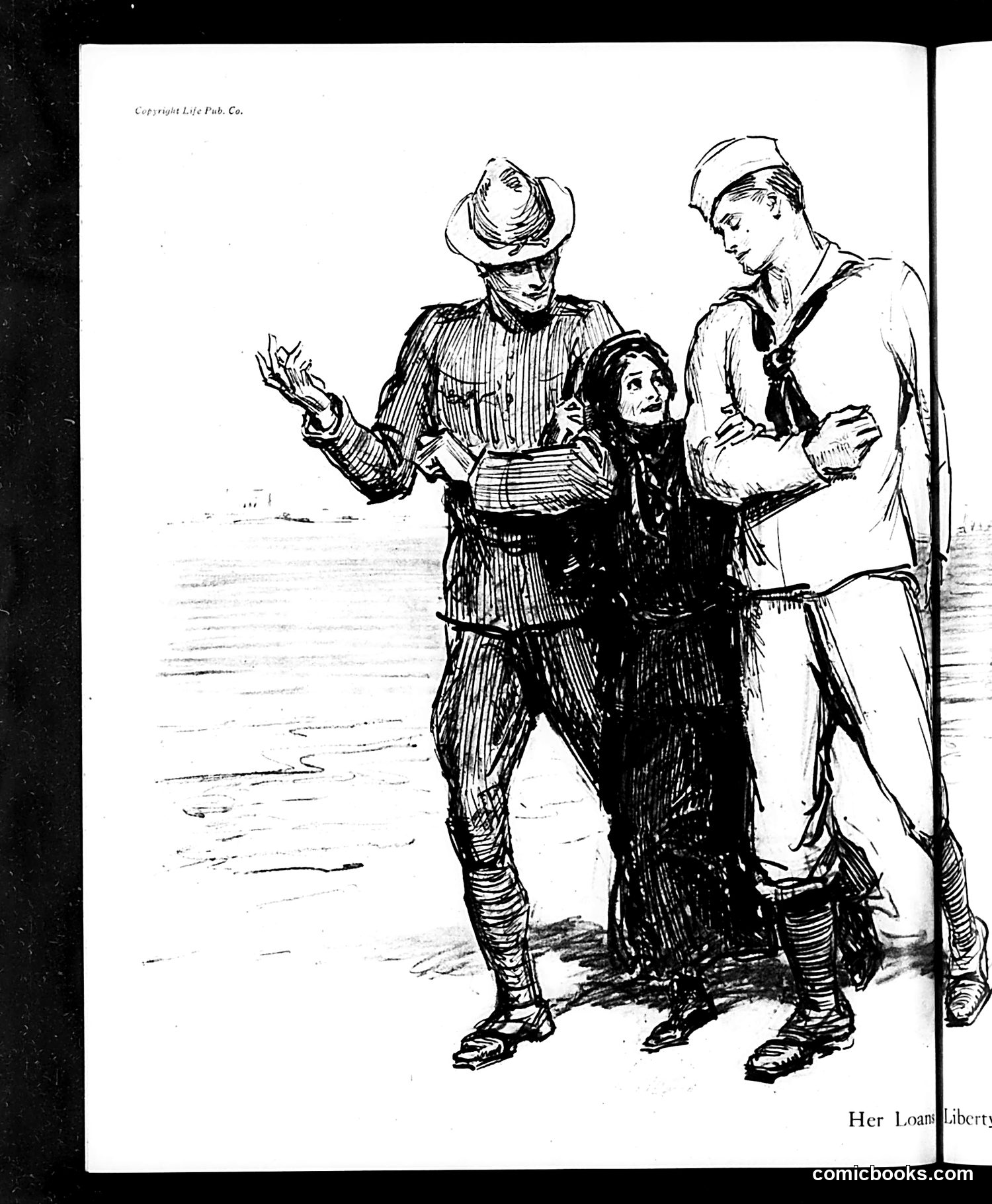
This illustration appears to depict a political commentary on liberty or patriotic ideals. The image shows three figures: a woman in military or official dress (center-left) gesturing expressively, a smaller figure in dark clothing (center), and a man in lighter clothing (right). The title "Her Loan Liberty" suggests wordplay—possibly a pun on "loan" versus "long" live liberty, or commentary on liberty being temporarily "loaned" rather than permanently secured. The formal military attire and the positioning suggest this satirizes government authority or patriotic rhetoric. Without clearer context about Life magazine's publication date, the specific political moment remains unclear, though the style suggests early-to-mid 20th century American satire. The exact targets of this satire cannot be confidently identified from the image alone.
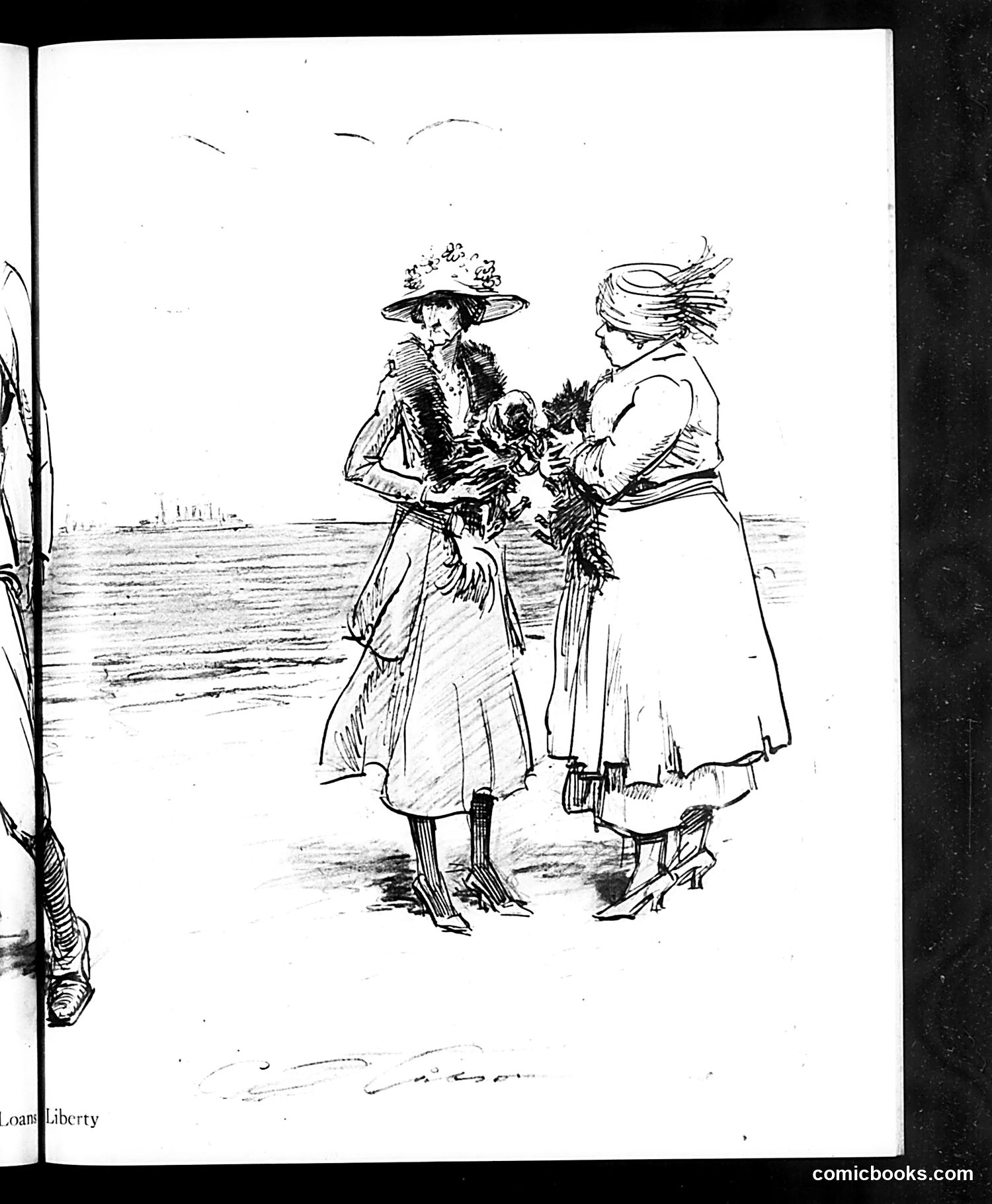
I can see this is a pen-and-ink illustration showing two elegantly dressed women with fashionable hats standing together by what appears to a shoreline or beach. One woman holds what looks like a small dog or similar pet between them. The drawing style is characteristic of early 20th-century satirical illustration. However, the OCR text provided only shows "comicbooks.com" and "Loab Liberty" (possibly a watermark or attribution), with no actual article text or caption visible that would explain the cartoon's specific satirical point, the identities of the figures, or what social/political commentary it intends. Without the accompanying text or caption, I cannot reliably explain what this cartoon means to a modern reader. The image alone doesn't provide sufficient context for interpretation.
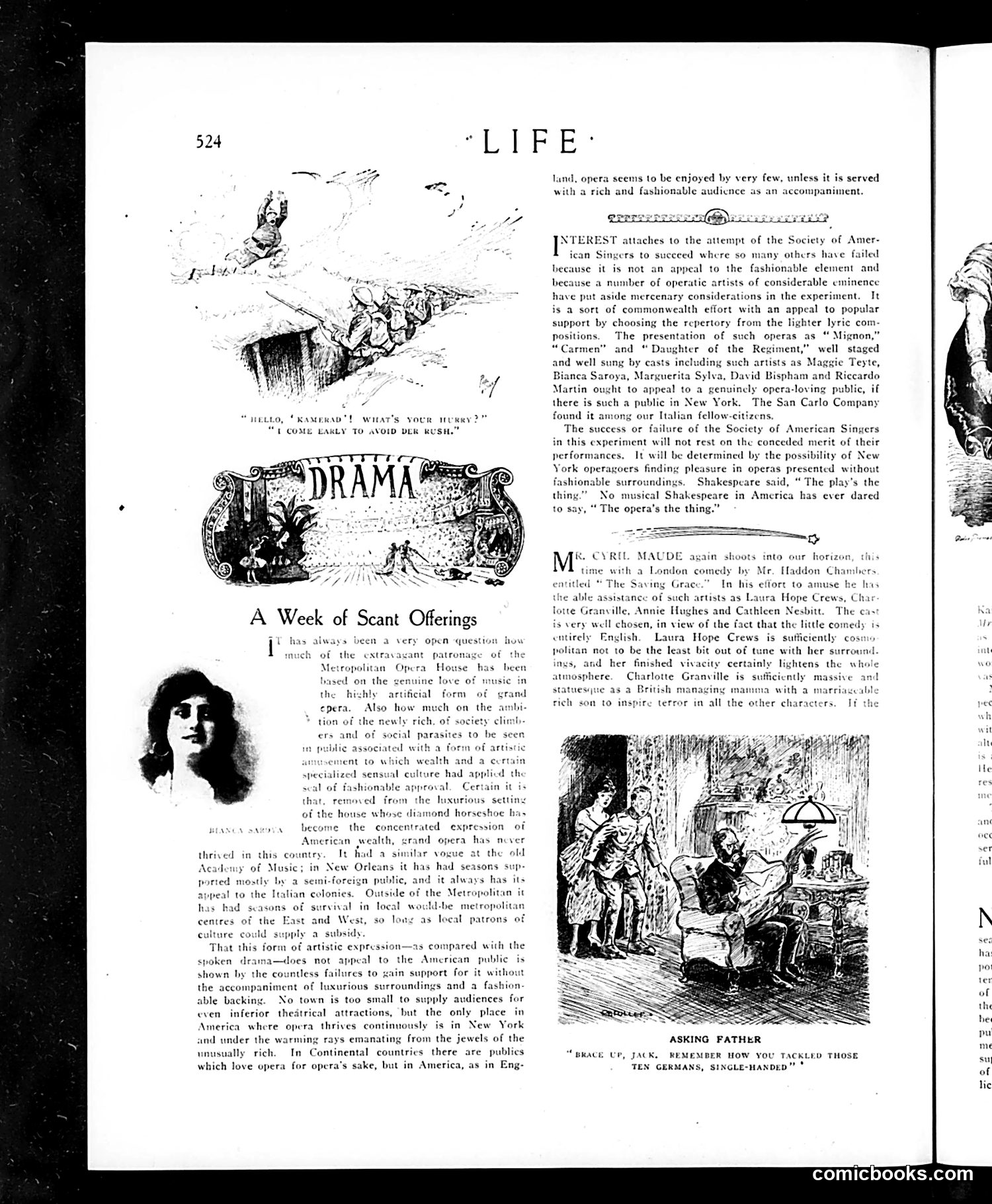
This page contains theater criticism rather than political satire. The main content discusses two topics: **"A Week of Scant Offerings"** critiques American opera's dependence on wealthy patronage. The article argues that grand opera in America only thrives in New York among "the unusually rich" because it lacks genuine popular appeal—unlike spoken drama, which succeeds everywhere. It notes the Metropolitan Opera House's "diamond horseshoe" represents concentrated American wealth rather than artistic merit. The piece expresses cautious interest in the Society of American Singers' attempt to present opera without this fashionable backdrop, questioning whether Americans will actually support opera "for opera's sake" as Europeans do. The second section briefly reviews theatrical productions featuring performers like Cyril Maude and Charlotte Granville. The sketch at top left (captioned about a "Kamerad") appears to be unrelated filler art, possibly WWI-era given the German reference. This is cultural criticism of class and artistic appreciation, not political satire.
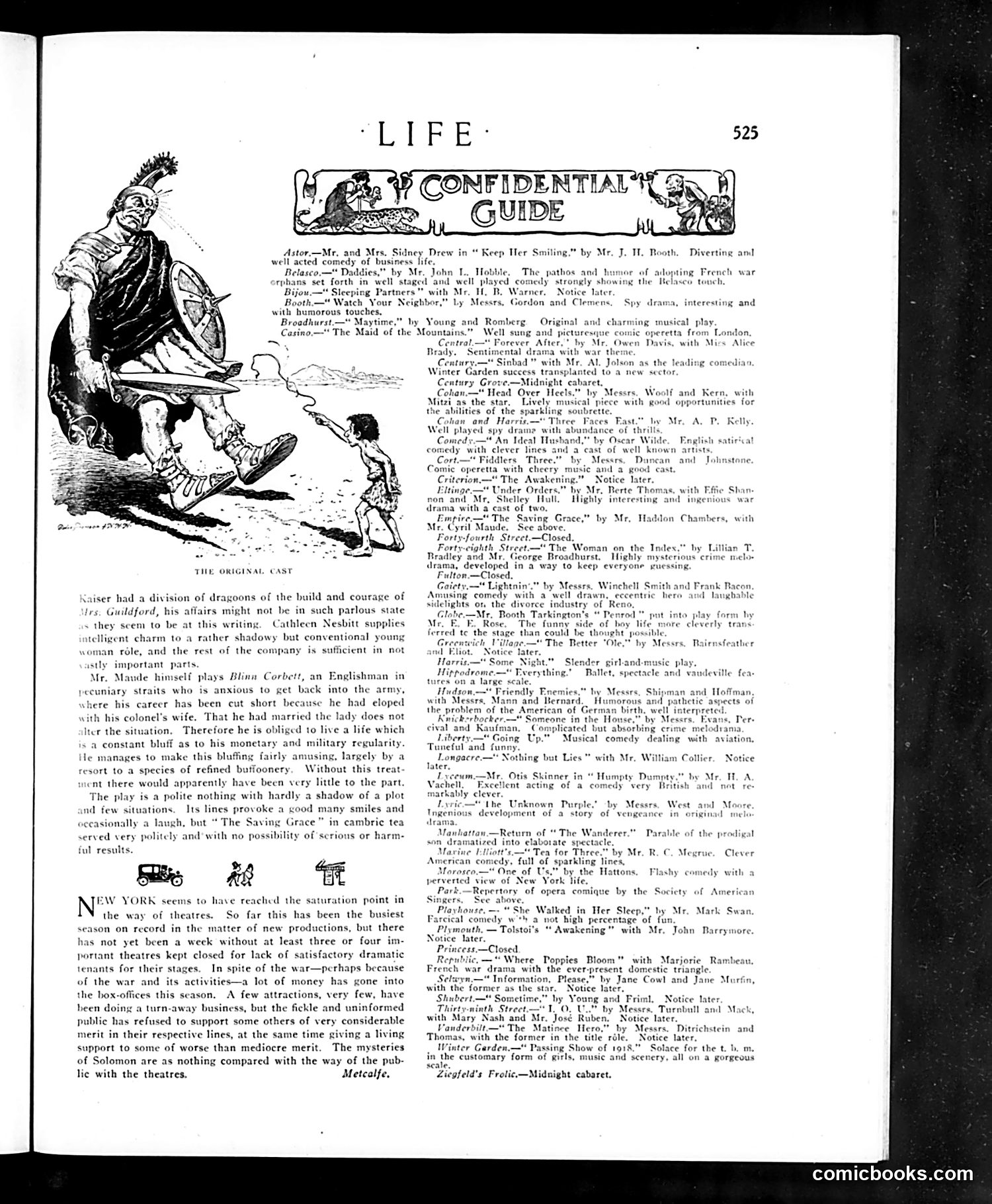
This page from *Life* magazine contains theater reviews rather than political cartoons. The illustration titled "THE ORIGINAL CAST" appears to be a humorous drawing showing a man in military dress (likely representing a character from one of the reviewed plays) interacting with a child in an exaggerated, comedic manner—typical of satirical magazine imagery of the era. The page primarily consists of a "Confidential Guide" to Broadway theaters, reviewing current productions. The reviews mention specific actors and plot details, often with brief critical commentary. Notable references include Sidney Drew in comedies and Oscar Wilde's "An Ideal Husband." The brief editorial at bottom by Metcalfe comments on New York's theater saturation—many productions opening despite limited audience support, suggesting the public's unpredictable tastes puzzle even experienced observers.
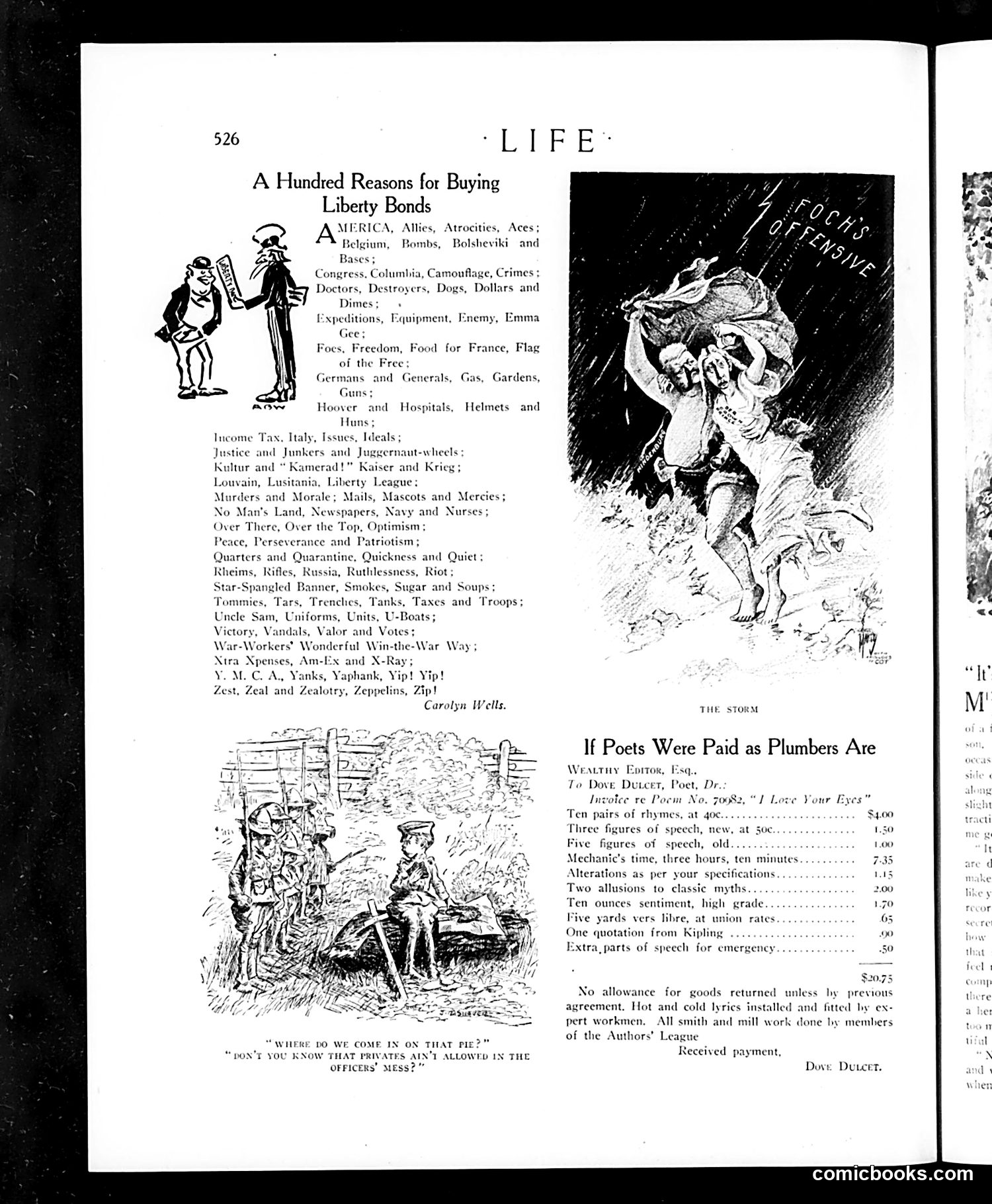
This page uses satire to promote WWI Liberty Bonds while mocking military hierarchy and undervaluing creative work. **"A Hundred Reasons for Buying Liberty Bonds"** (by Carolyn Wells) is an alphabetical list mixing patriotic concepts (Freedom, Peace, Victory) with war realities (Atrocities, Gas, Lusitania, trenches). The accompanying cartoon shows a soldier being denied entry to an officers' mess, satirizing class divisions even during wartime sacrifice. **"If Poets Were Paid as Plumbers Are"** mocks the undercompensation of poets by presenting a poem invoice styled as a plumber's bill. Items like "ten pairs of rhymes" and "ten ounces sentiment, high grade" are priced laughably low (totaling $30.25), while "mechanic's time" would cost far more. The satire critiques how society undervalues literary work compared to manual labor—a pointed jab at the Authors' League, which likely sought better compensation for writers. Both pieces use humor to address serious WWI-era issues: patriotic duty, class inequality, and artist compensation.
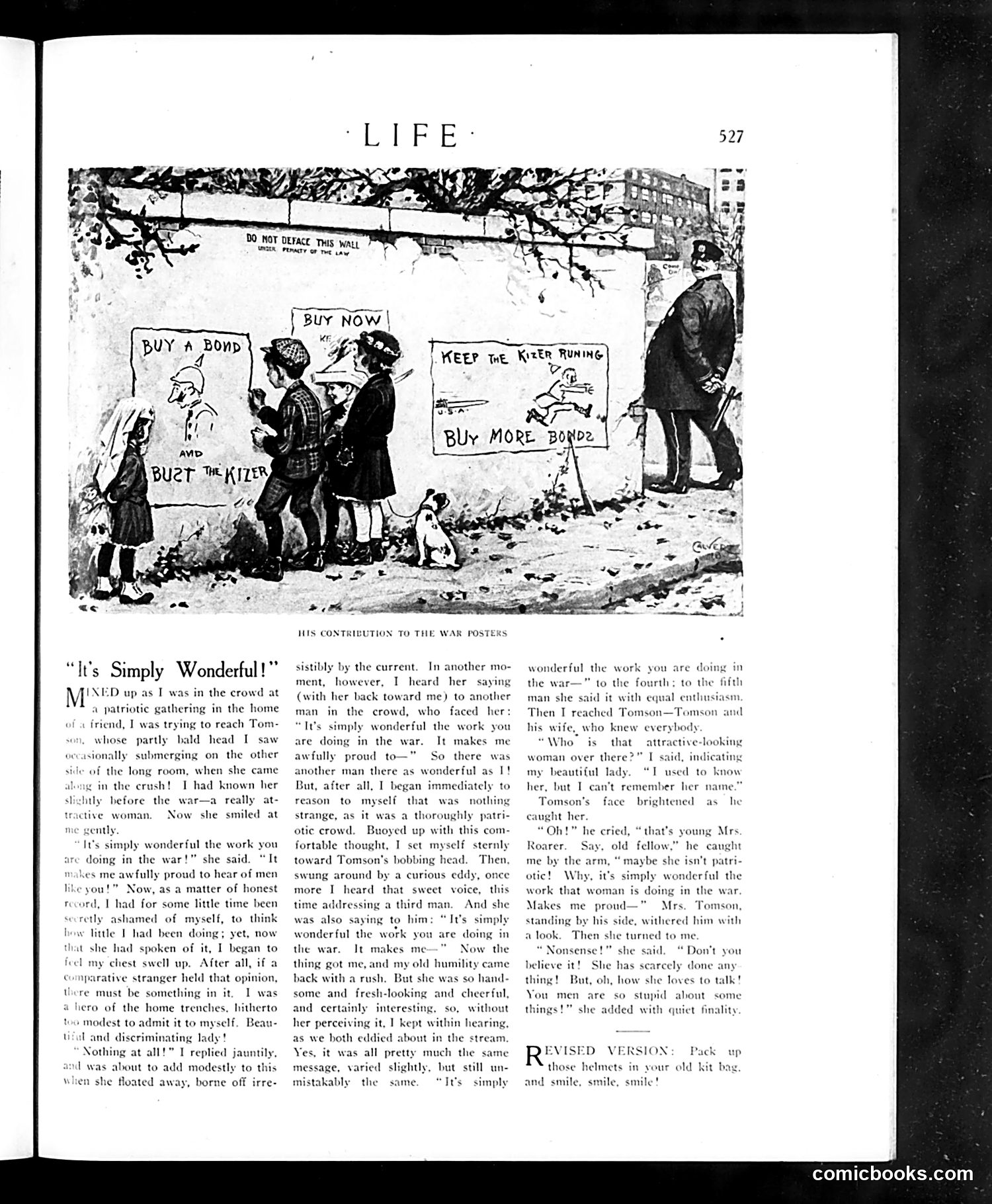
This page contains satirical commentary on wartime morale-boosting through flattery—specifically how women's indiscriminate praise undermines genuine recognition of actual war effort. ## The Main Story/Cartoon The narrative describes a man at a patriotic gathering who feels validated when a woman praises his war work. His pride deflates when he realizes she gives identical compliments ("It's simply wonderful!") to every man she encounters—it's mechanical flattery, not genuine appreciation. ## The Point The satire mocks how wartime propaganda and social pressure create hollow, repetitive praise. The woman, "Mrs. Roarer," is revealed as all talk—she does nothing substantial herself but performs patriotism through glib compliments. Mrs. Tomson's final comment ("Don't you believe it!") exposes the fraud. ## The War Posters Above The crude wall posters ("BUY A BOND," "BUST THE KILLER," "KEEP THE KILLER RUNNING," "BUY MORE BONDS") represent the relentless, repetitive messaging that parallels the woman's empty platitudes—both are wartime noise rather than substance. The satire targets superficial wartime patriotism and the gap between performative support and actual contribution.
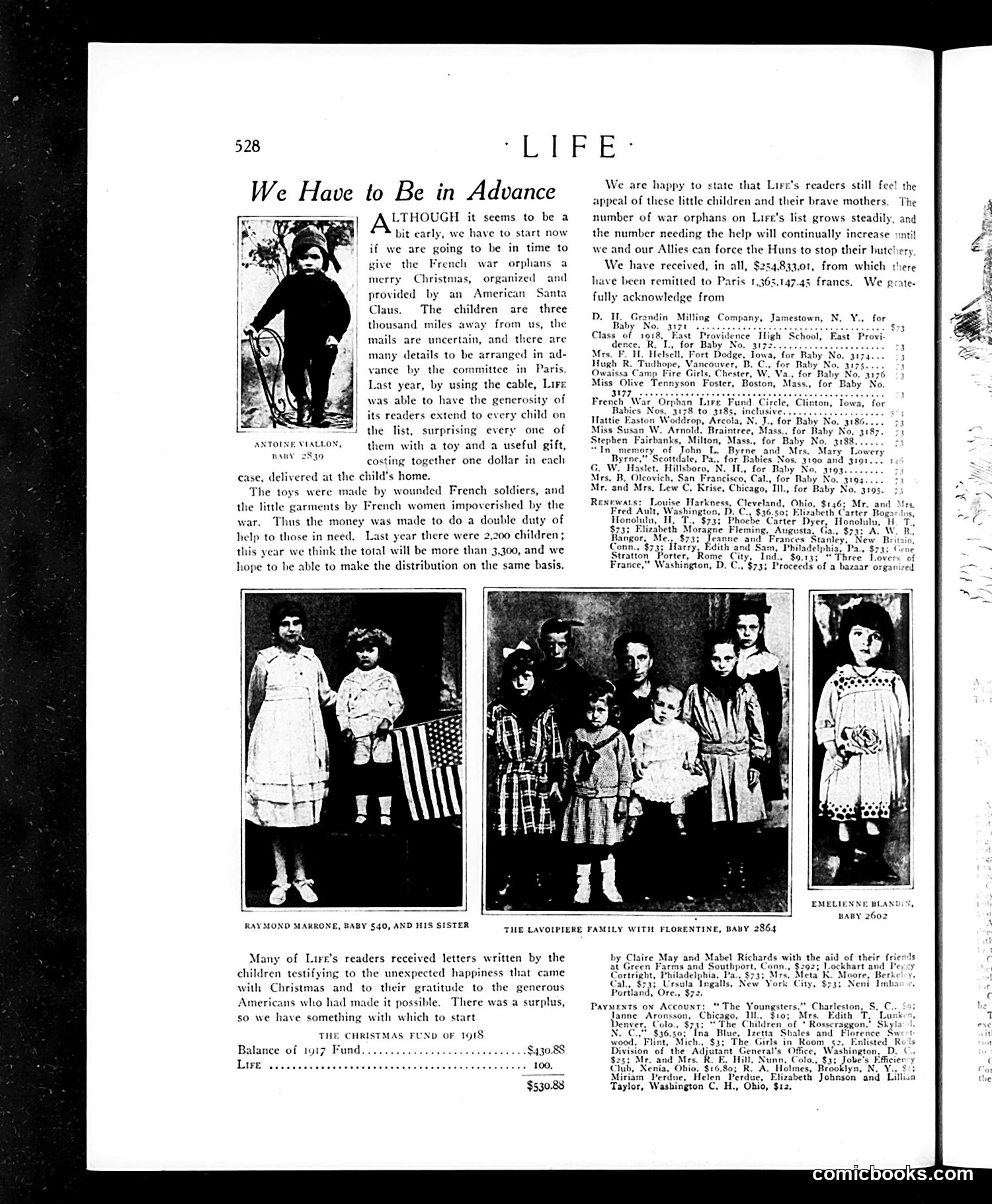
This is a **fundraising article** for Life magazine's Christmas charity initiative supporting French war orphans during or after World War I. The page is not a political cartoon but rather a sincere appeal emphasizing urgent need. **The context:** France has 3,300+ orphaned children awaiting toys and clothing. To deliver gifts by Christmas, American readers must donate *now*—months in advance—because mails are uncertain and planning requires time. **The appeal's logic:** Donations fund toys made by wounded French soldiers and garments sewn by impoverished French women, creating "double duty" by helping multiple populations simultaneously. The page lists donors and donation amounts, along with photographs of children like Antoine Viallon and the Lavoipière family. The emphasis on these individual beneficiaries was designed to personalize the charity and inspire continued American generosity toward America's European allies.
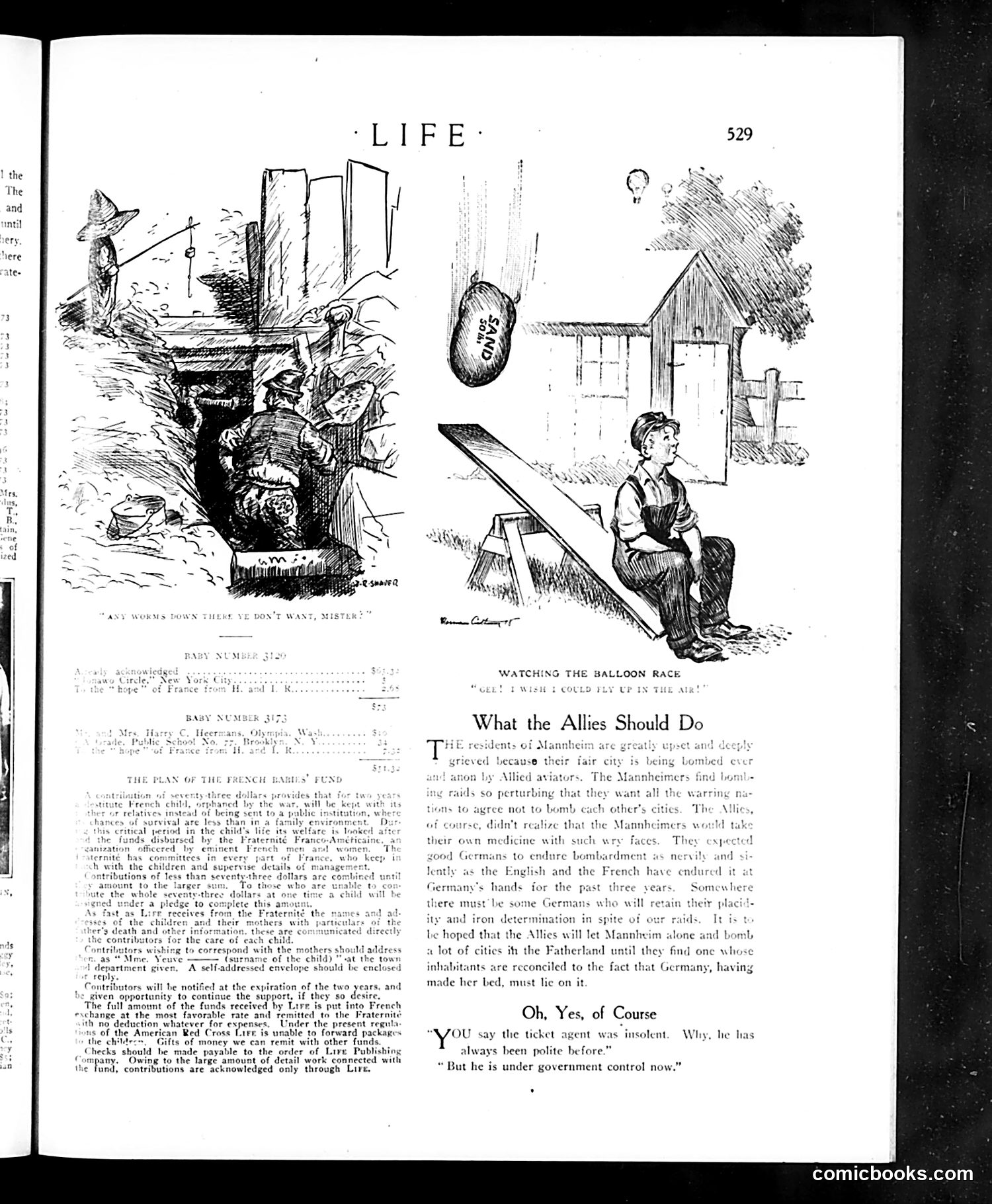
This page contains two distinct satirical pieces from World War I era Life magazine: **Left cartoon ("Any Worms Down There?"):** Shows a fisherman-like figure in a trench, apparently fishing in muddy water. The caption suggests dark humor about trench warfare conditions. **Right illustration ("Watching the Balloon Race"):** Depicts a boy observing a hot air balloon, with accompanying text about observing aerial activity. **Main article "What the Allies Should Do":** Discusses Mannheim (a German industrial city), arguing the Allies should bomb it repeatedly. The satire mocks German complaints about air raids—the author suggests Germans expected "fair" warfare and shouldn't complain after their own aggression. The logic is bitterly ironic: Germany started the war, so they deserve bombing. **"Oh, Yes, of Course" dialogue:** A brief comic exchange mocking government control over civilian workers, suggesting wartime bureaucracy has made previously polite employees now rude when acting under government authority. The overall tone reflects American satirical commentary on World War I conduct and German military responsibility.
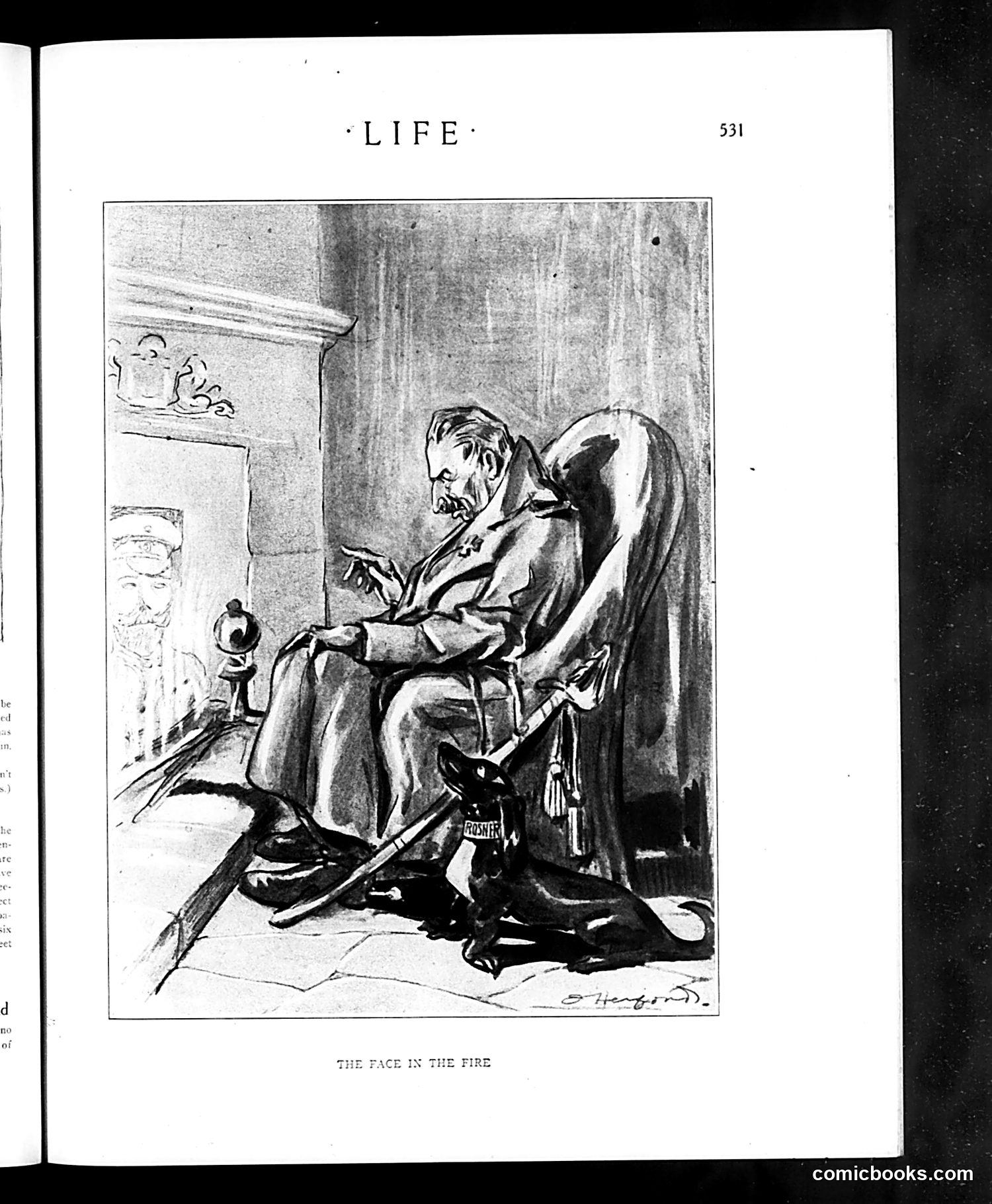
This cartoon depicts a man in formal attire sitting in a chair by a fireplace, gazing intently into the flames. The illustration style and composition suggest he's seeing or imagining something in the fire—a common romantic or supernatural trope in literature and art. Without additional context from the surrounding article text, the specific satirical target is unclear. However, the setup appears to mock either: a man lost in daydreaming or nostalgic reverie; superstitious belief in fire-gazing divination; or possibly a commentary on someone obsessed with an absent person or memory. The formal dress and interior setting suggest this targets a particular social type or contemporary figure, but the identity remains unclear from the image alone.
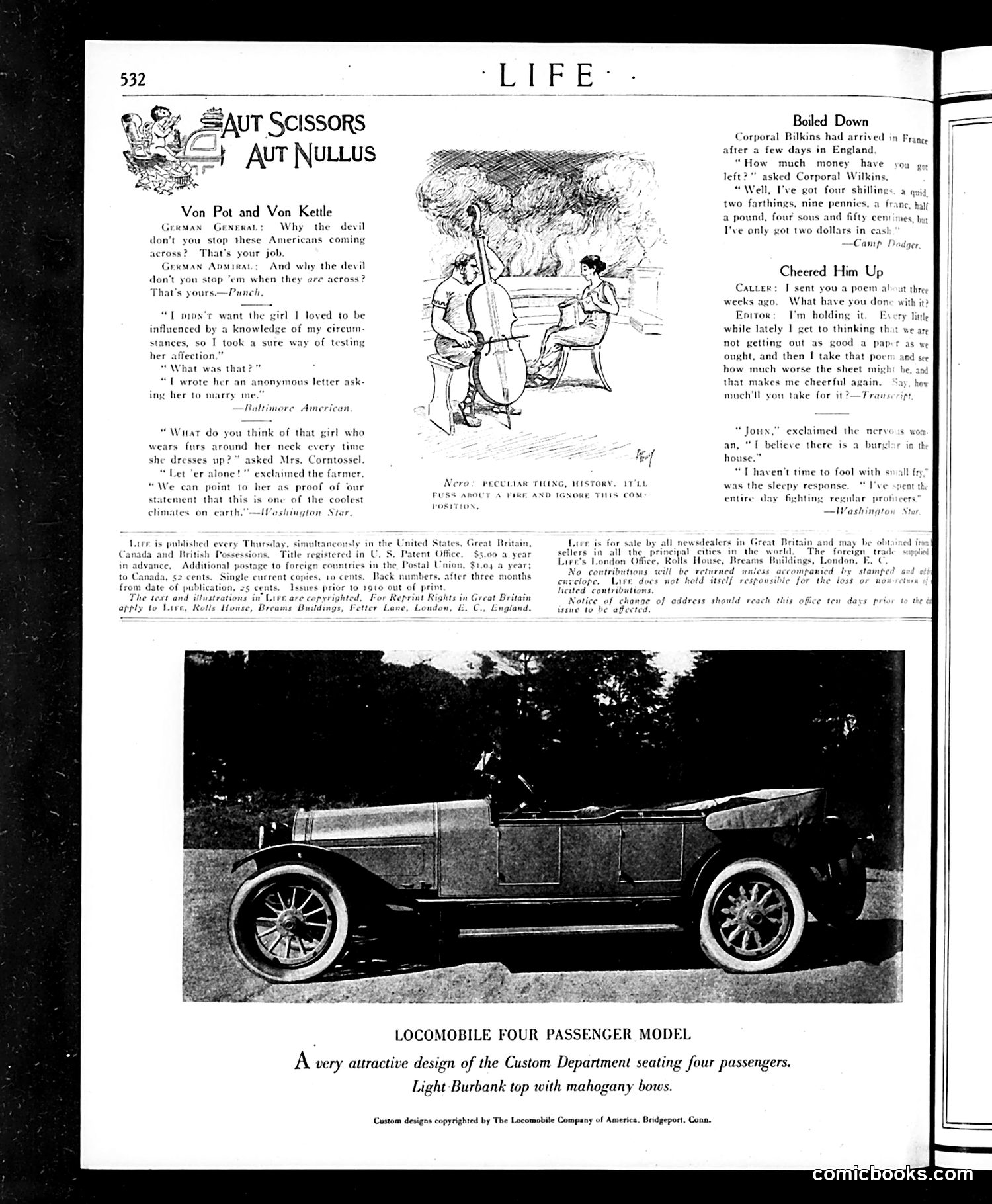
This page contains three satirical joke sections plus an automobile advertisement. **"Von Pot and Von Kettle"** references the German proverb about the pot calling the kettle black. The cartoon depicts a dialogue between a German General and Admiral, each blaming the other for failing to stop Americans—likely referring to American military or economic intervention during World War I era. The satire mocks mutual finger-pointing between military branches. **"Boiled Down"** and **"Cheered Him Up"** are brief humorous anecdotes typical of Life's filler humor—one about a soldier's depleted finances, another about an editor holding poetry submissions to reuse as inspiration to improve the newspaper itself. The remaining jokes follow similar lightweight patterns of domesticity and mild absurdity. **The automobile section** features a Locomobile four-passenger vehicle advertisement, highlighting its custom design with mahogany details—typical luxury car marketing of the era. This page represents Life's mix of light political satire (WWI-era), domestic humor, and commercial advertising rather than hard-hitting journalism.
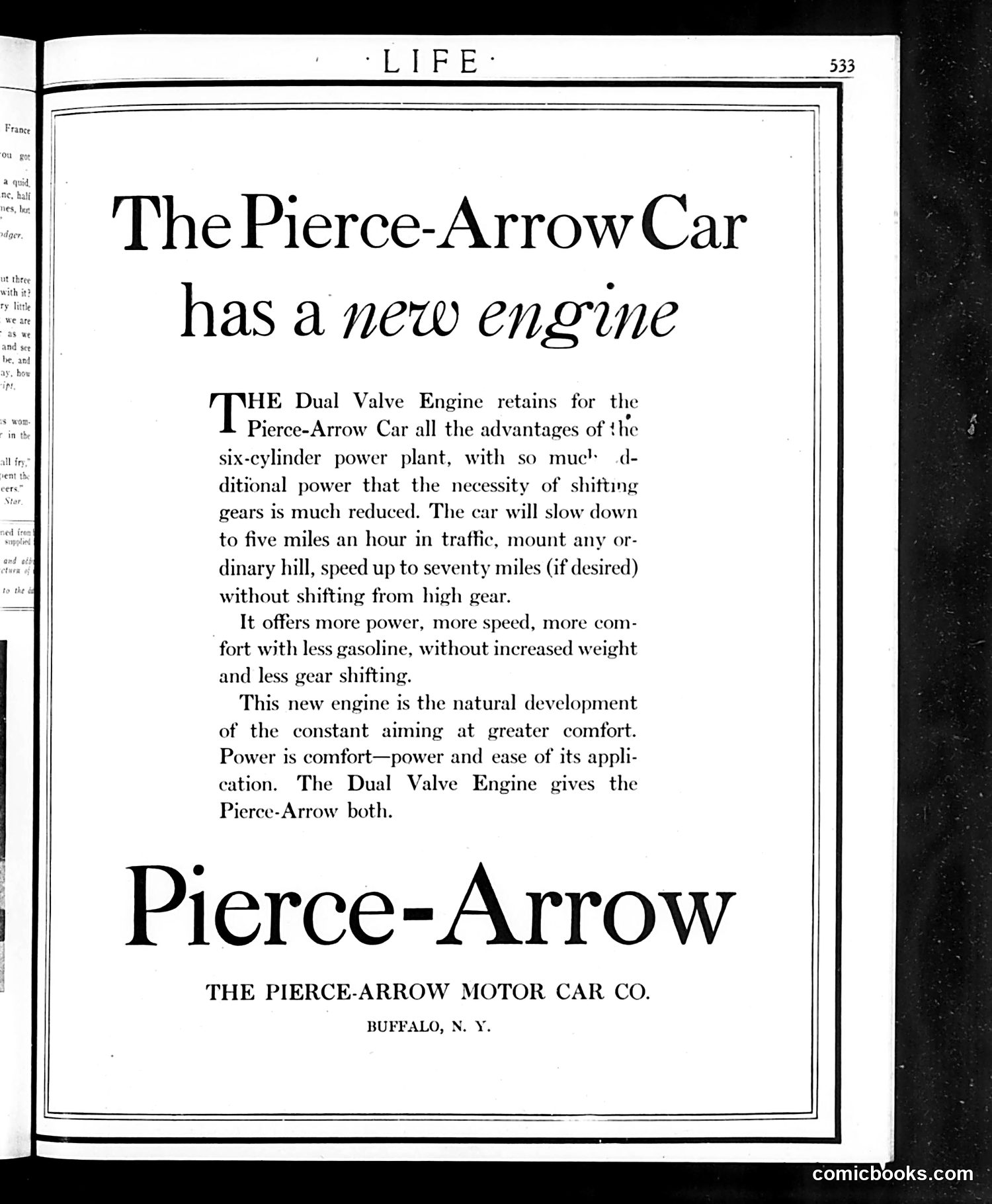
This page is **not a cartoon or satire**—it's a straightforward advertisement for the Pierce-Arrow Motor Car Company of Buffalo, New York. The ad promotes the Pierce-Arrow's new "Dual Valve Engine," highlighting technical innovations: reduced gear-shifting, ability to climb hills and reach 70 mph without changing gears, improved fuel efficiency, and enhanced comfort. The marketing pitch emphasizes that "power is comfort," positioning mechanical advancement as a luxury feature. This appears in *Life* magazine's advertising section. While *Life* was known for satire and humor, this particular page is commercial copy—a luxury automobile manufacturer advertising to affluent readers. The page number (533) and layout suggest it's part of the magazine's paid advertising section rather than editorial content.
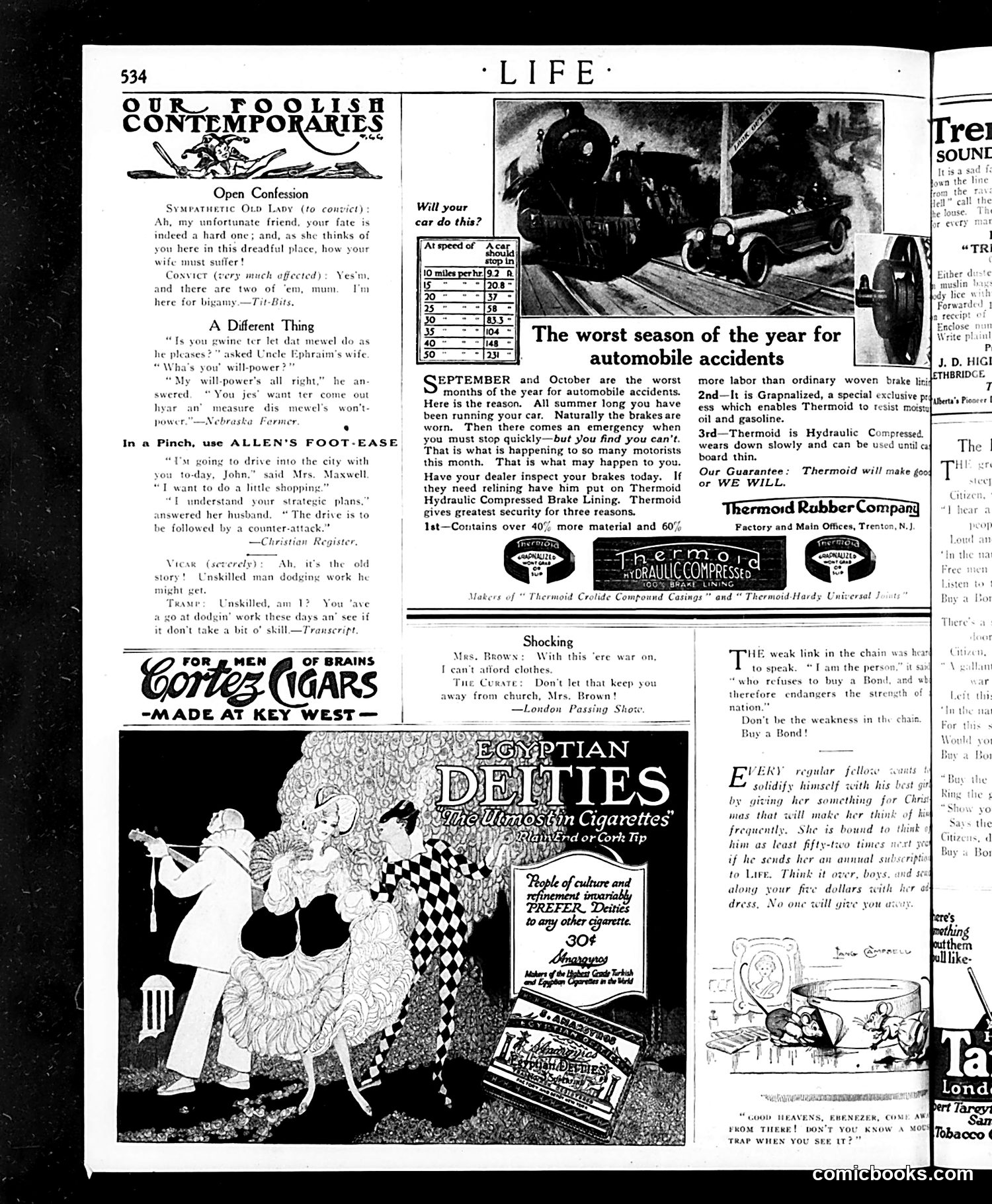
This page contains multiple satirical pieces typical of early 20th-century Life magazine humor: **"Our Foolish Contemporaries"** section offers brief comic vignettes mocking various social types—a sympathetic lady visiting a convict, a wife's strategic shopping trip, and workplace laziness—all using exaggerated dialogue for effect. **The automobile safety advertisement** for Thermod Rubber brake linings uses the legitimate concern about fall accident seasons to sell products, exemplifying how advertisers exploited public safety anxieties. **"Shocking" dialogue** between Mrs. Brown and a Curate references wartime clothing shortages, likely WWI-era. **The Egyptian Deities cigarette ad** features art deco styling and orientalist imagery typical of 1920s advertising aesthetics. **War Bond messaging** appears in the "weak link in the chain" section, urging citizens to buy bonds for national strength—wartime propaganda framing patriotic duty as personal responsibility. The page reflects a publication mixing humor, advertising, and patriotic messaging for educated readers during the World War I period.
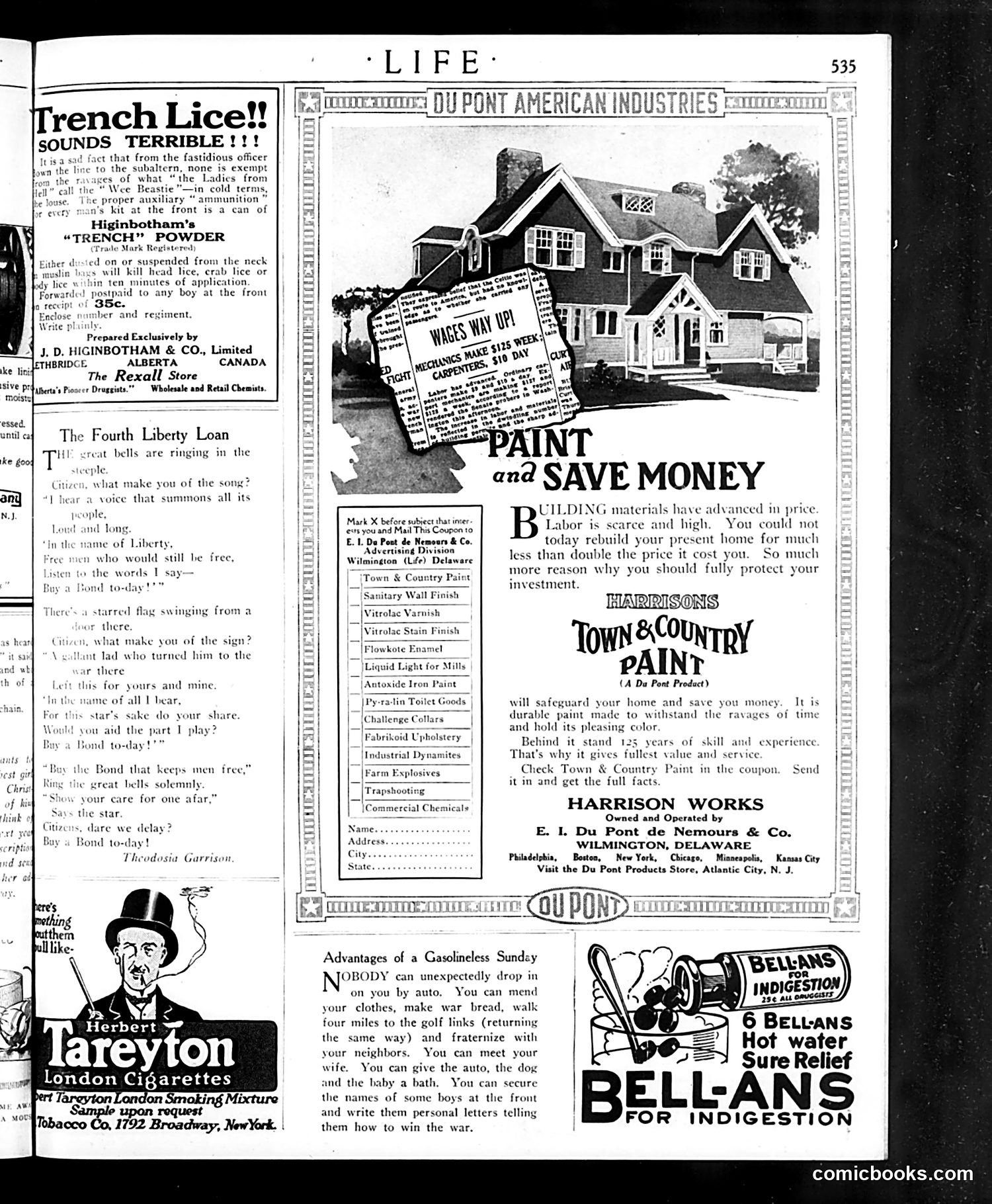
This page mixes wartime messaging with period advertising, likely from WWI era. **Left Column:** A satirical ad for "Trench Powder" addresses a genuine soldier problem—lice infestations in trenches—presenting the product as essential "ammunition" for front-line troops. The dark humor treats parasites as a serious military concern. **Center:** "The Fourth Liberty Loan" features a patriotic poem by Theodosia Garrison using dialogue between a citizen and symbolic figures (the flag, a star) to encourage war bond purchases. It's propaganda dressed as verse, emphasizing duty and sacrifice with lines like "Buy the Bond that keeps men free." **Right Side:** A large DuPont paint advertisement opportunistically ties home maintenance to wartime sacrifice, suggesting protecting one's property investment parallels supporting the war effort. **Bottom:** An advertisement for Bellans digestive aid exploits wartime anxiety about health. The page reflects how commercial interests exploited patriotic fervor while addressing real soldier concerns, mixing genuine wartime problems with marketing.
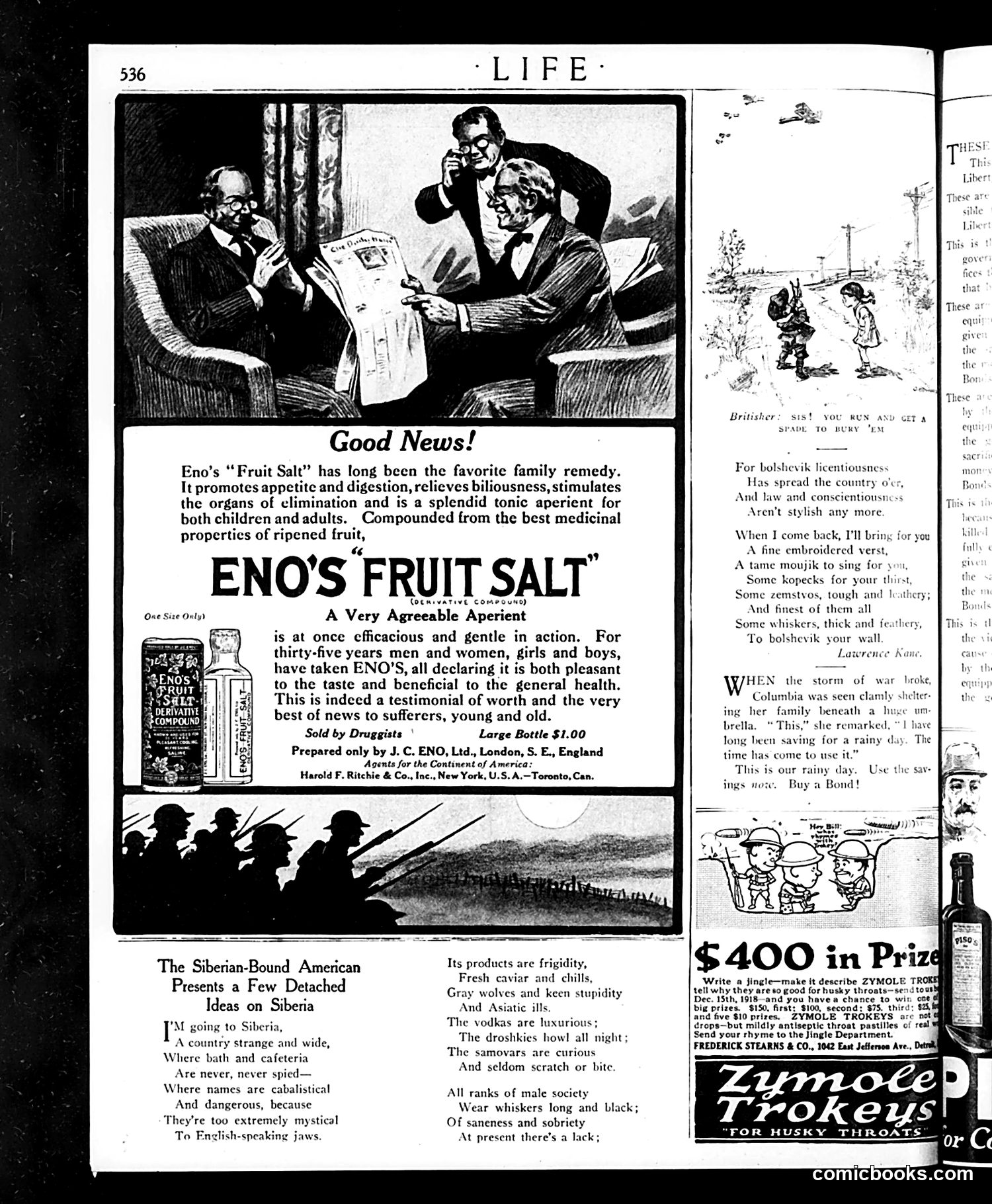
This page mixes commercial advertising with satirical content about World War I and post-war Russia. The main cartoon depicts three men in an office examining what appears to be a military map or document labeled with "Liberty Bonds." The satire targets American perceptions of Russia during the Bolshevik Revolution. The accompanying poem "The Siberian-Bound American" mocks Russian stereotypes—long beards, vodka, incomprehensible names, Bolshevik "licentiousness"—while suggesting Americans are being sent or are going to Siberia, likely referencing anti-Bolshevik military intervention. The bottom half features war-bond messaging: a woman sheltering under an umbrella remarks she's been "saving for a rainy day"—now is the time to "Buy a Bond!" This appeals to American patriotism and financial support for the war effort. The Eno's Fruit Salt advertisement occupies the upper portion, typical of the magazine's advertising-heavy model. Overall, the page reflects 1918 American anxieties about Bolshevism and mobilizes patriotic spending.
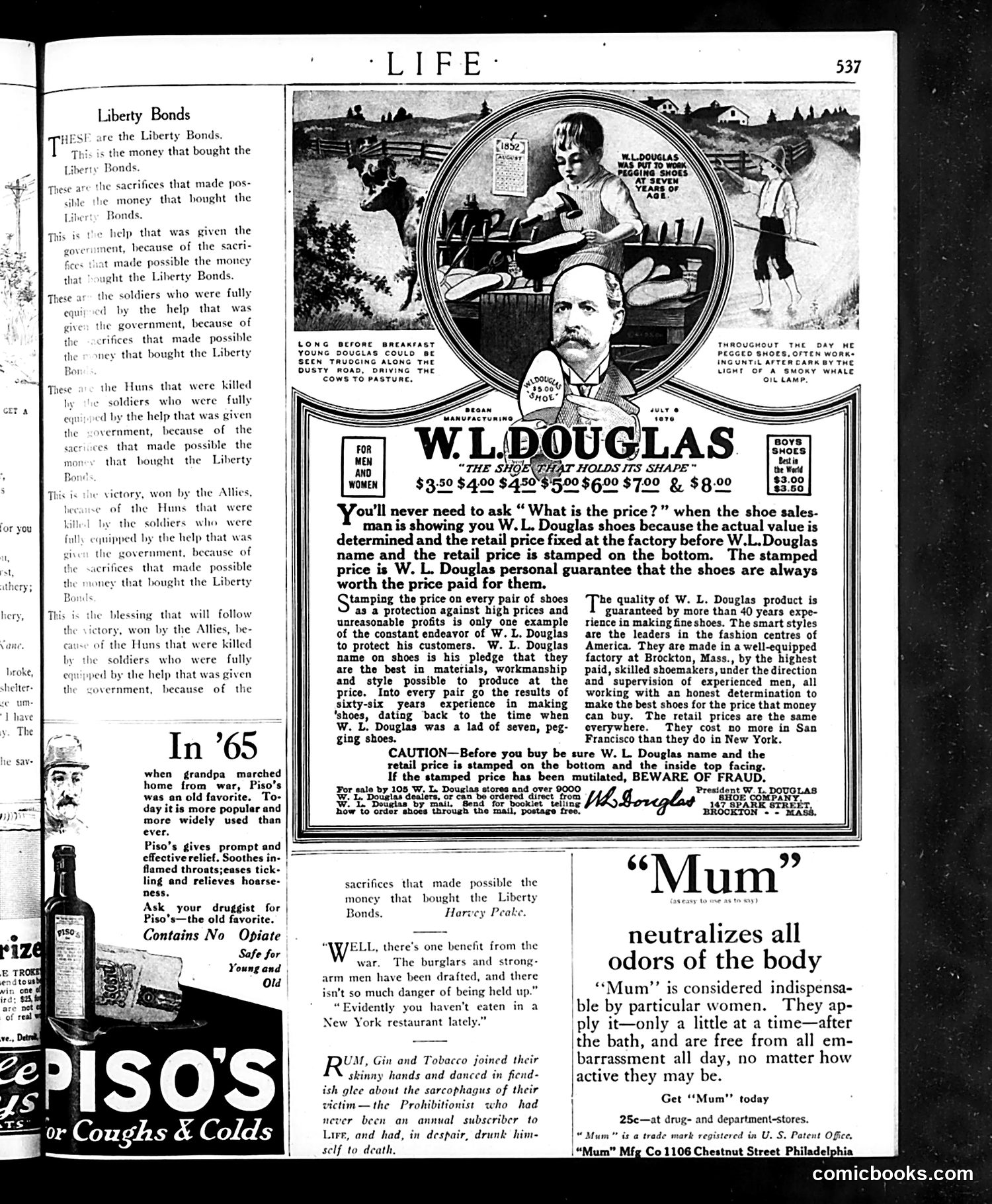
**Main Content:** This page is primarily **advertising**, dominated by a W.L. Douglas shoe company advertisement featuring a biographical narrative about young William L. Douglas pegging shoes as a child. **Left Side - "Liberty Bonds" Essay:** The repetitive text is satirical commentary on WWI sacrifice rhetoric. It cyclically chains together: Liberty Bonds → money → sacrifices → government help → soldiers → dead "Huns" (Germans) → victory. The satire mocks how patriotic appeals reduced complex wartime sacrifice to circular logic—each element justified by the others in an endless loop of justification. **Upper Left - Piso's Medicine Ad:** An old patent medicine advertisement claiming effectiveness for coughs/colds, notable for containing "No Opiate" (emphasizing safety during an era of opiate-laden remedies). **Lower Right - "Mum" Deodorant Ad:** A personal hygiene product marketed to women as a "necessity," reflecting early-20th-century consumer culture's expansion into intimate products. **Historical Context:** This 1918-era *Life* page reflects America's WWI involvement combined with emerging consumer capitalism and patent medicine marketing.
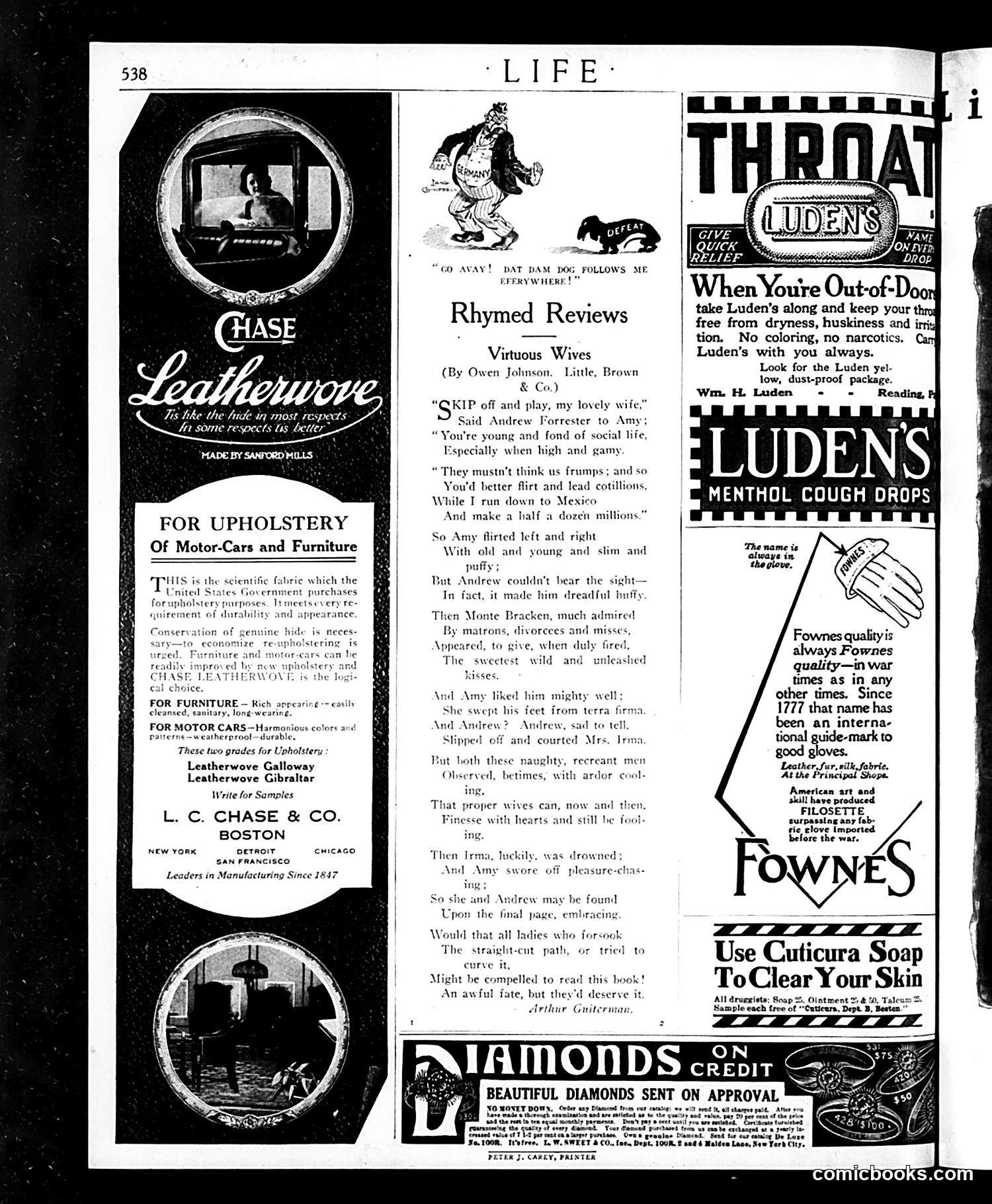
This page is primarily **advertising**, with a small satirical poem inserted among product promotions. The main cartoon/illustration shows a figure (drawn in exaggerated caricature style) exclaiming "GO AWAY! DAT DAM DOG FOLLOWS ME EVERYWHERE!" The dialect spelling suggests ethnic humor typical of early 20th-century American satire, though the specific target is unclear from the image alone. The "Rhymed Reviews" section by Arthur Guiterman satirizes the book *Virtuous Wives* by Owen Johnson. The poem mocks a marriage where both husband and wife pursue affairs—Andrew flirts while Amy does likewise with the admired Monte Bracken. The satire's point: both spouses' infidelities backfire when they realize the other's disloyalty, ending with them reconciled. Guiterman's closing wishes "all ladies" who abandon virtue would be compelled to read this cautionary tale. The remainder consists of period advertising for Leatherwove fabric, Luden's cough drops, Fownes gloves, Cuticura soap, and diamond jewelry—typical of 1920s Life magazine content.