
Life, 1918-10-10 · page 20 of 33
Life — October 10, 1918 — page 20: what you’re looking at
What you’re looking at
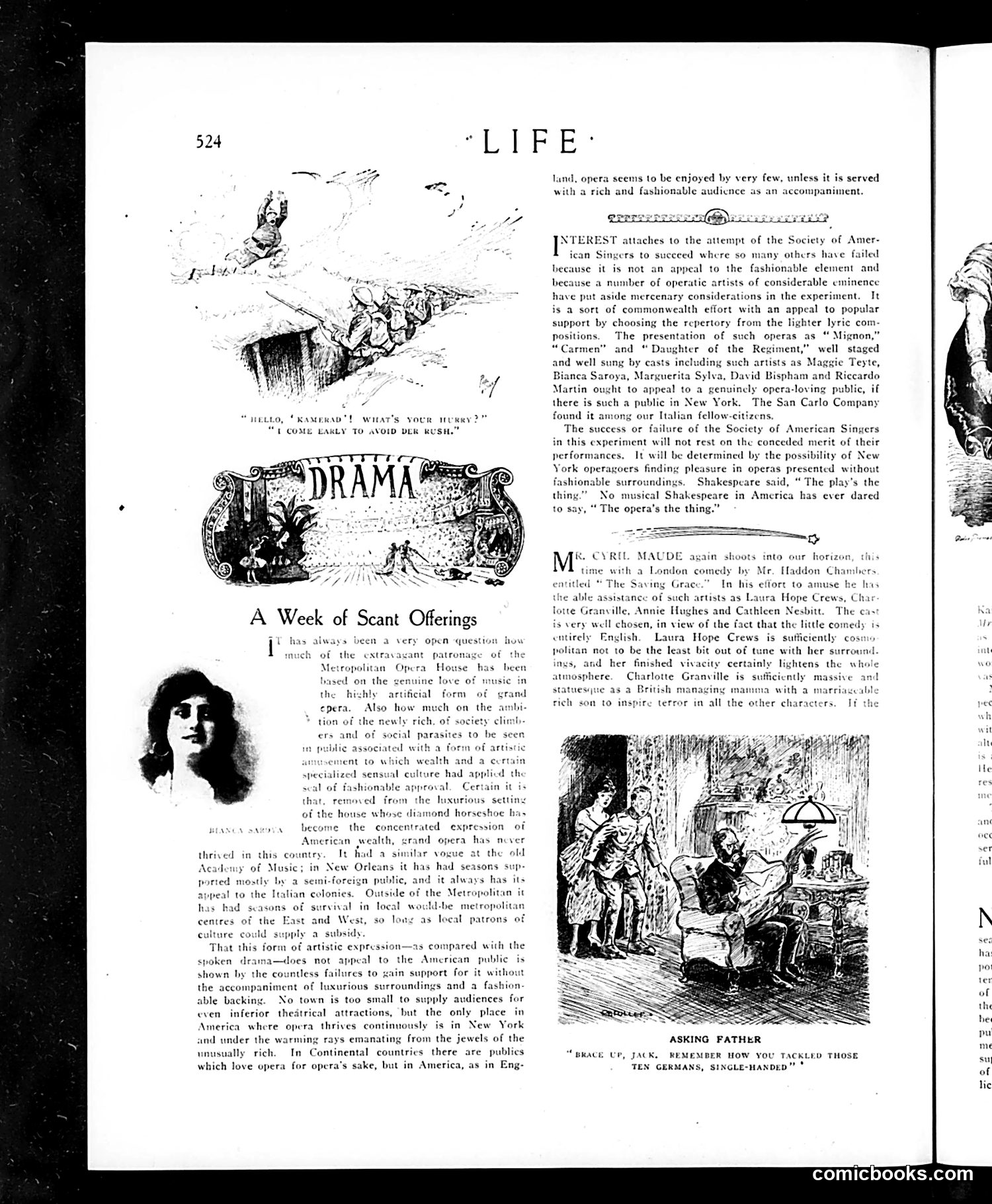
This page contains theater criticism rather than political satire. The main content discusses two topics: **"A Week of Scant Offerings"** critiques American opera's dependence on wealthy patronage. The article argues that grand opera in America only thrives in New York among "the unusually rich" because it lacks genuine popular appeal—unlike spoken drama, which succeeds everywhere. It notes the Metropolitan Opera House's "diamond horseshoe" represents concentrated American wealth rather than artistic merit. The piece expresses cautious interest in the Society of American Singers' attempt to present opera without this fashionable backdrop, questioning whether Americans will actually support opera "for opera's sake" as Europeans do. The second section briefly reviews theatrical productions featuring performers like Cyril Maude and Charlotte Granville. The sketch at top left (captioned about a "Kamerad") appears to be unrelated filler art, possibly WWI-era given the German reference. This is cultural criticism of class and artistic appreciation, not political satire.
📄 Transcribed text from this page (OCR, searchable)
Machine-transcribed from the original scan — historical spelling and the odd misread are preserved.
*LIFE® “ieeto, fKaMERAD TL witaT’s your MURKY? “1 COME EAKLY TO AVOID DEK RUSH.” A Week of Scant Offerings [i bss stave been a very open quest 1 of the extravagant patronag: Metropolitan Opera House based om the genuine love of the hishly artificial form of grand epera. Also how much on the ambi- tion of the newly rich, of society clit: ers and of social parasites to be seen sement to which wealth and a cer specialized sensual culture had applicd the seal of fashionable approval. Certain it is that, removed from the luxurious setting of the house whose diamond horseshoe has become the concentrated expression of American wealth, grand opera has never thrived in this country. It had a similar vogue at the old Academy of Music; in New Orleans it has had seasons sup- ported mostly by a semi-foreign public, and it always has its Outside of the Metropolitan it eal to the Italian colonies. has had centres of the East and West, so long as pply a subsidy seasons of survival cal patrons of culture could That this form of artistic expression—as compared with the spoken drama—does not appeal to American public is shown by the countless failures to gain support for it with he accompaniment of luxurious surroundings and a fashion able backing. No town is too small to supply audiences for even inferior theatrical attractions, but the only place in America where opera thrives continuously is in New York and under the warming rays emanating from the jewels of the unusually rich. In Continental countries there are publics which love opera for opera's sake, but in America, as in Eng- land, opera seems to be enjoyed by very few, unless it is served with a rich and fashionable audience as an accompaniment. NTEREST attaches to the attempt of the $ ican Singers to succeed where so many others have failed because it is not an appeal to the fashionable clement and because a number of operatic artists of considerable eminence ociety of Amer- have put aside mercenary considerations in the experiment. It is a sort of commonwealth effort with an appeal to popular support by choosing the repertory from the lighter lyric com The presentation of such operas as “ Mignon,” “Carmen” and “Daughter of the Regiment,” well staged and well sung by casts including such artists as Maggie Teyte, Bianca Saroya, Marguerita Sylva, David Bispham and Riccardo Martin ought to appeal to a genuinely opera-loving public, if there is such a public in New York. The San Carlo Company our Italian fellow-citizens. Positions, found it am The success or failure of the Society of American Singers in this experiment will not rest on the conceded merit of their performances, It will be determined by the possibility of New York operagoers ure in operas presented without fashionable surroundings. Shakespeare said, “ The play’s the thing.” No musical Shakespeare in America has ever dared to say, “The opera's the thing. —— M* CYRIL MAUDE again shoots into our horizon, this : with a London comedy by Mr. Haddon Chambers entitled The Saving Gra In his effort to amuse he has able assistance of such artists as Laura Hope Crews, Cha lotte Granville, Annie Hughes and Cathleen Nesbitt. The cast is very well chosen, in view of the fact that the little comedy entirely English. Laura Hope Crews is sufficiently cos politan not to be the least bit out of tune with her surrot ings, and her finished vivacity certainly lightens the wh atmosphere. Charlotte Granville is sufficiently massive eas a British managing mamma with a marriageal terror in all t son to insp other chara ASKING FATHER REMEMBER HOW YOU TACKLED THOSE SINGLE-HANDED JACK. TEN GERMAN comicbooks.com