
A complete issue · 34 pages · 1918
Life — October 3, 1918
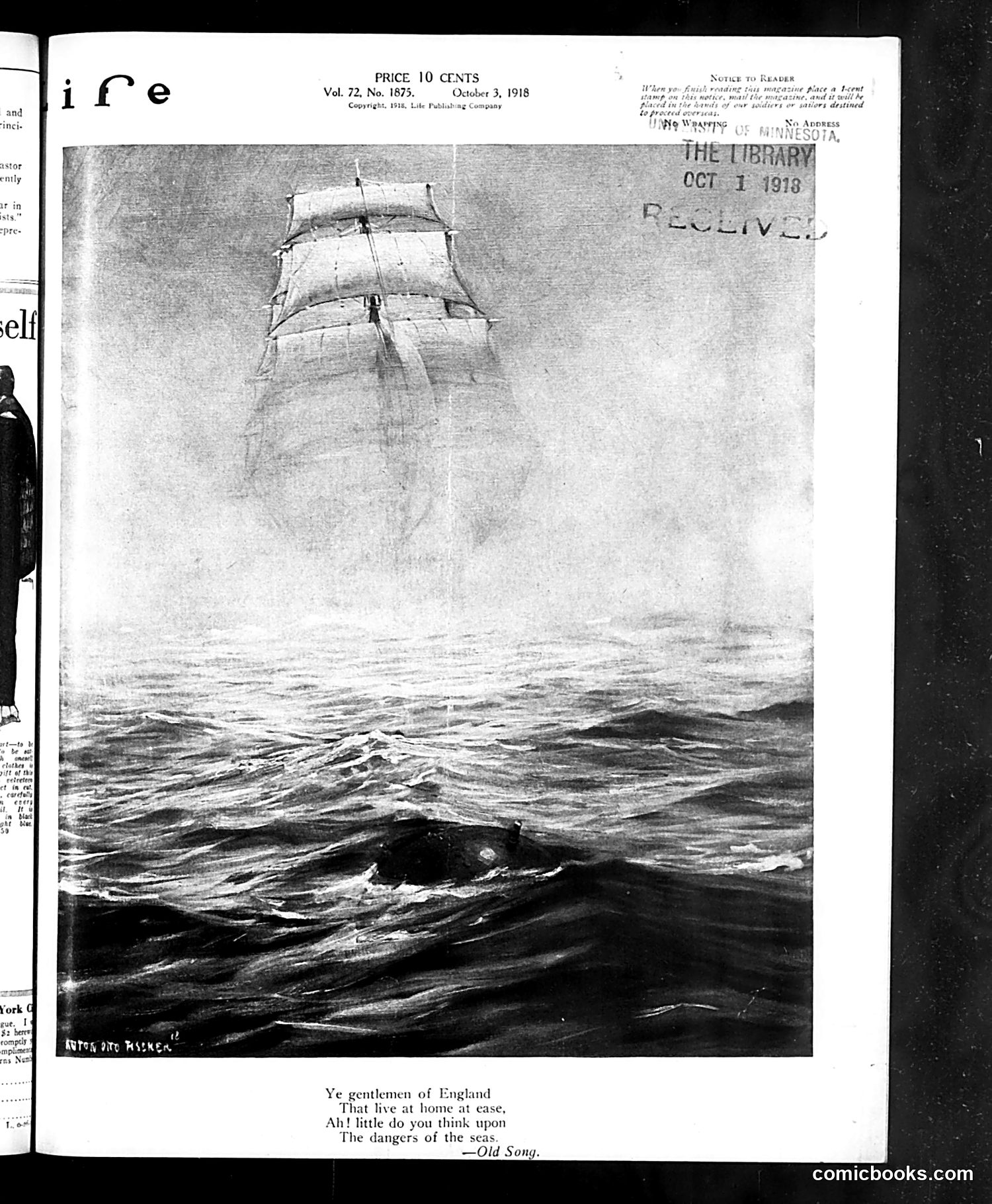
This *Life* magazine cover from October 3, 1918 features a sailing ship navigating rough seas, captioned with an old English verse about gentlemen at ease who underestimate maritime dangers. The image appears to be **WWI-era commentary** on submarine warfare. The ship represents either Allied or neutral vessels facing German U-boat threats in the Atlantic. The dramatic composition—with the vessel emerging from fog amid turbulent waves—emphasizes the peril of ocean travel during wartime. The closing date (October 1918) places this near war's end, when unrestricted submarine warfare remained a significant threat despite Germany's imminent defeat. The satirical comparison between English gentlemen's complacency and actual seafaring danger likely critiques civilian underestimation of wartime maritime risks or military unreadiness.
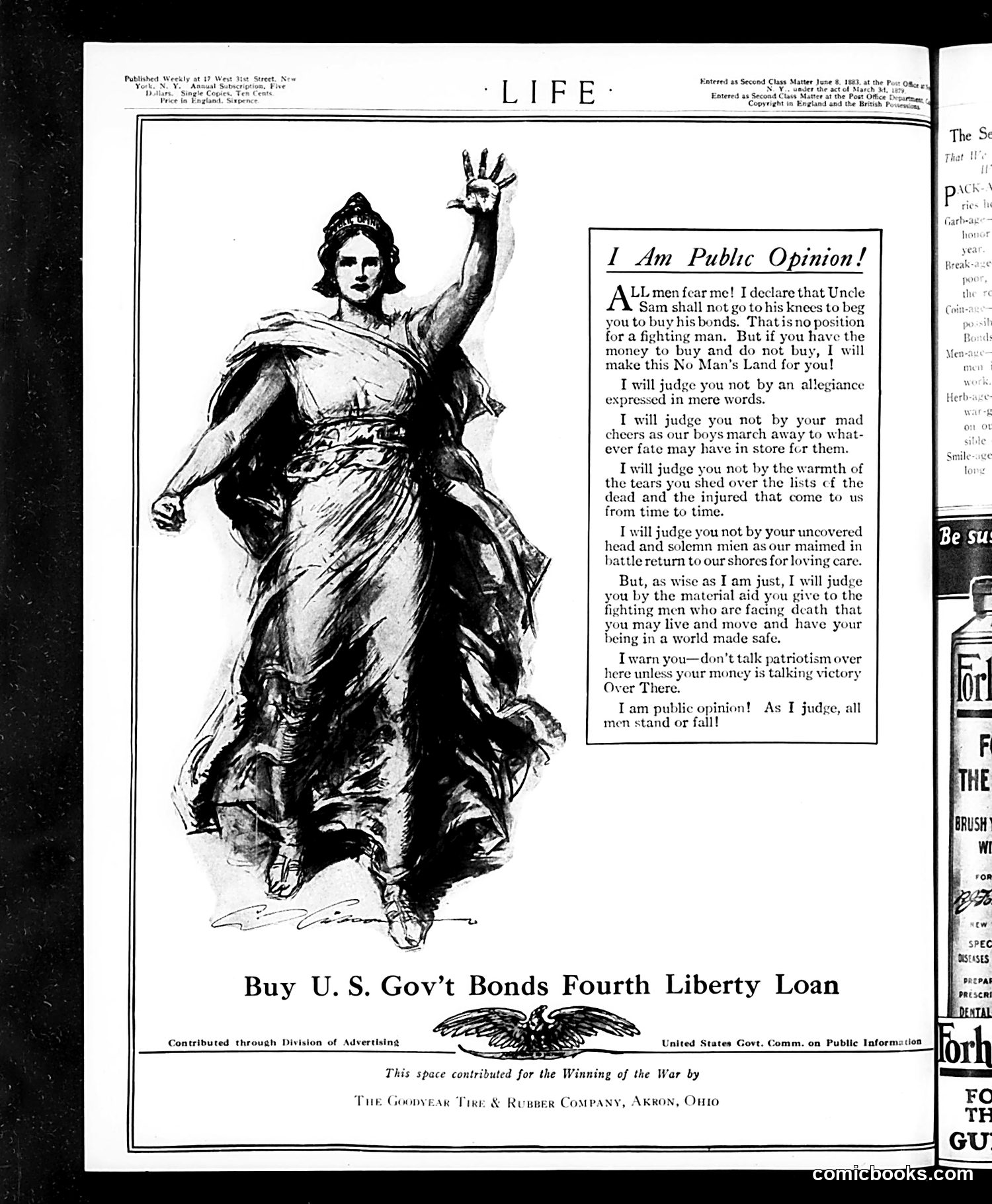
This is a **World War I propaganda advertisement**, not satire. The allegorical female figure represents "Public Opinion" or "Liberty," depicted in classical style with raised arm and crown. The text ("I Am Public Opinion!") is a direct appeal to readers' patriotic duty, declaring that citizens will be judged by their financial support for the war effort—specifically through purchasing U.S. government bonds in the Fourth Liberty Loan. Key message: Public opinion demands material sacrifice. The rhetoric warns against mere verbal patriotism, stating "don't talk patriotism over here unless your money is talking victory Over There" (meaning the European front). This reflects how American governments used shame and peer pressure to fund WWI. The Goodyear Tire company sponsored this space "for the Winning of the War."
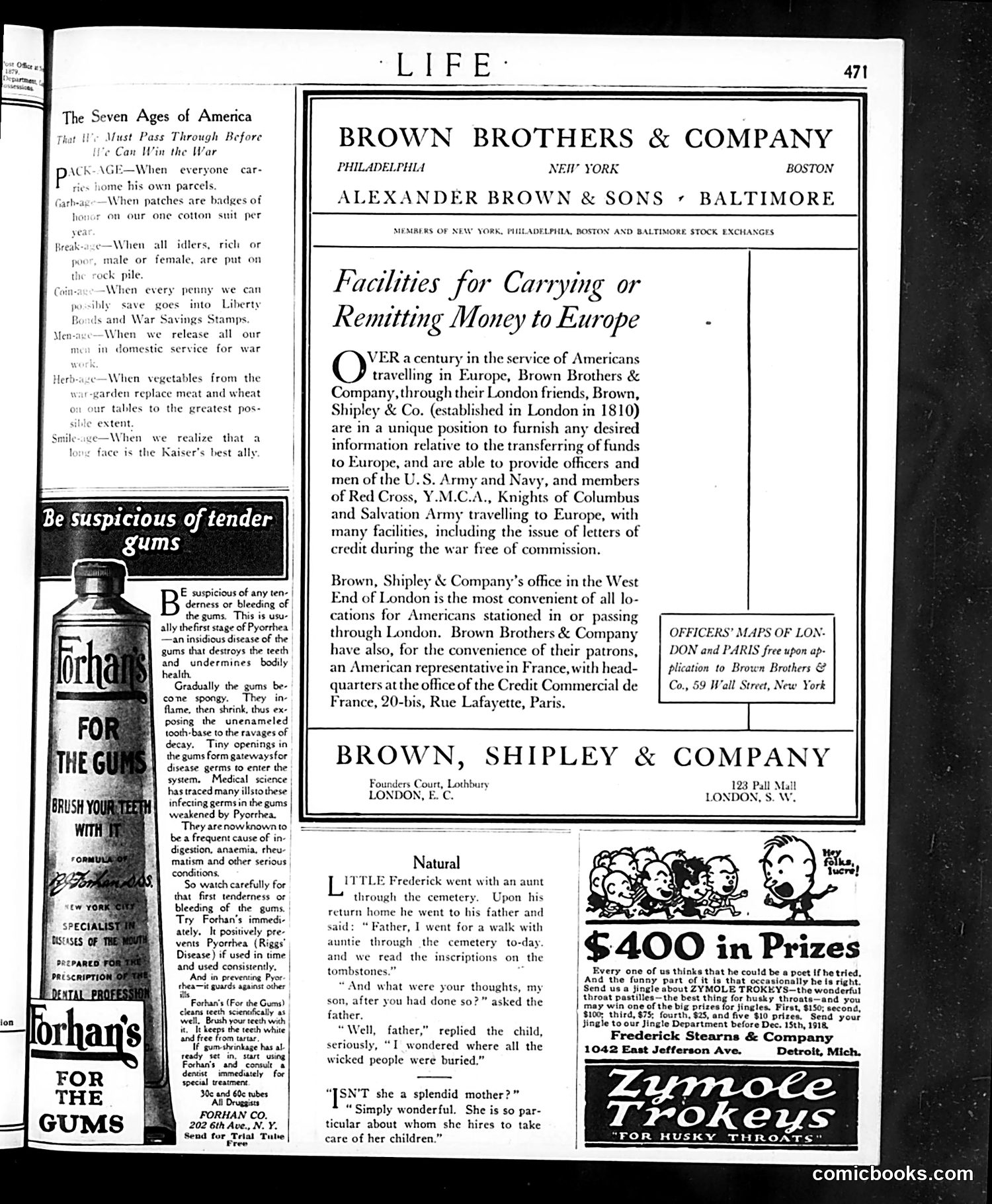
This Life magazine page (471) is primarily **advertising and commercial content** rather than satire or political cartoons. The main advertisement features **Brown Brothers & Company**, a financial services firm offering money transfer and letters of credit to Americans traveling or stationed in Europe during World War I. The text emphasizes their century-long service and convenience for soldiers, Red Cross workers, and military personnel. The left side contains advertisements for **Forhan's toothpaste**, marketed as preventing tooth decay and gum disease—conditions allegedly caused by Pyorrhea. At bottom right, a **Frederick Stearns & Company contest** advertises "$400 in Prizes" for submitting "Zymole Trokeys" (throat lozenges). A brief humorous story titled "Natural" about a child's cemetery visit appears between major advertisements.
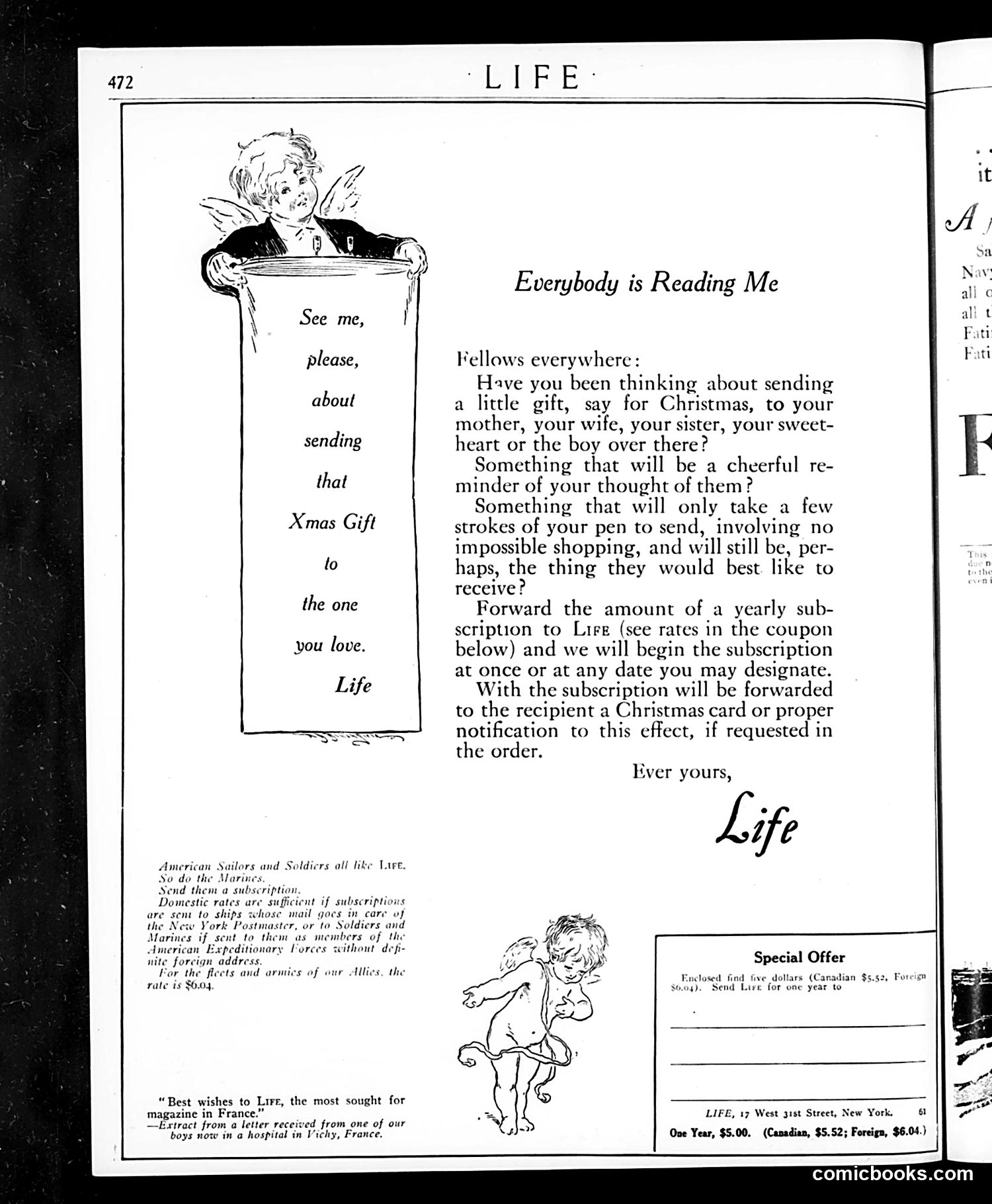
This page is primarily **advertising, not political satire**. It's a Life magazine gift subscription pitch from what appears to be the World War I era (based on the reference to soldiers in France and the mention of "the boy over there"). The central image shows a cherub-like figure emerging from a box with italicized text urging readers to send Life magazine subscriptions as Christmas gifts to loved ones. The appeal emphasizes convenience—requiring only "a few strokes of your pen"—and positions the gift as a thoughtful reminder of the giver's affection. The bottom includes a testimonial claiming soldiers find Life particularly valuable, and pricing information for domestic and foreign subscriptions. This is straightforward commercial messaging, not satirical commentary.
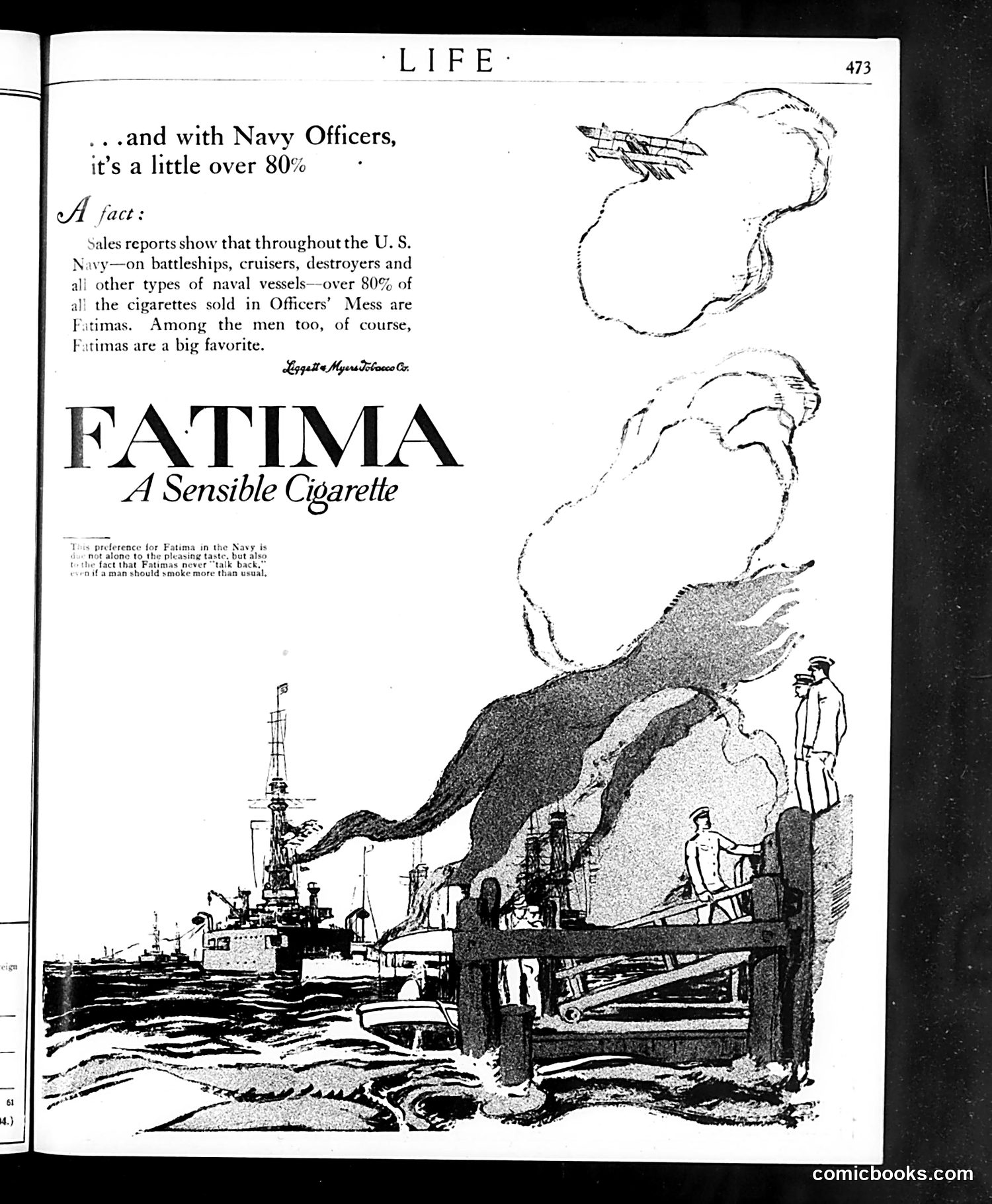
This is a **cigarette advertisement**, not political satire. It markets Fatima brand cigarettes to U.S. Navy officers by claiming over 80% of cigarettes sold in Officers' Mess aboard naval vessels are Fatimas. The advertisement emphasizes two selling points: the brand's appealing taste and that Fatimas "never talk back"—meaning they don't "bite back" or cause throat irritation if smoked in excess. The illustration shows a dramatic scene of a naval destroyer with sailors on shore, with smoke rings rising from the cigarette. This was standard early-20th-century advertising imagery designed to associate the product with military prestige and masculine authority.
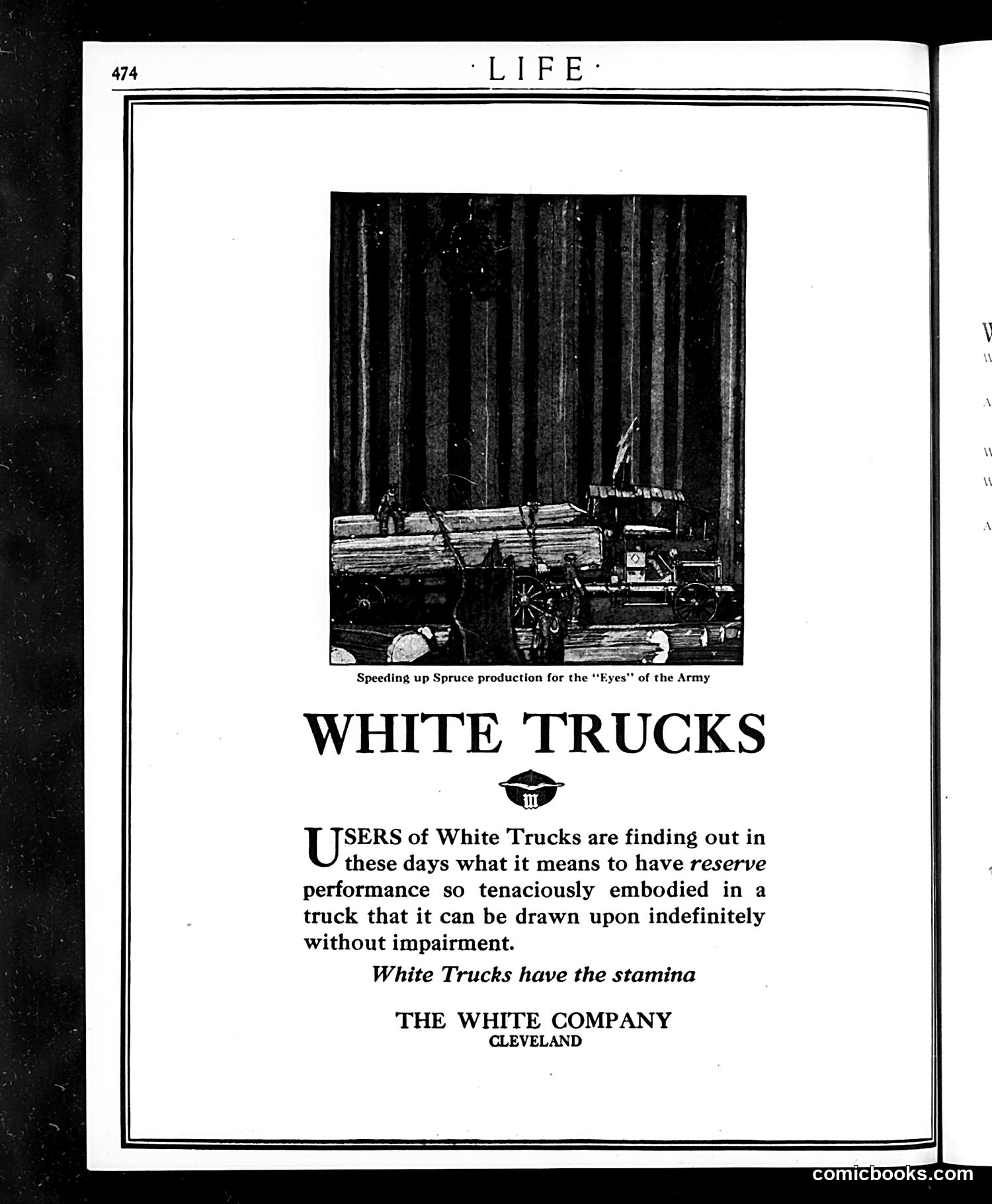
This is **not a cartoon or satire**—it's a straightforward advertisement for White Trucks, published in Life magazine (page 474). The image shows a truck loading large logs in a forest, captioned "Speeding up Spruce production for the 'Eyes' of the Army." This references wartime military production, likely World War I or II era, when spruce wood was critical for aircraft construction (the "Eyes of the Army" meaning reconnaissance planes). The ad emphasizes White Trucks' reliability and durability for heavy industrial work, claiming their performance can be "drawn upon indefinitely without impairment." The company, based in Cleveland, uses patriotic wartime production needs to market their vehicles as dependable for critical national defense work.
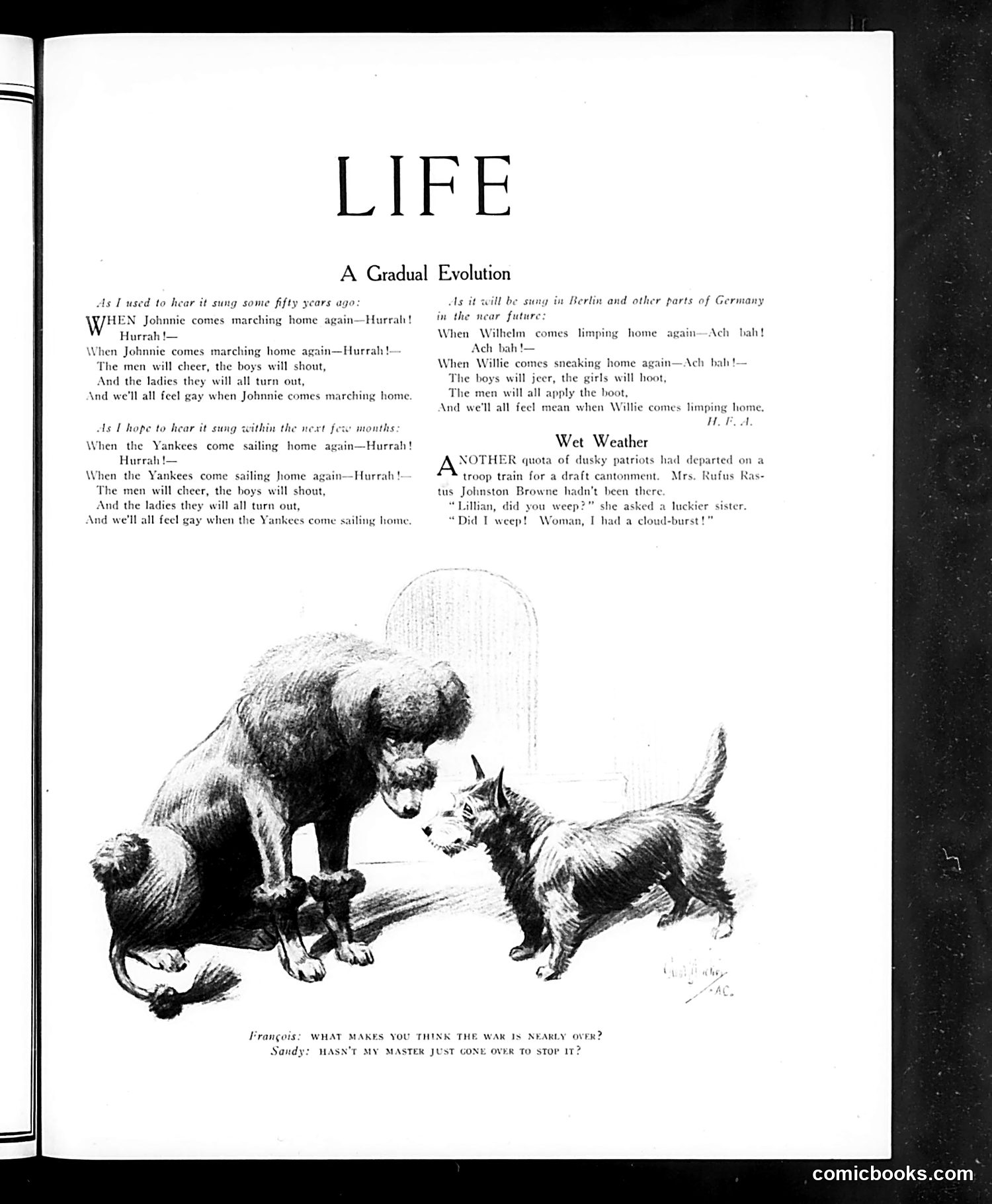
This page contains WWI-era patriotic poetry and a satirical cartoon about the war's persistence. The two poems at top celebrate soldiers' homecomings—first "Johnnie," then "the Yankees"—reflecting American optimism about victory. However, the subtitle "A Gradual Evolution" suggests this optimism is misplaced. The cartoon below, titled "Wet Weather," depicts two dogs (François and Sandy) discussing the war. François asks "what makes you think the war is nearly over?" Sandy replies "hasn't my master just gone over to stop it?"—a sharp joke mocking American confidence that U.S. entry would quickly end the conflict. The satire targets naive wartime assumptions: the poems suggest endless cycles of soldiers departing and returning, while the cartoon explicitly questions whether American involvement will actually end the fighting. The "gradual evolution" suggests the war will persist far longer than civilians hoped.
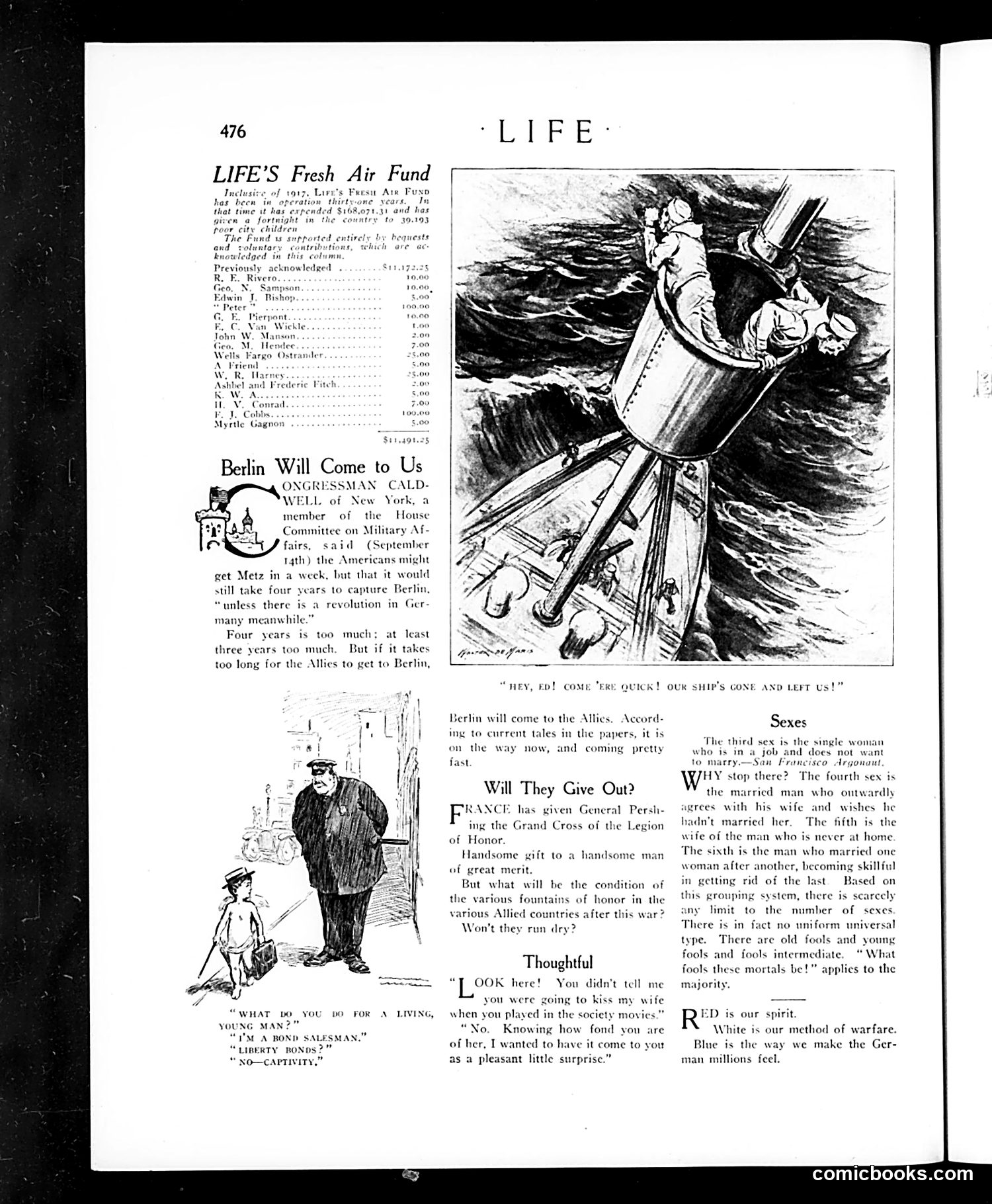
This page contains three distinct satirical pieces from the WWI period: 1. **"Berlin Will Come to Us"**: Congressman Caldwell argues the Allies should let Germany come to them rather than invade Berlin, suggesting it will take years otherwise. 2. **"Will They Give Out?"**: A cartoon showing a tall military officer with a small boy, satirizing France's award of the Grand Cross of the Legion of Honor to Allied leaders. The joke questions whether such decorations will lose their prestige after the war when distributed widely. 3. **"Sexes" and "Thoughtful"**: Brief humorous commentary on relationships and wartime attitudes. The overall tone reflects American WWI-era debate about military strategy and satirizes both military hierarchy and the devaluation of honors through overuse.
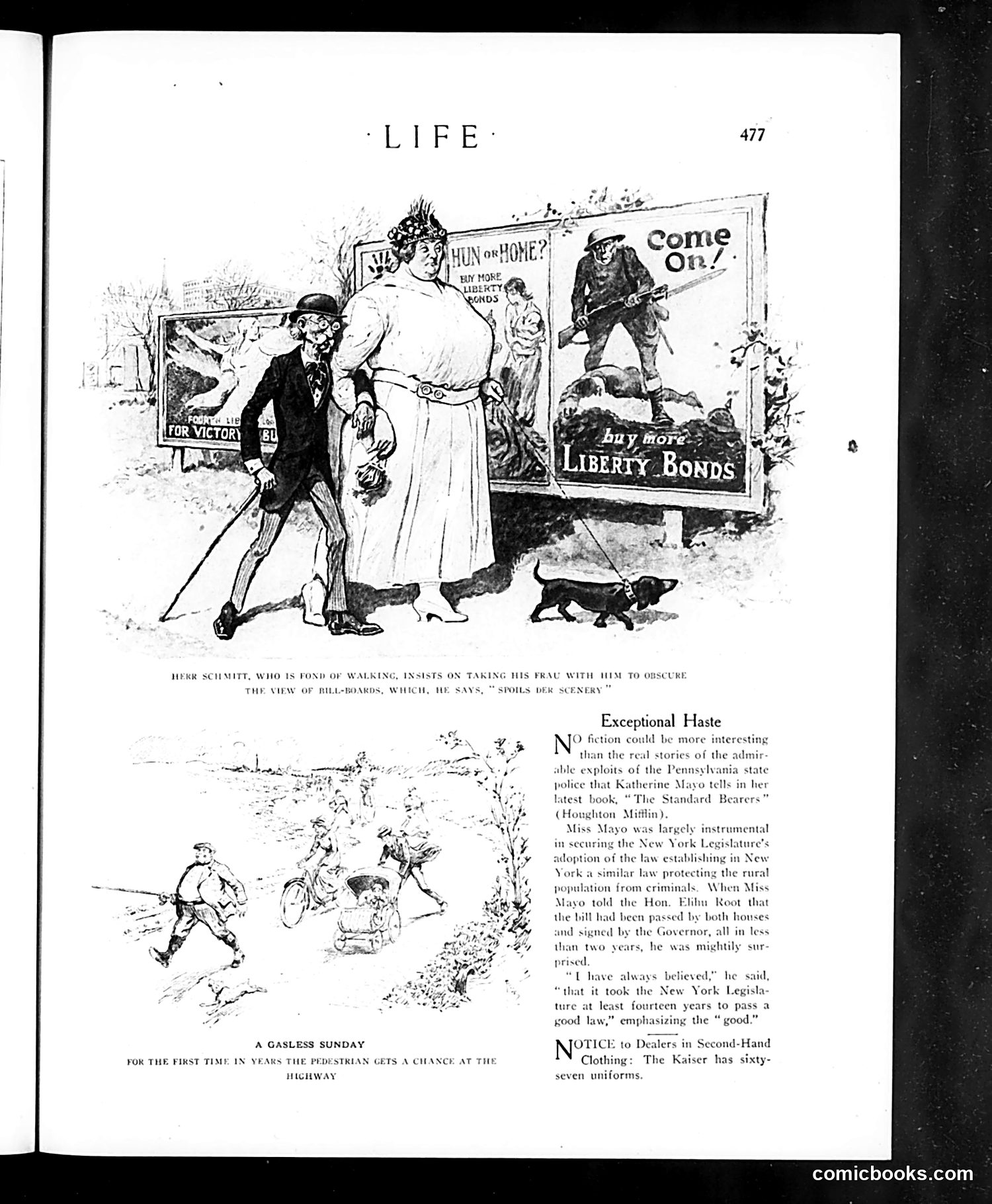
**Top Cartoon**: Depicts a woman (Liberty, based on her classical dress) with a man attempting to obstruct her view of billboards. The caption states he "insists on taking his faux with him to obscure the view of bill-boards, which, he says, 'spoils our scenery.'" This satirizes concerns about billboard advertising cluttering American landscapes—a Progressive Era debate about commercial visual pollution versus natural aesthetics. **Bottom Cartoon**: Titled "A Gasless Sunday," shows a pedestrian enjoying highway travel without automobiles for the first time in years. This references wartime fuel rationing (likely WWI era), satirizing the irony that gas rationing produced an unexpected benefit: cleaner roads and safer pedestrian access. Both cartoons mock contemporary American anxieties through absurdist humor.
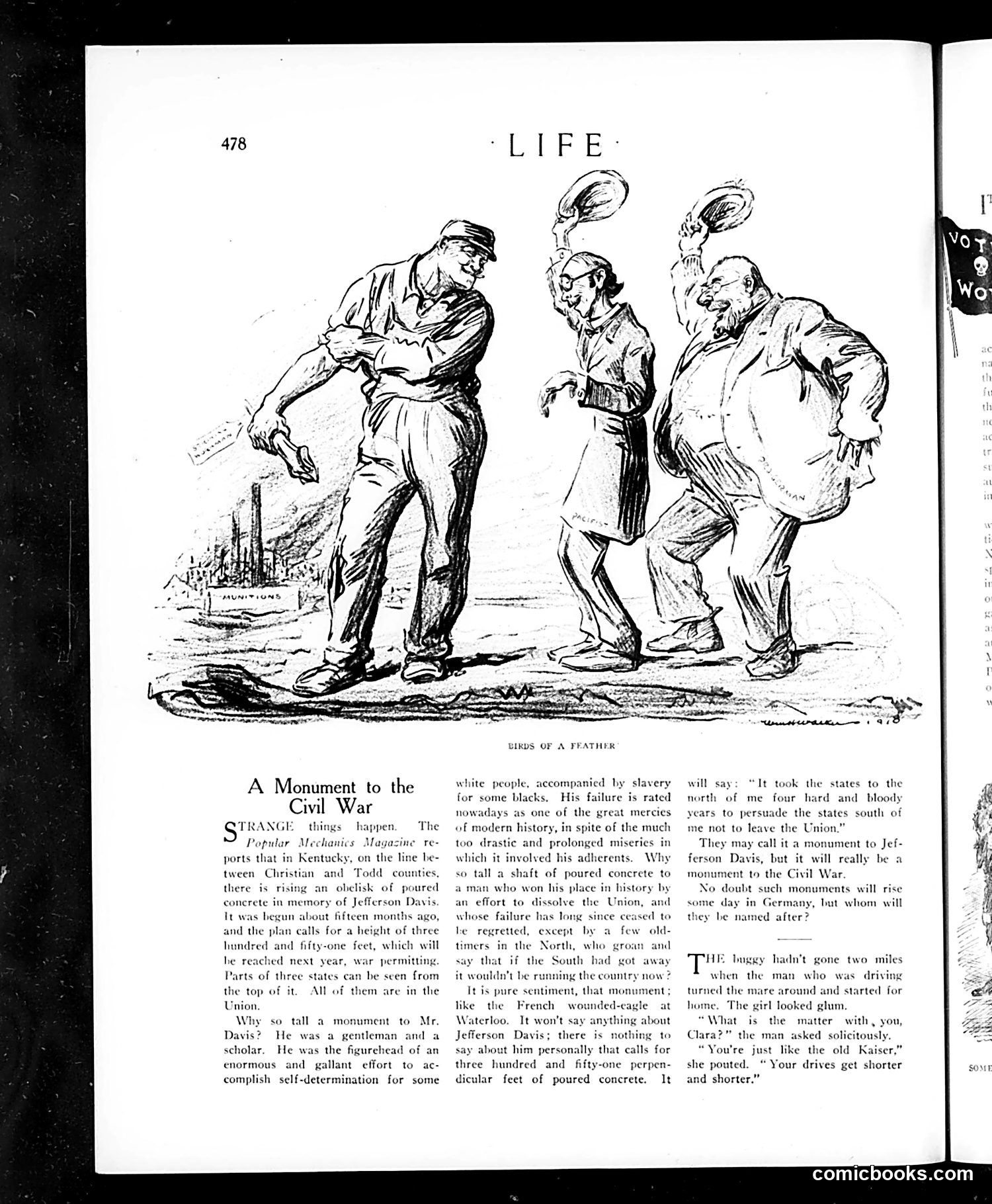
This satirical cartoon critiques a proposed monument to Jefferson Davis in Kentucky. The image shows three figures: a man on the left pouring concrete, and two men on the right examining the work—one appears to be an African American man tipping his hat. The satire operates on multiple levels: it mocks the idea of honoring Davis (Confederate president) while suggesting the monument's "poured concrete" construction is cheap and undignified. The presence of the Black figure tipping his hat implies bitter irony—that formerly enslaved people would be expected to celebrate a monument to their oppressor. The accompanying text questions why Kentucky would honor Davis at all, arguing such monuments serve no purpose beyond regional resentment.
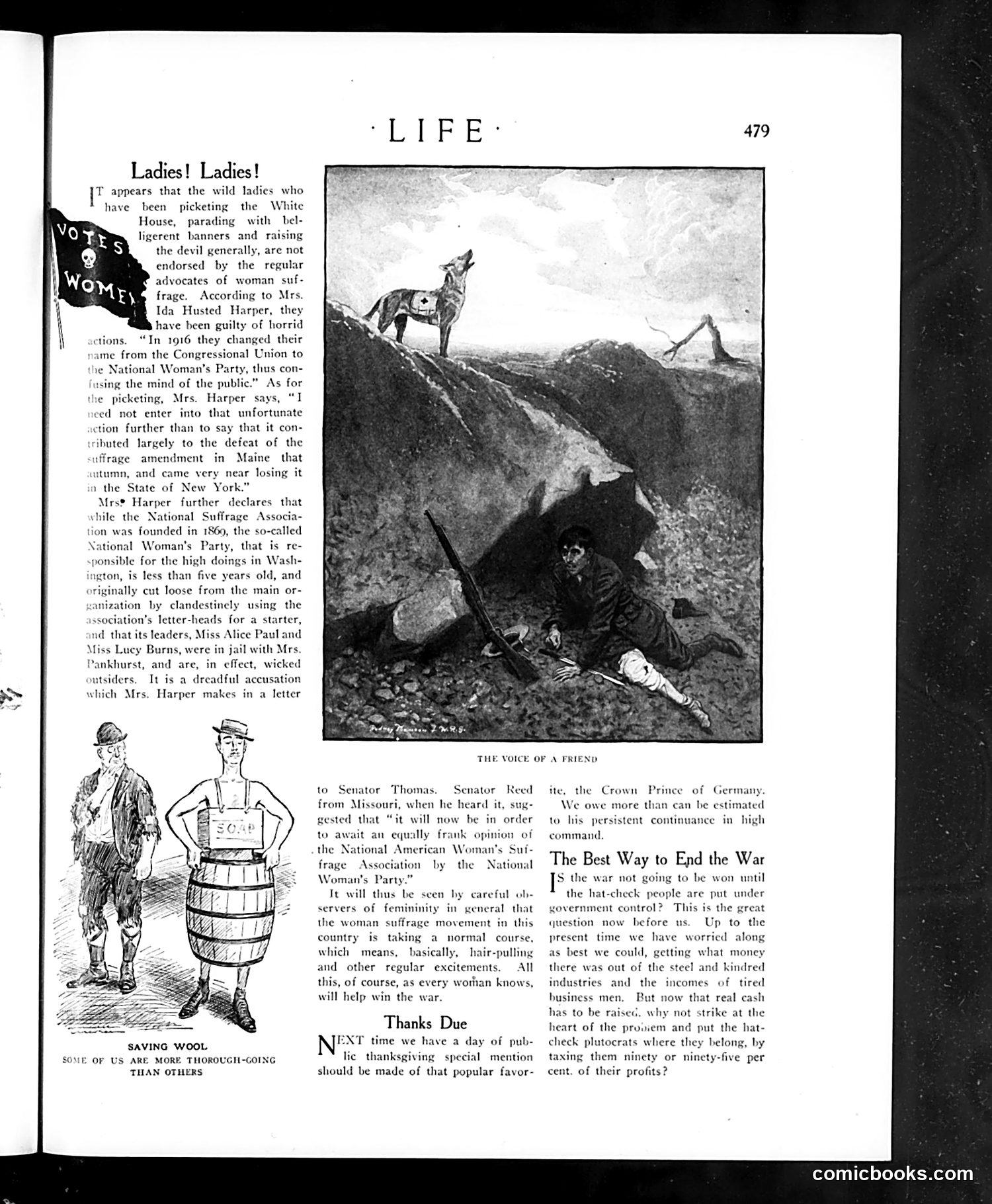
This page attacks the **National Woman's Party** and its picketing of the White House during World War I. Mrs. Ida Husted Harper defends the picketers against accusations they committed "horrid actions," claiming they've been unfairly portrayed. The bottom cartoon labeled "SAVING WOOL" satirizes women's wartime conservation efforts—showing exaggerated figures representing the tension between women's activism and domestic duty. The main photograph, "THE VOICE OF A FRIEND," depicts a dog, likely symbolizing loyalty or faithfulness during wartime division. The page reflects contemporary debate: while women's suffrage advocates picketed for voting rights, critics accused them of being unpatriotic during WWI. The satire suggests these female activists were simultaneously mocked for both their protest tactics and their wartime participation.
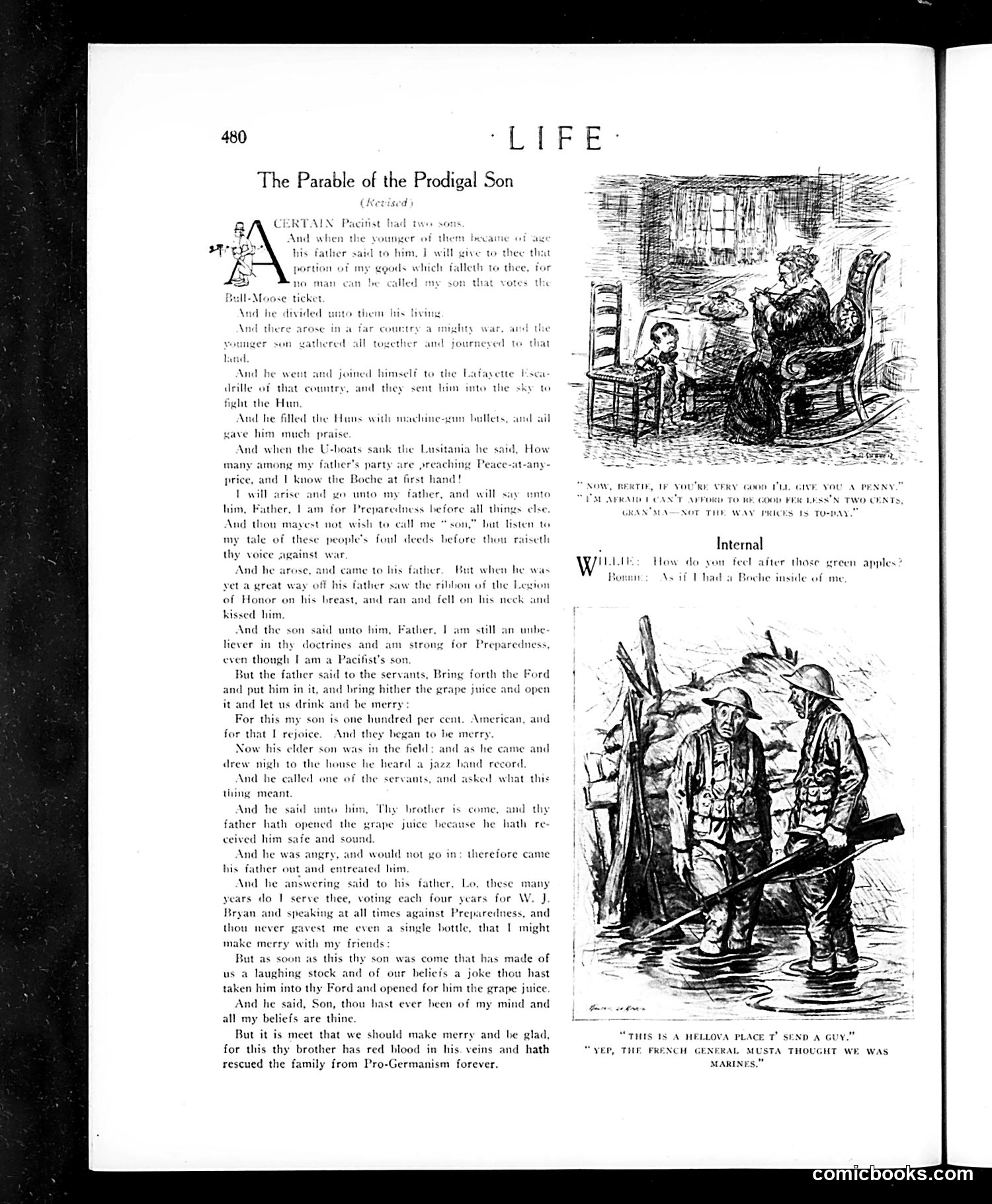
This page presents a "Revised" version of the Biblical Parable of the Prodigal Son, recontextualized as early 20th-century American satire. The text modernizes the classic story with references to contemporary concerns: the younger son fights in WWI (Lafayette Escadrille, U-boats, the Lusitania), receives "Preparedness" indoctrination, and upon returning home, the father celebrates with a Ford automobile and grape juice—likely referencing Prohibition-era social debates. The cartoons illustrate specific scenes with period clothing and settings. The satirical point appears to target American isolationism, military preparedness movements, and moral attitudes during or shortly after WWI, using the timeless parable to critique contemporary social anxieties. The caption references "French General Musta" (unclear figure), suggesting Franco-American military relations as context.
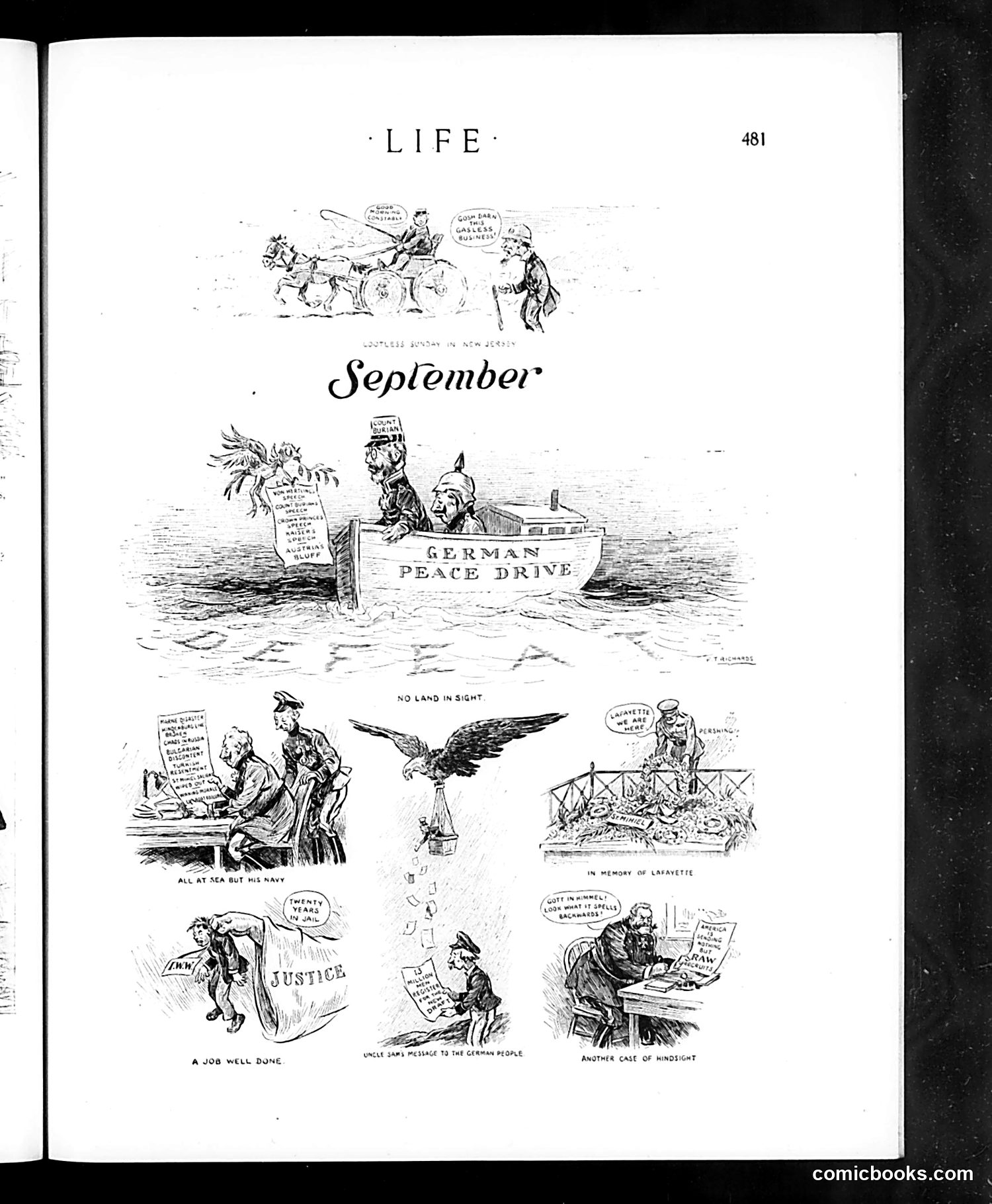
This page of political cartoons satirizes World War I events from September 1918, near the war's end. The central cartoon mocks Germany's "Peace Drive"—a diplomatic effort to negotiate peace terms. Multiple panels critique various aspects of the war: "No Land in Sight" depicts the German peace initiative as desperate and futile. "All at Sea but No Navy" suggests Germany's naval weakness. "A Job Well Done" appears to reference military accomplishments. Other panels mock German propaganda messages to their people and criticize diplomatic hypocrisy. The cartoons use caricature and dark humor to express American support for continued prosecution of the war against Germany, dismissing German peace overtures as insincere or strategically motivated rather than genuine surrender.
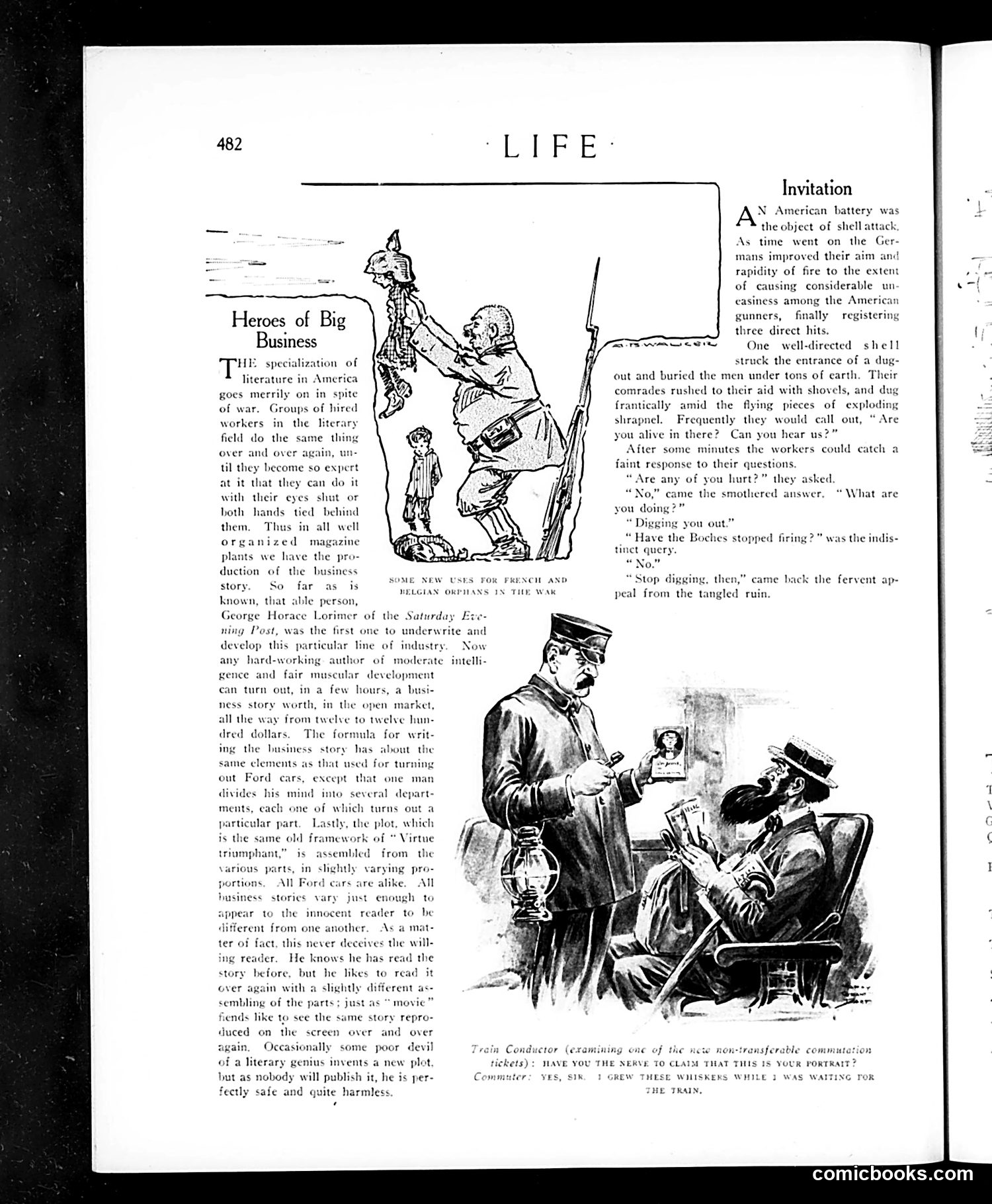
This page satirizes how American literature romanticizes business and war profiteering. The left column discusses how George Horace Lorimer of the *Saturday Evening Post* pioneered "business stories" as a literary genre—formulaic tales where authors manufacture dramatic narratives from mundane commercial activities. The illustrations mock this trend: the top shows soldiers rescuing orphans during wartime (labeled "Some New Uses for French and Belgian Orphans in the War"), while the bottom depicts a train conductor demanding payment from a passenger, sarcastically captioned about collecting fares. The satire argues that business-story writers artificially inject heroism and moral significance into ordinary commercial transactions, essentially exploiting wartime suffering and human misery for entertainment and profit.
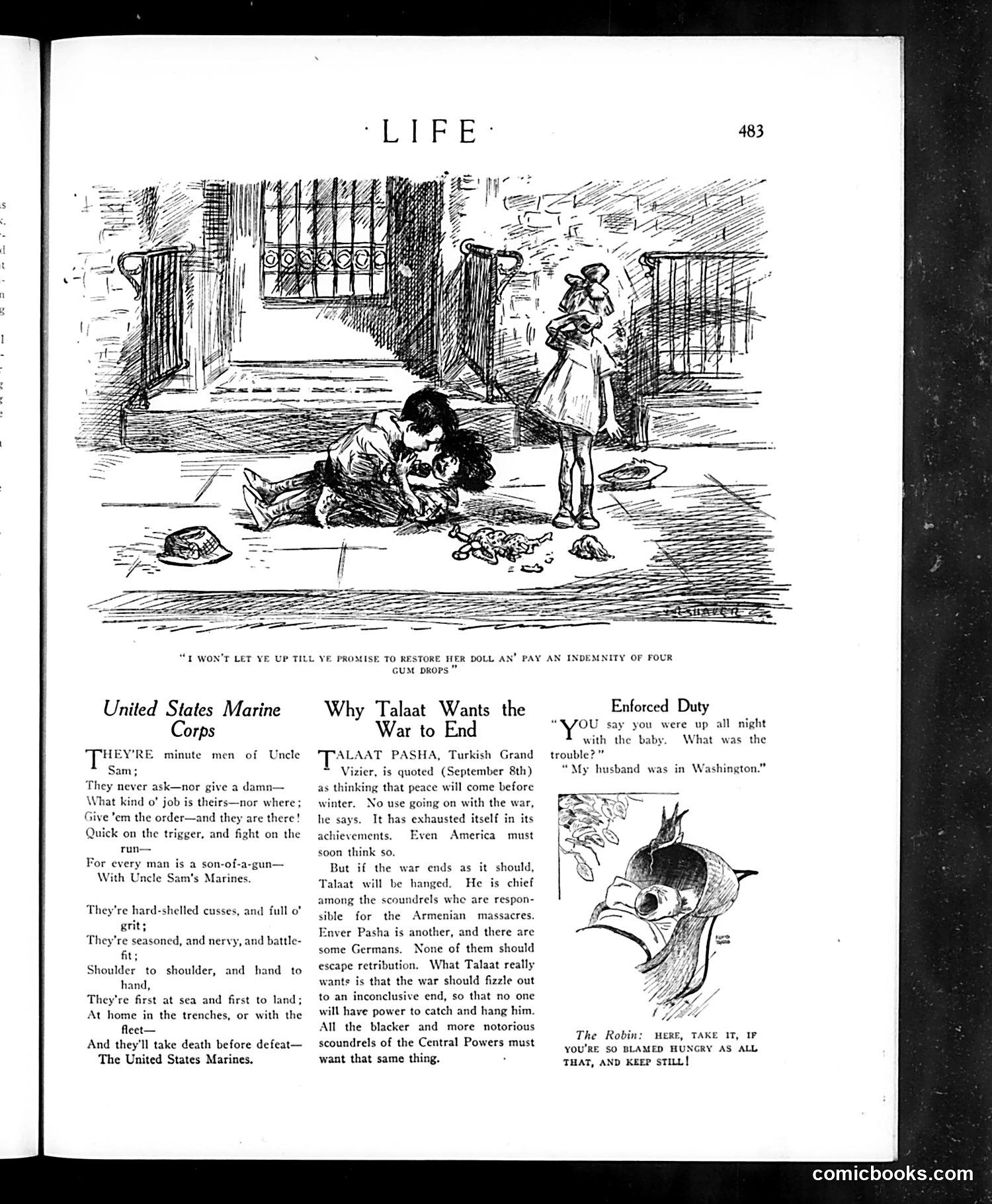
This page contains three separate pieces of WWI-era satire: 1. **Main illustration**: Shows children playing with dolls and toys in what appears to be poverty conditions, captioned with a child's defiant promise to restore a broken doll—commentary on wartime deprivation and children's resilience amid hardship. 2. **"United States Marine Corps"**: A patriotic poem praising Marines as elite, dependable soldiers willing to fight to the death—typical jingoistic recruitment rhetoric of the period. 3. **"Why Talaat Wants the War to End"**: References Turkish Grand Vizier Talaat Pasha, discussing his fear of postwar retribution for Armenian massacres. Argues he wants an "inconclusive end" to avoid accountability. 4. **"The Robin" cartoon**: A small sketch of a thin bird, apparently satirizing wartime food scarcity. The page reflects American WWI attitudes: military glorification mixed with criticism of war's humanitarian costs.
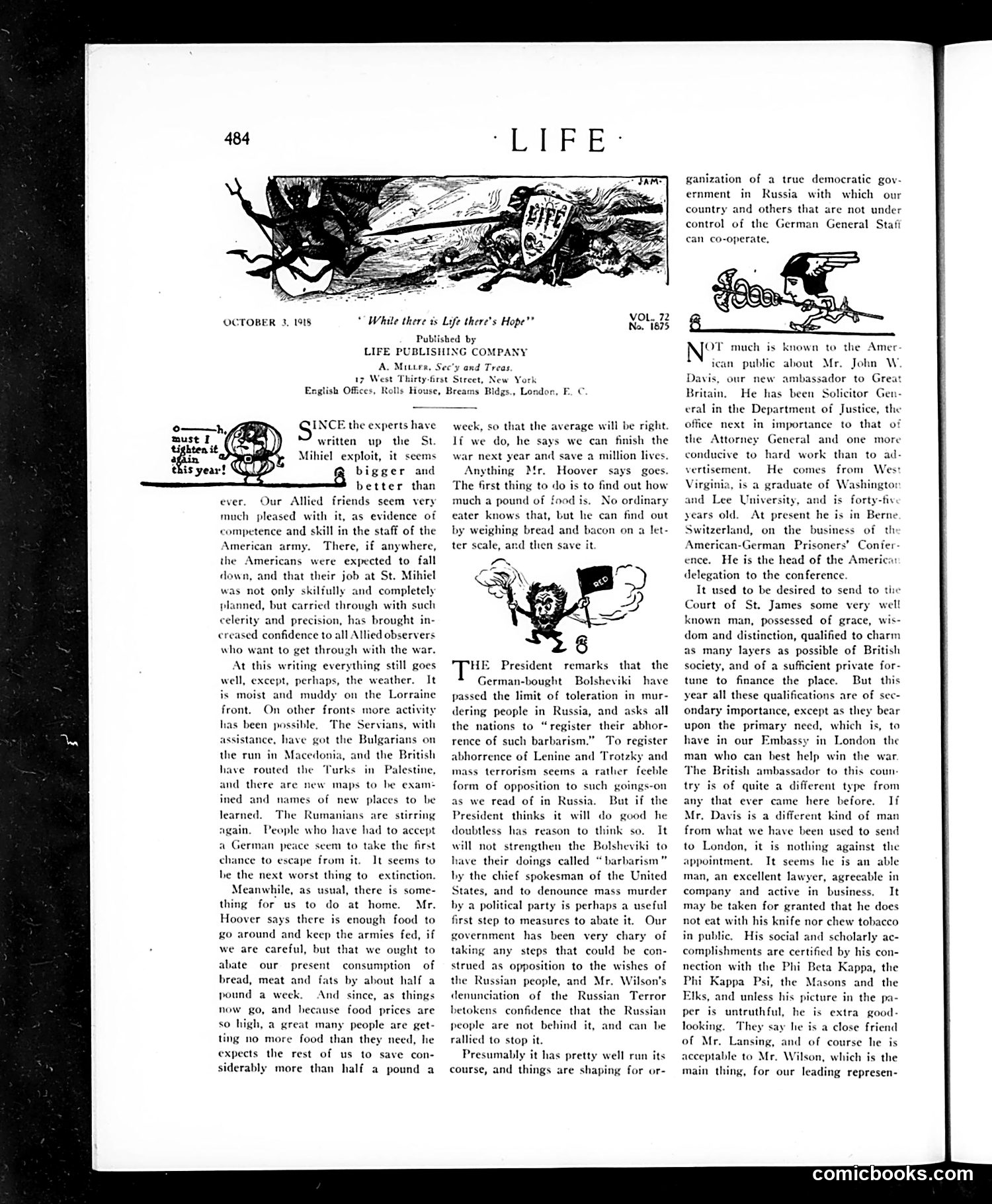
This page contains editorial commentary rather than cartoons. The main content addresses three topics relevant to late 1918: **Military Success**: Celebration of the American St. Mihiel offensive, praising Allied military competence and coordination. **Food Rationing**: Herbert Hoover's request that Americans reduce consumption of bread and meat by half a pound weekly to support the war effort and potentially end the war in 1918, saving "a million lives." **Russian Revolution**: President Wilson's public denunciation of Bolshevik "barbarism" under Lenin and Trotsky, framed as opposing mass murder while expressing confidence Russians will reject Bolshevism and establish a democratic government compatible with Western interests. The page also announces John W. Davis as the new ambassador to Great Britain, noting his previous role as Solicitor General. The tone is optimistic about war's conclusion and dismissive of Bolshevism as a temporary aberration the Russian people will naturally reject.
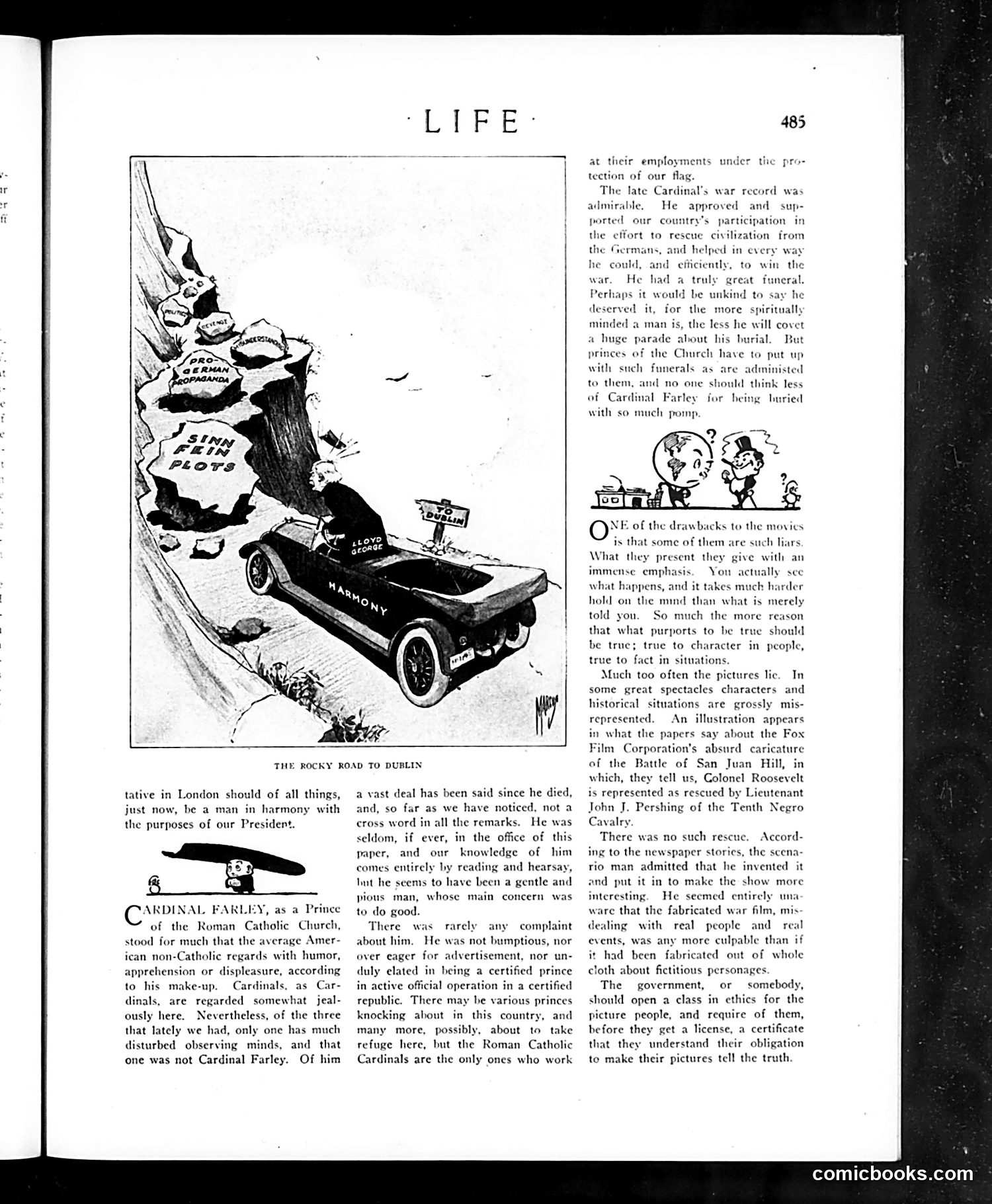
**The Cartoon:** Shows a car labeled "Harmony" precariously balanced on a cliff edge above rocks labeled "German Conspiracy," "Sinn Fein Plot," and "Lloyd George" — referencing post-WWI Irish political turmoil and Anglo-Irish tensions. **The Text's Main Subject:** Cardinal Farley's recent death and funeral. The article praises him as a gentle, non-controversial figure who supported America's WWI efforts and worked under American flag protection — unlike other Catholic princes potentially seeking refuge in the U.S. **The Satire:** The piece critiques Hollywood's dishonesty in depicting historical events (specifically Fox Film's fabricated "rescue" scene at San Juan Hill, attributing it to Pershing rather than Roosevelt). Life argues that films claiming truth must be truthful — especially when depicting real historical figures — and calls for government ethics regulation of studios. **The Connection:** Both elements warn against instability and deception in public representation during a fragile postwar period.
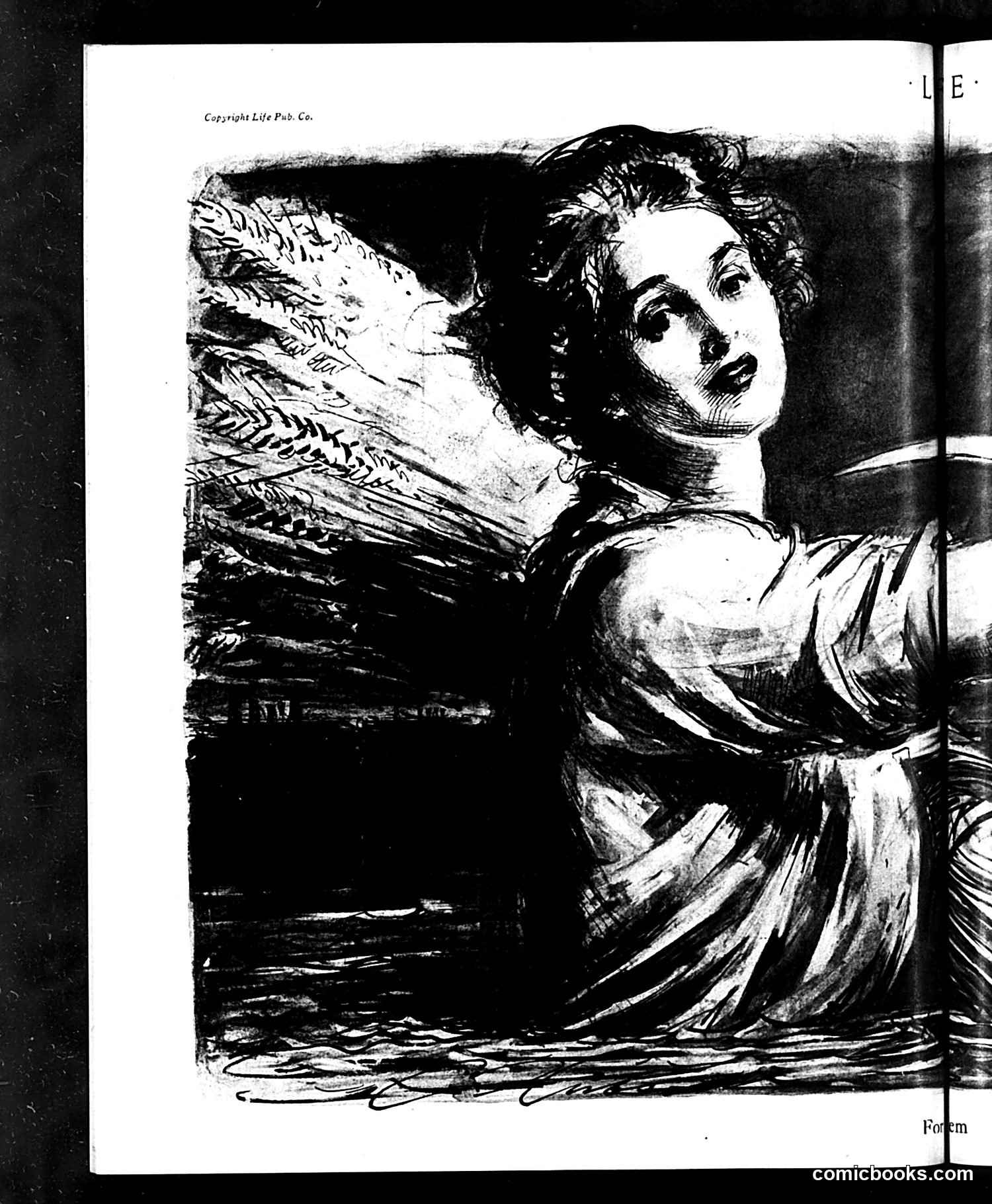
This page appears to be from *Life* magazine and shows an illustration labeled "Form" at the bottom. The image depicts a woman in classical or theatrical dress, rendered in a dramatic black-and-white sketching style with strong contrasts between light and shadow. Without additional context or caption text visible on the page, I cannot definitively identify the specific political or social satire being referenced. The artistic technique and classical drapery suggest this may be commenting on artistic or theatrical conventions of the era, or possibly on idealized representations of femininity in art. However, the exact target of satire remains unclear from the image alone.
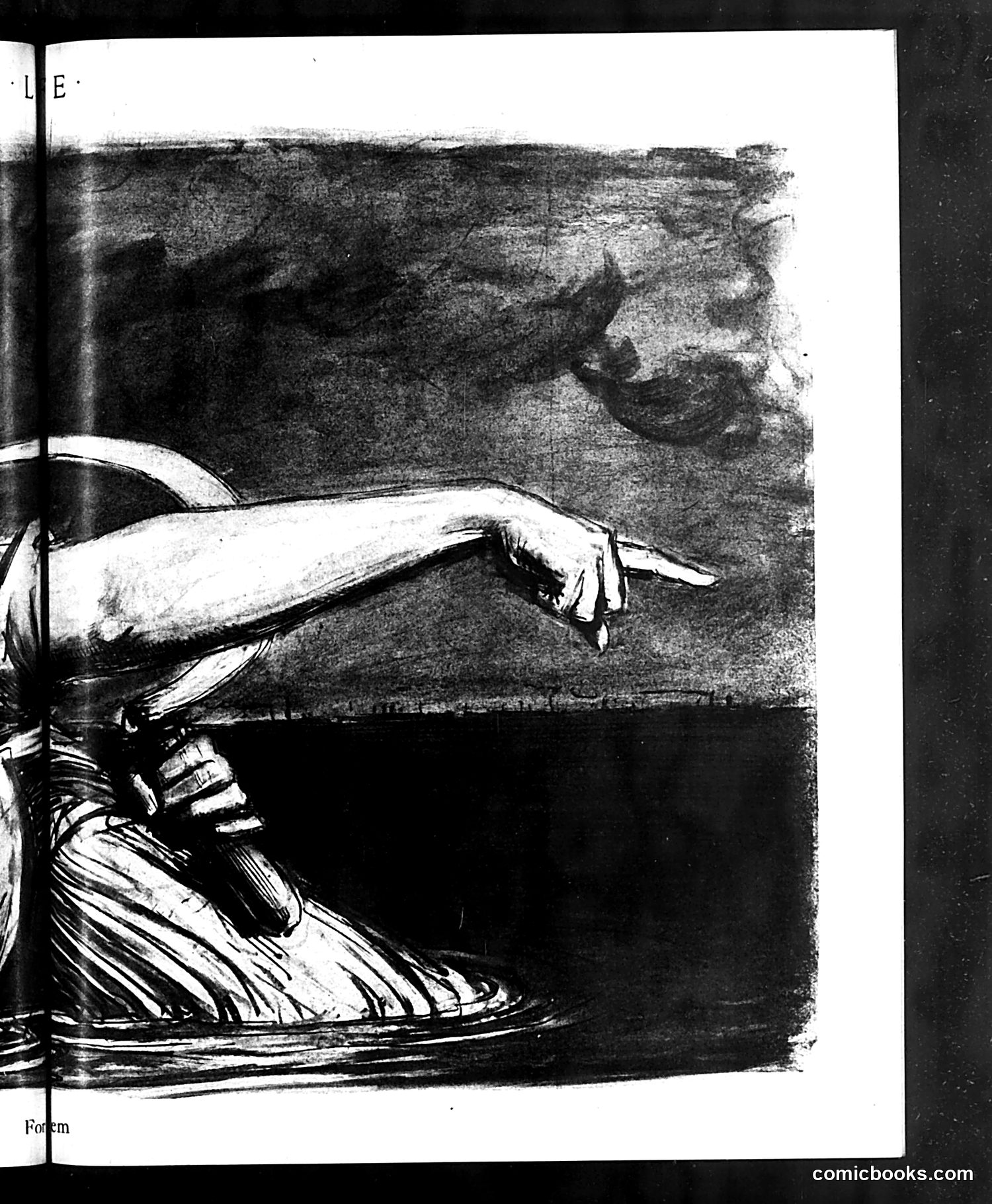
This page appears to be from the cover or opening section of *Life* magazine, showing an illustration of a reclining figure in classical or Renaissance style. The figure has an elongated arm extended outward in a gesture that suggests pointing, dismissal, or accusation. The artistic style—with its dramatic shading and classical composition—suggests this may be referencing a famous artwork or historical moment, though without additional context or captions, I cannot definitively identify which specific political or social satire is intended. The "LE" text visible at top left may indicate a section heading. Without clearer textual context or identifying labels in the image itself, I cannot accurately explain the specific satirical point to a modern reader.
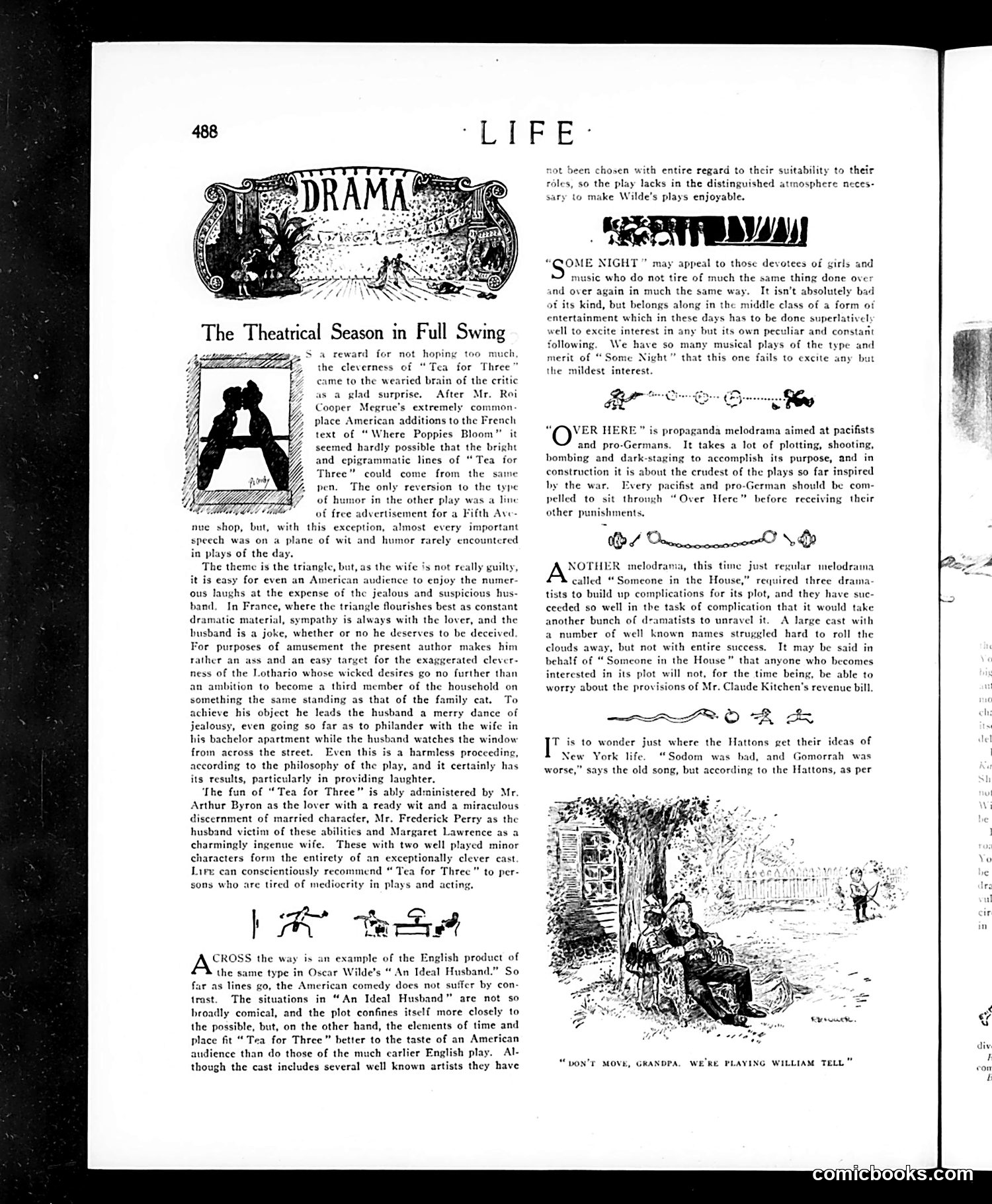
This page reviews the 1912 theatrical season, focusing on three plays: **"Tea for Three,"** **"An Ideal Husband,"** and **"Over Here."** The critic praises "Tea for Three" as witty relief after mediocre plays. It's a marital triangle comedy where the husband is portrayed as foolish—appealing to American audiences who sympathize with the innocent wife, unlike French audiences who typically favor the lover. The page contrasts this with Oscar Wilde's "An Ideal Husband," calling it more refined but less suited to American taste. **"Over Here"** is dismissed as crude propaganda melodrama targeting pacifists and pro-Germans—suggesting this review dates to WWI era when American patriotic theater was common. The critic finds it structurally clumsy despite its political message. The illustration at bottom shows a domestic scene, likely from one of the reviewed plays, reinforcing the theater-of-manners theme.
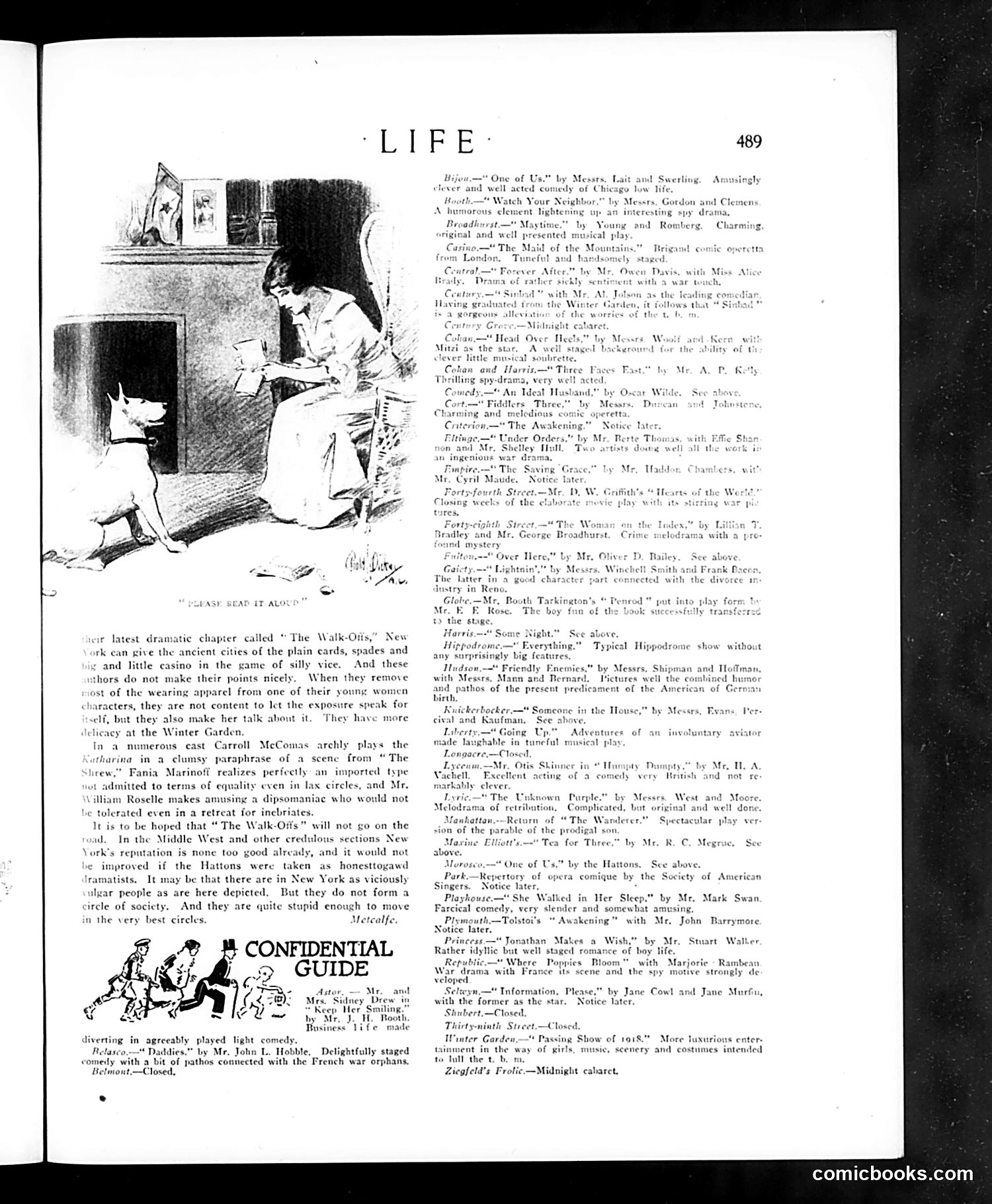
This page from *Life* magazine contains theater reviews and a single illustration titled "Please Read It Aloud." The sketch depicts a woman reading aloud to a man seated beside her—likely a domestic scene meant to gently satirize leisure activities or courtship rituals of the era. The accompanying text criticizes a play called "The Walk-Offs," arguing that New York dramatists remove women's clothing from scenes but then compound the offense by having characters discuss it explicitly. The critic suggests this represents not authentic high society behavior but rather the stupid vulgarity of a lower social circle trying to infiltrate respectable circles. The review reflects period anxieties about theatrical morality and New York's reputation, particularly concerns about how such depictions might be received by "credulous" audiences in the Midwest. The page primarily consists of capsule reviews of Broadway productions from around 1918.
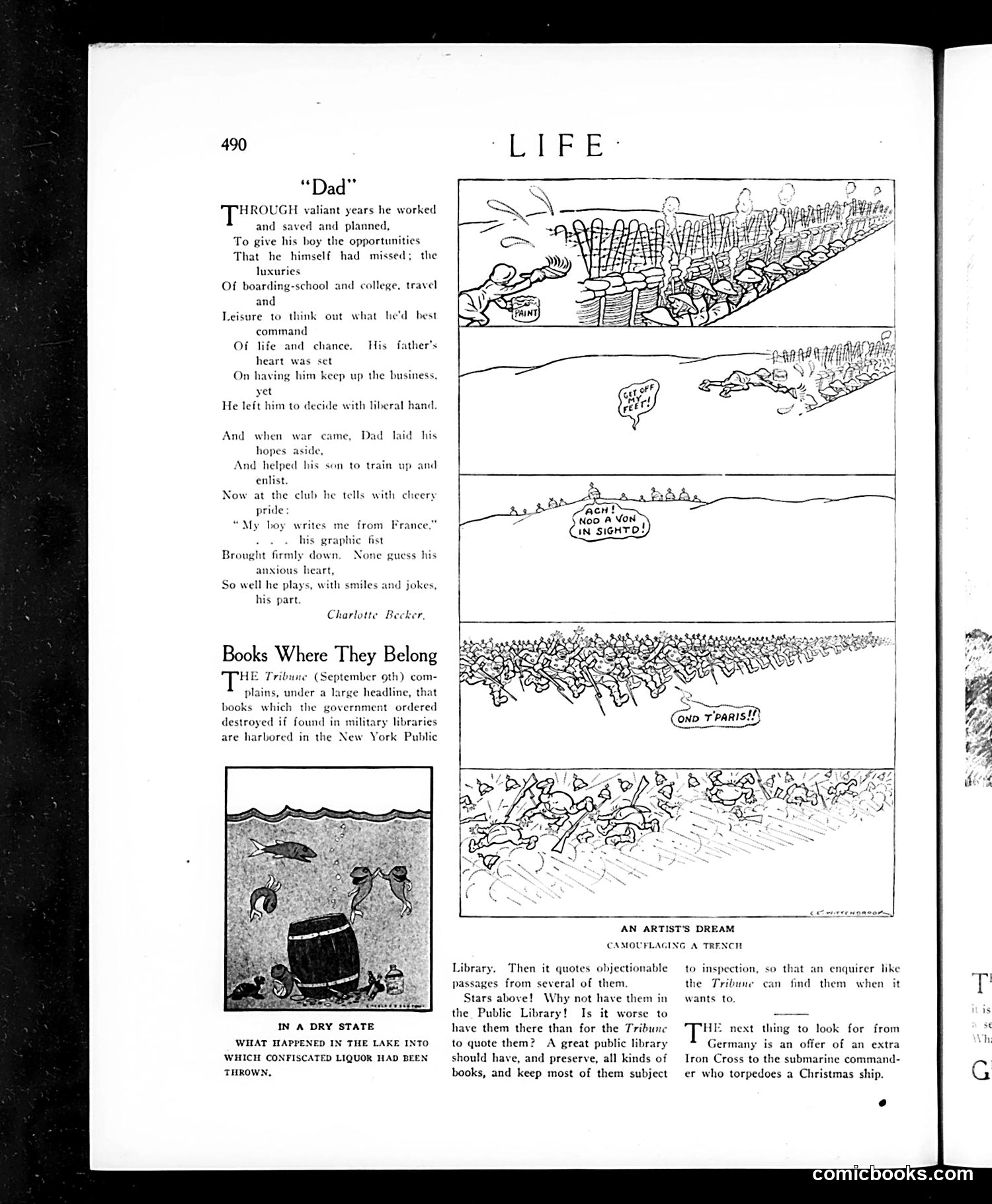
This page contains two pieces of satirical commentary from Life magazine during World War I. **"Dad"** is a sentimental poem by Charlotte Becker about a father who sacrificed his business ambitions to give his son opportunities, then supported his son's enlistment when war came. The satire is gentle: the father masks his anxiety with false cheer at his club, claiming pride while hiding genuine worry. It critiques the public performance of patriotism—how fathers must smile and pretend confidence while their sons fight in France. **"Books Where They Belong"** attacks censorship. The Tribune newspaper demanded the government suppress certain books from public libraries. Life's satire points out the hypocrisy: the Tribune itself quotes these "objectionable" passages in print while demanding they be hidden from the public. The piece advocates for open access to all books in libraries, positioning censorship as absurd. The right-side cartoon "An Artist's Dream" appears to mock military camouflage techniques in trenches.
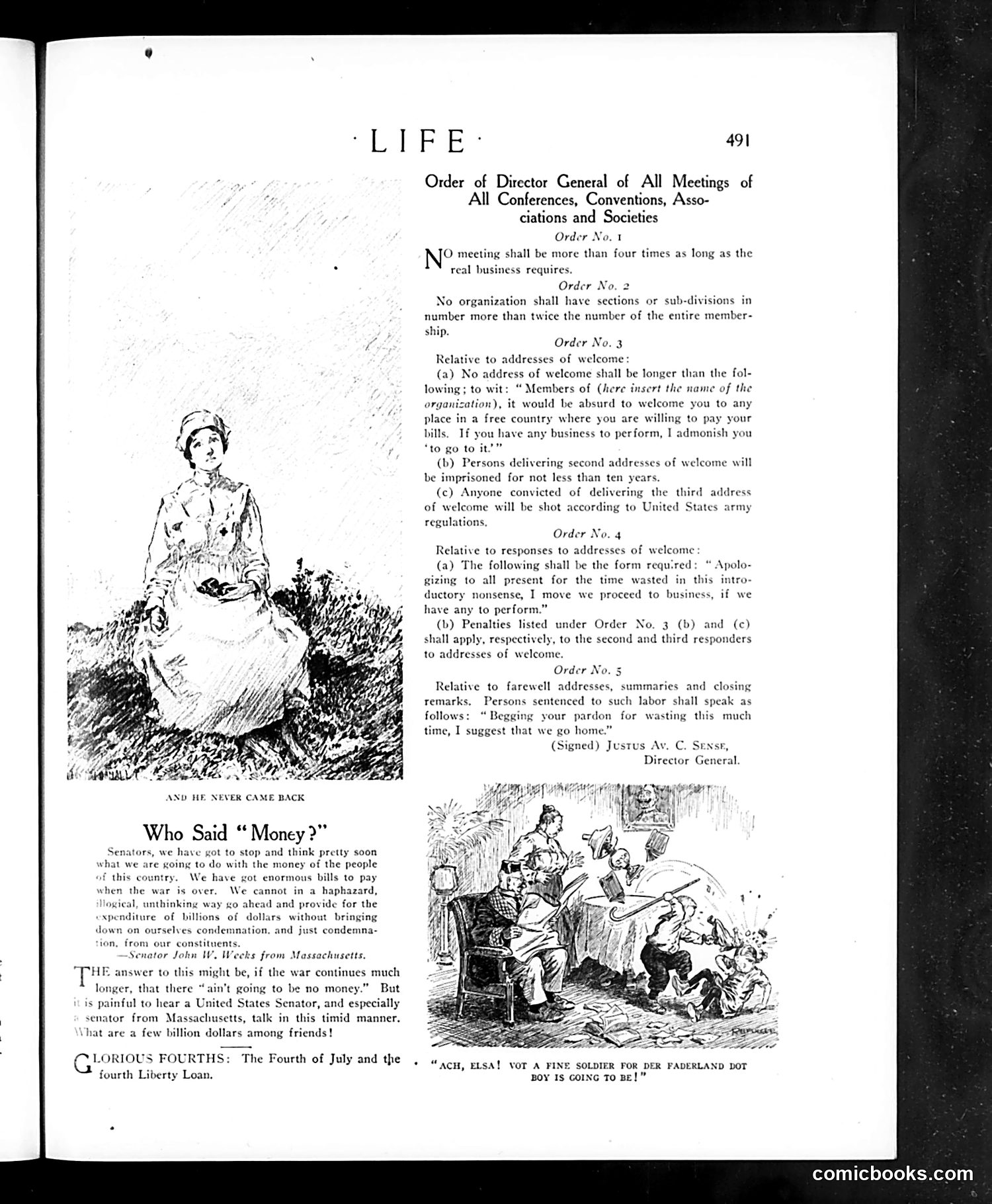
This page contains two satirical pieces from Life magazine during World War I. **"Who Said Money?"** mocks Senator John W. Weeks of Massachusetts for timidly expressing concern about wartime spending. The satire suggests his worry about "billions of dollars" is laughably naive—the implicit point being that massive wartime expenditure is inevitable and unavoidable. The phrase "What are a few billion dollars among friends!" drips with sarcasm at the scale of government spending. **The Orders by "Director General"** humorously parody bureaucratic meeting culture by proposing absurdly harsh penalties (imprisonment, execution) for long-winded speeches and welcome addresses. It satirizes the endless ceremonial speeches plaguing organizational meetings, suggesting such verbosity deserves severe punishment. **The lower cartoon** shows a German immigrant parent proudly envisioning their son's military future ("What a fine soldier for the Fatherland that boy is going to be!"), likely satirizing German-American loyalty concerns during WWI and the tension between immigrant heritage and American citizenship.
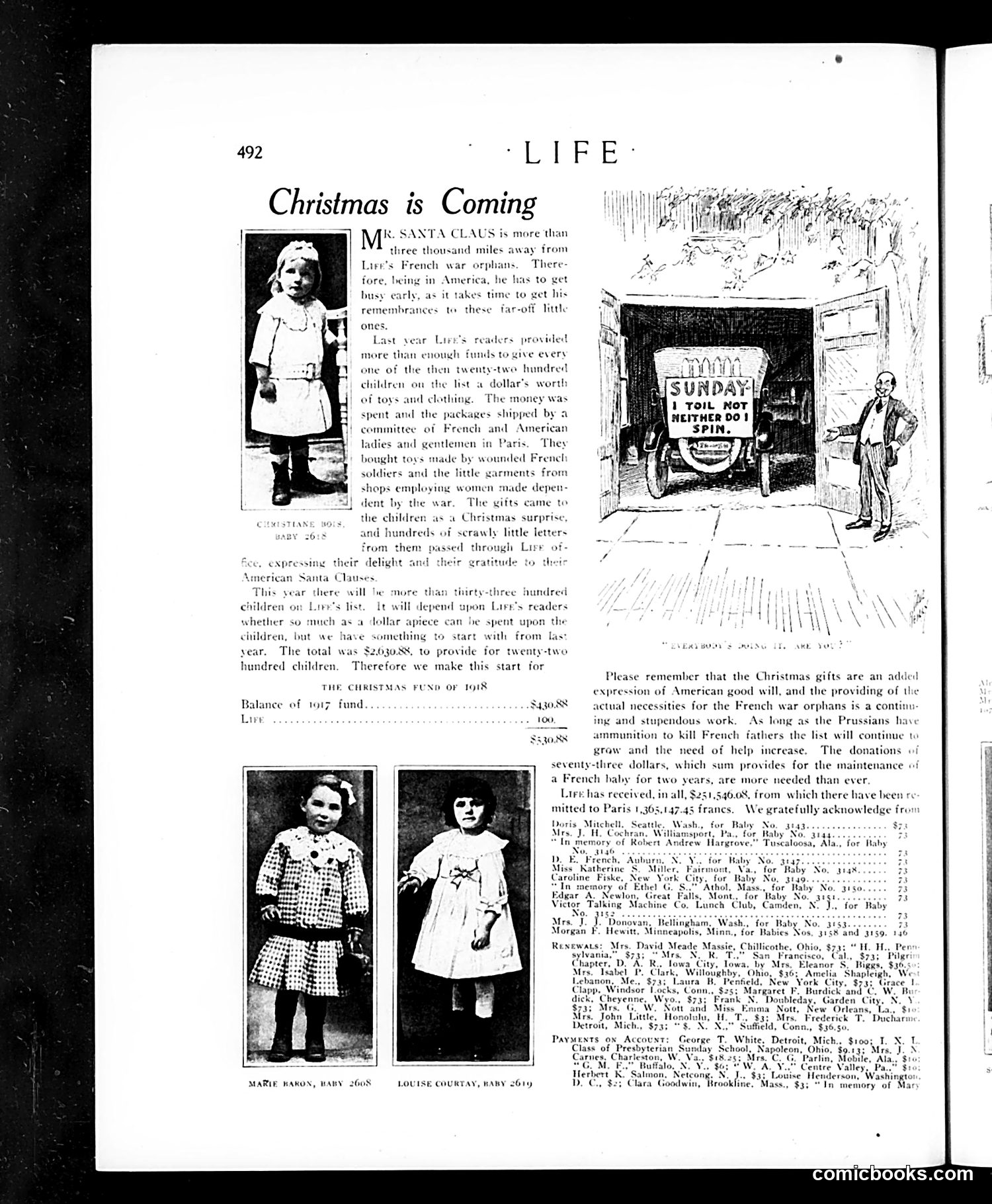
This page documents Life magazine's charitable campaign to aid French war orphans during World War I. The main article describes how American readers donated funds to provide Christmas gifts—toys and clothing—to French children orphaned by the war. The central illustration shows a delivery truck labeled "SUNDAY" with a sign reading "I TOIL NOT NEITHER DO I SPIN," depicting the irony of Santa delivering wartime aid. The accompanying photographs show French orphan recipients (identified as "Baby" numbers rather than names). The campaign's financial accounting lists donors and their contributions. The satirical point appears implicit: while American "Santa" enjoys peaceful Sunday leisure (the truck's message references Matthew 6:28), French children face deprivation caused by ongoing warfare and lost fathers. The contrast between American comfort and French suffering—and the call for American generosity to bridge that gap—forms the underlying social commentary of this charity appeal.
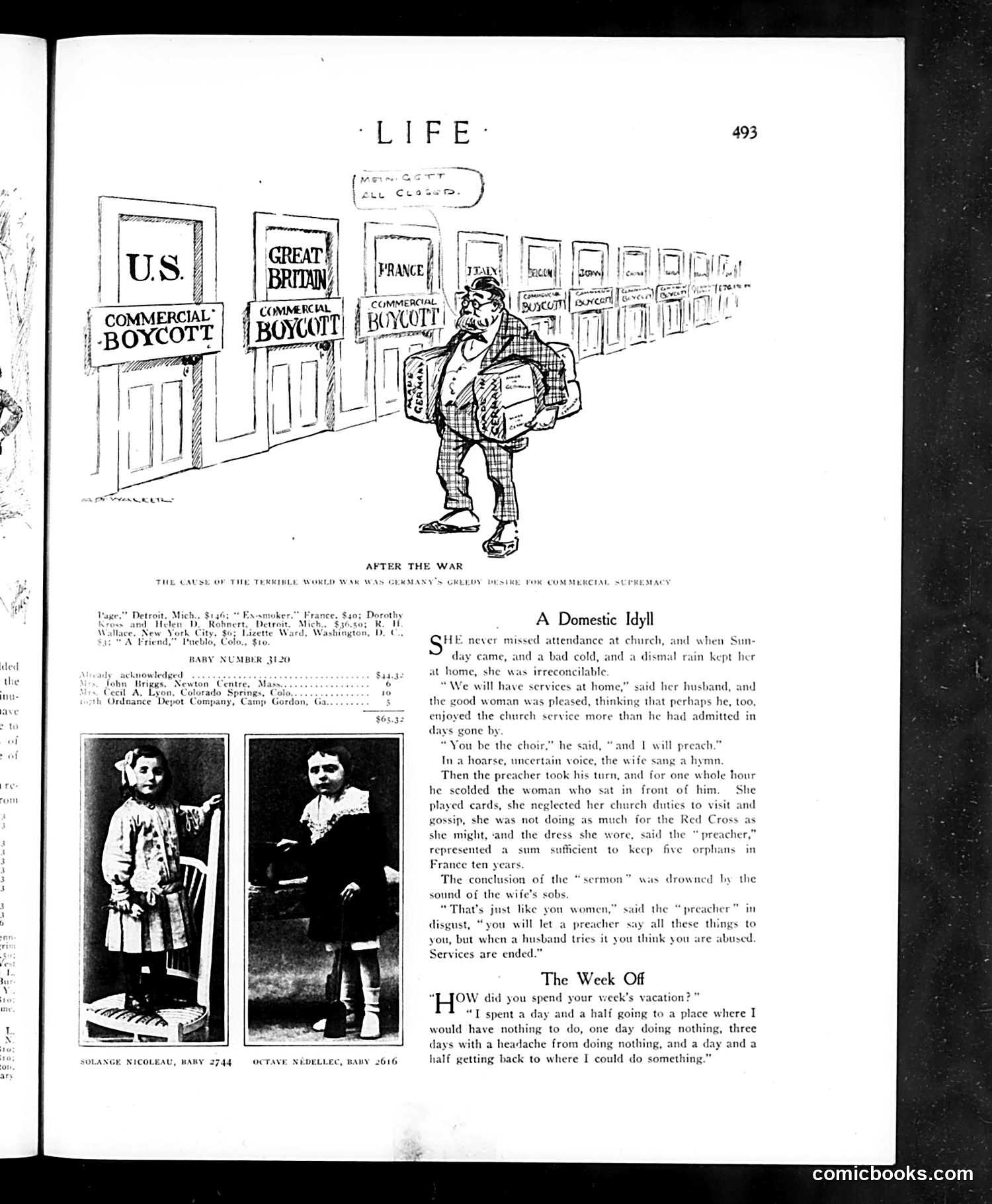
The top cartoon depicts a man labeled with various countries' commercial boycotts (U.S., Great Britain, France, Italy, and others in diminishing size). He carries bundles marked "COMMERCIAL BOYCOTT," illustrating post-WWI economic sanctions against Germany. The caption explains the satire's premise: Germany's desire for "commercial supremacy" caused the "terrible world war." The cartoon satirizes the Allied powers' strategy of using economic boycotts as punishment and containment—suggesting that the very commercial competition that allegedly sparked the war was now being weaponized against the defeated nation. This reflects actual post-1918 sentiment: the Treaty of Versailles imposed severe economic restrictions on Germany, which many contemporaries believed would ensure its weakness and prevent future aggression. The satire critiques whether punitive economic measures could truly prevent future conflict.
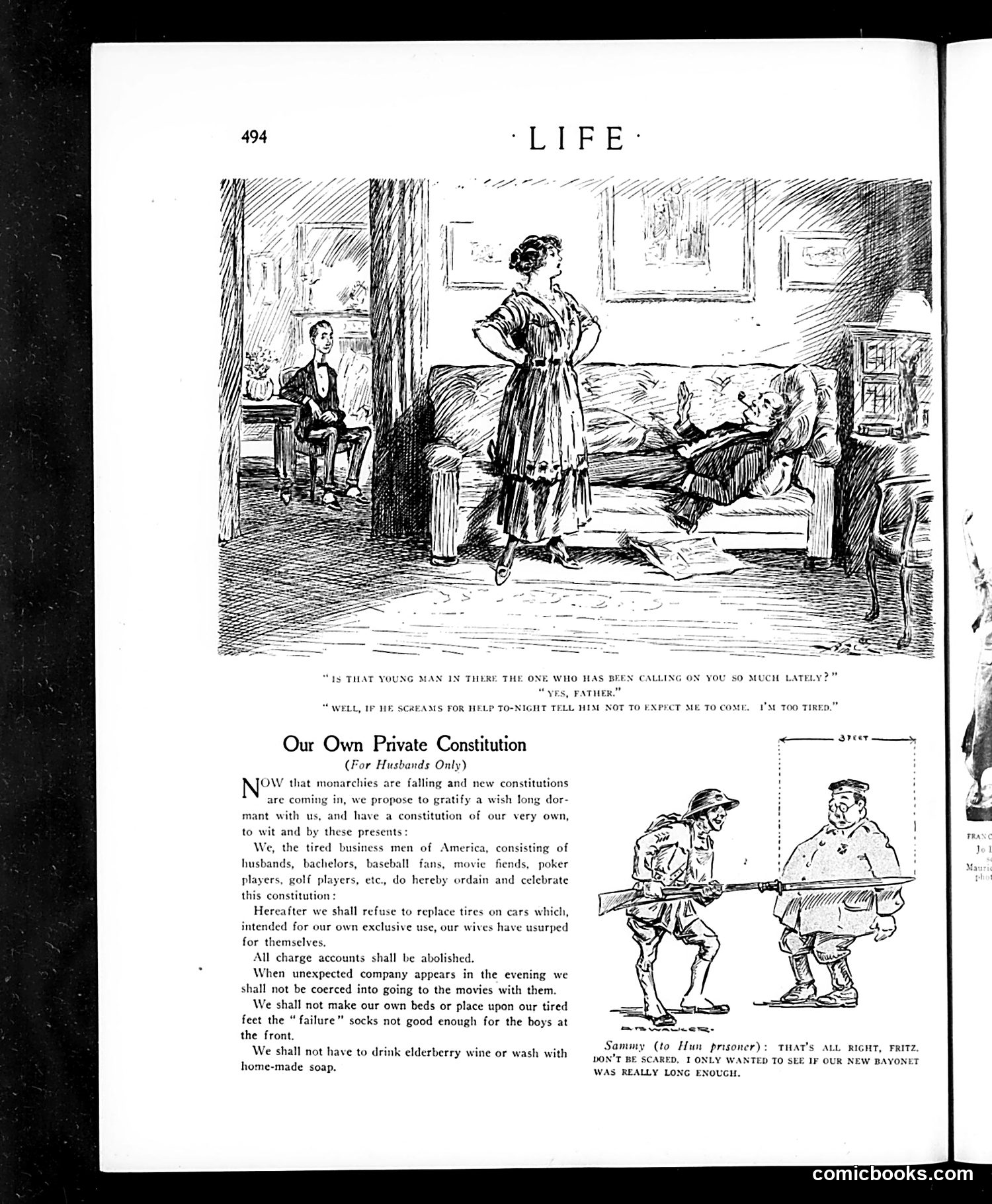
The page contains two distinct satirical pieces: **Top Cartoon:** A domestic humor sketch where a father, exhausted from work, tells his daughter that if her young suitor screams for help tonight, he won't respond because he's too tired. The joke plays on the father's traditional role as protective guardian—humorously abandoned due to fatigue. **"Our Own Private Constitution" (For Husbands Only):** A humorous manifesto where "tired business men of America" mock the era's constitutional reform movements by proposing their own "constitution" listing domestic grievances. Men demand relief from: replacing car tires wives have "usurped," wives' charge accounts, mandatory movies with unexpected guests, making beds, wearing "failure" socks, drinking homemade elderberry wine, and washing with homemade soap. **Bottom Cartoon:** A WWI soldier (Sammy) shows a captured German prisoner (Hun) a new bayonet, joking that he only wanted to test if it was long enough. The satire targets both domestic conflict (wives' independence/spending) and wartime masculinity, reflecting early 20th-century gender anxieties as women gained more autonomy.
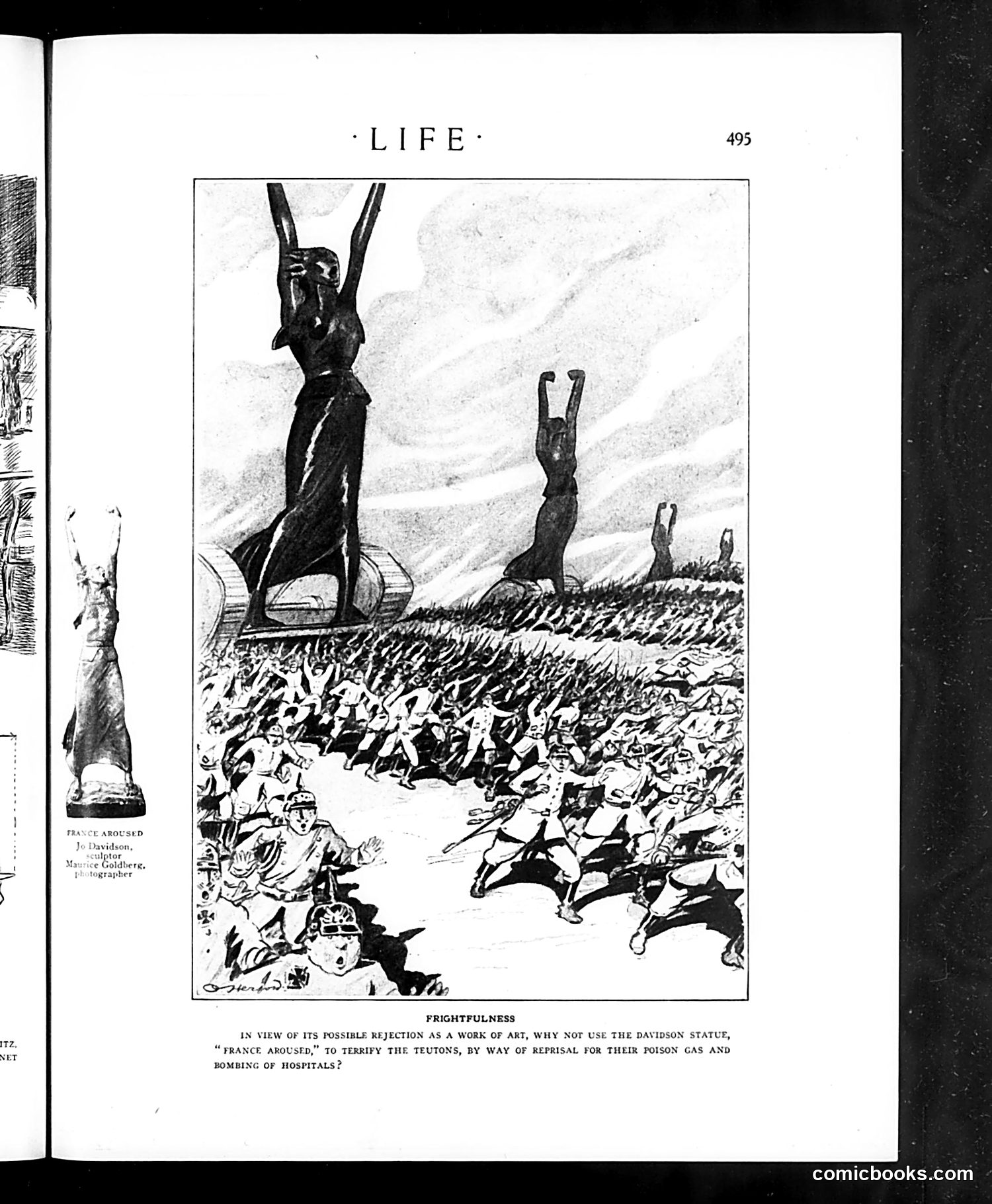
This satirical cartoon critiques German wartime tactics during World War I. The image depicts the Davidson statue "France Aroused"—a monumental sculpture of a woman with raised arms—looming over a battlefield where tiny German soldiers ("Teutons") flee in terror. The satire is darkly humorous: the caption sarcastically proposes using the statue as a weapon against Germany to retaliate for their use of poison gas and bombing of hospitals—violations of international warfare conventions that shocked Allied nations. The joke hinges on absurdity: instead of condemning the statue's artistic merit, why not weaponize it? This simultaneously mocks German brutality, defends French artistic pride, and reflects the bitter humor of WWI-era propaganda. The "Frightfulness" title likely references Germany's *Schrecklichkeit* (terror tactics) doctrine.
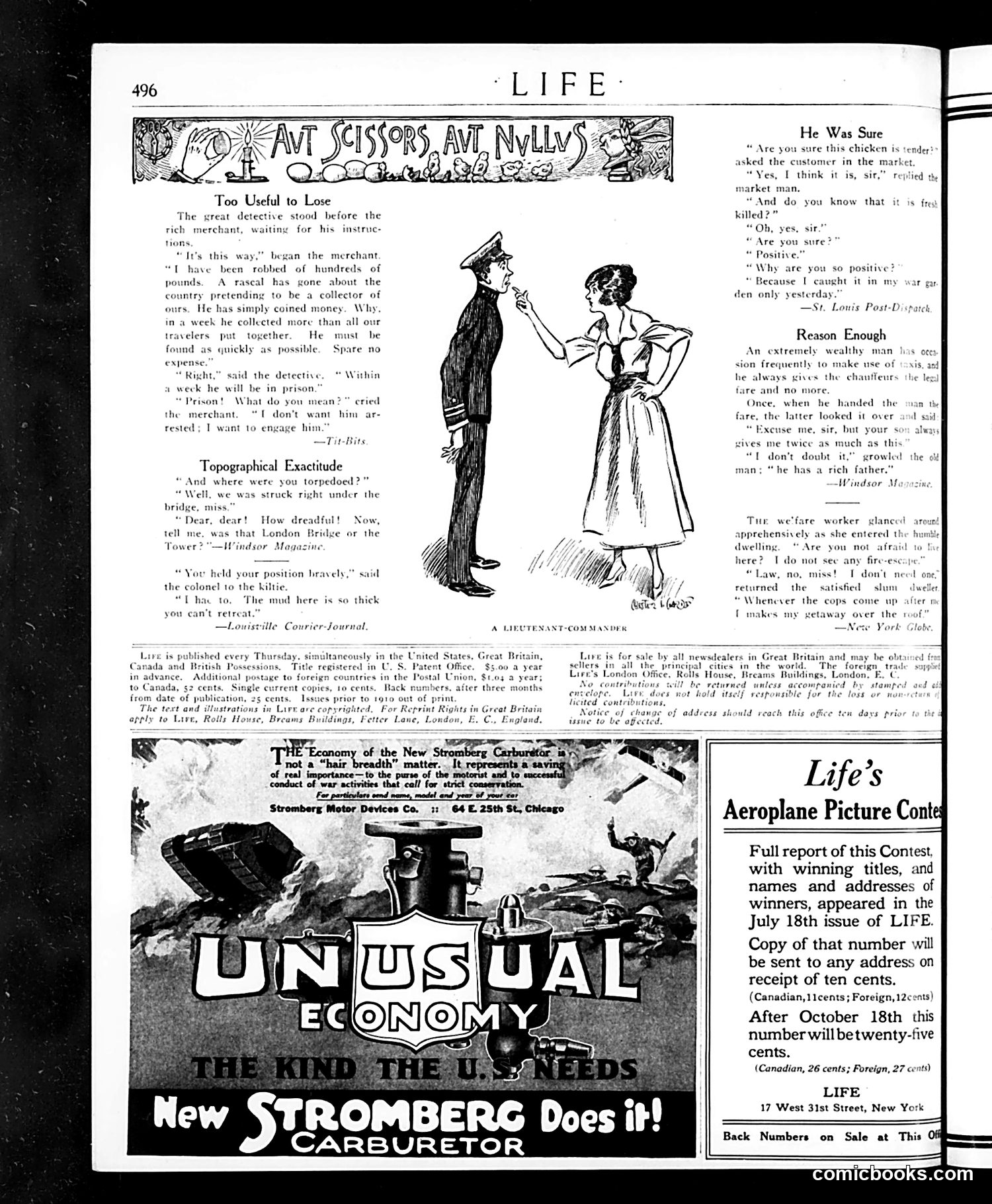
This page contains several short humor pieces typical of Life's satirical format: **"Too Useful to Lose"** mocks business ethics: a merchant hires a detective to catch a criminal impersonator who's been collecting money fraudulently—but then asks to *employ* the criminal instead, valuing his profitable dishonesty over justice. **"Topographical Exactitude"** is a WWI joke: a soldier claims he was torpedoed "right under the bridge, miss," but the woman questions whether it was London Bridge or the Tower—treating a wartime casualty account as a geography quiz. **"He Was Sure"** ridicules a market vendor's contradictory confidence: he claims the chicken is tender and freshly killed, but admits he caught it yesterday—his certainty reveals his obliviousness. **"Reason Enough"** jokes about class entitlement: a wealthy man gives his chauffeur double pay "because he has a rich father"—suggesting inherited wealth justifies inflated wages. The remaining pieces use similar ironic reversals common to Life's humor formula. The page also includes advertisements, notably for a Stromberg carburetor.
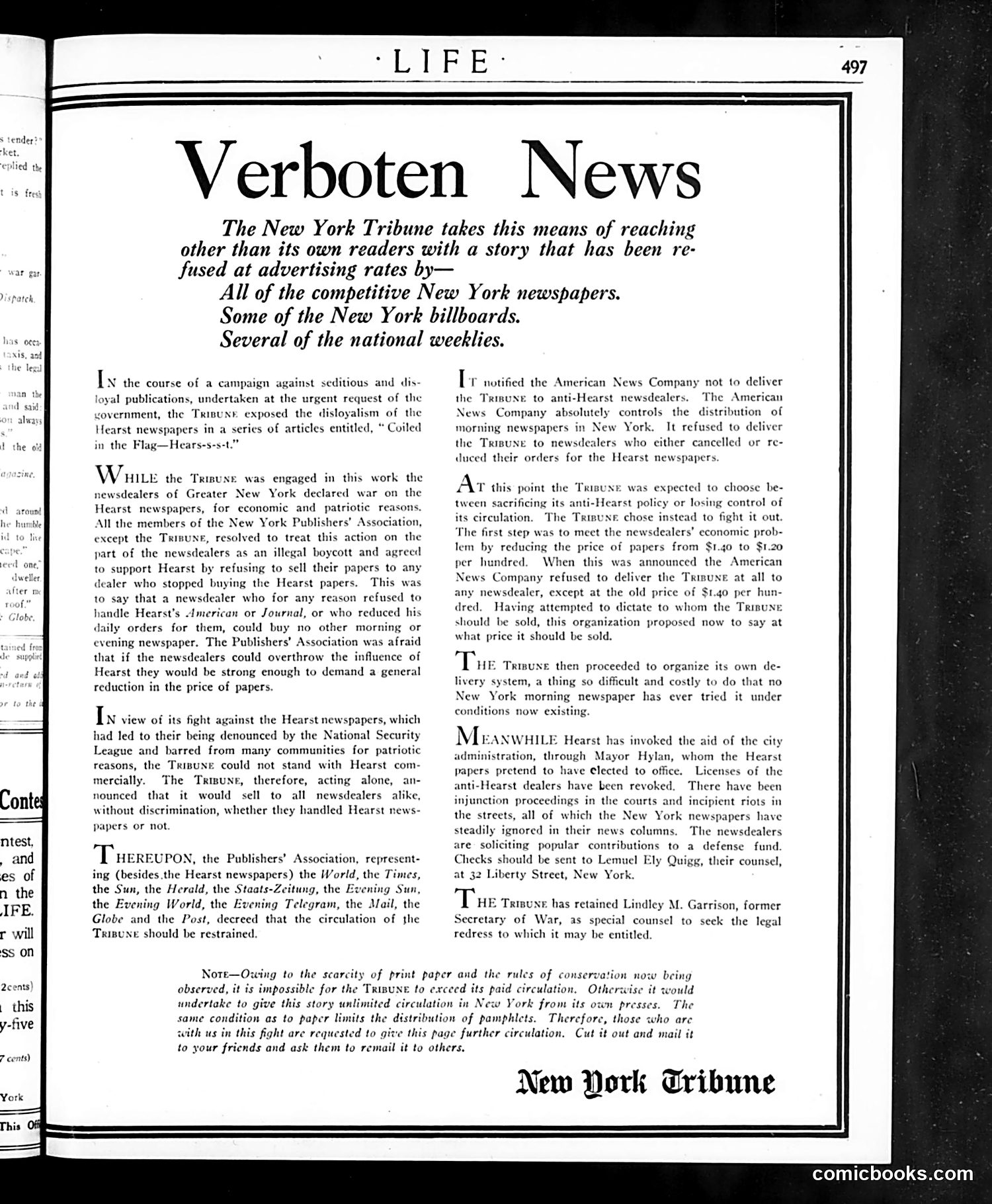
This is not a cartoon but a polemical article by the *New York Tribune* explaining why major New York newspapers and billboards refused to carry its advertisements—a story it's now publishing directly to readers. The context: The *Tribune* criticized William Randolph Hearst's newspapers as disloyal during World War I. In retaliation, the Publishers' Association (representing nearly every major NYC paper except the *Tribune*—the *Times*, *World*, *Herald*, etc.) coordinated to restrict the *Tribune's* circulation through the American News Company, which controlled newspaper distribution. The *Tribune* responded by establishing its own delivery system and reduced subscription prices. Hearst then allegedly used Mayor Hylan's administration to revoke licenses of *Tribune*-sympathetic newsdealers. The satire: The article exposes how even "respectable" newspapers engaged in illegal economic boycotts against a competitor for publishing anti-Hearst content—revealing that press monopolies, not just "seditious" publishers, threatened free speech. "Verboten" (forbidden) is apt: the establishment press literally forbade distribution of contrary viewpoints.
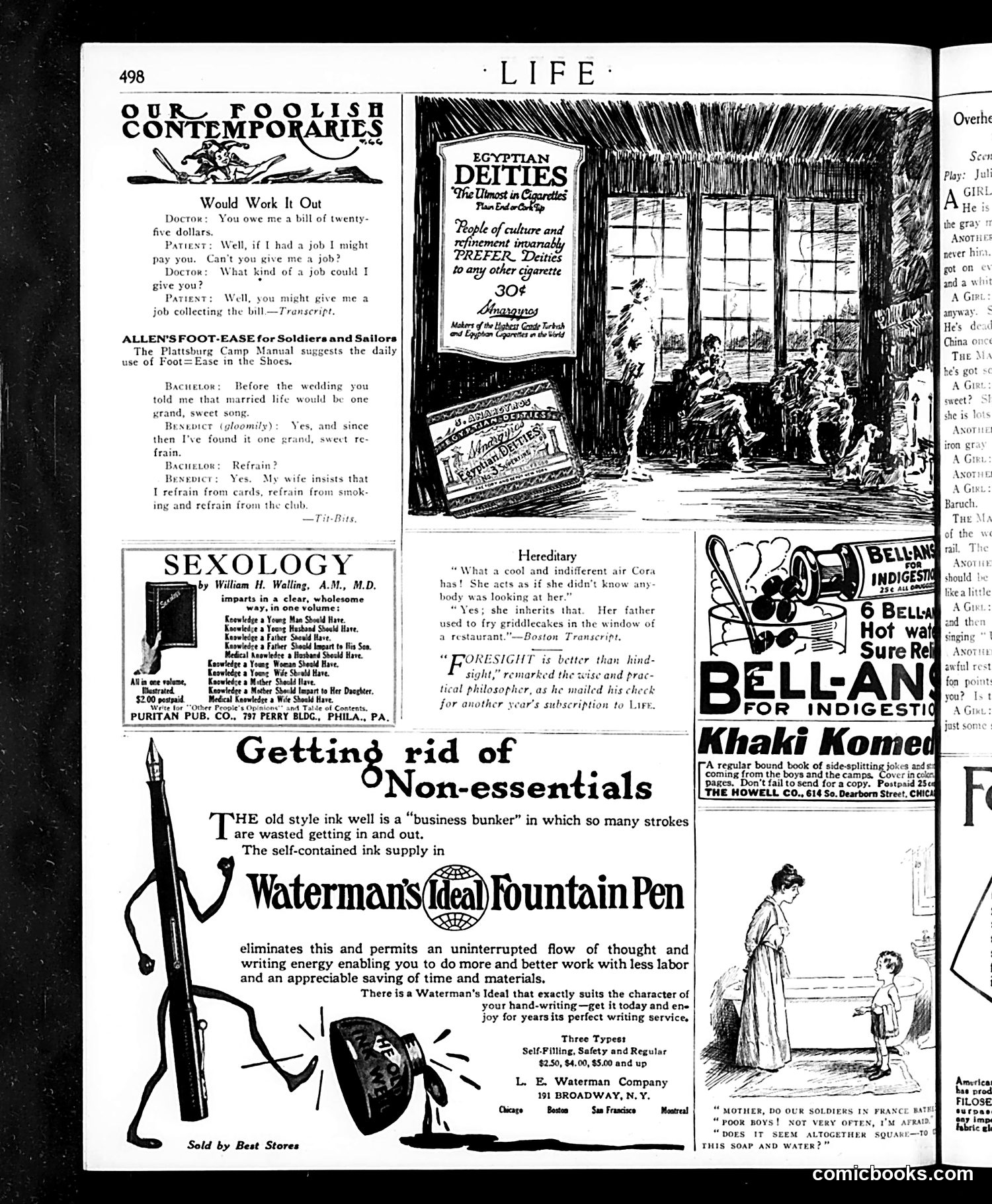
This page from *Life* magazine consists primarily of **advertising and humor columns** rather than political cartoons. The main content includes: **"Our Foolish Contemporaries"** — A humor section featuring short satirical dialogues mocking everyday absurdities: - A doctor-patient exchange about unpaid medical bills and employment - A newlywed couple where the husband's promised "sweet song" of marriage turns out to be a "refrain" (a pun on refraining from cards, smoking, and clubs) - A joke about inherited behavior traits The page is dominated by **period advertisements**: Egyptian Deities cigarettes, Allen's Foot-Ease, Waterman's Ideal Fountain Pens, and "Khaki Komer" (a WWI soldiers' joke book). One ad shows a mother and soldiers, referencing soldiers in France during what appears to be World War I. The satire is **mild and domestic** rather than political—poking fun at marriage frustrations, bill collection, and social pretenses rather than addressing major political issues.
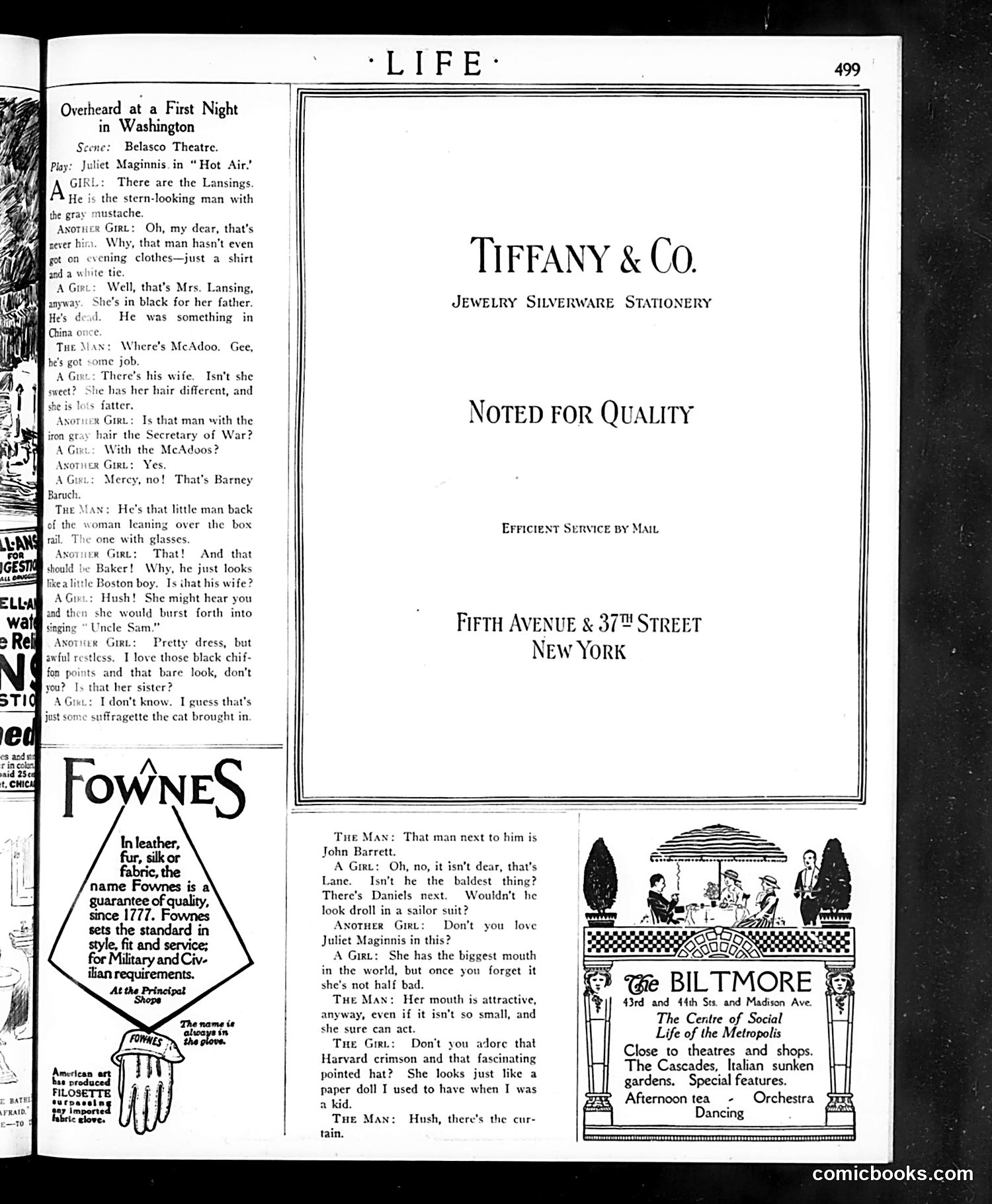
This satirical piece mocks Washington society at a theater premiere. Gossiping theatergoers identify prominent government figures by appearance and rumor, their comments revealing both social snobbery and ignorance. The references appear to be to actual Wilson-era officials: "McAdoo" (likely Treasury Secretary William McAdoo), "Baker" (Secretary of War Newton Baker), "Daniels" (Secretary of Navy Josephus Daniels), and "Lane" (Interior Secretary Franklin Lane). The dialogue ridicules these men's physical appearance while also mocking the women speakers—their superficiality, fashion obsession, and casual cruelty. A suffragette joke appears near the end. The humor targets both pretentious Washington society and the speakers' own vapid commentary, suggesting that those who claim to move in powerful circles are themselves rather foolish and petty.
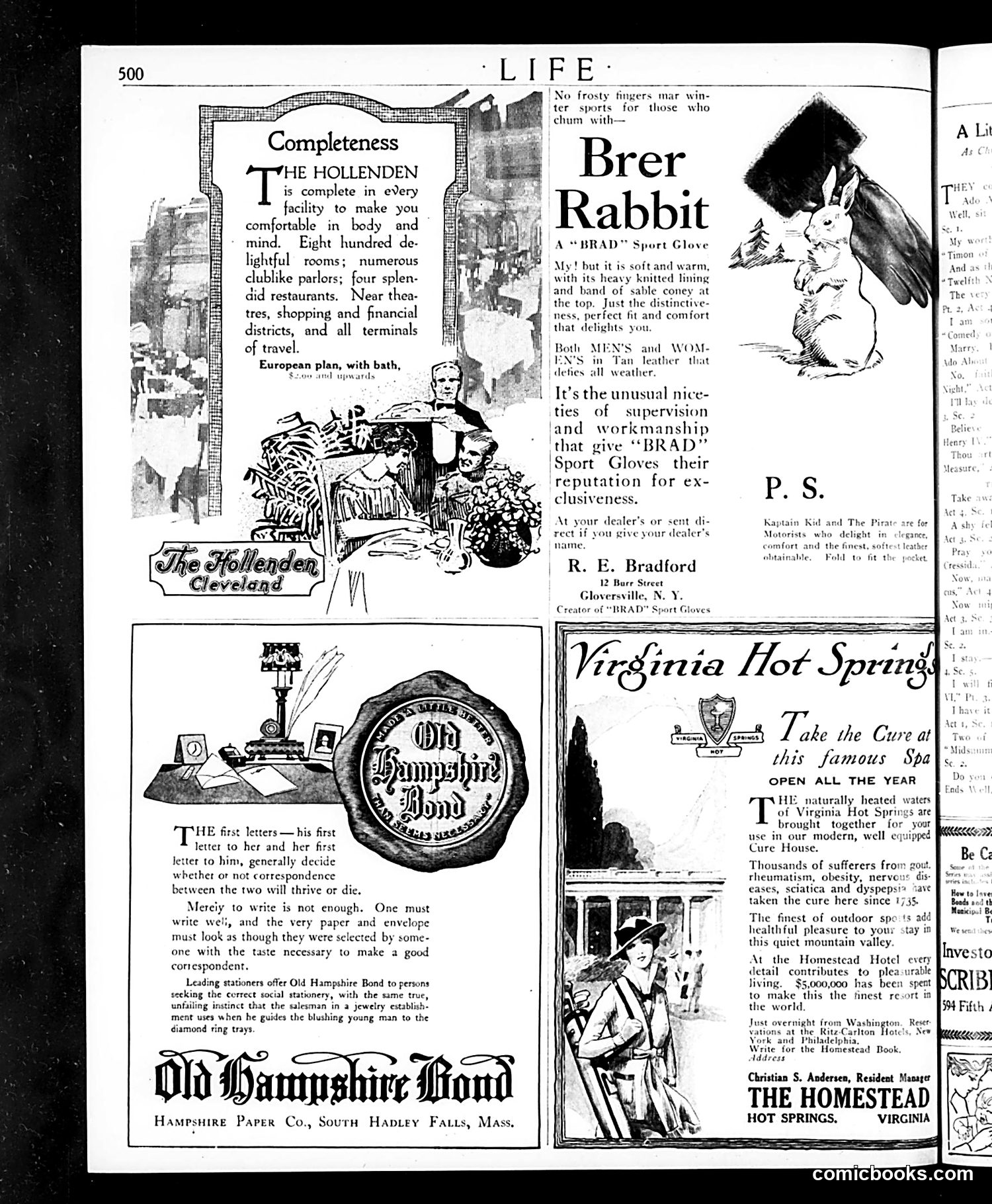
This page is primarily **advertisements** for luxury goods and services aimed at wealthy readers, not political satire. The ads include: - **The Hollenden** (Cleveland hotel) emphasizing comfort and central location - **Old Hampshire Bond** stationery, with text about letter-writing etiquette and courtship rituals - **Brer Rabbit sport gloves** for winter activities - **Virginia Hot Springs** spa resort The only potentially satirical element is the stationery ad's somewhat overwrought emphasis on how "first letters" determine romantic futures, mocking the social anxieties of the era about proper etiquette. The copy gently ridicules both the importance placed on choosing "correct" stationery and the nervousness of "the blushing young man" buying an engagement ring. Otherwise, this reflects early 20th-century consumer culture targeting the upper class—hotels, quality paper goods, luxury winter sports wear, and health resorts were aspirational purchases for Life's affluent readership.
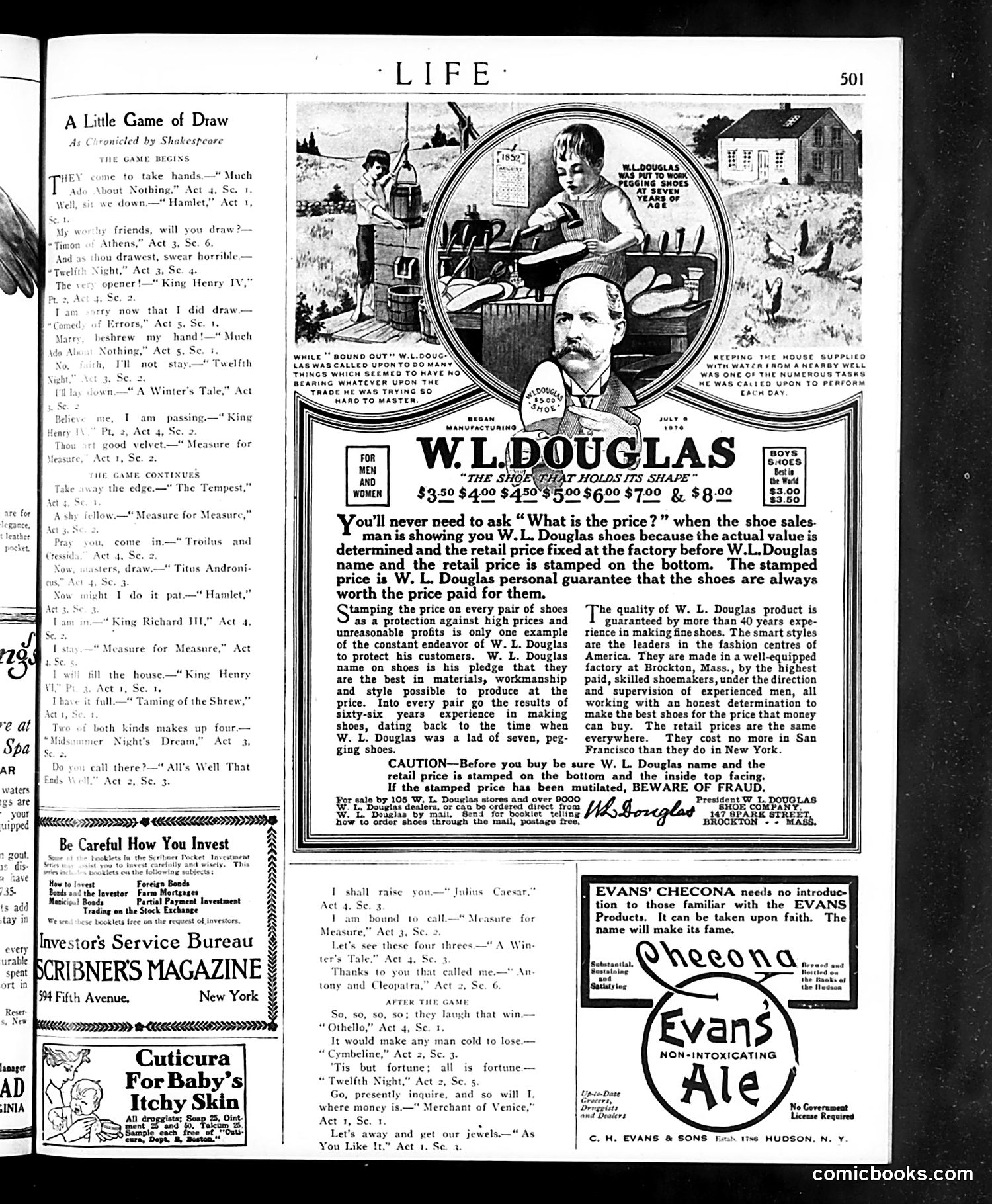
This page is primarily **advertising**, not political satire. The dominant feature is a large W.L. Douglas shoe advertisement (center-right), which uses Shakespeare quotations as decorative framing. **The "Little Game of Draw" section** (left column) is a clever wordplay piece attributing various Shakespeare quotes about "drawing" to different plays. It's a lighthearted literary game with no political content—merely matching quotations thematically. **The W.L. Douglas shoe ad** emphasizes that prices are stamped on shoes as a consumer protection against inflated markups. The accompanying narrative panels show Douglas as a hardworking manufacturer ensuring quality and fair pricing—a straightforward commercial message typical of early 20th-century advertising claiming honesty and value. **Additional ads** include Evans Checona ale and other products, suggesting this is a standard magazine issue from approximately 1912. There is no apparent political cartoon or satire here—the page represents typical Life magazine content mixing light literature with advertising.
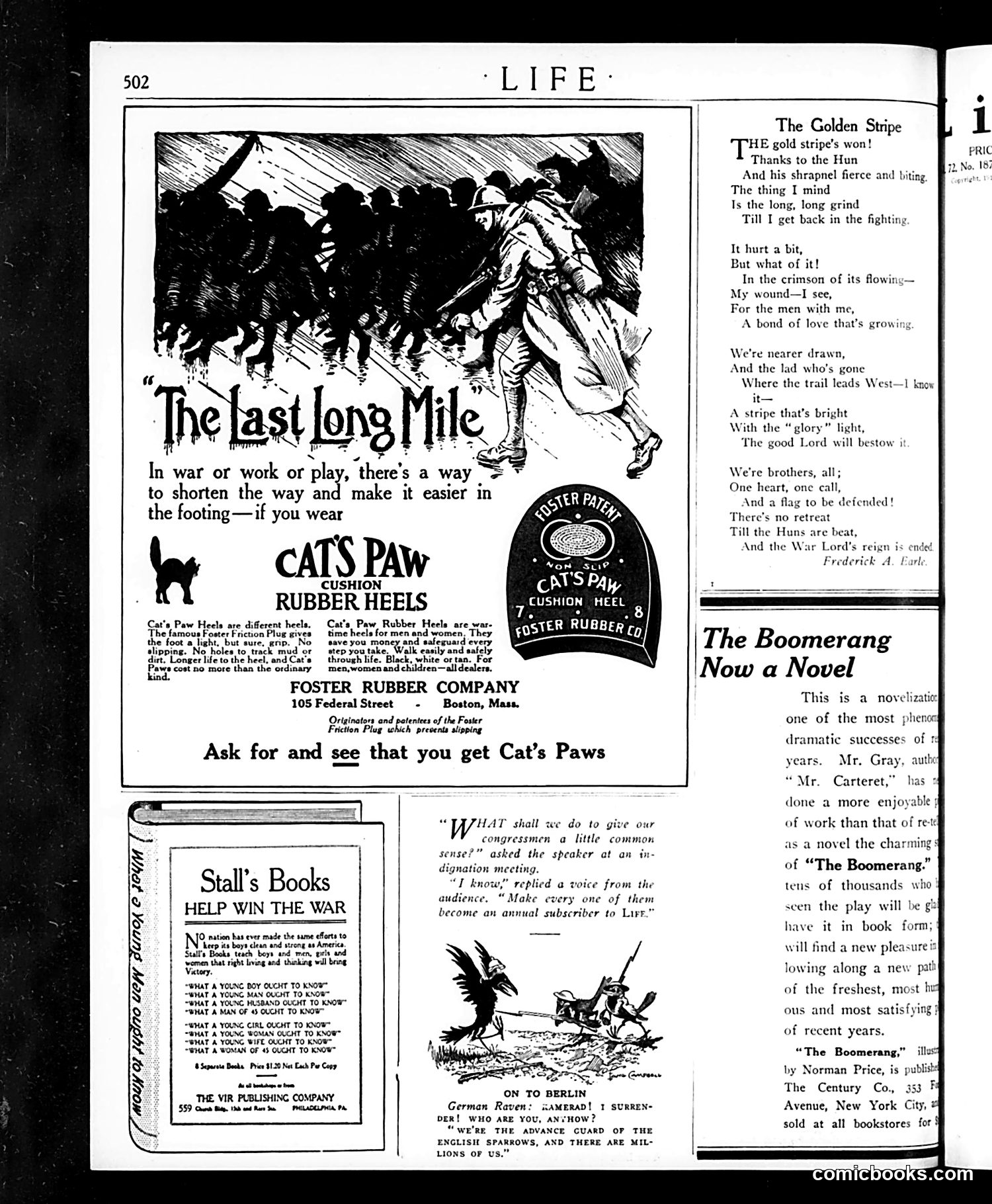
This page from *Life* magazine (appears to be WWI-era, given references to "the Hun" and fighting) contains: **"The Golden Stripe" poem**: A sentimental war poem celebrating a soldier's wound as a badge of honor and brotherhood. The "golden stripe" likely refers to a wound stripe—a military decoration for combat injuries. The poem romanticizes sacrifice and suggests the wound binds soldiers together spiritually. **Cat's Paw Rubber Heels advertisement**: A product ad claiming the heels make walking easier and prevent slipping—presented as practical for wartime conditions. **Stall's Books advertisement**: Educational books marketed as supporting the war effort by keeping youth "clean and strong." **Congressional joke**: A satirical quip suggesting congressmen need to read *Life* magazine to gain common sense—typical political mockery. **"On to Berlin" cartoon**: A humorous illustration where English sparrows surrender to an advancing "army," making light of German military fears through absurdist humor. The page blends patriotic content with consumer advertising and gentle satire—typical of wartime *Life* magazine's mix of propaganda, humor, and commerce.