
Life, 1918-10-03 · page 20 of 34
Life — October 3, 1918 — page 20: what you’re looking at
What you’re looking at
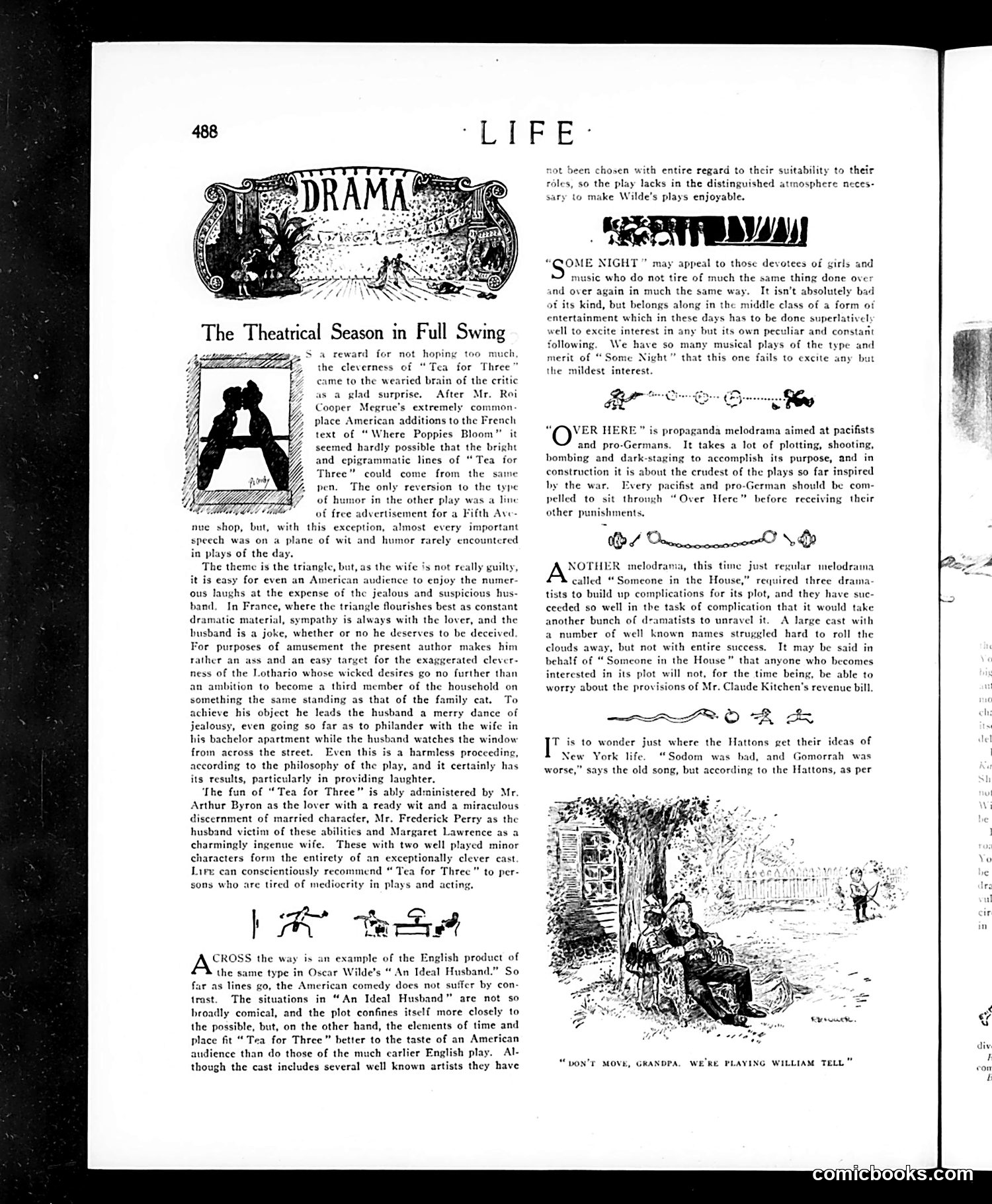
This page reviews the 1912 theatrical season, focusing on three plays: **"Tea for Three,"** **"An Ideal Husband,"** and **"Over Here."** The critic praises "Tea for Three" as witty relief after mediocre plays. It's a marital triangle comedy where the husband is portrayed as foolish—appealing to American audiences who sympathize with the innocent wife, unlike French audiences who typically favor the lover. The page contrasts this with Oscar Wilde's "An Ideal Husband," calling it more refined but less suited to American taste. **"Over Here"** is dismissed as crude propaganda melodrama targeting pacifists and pro-Germans—suggesting this review dates to WWI era when American patriotic theater was common. The critic finds it structurally clumsy despite its political message. The illustration at bottom shows a domestic scene, likely from one of the reviewed plays, reinforcing the theater-of-manners theme.
📄 Transcribed text from this page (OCR, searchable)
Machine-transcribed from the original scan — historical spelling and the odd misread are preserved.
LIFE The Theatrical Season in Full Swing Sa reward for not hoping too much the cleverness of “Tea for Three” came to the wearied brain of the critic After Mr. Roi Cooper Megrue’s extremely common place American additions to the French text of “Where Poppies Bloom” it seemed hardly possible that the bright and epigrammatic lines of “Tea for ” could come from the sar pen. The only reversion to the tyne of humor in the other play was a line of free advertisement for a Fifth Ave- with this exception, almost every impor! 1s a glad surprise, Three nue shop, but, speech was on a plane of wit and humor rarely encountered in plays of the day. The theme is the triangle, but, as the wife is not really guilty, it is easy for even an American audience to enjoy the numer- ous laughs at the expense of the jealous and suspicious hus- band, In France, where the triangle flourishes best as constant dramatic material, sympathy is always with the lover, and the busband is a joke, whether or no he deserves to be deceived. For purposes of amusement the present author makes him rather an ass and an easy target for the exaggerated clever- ness of the Lothario whose wicked desires go no further than an ambition to become a third member of the household on something the same standing as that of the family cat. To achieve his object he leads the husband a merry dance of jealousy, even going so far as to philander with the ein his bachelor apartment while the husband watches the window from across the street. Even this is a harmless proceeding, according to the philosophy of the play, and it certainly has its results, particularly in providing laughter. ‘The fun of “Tea for Three” is ably administered by Mr. Arthur Byron as the lover with a ready wit and a miraculous discernment of married character, Mr. Frederick Perry as the husband vic ies and Margaret Lawrence as a charmingly ingenue wife. These with two well played minor aracters form the entirety of an exceptionally clever cast Lire can conscientiously recommend “ Tea for Three" to per- sons who are tired of mediocrity in plays and acting, b A Verh the way is English product of the same type in Oscar Wilde’s “An Ideal Husband.” So as lines go, the American comedy does not suffer by con- trast. The situations in “An Ideal Husband” are not so broadly comical, and the plot confines itself more closely to the possible, but, on the other hand, the elements of time and place fit “Tea for Three” better to the taste of an American audience than do those of the much carlier English play. Al- though the cast includes several well known artists they have an example of the not been chosen with entire regard to their suitability to their roles, so the play lacks in the distinguished atmosphere neces- sary to make Wilde's plays enjoyable. |W) appeal to those devotees of girls and ic who do not tire of much the same thing done over and over again in much the same way. It isn’t absolutely ba of its kind, but belongs along in the middle class of a form of entertainment which in these days has to be done superlativel well to excite interest in any but its own peculiar and constant following. We have so many musical plays of the type and merit of “Some Night" that this one fails to excite any bu the mildest interest VER HERE ” is propaganda melodrama aimed at pacifists and pro-Germans. It takes a lot of plotting, shooting, bombing and dark-staging to accomplish its purpose, and in construction it is about the crudest of the plays so far inspired hy the war. Every pacifist and pro-German should be com- pelled to sit through “Over Here” before receiving their other punishments. Wd OmecconoconD Sip OTHE this time just regular melodrama led “Someone in the House,” tists to build up complications for its plot, and they have suc- ceeded so well in the task of complication that it would take another bunch of dramatists to unravel it. A large cast with a number of well known names struggled hard to roll the clouds away, but not with entire success. It may be said in of meone in the House” that anyone who becomes interested in its plot will not, for the time being, be able to worry about the provisions of Mr. Claude Kitchen’s revenue bill. SO T is to wonder just where the Hattons get their ideas of New York life. “Sodom was bad, and Gomorrah was ays the old song, but according to the Hattons, as per melodr; required three drama A worse, “DON'T MOVE, GRANDPA, WE'RE PLAYING WILLIAM TELL