
Life, 1918-10-03 · page 29 of 34
Life — October 3, 1918 — page 29: what you’re looking at
What you’re looking at
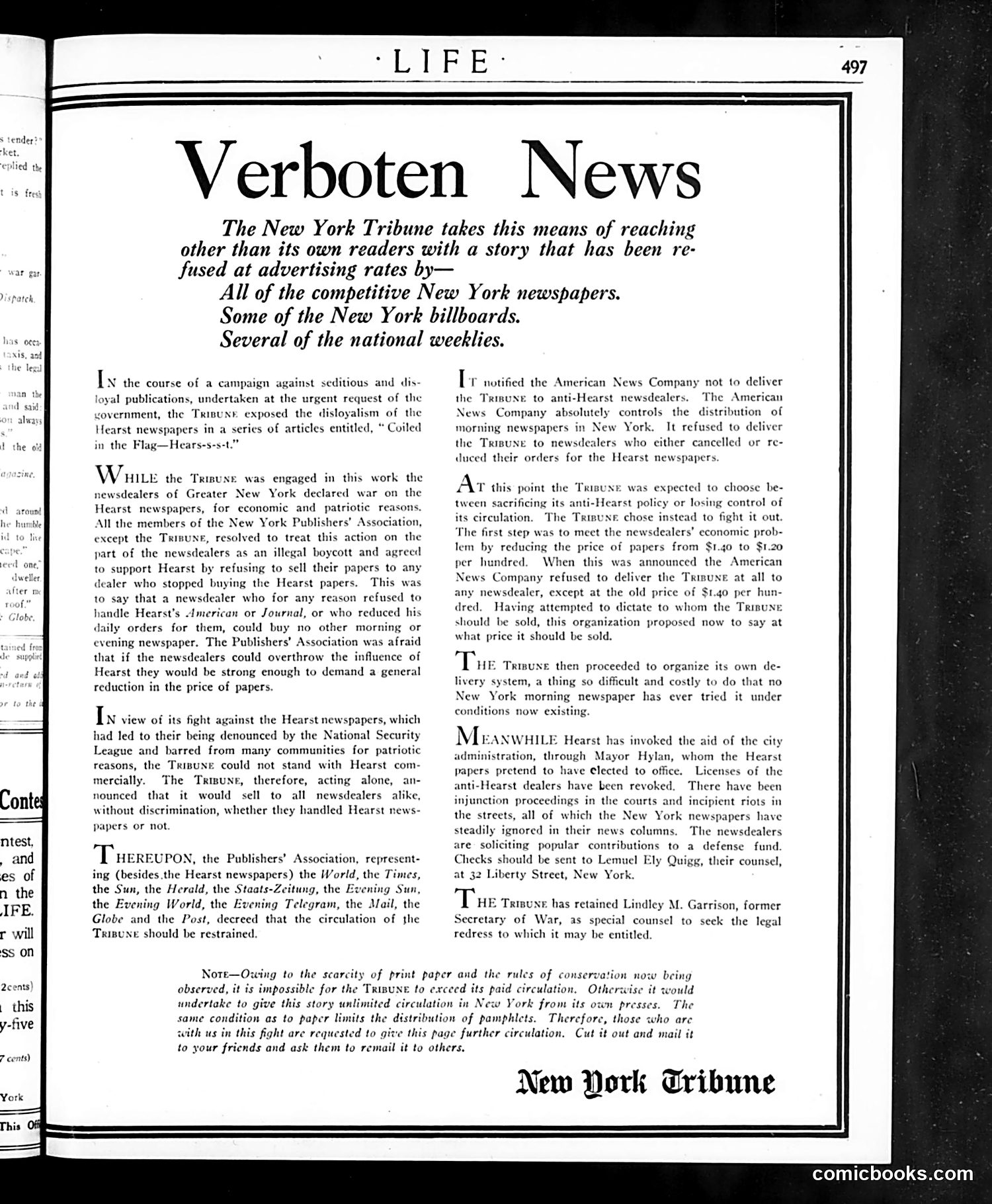
This is not a cartoon but a polemical article by the *New York Tribune* explaining why major New York newspapers and billboards refused to carry its advertisements—a story it's now publishing directly to readers. The context: The *Tribune* criticized William Randolph Hearst's newspapers as disloyal during World War I. In retaliation, the Publishers' Association (representing nearly every major NYC paper except the *Tribune*—the *Times*, *World*, *Herald*, etc.) coordinated to restrict the *Tribune's* circulation through the American News Company, which controlled newspaper distribution. The *Tribune* responded by establishing its own delivery system and reduced subscription prices. Hearst then allegedly used Mayor Hylan's administration to revoke licenses of *Tribune*-sympathetic newsdealers. The satire: The article exposes how even "respectable" newspapers engaged in illegal economic boycotts against a competitor for publishing anti-Hearst content—revealing that press monopolies, not just "seditious" publishers, threatened free speech. "Verboten" (forbidden) is apt: the establishment press literally forbade distribution of contrary viewpoints.
📄 Transcribed text from this page (OCR, searchable)
Machine-transcribed from the original scan — historical spelling and the odd misread are preserved.
tender? kee: ied the Verboten News The New York Tribune takes this means of reaching other than its own readers with a story that has been re- fused at advertising rates by— All of the competitive New York newspapers. Some of the New York billboards. Several of the national weeklies. Ly the course of a campaign against seditious and dis- loyal publications, undertaken at the urgent request of the reinuNe exposed the disloyalism of the “ Coiled vernment, the Hearst newspapers in a series of articles entitled, in the Flag—Hears-s-s-t.” Wun the Trinune was engaged in this work the newsdealers of Greater New York declared war on the Hearst newspapers, for economic and patriotic reasons. All the members of the New York Publishers’ Association, except the Trisune, resolved to treat this action on the part of the newsdealers as an illegal boycott and agreed to support Hearst by refusing to sell their papers to any dealer who stopped buying the Hearst papers. This was to say that a newsdealer who for any reason refused to handle Hearst's American or Journal, or who reduced his daily orders for them, could buy no other morning or evening newspaper. The Publishers’ Association was afraid that if the newsdealers could overthrow the influence of Hearst they would be strong enough to demand a general reduction in the price of papers. In view of its fight against the Hearst newspapers, which had led to their being denounced by the National Security League and barred from many communities for patriotic reasons, the TripuNe could not stand with Hearst com- mercially. The Tripune, therefore, acting alone, an- nounced that it would sell to all newsdealers alike, without discrimination, whether they handled Hearst news- papers or not. "Tuereuroy, the Publishers’ Association, represent- ing (besides.the Hearst newspapers) the World, the Times, the Sun, the Herald, the Staats-Zeitung, the ning Sun, the Evening World, the Evening Telegram, the Mail, the Globe and the Post, decreed that the circulation of the Tripune should be restrained. Note—Owing to the scarcity of print paper and ti E to exceed its paid circulation. Otherwise it would observed, it is impossible for the Trisu Lr notified the American News Company not to deliver the Trinuxe to anti-Hearst newsdealers. The American News Company absolutely controls the distribution of morning newspapers in New York. It refused to deliver the Tripune to newsdealers who cither cancelled or re- duced their orders for the Hearst newspapers. Ar this point the Trisunr was expected to choose be- tween sacrificing its anti-Hearst policy or losing control of ation. The Trinunr chose instead to fight it out. The first step was to meet the newsdealers’ economic prob- lem by reducing the price of papers from $1.40 to $1.20 per hundred. When this was announced the American News Company refused to deliver the Trinune at all to any newsdealer, except at the old price of $1.40 per hun- dred. Having attempted to dictate to whom the TrinuNe should be sold, this organization proposed now to say at what price it should be sold. Tue TripuNe then proceeded to organize its own de- livery system, a thing so difficult and costly to do that no New York morning newspaper has ever tried it under conditions now existing. M EANWHILE Hearst has invoked the aid of the city administration, through Mayor Hylan, whom the Hearst papers pretend to have Clected to office. Licenses of the anti-Hearst dealers have been revoked. There have been injunction proceedings in the courts and incipient riots in the streets, all of which the New York newspapers have steadily ignored in their news columns. The newsdealers are soliciting popular contributions to a defense fund. Checks should be sent to Lemucl Ely Quigg, their counsel, at 32 Liberty Street, New York. Te Tarvse has retained Lindley M. Garrison, former Secretary of War, as special counsel to seck the legal redress to which it may be entitled. rules of conservation now being undertake to give this story unlimited circulation in New York from its own presses. The same condition as to paper limits the distribution of pamphlets. Therefore, those who are with us in this fight are requested to give this page further circulation, Cut it out and mail it to your friends and ask them to remail it to others. New Dork Tribune comicbooks.com