
Life, 1918-10-03 · page 14 of 34
Life — October 3, 1918 — page 14: what you’re looking at
What you’re looking at
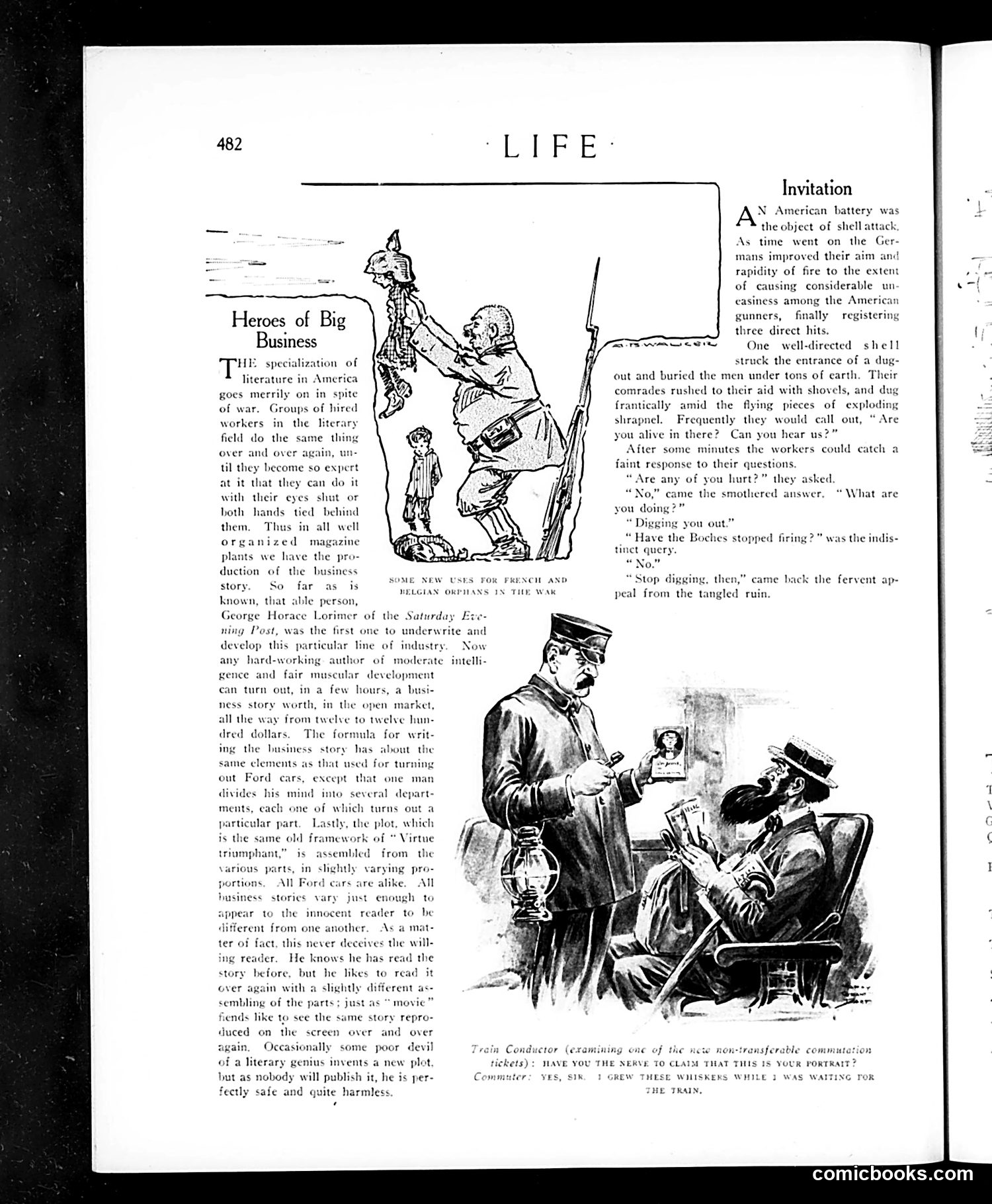
This page satirizes how American literature romanticizes business and war profiteering. The left column discusses how George Horace Lorimer of the *Saturday Evening Post* pioneered "business stories" as a literary genre—formulaic tales where authors manufacture dramatic narratives from mundane commercial activities. The illustrations mock this trend: the top shows soldiers rescuing orphans during wartime (labeled "Some New Uses for French and Belgian Orphans in the War"), while the bottom depicts a train conductor demanding payment from a passenger, sarcastically captioned about collecting fares. The satire argues that business-story writers artificially inject heroism and moral significance into ordinary commercial transactions, essentially exploiting wartime suffering and human misery for entertainment and profit.
📄 Transcribed text from this page (OCR, searchable)
Machine-transcribed from the original scan — historical spelling and the odd misread are preserved.
Heroes of Big Business HE specialization of literature in America goes merrily on in spite of war. Groups of hired workers in the literary field do the same thing gain, un- til they become so expert at it that they can do it with their eyes shut or Hoth hands tied behind them. Thus in all well organized over and over magazine plants we have the pro- duction of the business ; some far New s NELGIAN story, known, that George Horace g Post, develop this particular line of as is Ile person, Lorimer of the Saturda, ni was the first one t industry moderate any hard-working author of nee and fair muscular development can turn out, ina few hours, a busi- ness story worth, in the open market, all the way from twelve to twelve hun- The iness story for writ- the dred dollars formula ing the In same out has about ments as that used for turn Ford that ng cars, except one man divides his mind into. several depart- ments, cach one of which turns out a particular part. Lastly, the plot, which is the same old framework of * Virtue nbled the various parts, in slightly varying pro- AI] Ford cars are alike. All enough to reader to he As a mat- triumphant,” is asse irom portions business stories vary. just pear to the innocent different from one another ter of fact, this never deceives the will- ng re He knows he has read the story likes 1 i over again with a slightly different as- er. hefore, but he to re sembling of the parts; just as “ movie” fiends like to see the same story repro- duced the in. Occasionally some poor devil on screen over and over of a literary genius invents a new plot but as nobody will publish it, he is per- fectly safe and quite harmless USES FoR FRENCH RPMANS IN y E underwrite and Now intelli- c n Conductor (examini ts) mmuter AND THE WAK MAVE You sik Invitation American battery was A As time mans improved their aim and the object of shell attack went on the Ger- rapidity of fire to the extent of causing considerable un easiness among the American gunners, finally three direct hits. One well-directed shell struck the entrance of a dug- out and buried the men under tons of earth, Their comrades rushed to their aid with shovels, and dug frantically amid the flying pieces of : shrapnel. Frequently they would call out, “ Are you alive in there? Can you hear us Aiter some minutes the workers could catch registering oe ETI explodin faint response to their questions. Are any of you hurt?” they asked No,” came the smothered answer. you doing?” “What are “Digging you out.” “Have the Boches stopped firing?” tinct query. 0.” was the indis- “Stop digging, then,” came back the fervent ap- peal from the tangled ruin, M THAT THIS 1S YOUR FORTRAT THE NERVE TO CLA‘ WAS Wal 1 GREW THES THE TRAIN, WHISKERS WHILE 3 comicbooks.com