
A complete issue · 40 pages · 1918
Life — June 6, 1918
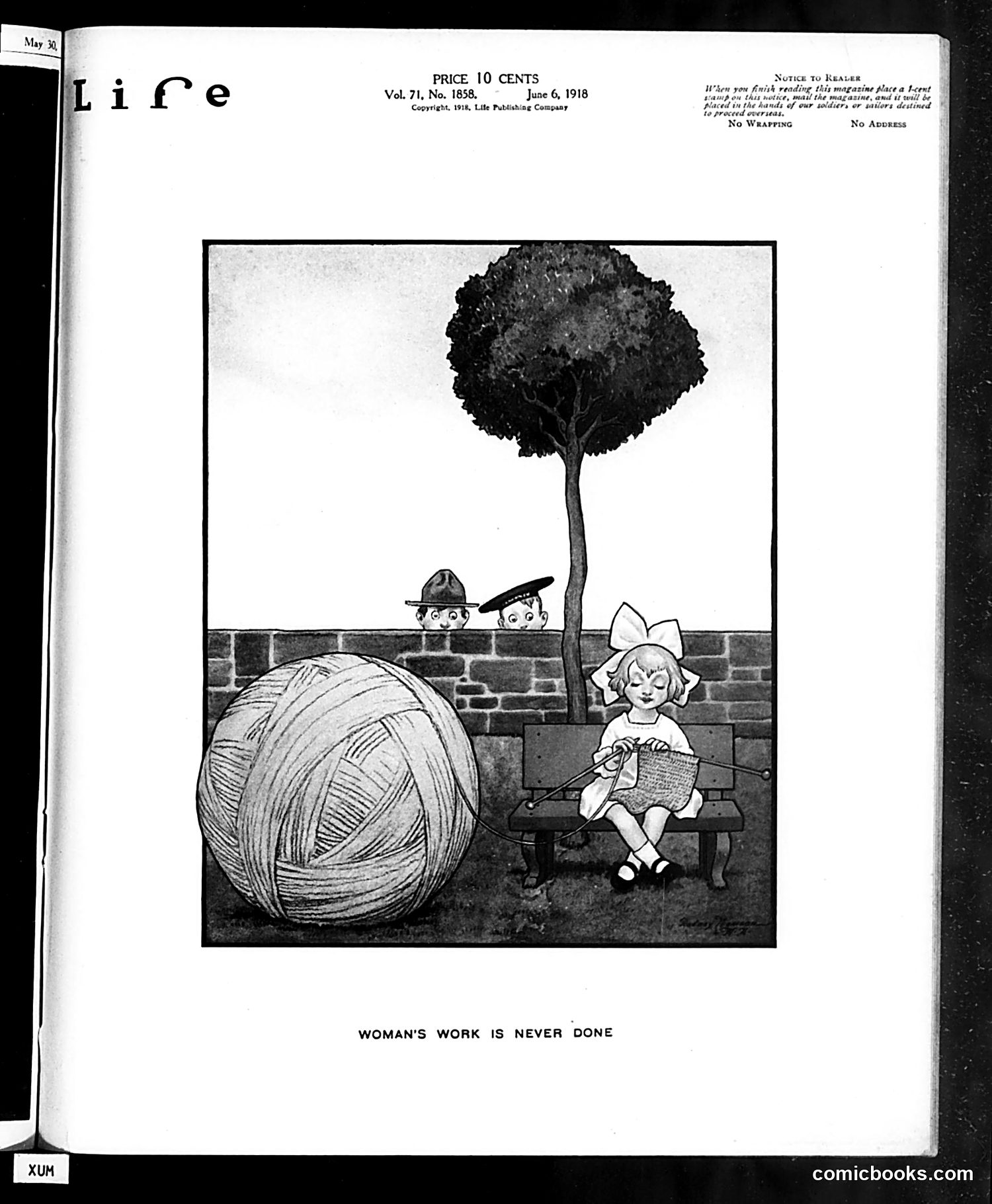
This cartoon depicts a young girl sitting on a bench, knitting what appears to be a large ball of yarn or finished knitted item. Behind her, two boys peer over a wall, apparently playing or observing. A tree stands in the background. The caption "Woman's Work Is Never Done" uses gentle satire about gendered labor expectations. Published during World War I (1918), this likely references women's domestic and wartime contributions—knitting was a significant civilian war effort, with women producing socks, scarves, and other items for soldiers. The cartoon suggests that while others (the boys) enjoy leisure activities, women and girls face endless productive labor, even during recreational moments. It's commentary on how women's work, whether domestic or patriotic, was considered perpetual and unfinished.
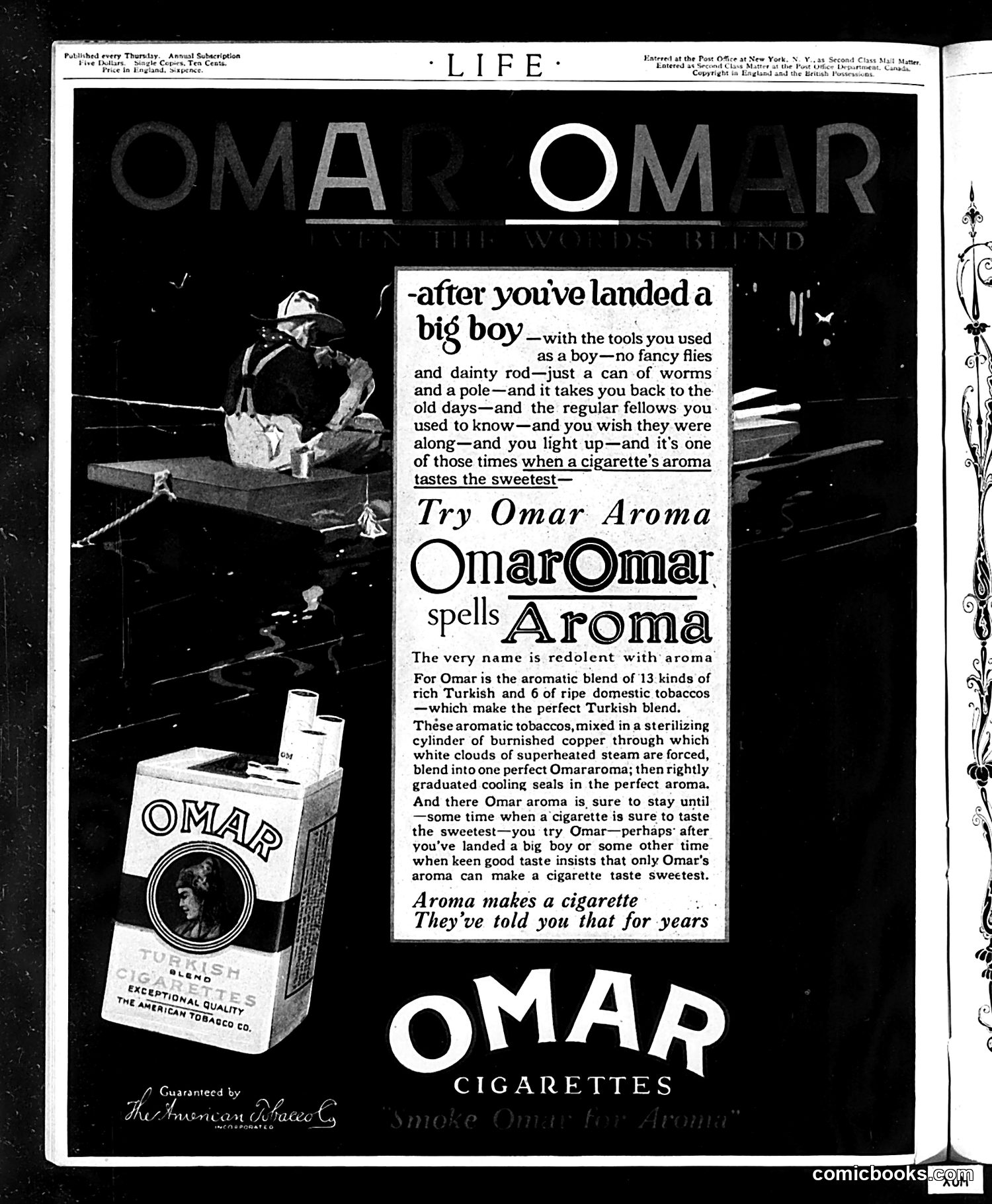
This page is primarily **an advertisement for Omar cigarettes**, not political satire or cartoon content. The ad occupies the full page in LIFE magazine. The visual shows a fisherman in a boat with his catch, accompanied by text nostalgically describing simple pleasures—fishing with basic tools, wanting old friends present, and enjoying a cigarette. The advertisement markets Omar Aroma cigarettes as providing similarly satisfying, authentic pleasure. The ad emphasizes that Omar is a Turkish-blend cigarette (13 Turkish tobaccos, 6 domestic varieties) and claims its "aroma makes a cigarette taste the sweetest." The messaging appeals to masculine leisure and wholesomeness rather than containing political commentary. This reflects early 20th-century cigarette advertising's common use of pastoral imagery and nostalgia to sell tobacco products.
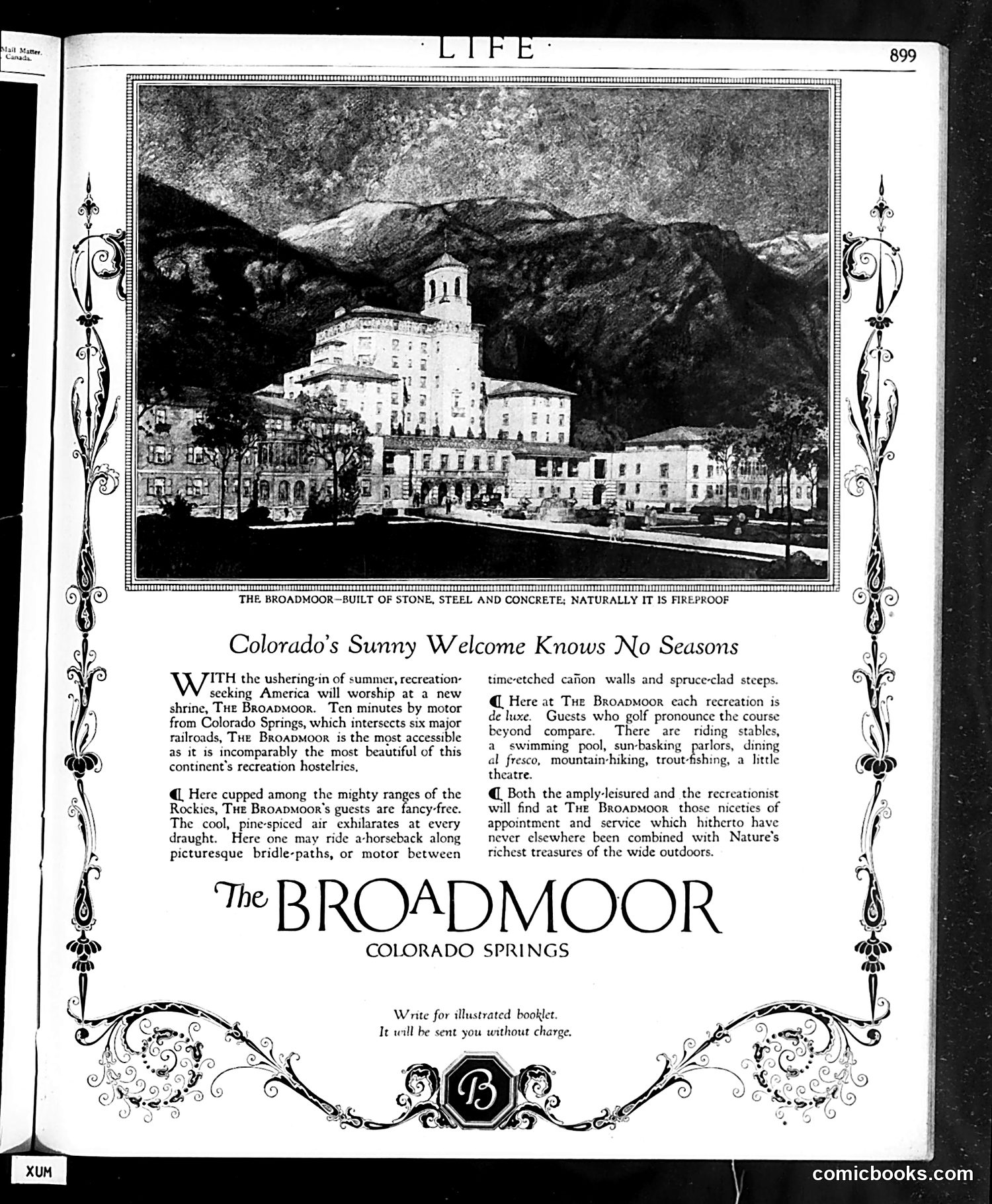
This page is **not a cartoon or satire**—it's a straightforward advertisement for The Broadmoor, a luxury hotel resort in Colorado Springs. The image shows the hotel's main building, a substantial stone structure nestled against the Rocky Mountains. The text emphasizes the resort's amenities and natural setting: its accessibility from Colorado Springs via railroad, recreational facilities (riding stables, swimming pool, mountain-hiking, trout-fishing), and its positioning as combining luxury hospitality with outdoor recreation. The phrase "Colorado's Sunny Welcome Knows No Seasons" appears to be a marketing slogan highlighting year-round pleasant weather. The ornamental borders and typography are typical of early 20th-century luxury advertising in Life magazine, targeting affluent readers seeking exclusive vacation destinations.
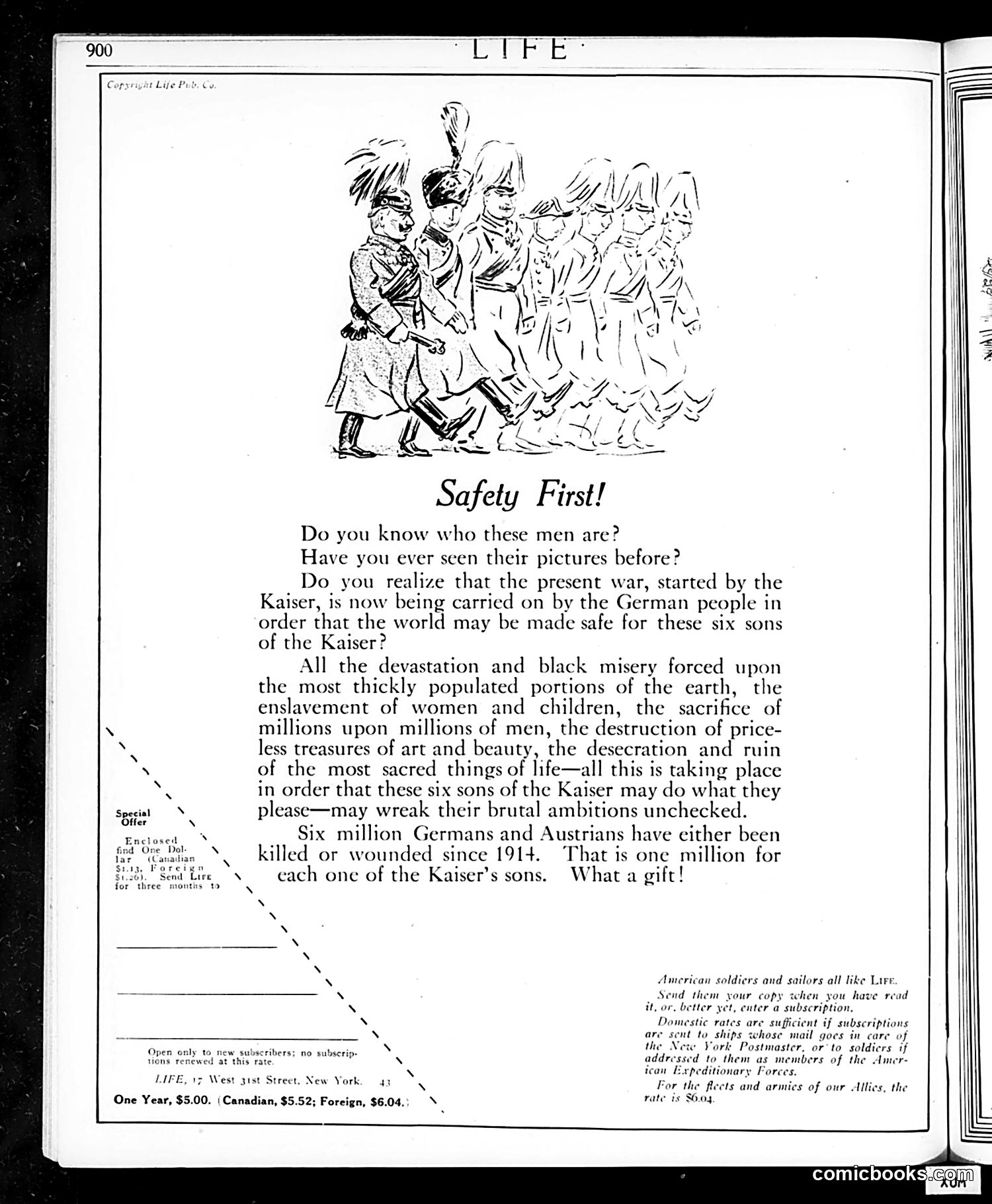
This WWI-era propaganda page attacks Germany's Kaiser and his six sons. The cartoon shows the Kaiser (left, with distinctive spiked helmet and military uniform) leading his six sons in military formation. The text argues that Germany's war effort, which has killed six million soldiers since 1914, amounts to one million casualties per Kaiser son—presented as an obscene "gift" to satisfy their ambitions. The satire sarcastically frames the enormous human cost of war as a personal benefit to the Kaiser's family. The page calls American soldiers and sailors to subscribe to *Life* magazine, framing support for the Allied cause as patriotic duty. This is anti-German wartime propaganda designed to rally American support against the Central Powers by personalizing the war's devastation as the fault of one family's imperial ambitions.
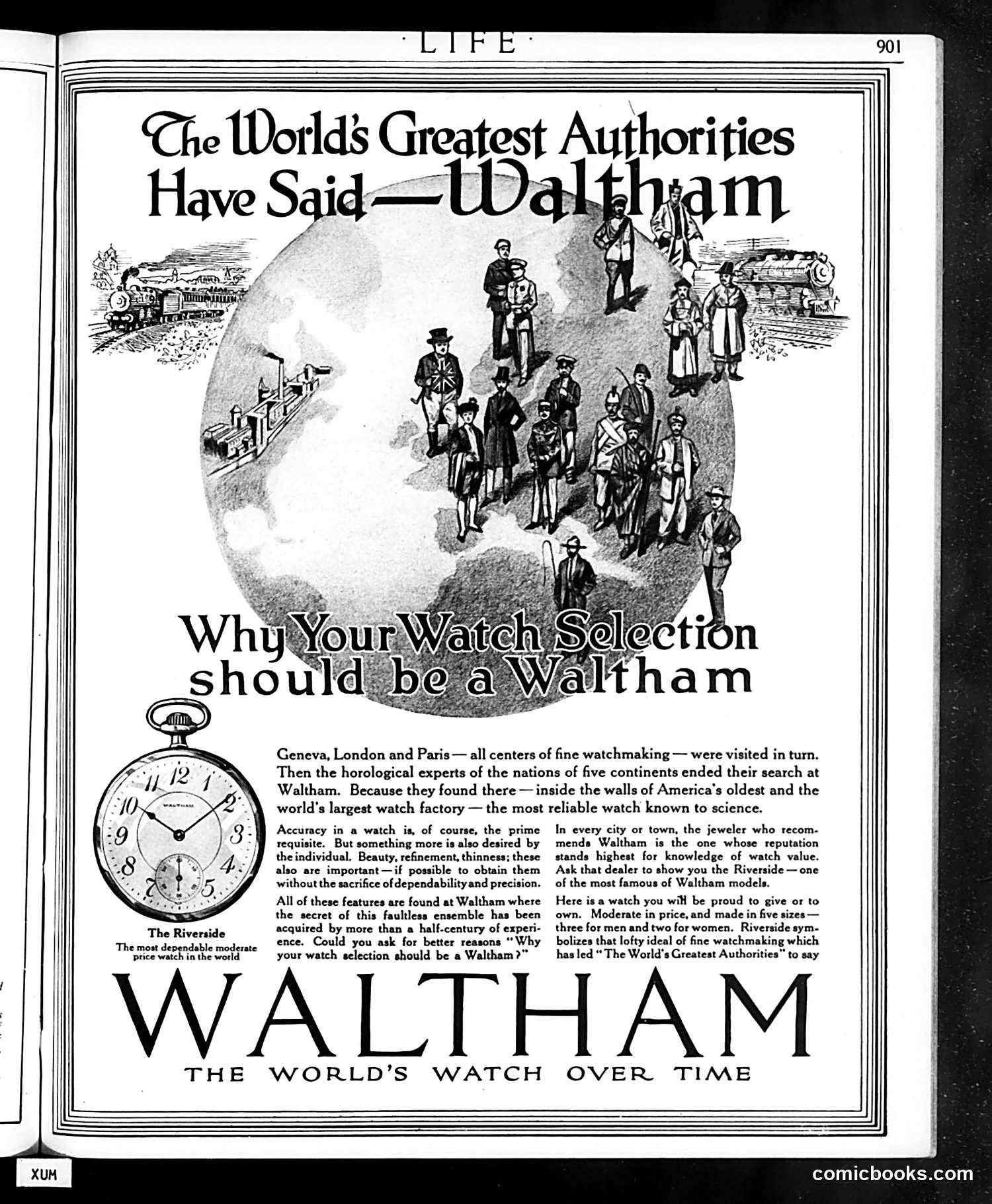
This is a **Waltham watch advertisement**, not political satire. The page depicts Waltham as America's premier watchmaker by claiming endorsement from "the world's greatest authorities." The central illustration shows a globe surrounded by diverse figures—representing international experts and people from various nations and professions. A steam locomotive and steamship appear in the background, symbolizing progress and global commerce. The ad argues that Waltham watches combine accuracy (scientifically proven) with beauty, refinement, and reliability. It emphasizes the company's status as "America's oldest and the world's largest watch factory" and claims their "Riverside" model is "the most dependable watch in the world." This represents early 20th-century marketing: leveraging industrial scale, scientific credibility, and international prestige to sell consumer goods.
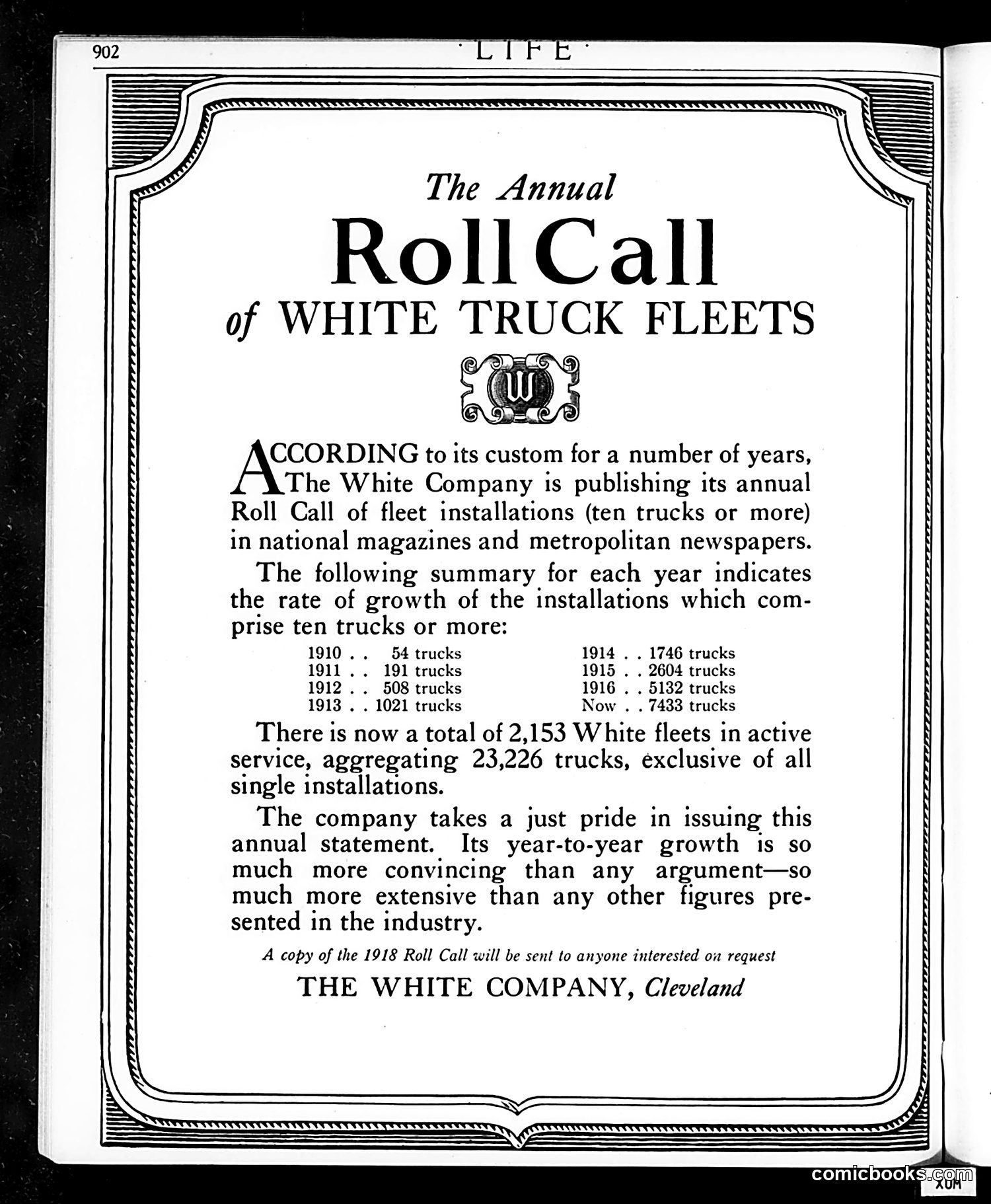
This page is **entirely an advertisement**, not satirical content or a cartoon. It's a full-page ad from The White Company of Cleveland promoting their truck fleet business. The ad announces The White Company's annual "Roll Call of White Truck Fleets"—a publication listing commercial fleet installations of ten or more White trucks. It presents growth statistics from 1910-1916, showing dramatic expansion from 54 trucks to 7,433 trucks currently in operation. The company claims 2,153 active White fleets totaling 23,226 trucks. The ad positions this annual roll call as impressive evidence of White's market dominance and year-to-year growth, arguing the statistics speak more convincingly than any other industry figures. This is straightforward commercial advertising typical of early 20th-century trade publications.
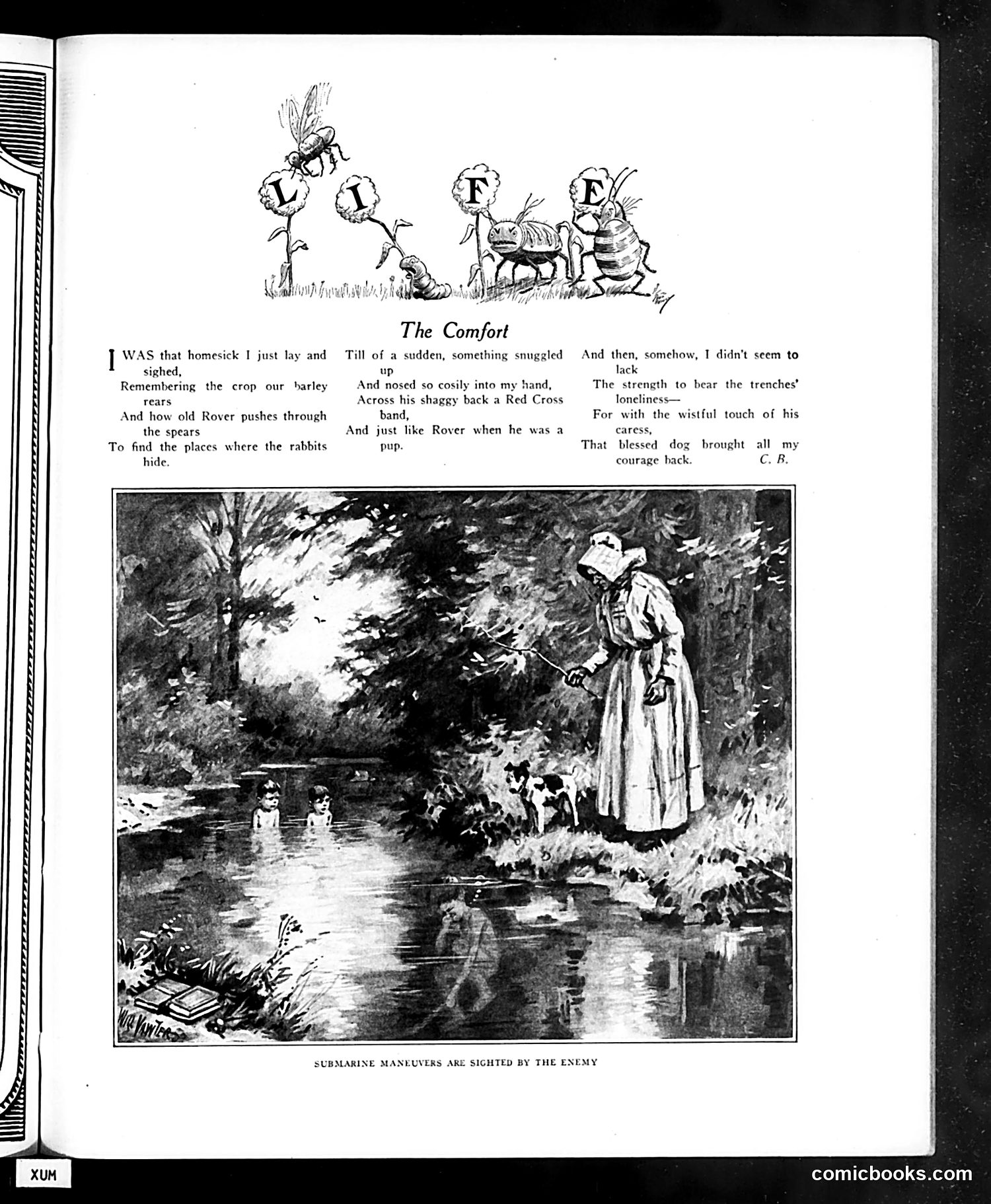
This page contains a poem titled "The Comfort" alongside a whimsical illustration and a serious wartime illustration. **The cartoon at top** shows insects (a wasp, bees, and what appears to be a cow or similar creature) gathered around flowers. This appears to be a humorous, non-political illustration, likely decorative. **The main illustration below** depicts a woman in a long coat standing by a stream, with what appears to be a dog. The caption reads "SUBMARINE MANEUVERS ARE SIGHTED BY THE ENEMY." **The poem** references WWI themes: homesickness, lost comrades ("Rover"), trenches, and emotional comfort from a dog's companionship during wartime suffering. The illustration suggests how pastoral, domestic scenes provided psychological comfort to soldiers enduring the trauma and loneliness of combat, contrasting peaceful nature against the war's brutality.
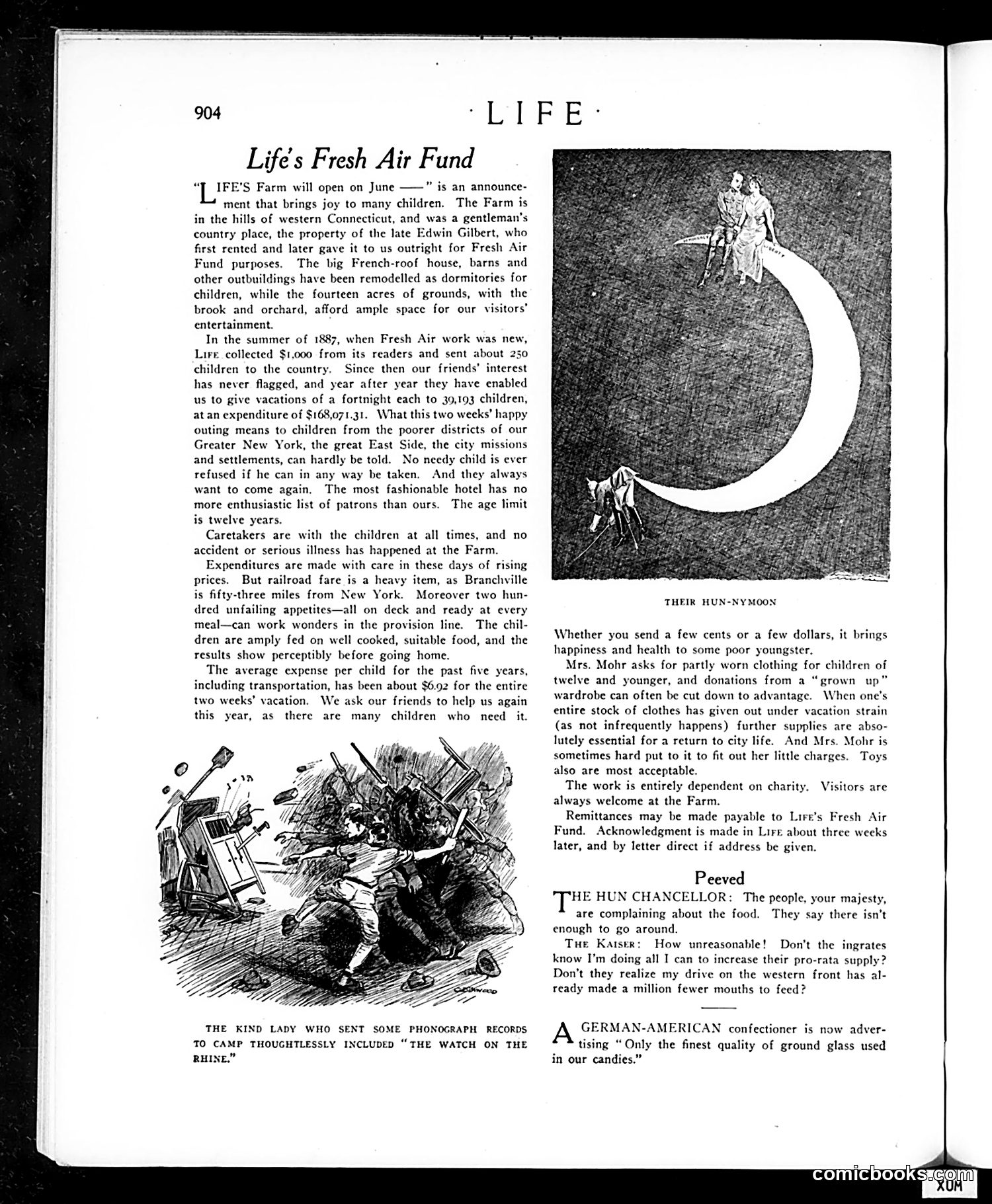
**Main Content:** This page features an article about LIFE's Fresh Air Fund, a charitable program sending poor children from New York City tenements to a country farm for vacations. **The Cartoons:** 1. **Upper illustration** ("Their Hun-Nymoon"): Shows a couple on a crescent moon, likely a romantic/humorous piece unrelated to the main article. 2. **Lower illustration**: Depicts what appears to be soldiers or workers in chaos, captioned about phonograph records sent to "camp thoughtlessly" including "The Watch on the Rhine"—a German patriotic song. This satirizes the awkwardness of sending German military music to soldiers, possibly during WWI tensions. **Context:** The page mixes charity promotion with wartime-era satirical commentary on cultural blind spots.
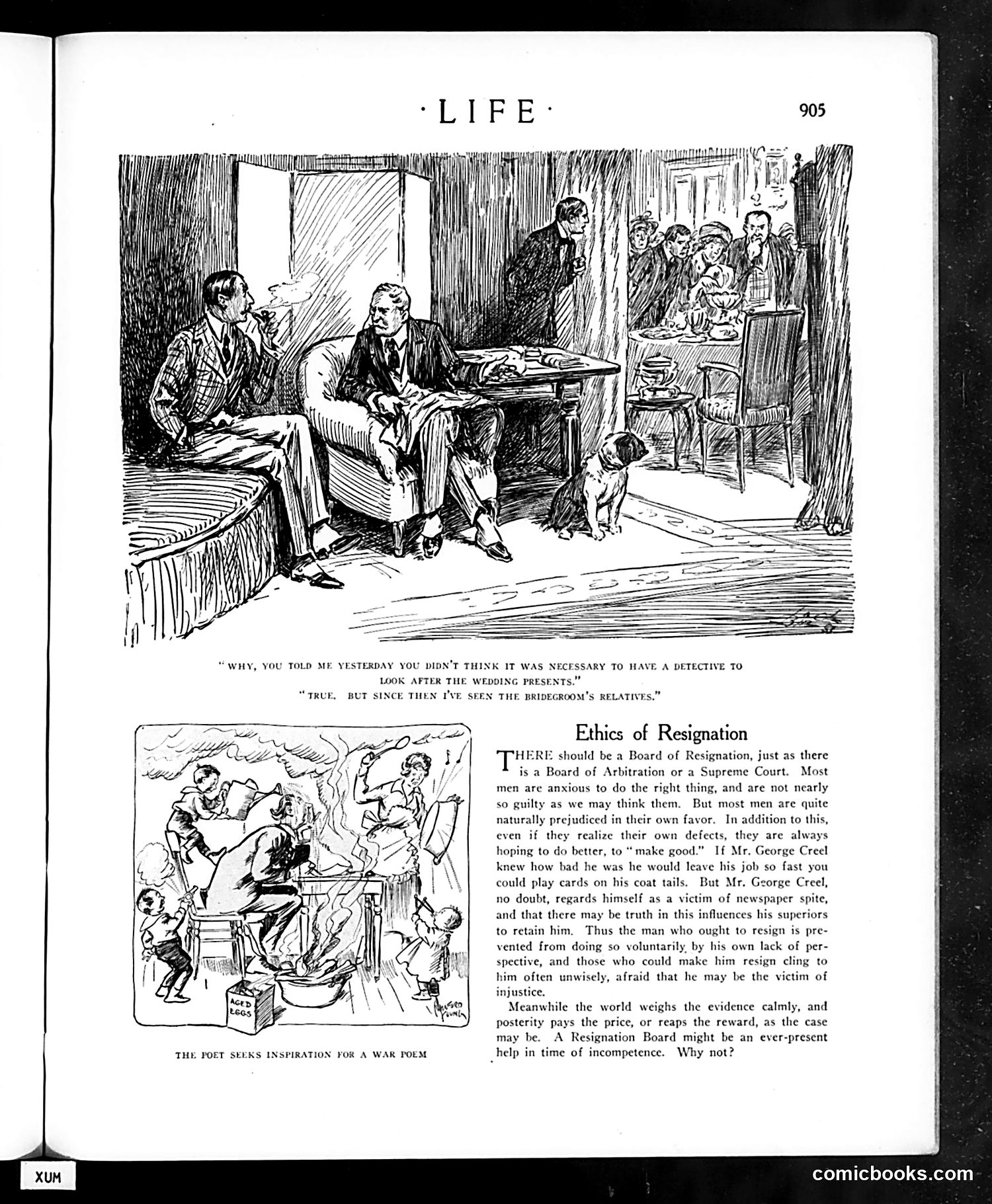
This page contains two satirical cartoons and an essay titled "Ethics of Resignation." **Top Cartoon:** Shows a man confronted about hiring a detective for wedding presents. The joke hinges on the speaker's admission of suspicion toward "the bridegroom's relatives"—implying distrust of in-laws or concern about theft. **Bottom Cartoon:** Titled "The Poet Seeks Inspiration for a War Poem," depicts a poet surrounded by chaotic domestic chaos (children, activity, noise). The satire mocks the romantic notion of poetic inspiration, suggesting the mundane reality of household life makes serious creative work impossible. **Essay:** Argues for establishing a "Board of Resignation" to evaluate when officials should ethically step down, protecting them from unfair pressure while ensuring accountability. It addresses conflicts between personal ambition and public service. The page reflects early 20th-century concerns about professional integrity and domestic life's intrusions.
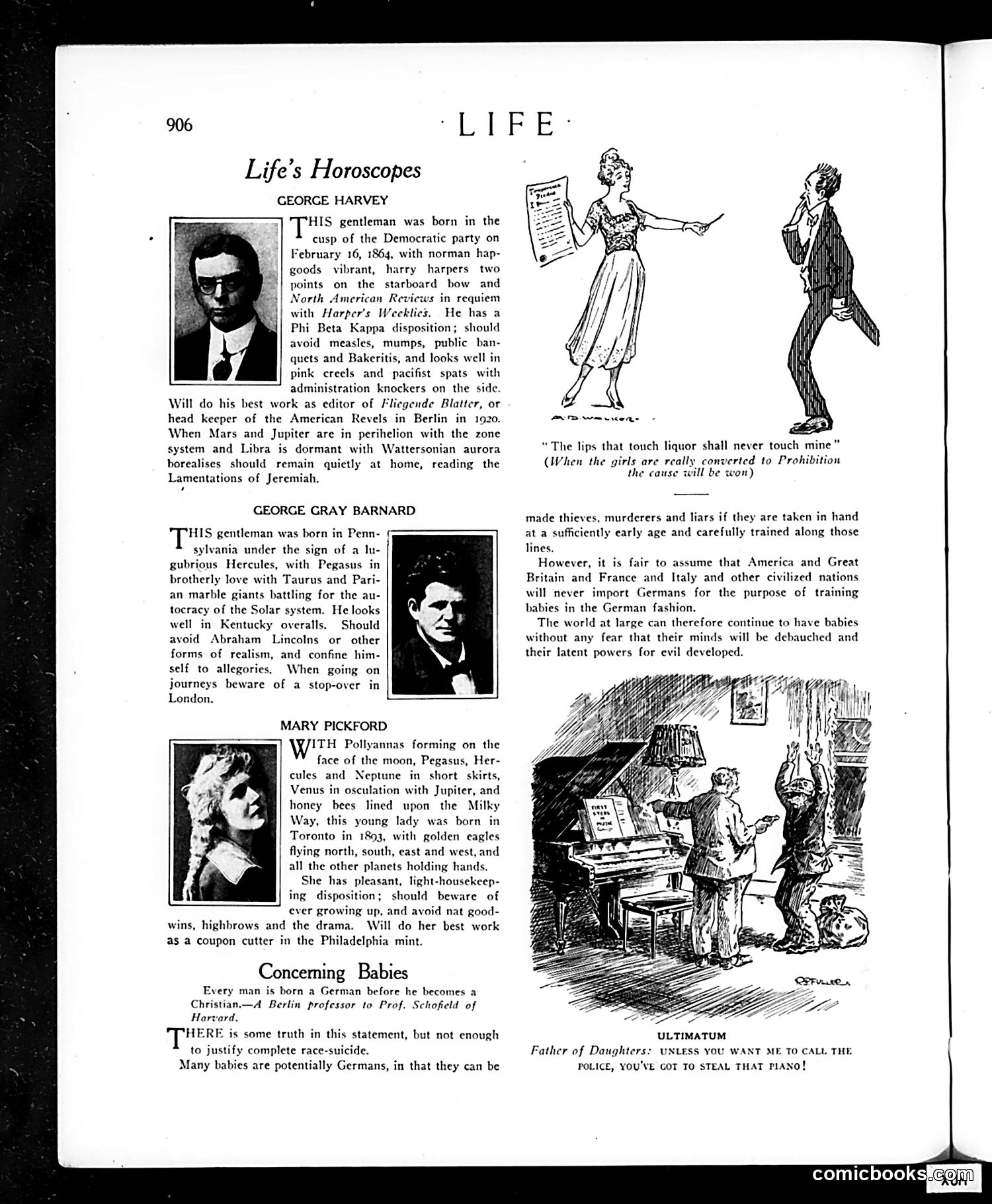
This 1920s Life page satirizes prominent figures through mock horoscopes. **George Harvey** (editor, born 1823) is ridiculed for his involvement with *Harper's Weekly* and predicted career moves. **George Gray Barnard** (sculptor) faces mockery for avoiding "realistic forms." **Mary Pickford** (silent film star) is skewered for her public image and romantic life. The bottom section, "Concerning Babies," contains xenophobic satire claiming babies are "potentially Germans" who could become criminals unless properly trained—reflecting post-WWI anti-German sentiment prevalent in American media. The cartoon illustration shows a family scene with comedic caption about stealing a piano, typical of Life's satirical humor targeting contemporary social anxieties and celebrity culture.
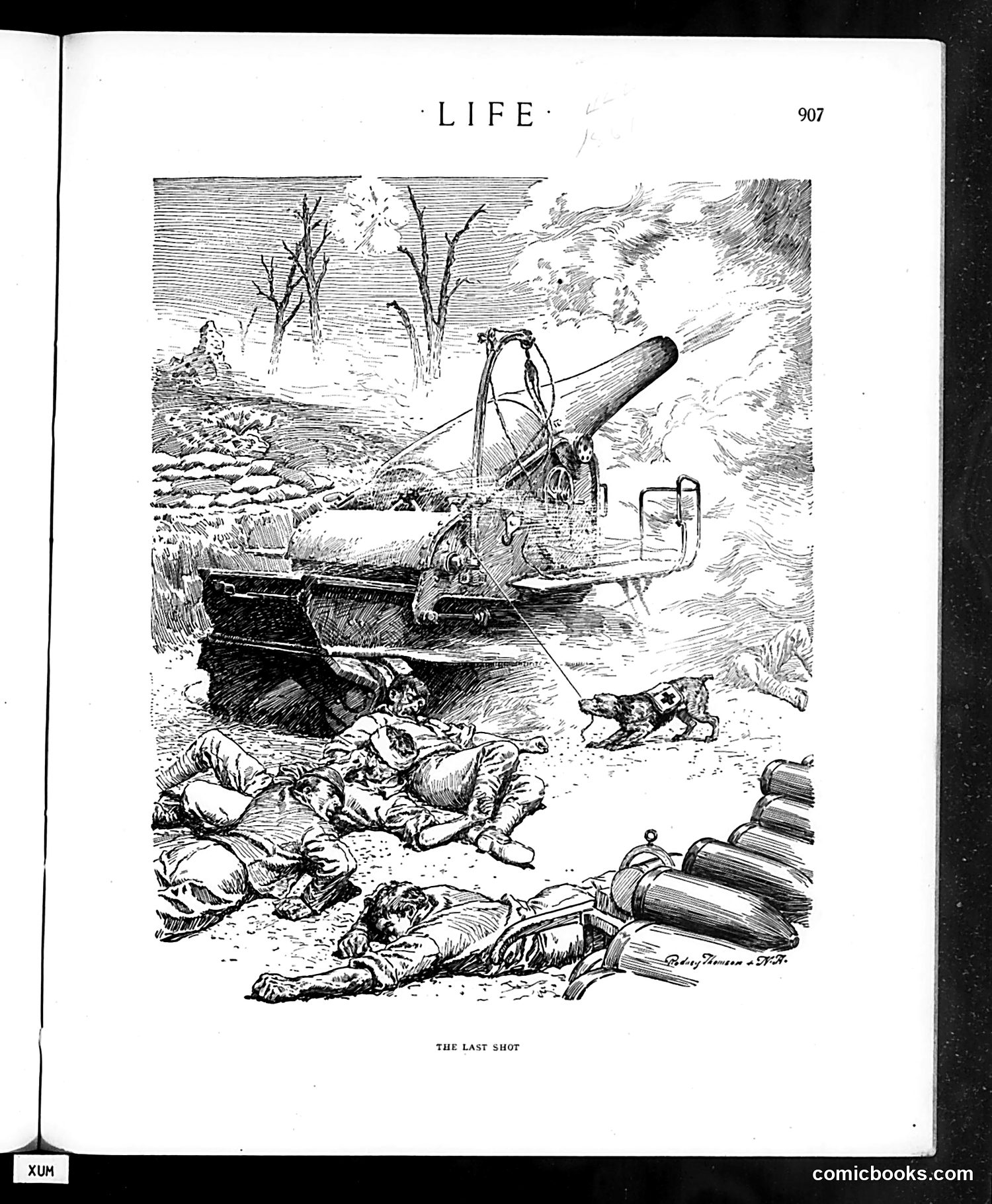
This engraving depicts a battlefield scene with fallen soldiers scattered in the foreground and a cannon positioned on elevated ground in the background. A small dog and a few standing figures are visible among the devastation. The title "The Last Shot" suggests this illustrates the final moments or aftermath of a military engagement. Without additional context about the specific publication date or historical event referenced, the exact political or military conflict depicted remains unclear. However, the composition—emphasizing the human cost of warfare through numerous casualties—suggests the artist intended social commentary on the brutality and destruction of armed conflict. The perspective contrasts the mechanical instrument of war (the cannon) with the human victims below, a common satirical device of the era.
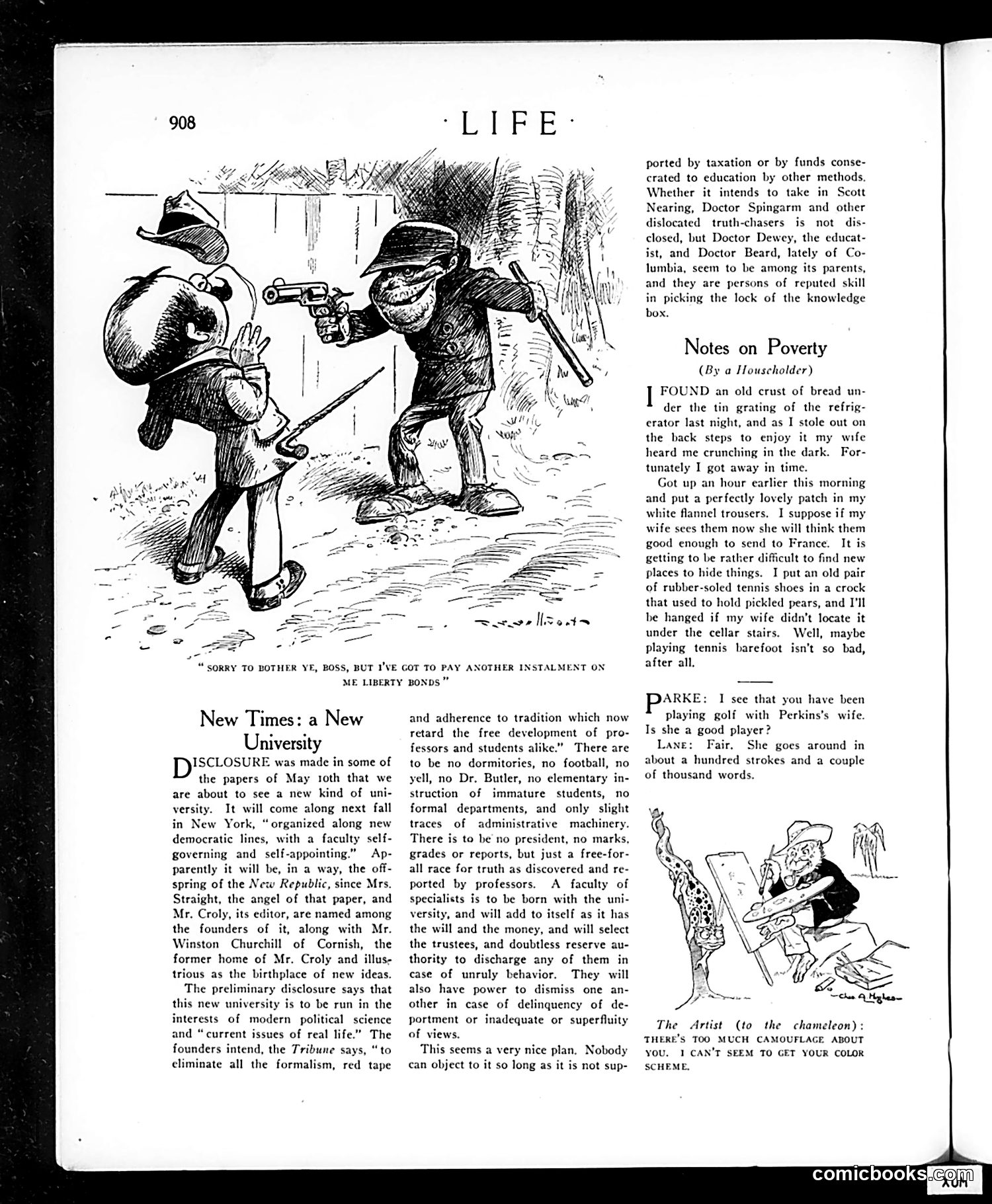
The main cartoon depicts two figures in what appears to be a confrontation about debt. One character, labeled as needing to pay "another instalment on me liberty bonds," approaches another figure holding a gun. The caption reads: "SORRY TO BOTHER YE, BOSS, BUT I'VE GOT TO PAY ANOTHER INSTALMENT ON ME LIBERTY BONDS" This satirizes the financial burden of Liberty Bond payments on working-class Americans, likely during or after World War I. The "boss" figure represents authority or wealth, while the supplicant suggests economic hardship. The gun implies coercion or threat, critiquing how ordinary citizens were pressured into purchasing war bonds they struggled to repay. The satire mocks the gap between patriotic duty and actual financial strain on workers.
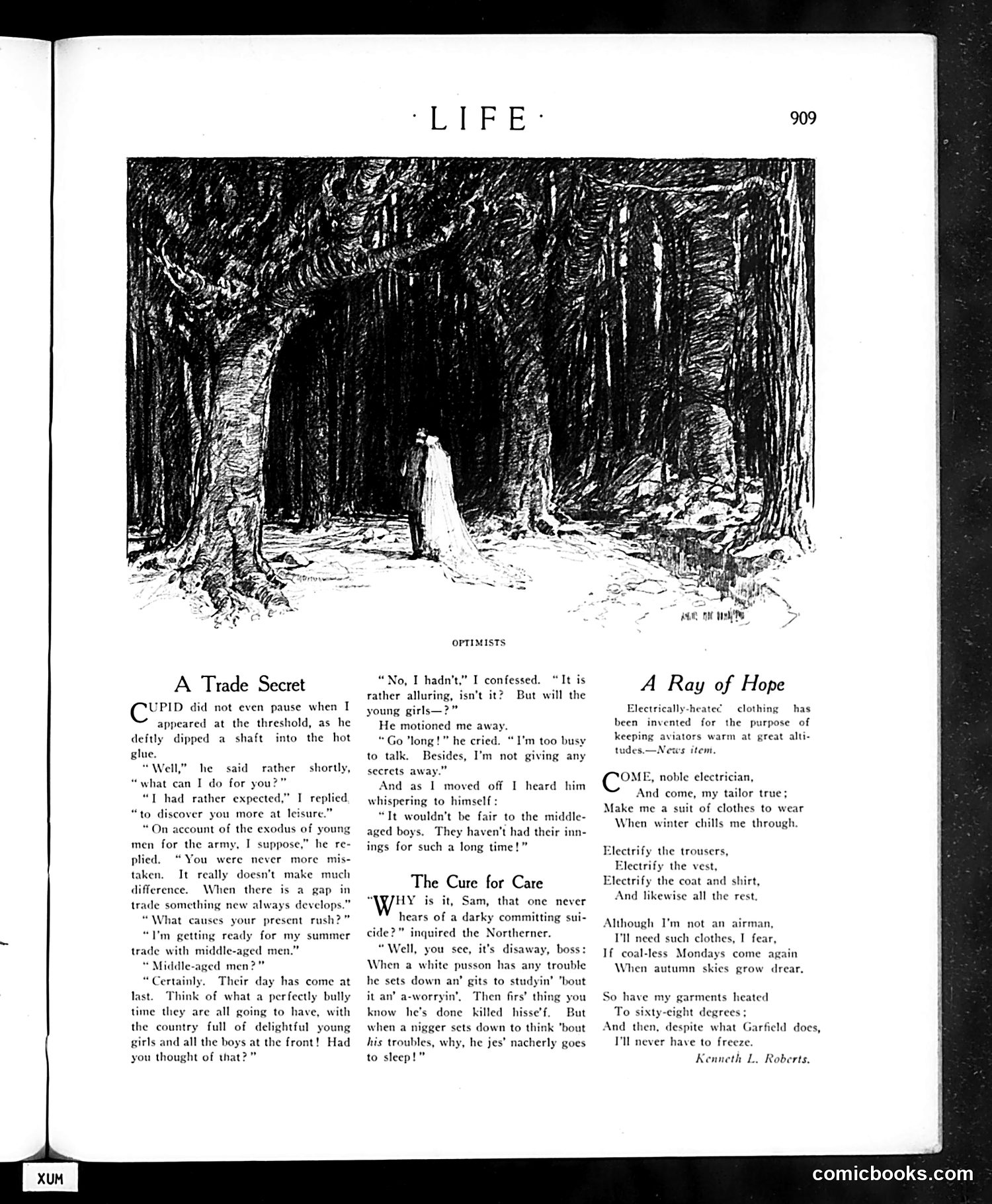
This page contains three separate prose pieces rather than political cartoons. "A Trade Secret" depicts a conversation between a man and woman about young men being sent away for military service during wartime—likely referencing WWI conscription. The man cynically suggests the departure of eligible young men benefits middle-aged men's romantic prospects. "The Cure for Care" presents dialect humor about a Black character's folk wisdom regarding how to manage troubles through sleep. "A Ray of Hope" is a humorous poem advocating for electrically-heated clothing to keep aviators warm at high altitudes, presented as innovation solving a practical problem. The page reflects early 20th-century attitudes toward war, class, and racial humor typical of the era's satirical publications.
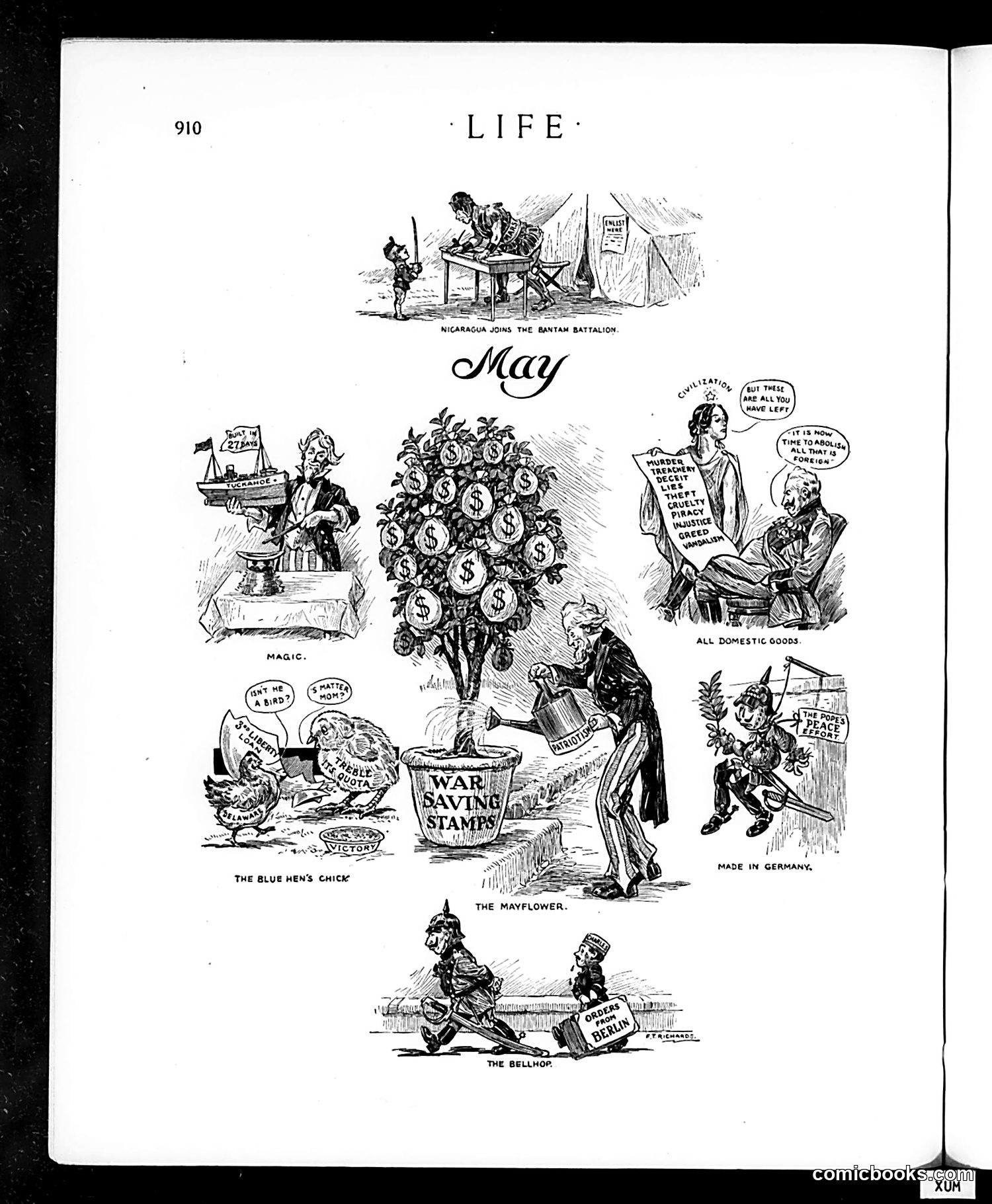
This page presents WWI-era satirical cartoons commenting on American wartime issues. The central image, "The Mayflower," shows a figure watering a money tree labeled "War Saving Stamps," satirizing government bond campaigns. Surrounding cartoons address related themes: "Magic" depicts financial manipulation, "The Blue Hen's Chick" references patriotic rhetoric, and "All Domestic Goods" critiques wartime economic controls. "Made in Germany" mocks German manufacturing, while "The Bellhop" appears to comment on labor or class dynamics. The top illustration shows "Nicaragua Joins the Bantan Battalion," likely referencing Central American involvement in WWI affairs. Overall, the page satirizes American wartime economic policies, propaganda, and government financial strategies during the First World War era.
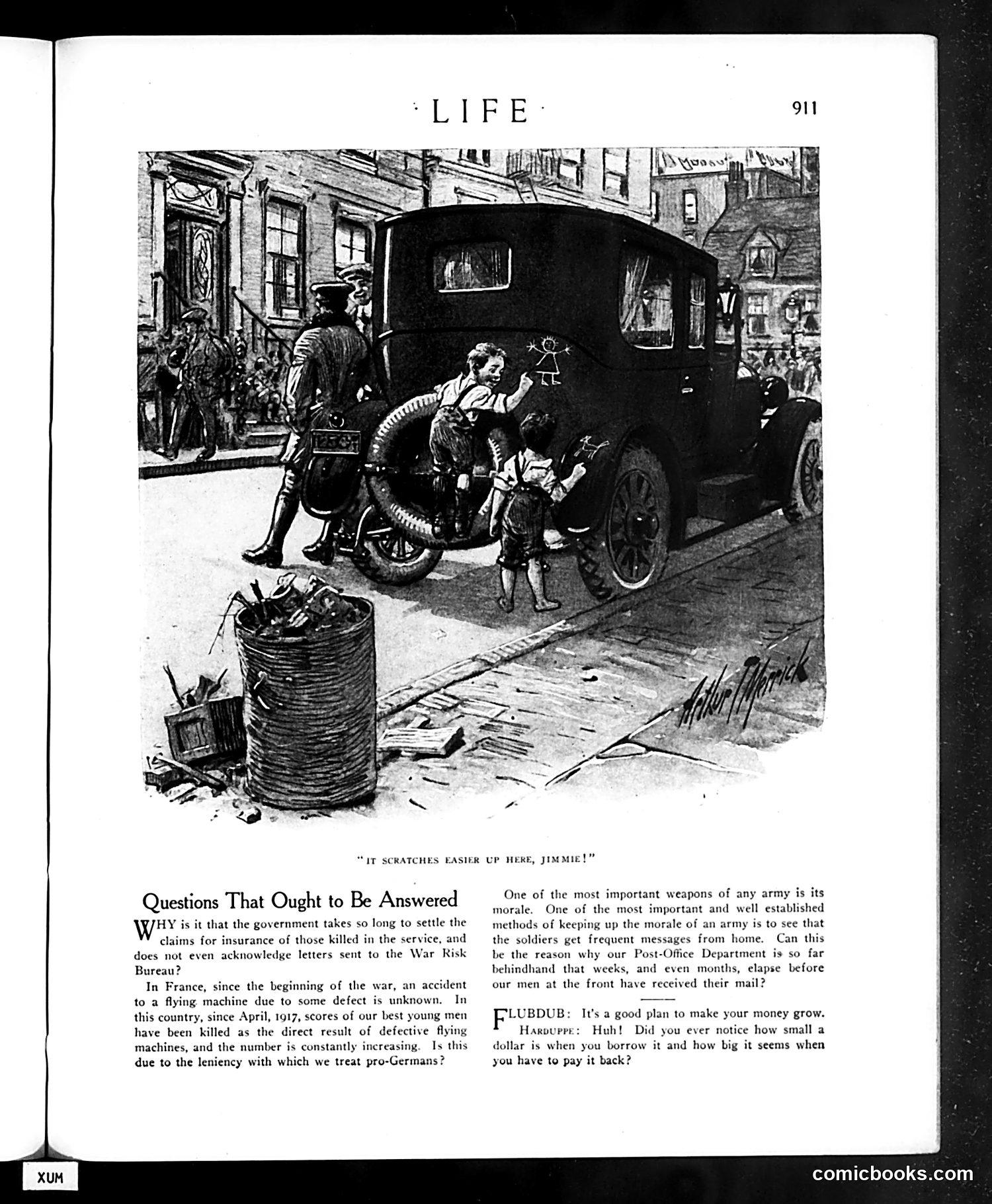
The cartoon depicts a woman leaning out of an automobile, pointing at a trash barrel filled with discarded items. The caption reads: "IT SCRATCHES EASIER UP HERE, JIMMIE!" This satirizes wartime waste and salvage efforts. During WWI, Americans were urged to conserve materials for military use. The joke suggests a woman is directing someone to scratch initials or marks into a trash barrel rather than a car—implying citizens were prioritizing personal convenience over patriotic conservation during wartime. The accompanying article "Questions That Ought to Be Answered" addresses serious WWI concerns: slow insurance settlements for soldiers' deaths, defective flying machines causing pilot casualties, and deteriorating morale from delayed mail delivery to troops. The contrast between the humorous cartoon and grave questions reflects Life's approach to blending satire with substantive wartime criticism.
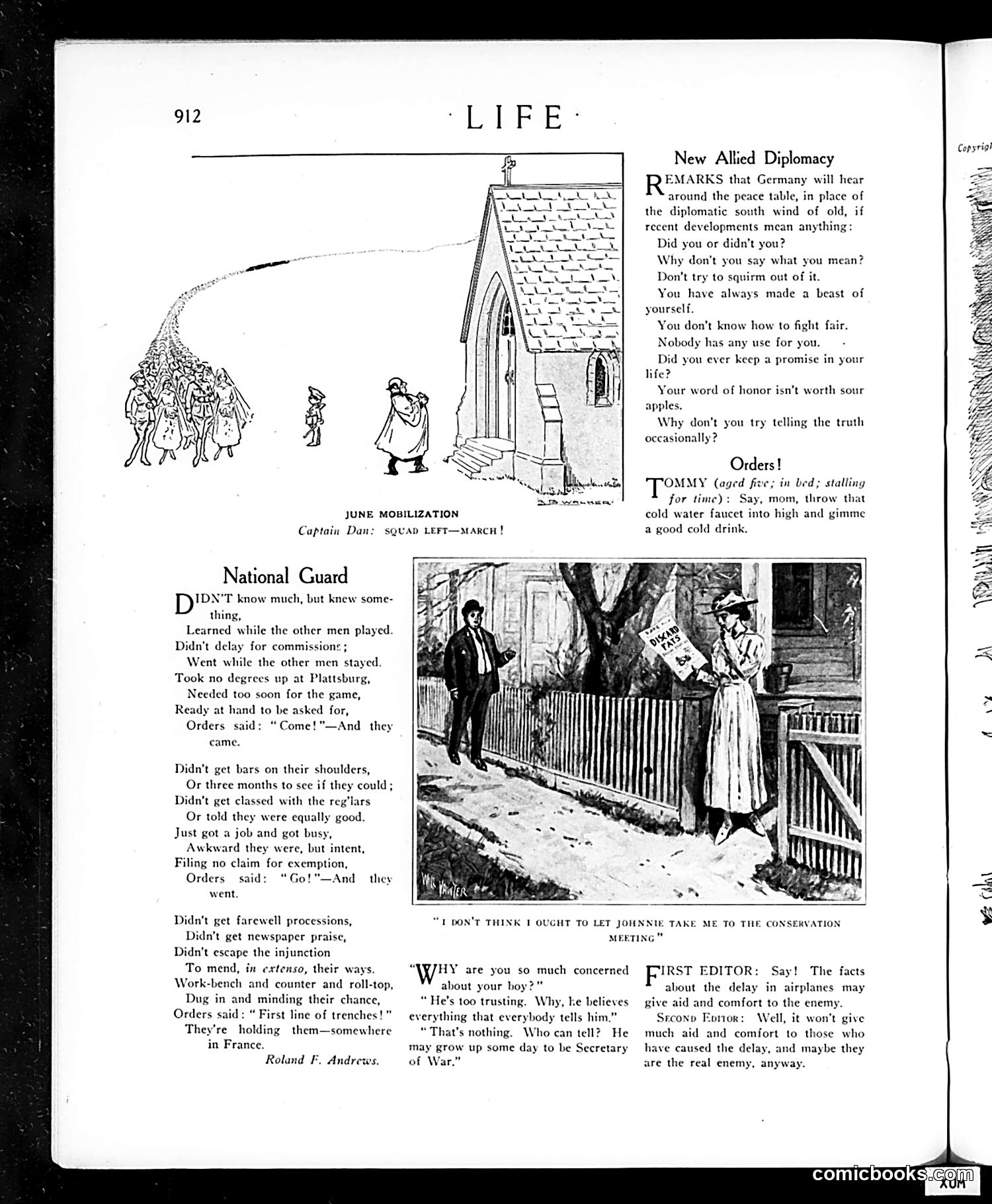
This page contains satirical commentary on American entry into World War I and post-war diplomacy. **"National Guard"** (poem by Roland F. Andrews): Praises ordinary National Guard soldiers who enlisted without fanfare or formal training ("no degrees up at Plattsburg"), contrasting their quiet service with the bureaucracy of regular military commissions. They're depicted as working-class men ("work-bench and counter") now "holding" trenches "somewhere in France"—a straightforward tribute to unglamorous wartime sacrifice. **"New Allied Diplomacy"**: A scathing list of accusations directed at Germany for the peace negotiations, replacing old diplomatic niceties with blunt recriminations: broken promises, dishonesty, unfair fighting. It reflects American anger toward Germany post-Armistice. **Minor humor pieces**: "Orders!" jokes about a child's demands; the editor exchange mocks delayed airplane production, sarcastically suggesting those causing the delays are "the real enemy." The page reflects 1918-1919 wartime patriotism mixed with home-front frustrations over inefficiency and accountability.
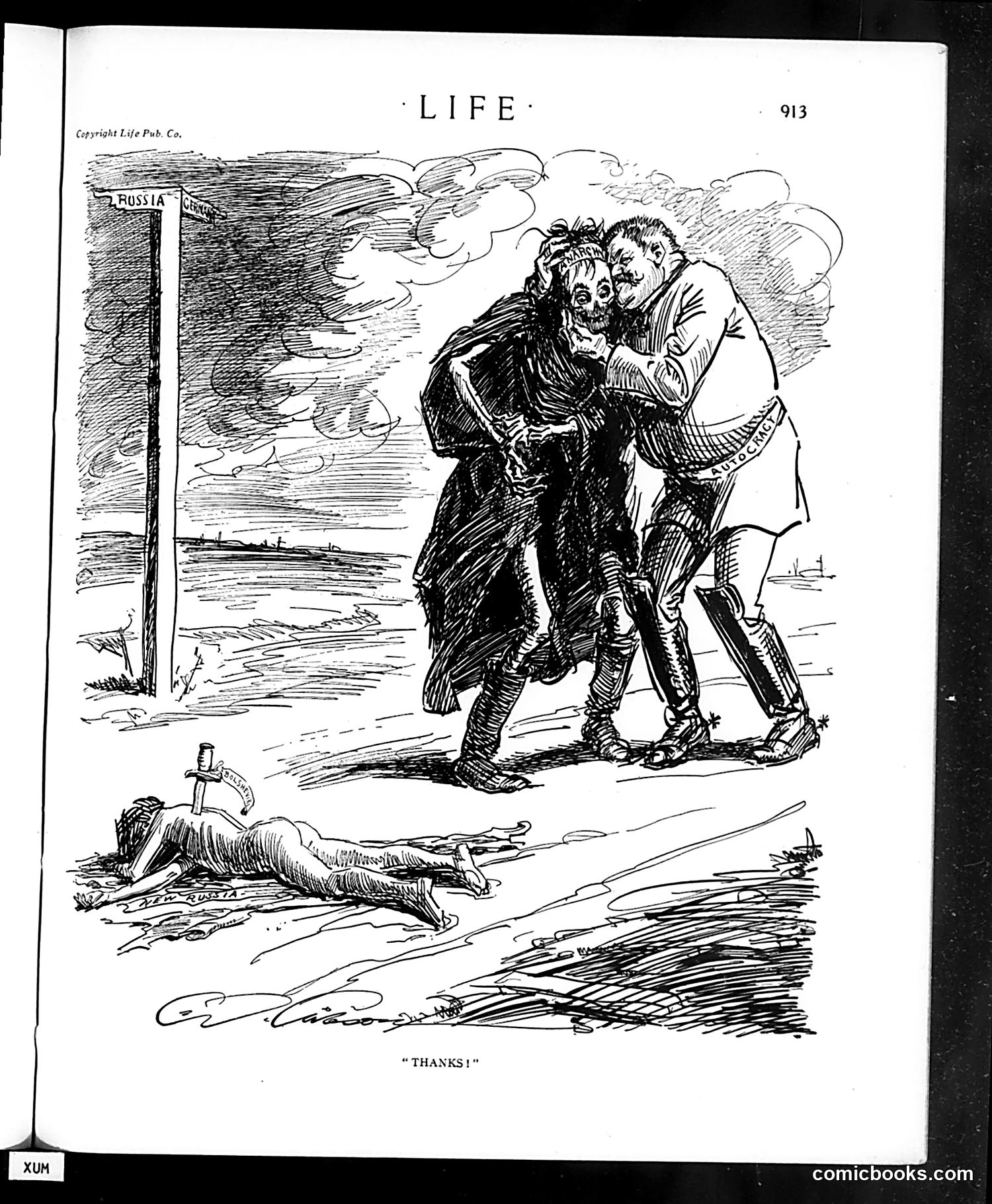
This cartoon from *Life* magazine (page 913) depicts a macabre scene with dark political satire. Two figures appear to be greeting or embracing a skeletal, death-like personification, while a fallen body lies on the ground below. A sign reading "RUSSIA" is visible on the left. The cartoon likely comments on Russian military casualties or suffering, possibly during World War I or a related conflict. The skeletal figure represents Death itself, and the "thanks" caption suggests bitter irony—acknowledging that Russia has "paid" dearly through loss of life. The two standing figures appear to be political or military leaders accepting these tragic costs. Without additional context or visible artist attribution, the precise historical event and intended targets remain somewhat unclear, but the satire denounces the human toll of war.
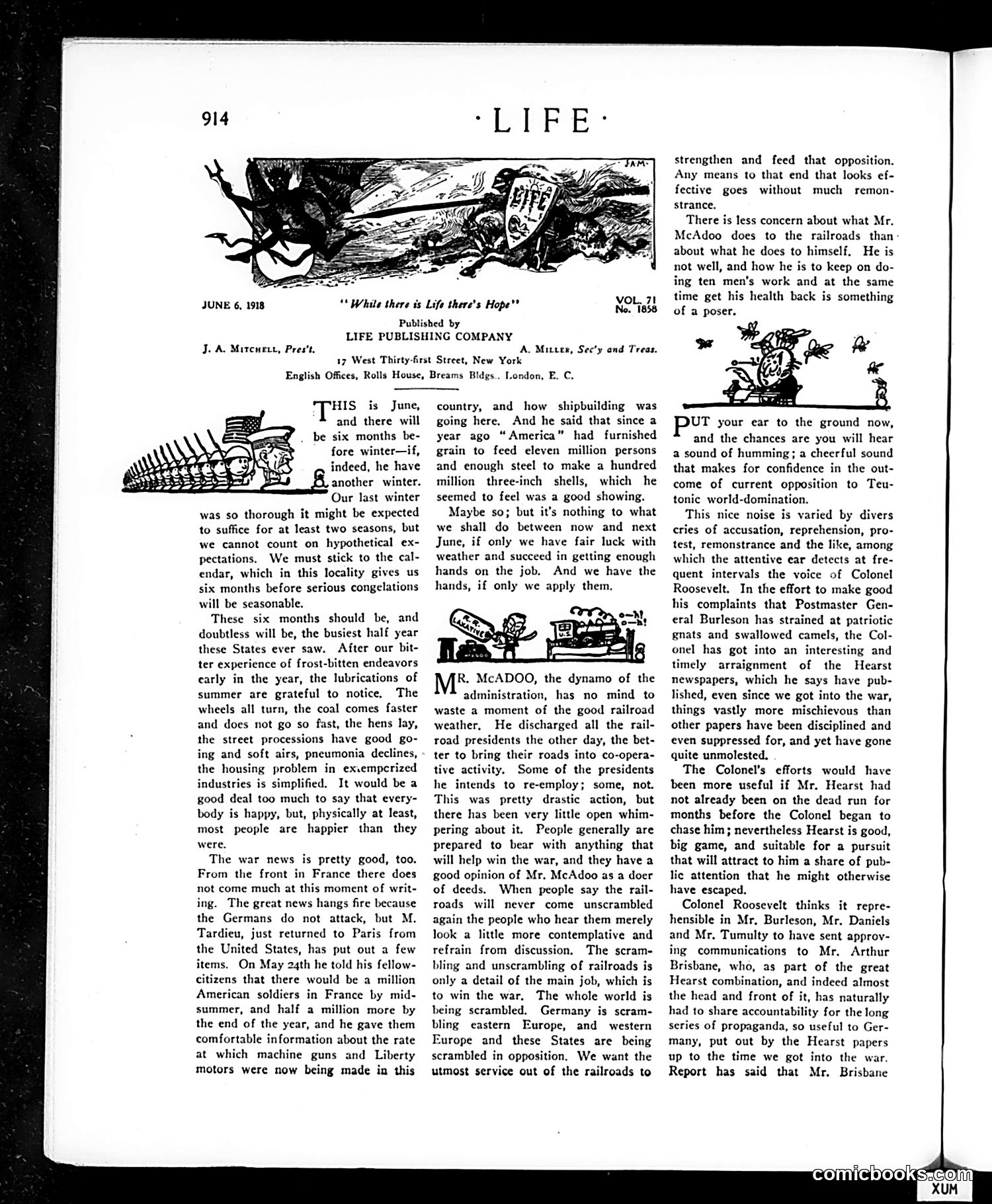
This editorial page discusses American mobilization for World War I. The main cartoon (top left) appears to show **Death or hardship** threatening American efforts, with a shield labeled "LIFE" as defense—illustrating the stakes of the coming six months. The text celebrates **William McAdoo** (Treasury Secretary and railroad administrator), praising his drastic action of firing railroad presidents to force cooperative war effort. The piece frames this as necessary wartime discipline, noting the public accepts such measures to win the war. The writing discusses **French official Tardieu's** report on American military production: one million soldiers promised by mid-summer, artillery shell manufacturing, and Liberty motor production. The satirical tone is mild—more patriotic boosterism than critique. The "joke" is that Americans will tolerate even extreme executive actions if justified by military necessity. McAdoo's health concerns are mentioned sympathetically rather than mockingly, reflecting wartime unity sentiment during WWI's final year.
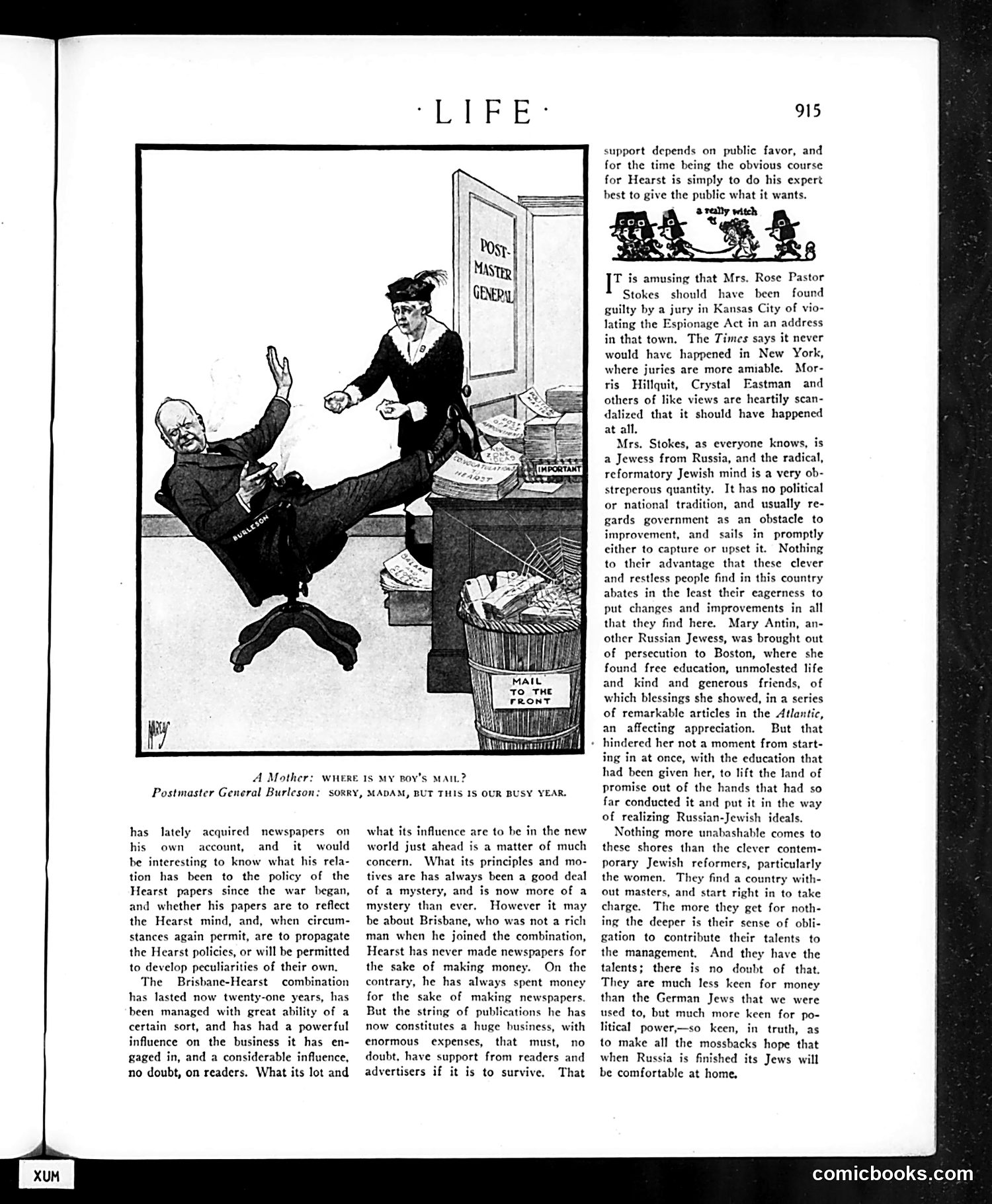
**The Cartoon:** The illustration depicts Postmaster General Albert Burleson dismissing a concerned mother asking about her son's mail. He claims it's "our busy year"—a satirical reference to mail censorship during World War I. Burleson infamously suppressed anti-war publications and materials deemed seditious. **The Article:** The text discusses Rose Pastor Stokes, a Russian-Jewish radical who was convicted under the Espionage Act in Kansas City for an anti-war speech. The author expresses surprise a jury would convict her, noting New York juries would likely acquit. The piece then criticizes Russian-Jewish immigrants (particularly women reformers) for their radical, anti-government activism. While acknowledging their intelligence and talents, the author portrays them as ungrateful troublemakers who agitate for social change despite America's generosity. **Context:** This reflects early-20th-century prejudices against both Eastern European Jewish immigrants and anti-war activists during WWI. The "busy year" joke satirizes government mail censorship while the article's stereotype of "clever and restless" Jewish reformers reveals the publication's own editorial biases.
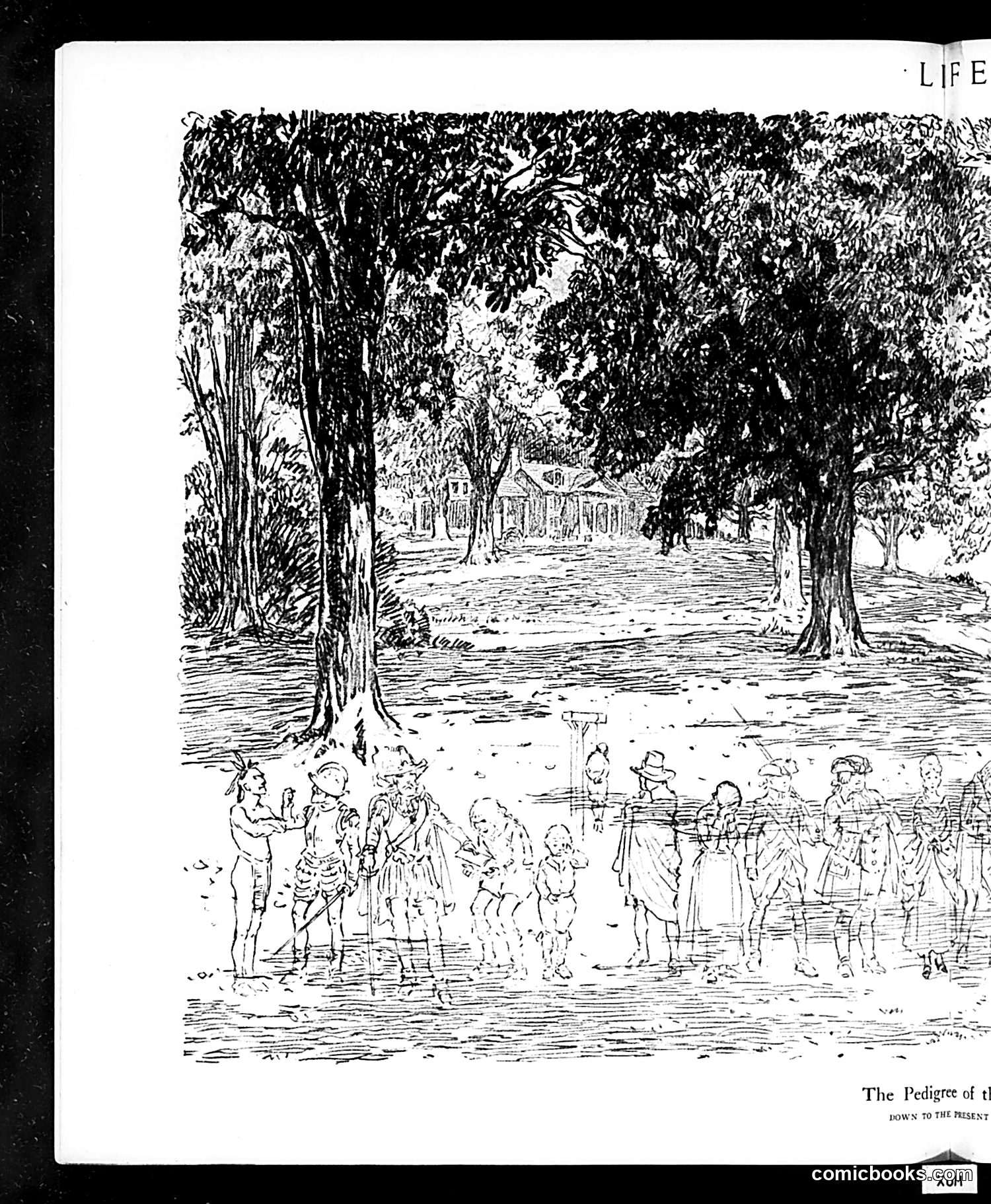
This appears to be a satirical illustration titled "The Pedigree of [something] Down to the Present" (title is cut off). The image shows a large tree-lined avenue or path in the background, with a group of children and young people gathered in the foreground near what appears to be a utility pole or post. The satire likely concerns the "pedigree" or lineage of American youth or a social institution, showing how it has developed "down to the present." The specific figures are unclear without the complete title, but the juxtaposition of a dignified, tree-lined estate or institution in the background against a somewhat disorderly gathering of youths in the foreground suggests commentary on cultural or social decline—a common satirical theme in early 20th-century American magazines like *Life*. The exact political or social reference remains unclear without the complete caption.
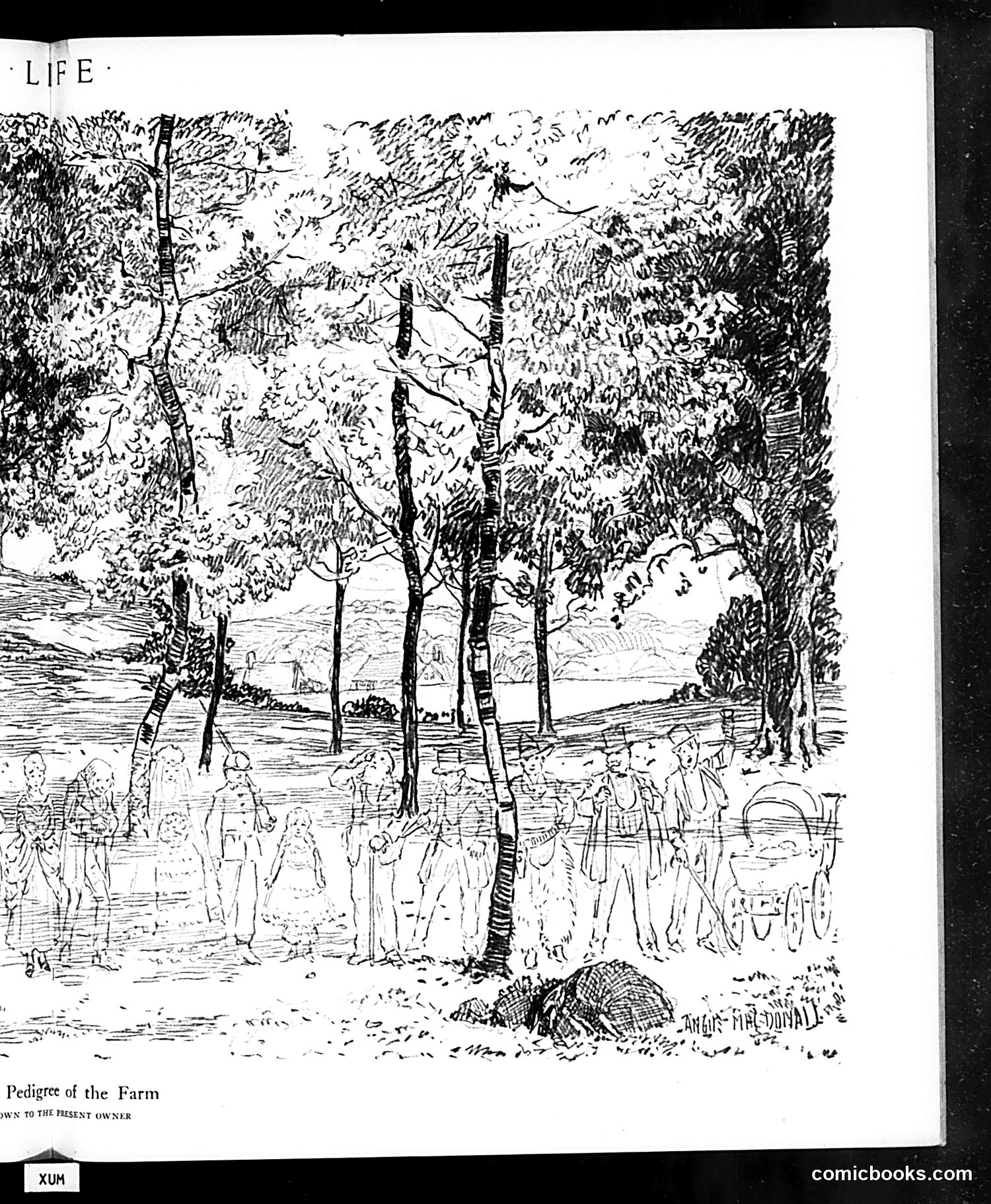
This cartoon satirizes rural land ownership and genealogy. The sketch shows a large gathering of people beneath tall trees on farmland, with the caption "Pedigree of the Farm—Down to the Present Owner." The satire appears to mock the concept of agricultural "pedigree" or lineage. Rather than tracing a farm's ownership through distinguished or notable figures, the cartoon suggests the assembled crowd represents the farm's actual history of owners—implying either that the current owner has inherited through numerous undistinguished predecessors, or that the farm's supposed "pedigree" is merely a collection of ordinary people rather than anything prestigious. The work critiques pretensions to agricultural heritage or class status based on land ownership.
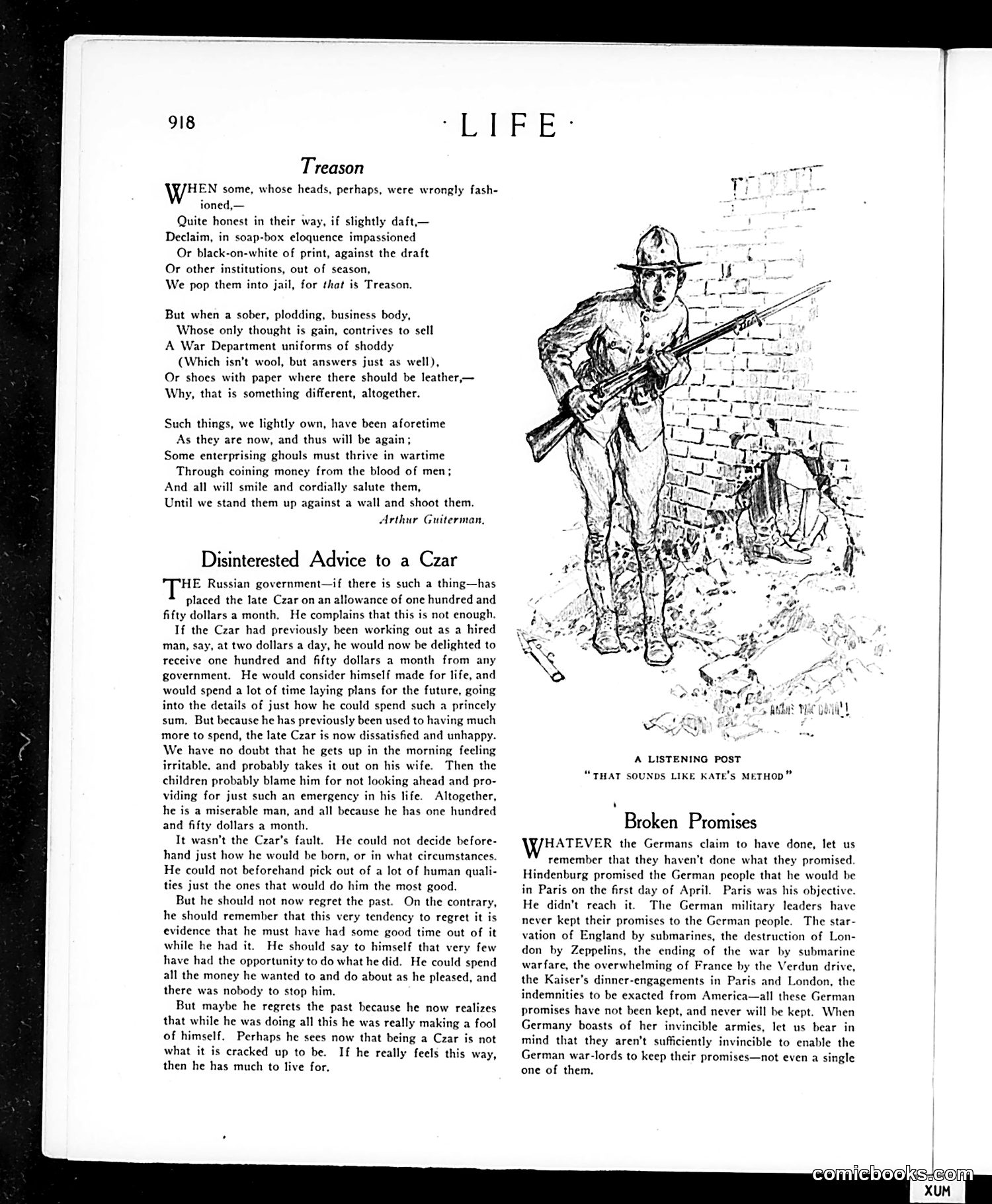
This page contains three satirical pieces critiquing wartime hypocrisy and broken promises: **"Treason"** (by Arthur Guiterman): Mocks the double standard of jailing anti-draft protesters as traitors while ignoring war profiteers who sell defective uniforms and shoes to the military—calling the latter "something different, altogether." The satire culminates with the dark joke that profiteers are only punished when "we stand them up against a wall and shoot them." **"Disinterested Advice to a Czar"**: Satirizes the deposed Russian Tsar's complaint about receiving only $150/month government allowance, arguing he should be grateful given his previous lavish lifestyle—a commentary on post-revolutionary Russian politics. **"Broken Promises"**: Lists failed German military promises (reaching Paris by April, starving England via submarine warfare, destroying London with Zeppelins), arguing Germany's boasts of invincibility are hollow. The illustration shows a soldier at a listening post, captioned "That sounds like Kate's method"—likely referencing kitchen-table gossip or domestic criticism of the war effort.
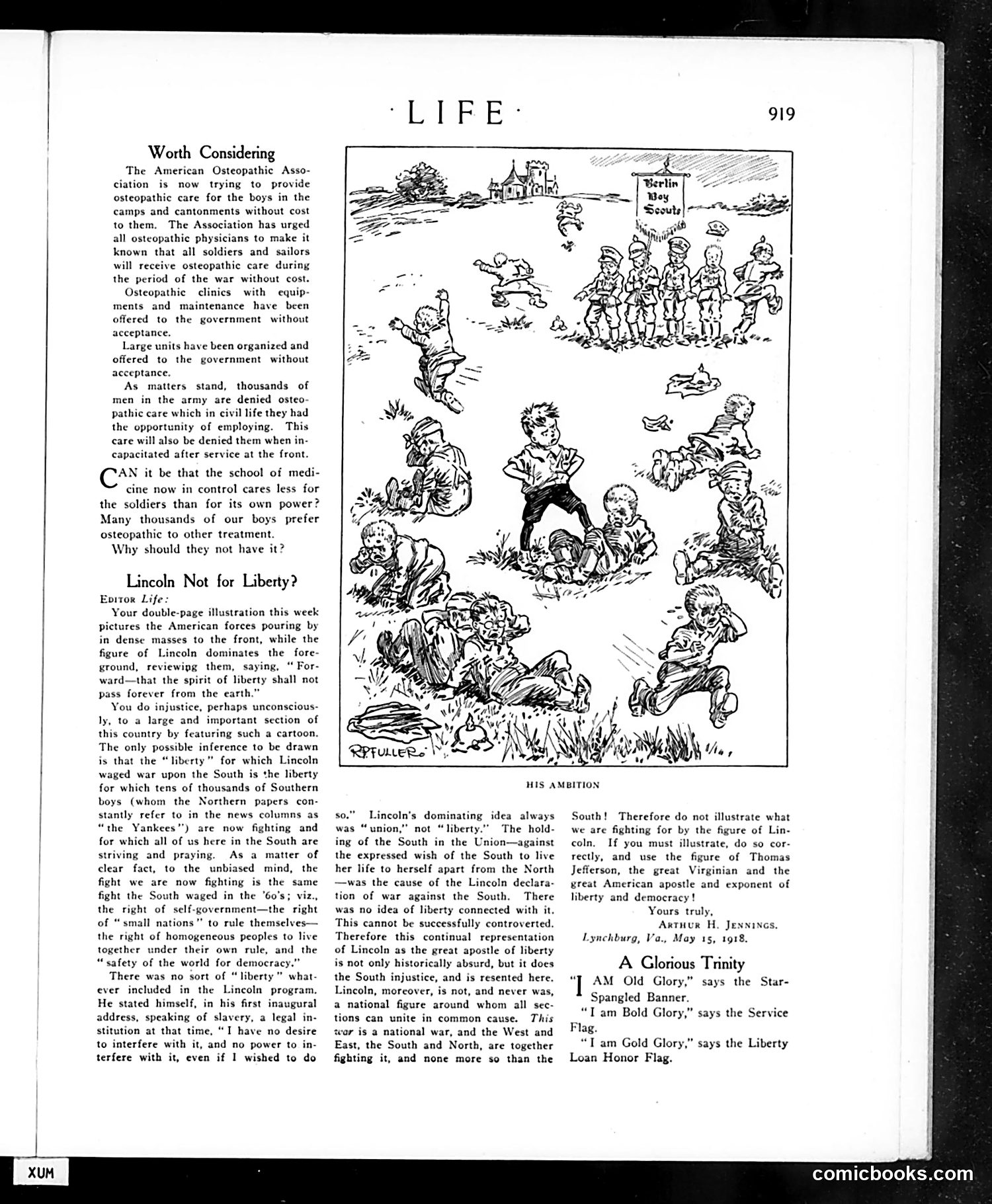
This page contains a satirical cartoon depicting children playing soldiers near Berlin, with Lincoln's figure looming above. The accompanying letters critique Life magazine's editorial choices during World War I. The main cartoon satirizes American military ambition—children's innocent play mirrors adult warfare, suggesting the perpetual cycle of conflict. More significantly, the letters reveal bitter sectional tensions. A Southern reader attacks Life's use of Lincoln as a symbol of liberty and unity, arguing Lincoln fought for "union," not freedom, and that the Civil War paralleled current WWI battles for self-determination. The writer insists Lincoln is a divisive figure in the South and demands Thomas Jefferson—"great American apostle of liberty"—be used instead to represent shared national values. This reflects how deeply the Civil War wounds persisted fifty years later, and how WWI rhetoric about fighting for democracy and liberty reopened sectional wounds about what those ideals actually meant.
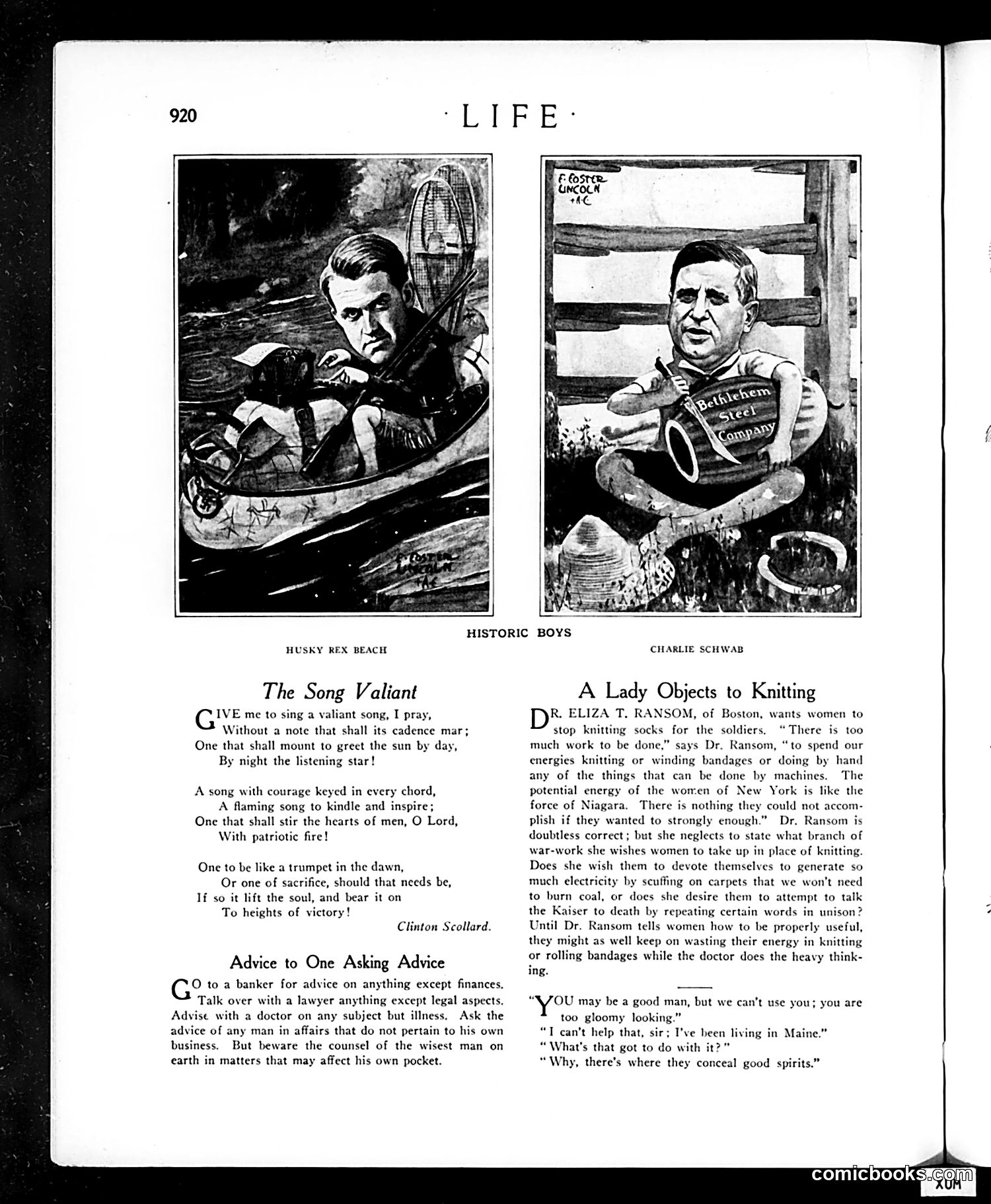
This page contains three distinct pieces of satirical content from wartime America (likely WWI era): **"Historic Boys"** features caricatures of Rex Beach and Charlie Schwab—prominent public figures whose exaggerated likenesses served as humorous commentary on notable men of the day. **"The Song Valiant"** is a patriotic poem by Clinton Scollard, striking a stirring, earnest tone about martial courage—likely included as sincere wartime inspiration rather than satire. **"A Lady Objects to Knitting"** mocks Dr. Eliza T. Ransom's criticism of women's volunteer knitting efforts for soldiers. The satire is brutal: Life sarcastically suggests absurd alternatives (generating electricity by scuffing carpets, talking the Kaiser to death) to ridicule her argument that hand-knitting wastes women's potential. The piece defends traditional women's war work against elite criticism. **"Advice to One Asking Advice"** offers cynical wisdom about whom to trust, concluding that even wise men become biased when their own finances are at stake.
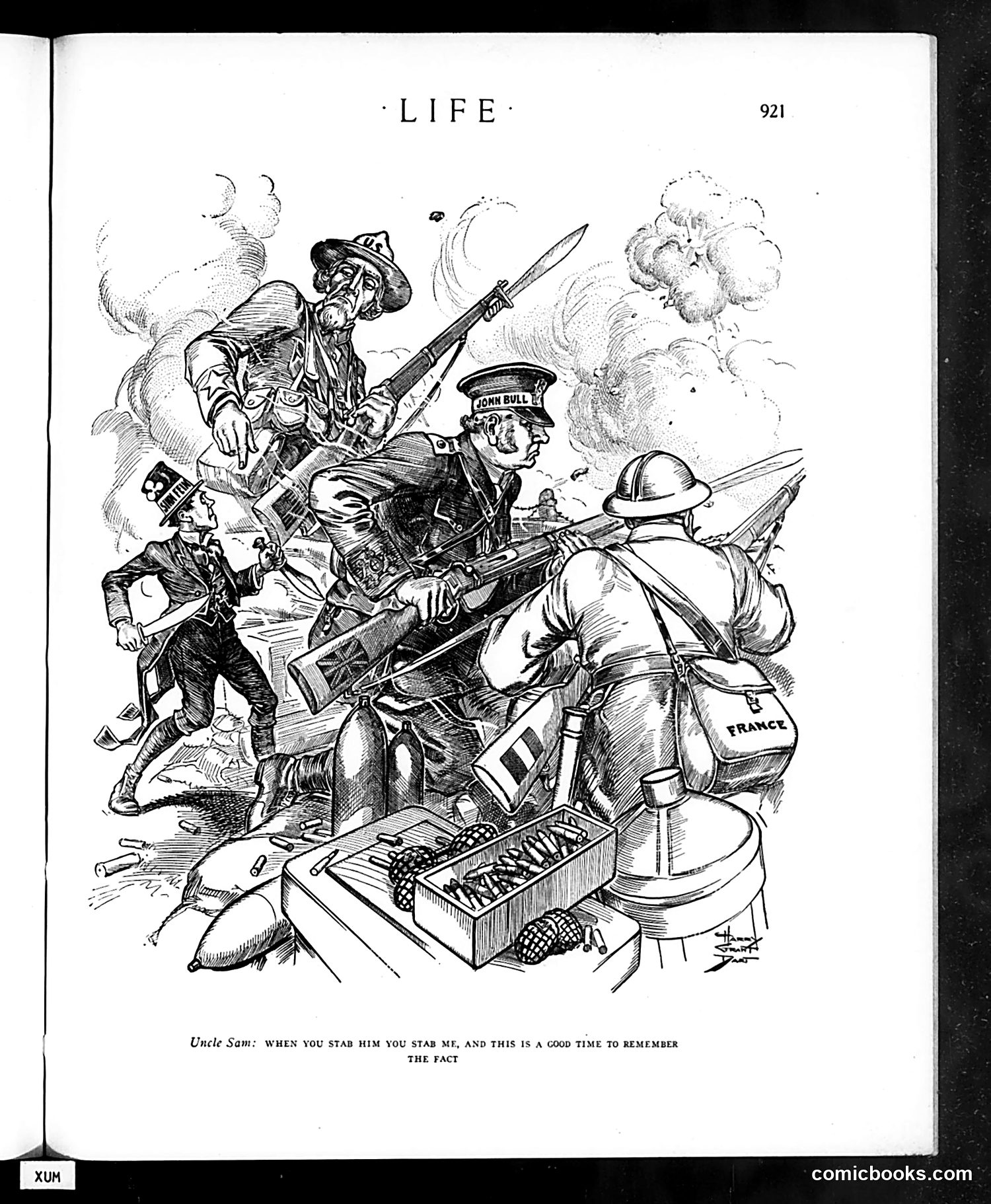
This WWI-era Life magazine cartoon depicts Uncle Sam (personifying the United States) warning allied nations about attacking Germany. The central figure is Uncle Sam with his characteristic top hat, surrounded by soldiers representing France (labeled) and other Allied powers bearing weapons and grenades. The caption "When you stab him you stab me, and this is a good time to remember the fact" emphasizes American solidarity with its allies—suggesting that attacking one allied nation effectively attacks all of them, including America. The cartoon likely addresses either German aggression against Allied forces or diplomatic tensions among the Allied coalition itself, reminding all parties of their mutual interdependence during the conflict.
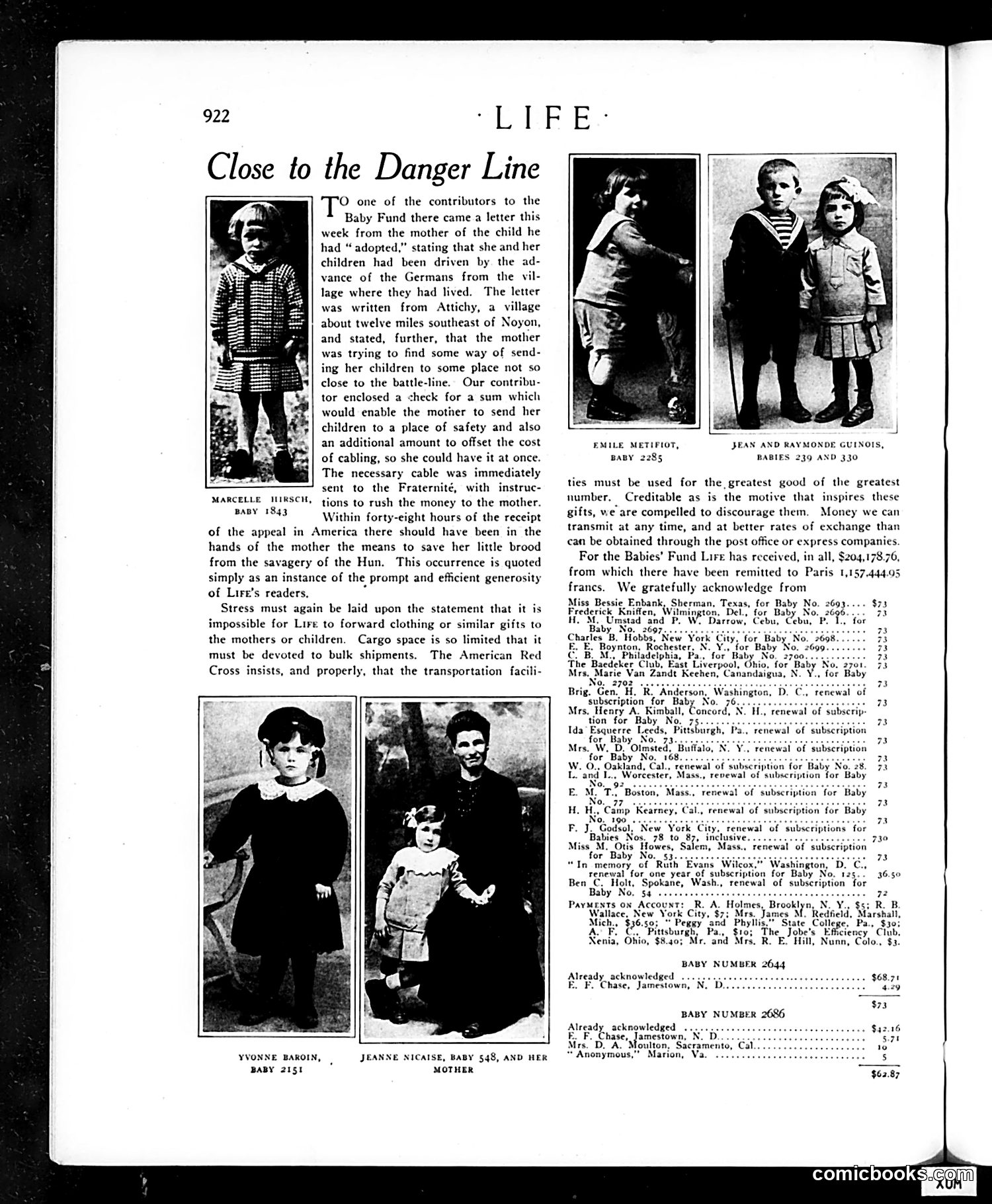
This article documents Life magazine's "Baby Fund"—a charitable program supporting French children displaced by World War I. The piece illustrates the urgent humanitarian crisis: a woman from Attichy (near the front lines) wrote seeking help evacuating her children to safety. An American donor immediately contributed funds, which were cabled to Paris relief organizations within 48 hours. The accompanying photographs show beneficiary children (identified by number: Marcelle Hirsch, Yvonne Baroin, Jean and Raymonde Guinois, etc.). The article emphasizes that monetary donations—not clothing shipments—are most effective due to limited cargo space and Red Cross coordination requirements. The title references how close these children lived to combat. By listing donors and amounts, Life demonstrates both the magazine's social responsibility and reader generosity during the war. This represents early American philanthropic response to European civilian suffering.
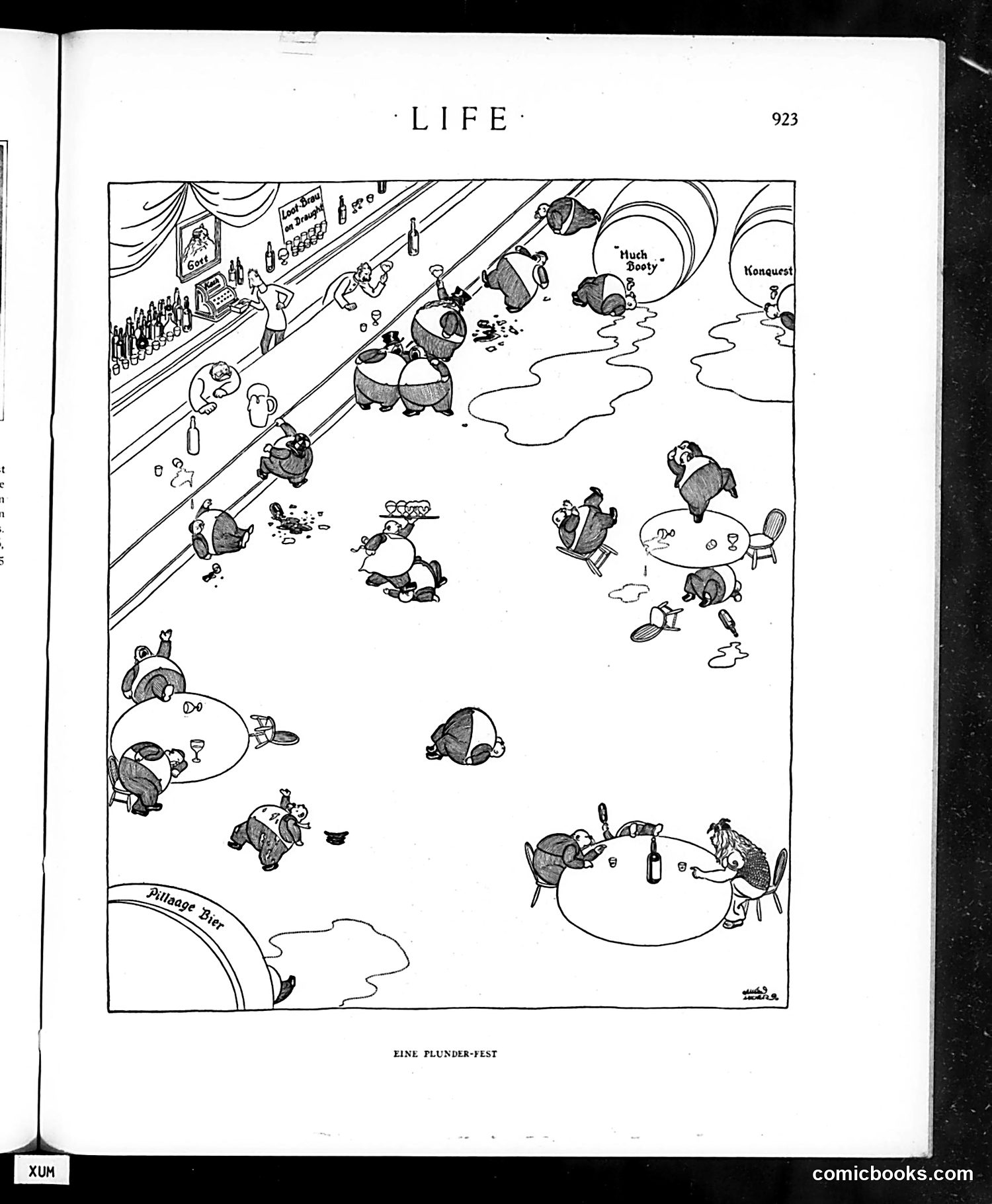
This cartoon satirizes excessive drinking and revelry, likely targeting German immigrants or German-American culture (suggested by the German title). The scene depicts numerous rotund figures engaged in a chaotic beer garden or tavern celebration along the "Pillage River" (visible at bottom left). Speech bubbles include "Much Booze" and "Konquest," suggesting the satire conflates drunken indulgence with militaristic conquest—possibly a post-WWI jab at Germany or Germanic culture. The figures are scattered across the composition in various states of inebriation, surrounded by bottles, food, and overturned furniture. The cartoon appears to ridicule both excessive consumption and stereotypes about German culture during a period of significant anti-German sentiment in American media.
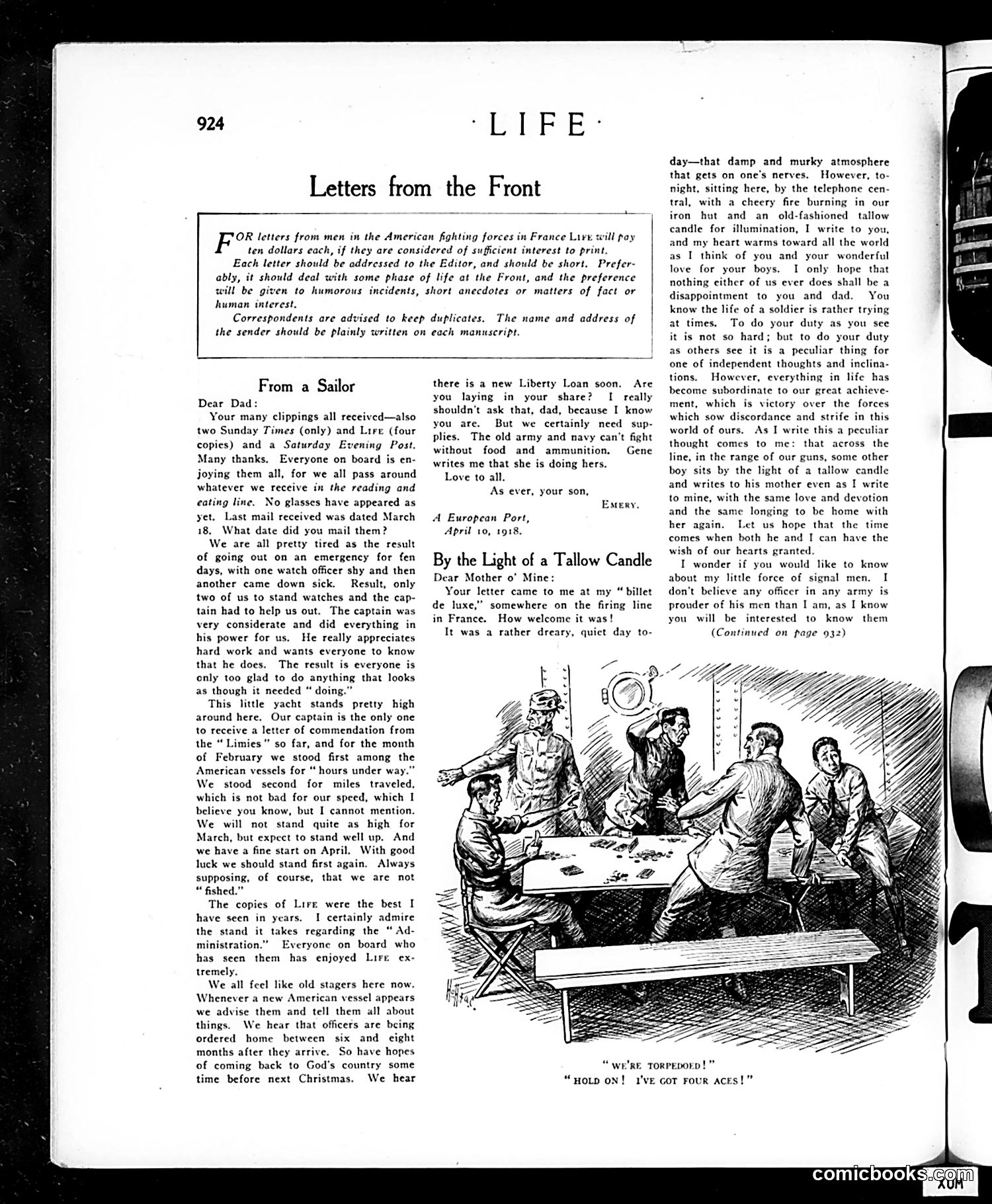
This page contains two soldier letters home from France during World War I (dated April 1918), soliciting contributions from servicemen for publication. **The Cartoon**: The illustration shows soldiers playing cards by candlelight in a military hut. One soldier exclaims "We're torpedoed!" while another responds "Hold on! I've got four aces!"—a dark humor joke about the dangers of submarine warfare threatening supply ships, while the men remain absorbed in their card game. **Context for Modern Readers**: This reflects genuine WWI anxieties about German U-boats sinking American supply and troop vessels. The satire lies in the soldiers' casual indifference to mortal danger, prioritizing their game. The letters themselves showcase Life's editorial interest in authentic soldier experiences—offering payment for accounts of front-line life, emphasizing either "humorous incidents" or factual anecdotes about military routine and morale.
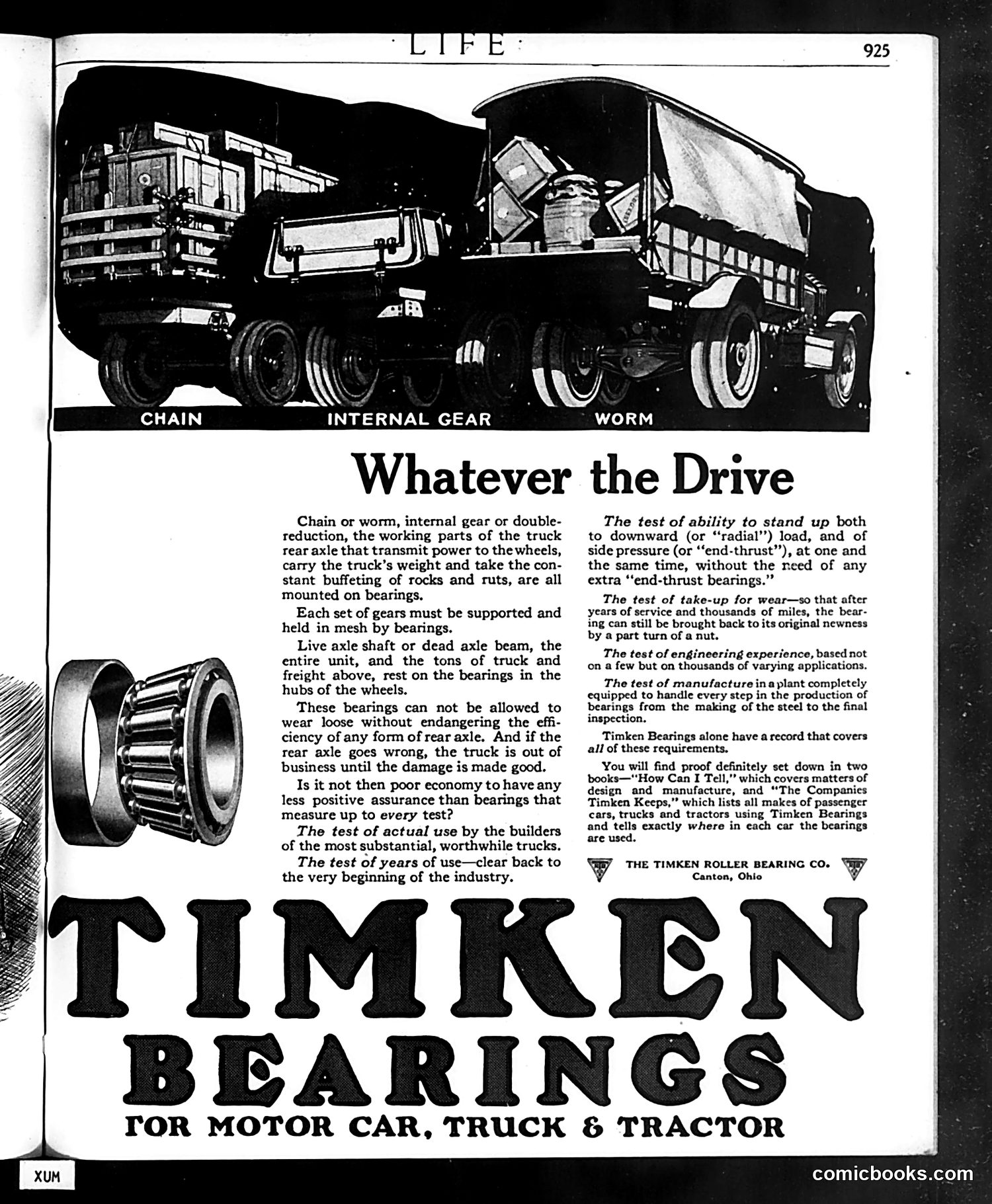
This is **not a cartoon or satire**—it's a straightforward advertisement for Timken Roller Bearings, a real industrial company based in Canton, Ohio. The page features technical illustrations of three truck rear-axle drive systems (chain, internal gear, and worm drive) at the top, demonstrating different mechanical approaches to the same function. The accompanying text argues that regardless of which drive system a truck manufacturer uses, all depend equally on reliable bearings. The advertisement's strategy is to position Timken bearings as the superior choice by emphasizing rigorous testing across multiple criteria: actual use by truck builders, decades of industry history, load-handling capability, wear resistance, engineering expertise, and manufacturing quality control. This represents early-20th-century industrial marketing: establishing credibility through technical detail and proven track record rather than emotional appeal. The references to available literature ("How Can I Tell," "The Companies Timken Keeps") indicate Timken actively promoted their engineering credentials to both manufacturers and consumers.
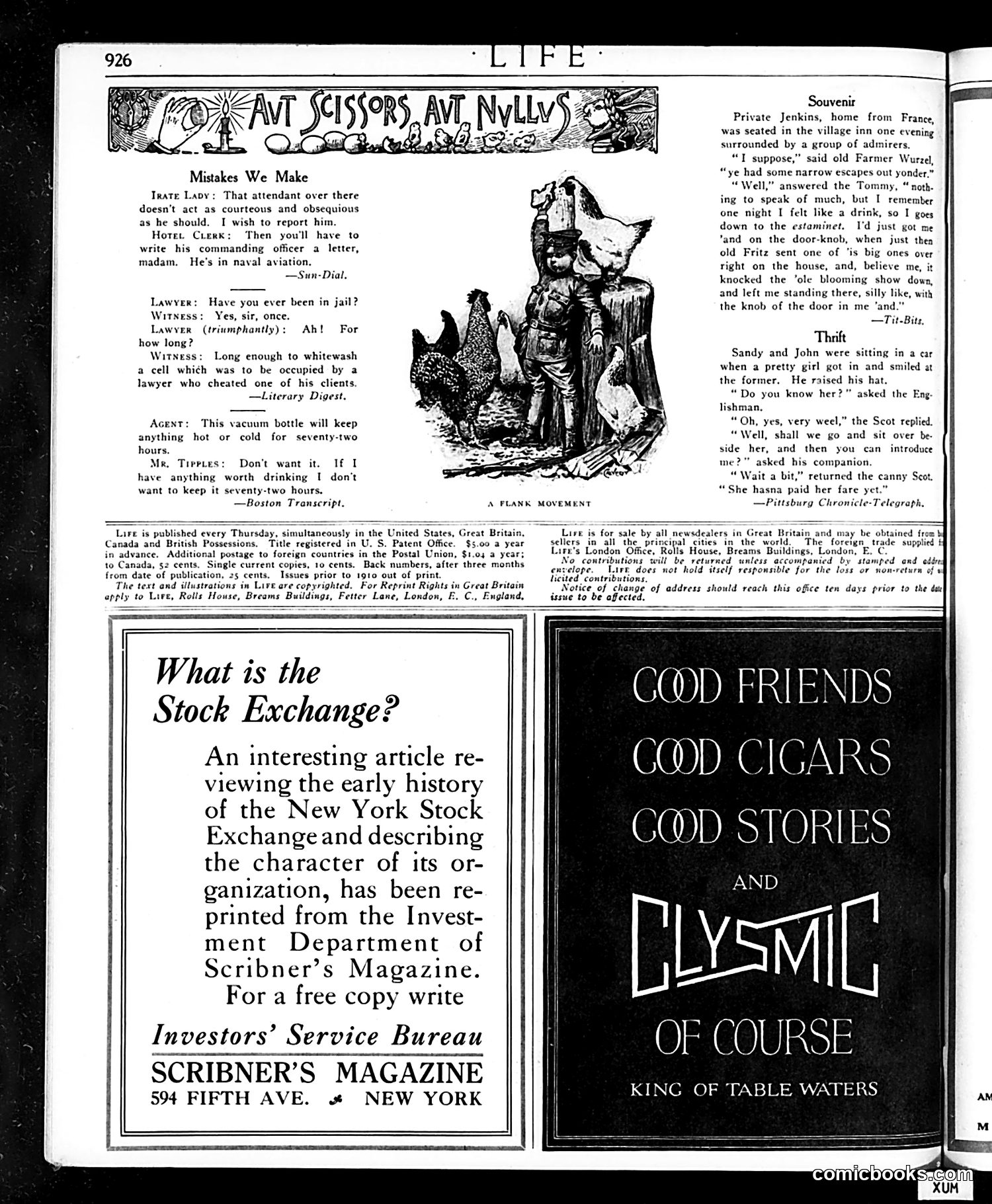
This is primarily a **humor page** from *Life* magazine featuring short jokes rather than a single cartoon. The main illustrated item, "A Plank Movement," shows what appears to be soldiers carrying lumber, likely making a pun on the military term "movement." The jokes satirize **everyday ironies and social observations**: - A hotel clerk's rudeness is excused because he's enlisted in naval aviation - A witness's jail sentence was served whitewashing a cell for a dishonest lawyer (reversing victim/perpetrator roles) - A man refuses a vacuum bottle because he'd drink anything worth keeping immediately - A Scottish soldier delays introducing a pretty girl because she hasn't paid her car fare yet—emphasizing Scottish frugality as comedic character trait The "Souvenir" anecdote humorously recounts a soldier's near-miss with artillery during WWI. The humor relies on understatement and ironic juxtaposition rather than political commentary. The page is largely advertisements otherwise.
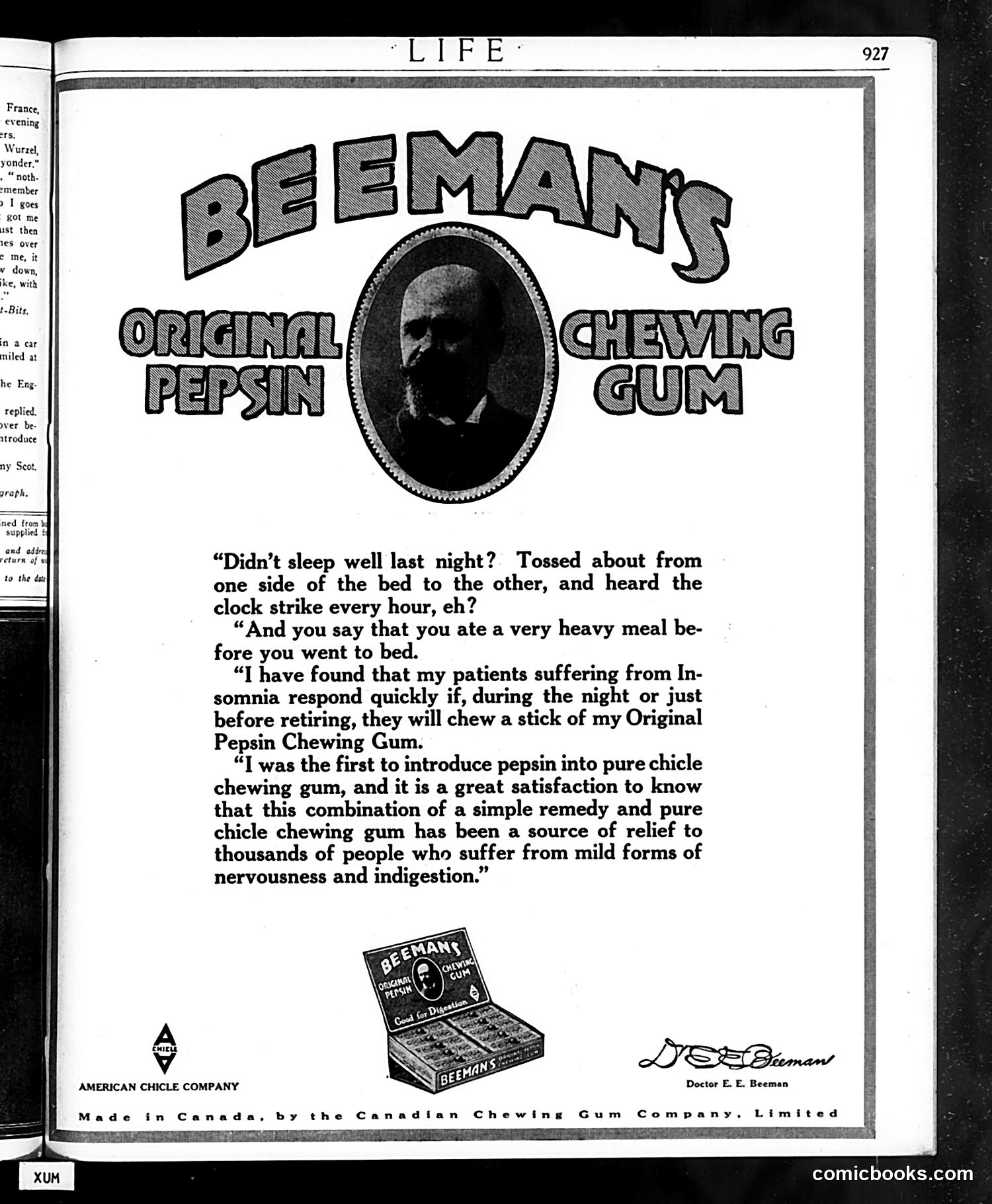
This is a full-page advertisement (not satire) for Beeman's Original Pepsin Chewing Gum, appearing in *Life* magazine. A doctor endorses the product by describing a patient's insomnia case and recommending the gum as treatment. The advertisement uses a common early-20th-century marketing strategy: physician endorsement. Doctor E. E. Beeman (the actual product creator) claims he was "the first to introduce pepsin into pure chicle chewing gum" and that it helps patients with insomnia, nervousness, and indigestion. For modern readers: pepsin is a digestive enzyme, so the pitch combines digestive aid with the act of chewing—positioning gum as medicine rather than mere confection. This reflects an era when such medical claims in advertising were unregulated and relatively common. The earnest testimonial format, now recognized as quaint marketing, was then considered persuasive and scientific-sounding.
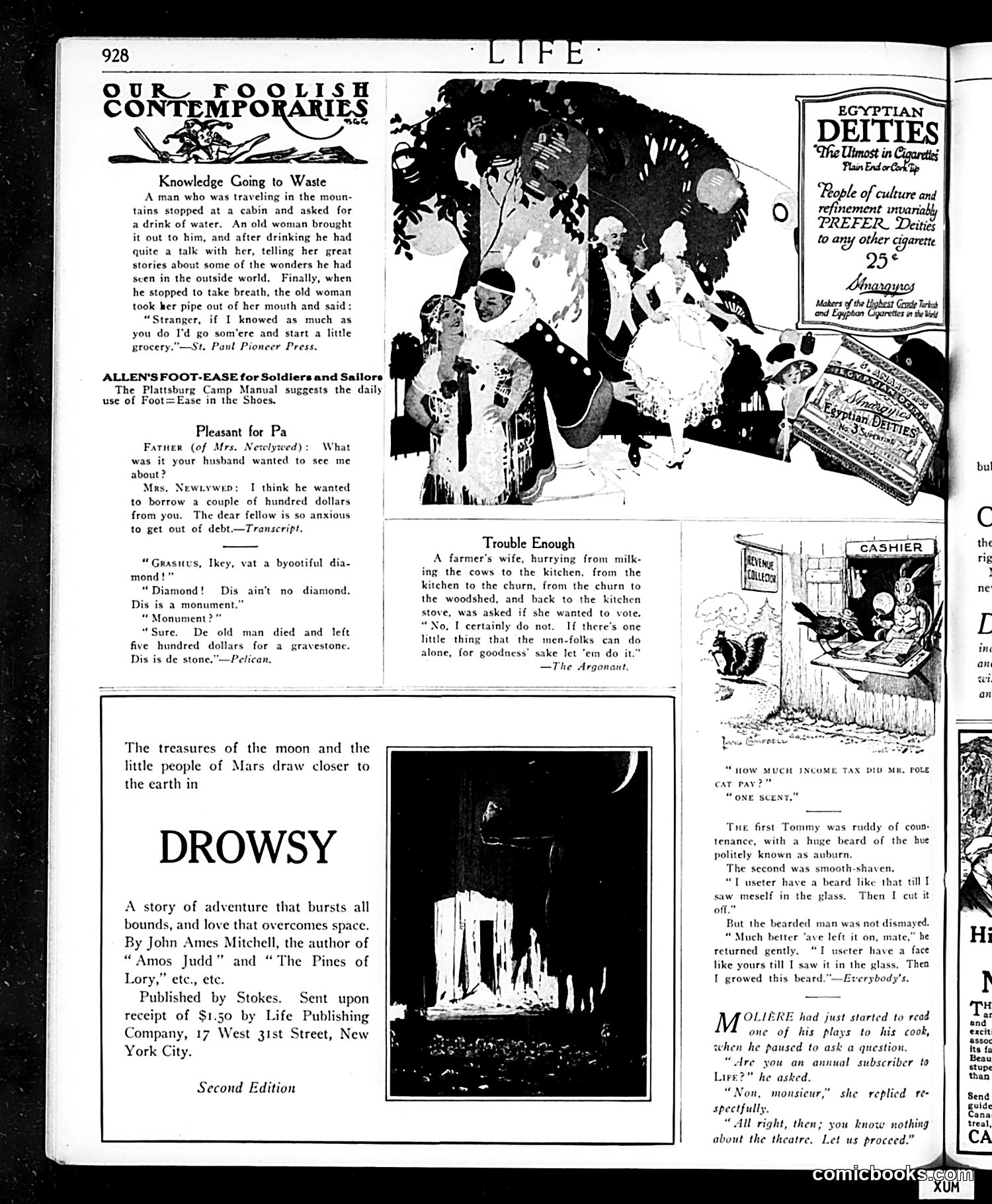
This page collects brief humorous anecdotes typical of *Life* magazine's satirical content, alongside advertisements and a book promotion. **The main jokes target rural ignorance and gender roles:** - "Knowledge Going to Waste" mocks an illiterate mountain woman who, impressed by a traveler's stories, suggests she'd open a grocery store if educated—implying rural women lack ambition or sense. - "Trouble Enough" depicts a farm wife too exhausted by domestic labor to care about voting rights, presented as comic acceptance of her limited sphere. - Other short jokes play on malapropisms and misunderstandings (the "monument" diamond, the "income tax" pun). **The Molière anecdote** satirizes class pretension: a playwright dismisses his cook's opinion because she lacks theatrical education. Collectively, these reflect early-20th-century attitudes: rural people as comically ignorant, women's domestic duties as naturally confining, and working-class people as intellectually inferior. The humor relies on stereotypes now recognized as classist and sexist.
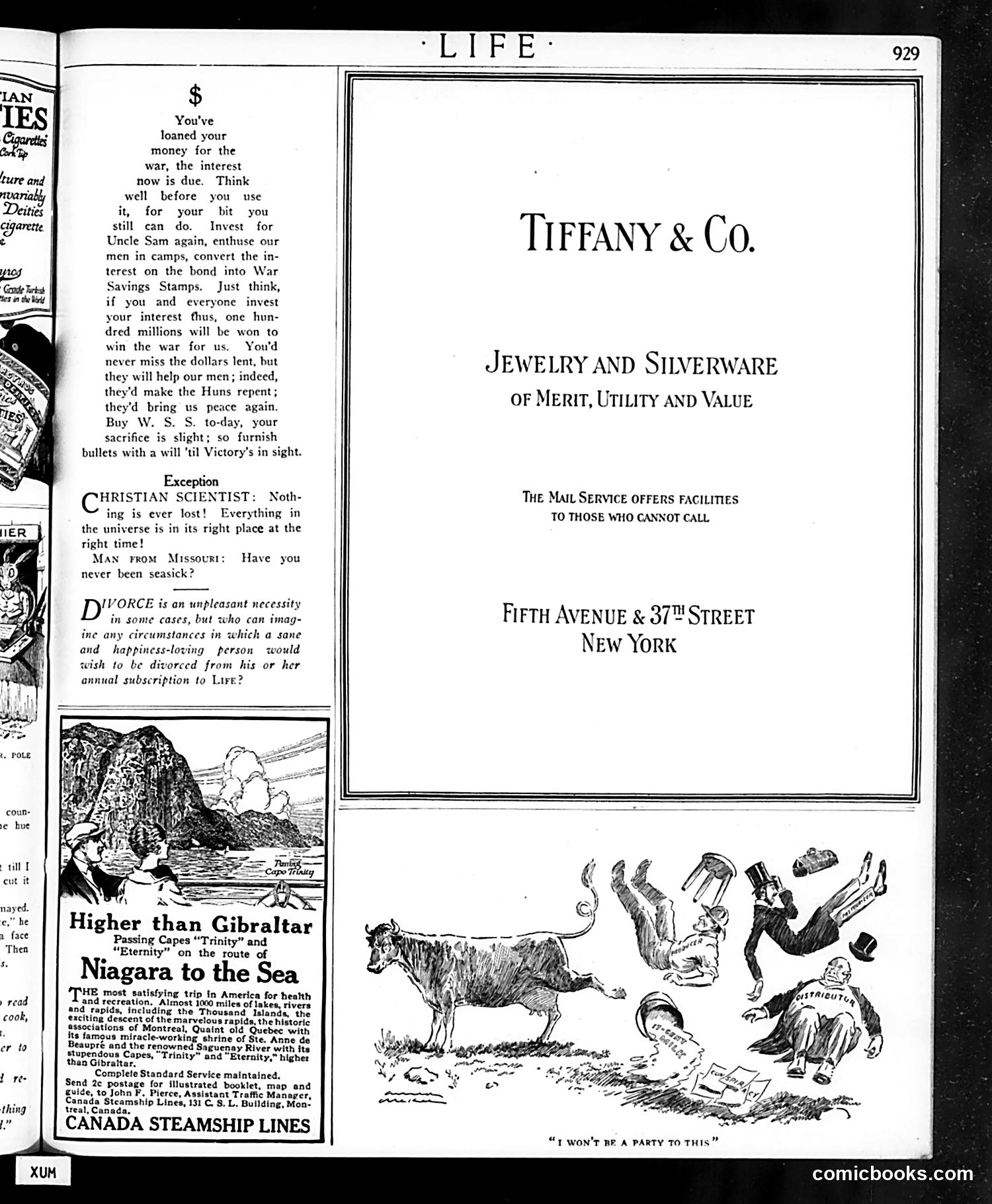
This page mixes advertisements with wartime satire and humor, likely from WWI era (references to "War Savings Stamps" and defeating "the Huns"). The main cartoon at bottom shows figures refusing participation—one saying "I won't be a party to this"—though the specific target is unclear from the image alone. The left column contains humorous "exception" quotes mocking various groups: a Christian Scientist denying loss exists, a Missourian asking about seasickness, and a rhetorical question about divorcing one's Life magazine subscription. These are gentle satirical jabs at contemporary attitudes. The top-left text urges readers to invest war bond interest in War Savings Stamps rather than spend it, framing this as patriotic duty to support troops and "win the war for us." The right side features a Tiffany & Co. jewelry advertisement and Canada Steamship Lines travel ad—standard commercial content typical of Life's mixed editorial-advertising format. The page reflects WWI-era American patriotic messaging alongside commercial activity and mild social satire.
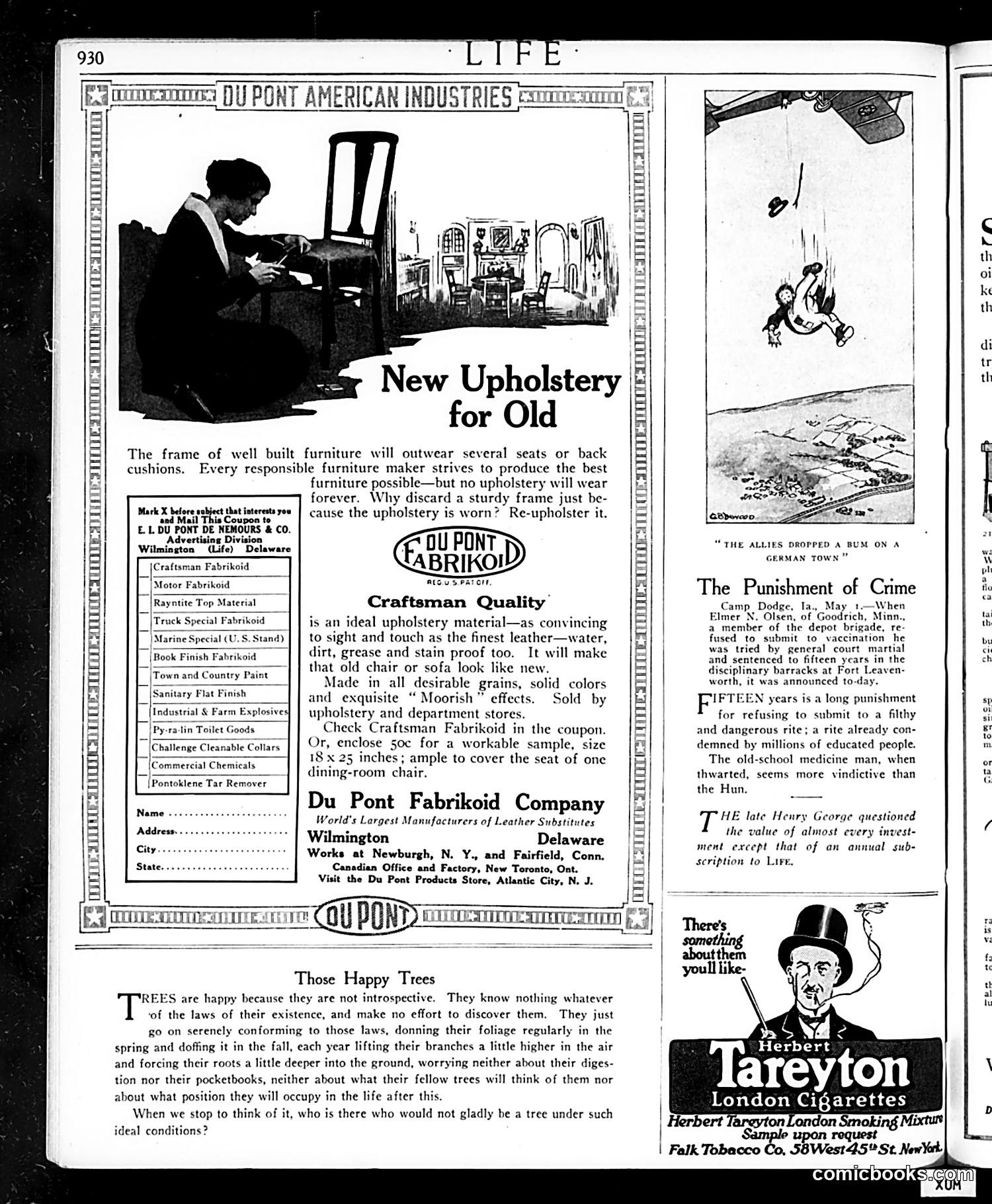
This page is primarily **advertising** rather than editorial content or political satire. The dominant feature is a Du Pont Fabrikoid advertisement promoting synthetic leather upholstery material for furniture re-upholstering. The ad uses a domestic scene showing a woman examining furniture and emphasizes that durable frames needn't be discarded when upholstery wears out—a practical message for post-WWI consumers managing resources. The right column contains brief news items and a Herbert Tareyton cigarette advertisement. One news story describes a soldier court-martialed for refusing vaccination at Camp Dodge, Iowa; the editorial comment sarcastically criticizes the punishment as excessive, equating military discipline to barbarism ("vindictive than the Hun"). The page's concluding essay, "Those Happy Trees," is a philosophical reflection—not satire—suggesting trees' contentment derives from lacking self-awareness and ambition, offering implicit social commentary on human anxiety. This appears to be a typical Life magazine layout mixing consumer advertising with brief news and light philosophical humor, rather than featuring prominent political cartoons or satire.
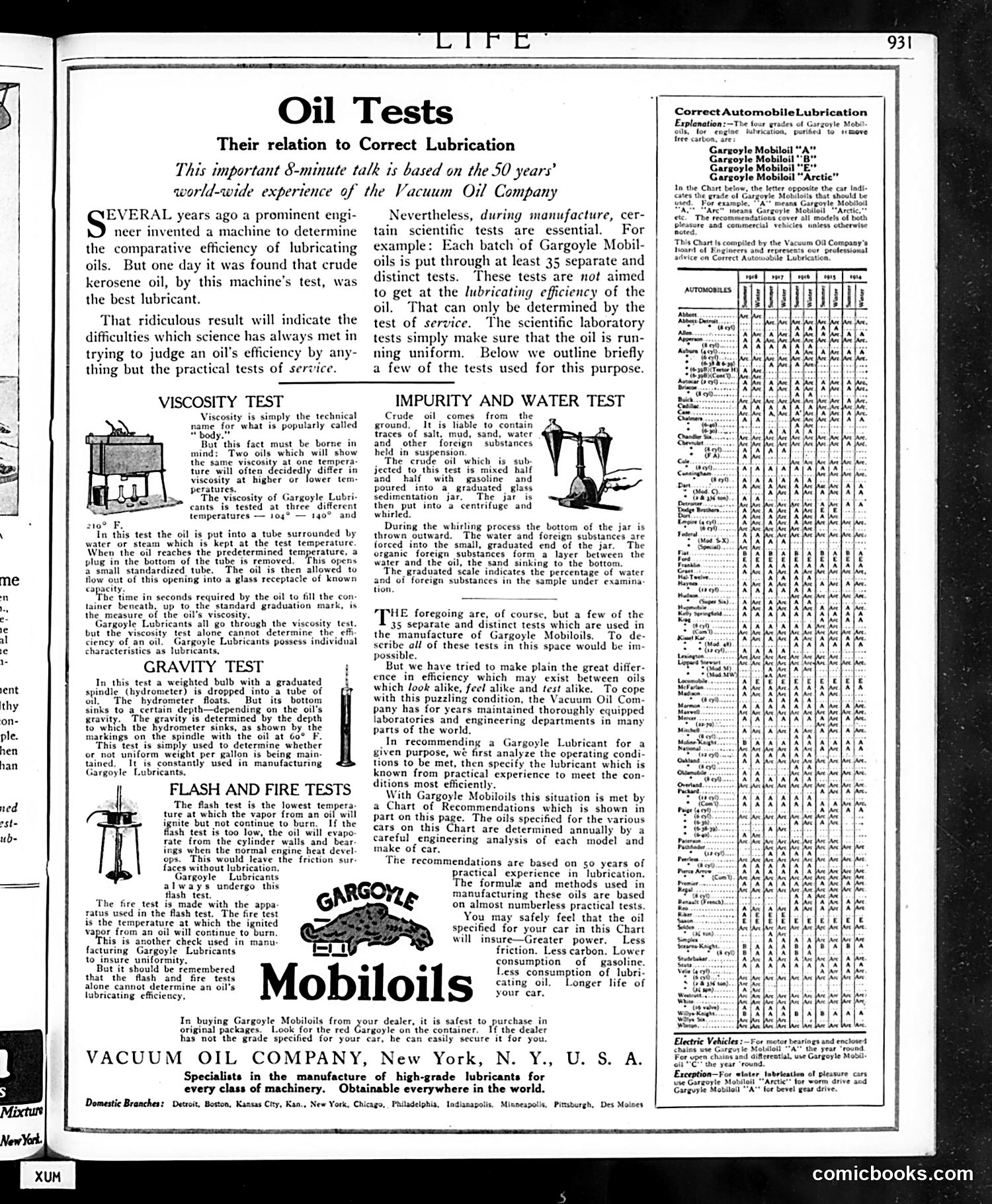
This is primarily **advertising**, not satire or political commentary. It's a 1920s promotional piece for Gargoyle Mobiloils (a Vacuum Oil Company product) disguised as educational journalism. The page explains oil testing methods—viscosity, gravity, flash point, and purity tests—to convince consumers that Gargoyle oils are scientifically superior. The opening anecdote (crude kerosene testing "best") is a rhetorical device: it argues that *practical service matters more than lab tests alone*, yet paradoxically, the company then emphasizes their rigorous testing to prove reliability. The accompanying chart recommends specific Gargoyle oils for different car models, turning technical information into a purchasing guide. **For modern readers**: This represents early 20th-century **corporate credibility-building through pseudo-scientific authority**—a precursor to modern marketing claims about "clinically tested" products. The irony is unintentional: while dismissing pure lab efficiency, the ad relies heavily on describing laboratory procedures to establish trust.
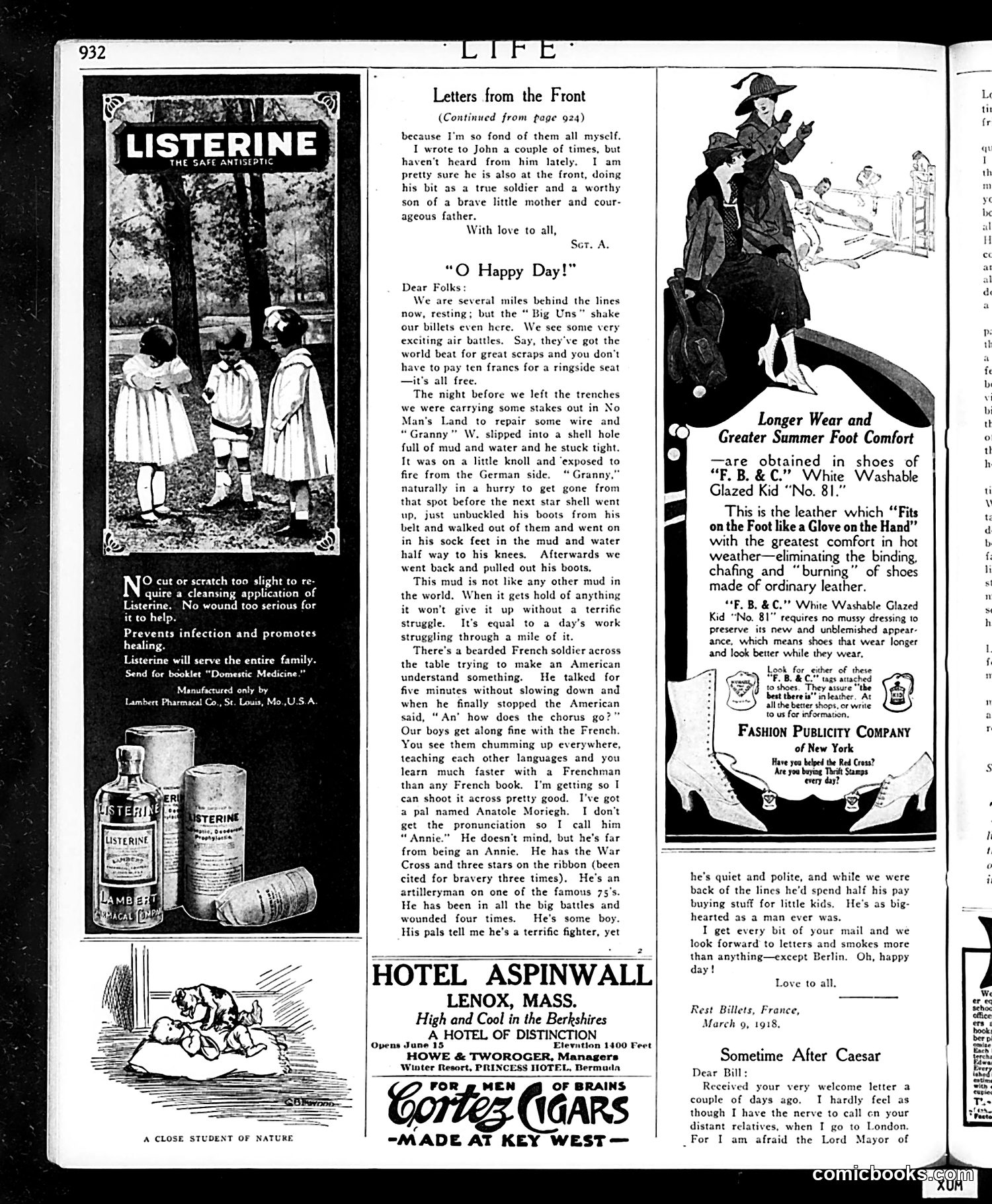
This page is primarily **advertisements and letters from soldiers at the front during World War I** — not political satire in the traditional sense. The main content is "Letters from the Front," personal correspondence from American soldiers describing trench warfare experiences. One letter details mundane hardships: a soldier losing his boots in mud while under German fire, and interactions with French allies. Another mentions a decorated French artilleryman with three citations for bravery. The **advertisements** include Listerine (marketed as preventing infection), Hotel Aspinwall in Massachusetts, and F.B. & C. white kid shoes promoting comfort in summer heat. The sole cartoon, captioned **"A Close Student of Nature,"** appears at bottom left but is too small/unclear to interpret with confidence—it seems to show an animal or figure studying something, likely a humorous nature observation unrelated to the war content. The overall page reflects **1918 wartime American journalism**: mixing soldier correspondence with commercial advertisements, presenting the war as an important shared experience for the home front audience.
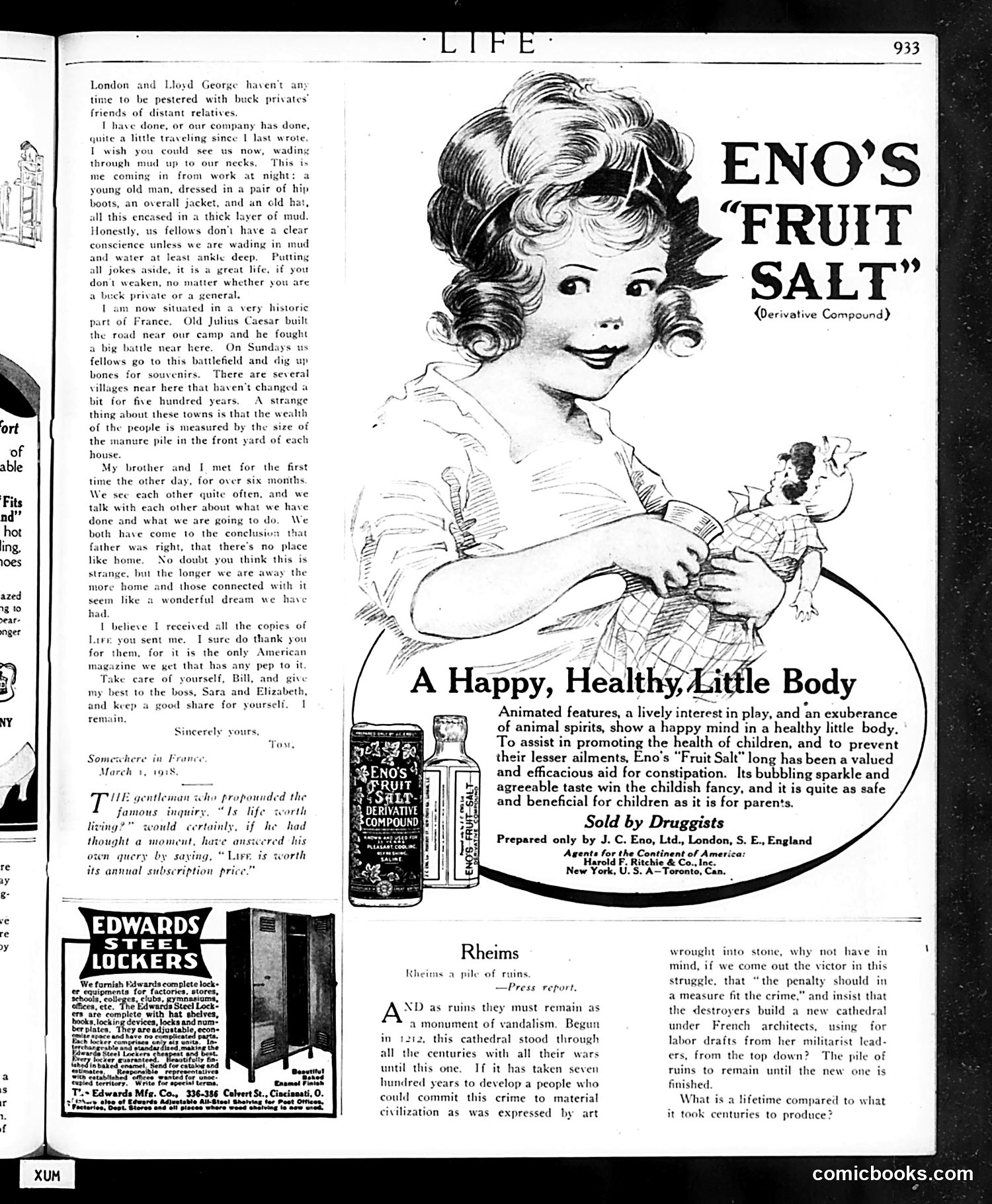
This page contains a **personal letter from a World War I soldier** stationed in France, combined with **product advertisements**. The letter describes military life: wading through mud, encountering historic French battlegrounds (near Julius Caesar's old roads), and an emotional reunion with his brother. The soldier expresses homesickness and gratitude that *Life* magazine reaches troops overseas, providing American morale support. The main advertisement features **Eno's Fruit Salt**, a laxative/digestive aid marketed for children with a cheerful illustration of a smiling girl. The copy claims it promotes health and prevents constipation while tasting pleasant. A secondary piece discusses **Rheims Cathedral's destruction**, likely referring to German bombardment during WWI. It argues that if victorious, the Allies should force Germany to rebuild the cathedral as a "penalty" for vandalism—a moral lesson in stone. The page reflects early-20th-century advertising aesthetics and wartime concerns, with product promotion mixed seamlessly into editorial content.
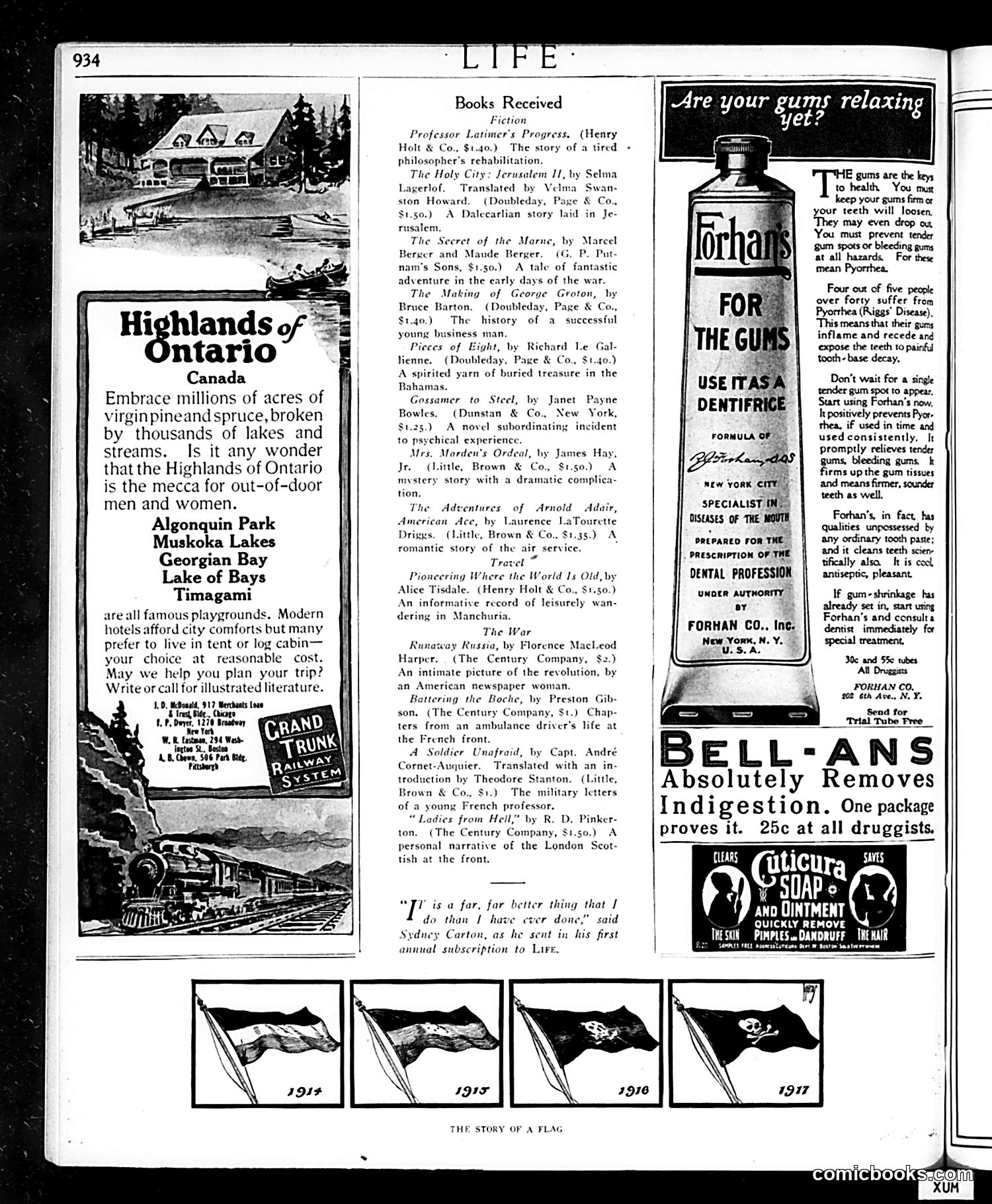
This page is primarily **advertising and book reviews**, not political satire. The main content includes: **Left side**: A travel advertisement for Ontario's wilderness destinations (Algonquin Park, Muskoka Lakes, etc.), appealing to outdoor recreation enthusiasts. **Center**: A "Books Received" section listing recently published fiction and non-fiction, many focused on **World War I themes**—titles like *The Secret of the Marne*, *Battering the Boche*, and *Ladies from Hell* reflect contemporary wartime interest. **Right side**: Advertisement for **Forhan's dentifrice** (toothpaste), explaining gum disease (Pyorrhea) and promoting their product as preventative. Period-typical health claims. **Bottom**: "The Story of a Flag"—a historical sequence showing flag evolution from 1915-1917, likely depicting changing national emblems during the war period. The page reflects early 20th-century concerns: tourism, wartime literature, and commercial health products marketed with pseudo-scientific explanations.
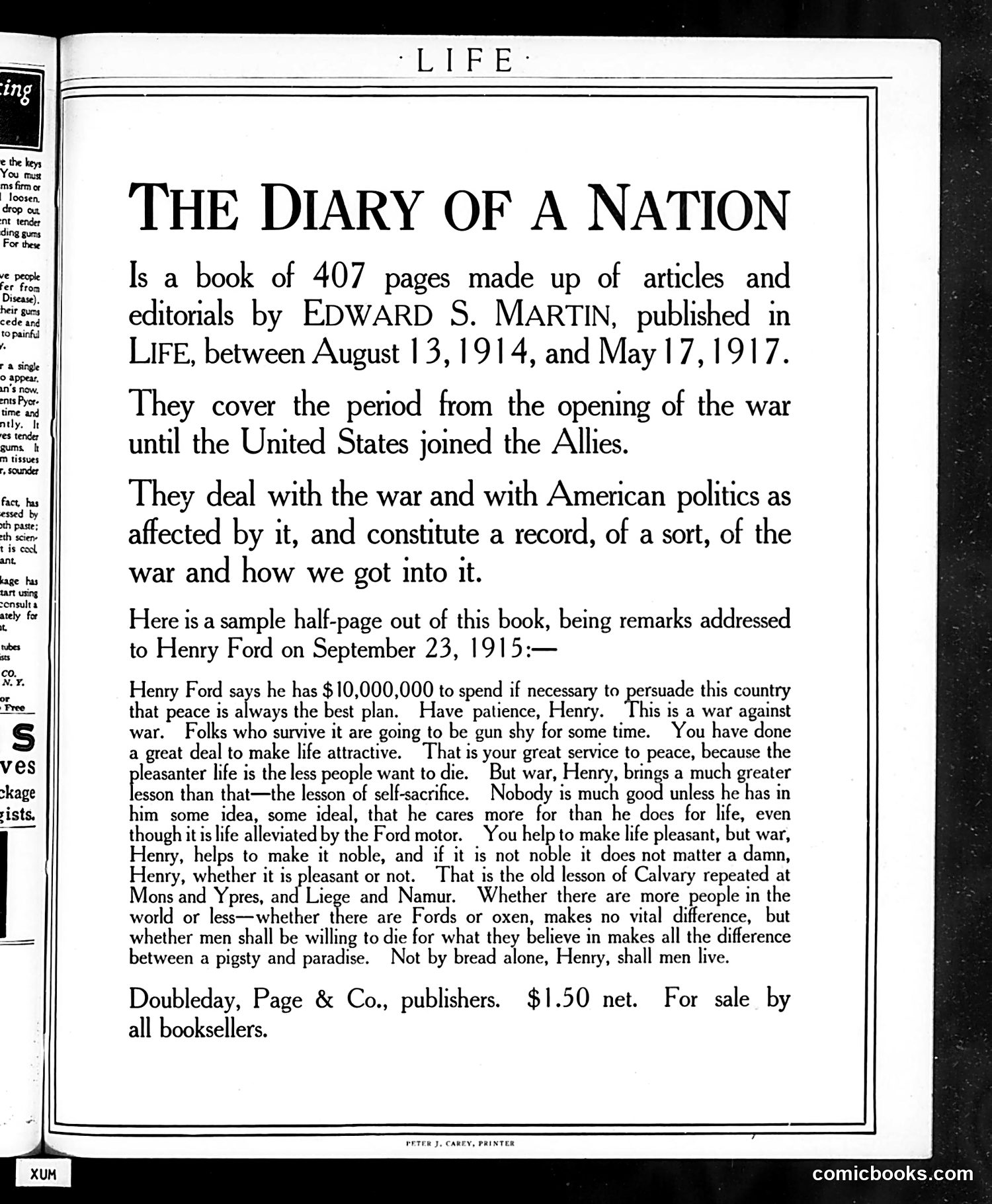
This page advertises Edward S. Martin's book *The Diary of a Nation*, a collection of editorials published in *Life* magazine from August 1914 to May 1917—covering World War I's opening until America entered. The excerpt shown is a 1915 editorial addressing **Henry Ford**, the automobile magnate who had publicly advocated for peace and offered to spend $10 million promoting pacifism. Martin's response is satirical critique: he acknowledges Ford's good works making life pleasant, but argues war teaches necessary lessons about **self-sacrifice and ideals worth dying for**—spiritual nobility beyond material comfort. Martin invokes World War I battles (Mons, Ypres, Liège, Namur) and religious imagery (Calvary) to argue that mere comfort and consumption (symbolized by "Fords or oxen") matter less than whether people possess convictions worth dying for. The message: Ford's pacifism, however well-intentioned, misses war's role in elevating human purpose beyond mere survival and pleasure. This reflects pre-1917 American debate over intervention.
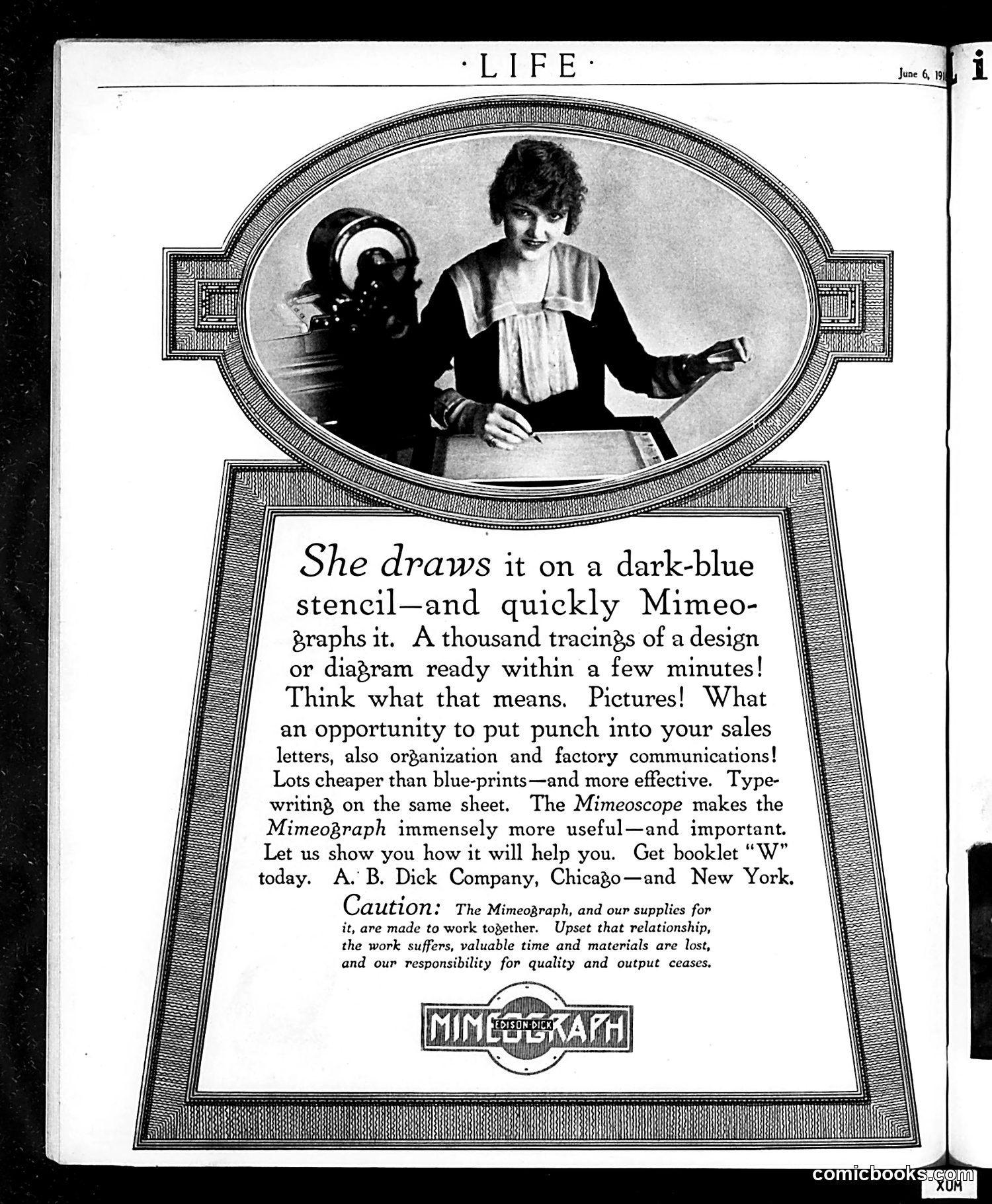
This is a **product advertisement**, not political satire. It promotes the "Mimeoscope," an attachment for mimeograph machines made by A.B. Dick Company (Chicago and New York). The image shows a woman operating a mimeograph machine. The ad emphasizes the device's practical business benefits: quickly producing multiple copies of designs, diagrams, and typed content for sales letters and factory communications—cheaper and more effective than blueprints. The "Caution" section is notably defensive, warning users that the Mimeoscope only works properly with A.B. Dick's own supplies; using other materials voids the company's responsibility for quality. This suggests competitive pressure in the copying-equipment market and concerns about customers substituting cheaper third-party supplies. The tone is straightforward industrial marketing, typical of early-20th-century business magazine advertising.