
Life, 1918-06-06 · page 18 of 40
Life — June 6, 1918 — page 18: what you’re looking at
What you’re looking at
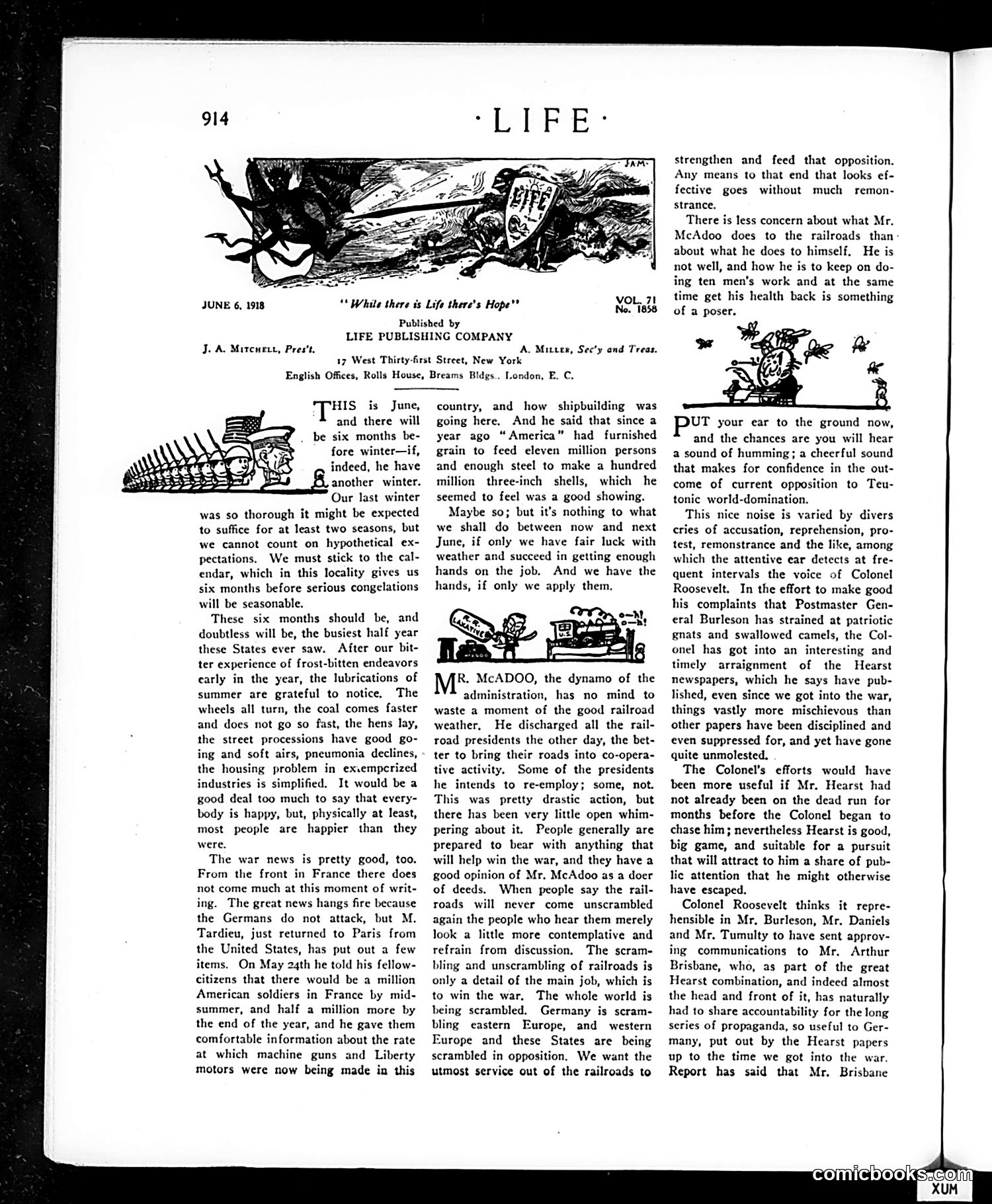
This editorial page discusses American mobilization for World War I. The main cartoon (top left) appears to show **Death or hardship** threatening American efforts, with a shield labeled "LIFE" as defense—illustrating the stakes of the coming six months. The text celebrates **William McAdoo** (Treasury Secretary and railroad administrator), praising his drastic action of firing railroad presidents to force cooperative war effort. The piece frames this as necessary wartime discipline, noting the public accepts such measures to win the war. The writing discusses **French official Tardieu's** report on American military production: one million soldiers promised by mid-summer, artillery shell manufacturing, and Liberty motor production. The satirical tone is mild—more patriotic boosterism than critique. The "joke" is that Americans will tolerate even extreme executive actions if justified by military necessity. McAdoo's health concerns are mentioned sympathetically rather than mockingly, reflecting wartime unity sentiment during WWI's final year.
📄 Transcribed text from this page (OCR, searchable)
Machine-transcribed from the original scan — historical spelling and the odd misread are preserved.
JUNE 6, 1918 Whale there is Life there’s Hope’* No. 1858 Published by LIFE PUBLISHING COMPANY J. A. Mitcnent, Pres‘t, HIS is June, and there will be six months be- fore winter—if, indeed, he have 6. another winter. Our last winter was so thorough it might be expected to suffice for at least two seasons, but we cannot count on hypothetical ex- pectations. We must stick to the cal- endar, which in this locality gives us six months before serious congelations will be seasonable. These six months should be, and doubtless will be, the busiest half year these States ever saw. After our bit- ter experience of frost-bitten endeavors early in the year, the lubrications of summer are grateful to notice, The wheels all turn, the coal comes faster and does not go so fast, the hens lay, the street processions have good go- ing and soft airs, pneumonia decline: the housing problem in exvempcrized industries is simplified. It would be a good deal too much to say that every- body is happy, but, physically at least, most people are happier than they were, The war news is pretty good, too. From the front in France there does not come much at this moment of writ- ing. The great news hangs fire because the Germans do not attack, but M. Tardieu, just returned to Paris from the United States, has put out a few items. On May 24th he told his fellow- citizens that there would be a million American soldiers in France by mid- summer, and half a million more by the end of the year, and he gave them comfortable information about the rate at which machine guns and Liberty motors were now being made in this A. Mittes, Sec'y and Treas. 17 West Thirty-first Street, New York English Offices, Rolls House, Breams Bldgs. London, BE. C. country, and how shipbuilding was going here, And he said that since a year ago “America” had furnished grain to feed eleven million persons and enough steel to make a hundred million three-inch shells, which he seemed to feel was a good showing. Maybe so; but it’s nothing to what we shall do between now and next June, if only we have fair luck with weather and succeed in getting enough hands on the job. And we have the hands, if only we apply them, R. McADOO, the dynamo of the administration, has no mind to waste a moment of the good railroad weather, He discharged all the rail- road presidents the other day, the bet- ter to bring their roads into co-opera- tive activity. Some of the presidents he intends to re-employ; some, not. This was pretty drastic action, but there has been very little open whim- pering about it. People generally are prepared to bear with anything that will help win the war, and they have a good opinion of Mr, McAdoo as a doer of deeds. When people say the rail- roads will never come unscrambled again the people who hear them merely look a little more contemplative and refrain from discussion, The scram- bling and unscrambling of railroads is only a detail of the main job, which is to win the war, The whole world is being scrambled. Germany is scram- bling eastern Europe, and western Europe and these States are being scrambled in opposition. We want the utmost service out of the railroads to strengthen and feed that opposition. Any means to that end that looks ef- fective goes without much remon- strance. There is less concern about what Mr. McAdoo does to the railroads than about what he does to himself. He is not well, and how he is to keep on do- ing ten men’s work and at the same time get his health back is something of a poser, UT your ear to the ground now, and the chances are you will hear a sound of humming; a cheerful sound that makes for confidence in the out- come of current opposition to Teu- tonic world-domination. This nice noise is varied by divers cries of accusation, reprehension, pro- test, remonstrance and the like, among which the attentive ear detects at fre- quent intervals the voice of Colonel Roosevelt. In the effort to make good his complaints that Postmaster Gen- eral Burleson has strained at patriotic gnats and swallowed camels, the Col- onel has got into an interesting and timely arraignment of the Hearst newspapers, which he says have pub- lished, even since we got into the war, things vastly more mischievous than other papers have been disciplined and even suppressed for, and yet have gone quite unmolested. The Colonel’s efforts would have been more useful if Mr. Hearst had not already been on the dead run for months before the Colonel began to chase him; nevertheless Hearst is good, big game, and suitable for a pursuit that will attract to him a share of pub- lic attention that he might otherwise have escaped. Colonel Roosevelt thinks it repre- hensible in Mr, Burleson, Mr. Daniels and Mr. Tumulty to have sent approv- ing communications to Mr, Arthur Brisbane, who, as part of the great Hearst combination, and indeed almost the head and front of it, has naturally had to share accountability for the long series of propaganda, so useful to Ger- many, put out by the Hearst papers up to the time we got into the war. Report has said that Mr. Brisbane