
Life, 1918-06-06 · page 32 of 40
Life — June 6, 1918 — page 32: what you’re looking at
What you’re looking at
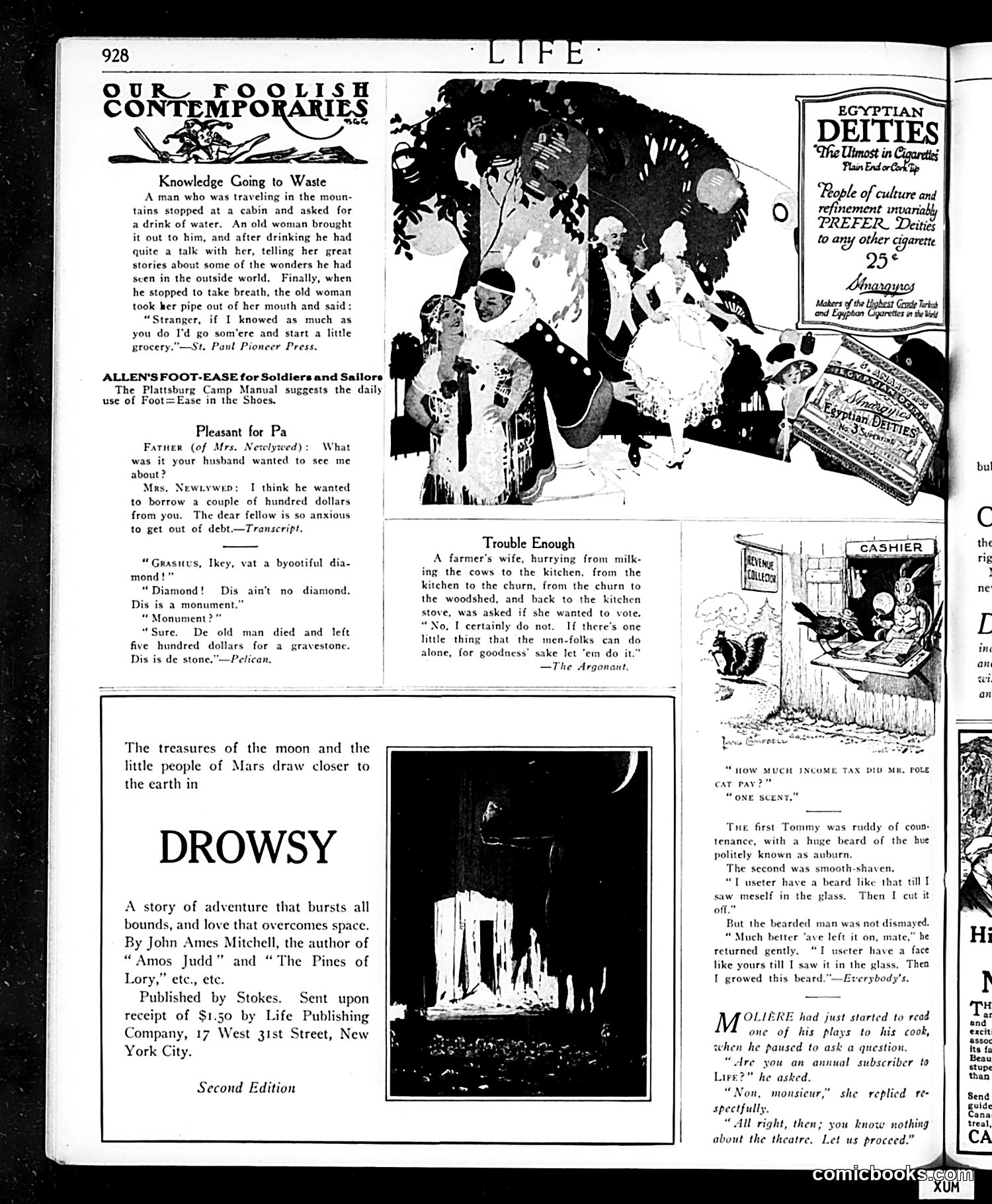
This page collects brief humorous anecdotes typical of *Life* magazine's satirical content, alongside advertisements and a book promotion. **The main jokes target rural ignorance and gender roles:** - "Knowledge Going to Waste" mocks an illiterate mountain woman who, impressed by a traveler's stories, suggests she'd open a grocery store if educated—implying rural women lack ambition or sense. - "Trouble Enough" depicts a farm wife too exhausted by domestic labor to care about voting rights, presented as comic acceptance of her limited sphere. - Other short jokes play on malapropisms and misunderstandings (the "monument" diamond, the "income tax" pun). **The Molière anecdote** satirizes class pretension: a playwright dismisses his cook's opinion because she lacks theatrical education. Collectively, these reflect early-20th-century attitudes: rural people as comically ignorant, women's domestic duties as naturally confining, and working-class people as intellectually inferior. The humor relies on stereotypes now recognized as classist and sexist.
📄 Transcribed text from this page (OCR, searchable)
Machine-transcribed from the original scan — historical spelling and the odd misread are preserved.
Knowledge Going to Waste A man who was traveling in the moun- tains stopped at a cabin and asked for a drink of water. An old woman brought it out to him, and after drinking he had quite a talk with her, telling her great stories about some of the wonders he had seen in the outside world. Finally, when he stopped to take breath, the old woman took her pipe out of her mouth and said: “Stranger, if I knowed as much as you do I'd go som'ere and start a little grocery."—St. Paul Pioneer Press. ALLEN'S FOOT-EASE for Soldiers and Sailors The Plattsburg Camp Manual suggests the daily use of Foot=Ease in the Shoes. Pleasant for Pa Farner (of Mrs. Newlywed): What was it your husband wanted to see me about ? Mrs, Newnyweo: I think he wanted to borrow a couple of hundred dollars from you. The dear fellow is so anxious to get out of debt—Transcript. “Grasitvs, Ikey, vat a byootiful dia- mond!” “Diamond! Dis ain't no diamond. Dis is a monument.” “ Monument?” Sure. De old man died and left five hundred dollars for a gravestone. Dis is de stone."—Pelican. The treasures of the moon and the little people of Mars draw closer to the earth in DROWSY A story of adventure that bursts all bounds, and love that overcomes space. By John Ames Mitchell, the author of “Amos Judd” and “The Pines of ee., etc. Published by Stok Sent upon receipt of $1.50 by Life Publishing Company, 17 West 31st Street, New York City. Second Edition Trouble Enough A farmer's wife, hurrying from milk- ing the cows to the kitchen. from the kitchen to the churn, from the churn to the woodshed, and back to the kitchen stove, was asked if she wanted to vote. “No, I certainly do not. If there's one little thing that the men-folks can do alone, for goodn ‘ss’ sake let ‘em do it.” —The Argonaut. EGYPTIAN DEITIES “The Utmost in PlinEndorCakty — | i Rople of culture and | | refinement invariably | PREFER. Deities | to any other cigarette 25° Firargyss Makers of the i | “HOW MUCH INCOME TAX DID MR, POLE cat pay?” “ONE SCENT.” Tne first Tommy was ruddy of coun- tenance, with a huge beard of the hve politely known as auburn. The second was smooth-shaven. “Tuseter have a beard like that till I saw meself in the glass. Then I cut it off.” But the bearded man was not dismayed. “Much better ‘a returned gently. “I useter have a face like yours till T saw it in the glass, Thea I growed this beard."—E ve left it on, m: rybody’s. OLIERE had just started to read one of his plays to his cook, when he paused to ask a question. “dre you an annual subscriber to Lire?” he asked. “Non, monsicur,” she replied re- spectfully. “All right, then; you know nothing about the theatre, Let us proceed.” COMICDOOK ssome bul