
Life, 1918-06-06 · page 23 of 40
Life — June 6, 1918 — page 23: what you’re looking at
What you’re looking at
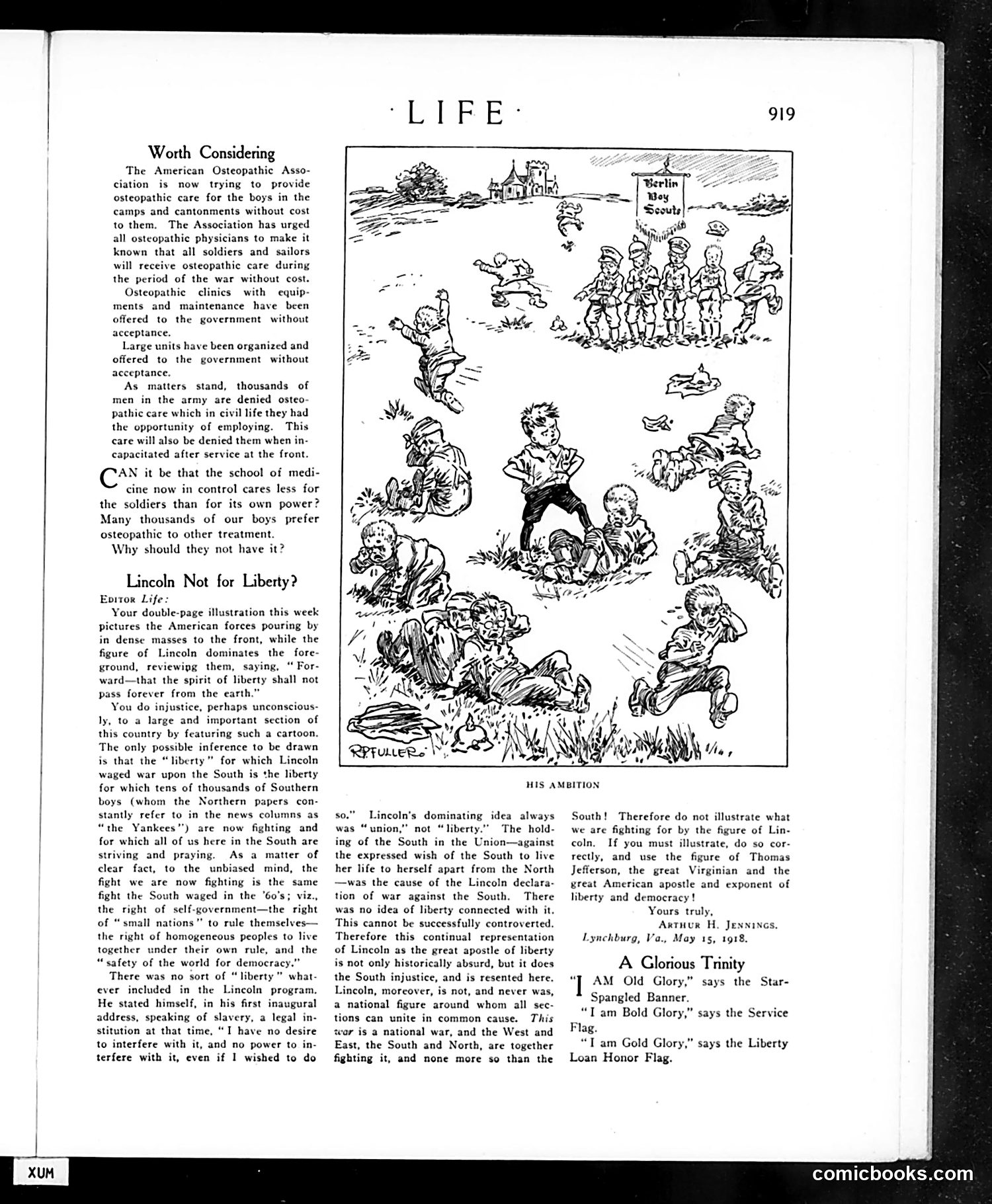
This page contains a satirical cartoon depicting children playing soldiers near Berlin, with Lincoln's figure looming above. The accompanying letters critique Life magazine's editorial choices during World War I. The main cartoon satirizes American military ambition—children's innocent play mirrors adult warfare, suggesting the perpetual cycle of conflict. More significantly, the letters reveal bitter sectional tensions. A Southern reader attacks Life's use of Lincoln as a symbol of liberty and unity, arguing Lincoln fought for "union," not freedom, and that the Civil War paralleled current WWI battles for self-determination. The writer insists Lincoln is a divisive figure in the South and demands Thomas Jefferson—"great American apostle of liberty"—be used instead to represent shared national values. This reflects how deeply the Civil War wounds persisted fifty years later, and how WWI rhetoric about fighting for democracy and liberty reopened sectional wounds about what those ideals actually meant.
📄 Transcribed text from this page (OCR, searchable)
Machine-transcribed from the original scan — historical spelling and the odd misread are preserved.
Worth Considering The American Osteopathic Asso- ciation is now trying to provide osteopathic care for the boys in the camps and cantonments without cost to them. The Association has urged all osteopathic physicians to make it known that all soldiers and sailors will receive osteopathic care during the period of the war without cost. Osteopathic clinics with equip- ments and maintenance have been offered to the government without acceptance. Large units have been organized and offered to the government without acceptance. As matters stand, thousands of men in the army are denied osteo- pathic care which in civil life they had the opportunity of employing. This care will also be denied them when in- capacitated after service at the front. ‘AN it be that the school of medi- cine now in control cares less for the soldiers than for its own power? Many thousands of our boys prefer osteopathic to other treatment. Why should they not have it? Lincoln Not for Liberty? Epitor Lif Your double-page illustration this week pictures the American forces pouring by in dense masses to the front, while the figure of Lincoln dominates the fore- ground, reviewipg them, saying, “ For- ward—that the spirit of liberty shall not pass forever from the earth.” You do injustice, perhaps unconscious- ly, to a large and important section of this country by featuring such a cartoon. The only possible inference to be drawn is that the “liberty” for which Lincoln waged war upon the South is the liberty for which tens of thousands of Southern boys (whom the Northern papers con- stantly refer to in the news columns as “the Yankees”) are now fighting and for which all of us here in the South are striving and praying. As a matter of clear fact, to the unbiased mind, the fight we are now fighting is the same fight the South waged in the ‘60's; viz., the right of self-government—the right of “small nations” to rule themselves— the right of homogeneous peoples to live together under their own rule, and the “safety of the world for democracy.” There was no sort of “liberty” what- ever included in the Lincoln program. He stated himself, in his first inaugural address, speaking of slavery, a legal in- stitution at that time, “I have no desire to interfere with it, and no power to in- terfere with it, even if 1 wished to do HIS AMBITION so." Lincoln's dominating idea always was “union,” not “liberty.” The hold- ing of the South in the Union—against the expressed wish of the South to live her life to herself apart from the North —was the cause of the Lincoln declara- tion of war against the South. There was no idea of liberty connected with it. This cannot be successfully controverted. Therefore this continual representation of Lincoln as the great apostle of liberty is not only historically absurd, but it does the South injustice, and is resented here. Lincoln, moreover, is not, and never was, a national figure around whom all sec- tions can unite in common cause. This wor is a national war, and the West and East, the South and North, are together fighting it, and none more so than the South! Therefore do not illustrate what we are fighting for by the figure of Lin- coln. If you must illustrate, do so cor- rectly, and use the fi of Thomas Jefferson, the great Virginian and the great American apostle and exponent of liberty and democracy ! Yours truly, Axtuur H. Jennines. Lynchburg, Va., May 15, 1918. A Glorious Trinity “IT AM Old Glory,” says the Star- Spangled Banner. “Tam Bold Glory,” says the Service Flag. “Tam Gold Glory,” says the Liberty Loan Honor Flag. comicbooks.com