
Life, 1918-06-06 · page 19 of 40
Life — June 6, 1918 — page 19: what you’re looking at
What you’re looking at
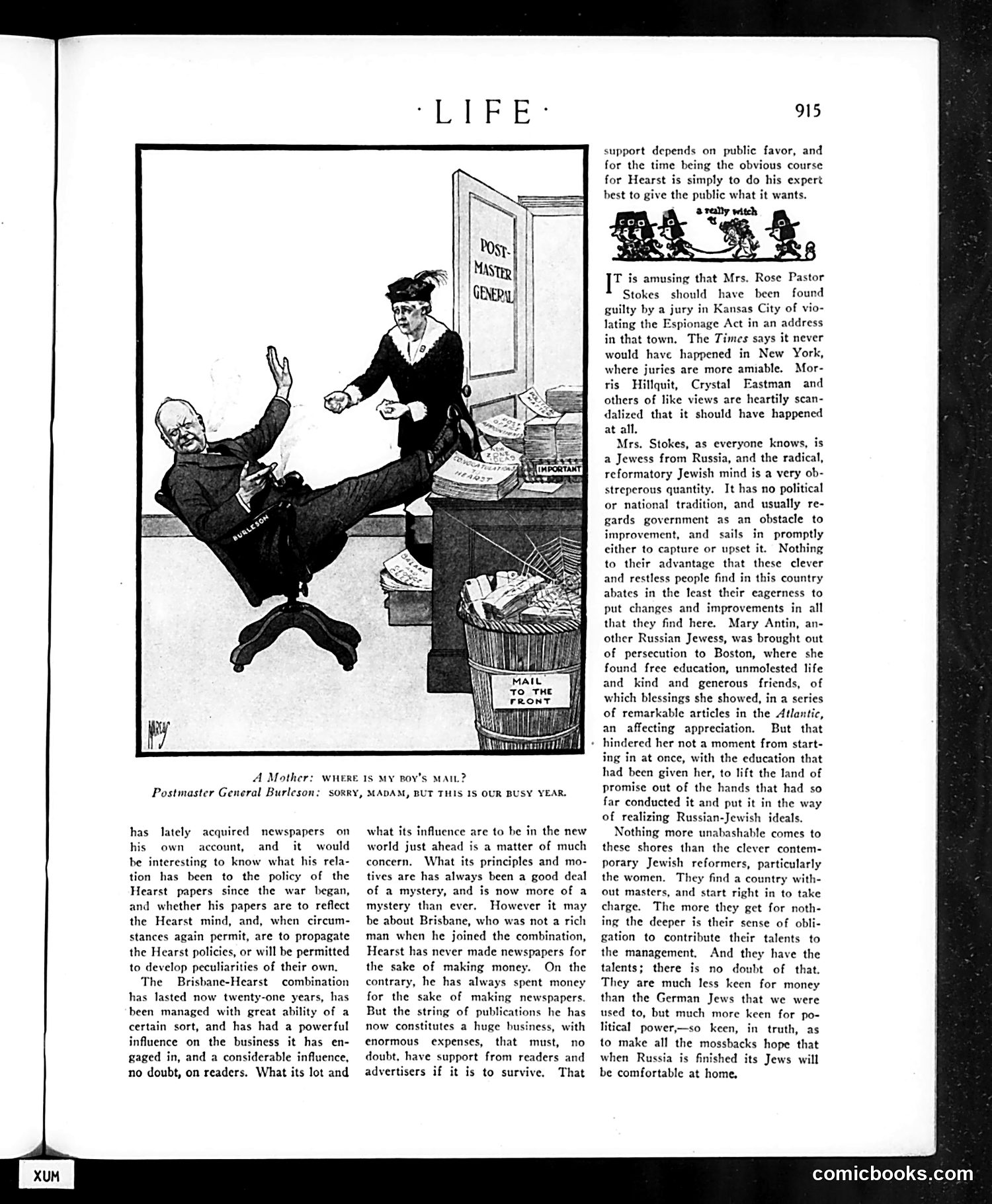
**The Cartoon:** The illustration depicts Postmaster General Albert Burleson dismissing a concerned mother asking about her son's mail. He claims it's "our busy year"—a satirical reference to mail censorship during World War I. Burleson infamously suppressed anti-war publications and materials deemed seditious. **The Article:** The text discusses Rose Pastor Stokes, a Russian-Jewish radical who was convicted under the Espionage Act in Kansas City for an anti-war speech. The author expresses surprise a jury would convict her, noting New York juries would likely acquit. The piece then criticizes Russian-Jewish immigrants (particularly women reformers) for their radical, anti-government activism. While acknowledging their intelligence and talents, the author portrays them as ungrateful troublemakers who agitate for social change despite America's generosity. **Context:** This reflects early-20th-century prejudices against both Eastern European Jewish immigrants and anti-war activists during WWI. The "busy year" joke satirizes government mail censorship while the article's stereotype of "clever and restless" Jewish reformers reveals the publication's own editorial biases.
📄 Transcribed text from this page (OCR, searchable)
Machine-transcribed from the original scan — historical spelling and the odd misread are preserved.
A Mother: WHERE IS MY ROY’S MAIL? Postmaster General Burleson: SORRY, MADAM, BUT THIS 15 OUR BUSY YEAR. has lately acquired newspapers on his own account, and it would be interesting to know what his rela- tion has been to the policy of the Hearst papers since the war began, and whether his papers are to reflect the Hearst mind, and, when circum- stances again permit, are to propagate the Hearst policies, or will be permitted to develop peculiarities of their own, The Brisbane-Hearst combination has lasted now twenty-one years, has been managed with great ability of a certain sort, and has had a powerful influence on the business it has en- gaged in, and a considerable influence, no doubt, on readers. What its lot and what its influence are to be in the new world just ahead is a matter of much concern. What its principles and mo- tives are has always been a good deal of a mystery, and is now more of a mystery than ever. However it may be about Brisbane, who was not a rich man when he joined the combination, Hearst has never made newspapers for the sake of making money. On the contrary, he has always spent money for the sake of making newspapers. But the string of publications he has now constitutes a huge business, with enormous expenses, that must, no doubt, have support from readers and advertisers if it is to survive. That 915 support depends on public favor, and for the time being the obvious course for Hearst is simply to do his expert best to give the public what it wants. T is amusing that Mrs. Rose Pastor Stokes should have been found guilty by a jury in Kansas City of vio- lating the Espionage Act in an address in that town. The Times says it never would have happened in New York, where juries are more amiable. Mor- ris Hillquit, Crystal Eastman and others of like views are heartily scan- dalized that it should have happened at all. Mrs. Stokes, as everyone knows, is a Jewess from Russia, and the radical, reformatory Jewish mind is a very ob- streperous quantity. It has no political or national tradition, and usually re- gards government as an obstacle to improvement, and sails in promptly cither to capture or upset it. Nothing to their advantage that these clever and restless people find in this country abates in the least their eagerness to put changes and improvements in all that they find here. Mary Antin, an- other Russian Jewess, was brought out of persecution to Boston, where she found free education, unmolested life and kind and generous friends, of which blessings she showed, in a seri of remarkable articles in the Atlas an affecting appreciation. But that + hindered her not a moment from start- ing in at once, with the education that had been given her, to lift the land of promise out of the hands that had so far conducted it and put it in the way of realizing Russian-Jewish ideals, Nothing more unabashable comes to these shores than the clever contem- porary Jewish reformers, particularly the women. They find a country with- out masters, and start right in to take charge. The more they get for noth- ing the deeper is their sense of ot gation to contribute their talents to the management. And they have the talents; there is no doubt of that. They are much less keen for money than the German Jews that we were used to, but much more keen for po- litical power,—so keen, in truth, as to make all the mossbacks hope that when Russia is finished its Jews will be comfortable at home. comicbooks.com