
Life, 1918-06-06 · page 22 of 40
Life — June 6, 1918 — page 22: what you’re looking at
What you’re looking at
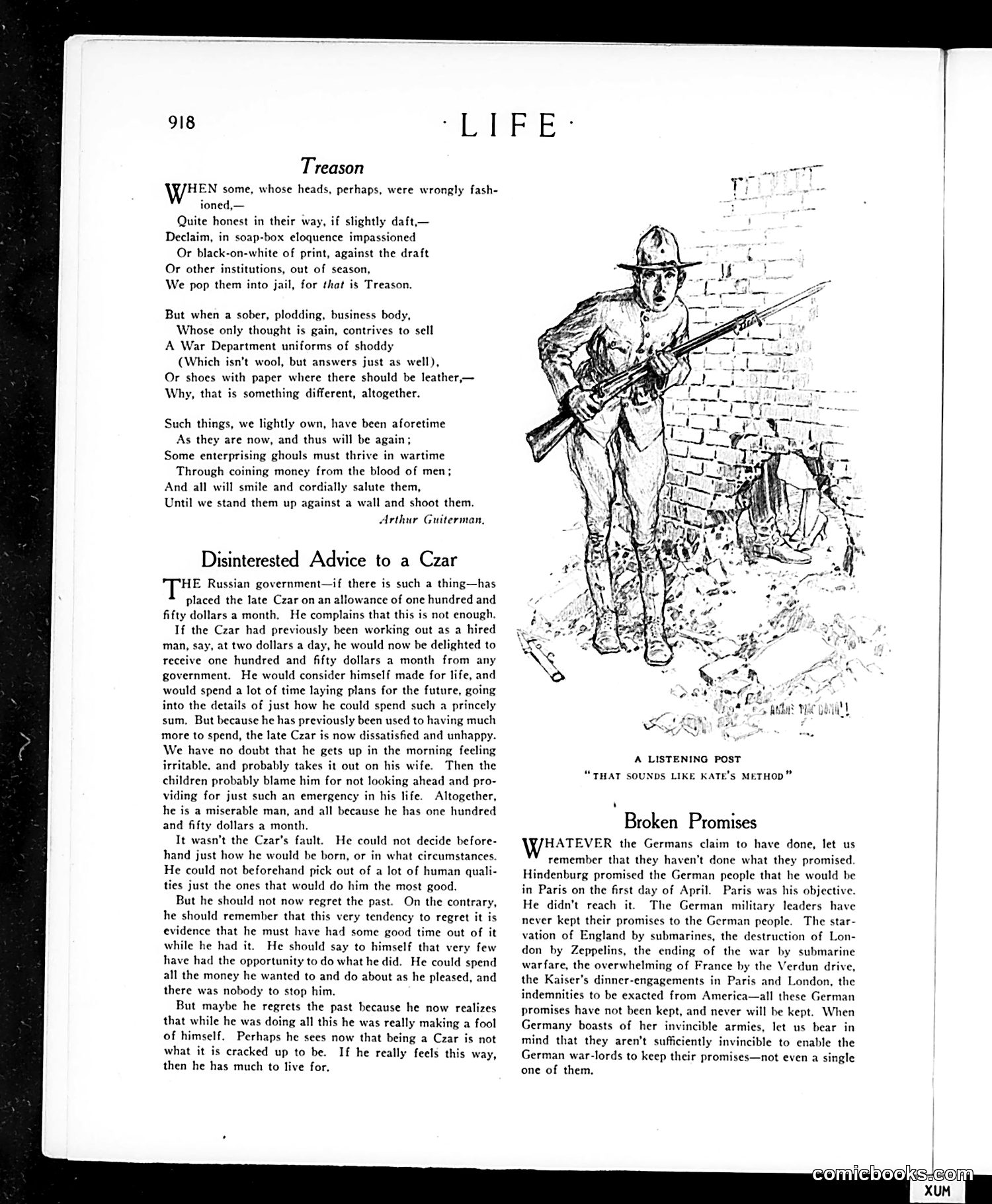
This page contains three satirical pieces critiquing wartime hypocrisy and broken promises: **"Treason"** (by Arthur Guiterman): Mocks the double standard of jailing anti-draft protesters as traitors while ignoring war profiteers who sell defective uniforms and shoes to the military—calling the latter "something different, altogether." The satire culminates with the dark joke that profiteers are only punished when "we stand them up against a wall and shoot them." **"Disinterested Advice to a Czar"**: Satirizes the deposed Russian Tsar's complaint about receiving only $150/month government allowance, arguing he should be grateful given his previous lavish lifestyle—a commentary on post-revolutionary Russian politics. **"Broken Promises"**: Lists failed German military promises (reaching Paris by April, starving England via submarine warfare, destroying London with Zeppelins), arguing Germany's boasts of invincibility are hollow. The illustration shows a soldier at a listening post, captioned "That sounds like Kate's method"—likely referencing kitchen-table gossip or domestic criticism of the war effort.
📄 Transcribed text from this page (OCR, searchable)
Machine-transcribed from the original scan — historical spelling and the odd misread are preserved.
Treason WHEN some, whose heads, perhaps, were wrongly fash- ioned,— Quite honest in their way, if slightly daft— Declaim, in soap-box eloquence impassioned Or black-on-white of print, against the draft Or other institutions, out of season, We pop them into jail, for that is Treason. But when a sober, plodding, business body, Whose only thought is gain, contrives to sell A War Department uniforms of shoddy (Which isn’t wool, but answers just as well), Or shoes with paper where there should be leather,— Why, that is something different, altogether. Such things, we lightly own, have been aforetime As they are now, and thus will be again; Some enterprising ghouls must thrive in wartime Through coining money from the blood of men; And all will smile and cordially salute them, Until we stand them up against a wall and shoot them. Arthur Guiterman, Disinterested Advice to a Czar 'HE Russian government—if there is such a thing—has placed the late Czar on an allowance of one hundred and fifty dollars a month. He complains that this is not enough. If the Czar had previously been working out as a hired man, say, at two dollars a day, he would now be delighted to receive one hundred and fifty dollars a month from any government. He would consider himself made for life, and would spend a lot of time laying plans for the future, going into the details of just how he could spend such a princely sum. But because he has previously been used to having much more to spend, the late Czar is now dissatisfied and unhappy. We have no doubt that he gets up in the morning feeling irritable, and probably takes it out on his wife. Then the children probably blame him for not looking ahead and pro- viding for just such an emergency in his life. Altogether, he is a miserable man, and all because he has one hundred and fifty dollars a month. It wasn’t the Czar’s fault. He could not decide before- hand just how he would be born, or in what circumstances. He could not beforehand pick out of a lot of human quali- ties just the ones that would do him the most good. But he should not now regret the past. On the contrar: he should remember that this very tendency to regret it is evidence that he must have had some good time out of it while he had it. He should say to himself that very few have had the opportunity to do what he did. He could spend all the money he wanted to and do about as he pleased, and there was nobody to stop him. But maybe he regrets the past because he now realizes that while he was doing all this he was really making a fool of himself. Perhaps he sees now that being a Czar is not what it is cracked up to be. If he really feels this way, then he has much to live for. LEE * A LISTENING POST “THAT SOUNDS LIKE KATE'S METHOD” Broken Promises HATEVER the Germans claim to have done, let us remember that they haven't done what they promised. Hindenburg promised the German people that he would be in Paris on the first day of April. Paris was his objective. He didn’t reach it. The German military leaders have never kept their promises to the German people. The star- vation of England by submarines, the destruction of Lon- don by Zeppelins, the ending of the war by submarine warfare, the overwhelming of France by the Verdun drive, the Kaiser's dinner-engagements in Paris and London, the indemnities to be exacted from America—all these German promises have not been kept, and never will be kept. When Germany boasts of her invincible armies, let us bear in mind that they aren't sufficiently invincible to enable the German war-lords to keep their promises—not even a single one of them,