
A complete issue · 40 pages · 1918
Life — April 4, 1918
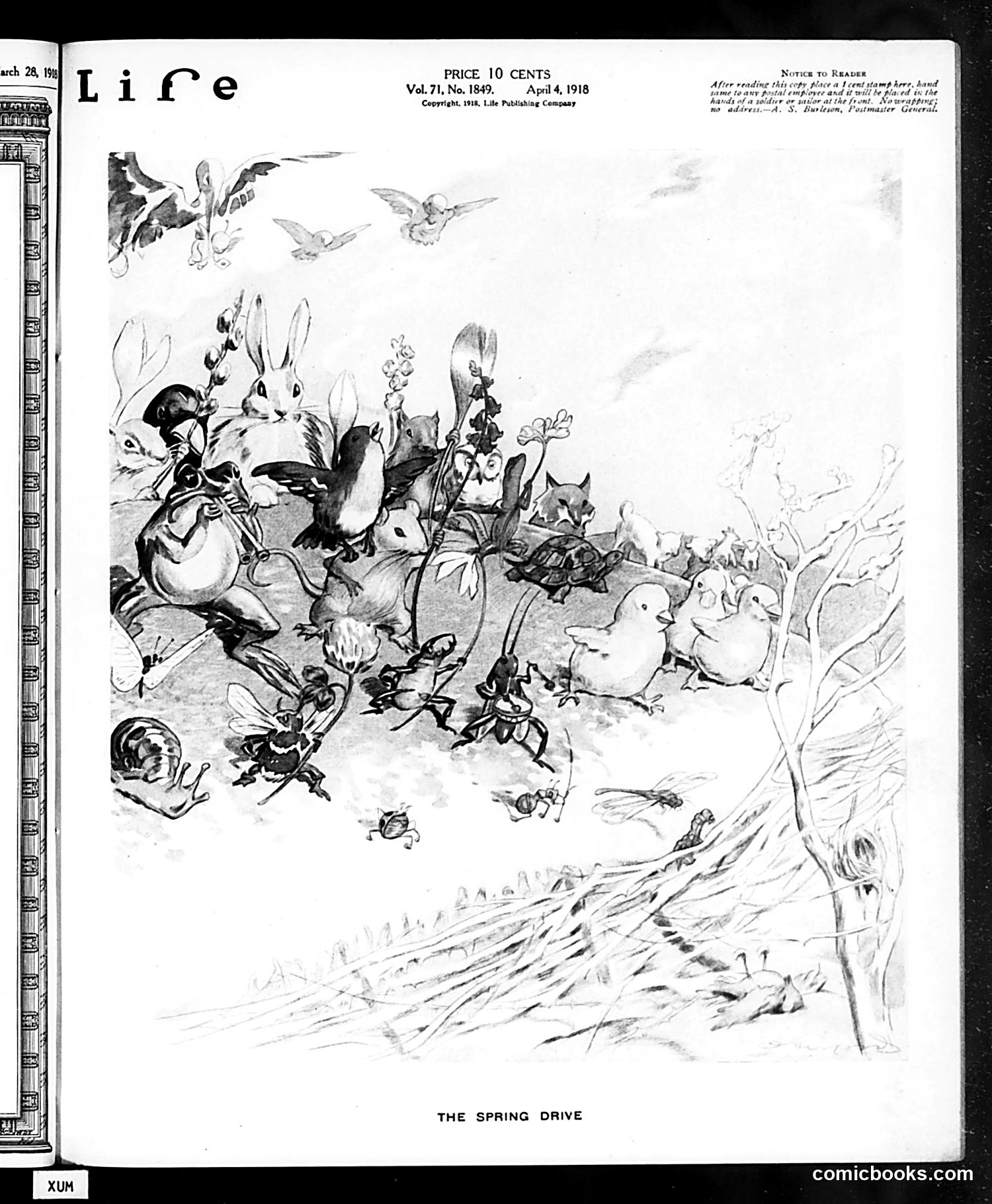
This whimsical illustration depicts anthropomorphized animals—rabbits, birds, a turtle, and other creatures—engaged in what appears to be a springtime migration or gathering. The title "The Spring Drive" suggests seasonal movement rather than political satire. However, given the April 1918 publication date (during WWI's final year), the image may contain allegorical commentary. The animals appear organized or mobilized, possibly referencing wartime conscription, resource mobilization, or social organization efforts. The varied creatures could symbolize different social classes or nations working together. The artistic style is typical of Life's whimsical cover illustrations. Without clearer identifying marks or contextual captions, the specific satirical intent remains ambiguous—it may simply be seasonal humor rather than political commentary.
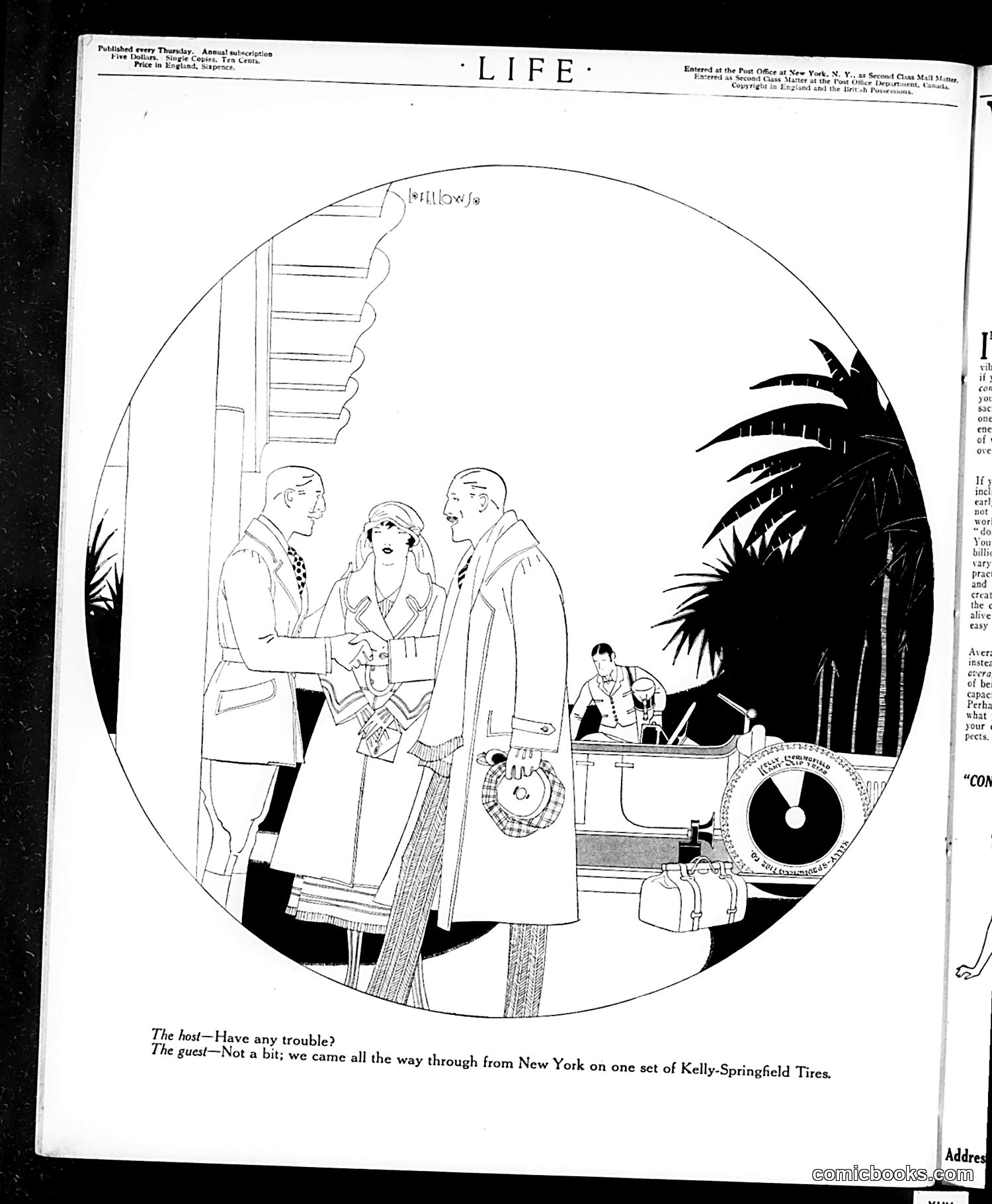
This is a **car advertisement disguised as humor**. The cartoon depicts a social scene where a host asks a guest if they had any travel troubles. The guest's response—that they drove from New York without any problems using Kelly-Springfield Tires—is the punchline and sales pitch. The satire targets the **emerging automobile culture** and travel experiences of the wealthy. The scene shows luxurious details (palm plants, fashionable clothing, servants) to suggest upscale clientele. By presenting tire reliability as a social conversation point among the affluent, the ad humorously suggests that trouble-free long-distance driving is now an expected luxury amenity. This represents **early 1900s advertising strategy**: embedding product endorsements within comedic magazine content to reach desirable consumers.
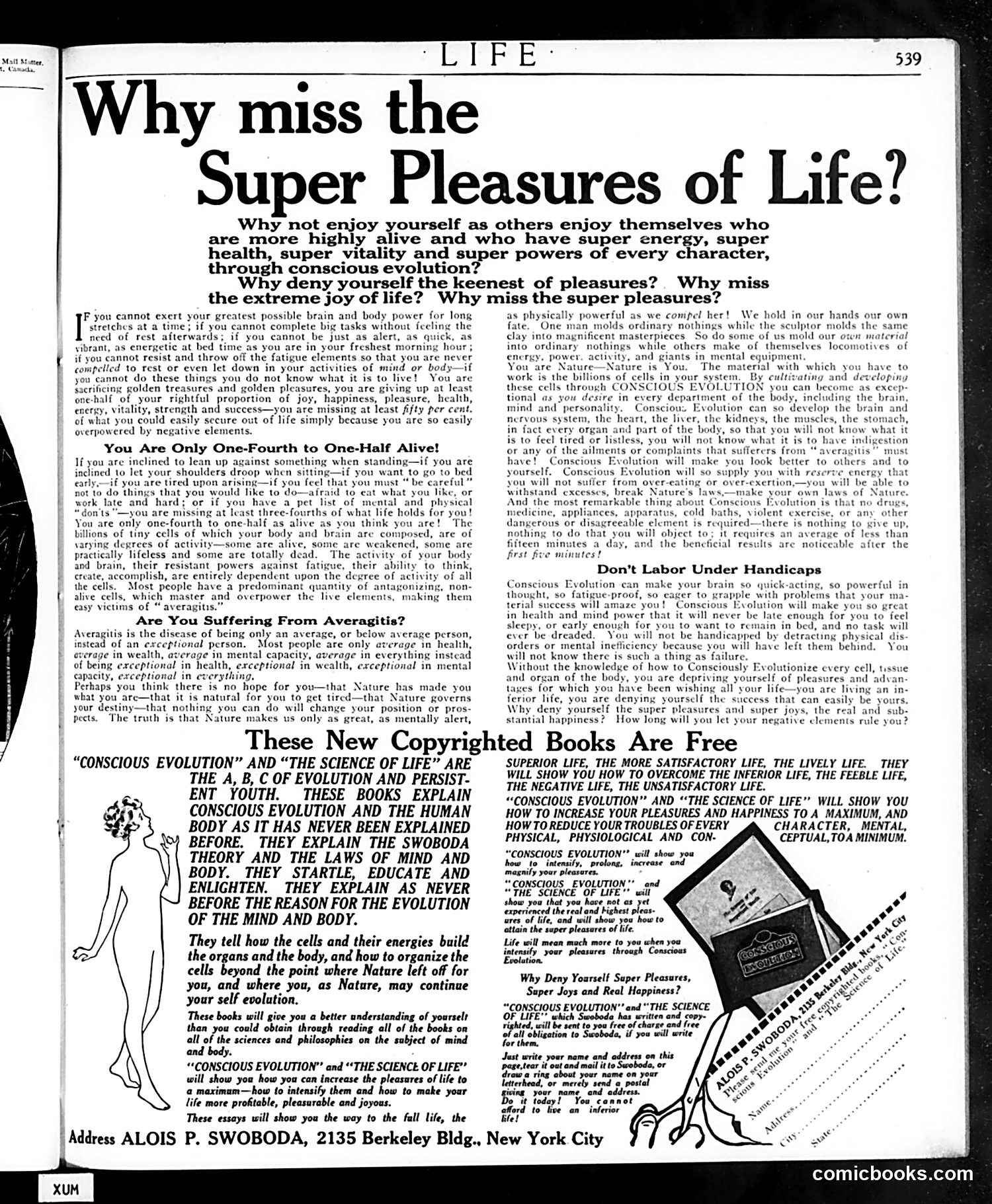
This page is primarily **advertising rather than satire or editorial content**. The large headline "Why miss the Super Pleasures of Life?" introduces promotional material for two books: "Conscious Evolution" and "The Science of Life," published by Alois P. Swoboda. The two illustrated figures (appearing to be classical male and female nudes) are generic representations used to suggest health, vitality, and physical perfection—common tropes in early 20th-century wellness advertising. The text promises these books will explain "conscious evolution" and reveal secrets to overcoming life's problems, maximize pleasure, and achieve superior physical and mental health. This appears to be **pseudo-scientific self-help marketing**, typical of the era, rather than satirical content mocking any particular political or social target.
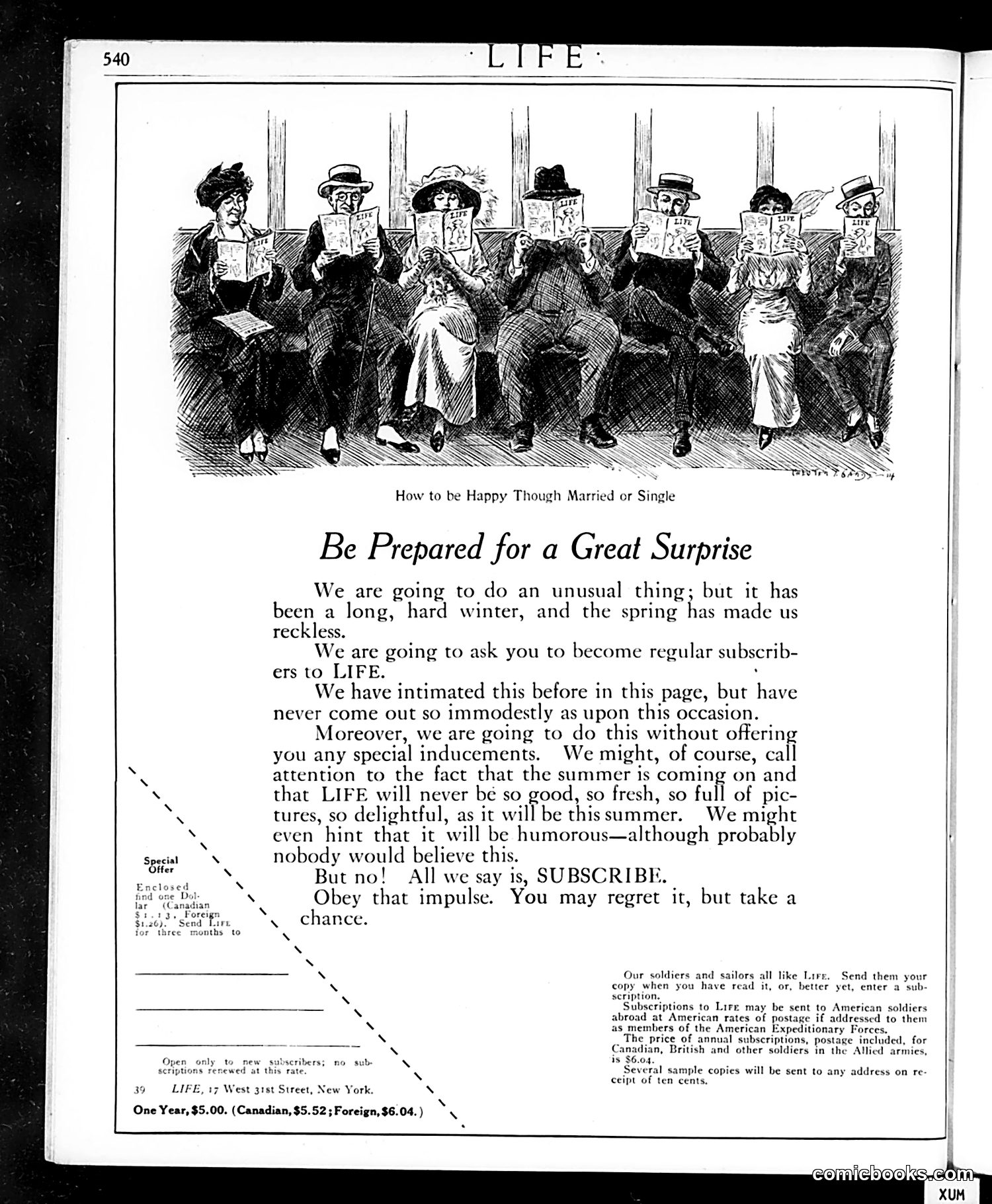
This page is primarily a **subscription advertisement** for *Life* magazine rather than a political cartoon. The illustration at top shows seven people reading newspapers on public transit, titled "How to be Happy Though Married or Single." The ad's humor is self-promotional: the editors jokingly claim they're making an "unusual" and "immodest" request by asking readers to subscribe. They emphasize *Life* will be "so good, so fresh, so full of pictures, so delightful" this summer, and hint it "will be humorous"—while admitting "probably nobody would believe this." The tone is tongue-in-cheek flattery. Rather than offering special incentives, they simply command: "SUBSCRIBE. Obey that impulse." The joke relies on *Life's* reputation for quality satire and humor to make the bold pitch itself entertaining.
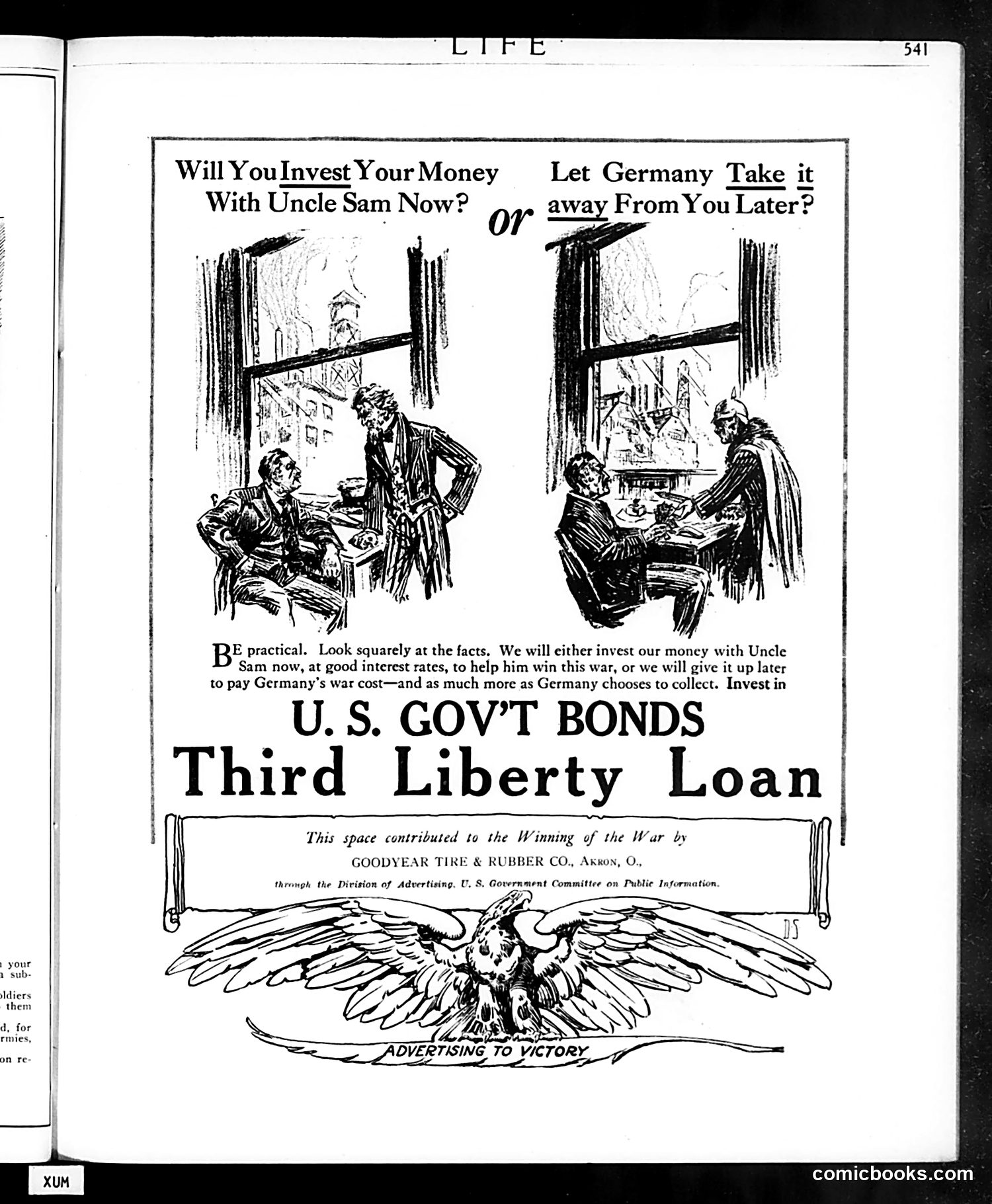
This is a World War I fundraising advertisement for the Third Liberty Loan bond drive. The cartoon presents a stark choice: invest money in U.S. government bonds now at good interest rates, or later be forced to pay Germany's war costs through reparations or occupation. The left panel shows a man discussing bonds with Uncle Sam (representing the U.S. government). The right panel depicts the same man meeting with a German officer—implying financial devastation if America doesn't fund the war effort. The message is propagandistic: voluntary investment now is preferable to involuntary payment later. The eagle and "Advertising to Victory" tagline reinforce patriotic duty. The ad was contributed by Goodyear Tire & Rubber Company through the U.S. Government Committee on Public Information.
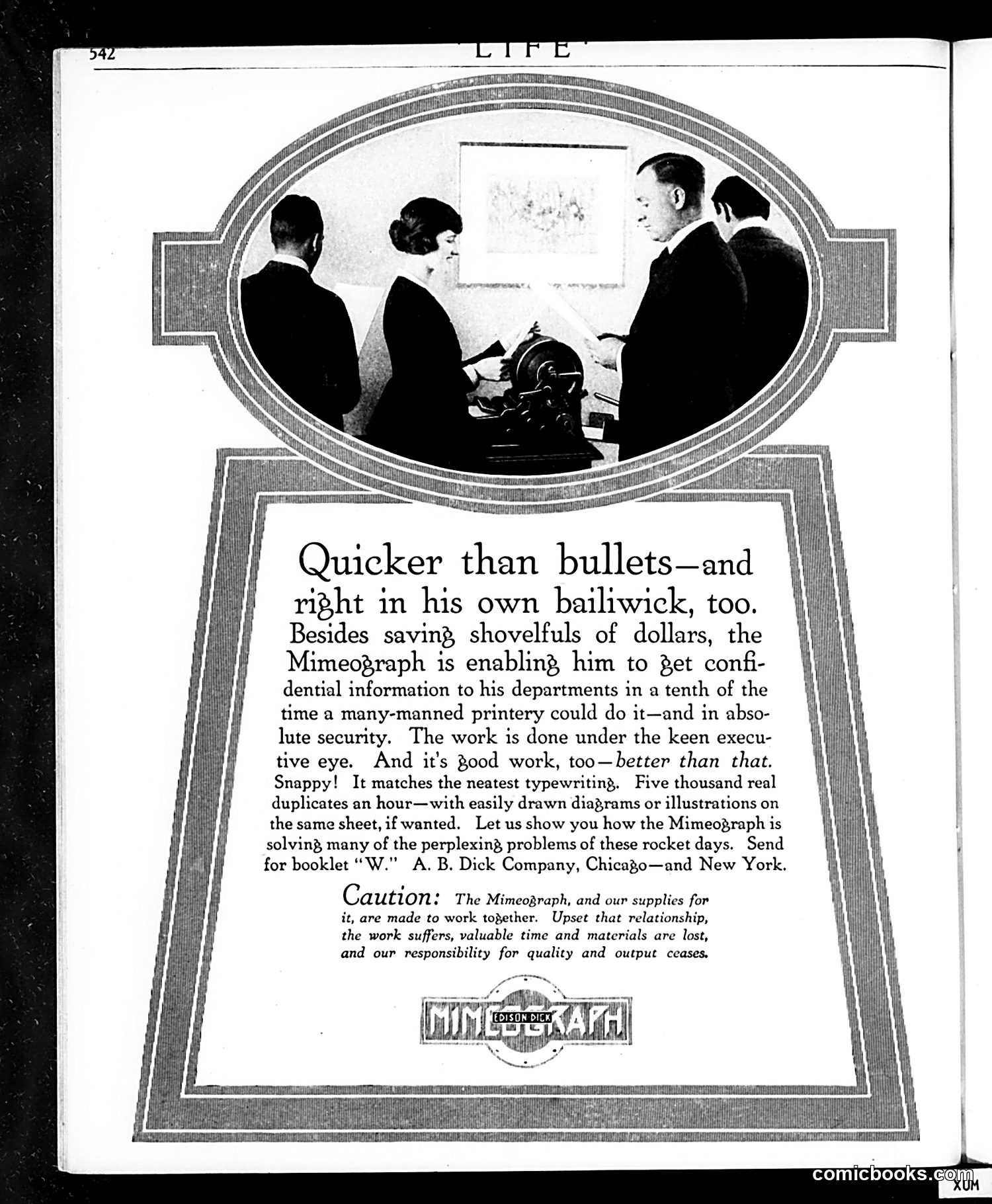
This is a **Mimeograph machine advertisement** from A. B. Dick Company, not a political cartoon. The image shows five businessmen in an office examining a Mimeograph device—an early duplicating machine. The ad's headline "Quicker than bullets" uses metaphorical language to emphasize the machine's speed for producing documents. The text claims the Mimeograph enables confidential information distribution to departments rapidly and securely, allegedly faster and cheaper than traditional printing methods. The "Caution" section warns users that improper supplies can damage output quality, establishing a business relationship between the manufacturer and customers. This represents early-20th-century office technology marketing, targeting businesses seeking efficient document reproduction solutions.
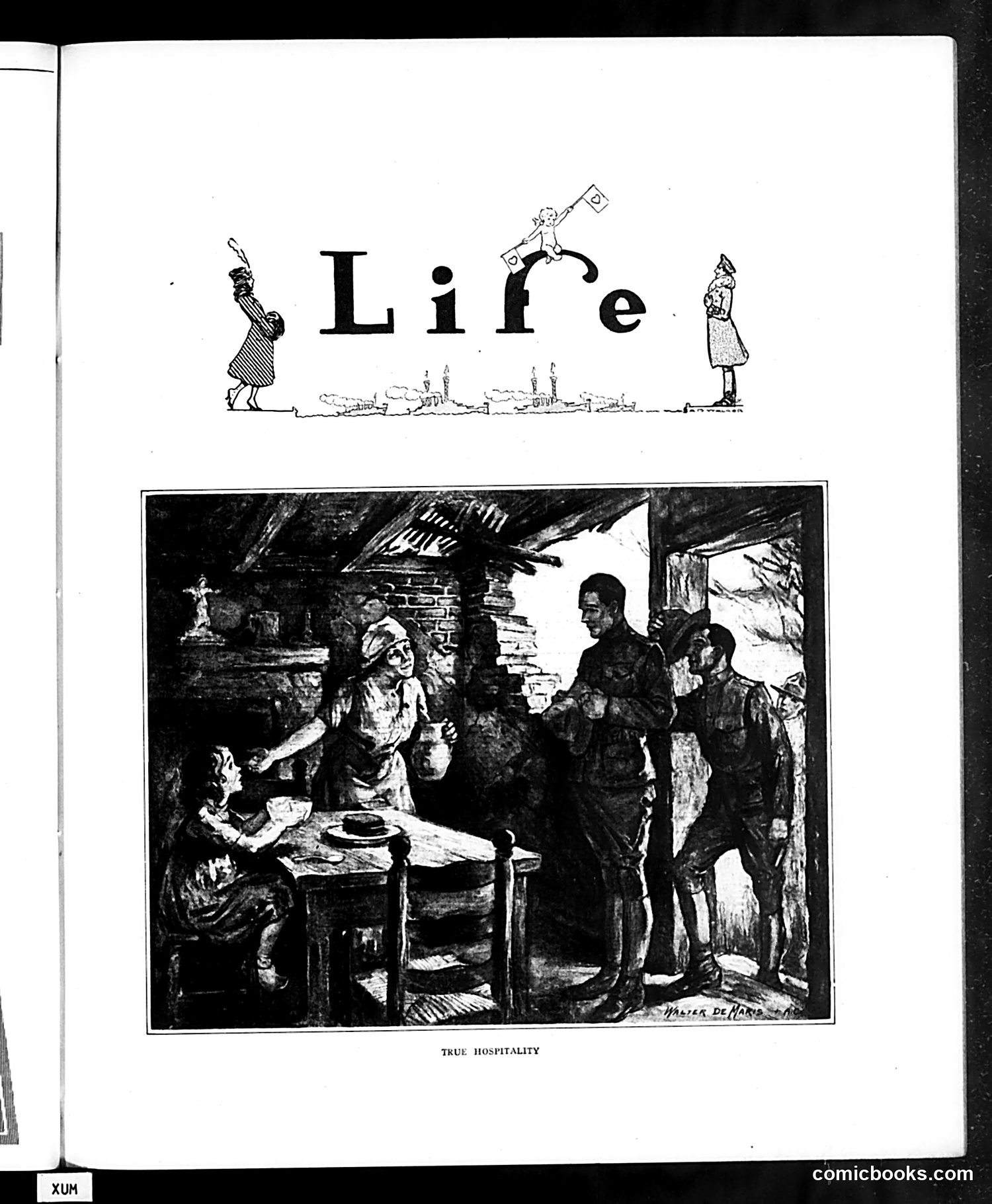
This page from the satirical magazine *Life* features an illustration titled "True Hospitality" by Marion de Mares (visible signature). The black-and-white sketch depicts a domestic interior scene where a woman (seated, left) appears to be hosting visitors—a man and what seems to be two other guests standing in her modest home. The satire likely comments on working-class or immigrant hospitality customs, contrasting formal social conventions with genuine warmth. The cramped, humble setting and the woman's animated gesture suggest the cartoon is celebrating authentic generosity despite modest means—possibly mocking upper-class pretension by showing "true hospitality" exists among ordinary people rather than the wealthy. The exact historical context remains unclear without additional publication details.
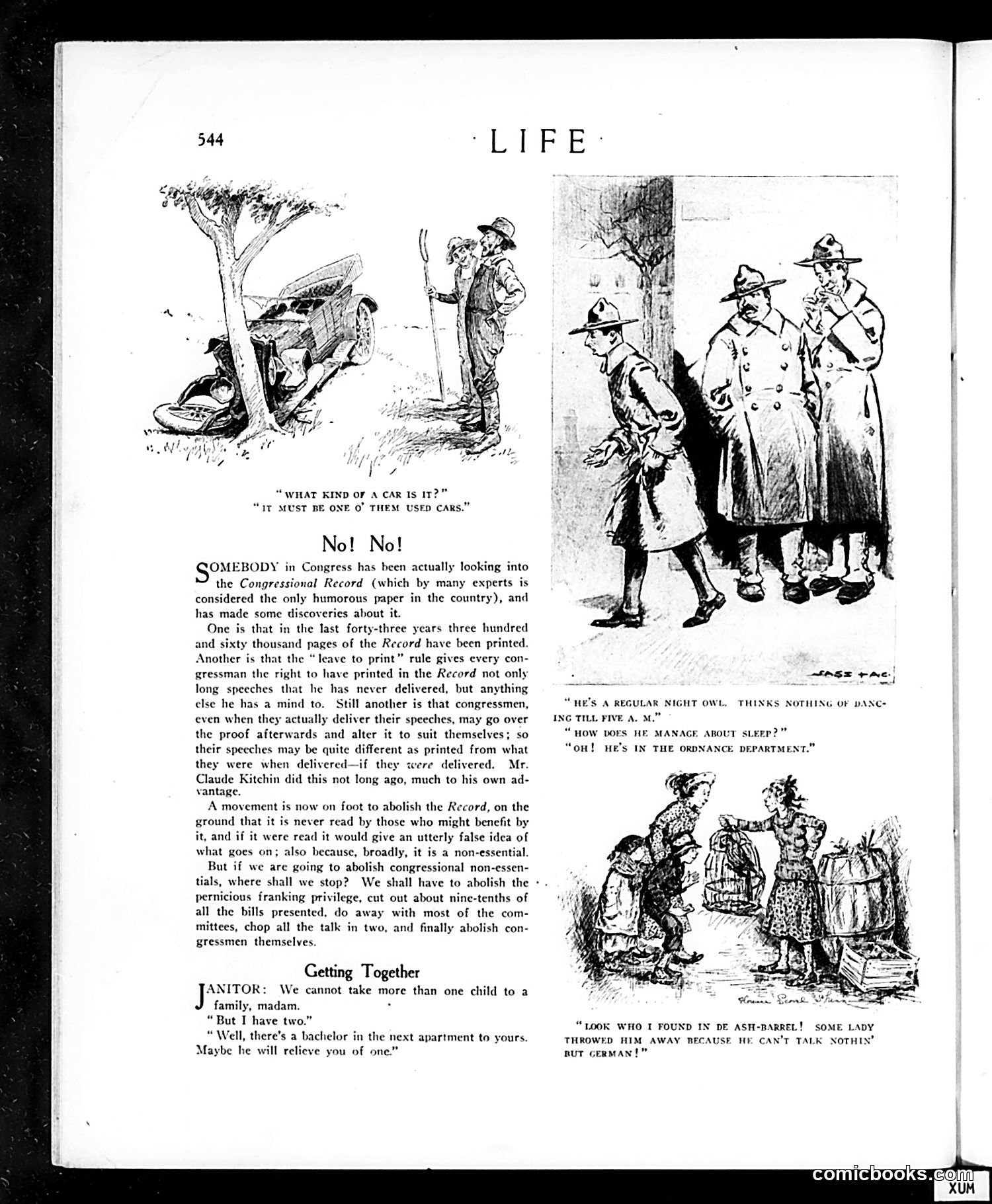
This page contains political satire about the **Congressional Record**—the official printed transcript of congressional proceedings. The main article argues against abolishing it, despite its massive length (over 300,000 pages in 43 years). The author criticizes Congress members who alter their speeches after delivery before publication, calling this deceptive. The cartoon at top satirizes a wrecked car, with one figure asking "What kind of car is it?" and another responding "It must be one of them used cars"—likely mocking congressmen who extensively revise their speeches, making them "used" or secondhand versions of what was actually spoken. The accompanying comic illustrations are humorous vignettes unrelated to the main article.
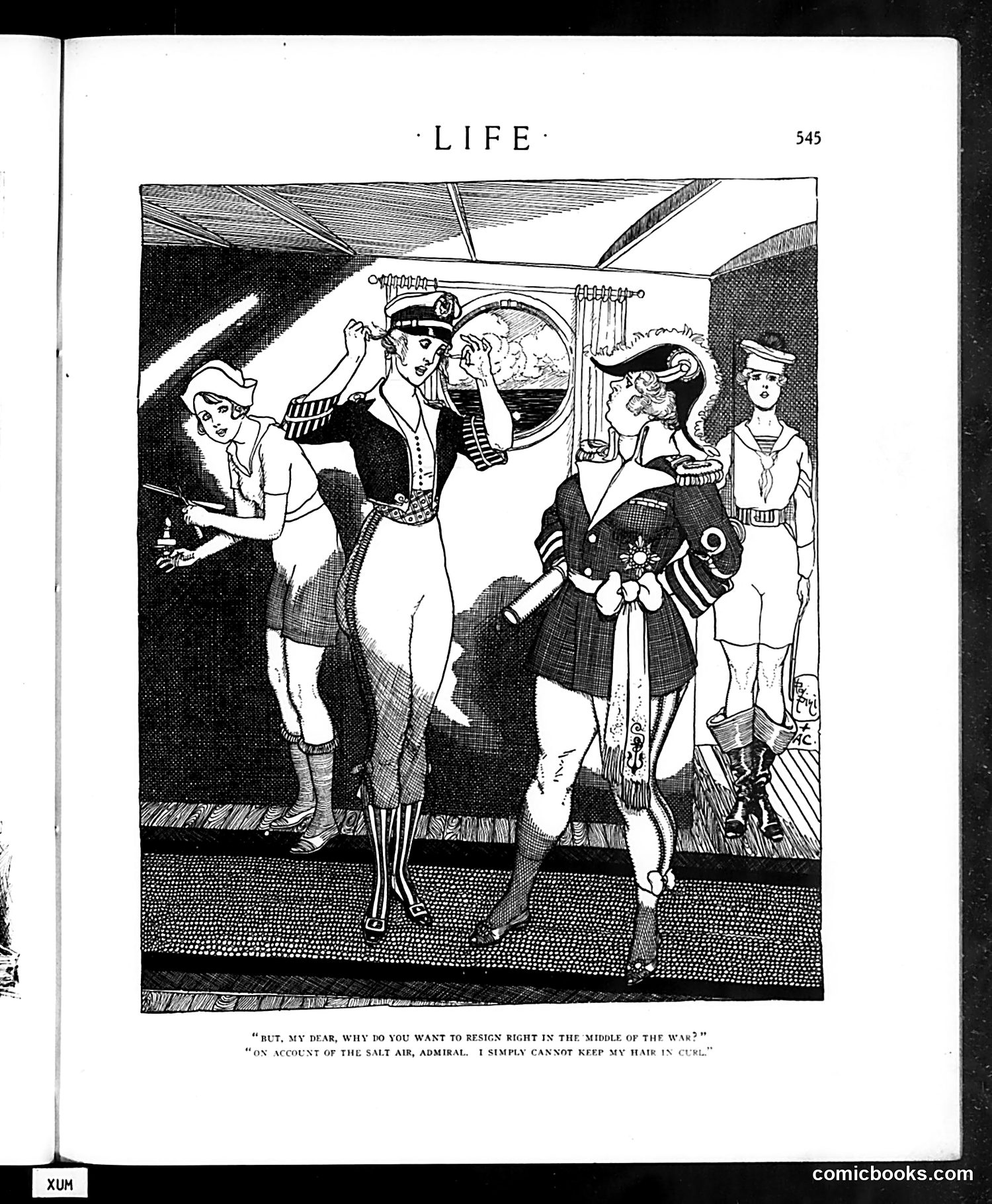
This illustration from *Life* magazine depicts a scene aboard what appears to be a naval vessel during wartime. The central female figure, dressed in military uniform with insignia, is surrounded by sailors and naval personnel in a ship's interior. The caption reveals the satire: a woman officer is resigning from military service, claiming she "cannot keep [her] hair in curl" due to the salt air—a frivolous, vanity-based reason contrasted against wartime duty. The joke mocks women in military roles, suggesting they prioritize personal appearance over serious wartime commitment. This reflects early-to-mid 20th century attitudes questioning whether women belonged in uniform, using humor to undermine their professional credibility by portraying them as vain and unsuitable for military service.
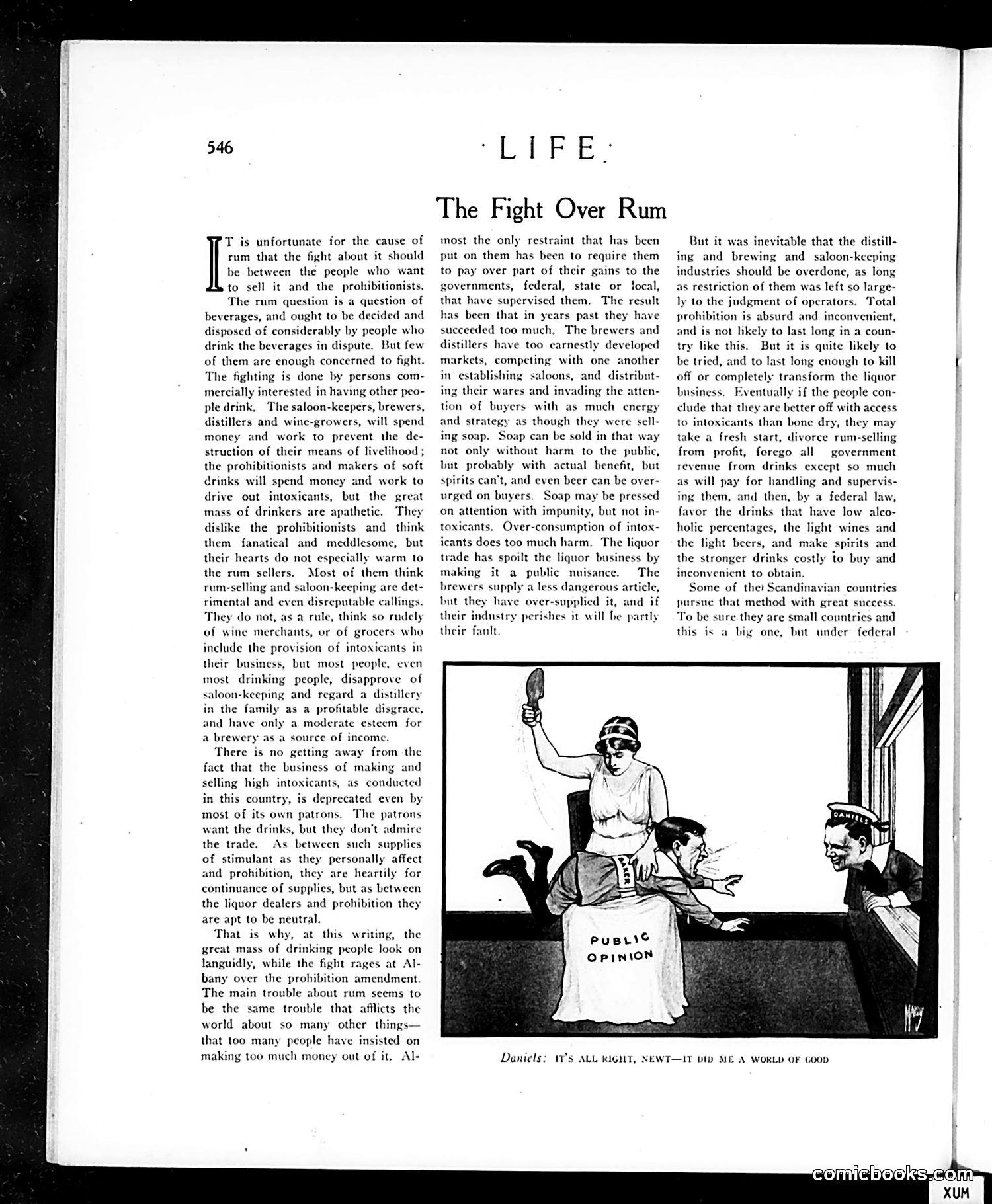
This page discusses Prohibition-era debates about alcohol regulation. The accompanying cartoon depicts "Public Opinion" (personified as a woman on a pedestal) being courted or pressured by two men—likely representing competing interests in the rum/liquor trade debate. The article argues that the liquor industry's problem stems from making excessive profits rather than from Prohibition itself. It criticizes distillers and brewers for oversupplying markets and establishing saloons, while acknowledging that most people dislike saloon-keeping as a "profitable disgrace." The caption reads: "Daniels: It's all right, Newt—it did me a world of good," suggesting commentary on political figures' stances on alcohol policy during this contentious period of American history.
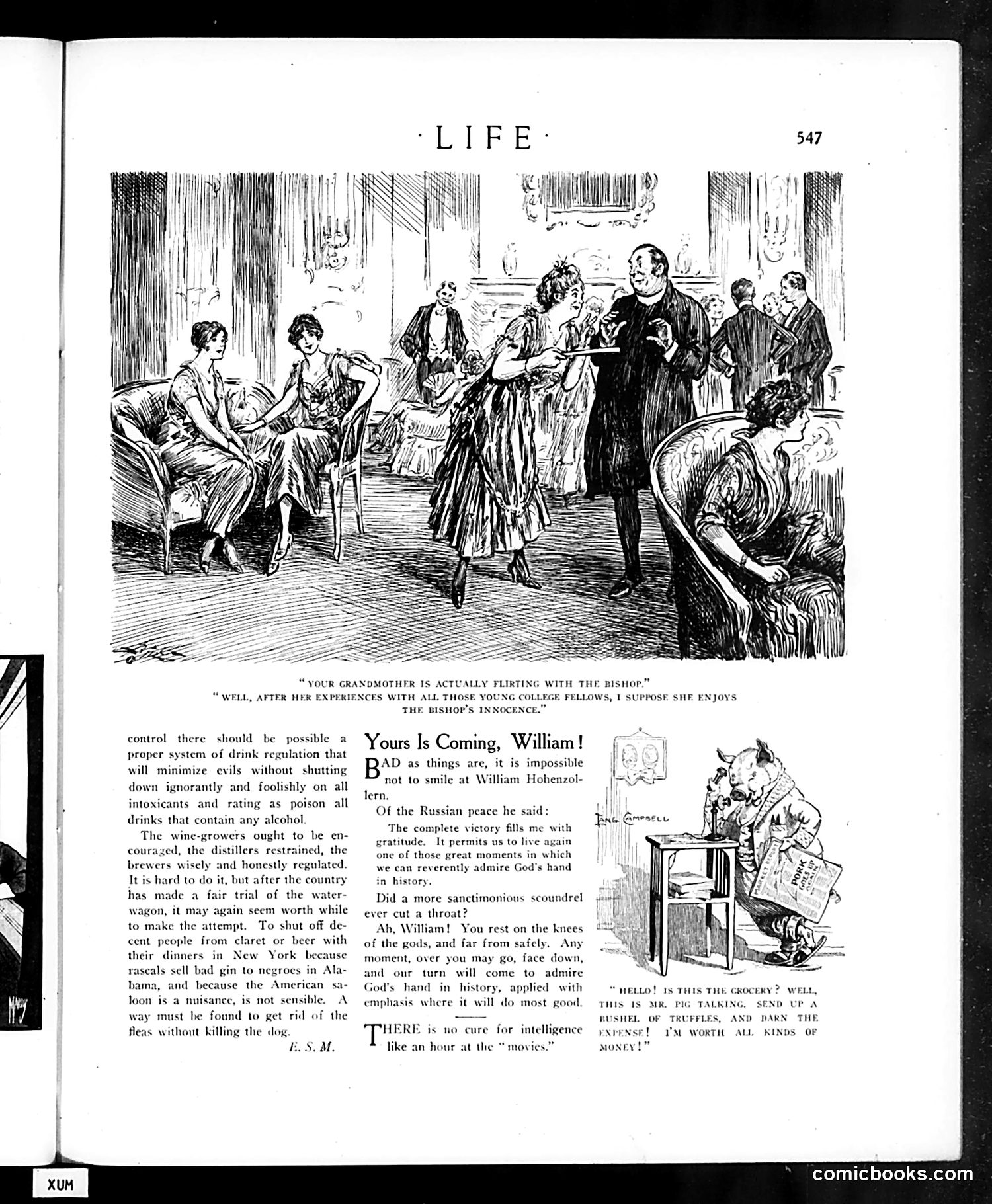
**Top Illustration:** A social gathering showing a woman flirting with a Bishop (clergy figure in dark robes), with the caption suggesting her grandmother is "actually flirting with the bishop" and implying she enjoys his "innocence." This satirizes wealthy society women's behavior and hypocrisy regarding clergy and morality. **"Yours Is Coming, William!" Section:** A commentary on William Hohenzollern (Kaiser Wilhelm II of Germany). The text expresses relief that Russia's peace treaty allows admiration of "God's hand in history," while sarcastically suggesting William should "rest on his knees" as divine judgment approaches him—a pointed reference to Germany's expected military defeat. **Bottom Comic:** A domestic scene about someone named "Mr. Fig" talking on a telephone about a movie ("crocky"), mocking lowbrow entertainment culture.
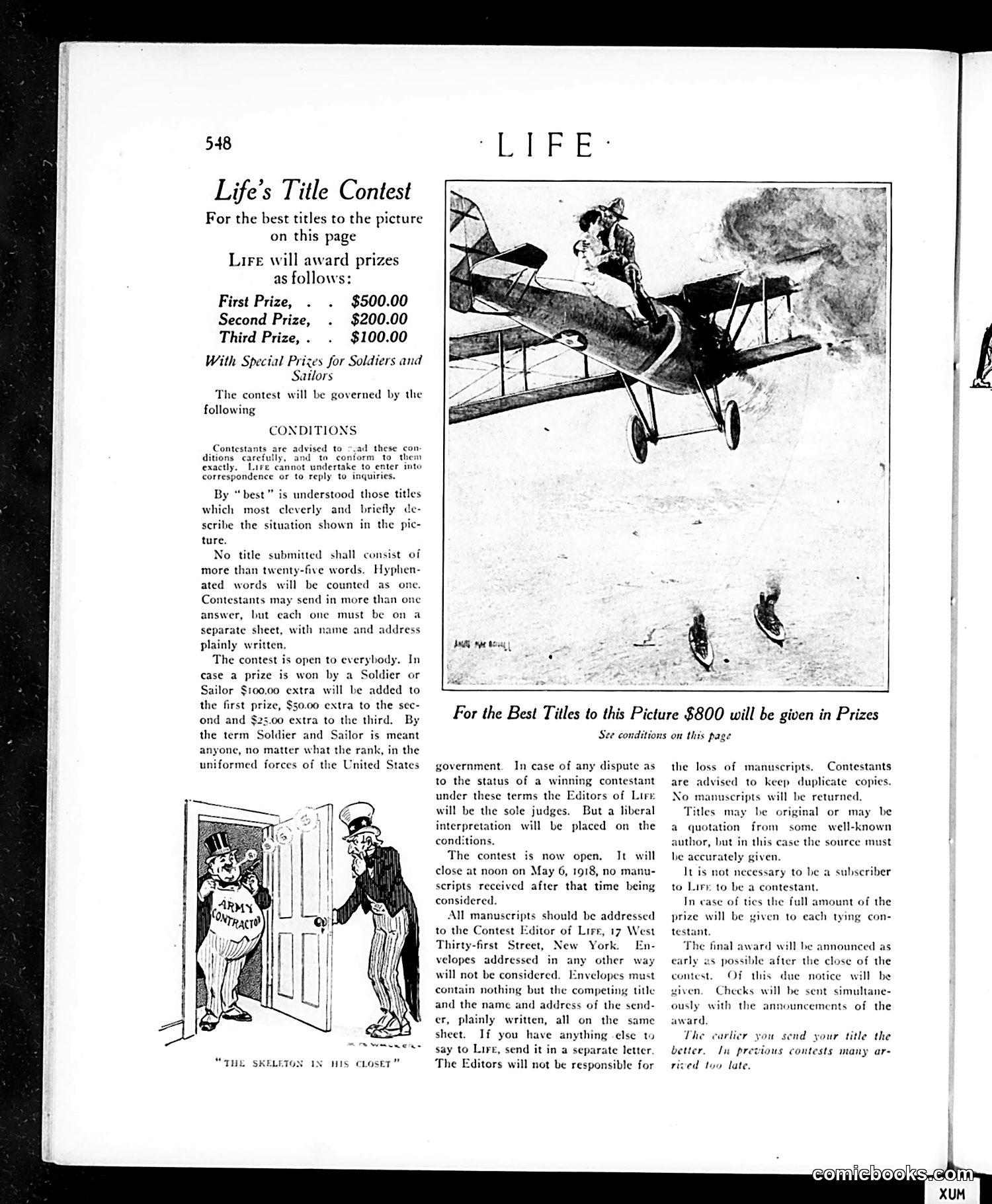
This page is primarily a **contest announcement** rather than satirical content. Life magazine is soliciting reader submissions for humorous titles describing the main photograph—an early airplane with people aboard and others on the ground below. The contest offers $800 in prizes ($500 first place), with **bonus payments specifically for military personnel** ("Soldiers and Sailors"). This reflects the **World War I era context** (the contest closes May 6, 1918), when the magazine was actively encouraging patriotic participation from uniformed service members. The small cartoon at bottom left ("The Skeleton in His Closet") appears unrelated—a separate joke about someone hiding something in a wardrobe. The page serves primarily as a **marketing/engagement tool** rather than political satire, though the military emphasis suggests the war effort's cultural prominence at that moment.
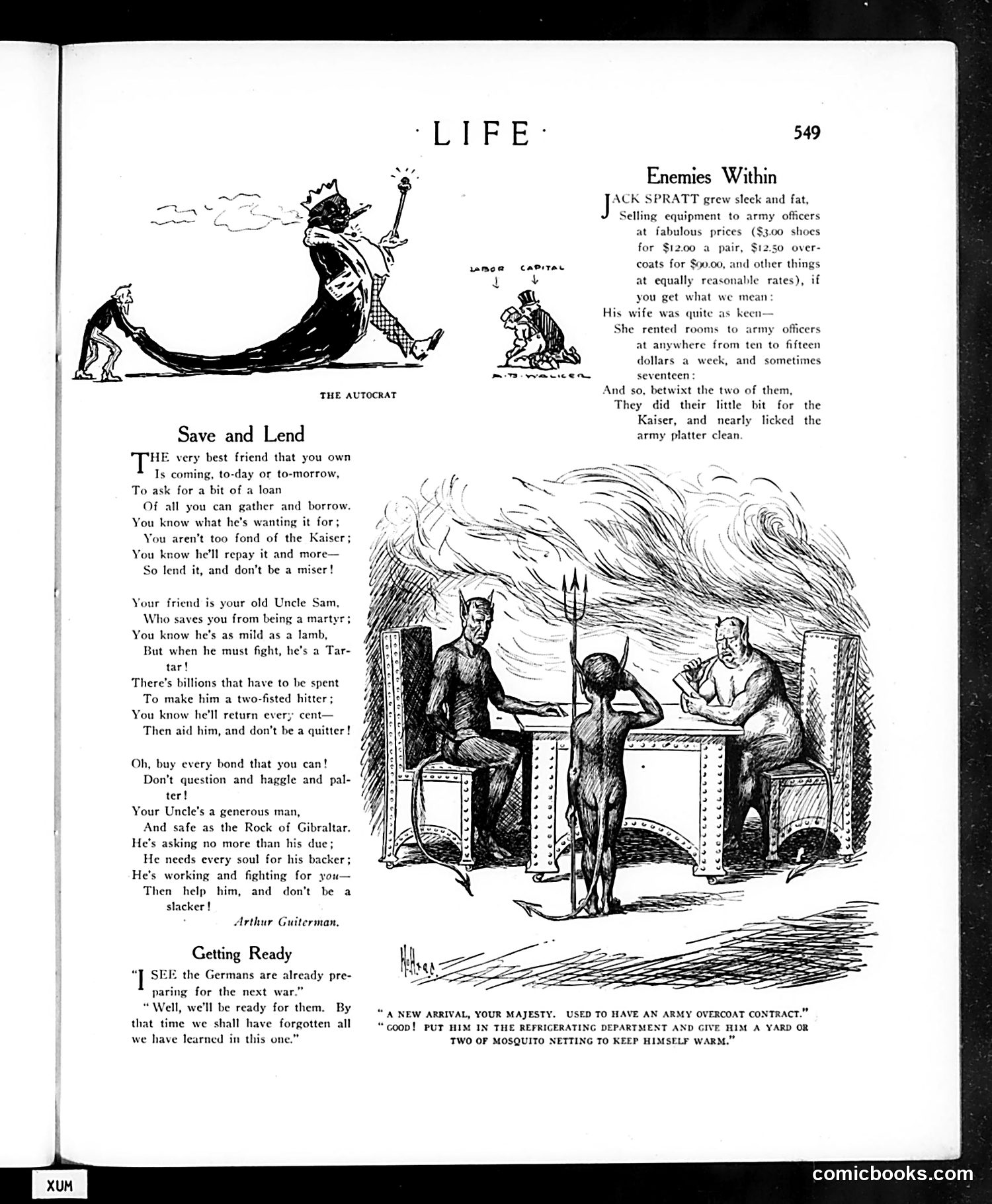
This page contains WWI-era propaganda and satire from an American magazine. The top cartoon, "The Autocrat," depicts Lady Liberty being dragged by a figure labeled "LARGE CAPITAL," satirizing wealthy industrialists profiting from war. "Save and Lend" is a patriotic poem encouraging Americans to purchase war bonds to support "Uncle Sam" (the U.S. government) in fighting Germany—a major fundraising campaign during WWI. "Getting Ready" quotes Germans preparing for future war, reflecting American concerns about German militarism. The lower cartoon mocks military inefficiency, showing soldiers struggling with bureaucratic solutions (an overcoat contract and mosquito netting) rather than practical wartime supplies—likely criticizing procurement failures or officer incompetence during the war effort.
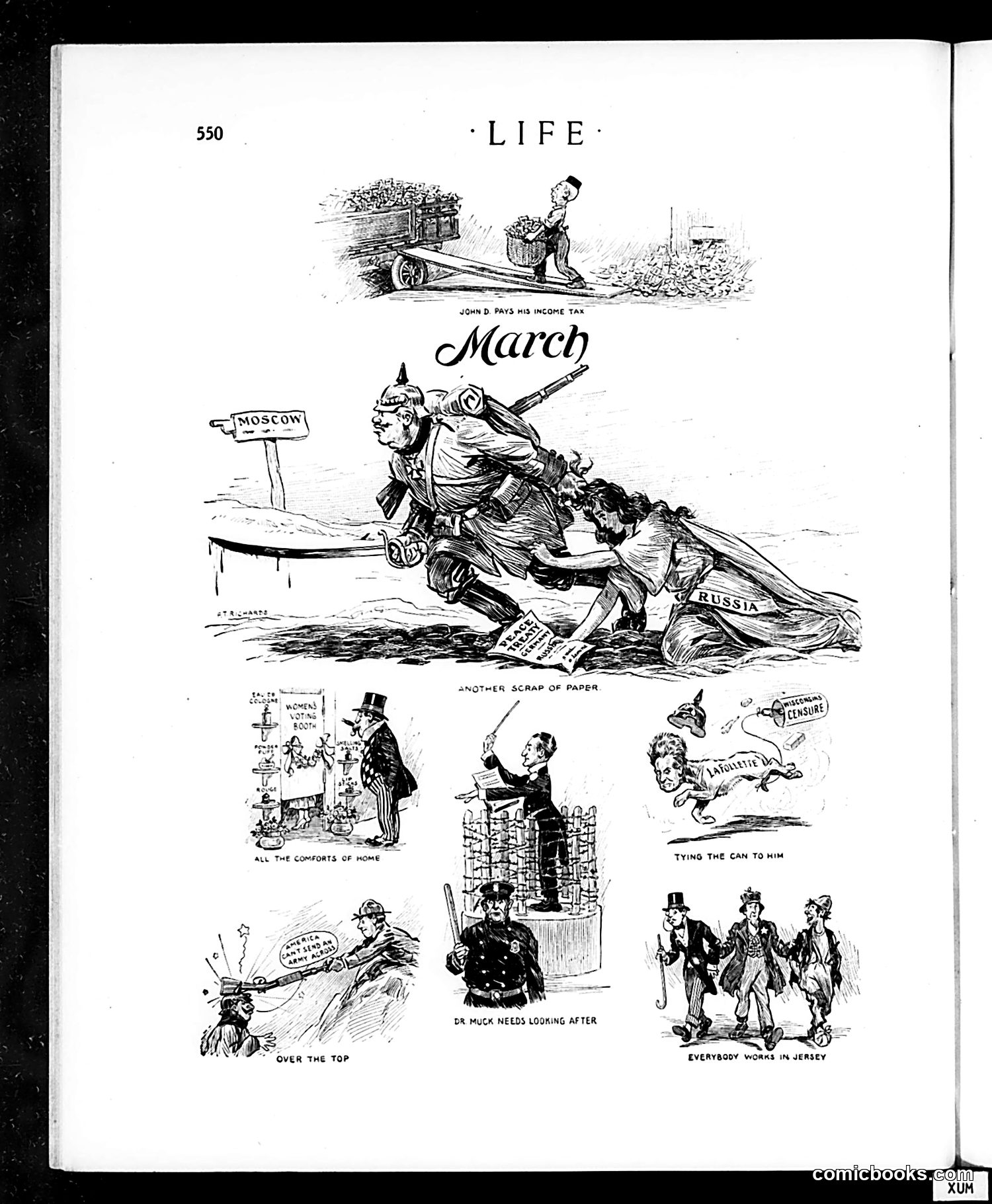
This page presents multiple satirical cartoons commenting on early 20th-century political and social issues: **Top cartoon**: Shows a figure labeled "Moscow" with military dress stabbing or attacking a prone figure labeled "Russia," captioned "Another Scrap of Paper." This appears to reference the Russian Revolution and Bolshevik seizure of power, satirizing Lenin's government as destructive to Russia itself. **Other cartoons** address: income tax obligations ("John D. Pays His Income Tax"), domestic concerns ("All the Comforts of Home"), military/government oversight ("Da Muck Needs Looking After"), and labor ("Everybody Works in Jersey"). The cartoons employ caricature and personification to mock political figures, government bureaucracy, and wartime/post-war tensions—typical of Life's satirical commentary on contemporary affairs.
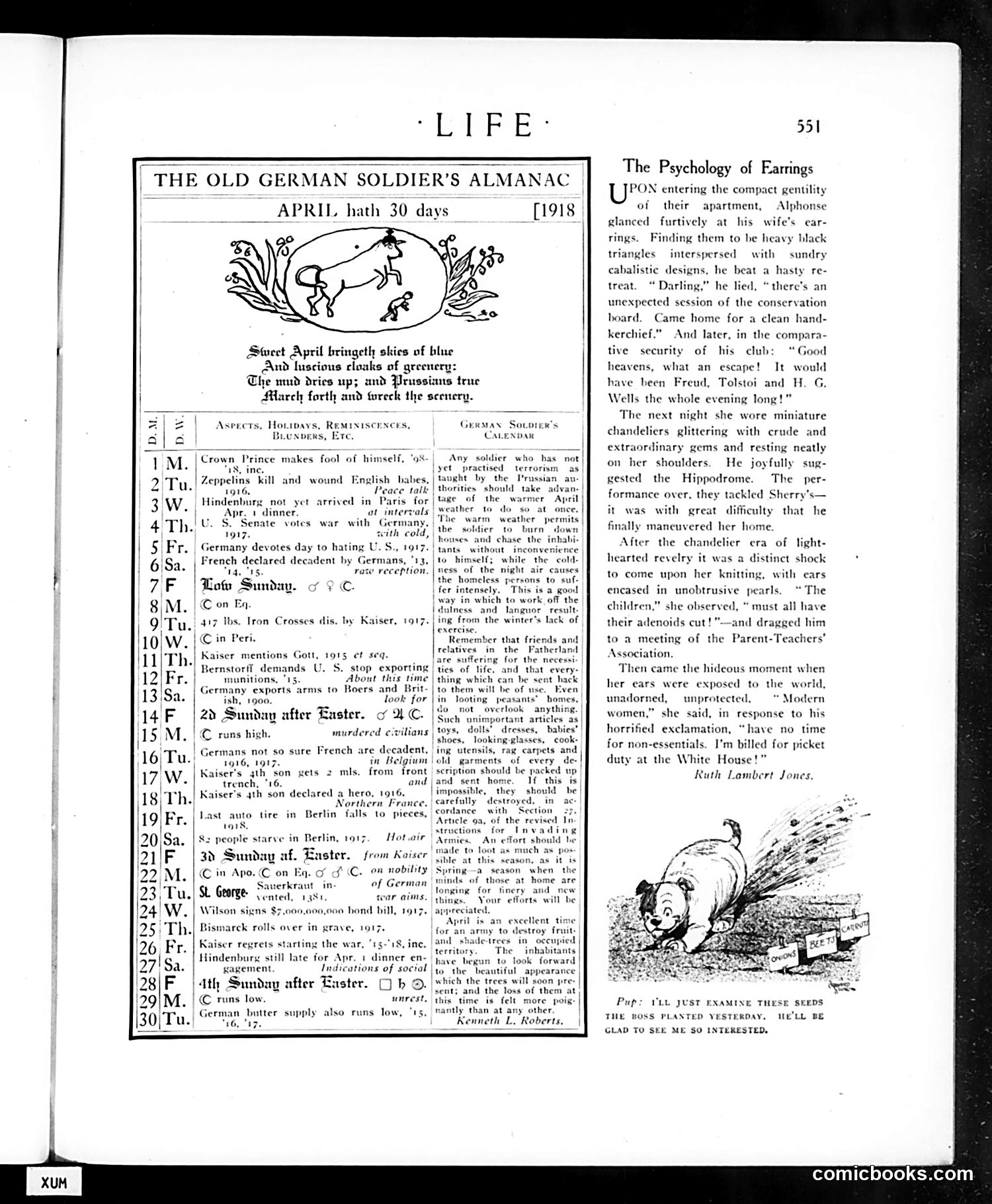
This page contains a short humorous story about a husband named Alphonse examining his wife's heavy, ornate earrings. He finds them visually striking but impractical, joking about "an unexpected session of the conservatory board" and later praising them to his club as proof of their wealth and taste—though he privately wishes for simpler jewelry. The accompanying cartoon (bottom right) shows a man examining seeds, with the caption suggesting the seeds will grow into something worthwhile—a visual pun contrasting with the earring story's theme of examining decorative objects. The left side includes "The Old German Soldier's Almanac" for April 1918, a dated WWI-era satirical calendar mocking German military life during wartime.
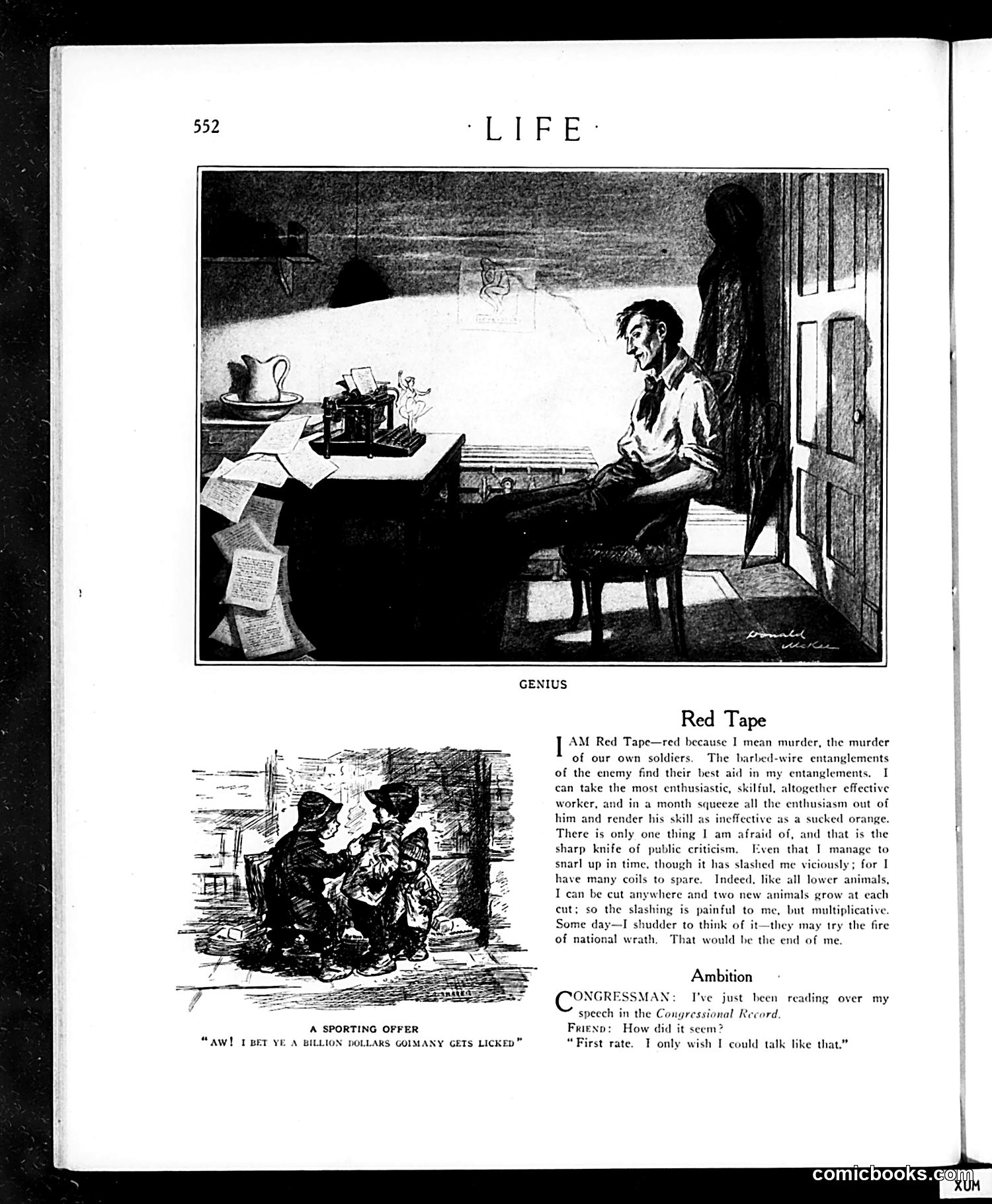
**Top Cartoon ("Genius"):** Depicts a writer or journalist at a desk surrounded by papers, facing a stern figure in the doorway—likely representing editorial authority or censorship during wartime. **Main Feature ("Red Tape"):** A personified "Red Tape" character delivers a first-person monologue about bureaucratic obstruction during what appears to be World War I. Red Tape boasts of hampering military effectiveness through administrative entanglement, killing soldier enthusiasm, and evading public criticism. It claims invulnerability except to "national wrath." **Lower Cartoon ("A Sporting Offer"):** Two soldiers bet that Germany will be defeated—a confident prediction of Allied victory. **Historical Context:** This satirizes WWI-era military bureaucracy and inefficiency. The Red Tape piece particularly criticizes how administrative procedures supposedly undermine military morale and effectiveness, while resisting public accountability. The page critiques both wartime governmental dysfunction and self-serving institutional resistance to reform.
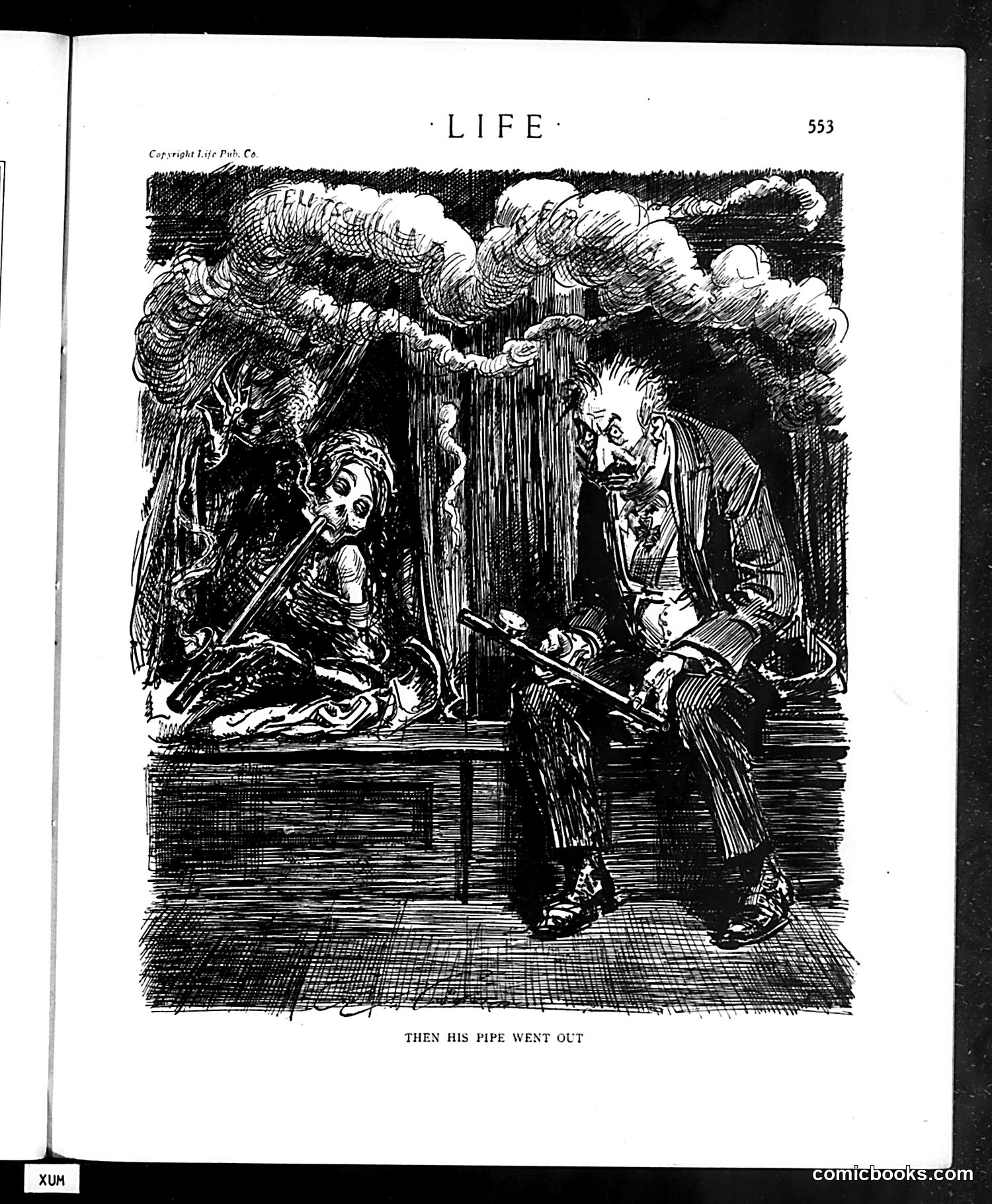
This cartoon depicts two men in suits sitting in what appears to be a formal interior setting, likely an office or establishment. Both are drawn with caricatured features suggesting they may represent specific public figures, though their identities aren't explicitly labeled on this page. The caption "Then His Pipe Went Out" suggests a moment of deflation or disappointment—a common satirical device. The exaggerated expressions and body language indicate the humor involves one character experiencing some form of comeuppance or loss of status/confidence. Without additional context about the publication date or surrounding articles, the specific political or social commentary remains unclear, though the style suggests early-to-mid 20th century American satirical humor.
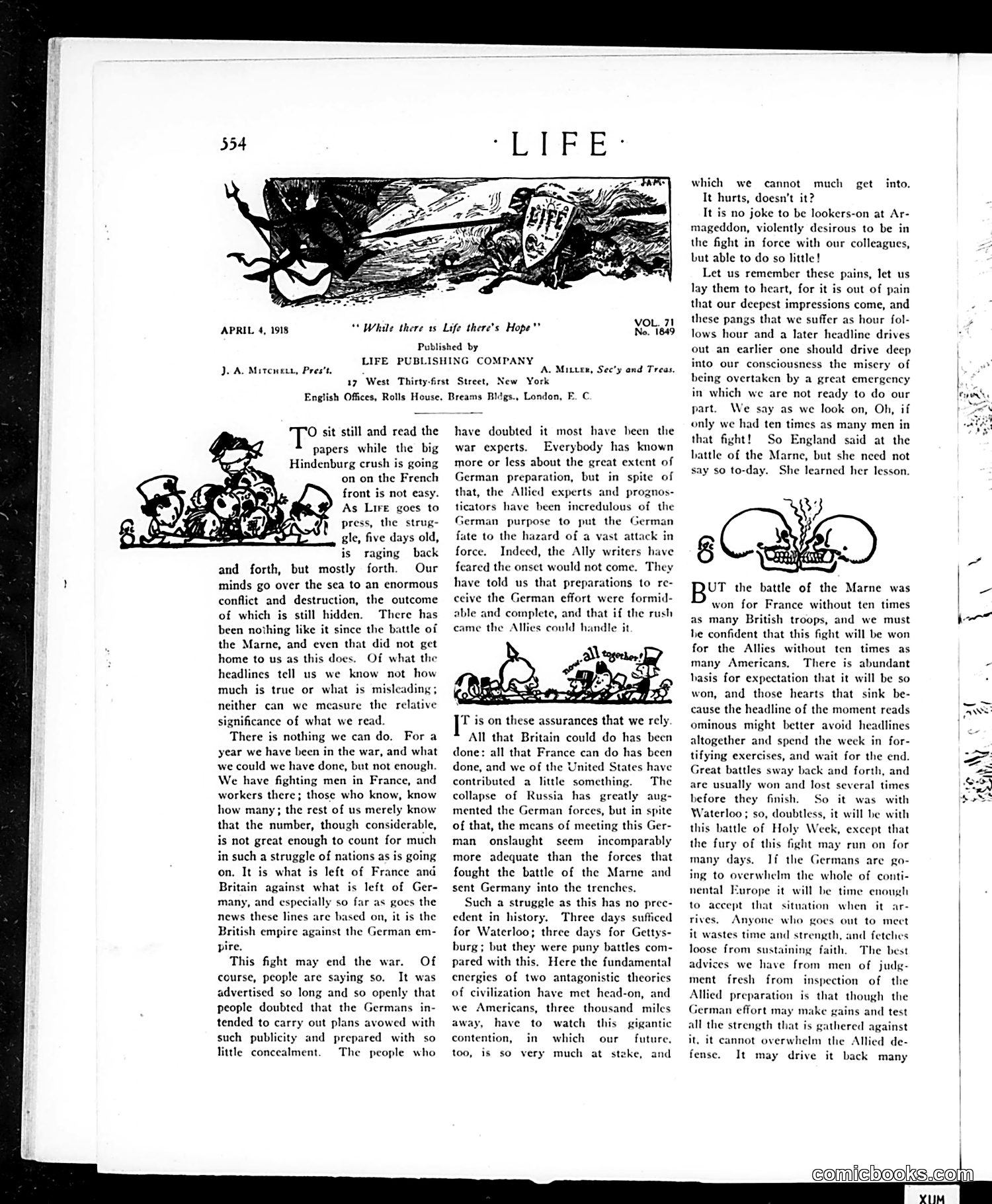
This page contains editorial commentary on the ongoing German offensive on the French front during World War I, rather than traditional political cartoons. The small illustrations are decorative vignettes rather than satirical commentary. The article's main point addresses American frustration at being a peripheral observer in a massive, decisive battle. The author notes the irony that Americans entered the war but lack sufficient forces to significantly impact the outcome—comparing the current struggle to the historic Battles of the Marne, Waterloo, and Gettysburg. The editorial expresses American helplessness watching "from three thousand miles away" while Britain and France bear the primary burden against Germany's collapse of Russian forces. The title "While There Is Life There's Hope" reflects cautious optimism that Allied defenses (declared "formidable and complete") will withstand the German assault. The tone is one of anxious waiting and frustration at America's limited military presence in France.
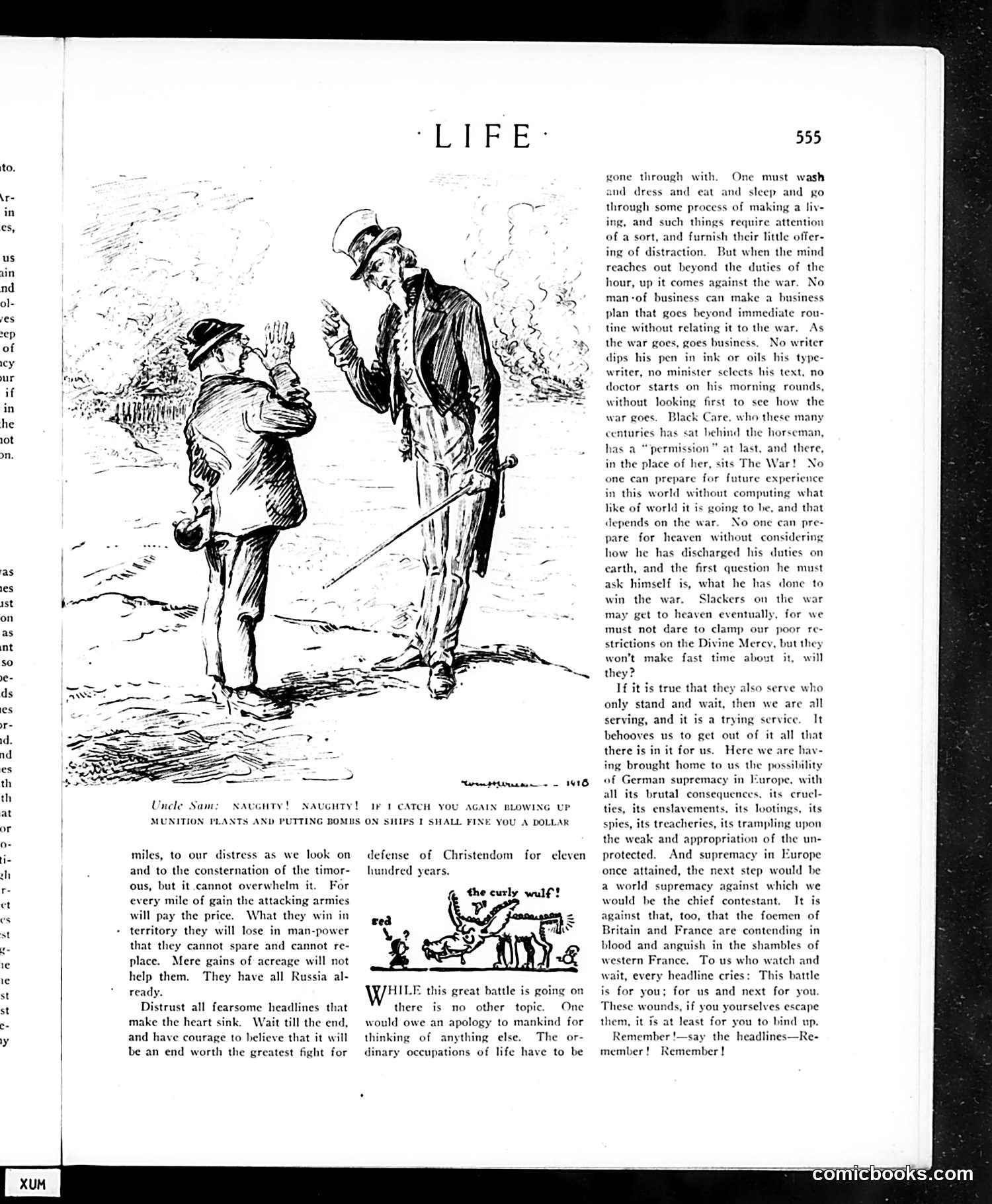
This page from *Life* magazine addresses World War I, likely from 1916-1917. The cartoon depicts **Uncle Sam** (representing the United States) sternly warning a small figure—likely representing either a German saboteur or an American pacifist/draft resister—about blowing up munition plants and bombing ships, threatening only a dollar fine as mock punishment. The accompanying editorial argues that the war dominates all civilian life and moral consideration. It warns of German supremacy's brutal consequences and appeals to American readers' duty to support the war effort, even those not directly fighting ("they also serve who only stand and wait"). The satire's point: American neutrality is morally untenable given the stakes; all citizens must contribute to defeating Germany and preventing European/global domination. The "dollar fine" joke underscores how inadequate pacifism or sabotage seems against the war's magnitude.
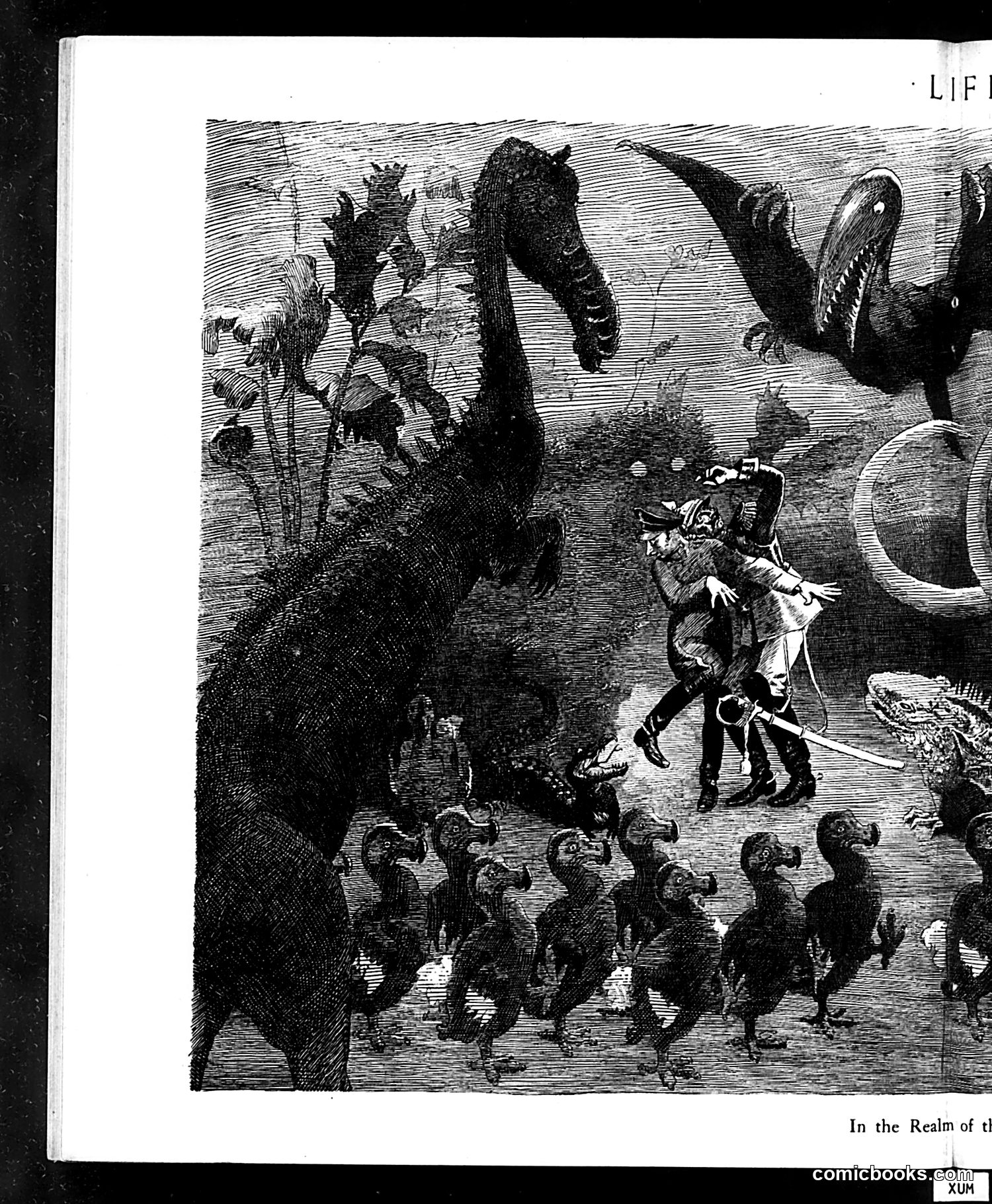
This engraving depicts a fantastical scene in what appears to be an underground or magical realm. A gentleman in period dress (possibly 18th or 19th century) stands defensively with a sword against various grotesque creatures—including winged demons, horned beasts, and what appears to be a large dragon or serpent on the left. Below, a procession of smaller imp-like or goblin creatures marches forward. The partial caption "In the Realm of th[e]..." suggests this illustrates a literary or theatrical work, likely a fantastical adventure story rather than political satire. Without the complete text and date, the specific reference remains unclear—this could reference Dante, folk tales, or contemporary fiction. The engraving style and composition suggest it's illustrating an imaginative narrative rather than commenting on contemporary politics or social issues.
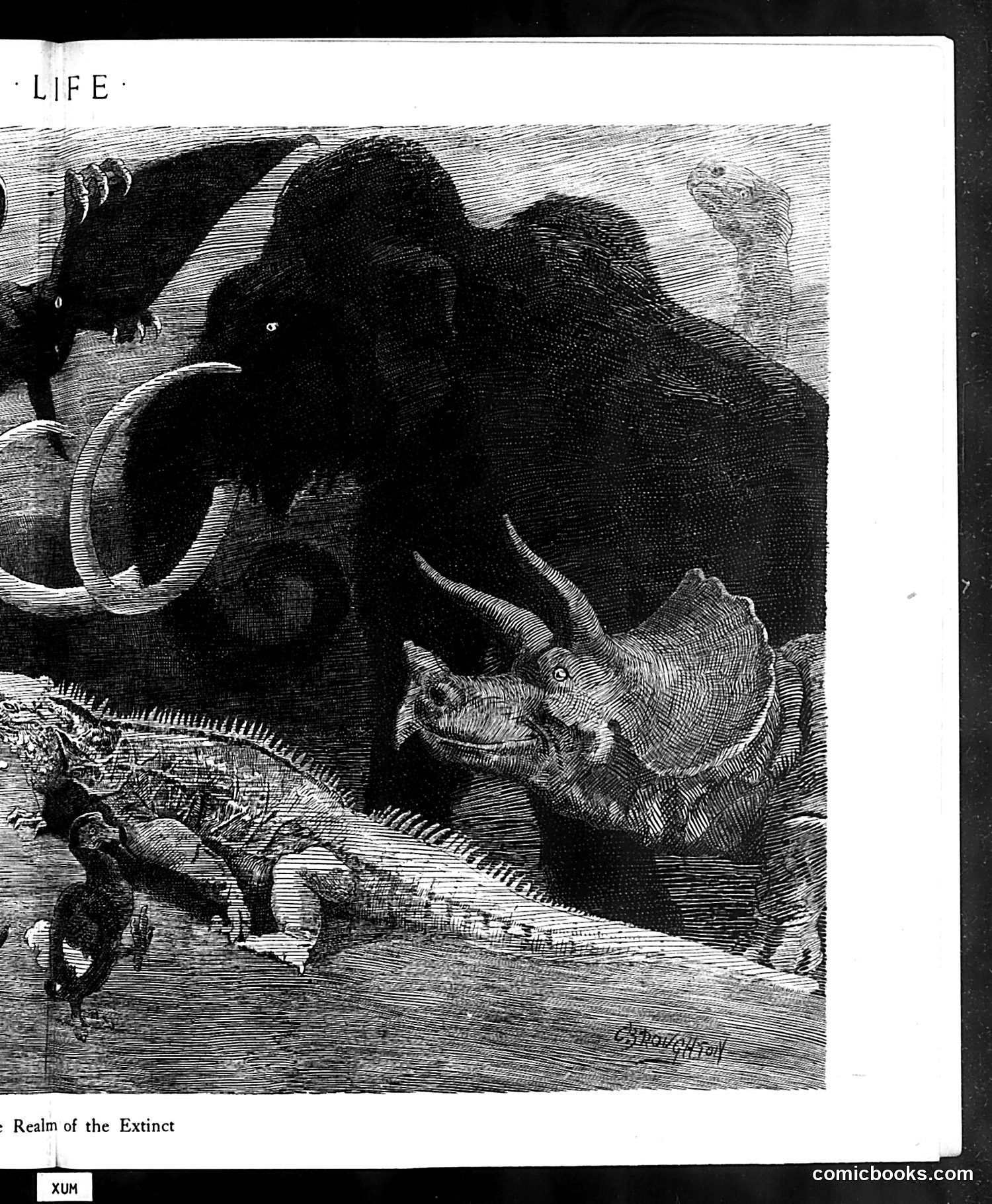
This appears to be a satirical illustration titled "Realm of the Extinct," depicting extinct prehistoric creatures—notably mammoths with their characteristic curved tusks and woolly bodies, along with what seems to be smaller extinct animals in the foreground. The caption suggests social commentary using extinction as metaphor. Without additional context or OCR text beyond the title, the specific satire remains unclear. It could reference: - Extinct political movements or ideologies - Obsolete social institutions - Outdated business practices or companies The naturalistic engraving style and *Life* magazine format suggest this critiques something contemporary to the publication's era as "dead" or "extinct." However, without clearer OCR text or visible attributions, the precise target of satire cannot be definitively identified.
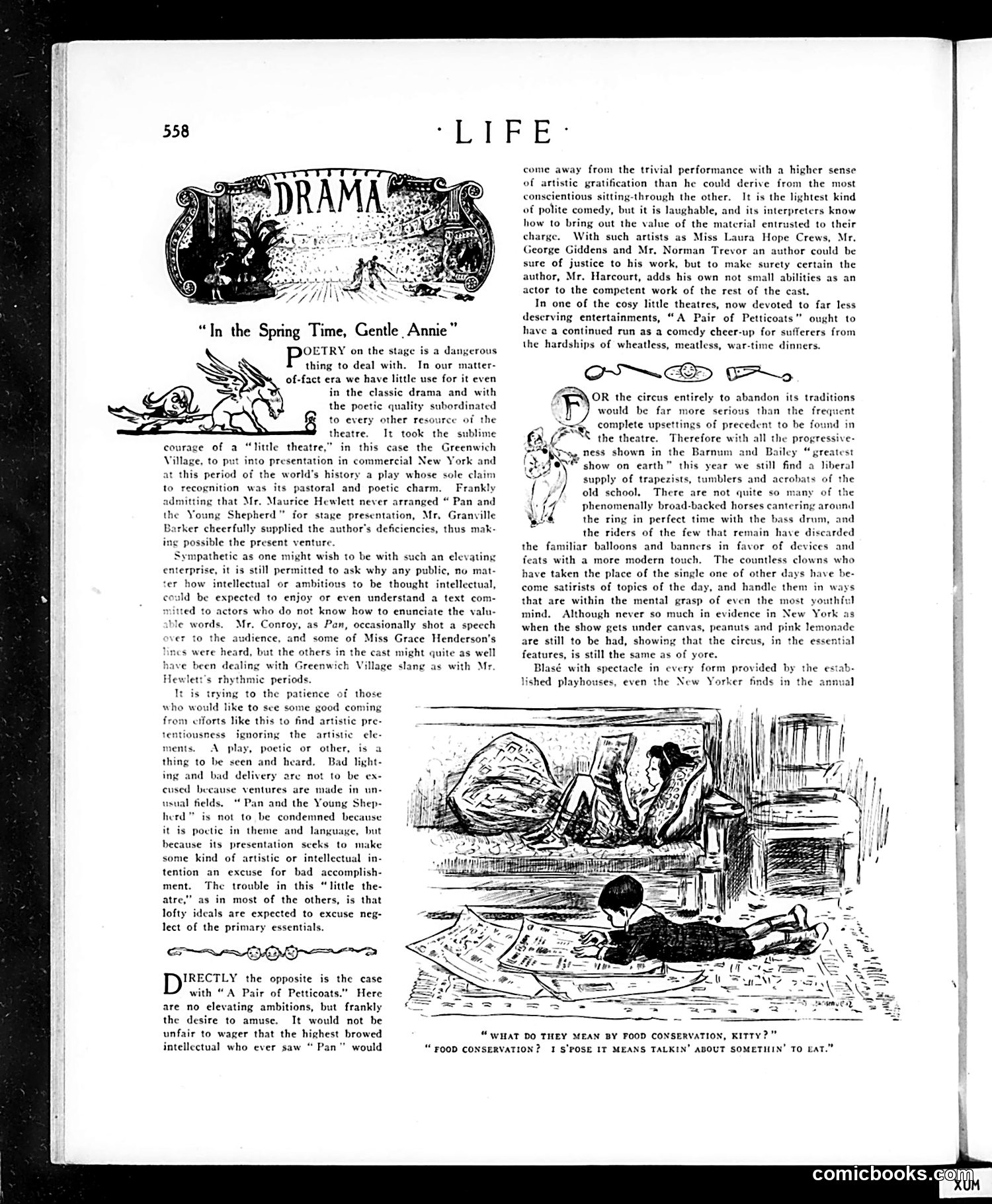
This page critiques theatrical productions of the era (appears to be WWI period, given references to "wheatless, meatless, war-time dinners"). **The main satire:** Life compares two Broadway productions. "Pan and the Young Shepherd"—an artistically ambitious poetic drama by Maurice Hewlett—is mocked for prioritizing intellectual pretension over basic performance competency. The reviewers argue that poor lighting, inaudible delivery, and bad acting undermine the noble material. By contrast, "A Pair of Petticoats" is praised as lightweight comedy that competently executes its modest aims, starring capable performers like Laura Hope Crews and Norman Trevor. **The point:** Life satirizes the little-theatre movement's tendency to excuse poor execution by invoking artistic ambition. The magazine argues that theatrical fundamentals—clear speech, good lighting, skilled acting—matter more than lofty pretensions. Entertainment value and professional craftsmanship trump intellectual aspiration. The cartoon (bottom) appears unrelated, depicting food-conservation humor.
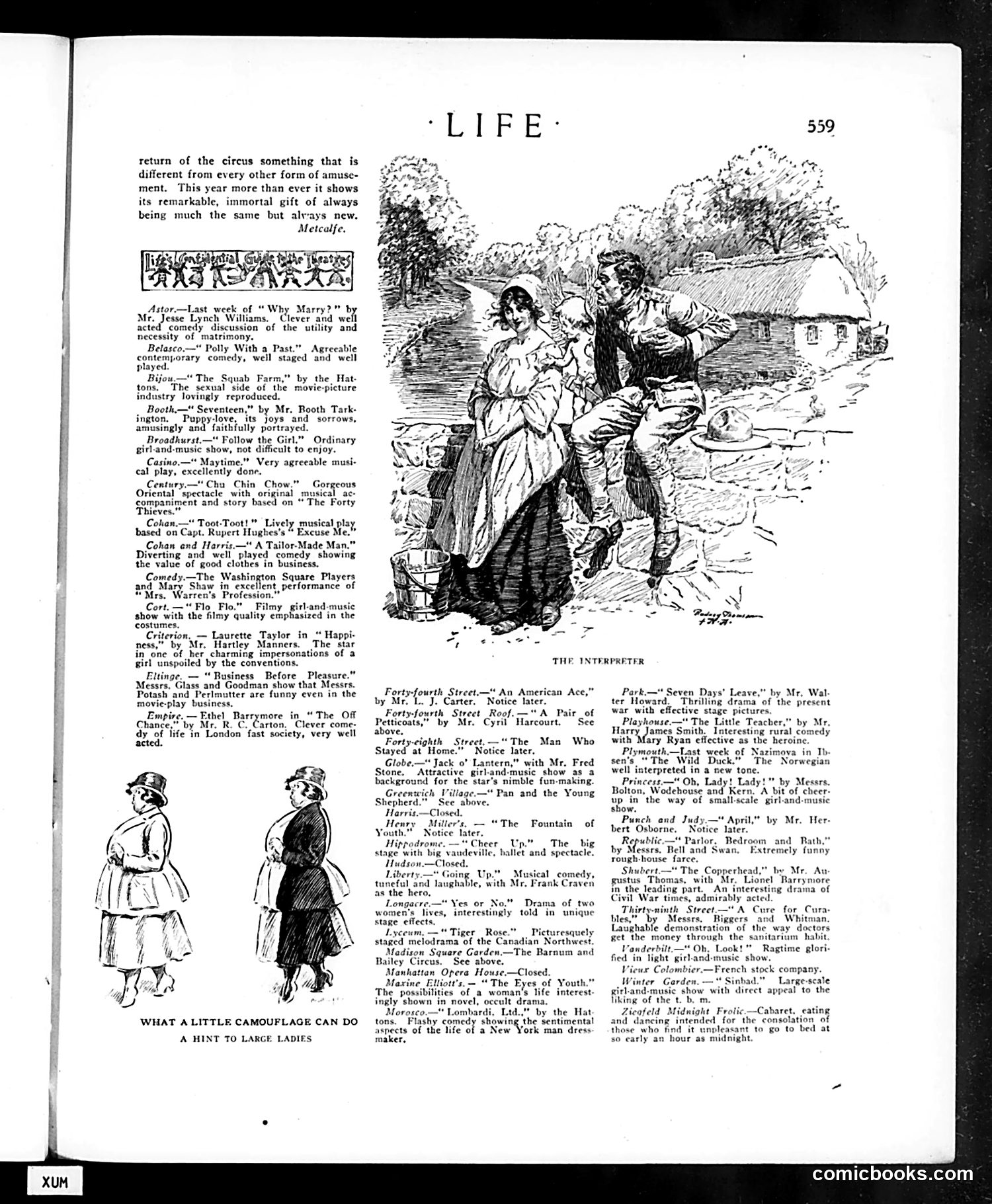
This page from *Life* magazine consists primarily of theater reviews. The cartoon at bottom left, captioned "What a Little Camouflage Can Do: A Hint to Large Ladies," depicts two women in silhouette—one appearing noticeably larger than the other. The satire targets fashion and body image: it suggests that strategic clothing choices ("camouflage") can visually reshape a woman's figure. The "hint to large ladies" frames this as practical advice, though the cartoon's tone is gently mocking rather than genuinely helpful. This reflects early 20th-century attitudes about women's appearance and the fashion industry's role in addressing (or exploiting) anxieties about body size. The humor relies on assumptions that larger women would want to appear slimmer, and that clothing could accomplish this deception. The surrounding theater listings are standard entertainment journalism with no apparent satirical content.
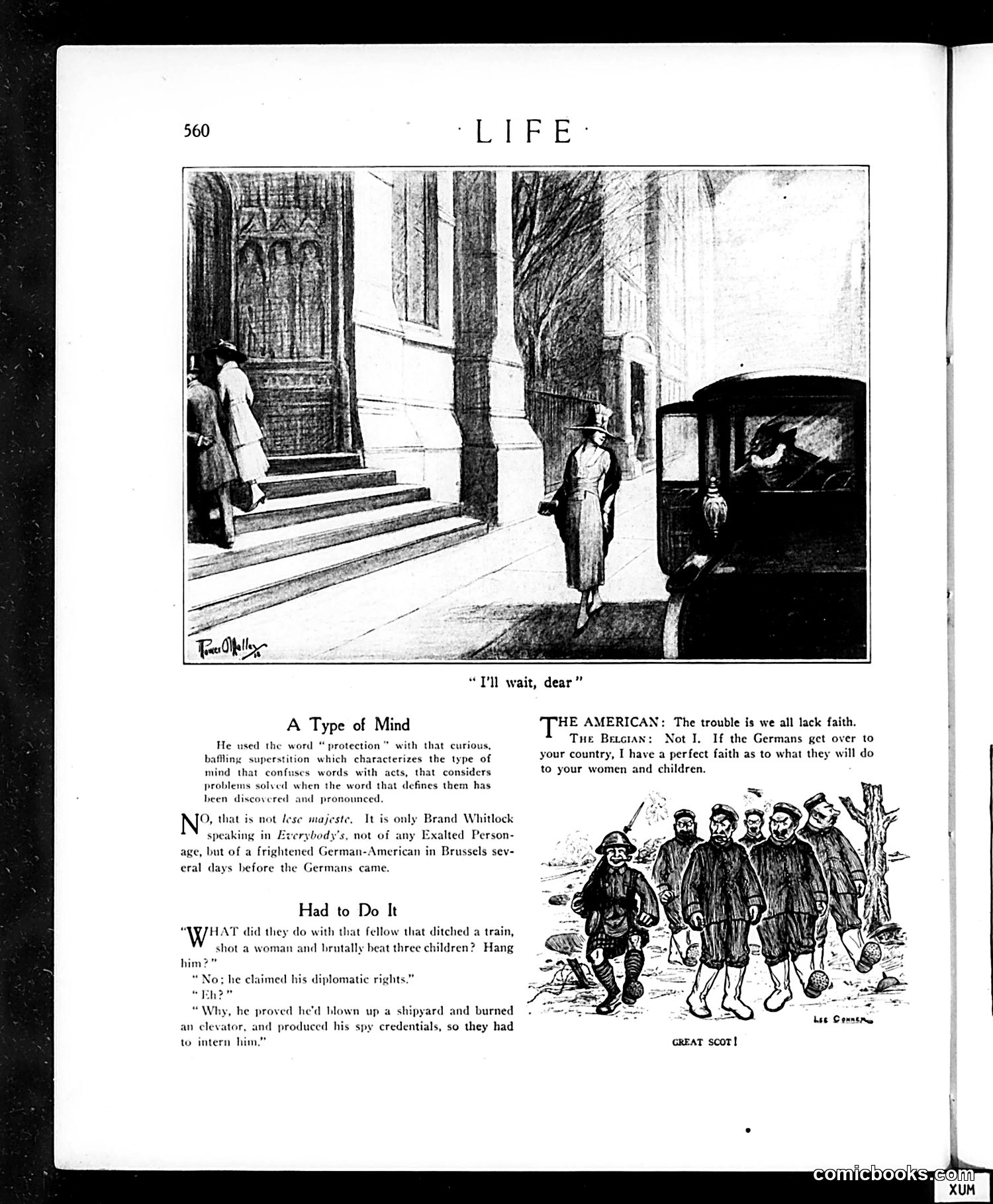
This page contains WWI-era satirical content reflecting American anxieties about German aggression and espionage. **Top cartoon** ("I'll wait, dear"): Shows a woman standing in a European street as a car passes. The caption suggests she's waiting for someone, likely conveying anxiety about separation during wartime. **"A Type of Mind"**: References Brand Whitlock, the American minister to Belgium during German occupation. The text mocks people who confuse verbal "protection" with actual safety—a dig at those who believed diplomatic language could shield them from German invasion. **Dialogue snippet**: An American and Belgian discuss faith; the Belgian expresses dark certainty about German treatment of civilians if they invade America—a propaganda point about German brutality. **"Had to Do It"**: Jokes bitterly about a saboteur (who ditched trains, attacked civilians, bombed shipyards) being merely "interned" rather than executed, because he claimed "diplomatic rights." The sarcasm critiques lenient treatment of enemy agents. **Bottom illustration** ("Great Scot!"): Lee Corey's drawing of what appear to be German soldiers or refugees, though context is unclear. Overall: anti-German propaganda emphasizing invasion fears and espionage threats.
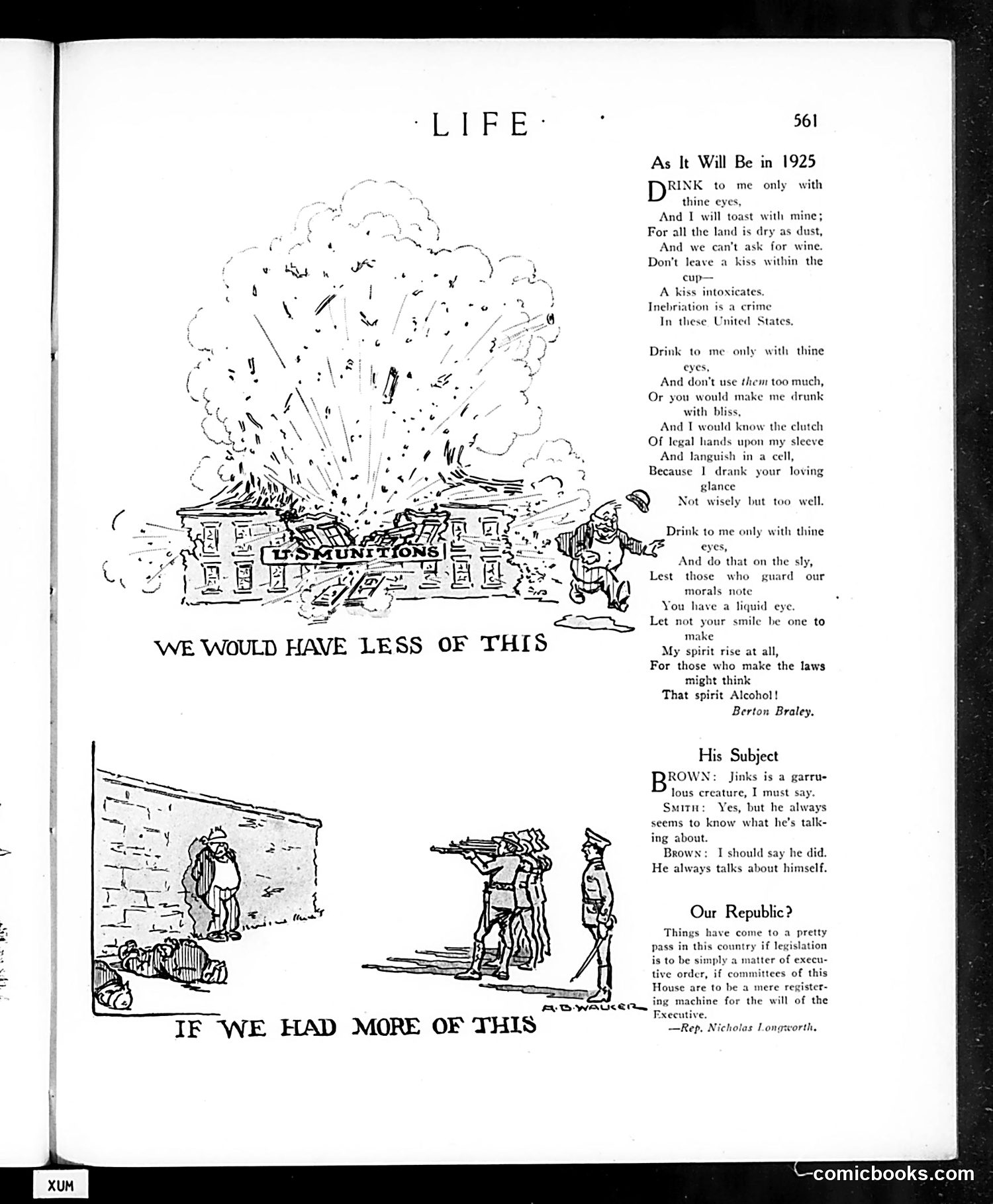
This page satirizes **Prohibition**, the constitutional ban on alcohol (1920-1933). The cartoons contrast two scenarios: **"We Would Have Less of This"** depicts an explosion at a building—likely representing illegal distilleries or speakeasies created by Prohibition's enforcement failures. **"If We Had More of This"** shows soldiers or law enforcement, suggesting more policing could theoretically prevent illegal alcohol production. **"As It Will Be in 1925"** is a poem by Berton Braley mocking Prohibition's absurdity. It parodies the romantic poem "Drink to Me Only with Thine Eyes," transforming it into commentary on how Prohibition criminalizes even innocent gestures—a smile might be interpreted as intoxication by morality enforcers. The final section quotes Rep. Nicholas Longworth criticizing how Congress has become merely an "executive order" machine, lacking independent authority. **The satire's point**: Prohibition creates unintended consequences (bootlegging, violence) while invasively policing everyday behavior, and simultaneously weakens congressional power.
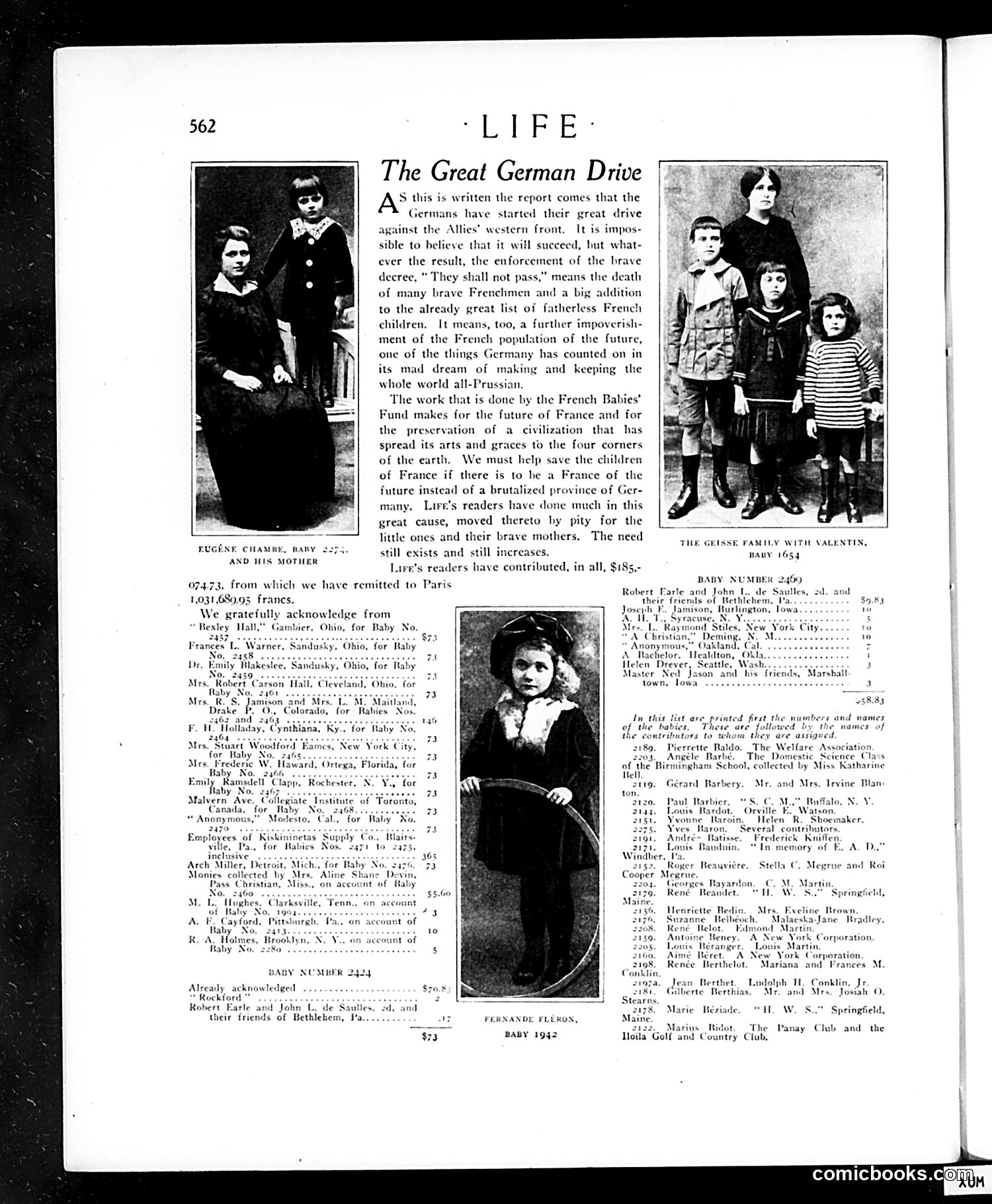
This page combines a charitable fundraising appeal with commentary on World War I. The main article discusses Germany's spring 1918 offensive on the Western Front, warning that if successful, it will kill French soldiers and orphan French children. The accompanying photographs show French war orphans and families supported by Life magazine's "French Babies' Fund"—a charity readers contributed to ($185,074.73 total, the text notes). The article frames aid to French children as essential to preserving French civilization against Germany's goal of making Europe "all-Prussian." The bulk of the page lists individual donors and which baby number they're supporting—a form of financial transparency and donor recognition typical of early-20th-century charitable campaigns. This is not satire, but earnest wartime advocacy using real orphans' images to motivate American donors to support France.
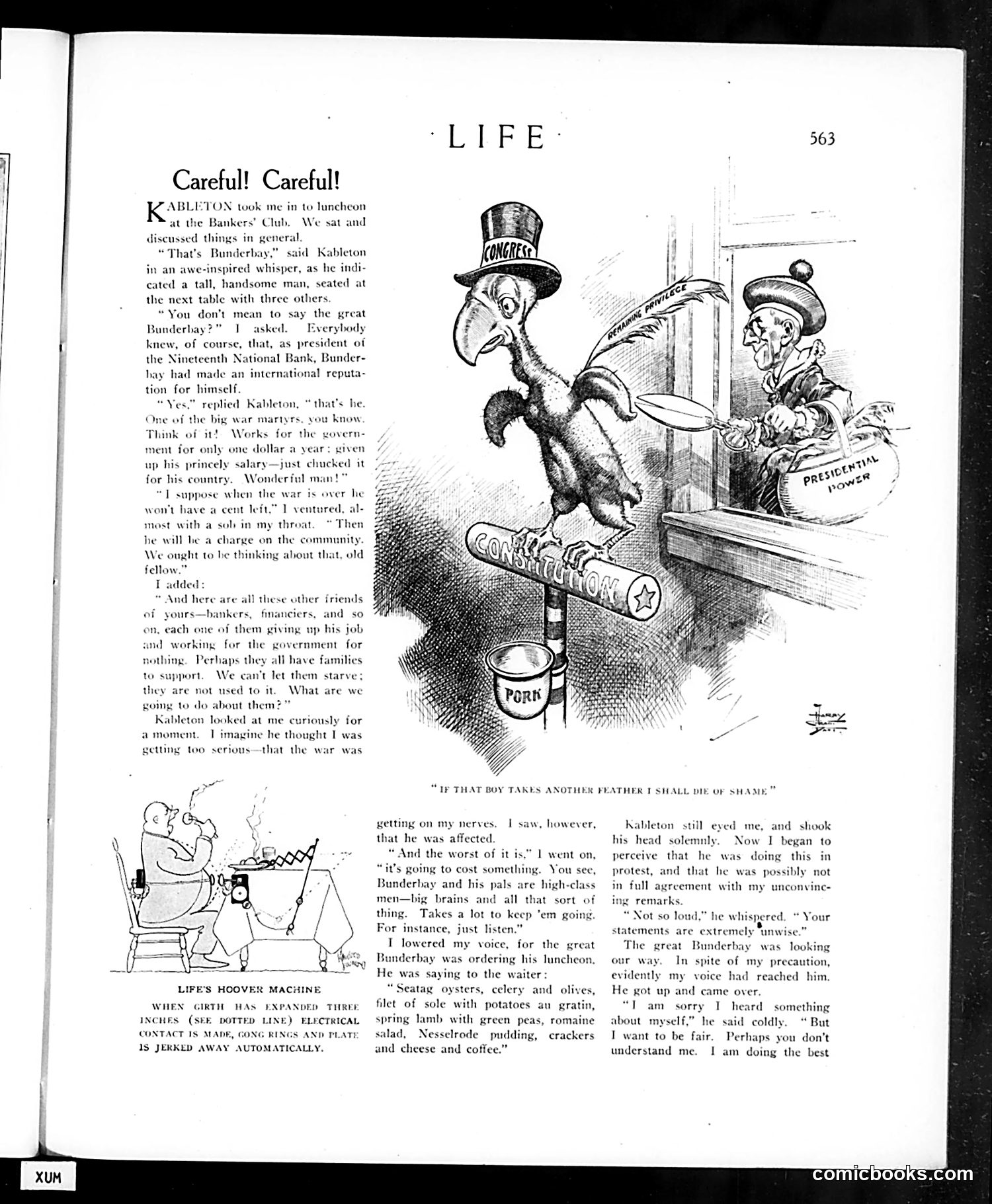
This page satirizes the hypocrisy of wealthy bankers claiming patriotic sacrifice during wartime. "Bunderbay," president of the Nineteenth National Bank, is celebrated for working for the government at $1/year—supposedly giving up his "princely salary." The narrator exposes the con: these "high-class" men with "big brains" still live lavishly (ordering expensive oysters, filet, Nesselrode pudding). The joke is that Bunderbay hasn't actually sacrificed—he's still consuming luxuriously while ordinary citizens genuinely suffer. The cartoons mock both the bankers' performative patriotism and public gullibility in accepting it. The "Hoover Machine" cartoon (bottom) makes a separate joke about weight gain from excessive eating, likely referencing rationing or dietary concerns of the WWI era. This reflects post-WWI skepticism about whether the wealthy truly bore war's burdens fairly.
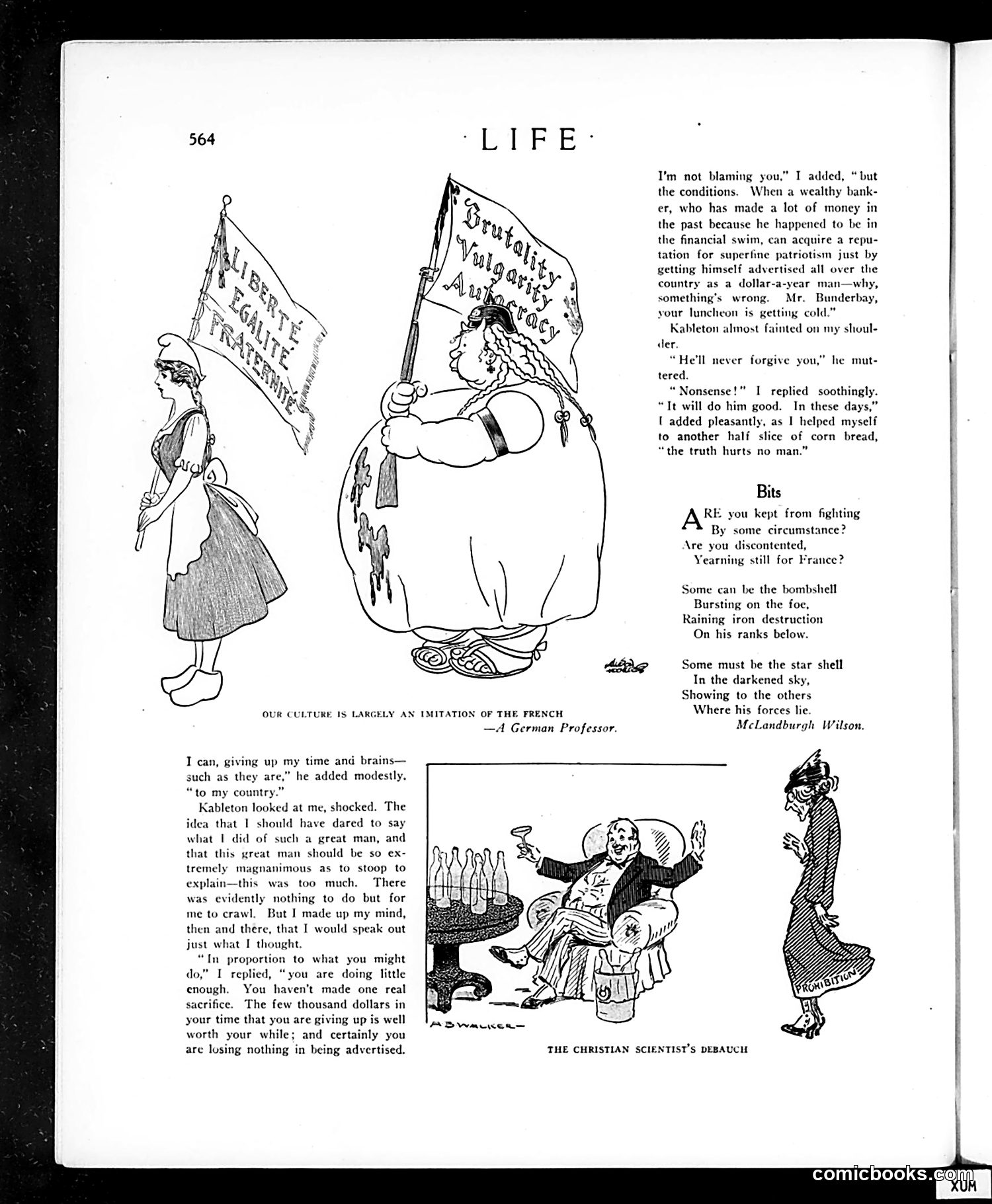
This page contains multiple satirical pieces targeting American social hypocrisy during World War I: **Top cartoons:** Contrast Liberty (left, holding "Liberty and Gratitude" flag) with a bloated, carousing figure (right) holding a "Profiteering and Graft" flag. The caption attributes this to a "German Professor," suggesting Americans are imitating French culture while actually embodying greed and corruption. **Main narrative:** Criticizes wealthy bankers who gain patriotic reputations as "dollar-a-year men"—corporate executives serving government at nominal salary for propaganda value—while making real sacrifices. The speaker confronts "Bunderbay" (likely fictional), arguing such men haven't genuinely sacrificed despite public acclaim. **Bottom cartoon ("The Christian Scientist's Debauch"):** Depicts apparent hypocrisy—likely mocking Christian Scientists or prohibitionists enjoying alcohol/excess while preaching restraint. **Poem "Bits":** Acknowledges different wartime contributions (shells, artillery, information), suggesting various sacrifice types are legitimate. The overall theme: American patriotism is performative when wealthy elites profit while claiming sacrifice.
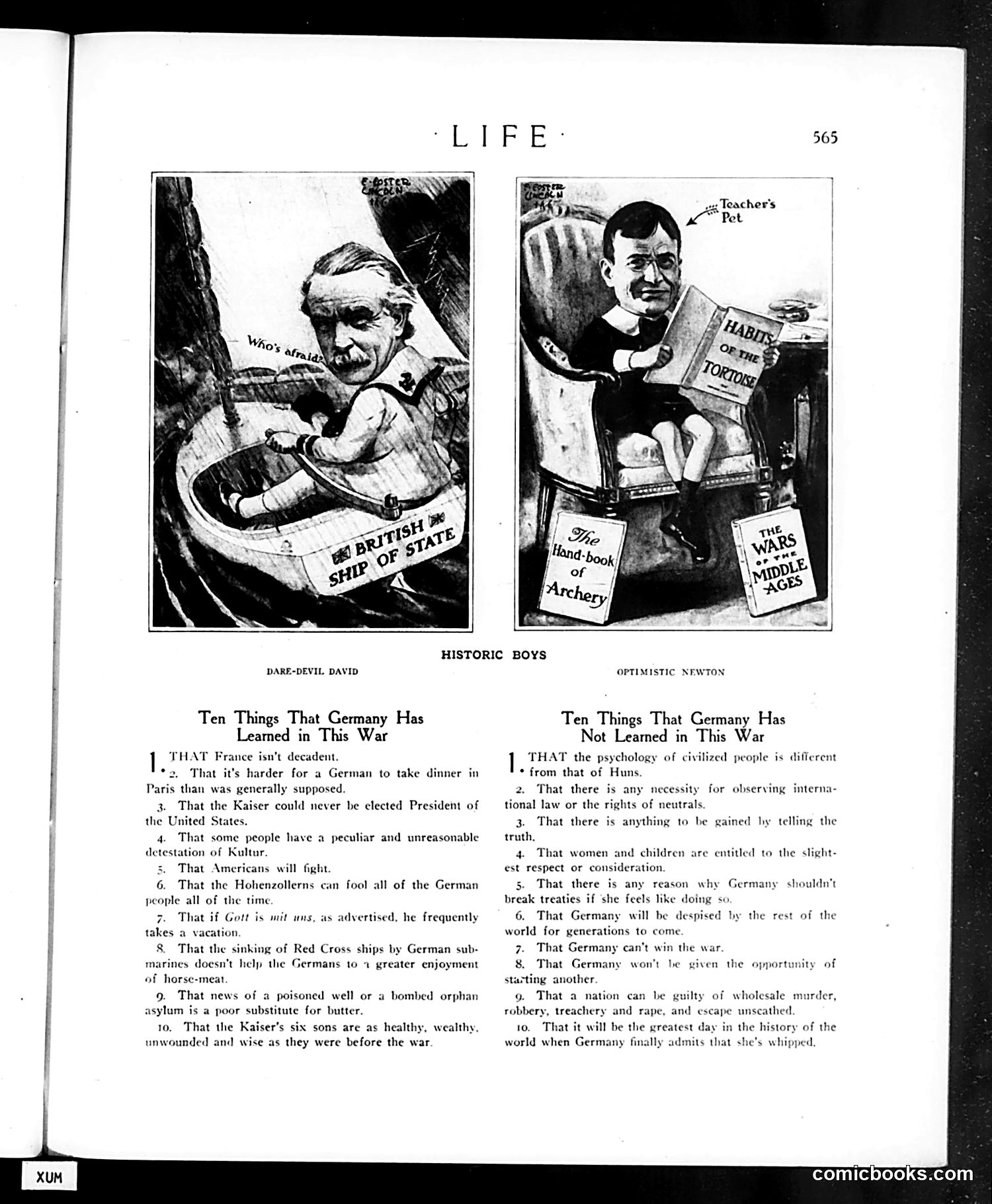
This Life magazine page uses two parallel "historic boys" characters—biblical David (left) and Newton (right)—to satirize Germany during World War I. The left cartoon, titled "Dare-Devil David," lists ten things Germany *has* learned through military defeats: France isn't weak, Americans will fight, German submarines attacking Red Cross ships backfire diplomatically, and atrocities don't win sympathy. The right cartoon, "Optimistic Newton," inverts this, listing what Germany *hasn't* learned: disregard for international law, disrespect for civilians, treaty-breaking, and belief in military superiority. The satire's point: Germany stubbornly refuses moral lessons from its wartime conduct—attacking neutral ships, targeting civilians, committing documented atrocities—yet remains convinced it can win. The cartoonist suggests Germany's fundamental moral blindness prevents it from grasping that such actions ensure lasting international condemnation and future conflict.
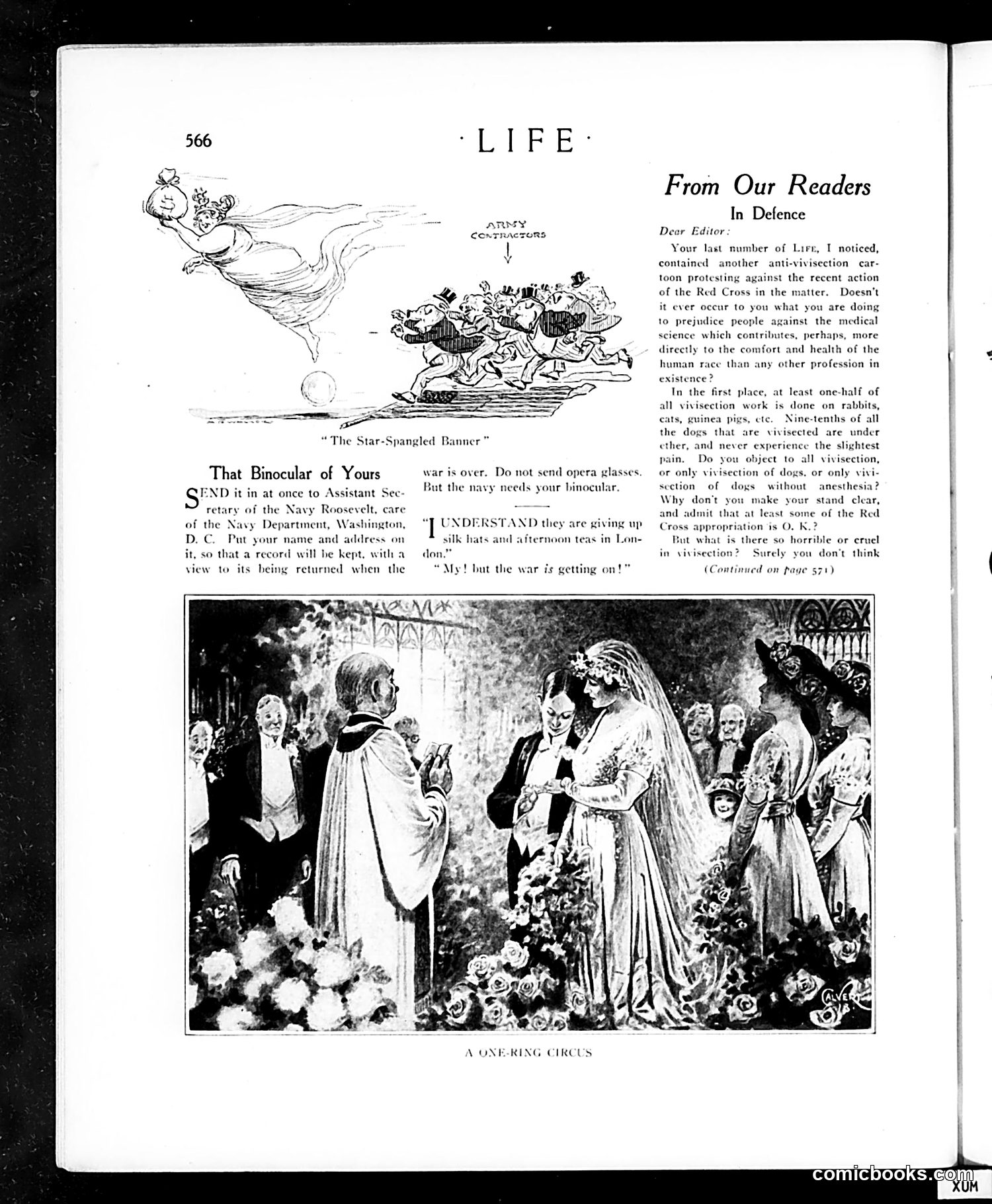
This *Life* magazine page contains WWI-era content addressing two concerns: **Top Left Cartoon ("That Binocular of Yours"):** A satirical request directed at readers to donate binoculars to Assistant Secretary of the Navy Roosevelt (likely Theodore Roosevelt) for the war effort. The cartoon mocks the patriotic appeals for civilians to contribute their personal goods during wartime. **Letters Section ("From Our Readers - In Defence"):** A reader defends medical vivisection (animal testing) against recent *Life* cartoons criticizing the Red Cross's use of animal experimentation. The writer argues that anti-vivisection advocacy unfairly prejudices people against medical science and questions whether critics consistently oppose all animal testing or only certain kinds. **Bottom Image ("A One-Ring Circus"):** A formal wedding scene, likely satirizing high society or wartime social life—the caption title suggests the ceremonial spectacle of weddings during the war period. The page reflects WWI-era debates about patriotic sacrifice, medical ethics, and civilian concerns amid military demands.
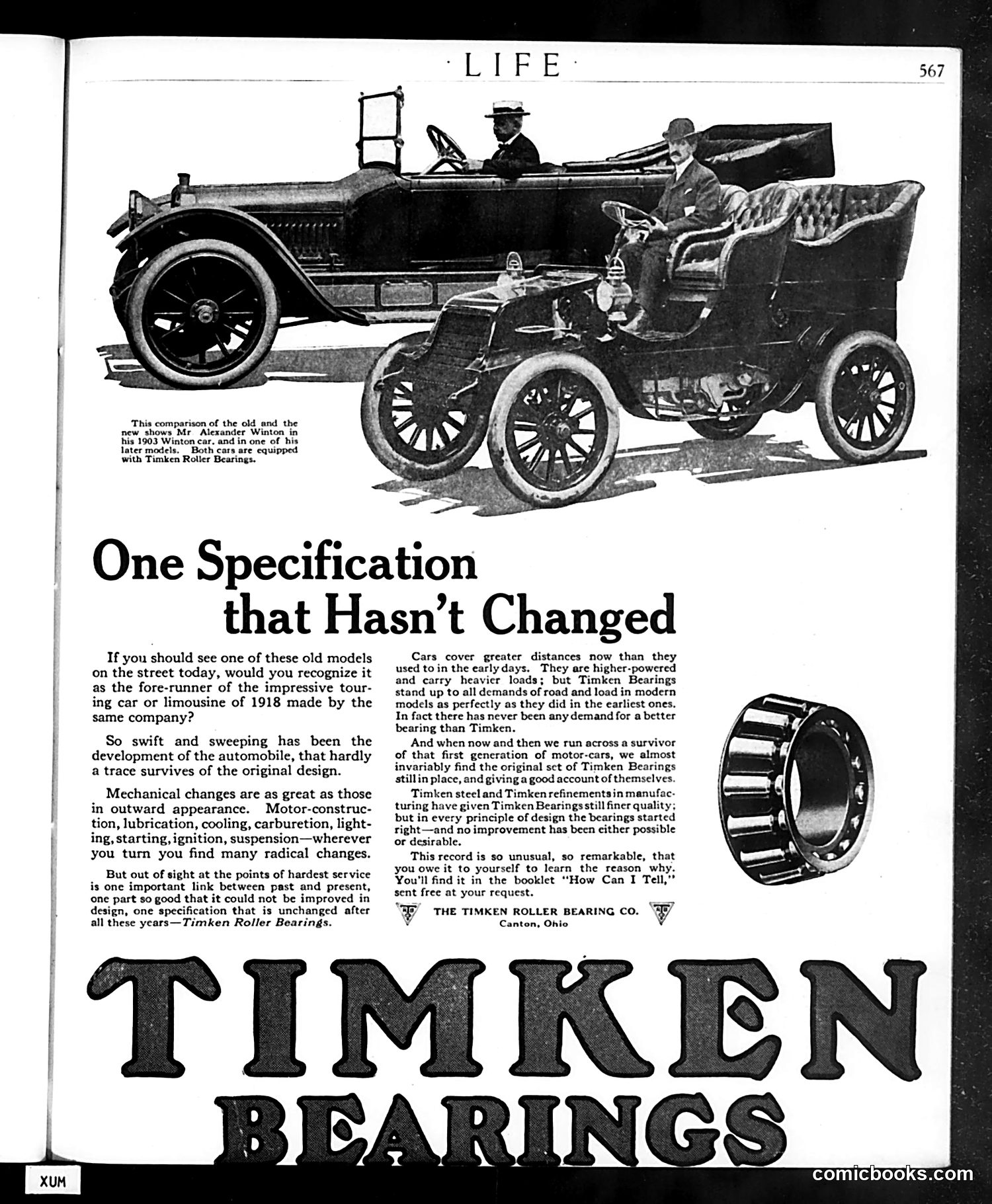
This is primarily a **Timken Roller Bearings advertisement**, not a political cartoon. It appears in *Life* magazine (page 567) circa 1918. The ad compares two automobiles: a 1903 Winton car driven by Alexander Winton (the vehicle's manufacturer) and a newer 1918 Winton model. The visual contrast emphasizes how dramatically automobiles have evolved—the 1903 car is primitive and skeletal by 1918 standards. The advertisement's argument is that while virtually every mechanical component has been redesigned and improved over fifteen years, Timken Roller Bearings remain unchanged because they were engineered so perfectly from the start that no improvement is possible or desirable. The ad claims surviving 1903 cars still have original Timken bearings functioning well, proving their durability. This is a marketing strategy using technological progress as a backdrop to establish brand credibility through claimed permanence rather than innovation.
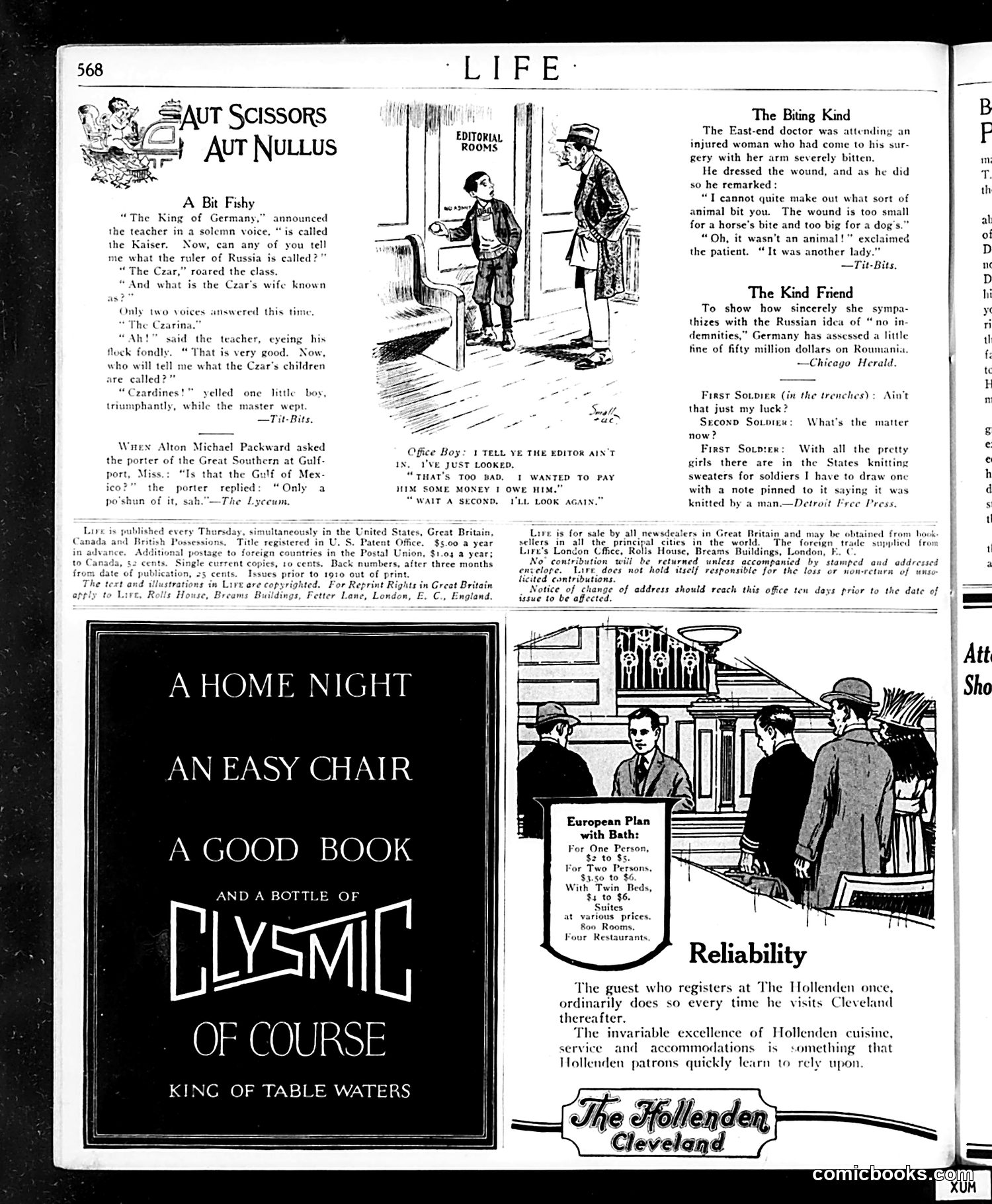
This page from *Life* magazine contains satirical humor pieces typical of early 20th-century American comics. The main items are: **"A Bit Fishy"**: A classroom joke where a teacher asks students about Russian rulers. One boy humorously answers "Czardines" when asked what the Czar's children are called—a pun conflating "Czar" with "sardines," making the teacher weep with laughter. **"The Biting Kind"** and related short jokes: These are brief anecdotes about animal bites, romantic mishaps, and wartime soldier complaints—standard humorous fillers. **The cartoons**: An office scene and hotel advertisement illustration accompany these pieces. The page is mostly **filler content and advertisements**—including promotions for Clysmic water and the Hollenden hotel in Cleveland. The humor relies on wordplay, misunderstandings, and gentle social observation rather than political satire. This represents *Life*'s lighter editorial material from the era.
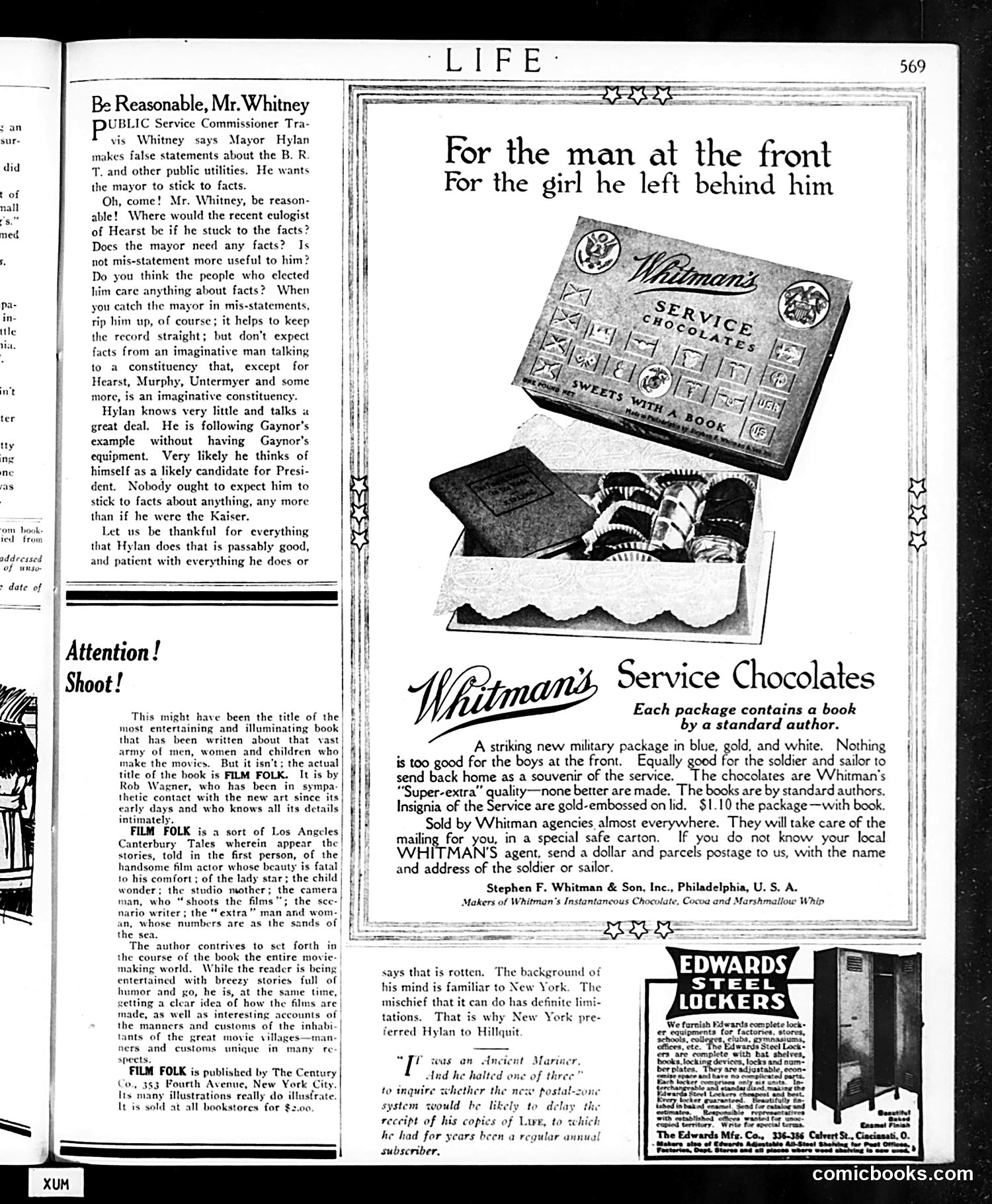
This page contains **advertising and editorial content**, not political satire. The right side features a **Whitman's Service Chocolates advertisement** targeting WWI soldiers and their loved ones. The packaging explicitly states "For the man at the front / For the girl he left behind him," positioning chocolates as comfort care packages. Each box includes a book by a "standard author," marketed as morale-boosting gifts for servicemen. The left side contains an editorial piece titled **"Be Reasonable, Mr. Whitney"** criticizing Public Service Commissioner Travis Whitney for allegedly making false statements about Mayor Hylan and city utilities. Below that is a film review section discussing "Film Folk." The **Edwards Steel Lockers advertisement** appears at the bottom right. This is primarily a commercial and civic commentary page from the WWI era, not satirical cartooning.
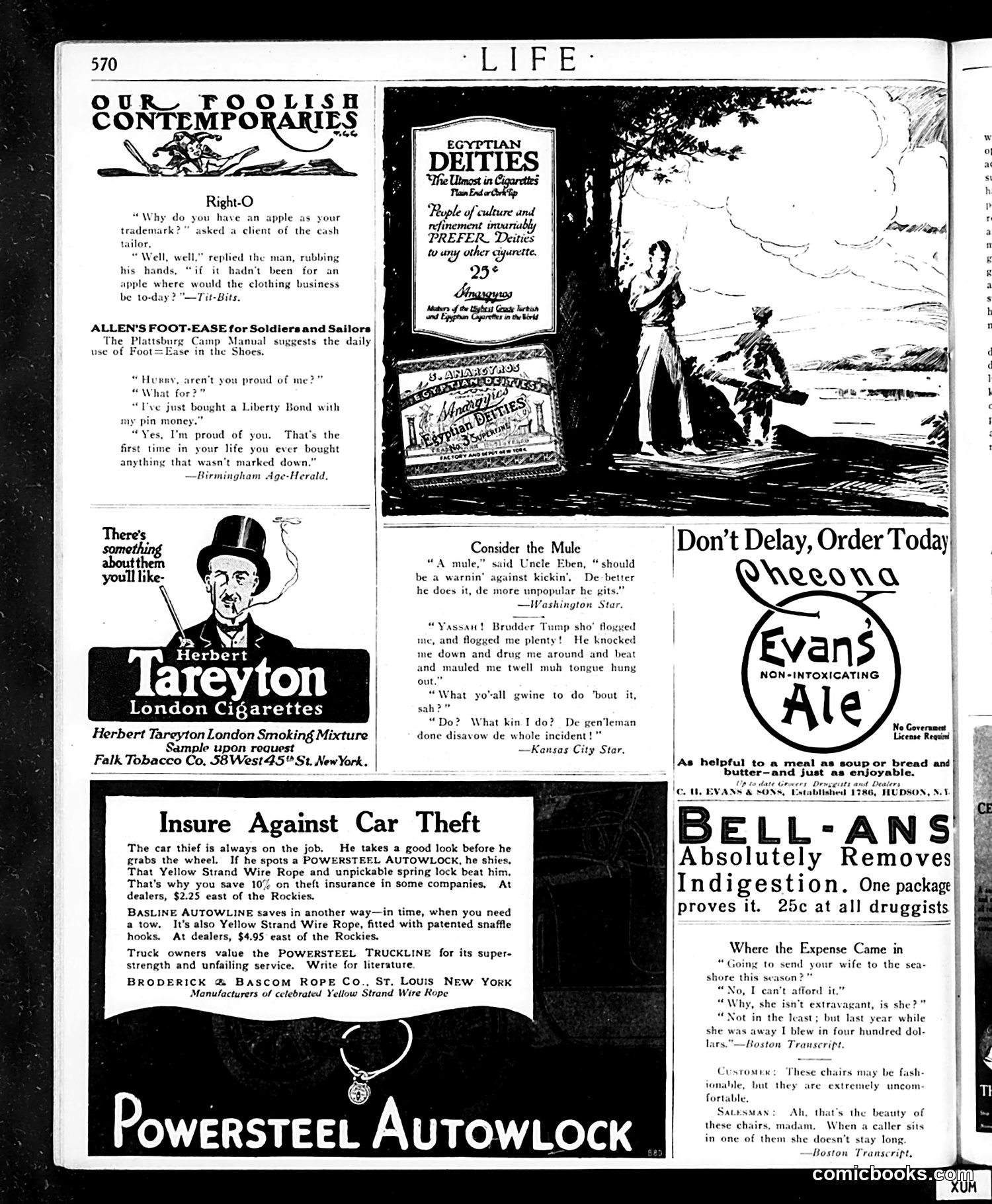
This page collects brief satirical jokes and advertisements typical of early 20th-century Life. The humor targets social absurdities: **"Right-O"**: A tailor justifies his apple trademark by crediting the fruit for launching the clothing business—a nonsensical pun referencing Adam and Eve's biblical nakedness. **Liberty Bond joke**: A husband expects praise for finally buying something that *wasn't* on sale—mocking both his chronic penny-pinching and the wartime push for bond purchases (this appears WWI-era, given soldier references). **"Consider the Mule"**: Uses a rural Black dialect speaker ("Uncle Eben") to deliver folk wisdom: a mule who kicks becomes unpopular. The anecdote about a man beating a mule who won't apologize plays on the mule's stubborn reputation. **Herbert Tareyton ad**: Features a top-hatted gentleman endorsing cigarettes. The page is primarily **advertising mixed with humor**—typical Life content blending commerce with satire on consumer culture, marital dynamics, and rural wisdom. The racial dialect humor reflects period conventions modern readers would find outdated and offensive.
This page is primarily **reader letters and advertisements** rather than editorial cartoons. The substantive content consists of three reader letters debating serious WWI-era issues: 1. **"From Our Readers"**: Stuart C. Donn defends vivisection (animal testing) as necessary for surgical training, arguing doctors need practice before operating on humans—a response to apparent Red Cross criticism. 2. **"One for the Tribune"**: J. Hollister Wilson praises the New York *Tribune* newspaper's editorial stance supporting the Allied cause and condemning German atrocities, contrasting it favorably with other publications that remained cautious about U.S. involvement. The letters reflect American debates circa 1918 about medical ethics and appropriate press coverage of World War I—when the U.S. had recently entered the conflict and consensus about Allied support was still forming. The page also contains period advertisements for Tiffany & Co., a searchlight product, and Cuticura baby care—typical of the magazine's commercial content.
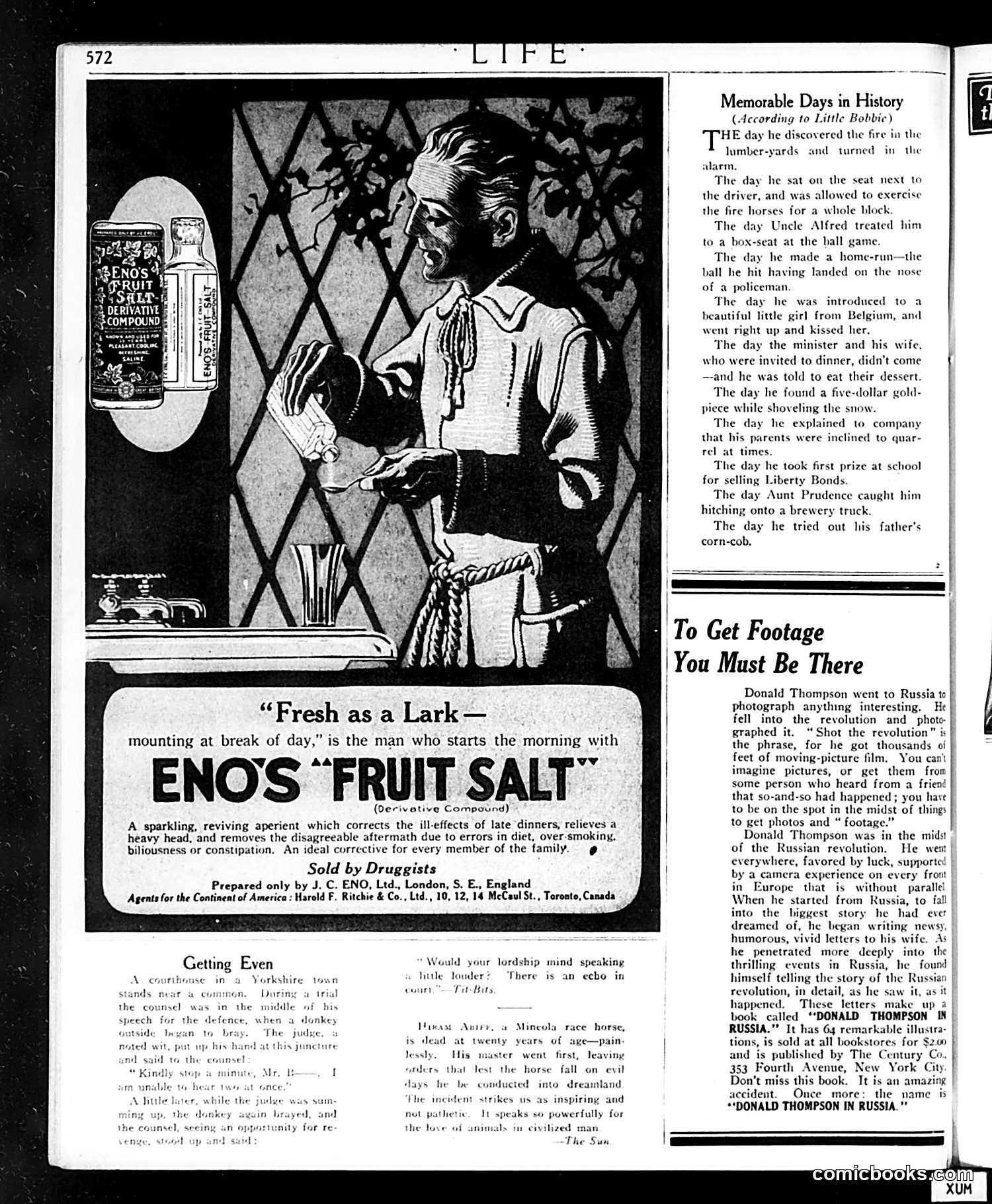
This is primarily an **advertisement page** for Enos Fruit Salt, a digestive remedy, occupying the central image with accompanying copy about correcting "ill-effects of late dinners" and digestive complaints. The right column contains three separate, unrelated humor items and notices: 1. **"Memorable Days in History"** — A sentimental-comic list of a boy's notable childhood moments, from discovering a fire to hitting a baseball at a policeman's nose. The humor is in the mundane, mischievous nature of what constitutes his "memorable" days (opposite of actual historical events). 2. **"Getting Even"** — A brief courtroom joke about a judge's hearing and a touching anecdote about a wealthy racehorse owner who arranges his horse's peaceful death rather than risk it falling into hardship. 3. **"To Get Footage You Must Be There"** — Promotional material for Donald Thompson's book about photographing the Russian Revolution, emphasizing first-hand experience over secondhand reports. The page reflects typical *Life* magazine content: light satire, brief humor, and advertising seamlessly integrated.
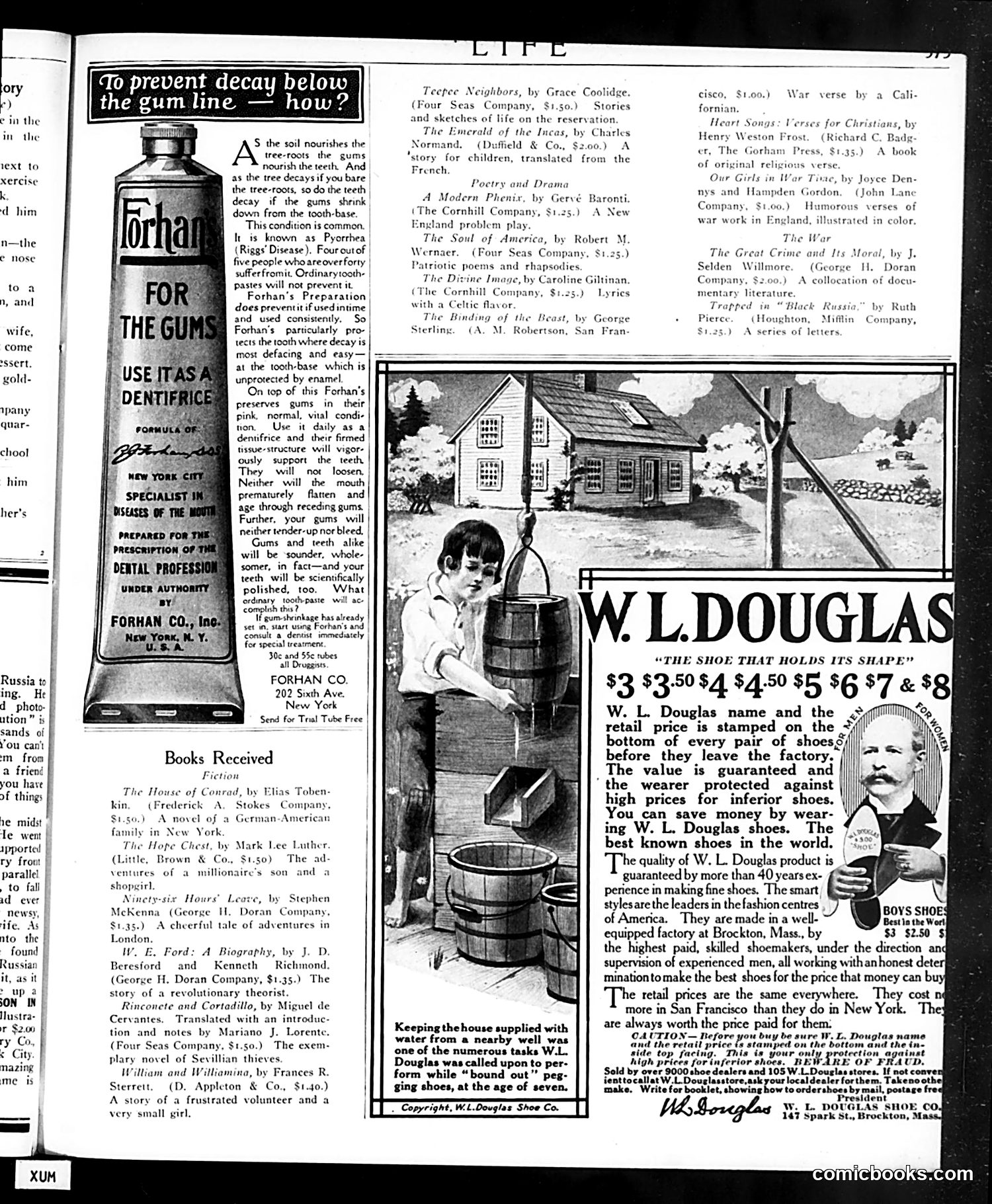
This page contains two unrelated advertisements and a book review section typical of early 20th-century magazines. **Left side:** A Forhan's toothpaste ad uses a tree metaphor to explain gum decay (pyorrhea). Just as exposed tree roots cause decay, receding gums expose tooth bases to deterioration. The ad targets the common problem of gum disease affecting "four out of five people over forty," positioning Forhan's as a preventative dentifrice. The medical language ("tissue-structure," "scientifically polished") appeals to health-conscious readers. **Center/Right:** A W.L. Douglas shoe advertisement emphasizes that the brand name and retail price are stamped on every shoe's bottom—a guarantee of authenticity and value. The imagery shows a well pump and rural homestead, suggesting durability suitable for working families. Prices range from $3 to $8, positioning these as quality affordable shoes made in Massachusetts. **Bottom:** A "Books Received" section lists contemporary fiction and poetry, primarily from 1910s-1920s publishers, reflecting the magazine's literary coverage. No satirical cartoons appear on this page.
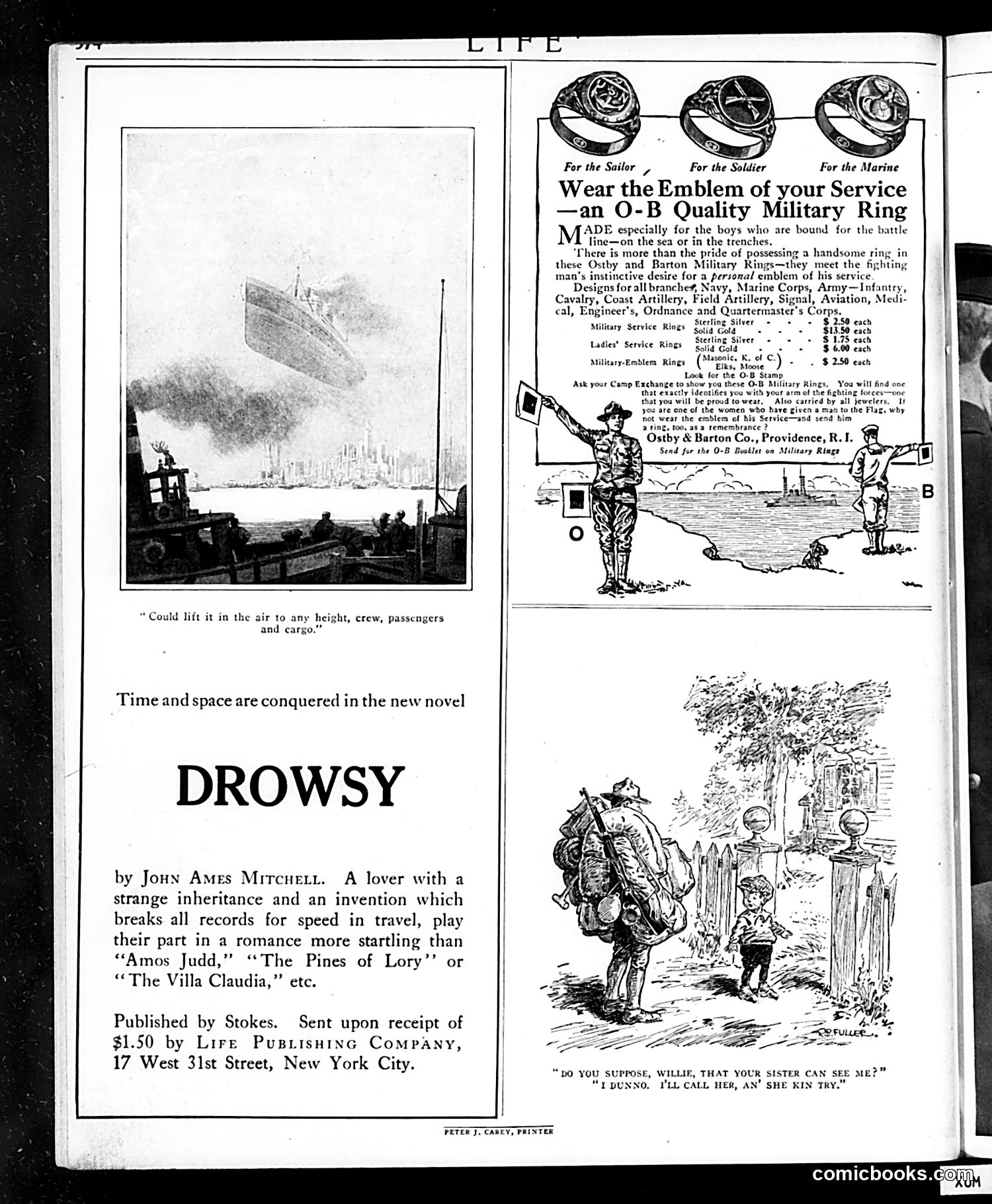
This page contains two distinct elements: **Left Side:** An advertisement for the novel *Drowsy* by John Ames Mitchell, featuring an illustration of what appears to be an early aircraft or flying vessel over a cityscape. The ad emphasizes the book's futuristic themes—a protagonist with "an invention which breaks all records for speed in travel"—positioning it as more exciting than Mitchell's previous works. **Right Side:** A wartime advertisement for O-B Quality Military Rings by Ostby & Barton Co. The rings are marketed to servicemen across all military branches (Navy, Army, Marines, etc.) and to women who've "given a man to the Flag" (lost relatives in WWI). The advertisement includes patriotic illustrations of soldiers and a domestic scene, emphasizing pride, service, and remembrance. Pricing ranges from $1.35 to $2.50. The page reflects early 20th-century American culture: emerging aviation technology as literary subject matter, and aggressive WWI-era patriotic marketing targeting both active soldiers and grieving civilians.
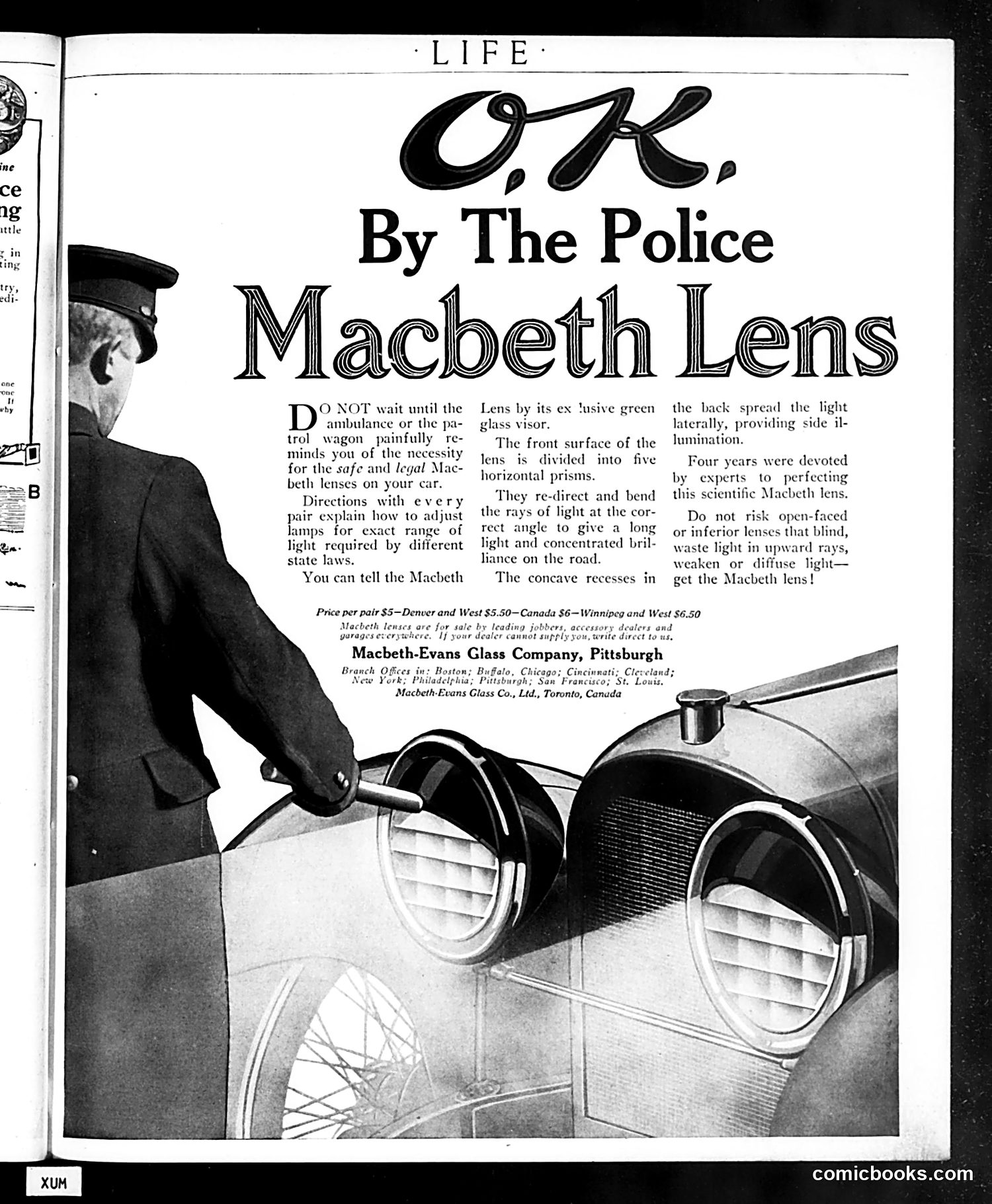
This is a **product advertisement**, not satire or political commentary. The page promotes Macbeth automobile headlight lenses manufactured by Macbeth-Evans Glass Company of Pittsburgh. The humor in the title—"O.K. By The Police"—plays on early automotive safety concerns. Police were increasingly enforcing headlight regulations, as different states had conflicting laws about light intensity and direction. The ad suggests that Macbeth lenses comply with these legal requirements, so drivers won't face police citations or ambulance calls due to inadequate lighting. The policeman pictured adjusts a car's headlamp, illustrating the product's key selling point: directions included with each pair explain proper adjustment for "exact range of light required by different state laws." This reflects the early-20th-century automotive era when standardized safety equipment was still developing and legal compliance was a genuine consumer concern—making "police approval" a genuine marketing advantage rather than satire.
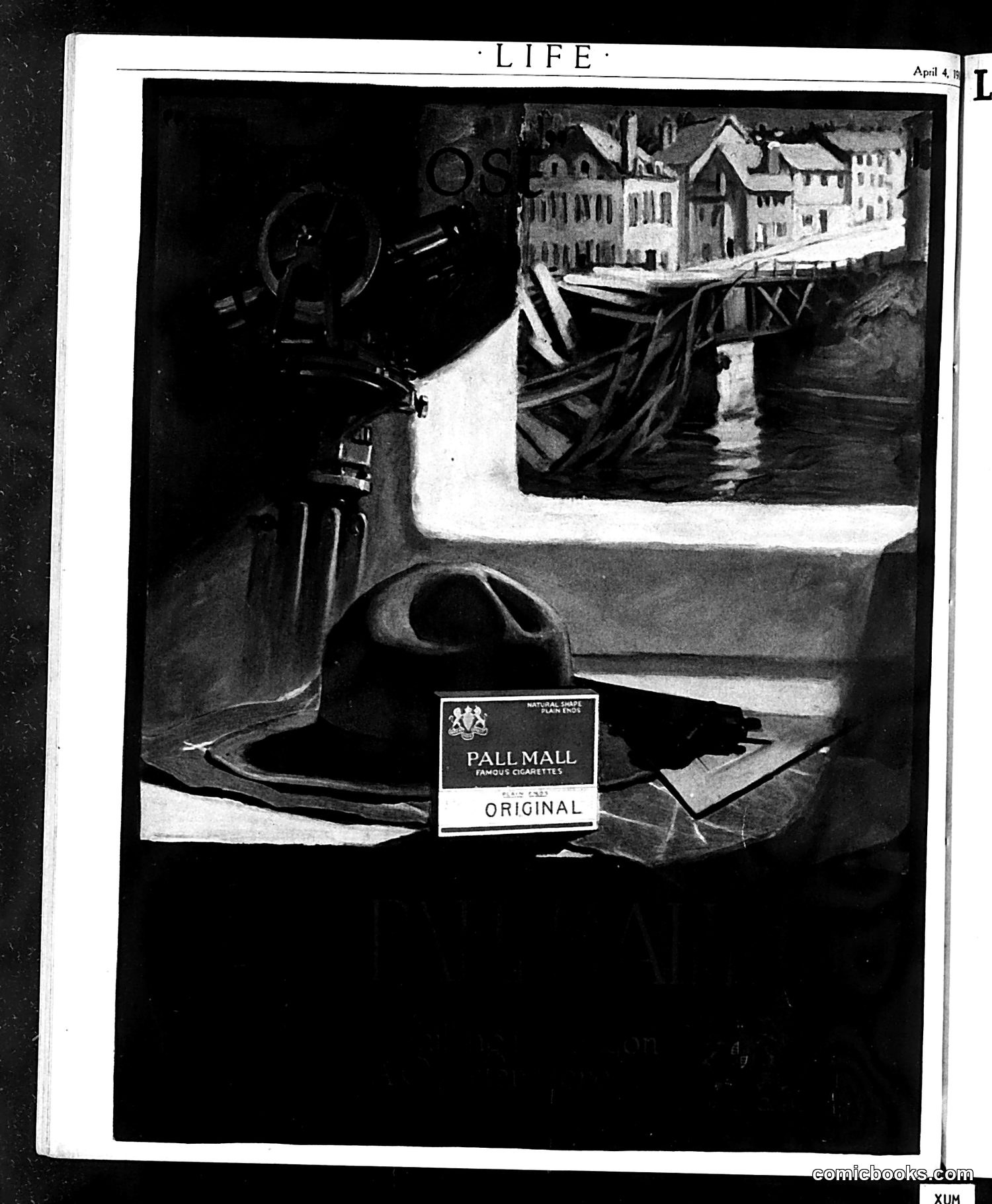
This is a cigarette advertisement from *Life* magazine (dated April 4, visible at top). The image shows a movie projector displaying a scenic film still—an Italian-style waterfront village with gondolas and Renaissance architecture—while a Pall Mall cigarette pack sits prominently in the foreground. The ad appears to use cinema imagery to associate smoking with sophistication and worldly travel. The juxtaposition of the projector and foreign landscape suggests that Pall Mall cigarettes offer an escape or connection to exotic, cultured experiences. The "Original" label emphasizes the product's established authenticity. This represents typical early 20th-century advertising strategy: linking consumer products to aspirational lifestyles and leisure.