
Life, 1918-04-04 · page 22 of 40
Life — April 4, 1918 — page 22: what you’re looking at
What you’re looking at
This page critiques theatrical productions of the era (appears to be WWI period, given references to "wheatless, meatless, war-time dinners"). **The main satire:** Life compares two Broadway productions. "Pan and the Young Shepherd"—an artistically ambitious poetic drama by Maurice Hewlett—is mocked for prioritizing intellectual pretension over basic performance competency. The reviewers argue that poor lighting, inaudible delivery, and bad acting undermine the noble material. By contrast, "A Pair of Petticoats" is praised as lightweight comedy that competently executes its modest aims, starring capable performers like Laura Hope Crews and Norman Trevor. **The point:** Life satirizes the little-theatre movement's tendency to excuse poor execution by invoking artistic ambition. The magazine argues that theatrical fundamentals—clear speech, good lighting, skilled acting—matter more than lofty pretensions. Entertainment value and professional craftsmanship trump intellectual aspiration. The cartoon (bottom) appears unrelated, depicting food-conservation humor.
📄 Transcribed text from this page (OCR, searchable)
Machine-transcribed from the original scan — historical spelling and the odd misread are preserved.
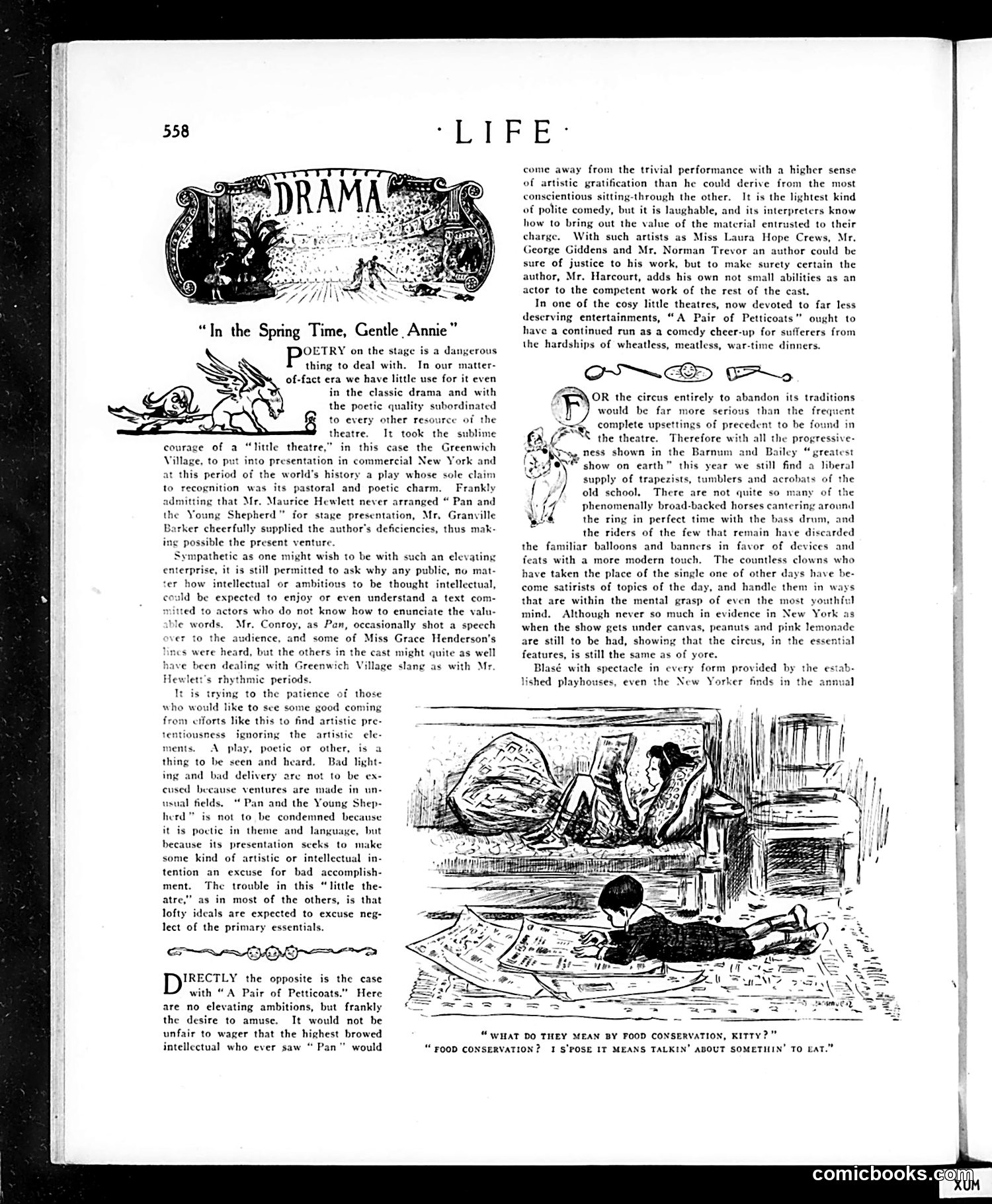
“In the Spring Time, Gentle Annie” OETRY on the stage is a dangerous thing to deal with. In our matter- of-fact era we have little use for it even in the classic drama and with the poetic quality subordinated to every other resource of the theatre. It took the sublime courage of a “little theatre,” in this case the Greenwich Village, to put into presentation in commercial New York and at this period of the world’s history a play whose sole ¢ to recognition was its pastoral and poetic charm. Frankly admitting that Mr. Maurice Hewlett never arranged “ Pan and the Young Shepherd” for stage presentation, Mr, Granville Barker cheerfully supplied the author's deficiencies, thus mak- ing possible the present venture. Sympathetic as one might wish to be with such an elevating enterprise, it is still permitted to ask why any public, no mat- ter how intellectual or ambitious to be thought intellectual, Jd be expected to enjoy or even understand a text com- itted to actors who do not know how to enunciate the valu- ble words. Mr. Conroy, as Pan, occasionally shot a speech to the audience, and some of Miss Grace Henderson's nes were heard, but the others in the cast might quite as well ¢ been dealing with Greenwich Village slang as with Mr Hewlett’s rhythmic periods. It is trying to the patience of those who would like to see some good coming from eiforts like this to find artistic pre- tentiousness ignoring the artistic ele- m1 ments. A play, poetic or other, is a thing to be seen and heard. Bad light- ing and bad delivery are not to be ex- cused because ventures are made in un- usual fields. “Pan and the Young Shep- herd” is not to be condemned because it is poctic in theme and language, but because its presentation seeks to make some kind of artistic or intellectual in- tention an excuse for bad accomplish- ment. The trouble in this “little the- atre,” as in most of the others, is that lofty ideals are expected to excuse neg- lect of the primary essentials. SMO IRECTLY the opposite is the case with “A Pair of Petticoats.” Here are no elevating ambitions, but frankly “LIFE: come away from the trivial performance with a higher sense of artistic gratification than he could derive from the most conscientious sitting-through the other. It is the lightest kind of polite comedy, but it is laughable, and its interpreters know how to bring out the value of the material entrusted to their charge. With such artists as Miss Laura Hope Crews, Mr, George Giddens and Mr. Norman Trevor an author could be sure of justice to his work, but to make surety certain the author, Mr. Harcourt, adds his own not small abilities as an actor to the competent work of the rest of the cast. In one of the cosy little theatres, now devoted to far less deserving entertainments, “A Pair of Petticoats” ought to have a continued run as a comedy cheer-up for sufferers from the hardships of wheatless, meatless, war-time dinners. OS—™ED [~ OR the circus entirely to abandon its traditions would be far more serious than the frequent * complete upsettings of precedent to be found in (a (rs the theatre. Therefore with all the progressive: PARK oog, ness shown in the Barnum and Bailey 4 [47 8N® show on earth” this year we still find a liberal !) supply of trapezists, tumblers and acrobats of the \ ; * greatest Kar Y'] old school. There are not quite so many of the {4 phenomenally broad-backed horses cantering around % the ring in perfect time with the bass drum, and the riders of the few that remain have discarded the familiar balloons and banners in favor of devices and feats with a more modern touch. The countless clowns who have taken the place of the single one of other days have be- come satirists of topics of the day, and handle them in ways that are within the mental grasp of even the most youthivl mind, Although never so much in evidence in New York as when the show gets under canvas, peanuts and pink lemonade are still to be had, showing that the circus, in the essential features, is still the same as of yore. Blasé with spectacle in every form provided by the estab- lished playhouses, even the New Yorker finds in the annual Sts Sa — fu the desire to amuse. It would not be unfair to wager that the highest browed intellectual who ever saw “ Pan" would “WHAT DO THEY MEAN BY FOOD CONSERVATION, KITTY?" “FOOD CONSERVATION? 1 S'POSE IT MEANS TALKIN’ ABOUT SOMETHIN’ TO EAT.” comicbooks. —