
Life, 1918-04-04 · page 35 of 40
Life — April 4, 1918 — page 35: what you’re looking at
What you’re looking at
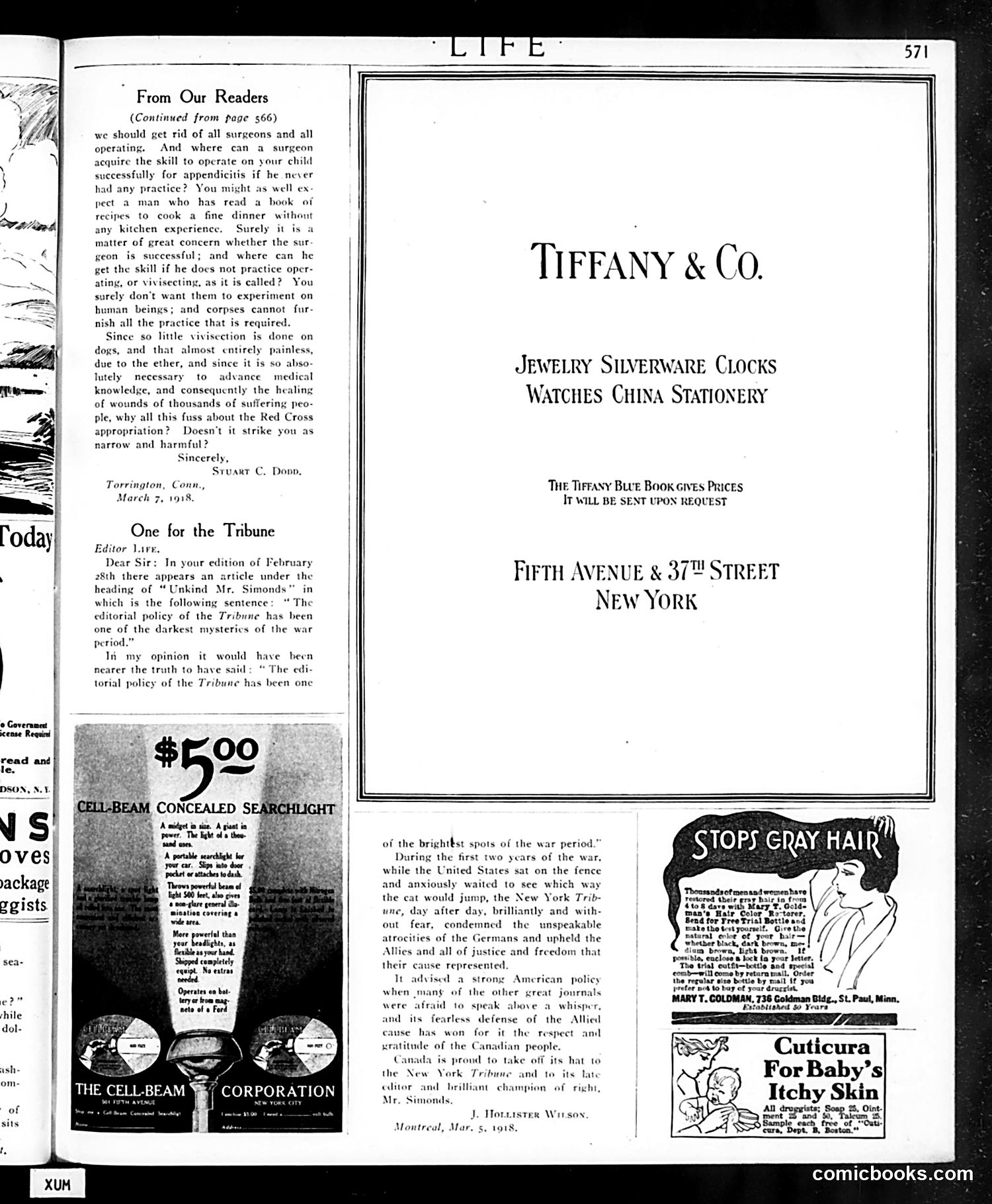
This page is primarily **reader letters and advertisements** rather than editorial cartoons. The substantive content consists of three reader letters debating serious WWI-era issues: 1. **"From Our Readers"**: Stuart C. Donn defends vivisection (animal testing) as necessary for surgical training, arguing doctors need practice before operating on humans—a response to apparent Red Cross criticism. 2. **"One for the Tribune"**: J. Hollister Wilson praises the New York *Tribune* newspaper's editorial stance supporting the Allied cause and condemning German atrocities, contrasting it favorably with other publications that remained cautious about U.S. involvement. The letters reflect American debates circa 1918 about medical ethics and appropriate press coverage of World War I—when the U.S. had recently entered the conflict and consensus about Allied support was still forming. The page also contains period advertisements for Tiffany & Co., a searchlight product, and Cuticura baby care—typical of the magazine's commercial content.
📄 Transcribed text from this page (OCR, searchable)
Machine-transcribed from the original scan — historical spelling and the odd misread are preserved.
From Our Readers (Continued from page 366) we should get rid of all surgeons and all operating. And where can a surgeon acquire the skill to operate on your child successfully for appendicitis if he never had any practice? You might as well ex pect a man who has read a book of es to cook a fine dinner without any kitchen experience. Surely it is a ma ater of great concern whether the sur. successful; and where can he kill if he does not practice oper- | FFE. or vivisecting, as it is called? You surely don't want them to experiment on human beings; and corpses cannot fur- nish all the practice that is required. Since so little vivisection is done on dogs, and that almost entirely painless, due to the ether, and since it is so geon NY & CO. get the s ating, lutely necessary to advance medical JEWELRY SILVERWARE CLOCKS knowledge, and consequently the healing WATCHES Cul STATIONERY of wounds of thousands of suffering peo- ple, why all this fuss about the Red Cross appropriation? Doesn't it strike you as narrow and harmful? Sincerely Sruaxt C. Donn, | Torrington, Conn., | THE Tirraxy Buve Book Gives Prices March 7, 1918. | IT WILL BE SENT UPON REQUEST One for the Tribune Editor Lare. New YORK heading of “Unkind Mr. Simonds” in he following sentence: “ The editorial policy of the Tribune has been | one of the darkest mysteries of the war period.” Ii my opinion it would have been * The edi torial policy of the Tribune has been one | which nearer the truth to have said of the brightkst spots of the war period.” During the first two years of the war, while the United States sat on the fence and anxiously waited to see which way the cat would jump, the New York Trib- une, d ter day, brilliantly and with- out fear, condemned the unspeakable Mere powerlal thes, atrocities of the Germans and upheld the your beadlights, as ‘ : exe a your band. Allies and all of justice and freedom that Sea: ‘SKeped completely their cause represented. equipt. No extras . / ded It advised a strong American policy the reralar, a be by al sexe / when many of the other great journals qoeter nah te Bay st yout Orse MARY T. COLDMAN, 736 Goldman Bide., St. Paul, Minn, er . were afraid to speak abo whisper, shile and its fearless defense of the Allied dol- cause has won for it the respect and — xratitude of the Canadian’ people. Cuticura Canada is proud to take off its hat 10 > she the New York Tribune and to its late For Baby Ss om- editor and. brilliant cha of right, Ve Itchy cord Mr. Simonds, J. Hortaister Witsox | ors. Montreal, Mar, comicbooks.com