
Life, 1918-04-04 · page 10 of 40
Life — April 4, 1918 — page 10: what you’re looking at
What you’re looking at
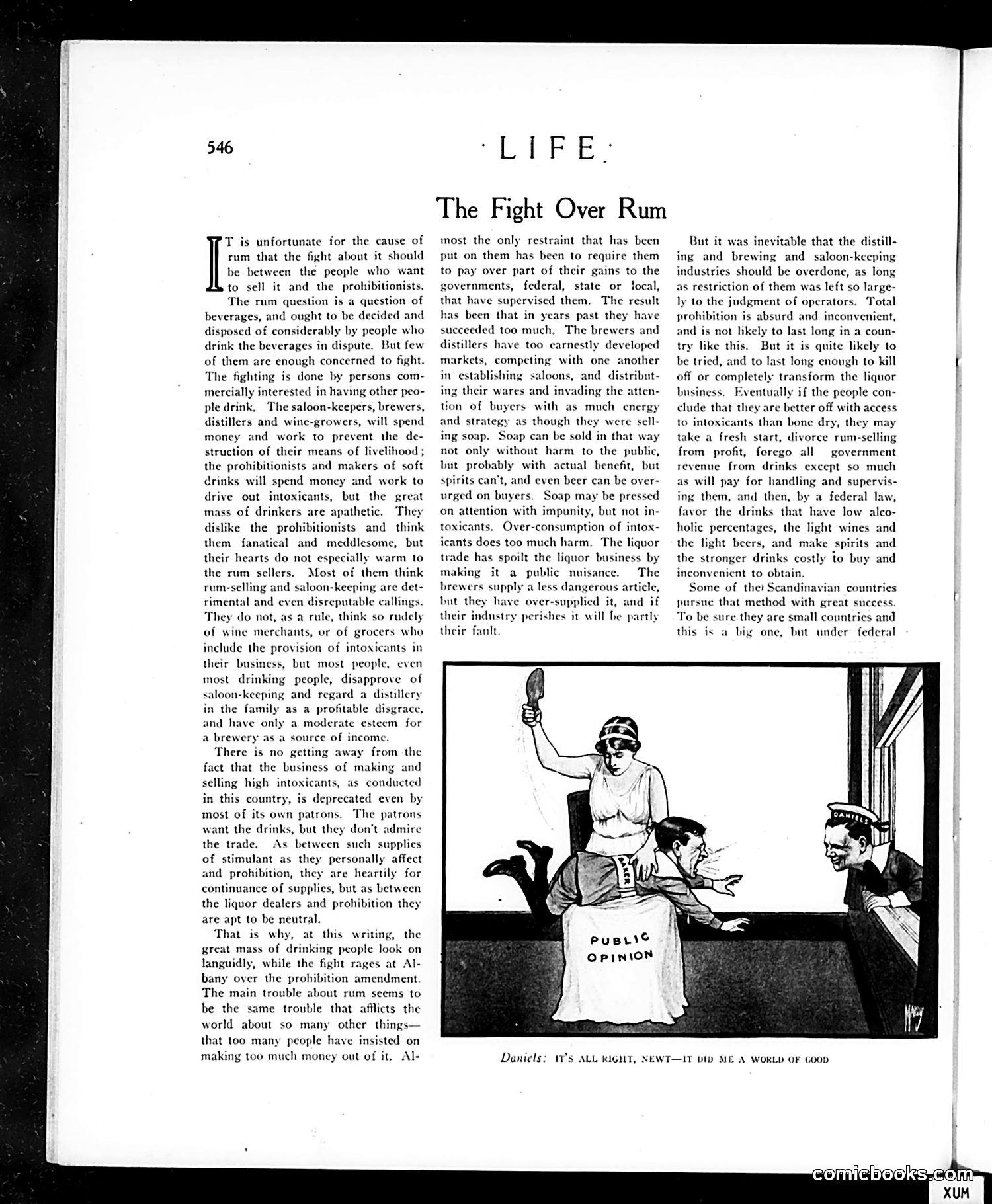
This page discusses Prohibition-era debates about alcohol regulation. The accompanying cartoon depicts "Public Opinion" (personified as a woman on a pedestal) being courted or pressured by two men—likely representing competing interests in the rum/liquor trade debate. The article argues that the liquor industry's problem stems from making excessive profits rather than from Prohibition itself. It criticizes distillers and brewers for oversupplying markets and establishing saloons, while acknowledging that most people dislike saloon-keeping as a "profitable disgrace." The caption reads: "Daniels: It's all right, Newt—it did me a world of good," suggesting commentary on political figures' stances on alcohol policy during this contentious period of American history.
📄 Transcribed text from this page (OCR, searchable)
Machine-transcribed from the original scan — historical spelling and the odd misread are preserved.
T is unfortunate for the cause of rum that the fight about it should be between the people who want to sell it and the prohibitionists. The rum question is a question of beverages, and ought to be decided and disposed of considerably by people who drink the beverages in dispute. But few of them are enough concerned to fight. The fighting is done by persons com- mercially interested in having other peo- ple drink, The saloon-keepers, brewers, distillers and wine-growers, will spend money and work to prevent the de- struction of their means of livelihood ; the prohibitionists and makers of soft drinks will spend money and work to drive out intoxicants, but the great mass of drinkers are apathetic. They dislike the prohibitionists and think them fanatical and meddlesome, but their hearts do not especially warm to the rum sellers. Most of them think rum-selling and saloon-keeping are det- rimental and even disreputable callings. They do not, as a rule, think so rudely of wine merchants, or of grocers who include the provision of intoxicants in their business, but most people, even most drinking people, disapprove of saloon-keeping and regard a distillery in the family as a profitable dis and have only a moderate est a brewery as a source of income, There is no getting away from the fact that the business of making and selling high intoxicants, as conducted in this country, is deprecated even by most of its own patrons. The patrons want the drinks, but they don’t admire the trade. As between such supplies of stimulant as they personally affect and prohibition, they are heartily for continuance of supplies, but as between. the liquor dealers and prohibition they are apt to be neutral. That is why, at this writing, the great mass of drinking people look on languidly, while the fight rages at Al- bany over the prohibition amendment The main trouble about rum seems to be the same trouble that afflicts the world about so many other things— that too many people have insisted on making too much moncy out of it. Al- aCe, ‘m for “LUPE: The Fight Over Rum most the only restraint that has been put on them has been to require them to pay over part of their gains to the governments, federal, state or local, that have supervised them. The result has been that in years past they have succeeded too much, The brewers and distillers have too carnestly developed markets, competing with one another in establishing saloons, and distribut- ing their wares and invading the atten- tion of buyers with as much energy and strategy as though they were sell- ing soap. Soap can be sold in that way not only without harm to the public, but probably with actual benefit, but spirits can’t, and even beer can be over- urged on buyer: soap may be pressed on attention with impunity, but not in- toxicants. Over-consumption of into: icants does too much harm. The liquor trade has spoilt the liquor business by making it a public nuisance. The brewers supply a less dangerous article, Int they have over-supplied it, and if their industry perishes it will be partly their fault Daniels: 11's ALL KiGut, NEWwT—1T But it was inevitable that the distill- ing and brewing and_ saloon-kceping industries should be overdone, as long as restriction of them was left so large- ly to the judgment of operators. Total prohibition is absurd and inconvenient, and is not likely to last long in a coun- try like this, But it is quite likely to be tried, and to last long enough to kill off or completely transform the liquor business. Eventually if the people con- clude that they are better off with access to intoxicants than bone dry, they may take a fresh start, divorce rum-selling from profit, forego all government revenue from drinks except so much as will pay for handling and supervis- ing them, and then, by a federal law, favor the drinks that have low alco- holic percentages, the light wines and the light beers, and make spirits and the stronger drinks costly to buy and inconvenient to obtain. Some of thei Scandinavian countries pursue that method with great success. » be sure they are small countries and this is a big one, but under federal DID ME A WORLD OF GooD