
A complete issue · 56 pages · 1918
Life — March 21, 1918
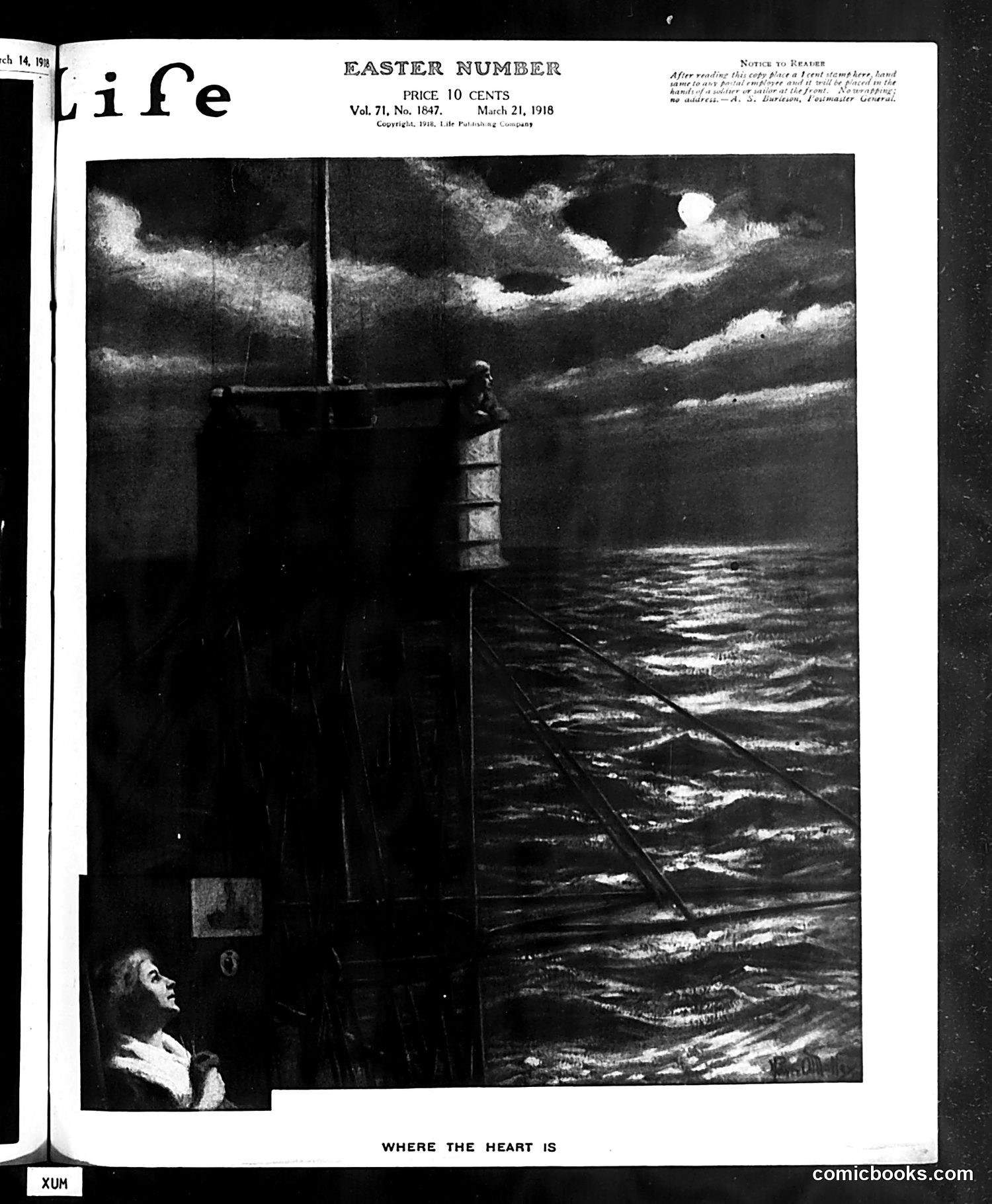
This image, titled "Where the Heart Is," depicts a submarine at sea during World War I. A figure stands atop the vessel while another observes from below, watching turbulent waters under a moonlit sky. Published during America's involvement in WWI (1917-1918), this likely satirizes German U-boat warfare, which had killed American civilians and merchant sailors. The caption "Where the Heart Is"—playing on the homesick sentiment—appears darkly ironic, suggesting the submarine as a deadly instrument rather than a place of patriotic devotion. The composition emphasizes the submarine's menacing silhouette against the moonlit seascape, conveying the threat these vessels posed to American shipping lanes and national security during the period.
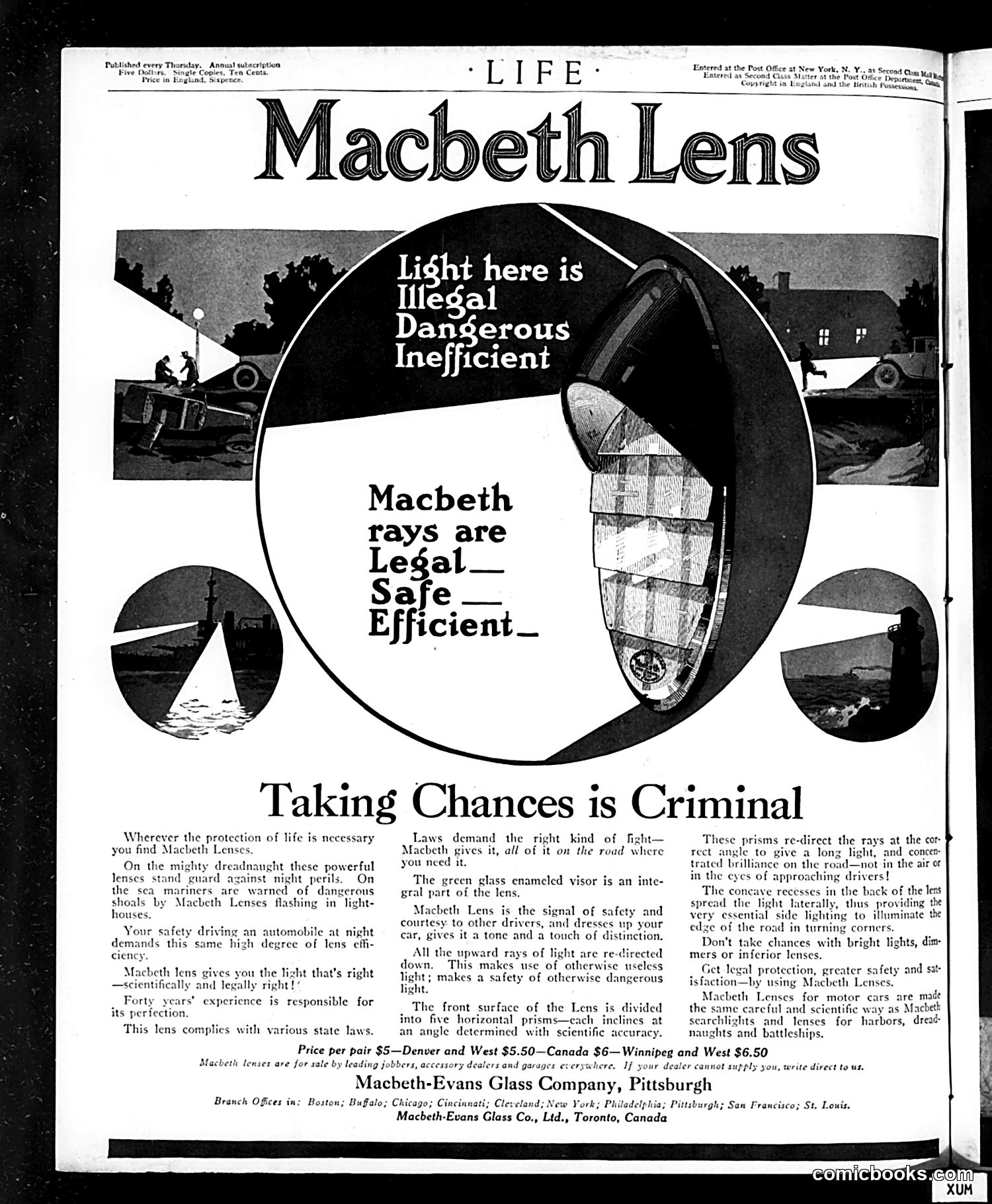
This is primarily a **product advertisement**, not political satire. The Macbeth-Evans Glass Company is marketing "Macbeth Lenses"—automobile safety lighting devices. The ad uses Shakespearean wordplay (the "Macbeth" name references the famous line "Out, damned spot"), presenting the product as essential safety equipment. The central diagram shows how the lens redirects light to prevent dangerous glare for oncoming drivers. The headline "Taking Chances is Criminal" emphasizes safety concerns of early automobile driving. Circular photographs around the border appear to show road/driving scenarios illustrating safety hazards. The ad claims the lens complies with various state laws and positions Macbeth Lenses as the legitimate, safe alternative to illegal or inadequate lighting—essentially a straightforward commercial appeal to automobile owners prioritizing safety and legal compliance.
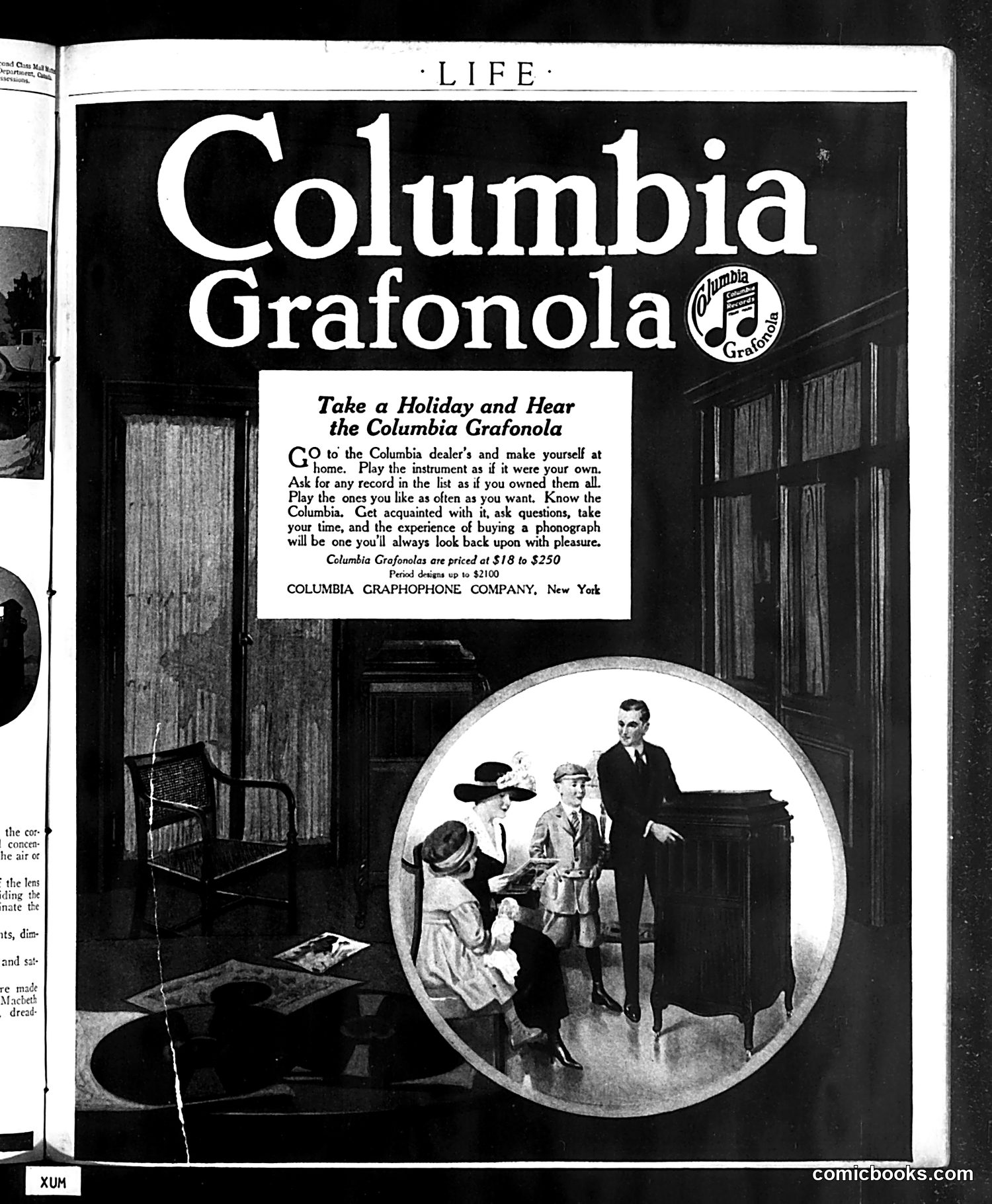
This is **advertising, not satire or editorial content**. It's a full-page Columbia Grafonola (phonograph) advertisement from *Life* magazine. The ad uses a domestic leisure scenario to market the product: a well-dressed salesman demonstrates the machine to a middle-class family in their home. The headline "Take a Holiday and Hear the Columbia Grafonola" positions phonograph ownership as aspirational and accessible entertainment. The copy encourages potential buyers to visit Columbia dealers, audition records, and experience the machine casually—framing record-buying as a pleasant, pressure-free shopping experience. Pricing is listed as $18 to $250, with records up to $2. There is **no political satire or cartoon elements** on this page—it's straightforward commercial promotion aimed at early 20th-century consumers.
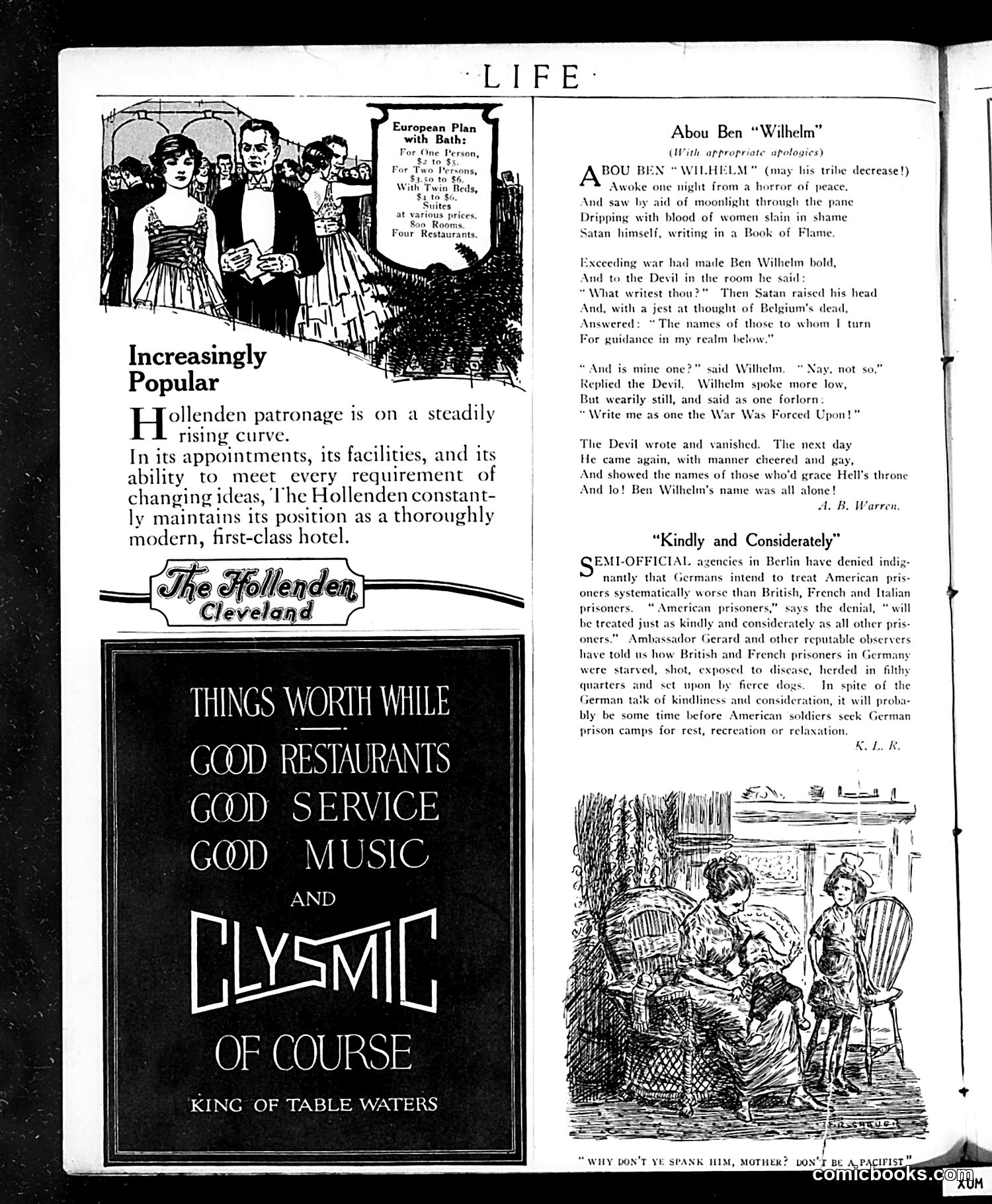
This page combines hotel advertising with wartime satire and poetry. **Left side:** Advertisement for The Hollenden Hotel in Cleveland, emphasizing its "modern, first-class" status and rising popularity. The top illustration depicts elegant diners. **Right side:** A poem titled "Abou Ben 'Wilhelm'" parodies famous poetry (likely Leigh Hunt's "Abou Ben Adhem"), mocking a German military figure. The satire suggests Wilhelm (likely Kaiser Wilhelm II) made a Faustian bargain, offering names of Belgium's dead to Satan in exchange for military success, only to have his own name erased from Hell's roster—suggesting his ignominy surpasses even damnation. Below, an article titled "Kindly and Considerately" critiques German claims about treating prisoners humanely, contrasting propaganda with documented reports of Allied prisoners' mistreatment in German camps. The page reflects WWI-era American anti-German sentiment.
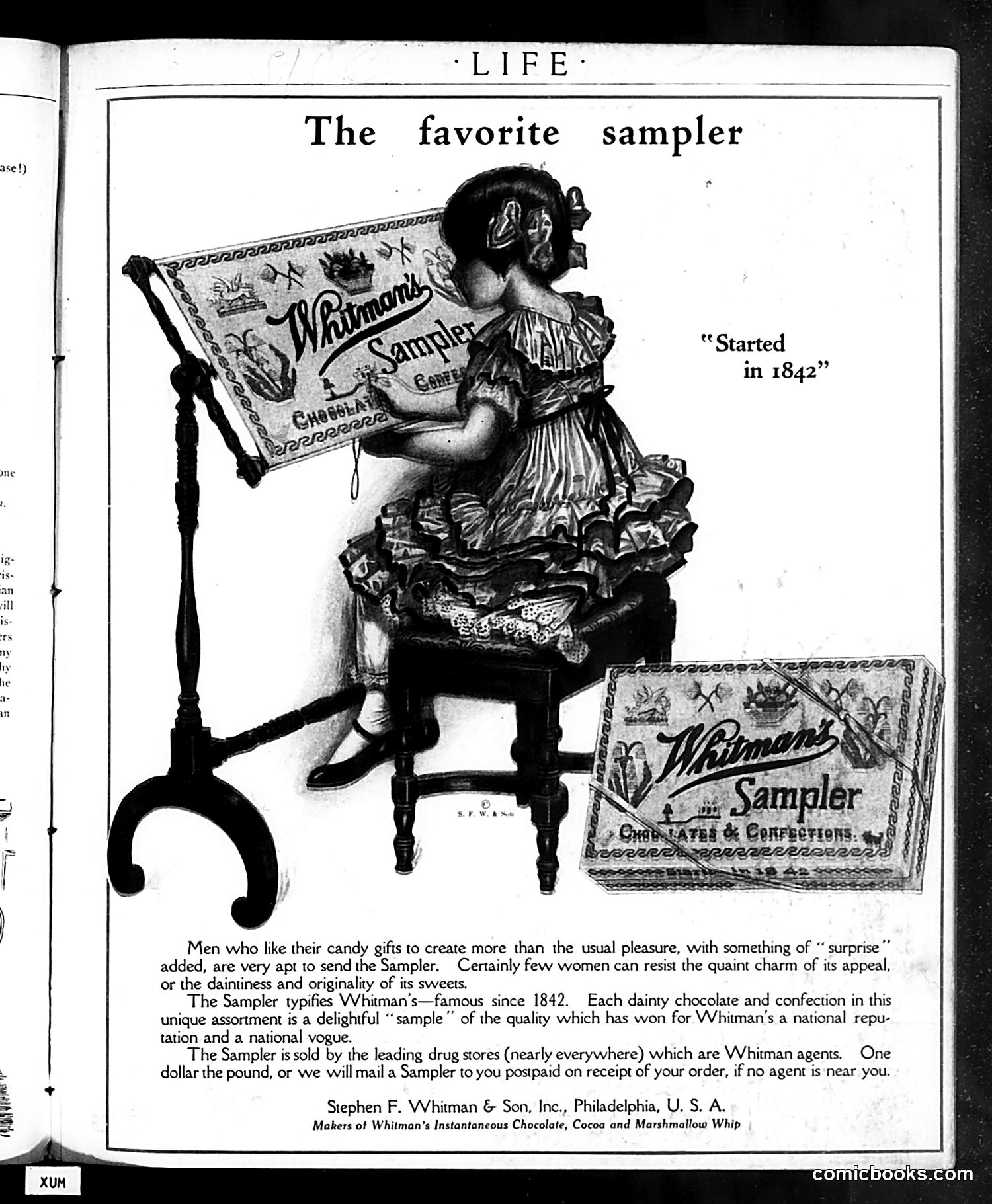
This is primarily a **Whitman's chocolate advertisement**, not satire. The illustration shows a woman in Victorian-era dress holding a Whitman's Sampler box, with the tagline "Started in 1842." The ad copy appeals to male gift-givers, suggesting the Sampler creates "surprise" and appeals to women's tastes better than typical candy gifts. It emphasizes the product's "daintiness and originality." **Historical context**: This reflects early 1900s gender norms where men purchased fancy chocolates as romantic gifts for women. The Sampler's variety ("sample") of assorted chocolates was marketed as especially appealing to female consumers. The ad notes availability "at the leading drug stores" and direct mail options—standard early advertising distribution. The page contains no political satire; it's straightforward commercial messaging using period-appropriate imagery and gender conventions.
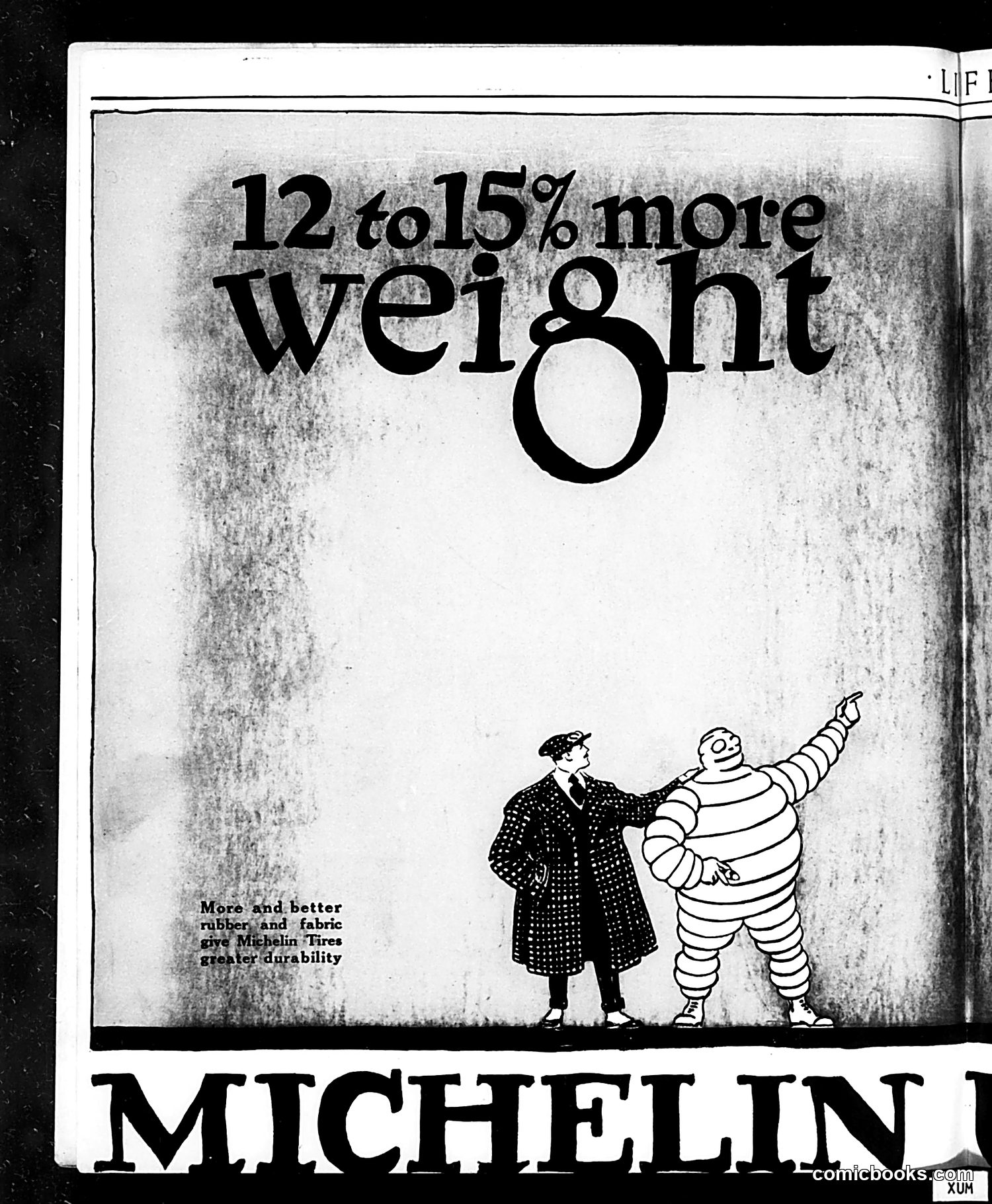
This is a **Michelin tire advertisement**, not political satire. The image shows a well-dressed businessman presenting the famous Michelin Man (Bibendum) character, who appears notably larger than in earlier depictions. The headline claims "12 to 15% more weight" for Michelin tires, and small text promises "more and better rubber and fabric give tires greater durability." The advertiser is using the Michelin Man's increased size as a visual metaphor: more material equals better quality and longer-lasting tires. This appears to be early 20th-century advertising emphasizing product improvement and substantiality—larger/heavier meant more durable to consumers of that era. The cartoon style and Michelin Man mascot were established advertising tools, not commentary on current events.
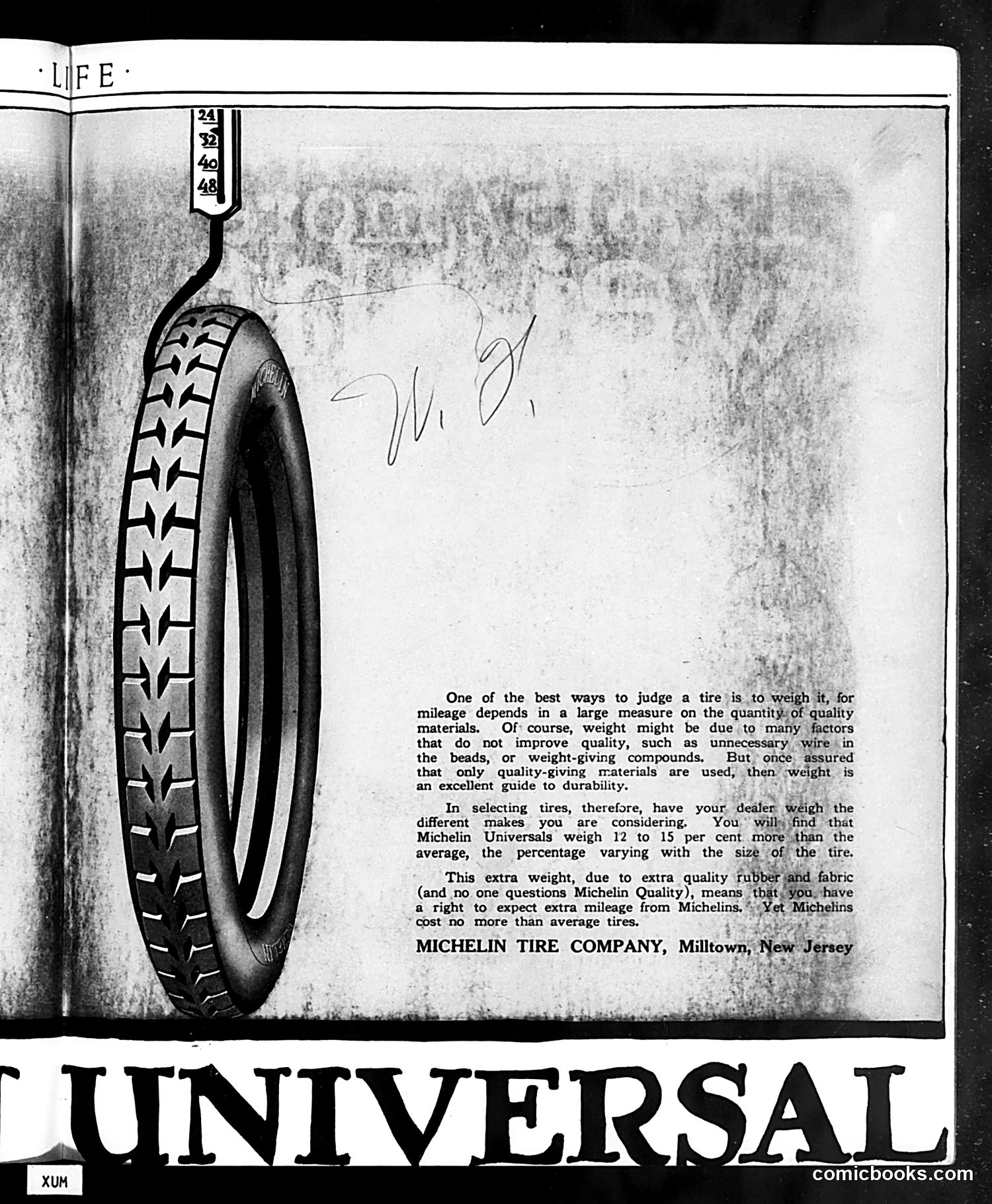
This is a straightforward **Michelin Tire Company advertisement**, not a political cartoon. The page features an illustration of a Michelin Universal tire with a weight scale indicator showing measurements (24, 32, 40, 48). The advertisement argues that tire **weight correlates with quality and durability**. It claims Michelin Universals weigh 12-15% more than average tires due to superior rubber and fabric, justifying their higher cost by promising extended mileage. The ad addresses consumer skepticism about paying more, positioning extra weight as evidence of quality materials rather than inferior filler compounds. This represents typical early 20th-century advertising strategy: using technical specifications to justify premium pricing.
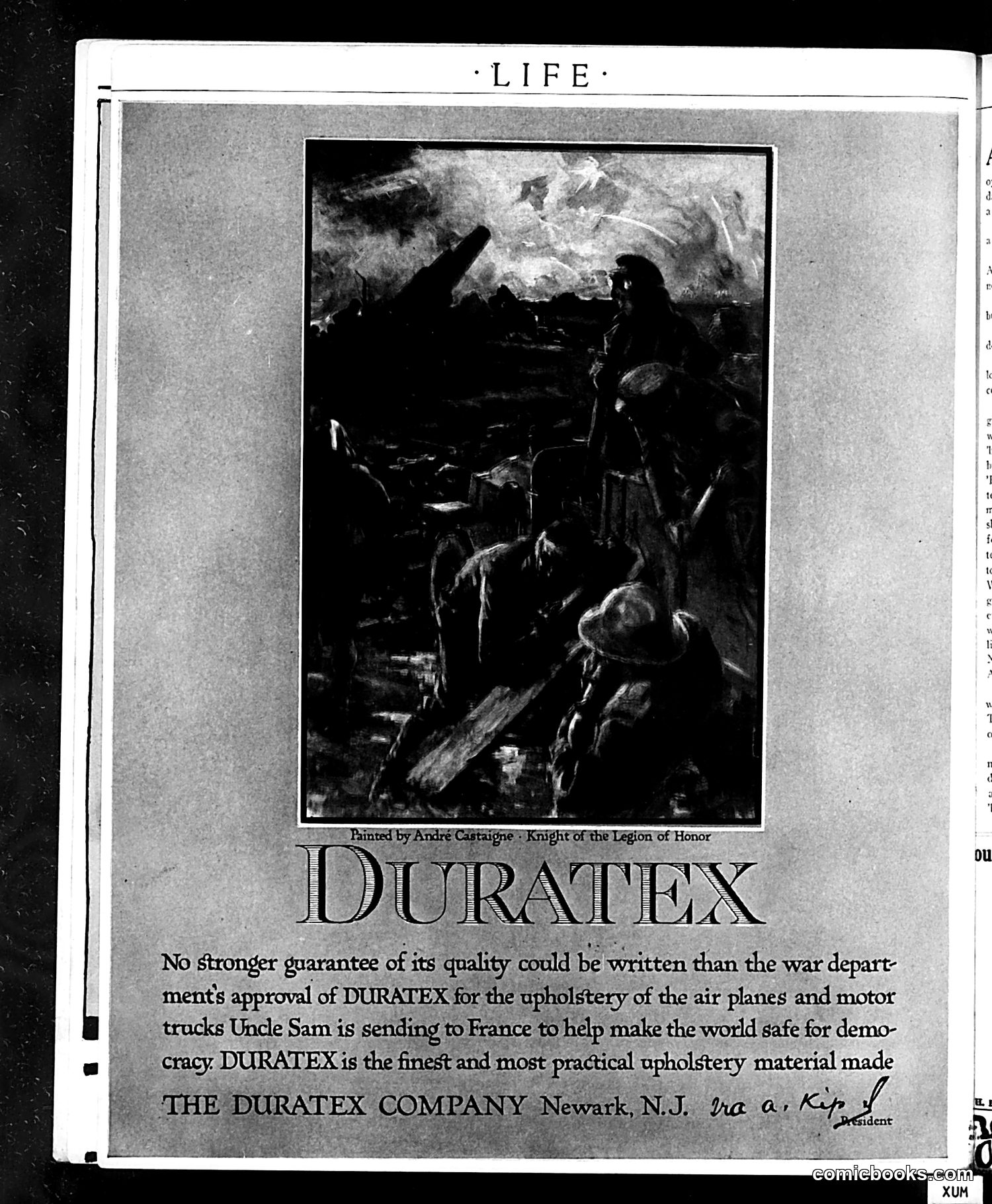
This is primarily an **advertisement for Duratex upholstery material**, not satire or political commentary. The page features a dramatic war painting by André Castaigne (credited as "Knight of the Legion of Honor") depicting soldiers in what appears to be a World War I trench or battlefield scene, with artillery fire visible in the sky. The ad's message uses patriotic appeal: it claims the U.S. War Department approved Duratex for upholstering military aircraft and trucks being sent to France. The tagline promises Duratex is "the finest and most practical upholstery material made." This represents typical **WWI-era advertising strategy**—leveraging government endorsement and military necessity to promote commercial products as patriotic contributions to the war effort.
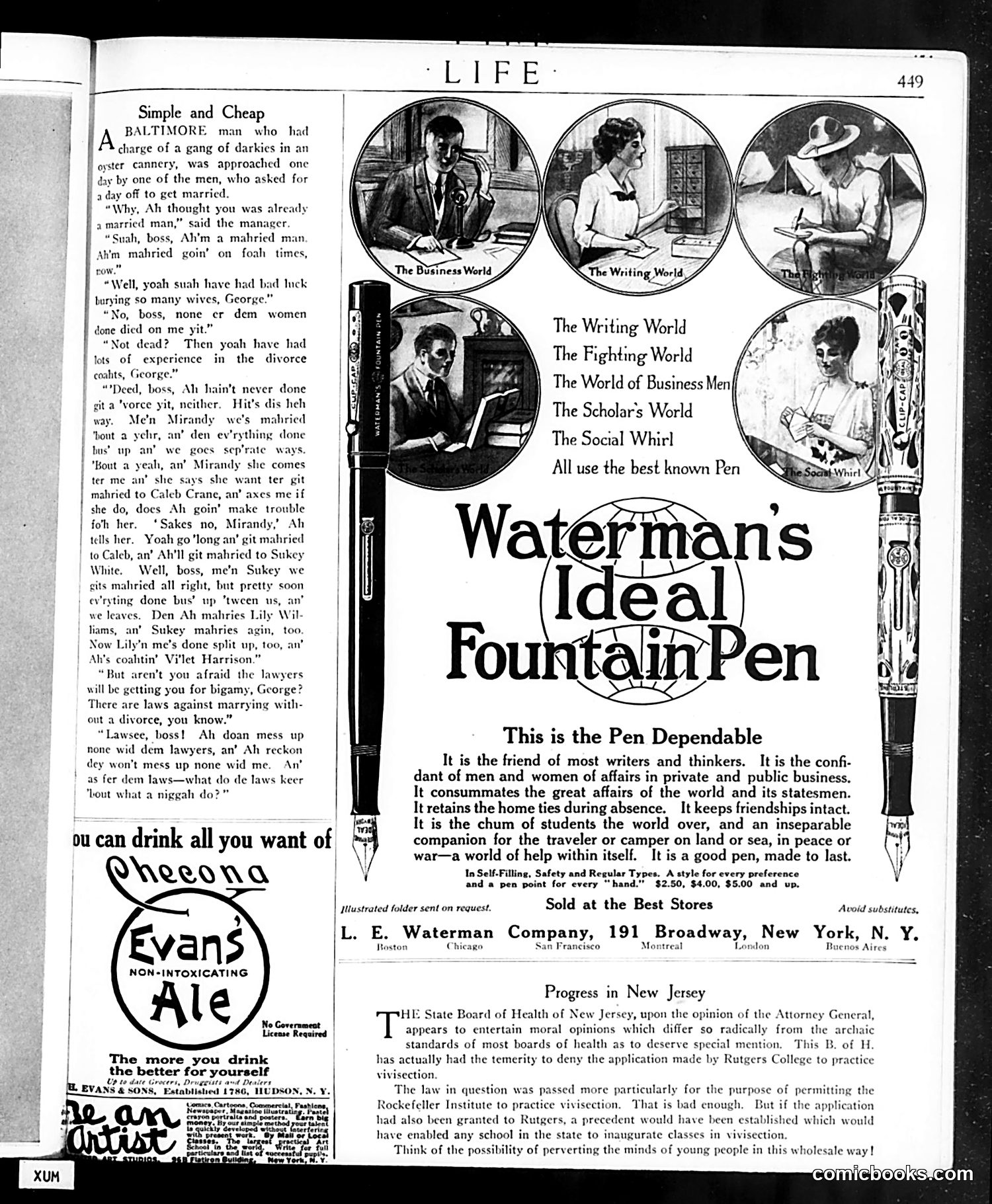
This page contains two main elements: **Left side:** A satirical story titled "Simple and Cheap" mocking Baltimore's working-class culture, specifically dialogue between a manager and an Irish immigrant worker named George about marriage and divorce. The humor relies on ethnic stereotyping and dialect humor common to early 20th-century magazines—portraying Irish immigrants as comically ignorant about marriage law. **Right side:** A Waterman's Ideal Fountain Pen advertisement featuring circular vignettes of different professional worlds (business, writing, fighting, social). The ad promotes the pen's universal utility across professions. **Bottom:** An unrelated article about New Jersey's Board of Health denying vivisection permissions to Rutgers College. The page reflects period attitudes toward immigration, class, and commercial aspiration typical of *Life* magazine's satirical brand.
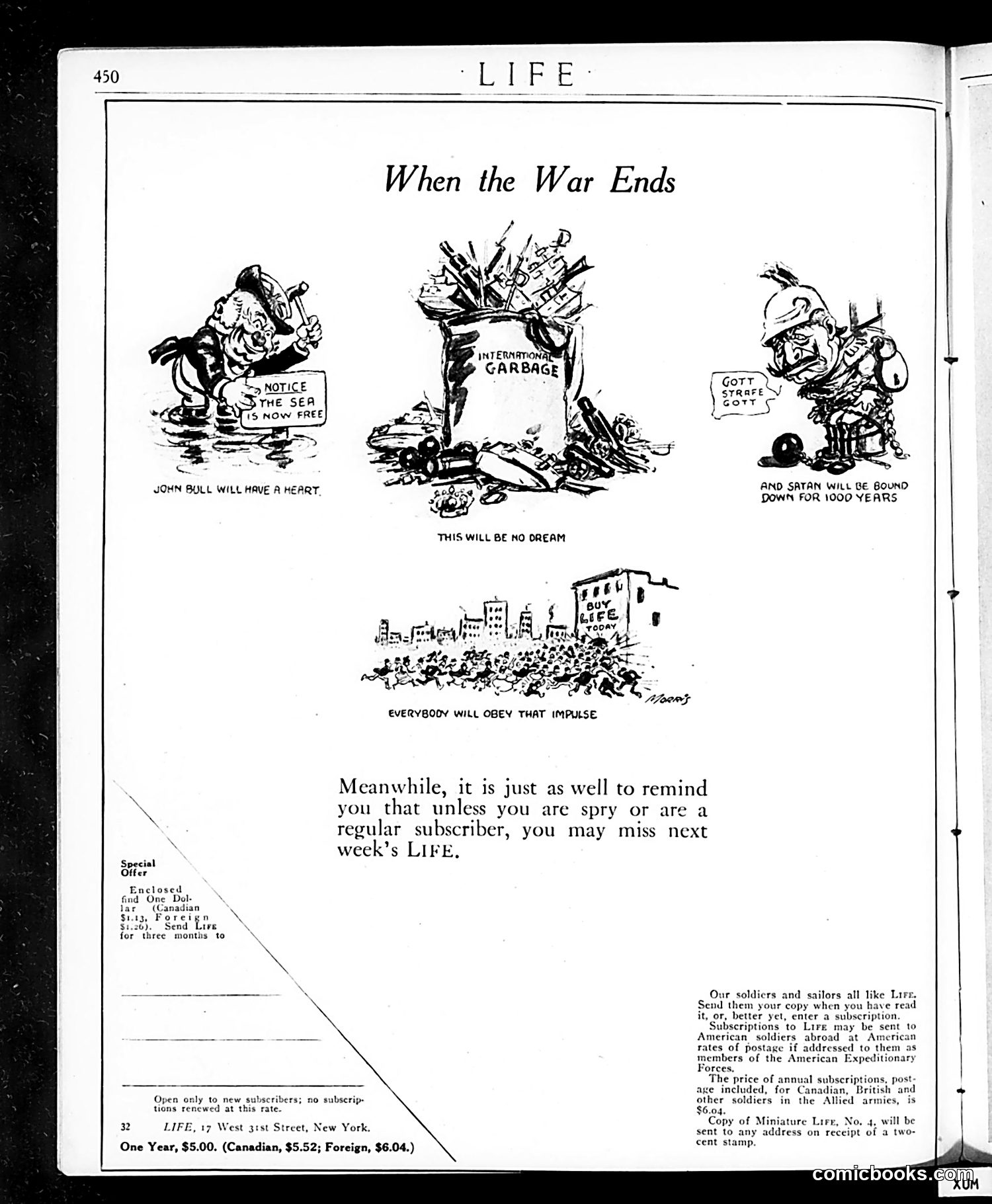
This page presents four cartoons satirizing post-World War I outcomes. The top panels mock Allied leaders' post-war plans: - **"John Bull will have a Heart"** (left): The British figure, posting a "Notice: The Sea is now Free," appears ironic given naval conflicts. - **Center panel**: A massive "International Garbage" heap represents the chaotic post-war world—"This will be no dream." - **Right panel**: Shows Satan being bound, likely referencing German defeat and reparations ("bound down for 1000 years"). - **Bottom panel**: A city building labeled "Buy Life" sits atop debris—"Everybody will obey that impulse"—satirizing commercialism amid post-war reconstruction. The cartoons suggest cynicism about peace's benefits and concerns that wartime suffering would yield to mere profit-seeking rather than genuine improvement.
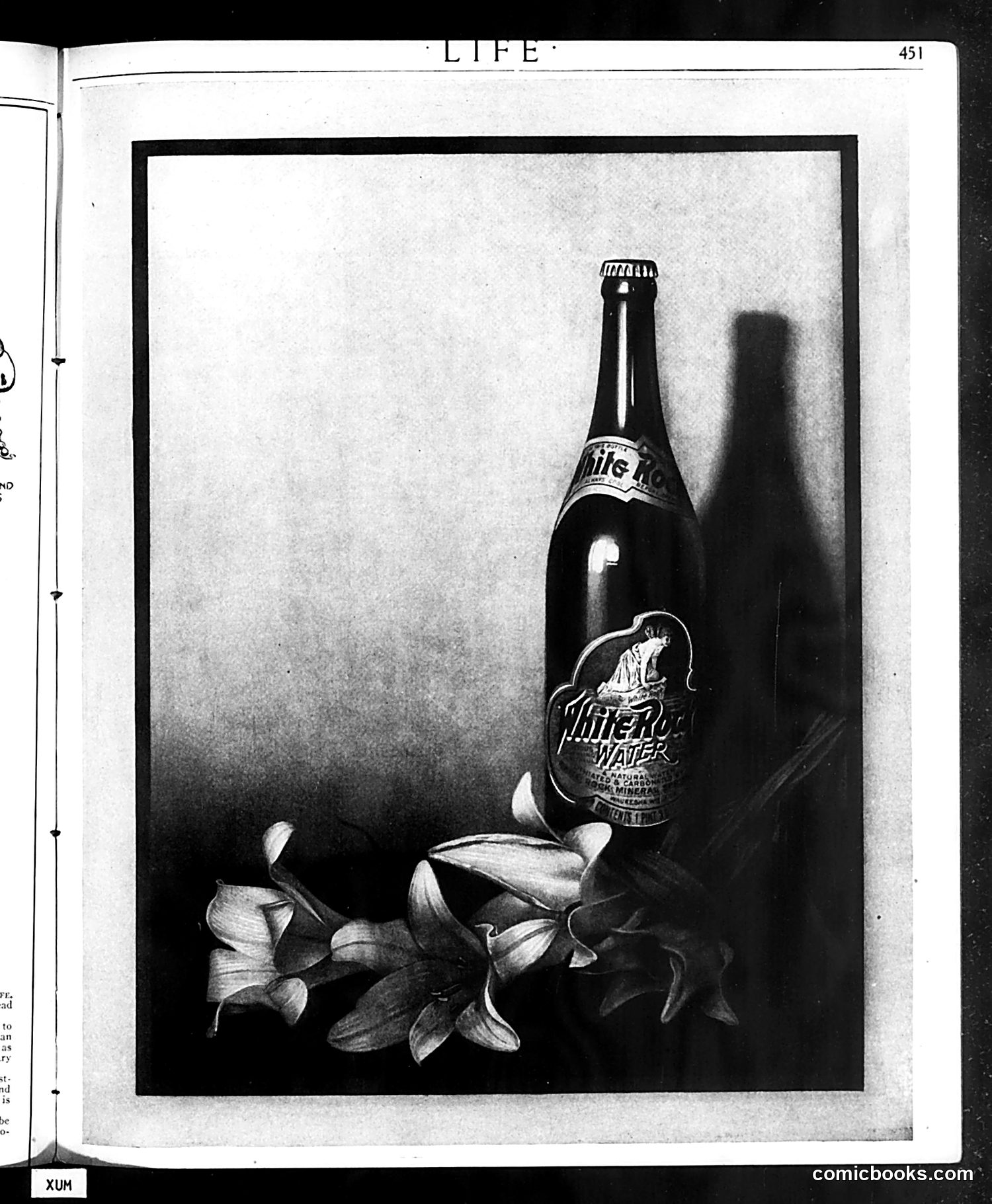
This page from *Life* magazine (page 451) features a still-life advertisement or illustration for "Miller" beer, identifiable by the label visible on the bottle. The image shows a beer bottle surrounded by what appear to be flowers or floral arrangements in a dramatic black-and-white photograph. The composition mimics fine art still-life painting—a stylistic choice that elevates a commercial product to the level of high culture. This was a common advertising approach in early-to-mid 20th century magazines, presenting consumer goods as objects of aesthetic appreciation rather than mere commodities. Without additional OCR text or context from surrounding pages, the specific satirical message—if any—remains unclear. This may be straight advertising rather than editorial satire.
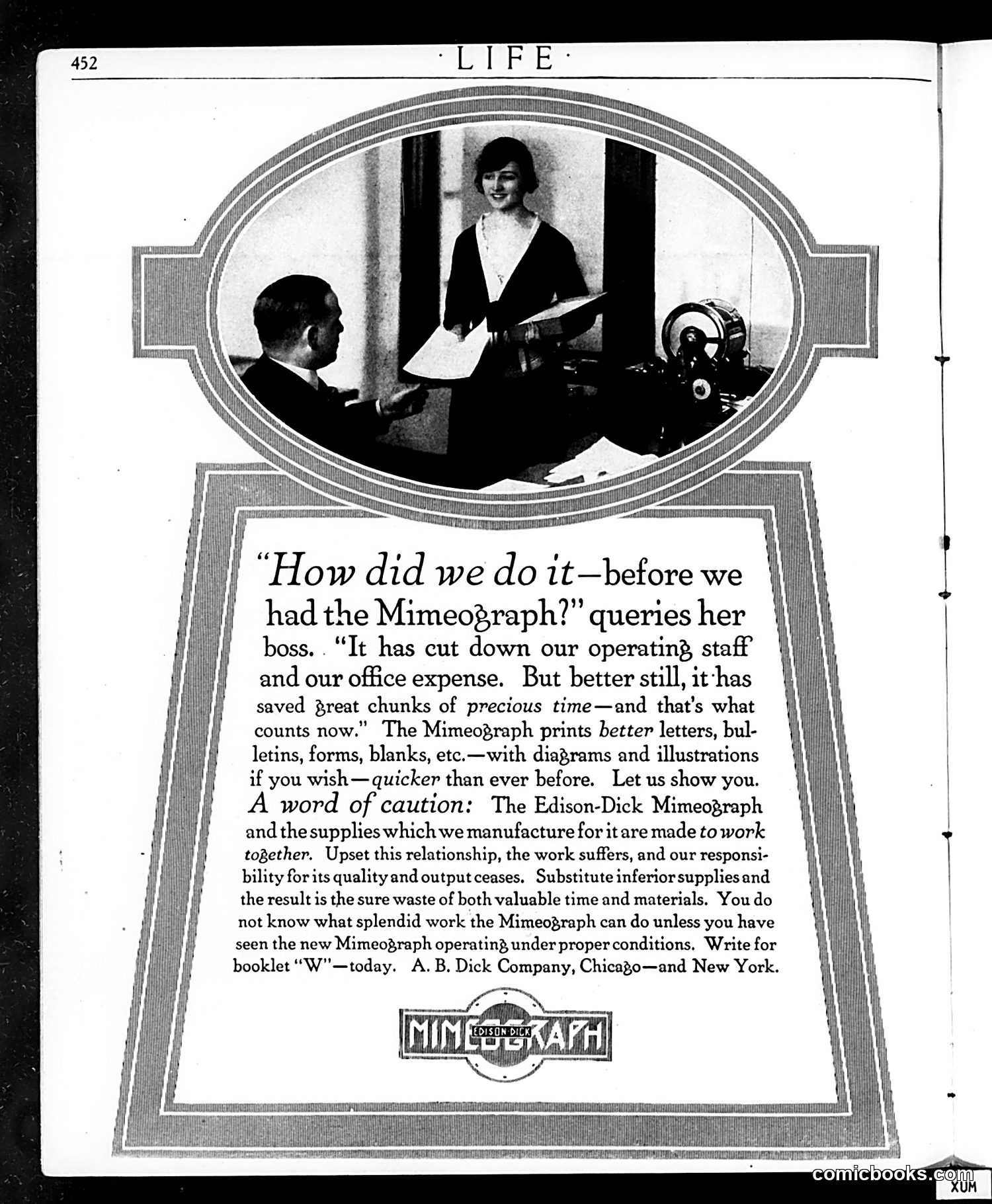
This is a **commercial advertisement**, not satire or political commentary. The A.B. Dick Company advertises the "Mimeograph" (an early duplicating machine) by showing an office scene where a woman operates the device while her boss watches approvingly. The ad's pitch emphasizes **efficiency gains**: the machine reduces operating staff and office expenses while producing "better letters, bulletins, forms, blanks, etc." faster than previous methods. The appeal targets business managers concerned with modernization and cost-cutting. The woman's presence suggests the Mimeograph could be operated by clerical staff, not specialized technicians—making it practical for offices of various sizes. This reflects early-20th-century optimism about labor-saving technology.
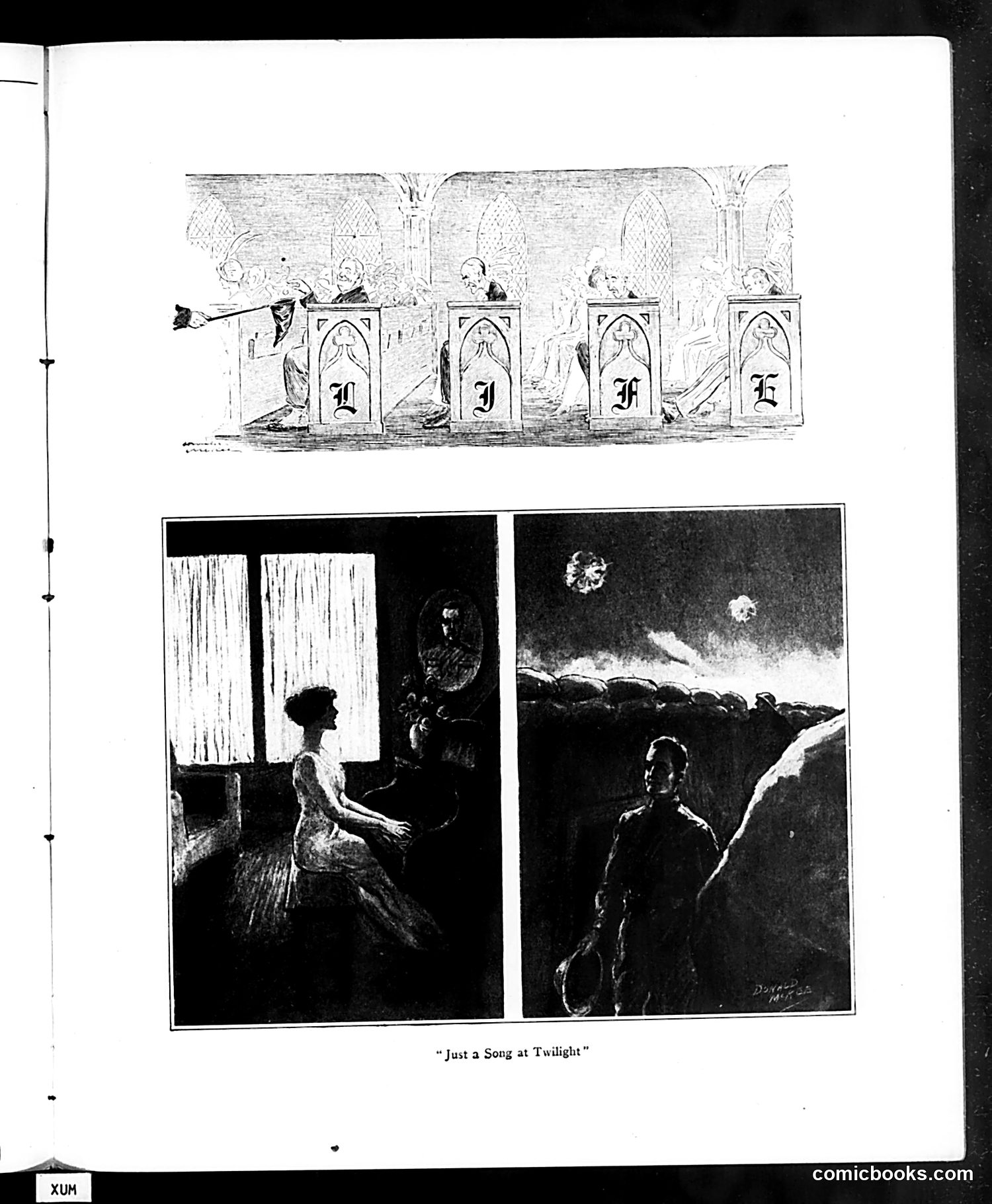
This page contains three illustrations satirizing religious hypocrisy or performative piety. The top cartoon shows four church confessional booths labeled with letters spelling "LIFE," with figures inside and one person appearing to flee or escape, suggesting mockery of confession practices. The bottom two panels, captioned "Just a Song at Twilight," depict contrasting scenes: a woman at a window gazing at what appears to be a religious figure or vision, and a soldier in a battlefield at dusk with explosions overhead. The juxtaposition seems to satirize the gap between sentimental, romantic religious sentiment (the woman's spiritual reverie) and the brutal reality of warfare—suggesting that piety or religious comfort offers little solace amid actual human suffering and death. The satire appears critical of disconnected spirituality.
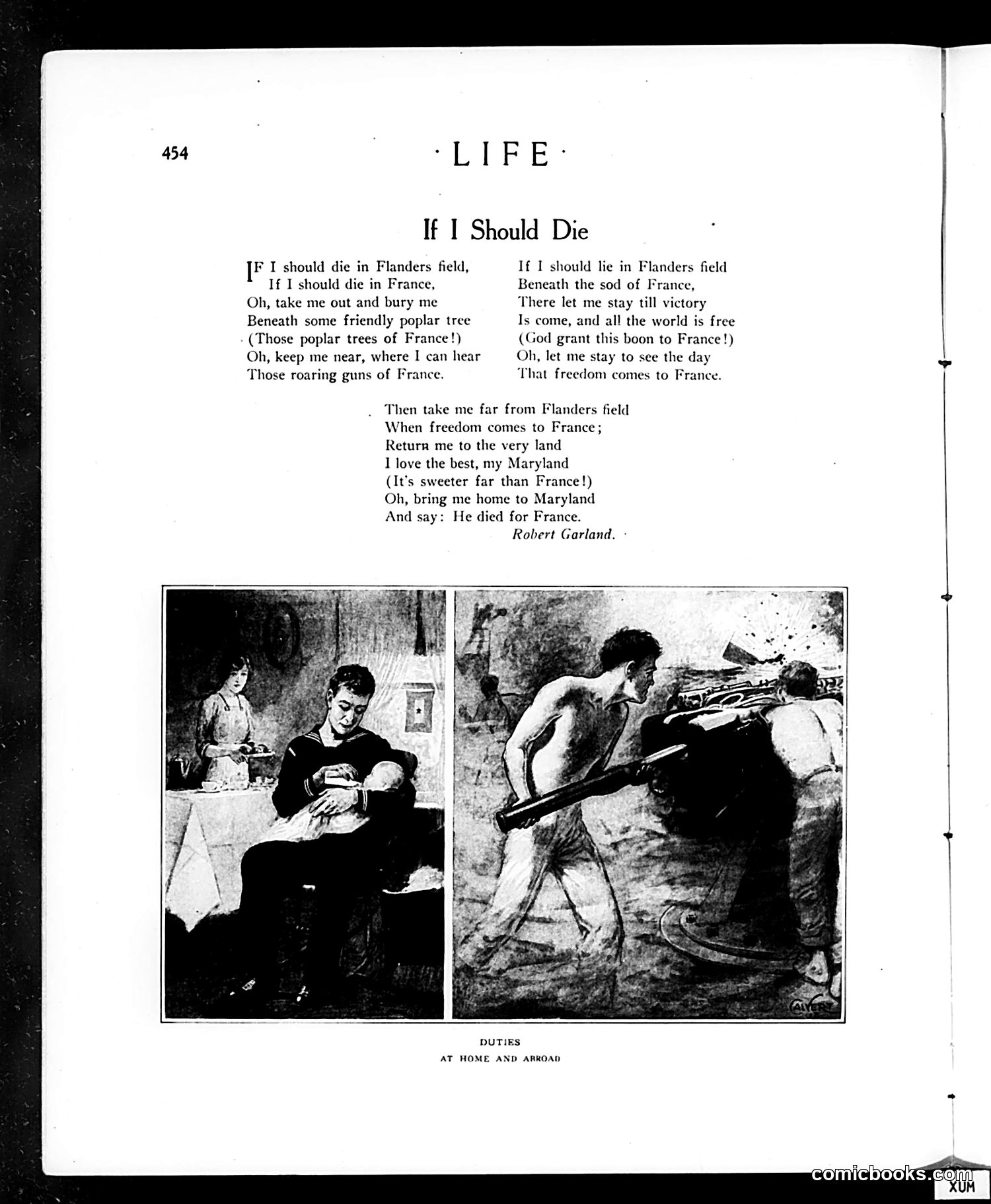
This page features a patriotic poem by Robert Garland about sacrifice during World War I, paired with two photographs labeled "Duties: At Home and Abroad." **Left image:** Shows a woman knitting or doing needlework indoors—representing women's domestic contribution to the war effort (making supplies for soldiers). **Right image:** Depicts shirtless soldiers in combat with rifles, representing frontline military service. The juxtaposition illustrates the poem's central conceit: contrasting the speaker's willingness to die in France's fields with his hope to eventually return to his beloved Maryland. The photographs reinforce how WWI divided duties between home and battlefield, with civilians (particularly women) supporting the war through domestic labor while soldiers fought abroad. This is straightforward wartime propaganda emphasizing shared sacrifice.
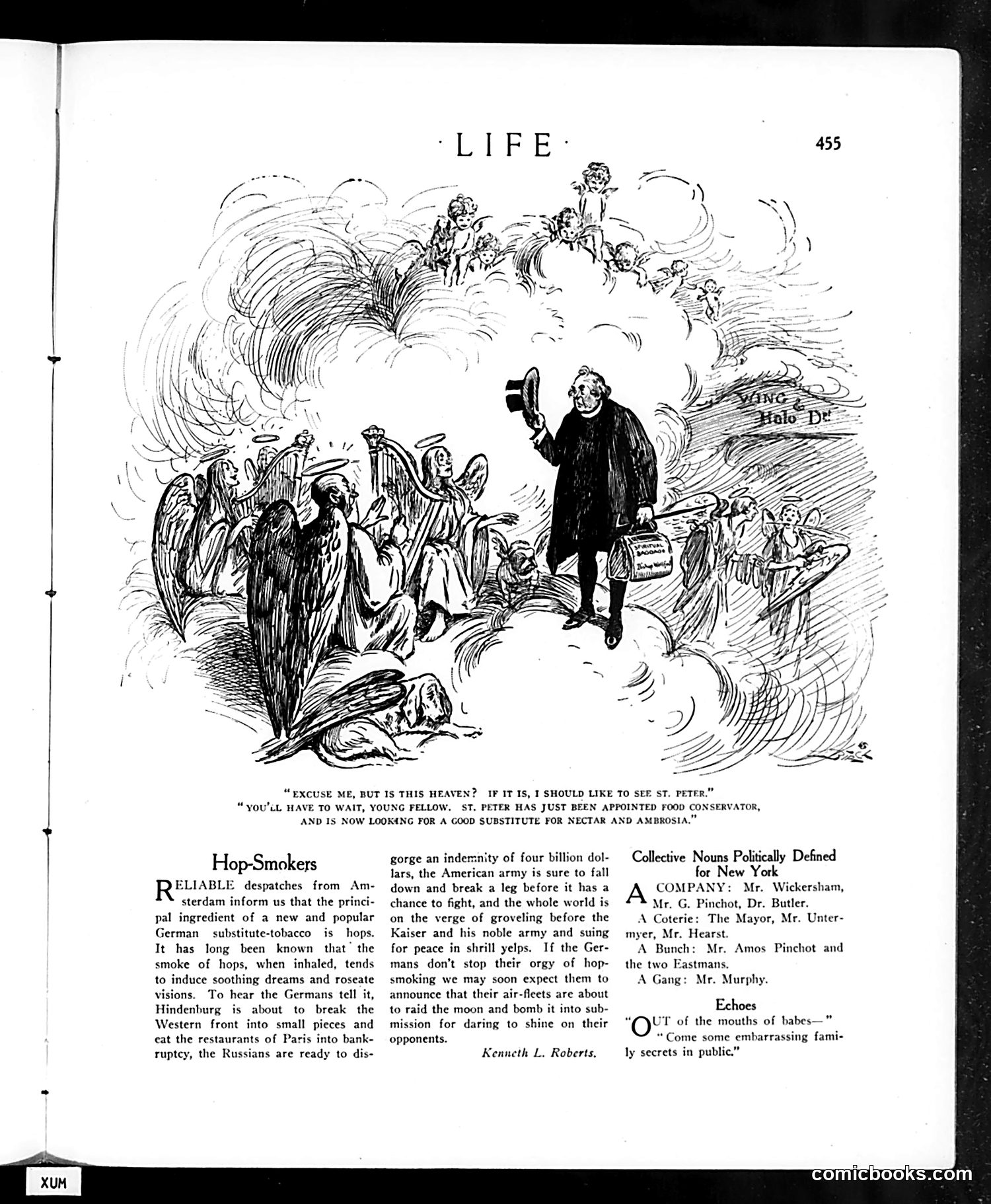
The main cartoon depicts a man in formal dress and top hat standing among angels and clouds in heaven, speaking to St. Peter. The caption indicates he's asking if this is heaven and requesting to see St. Peter, who has apparently been "appointed food conservator" and is now seeking a substitute for "nectar and ambrosia." This is satirical commentary on American food rationing or conservation efforts during World War I. The joke mocks government food administrators by suggesting even in paradise, St. Peter must comply with earthly rationing policies—implying the restrictions are absurdly excessive or bureaucratically burdensome. The text below contains separate pieces on hop-smoking as a German tobacco substitute and various humorous society notices, typical of Life's miscellaneous satirical content from the WWI era.
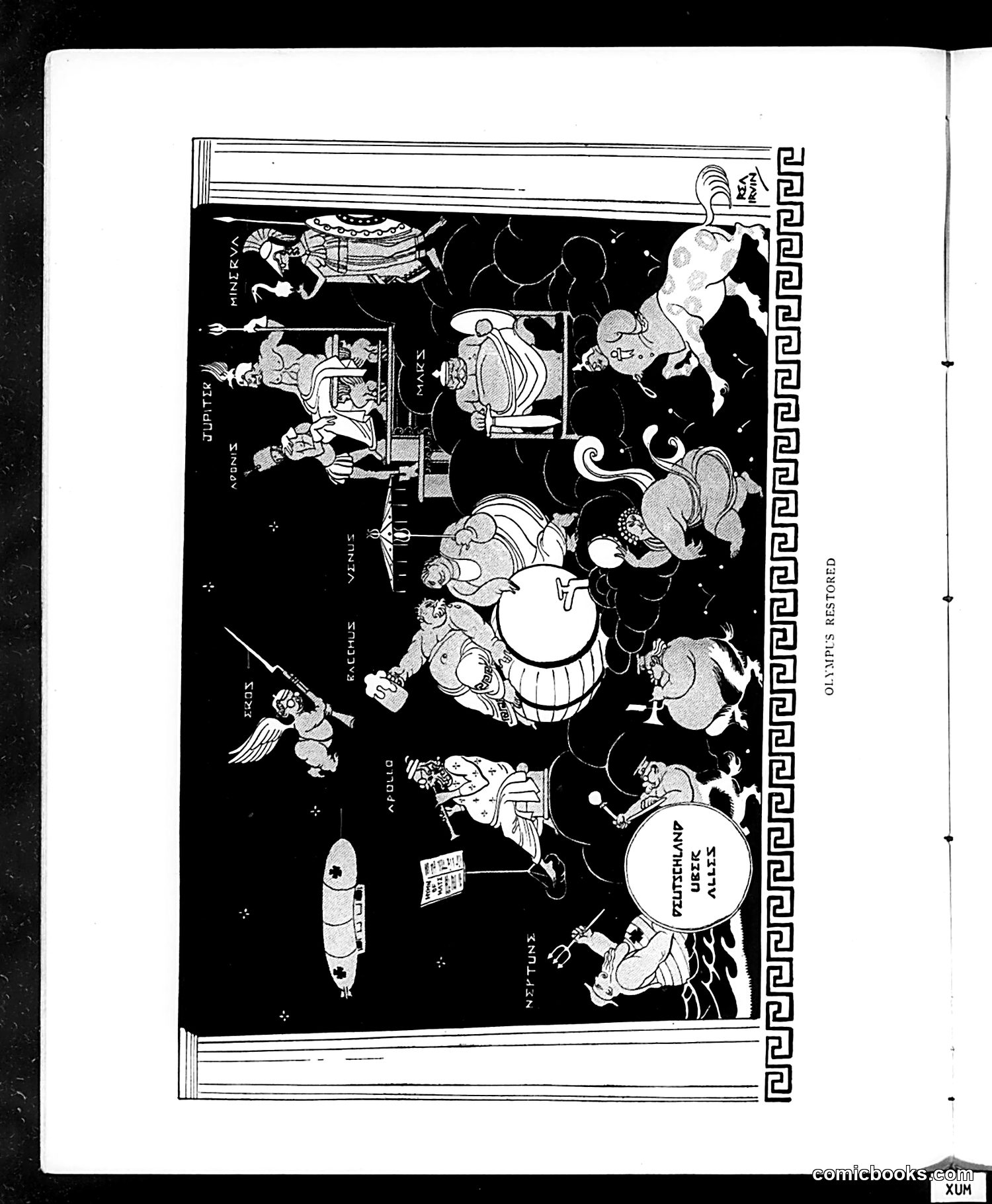
This appears to be a satirical cartoon titled "Olympus Restored" depicting Greek gods and mythological figures in a chaotic scene. The composition shows multiple figures arranged around what looks like Mount Olympus, with Greek key pattern borders suggesting classical themes. The satire likely comments on the restoration or revival of classical ideals, though without clearer identification of specific figures or historical context from the visible text, the exact political target remains unclear. The crowded, somewhat anarchic arrangement of divine figures might mock the disorder or absurdity of whatever "restoration" is being referenced. The style is consistent with early-to-mid 20th century American political cartooning, but specific contemporary references are not legible enough to definitively explain the satire's point to a modern reader.
This is a text-only editorial page (no cartoon visible) analyzing political ideology during the post-WWI period. The author distinguishes between "Celestials" (idealists seeking reform) and "Carnals" (practical realists accepting existing order). The piece critiques the *Kansas City Star* for calling Lenin and Trotsky "Celestials"—the author argues President Wilson better exemplifies this type. The key point: Russia's revolution was hijacked by an "ignorant fringe" of Celestials rather than being guided by responsible idealists like Wilson. The author defends Celestial philosophy itself—advocating justice, law, and order—while blaming the Russian catastrophe on incompetent revolutionaries, not the ideology. He implies American Celestials (represented by Wilson) represent a more sensible, orderly approach to reform than the Russian chaos.
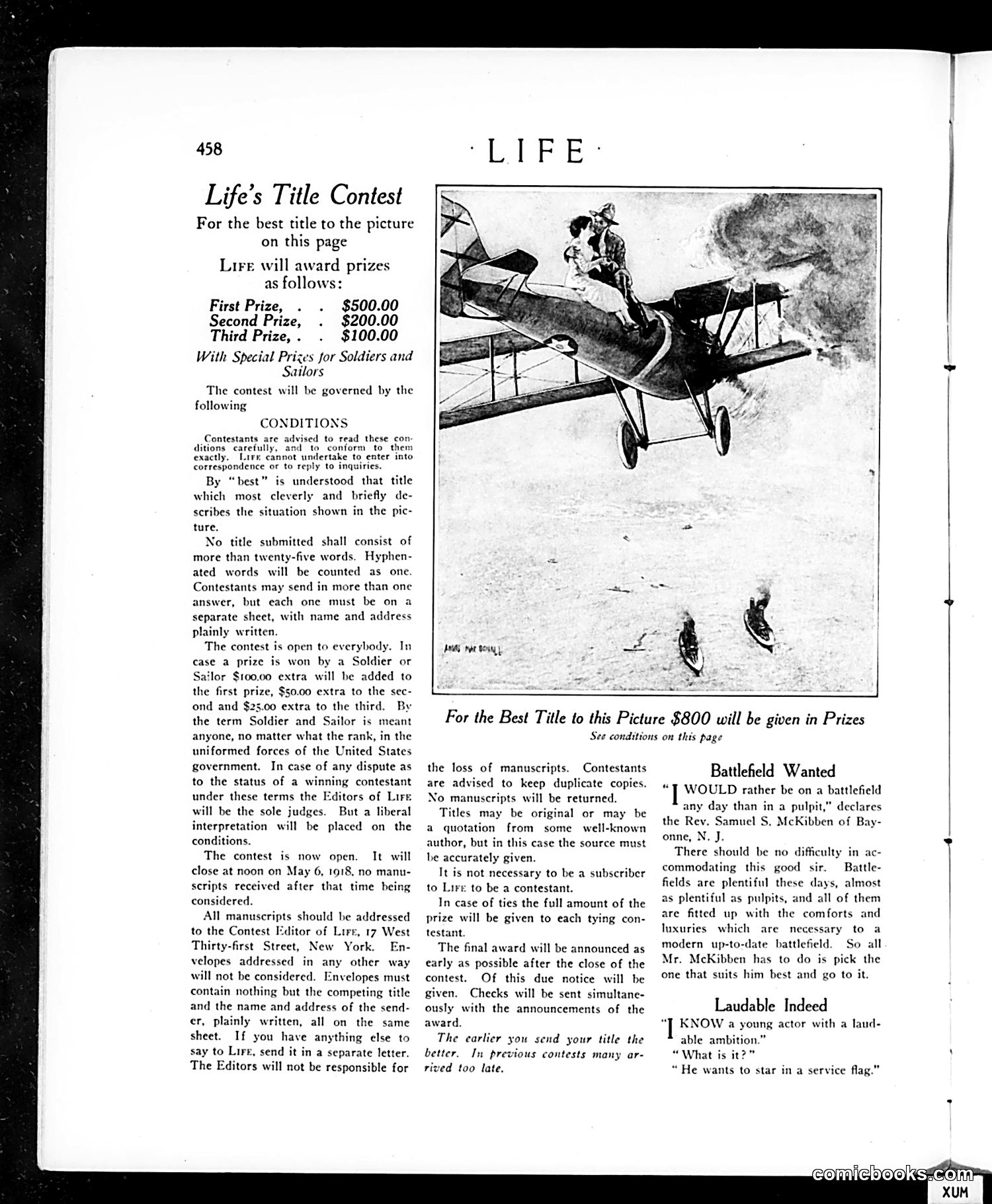
This page announces a **title-writing contest** for a photograph showing what appears to be a WWI-era airplane with figures on or near it. Life magazine is offering $500, $200, and $100 for the best titles, with **bonus prizes for soldiers and sailors**—reflecting America's involvement in World War I (the contest closes May 6, 1918). The detailed conditions emphasize strict rules: titles must be 25 words or fewer, submitted separately with name and address, and sent to Life's New York office. The page also includes two brief satirical items mocking contemporary attitudes: one about a reverend preferring battlefields to pulpits (suggesting naive enthusiasm for war), and another joking about an actor's ambition to "star in a service flag" (a dark joke about dying in service, represented by memorial flags displayed in windows). The contest reflects how magazines engaged readers during wartime while the satirical bits critique civilian attitudes toward combat.
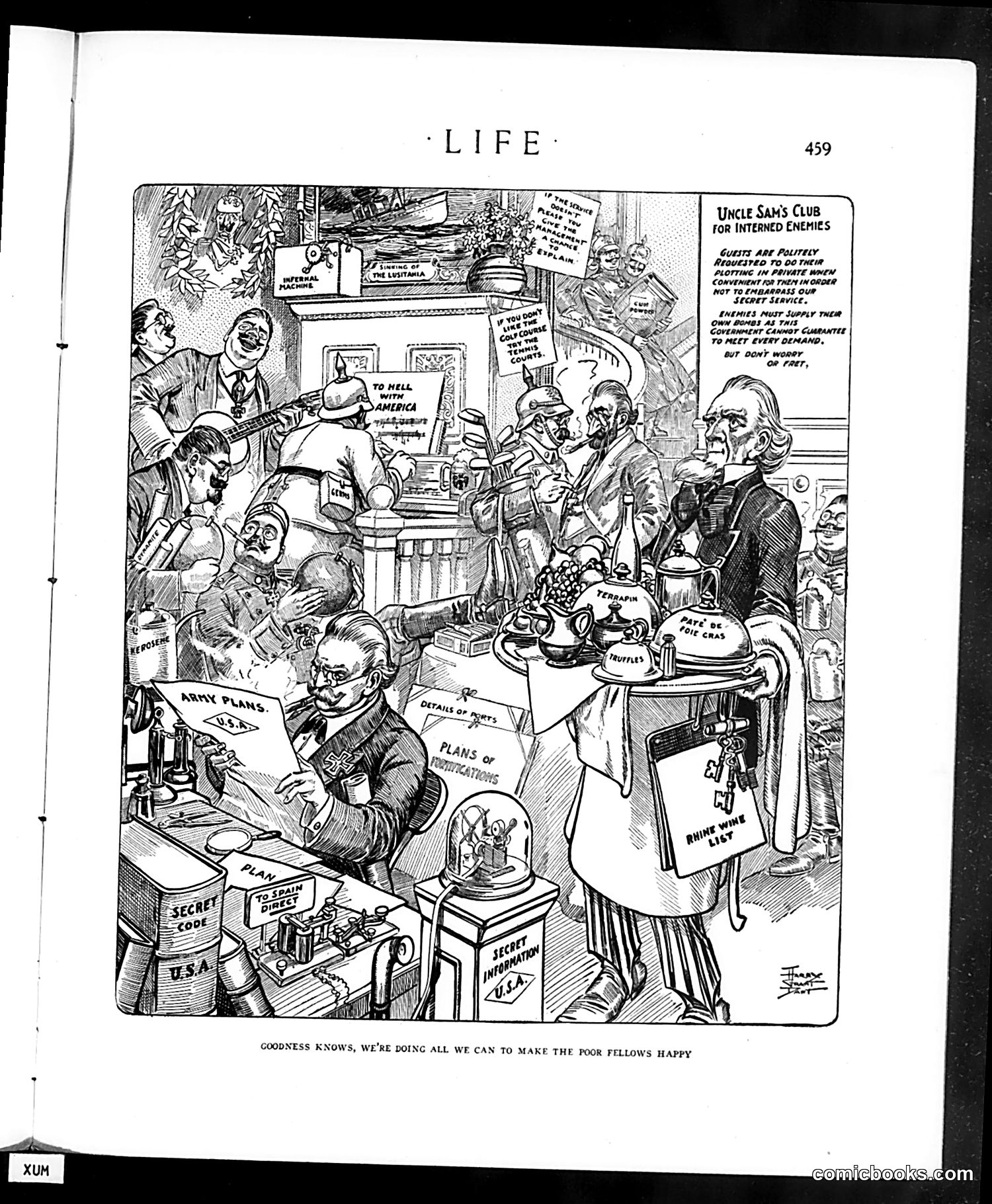
This cartoon satirizes American treatment of interned enemy aliens during wartime (likely WWI or WWII, based on style). The drawing depicts Uncle Sam's "club" for detained foreigners—a crowded room where officials manage internees with bureaucratic excess: visible documents include "Secret Code," "Army Plans," "Secret Information," and "Rhine Wine List." The satire's point: despite good intentions ("make the poor fellows happy"), the government creates absurdly elaborate procedures and luxuries for prisoners while drowning them in red tape and secrecy protocols. The crowded, chaotic scene with officials fussing over details mocks the disconnect between claimed hospitality and actual imprisonment. The caption's ironic tone suggests Americans protest too much about fair treatment.
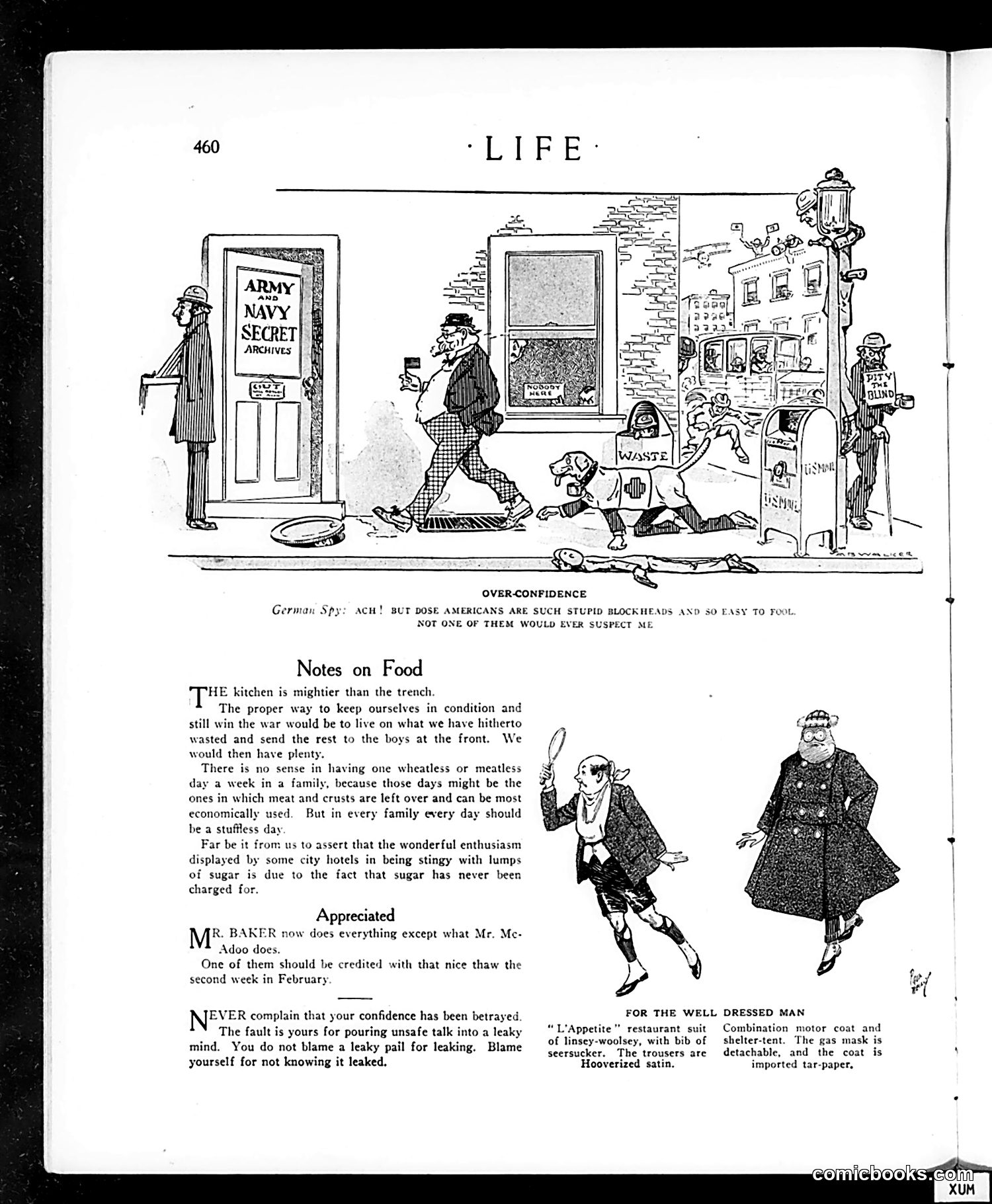
This WWI-era page contains multiple satirical pieces: **"Over-Confidence" Cartoon**: A German spy, confident Americans are too stupid to suspect him, walks openly past an Army-Navy Secret Archives office while civilians observe. The satire mocks German arrogance and warns against careless security during wartime. **"Notes on Food"**: Advocates home food conservation to support troops, criticizing wasteful eating habits. It satirizes both excessive sugar rationing at hotels and the ineffectiveness of designated "meatless days." **"Appreciated"**: A brief joke crediting Mr. Baker (likely a public figure) with accomplishments, while implying Mr. McAdoo accomplishes nothing—political mockery of a contemporary official. **"Never Complain"**: Warns against gossiping, using the metaphor of a leaky pail—blaming the gossiper, not the listener, for leaked secrets. **"For the Well Dressed Man"**: Fashion satire describing absurd wartime "outfits" combining rationed materials (seersucker, tar-paper) with practical items (gas masks, shelter-tents), mocking fashion industry adaptation to wartime shortages. The page reflects American WWI concerns: security, rationing, and civic responsibility.
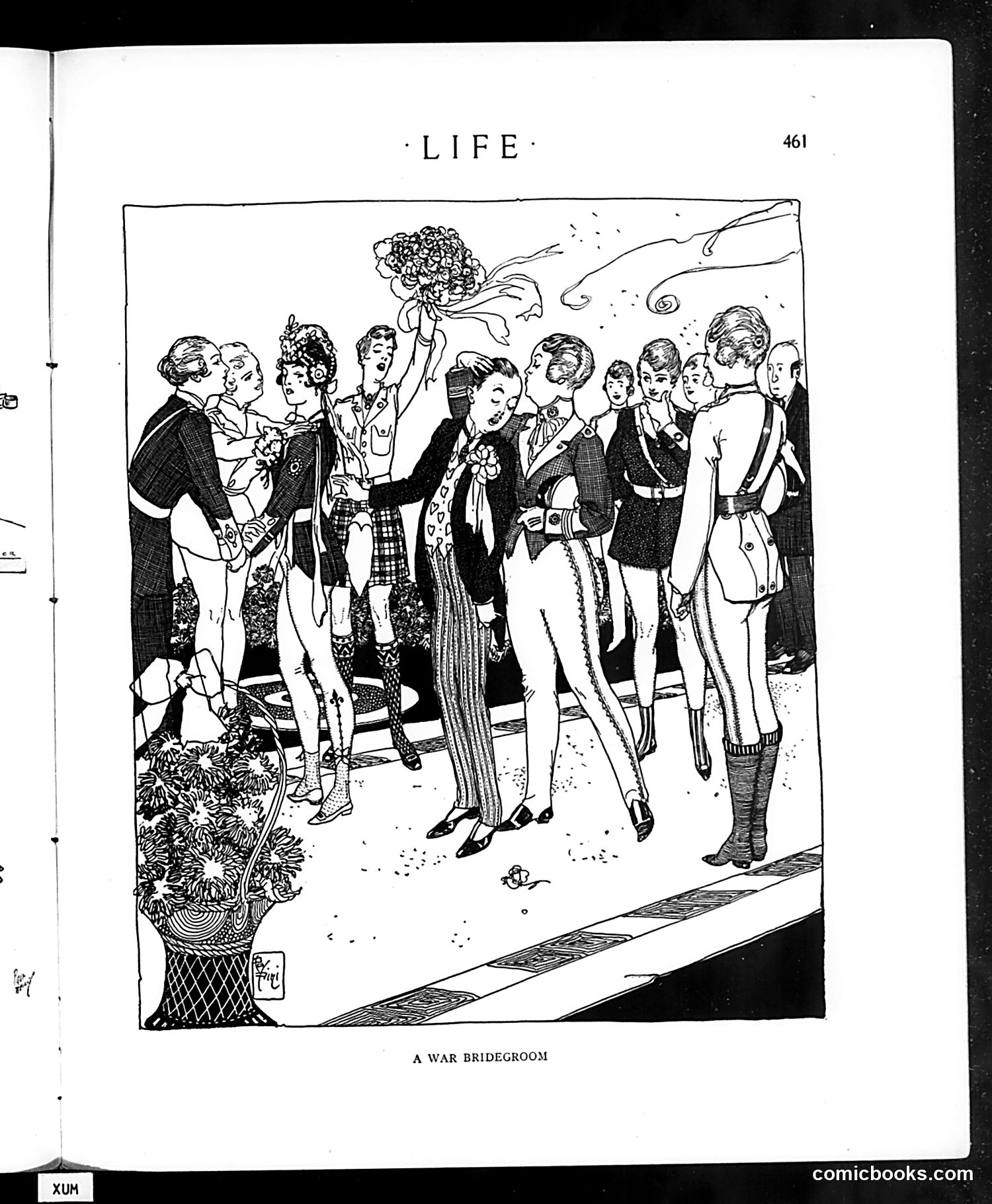
This satirical illustration depicts a wedding scene during wartime (likely WWI, given the military uniforms visible). The central figure—a woman in a striped dress and veil—appears to be the "war bridegroom," though the satire's meaning is ambiguous from the image alone. The cartoon likely satirizes either: (1) marriages hastily arranged during wartime, (2) women marrying soldiers before deployment, or (3) the absurdity of romantic unions amid military chaos. The formal wedding attire contrasts sharply with the military personnel and surreal background elements (flying fish, decorative flora), suggesting the incongruity between civilian celebration and wartime reality. Without additional context, the specific target of satire remains unclear, but the work critiques some aspect of wartime matrimonial practices or attitudes.
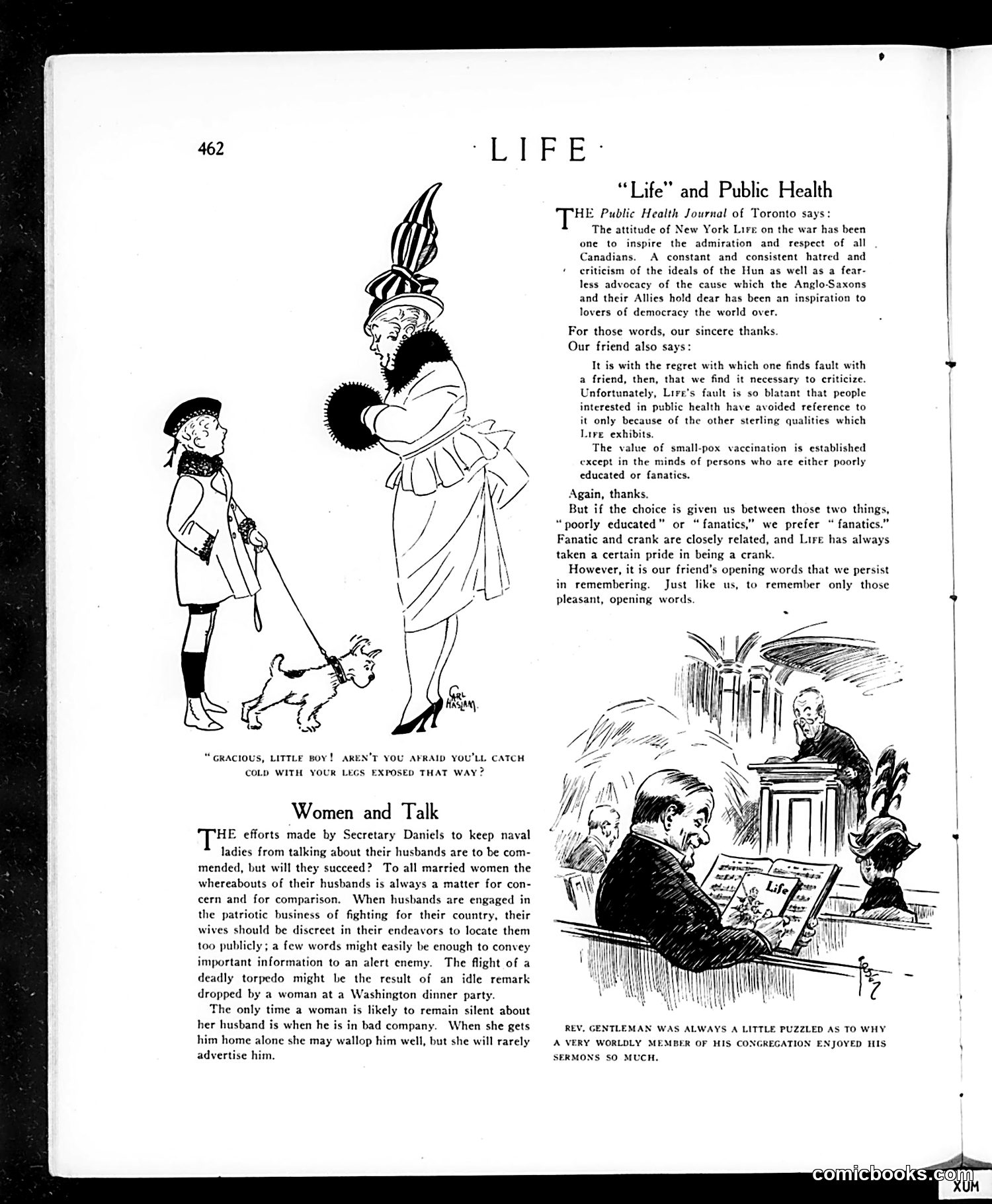
This WWI-era satirical page contains two distinct pieces: **"Women and Talk"** critiques Secretary of the Navy Josephus Daniels' attempts to prevent naval officers' wives from publicly discussing their husbands' whereabouts. The accompanying cartoon shows a fashionably dressed woman in a short skirt speaking to a small boy, satirizing concerns about women's indiscretion during wartime. The article argues that while wives should avoid revealing military information to potential enemies, women's natural tendency to discuss their husbands makes strict secrecy unrealistic. The satire suggests the policy addresses a genuine security risk but acknowledges human nature—particularly women's supposed chattiness—makes enforcement difficult. **"'Life' and Public Health"** praises *Life* magazine's strong anti-German stance during the war, then criticizes its editorial skepticism toward smallpox vaccination. The piece suggests *Life* conflates anti-vaccination sentiment with fanaticism rather than acknowledging legitimate public-health concerns, sardonically praising only *Life's* "pleasant, opening words" of patriotic support.
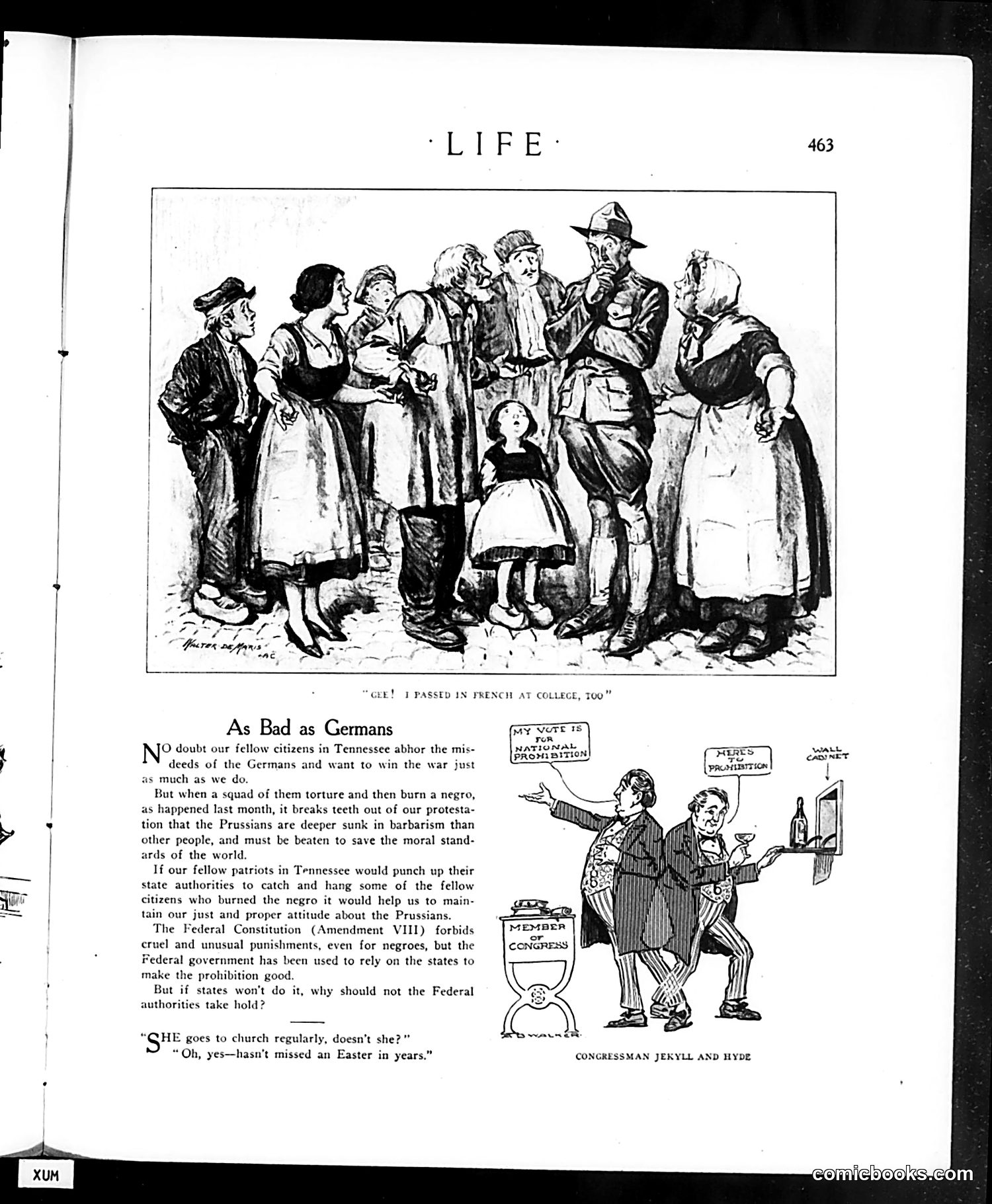
This page criticizes American hypocrisy regarding moral authority. The main article, "As Bad as Germans," addresses a lynching in Tennessee (referenced as occurring "last month"). It argues that while Americans condemn German brutality in WWI, American citizens who torture and burn a Black person undermine American moral claims to superiority. The author calls for federal intervention when states fail to enforce the Constitutional prohibition on cruel punishment. The bottom cartoon, "Congressman Jekyll and Hyde," satirizes a politician who publicly advocates for national Prohibition while privately consuming alcohol—shown with bottles and a wall cabinet. The labels "Member of Congress," "My Vote is for National Prohibition," and "Hard Wall Prohibition" emphasize the gap between public morality and private behavior. Together, these pieces expose American double standards: condemning foreign barbarism while permitting domestic racial violence, and championing moral reform while ignoring personal hypocrisy. This reflects Life magazine's progressive stance on racial justice and political accountability during the WWI era.
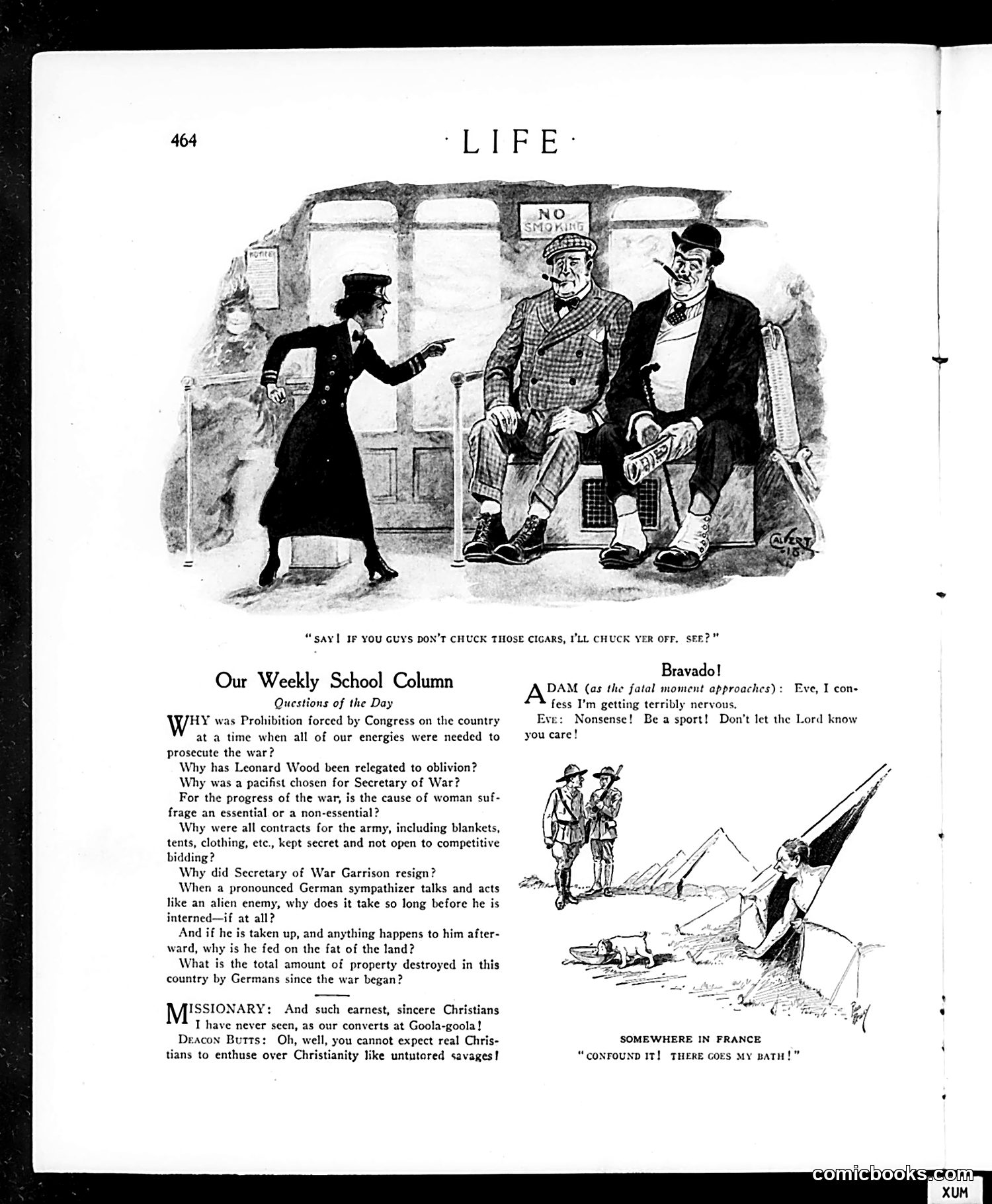
**Top Cartoon**: A conductor on a streetcar threatens two roughneck passengers to discard their cigars or be ejected. The satire mocks working-class masculinity and smoking culture—the tough-guy posturing of men who resist basic social rules. **"Our Weekly School Column"**: A satirical Q&A section asking pointed questions about WWI-era government decisions—Prohibition during wartime, the sidelining of General Leonard Wood, pacifists in military positions, and treatment of German sympathizers. These questions mock apparent contradictions and perceived mismanagement of the war effort. **"Bravado!" Dialogue**: Adam and Eve discuss approaching death with forced cheerfulness, satirizing false bravery and religious platitudes ("Don't let the Lord know you care"). **"Somewhere in France" Cartoon**: A soldier's bath is destroyed by an artillery shell. Dark humor about the absurd indignities of war. **Overall Context**: This appears to be WWI-era satire criticizing American domestic and military policy inconsistencies, class behavior, and war's realities.
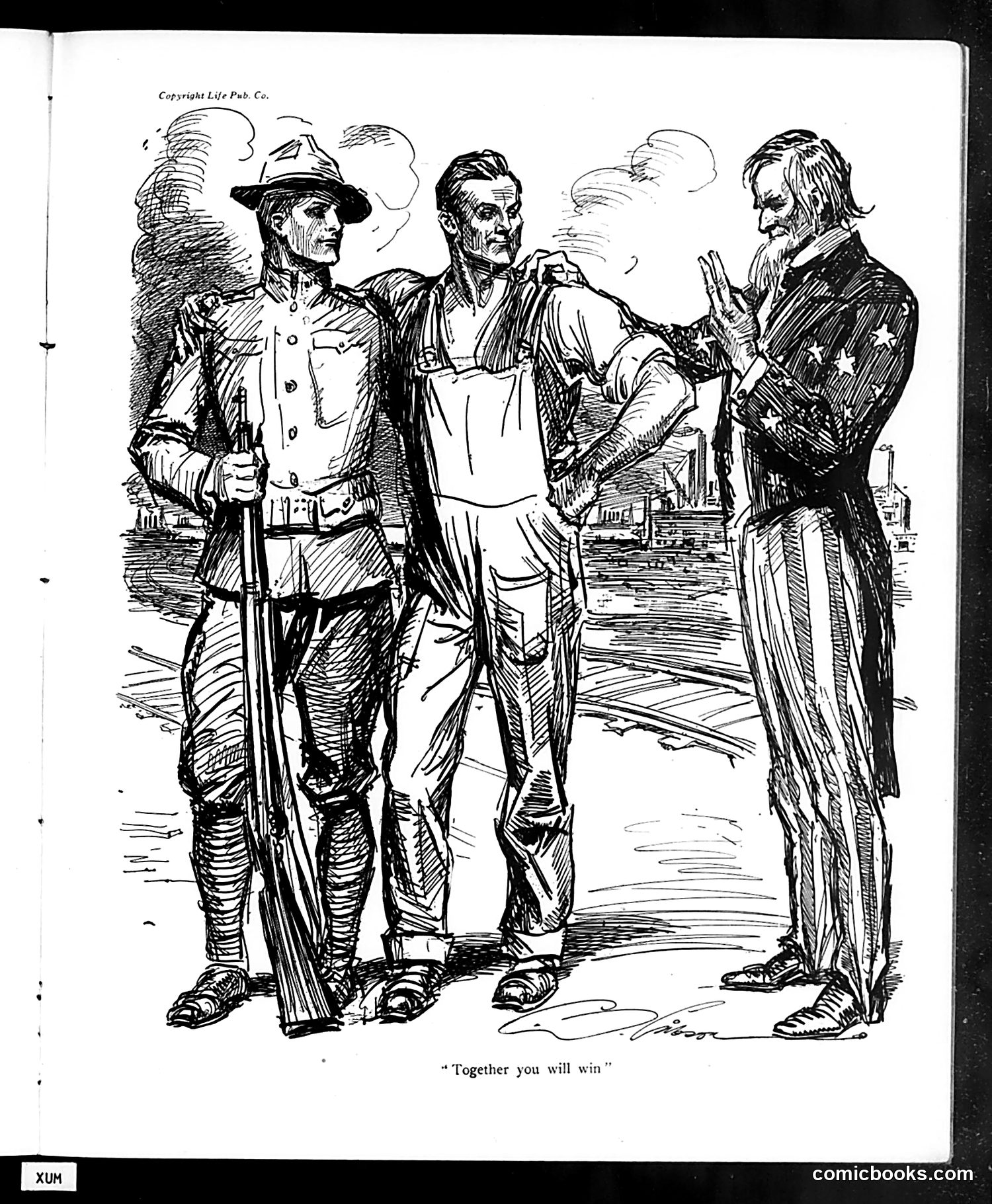
This ink sketch depicts three men in conversation, with the caption "Together you will win." The figure on the left wears a military uniform with a hat and carries a rifle, suggesting a soldier or military commander. The center figure appears to be a civilian or laborer in work clothes. The man on the right, dressed formally, appears to be addressing or persuading the other two. The cartoon likely promotes wartime unity or cooperation between military and civilian populations—a common theme in early 20th-century American satire. The message suggests that soldiers and workers (and perhaps political leadership) must work together to achieve victory, possibly referencing World War I or a similar conflict. Without additional context or visible dates, the specific historical moment remains unclear, but the propaganda-like message is unmistakable.
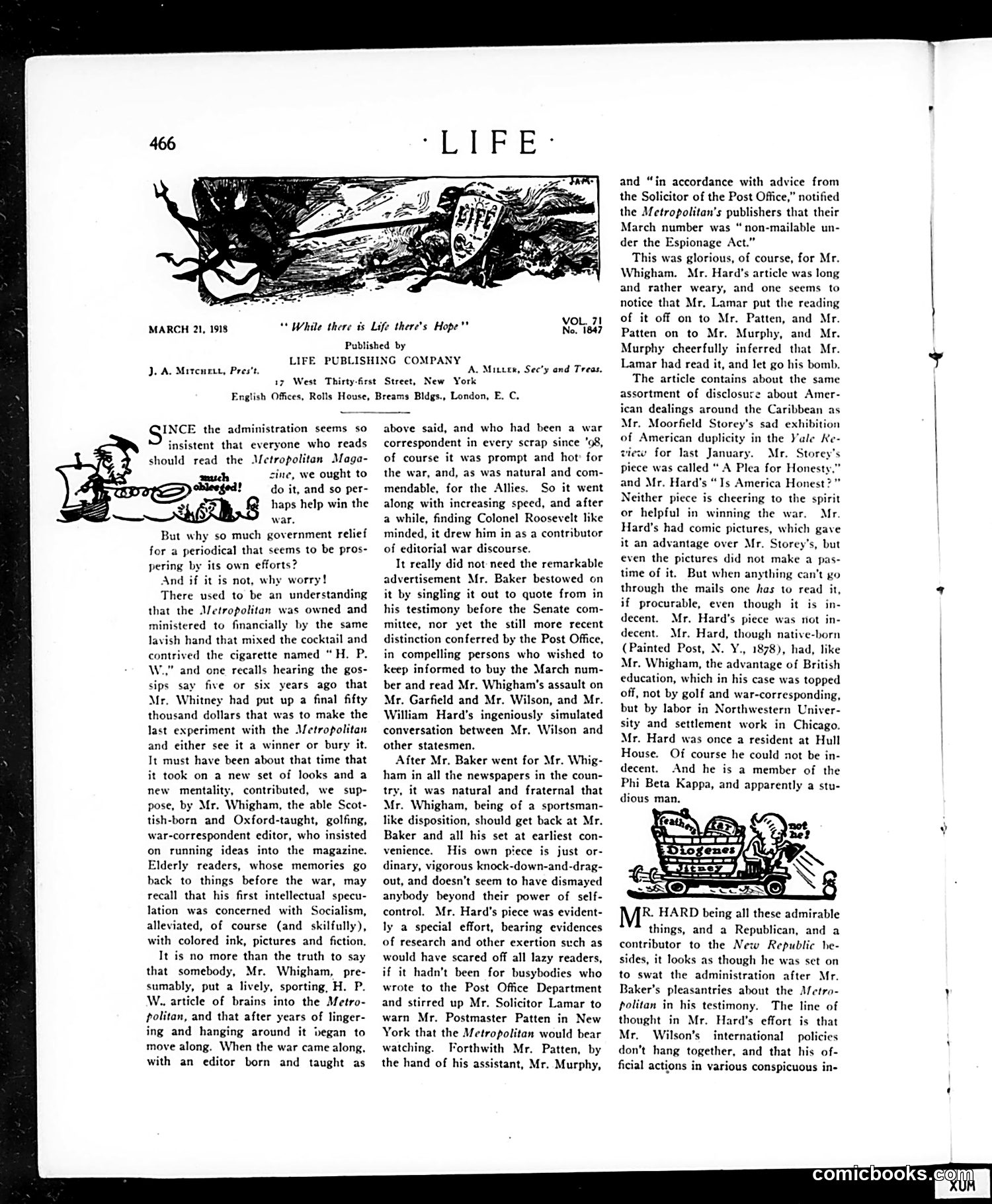
This page satirizes government censorship of *The Metropolitan* magazine during World War I. The article criticizes the Post Office's decision to declare the March 1918 issue "non-mailable" under the Espionage Act. The targets include: **Key figures mentioned:** - Secretary of War Newton D. Baker, who publicly attacked the magazine - Editor H.B. Whigham, a Scottish war correspondent who sided with the Allies - Contributor William Hard, whose article about Wilson apparently triggered officials - Post Office Solicitor Lamar and Postmaster Patten, who issued the ban **The satire's point:** *Life* mocks the government's heavy-handed suppression. The magazine notes the irony that Baker's public criticism drew more attention than the original articles, and that busybodies reporting to the Post Office created the censorship controversy. The author questions why government is "relieving" a struggling magazine—through censorship. The opening cartoon (unclear in detail) appears to support the editorial's anti-censorship stance.
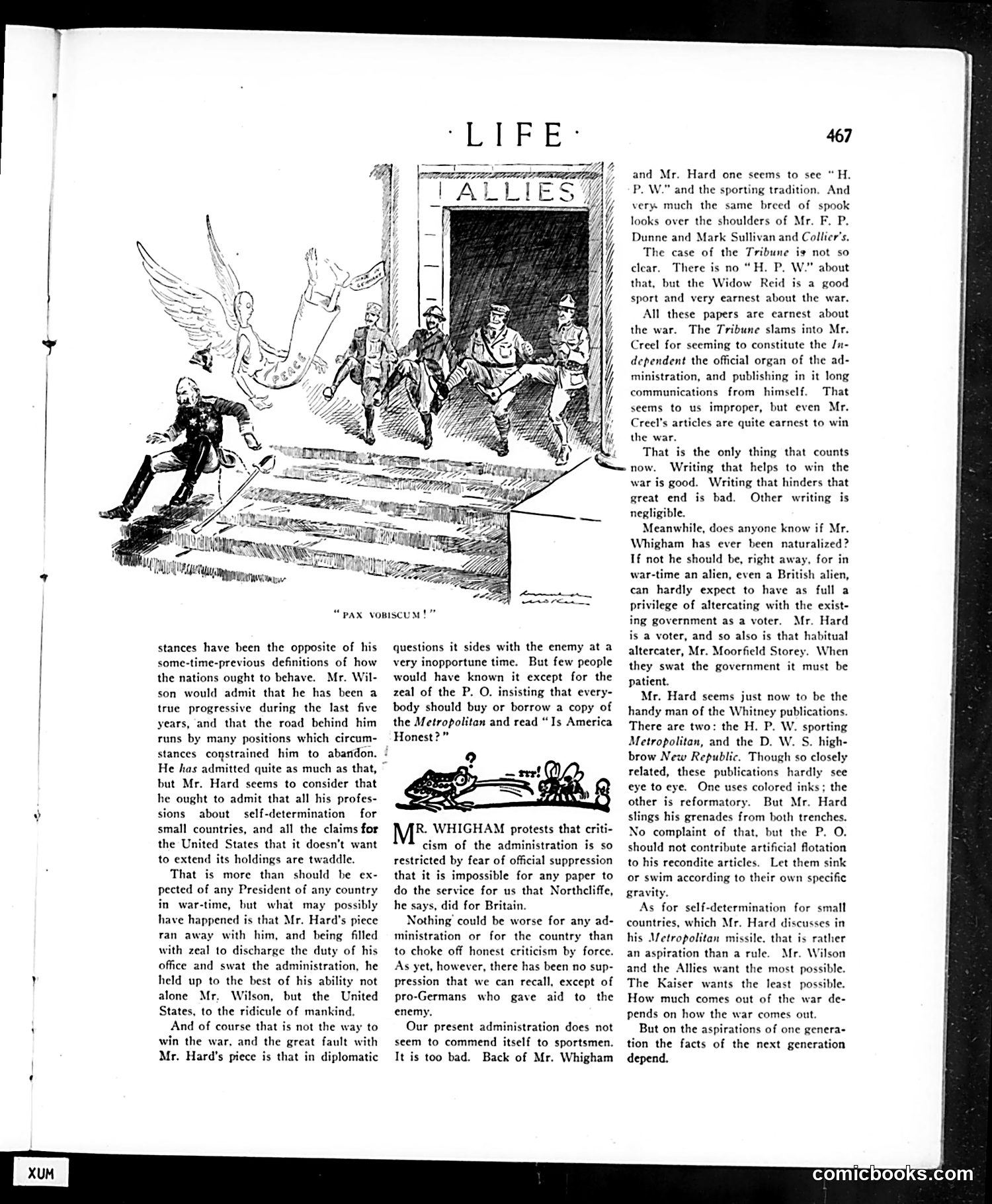
This page critiques various journalists and publications criticizing the Wilson administration during World War I. The cartoon "Pax Vobiscum!" (Latin for "Peace be with you") depicts Allied figures entering through a doorway labeled "Allies," apparently satirizing the entry of new allies or diplomatic negotiations. The text discusses Mr. Hard's article "Is America Honest?" in the *Metropolitan* magazine, which the Post Office apparently promoted by requiring copies be purchased—a decision Life ridicules. The article allegedly sided with enemies on diplomatic matters during wartime. The piece also references Mr. Whigham's complaints about suppressed criticism, noting that while censorship concerns exist, the administration hasn't actually suppressed non-enemy publications. Life's overarching point: during wartime, writing must serve victory; criticism is acceptable only from citizens/voters, questioning whether British alien Whigham deserves equal voice. The tone is patriotic and dismissive of what Life considers self-indulgent, counterproductive criticism during active conflict.
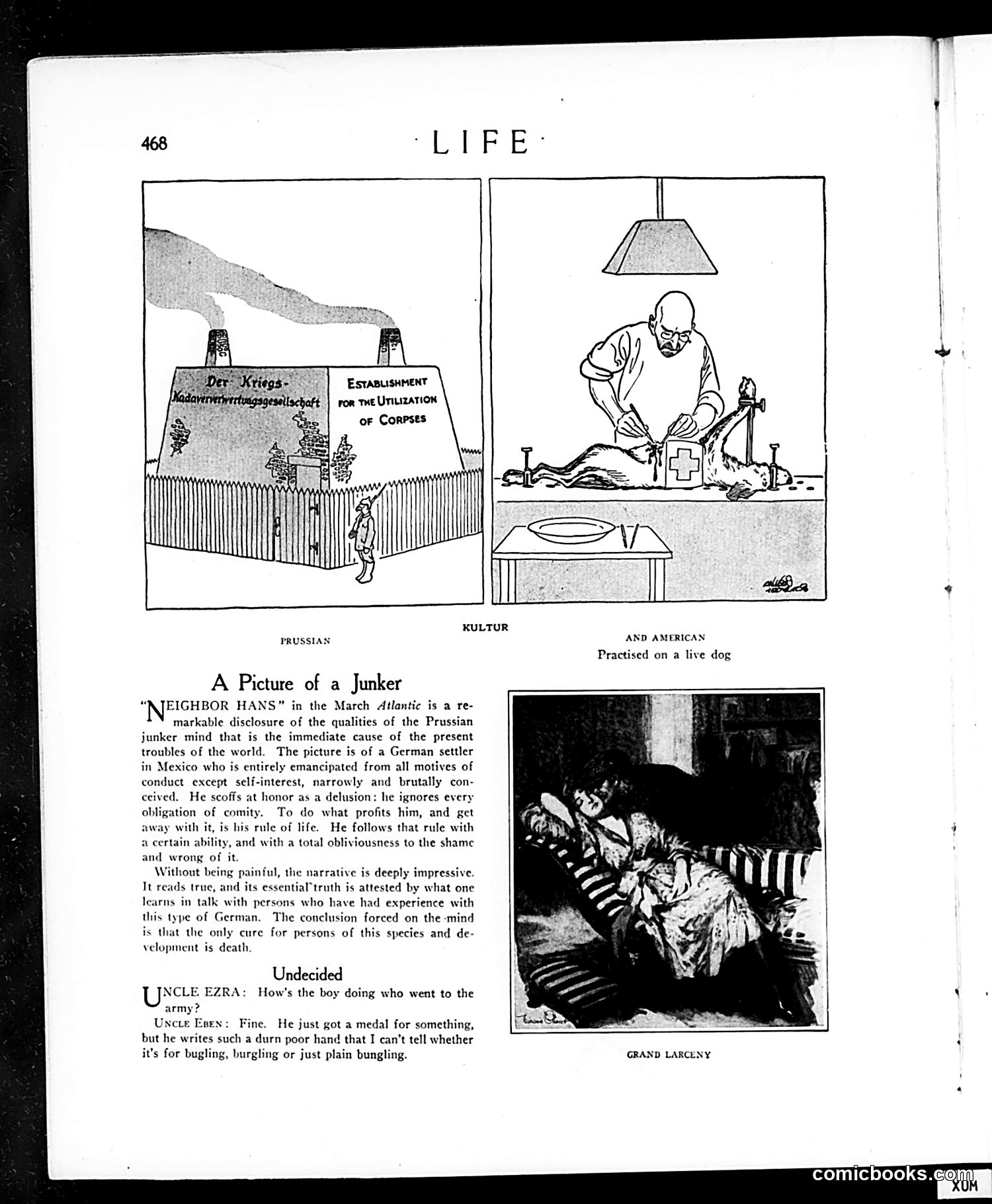
This page satirizes Prussian militarism and German character during what appears to be World War I. The top cartoon contrasts a German "establishment for the utilization of corpses" with American medical ethics, showing the Germans casually experimenting on a dog while Americans practice responsibly on animals—implying German brutality and disregard for human life. The article discusses the "Prussian junker" (aristocratic military class) as embodying pure self-interest and amorality, using a fictional character from *The Atlantic* magazine as example. It argues only death can cure such individuals. The joke at bottom plays on an illiterate soldier's handwriting being so poor the uncle cannot distinguish whether the medal was for bugling (trumpet), burgling (theft), or bungling (incompetence)—satirizing military incompetence or corruption. The overall message: Germans are fundamentally immoral; Americans are civilized by comparison.
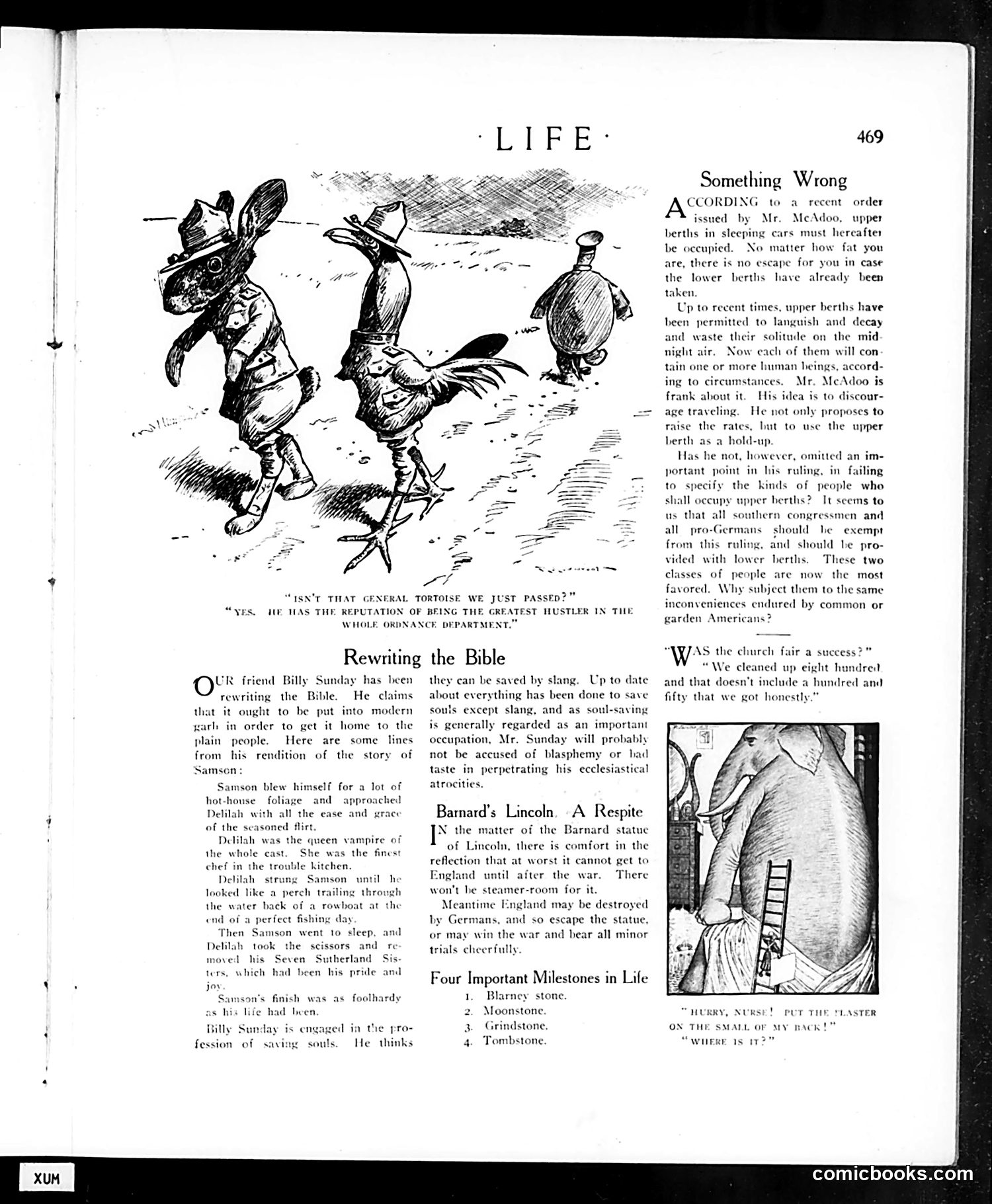
This page contains three distinct satirical pieces from Life magazine (undated, but references suggest early 20th century): **Top Cartoon**: Two rabbit soldiers discuss a tortoise officer, calling him "the greatest hustler in the whole ordnance department." The joke appears to mock military inefficiency or questionable promotion practices—the tortoise's reputation for being slow is ironically praised in a military context. **"Rewriting the Bible"**: Satirizes Billy Sunday, a real evangelist famous for using colloquial language to modernize scripture for mass appeal. The piece mocks his approach by rewriting the Samson story in crude slang ("Samson blew himself for a lot of hot-house foliage"), suggesting his methods are undignified or blasphemous. **Other pieces**: Include complaints about railway sleeping-car policies under Secretary McAdoo, criticism of southern congressmen and "pro-Germans" (likely WWI-era references), and a joke about church fundraising honesty. The overall tone reflects Life's satirical tradition of mocking social pretension, religious excess, government overreach, and political hypocrisy.
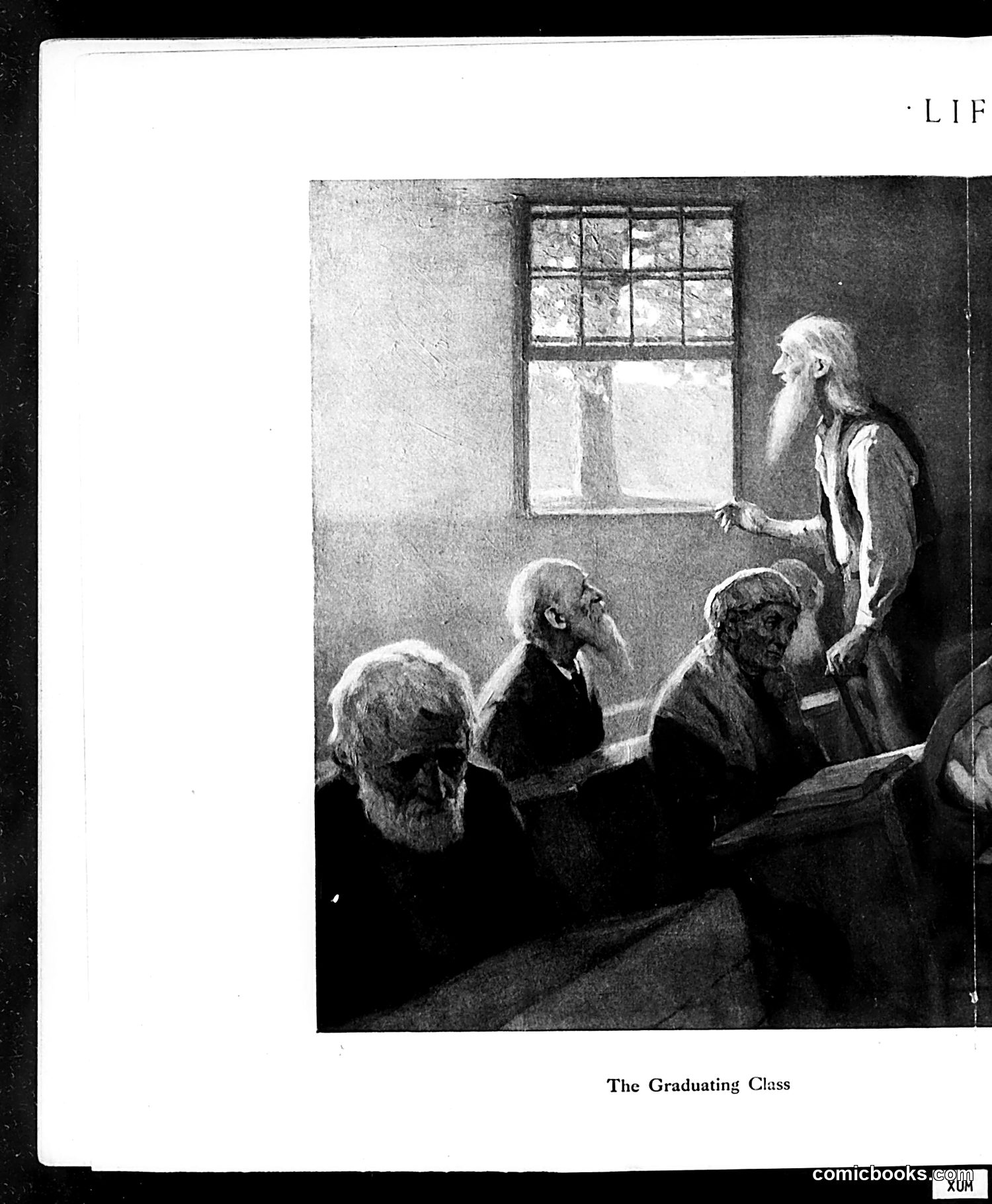
This cartoon depicts elderly men in what appears to be a prison or institutional cell—note the barred window and sparse furnishings. The caption's irony is the central joke: these are not students graduating from school, but rather long-term prisoners being released or completing their sentences. The satire likely comments on aging convicts or the prison system itself, though without additional context from Life magazine's date and surrounding articles, the specific targets remain unclear. The detailed caricatures suggest these may represent recognizable figures—possibly politicians or public figures associated with scandals or legal troubles—but their identities cannot be determined from the image alone. The humor derives from the grim inversion of "graduation" as a marker of completion rather than achievement.
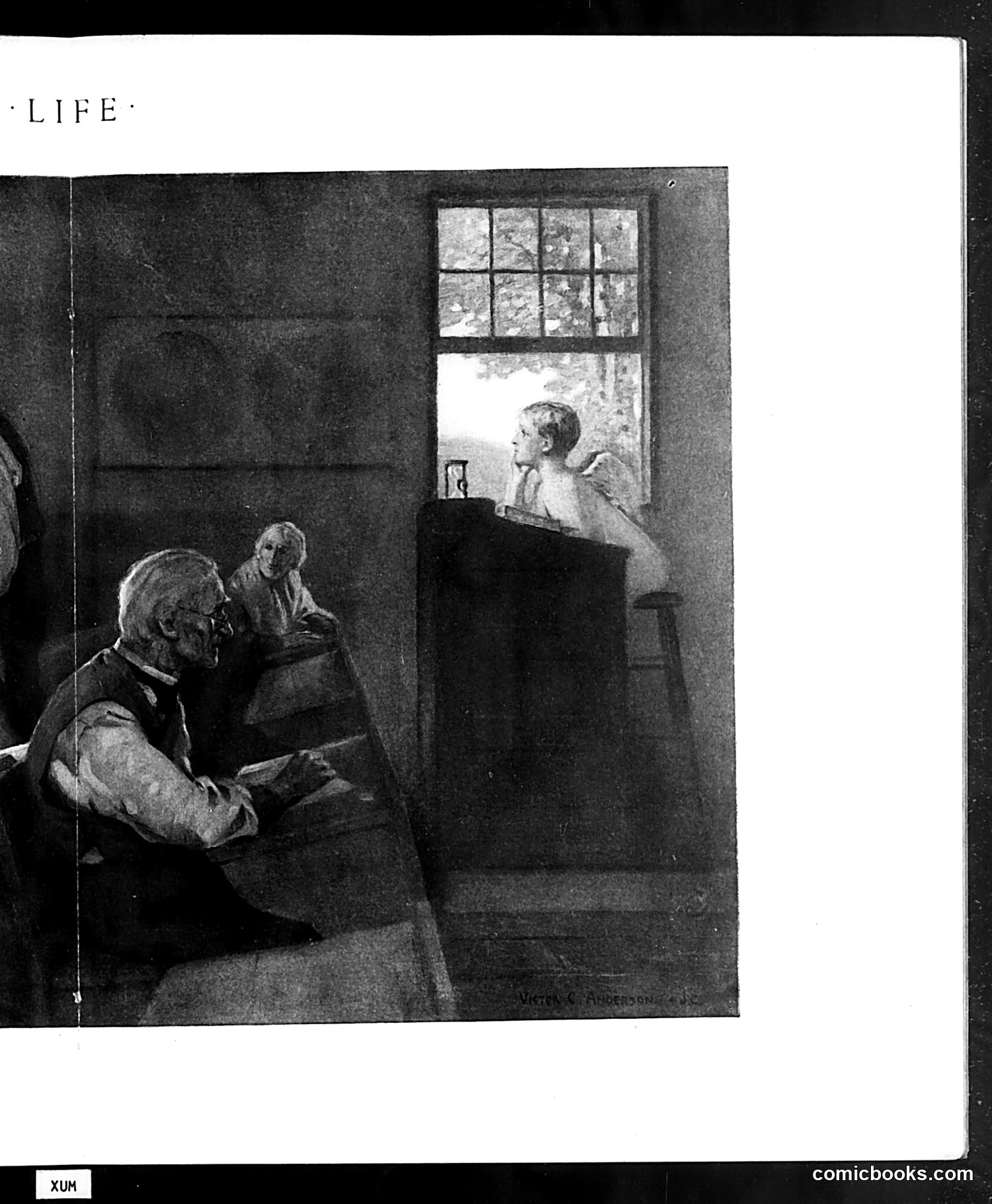
This page from *Life* magazine features an illustration credited to Victor C. Anderson (visible in the lower right). The image depicts an interior scene with two figures: an elderly man in the foreground and a woman visible through a window in the background. The woman appears to be looking outward contemplatively while the man, seated indoors, observes her. Without clearer OCR text or additional context, the specific satirical or political point remains unclear. The scene suggests themes of longing, separation, or domestic observation typical of early 20th-century *Life* magazine's satirical commentary on American life and relationships. The composition emphasizes the spatial and emotional distance between the figures, but the precise social commentary intended is not definitively apparent from the image alone.
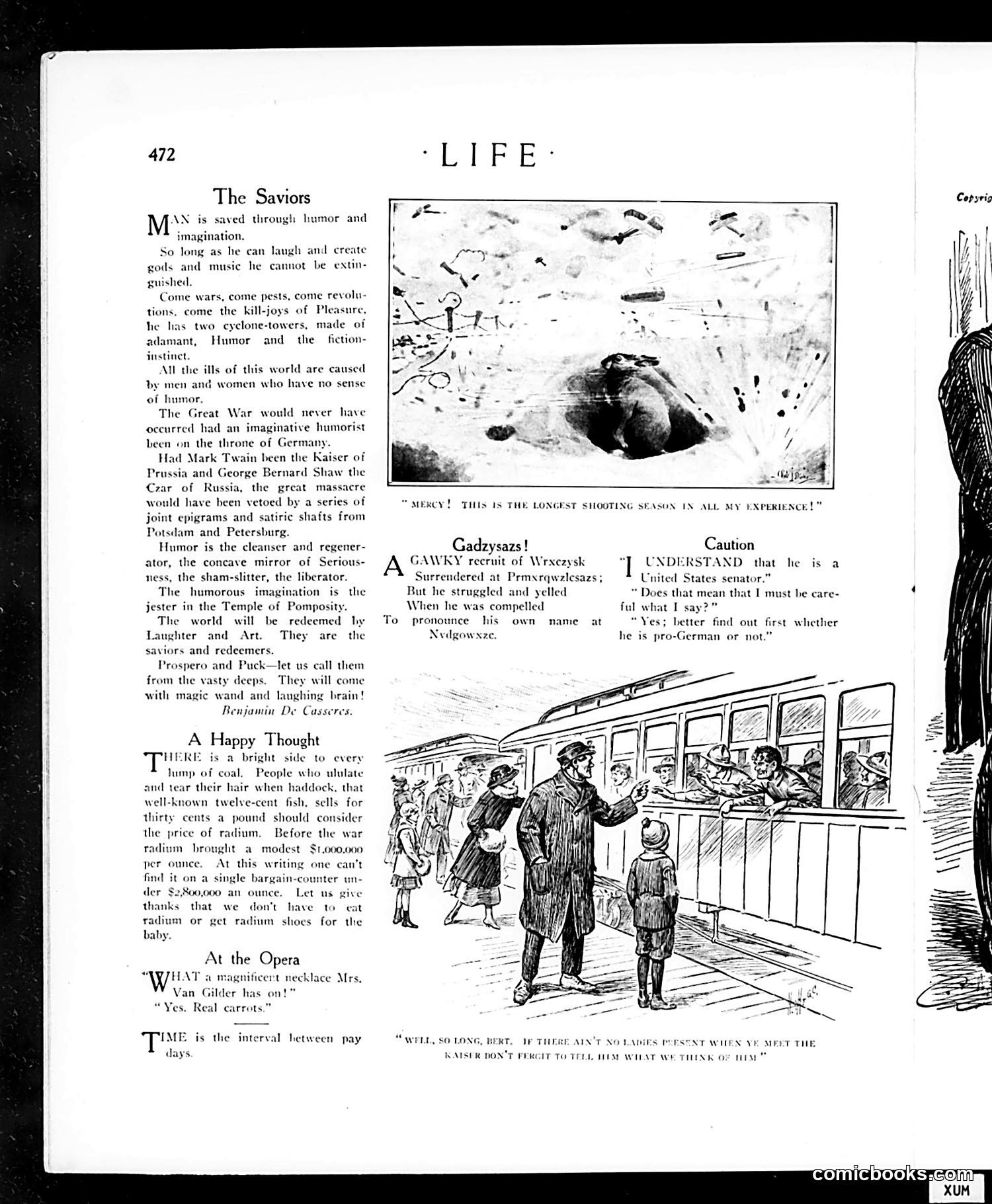
This page contains wartime satire from World War I era (references to "The Great War," Kaiser, Czar). **"The Saviors"** essay argues humor and imagination could have prevented the war—fantasizing that Mark Twain as Kaiser or George Bernard Shaw as Czar would have used satire instead of military force. **The cartoons mock WWI absurdities:** - Top image: A soldier in a shell crater, claiming the "longest shooting season" of his experience—dark humor about the mechanized slaughter of trench warfare. - Bottom cartoon: A soldier warning another about a U.S. senator's pro-German sympathies (relevant to 1917-18 American suspicion of German-American loyalties). The joke: be careful what you say around senators, then the crude punchline about telling the Kaiser "what we think of him." **"Cadzysazs!"** mocks unpronounceable Eastern European names—a common comedic trope of the era. The page uses humor to process wartime anxiety, xenophobia, and military carnage—exactly the "redemptive laughter" the essay claims saves civilization.
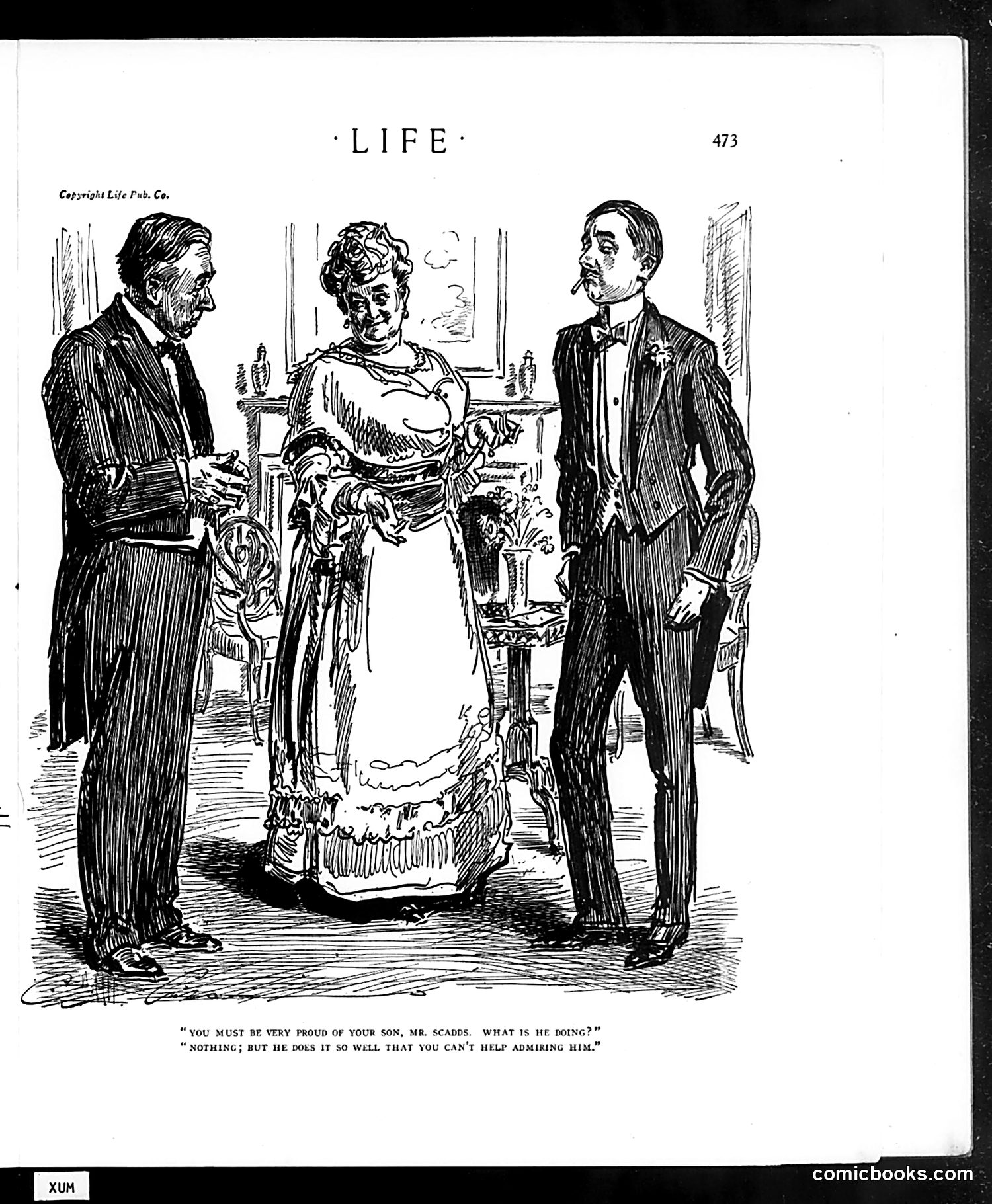
This is a single cartoon from *Life* magazine (page 473) showing three well-dressed figures in what appears to be a formal social setting. Two men in suits flank a woman in an elaborate dress. The dialogue reads: "You must be very proud of your son, Mr. Scadds. What is he doing?" "Nothing; but he does it so well that you can't help admiring him." **The satire**: This is a social comedy mocking wealthy idleness. Mr. Scadds is portrayed as a father proud of his son despite—or because of—the boy's complete lack of accomplishment or employment. The joke satirizes the upper class's ability to maintain respectability and even admiration while doing nothing productive, suggesting that wealth and social polish can substitute for actual achievement or merit.
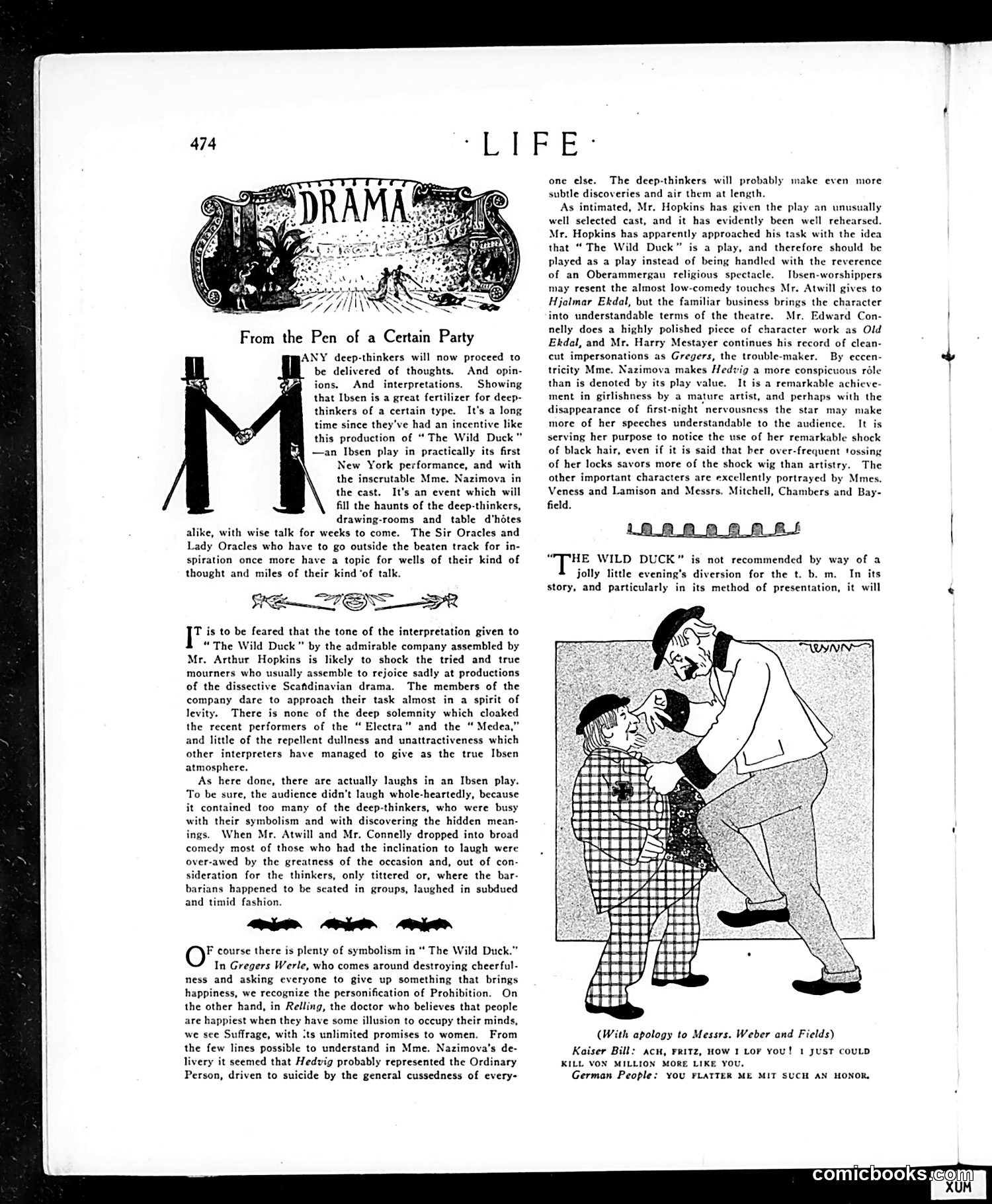
This page reviews Arthur Hopkins's production of Ibsen's *The Wild Duck*, satirizing both pretentious intellectuals and the play's allegorical interpretations. **The Cartoon:** Shows two men in a physical struggle, captioned with a German insult about honor—likely referencing WWI-era anti-German sentiment common in American publications. **The Satire's Target:** The review mocks "deep-thinkers"—intellectuals who gather in drawing rooms to extract hidden meanings from Ibsen's work. The critic notes the production uses comedy and accessible staging, which disturbs serious Ibsen devotees expecting reverent solemnity. **The Allegory Joke:** The reviewer sarcastically identifies characters as symbols: Gregers Werle represents Prohibition (destroying happiness), Relling represents Suffrage (offering false promises), and Hedvig represents the "Ordinary Person" destroyed by society's chaos—contemporary American political concerns read into a Norwegian play. **Point:** The satire ridicules how intellectuals overcomplicate literature while missing straightforward enjoyment, and how they impose contemporary politics onto unrelated works.
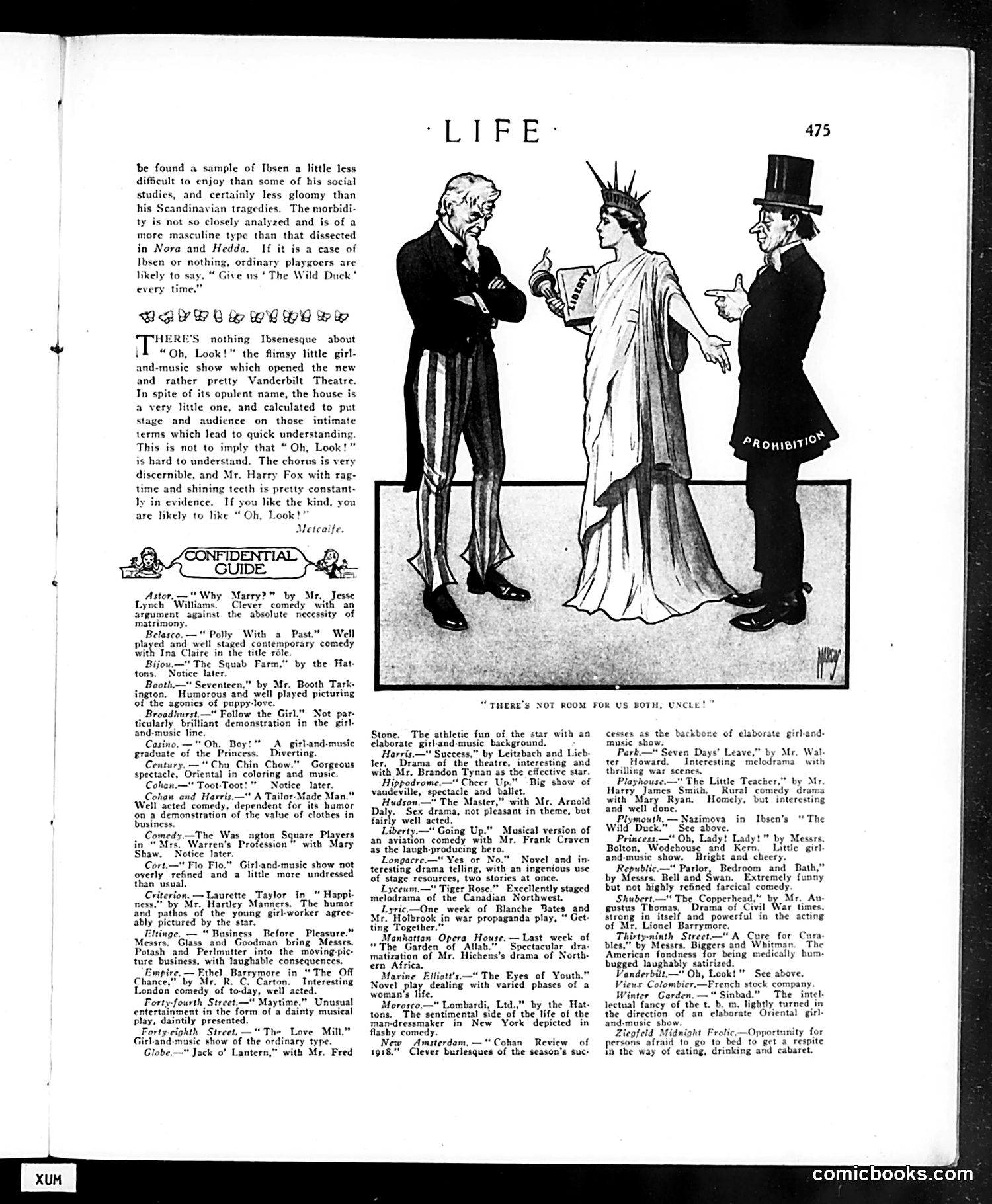
The main cartoon depicts three figures: on the left, an elderly man in worn clothing (likely representing an "Uncle" figure, possibly Uncle Sam or a similar patriarch); in the center, a woman in an elegant dress labeled "Prohibition"; and on the right, a gentleman in a top hat. The woman gestures between them with the caption "There's not room for us both, uncle!" **What it means:** This is satirical commentary on Prohibition's arrival in America. The cartoon suggests that Prohibition (personified as a fashionable woman) cannot coexist with traditional American masculine culture represented by the older man. The joke critiques Prohibition as an unwelcome intrusion that will displace established social customs—specifically, drinking culture and male social spaces. The satire mocks Prohibition's sweeping changes to American life, suggesting it's fundamentally incompatible with existing traditions and will force one to go.
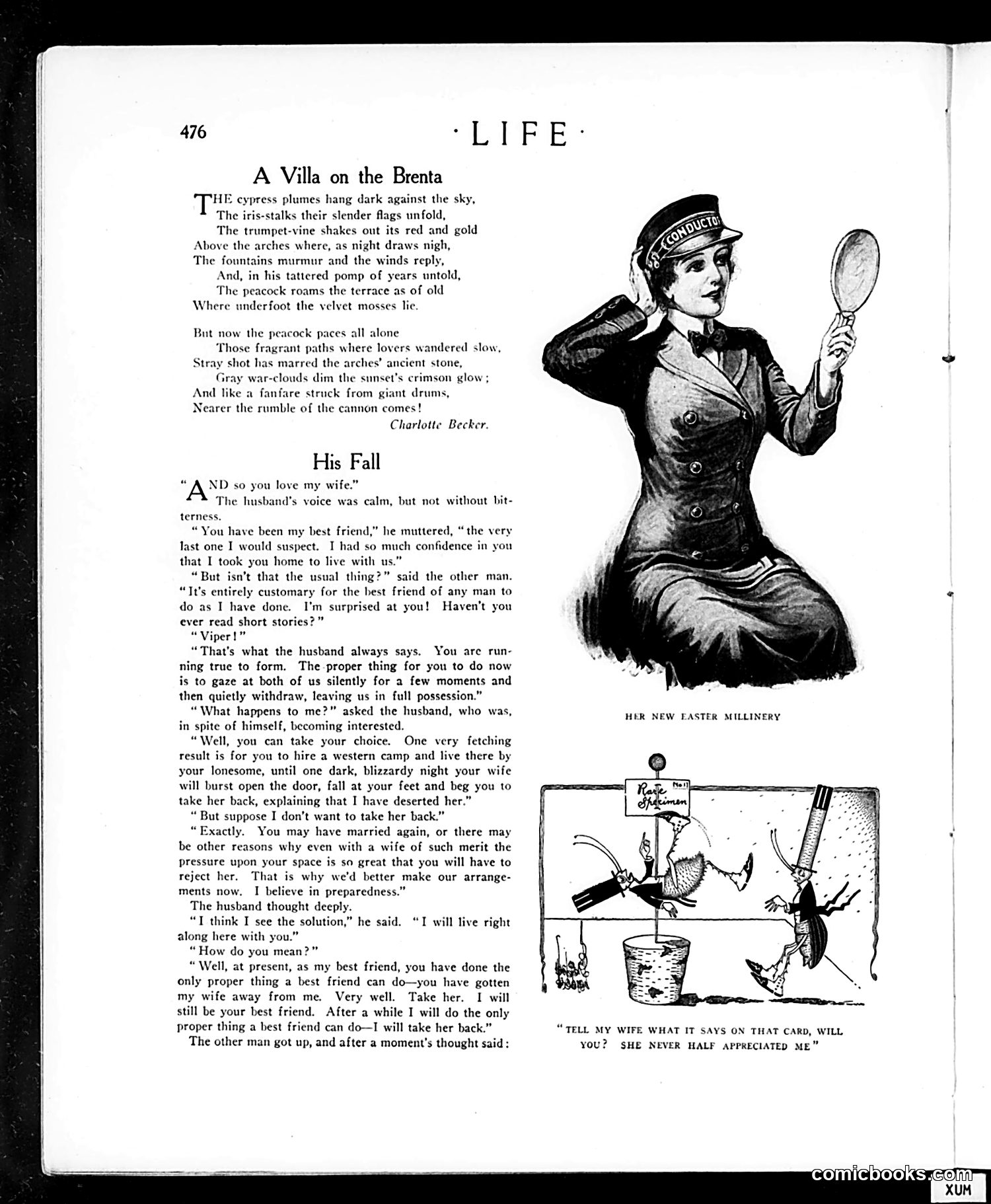
This page contains two distinct pieces of satirical content: **"A Villa on the Brenta"** is a poem by Charlotte Becker describing an Italian villa transformed by war—cypress trees, fountains, and peacocks now disrupted by cannon fire and "stray shot." It reflects WWI's impact on European culture and beauty. **"His Fall"** is a comedic short story mocking the conventions of popular fiction. Two men engage in absurdist dialogue about seducing the husband's wife. The "other man" sarcastically notes that betraying one's best friend is "customary" and references predictable literary tropes (the abandoned husband, the dramatic return). The punchline subverts expectations: the husband proposes they simply exchange the wife repeatedly, making infidelity a practical arrangement rather than dramatic tragedy. **The cartoon** shows a woman admiring her Easter hat while a man holds a card—presumably a compliment she dismisses. It illustrates how women's vanity overshadows their appreciation for men's efforts or sentiment. The page satirizes both war's destruction of civilization and the hollow conventions of popular romance narratives.
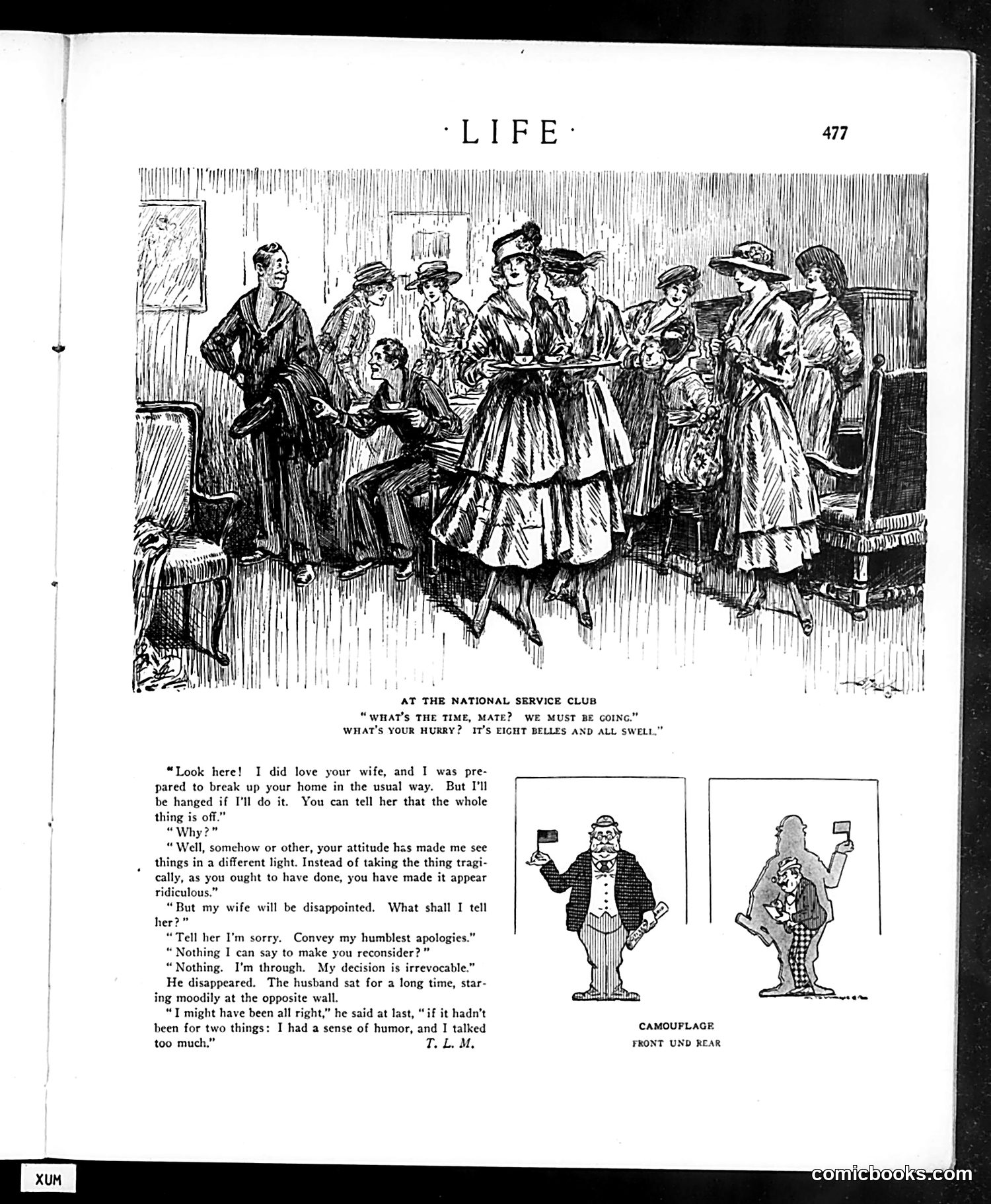
This satirical piece from Life magazine depicts a domestic drama at a National Service Club. The main cartoon shows a man confessing to another that he intended to seduce his wife and break up his home—a stock scenario of seduction narratives—but is calling it off because the husband refused to react with the expected tragedy and anger. Instead, the husband treated the situation with humor and talked too much, rendering the affair "ridiculous" rather than tragic. The satire mocks both masculine honor codes and seduction narratives of the era. By refusing dramatic outrage, the husband inadvertently defeats the seducer's purpose. The smaller "Camouflage Front and Rear" cartoons suggest the theme of deceptive appearances versus reality. The joke's deeper point: humor and casual speech undermine the seriousness that affairs require to seem consequential. The story credits "T. L. M." as the author.
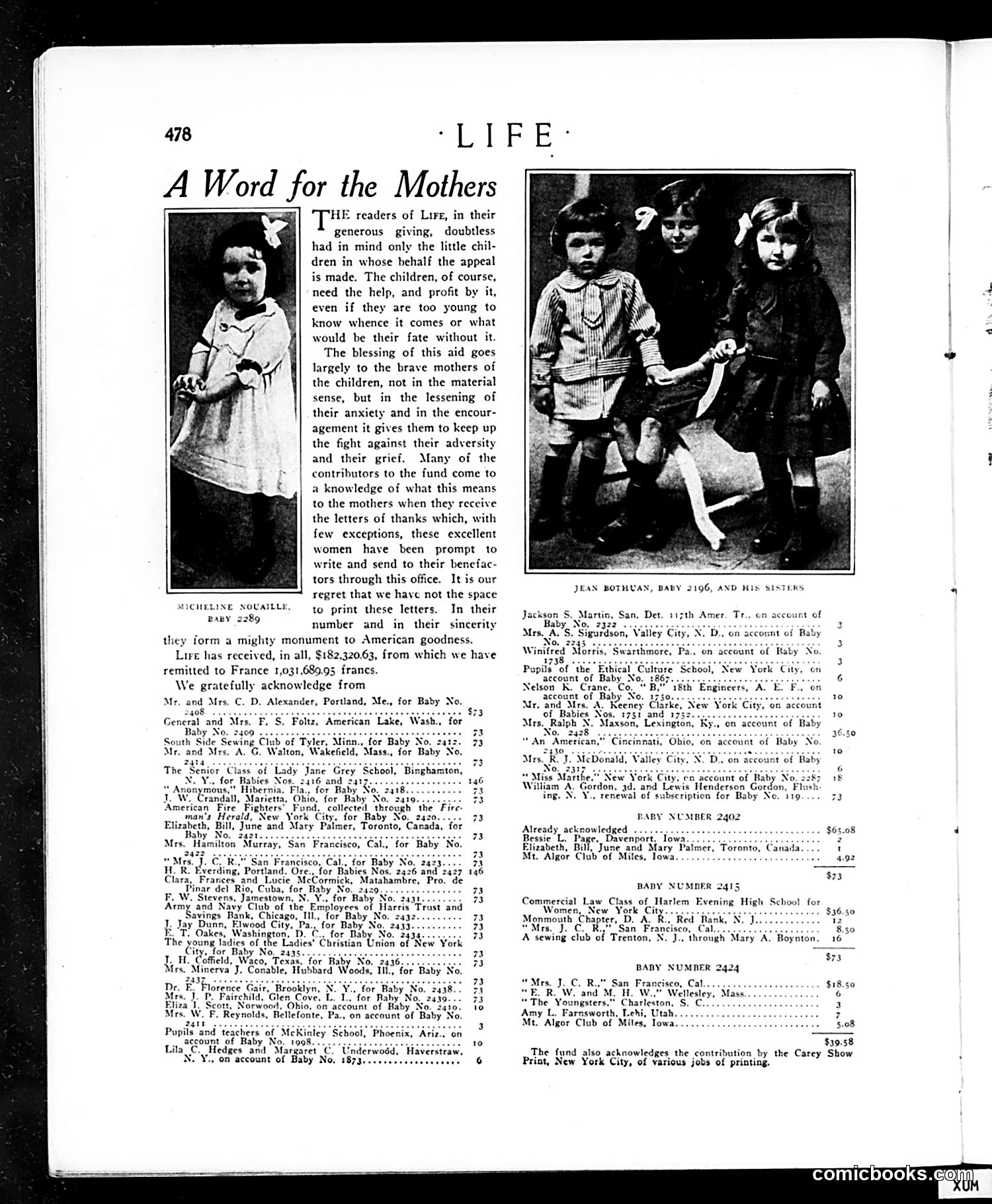
This page documents Life magazine's charity campaign to aid French children orphaned or displaced by World War I. The editorial "A Word for the Mothers" acknowledges donations to the relief fund, emphasizing that aid helps not just the children materially, but also provides psychological relief to their mothers by reducing anxiety and despair. The accompanying photograph shows "Jean Bothuan, Baby 2196, and his sisters"—one of the specific beneficiary children whose case donors could follow. The extensive acknowledgment lists show donors from across America (Portland, Chicago, San Francisco, etc.) contributing amounts ranging from a few dollars to substantial sums. The campaign raised $182,320.63 total, with $1,031,689.95 francs remitted to France. This reflects post-WWI American philanthropic response to European humanitarian crisis, personalizing aid through individual "baby sponsorship" that connected American donors directly to named French children in need.
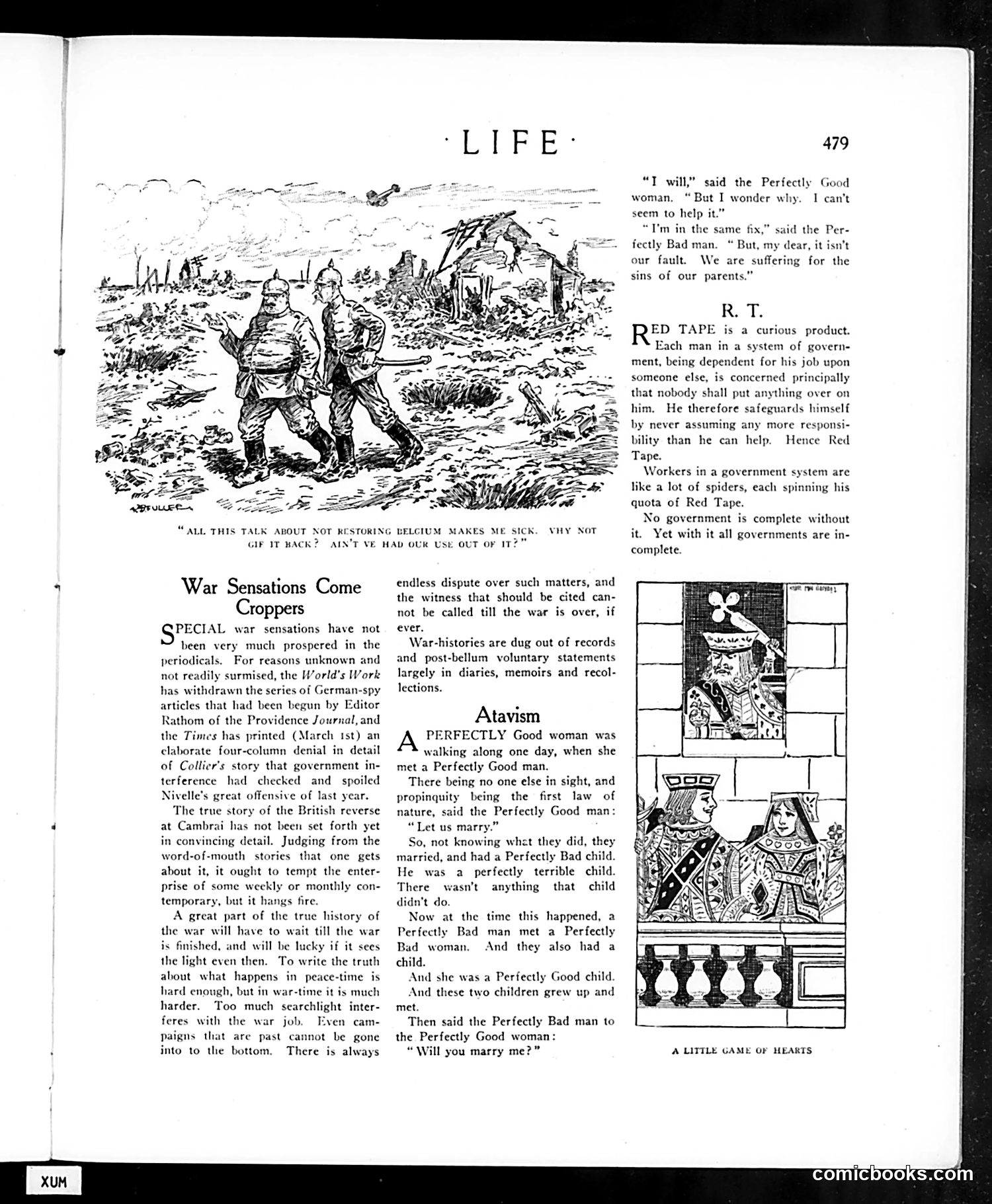
**"War Sensations Come Croppers"** discusses how American periodicals have failed to publish sensational wartime stories. The piece critiques censorship and government interference—noting that *World's Work* withdrew German-spy articles and the *New York Times* denied *Collier's* account of military operations. The author argues that true war history must wait until peace, as wartime "searchlight" scrutiny prevents accurate reporting. The cartoon caption (partially visible) appears cynical about Belgium's restoration, suggesting post-war reckoning. **"Atavism"** is a morality fable suggesting heredity or ancestral "sins" determine character. Two "Perfectly Good" people produce a "Perfectly Bad" child, while "Perfectly Bad" parents produce a "Perfectly Good" child. When these children meet and marry, they attribute their incompatible nature to inherited traits—a satirical critique of determinism or fatalism about moral character. **"Red Tape"** satirizes bureaucratic systems where officials protect themselves by avoiding responsibility, spinning endless procedural "tape" like spiders. The author notes governments require but are ultimately hampered by it.
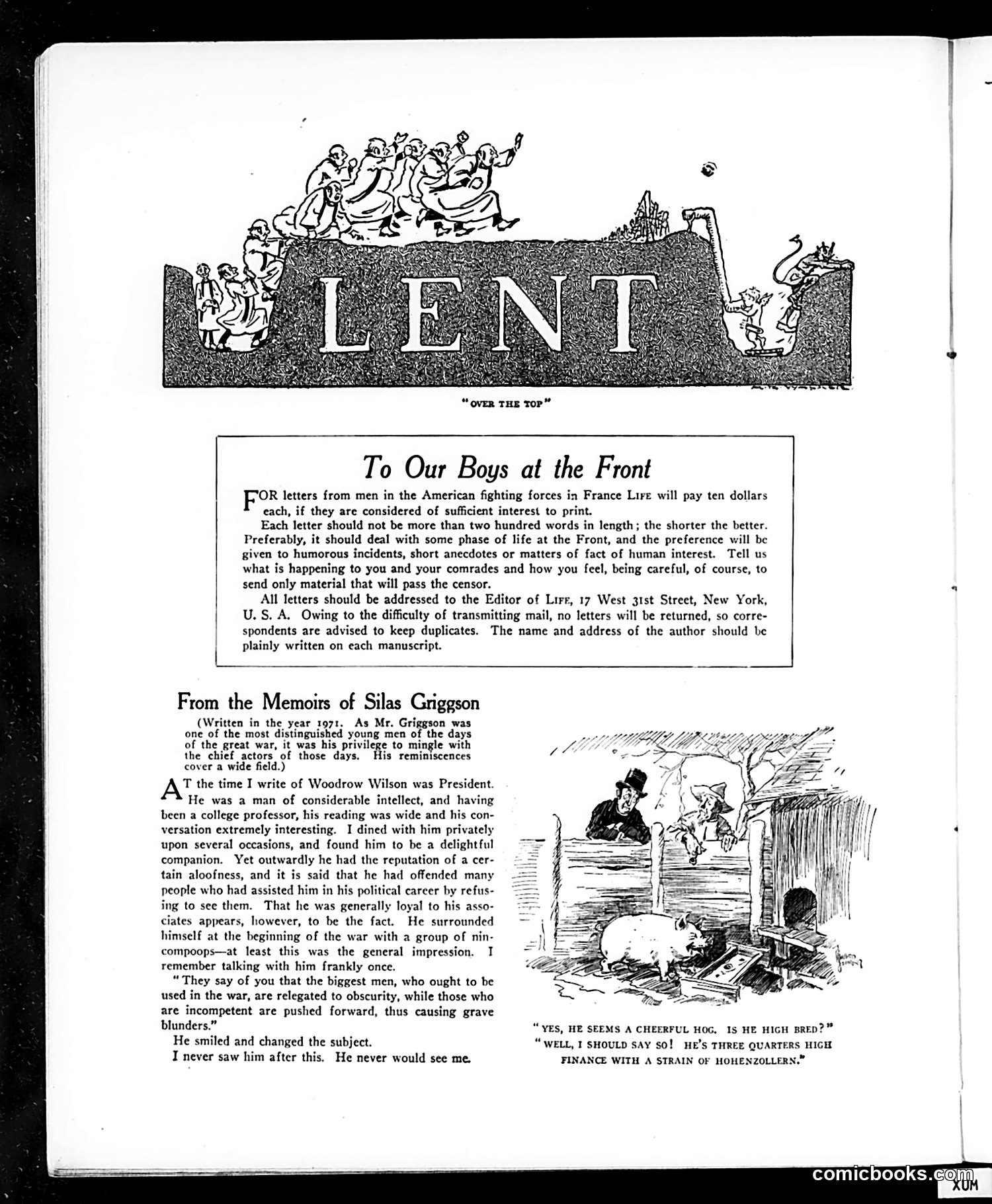
This page contains a call for WWI soldier letters and a satirical memoir excerpt about President Woodrow Wilson. **The Setup:** Life magazine solicits firsthand accounts from American soldiers in France, paying $10 per published letter—positioning itself as documenting the Great War experience. **The Satire:** The "Memoirs of Silas Griggson" (written retrospectively in 1971) mocks Wilson's administration. The author recalls dining with President Wilson and gently criticizing him for surrounding himself with "nincompoops"—incompetent advisors causing military blunders. Wilson deflects the criticism and refuses further meetings. **The Cartoon:** The illustration depicts a pig being inspected, with dialogue questioning its breeding and bloodline, referencing "Hohenzollern" (the German imperial family). This is a crude visual metaphor—the pig likely represents either an incompetent official or German militarism itself. **Context:** This reflects contemporary American skepticism about Wilson's war leadership and his cabinet appointments, a common criticism during WWI.
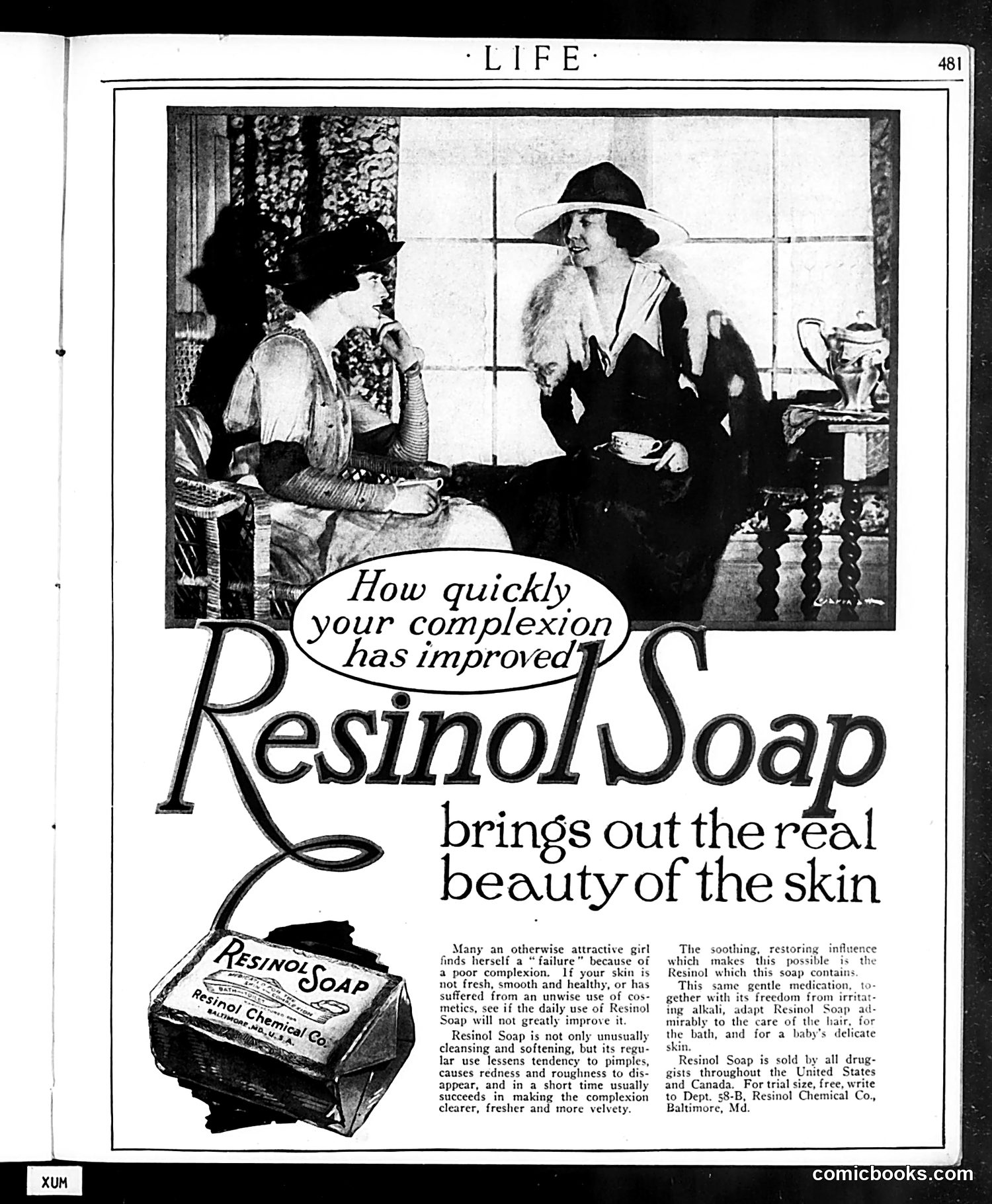
This is a **Resinol Soap advertisement**, not satire or political commentary. The page shows two women in 1920s dress having a conversation where one compliments the other's improved complexion, attributed to using Resinol Soap. The "cartoon" element is minimal—just an illustrated scene establishing a social scenario. The advertising copy below emphasizes that poor complexion causes women to feel like "failures," and promises Resinol will cure pimples, redness, and roughness through its medicinal ingredient. **For modern readers**: This reflects early-20th-century beauty standards and advertising practices that linked a woman's social worth to her appearance. The product contained resinol (a medicated ingredient), which was genuinely used in skincare then. The ad's psychology—suggesting personal inadequacy and offering cosmetic "cure"—exemplifies how vintage advertising weaponized insecurity to sell products, a practice modern audiences recognize as manipulative.
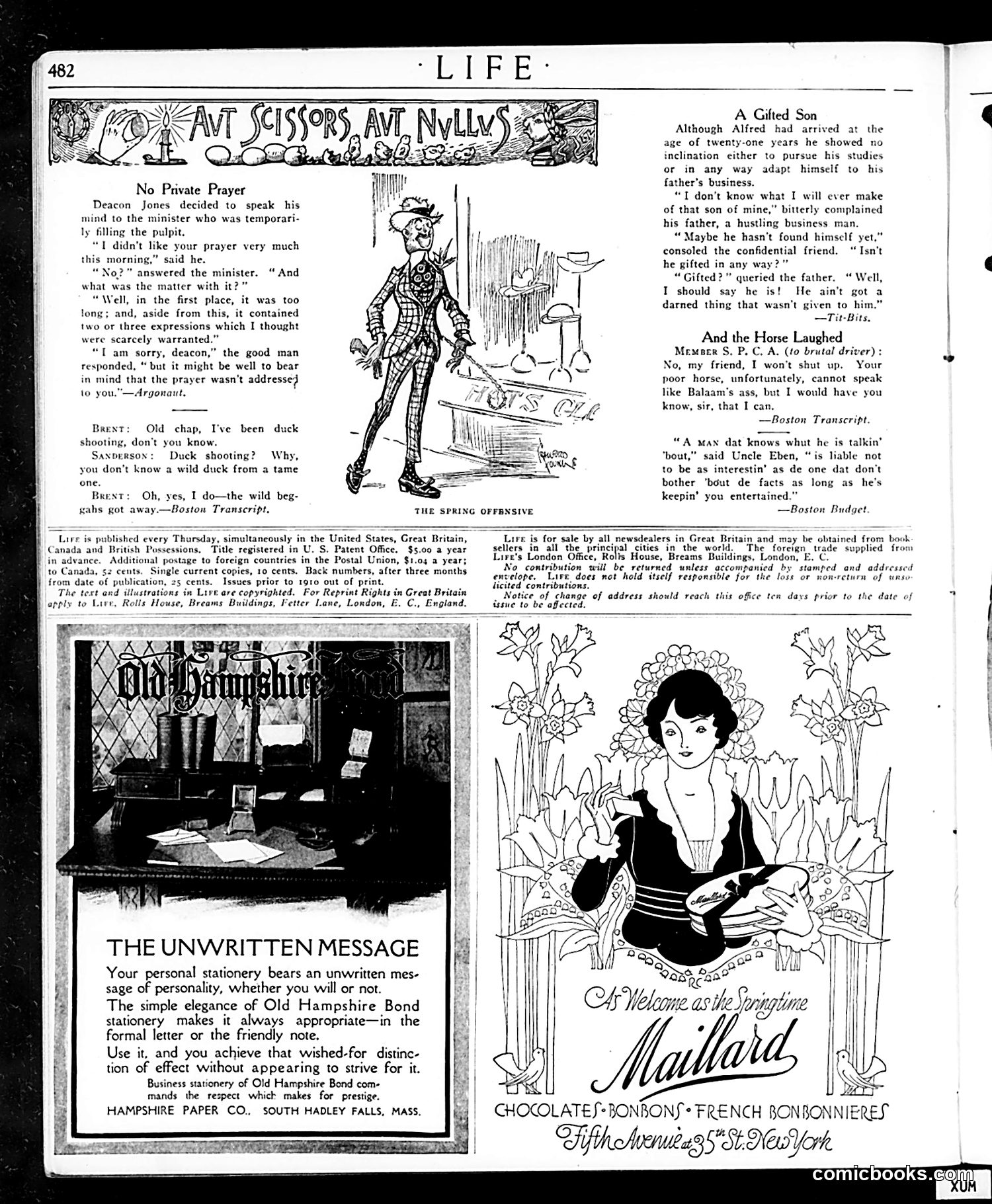
This page contains several short humorous anecdotes typical of early 20th-century American humor magazines: **"No Private Prayer"** mocks a sanctimonious deacon who criticizes the substitute minister's prayer as too long and presumptuous. The minister's witty retort—that the prayer wasn't addressed to the deacon anyway—deflates the deacon's self-importance. **"The Spring Offensive"** (cartoon) shows a man dressed in elaborate spring clothing, likely satirizing exaggerated fashion trends or dandyish behavior of the era. **Other brief jokes** target: a duck hunter who can't identify ducks; a father frustrated that his "gifted" son has no useful talents; and an animal-rights activist defending a horse that cannot speak for itself. The page is primarily **humorous social commentary**—gentle satire of human foibles like vanity, hypocrisy, and pretension rather than sharp political critique. The remaining content consists of period advertisements for stationery and candy, typical of Life's commercial pages.

This is a **straightforward advertisement**, not a cartoon or satire. It's a full-page ad for Federal brand tires, published in *Life* magazine (page 483). The page displays two large tire photographs flanking central text describing Federal's "Double-Cable-Base" technology. The ad emphasizes that Federal tires resist wear on both road and rim due to internal cable construction that prevents the tire from shifting on the wheel, pinching inner tubes, or blowing off the rim. The Federal Rubber Company of Illinois (based in Cudahy, Wisconsin) manufactures automobile, motorcycle, and bicycle tires, plus related rubber products. **For modern readers:** This reflects early automotive advertising's focus on tire durability and safety—concerns that remain relevant today, though tire technology has advanced considerably. The technical claims about cable construction were presented as cutting-edge innovations at the time.
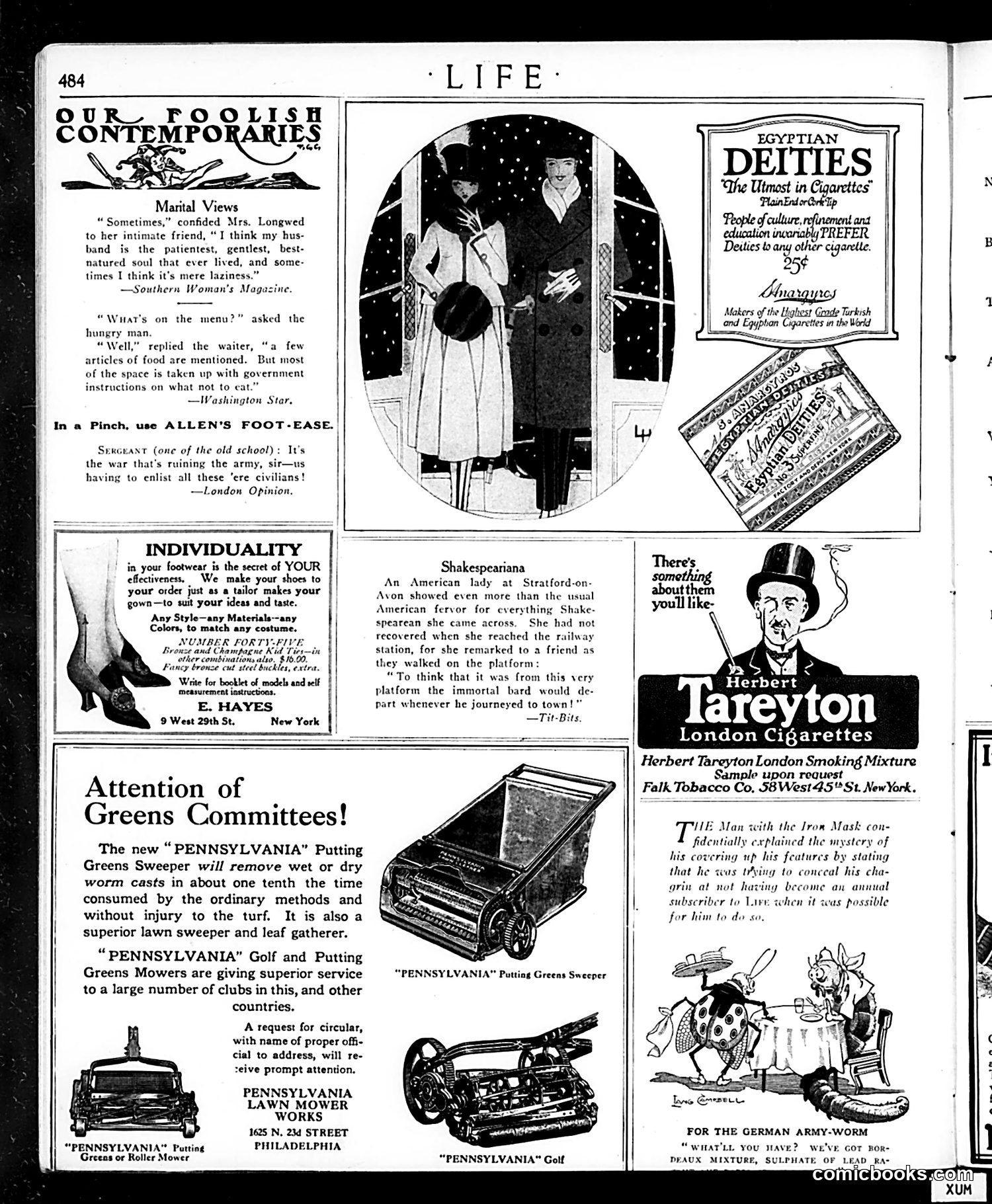
This page is primarily **advertising content** from an early 20th-century American satirical magazine, with several small humor pieces interspersed. **Humor Content:** The "Marital Views" and "Shakespeariana" sections are light social commentary. The first jokes that a patient husband might simply be lazy rather than virtuous. The second mocks American tourists' excessive enthusiasm for Shakespeare-related sites in England—the American woman at Stratford-on-Avon is so enamored she imagines Shakespeare departed from the railway platform to travel to town (historically inaccurate, playing on American naiveté about English literature). **Notable Advertisement:** The "Man with the Iron Mask" cartoon at bottom right is a meta-joke: it claims the historical masked prisoner concealed his identity to avoid admitting he *wasn't* a magazine subscriber—humor aimed at encouraging subscriptions. **Context:** The page reflects WWI-era concerns (government food rationing mentioned), period anxieties about American tourists abroad, and advertising targeting middle-class consumers with lawn care and custom footwear.
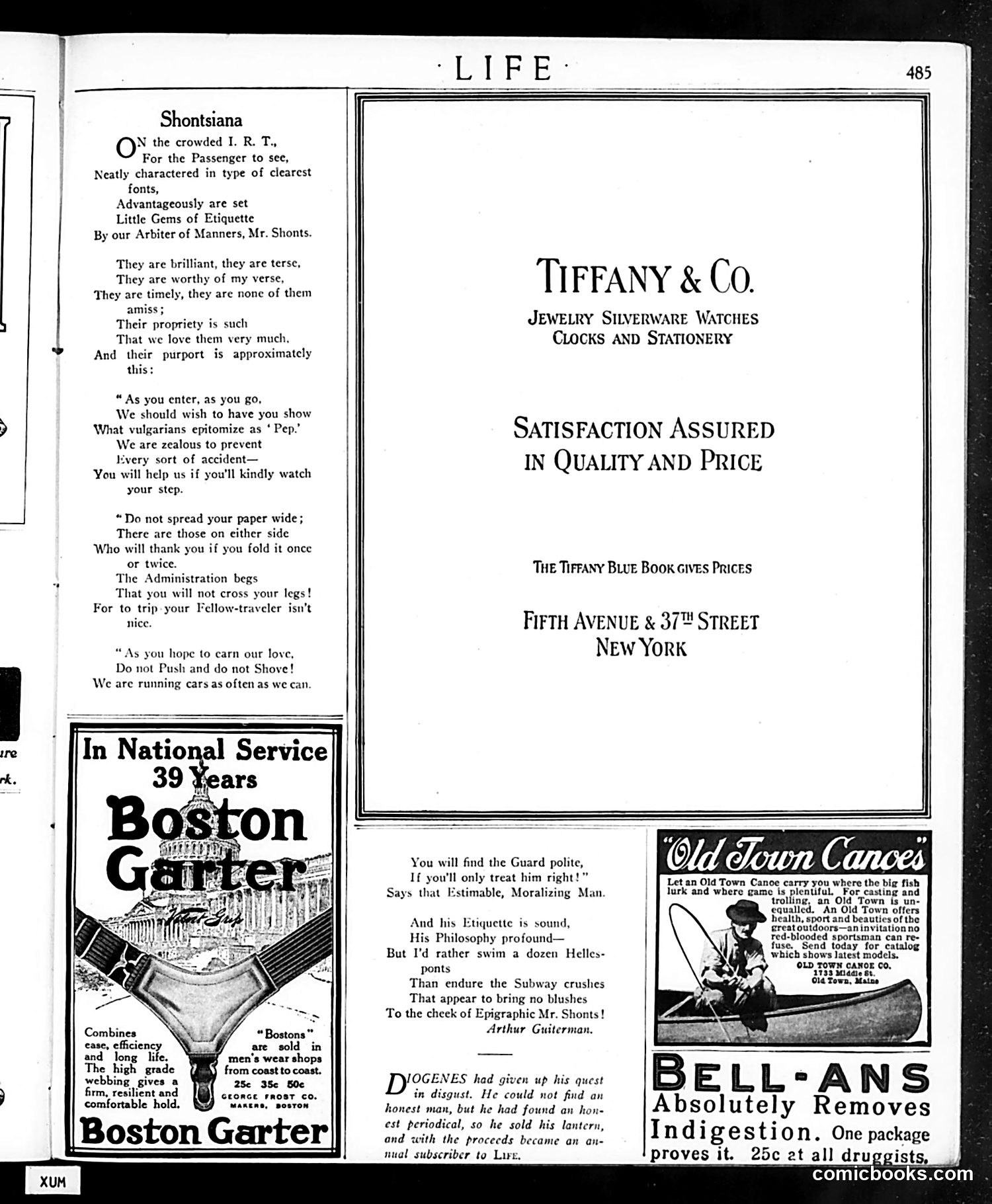
This page satirizes **Theodore Shonts**, president of the Interborough Rapid Transit (IRT) subway system, who apparently posted etiquette notices for passengers. The poem mocks his sanctimonious "Little Gems of Etiquette"—rules about not spreading newspapers, crossing legs, or pushing—by presenting them as absurdly preachy moral pronouncements. Poet Arthur Guiterman's commentary is the joke: while praising Shonts's "sound" philosophy and "profound" etiquette, he admits he'd "rather swim a dozen Hellespont" than endure the actual subway crushes that these notices fail to prevent. The satire suggests Shonts's genteel rules are useless against the chaotic reality of crowded New York subways—his moralizing cannot control human behavior in cramped transit conditions. The humor targets the gap between aspirational corporate messaging and lived urban experience.
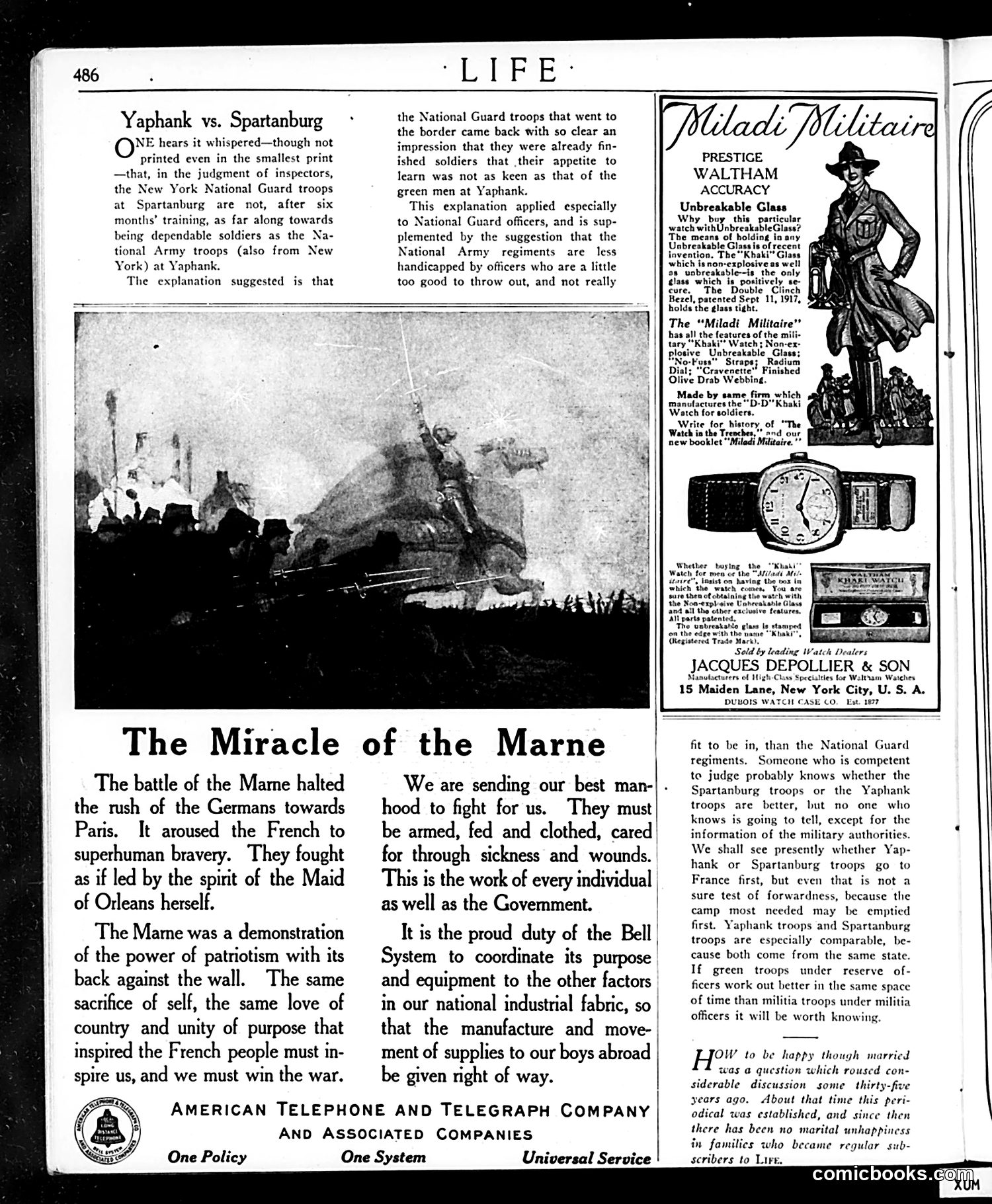
This page critiques military preparedness during World War I. The main article "Yaphank vs. Spartanburg" compares two New York military units—one National Guard (Spartanburg) and one National Army (Yaphank)—after six months' training. Life's satirical point: the National Guard troops, having served on the Mexican border earlier, believed themselves already "finished soldiers" and showed less eagerness to learn compared to the greener National Army recruits. The piece subtly mocks experienced officers as overconfident and resistant to further training. The accompanying AT&T advertisement ties patriotic messaging to corporate utility, claiming the Bell System will support war supply chains. The lower section includes period watch and jewelry advertisements emphasizing military utility. The final paragraph satirizes Life's own advertising claims—humorously asserting that readers who subscribed to Life magazine experienced perfect marital happiness, an obvious tongue-in-cheek exaggeration meant to mock such promotional promises.
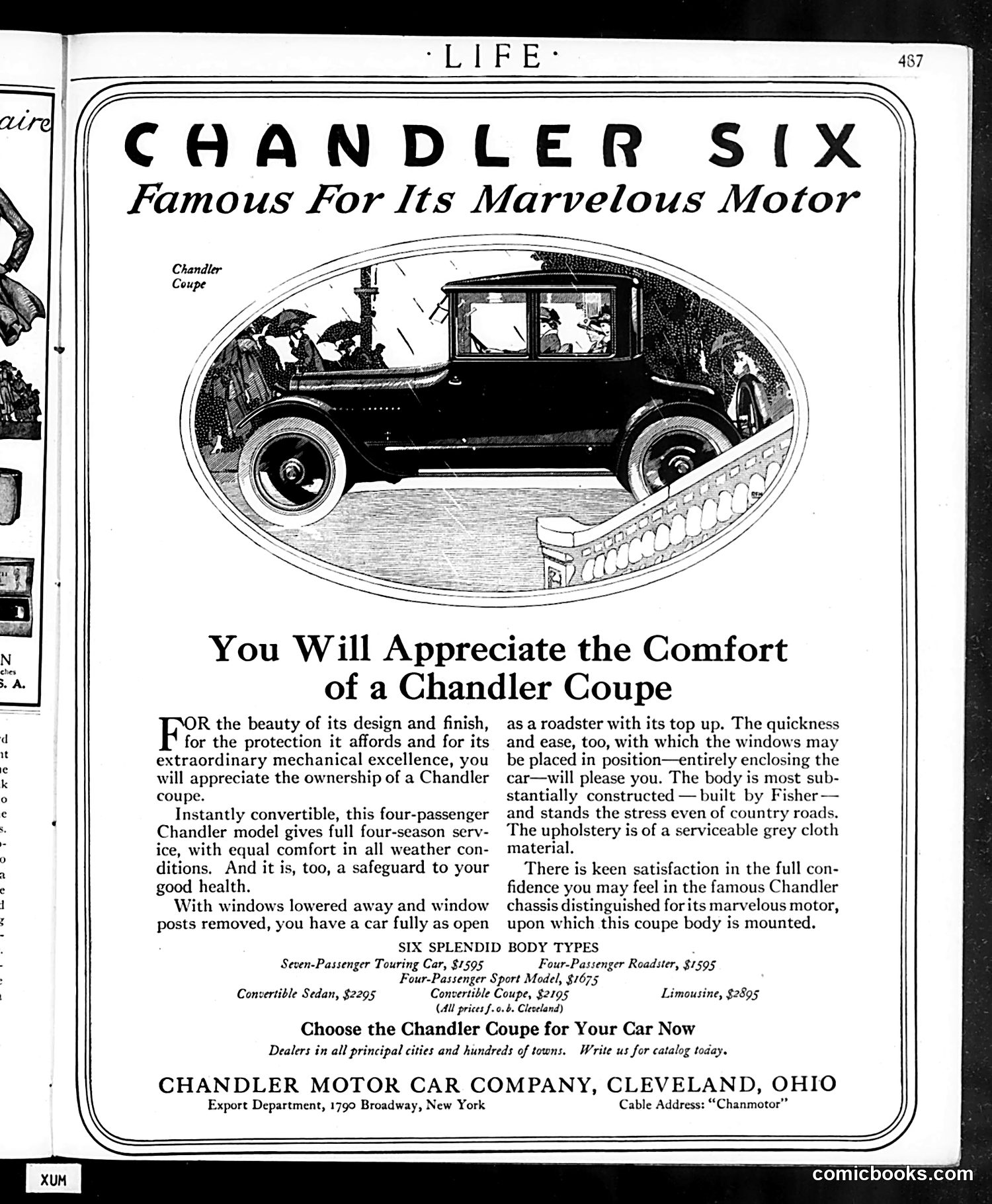
This page contains **no cartoon or satire**—it is a straightforward automobile advertisement for the Chandler Six, published in *Life* magazine (page 487). The ad promotes a luxury car manufactured by the Chandler Motor Car Company of Cleveland, Ohio. It emphasizes the vehicle's "marvelous motor," convertible design, comfort features, and sturdy Fisher-built body. The image shows a Chandler Coupe with passengers, positioned as an elegant, sophisticated vehicle. Pricing ranges from $1,595 for a touring car to $2,895 for a limousine—substantial sums indicating this was a premium product aimed at affluent buyers. The ad highlights practical features like adjustable windows and all-weather functionality appealing to early 20th-century motorists. This appears to be a standard commercial advertisement rather than satirical content, consistent with *Life*'s mix of editorial and advertising material from that era.
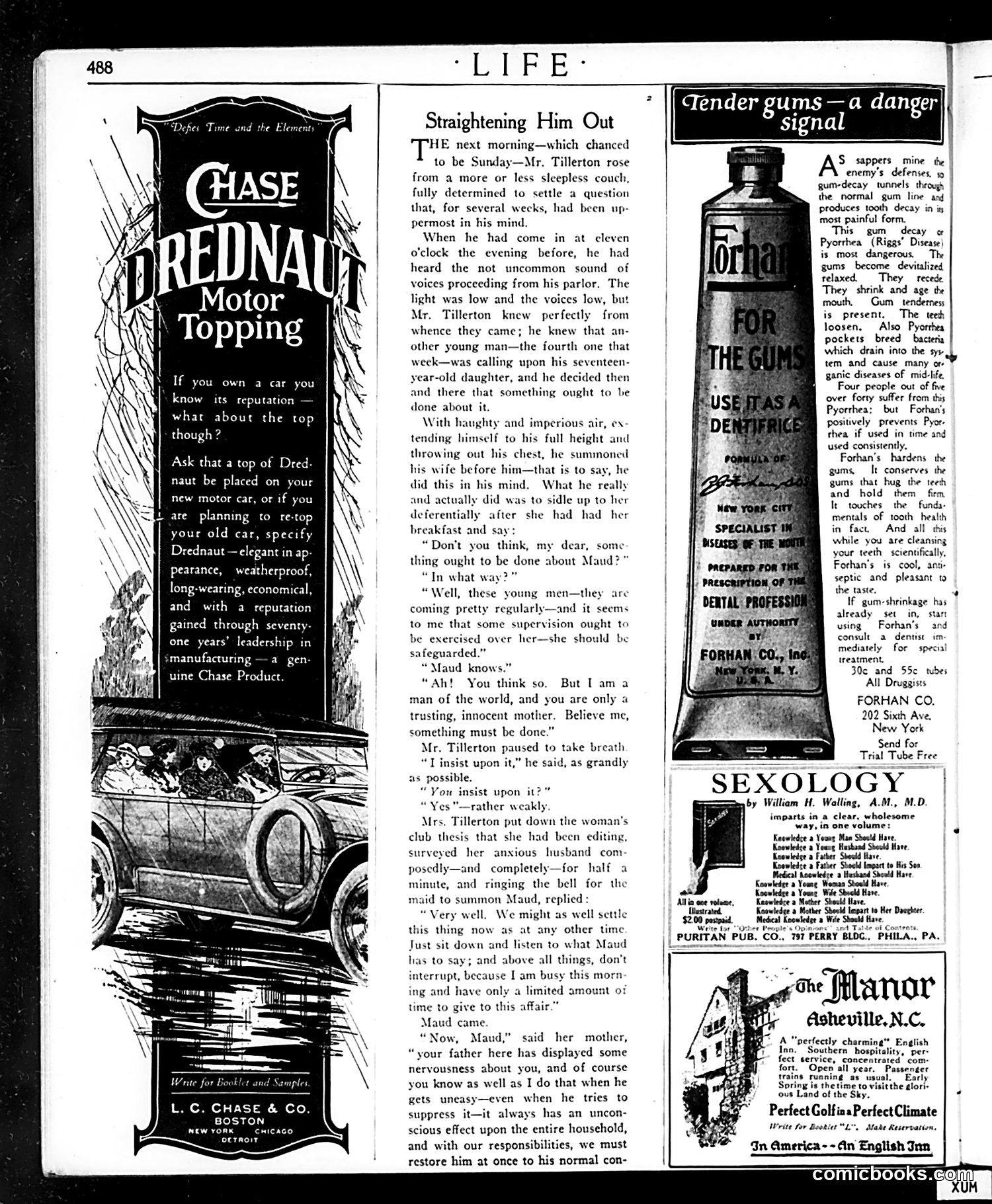
This page contains a serialized short story titled "Straightening Him Out" about domestic relations, alongside period advertisements. **The Story**: Mr. Tillerton, anxious about his 17-year-old daughter Maud receiving frequent male callers, attempts to assert authority over his wife to impose supervision. His approach is comically ineffectual—he "sides up to her deferentially" rather than commanding. His wife, who is editing a woman's club thesis, calmly summons Maud and prepares to hear her out, implicitly suggesting the father's concerns are overblown. **The Satire**: The humor lies in the contrast between Tillerton's self-image as "a man of the world" and his actual weakness in domestic matters. His wife's composed response—she's busy but will listen to Maud directly—deflates his patriarchal pretensions. This reflects early 20th-century anxieties about changing gender dynamics and women's increasing independence (the wife's involvement in women's clubs signals progressive activism). **Advertisements** include motor car tops, dental products, and a sexology book—typical of the era's commercial messaging.
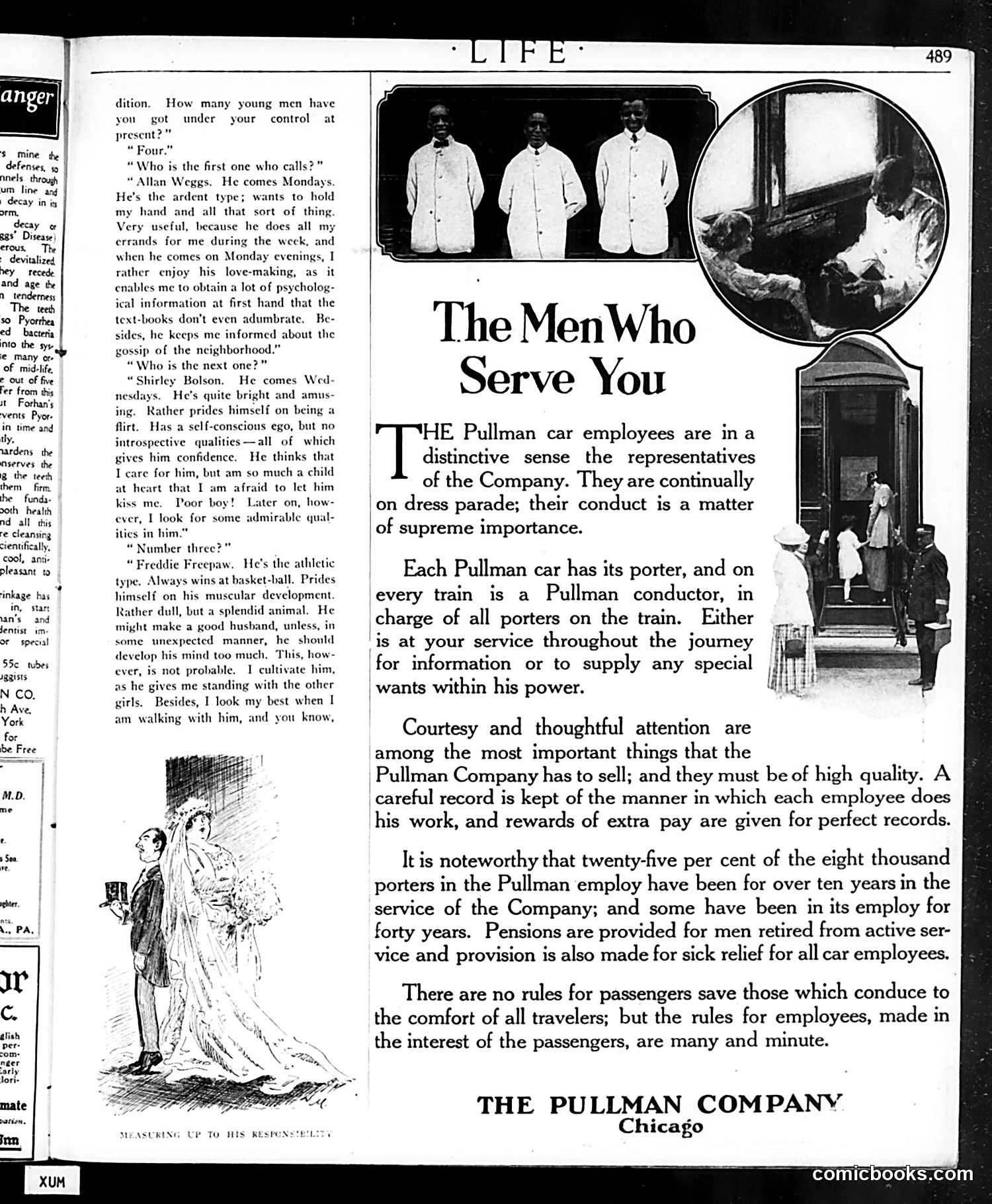
This page is primarily a **Pullman Company advertisement** celebrating its railroad porters and conductors. The top section contains unrelated satirical dialogue (appearing to be from a separate article) about a woman discussing her multiple suitors. The main advertisement features photographs of three uniformed Pullman employees and images of porters assisting passengers. The text emphasizes the company's commitment to employee quality, professionalism, and longevity—noting that 25% of its 8,000 porters have served over a decade, with some employed 40 years. **Historical context for modern readers**: This likely represents Pullman's effort to justify labor practices and working conditions during an era when the company faced significant scrutiny. Pullman porters, predominantly African American, were notoriously underpaid and relied heavily on tips. This advertisement presents an idealized corporate image of care and stability, though historical records show the reality was far harsher. The emphasis on "strict rules" and "careful records" underscores tight control over employees marketed as customer service excellence.
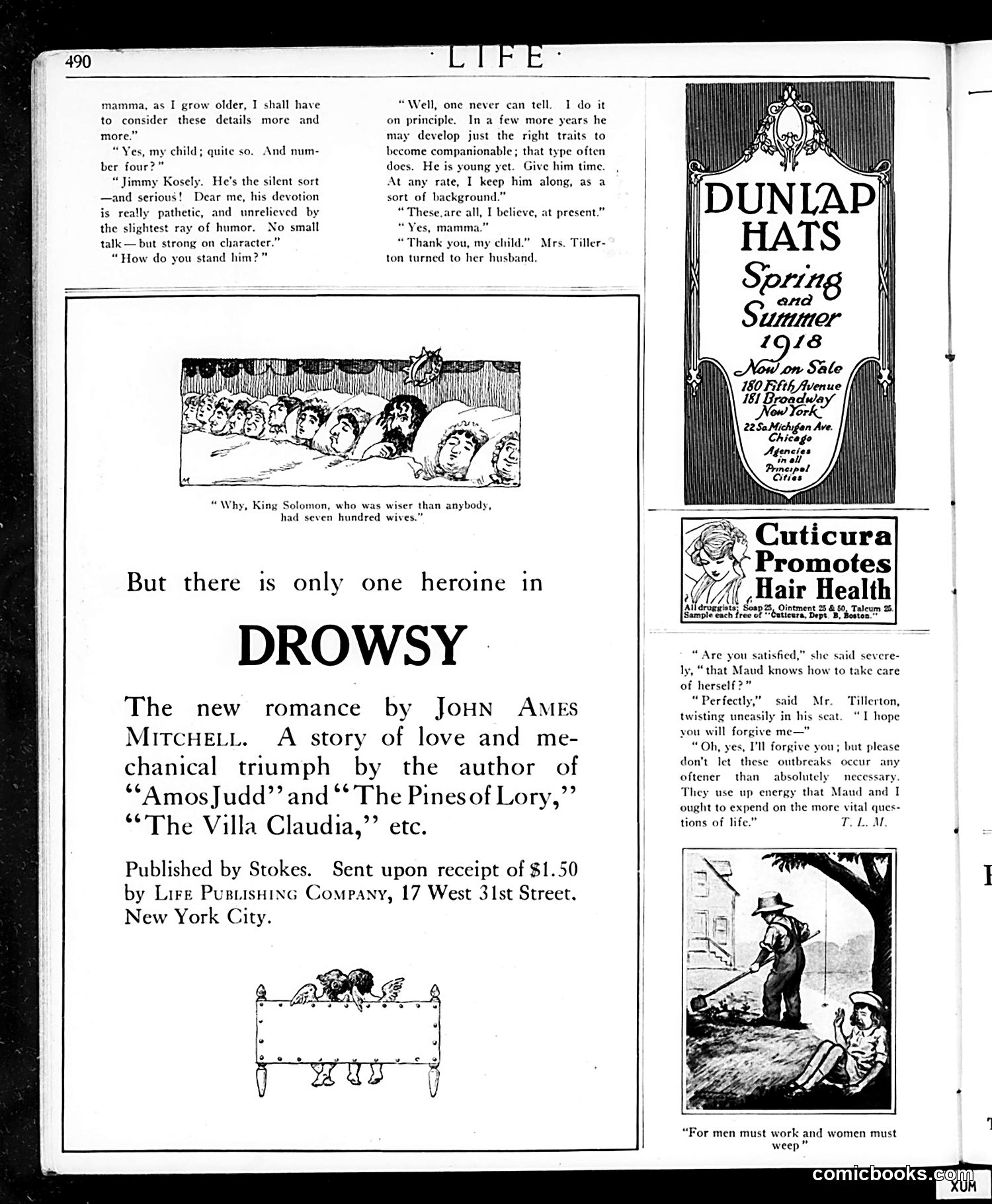
This page contains a domestic comedy sketch satirizing marriage dynamics and female authority. A wife confronts her husband about his emotional outburst, comparing him unfavorably to King Solomon (who had 700 wives). The joke hinges on the wife's absolute control: she permits her husband limited emotional expression only if it doesn't interfere with her energy for "vital questions." The sketch mocks the era's "New Woman"—educated, commanding, managing multiple suitors ("number four") with clinical detachment while keeping them as backups. Her casual, strategic approach to romance reflects early 20th-century feminist independence, though the satire suggests this threatens traditional masculinity. The final quoted line—"For men must work and women must weep"—ironically inverts the traditional saying, suggesting the power dynamic has reversed. The page is primarily advertising (Dunlap Hats, Cuticura), with this sketch as filler content typical of Life's satirical format.
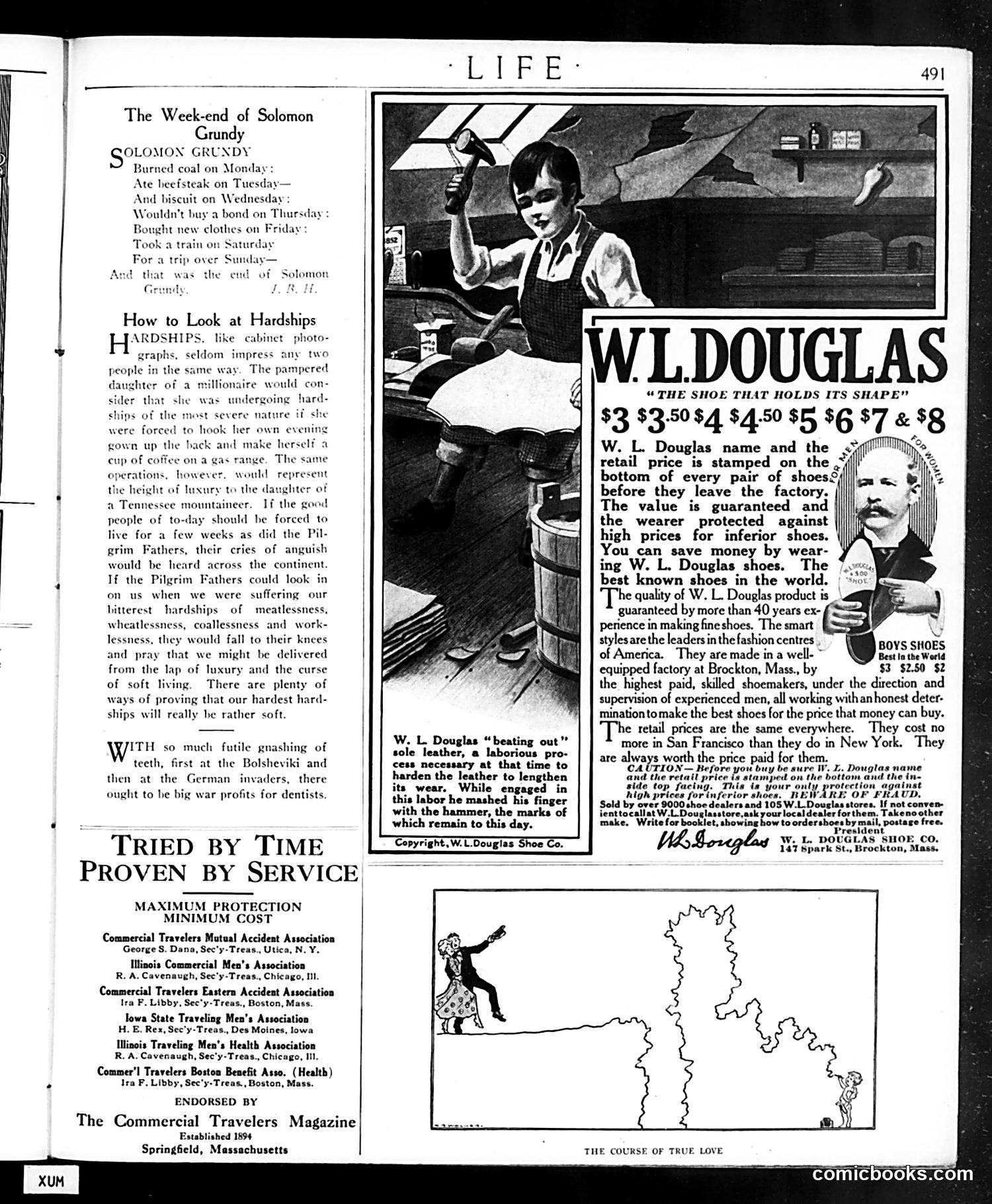
This page contains two distinct pieces of satire. **"The Week-end of Solomon Grundy"** is a short humorous poem playing on the nursery rhyme "Solomon Grundy." It mocks consumer behavior and financial responsibility by listing mundane weekly activities (burning coal, eating meals, buying clothes, taking a train trip) while notably including the line "Wouldn't buy a bond on Thursday"—a jab at Americans reluctant to purchase war bonds, likely during or after World War I. **"How to Look at Hardships"** is a satirical essay contrasting perspectives on deprivation. It argues that modern Americans complain about minor inconveniences (buying one's own evening gown, making coffee) that would constitute luxury to poorer people like "the daughter of a Tennessee mountaineer" or the Pilgrim Fathers. The piece mocks contemporary "meatlessness, wheatlessness, coallessness" complaints (likely wartime rationing), suggesting Americans' claimed hardships are actually signs of soft living. Both pieces reflect post-WWI attitudes criticizing American materialism and wartime sacrifice reluctance.
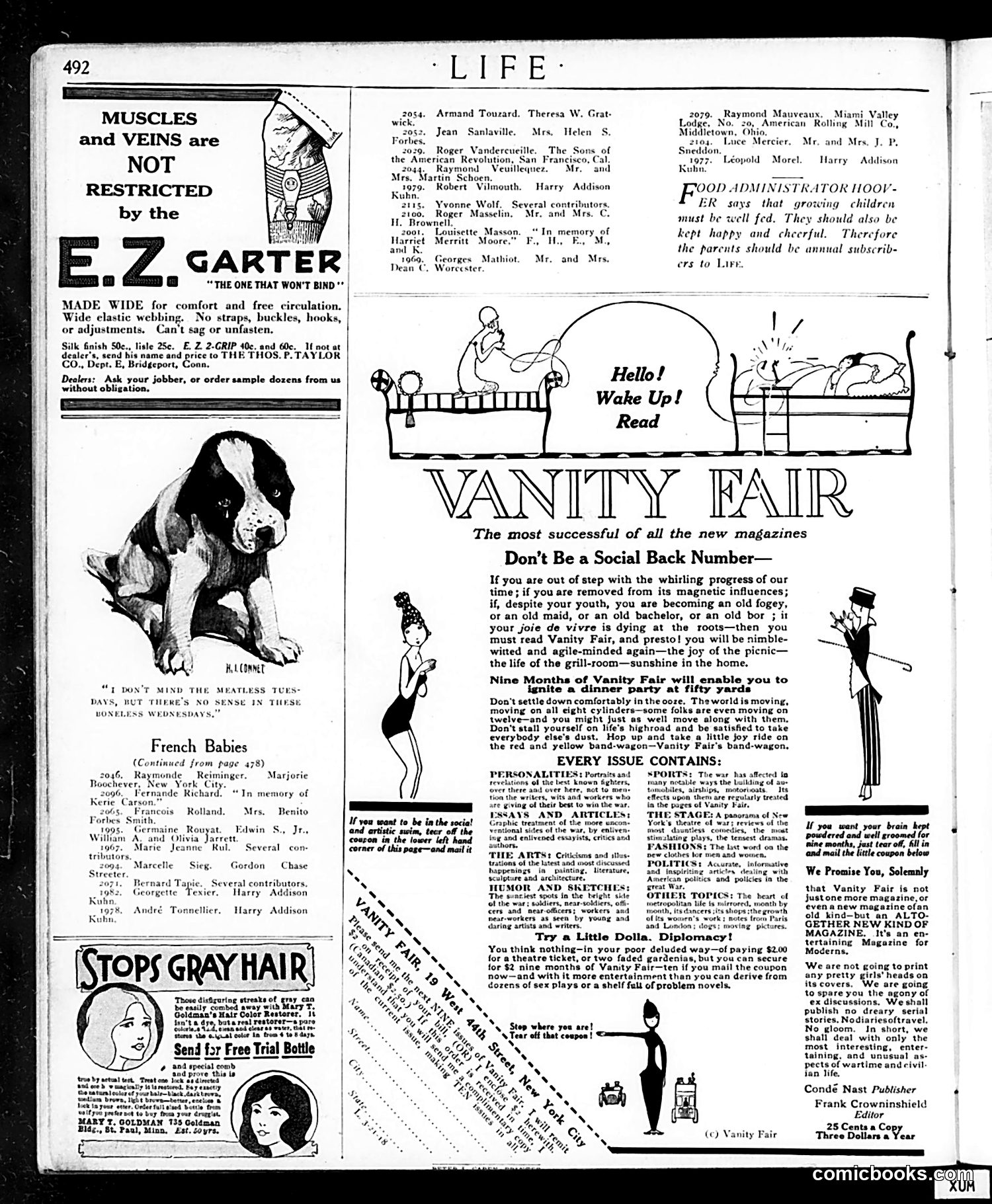
This page is primarily a Vanity Fair magazine advertisement. The central pitch warns readers against becoming socially obsolete: if you're "out of step with the whirling progress of our time" or becoming "an old fogey," you need this magazine. The ad uses energetic language about "moving on all eight cylinders" and keeping up with modern life—a pitch clearly aimed at post-WWI readers anxious about remaining relevant in rapidly changing times. References to "Hooverian" child-rearing and "meatless Tuesdays" (a WWI rationing measure) date this to the early 1920s. The surrounding ads for E.Z. Garter stockings, hair restorer, and other products reinforce the social-anxiety theme. The overall message: consume the right products and magazines to stay modern and socially acceptable.
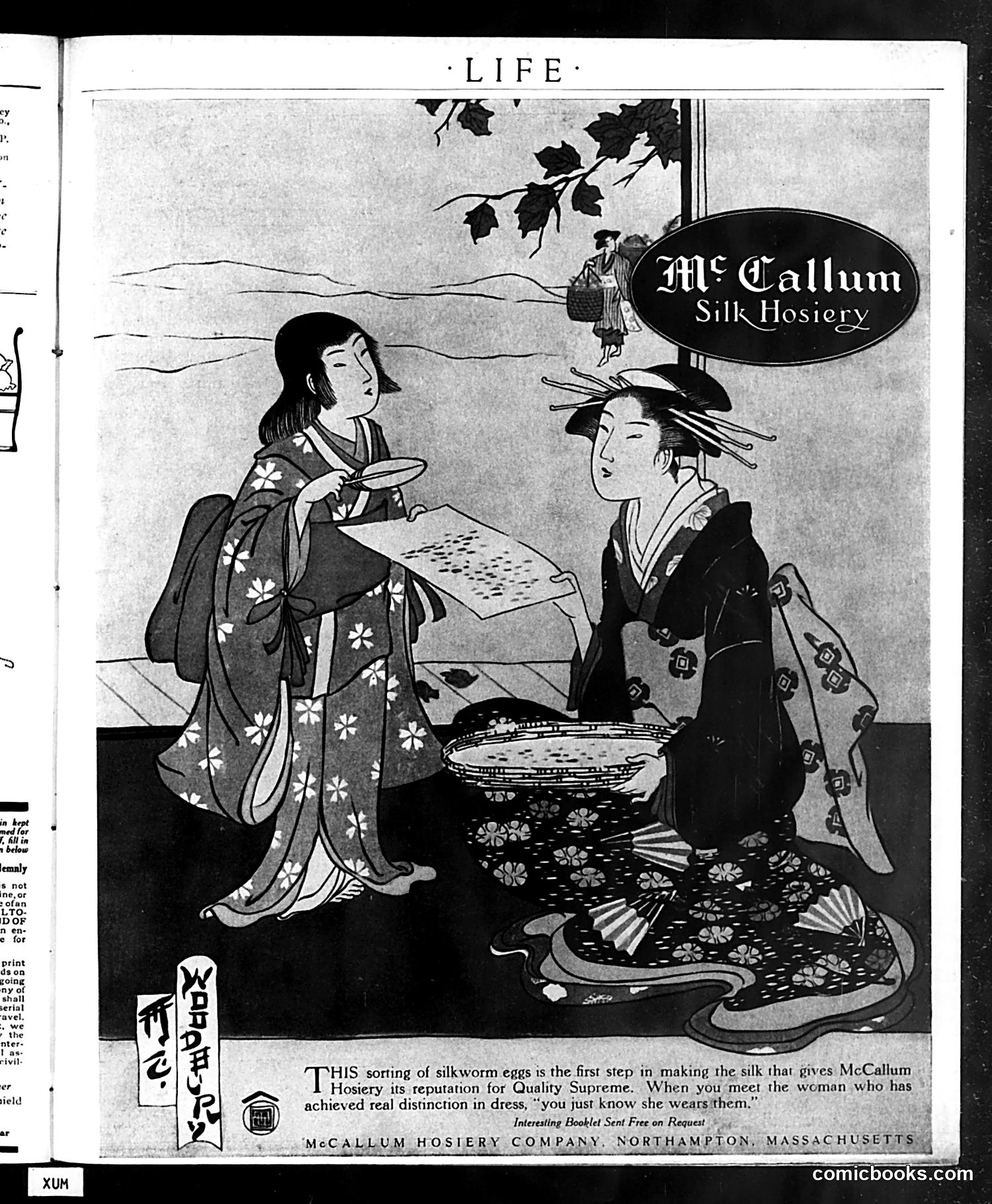
This is a full-page advertisement for McCallum silk hosiery (stockings), not political satire. It depicts two Japanese women in traditional dress examining silkworm eggs and finished silk products. The ad uses Orientalist imagery—fashionable in early 20th-century American marketing—to suggest exotic origins and superior quality. The message claims that McCallum hosiery's "reputation for Quality Supreme" derives from careful silk production. The tagline promises that women wearing these stockings will be recognized as having "real distinction in dress." This appeals to consumers' aspirations for elegance and status. The Japanese setting lends authenticity and prestige to the product, exploiting contemporary fascination with Asian aesthetics while offering a "free booklet" to interested readers.
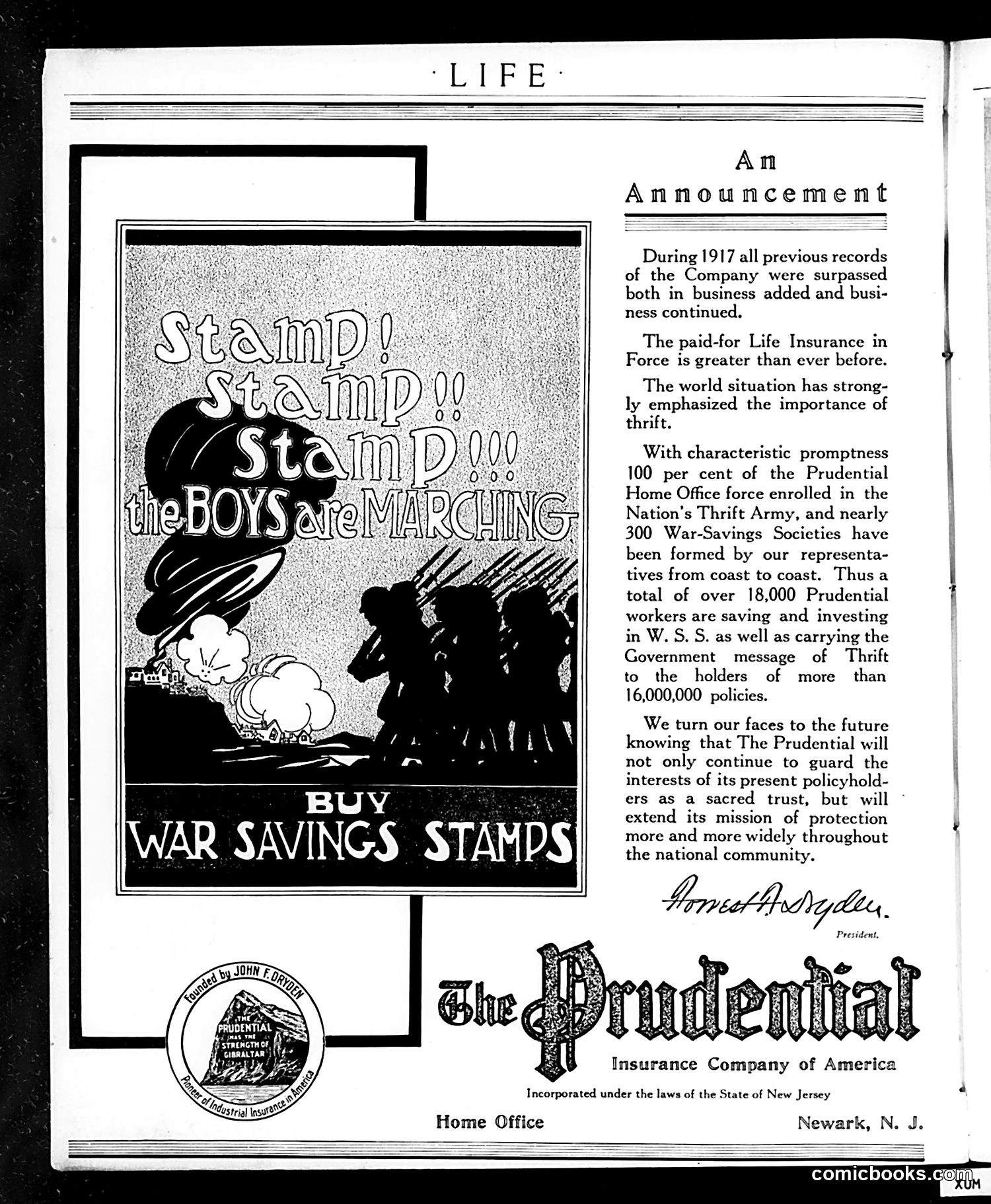
This is primarily a **Prudential Insurance advertisement** from 1917, not satire. The poster on the left shows marching soldiers with the slogan "Stand! Stand! Stand! The Boys are Marching—Buy War Savings Stamps," encouraging Americans to purchase government bonds to finance World War I. The accompanying announcement celebrates Prudential's patriotic mobilization: all 18,000+ company employees enrolled in the "Thrift Army," and the company formed 300 War-Savings Societies nationwide. The text emphasizes how the company used its 16 million policyholders to spread the government's message about financial sacrifice during wartime. This reflects early WWI propaganda linking corporate participation in war bond campaigns with patriotism and national duty. The "thrift" message promoted saving as both personal virtue and wartime obligation.
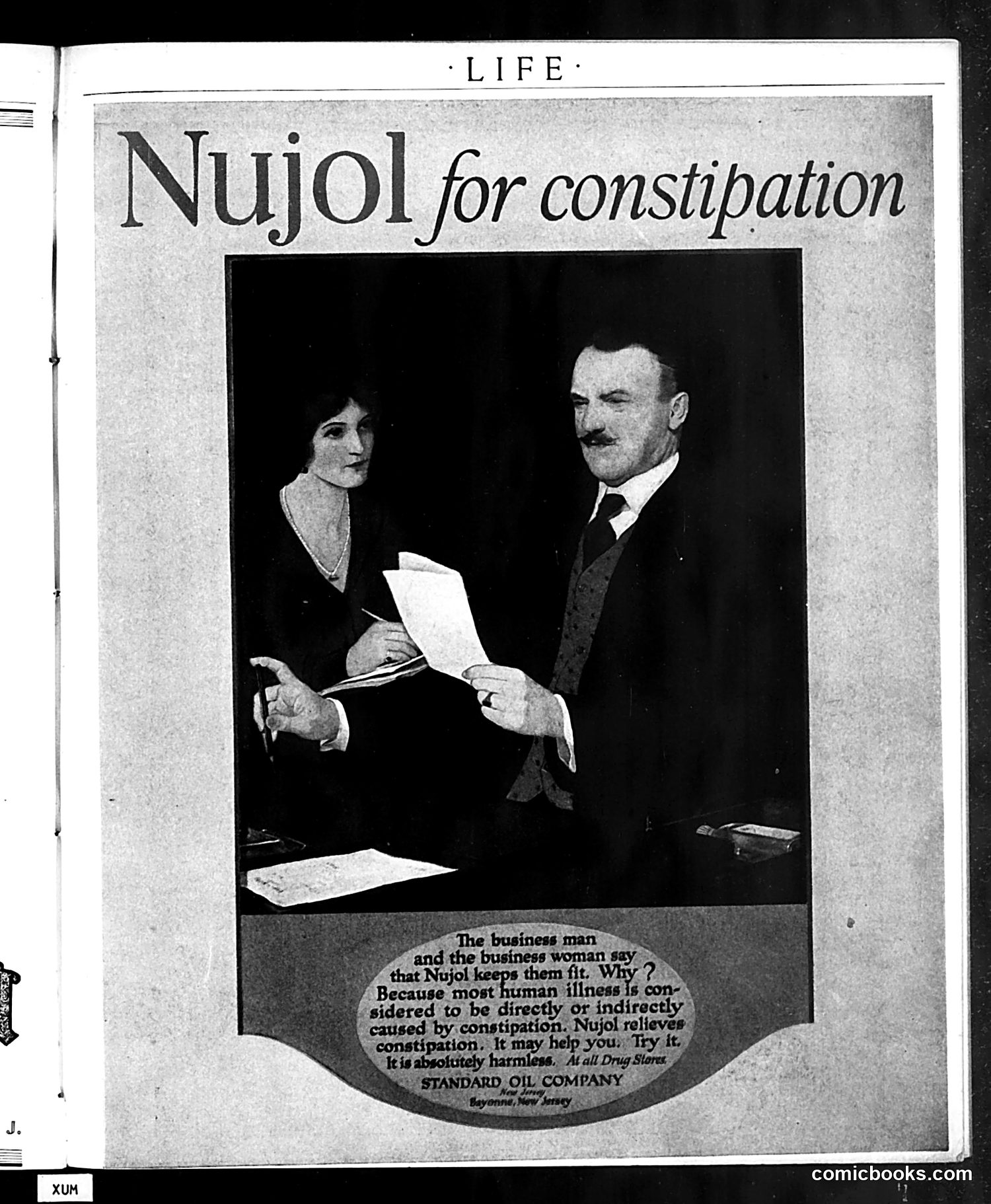
This is a **product advertisement**, not political satire. It promotes Nujol, a mineral oil laxative made by Standard Oil Company (Bayonne, New Jersey). The ad depicts a well-dressed businessman and woman in an office setting, exchanging documents. The caption claims that "the business man and the business woman say Nujol keeps them fit" because "most human illness is considered to be directly or indirectly caused by constipation." The ad's pitch: Nujol relieves constipation and is "absolutely harmless." This reflects early 20th-century medical misconceptions that positioned constipation as the root cause of widespread illness—a belief that drove considerable marketing of laxatives during this era. The professional office setting targets middle-class workers.
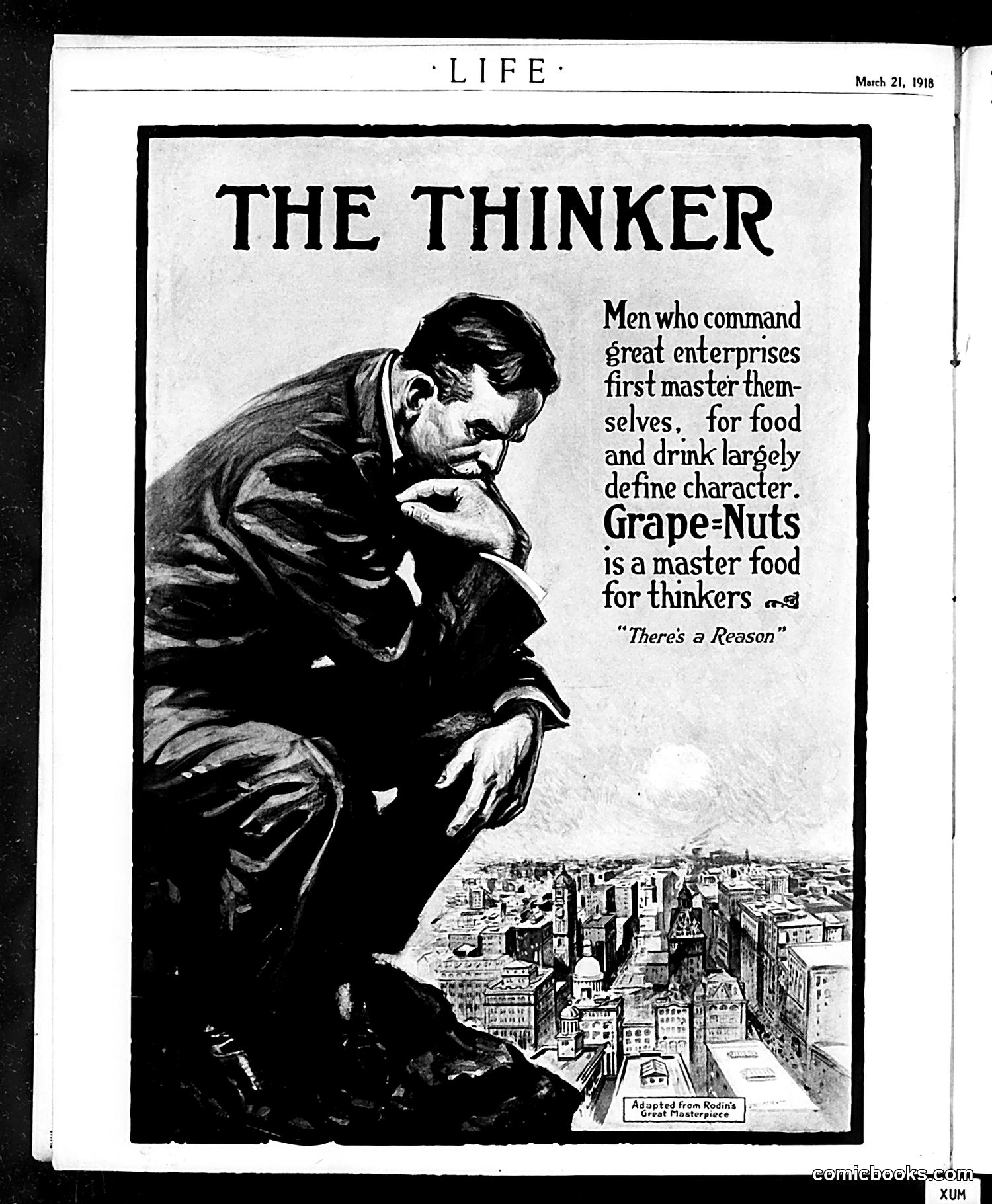
This is a **Grape-Nuts cereal advertisement** disguised as editorial content. The image shows a man in a contemplative pose overlooking a city—deliberately styled like Rodin's famous sculpture "The Thinker" (credited at bottom). The ad argues that successful leaders ("men who command great enterprises") achieve self-mastery through diet, and that food and drink "largely define character." It then pitches Grape-Nuts as the ideal food for intellectuals and decision-makers. This represents early 20th-century advertising strategy: using philosophy, art references, and pseudo-scientific claims about nutrition to market a breakfast cereal to aspirational middle-class readers. The wartime date (March 1918) may suggest appeals to strength and capability during WWI. The tagline "There's a Reason" was Grape-Nuts' actual historical slogan.