
Life, 1918-03-21 · page 34 of 56
Life — March 21, 1918 — page 34: what you’re looking at
What you’re looking at
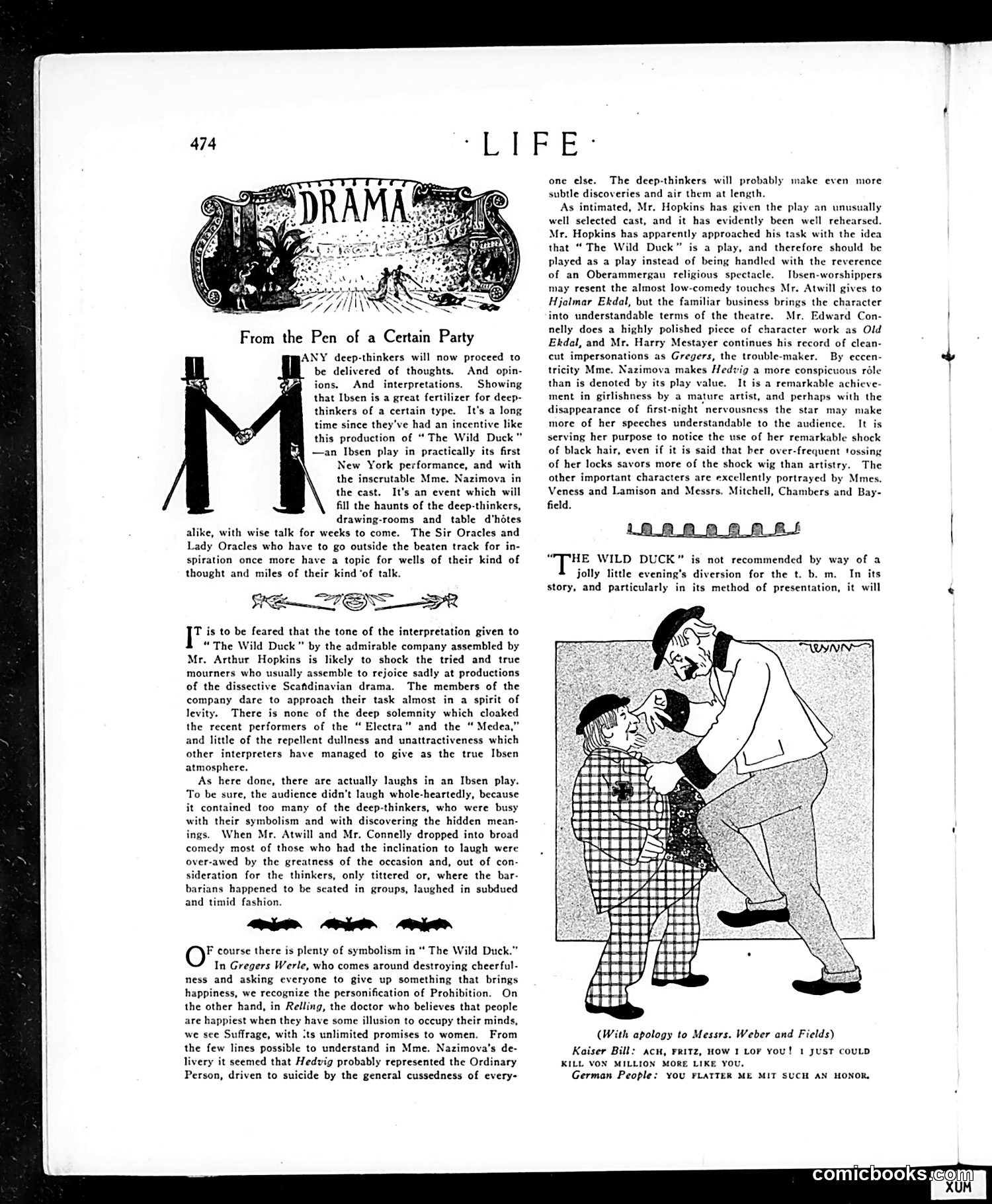
This page reviews Arthur Hopkins's production of Ibsen's *The Wild Duck*, satirizing both pretentious intellectuals and the play's allegorical interpretations. **The Cartoon:** Shows two men in a physical struggle, captioned with a German insult about honor—likely referencing WWI-era anti-German sentiment common in American publications. **The Satire's Target:** The review mocks "deep-thinkers"—intellectuals who gather in drawing rooms to extract hidden meanings from Ibsen's work. The critic notes the production uses comedy and accessible staging, which disturbs serious Ibsen devotees expecting reverent solemnity. **The Allegory Joke:** The reviewer sarcastically identifies characters as symbols: Gregers Werle represents Prohibition (destroying happiness), Relling represents Suffrage (offering false promises), and Hedvig represents the "Ordinary Person" destroyed by society's chaos—contemporary American political concerns read into a Norwegian play. **Point:** The satire ridicules how intellectuals overcomplicate literature while missing straightforward enjoyment, and how they impose contemporary politics onto unrelated works.
📄 Transcribed text from this page (OCR, searchable)
Machine-transcribed from the original scan — historical spelling and the odd misread are preserved.
From the Pen of a Certain Party ANY deep-thinkers will now proceed to be delivered of thoughts. And opin- ions. And interpretations. Showing that Ibsen is a great fertilizer for deep- thinkers of a certain type. It’s a long time since they've had an incentive like this production of “The Wild Duck” —an Ibsen play in practically its first New York performance, and with the inscrutable Mme. Nazimova in the cast. It's an event which will fill the haunts of the deep-thinkers, drawing-rooms and table d’hétes alike, with wise talk for weeks to come. The Sir Oracles and Lady Oracles who have to go outside the beaten track for in- spiration once more have a topic for wells of their kind of thought and miles of their kind ‘of talk. a T is to be feared that the tone of the interpretation given to “The Wild Duck" by the admirable company assembled by Mr. Arthur Hopkins is likely to shock the tried and true mourners who usually assemble to rejoice sadly at productions of the dissective Scafdinavian drama. The members of the company dare to approach their task almost in a spirit of levity. There is none of the deep solemnity which cloaked the recent performers of the “Electra” and the “ Medea,” and little of the repellent dullness and unattractiveness which other interpreters have managed to give as the true Ibsen atmosphere. As here done, there are actually laughs in an Ibsen play. To be sure, the audience didn’t laugh whole-heartedly, because it contained too many of the deep-thinkers, who were busy with their symbolism and with discovering the hidden mean- in When Mr. Atwill and Mr, Connelly dropped into broad comedy most of those who had the inclination to laugh were over-awed by the greatness of the occasion and, out of con- sideration for the thinkers, only tittered or, where the bar- barians happened to be seated in groups, laughed in subdued and timid fashion. en he Bim F course there is plenty of symbolism in “ The Wild Duck.” In Gregers Werle, who comes around destroying cheerful- ness and asking everyone to give up something that brings happiness, we recognize the personification of Prohibition. On the other hand, in Relling, the doctor who believes that people are happiest when they have some illusion to occupy their minds, we sce Suffrage, with ts unlimited promises to women. From the few lines possible to understand in Mme, Nazimova’s de- livery it seemed that Hedvig probably represented the Ordinary Person, driven to suicide by the general cussedness of every- “(LHP B- one else. The deep-thinkers will probably make even more subtle discoveries and air them at length. As intimated, Mr, Hopkins has given the play an unusually well selected cast, and it has evidently been well rehearsed. Mr. Hopkins has apparently approached his task with the idea that “ The Wild Duck” is a play, and therefore should be played as a play instead of being handled with the reverence of an Oberammergau religious spectacle. Ibsen-worshippers may resent the almost low-comedy touches Mr. Atwill gives to Hjalmar Ekdal, but the familiar business brings the character into understandable terms of the theatre. Mr. Edward Con- nelly does a highly polished piece of character work as Old Ekdal, and Mr. Harry Mestayer continues his record of clean- cut impersonations as Gregers, the trouble-maker. By eccen- tricity Mme. Nazimova makes Hedvig a more conspicuous réle than is denoted by its play value. It is a remarkable achieve- ment in gitlishness by a mature artist, and perhaps with the disappearance of first-night ‘nervousness the star may make more of her speeches understandable to the audience. It is serving her purpose to notice the use of her remarkable shock of black hair, even if it is said that ber over-frequent tossing of her locks savors more of the shock wig than artistry. The other important characters are excellently portrayed by Mmes. Veness and Lamison and Messrs. Mitchell, Chambers and Bay- field. “THE WILD DUCK” is not recommended by way of a jolly little evening's diversion for the t. b. m. In its (With apology to Messrs. Weber and Fields) Kaiser Bill: acu, Fritz, How 1 Lor you! 1 yusT couLD KILL VON MILLION MORE LIKE YOU. German People: You FLATTER ME MIT SUCH AN HONOR, comicbooks