
Life, 1918-03-21 · page 26 of 56
Life — March 21, 1918 — page 26: what you’re looking at
What you’re looking at
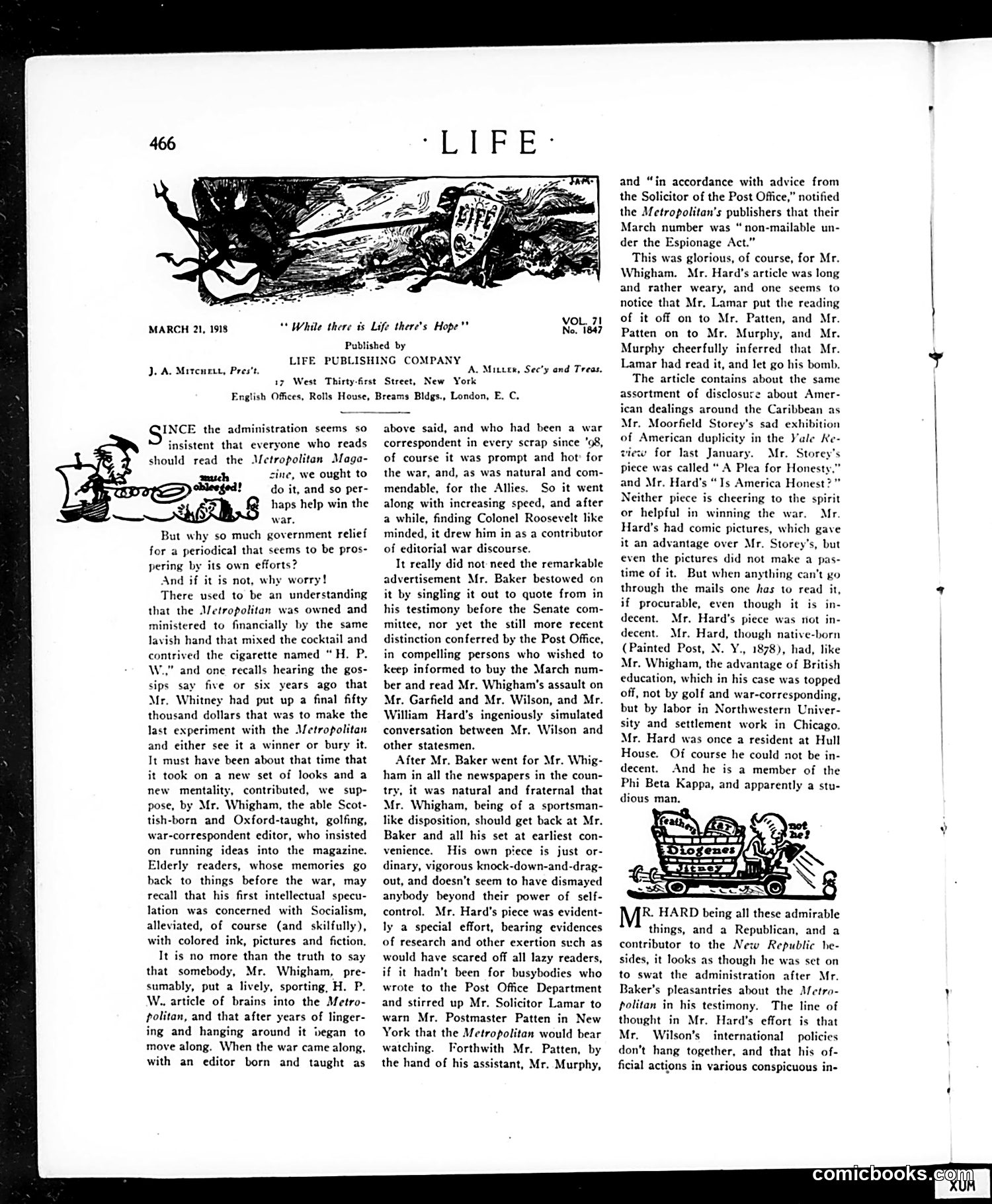
This page satirizes government censorship of *The Metropolitan* magazine during World War I. The article criticizes the Post Office's decision to declare the March 1918 issue "non-mailable" under the Espionage Act. The targets include: **Key figures mentioned:** - Secretary of War Newton D. Baker, who publicly attacked the magazine - Editor H.B. Whigham, a Scottish war correspondent who sided with the Allies - Contributor William Hard, whose article about Wilson apparently triggered officials - Post Office Solicitor Lamar and Postmaster Patten, who issued the ban **The satire's point:** *Life* mocks the government's heavy-handed suppression. The magazine notes the irony that Baker's public criticism drew more attention than the original articles, and that busybodies reporting to the Post Office created the censorship controversy. The author questions why government is "relieving" a struggling magazine—through censorship. The opening cartoon (unclear in detail) appears to support the editorial's anti-censorship stance.
📄 Transcribed text from this page (OCR, searchable)
Machine-transcribed from the original scan — historical spelling and the odd misread are preserved.
MARCH 21, 1918 “+ While there ts Life there's Hope" Meera Published by LIFE PUBLISHING COMPANY J. A. Mitcnrit, Pres’t. A. Minute, Sec’y and Treas. 17 West Thirty-first Street, New York English Offices, Rolls House, Breams Bldgs., London, E. C. INCE the administration seems so insistent that everyone who reads should read the Metropolitan Maga- amuch sine, we ought to obleeged! =o it, and so per- g & haps help win the war. But why so much government relief for a periodical that seems to be pros- pering by its own efforts? And if it is not, why worry! There used to be an understanding that the Metropolitan was owned and ministered to financially by the same lavish hand that mixed the cocktail and contrived the cigarette named “H. P. W.," and one recalls hearing the gos- sips say five or six years ago that Mr. Whitney had put up a final fifty thousand dollars that was to make the last experiment with the Metropolitan and either see it a winner or bury it. It must have been about that time that it took on a new set of looks and a new mentality, contributed, we sup- pose, by Mr. Whigham, the able Scot- tish-born and Oxford-taught, golfing, war-correspondent editor, who insisted on running ideas into the magazine. Elderly readers, whose memories go back to things before the war, may recall that his first intellectual specu- lation was concerned with Socialism, alleviated, of course (and skilfully), with colored ink, pictures and fiction. It is no more than the truth to say that somebody, Mr. Whigham, pre- sumably, put a lively, sporting, H. P. W.. article of brains into the Metro- pfolitan, and that after years of linger- ing and hanging around it began to move along. When the war came along, with an editor born and taught as above said, and who had been a war correspondent in every scrap since ‘08, of course it was prompt and hot’ for the war, and, as was natural and com- mendable, for the Allies. So it went along with increasing speed, and after a while, finding Colonel Roosevelt like minded, it drew him in as a contributor of editorial war discourse. It really did not need the remarkable advertisement Mr. Baker bestowed on it by singling it out to quote from in his testimony before the Senate com- mittee, nor yet the still more recent distinction conferred by the Post Office, in compelling persons who wished to keep informed to buy the March num- ber and read Mr. Whigham’s assault on Mr. Garfield and Mr. Wilson, and Mr. William Hard’s ingeniously simulated conversation between Mr. Wilson and other statesmen. After Mr. Baker went for Mr. Whig- ham in all the newspapers in the coun- try, it was natural and fraternal that Mr. Whigham, being of a sportsman- like disposition, should get back at Mr. Baker and all his set at earliest con- venience. His own piece is just or- dinary, vigorous knock-down-and-drag- out, and doesn’t seem to have dismayed anybody beyond their power of self- control. Mr. Hard’s piece was evident- ly a special effort, bearing evidences of research and other exertion such as would have scared off all lazy readers, if it hadn't been for busybodies who wrote to the Post Office Department and stirred up Mr. Solicitor Lamar to warn Mr. Postmaster Patten in New York that the Metropolitan would bear watching. Forthwith Mr. Patten, by the hand of his assistant, Mr. Murphy, and “in accordance with advice from the Solicitor of the Post Office,” notified the Metropolitan's publishers that their March number was “ non-mailable un- der the Espionage Act.” This was glorious, of course, for Mr. Whigham. Mr. Hard’s article was long and rather weary, and one seems to notice that Mr. Lamar put the reading of it off on to Mr. Patten, and Mr. Patten on to Mr. Murphy, and Mr. Murphy cheerfully inferred that Mr. Lamar had read it, and let go his bomb. The article contains about the same assortment of disclosure about Amer- ican dealings around the Caribbean as Mr. Moorfield Storey’s sad exhibition of American duplicity in the Vale Ke- view for last January. Mr. Storey’s piece was called “ A Plea for Honesty,” and Mr. Hard’s “Is America Honest?” Neither piece is cheering to the spirit or helpful in winning the war. Mr. Hard’s had comic pictures, which gave it an advantage over Mr. Storey’s, but even the pictures did not make a pas- time of it. But when anything can't go through the mails one has to read it, if procurable, even though it is in- decent. Mr. Hard’s piece was not in- decent. Mr. Hard, though native-born (Painted Post, N. Y., 1878), had, like Mr. Whigham, the advantage of British education, which in his case was topped off, not by golf and war-corresponding, but by labor in Northwestern Univer- sity and settlement work in Chicago. Mr. Hard was once a resident at Hull House. Of course he could not be in- decent. And he is a member of the Phi Beta Kappa, and apparently a stu- dious man. Me HARD being all these admirable things, and a Republican, and a contributor to the New Republic he- sides, it looks as though he was set on to swat the administration after Mr. Baker’s pleasantries about the Metro- holitan in his testimony. The line of thought in Mr. Hard’s effort is that Mr. Wilson’s international policies don’t hang together, and that his of- ficial actions in various conspicuous in-