
Life, 1918-03-21 · page 36 of 56
Life — March 21, 1918 — page 36: what you’re looking at
What you’re looking at
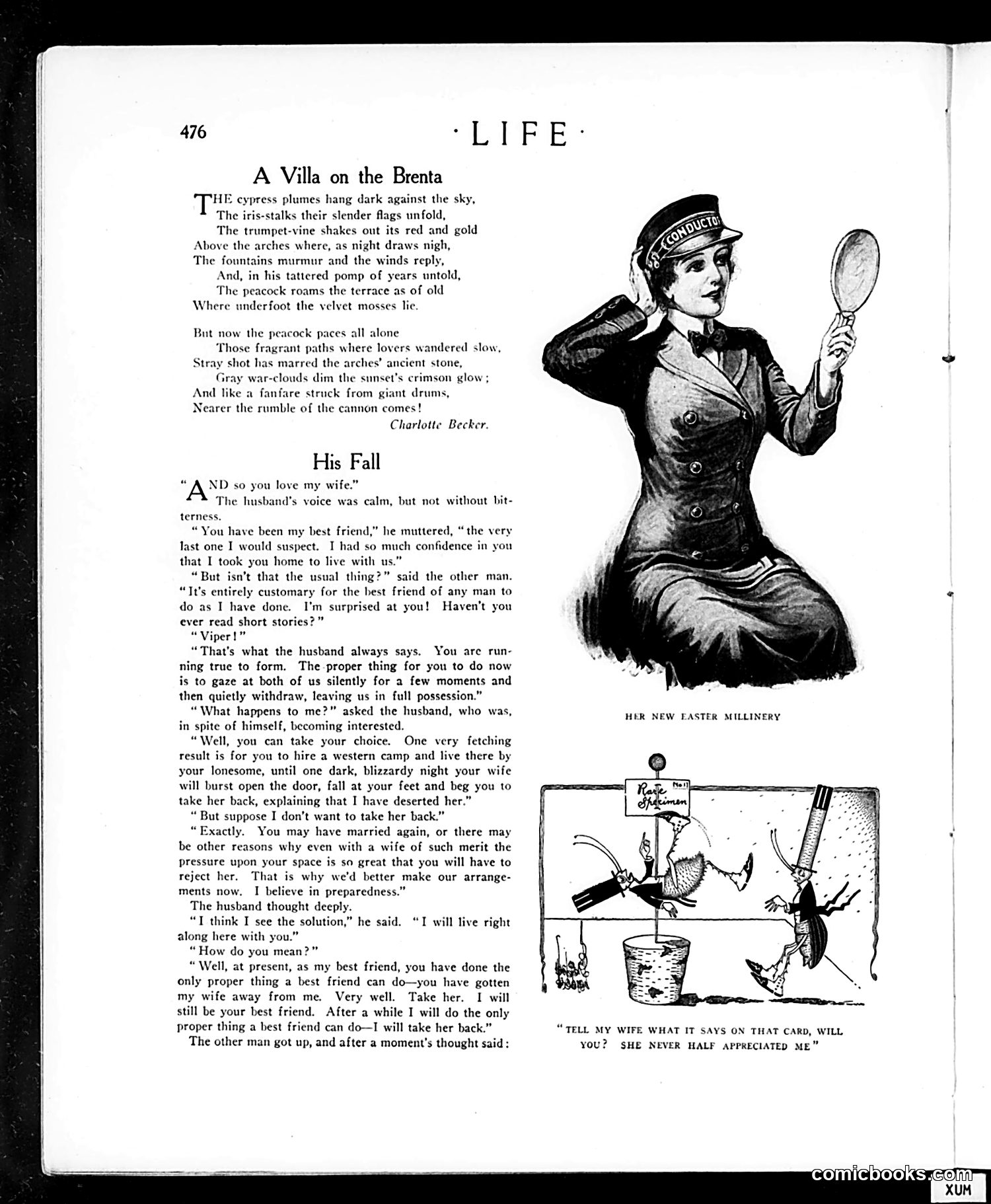
This page contains two distinct pieces of satirical content: **"A Villa on the Brenta"** is a poem by Charlotte Becker describing an Italian villa transformed by war—cypress trees, fountains, and peacocks now disrupted by cannon fire and "stray shot." It reflects WWI's impact on European culture and beauty. **"His Fall"** is a comedic short story mocking the conventions of popular fiction. Two men engage in absurdist dialogue about seducing the husband's wife. The "other man" sarcastically notes that betraying one's best friend is "customary" and references predictable literary tropes (the abandoned husband, the dramatic return). The punchline subverts expectations: the husband proposes they simply exchange the wife repeatedly, making infidelity a practical arrangement rather than dramatic tragedy. **The cartoon** shows a woman admiring her Easter hat while a man holds a card—presumably a compliment she dismisses. It illustrates how women's vanity overshadows their appreciation for men's efforts or sentiment. The page satirizes both war's destruction of civilization and the hollow conventions of popular romance narratives.
📄 Transcribed text from this page (OCR, searchable)
Machine-transcribed from the original scan — historical spelling and the odd misread are preserved.
A Villa on the Brenta HE cypress plumes hang dark against the s The iris-stalks their slender flags unfold, The trumpet-vine shakes out its red and gold Above the arches where, as night draws nigh, The fountains murmur and the winds reply, And, in his tattered pomp of years untold, The peacock roams the terrace as of old Where underfoot the velvet mosses lic. But now the peacock paces all alone Those fragrant paths where lovers wandered slow, ‘ay shot has marred the arches’ ancient stone, i Jouds dim the sunset’s crimson glow ; fanfare struck from giant drums, Nearer the rumble of the cannon comes! Charlotte Becker. His Fall ND so you love my wife The husband's voice was calm, but not without bit- terness. “You have been my best friend,” he muttered, “the very last one I would suspect. I had so much confidence in you that I took you home to live with us.” “But isn’t that the usual thing?” said the other man. “Tr's entirely customary for the best friend of any man to do as I have done. I'm surprised at you! Haven't you ever read short stories?” “Viper!” “That's what the husband always says. You are run- ning true to form. The proper thing for you to do now is to gaze at both of us silently for a few moments and then quietly withdraw, leaving us in full possession.” “What happens to me?” asked the husband, who was, in spite of himself, becoming interested. “Well, you can take your choice. One very fetching result is for you to hire a western camp and live there by your lonesome, until one dark, blizzardy night your wife will burst open the door, fall at your feet and beg you to take her back, explaining that I have deserted her.” “ But suppose I don’t want to take her back.” “Exactly. You may have married again, or there may be other reasons why even with a wife of such merit the pressure upon your space is so great that you will have to reject her. That is why we'd better make our arrange- ments now. I believe in preparedness.” The husband thought deeply. “T think I see the solution,” he said. “I will live right along here with you.” “How do you mean?” “Well, at present, as my best friend, you have done the only proper thing a best friend can do—you have gotten my wife away from me, Very well. Take her. I will still be your best friend. After a while I will do the only proper thing a best friend can do—I will take her back.” The other man got up, and after a moment's thought said: HER NEW EASTER MILLINERY “TELL MY WIFE WHAT IT SAYS ON THAT CARD, WILL You? SHE NEVER HALF APPRECIATED ME”