
Life, 1918-03-21 · page 35 of 56
Life — March 21, 1918 — page 35: what you’re looking at
What you’re looking at
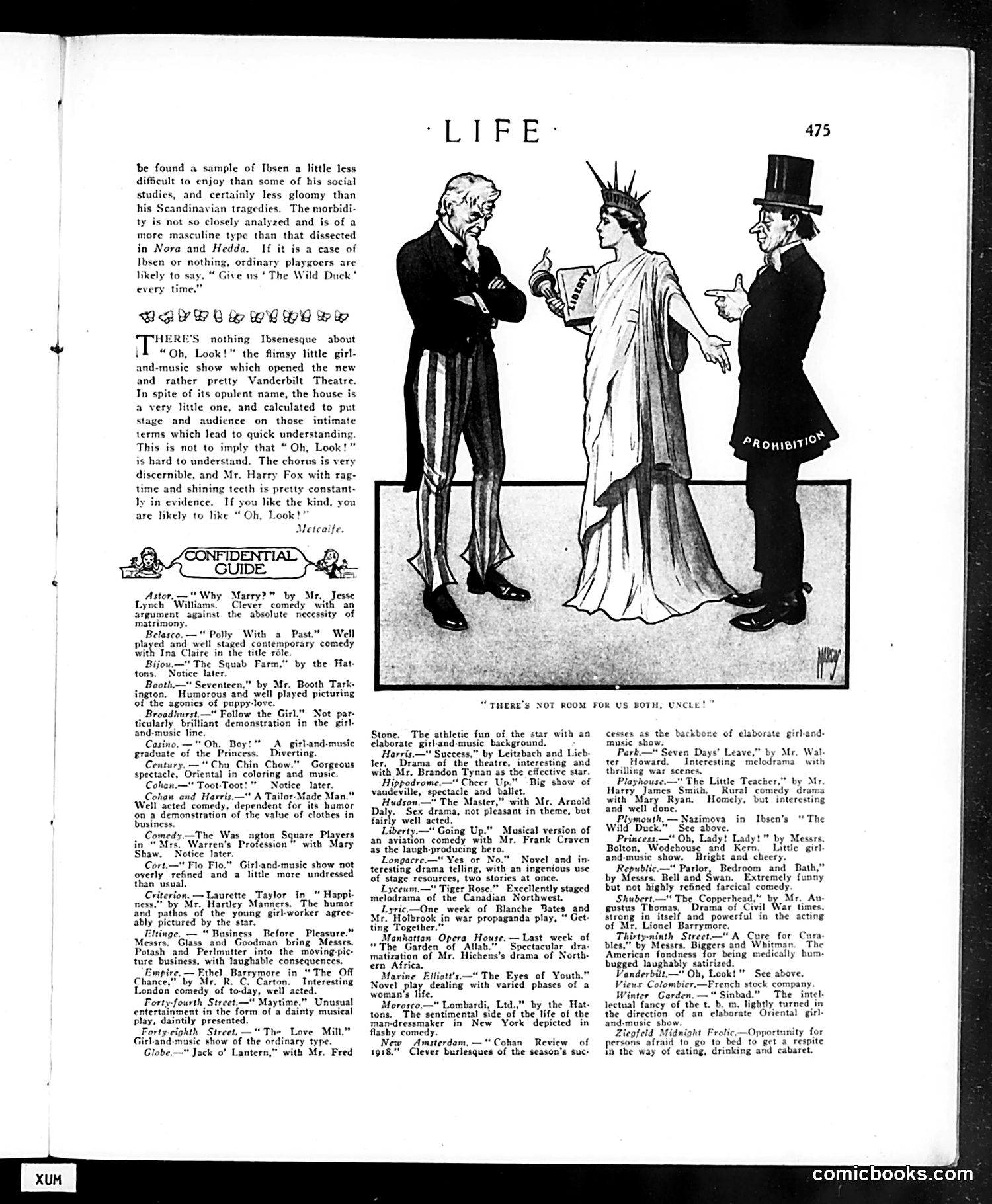
The main cartoon depicts three figures: on the left, an elderly man in worn clothing (likely representing an "Uncle" figure, possibly Uncle Sam or a similar patriarch); in the center, a woman in an elegant dress labeled "Prohibition"; and on the right, a gentleman in a top hat. The woman gestures between them with the caption "There's not room for us both, uncle!" **What it means:** This is satirical commentary on Prohibition's arrival in America. The cartoon suggests that Prohibition (personified as a fashionable woman) cannot coexist with traditional American masculine culture represented by the older man. The joke critiques Prohibition as an unwelcome intrusion that will displace established social customs—specifically, drinking culture and male social spaces. The satire mocks Prohibition's sweeping changes to American life, suggesting it's fundamentally incompatible with existing traditions and will force one to go.
📄 Transcribed text from this page (OCR, searchable)
Machine-transcribed from the original scan — historical spelling and the odd misread are preserved.
be found a sample of Ibsen a little less difficult to enjoy than some of his social studies, and certainly less gloomy than his Scandinavian tragedies. The morbidi- ty is not so closely analyzed and is of a more masculine type than that dissected in Nora and Hedda. If it is a case of Ibsen or nothing, ordinary playgoers are likely to say, “ Give us ‘The Wild Duck’ every time, WAYS ie OY HE we HERE'S nothing Ibsenesque about 4 “Oh, Look!” the flimsy little girl- and-music show which opened the new and rather pretty Vanderbilt Theatre. In spite of its opulent name, the house is a very little one, and calculated to put stage and audience on those intimate terms which lead to quick understanding. This is not to imply that “Oh, Look!” is hard to understand. The chorus is very discernible, and Mr. Harry Fox with rag- time and shining teeth is pretty constant- ly in evidence. If you like the kind, you are likely to like “Oh, Look!” Metceif @, /CONFIDENTIAL\, £9 ee GUIDE Spe Astor, — Why Marry?" by Mr. Jesse Lynch Williams. Clever comedy with an argument against the absolute necessity of matrimony. Belasco. —“ Polly With a Past.” Well played and, well staged contemporary comedy with Ina Claire in the title réle. Bijou.—" The Squab Farm,” by the Hat- tons. Notice later. Booth.—" Seventeen,” by Mr. Booth Tark- ington, Humorous and well played picturing of the agonies of puppy-love. Broadhurst —" Follow the Girl.” Not par- ticularly. brilliant demonstration in the girl and-music line. Casino. —“ Oh, Boy!" A girland-muste graduate of the Princess. Diverting. Century, —""Chu Chin Chow." Gorgeous spectacle, Oriental in coloring and music. Cohan.—" Toot-Toot!” Notice later. Cohan and Harris,—"' A Tailor-Made Man.” Well acted comedy, dependent for its humor on a demonstration of the value of clothes in business. medy.—The Was agton Square Players Warren's Profession” with Mary in“ Mrs. Shaw. Notice later. Cor Flo Flo.” Girl-and-music show not overly refined and a little more undressed than usual. Criterion, — Laurette Taylor in, “ Happi- ness,” by Mr. Hartley Manners. The humor and pathos of the young girlworker agree- ably pictured by the star. Eltinge, — “Business Before Pleasure. Messrs. Glass and Goodman bring Messi Potash and Perlmutter into the moving-pi ture business, with laughable consequences. Empire. — Ethel Barrymore in “The Of Chance," ‘by Mr. R. C. Carton. Interesting London comedy of today, well acted. Forty-fourth Street— Maytime.” Unusual entertainment in the form of a dainty musical play, daintily presented. Forty-cighth Street. —“The Love Mill.” Girland-music show of the ordinary type. tobe.—"" Jack o° Lantern,” with Mr. Fred 475 PRomei!™ “THERE'S NOT ROOM FOR US BOTH, UNCLE!” Stone. The athletic fun of the star with an elaborate girl-and-music background. Herris.—" Success,” by Leitzbach and Lieb- ler. Drama of the’ theatre, interesting and with Mr. Brandon Tynan as the effective star. Hippodrome.—" Cheer Up.” Big show of vaudeville, spectacle and ballet. Hudson. —" The Master,” with Mr. Arnold Daly.” Sex drama, not pleasant in theme, but fairly well acted. Liberty.—" Going Up.” Musical version of an aviation comedy with Mr. Frank Craven as the laugh-producing hero. Longacre.—" Yes or No.” Novel and in- teresting drama telling, with an ingenious use of stage resources, two stories at once. Lyceum.—" Tiger Rose.” Excellently staged melodrama of the Canadian Northwest. Lyric—One week of Blanche Bates, and Mr. Holbrook in war propaganda play, “ Get- ting Together. Manhatten Opera House. —Last week of “The Garden of Allah.” Spectacular, dra- matization of Mr. Hichens’s drama of North- ern Africa. Marine Eltiott's—" The Eyes of Youth.” Novel play dealing with varied phases of a woman's life. Morosco.—" Lombardi, Ltd.,” by the Hat- tons. The sentimental side of the life of the man-dressmaker in New York depicted in flashy comedy. New Amsterdam, —“Cohan Review of Clever burlesques of the season's suc: cesses as the backbone of elabor music show. Park.—"* Seven Days’ Leave,” by Mr. ter Howard. Interesting melodrama thrilling war scenes. Playhouse.—" The Little Teacher,” by Mr. Harry. Jai Smith. Rural comedy drama with Mary Ryan, Homely, but interesting and well done. Plymouth, — Nazimova in “The Wild Duck.” See above. Princess.—" Ob, Lady! Lady! by Messrs. Bolton, Wodehouse and Kern, Little girl and-music show. Bright and cheery. epublic.—" Parlor, Bedroom and Bath,” by Messrs. Bell and Swan. Extremely funny but not highly refined farcical comedy. Shubert.—" The Copperhead.” by Mr. Au- gustus Thomas, Drama of Civil War times, Strong in itself and powerful in the acting of Mr, Lionel Barrymore. Thirty-ninth Street—" A Cure for Cura bes," by Messrs. Biggers and Whitman. | The American fondness for being medically hum- bugged laughably satirized. Vanderbilt.—" Oh, Look!" See above. Vieux Colombier.—French stock company Winter Garden. —“ Sinbad.” The intel- lectual fancy of the t. b. m, lightly turned in the direction of an elaborate Oriental girl and-music show. Ziegfeld. Midnight Frotic—Opportunity for persons afraid to go to bed to get a respite in the way of eating, drinking and cabaret. girland- Wal: with Ibsen's comicbooks.com