
Life, 1918-03-21 · page 27 of 56
Life — March 21, 1918 — page 27: what you’re looking at
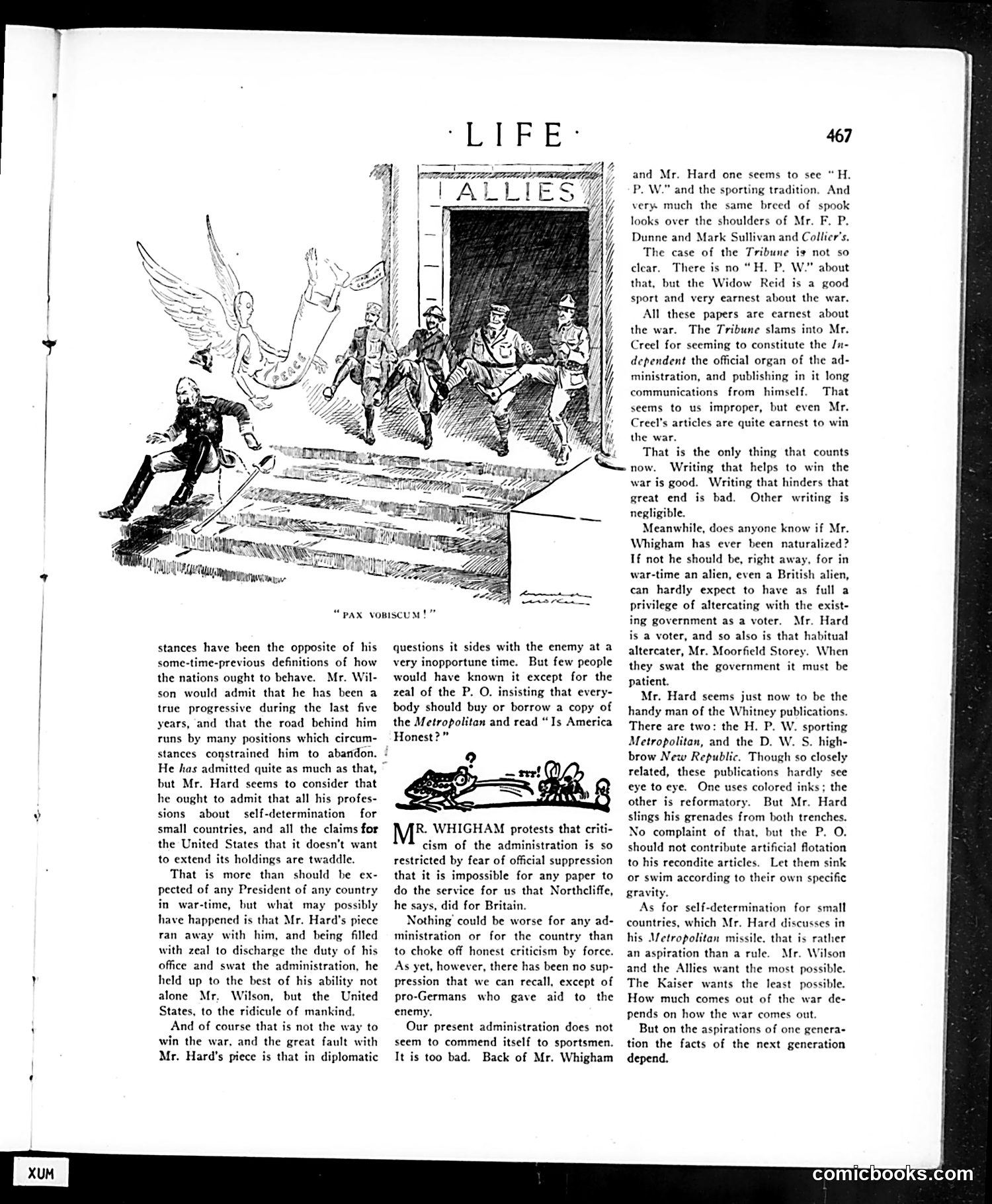
What you’re looking at
This page critiques various journalists and publications criticizing the Wilson administration during World War I. The cartoon "Pax Vobiscum!" (Latin for "Peace be with you") depicts Allied figures entering through a doorway labeled "Allies," apparently satirizing the entry of new allies or diplomatic negotiations. The text discusses Mr. Hard's article "Is America Honest?" in the *Metropolitan* magazine, which the Post Office apparently promoted by requiring copies be purchased—a decision Life ridicules. The article allegedly sided with enemies on diplomatic matters during wartime. The piece also references Mr. Whigham's complaints about suppressed criticism, noting that while censorship concerns exist, the administration hasn't actually suppressed non-enemy publications. Life's overarching point: during wartime, writing must serve victory; criticism is acceptable only from citizens/voters, questioning whether British alien Whigham deserves equal voice. The tone is patriotic and dismissive of what Life considers self-indulgent, counterproductive criticism during active conflict.
📄 Transcribed text from this page (OCR, searchable)
Machine-transcribed from the original scan — historical spelling and the odd misread are preserved.
stances have been the opposite of his some-time-previous definitions of how the nations ought to behave. Mr. Wil- son would admit that he has been a true progressive during the last five years, and that the road behind him runs by many positions which circum- stances constrained him to abandon. ‘ He has admitted quite as much as that, but Mr. Hard seems to consider that he ought to admit that all his profes- sions about self-determination for small countries, and all the claims for the United States that it doesn’t want to extend its holdings are twaddle. That is more than should be ex- pected of any President of any country in war-time, but what may possibly have happened is that Mr. Hard’s piece ran away with him, and being filled with zeal to discharge the duty of his office and swat the administration, he held up to the best of his ability not alone Mr. Wilson, but the United States, to the ridicule of mankind. And of course that is not the way to win the war, and the great fault with Mr. Hard’s piece is that in diplomatic “PAX vopiscuM!”” questions it sides with the enemy at a very inopportune time. But few people would have known it except for the zeal of the P. O. insisting that every- body should buy or borrow a copy of the Metropolitan and read “Is America Honest?” R. WHIGHAM protests that criti- cism of the administration is so restricted by fear of official suppression that it is impossible for any paper to do the service for us that Northcliffe, he says, did for Britain. Nothing could be worse for any ad- ministration or for the country than to choke off honest criticism by force. As yet, however, there has been no sup- pression that we can recall, except of pro-Germans who gave aid to the enemy. Our present administration does not seem to commend itself to sportsmen. It is too bad. Back of Mr. Whigham 467 and Mr. Hard one seems to see “H. P. W." and the sporting tradition, And very much the same breed of spook looks over the shoulders of Mr. F. P. Dunne and Mark Sullivan and Collier's, The case of the Tribune is not so clear. There is no “H. P. W." about that, but the Widow Reid is a good sport and very earnest about the war. All these papers are earnest about the war. The Tribune slams into Mr. Creel for seeming to constitute the /n- dependent the official organ of the ad- ministration, and publishing in it long communications from himself. That seems to us improper, but even Mr. Creel's articles are quite earnest to win the war. That is the only thing that counts now. Writing that helps to win the war is good. Writing that hinders that great end is bad. Other writing is negligible. Meanwhile, does anyone know if Mr. Whigham has ever been naturalized? If not he should be, right away, for in war-time an alien, even a British alien, can hardly expect to have as full a privilege of altercating with the exist- ing government as a voter. Mr. Hard is a voter, and so also is that habitual altercater, Mr. Moorfield Storey. When they swat the government it must be patient. Mr. Hard seems just now to be the handy man of the Whitney publications. There are two: the H. P. W. sporting Metropolitan, and the D. W. S. high- brow New Republic. Though so closely related, these publications hardly see eye to eye. One uses colored inks; the other is reformatory. But Mr. Hard slings his grenades from both trenches. No complaint of that, but the P. O. should not contribute artificial flotation to his recondite articles. Let them sink or swim according to their own specific gravity. As for self-determination for small countries, which Mr. Hard discusses in his Metropolitan missile. that is rather an aspiration than a rule. Mr. Wilson and the Allies want the most possible. The Kaiser wants the least possible. How much comes out of the war de- pends on how the war comes out. But on the aspirations of one genera- tion the facts of the next generation depend.