
A complete issue · 40 pages · 1917
Life — December 13, 1917
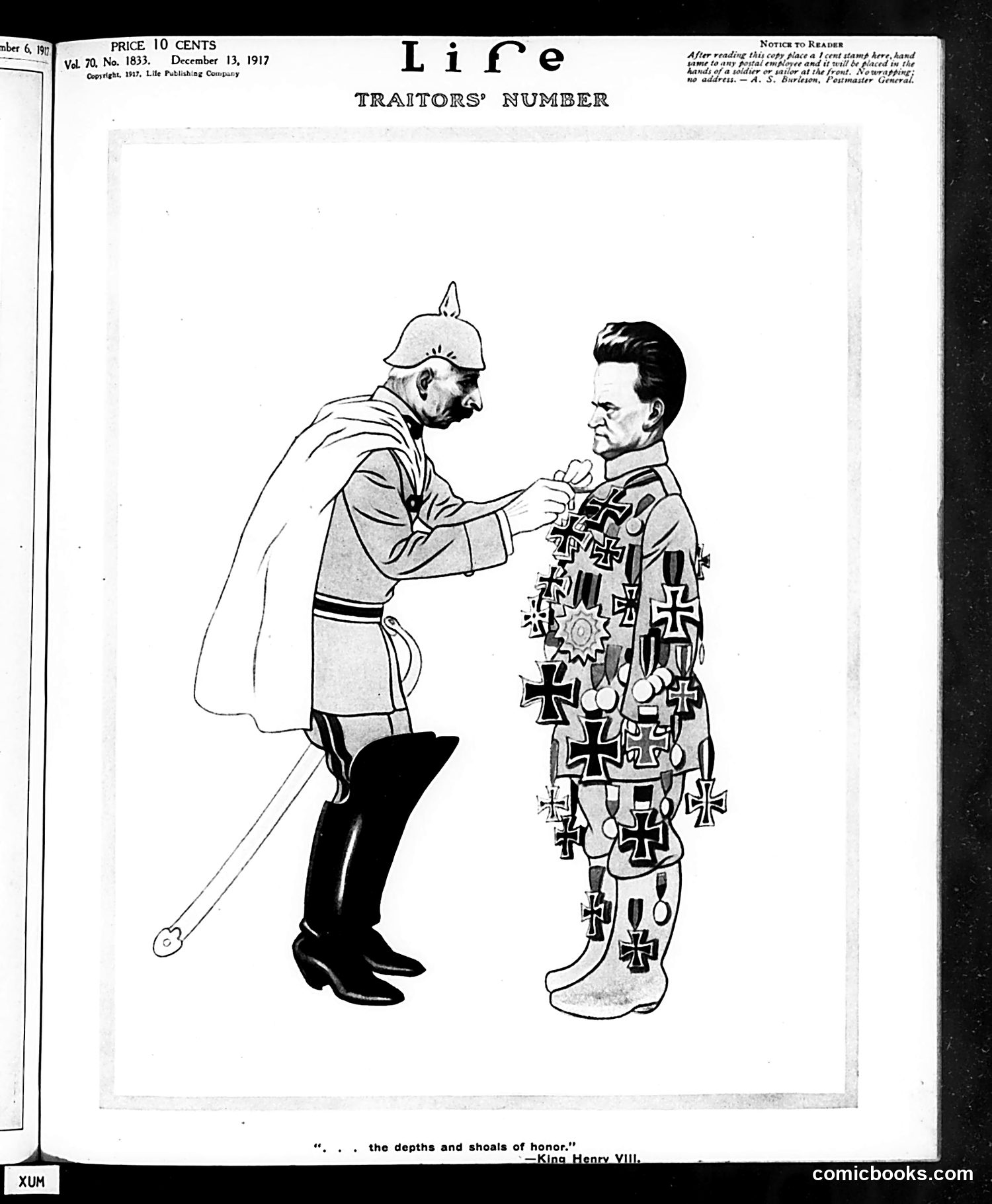
This satirical cartoon depicts a German military officer (left, wearing a Prussian spiked helmet) awarding numerous military decorations to a figure on the right, whose uniform is completely covered in Iron Crosses and other German honors. The cartoon's title "Traitors' Number" and caption—"the depths and shoals of honor"—suggest this mocks someone the magazine considered a traitor to America or the Allied cause during World War I. The ironic point: excessive German military honors indicate collaboration or sympathy with Germany rather than genuine honor. The visual joke emphasizes absurdity through the sheer quantity of decorations, suggesting hollow or illegitimate recognition. Without identifying the specific figure, the cartoon clearly criticizes wartime disloyalty.
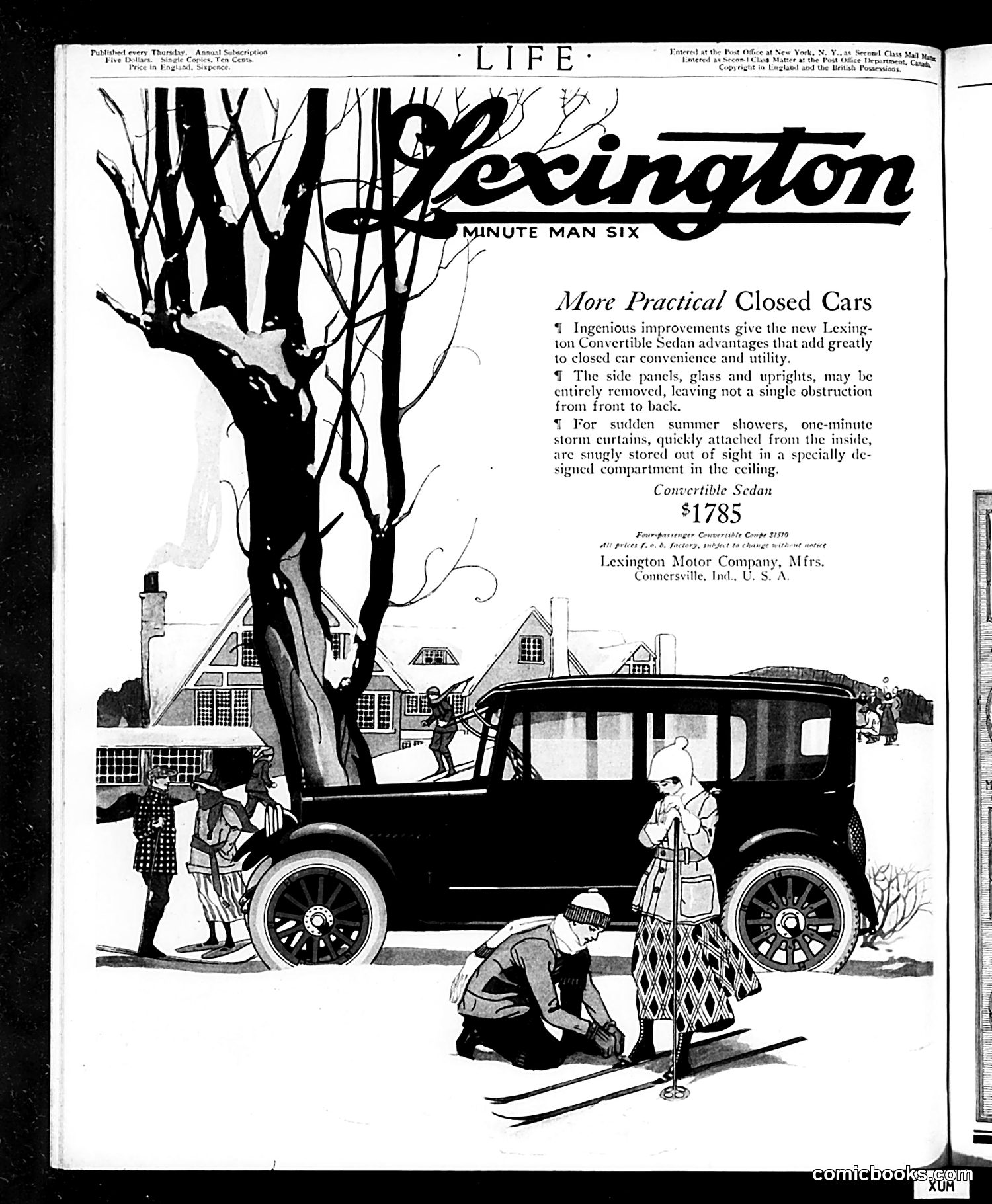
This is primarily a **car advertisement**, not political satire. The Lexington Motor Company promotes their Convertible Sedan model ($1785), emphasizing practical features for 1920s consumers: removable side panels and glass for open-air driving, and storm curtains for sudden weather. The illustration shows a family enjoying outdoor activities near their vehicle—people skiing and playing beneath a bare tree, with a house visible in the background. The "Minute Man Six" branding references the American Revolutionary War minutemen (local militia ready on short notice), suggesting the car's reliability and quick availability. This represents typical 1920s automotive marketing, appealing to middle-class aspirations for leisure and mobility rather than containing political commentary.
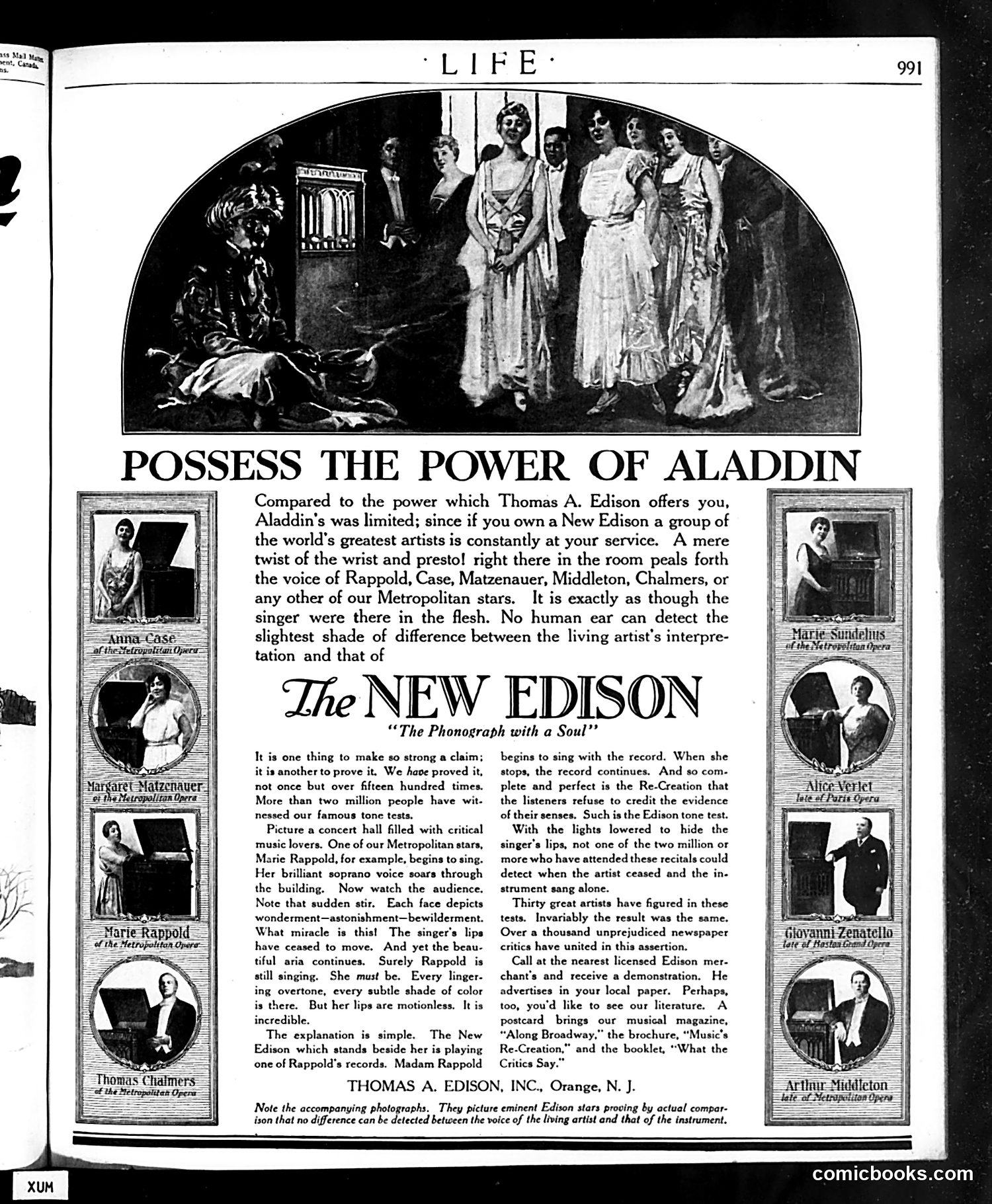
This is primarily a **Thomas Edison phonograph advertisement**, not political satire. It appears from Life magazine (page 991) and promotes Edison's latest "New Edison" phonograph model. The ad claims the device reproduces opera singers' voices so perfectly that listeners cannot distinguish the recorded performance from a live artist. It references famous Metropolitan Opera performers including Anna Case, Marie Rappold, and others shown in circular portraits on the left side. The satirical angle is subtle: the advertisement's hyperbolic claim—that the machine's reproduction is indistinguishable from reality—is presented as established fact through purported "tone tests" with newspaper critics. The ad implies Edison technology rivals actual human artistry, which is both the product's selling point and the basis for any satire about technology replacing live performance.
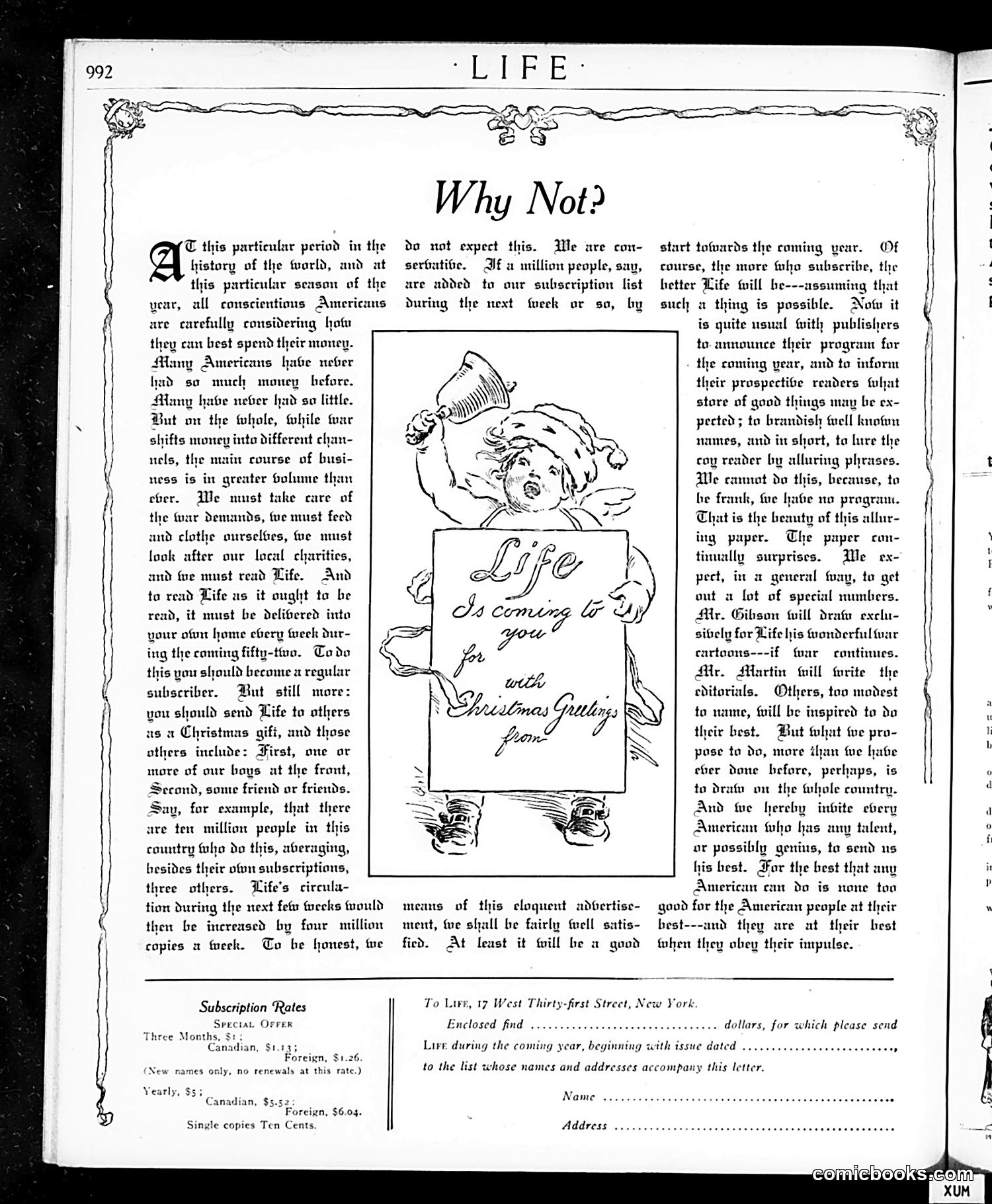
This page is primarily a **subscription solicitation for Life magazine**, not a political cartoon. The central image shows a cherub or baby figure holding a sign reading "Life is coming to you for with Christmas Greetings from," functioning as a Christmas-themed advertisement encouraging readers to subscribe. The accompanying text ("Why Not?") argues that during wartime (context suggests WWI era), Americans should subscribe to Life as a gift or for themselves. The pitch emphasizes Life's value as essential reading during consequential national events, and appeals to patriotism—suggesting that supporting the magazine means supporting American interests and morale. This is essentially a **Christmas gift-subscription campaign** using sentimental imagery and patriotic rhetoric rather than political satire.
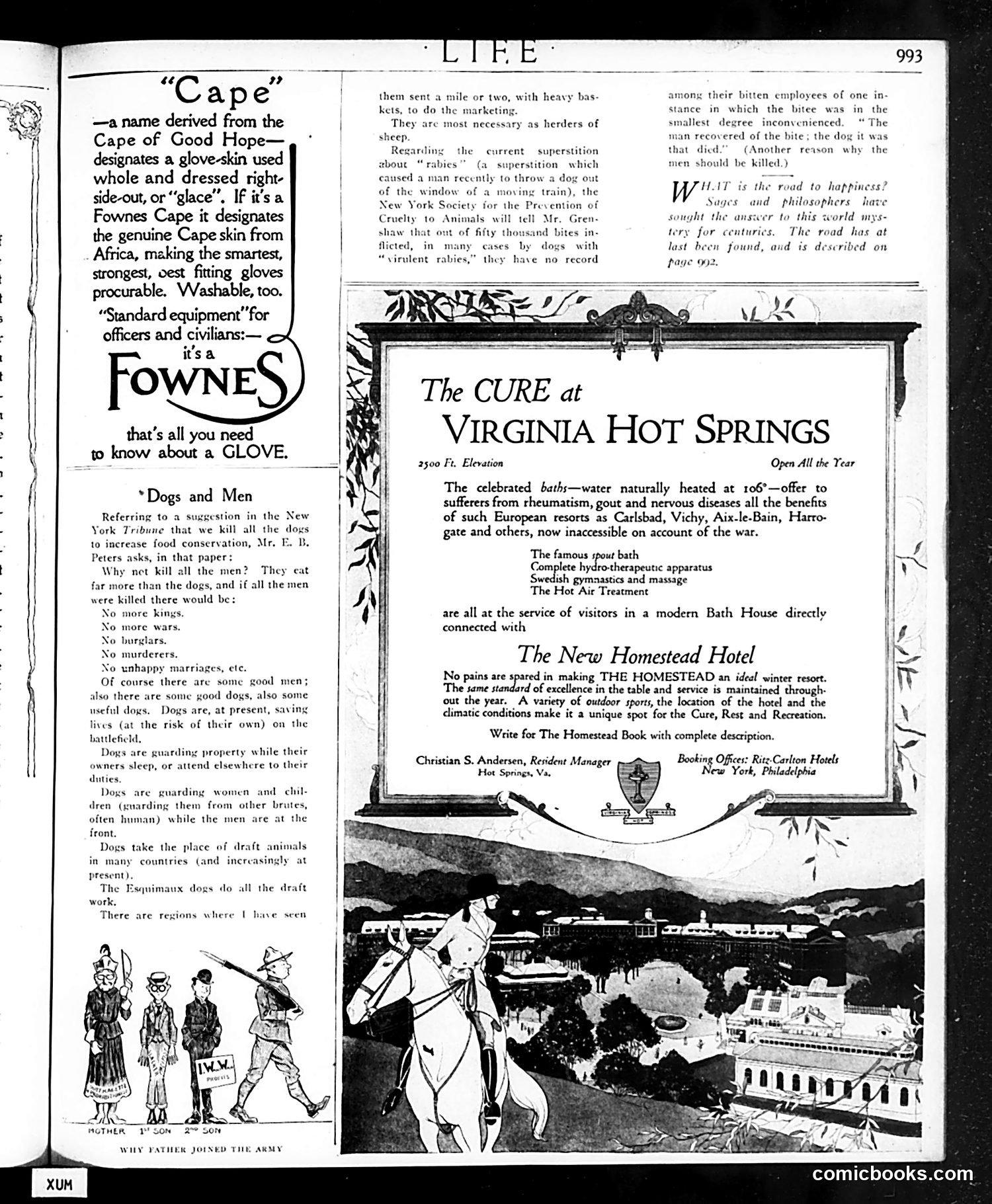
This page is primarily **advertising and editorial content** rather than political satire. The left side features a **Fownes gloves advertisement** playing on notions of colonial masculinity—referencing the "Cape of Good Hope" and marketing to "officers and civilians." Below that is a section titled **"Dogs and Men"** responding to a New York Tribune suggestion about increasing food conservation. The satire here is dark humor: the writer sarcastically lists benefits if all men were killed (no wars, murders, etc.), then undercuts this with practical observations about dogs' actual utility—they guard families, do draft work, and provide companionship while men sleep. The right side advertises **Virginia Hot Springs resort** and the Homestead Hotel as a winter destination. The cartoon at bottom left shows military figures, captioned "Why Father Joined the Army," though its specific meaning is unclear from this excerpt.
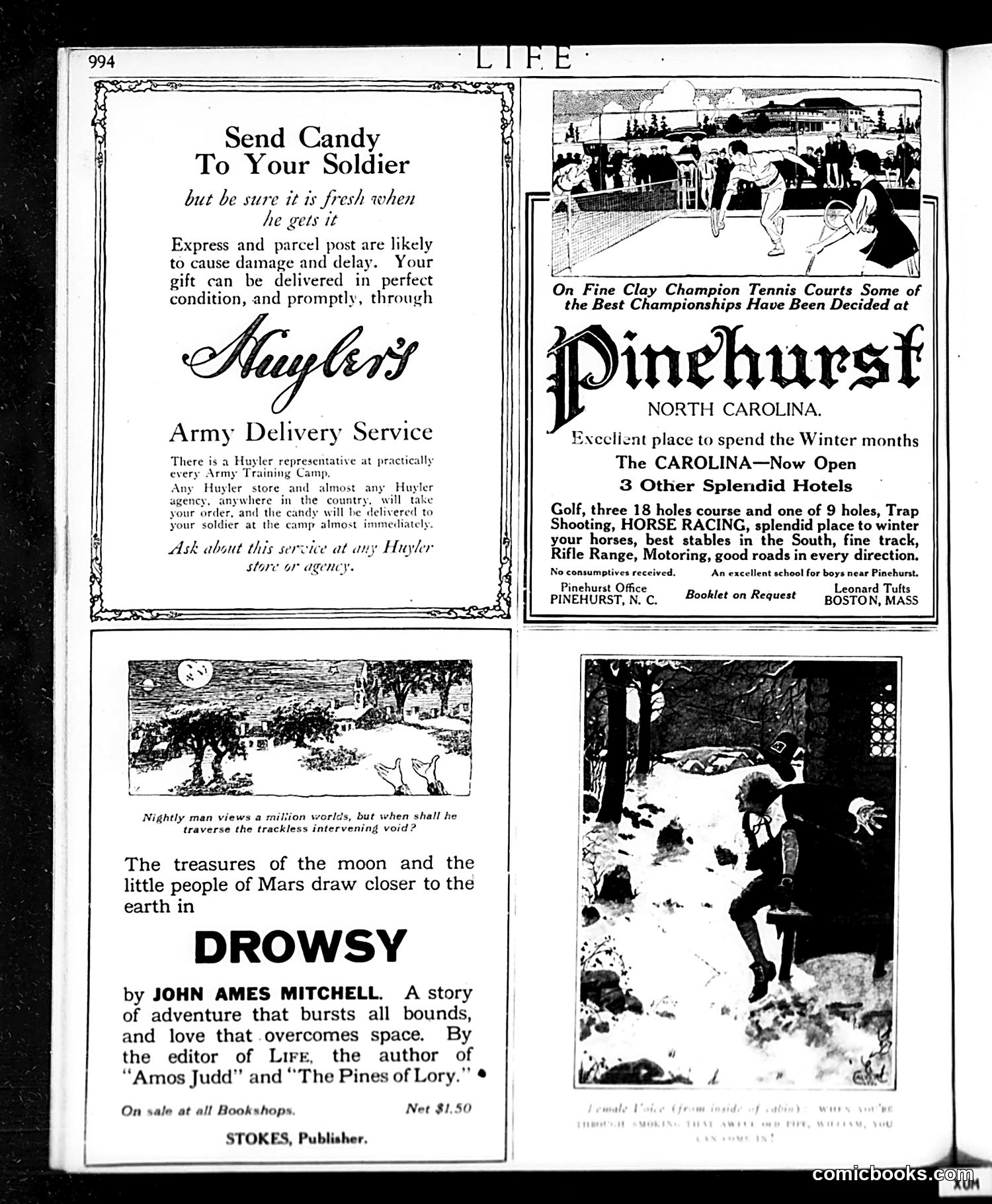
This page is primarily **advertising**, not satire or political commentary. The left side advertises **Huyler's Army Delivery Service** for sending candy to soldiers—likely referring to World War I troops. The pitch emphasizes fresh delivery through their dedicated army delivery network. The right side features a **Pinehurst, North Carolina resort advertisement**, promoting winter recreation including golf, horseback riding, and trap shooting at their hotel. Below is a **book advertisement for "Drowsy" by John Ames Mitchell**, described as an adventure story combining sci-fi elements (moon and Mars) with romance. The page's tennis court illustration appears decorative rather than satirical. Overall, this is a straightforward commercial publication aimed at affluent readers during the WWI era, with no discernible political cartoons or social satire present.
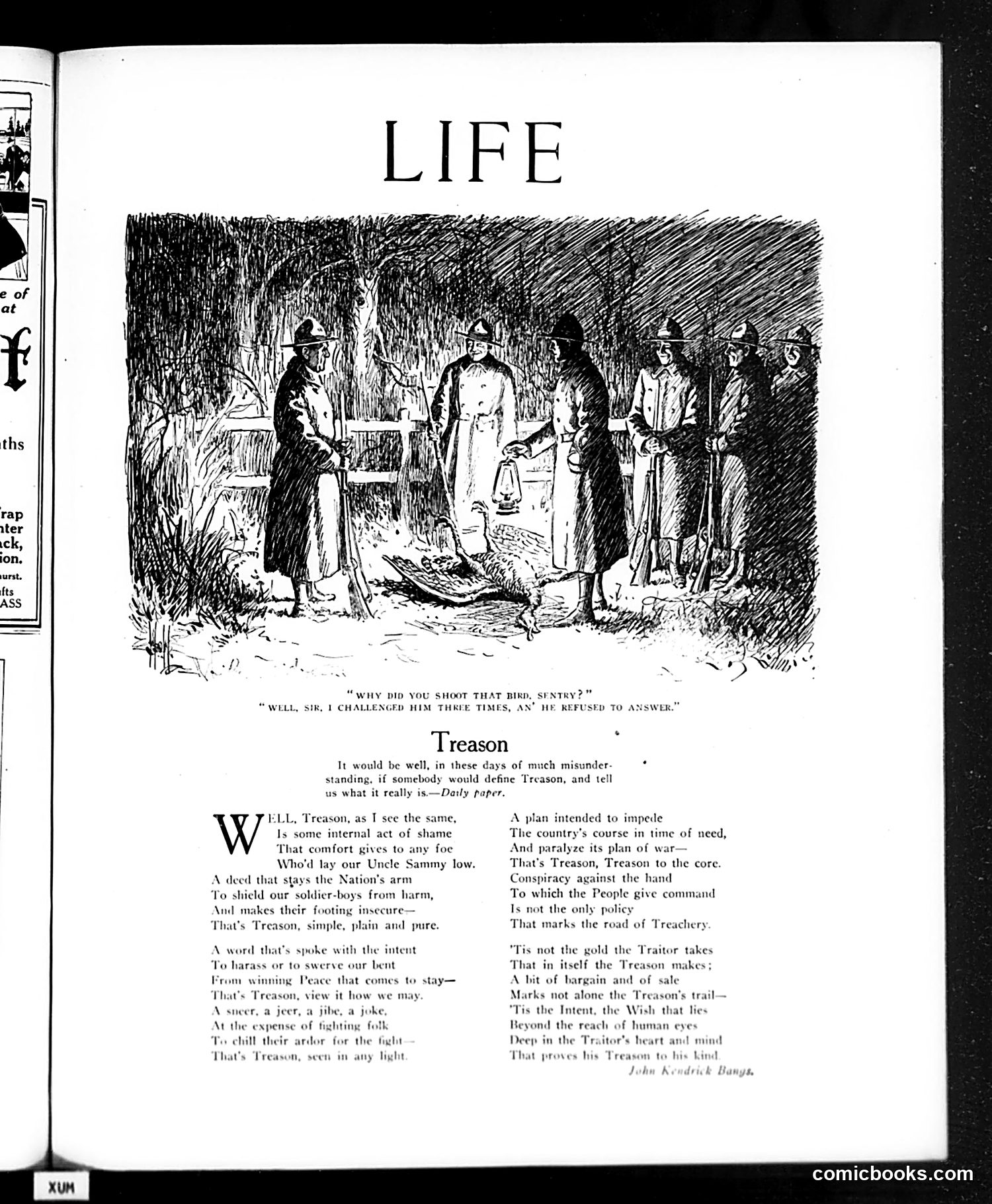
This page contains a satirical poem titled "Treason" by John Kendrick Bangs, illustrated with a sketch showing what appears to be a military or official inquiry scene. The cartoon depicts several uniformed men questioning a single figure about shooting a bird, with the caption: "Why did you shoot that bird, sentry?" "Well, sir, I challenged him three times, an' he refused to answer." The satire appears to critique the definition of treason itself rather than any specific political figure. The poem distinguishes between various forms of betrayal—from conspiracies against the state to personal acts of deception—arguing that true treason involves deliberate intent to harm the nation. The bird-shooting joke seems to illustrate absurd interpretations of duty and challenge, mocking overzealous or rigid interpretations of military protocol. The overall piece questions what constitutes genuine treason versus misunderstanding or incompetence.
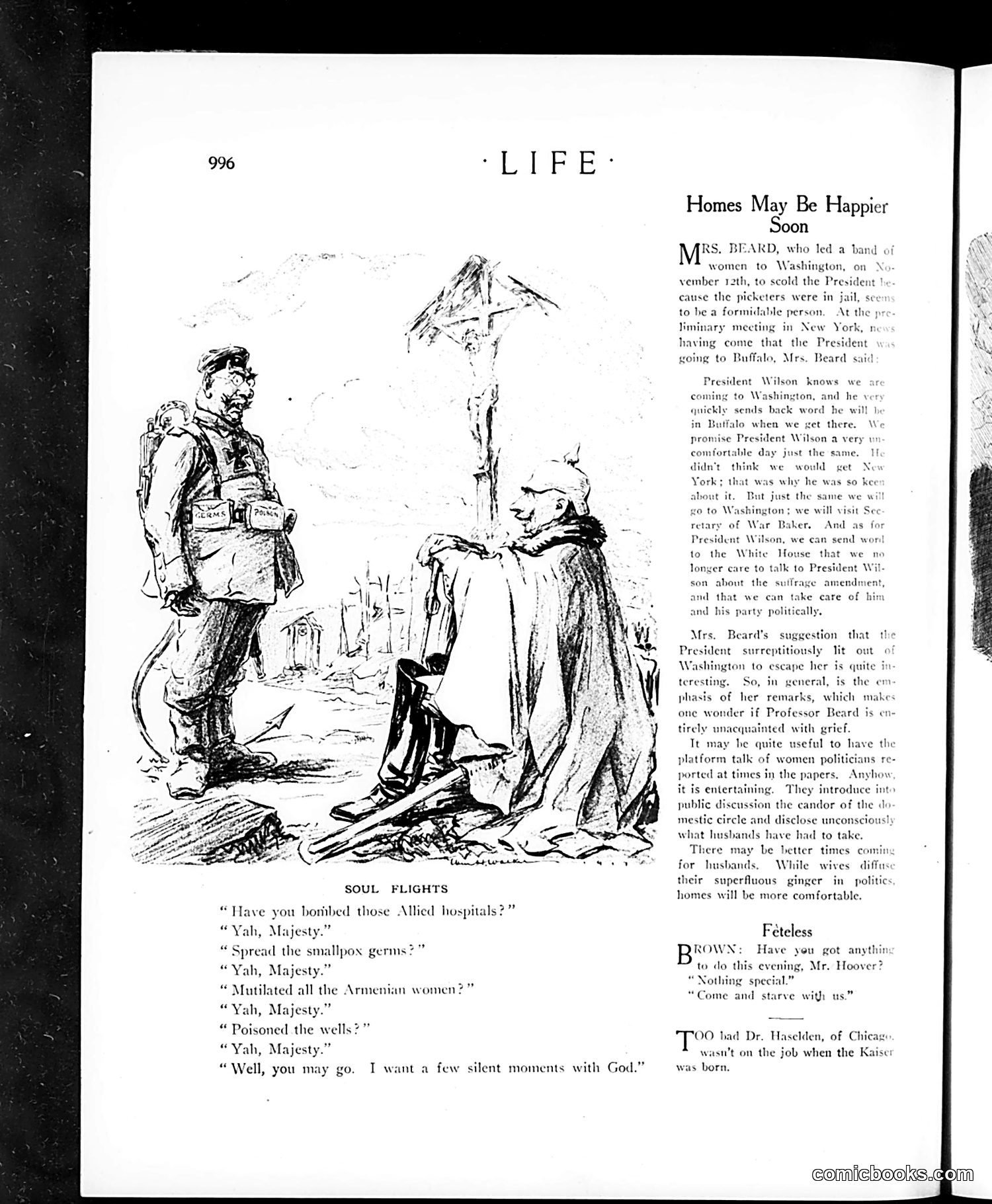
This political cartoon depicts a military figure interrogating what appears to be a German or Central Powers leader (identifiable by the spiked helmet, or "Pickelhaube"). The soldier presents a list of atrocities—bombing hospitals, spreading smallpox, mutilating Armenian women, poisoning wells—to which the figure repeatedly responds "Yah, Majesty." The cartoon satirizes alleged German wartime conduct during World War I. Each accusation references documented or widely-reported incidents blamed on Germany and its allies: hospital bombings, biological warfare rumors, Armenian genocide, and poison gas attacks. The figure's passive acceptance ("Yah, Majesty") mocks the idea that such actions were merely following orders. The caption's final line—"Well, you may go. I want a few silent moments with God"—suggests divine judgment awaits.
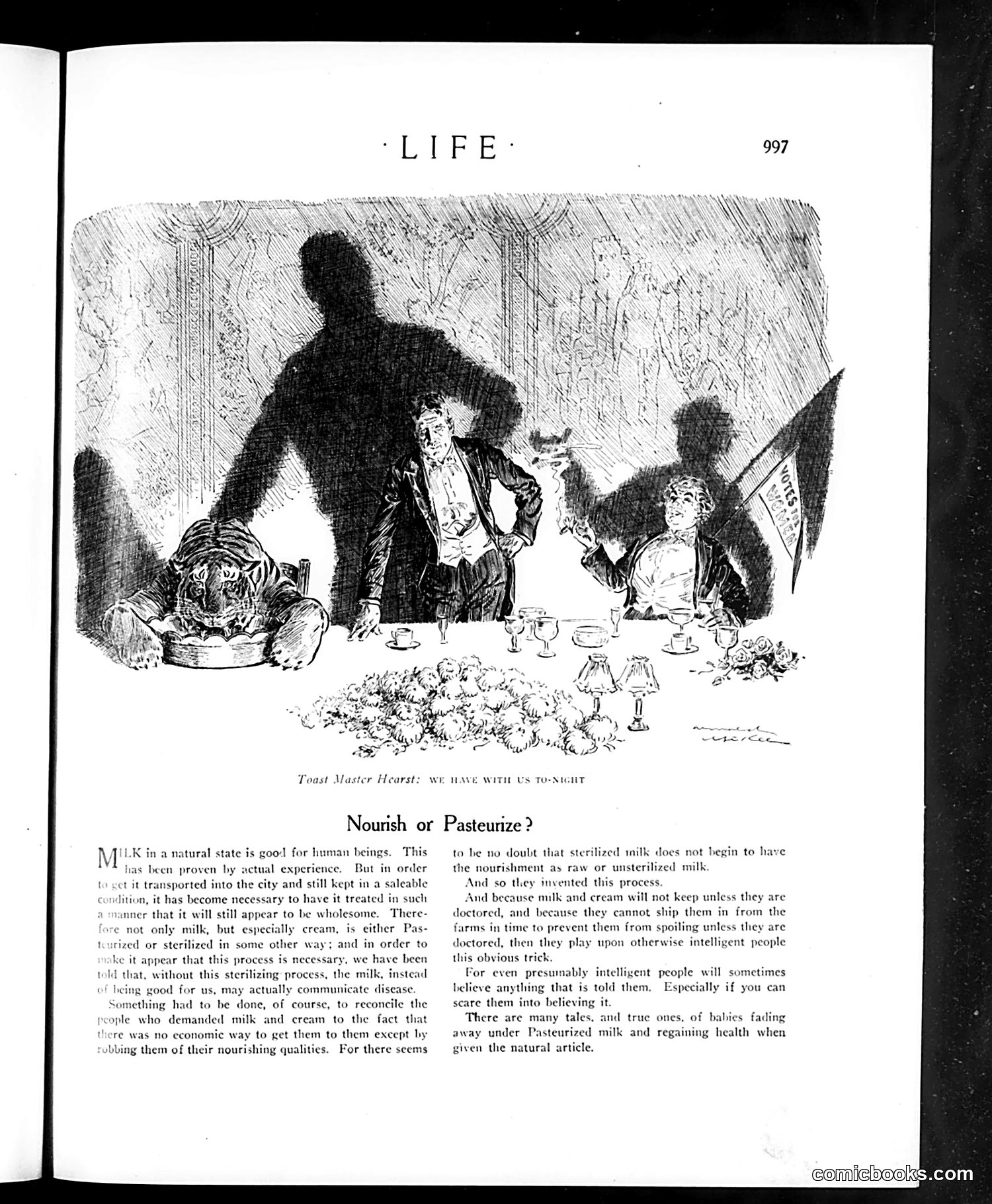
**The Cartoon:** Shows a formal dinner scene where a towering, shadowy figure looms over the diners. The "Toast Master Hearst" announces "WE HAVE WITH US TO-NIGHT," addressing the assembled guests around a table with wine glasses. **The Satire:** This appears to reference William Randolph Hearst, the powerful newspaper magnate. The cartoon satirizes his dominance and control—his massive shadow literally overshadows the dinner guests, suggesting his outsized influence over the proceedings and attendees. **The Article:** "Nourish or Pasteurize?" debates milk safety. It dismisses fears about pasteurization, arguing that raw milk requires sterilization to prevent disease. The text mocks people who accept unsupported claims, particularly regarding milk quality—suggesting some believed raw milk was healthier despite evidence. **Historical Context:** Early 20th-century American debates over food safety and scientific versus "natural" approaches.
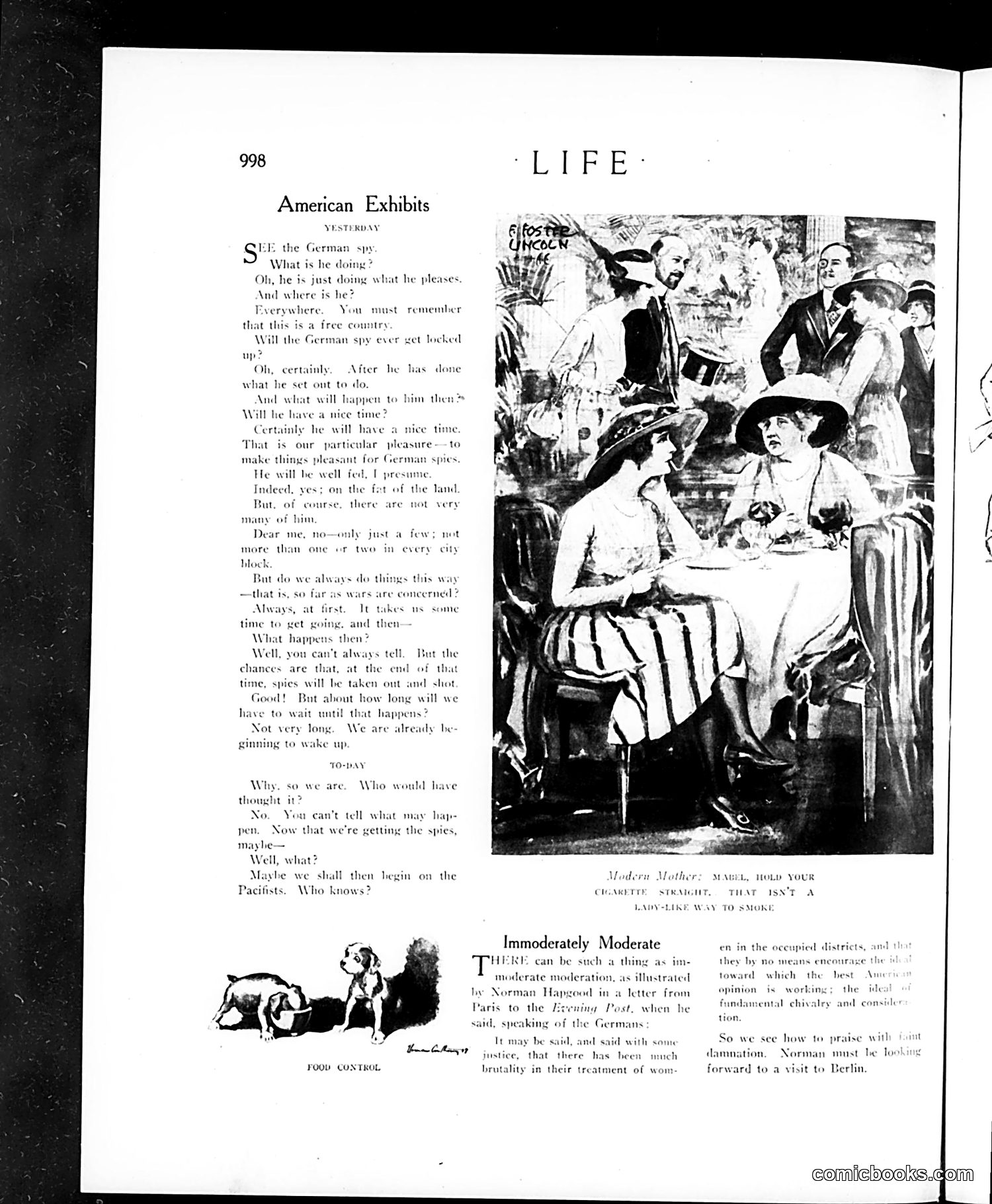
This page presents WWI-era commentary on German espionage and treatment of civilians. The main dialogue piece "American Exhibits—Yesterday" and "Today" satirizes American naiveté about German spies operating freely in the U.S., contrasting optimistic assumptions with harsher wartime realities. The illustration titled "Modern Mother" depicts a woman smoking a cigarette while holding a child, captioned as "MABEL, HOLD YOUR CIGARETTE STRAIGHT. THAT AIN'T A LADY-LIKE WAY TO SMOKE"—satirizing changing social mores and women's smoking habits during this period. The "Immediately Moderate" section references Norman Hapgood's criticism of German brutality toward women, calling for measured but firm condemnation. The small cartoon labeled "Food Control" appears to address rationing concerns. The overall tone reflects wartime anxieties about security and social change.
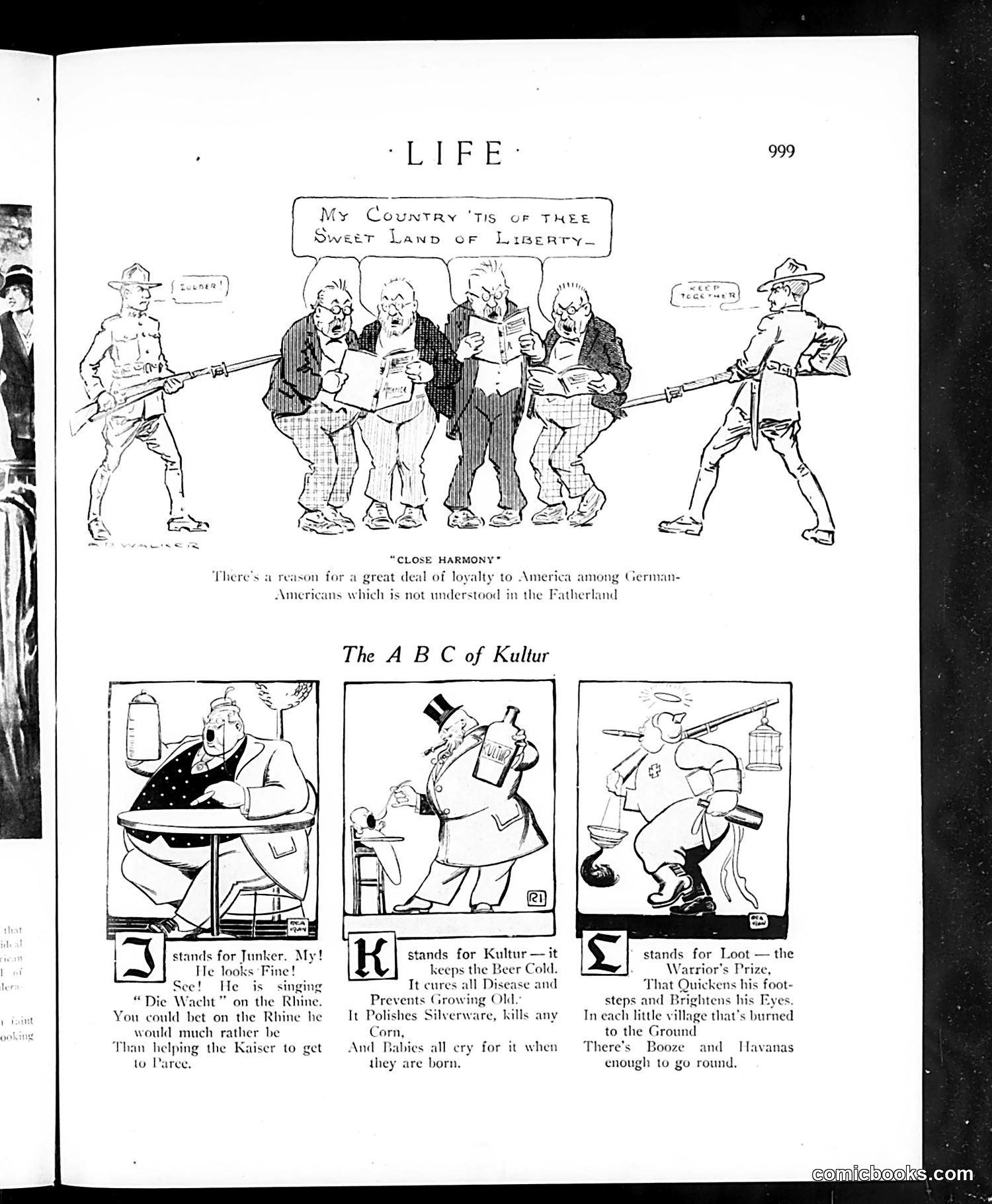
**Top Cartoon - "Close Harmony":** Four German-American men sing patriotic lyrics ("My Country 'Tis of Thee / Sweet Land of Liberty") while flanked by armed American soldiers with bayonets. The caption notes "a great deal of loyalty to America among German-Americans which is not understood in the Fatherland." This satirizes suspicions of German-American loyalty during what appears to be WWI-era tensions, suggesting German-Americans faced scrutiny despite their patriotic declarations. The bayonets framing them visually reinforce this surveillance/coercion. **Bottom Section - "The ABC of Kultur":** Three cartoon panels mock German cultural values (Junker militarism, Kultur as disease prevention, and "Loot" as warrior virtue), presenting them as barbaric. This wartime propaganda ridicules German ideology and justifies American opposition.
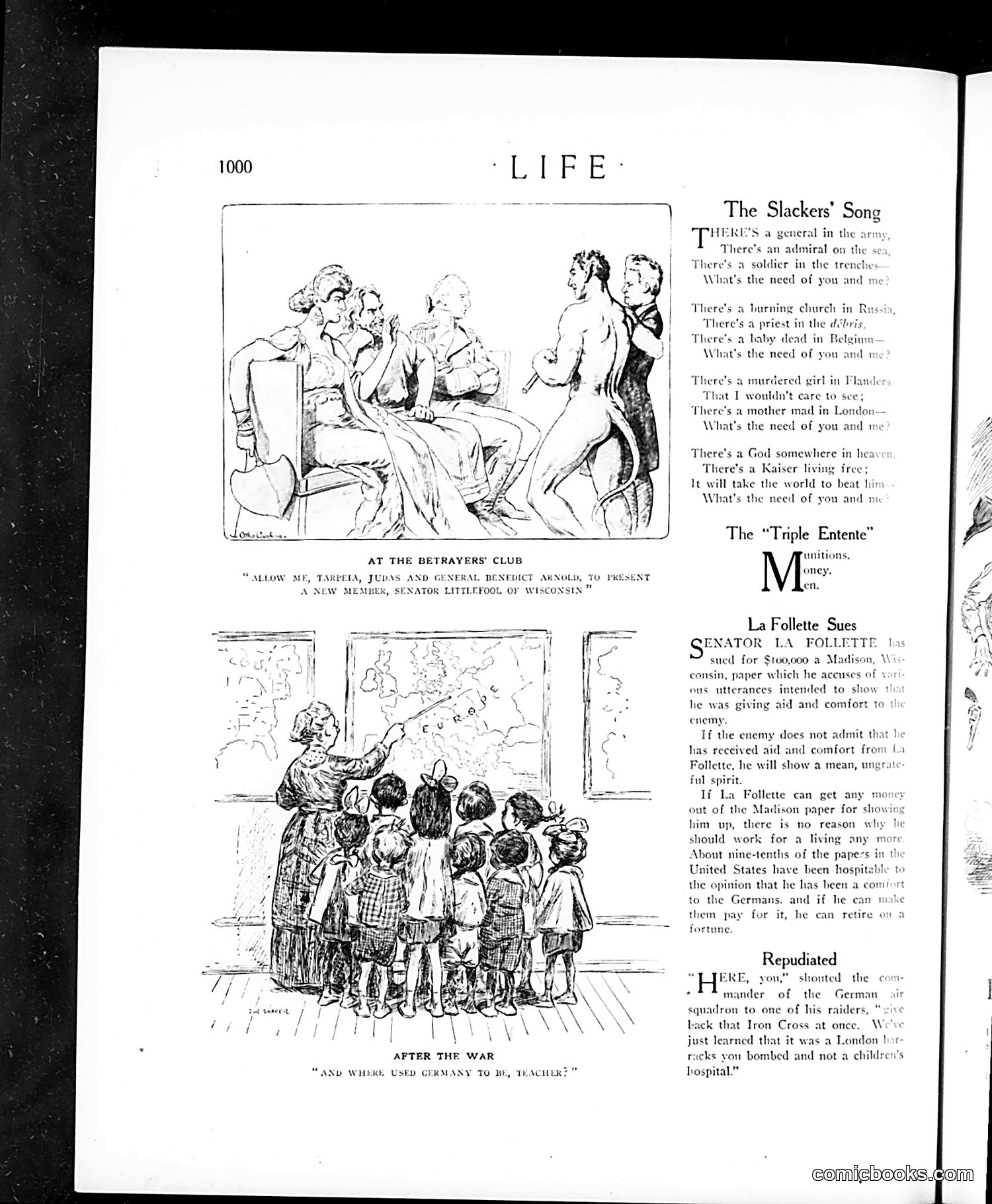
**Top Cartoon: "At the Betrayers Club"** This depicts wealthy or aristocratic figures at an exclusive club, with a caption about allowing "Tarbella, Denis, and General Beneifect Arnold to present a new member, Senator Littlefool of Wisconsin." The satire targets a senator (name likely fictional or obscure) for allegedly betraying principles, comparing him to Benedict Arnold, the Revolutionary War traitor. **Bottom Cartoon: "After the War"** Shows a woman teaching children, captioned "And where used Germany to be, teacher?" This references post-WWI geopolitical shifts, satirizing how thoroughly Germany's territory and status changed—so drastically that geography itself seemed altered for the next generation. Both cartoons employ historical comparison and ironic exaggeration to mock political betrayal and wartime consequences.
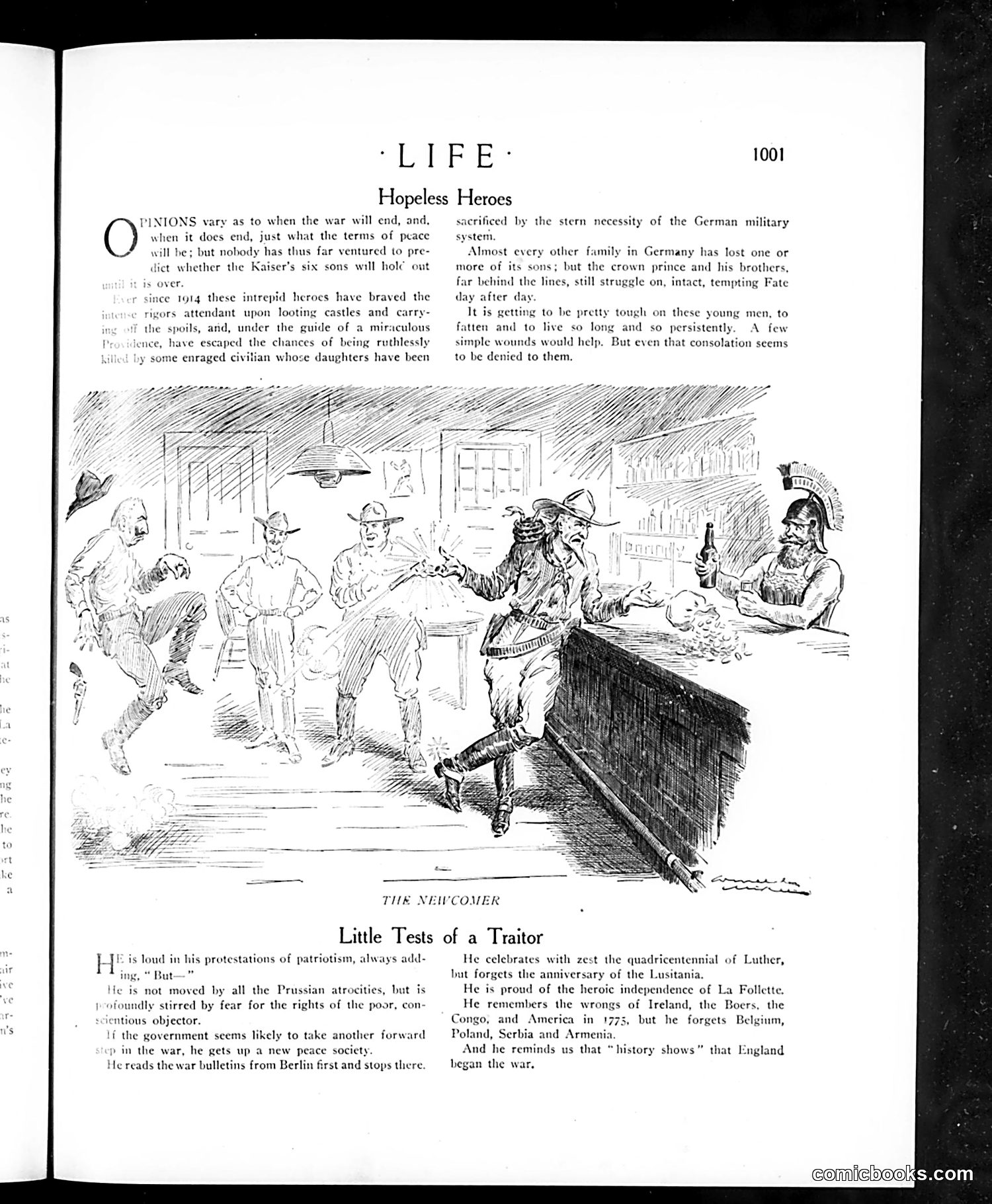
This page contains two separate satirical pieces about World War I. **"Hopeless Heroes"** (top) discusses German soldiers suffering at the front lines, expressing sympathy for young German men dying in the war while acknowledging Germany's military necessities. **"The Newcomer"** (cartoon) depicts a military scene where new German recruits appear to arrive at a barracks or command post. The cartoon likely satirizes the influx of inexperienced soldiers being sent to the front. **"Little Tests of a Traitor"** (bottom) mocks a German politician who claims patriotism but selectively remembers historical events—celebrating certain independence movements (Luther, La Follette) while conveniently forgetting German aggression against Belgium, Serbia, Poland, and Armenia. The satire suggests his patriotic rhetoric is hypocritical, and he blames England for starting the war despite Germany's own actions. The overall theme criticizes German war justifications.
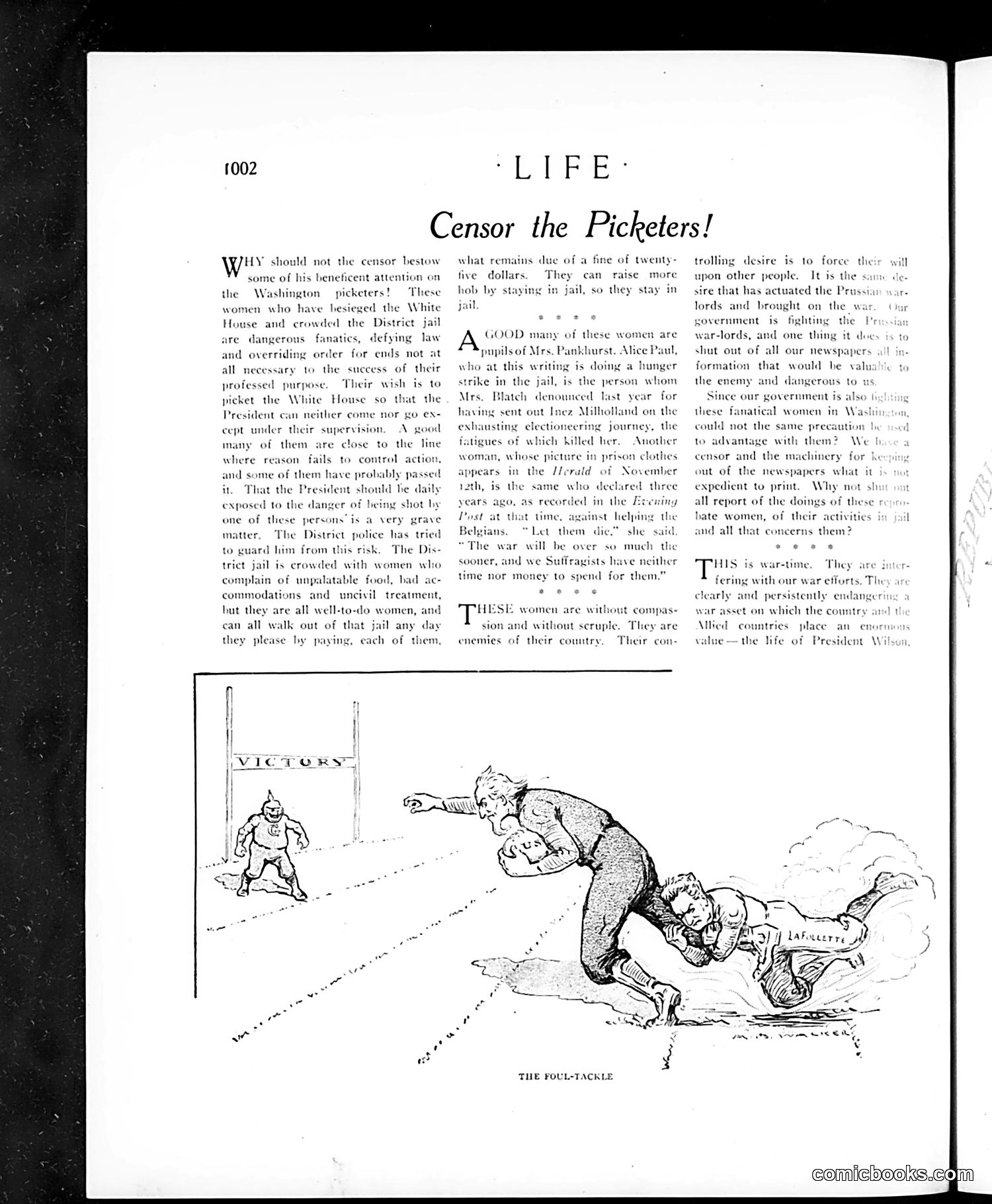
This page satirizes female suffragists and anti-war activists during World War I. The article criticizes women picketing the White House and jailing themselves, calling them "fanatics" who endanger national security by opposing the war effort. The cartoon titled "THE FOUL-TACKLE" depicts a figure labeled "VICTORY" (left) being blocked by a woman (representing suffragists/pacifists) who tackles an opposing player. The satire suggests these activists are obstructing the nation's war aims through their activism and civil disobedience. The text specifically mentions Mrs. Pankhurst, Alice Paul, and references to women in jail for their protests, positioning their activism as dangerous "scruples" that undermine the country during wartime—a common anti-suffragist argument of the era.
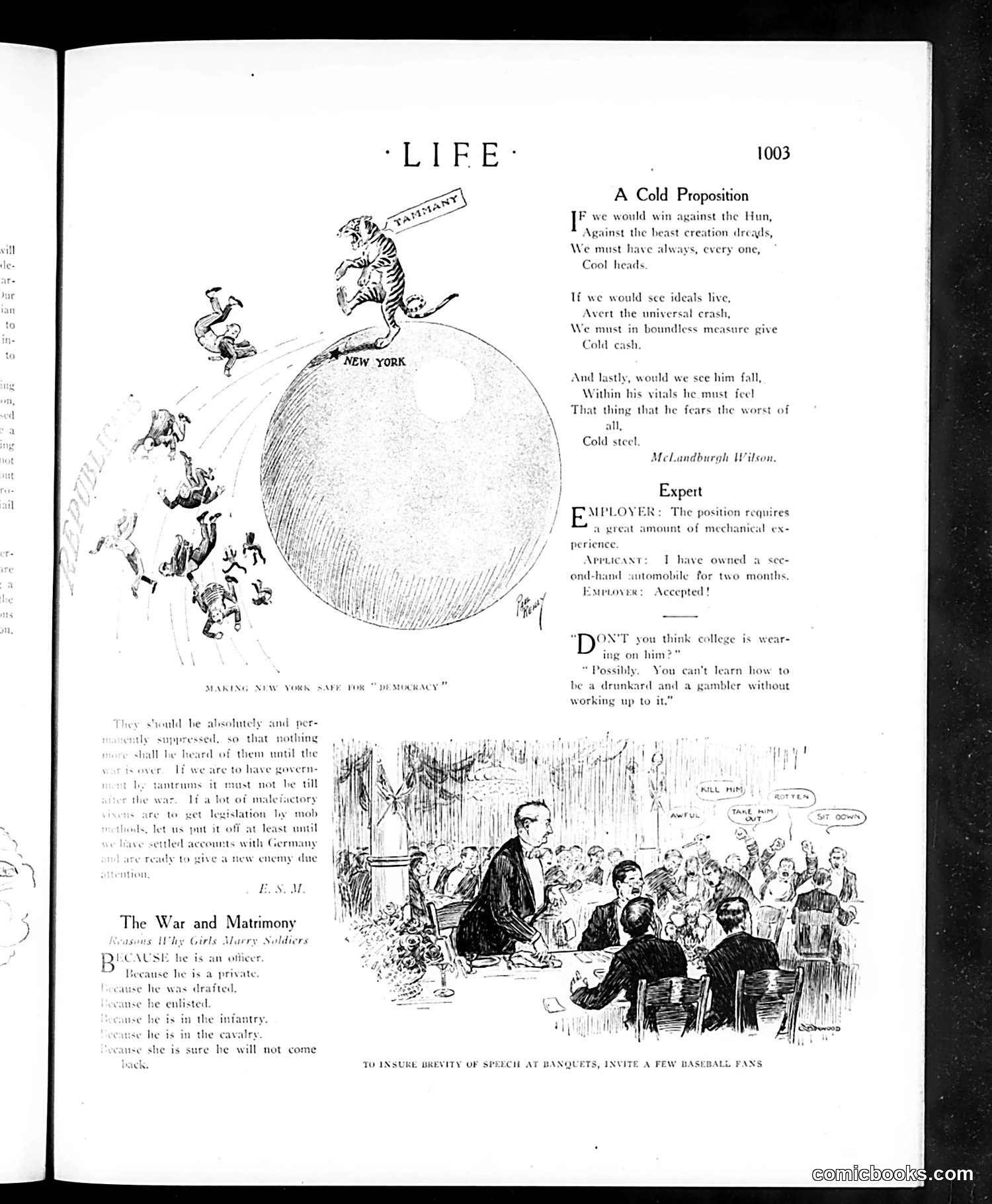
The main political cartoon depicts a large globe labeled "NEW YORK" being attacked by figures representing various threats—labeled "ANARCHY" at the top. Multiple armed or aggressive figures swarm the sphere, with the caption "MAKING NEW YORK SAFE FOR 'DEMOCRACY.'" This satirizes post-World War I anxieties about radical political movements and anarchism threatening American cities, particularly New York. The cartoon mocks the gap between rhetorical promises of safety and actual chaotic conditions. Below are three brief satirical pieces: "A Cold Proposition" (a poem about maintaining "cold cash"), "Expert" (mocking job interviews), and "The War and Matrimony" (a dark rhyme about why soldiers shouldn't marry). A sketch shows a banquet scene, captioned about inviting baseball fans to insure "brevity of speech." The overall theme critiques post-war American society's instability and contradictions.
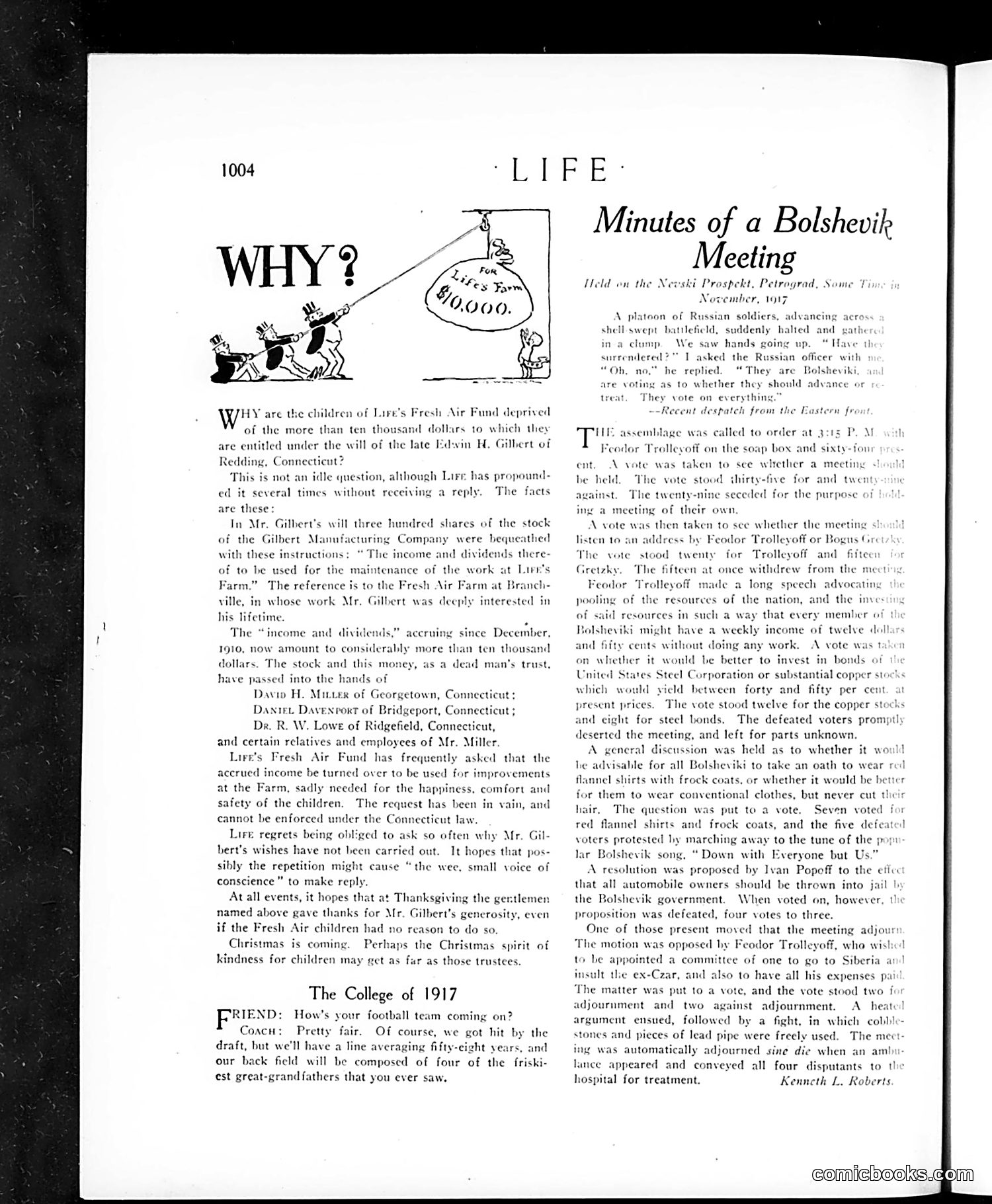
**Left cartoon ("WHY?"):** Life magazine criticizes wealthy trustees who are withholding over $10,000 from the Fresh Air Fund—money bequeathed by Edwin H. Gilbert for children's welfare. The cartoon depicts children deprived while trustees control the assets. The satire targets the trustees' failure to honor the donor's charitable wishes despite repeated public requests. **Right article ("Minutes of a Bolshevik Meeting"):** This satirizes the Russian Bolshevik government (newly in power after the November 1917 revolution) as absurdly inefficient and democratic to a fault. The joke: Bolsheviks vote on everything—whether to hold meetings, which speaker to hear, investment strategies—resulting in constant walkouts and schisms. The satire mocks their idealistic but chaotic governance, suggesting they prioritize voting procedures over actual action, while proposing impractical wealth redistribution schemes. Both pieces represent American anti-socialist sentiment during the Russian Revolution.
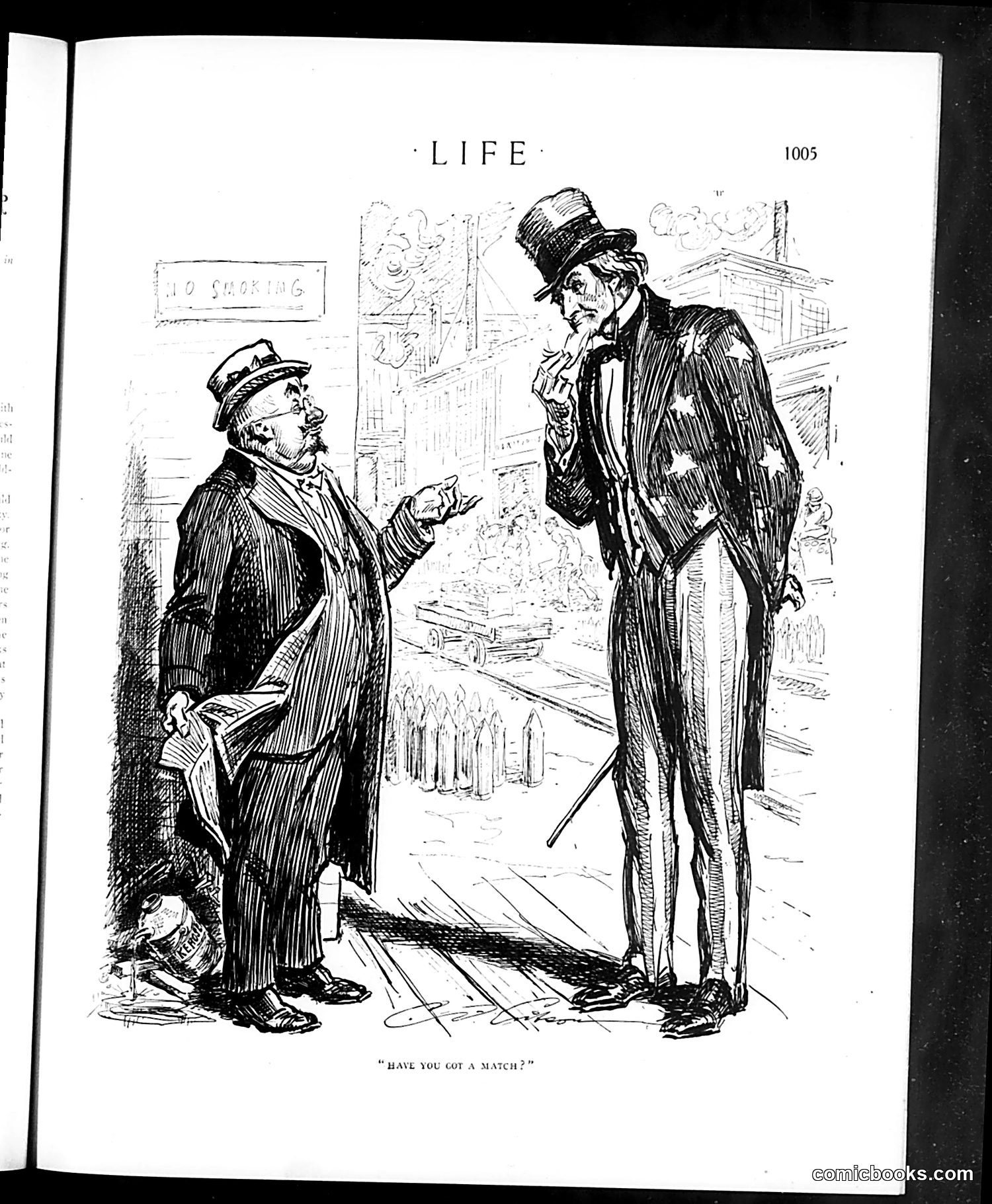
This cartoon from *Life* magazine depicts two men in formal attire having a street encounter. The shorter, working-class figure on the left (identifiable by his worn clothing and posture) asks the taller, well-dressed gentleman on the right for a match—a common panhandling request of the era. The satire likely plays on class contrasts: the wealthy man's superior bearing and fine clothes versus the poorer man's shabby appearance and desperation. The title suggests the beggar's indirect request for charity. The cartoon satirizes either indifference to poverty, the social gap between classes, or possibly the absurdity of a desperate man addressing a stranger with such a polite, indirect appeal. The background sketches suggest an urban street setting.
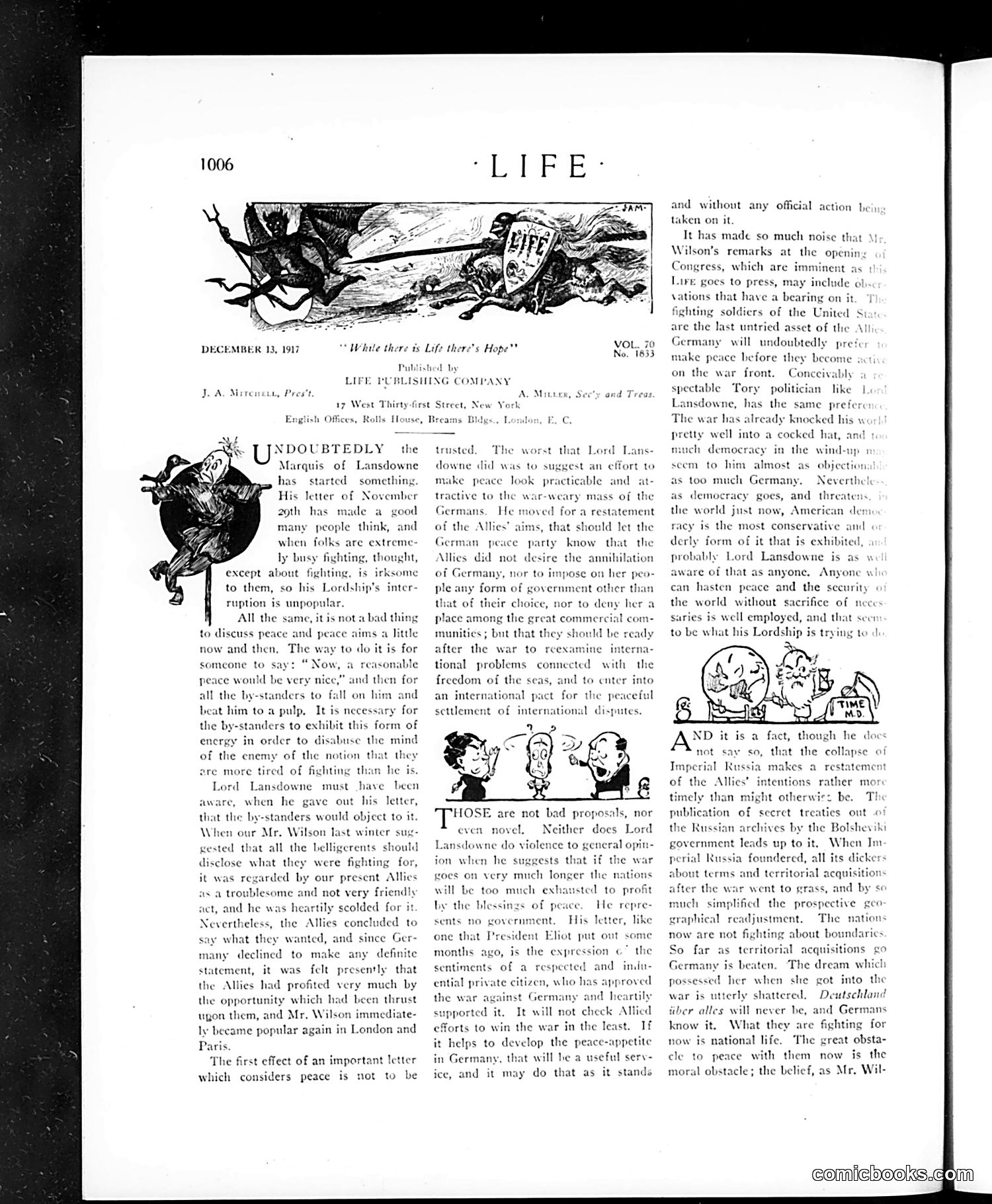
This page discusses the Marquis of Lansdowne's recent letter proposing peace negotiations during World War I. The cartoons and text satirize public reaction to his "troublemaking." **The central joke**: When someone suggests discussing peace terms, the public beats them "to a pulp"—they're so committed to fighting that even reasonable peace proposals become unpopular. The text notes this happened when President Wilson previously suggested belligerents state their war aims; he was initially criticized but later became popular when the Allies benefited from clarifying their position. **Lansdowne's proposal** wasn't radical—he simply urged stating that the Allies didn't seek to annihilate Germany or impose unwanted governments. The satire targets the *hysteria* surrounding peace talk rather than endorsing pacifism. The piece suggests discussing peace terms rationally isn't inherently defeatist, and that a war-exhausted Germany might respond to reasonable proposals. The cartoons (showing figures being attacked for suggesting peace) visually reinforce this theme of public intolerance for peace discussion during wartime.
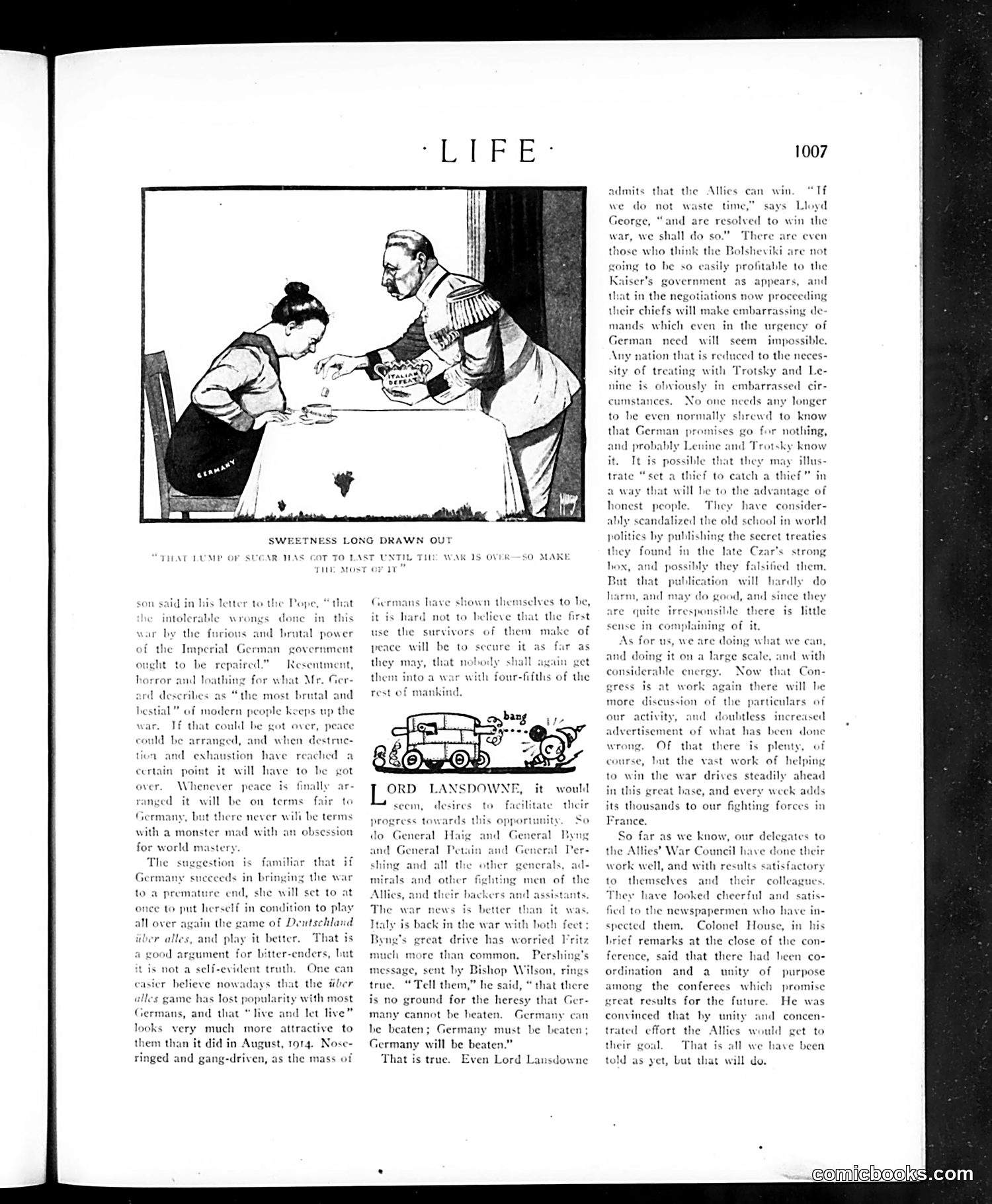
This cartoon depicts peace negotiations during World War I. The image shows a military officer (likely representing Allied leadership) offering sugar to a seated woman labeled "Germany"—a visual metaphor for sweetening peace terms. The accompanying text discusses whether Germany, if granted premature peace, would genuinely reform or simply rearm for future conquest. It references Lord Lansdowne's peace proposals and debates among Allied leaders (Haig, Pershing, Petain) about continuing the war. The satire's point: Germany cannot be trusted with leniency. The "lump of sugar" represents soft peace terms that might seem appealing but would merely extend German appetite for dominance. The title suggests such sweetness would be "long drawn out"—prolonging the problem rather than solving it. The text emphasizes that only complete German defeat ensures lasting peace, and that negotiating with the Bolsheviks (newly in power) introduces additional complications to Allied strategy.
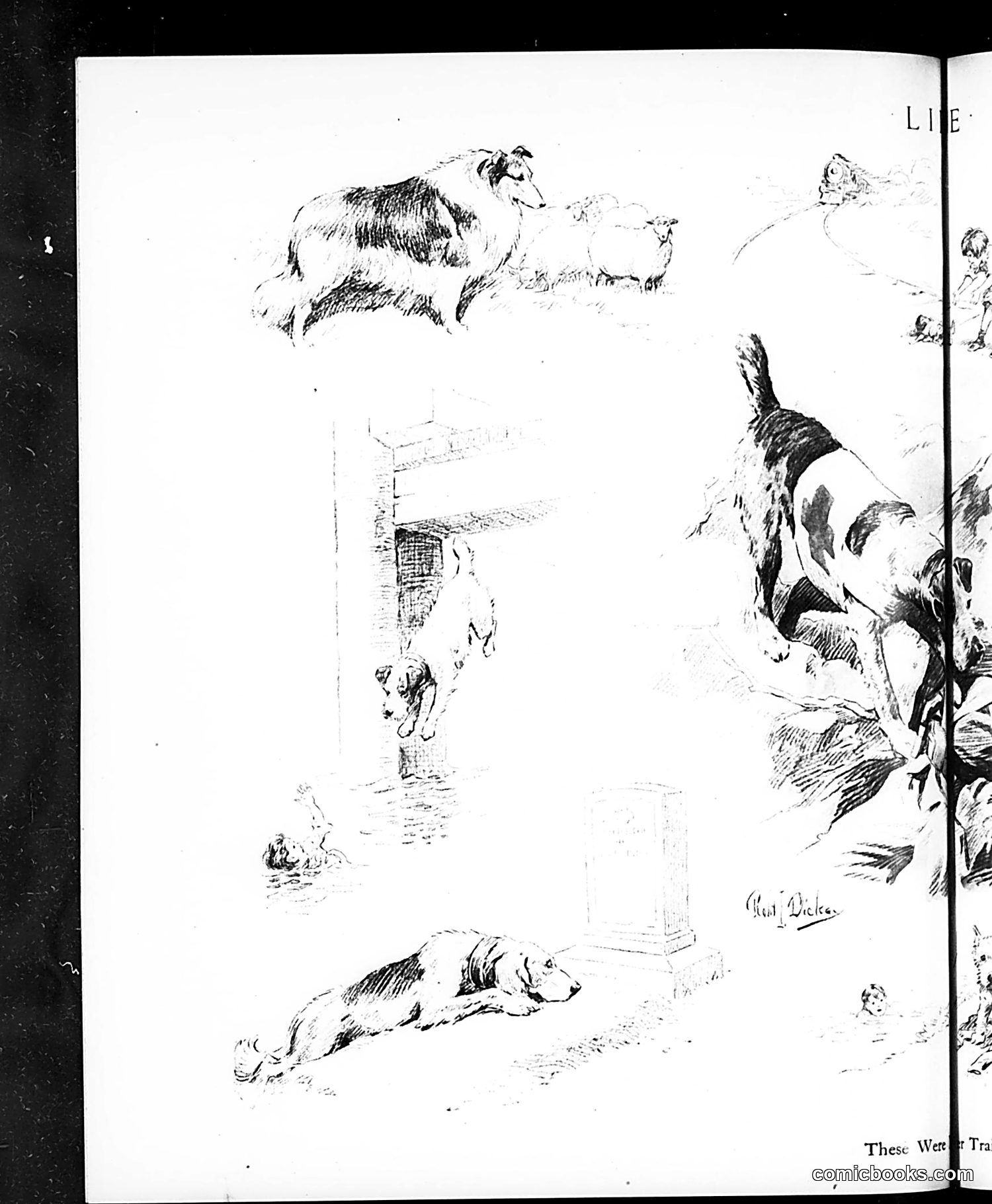
This page contains a sketch-style illustration signed by what appears to be "Cecil Nielson" (or similar), showing various dogs in different poses and settings. The drawing depicts several terrier-type dogs engaged in typical canine behavior—running, playing, interacting with each other, and one appears to be near a building or structure. The partial text at the bottom reads "These Were Tra[ditional]," suggesting this may be commenting on or depicting traditional dog breeds or behaviors, though the complete caption is cut off. Without the full context or caption visible, the specific satirical point is unclear. The work appears to be a straightforward animal illustration rather than political commentary, though Life magazine often included such content alongside satirical pieces.
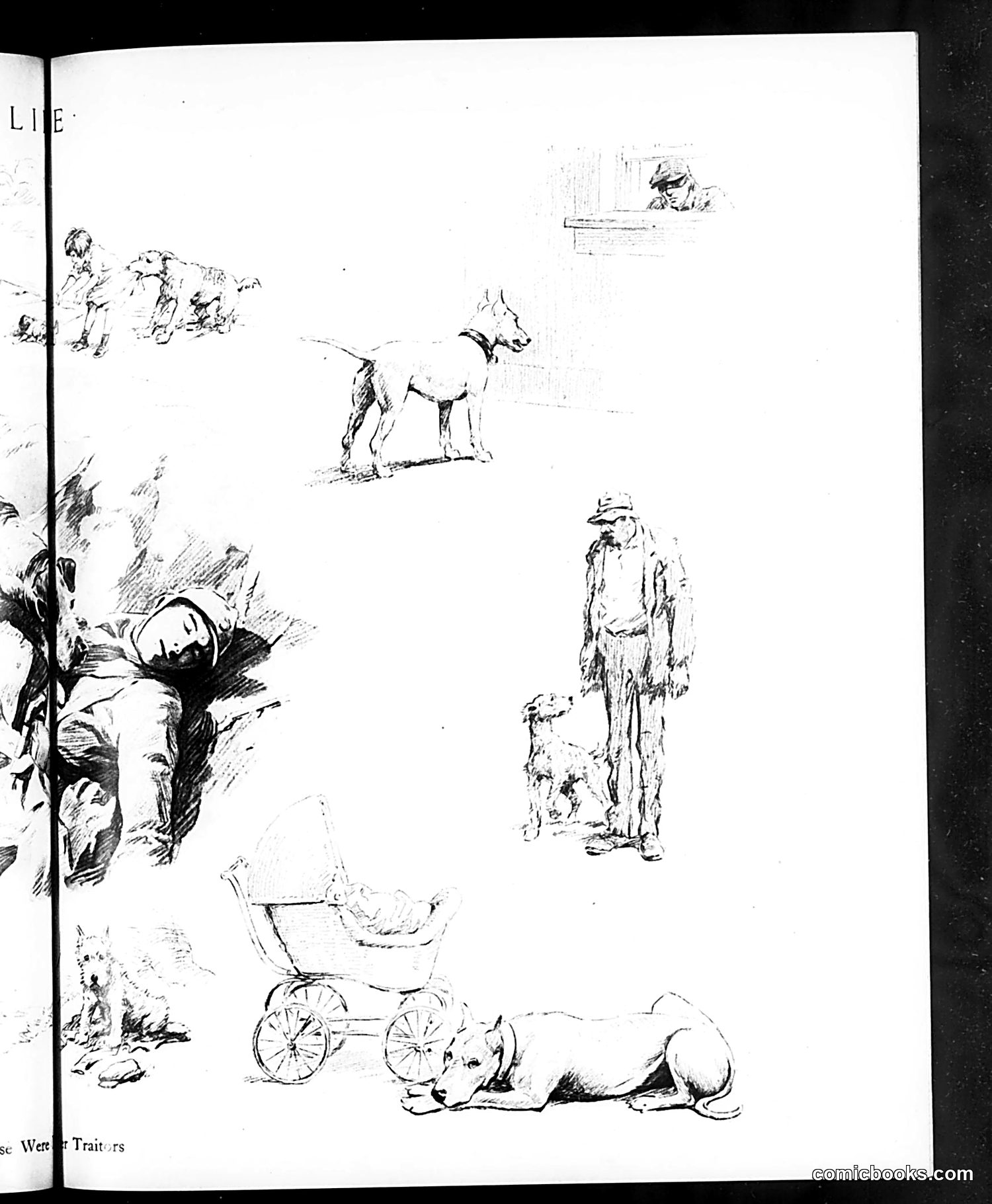
This page appears to be a collection of sketch studies rather than a finished cartoon. The drawings show various figures and scenes in ink: people in different poses and situations, a dog, a baby carriage, and what appears to be a person resting against a pole on the left side. The partial text visible at bottom mentions "Trait_rs" (possibly "Traitors"), suggesting political or social commentary, but without a clear narrative connecting these sketches or more legible text, the specific satirical point is unclear. These seem to be preliminary character and scene studies—possibly character development work for a larger satirical piece—rather than a completed editorial cartoon with an obvious political message a modern reader could readily decode.
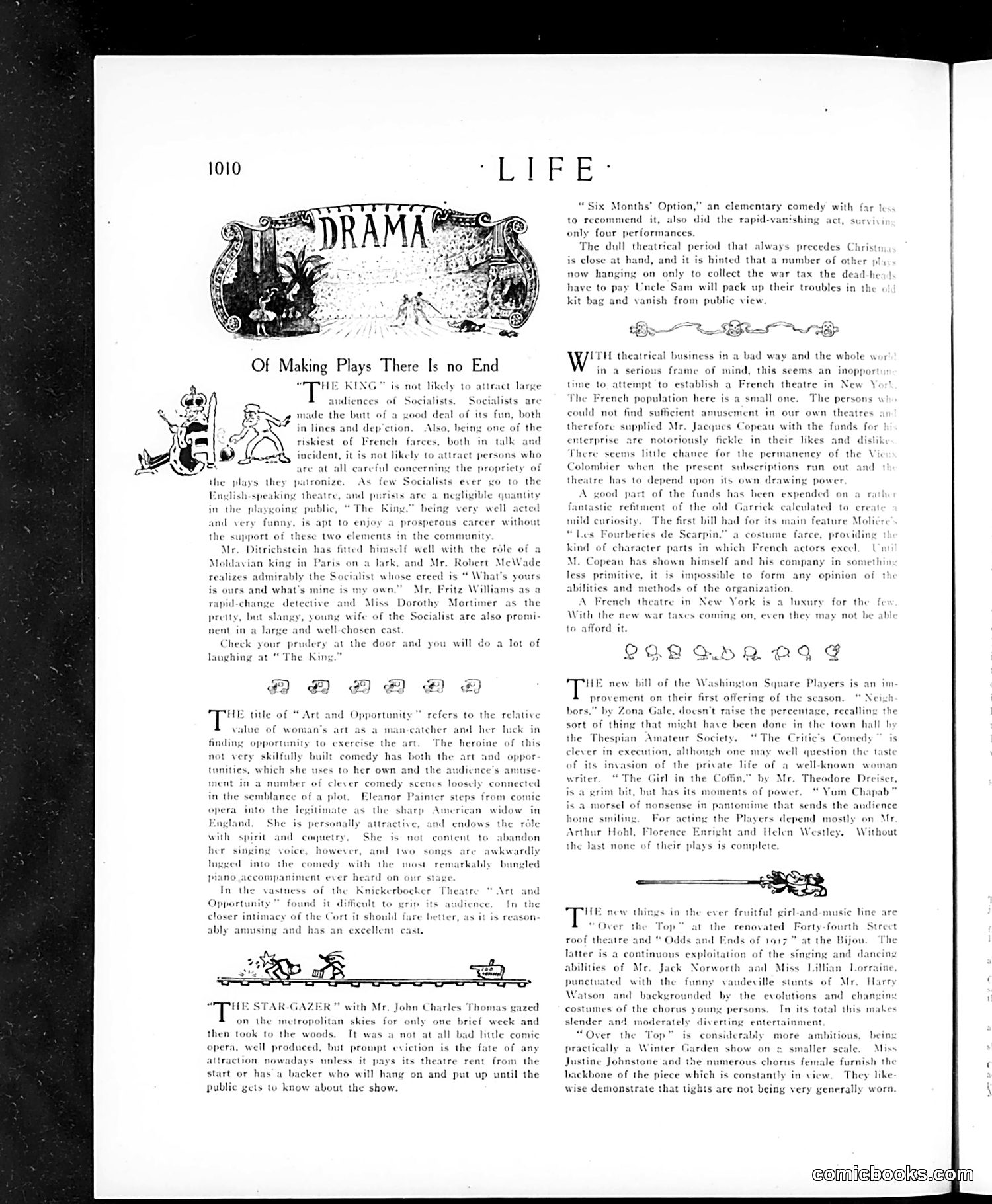
This page reviews theatrical productions and discusses challenges facing New York theater around the time of writing. The text critiques Socialist-themed plays like "The King," noting they appeal primarily to Socialist audiences rather than broader theater-goers. Several theatrical productions are reviewed, including "Art and Opportunity" (described as a weak comedy) and "The Star Gazer" with John Charles Thomas. The reviews note difficulty in attracting audiences to experimental or niche productions. The page also discusses financial struggles in theater, mentioning a French theater's reliance on its own drawing power and difficulties affording new taxes. References to Washington Square Players and various comedies suggest this covers the vibrant but economically precarious theatrical scene of early 20th-century New York.
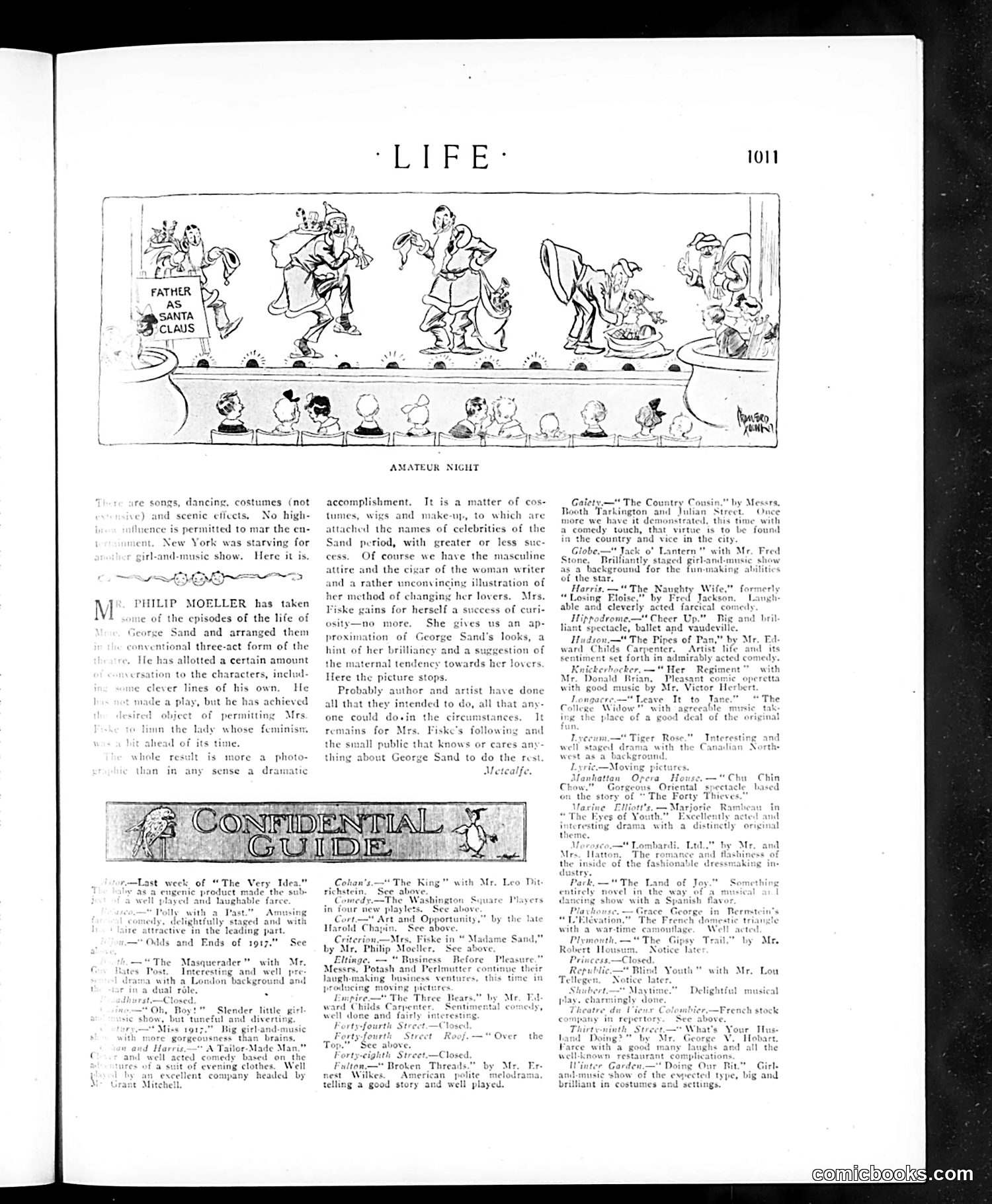
This cartoon depicts a theatrical performance titled "Amateur Night," showing performers on stage above and an audience below. The top figures appear to be actors in various costume pieces - the leftmost figure is labeled "Father Christmas" (suggesting holiday-themed entertainment), while other performers display different theatrical poses and props. The accompanying article discusses Philip Moeller's stage adaptation of episodes from George Sand's life, organized as a three-act play. The satire targets the theatrical world of 1917, mocking amateur theatrical productions and their often-awkward execution. The "Amateur Night" framing suggests these are inexperienced performers, likely satirizing New York's entertainment scene's quality issues or pretensions. The text references Mrs. Fiske (a notable actress) and various theatrical venues, indicating this is period theater criticism. The cartoon humorously contrasts the performers' earnest (if clumsy) efforts with the audience's skeptical reactions below, capturing contemporary attitudes toward amateur versus professional theater.
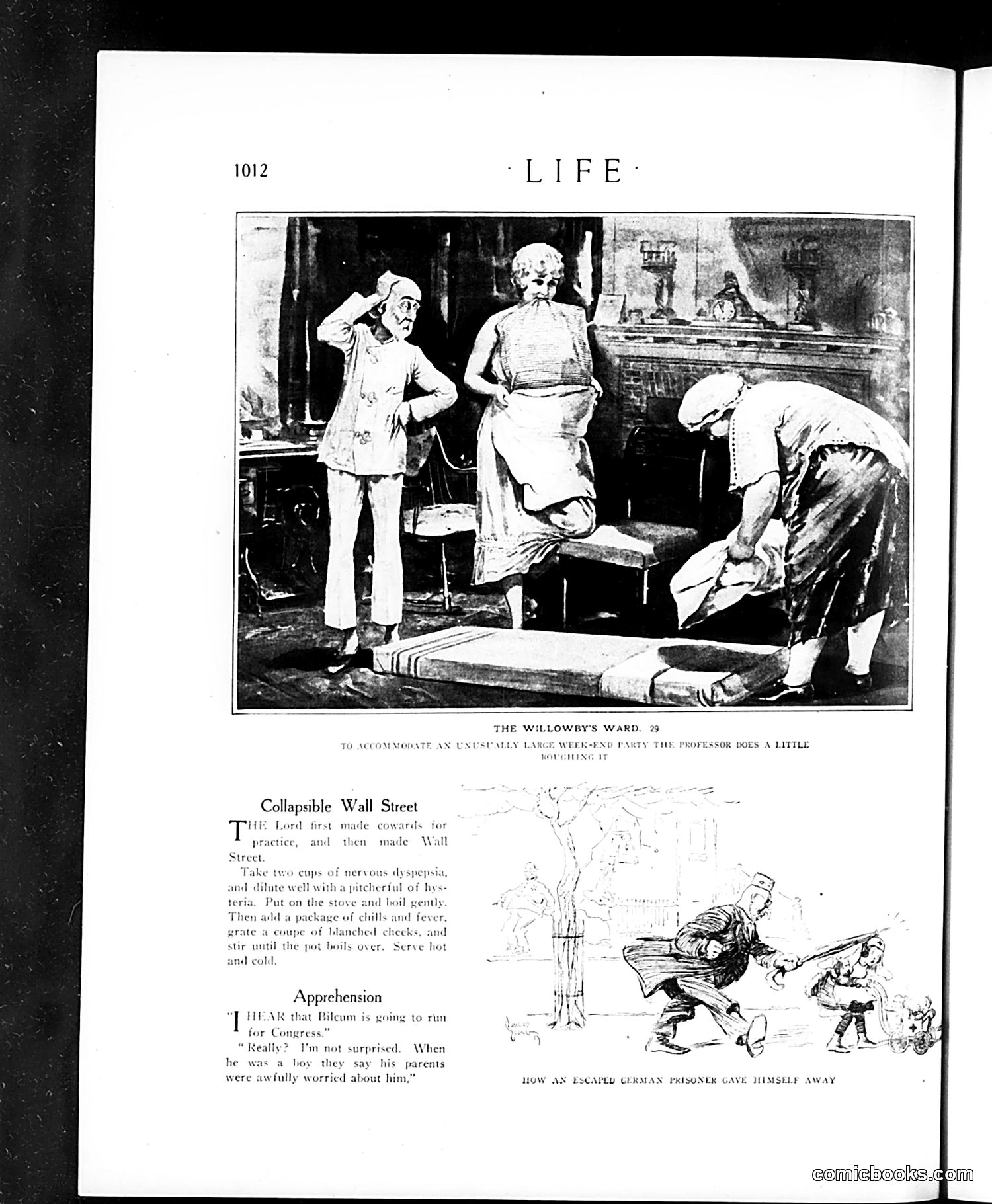
This page contains three distinct pieces of satire: 1. **"The Willowby's Ward"** (top): A comic strip panel showing what appears to be a domestic scene where "the Professor does a little boxing" during a weekend party—likely satirizing upper-class amateur athleticism or pretension. 2. **"Collapsible Wall Street"** (middle): A recipe-style joke mocking Wall Street's instability, comparing financial markets to a fragile dish that collapses. This references the volatility and unreliability of stock markets—a recurring target of Life's satire. 3. **"Apprehension"** (lower left): A brief joke about a man named Bileum running for Congress, with the punchline that his worried parents saw it coming—satirizing politicians as inherently unsuitable or foolish. 4. **"How an Escaped German Prisoner Gave Himself Away"** (bottom right): A sketch showing a soldier fleeing, likely referencing WWI-era military humor about German prisoners of war. The page reflects early 20th-century concerns: financial instability, political incompetence, and wartime anxiety.
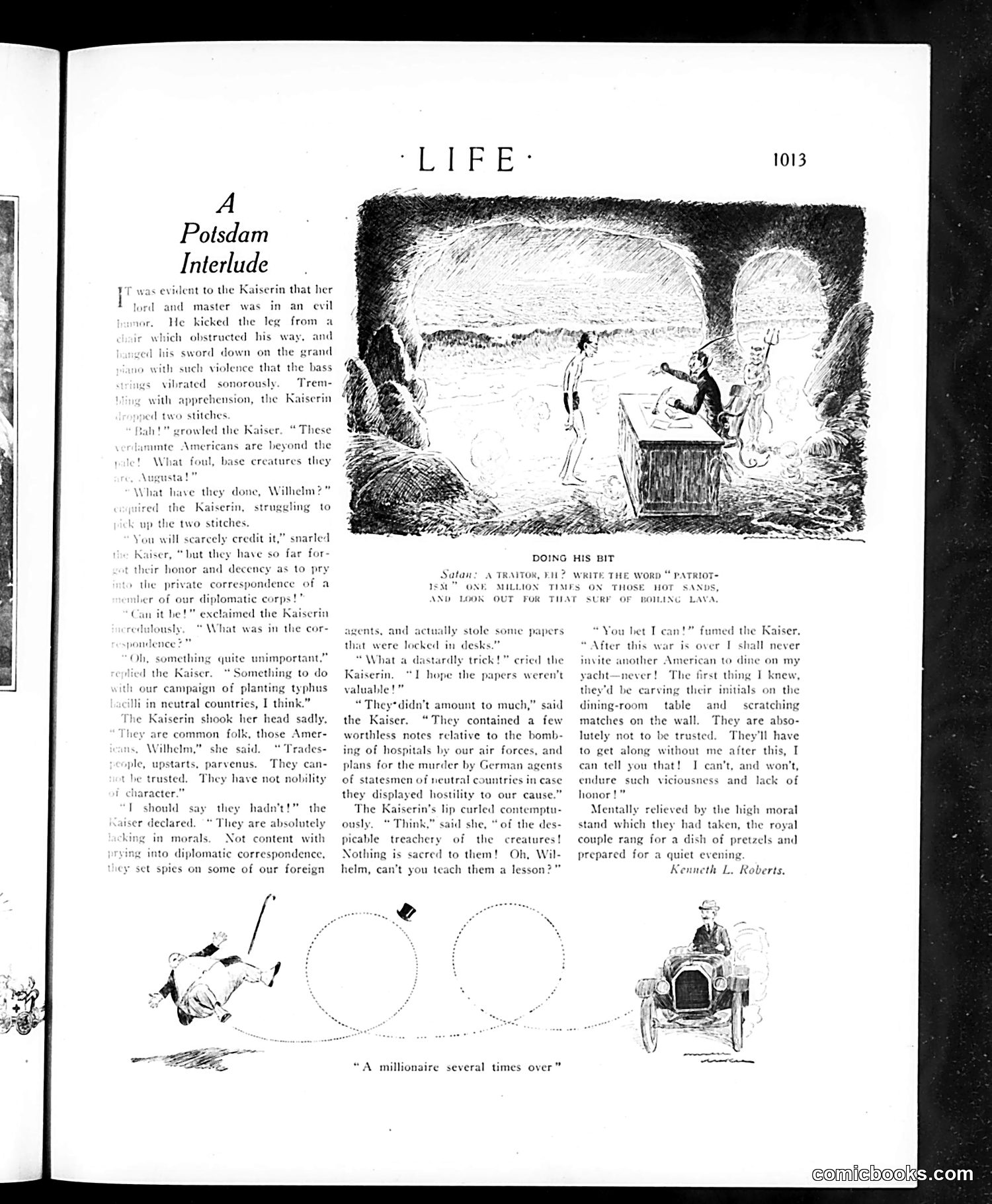
This satirical piece mocks the German Kaiser and Kaiserin during World War I. The dialogue portrays them as hypocritical and indignant about Americans allegedly intercepting diplomatic correspondence—specifically documents revealing German plans to bomb hospitals and murder civilians in neutral countries. The satire's core joke: the Kaiser complains about Americans' lack of honor and morality while casually admitting to war crimes. The Kaiserin worries Americans lack "nobility," yet the couple ends their moral indignation by simply ordering pretzels for the evening—suggesting their outrage is performative and shallow. The bottom cartoon, "A Millionaire Several Times Over," likely references profiteering or wealth accumulation during wartime, though details are unclear from the visible text. This reflects American anti-German sentiment during WWI, depicting German leadership as simultaneously ruthless and absurdly self-unaware about their own moral failures.
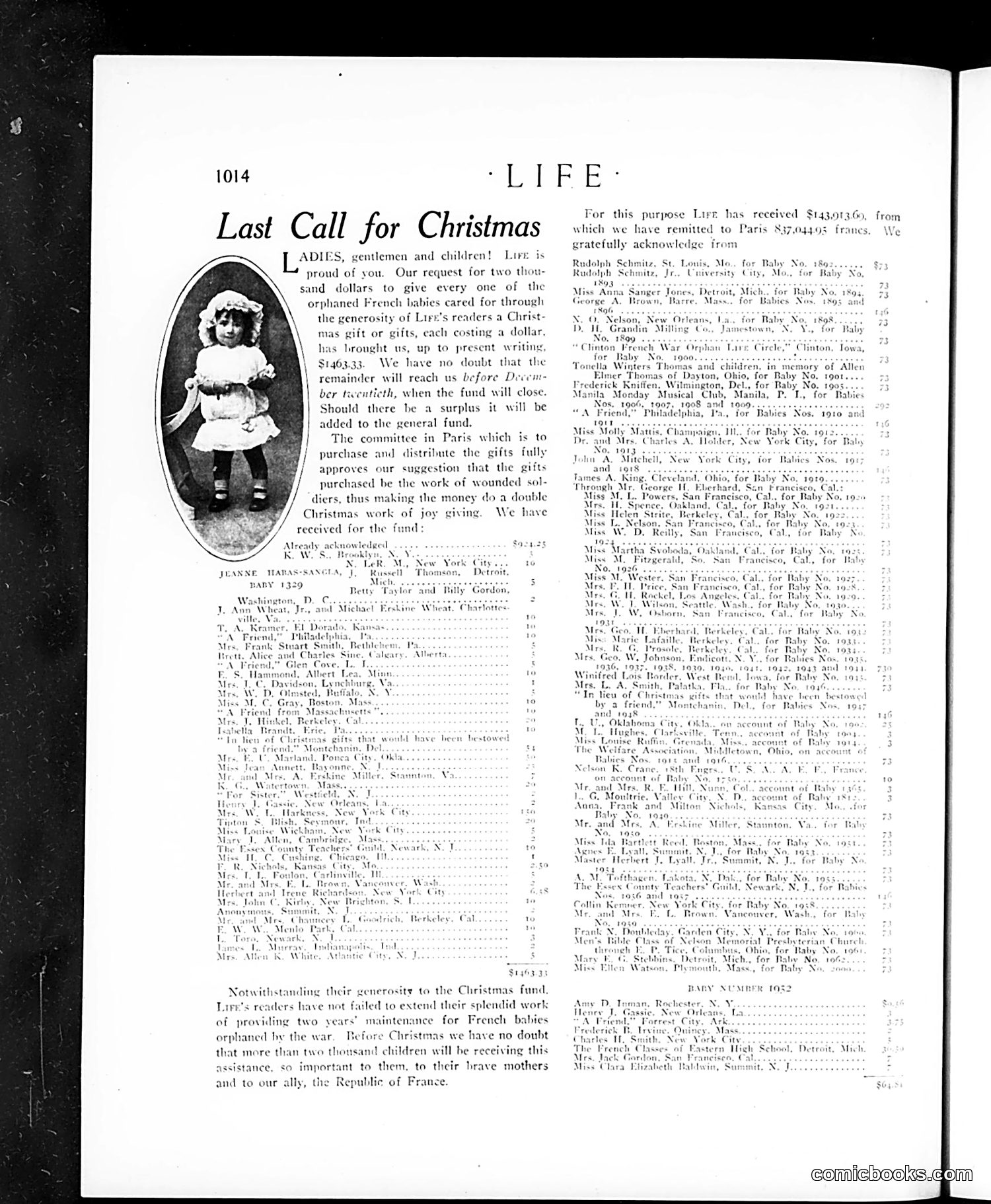
This is a **fundraising appeal**, not a political cartoon. The page features a sentimental illustration of a child in winter clothing alongside a solicitation for donations to support French orphans created by World War I. The text explains that *Life* magazine is requesting $2,000 to provide Christmas gifts to orphaned French children under Allied care. By the publication date, readers had already contributed $1,463.33, with the magazine confident the remainder would arrive before December 20th. The appeal notably emphasizes that donated funds should purchase gifts made by **wounded soldiers**, thereby giving "double" charitable impact—supporting both the orphans and disabled veterans through their labor. The right column lists hundreds of donors and their contributions, demonstrating the magazine's strategy of publicizing generosity to encourage additional giving. This reflects American philanthropic sentiment during WWI, positioning aid to French civilian casualties as patriotic support for an Allied nation.
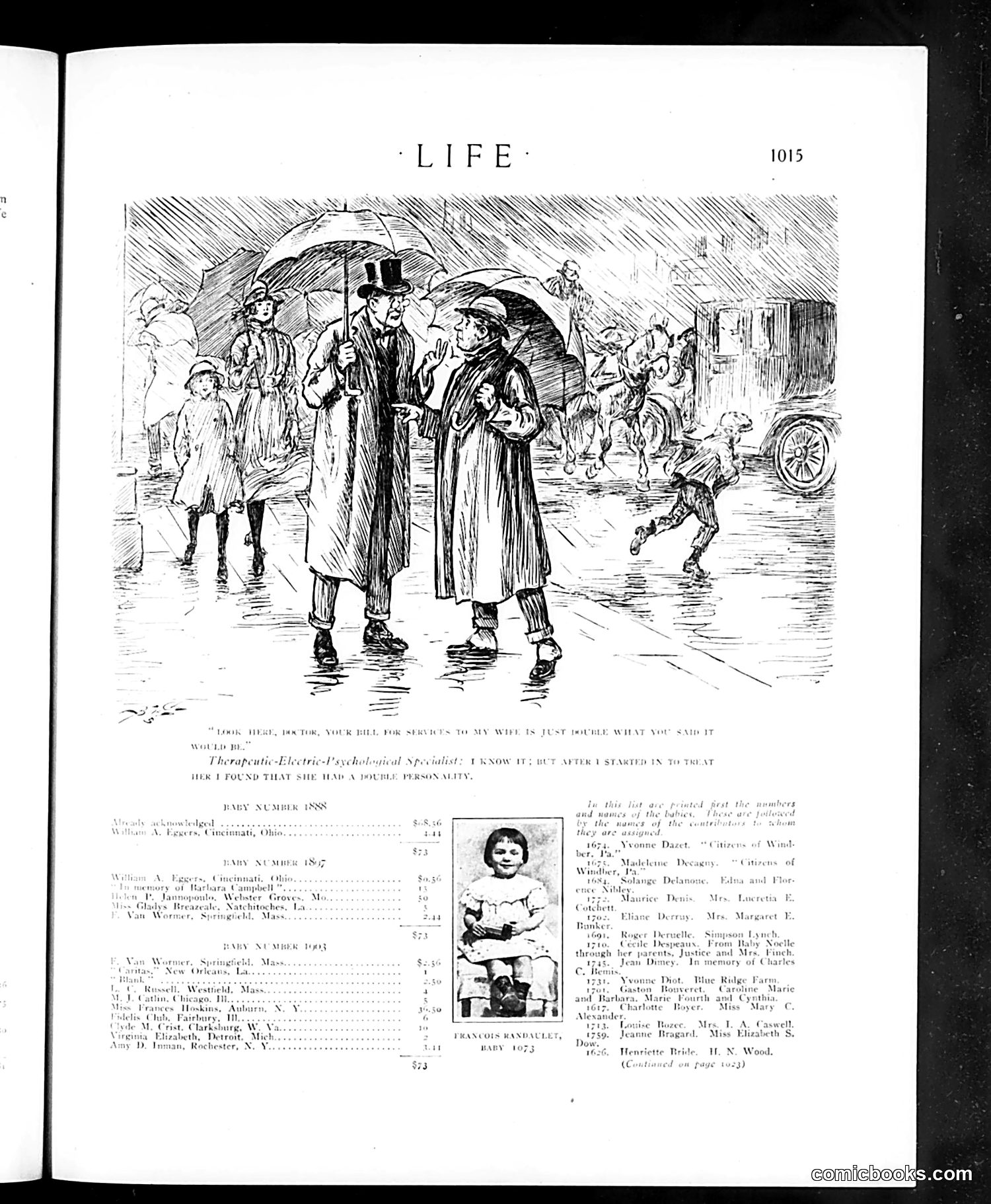
This page from *Life* magazine features a satirical illustration of a rainy street scene with well-dressed adults and children. The caption quotes someone claiming to be a "therapeutic-electric-psychological specialist" who treats patients with "double personality." The cartoon satirizes pseudoscientific medical practitioners of the era—specifically those claiming expertise in psychology and electrical treatments. The joke appears to be that the specialist diagnoses a child's misbehavior as a serious psychological condition ("double personality") rather than normal childhood behavior, reflecting contemporary mockery of overdiagnosis and excessive medicalization by fraudulent practitioners. The page also contains birth announcements and a photograph labeled "Francois Ramaguele, Baby 1923," suggesting this is a typical *Life* magazine page mixing satire with social announcements.
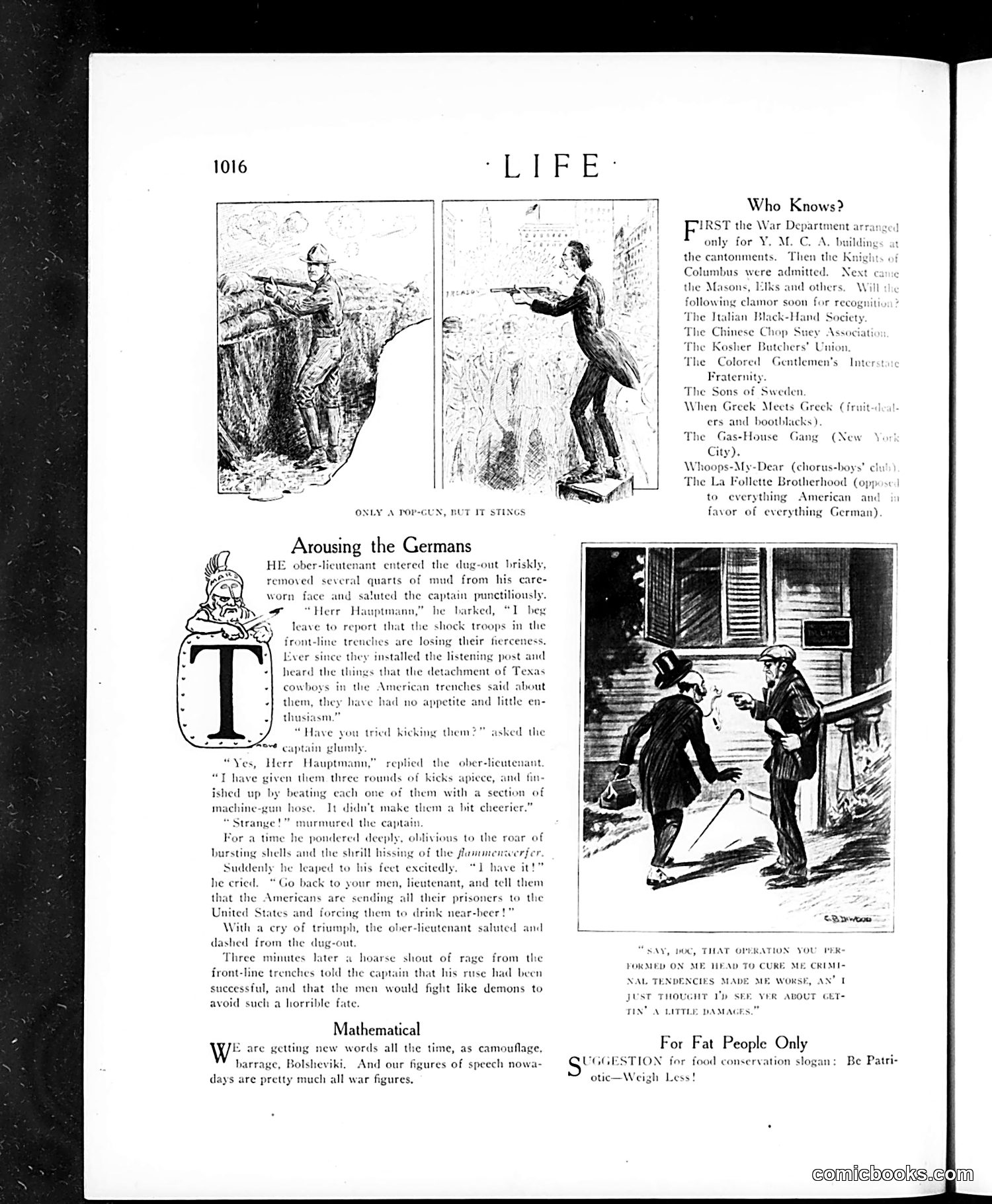
**Main Cartoon ("Arousing the Germans"):** This WWI-era satire depicts German officers losing morale after hearing American soldiers—specifically described as "Texas cowboys"—trash-talk them from the trenches. The joke relies on the stereotype of rough, intimidating American cowboys. When standard military punishment fails to restore discipline, a captain devises psychological warfare: spreading rumors that captured Germans will be sent to America and forced to drink "near-beer" (low-alcohol beer, considered inferior). This threat supposedly terrifies the troops more than combat itself—the joke being that Germans fear American civilian life more than death in battle. **"Who Knows?" Column:** A satirical list predicting which ethnic and fraternal organizations will next demand War Department recognition after the YMCA. Notably included is "The La Follette Brotherhood"—a jab at Senator Robert La Follette, a prominent anti-war progressive—described as "opposed to everything American and in favor of everything German," suggesting pro-German sentiment among war opponents. **Minor Jokes:** References to new war vocabulary ("camouflage," "barrage") and a food-conservation pun about overweight people losing weight.
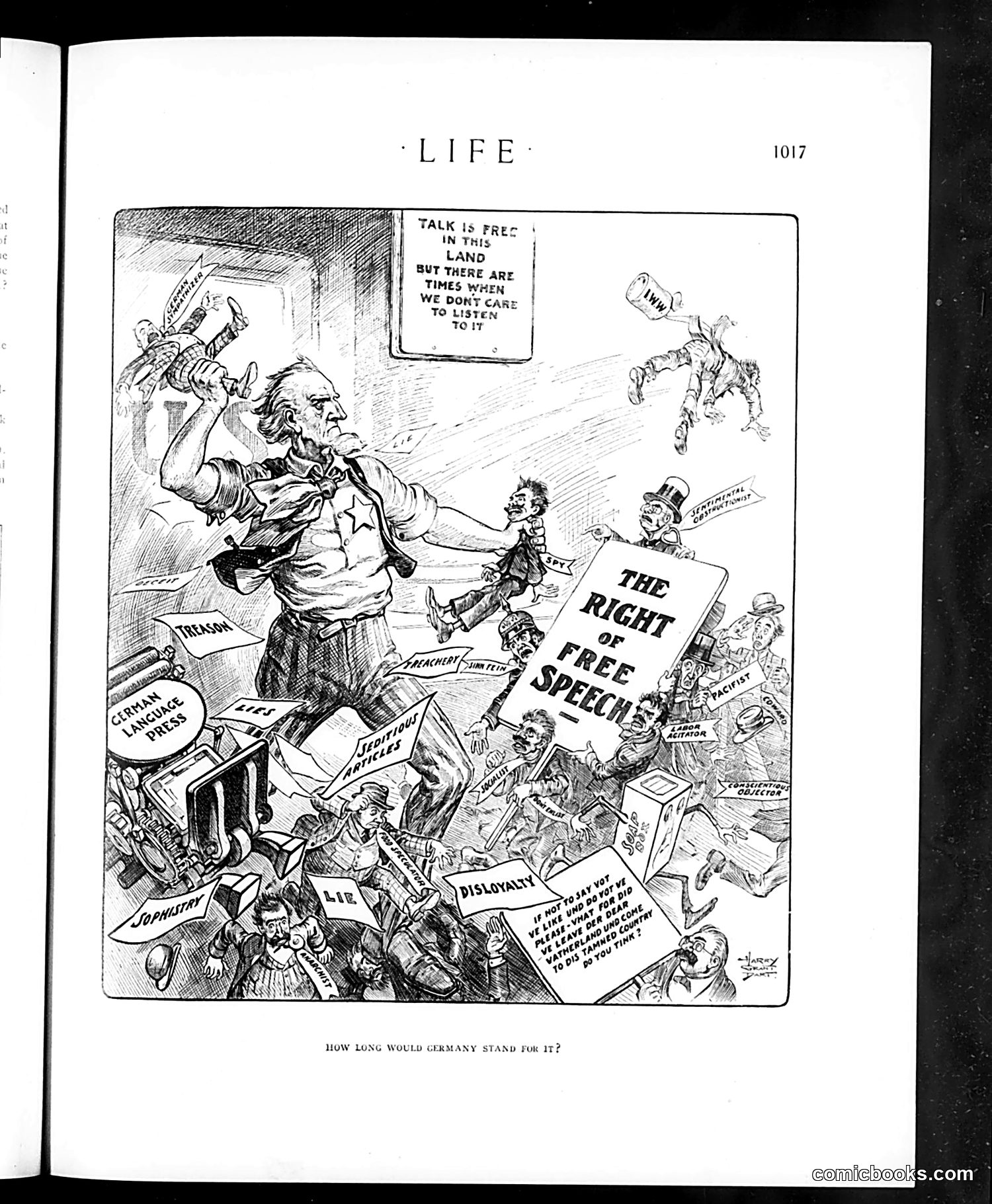
This WWI-era Life magazine cartoon satirizes German autocracy versus American free speech. A large, aggressive German military figure (representing Germany/Kaiser Wilhelm II) is depicted as a blustering authoritarian surrounded by various negative labels: "Treason," "Sophistry," "Disloyalty," and "Atrocity." American figures hold a sign reading "The Right of Free Speech," while a speech bubble notes that though America permits free speech, "there are times when we don't care to listen to it." The cartoon's title asks "How Long Would Germany Stand for It?" — suggesting Germany's militaristic regime could never tolerate the democratic freedoms Americans enjoy. The satire criticizes both German authoritarianism and implicitly warns Americans against certain types of propaganda or dissent during wartime.
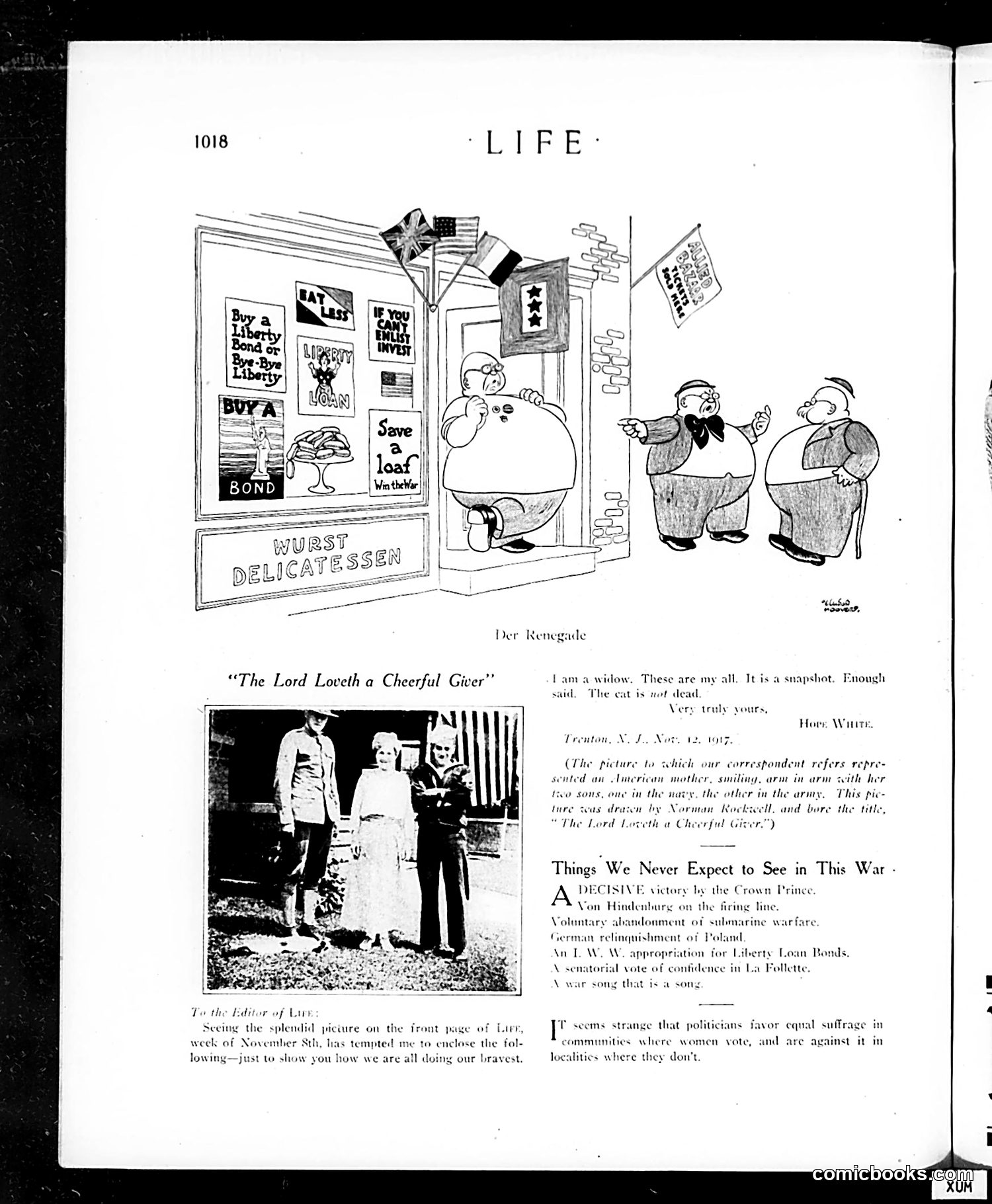
**Top Cartoon ("Der Renegade"):** This depicts a rotund German figure emerging from a delicatessen window covered in patriotic posters (Liberty Bonds, enlistment ads). Two Americans outside mock or confront him. The satire targets German-Americans or suspected German sympathizers during WWI, portraying them as hypocritical—profiting from American commerce while their homeland fights the U.S. **Letter Feature:** A widow's poignant note accompanies a photo of herself with two sons (one in Navy, one Army), stating "the cat is not dead" as her only remaining possession. This illustrates American sacrifice during the war. **"Things We Never Expect to See":** A satirical list mocking German military leadership (Crown Prince, Hindenburg) and American political hypocrisy—particularly the IWW (Industrial Workers of the World), Liberty Loan opposition, and Senator La Follette's anti-war stance. **Bottom Commentary:** Critiques politicians supporting women's suffrage only in voting communities, opposing it where women don't vote—exposing transparent political calculation.
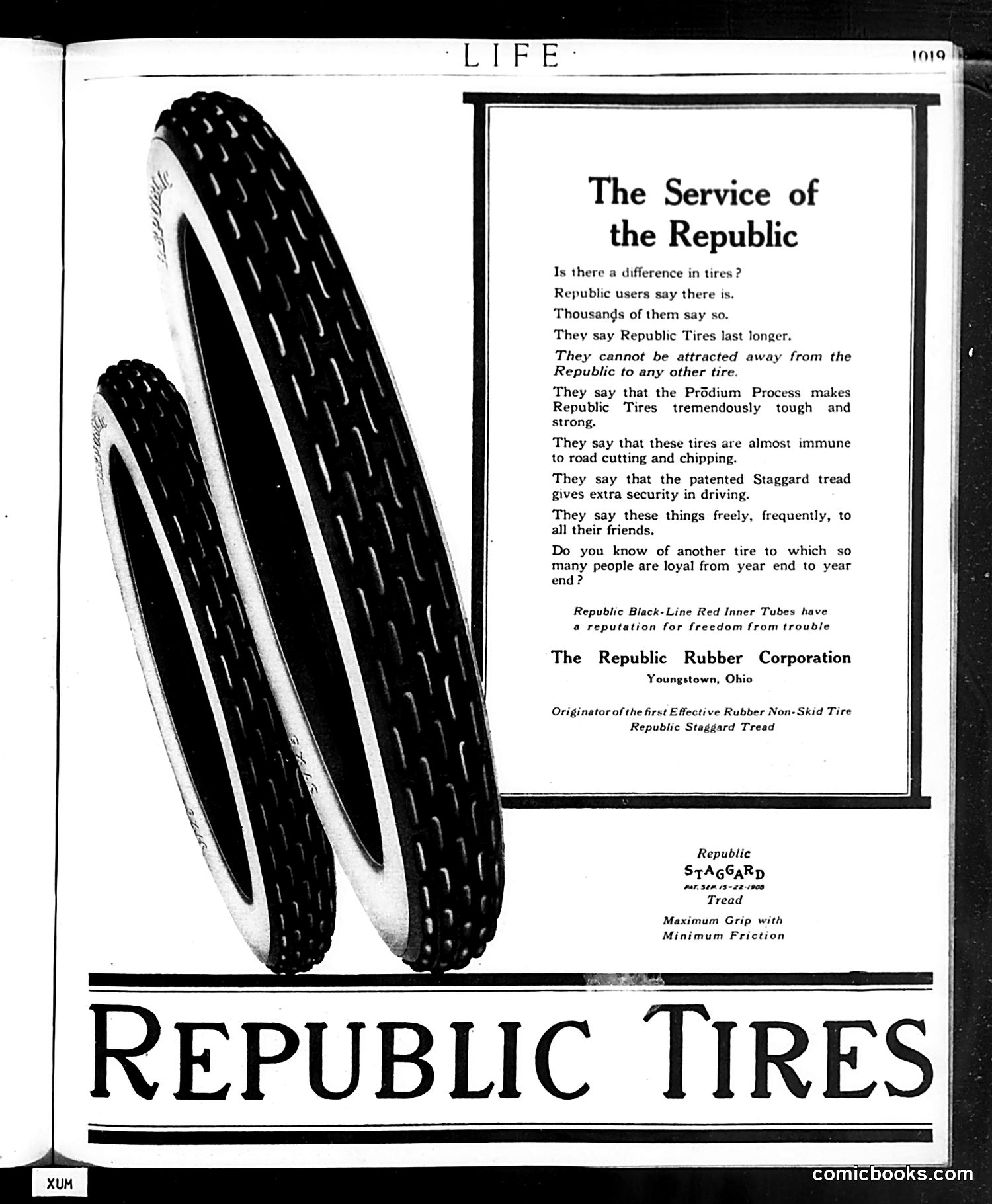
This is a **straightforward advertisement**, not satire or political commentary. It's a full-page ad for Republic Tires from the Republic Rubber Corporation in Youngstown, Ohio. The page uses testimonial marketing: it claims thousands of satisfied customers report that Republic Tires last longer, resist road damage, and inspire unusual brand loyalty. The ad emphasizes their patented "Staggard Tread" for grip and their "Prodium Process" for durability. The visual shows two tires in black and white illustration, displaying the distinctive tread pattern. The messaging relies on peer recommendation and customer testimonials rather than technical specifications—a common early-20th-century advertising approach. There is **no cartoon, satire, or political message** here. This appears to be typical commercial advertising from *Life* magazine's revenue model.
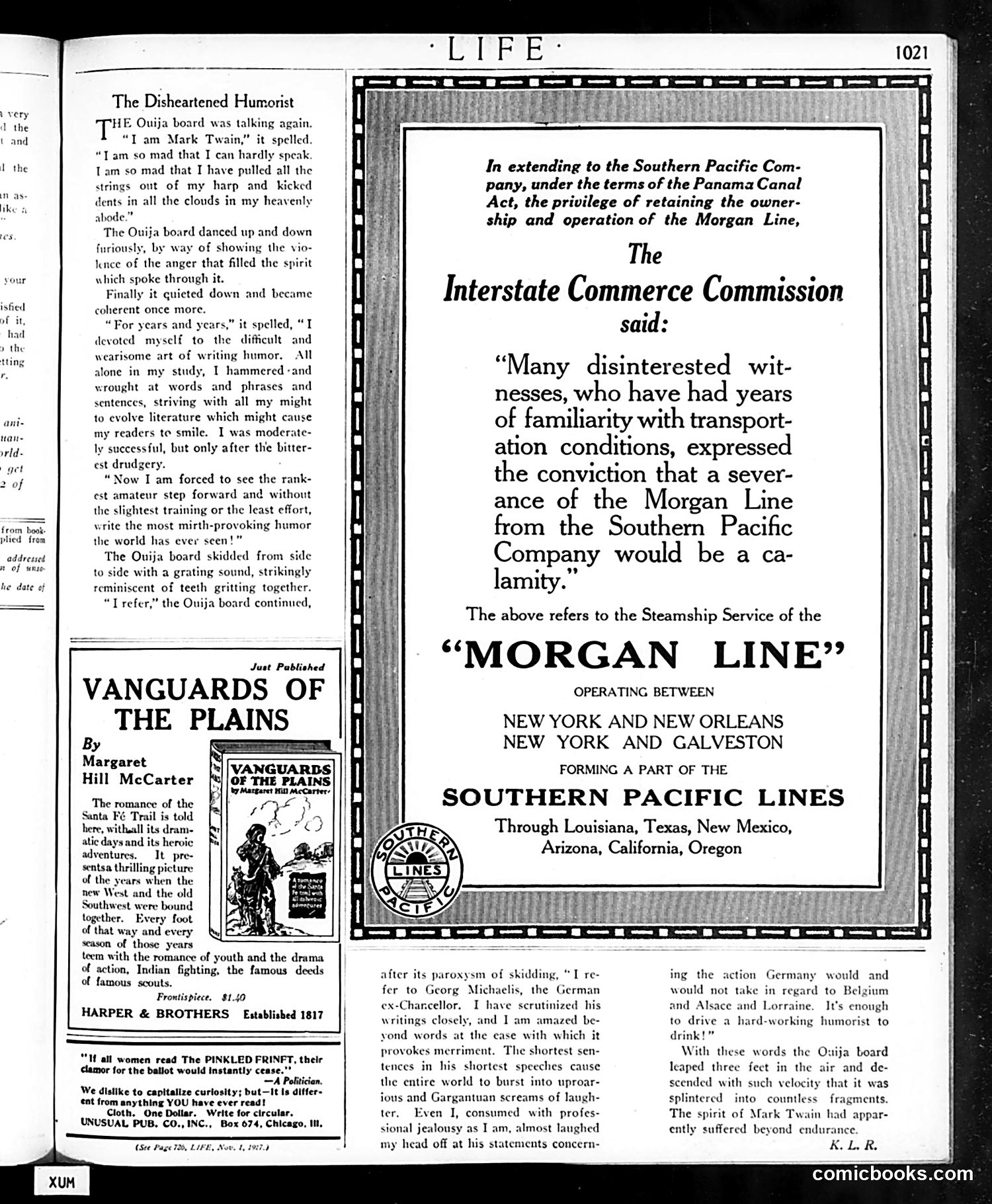
This page contains a satirical piece titled "The Disheartened Humorist," presenting Mark Twain's ghost (speaking through a Ouija board) complaining bitterly about unintentional humor. **The Joke:** Twain spent his career laboring to write witty material, yet someone—identified as Georg Michaelis, the German ex-Chancellor—produces inadvertent hilarity effortlessly through his serious political statements. Twain's jealous rage culminates in him literally destroying the Ouija board. **The Target:** Michaelis's statements about World War I (regarding Belgium, Alsace-Lorraine) are so absurdly self-serving or contradictory that they become unintentionally comic to readers. The satire mocks both Michaelis's diplomatic rhetoric and Twain's frustration at losing his monopoly on humor-writing. **Context:** Published during WWI, this targets German leadership's public statements as laughably transparent propaganda or nonsense—the ultimate insult to a professional humorist. The page also includes book advertisements and an unrelated railroad advertisement.
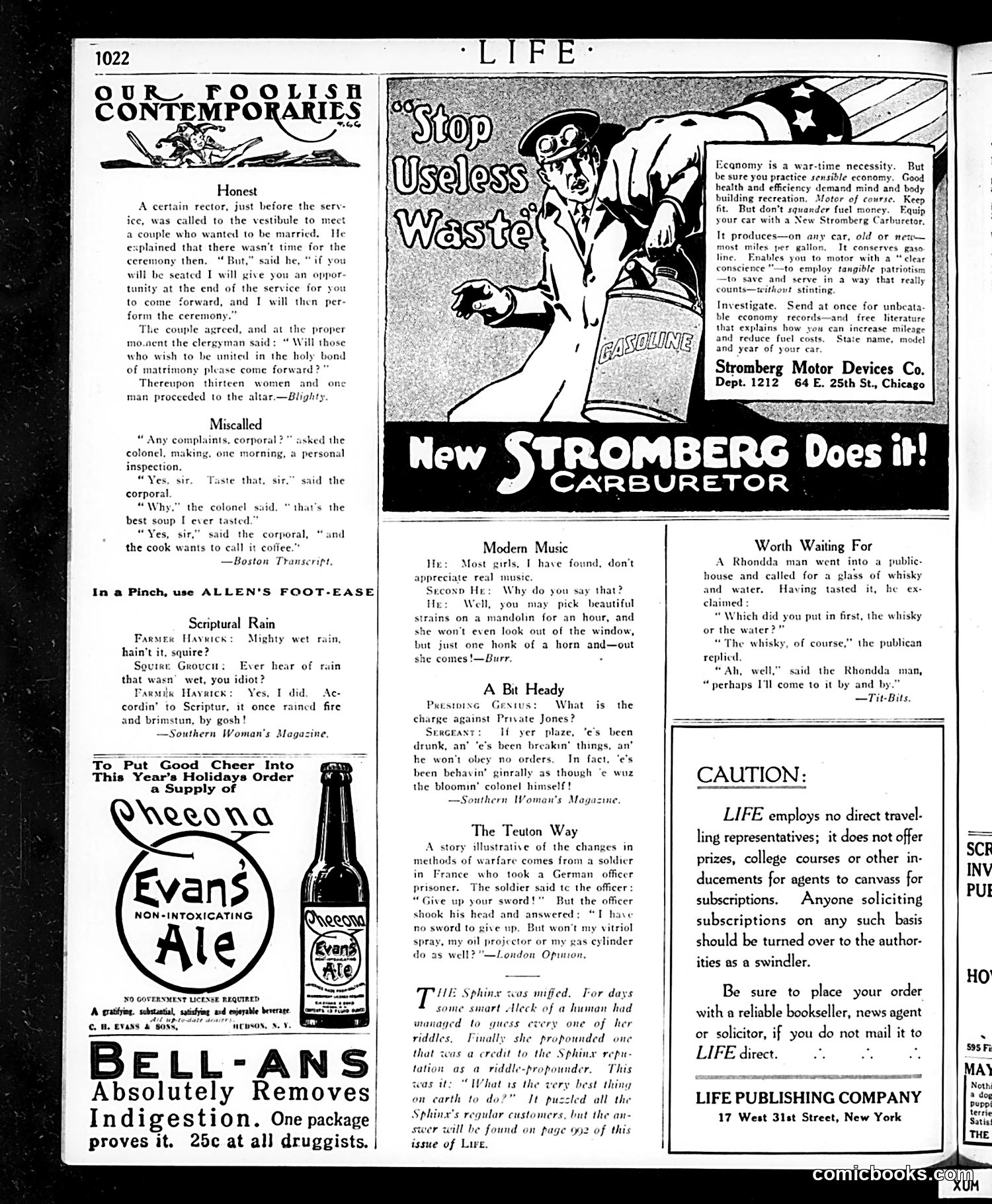
This page from *Life* magazine contains several brief humorous anecdotes and advertisements from approximately 1918-1920 (WWI era). **Main Cartoons/Jokes:** 1. **"Our Foolish Contemporaries"** section includes three short satirical pieces mocking human absurdity: a rector whose marriage ceremony invitation attracts thirteen women and one man (satirizing either marriage desperation or clerical incompetence); a soldier calling "soup" as "coffee" (military food quality joke); and scriptural/rural dialect humor. 2. **The Stromberg Carburetor advertisement** features wartime economy messaging—using fuel efficiency as patriotic duty while still promoting consumption. 3. Various other brief jokes about modern romance, military life, and cultural behavior. **Context:** These are gentle, domestic satires typical of early 20th-century American humor magazines, relying on wordplay, social observation, and irony rather than political commentary. The wartime references suggest publication during or shortly after WWI.
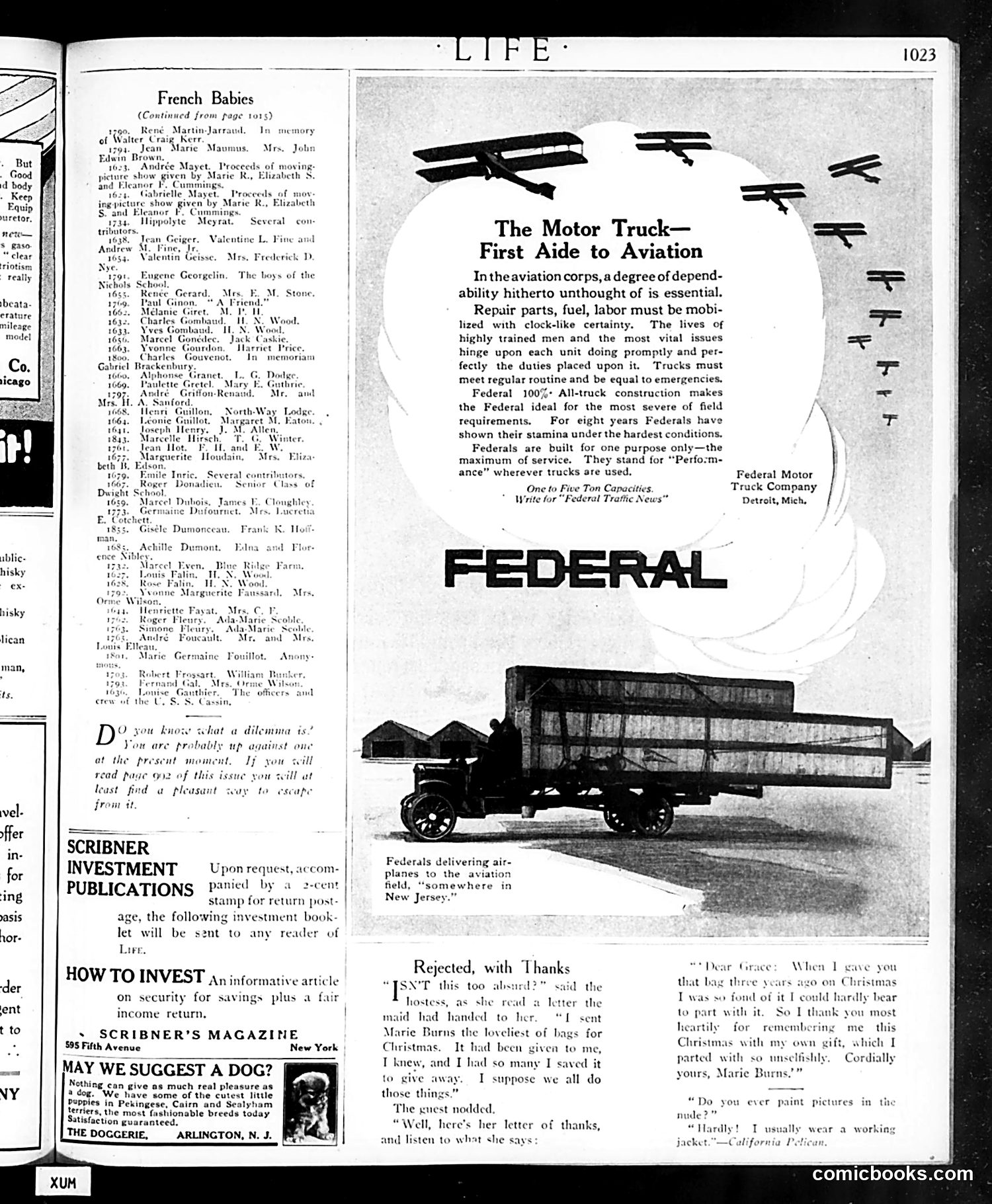
This is a **Federal Motor Truck Company advertisement**, not a political cartoon. The page promotes Federal trucks' essential role in World War I aviation support operations. The ad emphasizes that military aviation depends on reliable truck logistics—transporting repair parts, fuel, and personnel with "clock-like certainty" since "the lives of highly trained men and the most vital issues hinge upon each unit doing promptly and perfectly." The accompanying photograph shows a Federal truck delivering airplane fuselages to an aviation field in New Jersey, illustrating the company's claim that their trucks meet "the most severe of field requirements." This reflects 1917-era patriotic American advertising, positioning commercial vehicles as essential wartime infrastructure. The ad targets business readers of *Life* magazine by framing truck reliability as a matter of national security and military effectiveness.
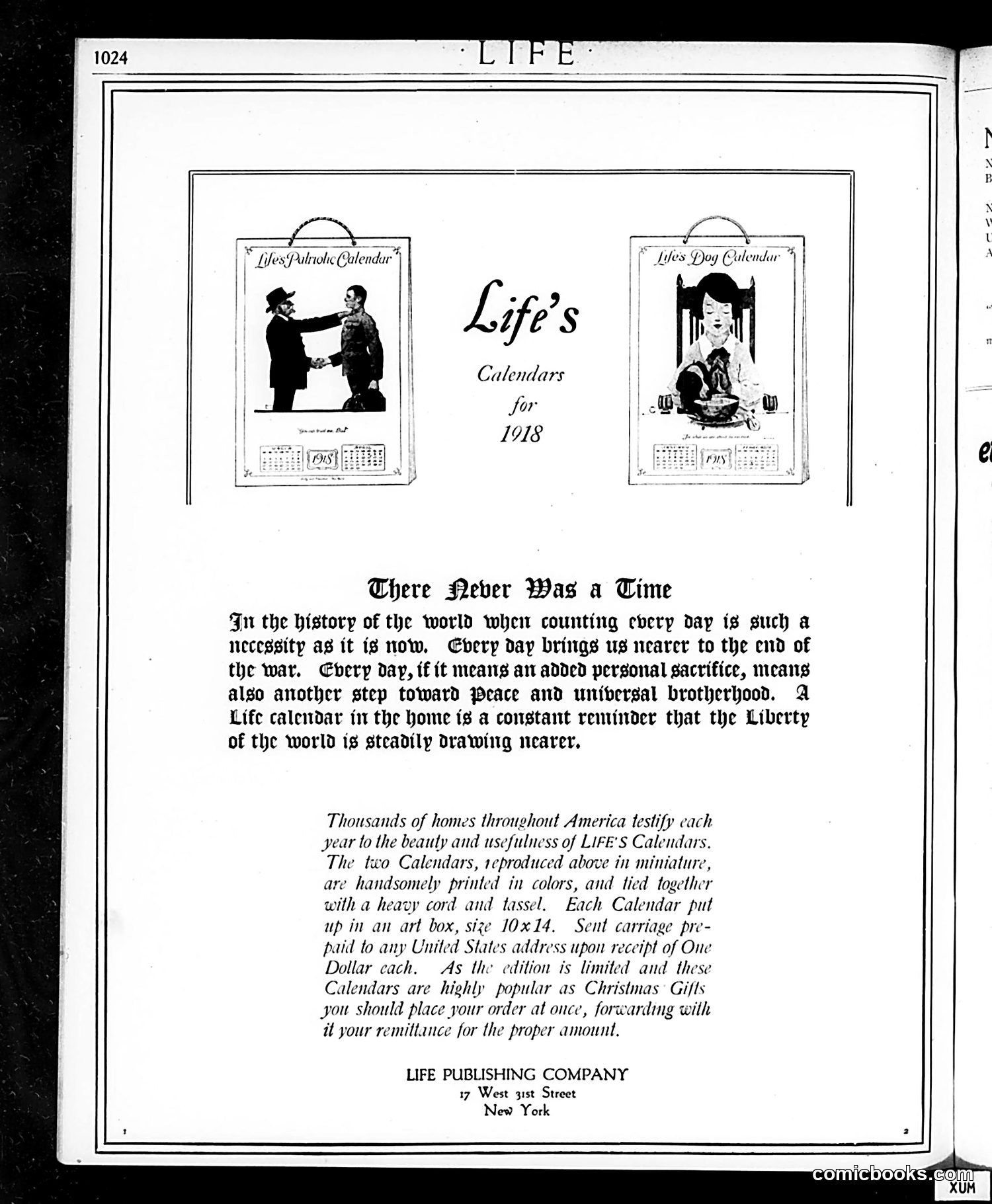
This is primarily an **advertisement**, not a political cartoon. It promotes Life magazine's 1918 calendars featuring two designs: "Life's Patriotic Calendar" (depicting two men in what appears to be a diplomatic handshake) and "Life's Day Calendar" (showing a woman). The ad's text references **World War I**, which the U.S. entered in 1917. The messaging frames daily calendar-counting as a patriotic act—each day brings Americans "nearer to the end of the war" and toward "peace and universal brotherhood." The phrase "Liberty of the world is steadily drawing nearer" appeals to American ideals about the war's purpose. The calendars cost one dollar each and are marketed as **Christmas gifts**. The ad emphasizes their "limited edition," creating urgency for purchase. This reflects how American commercial culture, including magazines, mobilized around World War I messaging during 1918, the final year of the conflict.
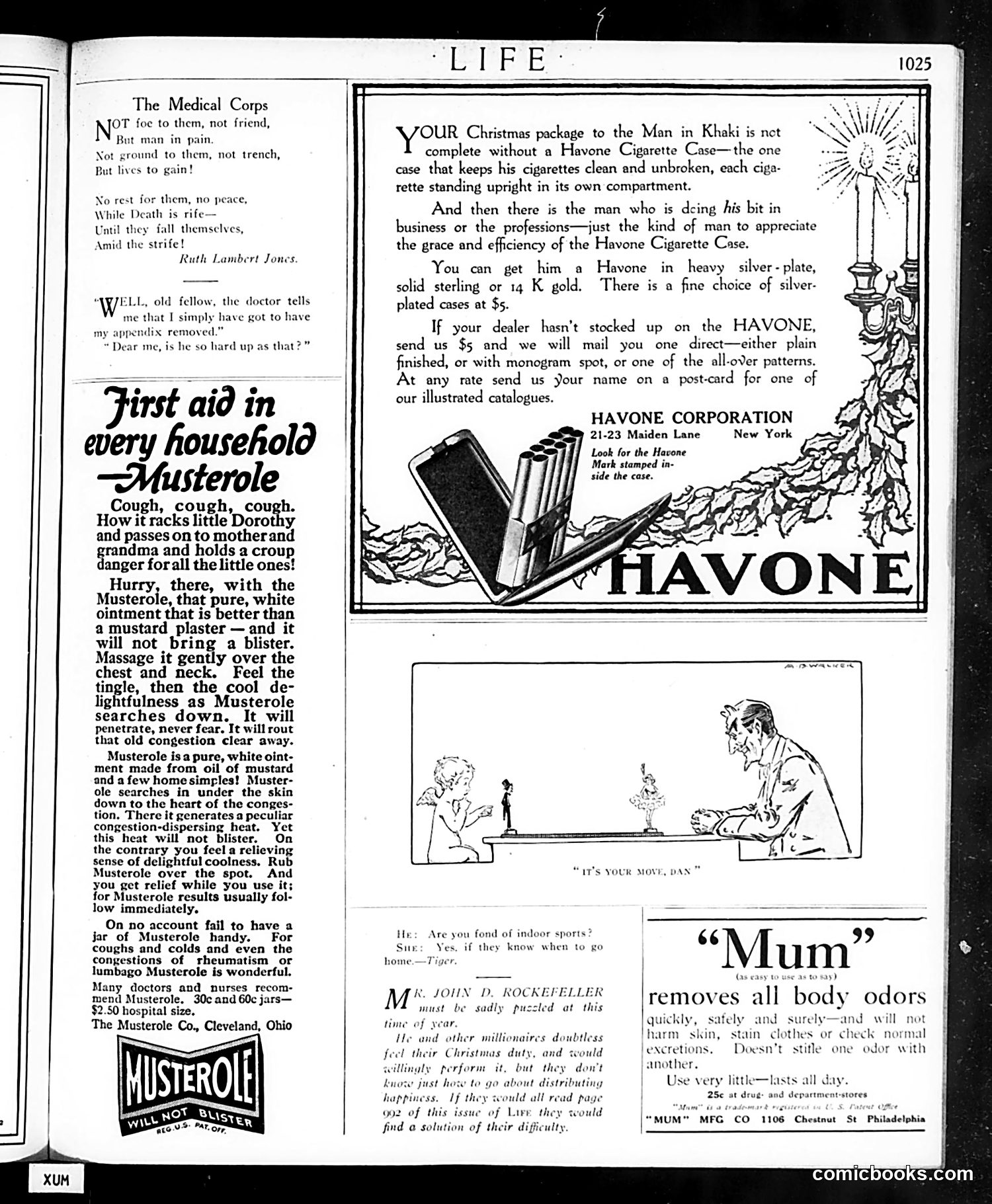
This page contains advertisements and a brief satirical piece rather than a political cartoon. The main content includes: **Advertisements:** - Musterole (chest rub for coughs/congestion) - Havone cigarette cases for soldiers ("the Man in Khaki") - "Mum" deodorant **Satire:** A small joke about John D. Rockefeller (identifiable by name in the text) puzzles over how millionaires should distribute Christmas charity and "happiness" to the poor. The satire's point: wealthy industrialists like Rockefeller are clueless about actually *helping* common people—they know they should perform charitable duty but lack understanding of people's real needs. **Historical Context:** The Havone ad references soldiers in "Khaki," suggesting WWI-era (post-1917). The Rockefeller satire reflects Progressive Era criticism of robber barons and their inadequate philanthropic efforts. The page is primarily commercial, with light satirical commentary typical of Life magazine's format.
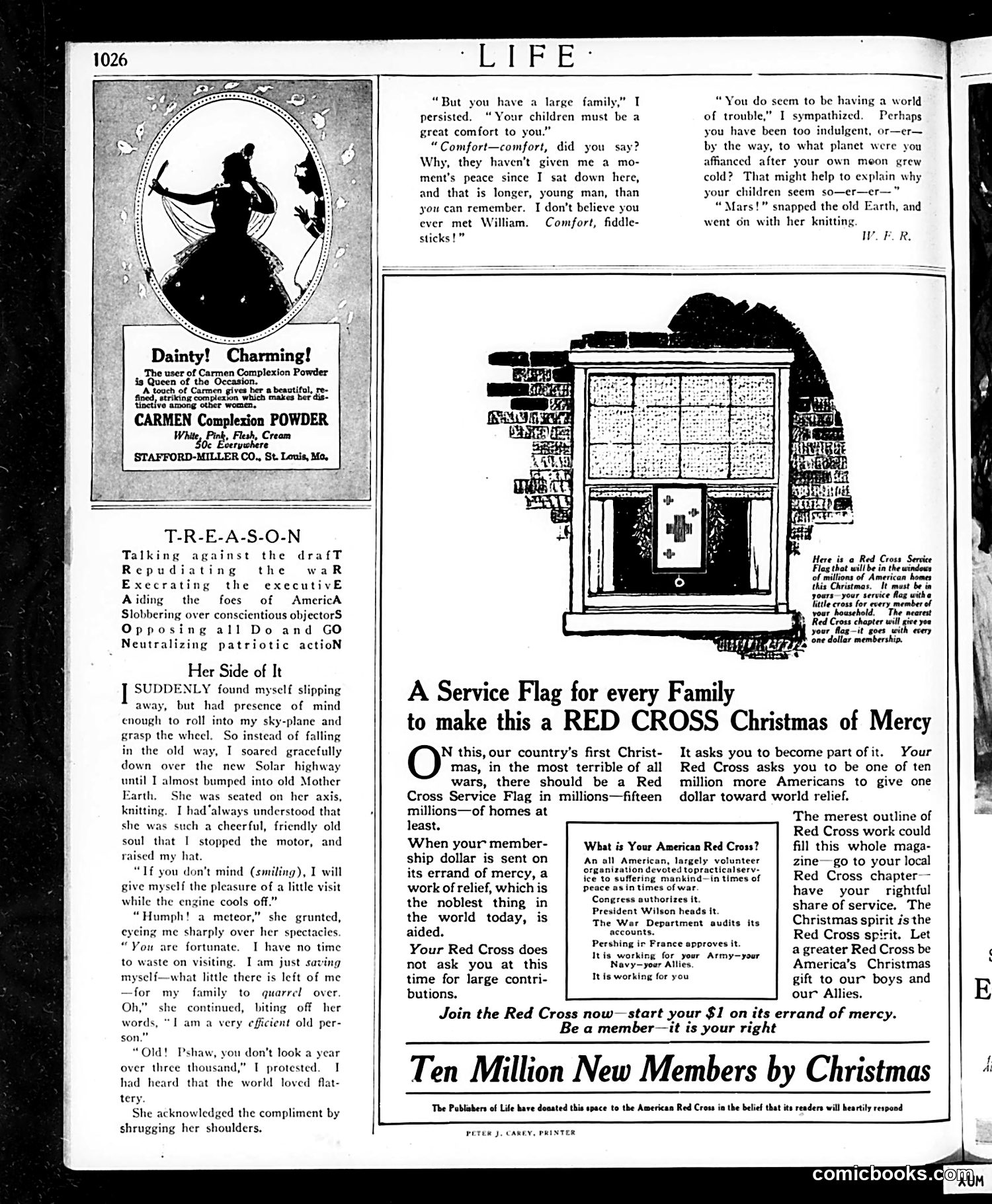
This page blends wartime propaganda with period advertising and fiction. The dominant content is a **Red Cross recruitment drive** urging Americans to purchase $1 memberships, aiming for "ten million new members by Christmas." The service flag graphic (a window display with a cross) signals patriotic home participation in relief work. A smaller section titled **"T-R-E-A-S-O-N"** lists anti-war activities as treasonous—talking against the draft, criticizing the executive, aiding enemy sympathizers—reflecting intense WWI-era intolerance of dissent. This appears designed to shame potential war critics. The fictional narrative "Her Side of It" depicts Earth herself as exhausted by quarreling "children" (nations), offering satirical commentary on global conflict through personification. A Carmen Complexion Powder advertisement occupies the upper left, typical period marketing unrelated to the page's political content. The overall message: American citizens should financially support the Red Cross and suppress anti-war sentiment as patriotic duty during the First World War.
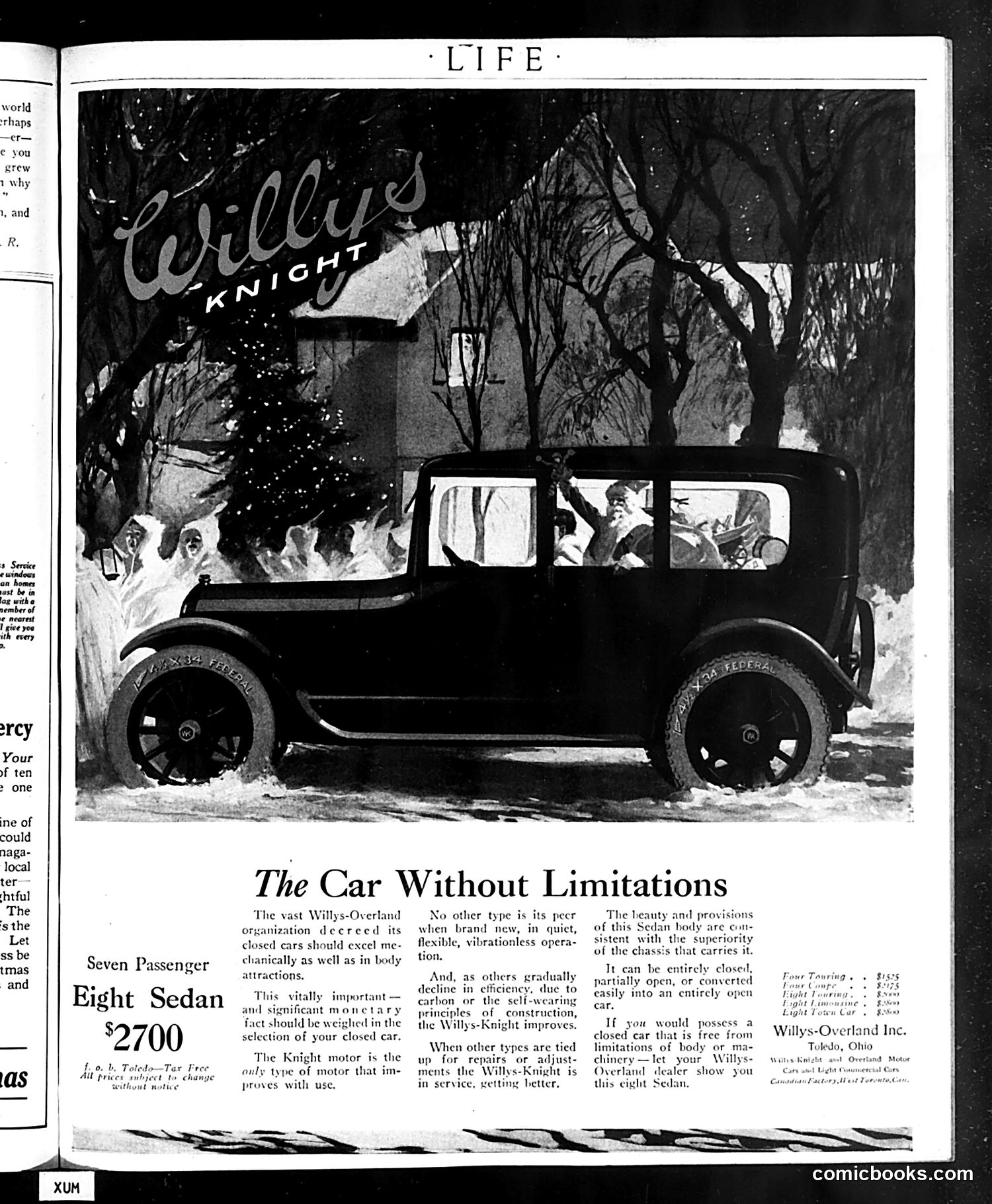
This is **not a political cartoon or satire**, but rather a **straight automobile advertisement** for the Willys-Overland Eight Sedan, priced at $2,700. The page promotes the car as "The Car Without Limitations," emphasizing its mechanical reliability (the Knight motor "improves with use"), flexible body design (can be "entirely or partially open, or converted"), and superior construction compared to competing types. The illustration shows the sedan in an idyllic rural setting with bare trees and a cottage, suggesting reliability and countryside capability. The accompanying text makes technical claims about durability and performance advantages. This represents typical early-1920s automotive advertising strategy: positioning a mid-priced vehicle as mechanically superior and versatile for American consumers seeking practical, durable transportation. There is no satirical intent or political commentary evident.
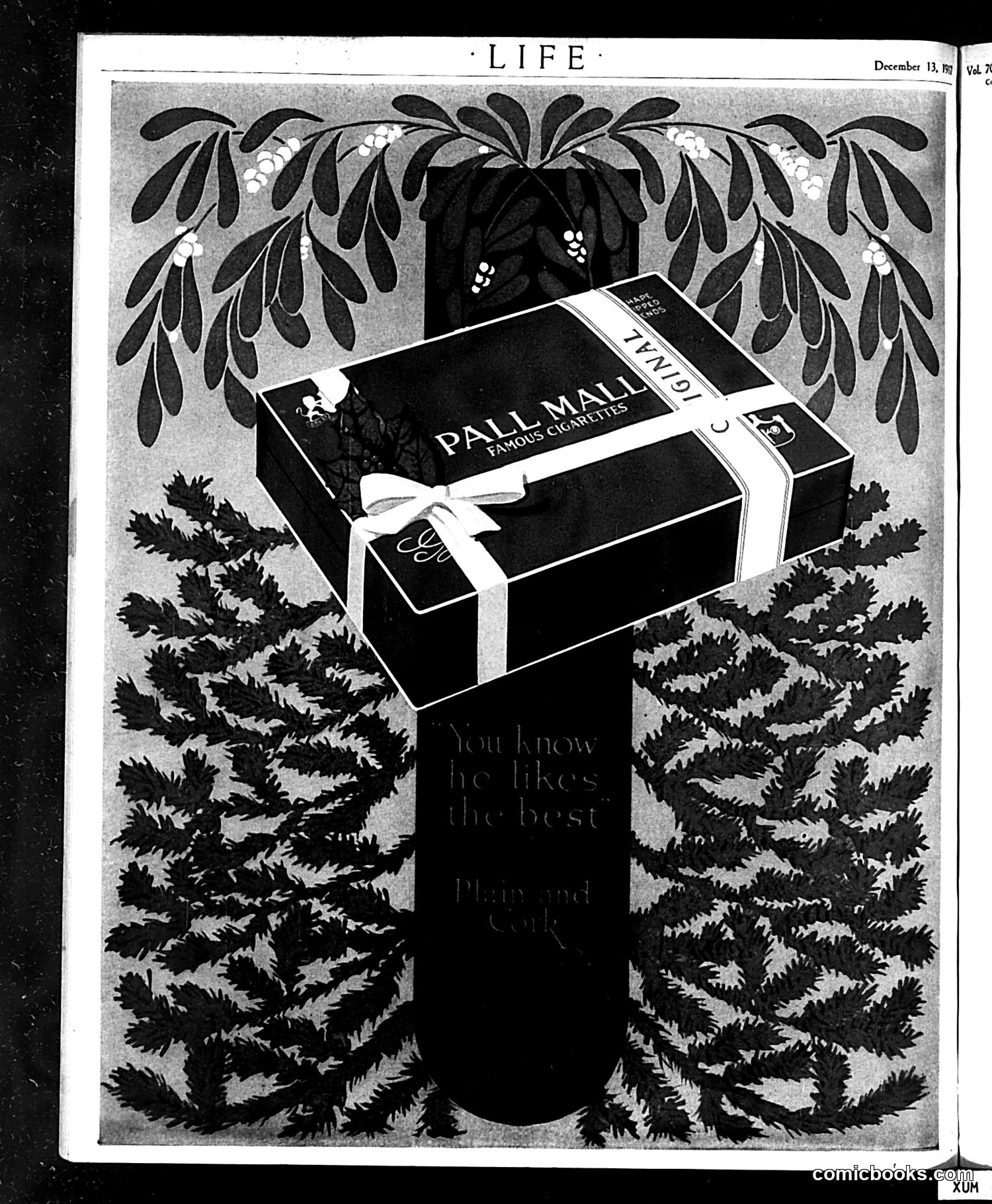
This is a **commercial advertisement**, not political satire. The page promotes Pall Mall "Famous Cigarettes" through a festive holiday design featuring: - A black gift box with white ribbon, positioned as the focal point - Decorative evergreen garland and hanging mistletoe above - Text stating "You know he likes the best" and crediting "Pllan and Cott" (likely the ad creators) The advertisement suggests cigarettes as an upscale Christmas gift for men. The phrase "You know he likes the best" appeals to gift-givers seeking premium products. The elegant black-and-white design and holiday framing were typical luxury marketing strategies in early 20th-century magazines, when cigarette advertising was common and largely unregulated.