
Life, 1917-12-13 · page 19 of 40
Life — December 13, 1917 — page 19: what you’re looking at
What you’re looking at
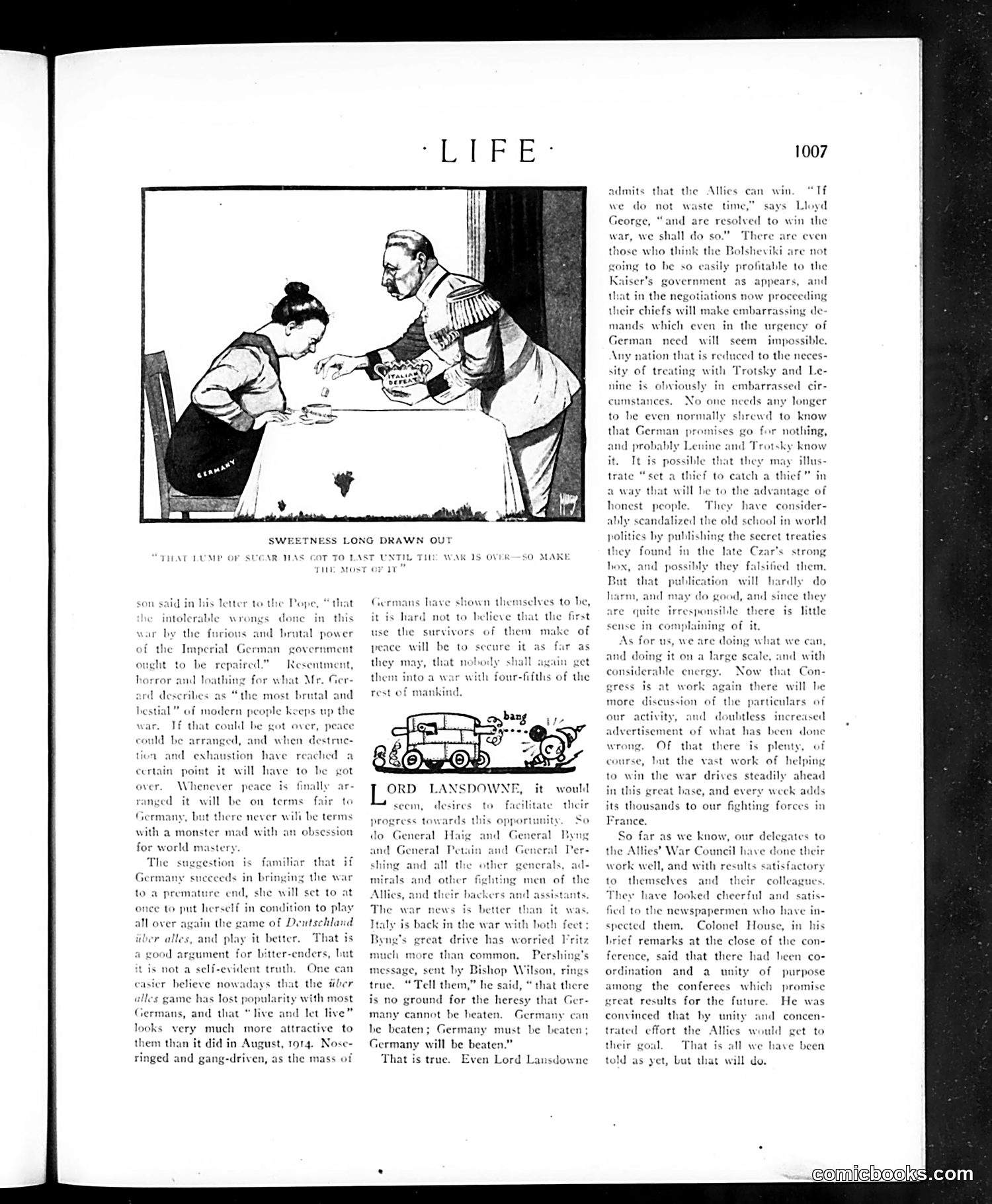
This cartoon depicts peace negotiations during World War I. The image shows a military officer (likely representing Allied leadership) offering sugar to a seated woman labeled "Germany"—a visual metaphor for sweetening peace terms. The accompanying text discusses whether Germany, if granted premature peace, would genuinely reform or simply rearm for future conquest. It references Lord Lansdowne's peace proposals and debates among Allied leaders (Haig, Pershing, Petain) about continuing the war. The satire's point: Germany cannot be trusted with leniency. The "lump of sugar" represents soft peace terms that might seem appealing but would merely extend German appetite for dominance. The title suggests such sweetness would be "long drawn out"—prolonging the problem rather than solving it. The text emphasizes that only complete German defeat ensures lasting peace, and that negotiating with the Bolsheviks (newly in power) introduces additional complications to Allied strategy.
📄 Transcribed text from this page (OCR, searchable)
Machine-transcribed from the original scan — historical spelling and the odd misread are preserved.
— SWEETNESS LONG DRAWN OUT THAT LUMP OF SUGAR IAS COT T LAST UNTIL TH WAK 1S OV IST OF IT that wrongs done ir is son said in his letter to the Pope, ‘ © intolerable ur by the furious and brutal power Imperial German ought to be repaired.” of the government Kesentmer I loathing for what Mr. Ger- s “the most brutal and horror a ard describes hestial ” of me If that could be got over, peace d, and when destruc- ern people keeps up the could be array tien and exhaustion have reached a certain point it will have to he got Whenever ill be on peace is finally ar- terms f over. ranged it Germany, but there never wilt be terms with a monster mad with cession for world mastery that zing the war The suggestion is familiar Germany succeeds in br to a premature end, she will set to at once to put herself in condition to play ain the game of Dentschland iiber alles, and play it better. That is r bitter-enders, but all over i good argument f it is not a self-evident truth, One casier believe nowadays that the tiber alles Germans, and that * looks very much them than it did in August, 1914. Nose- ringed and gang-driven, as the mass of ame has lost popularity with most live and let live” more attractive to Germans have shown themselves to he, it is hard not to believe that the first make of far as survivors of them it as use the peace will be to secu they may, that nobo: the I h four-fifths of the all again get LANSDOWNE, it desires to facilitate would Lor seem, their do General Haig and General Byn and General Petain and General shing and all the other mirals and other Allies, and their backers a The tter than it was Italy is back in th t drive has worried Fritz Pershi ressage, sent by Bishop Wilson, 4 true, “Tell them,” he said, “that there is no ground for the heresy that Ger- many cannot be heaten, Germany can war news is 1 war with both fee Byng’s gre ch more than common, he beaten; Germany must be beaten; Germany will be beat That is true. Even Lord Lansdowne 1007 “Tf Lloyd Allies can win. time,” admits that the we do not waste says George, “and are resolved to win the w we shall do so.” There are even those who think the Bolsheviki are not going to be so easily profitable to the Kaiser's government as appears, and that in the negotiations now proceeding their chiefs will make embarrassing de mands which even in the urgency of will seem impossible. German need Any nation that is reduced to the nec sity of treating with Trotsky and Le- nine is of yin embarrassed cir- » one needs any longer to be even normally to know that German promises go for nothing, sky know cumstances. > shrewd id probably Lenine and Tr« Tt is possible that they may illus- trate “ a way that will he to the honest people. They ably scandalized the old set a thief to catch a thief" in politics by publishing the secret treaties they found in the late Czar’s hox, and possibly they fa But that jon will harm, and may do good, and since they little strong ified them publi hardly do are quite irresponsible there is g of it. As for us, we are ¢ sense in complain ding what we can and doing it on a large scale, and with Now that Con- there conside! gress i. work again will he more discussion of the particulars of our activity, and doubtless increased advertisement of what has been done wrong, OF that there is plenty, of it the vast work of helping steadily ahead course, to win the war drives in this great base, and every week adds its thousands France. So fara the Allies’ War Council have « work well, and with results satisf, ne their clory their col Aes. rful and satis- to themselves and They have looked che fied to the newspapermen who have in- spected them. Colonel House, in his Irief remarks at the close of the con- e, said that there had heen co- ation and a unity o among the conferees which promise eat results for the future. He was convinced that by unity and concen- trated effort the Allies would get to their goal. = That is told as yet, Lut that will do. feret ordi purpose ll we have been