
Life, 1917-12-13 · page 18 of 40
Life — December 13, 1917 — page 18: what you’re looking at
What you’re looking at
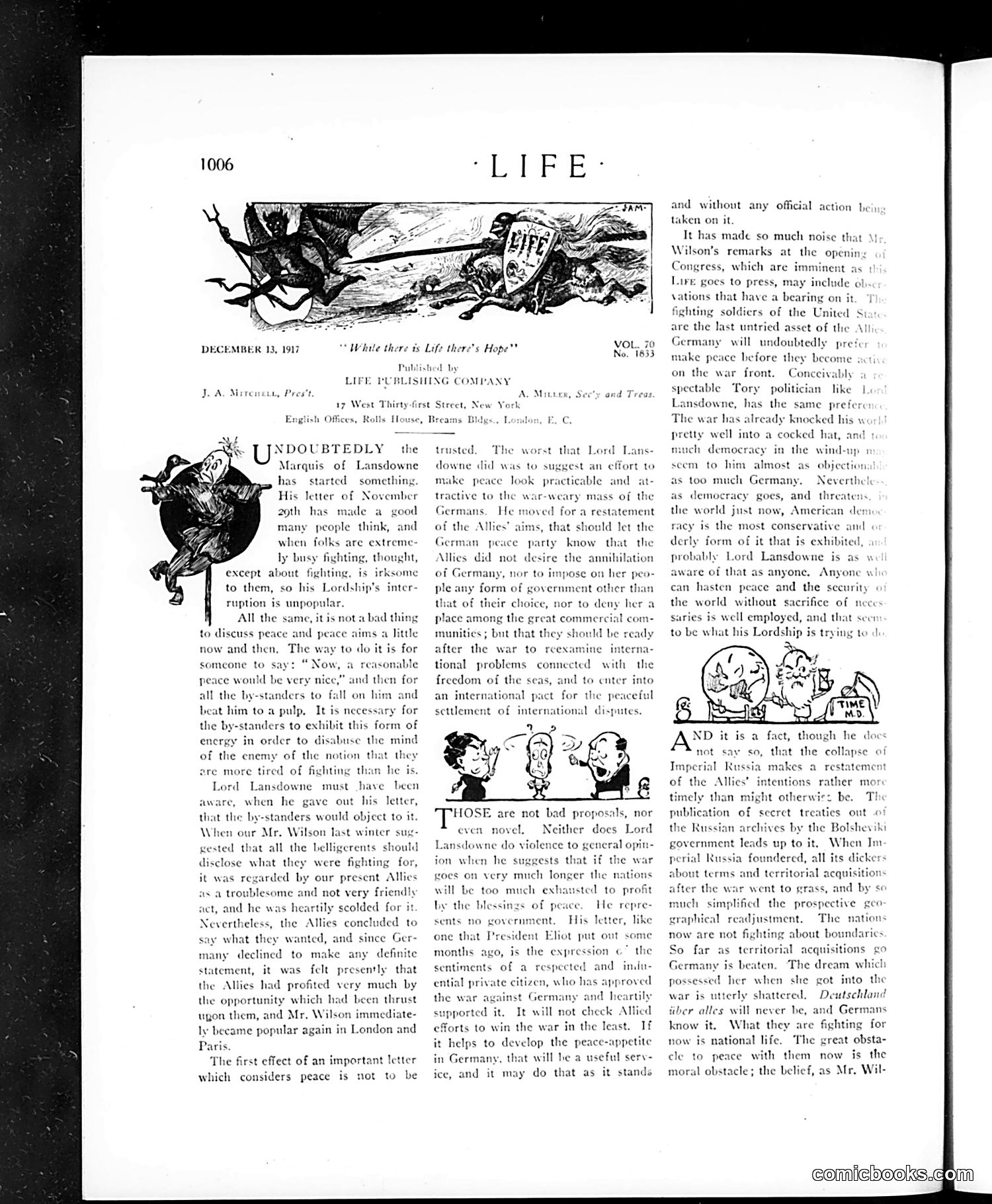
This page discusses the Marquis of Lansdowne's recent letter proposing peace negotiations during World War I. The cartoons and text satirize public reaction to his "troublemaking." **The central joke**: When someone suggests discussing peace terms, the public beats them "to a pulp"—they're so committed to fighting that even reasonable peace proposals become unpopular. The text notes this happened when President Wilson previously suggested belligerents state their war aims; he was initially criticized but later became popular when the Allies benefited from clarifying their position. **Lansdowne's proposal** wasn't radical—he simply urged stating that the Allies didn't seek to annihilate Germany or impose unwanted governments. The satire targets the *hysteria* surrounding peace talk rather than endorsing pacifism. The piece suggests discussing peace terms rationally isn't inherently defeatist, and that a war-exhausted Germany might respond to reasonable proposals. The cartoons (showing figures being attacked for suggesting peace) visually reinforce this theme of public intolerance for peace discussion during wartime.
📄 Transcribed text from this page (OCR, searchable)
Machine-transcribed from the original scan — historical spelling and the odd misread are preserved.
DECEMBER 13, 1917 “While there ts Pub LIFE Ly Pres’. J. A. Miter Life shed by PUBLISHING COMPANY 17 West Thirty-first Street nglish Offices, NDOUBTEDLY Marquis of Lansdowne the has started something. His letter of November 2oth has made a good many people think, and when folks are extreme ly busy fighting, thought, except about fighting, is irksome to them, so his Lordship’s inter ruption is unpopular All the same, to discuss peace now and then, The way to do it is for someone to say: “ Now, nd peace aims a little "and then for and y for peace would be very nice, all the by-standers to fall on hin beat him to a pulp. the by-standers to exhibit this form of energy in order to disabuse the mind of the enemy of the notion that they red of fighting than he must been letter, It is necess: are more Lord Lansdowne aware, when that the by-standers would object to it. When our Mr. Wilson last winter sug- gested that all the belligerents should disclose what they were fighting f it was regarded by our present Allies us a troublesome and not very friendly nd he was heartily scolded for ded to have he gave out his evertheless, the Alli say what they wanted, and since Ger- many declined to make any definite conel: statement, it was felt presently that the Allies had profited very much by the opportunity which had been thrust ugon them, and Mr. Wilson immediate- ly became popular again in London and Paris. The first effect considers of an important letter which peace is not to be ‘lls House, Breains The downe did was to suggest an effort trusted. that Lord Lans- peace look practicable and at- ve to the war-weary mass of the He moved for a restatement Allies’ aims, that should let the peace that the Mies did not desire the annihilation Germans of the German party know of Germany, nor to impose on her peo- ple any form of at of their choice, nor to deny her overnment other than P among the great commercial com- munities; but that they should be ready after the war to reexw tional problems connected freedom of the seas, and t an international pact for the peaceful ine inter with the enter into, settlement of international disputes. HOSE are not bad proposals, nor even novel, Neither does Lord Lansdowne do violence to general opin- ion w he suggests that if the war goes on very much longer the nations will be too much exhausted to profit of peace. He repre- His letter, like by the blessin sents no one that President Eliot put ot months ago, is the of a respecte government. expression « sentime and indu- ¢ private citizen, who has approved the war against Germany and heartily supported it. It will not Mllicd ‘orts to win the war in the least. If it helps to develop the peace-appetite in Germany. that will he a useful serv- it stands eck ice, and it may do that and without any official action 1x taken on it. It has made so much noise that \ Wilson’s remark the openin: Congress, which are imminent as Lire goes to press, may include o} vations that have a bearing on it fighting soldiers of the United Si are the last untried asset of the Germany will undoubtedly pre make peace before they become Conceivably like | prefe The war has already knocked his on the war front. spectable Tory politician Lansdowne, has the same pretty well into a cocked hat, much democracy in the wind-up scem to him almost as objection rmany. Neverthe! as democracy goes, and threate: the world just now, American dem as too much racy is the most conservative and derly form of it that is exhibited probably Lord Lansdowne is as \ aware of that as anyone. Anyone « can hasten peace and the security « the world without sacrifice of necc suries is well employed, and that seer to be what his Lordship is trying to d ND it is a fact, though he doc not Imper say so, that the collapse of 1 Russia restateme of the Allies’ intentions rather mor mely than might otherwie: be. TI publication of secret treaties out « the Russian archives by the Bolsheviki government leads up to it, When Im perial Russia foundered, all its dickers about terms and territorial acqui fter the war went to grass, and by se ified the prospective Ijustment. The about boundaries much simp! graphical re nations now are not fig z So far as territorial acquisitions go Germany is beaten, The dream whicl essed her when she got into the Deutschlav r alles will never be, and Germans know it. What they are fighting for now is national life. The great obsta- cle to peace with them moral obstacle; the belief, as Mr. Wil- pos war utterly shattered. now is the comichooks.qom