
Life, 1917-12-13 · page 3 of 40
Life — December 13, 1917 — page 3: what you’re looking at
What you’re looking at
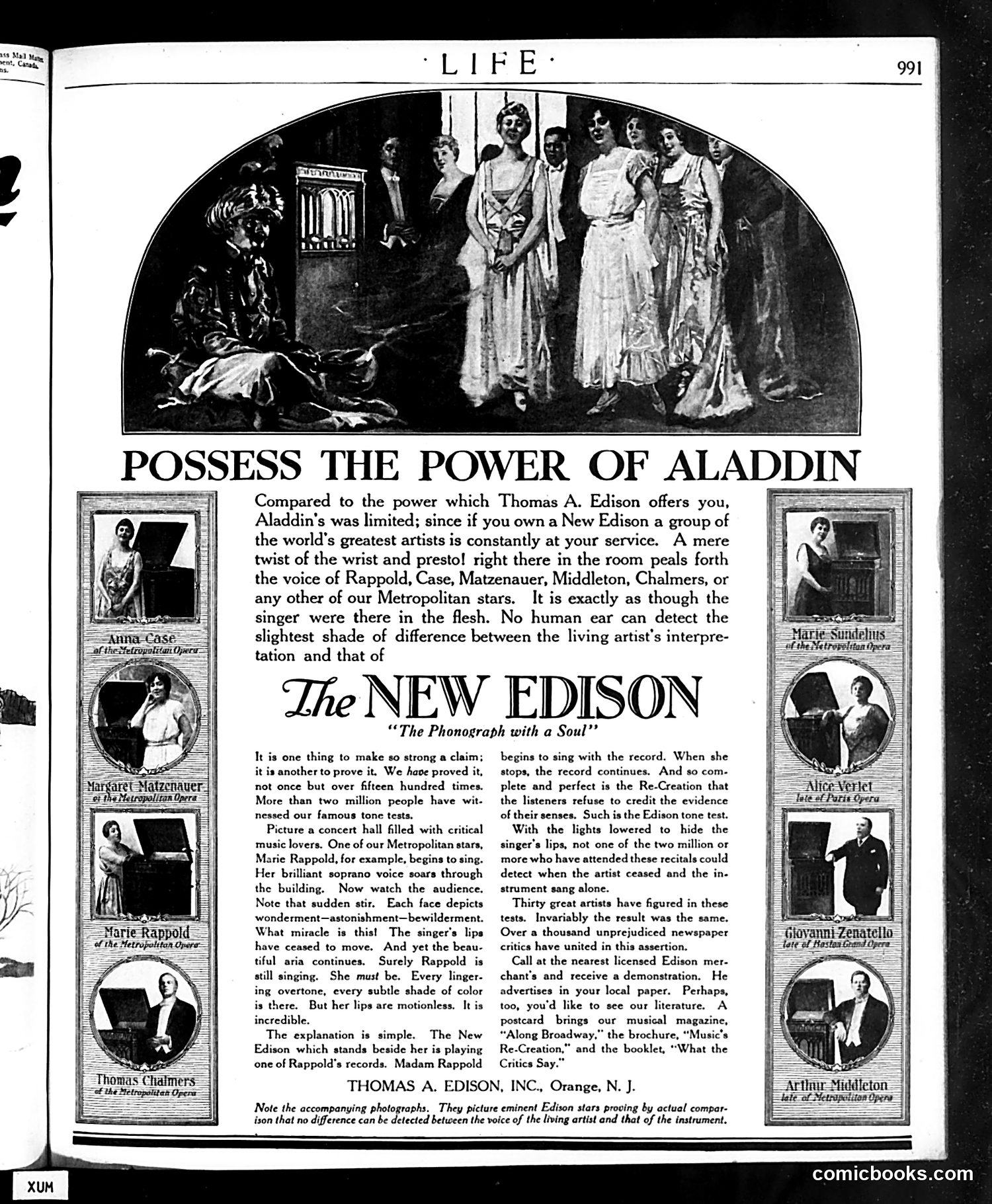
This is primarily a **Thomas Edison phonograph advertisement**, not political satire. It appears from Life magazine (page 991) and promotes Edison's latest "New Edison" phonograph model. The ad claims the device reproduces opera singers' voices so perfectly that listeners cannot distinguish the recorded performance from a live artist. It references famous Metropolitan Opera performers including Anna Case, Marie Rappold, and others shown in circular portraits on the left side. The satirical angle is subtle: the advertisement's hyperbolic claim—that the machine's reproduction is indistinguishable from reality—is presented as established fact through purported "tone tests" with newspaper critics. The ad implies Edison technology rivals actual human artistry, which is both the product's selling point and the basis for any satire about technology replacing live performance.
📄 Transcribed text from this page (OCR, searchable)
Machine-transcribed from the original scan — historical spelling and the odd misread are preserved.
Compared to the power which Thomas A. Edison offers you, Aladdin's was limited; since if you own a New Edison a group of the world’s greatest artists is constantly at your service. A mere twist of the wrist and presto! right there in the room peals forth the voice of Rappold, Case, Matzenauer, Middleton, Chalmers, or any other of our Metropolitan stars. It is exactly as though the singer were there in the flesh. No human ear can detect the slightest shade of difference between the living artist's interpre- tation and that of Lhe NEW EDISON “The Phonograph with a Soul” It is one thing to make so strong a claim; it is another to prove it, We have proved it, not once but over fifteen hundred times. More than two million people have wit- nessed our famous tonc tests. Picture a concert hall filled with critical music lovers. One of our Metropolitan stars, Marie Rappold, for example, begins to sing. Her brilliant soprano voice soars through the building. Now watch the audience. Note that sudden stir. Each face depicts wonderment—astonishment—bewilderment. What miracle is this! The singer's lips have ceased to move. And yet the beau- tiful aria continues. Surely Rappold is still singing. She must be. Every linger- ing overtone, every subtle shade of color is there. But her lips are motionless. It is incredible. The explanation is simple. The New Edison which stands beside her is playing one of Rappold’s records. Madam Rappold begins to sing with the record. When she stops, the record continues. And so com- plete and perfect is the Re-Creation that the listeners refuse to credit the evidence of their senses. Such is the Edison tone test. With the lights lowered to hide the singer's lips, not one of the two million or more who have attended these recitals could detect when the artist ceased and the in- strument sang alone. Thirty great artists have figured in these tests. Invariably the result was the same. Over a thousand unprejudiced newspaper critics have united in this assertion. Call at the nearest licensed Edison mer- chant’s and receive a demonstration. He advertises in your local paper. Perhaps, too, you'd like to see our literature. A postcard brings our musical magazine, “Along Broadway,” the brochure, “Music's Re-Creation,” and the booklet, “What the Critics Say.” THOMAS A. EDISON, INC., Orange, N. J. Note the accompanying photographs. They picture eminent Edison stars proving by actual compar- ison that no difference can be detected between the voice of the living artist and that of the instrument. comicbooks.com