
A complete issue · 44 pages · 1917
Life — October 25, 1917
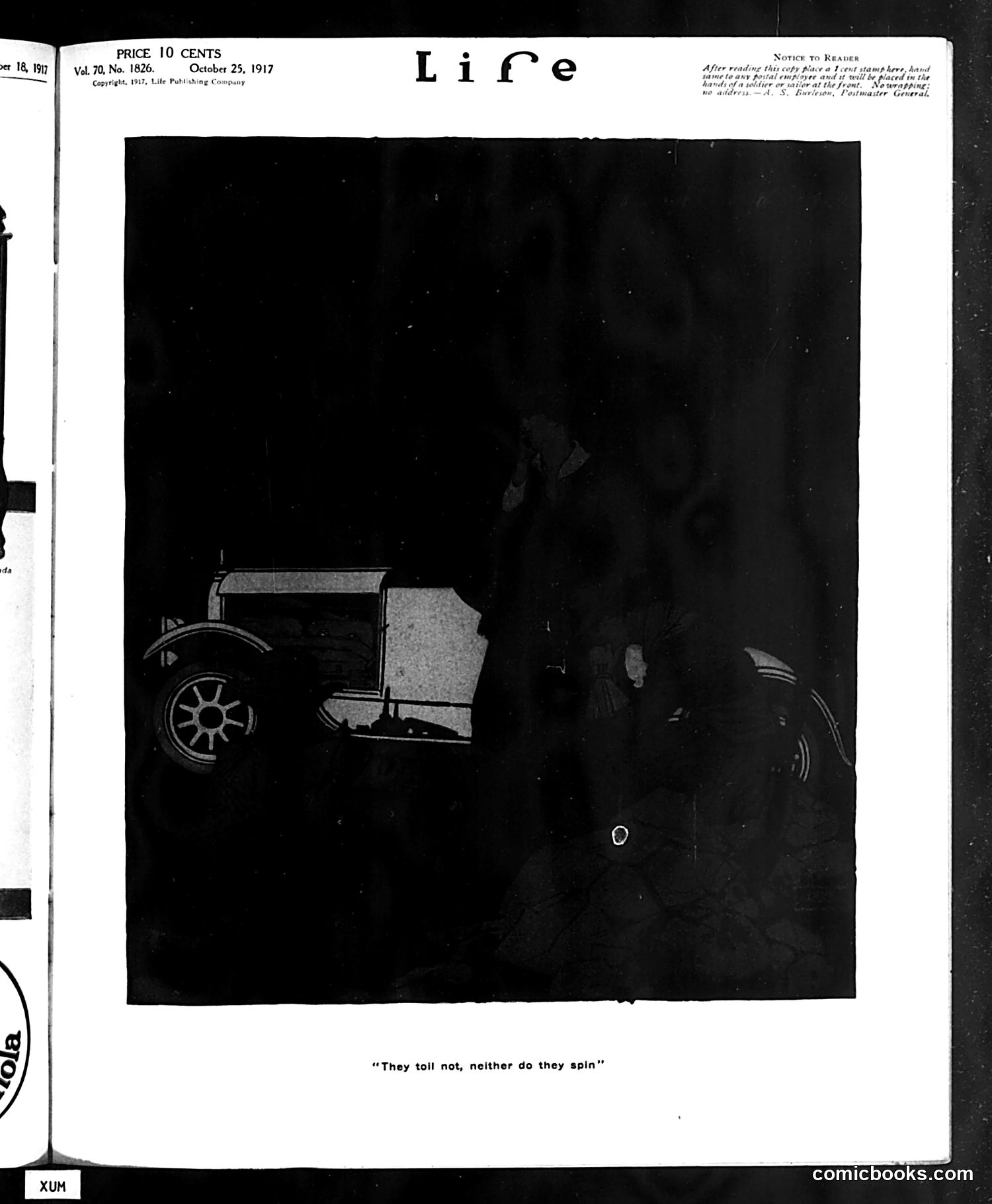
This cartoon depicts two early automobiles positioned side-by-side against a dark background, with the caption "They toil not, neither do they spin." The caption is a biblical reference (Matthew 6:28) about lilies of the field—things that exist without labor. The joke appears to satirize automobiles (or perhaps their owners) as idle luxuries that serve no productive purpose, merely consuming resources. Given the October 1917 date—during America's World War I involvement—this likely critiques automobile ownership as wasteful consumption during wartime, when resources should be directed toward military production and national sacrifice. The cartoon mocks the frivolity of maintaining personal vehicles while the nation mobilizes for war.
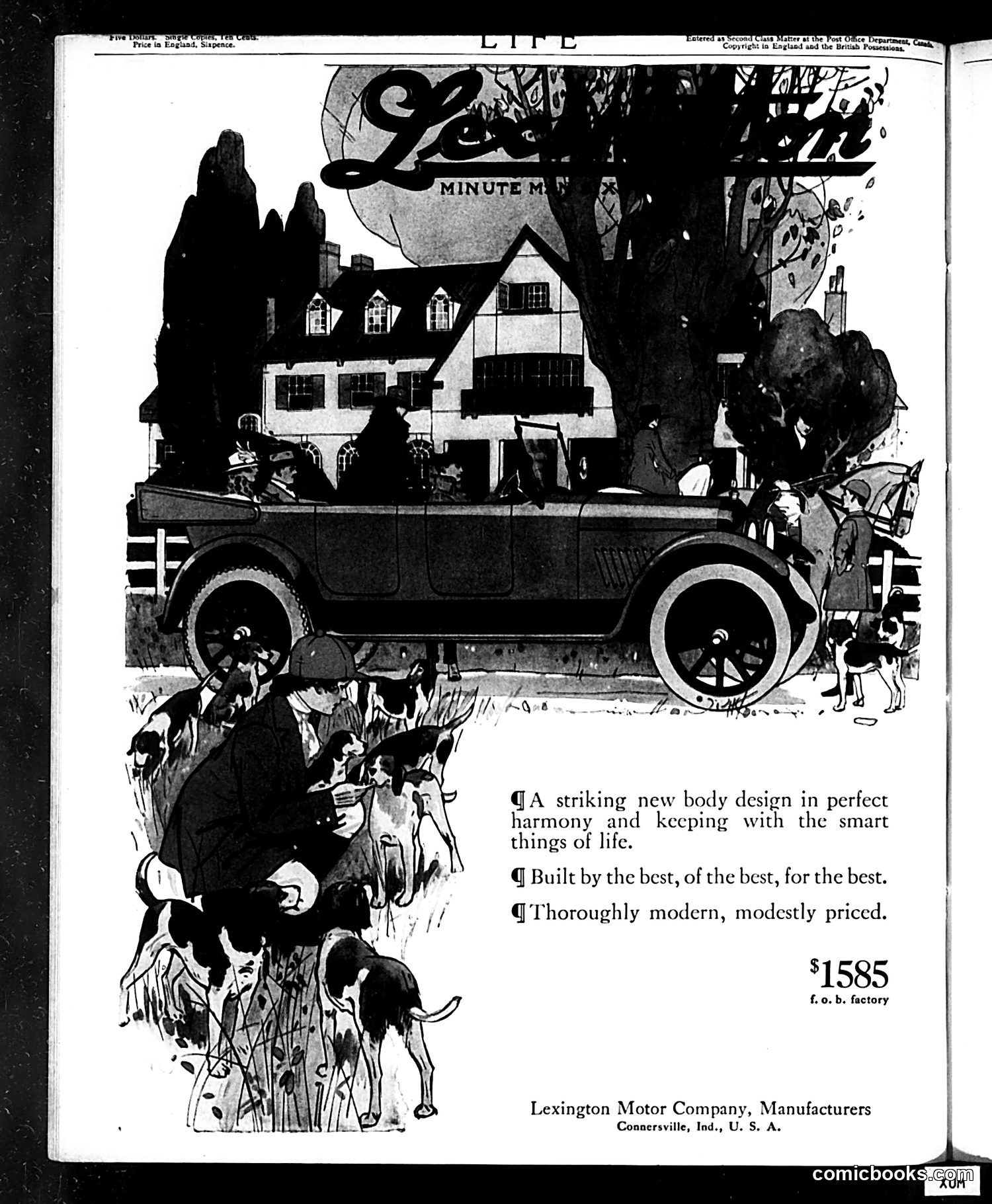
This page is primarily an **advertisement** for the Lexington Motor Company's automobile, not political satire. The ad appears in *Life* magazine and showcases a car with the tagline "A striking new body design in perfect harmony and keeping with the smart things of life." The illustration uses whimsical artistic framing—showing the car emerging from a countryside scene with a house, trees, and rural figures (hunters or farmers with dogs)—to suggest the vehicle suits modern life while maintaining connection to traditional values. The copy emphasizes the car is "Built by the best, of the best, for the best" and "Thoroughly modern, modestly priced" at $1585 f.o.b. factory. This is straightforward product marketing rather than political commentary or satire.
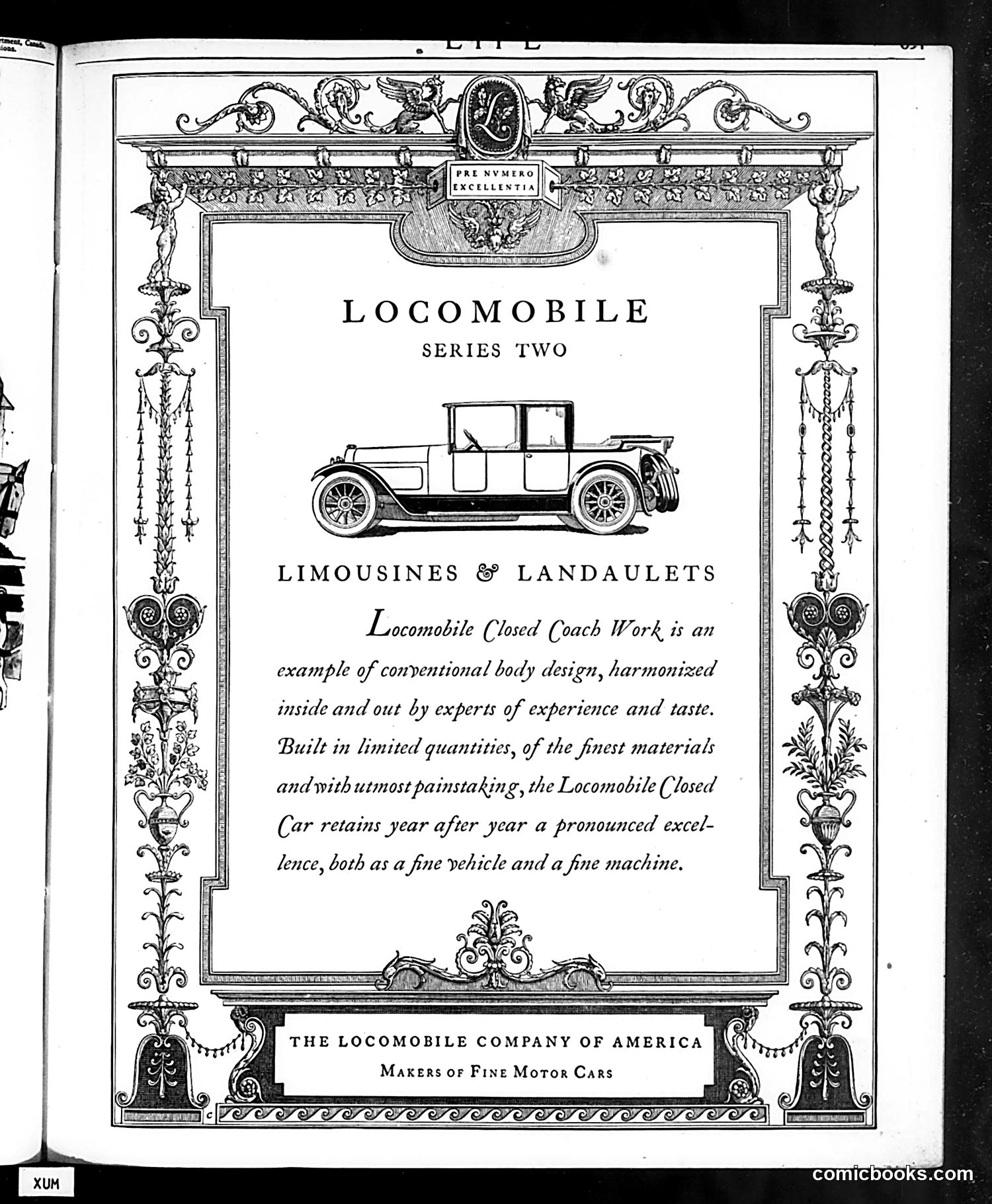
This is not a cartoon or satire—it's a **full-page advertisement for the Locomobile Company of America**, a luxury automobile manufacturer. The page features an ornate decorative border in classical style and an illustration of a touring car labeled "Limousines & Landaulets." The text promotes the Locomobile's craftsmanship, claiming it represents "conventional body design, harmonized inside and out by experts of experience and taste" and is "built in limited quantities, of the finest materials." The ad emphasizes exclusivity and lasting quality—that the car "retains year after year a pronounced excellence, both as a fine vehicle and a fine machine." This reflects early 20th-century luxury marketing that positioned automobiles as refined, prestigious goods comparable to fine art or machinery.
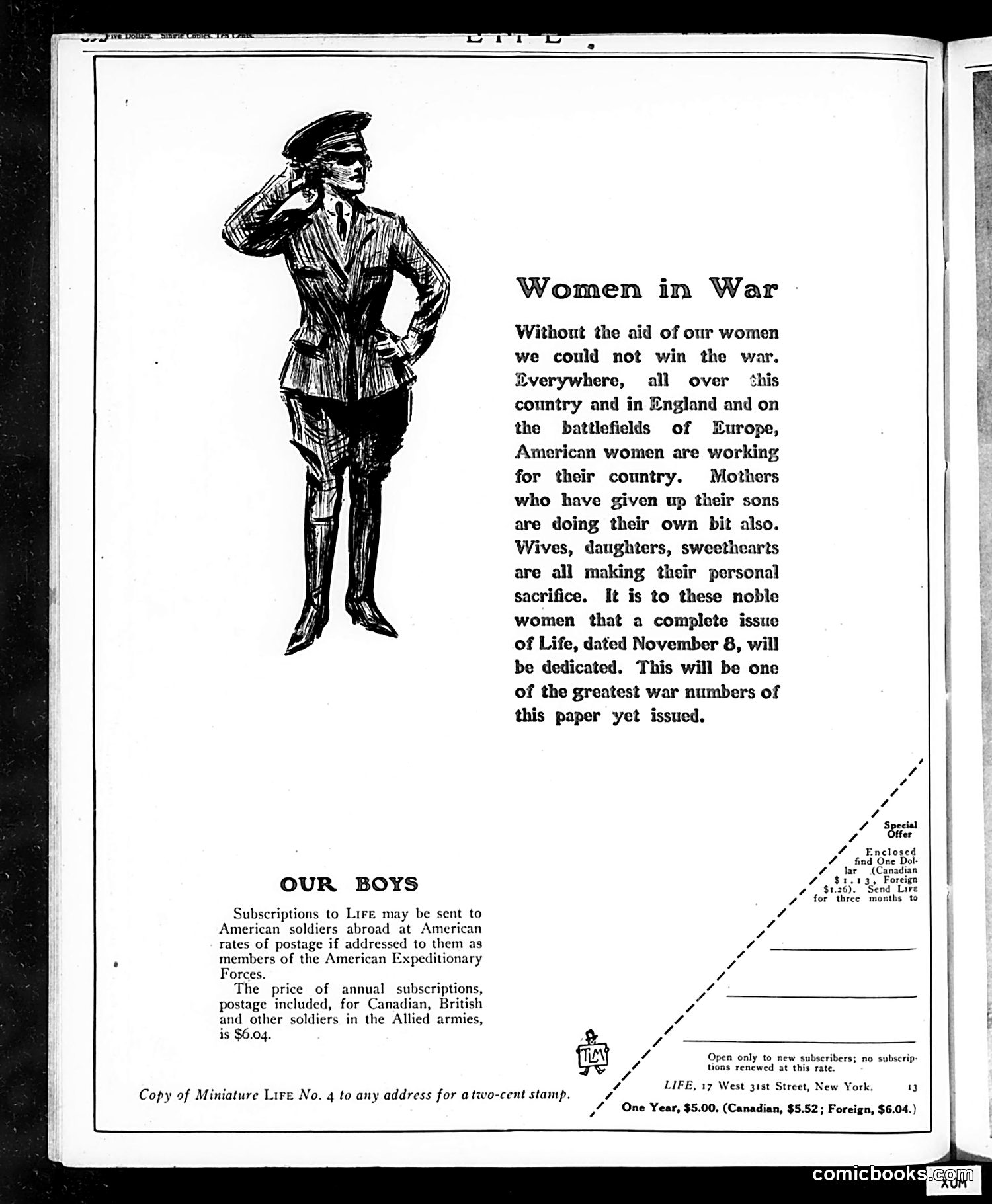
This page celebrates women's contributions to World War I. The illustration shows a woman in military-style uniform with cap and boots, standing at attention—a striking image for the era, as women were not yet formally integrated into the armed forces. The text emphasizes women's sacrifices: mothers who lost sons, wives and daughters working in support roles across America and Allied nations. Life magazine is announcing a special November 6 issue dedicated entirely to these women's war efforts. The "Our Boys" section below promotes Life subscriptions for American soldiers abroad, establishing the magazine's patriotic mission during wartime. This reflects how WWI mobilized entire populations, including women in unprecedented ways.
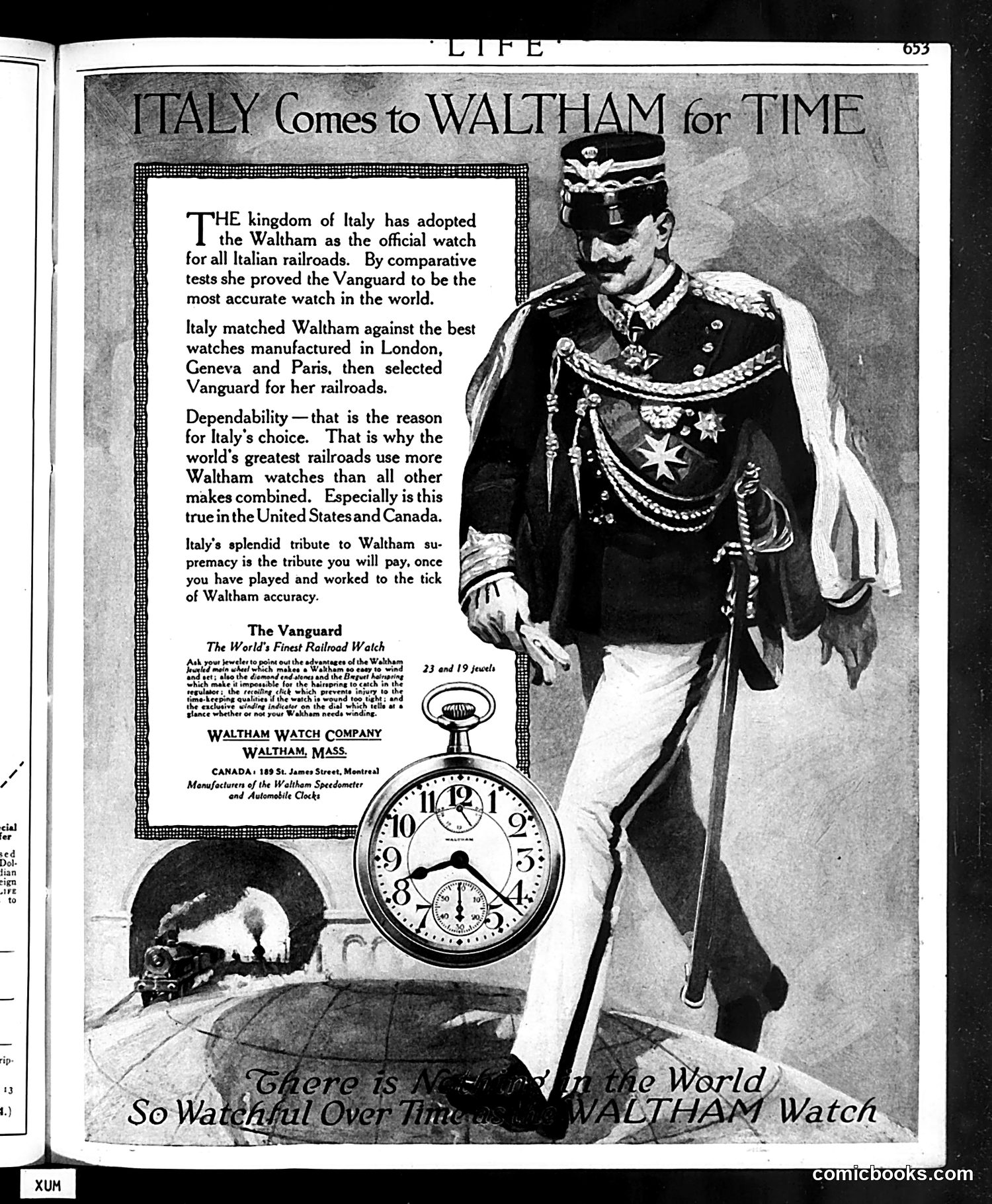
This is primarily a **Waltham Watch Company advertisement**, not a political cartoon. The page uses **nationalist appeal** to market watches: it claims Italy officially adopted Waltham as the official timepiece for all Italian railroads after comparative testing against Swiss and British competitors. The large illustration shows an **Italian military or royal figure** in formal dress uniform, establishing prestige and authority. The advertisement's humor/satire is subtle: it positions watch reliability as crucial to national infrastructure and pride. By featuring a dignified Italian leader endorsing the American product, it suggests that even traditionally European-dominated industries now defer to American manufacturing quality. The small train illustration reinforces the railroad connection. This reflects early 20th-century American commercial confidence and competitive messaging to international markets.
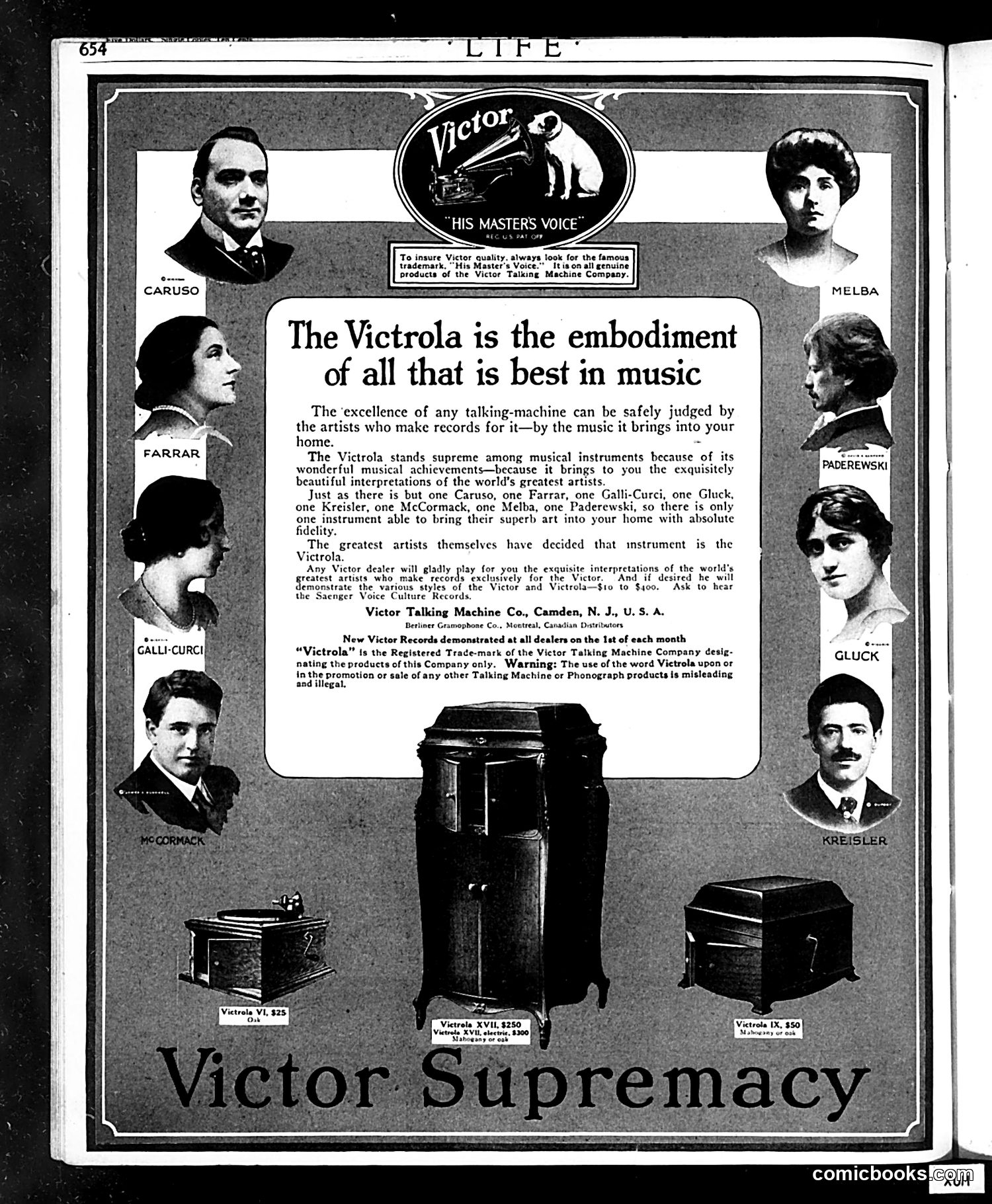
This is a **product advertisement**, not political satire. It promotes the Victrola phonograph by the Victor Talking Machine Company. The page features **famous opera singers and musicians of the early 20th century**—including Caruso, Melba, Farrar, Galli-Curci, McCormack, Paderewski, Glueck, and Kreisler—whose portraits surround the advertisement. The implicit message: these world-class artists recorded *exclusively* for Victor, legitimizing the Victrola as the superior device for experiencing fine music at home. The central claim—"The Victrola is the embodiment of all that is best in music"—uses celebrity endorsement to establish brand dominance. Three different Victrola models are pictured below. This reflects early 20th-century advertising strategy: associate consumer products with high culture and prestigious figures to justify premium pricing and market leadership ("Victor Supremacy").
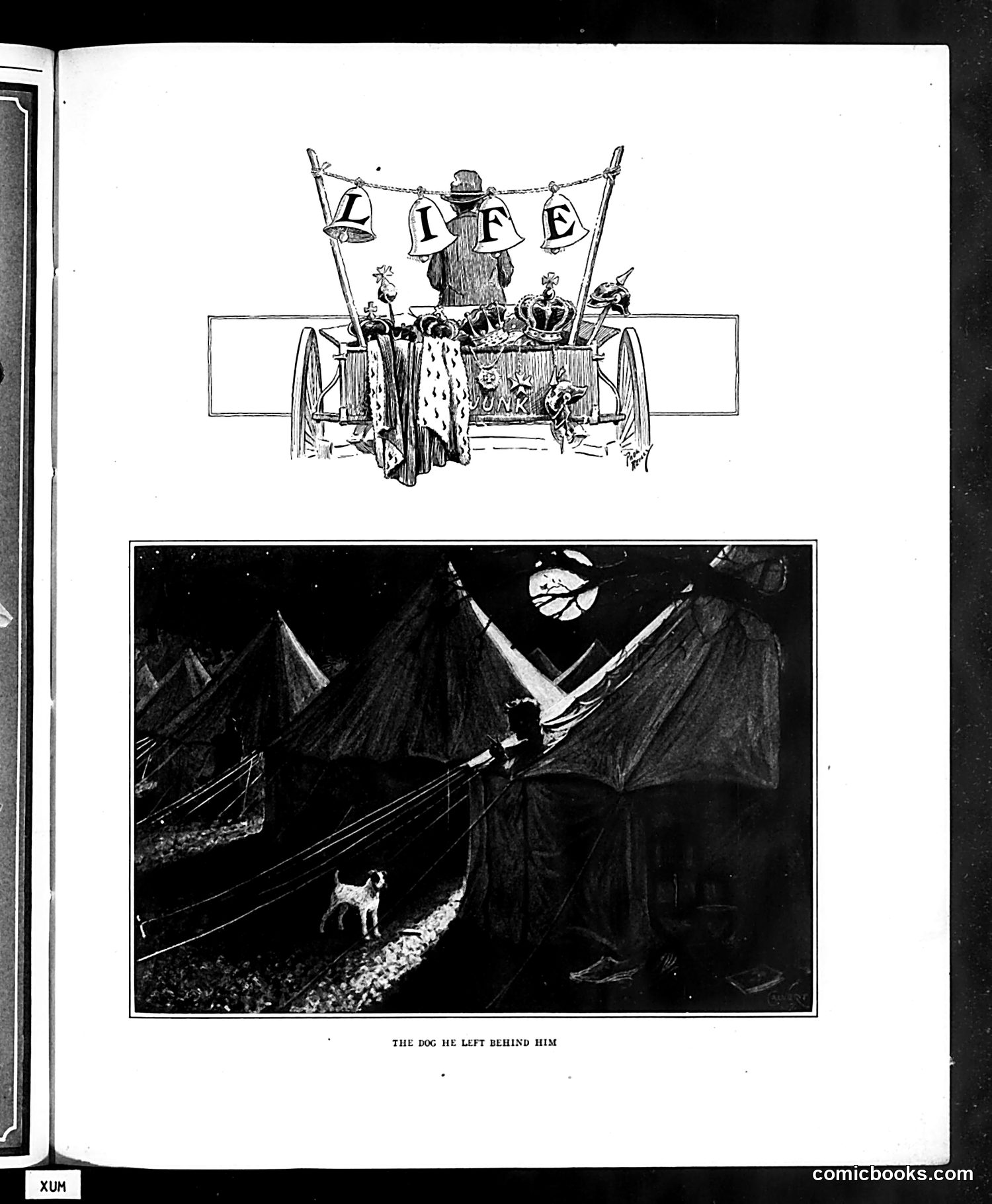
This page contains two illustrations satirizing life during wartime (likely WWI era, given the "LIFE" magazine context). The **top cartoon** depicts an allegorical scene: a figure representing "LIFE" sits in a vehicle labeled "JUNK," pulled by horses and topped with bells spelling "L-I-F-E." The character appears to be a personified representation of American life during wartime, laden with military regalia and symbols, suggesting how war burdens and transforms civilian existence. The **bottom photograph** shows a small dog standing alone near military tents under moonlight, captioned "THE DOG HE LEFT BEHIND HIM." This appears to reference the human cost of war—specifically, the emotional toll on those left behind when soldiers departed. The abandoned pet symbolizes families and communities disrupted by military service. Together, these images critique how wartime upends normal American life.
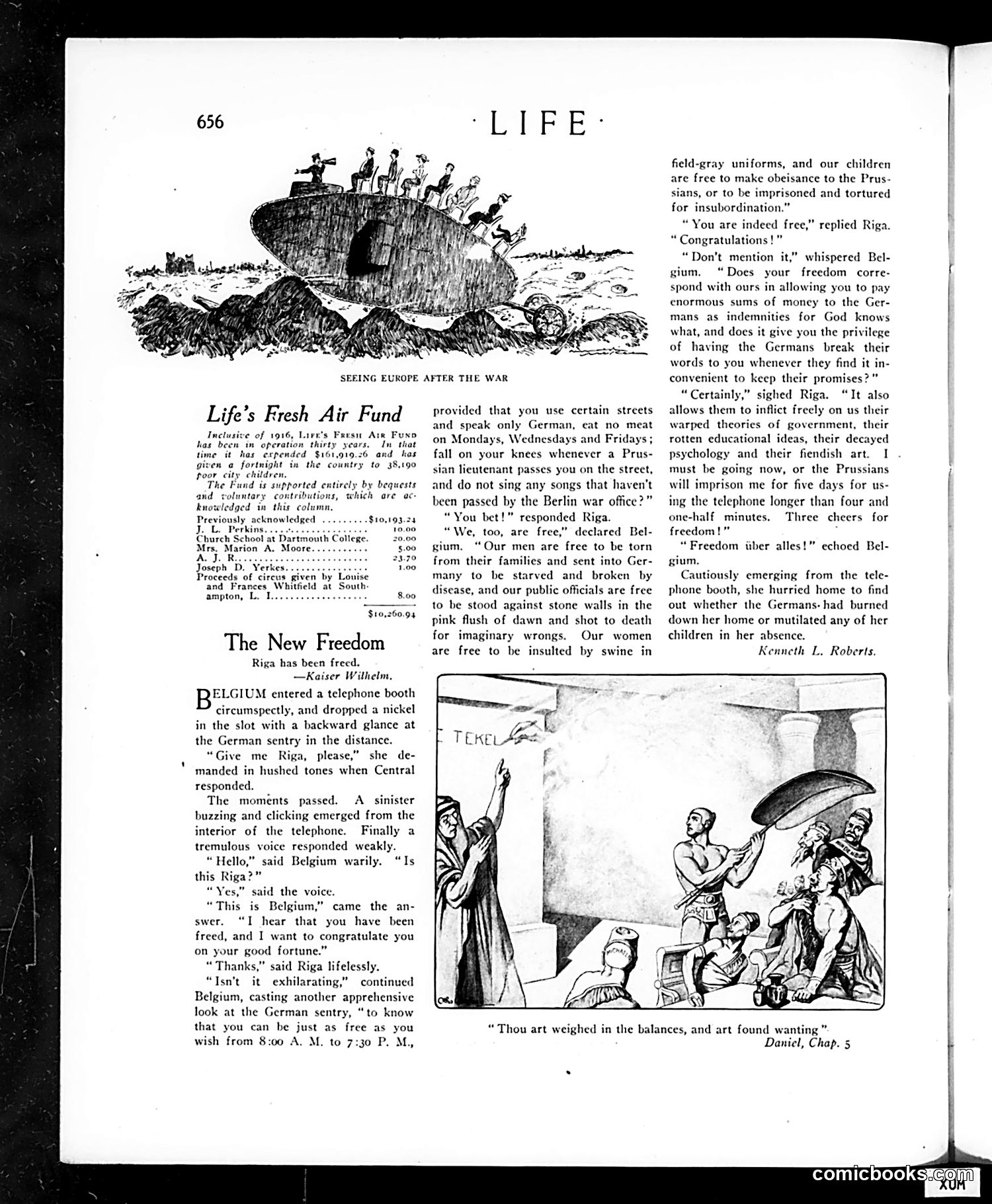
This page contains "The New Freedom" by Kaiser Wilhelm, a post-WWI satirical piece. The cartoon depicts Belgium emerging from a telephone booth to confront a German sentry, representing Germany's invasion and occupation of neutral Belgium during the war. The dialogue mocks Germany's justifications for the invasion. Belgium sarcastically thanks Germany for "freedom," while the sentry boasts of German liberty. The satire exposes the hypocrisy: Germany claimed to liberate Belgium while actually devastating it through military occupation, starvation, and violence against civilians. The biblical quote below ("Thou art weighed in the balances, and art found wanting") reinforces the moral judgment—Germany's actions are condemned as fundamentally unjust, referencing accountability for wartime atrocities.
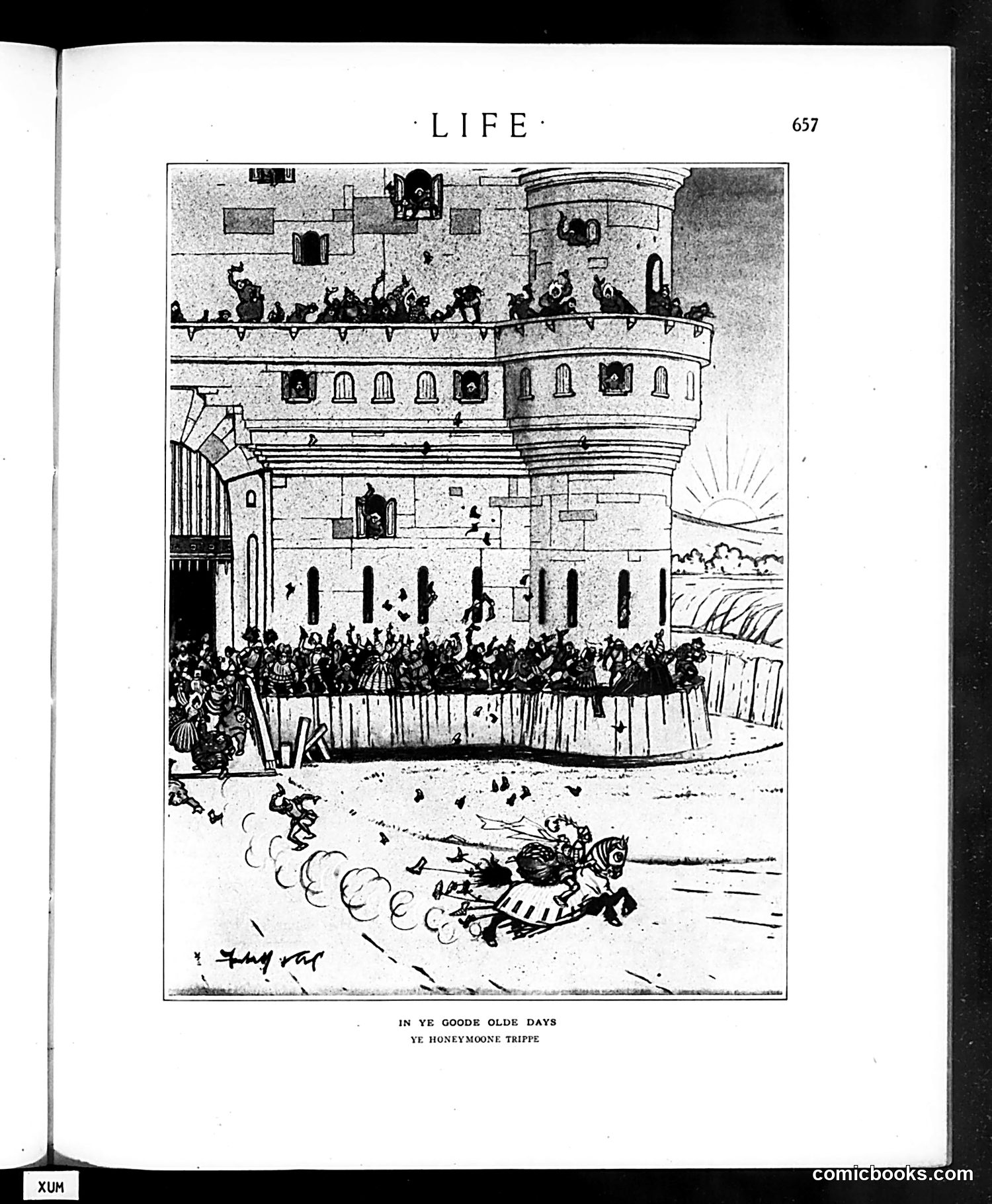
This cartoon depicts a medieval fortification under siege, labeled "In Ye Goode Olde Days / Ye Honeymoone Trippe." The humor lies in a nostalgic comparison: the caption contrasts "the good old days" with a honeymoon trip, suggesting that romantic getaways historically involved dangerous, chaotic conditions. The fortified tower is crowded with spectators above, while below, armored figures on horseback approach with cannons firing (indicated by smoke puffs). The joke satirizes the romanticization of the past—implying that even supposed idyllic occasions like honeymoons were actually perilous affairs in medieval times. This reflects early 20th-century satire about romantic nostalgia and the contrast between idealized historical narratives and harsh historical reality.
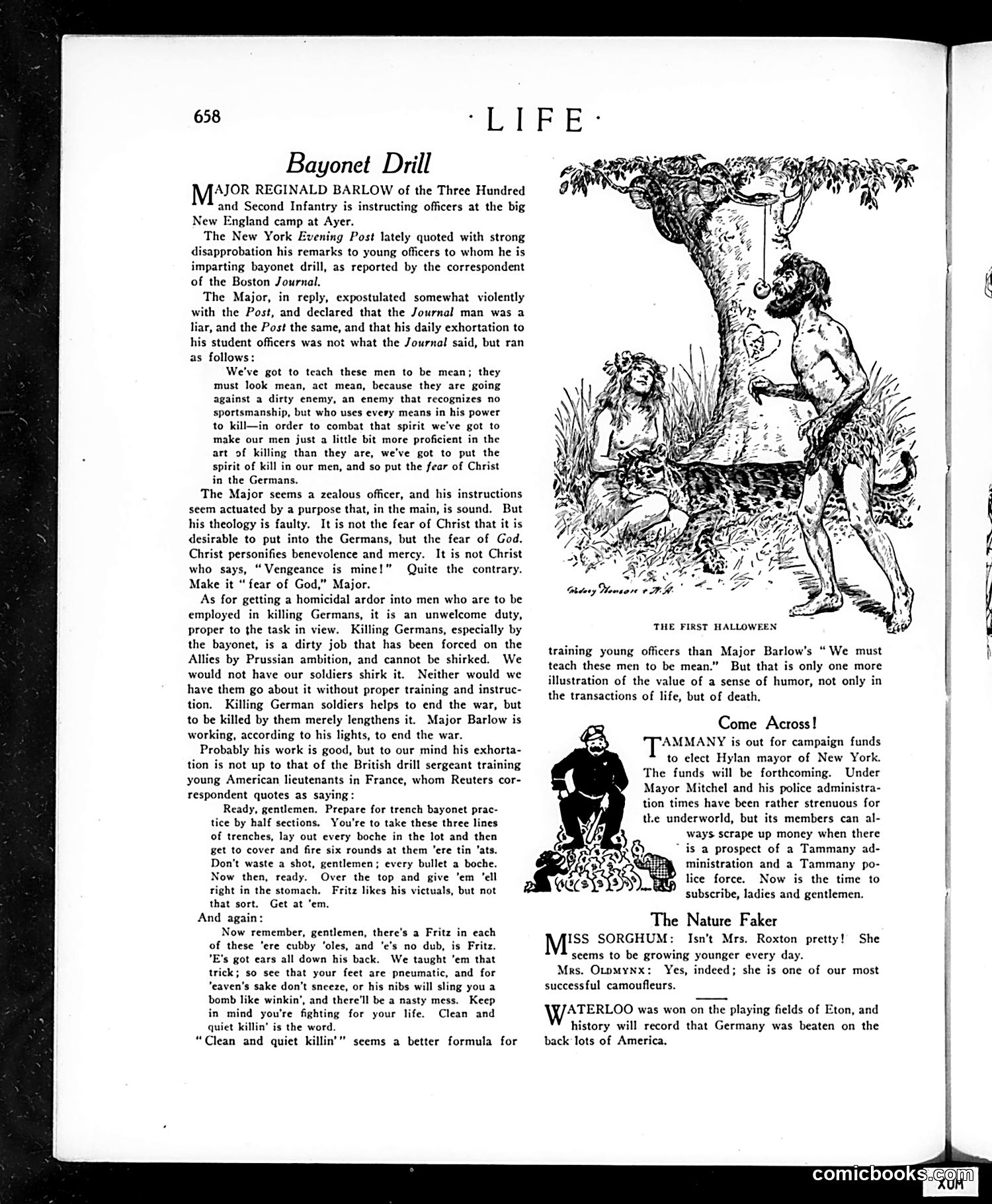
This cartoon depicts nude or near-nude figures in a primitive setting, captioned "THE FIRST HALLOWEEN." It appears to be satirizing the concept of Halloween's origins by presenting it as an ancient or "primitive" practice. The accompanying text discusses Major Reginald Barlow's bayonet drill instruction for officers, criticizing his philosophy of instilling aggressive killing spirit in soldiers. The article contrasts Barlow's emphasis on "fear of God" with Christian mercy. The cartoon's placement alongside this military training discussion suggests it may be mocking primitive or uncivilized behavior—perhaps implying that Barlow's brutal approach represents a reversion to barbarism rather than civilized warfare ethics. The satire likely critiques excessive military aggression during World War I.
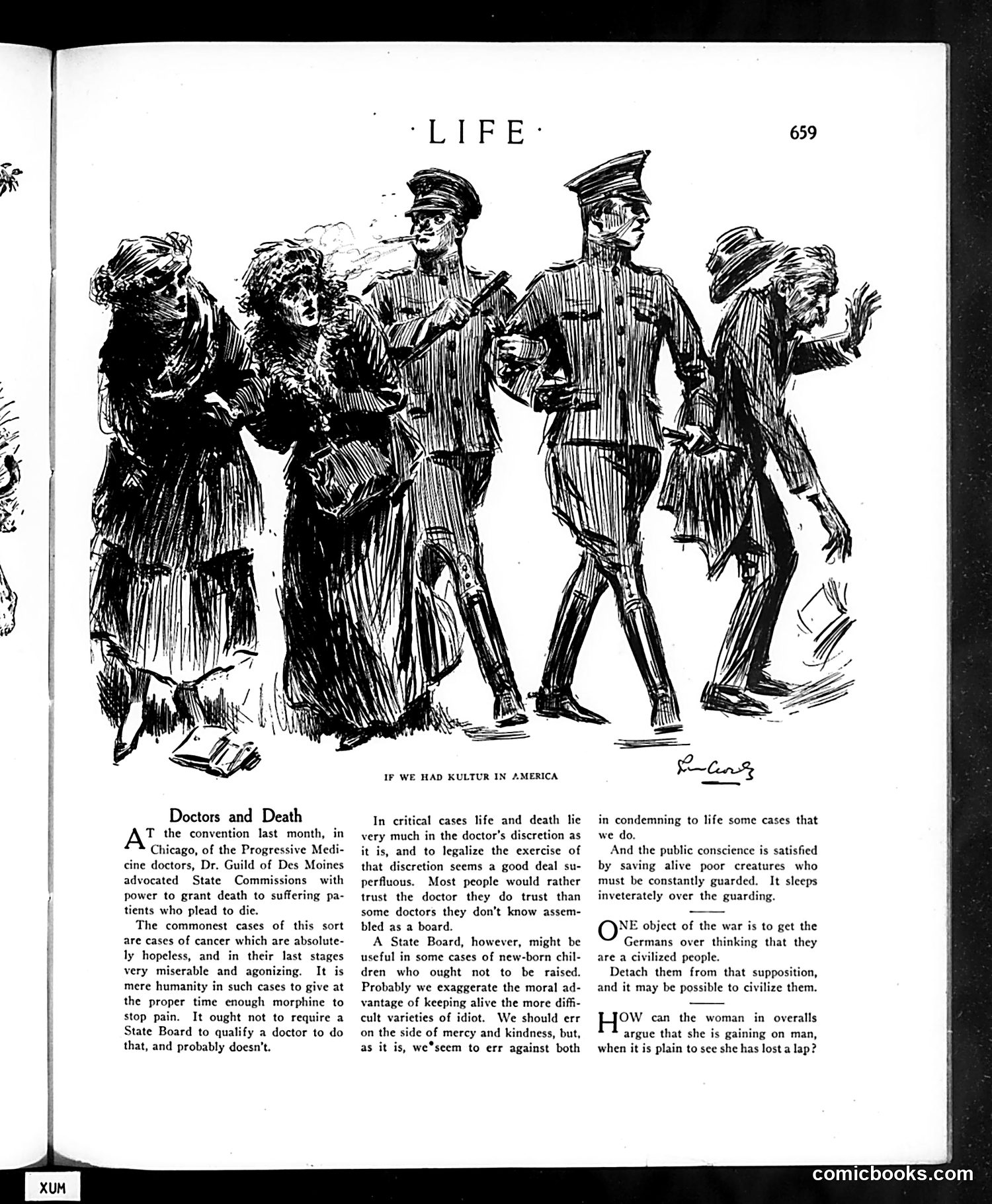
**The Cartoon:** Titled "If We Had Kultur in America," the sketch shows two military officers in the center flanked by four civilians in distress or exaggerated poses. The satire appears to target perceived German militarism and "kultur" (culture), suggesting that American adoption of Prussian-style authoritarian values would be absurd and harmful. **The Articles:** "Doctors and Death" debates whether states should authorize physicians to euthanize terminally ill patients. The piece argues against this, favoring mercy and medical discretion instead. A second piece critiques women in military uniforms, questioning whether such roles represent genuine women's advancement or constitute loss of femininity. **Context:** This appears to reflect World War I-era American anxieties about European militarism and evolving gender roles during wartime.
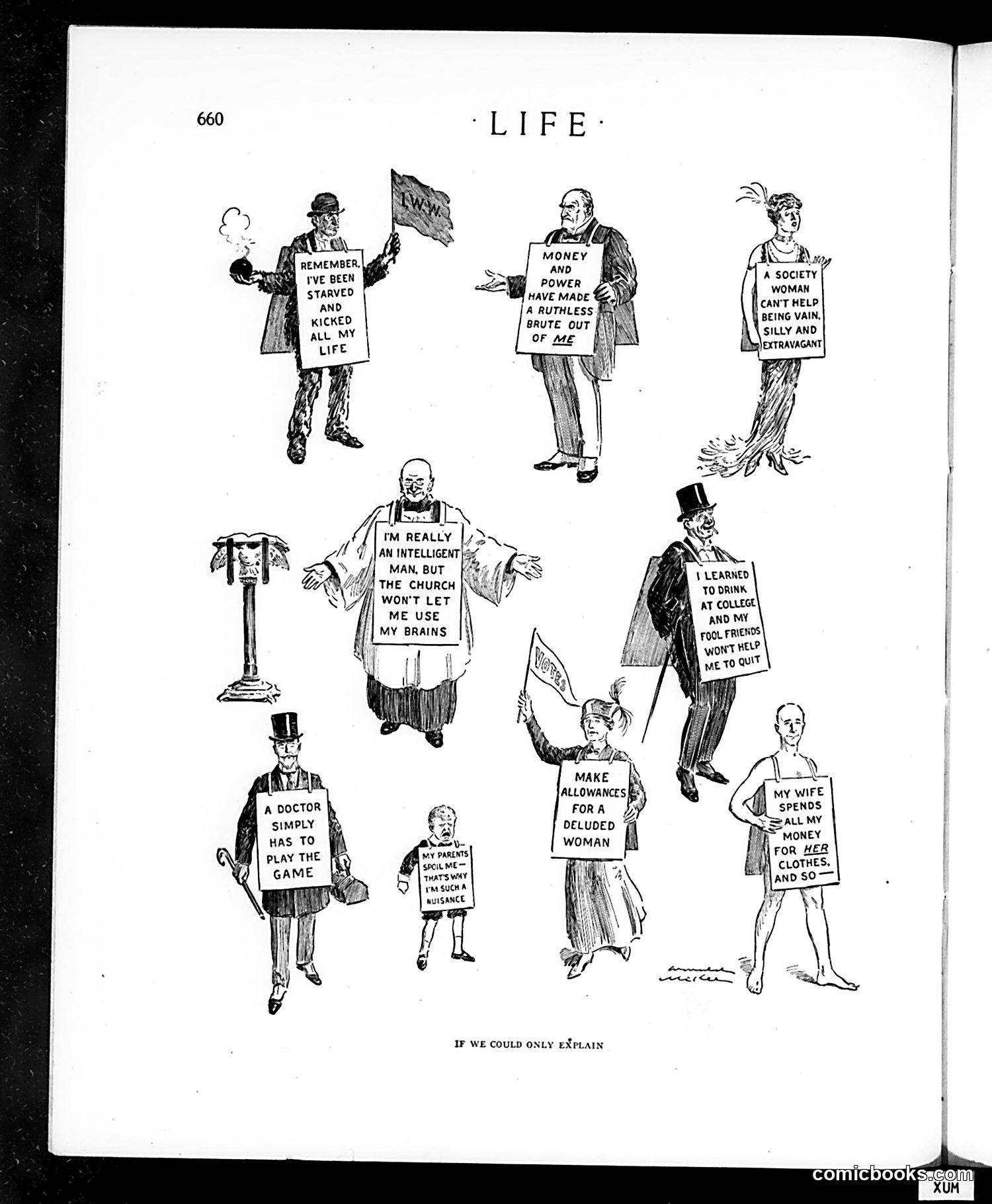
This satirical cartoon depicts various male archetypes, each carrying a sign explaining their poor behavior or character flaws. The figures represent common social problems: a starving man blaming circumstance, a wealthy man claiming ruthlessness, a drunkard attributing his habits to college friends, a clergyman claiming intelligence but constrained by his church, and a husband spending his wife's money on clothes. The cartoon's title—"If We Could Only Explain"—suggests satirical commentary on how men rationalize their failings through excuses rather than taking responsibility. Each figure essentially pleads "I'm not really to blame; circumstances made me this way." The satire critiques both male self-deception and contemporary social attitudes about personal accountability, morality, and gender dynamics.
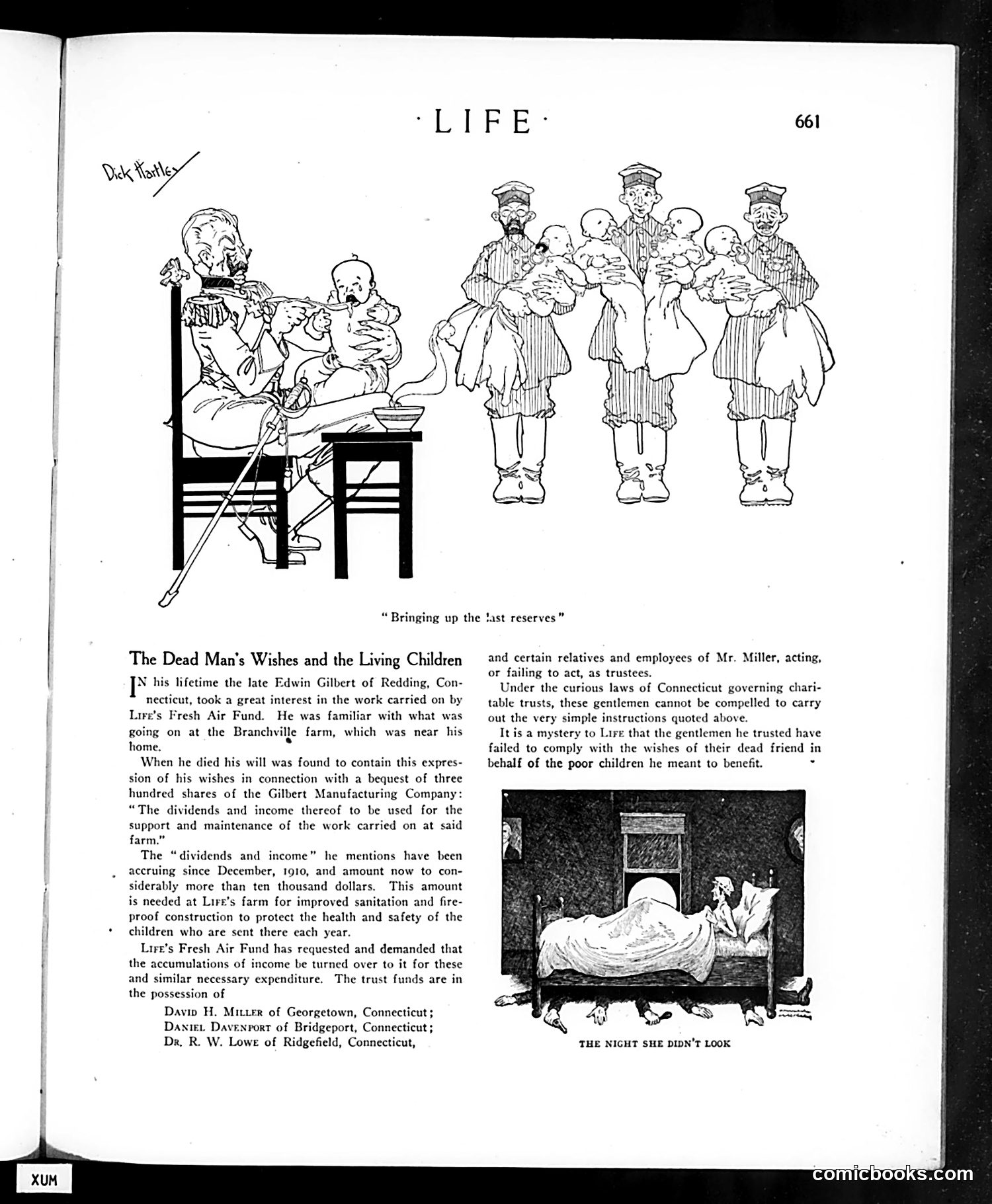
This article describes Edwin Gilbert of Redding, Connecticut, who bequeathed three hundred shares of his manufacturing company to support Lirt's Fresh Air Farm—a facility serving poor children near his home. The top cartoon, titled "Bringing up the last reserves," satirizes the trustees' apparent reluctance to use Gilbert's bequest. It shows an elderly man (likely representing the deceased Gilbert or frustrated administrators) with infants, while three stern-looking men in uniform stand holding additional babies—suggesting the trustees are withholding funds despite explicit instructions to improve the farm's sanitation and safety for children. The article expresses frustration that accumulated dividends remain unused for their intended charitable purpose.
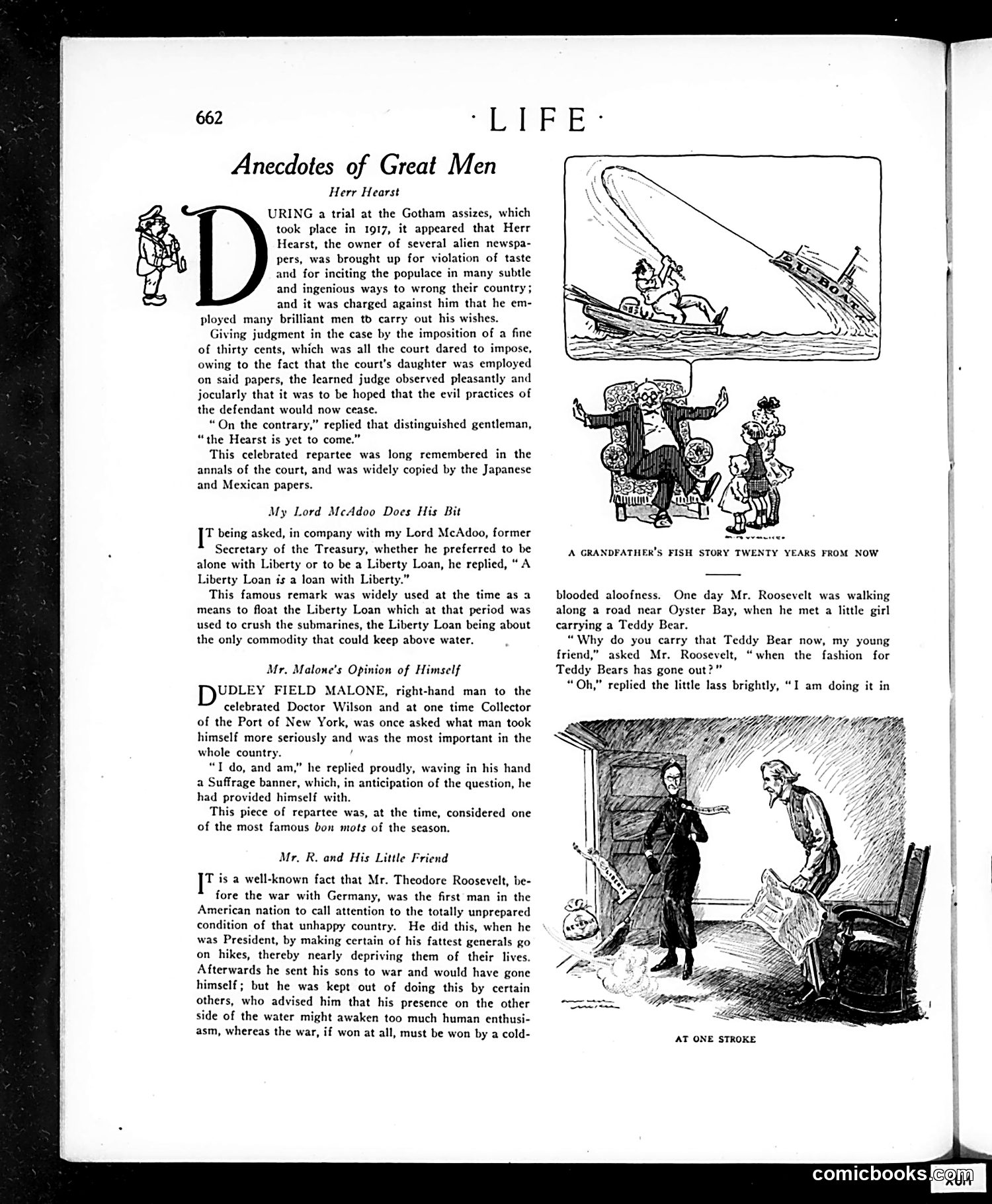
This page contains three anecdotes about famous men's witty remarks: 1. **Herr Hearst** — refers to William Randolph Hearst, newspaper magnate, prosecuted during WWI for allegedly employing brilliant men to undermine American interests and damage the country's reputation. 2. **Lord McAdoo** — William G. McAdoo, Treasury Secretary, quipped that "A Liberty Loan is a loan with Liberty" when asked about preferring Liberty Loans over individual loans. The Liberty Loan was a WWI financing mechanism. 3. **Dudley Field Malone** — a prominent attorney who supported women's suffrage, joked about being "the most important in the whole country" while waving a suffrage banner. The page satirizes prominent public figures through their memorable quips, mixing politics, war finance, and social reform issues of the era.
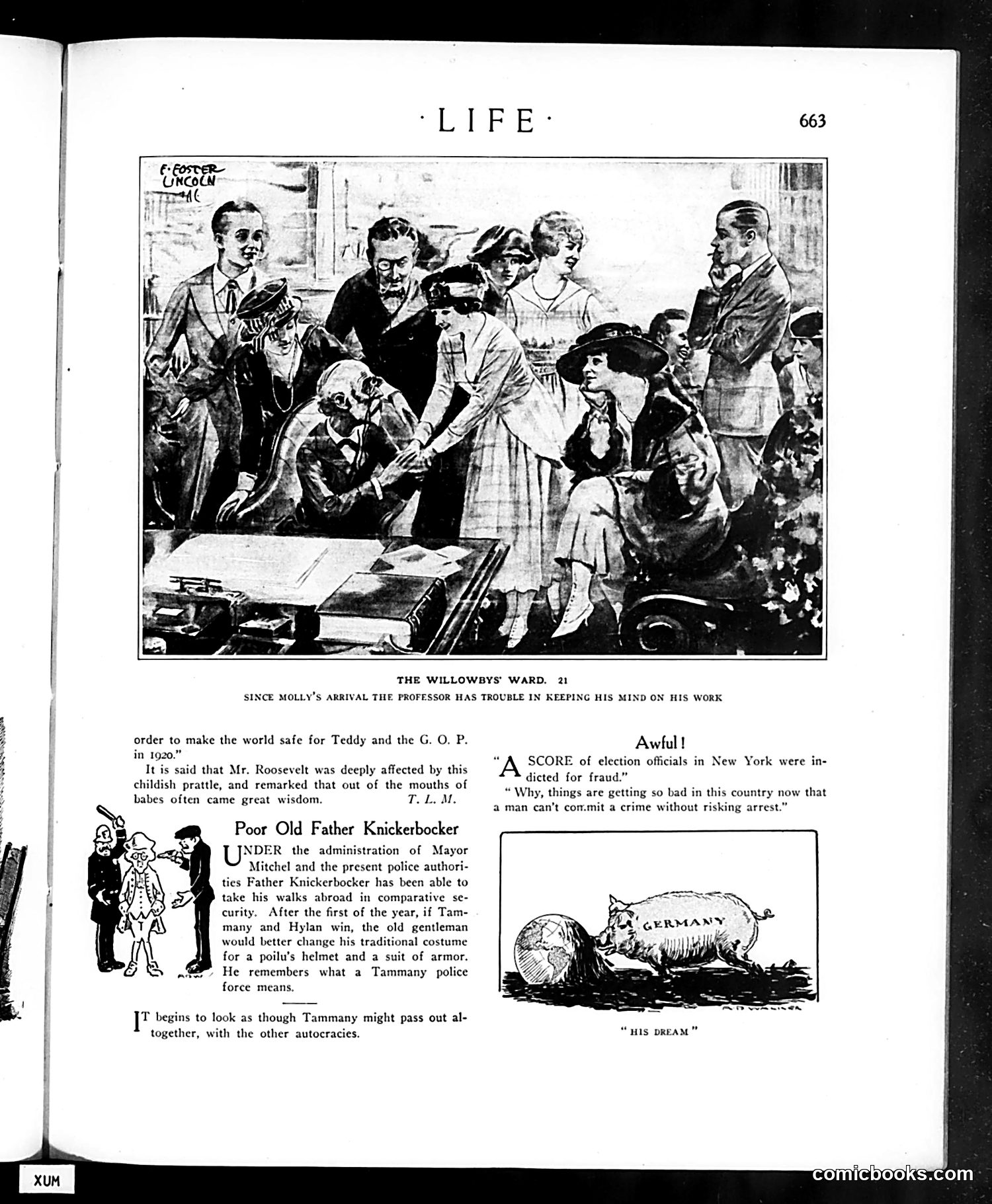
The page contains satirical commentary on 1920s American politics and crime. **Top illustration** ("The Willowbys' Ward"): Shows a domestic scene where a professor struggles to concentrate on work due to a visitor's child—likely satirizing how personal distractions interfere with professional duties. **"Poor Old Father Knickerbocker"** section: References New York City governance under Mayor Mitchell, noting that police reforms have made the streets safer, though "Tammany" (the corrupt Democratic political machine) appears to be declining alongside "other autocracies." **"Awful!" section**: Reports election fraud among New York officials, lamenting rising crime and lawlessness in the country—a common complaint during the chaotic Prohibition era. **"His Dream" cartoon**: Shows Germany dreaming of prosperity, likely reflecting post-WWI economic anxieties.
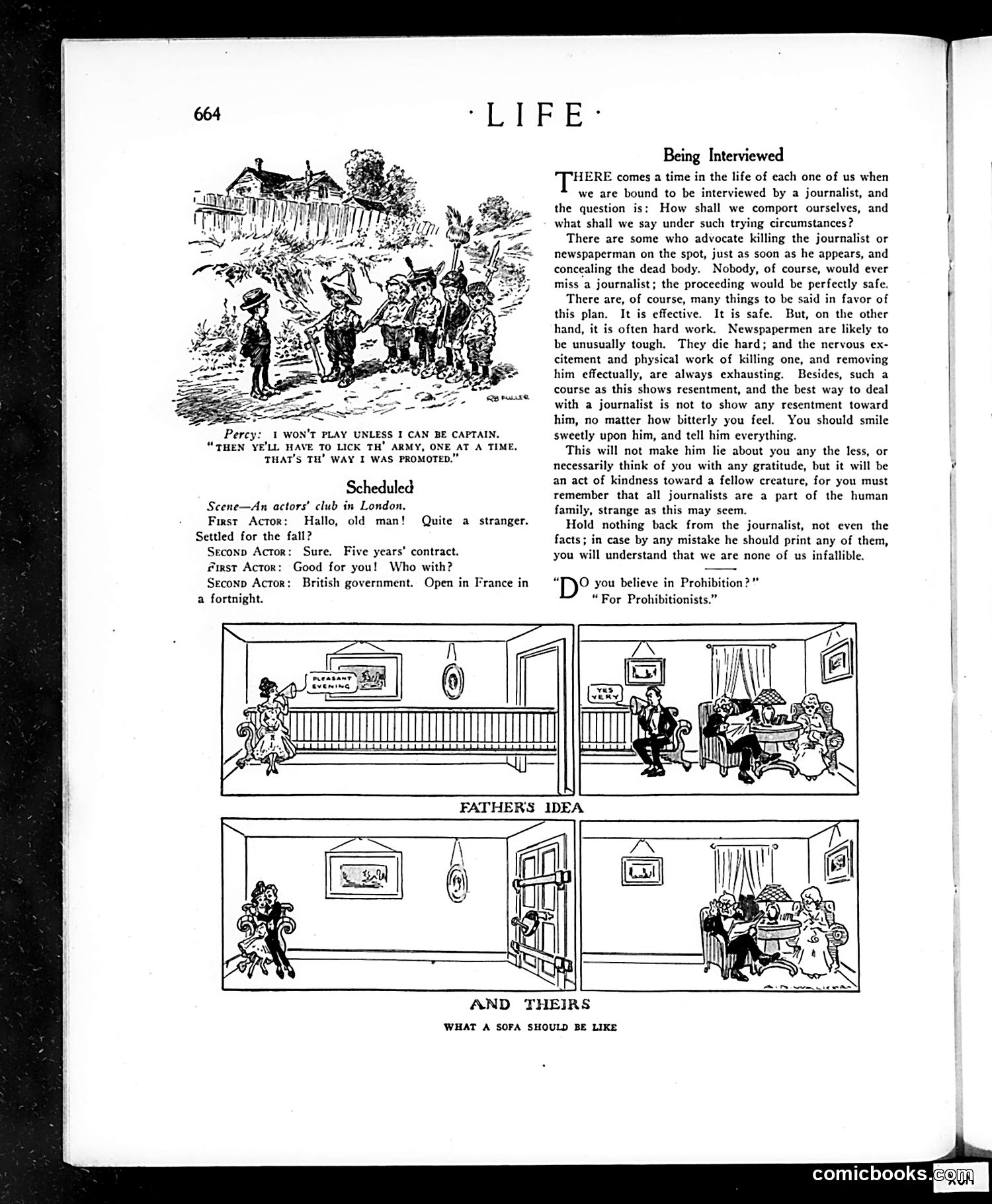
This satirical piece mocks both journalists and the public's anxiety about press interviews. The main article humorously suggests that while killing reporters would be "effective" and "safe," it's better to smile sweetly and tell them everything—while acknowledging they'll likely lie about you anyway. The tone is darkly comic, reflecting early 20th-century distrust of sensationalist journalism. The lower section shows two brief comedy sketches: one about a character named Percy demanding to be captain before playing (a military/hierarchy joke), and another about an actor booking a five-year contract with the "British government" to "open in France"—likely satirizing either wartime recruitment or absurdist theatrical deals. The bottom cartoon ("Father's Idea and Theirs") and accompanying caption about sofas appear to illustrate contrasting perspectives on domestic furnishings, though the specific satire is unclear from this image alone.
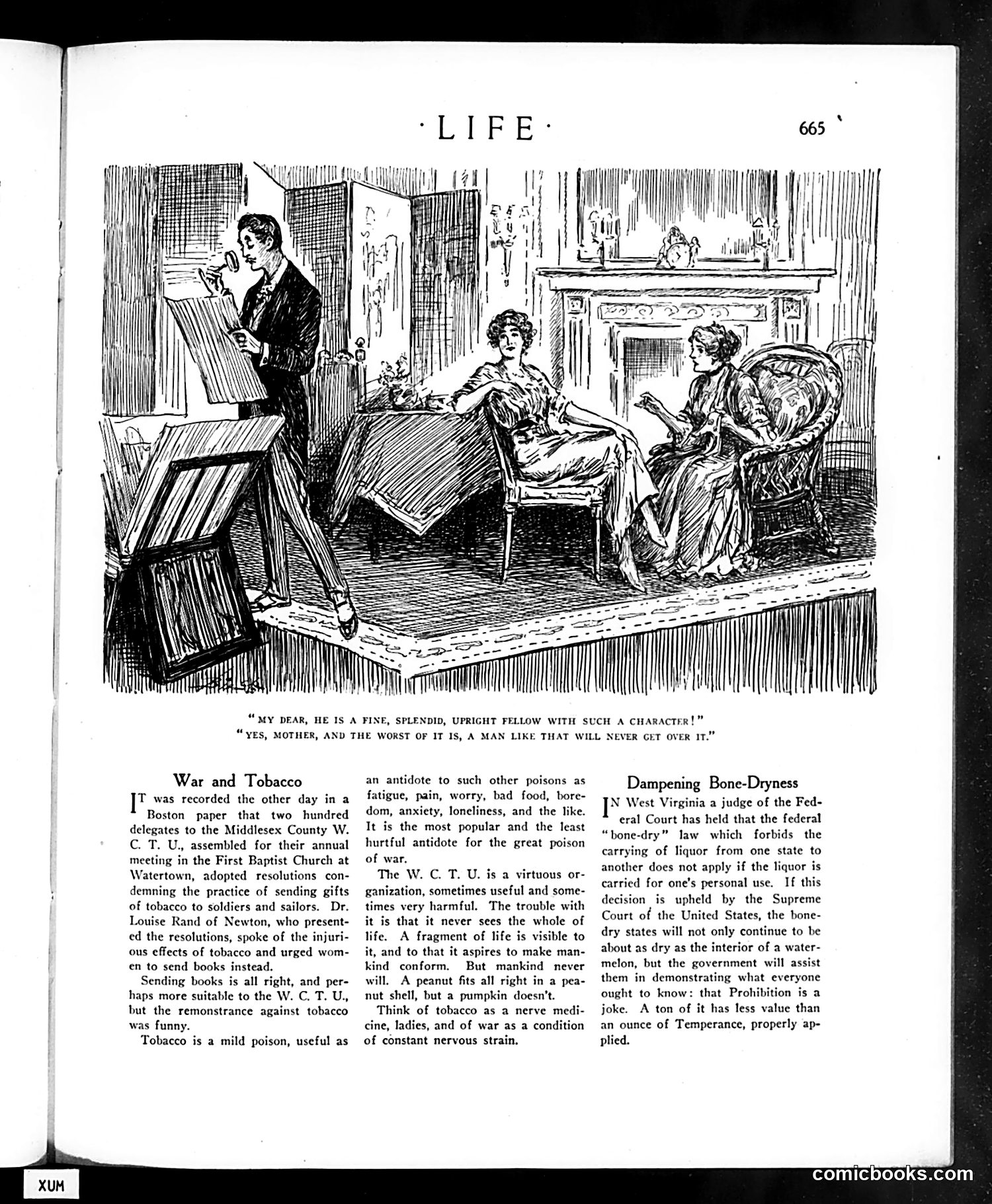
The cartoon depicts a social scene where two women discuss a man of exemplary character. The punchline—"a man like that will never get over it"—satirizes how wartime damage to soldiers' morality and character was considered permanent and irreversible. The accompanying text discusses two Prohibition-era controversies: **"War and Tobacco"** mocks the Women's Christian Temperance Union (W.C.T.U.) for condemning tobacco gifts to soldiers while ignoring war's greater harms. The author argues tobacco provides necessary psychological relief from war's stress, calling it "a mild poison" useful as an antidote to worse poisons like anxiety and loneliness. He criticizes the W.C.T.U. for moral rigidity—applying single-issue ideology without understanding life's complexities. **"Dampening Bone-Dryness"** ridicules Prohibition enforcement, reporting a federal judge's ruling that personal liquor transport isn't illegal. The author sarcastically suggests this undermines "bone-dry" states' attempts at total prohibition, calling Prohibition itself "a joke" compared to genuine temperance. Both sections critique moral absolutism and Prohibition-era reform movements.
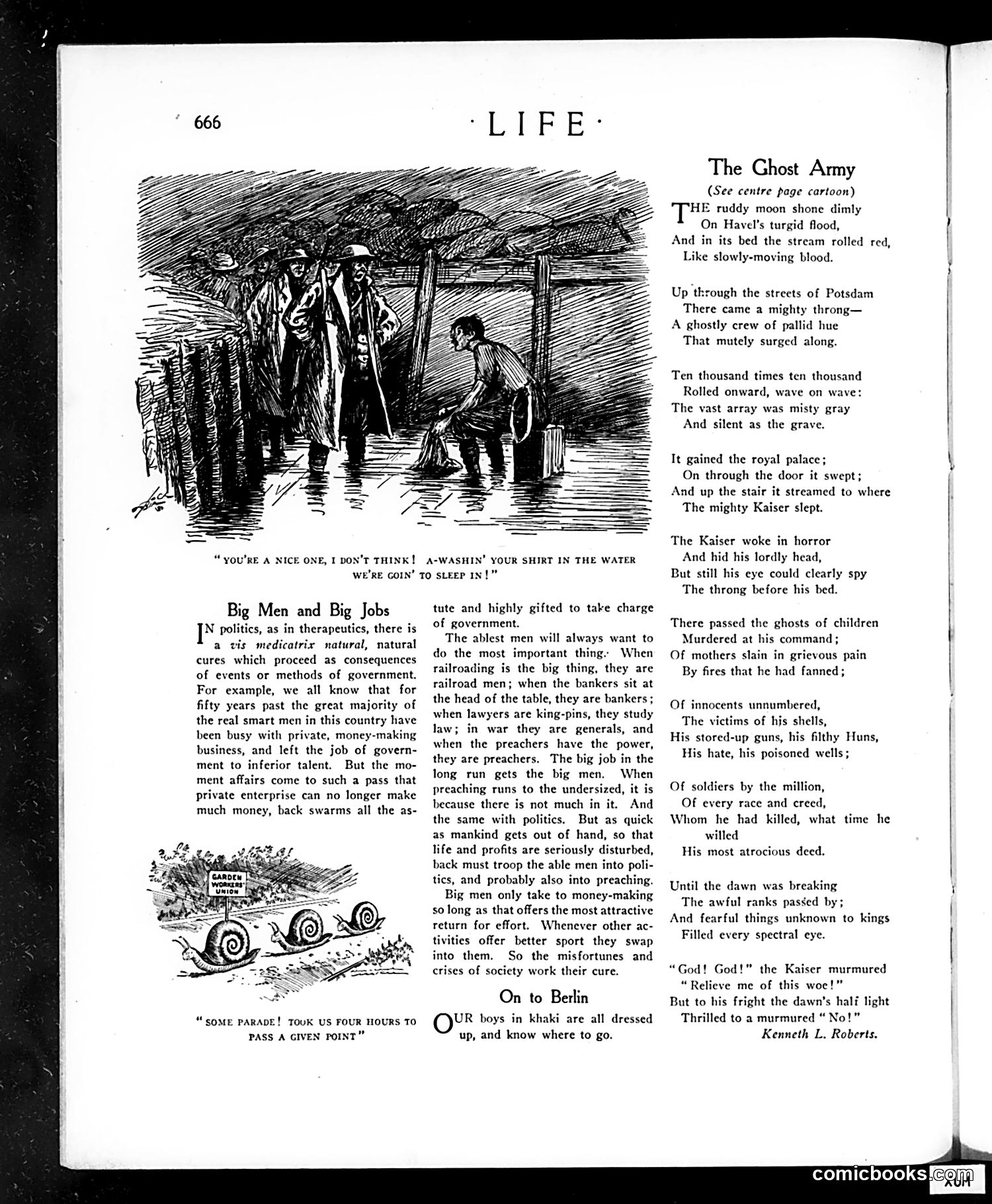
This page contains two distinct pieces of post-WWI American satire: **"Big Men and Big Jobs"** argues that capable men abandon government for profitable private enterprise, only returning to politics during national crises. The cartoons mock this pattern—one shows soldiers complaining about a tedious parade; another depicts snails, likely representing slow bureaucratic movement. **"The Ghost Army"** is a vengeful poem about the Kaiser (Wilhelm II of Germany) haunted by spectral victims of WWI—murdered children, mothers killed in fires, soldiers of all nations he destroyed. The accompanying illustration shows ghostly figures confronting him in his palace at Potsdam before dawn brings a supernatural "No!" denying him relief. Both pieces reflect 1918-1920 American attitudes: cynicism about peacetime governance and moral condemnation of German leadership. The Kaiser content specifically targets the defeated enemy's ruler with supernatural judgment—a common post-war rhetorical device blending horror with retribution fantasy.
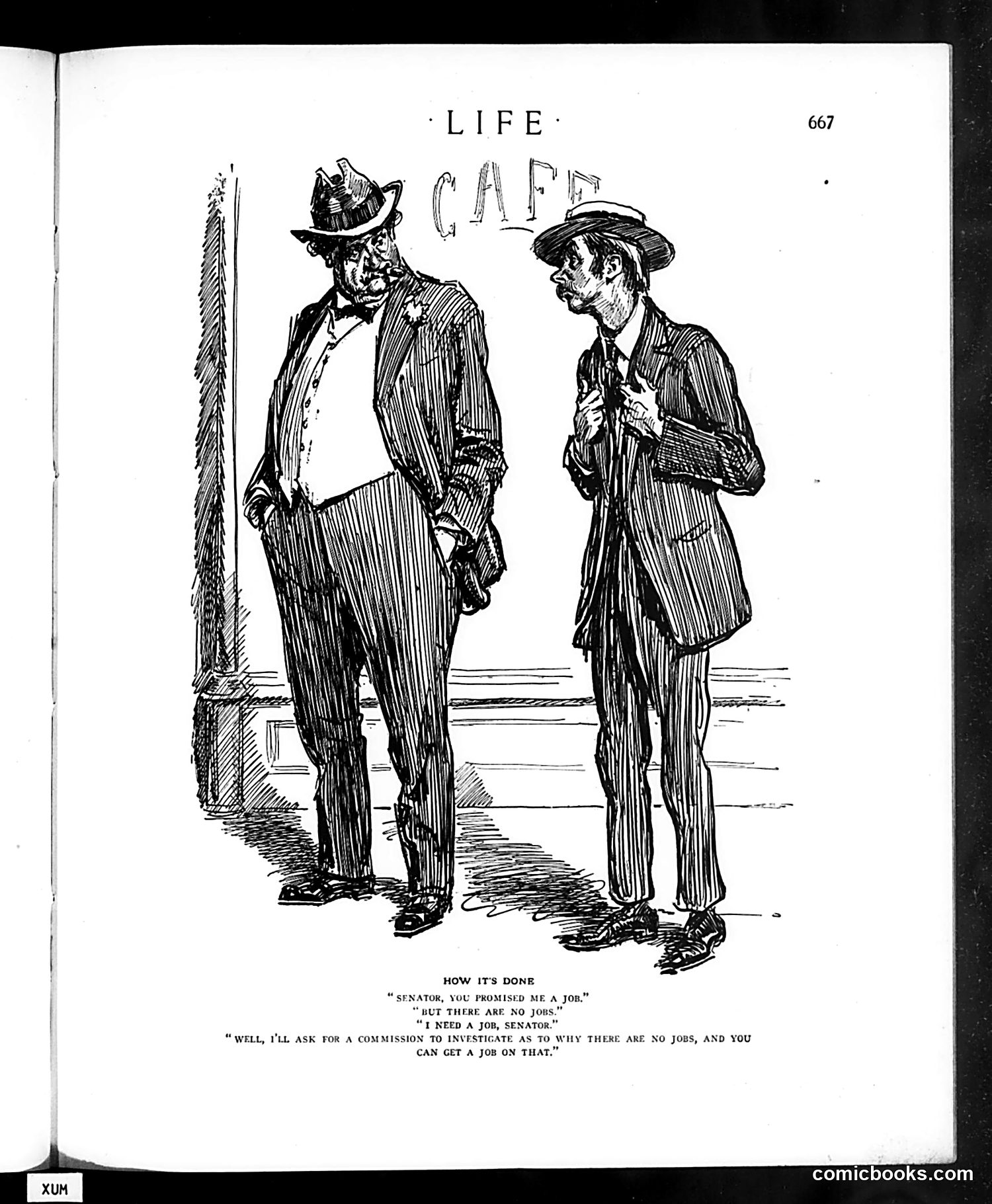
This cartoon depicts a conversation between two men in suits—one labeled as a Senator (on the left). The senator has apparently promised the other man a job, but when asked to deliver, claims "there are no jobs." The satire mocks political ineffectiveness and empty promises. The punchline shows the Senator's solution: he'll form a commission to *investigate* why there are no jobs, and from that investigation, the man can supposedly get a job. The joke satirizes bureaucratic circular logic—creating committees and investigations as a substitute for actual problem-solving. Rather than addressing unemployment directly, the politician proposes another layer of bureaucracy. This reflects cynicism about politicians' tendency to appear busy and responsive while accomplishing nothing concrete.
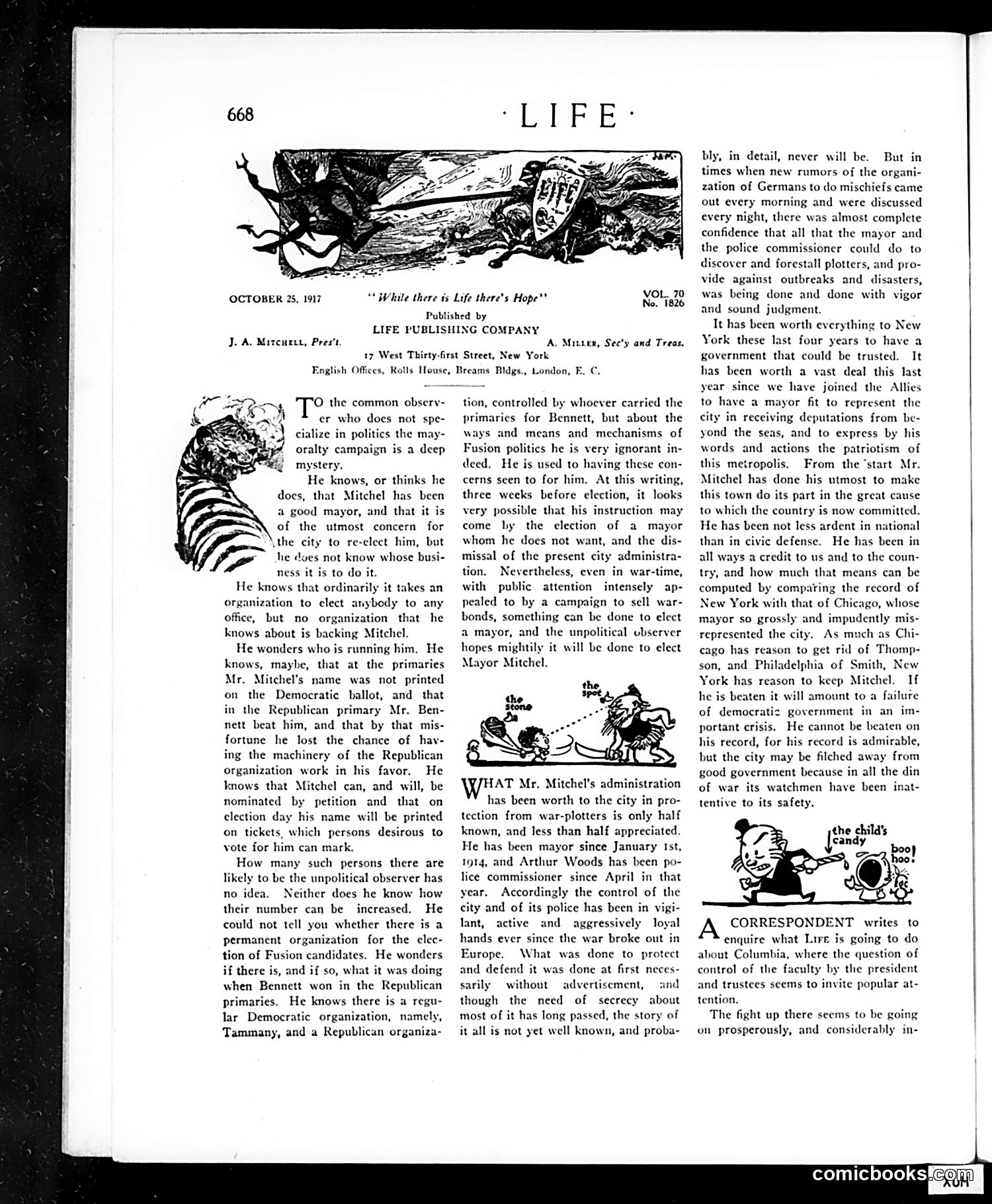
This page discusses New York Mayor John Purroy Mitchel's re-election campaign during WWI. The article argues that while ordinary voters recognize Mitchel as a competent mayor worth re-electing, they don't understand the political machinery supporting him. **The Political Context:** Mitchel, a Fusion candidate (independent/reform), lacks traditional party backing. Though not nominated on the Democratic ticket and losing the Republican primary to Bennett, he can still run via petition. The article contrasts his weakness in party organization with his strong record: he's been mayor since 1914 and, crucially, worked with Police Commissioner Arthur Woods to protect the city from German sabotage plots during wartime. **The Satire's Point:** The article exposes the average voter's political ignorance—they trust Mitchel's competence but don't grasp how electoral mechanics work. It warns that despite his admirable record protecting the city from wartime threats, he might lose due to organizational disadvantages, while Tammany (the corrupt Democratic machine) operates effectively behind the scenes. The cartoon illustrations (visible but unclear) likely reinforce themes of political confusion and Fusion weakness.
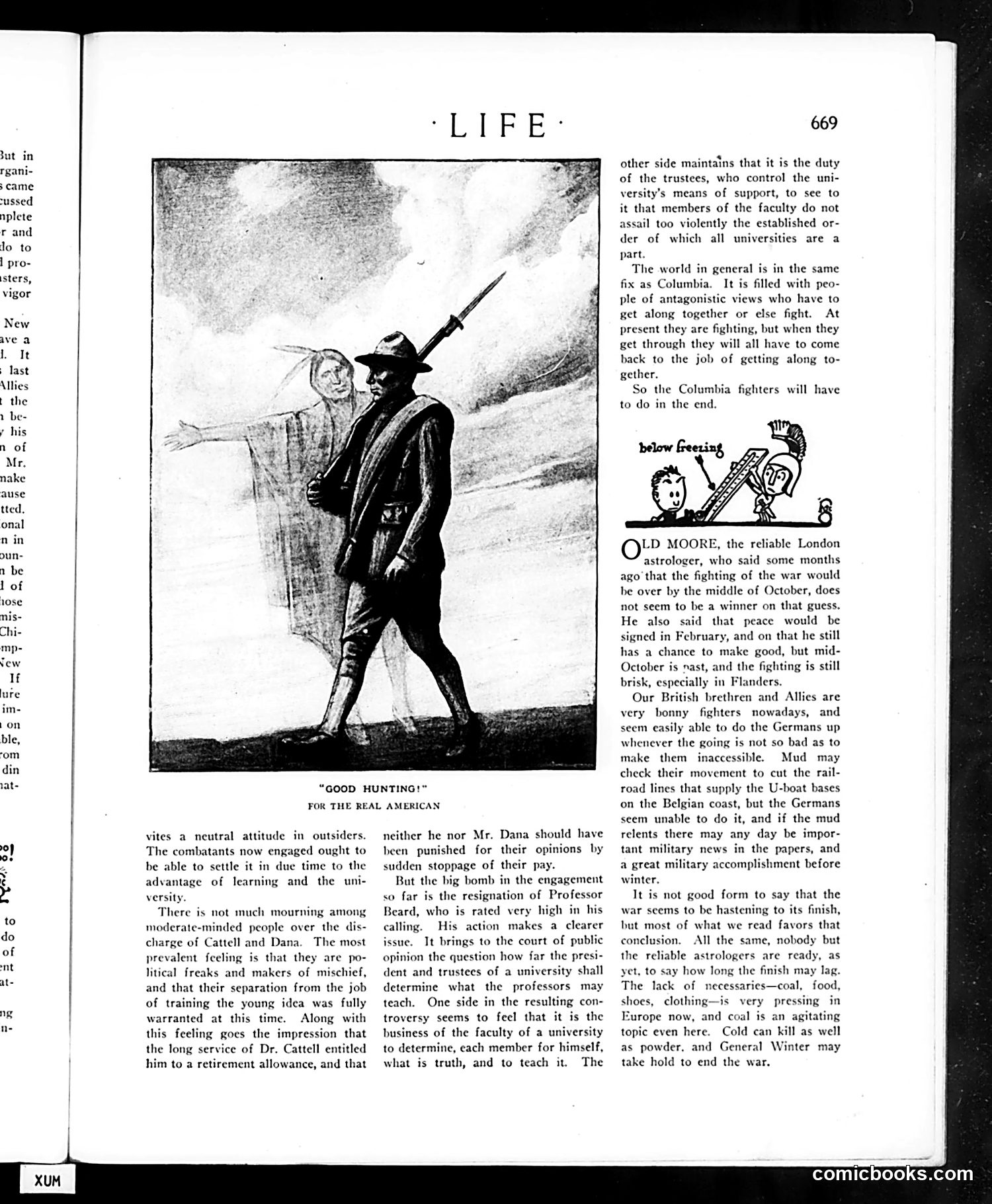
## The Cartoon: "Good Hunting!" The illustration shows a soldier in military uniform pointing a rifle, while a ghostly or skeletal figure appears to represent Death or a casualty of war. The caption "Good Hunting!" presents dark irony—a hunting metaphor applied to warfare. ## The Context This appears to be WWI-era content (references to fighting in Flanders, U-boat bases on Belgian coast, and General Winter suggest 1914-1917). The cartoon sardonically equates combat to sport hunting, mocking the romanticization of warfare. ## The Article The main text discusses Columbia University's firing of professors Cattell and Dana for their political views, and the resignation of Professor Beard in protest. Life uses this controversy as a metaphor: just as warring nations must eventually "get along together," so must universities with conflicting viewpoints coexist. The piece argues about academic freedom versus institutional control of faculty speech—a debate that mirrors broader societal conflict. The astrology reference dismisses predictions about war's end, suggesting fighting will continue "briskly."
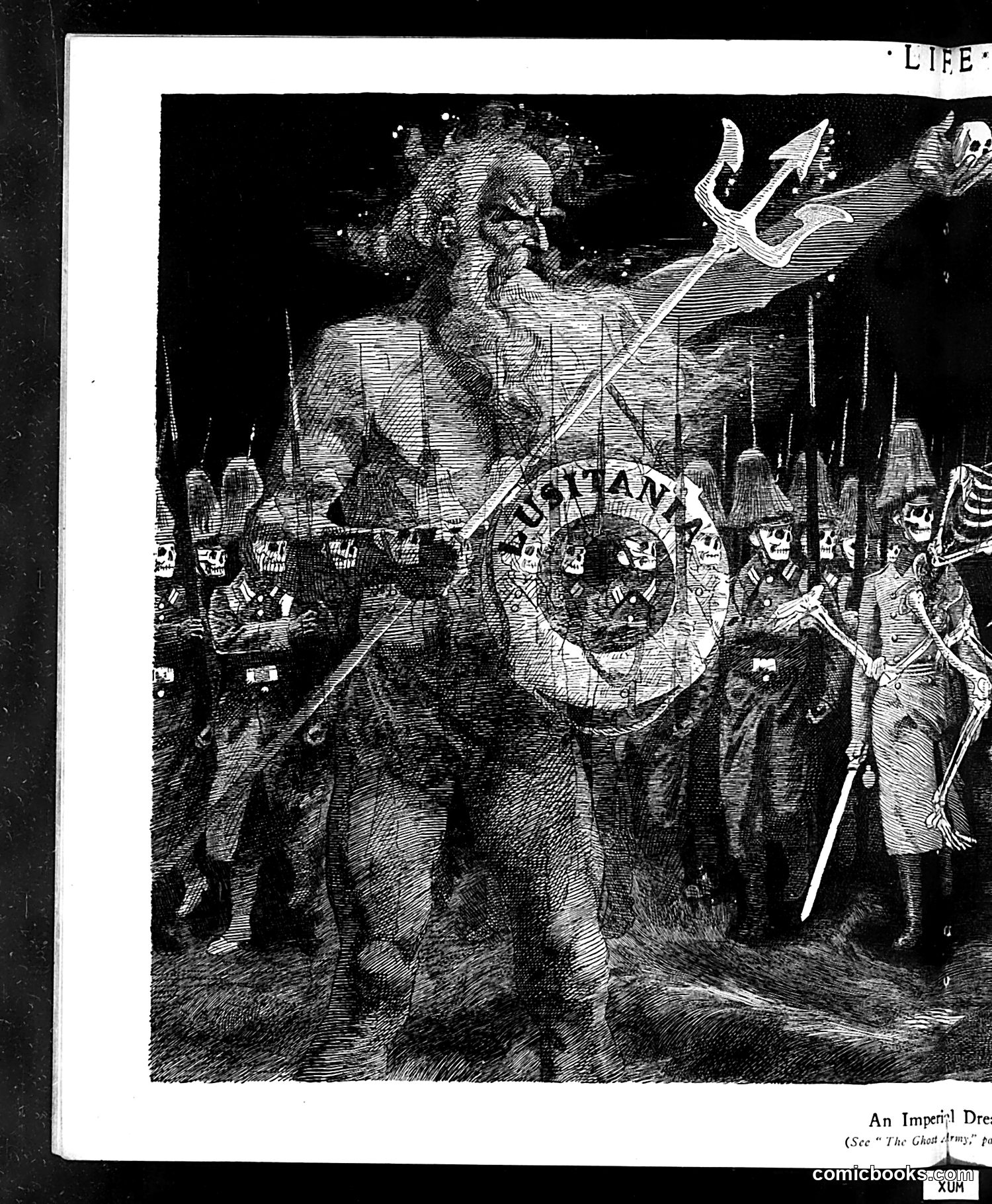
This engraving depicts a theatrical or allegorical scene showing a giant demonic or skeletal figure towering over a procession of armed soldiers and officials carrying banners and weapons. The massive central figure appears to represent an imperial power or ambition—likely military conquest or authoritarian rule. The soldiers below, marching in formation with their standards and weaponry, suggest the machinery of state power being marshaled. The satirical point appears to critique imperial ambitions as monstrous and destructive, using the grotesque central figure to embody how such dreams of empire tower over and control the masses who serve them. Without a visible date or clearer caption, the specific historical reference remains unclear, though the engraving style and military imagery suggest 19th-century political commentary on imperialism or militarism.
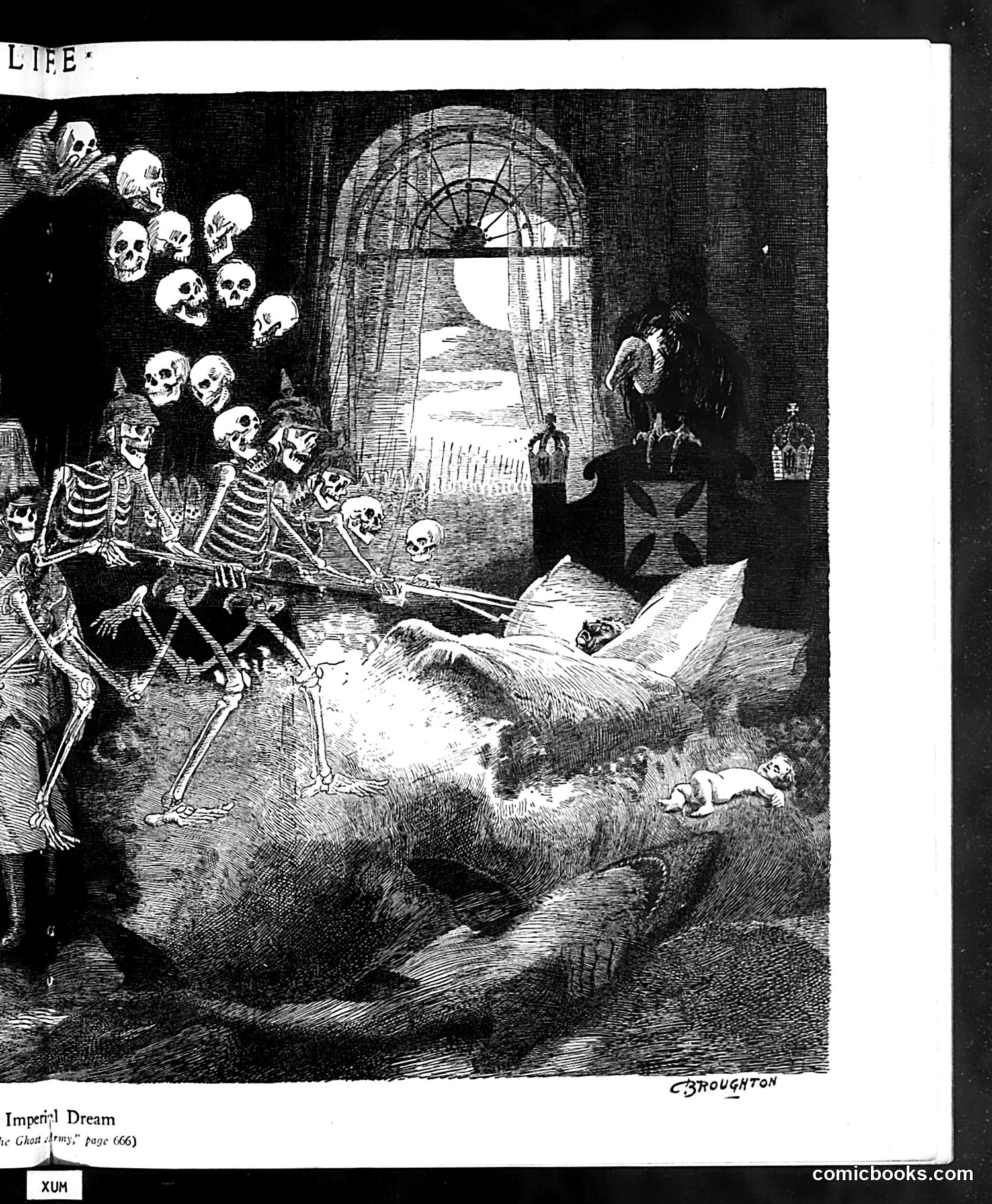
This etching by Broughton depicts a macabre scene titled "Imperial Dream" (referencing "Ghost Army," page 166). A skeletal military figure lies dying or dead on a bed in a stone chamber, while an army of skeleton soldiers in military dress stand assembled to the left. A robed figure (possibly Death or a spiritual entity) observes from the right near a Gothic archway with a cross visible outside. The cartoon appears to be WWI-era anti-war satire, suggesting that imperial military ambitions result only in death and skeletal armies—a critique of militarism's human cost. The "imperial dream" becomes a nightmare of death, with the grand military enterprise reduced to bones and ghosts.
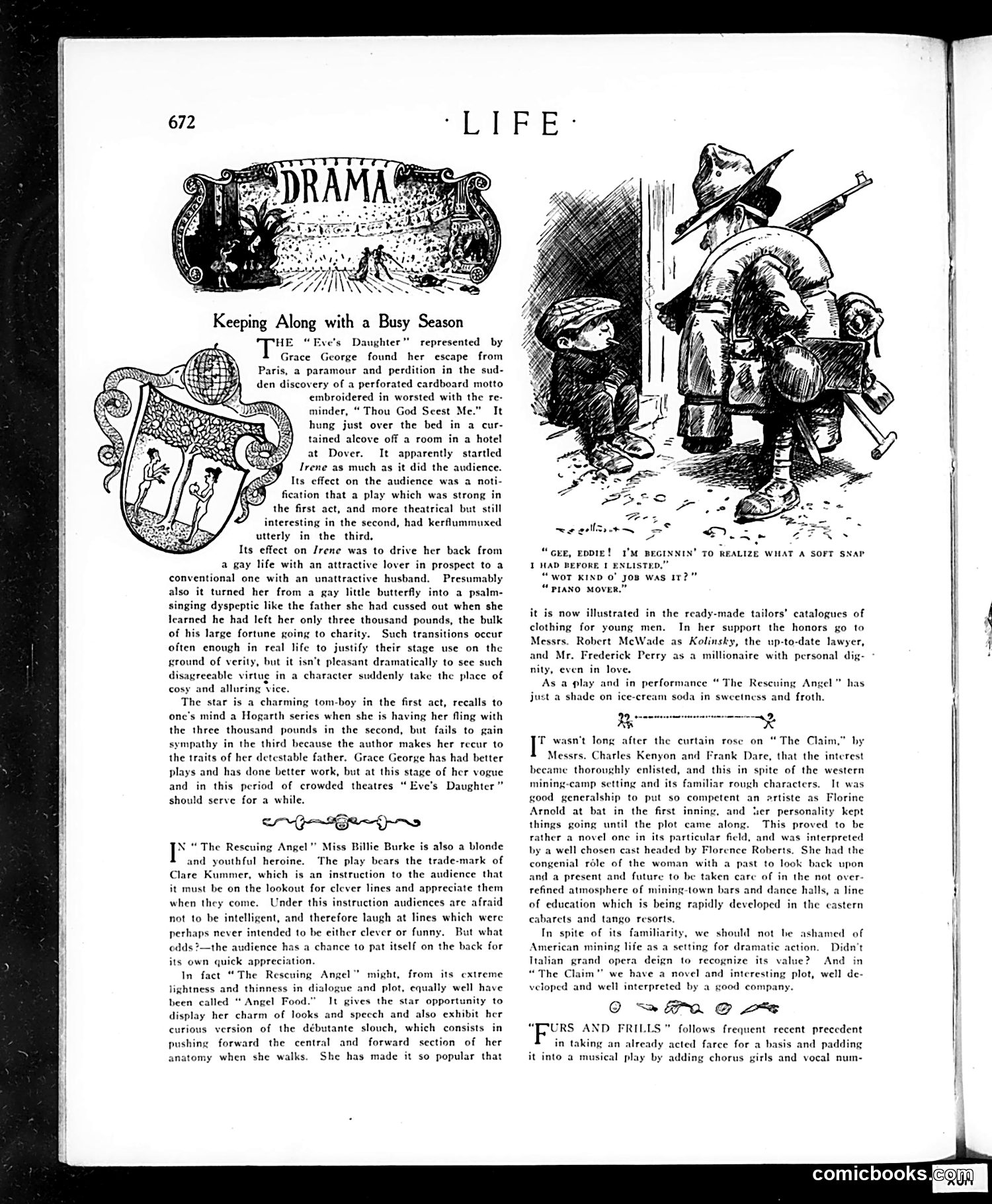
This page reviews three theatrical productions. The main cartoon depicts a soldier and woman—likely representing WWI-era themes about military service and domestic life. The soldier's dialogue references enlisting and a "piano mover" job, suggesting satire about sudden wartime occupational changes. The text reviews "Eve's Daughter" (starring Grace George), criticizing how the protagonist implausibly abandons her adventurous lifestyle after encountering a religious motto, converting to pious domesticity. The reviewer finds this moralistic turn dramatically unconvincing, despite the actress's charm. "The Rescuing Angel" (with Billie Burke) receives lighter treatment—described as witty but insubstantial ("ice-cream soda in sweetness and froth"), noting audiences over-laugh at lines fearing they'll miss clever wordplay. "The Claim," set in a mining camp, is praised for engaging the audience despite its rough setting and familiar characters. The reviews collectively critique contemporary theater's melodramatic morality and shallow entertainment value.
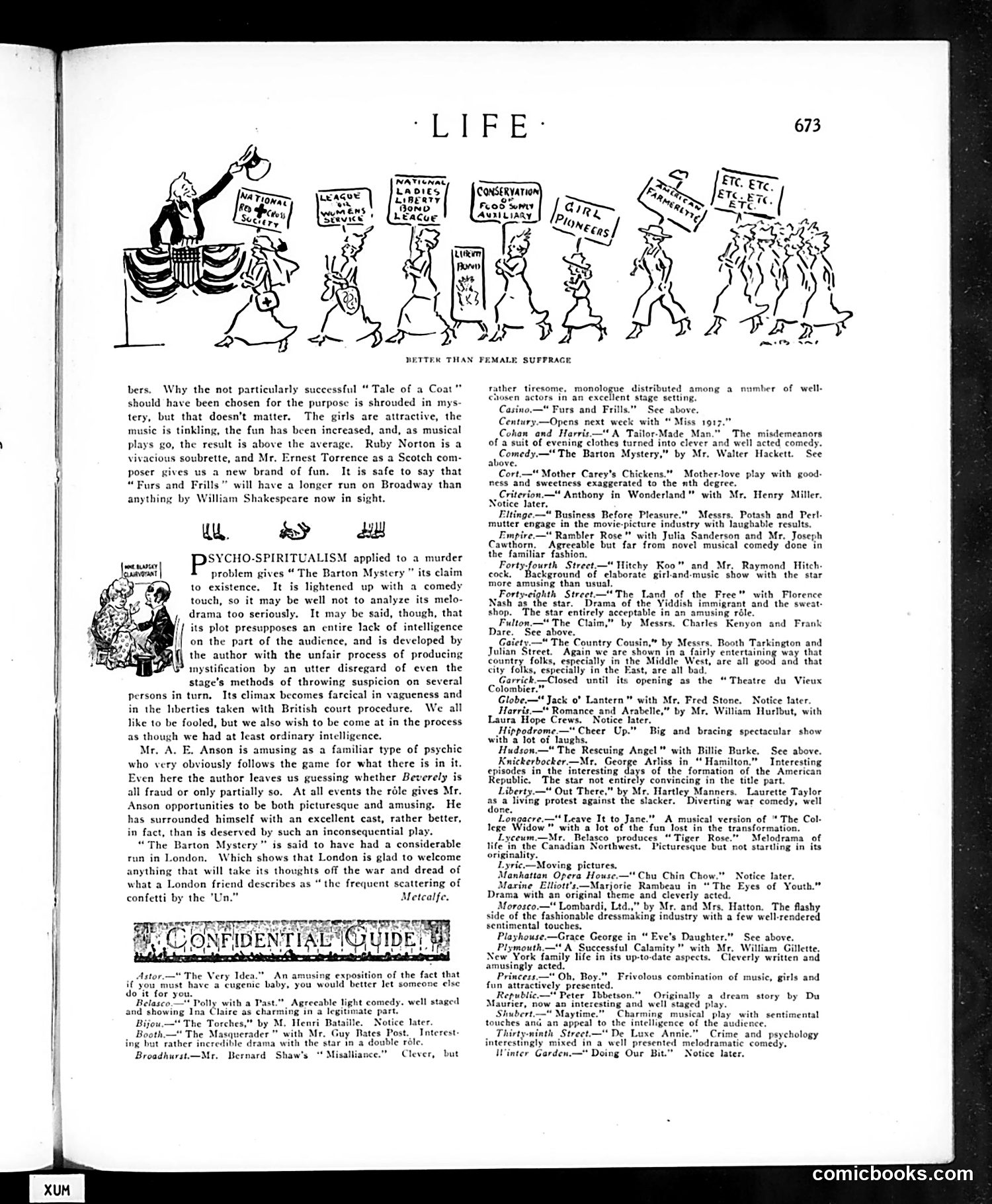
This political cartoon satirizes women's suffrage opposition by depicting female activists carrying protest signs ("National Ladies," "League for Liberty," "Conservation," "Girl Pioneers," etc.) as a parade being dismissed by a male figure on a podium. The caption's sarcastic title suggests that theatrical entertainment represents a "better" alternative to women's political participation. The cartoon's point: anti-suffrage advocates claimed women should focus on domestic and cultural roles rather than voting rights. By showing suffragists as a frivolous procession, the cartoonist ridicules this argument—the very seriousness with which women organize politically contradicts claims they belong only in entertainment and the home. This reflects the pre-19th Amendment era (before 1920) when female suffrage remained hotly contested in American politics.
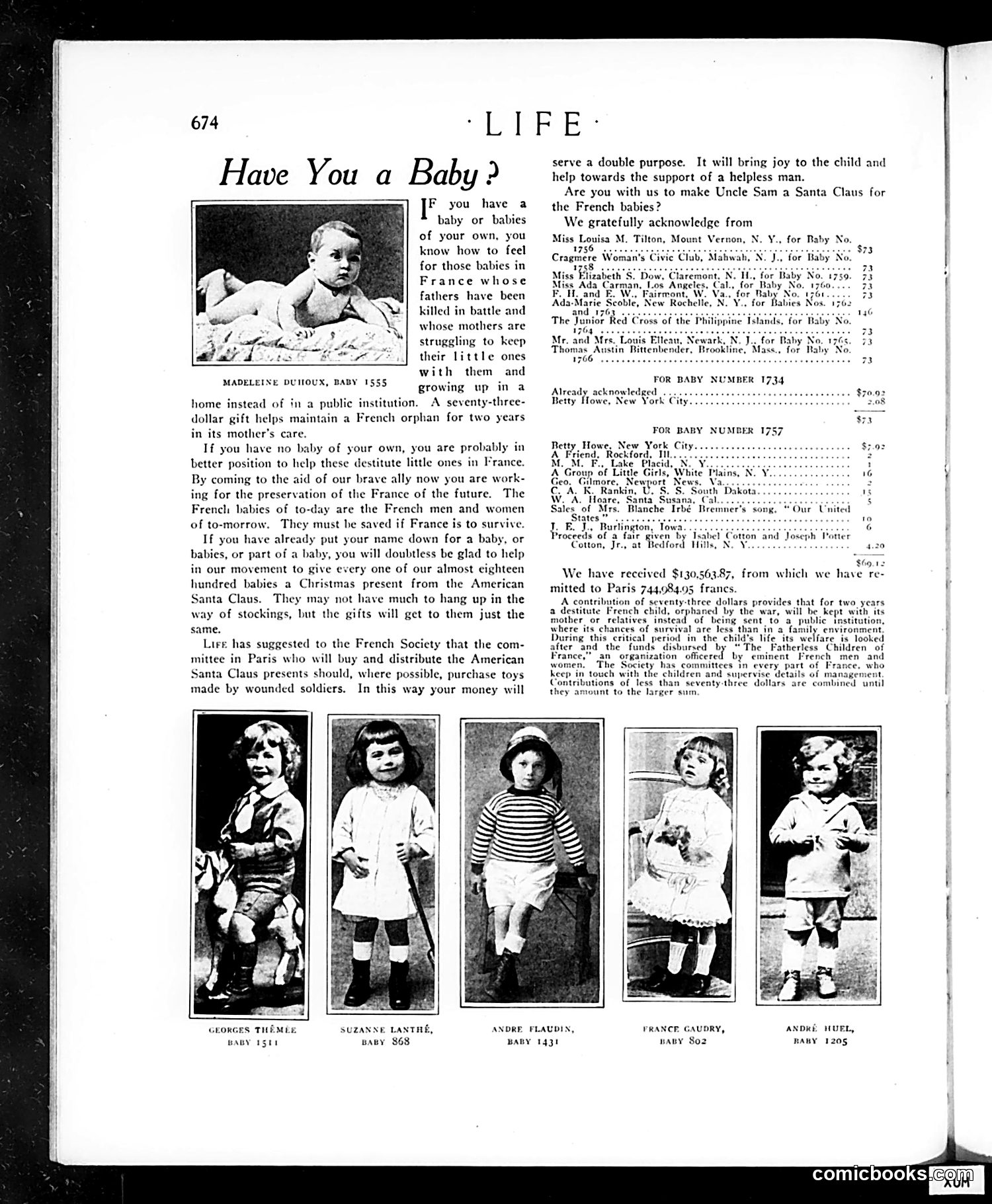
This page is a **fundraising appeal for French war orphans**, published during or shortly after World War I. The headline's pun ("Have You a Baby?") invites American readers to sponsor French children whose fathers were killed in battle. The appeal argues that $73 maintains one French orphan for two years with its mother rather than in a public institution—presenting this as both humanitarian aid and investment in France's future. It suggests that American "Santa Claus" donors purchase Christmas gifts from **wounded soldiers**, creating a "double purpose" of helping both children and disabled veterans. The five photographs display actual French orphans (identified by name and number) receiving aid—a common fundraising tactic to personalize charity. The detailed financial accounting at bottom ($130,563.87 collected, remitted to Paris) aims to establish donor confidence. **Context**: This reflects American support for France during WWI and the broader 1920s sentiment that American wealth should assist European reconstruction and children displaced by war.
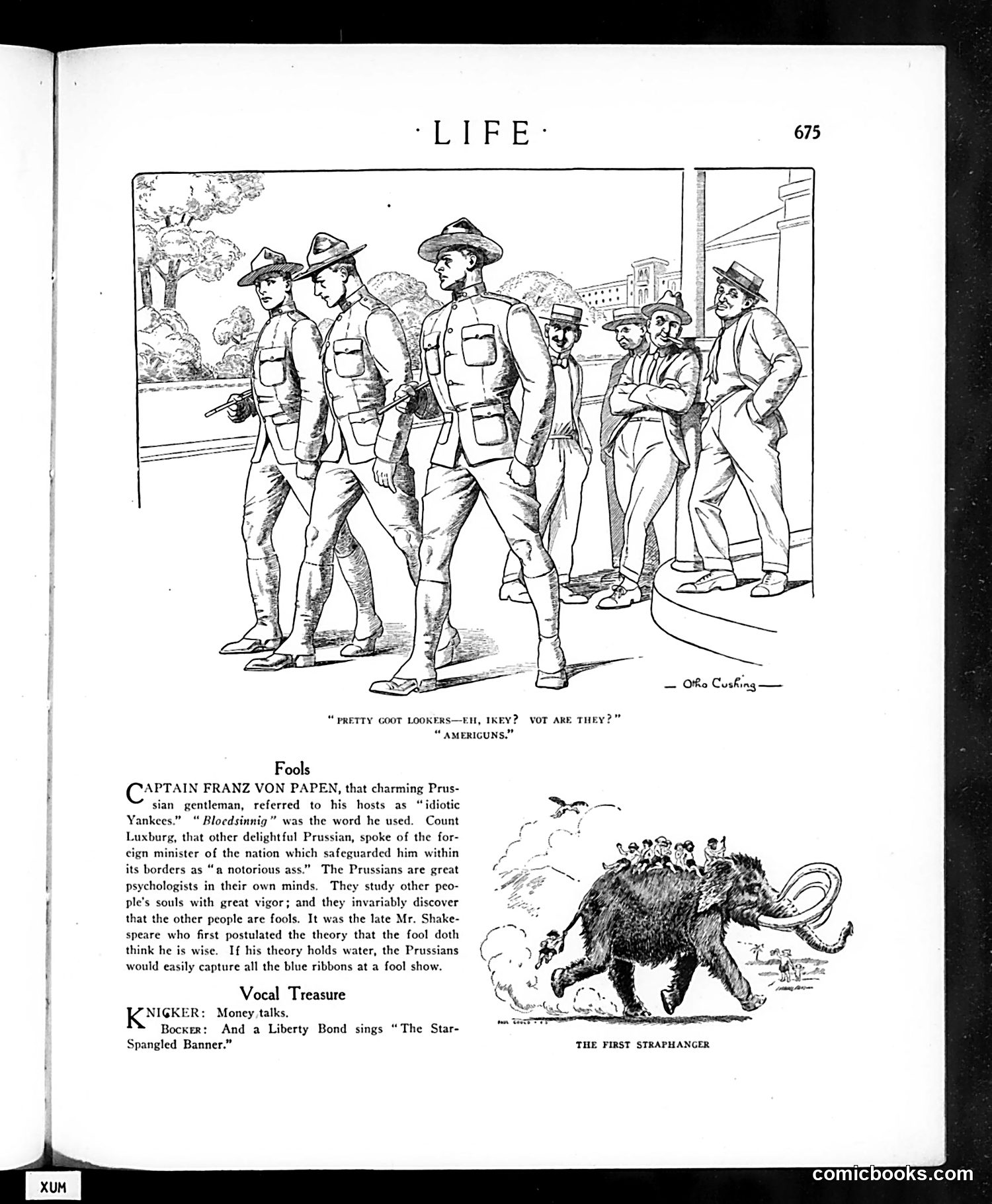
The main cartoon satirizes German diplomats' contempt for Americans. It depicts three tall, uniformed German military officers being observed by shorter American civilians. The caption—with exaggerated German accents ("goot lookers," "ikey," "vot")—has Germans dismissively calling Americans "Ameriguns" (a mocking pronunciation). The accompanying text references Captain Franz von Papen and Count Luxburg, actual German diplomats who publicly insulted American leadership during World War I, calling Americans "idiotic Yankees" and "notorious." Life's satire inverts their criticism: the Prussians, who fancy themselves psychologists of human nature, are themselves the real fools—a reference to Shakespeare's observation that fools believe themselves wise. The "Vocal Treasure" section makes a patriotic pun: while money talks, Liberty Bonds (WWI fundraising instruments) "sing" the national anthem, encouraging American financial support for the war effort. This page reflects American wartime sentiment mocking German arrogance.
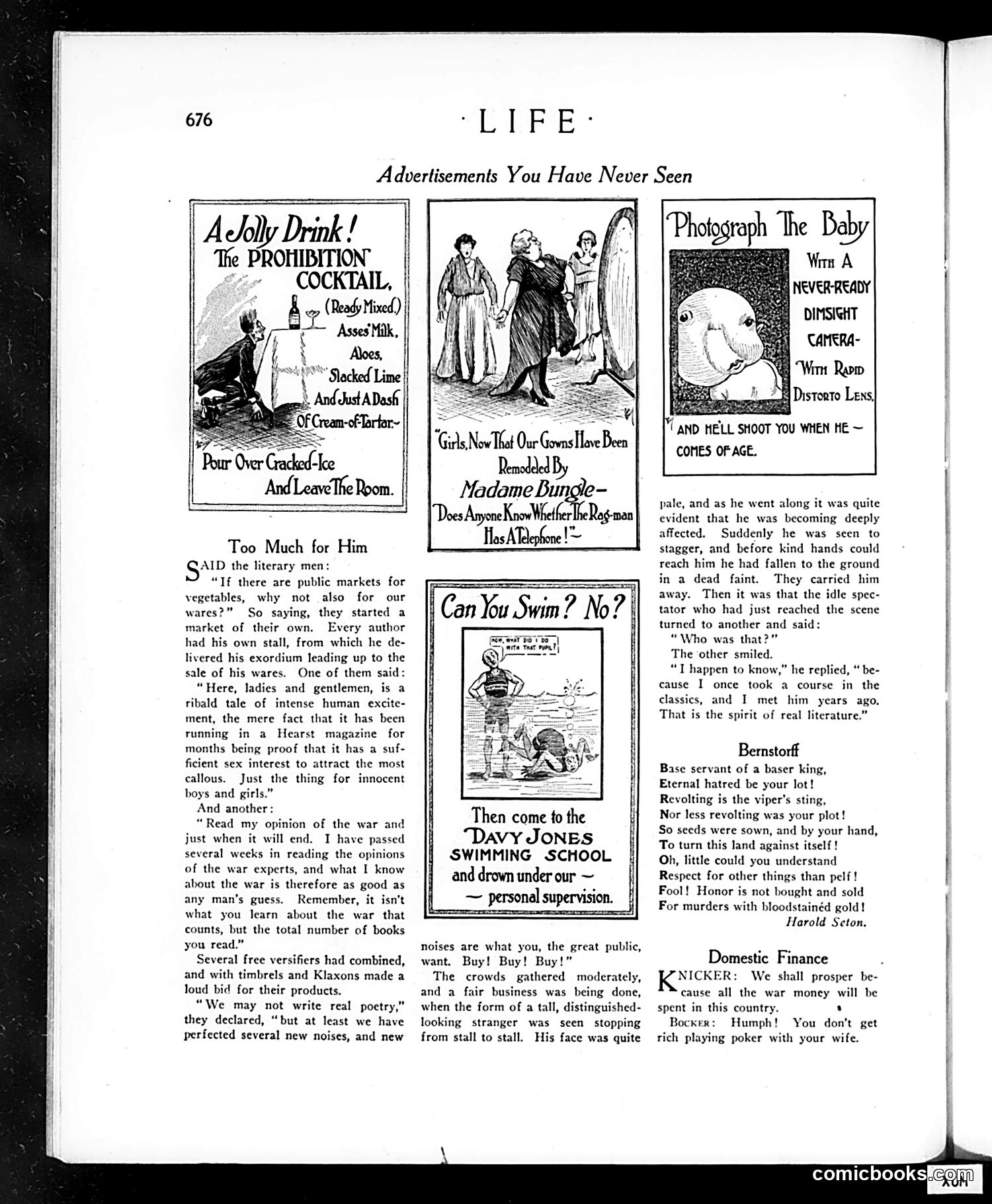
This satirical page mocks early 20th-century American literary and publishing culture. The main article, "Too Much for Him," describes authors attempting to sell their work like vegetables at a market, each hawking their wares with dubious claims: sensationalist "sex interest" from Hearst magazines, wartime commentary presented as expertise, and experimental "free verse" poetry that amounts to "new noises." The joke centers on a distinguished-looking stranger who faints upon witnessing this spectacle—revealed to be a classical literary figure appalled by modern writing standards. The satire targets what Life's editors saw as the degradation of serious literature into commercial product, replaced by sensationalism, pseudo-intellectualism, and noise masquerading as art. The surrounding ads are fake, mocking Prohibition-era cocktails, dubious cameras, and swimming schools—part of the same critique of American marketing excess.
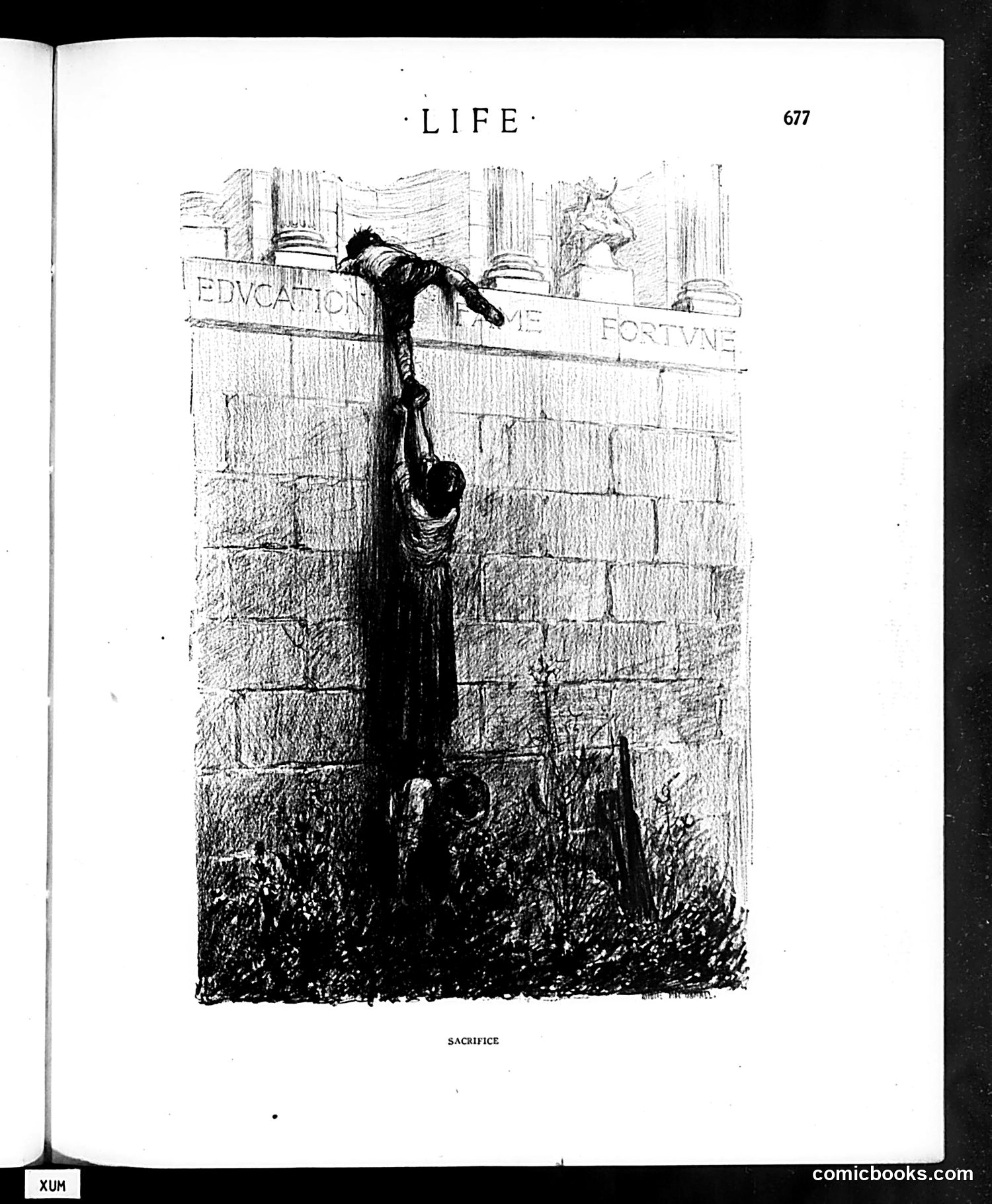
This political cartoon depicts a figure climbing a tall stone wall labeled "EDUCATION" and "FORTUNE." The climber appears to be straining upward, reaching toward the top where a figure looks down from above. Below, dark shadowy masses gather at the wall's base. The cartoon satirizes the difficulty of social and economic advancement through education. The wall represents barriers to achieving fortune/success through education—suggesting these barriers are steep and require tremendous personal effort ("sacrifice"). The masses below may represent those unable to breach these obstacles. The cartoon critiques either the inaccessibility of quality education to common people, or the false promise that education alone guarantees prosperity. The visual metaphor of the grueling climb emphasizes the enormous personal sacrifice required even to attempt advancement.
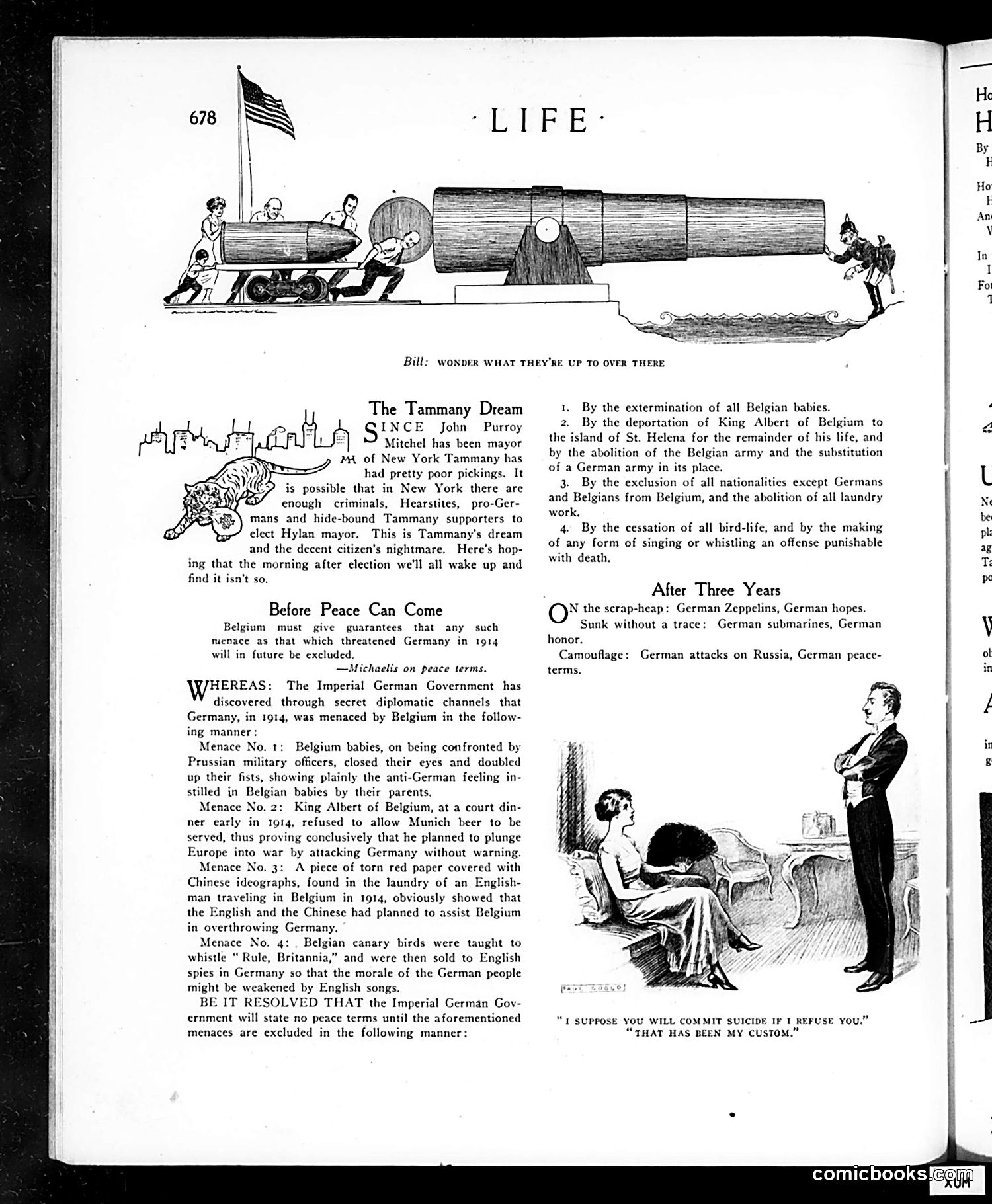
This page from Life magazine satirizes German war aims during World War I. The top cartoon mocks what New York's Tammany Hall political machine dreams of—electing their preferred mayor (likely John F. Hylan) over the reform candidate. The main content attacks Germany's peace negotiation demands. Through absurdist "menaces," Life ridicules Germany's justifications for invading Belgium in 1914. Germany claimed Belgium threatened them—a fabrication Life exposes by listing laughable "threats": Belgian babies resisting Prussian officers, King Albert refusing Bavarian beer, and canary birds whistling British songs. The satirical "resolutions" propose equally grotesque German "solutions": exterminating Belgian babies, deporting King Albert, and banning all singing. This reductio ad absurdum reveals the hypocrisy and brutality of Germany's actual demands for Belgian subjugation. The bottom illustration depicts a man coercing a woman into suicide—visualizing Germany's ultimatum tactics during peace negotiations, where refusal meant continued warfare and destruction.
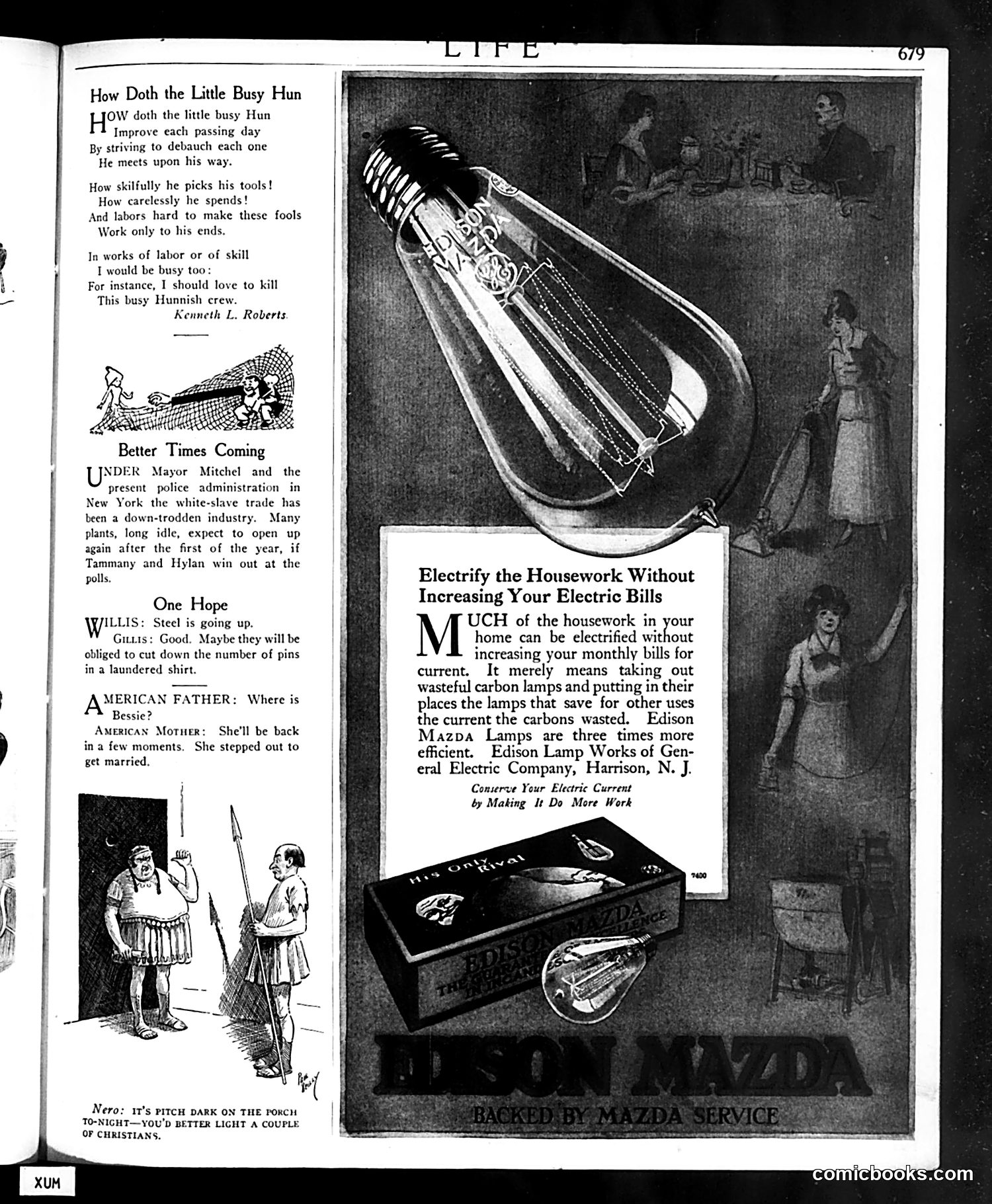
This page mixes political satire with advertising, circa World War I era. **"How Doth the Little Busy Hun"** is a virulent anti-German poem (by Kenneth L. Roberts) parodying the nursery rhyme "How Doth the Little Busy Bee." "Hun" was American WWI propaganda slur for Germans. The poem accuses Germans of moral corruption and exploitation, concluding with a call to kill them—reflecting intense wartime hostility. **The "American Father/Mother" cartoon** appears to satirize rapid, casual marriages, with the mother casually mentioning her daughter "stepped out to get married." **The Nero cartoon** mocks apathy about crime, suggesting people are indifferent ("pitch dark") to serious problems. **"Better Times Coming"** and **"One Hope"** sections discuss New York politics and steel prices—likely commentary on post-war economic hopes. The **Edison Mazda Lamps advertisement** dominates the right side, promoting electrical efficiency. The page reflects American society during or immediately after WWI, combining jingoistic war sentiment with consumer advertising and local political commentary.
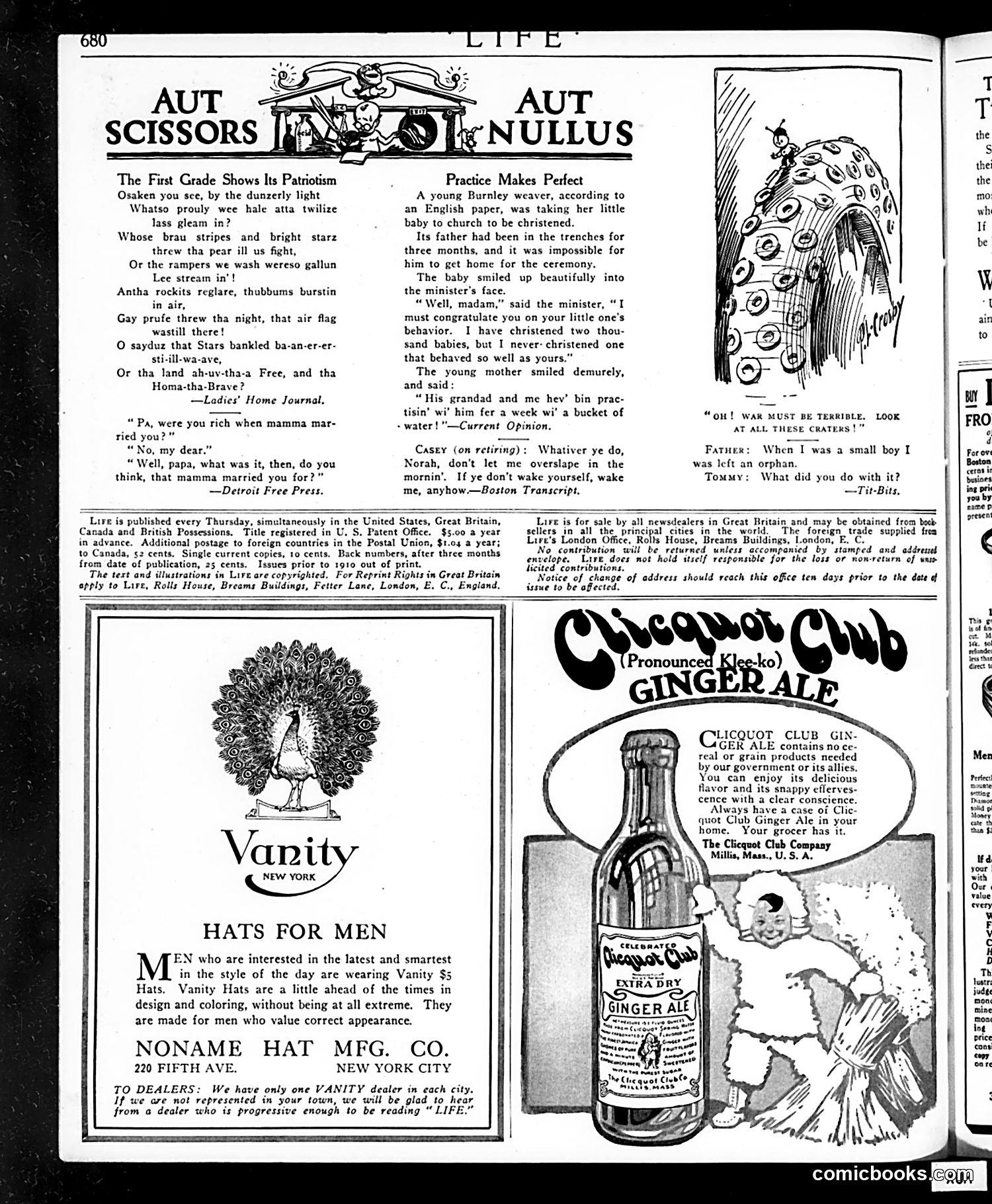
This page mixes humor with wartime messaging. The "First Grade Shows Its Patriotism" poem parodies a child's garbled recitation of "The Star-Spangled Banner"—the OCR captures the deliberately misspelled phonetic rendering. The satire gently mocks patriotic fervor while the joke structure suggests adults find children's earnest patriotism endearing. "Practice Makes Perfect" contrasts a soldier father absent from his child's christening with the mother's resourcefulness—she "practiced" the baby's good behavior using a water bucket. The humor lies in working-class ingenuity during wartime separation. The "moon craters" cartoon shows a child misinterpreting bomb craters as lunar features—dark wartime humor about weapons' destructive power. Advertisements (Vanity hats, Clicquot Club ginger ale) emphasize patriotic consumption. The ginger ale ad notably stresses it contains "no cereal or grain products needed by our government or its allies"—referencing WWI rationing and civilian sacrifice for the war effort.
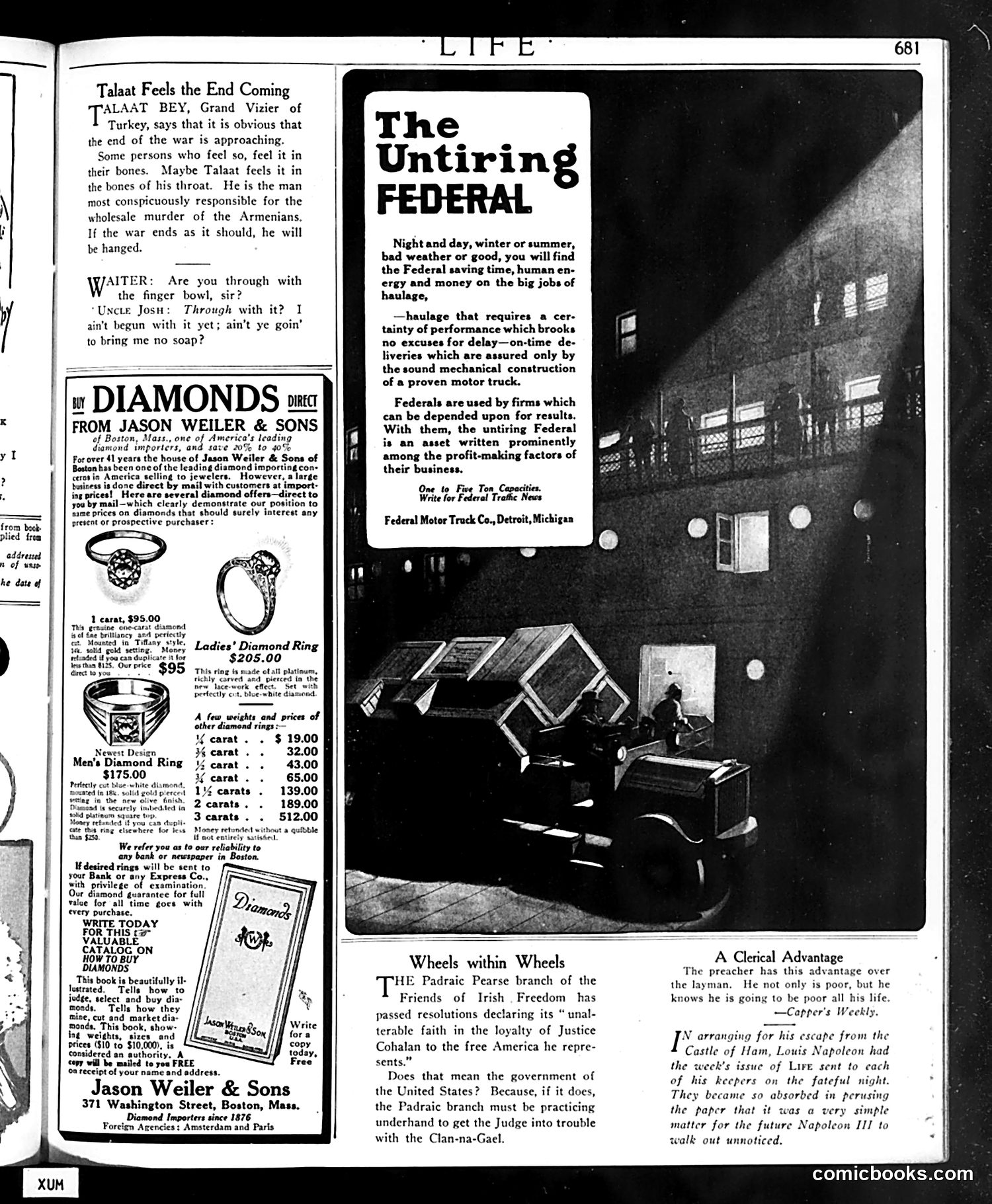
**Main Political Satire:** The opening section attacks **Talaat Bey, Grand Vizier of Turkey**, who is responsible for the Armenian genocide. The joke's grim punchline suggests that as WWI ends, he will be hanged for these "wholesale murders"—a reference to the contemporary Armenian massacres (1915 onward). The satirist expresses hope that post-war justice will execute him. **Secondary Items:** A brief dialogue about finger bowls and soap appears unrelated to politics—likely filler humor. The page is otherwise dominated by **period advertisements** for diamonds and Federal Motor Trucks, suggesting this is primarily a commercial publication page rather than a dedicated satirical cartoon. **Historical Context:** This reflects wartime sentiment against Ottoman leadership and anticipation of post-war tribunals, though Talaat actually escaped to Berlin and was assassinated by Armenian nationalists in 1921, not formally tried.
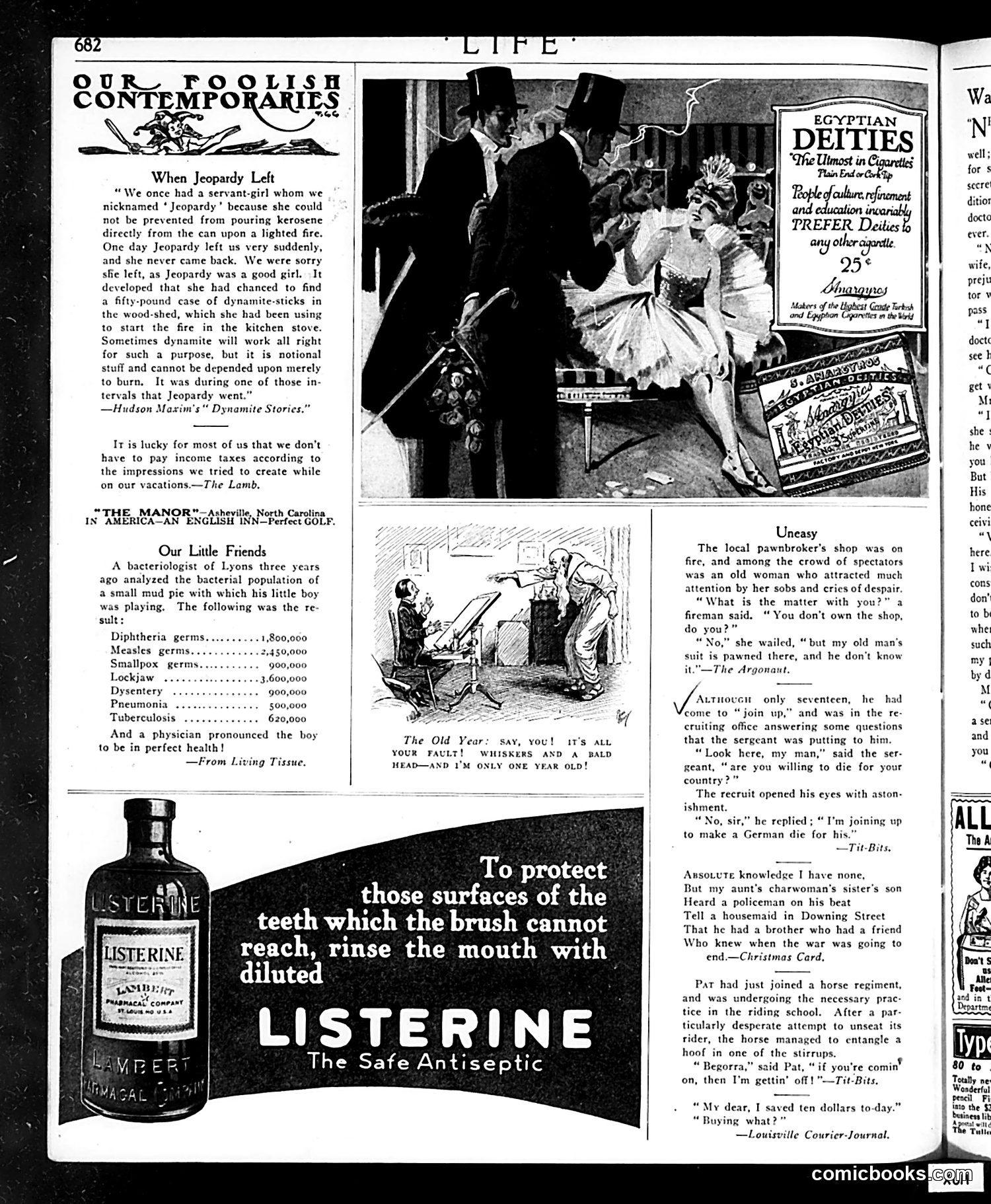
This page from *Life* contains multiple satirical pieces rather than a single unified cartoon: **"When Jeopardy Left"** is a humorous anecdote about a dangerously incompetent servant who unknowingly used dynamite sticks to start kitchen fires. The joke critiques both the servant's obliviousness and society's casual dangers—dynamite was apparently accessible enough for household use that someone could mistake it for kindling. **"Our Little Friends"** mocks excessive germ-consciousness by listing the bacterial content of a mud pie a child played with, then noting a doctor proclaimed the child healthy anyway. This satirizes both medical paranoia and the gap between scientific analysis and practical health outcomes. The remaining items are brief humorous anecdotes about misunderstandings and wartime recruitment (references to "German" and "join up" suggest WWI-era publication). The **Listerine advertisement** occupies significant space, typical of the era's magazines. Overall, the page reflects early 20th-century concerns about safety, hygiene, and domestic incompetence, delivered through gentle humor rather than sharp political satire.
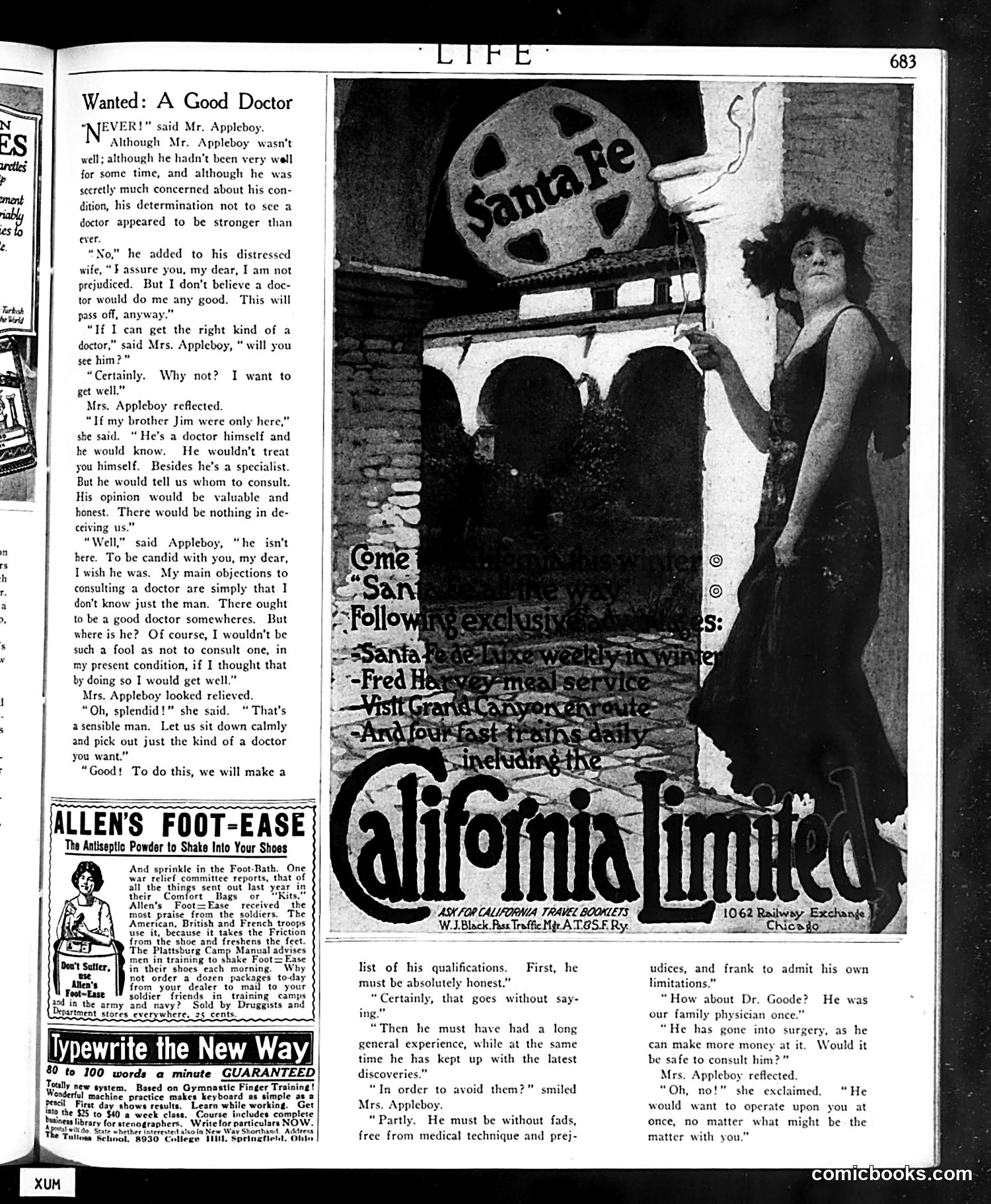
This page contains a satirical short story titled "Wanted: A Good Doctor," satirizing the difficulty of finding trustworthy medical care. **The Satire's Point:** Mr. Appleboy, though ill, refuses to see a doctor—claiming he doesn't know "the right kind." His wife attempts to establish rational criteria for selecting a physician: honesty, broad experience, current knowledge, freedom from fads, and humility about limitations. **The Social Commentary:** The humor targets both patient skepticism and professional self-interest. When Dr. Goode is mentioned as a candidate, Mrs. Appleboy rejects him because he's "gone into surgery" to "make more money at it" and would "want to operate upon you...no matter what might be the matter." This reflects early 20th-century concern that doctors were financially incentivized to perform unnecessary procedures—a criticism that remains relevant today. **The Irony:** Appleboy wants the "right" doctor but uses vague excuses to avoid medical consultation entirely, suggesting human reluctance to face health problems transcends finding good practitioners. The surrounding ads (Allen's Foot-Ease, typing classes) are period advertisements unrelated to the satire.
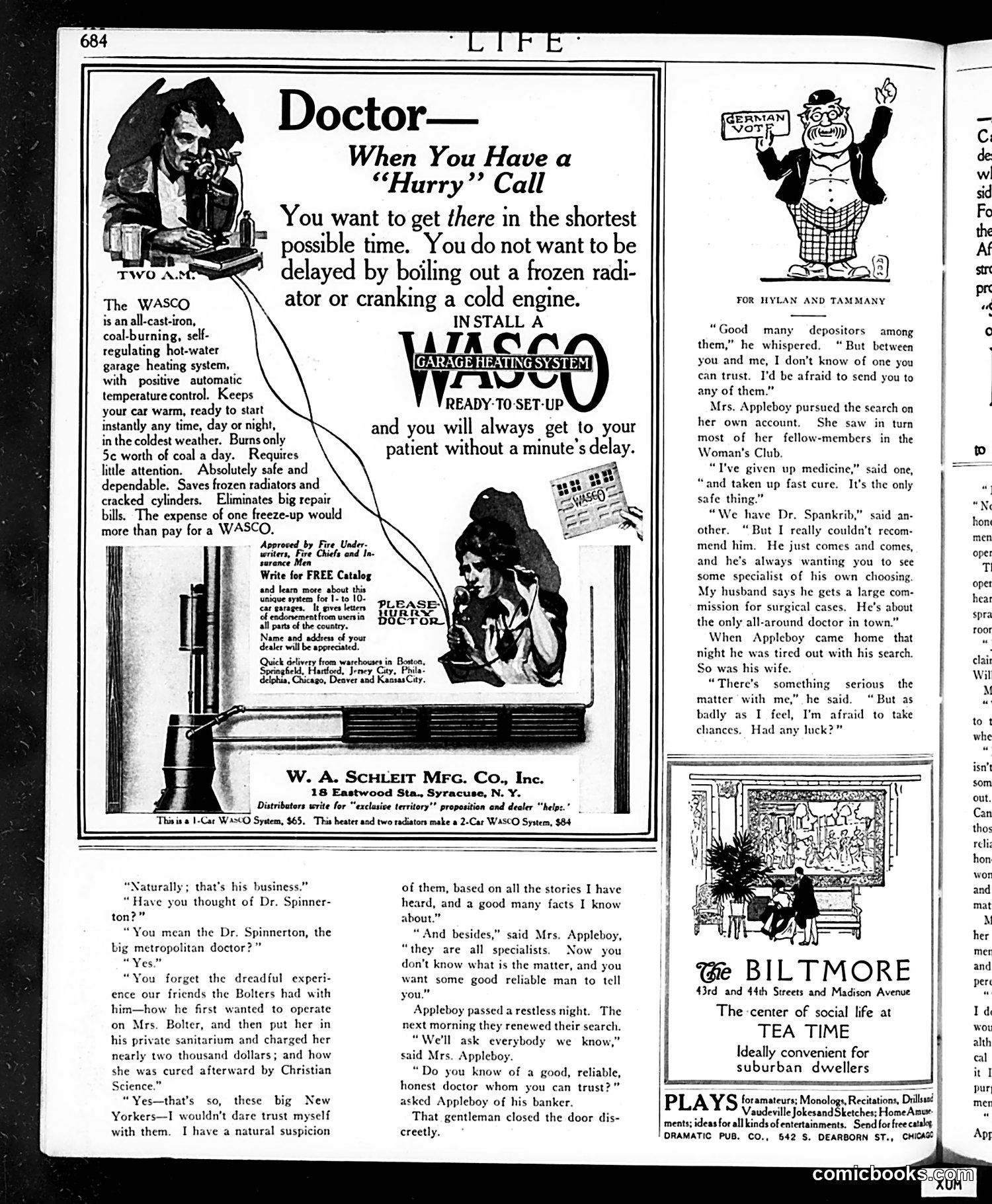
This page contains a **product advertisement** (WASCO garage heating system) and a **satirical narrative** about finding a trustworthy doctor. The main satire mocks the difficulty of locating an honest physician in early 20th-century America. A couple, the Appleboys, seek medical help but encounter widespread suspicion: a banker won't recommend doctors to his depositors for fear of liability; a woman has abandoned medicine for "fast cure" (likely faith healing); another doctor, Dr. Spankrib, allegedly over-prescribes specialists for commissions. The piece references **Dr. Spinnerton**, a caricatured "big metropolitan doctor" notorious for unnecessary surgery and sanitarium fees—a common contemporary complaint about urban medical practitioners. The satire targets **medical greed and incompetence** among urban physicians, playing on widespread public distrust of the medical profession during this era. The cartoon ultimately suggests that finding an ethical doctor is nearly impossible, a sharp critique of commercialized medicine.
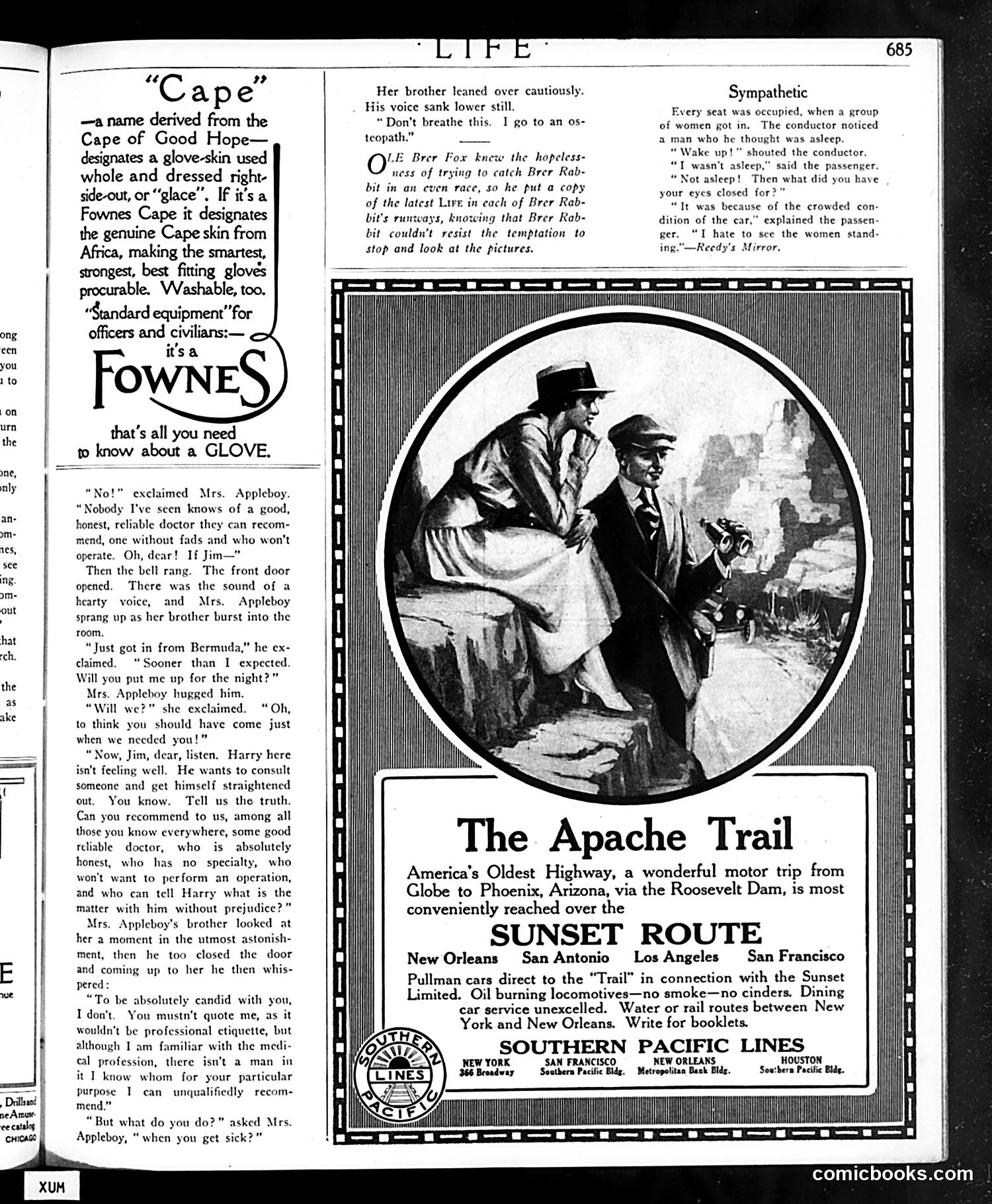
This page combines several distinct elements typical of early 20th-century Life magazine: **Left side**: A Fownes glove advertisement and a multi-panel narrative about Mrs. Appleboy seeking a doctor recommendation from her visiting brother Jim. The humor centers on Jim's candid admission that despite knowing many doctors, he cannot recommend *any* who are both honest and without problematic "fads" or unnecessary surgical tendencies—a subtle jab at medical overspecialization and unnecessary procedures of the era. **Right side**: A Southern Pacific Lines railroad advertisement promoting "The Apache Trail," a scenic motor route from Globe to Phoenix via Roosevelt Dam, offering Pullman car service. **Interspersed**: Two brief humorous anecdotes about train passengers, satirizing discomfort and social awkwardness in crowded rail cars. The page reflects early-1900s concerns about medical ethics and the growing railroad tourism industry. The satire assumes readers would recognize the irony of Jim's predicament—that specialization, while presented as professional advancement, actually narrowed doctors' trustworthiness in the public eye.
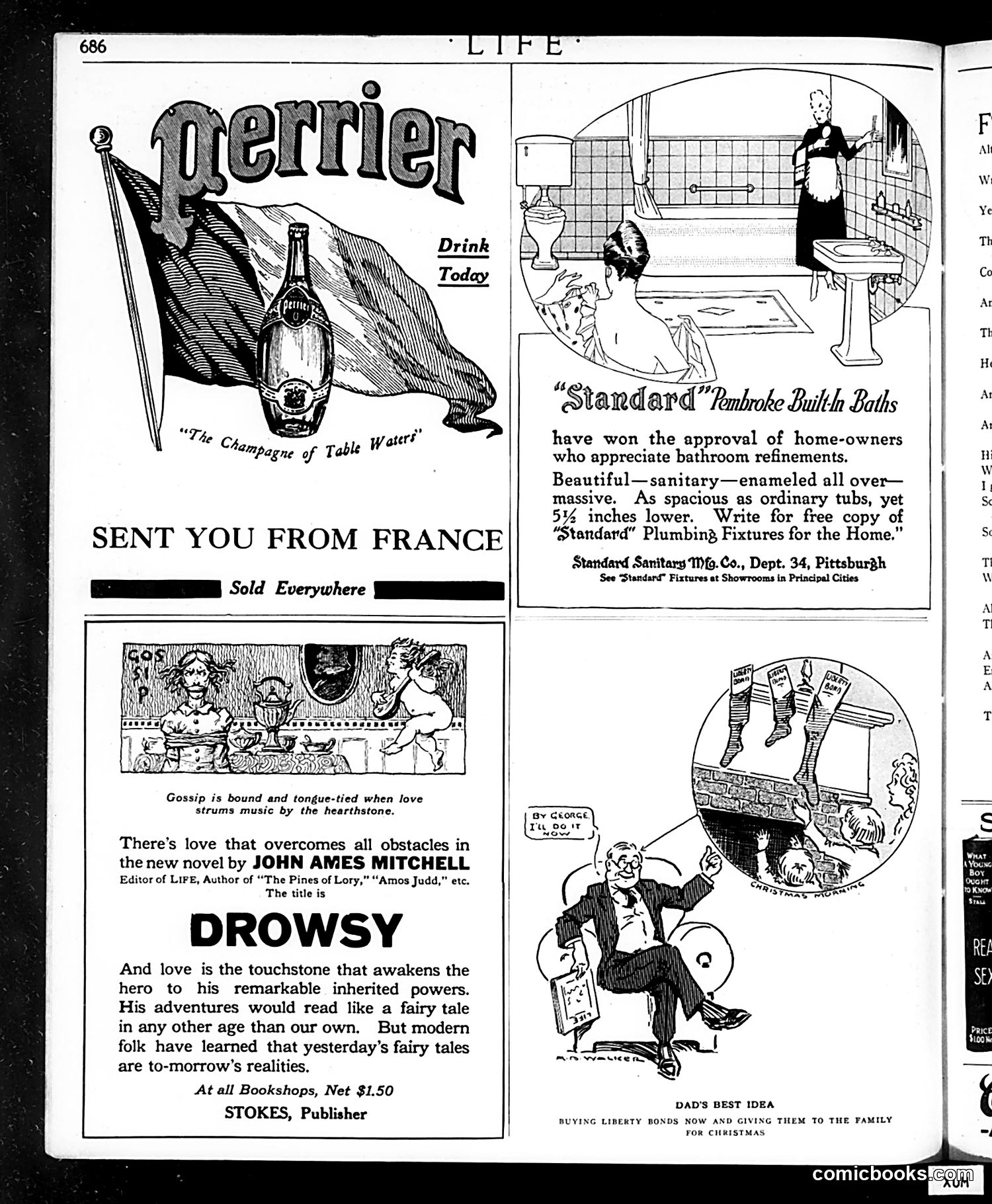
This page combines advertisements with promotional content for a novel. The main satirical element is subtle: **"Drowsy" Novel Promotion**: John Ames Mitchell (Life's editor) advertises his romance novel, claiming modern love "overcomes all obstacles" and that "yesterday's fairy tales are to-morrow's realities." The satire appears gentle—promoting a fantasy adventure while acknowledging contemporary skepticism about such tales. **Advertisements**: - **Perrier** ("Champagne of Table Waters"): A French beverage pitched as sophisticated refreshment - **Standard Plumbing Baths**: Emphasizes modern bathroom refinements and lower tub design for home comfort - **Liberty Bonds**: A patriotic pitch to purchase war bonds as Christmas gifts for family **Context**: This appears to be WWI-era (Liberty Bonds were sold 1917-1918), so the juxtaposition of escapist romance fiction with patriotic financial investment reflects wartime American values—mixing entertainment with civic duty. The page is primarily **advertising-driven** rather than presenting explicit political satire, though the Liberty Bonds ad carries patriotic messaging typical of the period.
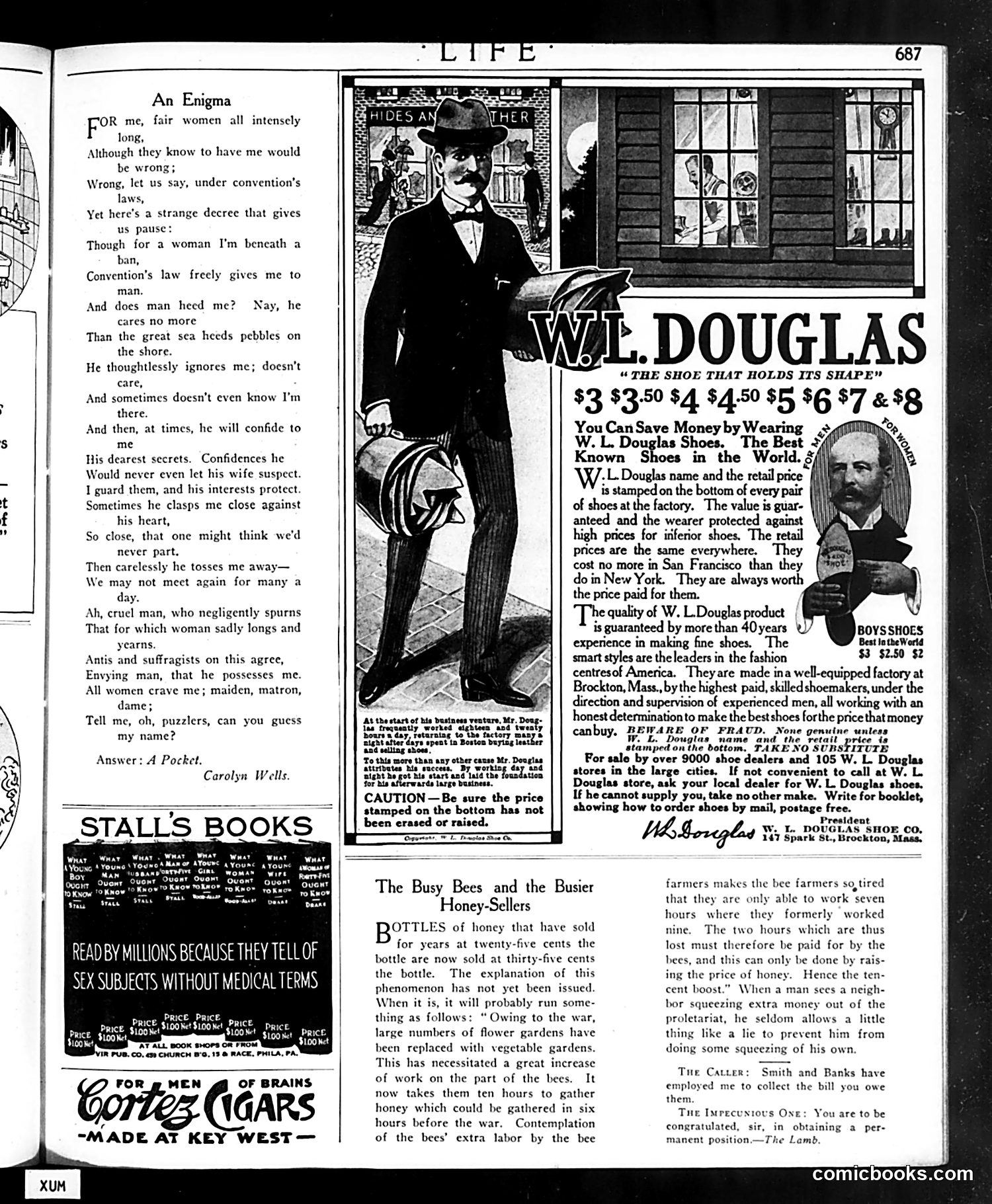
This page contains **primarily advertisements** interspersed with light satirical content. The main feature is **"An Enigma"** by Carolyn Wells—a riddling poem about a mysterious female figure that women desire and men confide in but casually discard. The answer is **"A Pocket,"** a clever play on women's limited agency: pockets are valued possessions on men's clothing but absent from women's garments, satirizing gender inequality and women's restricted access to practical freedoms. The page is dominated by a **W.L. Douglas shoe advertisement** featuring a man in formal dress, emphasizing consistent pricing across cities and quality guarantees. The brief article **"The Busy Bees and the Busier Honey-Sellers"** appears to satirize **wartime price inflation**. It humorously suggests that because flower gardens were replaced with vegetable gardens for the war effort, bees must work longer hours gathering honey, justifying price increases from 25 to 35 cents per bottle—absurdist logic mocking merchants' inflation excuses. The **context is WWI-era America**, when wartime disruptions and profiteering were common satirical targets.
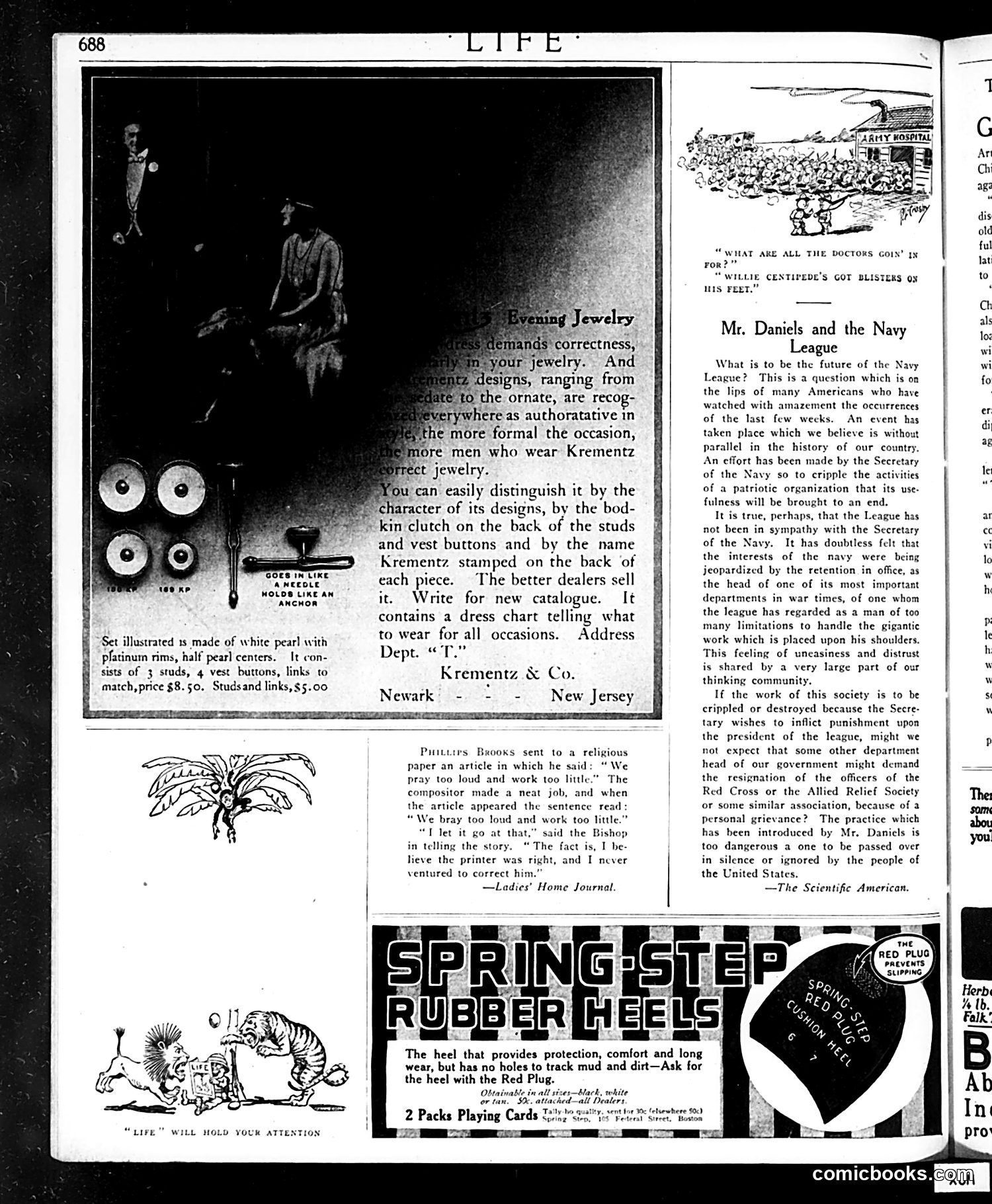
This page features a political editorial criticizing Secretary of the Navy Josephus Daniels for allegedly using his office to punish the Navy League—a patriotic organization—because its leadership disagreed with his policies. The piece argues that the Navy League had legitimate concerns about Daniels retaining certain officers despite believing them unfit for wartime command. Rather than address these criticisms on merit, Daniels allegedly sought to "cripple" the organization's effectiveness as retaliation. The author (from *Scientific American*) warns this sets a dangerous precedent: if Cabinet officials can destroy organizations that criticize them, other government departments might do the same to the Red Cross or relief societies based on personal grievance. The satire is pointed but serious—this is an editorial warning about executive overreach and the suppression of legitimate civic dissent, not a humorous cartoon.
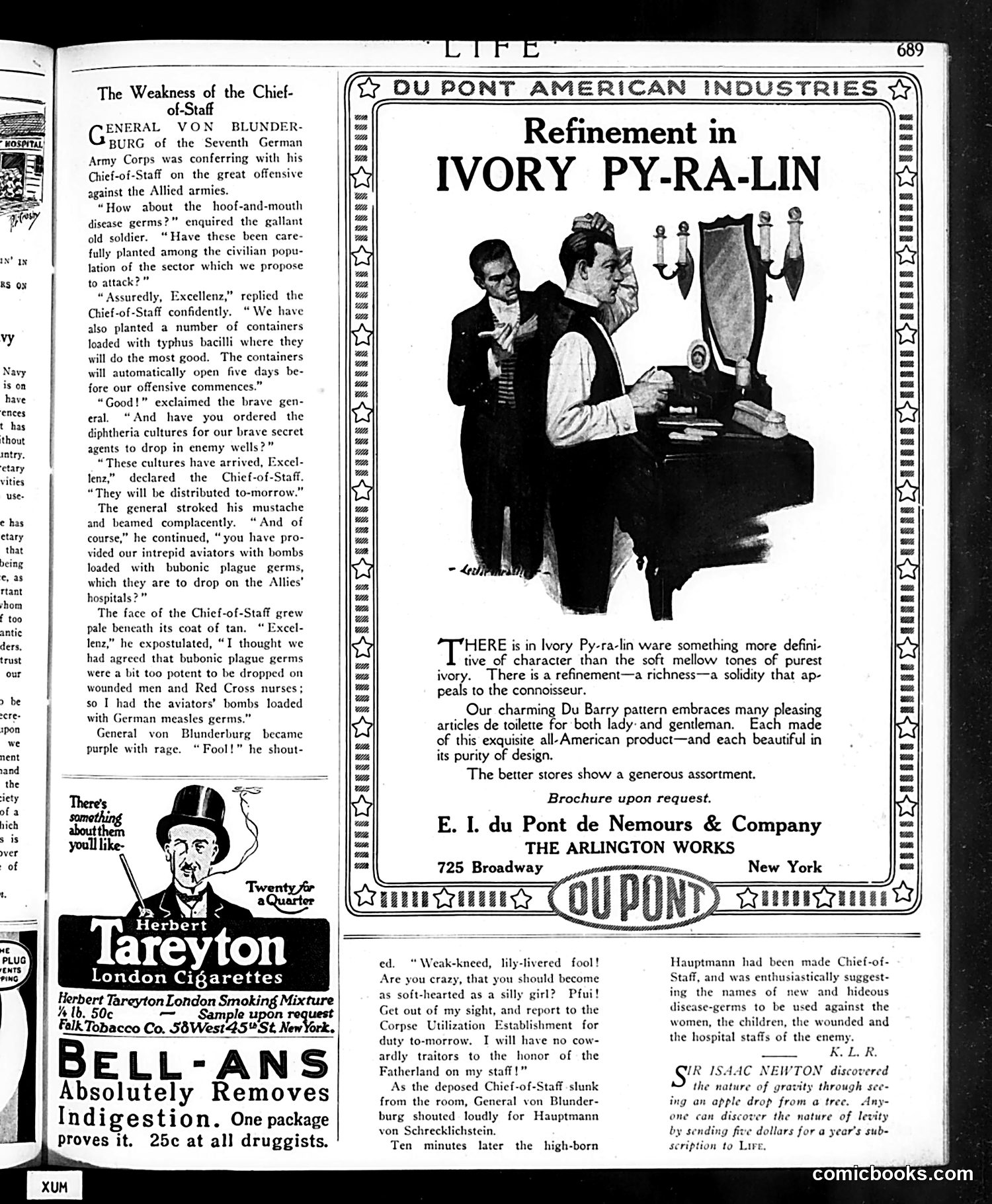
This wartime satire mocks German military incompetence by depicting a fictional dialogue between General von Blunderburg and his Chief-of-Staff. The joke turns on escalating absurdity: the general boasts of deploying biological weapons (typhus, diphtheria, bubonic plague) against Allied civilians and hospitals. When the Chief-of-Staff admits he only loaded bombs with "German measles germs"—a comparatively harmless disease—the general explodes in rage at his "weakness." The satire works on two levels: it ridicules German military planning as simultaneously cartoonishly evil and incompetent, while the punchline's casual reference to bioweapon deployment reflects actual WWI concerns about chemical/biological warfare. The exaggeration underscores Allied propaganda portraying Germany as barbarically willing to commit atrocities. The page also contains unrelated advertisements (cigarettes, antacids, ivory products), typical of *Life* magazine's format.
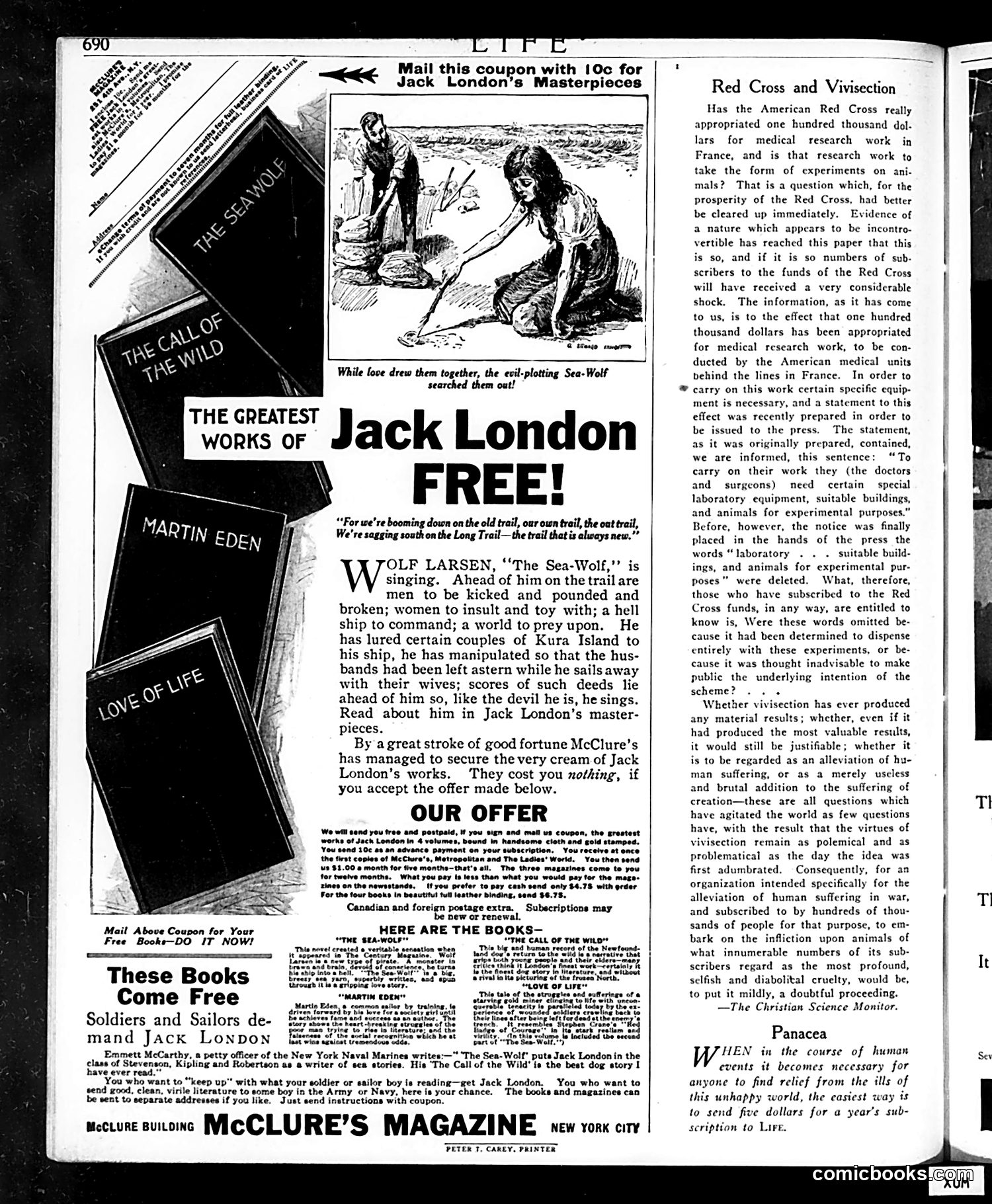
This page is primarily **advertising and promotional content**, not satire or political commentary. The main feature is a **Jack London book promotion** by McClure's Magazine, offering free copies of London's works (particularly *The Sea-Wolf*) to magazine subscribers. The accompanying illustration shows the novel's plot—the "Sea-Wolf" character manipulating couples—with the caption explaining his villainous nature. The smaller illustrated section at bottom-right addresses **animal testing ethics**: it critiques the Red Cross for allegedly appropriating funds for medical experiments on animals in France during WWI. The piece questions whether Red Cross subscribers would approve of vivisection and argues this raises serious moral concerns about animal cruelty versus wartime medical necessity. The page reflects early 20th-century anxieties about both **popular literature's moral influence** and **animal welfare in scientific research**—two distinct editorial concerns presented together.
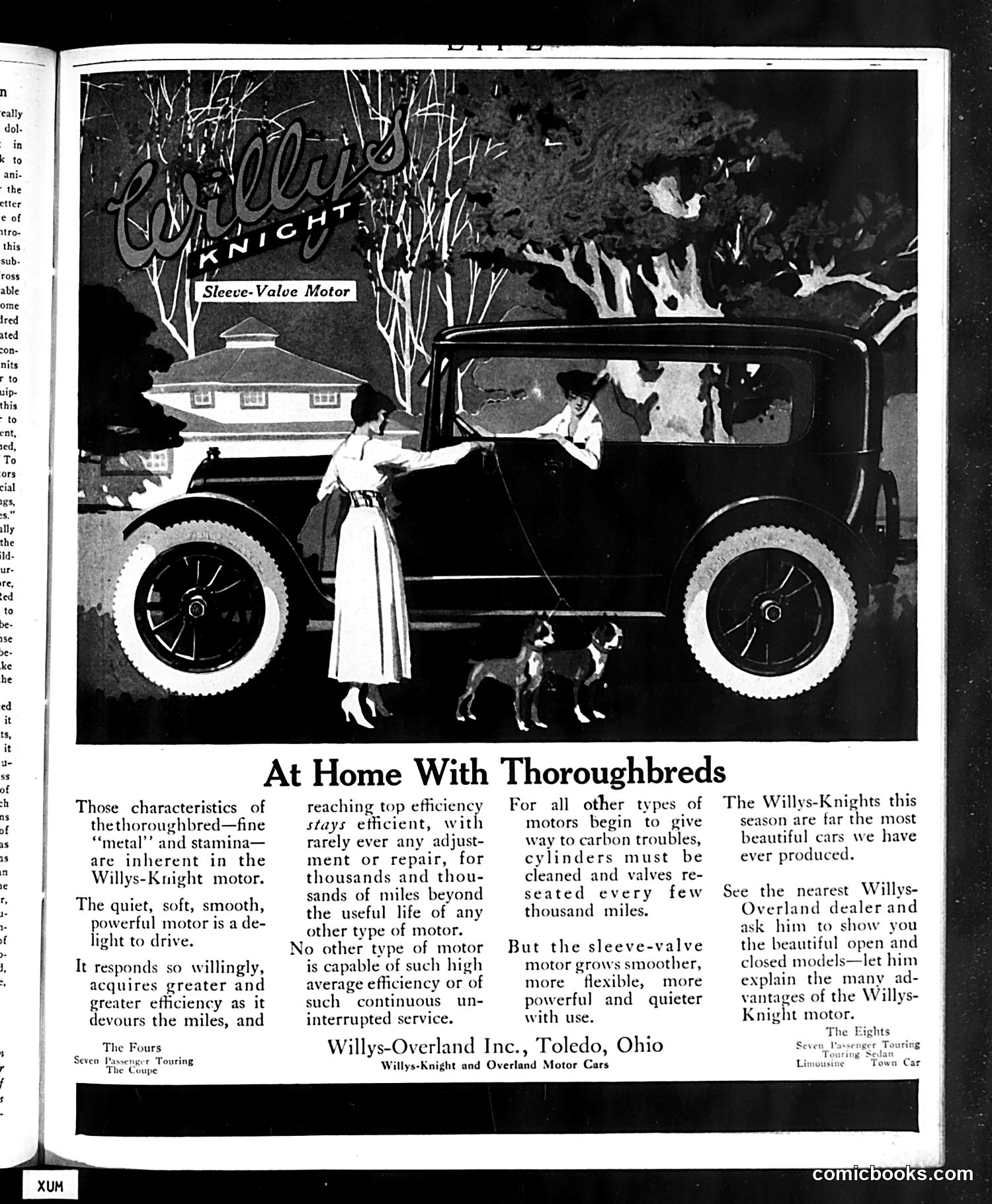
This is primarily a **car advertisement**, not political satire. It promotes the Willys-Knight automobile, specifically its "Sleeve-Valve Motor." The page uses an aristocratic metaphor: the headline "At Home With Thoroughbreds" compares the car's engine to a purebred horse—suggesting quality, breeding, and superiority. The illustration shows a well-dressed woman with two dogs beside a Willys-Knight sedan, emphasizing affluence and gentility. The sales pitch claims the motor's "fine metal and stamina" improve with use, unlike competitors' engines requiring frequent maintenance. The text argues that while other motors develop carbon deposits requiring valve work every thousand miles, the Willys-Knight grows "smoother, more powerful and quieter with use." This is standard early-automobile marketing, targeting middle-to-upper-class buyers by associating the product with refined taste and mechanical reliability. There is no apparent political commentary or satire on this page.
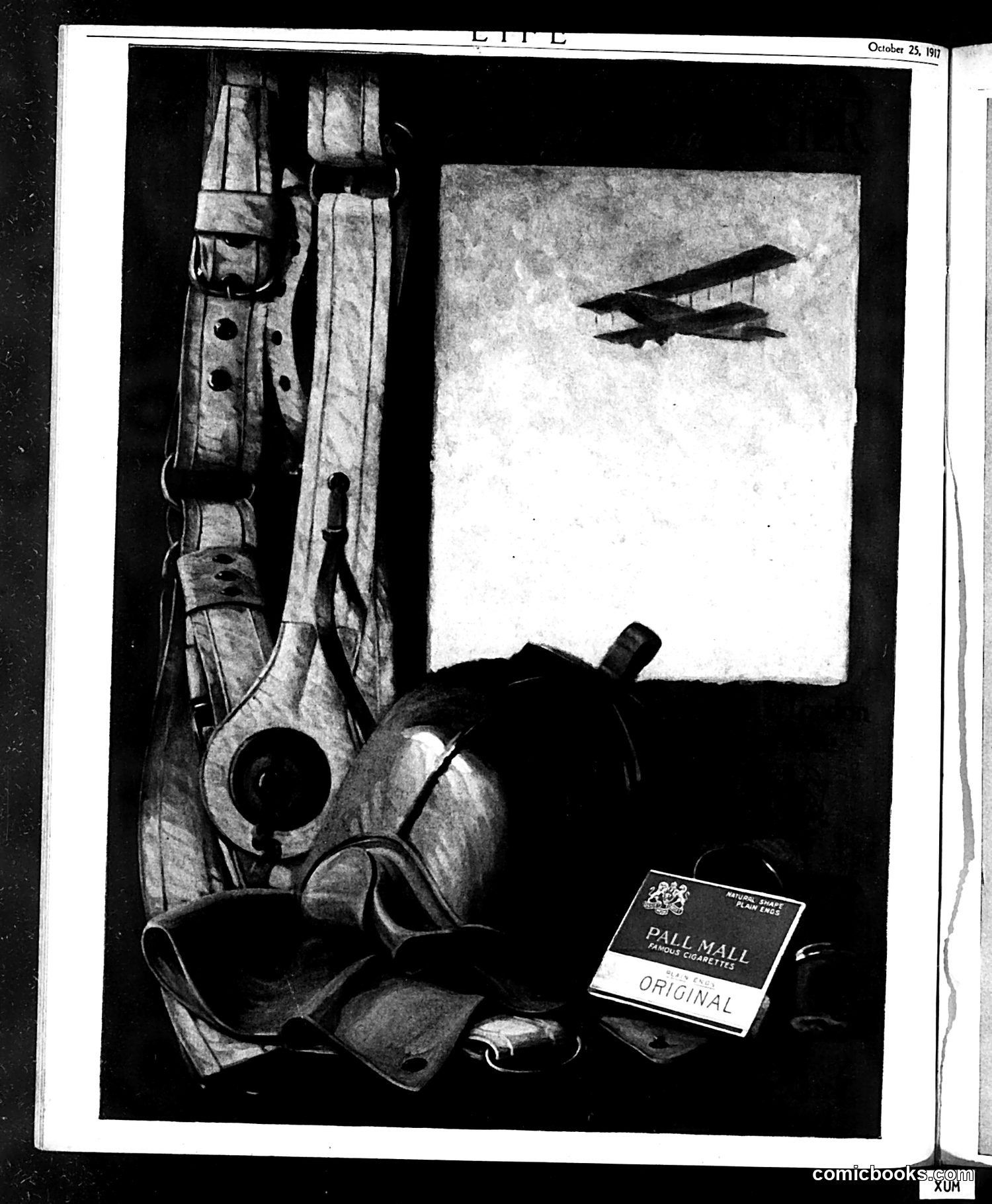
This Life magazine page (October 25, 1911) features an illustration of mechanical/industrial machinery in the foreground with an airplane visible through a window in the background. A "Pall Mall" cigarette package is prominently displayed. The cartoon appears to be **advertising commentary** rather than political satire. It juxtaposes early aviation technology (the biplane in flight) with mechanical industrial equipment, suggesting modernity and progress. The cigarette brand placement suggests this may be a sponsored or advertisement-related illustration. Without clearer text or identifying captions visible in the image, the specific satirical intent remains unclear. The composition emphasizes technological advancement circa 1911, when aviation was still novel and remarkable to the public.