
Life, 1917-10-25 · page 17 of 44
Life — October 25, 1917 — page 17: what you’re looking at
What you’re looking at
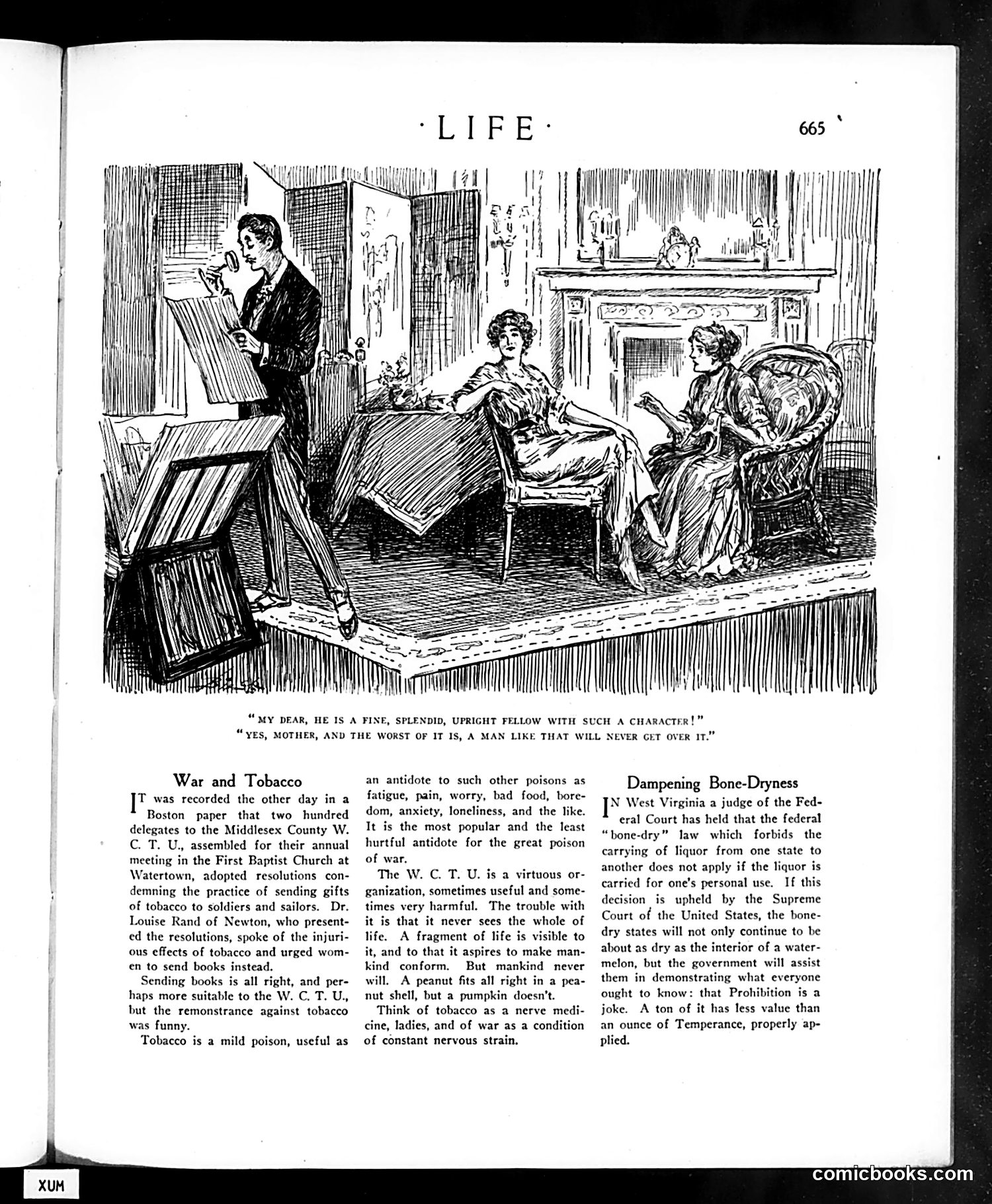
The cartoon depicts a social scene where two women discuss a man of exemplary character. The punchline—"a man like that will never get over it"—satirizes how wartime damage to soldiers' morality and character was considered permanent and irreversible. The accompanying text discusses two Prohibition-era controversies: **"War and Tobacco"** mocks the Women's Christian Temperance Union (W.C.T.U.) for condemning tobacco gifts to soldiers while ignoring war's greater harms. The author argues tobacco provides necessary psychological relief from war's stress, calling it "a mild poison" useful as an antidote to worse poisons like anxiety and loneliness. He criticizes the W.C.T.U. for moral rigidity—applying single-issue ideology without understanding life's complexities. **"Dampening Bone-Dryness"** ridicules Prohibition enforcement, reporting a federal judge's ruling that personal liquor transport isn't illegal. The author sarcastically suggests this undermines "bone-dry" states' attempts at total prohibition, calling Prohibition itself "a joke" compared to genuine temperance. Both sections critique moral absolutism and Prohibition-era reform movements.
📄 Transcribed text from this page (OCR, searchable)
Machine-transcribed from the original scan — historical spelling and the odd misread are preserved.
\\ | “MY DEAR, HE IS A FINE, SPLENDID, UPRIGHT FELLOW WITH SUCH A CHARACTER!” “YES, MOTHER, AND THE WORST OF IT IS, A MAN LIKE THAT WILL NEVER GET OVER 17.” War and Tobacco I was recorded the other day in a Boston paper that two hundred delegates to the Middlesex County W. C. T. U,, assembled for their annual meeting in the First Baptist Church at Watertown, adopted resolutions con- demning the practice of sending gifts of tobacco to soldiers and sailors. Dr. Louise Rand of Newton, who present- ed the resolutions, spoke of the injuri- ous effects of tobacco and urged wom- en to send books instead. Sending books is all right, and per- haps more suitable to the W. C. T. U., but the remonstrance against tobacco was funny. Tobacco is a mild poison, useful as an antidote to such other poisons as fatigue, pain, worry, bad food, bore- dom, anxiety, loneliness, and the like. It is the most popular and the least hurtful antidote for the great poison of war, The W. C. T. U. is a virtuous or- ganization, sometimes useful and some- times very harmful. The trouble with it is that it never sees the whole of life. A fragment of life is visible to it, and to that it aspires to make man- kind conform. But mankind never will, A peanut fits all right in a pea- nut shell, but a pumpkin doesn’t. Think of tobacco as a nerve medi- cine, ladies, and of war as a condition of constant nervous strain. 665 * rage il Dampening Bone-Dryness N West Virginia a judge of the Fed- eral Court has held that the federal “bone-dry” law which forbids the carrying of liquor from one state to another does not apply if the liquor is carried for one’s personal use. If this decision is upheld by the Supreme Court of the United States, the bone- dry states will not only continue to be about as dry as the interior of a water- melon, but the government will assist them in demonstrating what everyone ought to know: that Prohibition is a joke. A ton of it has less value than an ounce of Temperance, properly ap- plied. comicbooks.com