
Life, 1917-10-25 · page 24 of 44
Life — October 25, 1917 — page 24: what you’re looking at
What you’re looking at
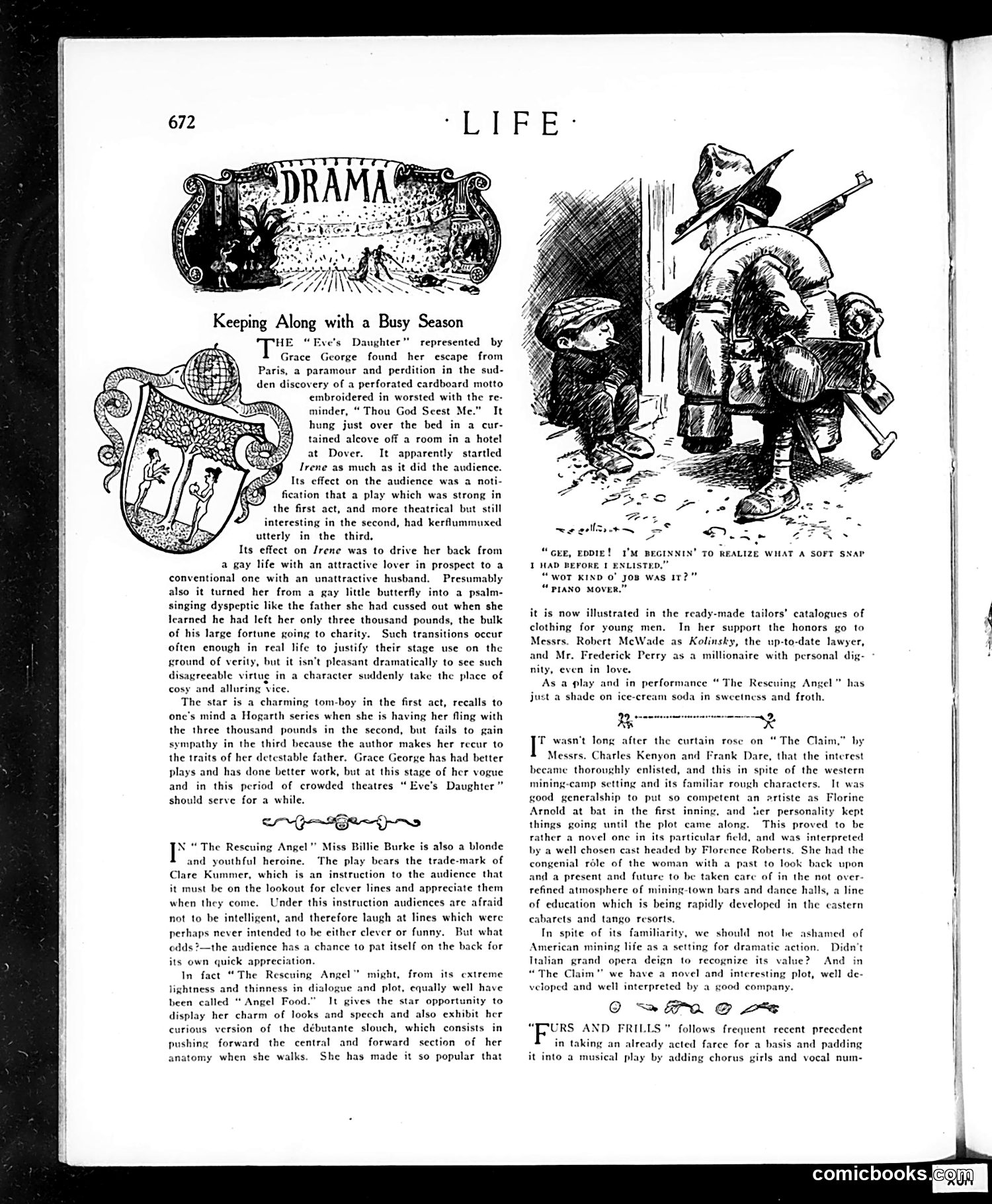
This page reviews three theatrical productions. The main cartoon depicts a soldier and woman—likely representing WWI-era themes about military service and domestic life. The soldier's dialogue references enlisting and a "piano mover" job, suggesting satire about sudden wartime occupational changes. The text reviews "Eve's Daughter" (starring Grace George), criticizing how the protagonist implausibly abandons her adventurous lifestyle after encountering a religious motto, converting to pious domesticity. The reviewer finds this moralistic turn dramatically unconvincing, despite the actress's charm. "The Rescuing Angel" (with Billie Burke) receives lighter treatment—described as witty but insubstantial ("ice-cream soda in sweetness and froth"), noting audiences over-laugh at lines fearing they'll miss clever wordplay. "The Claim," set in a mining camp, is praised for engaging the audience despite its rough setting and familiar characters. The reviews collectively critique contemporary theater's melodramatic morality and shallow entertainment value.
📄 Transcribed text from this page (OCR, searchable)
Machine-transcribed from the original scan — historical spelling and the odd misread are preserved.
Keeping Along with a Busy Season HE “Eve's Daughter” represented by Grace George found her escape from Paris, a paramour and perdition in the sud- den discovery of a perforated cardboard motto embroidered in worsted with the re- minder, “ Thou God Seest Me.” It hung just over the bed in a cur- tained alcove off a room in a hotel at Dover. It apparently. startled Irene as much as it did the audience. Its effect on the audience was a noti- fication that a play which was strong in the first act, and more theatrical but still interesting in the second, had kerflummuxed utterly in the third. Its effect on Irene was to drive her back from a gay life with an attractive lover in prospect to a conventional one with an unattractive husband. Presumably also it turned her from a gay little butterfly into a psalm- singing dyspeptic like the father she had cussed out when she learned he had left her only three thousand pounds, the bulk of his large fortune going to charity. Such transitions occur often enough in real life to justify their stage use on the ground of verity, but it isn’t pleasant dramatically to see such disagreeable virtue in a character suddenly take the place of cosy and alluring vice. The star is a charming tom-boy in the first act, recalls to one’s mind a Hogarth series when she is having her fling with the three thousand pounds in the second, but fails to gain sympathy in the third because the author makes her recur to the traits of her detestable father. Grace George has had better plays and has done better work, but at this stage of her vogue and in this period of crowded theatres “Eve's Daughter” should serve for a while. CG Gem fn I “The Rescuing Angel" Miss Billie Burke is also a blonde and youthful heroine. The play bears the trade-mark of Clare Kummer, which is an instruction to the audience that it must be on the lookout for clever lines and appreciate them when they come. Under this instruction audiences are afraid not to be intelligent, and therefore laugh at lines which were perhaps never intended to be either clever or funny, But what odds ?—the audience has a chance to pat itself on the back for tion. its own quick appreci In fact “The Rescuing lightness and thinness in dial been called “ Angel Food. display her charm of looks and specch and also exhibit her curious version of the débutante slouch, which consists in pushing forward the central and forward section of her my when she walks. She has made it so popular that ngel” might, from its extreme gue and plot, equally well have It gives the star opportunity to “Gee, Eppie! I'M BEGIN IT MAD BEPORE f ENLISTE: “WoT KIND 0° Jop Was 11?” “ PIANO MOVE it is now illustrated in the ready-made tailors’ catalogues of clothing for young men. In her support the honors go to Messrs. Robert McWade as Kolinsky, the up-to-date lawyer, and Mr. Frederick Perry as a millionaire with personal dig- nity, even in love. As a play and in performance “The Rescuing Angel” has just a shade on ice-cream soda in sweetness and froth. = T wasn’t long after the curtain rose on “ The Claim,” by Messrs. Charles Kenyon and Frank Dare, that the interest became thoroughly enlisted, and this in spite of the western mining-camp setting and its familiar rough characters. It was good generalship to put so competent an artiste as Florine Arnold at bat in the first inning, and ‘er personality kept things going until the plot came along. This proved to be rather a novel one in its particular field, and was interpreted by a well chosen cast headed by Florence Roberts, She had the congenial réle of the woman with a past to look back upon and a present and future to be taken care of in the not over refined atinosphere of mining-town bars and dance halls, a line of education which is being rapidly developed in the castern cabarets and tango resorts, In spite of its familiarity, we should not be ashamed of American mining life as a setting for dramatic action. Didn't Italian grand opera deign to recognize its value? And in Qo “The Claim” we have a novel and interesting plot, well de- veloped and well interpreted by a good company. O > &O @ 2*s 'URS AND FRILLS” follows frequent recent precedent in taking an already acted farce for a basis and padding it into a musical play by adding chorus girls and vocal num- a ae comicbooks