
Life, 1917-10-25 · page 11 of 44
Life — October 25, 1917 — page 11: what you’re looking at
What you’re looking at
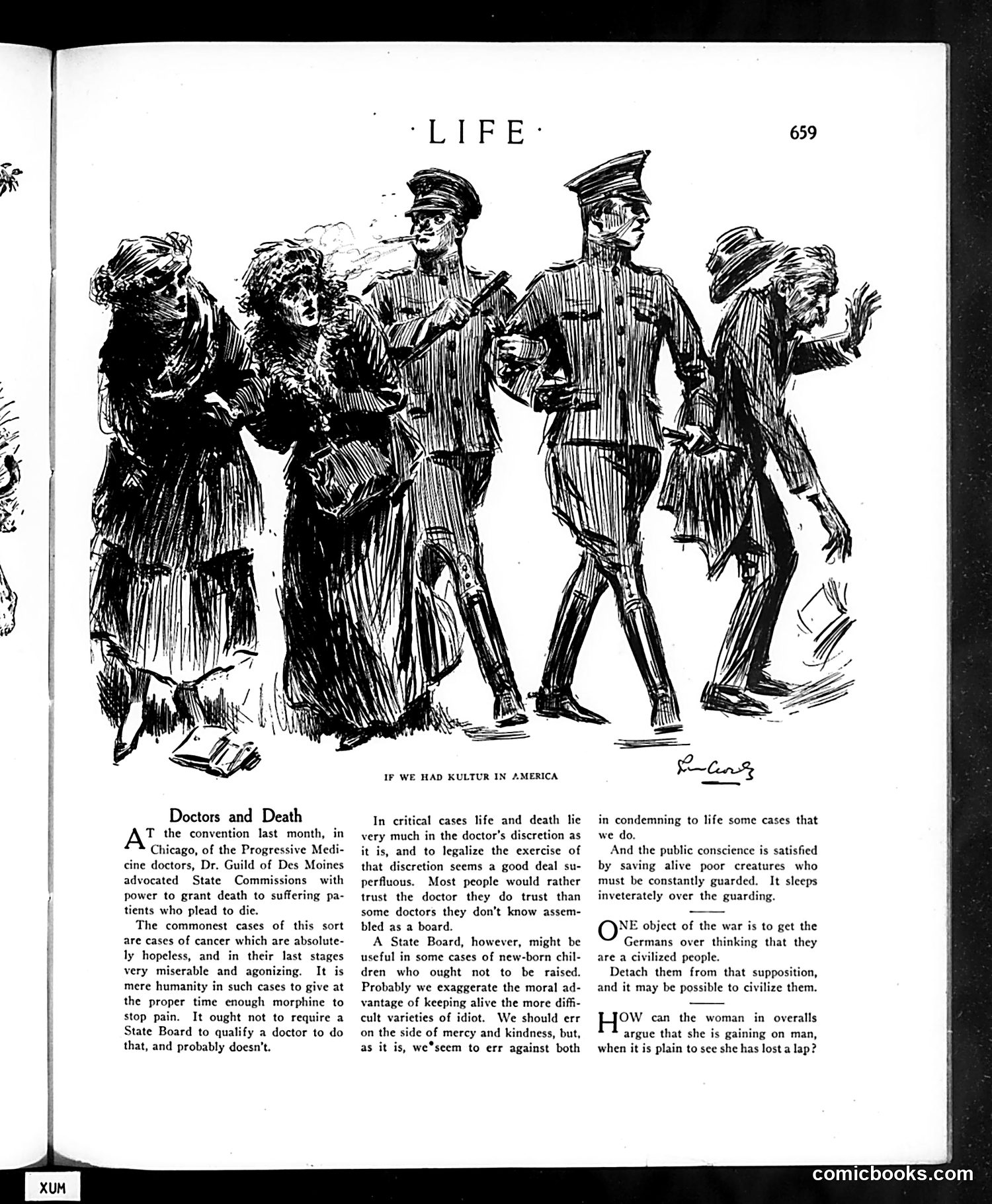
**The Cartoon:** Titled "If We Had Kultur in America," the sketch shows two military officers in the center flanked by four civilians in distress or exaggerated poses. The satire appears to target perceived German militarism and "kultur" (culture), suggesting that American adoption of Prussian-style authoritarian values would be absurd and harmful. **The Articles:** "Doctors and Death" debates whether states should authorize physicians to euthanize terminally ill patients. The piece argues against this, favoring mercy and medical discretion instead. A second piece critiques women in military uniforms, questioning whether such roles represent genuine women's advancement or constitute loss of femininity. **Context:** This appears to reflect World War I-era American anxieties about European militarism and evolving gender roles during wartime.
📄 Transcribed text from this page (OCR, searchable)
Machine-transcribed from the original scan — historical spelling and the odd misread are preserved.
Doctors and Death T the convention last month, in Chicago, of the Progressive Medi- cine doctors, Dr. Guild of Des Moines advocated State Commissions with power to grant death to suffering pa- tients who plead to die. The commonest cases of this sort are cases of cancer which are absolute- ly hopeless, and in their last stages very miserable and agonizing. It is mere humanity in such cases to give at the proper time enough morphine to stop pain. It ought not to require a State Board to qualify a doctor to do that, and probably doesn’t. IP WE HAD KULTUR IN AMERICA In critical cases life and death lie very much in the doctor’s discretion as it is, and to legalize the exercise of that discretion seems a good deal su- perfluous. Most people would rather trust the doctor they do trust than some doctors they don’t know assem- bled as a board. A State Board, however, might be useful in some cases of new-born chil- dren who ought not to be raised. Probably we exaggerate the moral ad- vantage of keeping alive the more diffi- cult varieties of idiot. We should err on the side of mercy and kindness, but, as it is, we°seem to err against both 659 in condemning to life some cases that we do. And the public conscience is satisfied by saving alive poor creatures who must be constantly guarded. It sleeps inveterately over the guarding. NE object of the war is to get the Germans over thinking that they are a civilized people. Detach them from that supposition, and it may be possible to civilize them. OW can the woman in overalls argue that she is gaining on man, when it is plain to see she has lost a lap?