
Life, 1917-10-25 · page 18 of 44
Life — October 25, 1917 — page 18: what you’re looking at
What you’re looking at
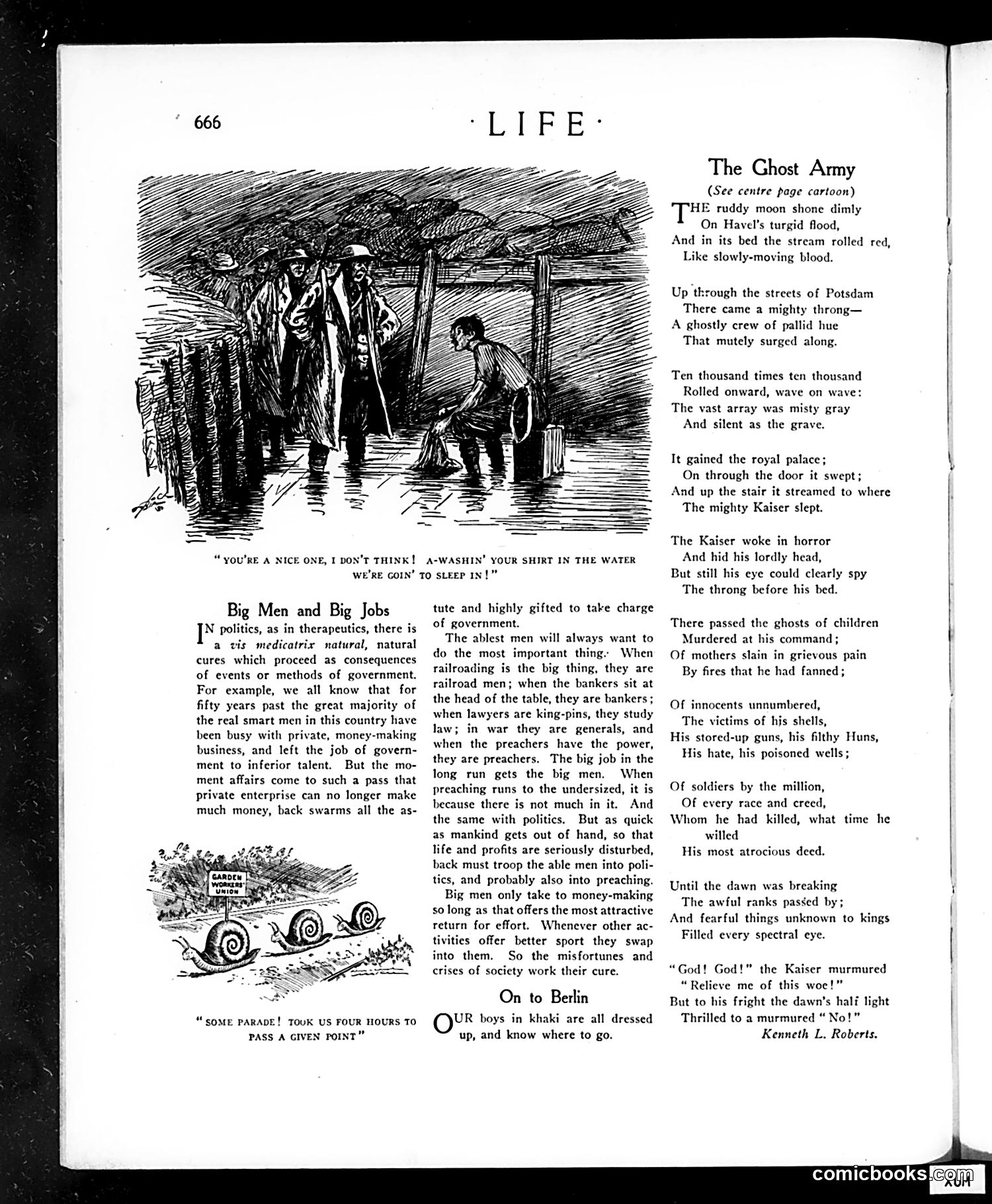
This page contains two distinct pieces of post-WWI American satire: **"Big Men and Big Jobs"** argues that capable men abandon government for profitable private enterprise, only returning to politics during national crises. The cartoons mock this pattern—one shows soldiers complaining about a tedious parade; another depicts snails, likely representing slow bureaucratic movement. **"The Ghost Army"** is a vengeful poem about the Kaiser (Wilhelm II of Germany) haunted by spectral victims of WWI—murdered children, mothers killed in fires, soldiers of all nations he destroyed. The accompanying illustration shows ghostly figures confronting him in his palace at Potsdam before dawn brings a supernatural "No!" denying him relief. Both pieces reflect 1918-1920 American attitudes: cynicism about peacetime governance and moral condemnation of German leadership. The Kaiser content specifically targets the defeated enemy's ruler with supernatural judgment—a common post-war rhetorical device blending horror with retribution fantasy.
📄 Transcribed text from this page (OCR, searchable)
Machine-transcribed from the original scan — historical spelling and the odd misread are preserved.
“YOU'RE A NICE ONE, I DON’T THINK! WE'RE GOIN’ TO SLEEP 1: Big Men and Big Jobs N politics, as in therapeutics, there is a vis medicatrix natural, natural cures which proceed as consequences of events or methods of government. For example, we all know that for fifty years past the great majority of the real smart men in this country have been busy with private, money-making business, and left the job of govern- ment to inferior talent. But the mo- ment affairs come to such a pass that private enterprise can no longer make much money, back swarms all the as- “SOME PARADE! TOUK US FOUR HOURS TO PASS A GIVEN POINT” x’ YOUR SHIRT IN THE WATER ” A-WASHI tute and highly gifted to take charge of government. The ablest men will always want to do the most important thing. When railroading is the big thing, they are railroad men; when the bankers sit at the head of the table, they are bankers ; when lawyers are king-pins, they study Jaw; in war they are generals, and when the preachers have the power, they are preachers. The big job in the long run gets the big men. When preaching runs to the undersized, it is because there is not much in it. And the same with politics, But as quick as mankind gets out of hand, so that life and profits are seriously disturbed, back must troop the able men into poli- tics, and probably also into preaching. Big men only take to money-making so long as that offers the most attractive return for effort. Whenever other ac- tivities offer better sport they swap into them. So the misfortunes and crises of society work their cure. On to Berlin UR boys in khaki are all dressed up, and know where to go. The Ghost Army (See centre page cartoon) 'HE ruddy moon shone dimly On Havel’s turgid flood, And in its bed the stream rolled red, Like slowly-moving blood. Up through the streets of Potsdam There came a mighty throng— A ghostly crew of pallid hue That mutely surged along. Ten thousand times ten thousand Rolled onward, wave on wave: The vast array was misty gray And silent as the grave. It gained the royal palace; On through the door it swept; And up the stair it streamed to where The mighty Kaiser slept. The Kaiser woke in horror And hid his lordly head, But still his eye could clearly spy The throng before his bed. There passed the ghosts of children Murdered at his command; Of mothers slain in grievous pain By fires that he had fanned; Of innocents unnumbered, The victims of his shells, His stored-up guns, his filthy Huns, His hate, his poisoned wells; Of soldiers by the million, Of every race and creed, Whom he had killed, what time he willed His most atrocious deed. Until the dawn was breaking The awful ranks passed by; And fearful things unknown to kings Filled every spectral eye. “God! God!” the Kaiser murmured “Relieve me of this woe!” But to his fright the dawn’s hali light Thrilled to a murmured “ No!” Kenneth L. Roberts. comicbooks Gay