
A complete issue · 40 pages · 1917
Life — September 20, 1917
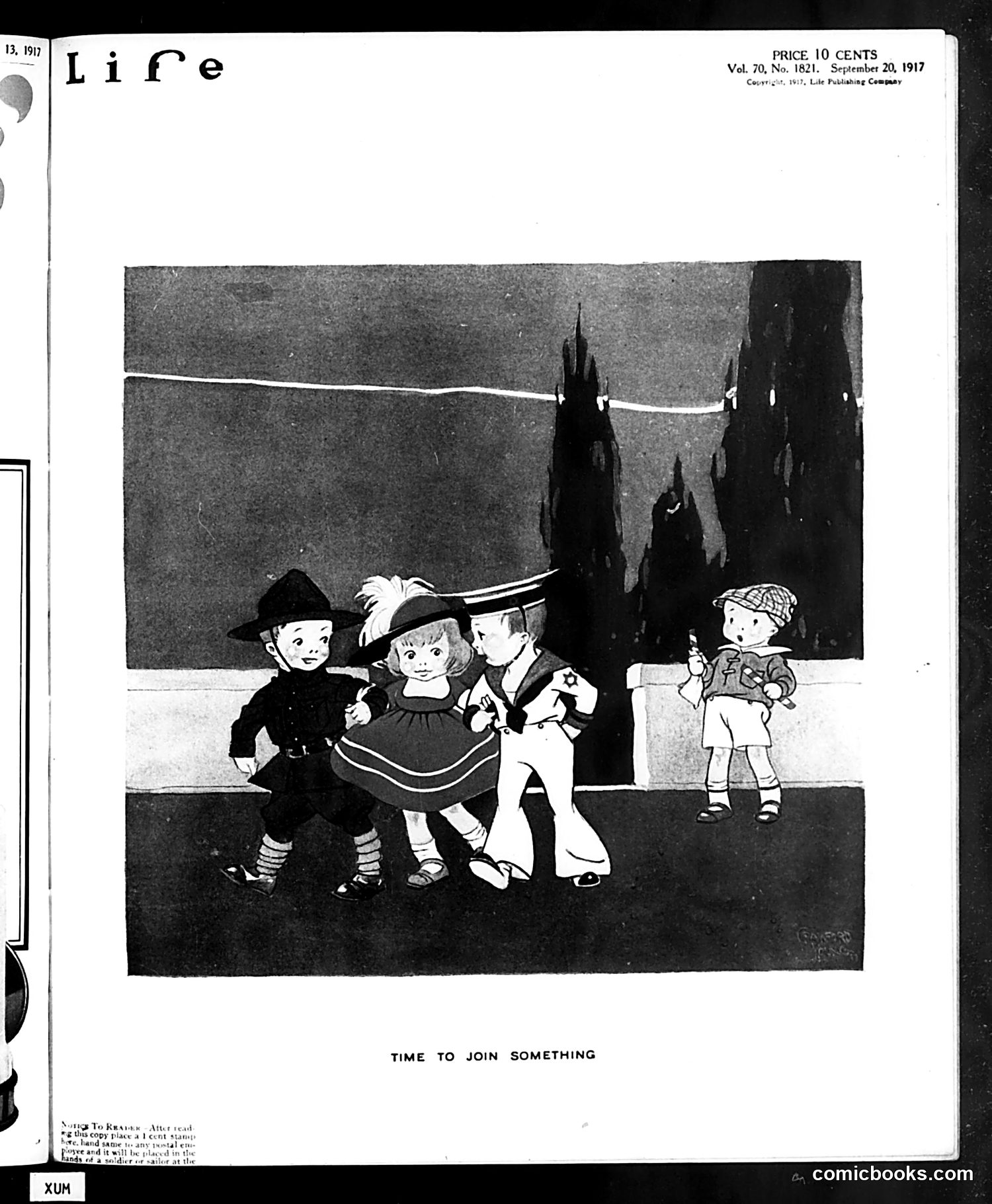
This 1917 *Life* magazine cartoon depicts four children in front of a Gothic castle silhouette, with the caption "TIME TO JOIN SOMETHING." Published during World War I (the U.S. entered in April 1917), this appears to be propaganda encouraging civic participation or military support. The children represent different nationalities or backgrounds—one wears a cowboy hat (American), another a military-style uniform, a third appears European, and the fourth wears what seems immigrant or working-class attire. The "something" likely refers to patriotic organizations, war-related charities, or military service. The satire suggests that citizens of all backgrounds should unite for the war effort. The ominous castle backdrop may represent either the enemy or the larger historical moment consuming Europe.
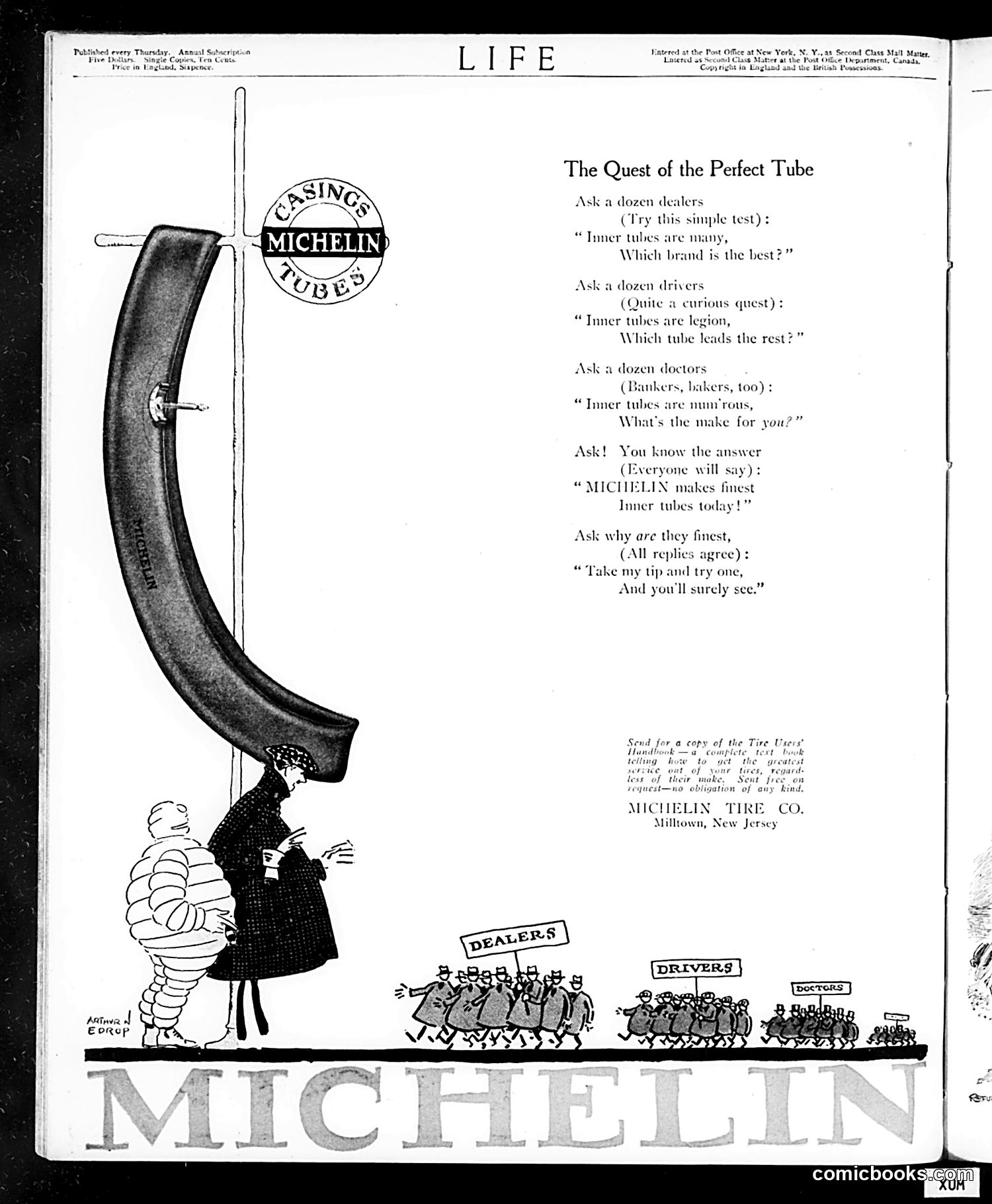
This is primarily a **Michelin Tire advertisement**, not satire or political commentary. The page features "The Quest of the Perfect Tube," a marketing poem claiming Michelin makes the finest inner tubes. The ad uses a humorous rhetorical structure: it poses the question "which inner tube is best?" to dealers, drivers, and doctors, then provides the answer—Michelin—with the tagline "Take my tip and try one, / And you'll surely see." The illustration depicts the Michelin Man (Bibendum) standing over various professional groups (dealers, drivers, doctors, bankers) labeled as crowds below him, suggesting their universal agreement with the product's superiority. This is straightforward early-20th-century advertising through verse rather than satire or political commentary.
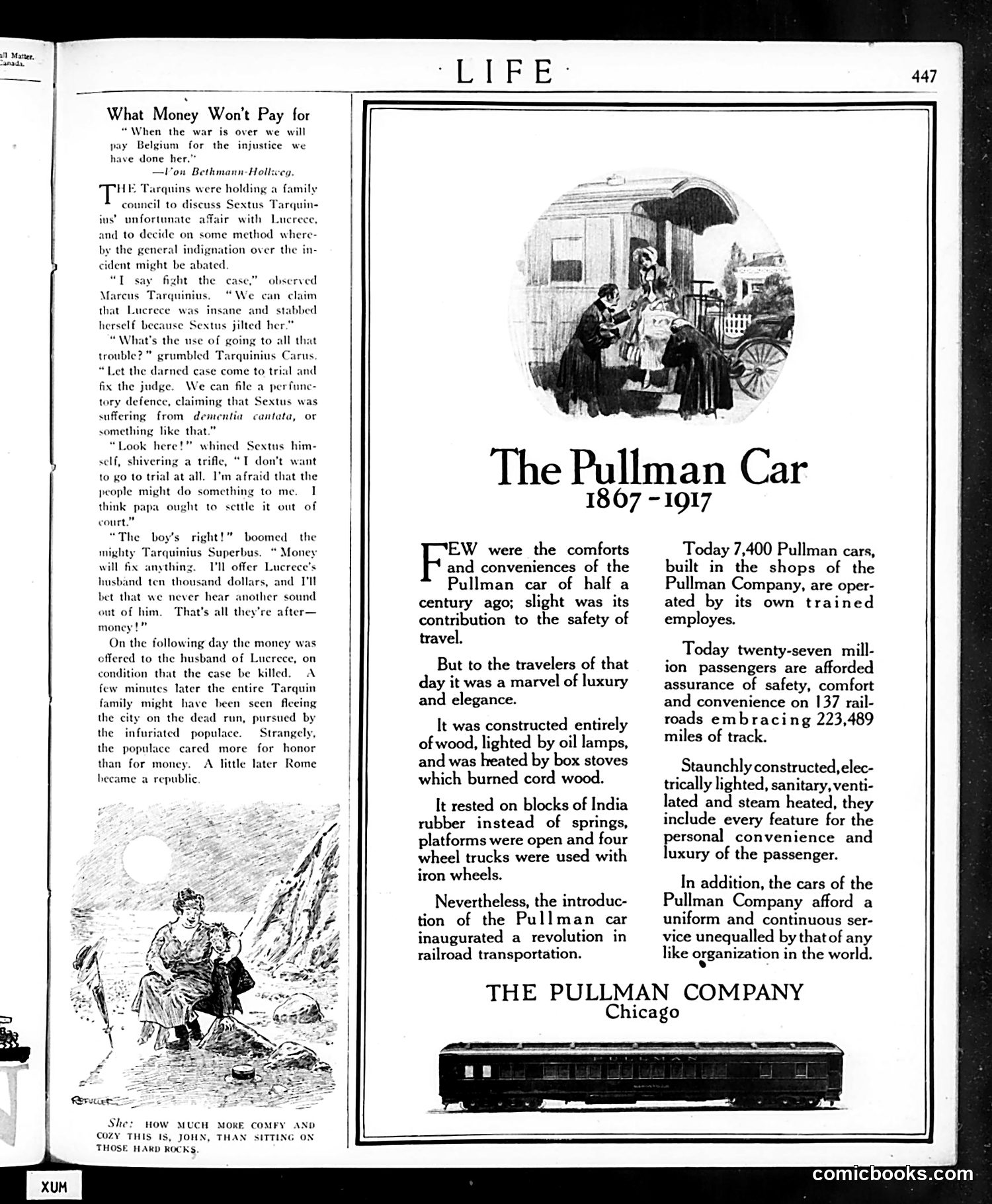
This page contains two distinct elements: **Left side:** A satirical story titled "What Money Won't Pay for" discussing a legal case involving characters named Sextus Tarquinius and Lucreece. The narrative concerns an "incident" and debates whether money can resolve it through legal settlement. A small illustration shows a woman seated on rocks. The story appears to reference classical Roman history, likely alluding to the legendary rape of Lucretia, using it as social commentary about justice and compensation. **Right side:** A Pullman Company advertisement for luxury railroad cars (1867-1917), highlighting their comfort, safety features, and widespread use across American rail networks. The juxtaposition suggests *Life* magazine's typical format: satirical commentary paired with contemporary advertising, though the thematic connection between legal justice and commercial luxury remains unclear.
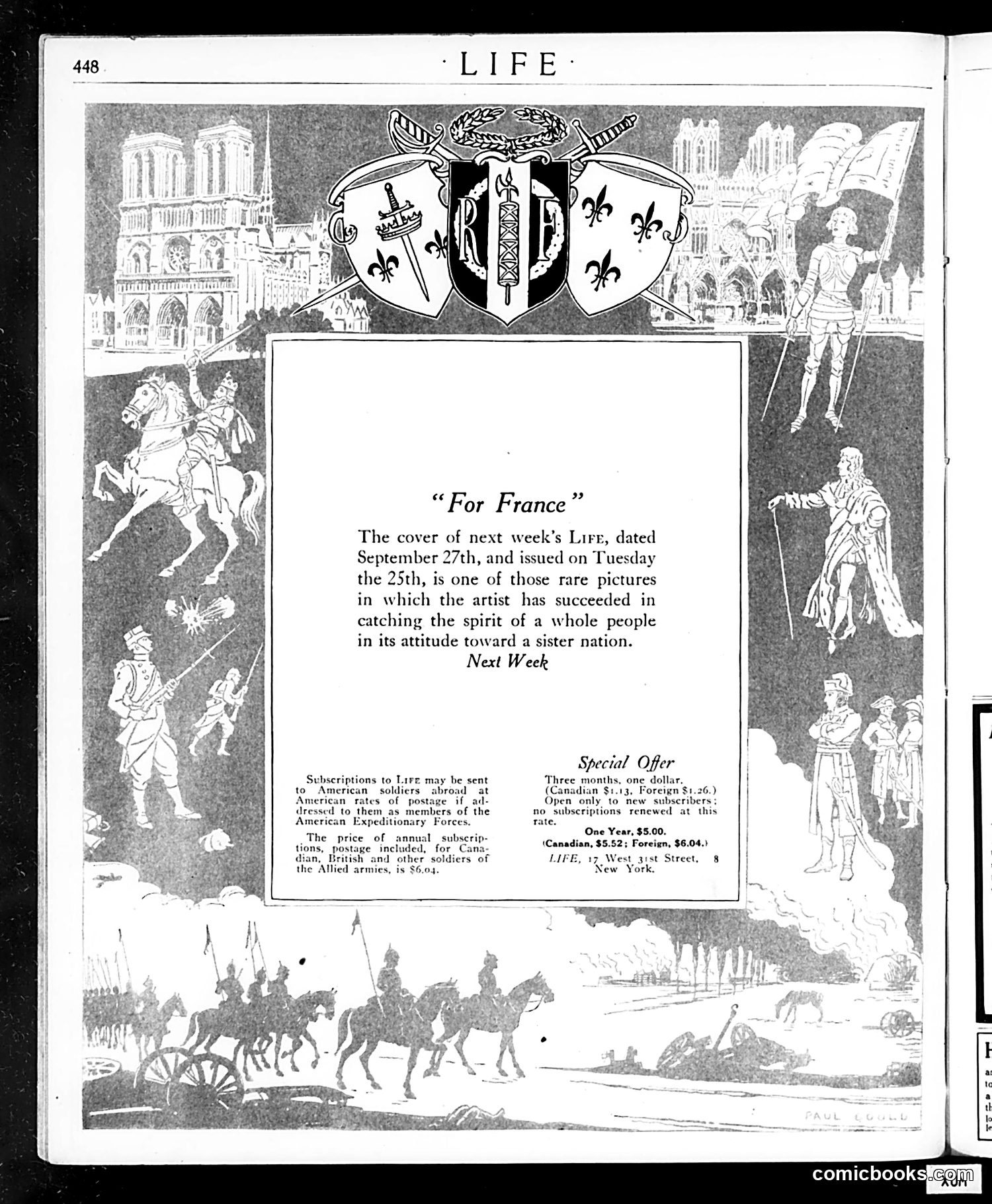
This page is primarily an **advertisement for Life magazine subscriptions**, not a political cartoon. The central text announces next week's cover (dated September 27th), which apparently features French imagery that "the artist has succeeded in catching the spirit of a whole people in its attitude toward a sister nation." The decorative border contains **French historical and military imagery**: soldiers on horseback, figures in period dress, Notre-Dame Cathedral, and fleur-de-lis symbols. These elements evoke French national identity and military heritage. The context appears to be **World War I era** (subscription offers mention "American soldiers abroad" and "Allied armies"), suggesting this celebrates Franco-American alliance and shared wartime values. The advertisement emphasizes patriotic appeal to American readers sympathetic to France.
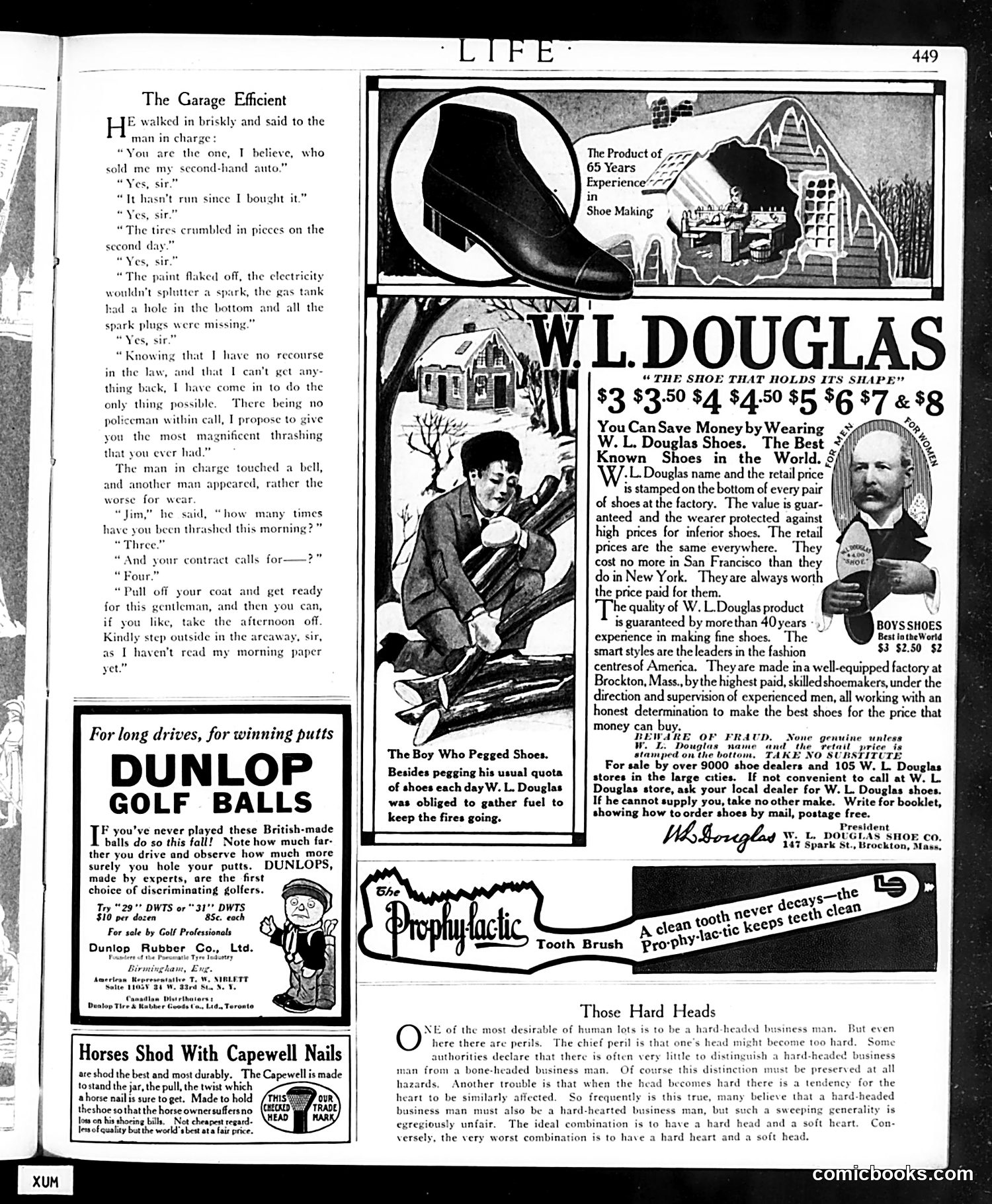
This page is **primarily advertisements** rather than political satire. The main content includes: 1. **"The Garage Efficient"** - A dialogue mocking an auto mechanic's incompetence. A man bought a used car that immediately breaks down completely. The mechanic offers no legal recourse and suggests the owner take the afternoon off—satirizing poor service and the buyer's helplessness. 2. **Advertisement section** - Multiple product ads (W.L. Douglas shoes, Dunlop golf balls, Prophylactic toothbrushes, Capewell horse nails). 3. **"Those Hard Heads"** - A brief essay about businessmen, discussing whether hard-headed practicality can coexist with compassion. The satire is mild social commentary on consumer frustration and business ethics, typical of *Life* magazine's gentle humor from this era.
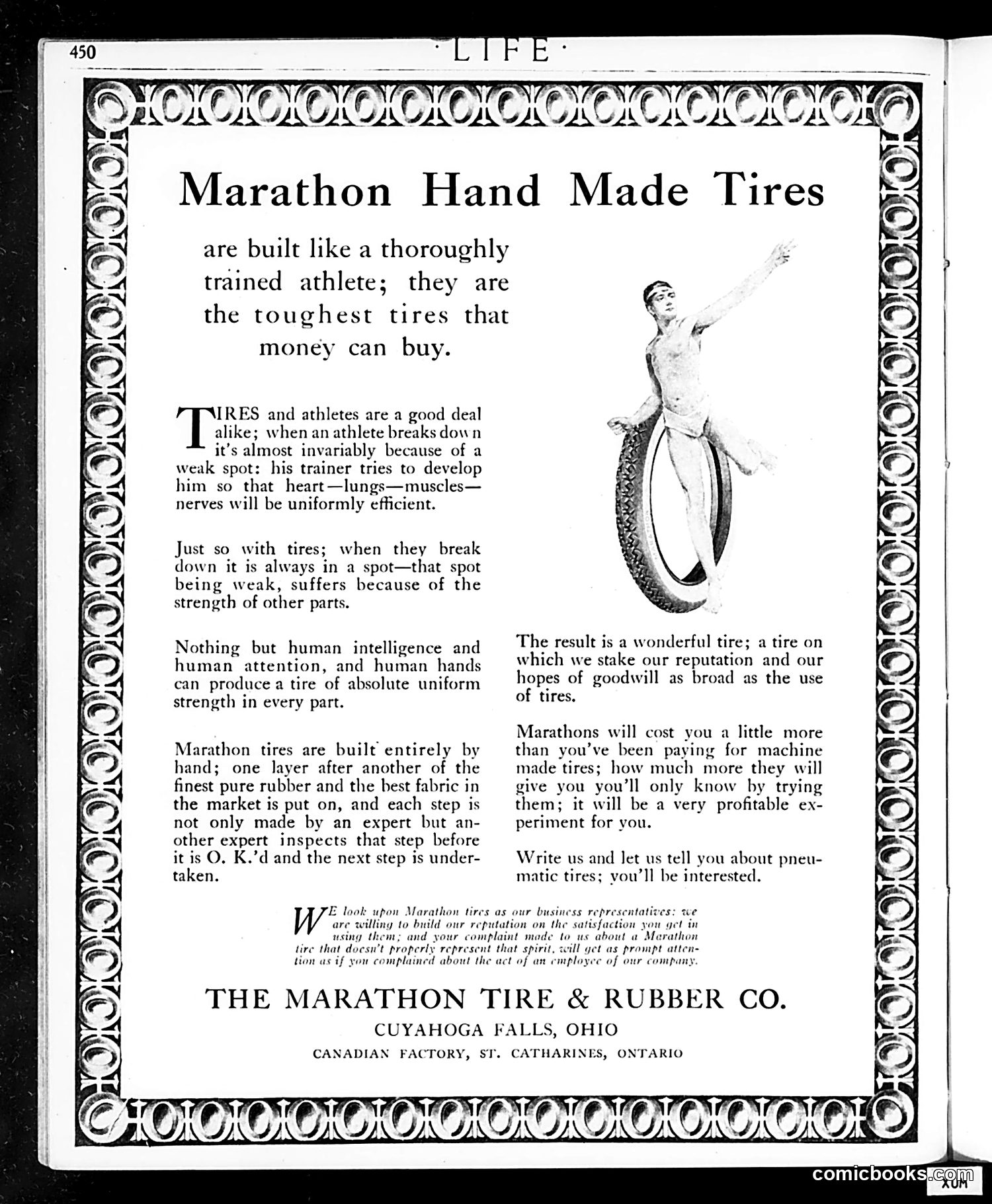
This is **not a political cartoon or satire** — it's a straightforward advertisement for Marathon Hand Made Tires, appearing in *Life* magazine (page 450). The image shows an athlete in classical pose, arm raised triumphantly while perched on a large tire. The ad uses an extended metaphor: just as trained athletes develop uniform physical strength through careful training, Marathon tires are built with meticulous hand-craftsmanship to ensure uniform strength throughout, preventing weak spots that cause failure. The copy emphasizes quality control — each tire is hand-inspected at multiple stages. The ad positions Marathon as a premium product, costing more than machine-made competitors but offering superior durability and reliability. **The company:** The Marathon Tire & Rubber Co., based in Cuyahoga Falls, Ohio (with a Canadian factory).
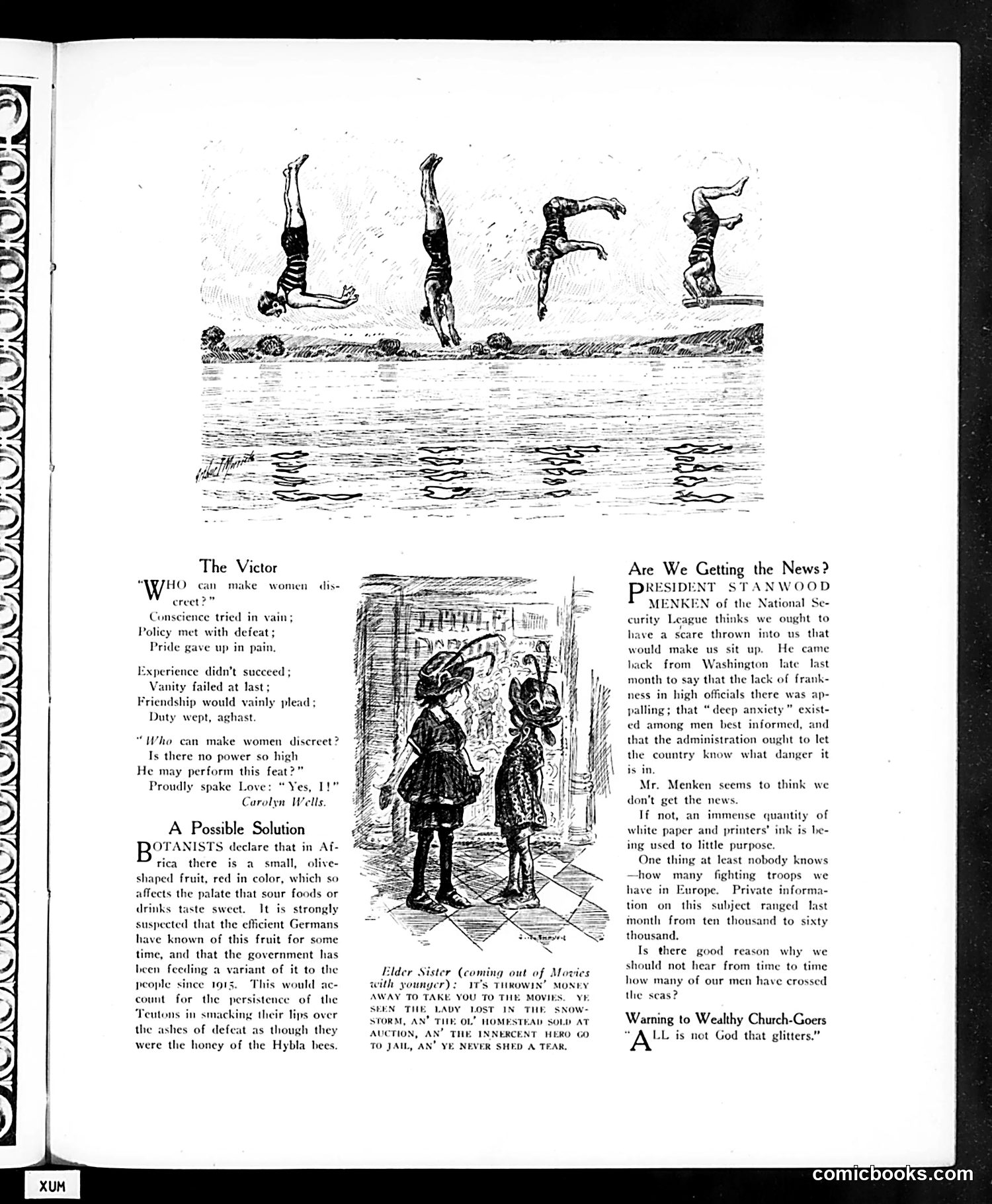
**Top Illustration:** Four figures performing handstands diving into water—a humorous sequence showing acrobatic diving or athletic stunts. **"The Victor":** A poem celebrating a woman who overcomes obstacles through love and pride rather than through conscience, policy, or experience. It appears to celebrate female agency and emotional strength. **"A Possible Solution":** Discusses a small, olive-shaped German fruit that supposedly affects taste perception. The author suggests the government distribute this fruit to the German population since 1915, humorously implying Germans have poor judgment. This is WWI-era propaganda satirizing the enemy. **"Are We Getting the News?":** Criticizes President Stanwood Menken of the National Security League for withholding information about troop numbers in Europe, suggesting the government isn't transparent with citizens during wartime. **"Elder Sister (Coming out of Movies)":** A cartoon about moviegoing and money.
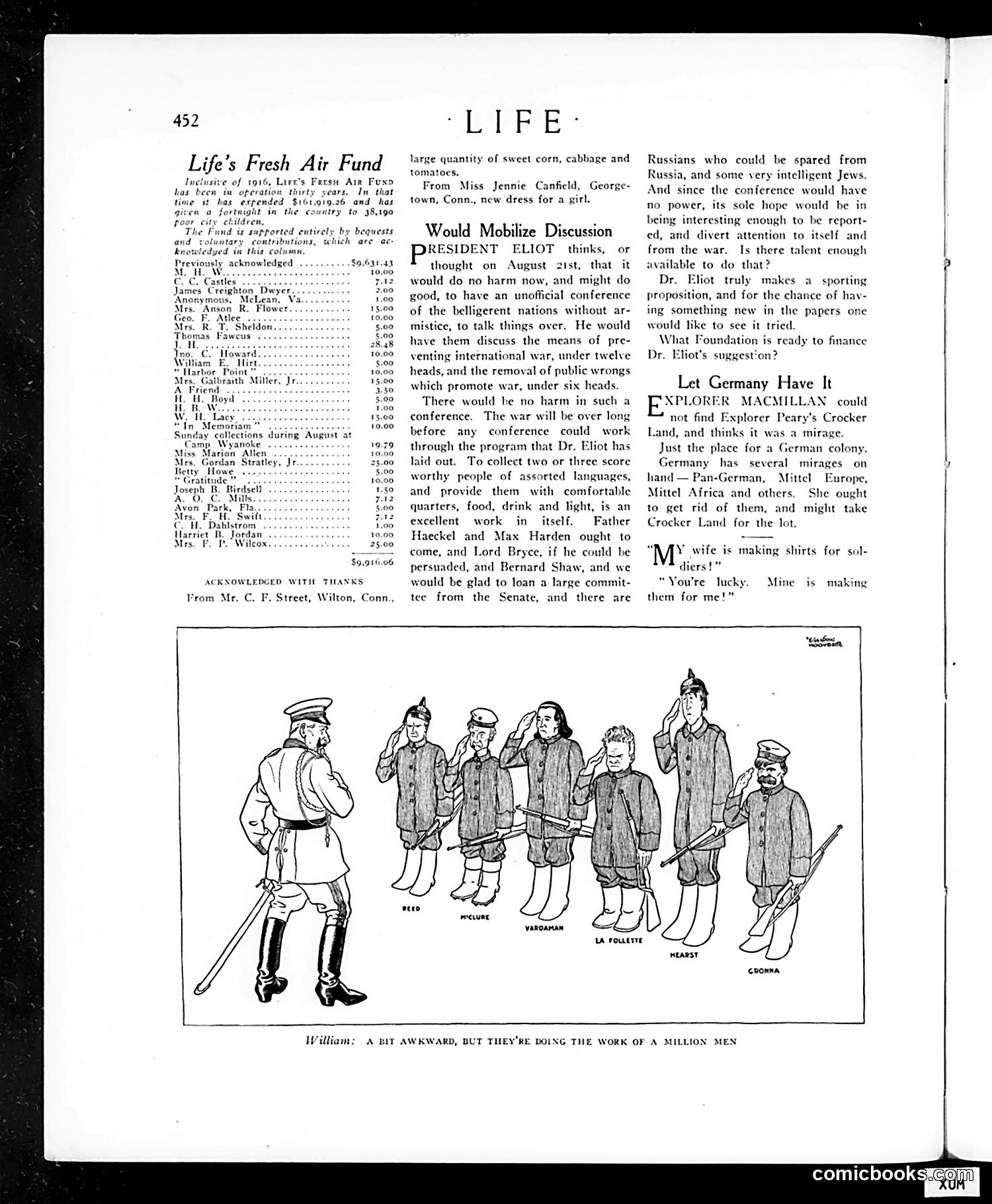
This WWI-era cartoon satirizes military efficiency through contrast. On the left stands "William" (likely Kaiser Wilhelm II of Germany), depicted as a traditional Prussian military officer. On the right, a ragtag line of soldiers labeled with various ethnic/national designations (Reed, Melchior, Vardaman, La Follette, Hearst, Gomma) shuffles forward awkwardly. The satire mocks the incongruity: Germany's supposedly superior military discipline versus the motley collection of American figures—likely politicians, journalists, and labor leaders—who nonetheless accomplish significant work. The cartoon suggests that despite lacking traditional military cohesion, these diverse American voices/forces effectively contribute to the war effort, implying American democratic chaos paradoxically proves more productive than Prussian order.
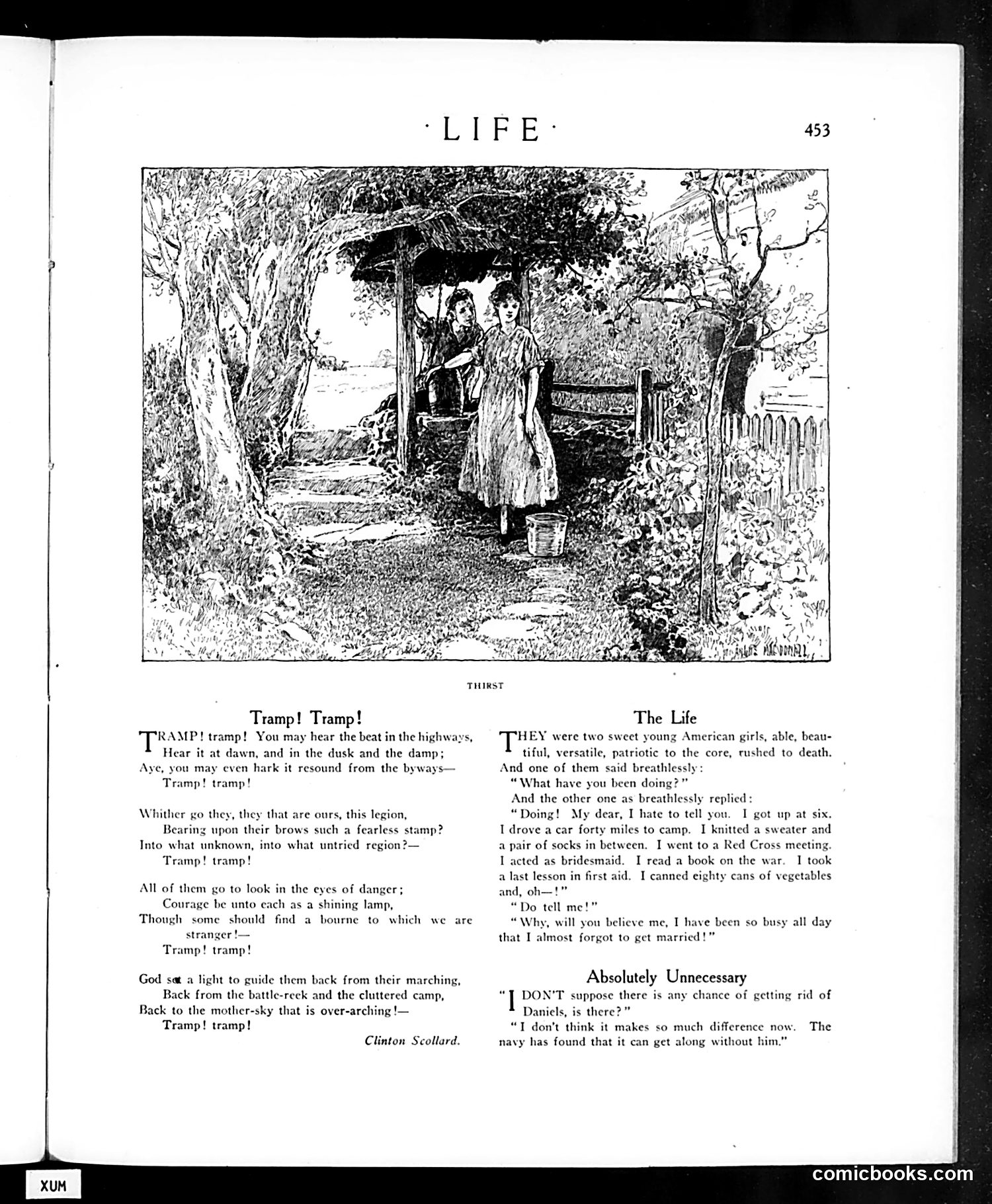
This page contains two distinct pieces: **"Tramp! Tramp!"** - A patriotic poem by Clinton Scollard about soldiers marching to war, encouraging courage and unity ("Courage be unto each as a shining lamp"). It references battlefield conditions and calls for divine guidance for troops returning home. **"The Life" and "Absolutely Unnecessary"** - Two brief humorous prose pieces. The first depicts two young women discussing their busy schedules—one mentions camping, Red Cross meetings, and first aid training while nearly forgetting to get married. The second is a short joke about the Navy no longer needing someone named Daniels. The illustration shows a garden scene with figures near a gate, likely illustrating the domestic/civilian life themes in the accompanying text. The content reflects early 20th-century American perspectives on patriotism, women's war-effort activities, and satirical commentary on everyday life.
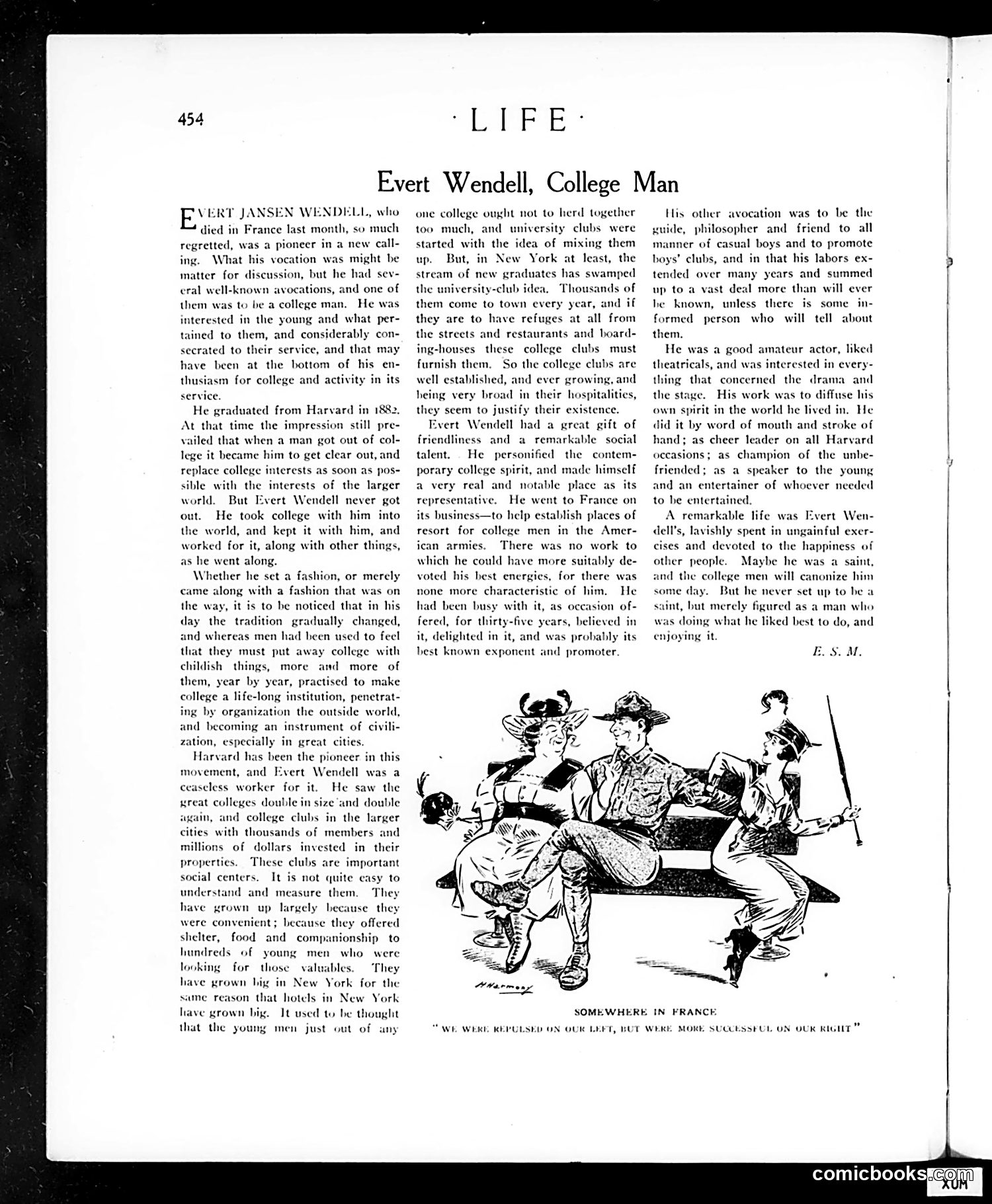
This page is an obituary/biography of Evert Jansen Wendell, a Harvard graduate (class 1882) who died in France. The text celebrates his lifelong dedication to college life and establishing social clubs for university students in major cities. The cartoon illustrates the caption "We were repulsed on our left, but were more successful on our right"—a humorous military reference showing college men in France engaged in what appears to be leisure activities (possibly dining or socializing) rather than serious combat. The joke satirizes the gap between military language and the actual comfortable social pursuits of college men abroad, suggesting they were more focused on enjoying themselves than actual wartime duties.
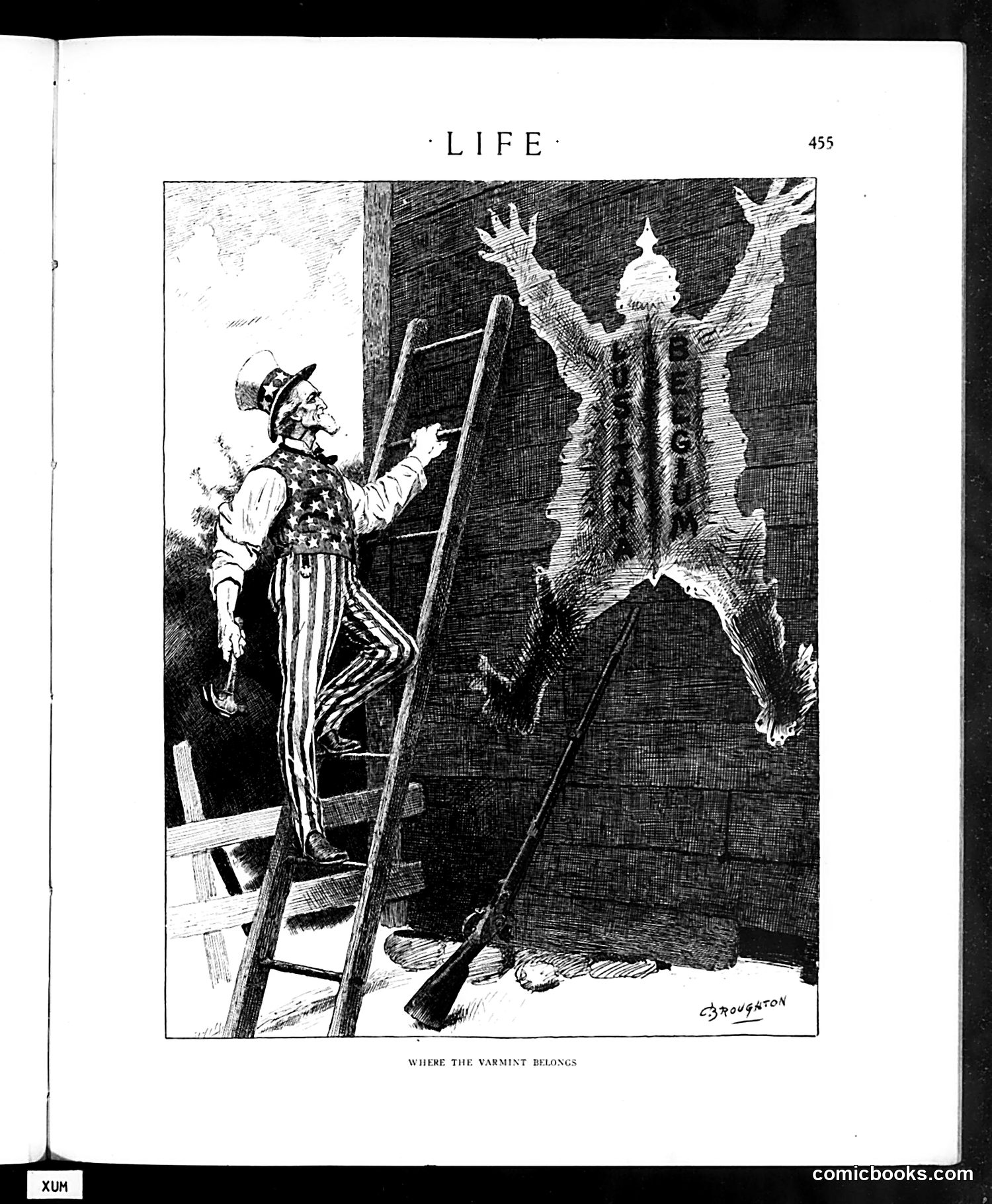
This cartoon depicts Uncle Sam (identifiable by his characteristic top hat and starred outfit) on a ladder, painting or applying something to a demonic creature emerging from what appears to be a brick wall or chimney. The demon figure—grotesque, multi-armed, and menacing—likely represents a political enemy or social threat that Life's editors wanted eliminated. The title "Where the Varmint Belongs" suggests banishment or destruction of an undesirable force. Without additional context about the publication date, the specific threat referenced remains unclear, though the imagery invokes American frontier imagery ("varmint") combined with Uncle Sam's authority to address national problems. The satirical tone suggests Life was endorsing aggressive action against whatever this creature symbolized.
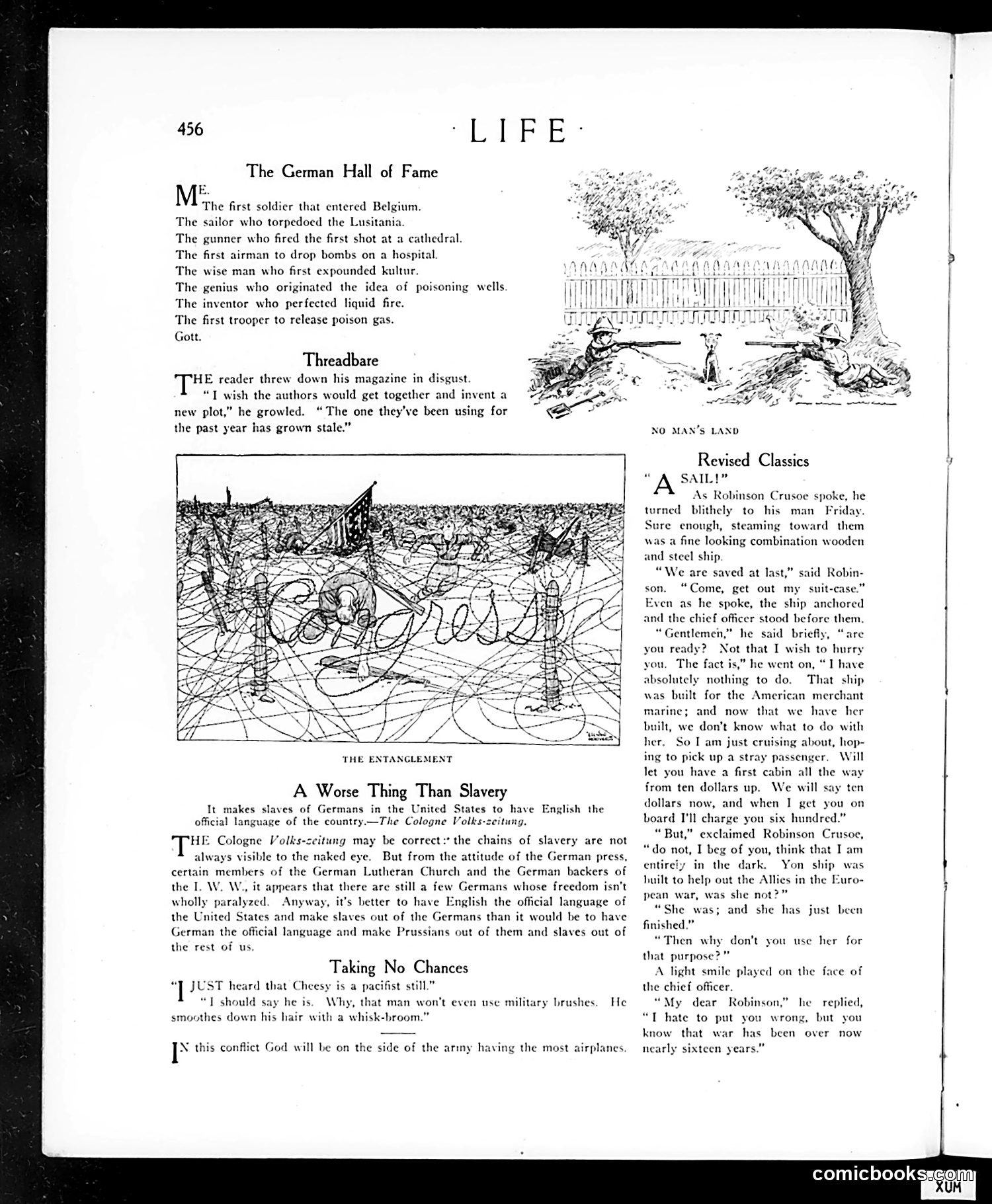
This page contains several satirical pieces critiquing World War I conduct and propaganda: **"The German Hall of Fame"** mockingly lists German military "achievements"—first soldier in Belgium, the Lusitania sinking, bombing hospitals, poisoning wells, using poison gas—presented as if these were honorable accomplishments. The satire inverts values, treating war crimes as glory. **"The Entanglement"** (illustration) appears to depict tangled military/naval conflict, likely referencing the Western Front's stalemate. **"A Worse Thing Than Slavery"** criticizes German official language policy, arguing that imposing German on conquered populations is cultural enslavement. **"Taking No Chances"** jokes about pacifists using whisk-brooms instead of military brushes, sarcastically suggesting military strength determines God's favor in war. All pieces reflect American pro-Allied WWI sentiment.
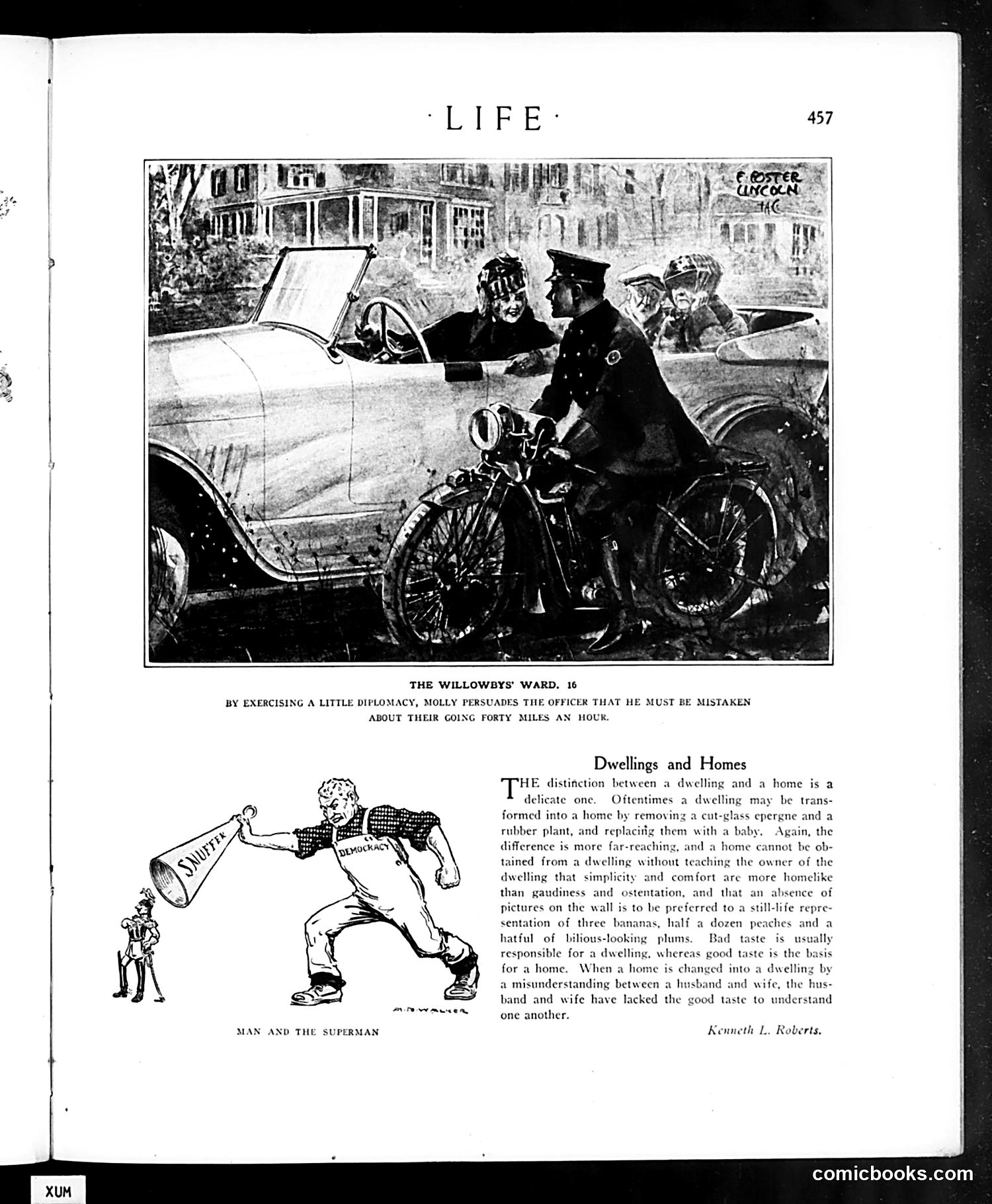
**Top Image: "The Willowbys' Ward, 16"** This is a scene from a serialized story or comic strip. A police officer on a motorcycle speaks with two people in a car, while other figures observe. The caption indicates Molly is using diplomacy to persuade the officer that they weren't actually driving forty miles an hour—a speeding violation joke. The humor relies on the common situation of traffic stops and attempted excuses. **Bottom Content: "Man and the Superman" / "Dwellings and Homes"** A cartoon shows a man labeled "Democracy" being sprayed by a figure representing "Suffrage"—a reference to women's suffrage debates. The accompanying essay by Kenneth L. Roberts discusses the distinction between dwellings and homes, treating interior decoration and family harmony as markers of taste and domestic success.
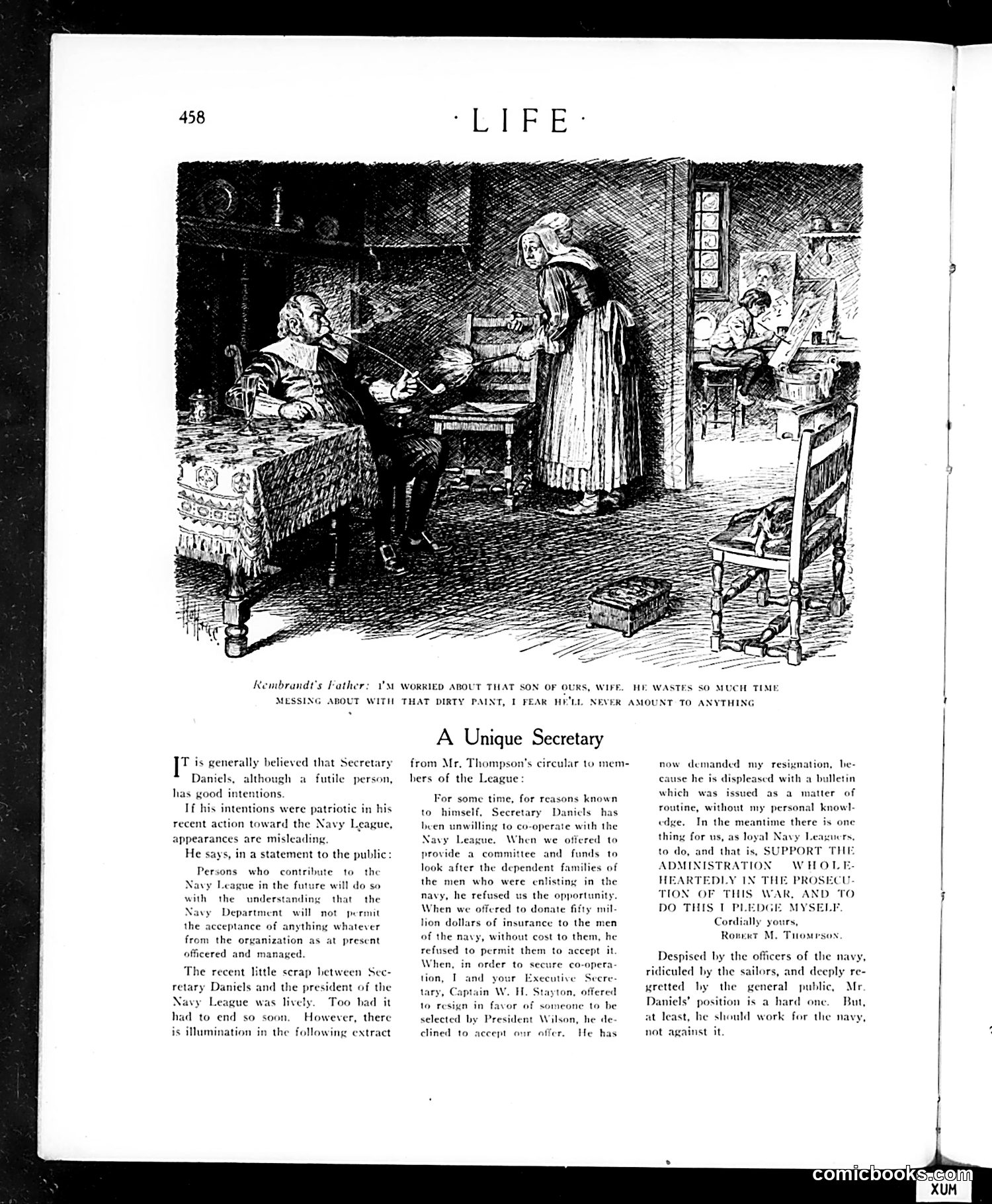
This satirical piece criticizes Secretary Daniels (likely Josephus Daniels, Navy Secretary under President Wilson) for his refusal to cooperate with the Navy League, a civilian organization seeking to support naval preparedness. The cartoon depicts Daniels rebuffing representatives, suggesting he's more concerned with his own bureaucratic control than supporting the military or dependent families of enlisted sailors. The accompanying text reveals Daniels refused to permit the Navy to accept insurance donations for sailors' families, citing administrative principle over practical need. The satire mocks his rigid adherence to protocol while the Navy League attempted charitable work, portraying him as obstructively self-serving rather than genuinely protective of naval interests or personnel welfare.
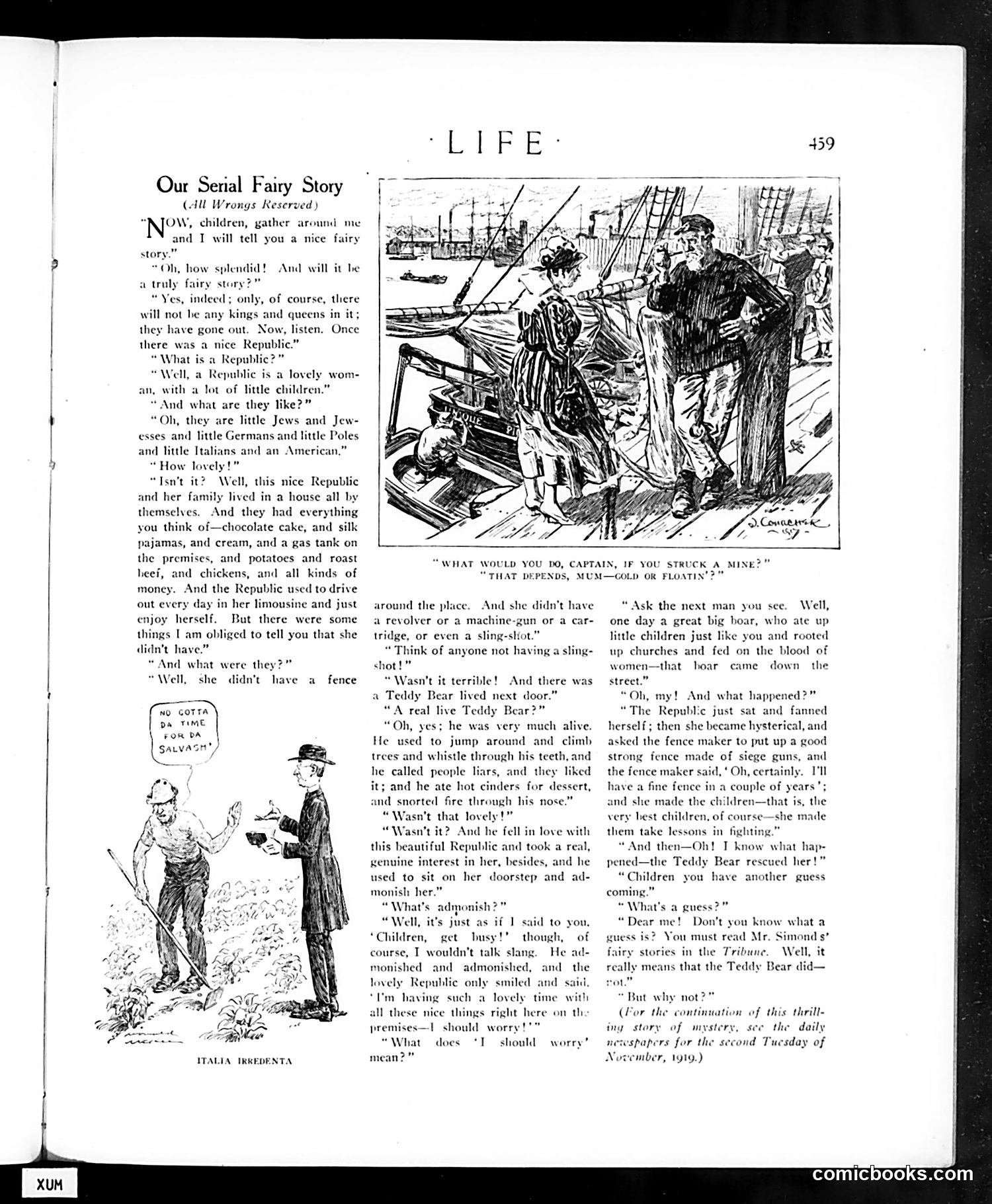
This satirical piece mocks utopian ideals through a fairy tale about a "nice Republic" — a community where diverse immigrants (Jews, Germans, Poles, Italians, Americans) live together in perfect harmony with abundant food and no crime. The joke's target appears to be naive progressivism or socialist utopianism popular in early 20th-century America. The story deliberately undercuts itself: characters keep noting the absence of typical problems (no fence, no weapons, no sling-shot), which—combined with the disclaimer "All Wrongs Reserved"—suggests the author sees such perfect societies as impossible fantasies. The accompanying illustrations show working-class figures and street scenes, grounding the satire in real urban immigrant life rather than idealistic fiction.
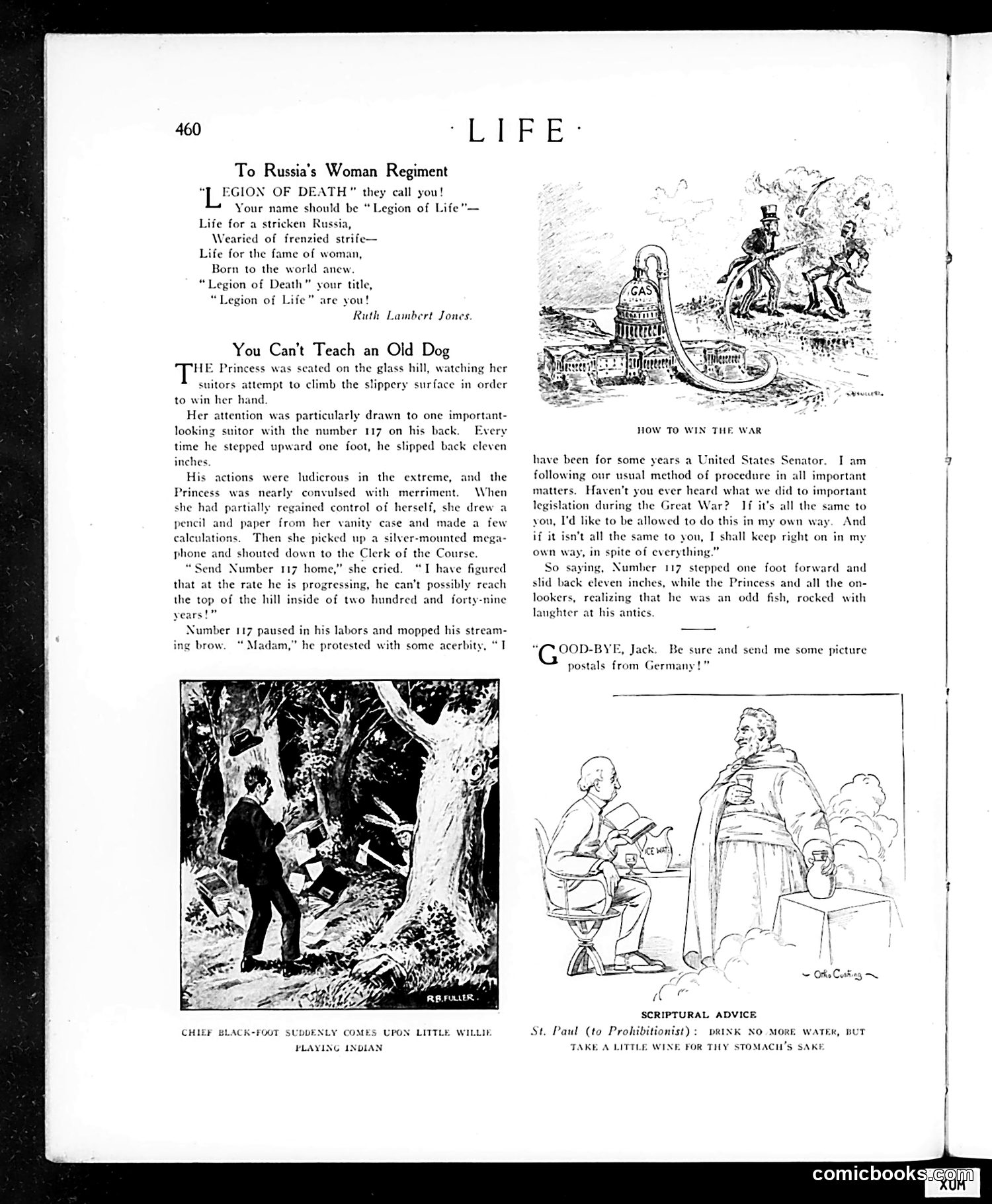
This page contains three distinct satirical pieces from WWI-era *Life* magazine: 1. **"To Russia's Woman Regiment"**: A poem honoring Russia's female combat unit (the "Legion of Death"), reframing them as a "Legion of Life" for Russia's renewal. This references the actual Russian Women's Battalion of Death, formed in 1917. 2. **"You Can't Teach an Old Dog"**: An allegory where "Number 117"—likely representing a U.S. Senator—attempts to climb a glass hill to win a princess's hand. He repeatedly slips backward, making no progress. The senator justifies his futile method by invoking his seniority and WWI legislative practices. The satire mocks Congressional obstruction and ineffective wartime procedure. 3. **"How to Win the War"** and **"Scriptural Advice"**: Brief cartoons seemingly about military strategy and Prohibition-era hypocrisy (quoting St. Paul to justify wine consumption against prohibition). The page ridicules political inertia and old-guard resistance to change during wartime.
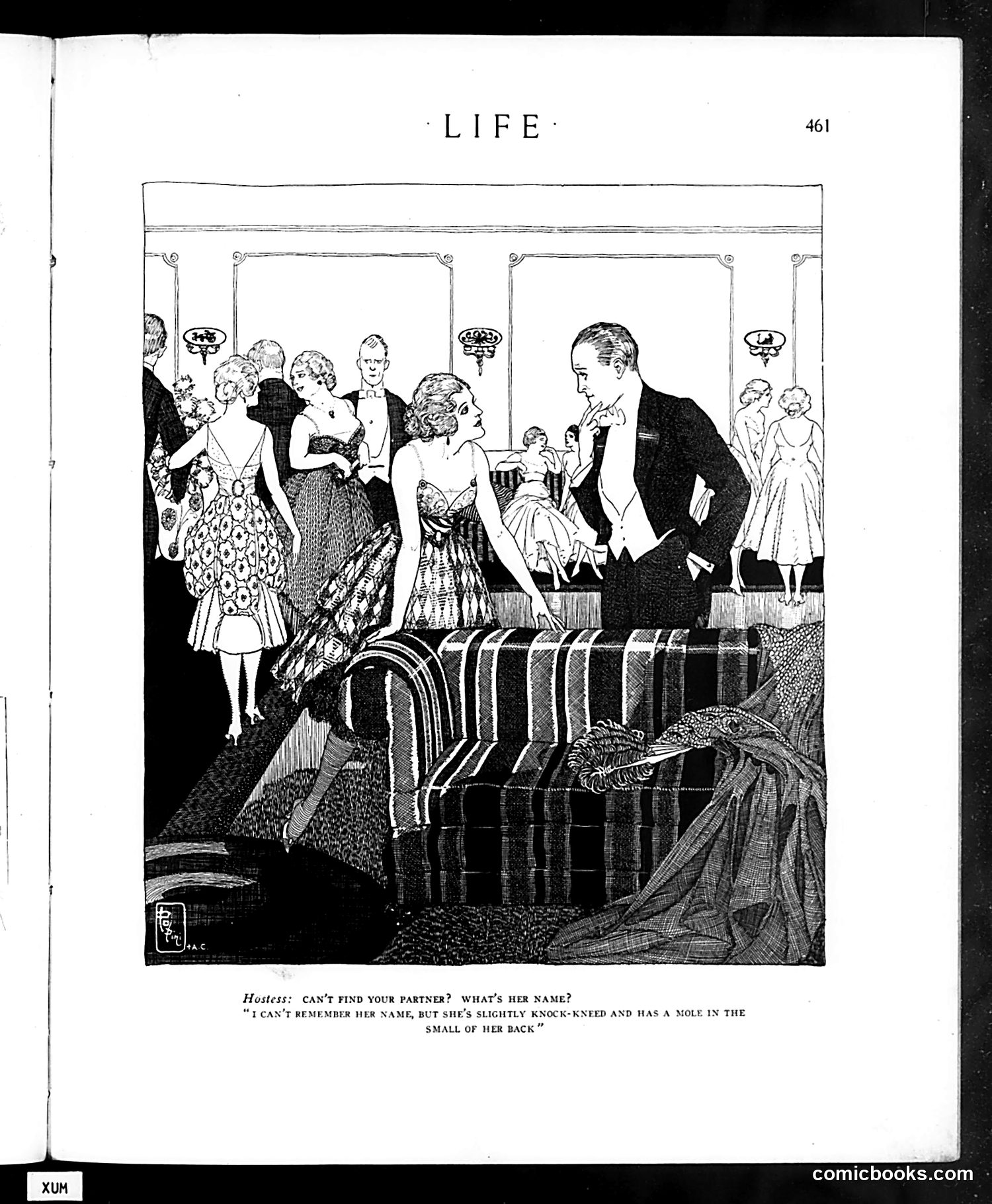
This is a single-panel cartoon satirizing social etiquette and romantic carelessness at what appears to be a formal party or dance. A well-dressed man admits to the hostess that he cannot remember his dance partner's name, then describes her only by physical peculiarities—"slightly knock-kneed and has a mole in the small of her back." The joke targets the shallow superficiality of the man's observation: he's noticed intimate physical details about a woman he's dancing with, yet remains oblivious to or indifferent about learning her actual identity. The cartoon critiques both masculine inattentiveness and the era's casual objectification of women at social events, where women might be reduced to physical descriptions rather than recognized as individuals worthy of being remembered by name.
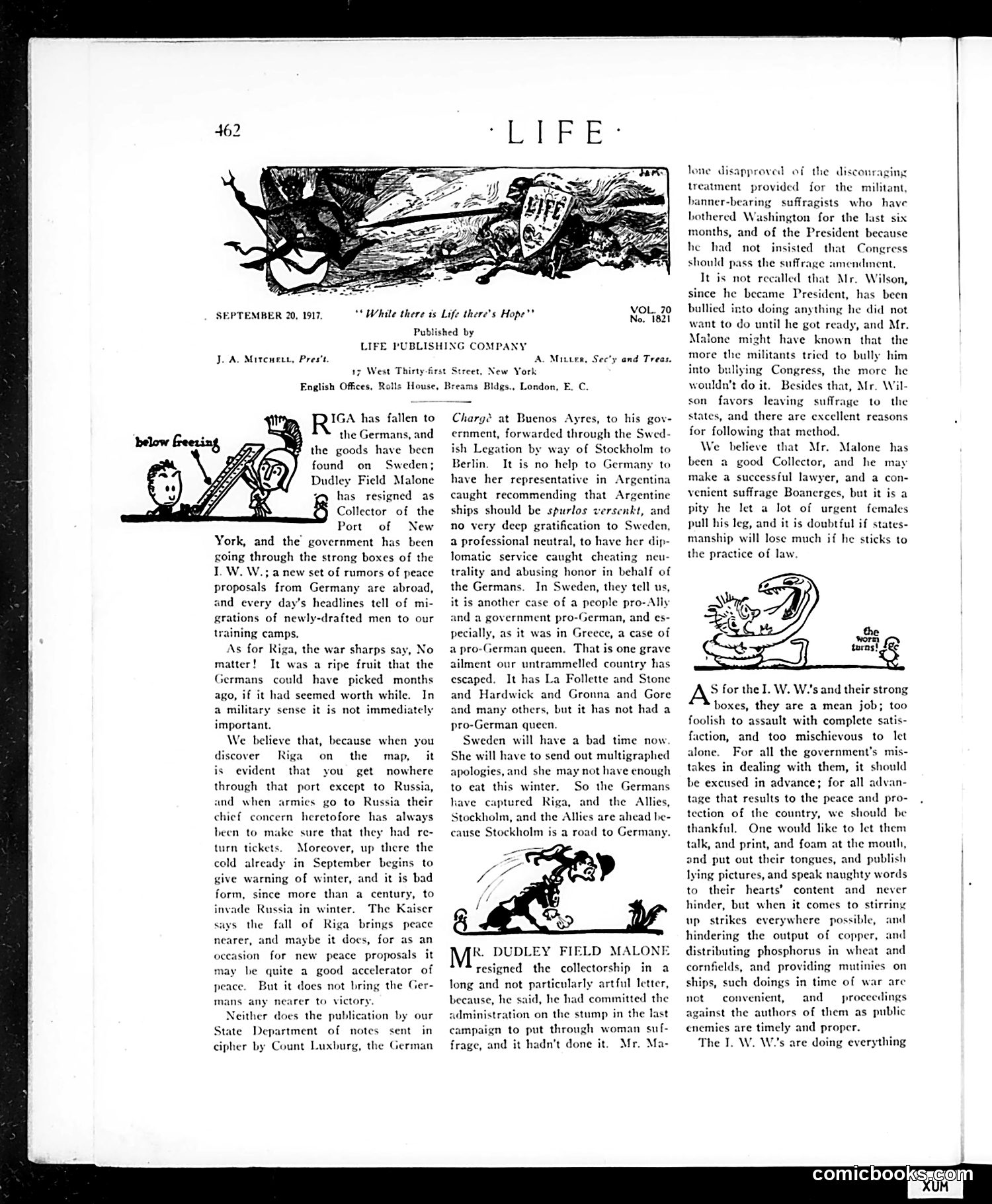
This editorial page addresses several wartime issues affecting America during World War I: **Riga's Fall**: The Germans captured this Russian city—a strategically minor but symbolically significant victory that generates new peace rumors, though it doesn't advance Germany's actual war aims. **Dudley Field Malone's Resignation**: The Collector of the Port of New York resigned, claiming President Wilson hadn't committed sufficiently to women's suffrage. The editorial defends Wilson, arguing militants pushing for suffrage merely antagonize rather than persuade him, and that Wilson prefers states handle the issue. **Swedish Neutrality Scandal**: German diplomat Count Luxburg was caught recommending neutral Swedish ships be sunk without trace ("spurlos versenkt"). This embarrassed Sweden, a supposedly neutral nation with a pro-German government—a situation America avoided, the writer notes with irony, having only anti-German politicians like La Follette and Gore rather than a pro-German queen. The overall tone is skeptical wartime commentary on both international and domestic politics.
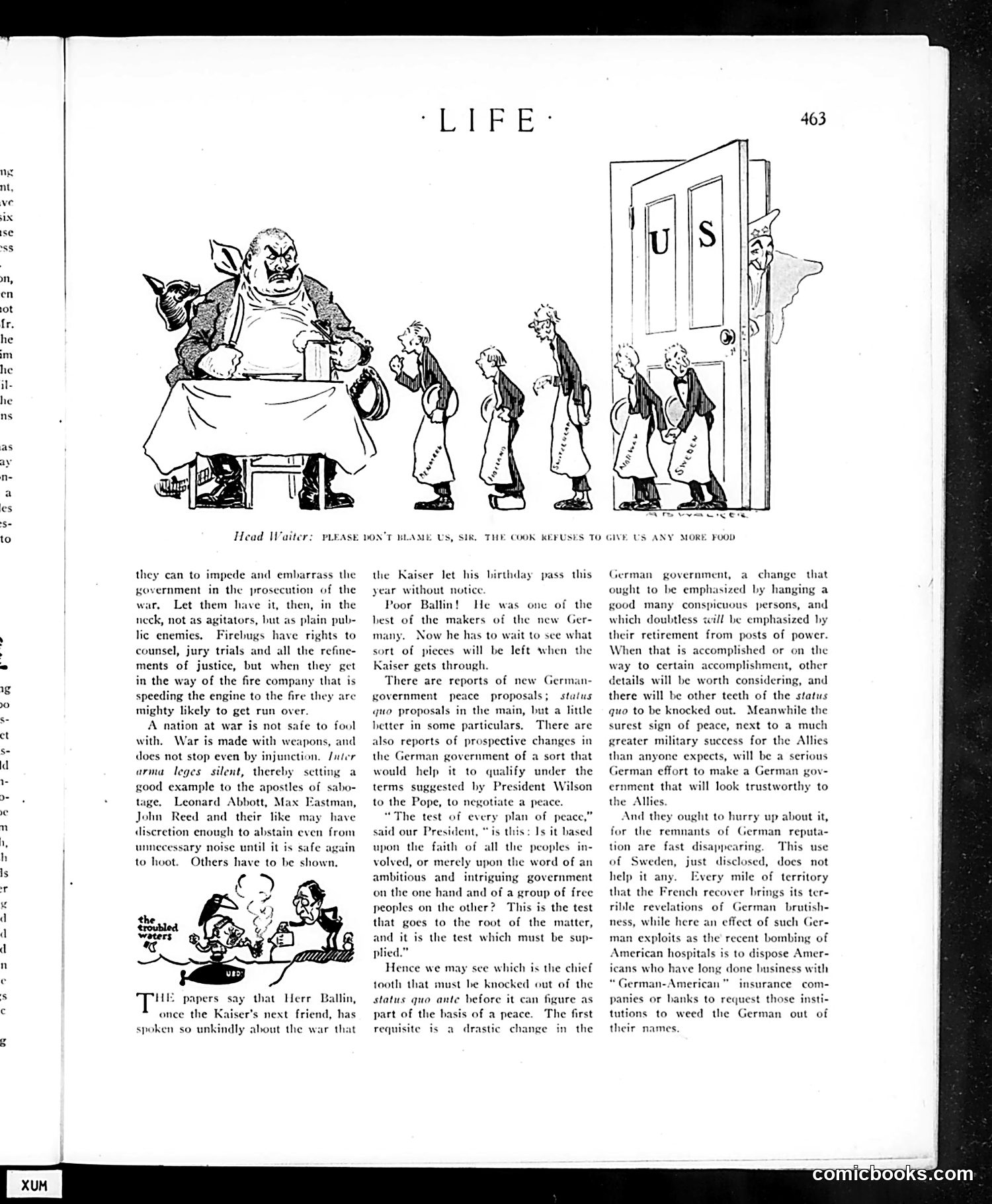
**The Top Cartoon**: A head waiter apologizes to an angry diner, explaining "the cook refuses to give us any more food." This is political satire about **food shortages in Germany during World War I**. The well-fed figure at the table represents German leadership; the starving children in line represent the German population. The joke: Germany's "cook" (government/war machine) has exhausted resources, leaving the people hungry. It mocks both German war effort collapse and the suffering it caused civilians. **The Text Content**: The article discusses **peace negotiations and German government reform**. It references Herr Ballin (a German industrialist who opposed the war, causing the Kaiser to snub his birthday), and President Wilson's conditions for peace—namely that Germany must undergo "drastic change" in government, possibly including executions of war leaders. The piece argues Germany's reputation is destroyed by war atrocities, and even German-American businesses are renaming themselves to distance from German identity. **Context**: This reflects 1918 America's hardening anti-German stance and demands for accountability.
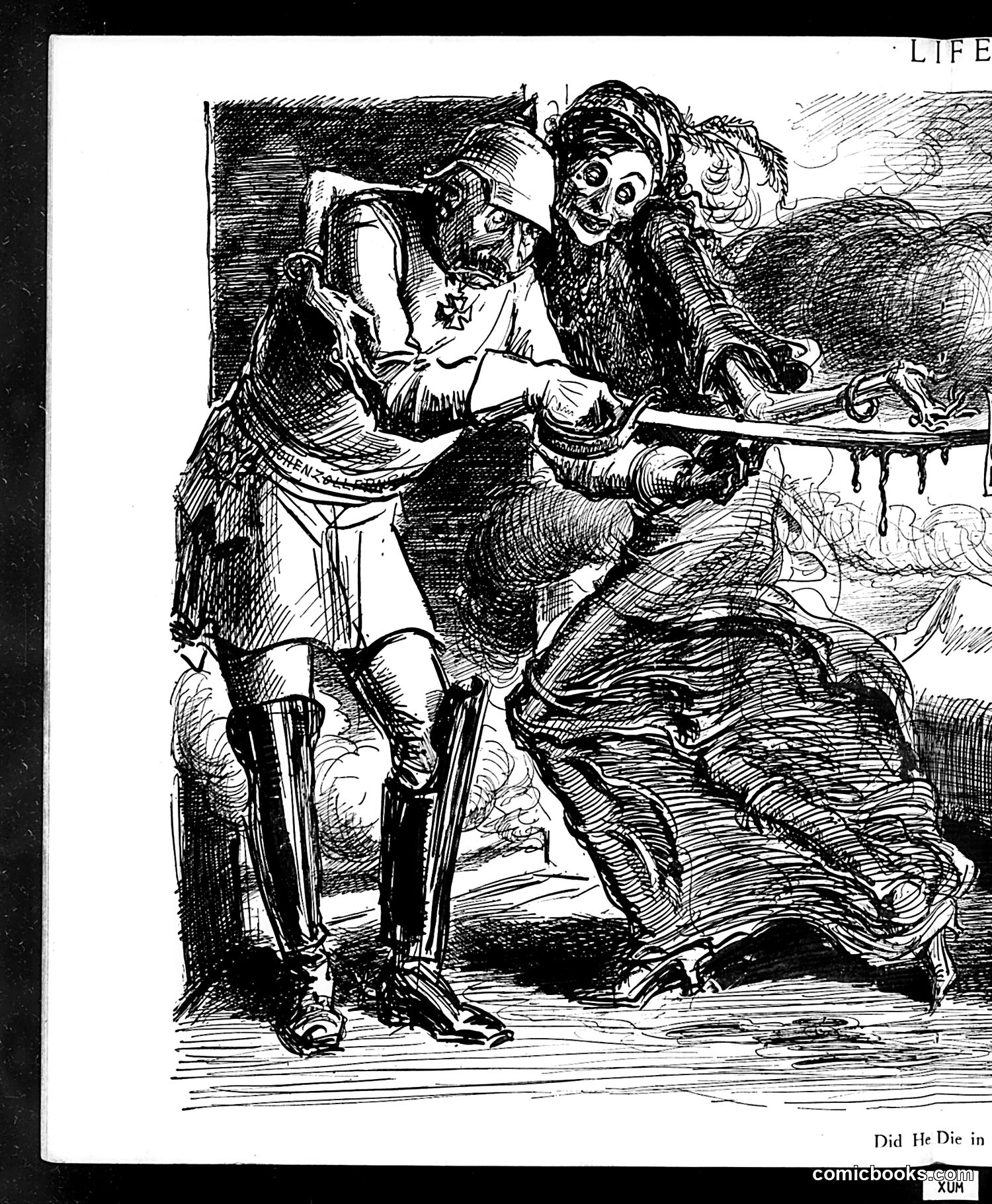
This appears to be a satirical illustration from *Life* magazine showing a dramatic scene with exaggerated, grotesque figures. The central character appears to be a bearded man in period clothing being confronted or attacked by distorted, demonic or caricatured figures surrounding him. The style suggests 19th-century engraving. The partial caption reads "Did He Die in..." but the complete text is cut off, making it impossible to identify the specific historical event, person, or political situation being satirized. Without the full caption and context, I cannot definitively explain what figures are being caricatured or what point the satire makes. The dramatic, violent imagery suggests commentary on a significant historical moment, but determining which requires the complete text.
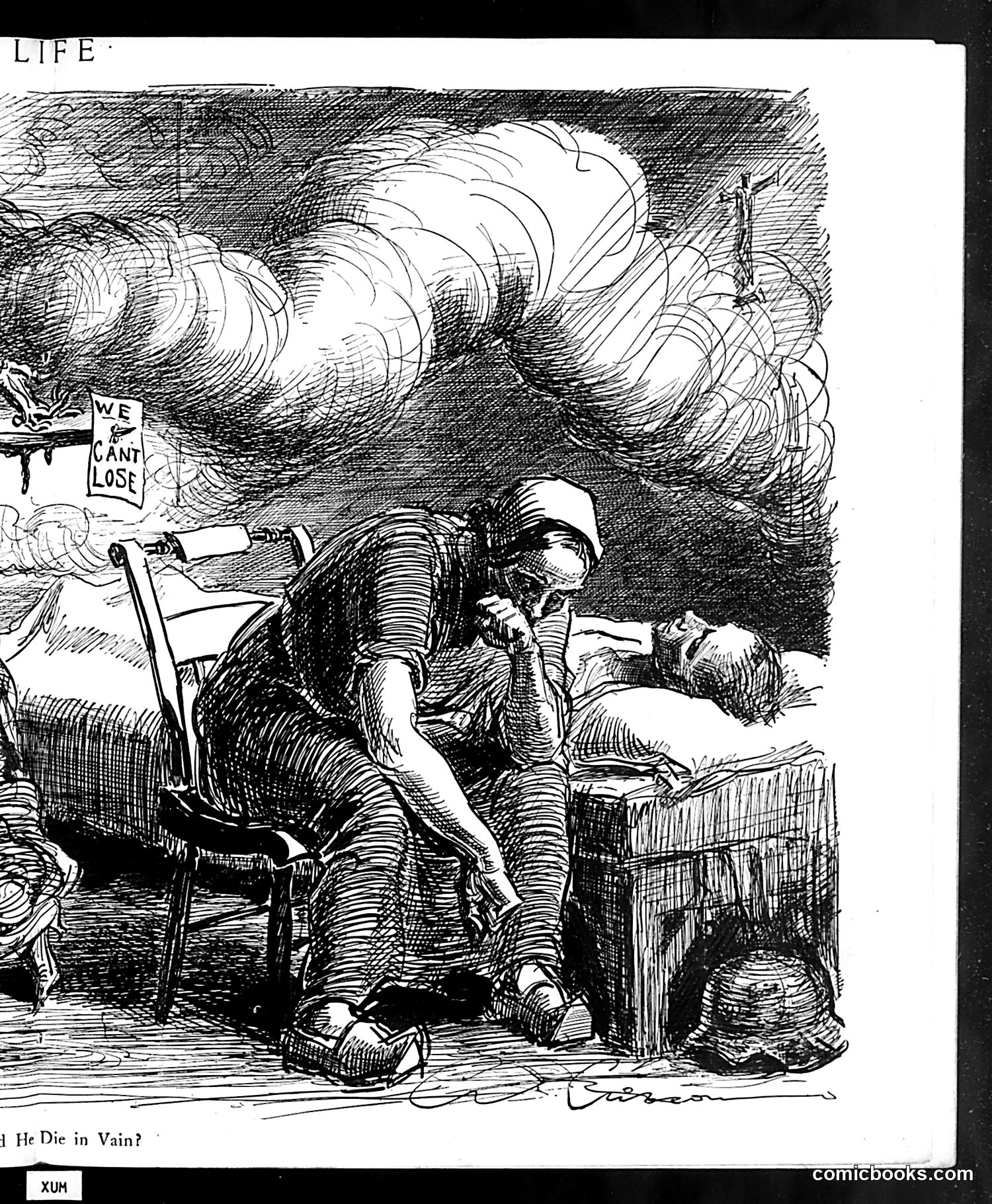
This appears to be a World War I-era cartoon from *Life* magazine's satirical section. The central figure is a soldier in military uniform and helmet, depicted in a stark, dramatic style. The sign reading "WE CAN'T LOSE" visible in the upper left suggests nationalist wartime sentiment. The caption below asks "He Die in Vain?" - likely referencing concerns about soldiers' sacrifice and whether casualties serve a meaningful purpose. The heavy cross-hatching and dark tone convey grimness rather than humor, suggesting this is anti-war satire critiquing the human cost of combat. The artist's signature appears to be "Cesare" or similar. The overall message seems to question whether military losses are justified, using stark imagery to challenge jingoistic "we can't lose" rhetoric.
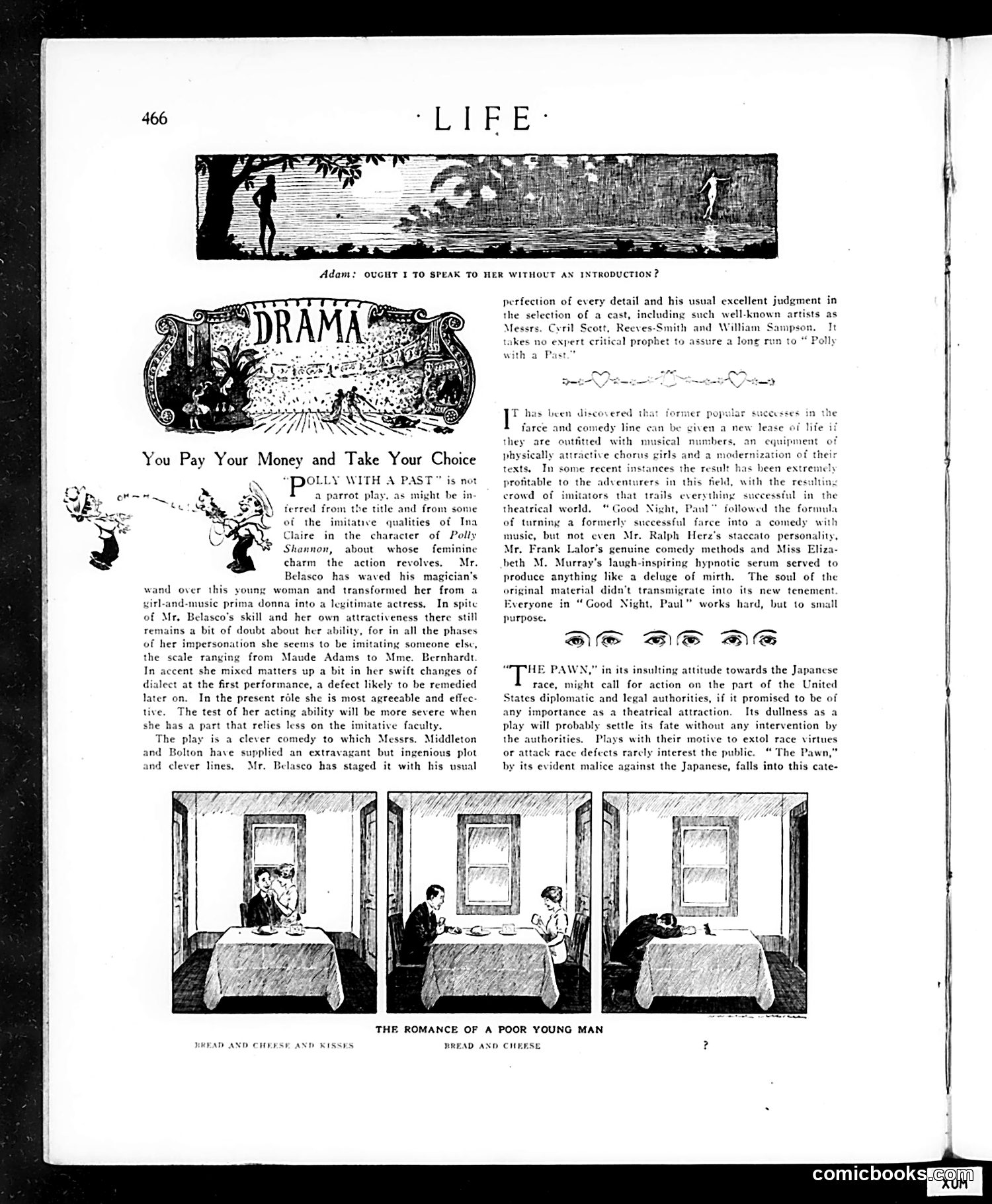
This page reviews three theatrical productions. The main content discusses "Polly with a Past," starring Ina Claire under director David Belasco's guidance. The review praises her transformation from operetta performer to legitimate actress, though notes her acting ability remains somewhat uncertain—she relies heavily on imitation and had dialect issues in her debut performance. Two other plays receive brief mentions: "Good Night, Paul" (a converted farce with musical numbers that failed to generate expected success despite its formula), and "The Pawn," which the reviewer criticizes harshly for its insulting portrayal of Japanese people. The reviewer suggests the play's racism may provoke diplomatic protest, though its theatrical mediocrity will likely doom it regardless. The three small illustrations at bottom depict "The Romance of a Poor Young Man"—a domestic scene showing the progression from intimate dinner ("bread and cheese and kisses") to apparent romantic dissolution.
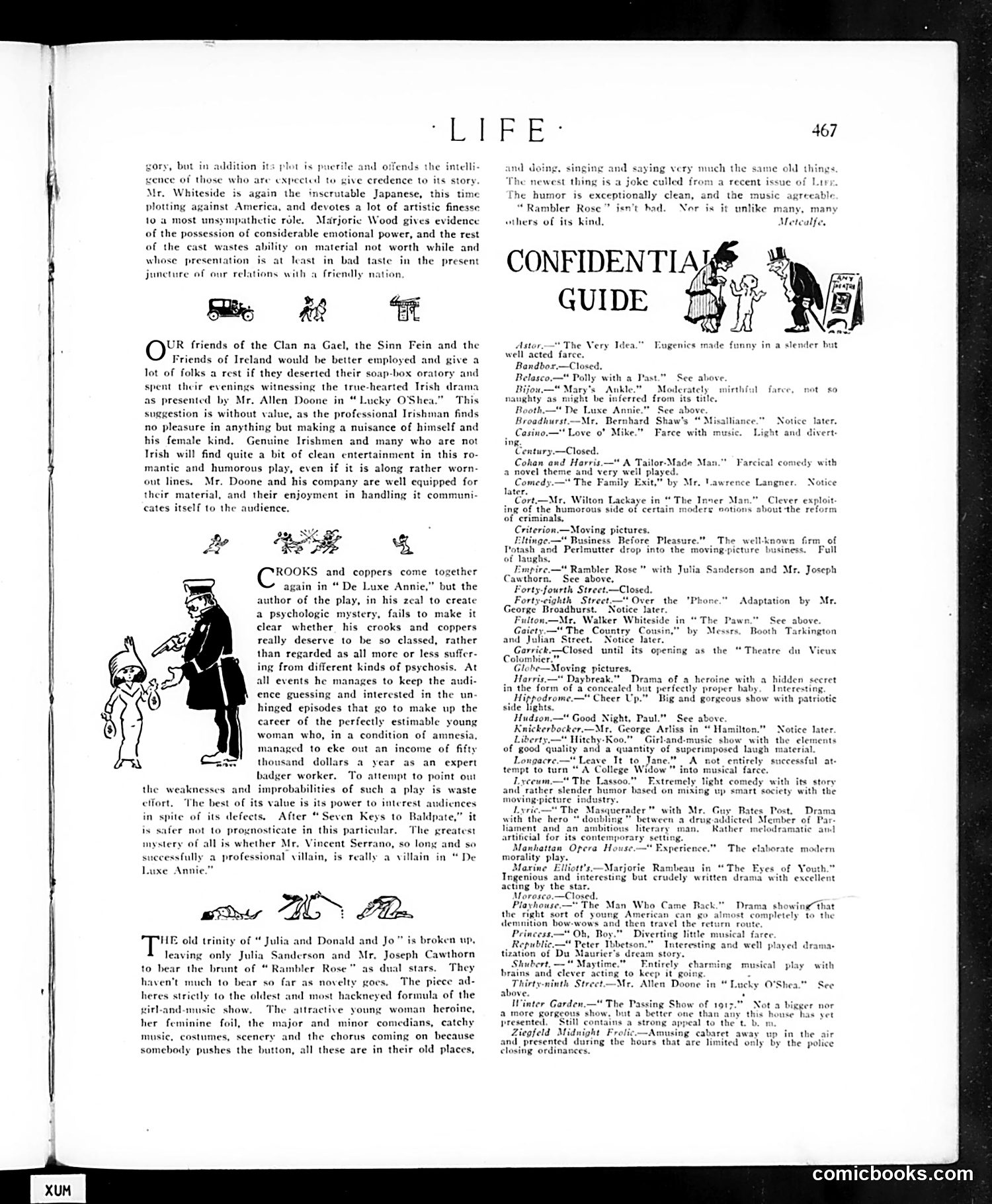
This page contains theatrical reviews rather than political cartoons. The critic discusses several Broadway productions from what appears to be the early 1910s. **Key Content:** The reviews critique plays including "Lucky O'Shea" (an Irish drama), "De Luxe Annie" (featuring crooks and police with psychological themes), and "Rambler Rose" (a girl-and-music show). **Satirical Points:** The critic mocks Irish-American activist groups ("Clan na Gael, the Sinn Fein") for their "soap-box oratory," suggesting they should instead enjoy wholesome Irish theatrical entertainment. There's also subtle critique of formulaic musical theater—the "girl-and-music show" that relies on predictable plot elements, attractive heroines, comedians, and chorus girls rather than originality. **Small decorative cartoons** appear throughout (showing figures in theatrical poses) but serve merely as design elements rather than conveying specific satirical messages. The page reflects early 20th-century American theater criticism and contemporary attitudes toward Irish-Americans and theatrical conventions.
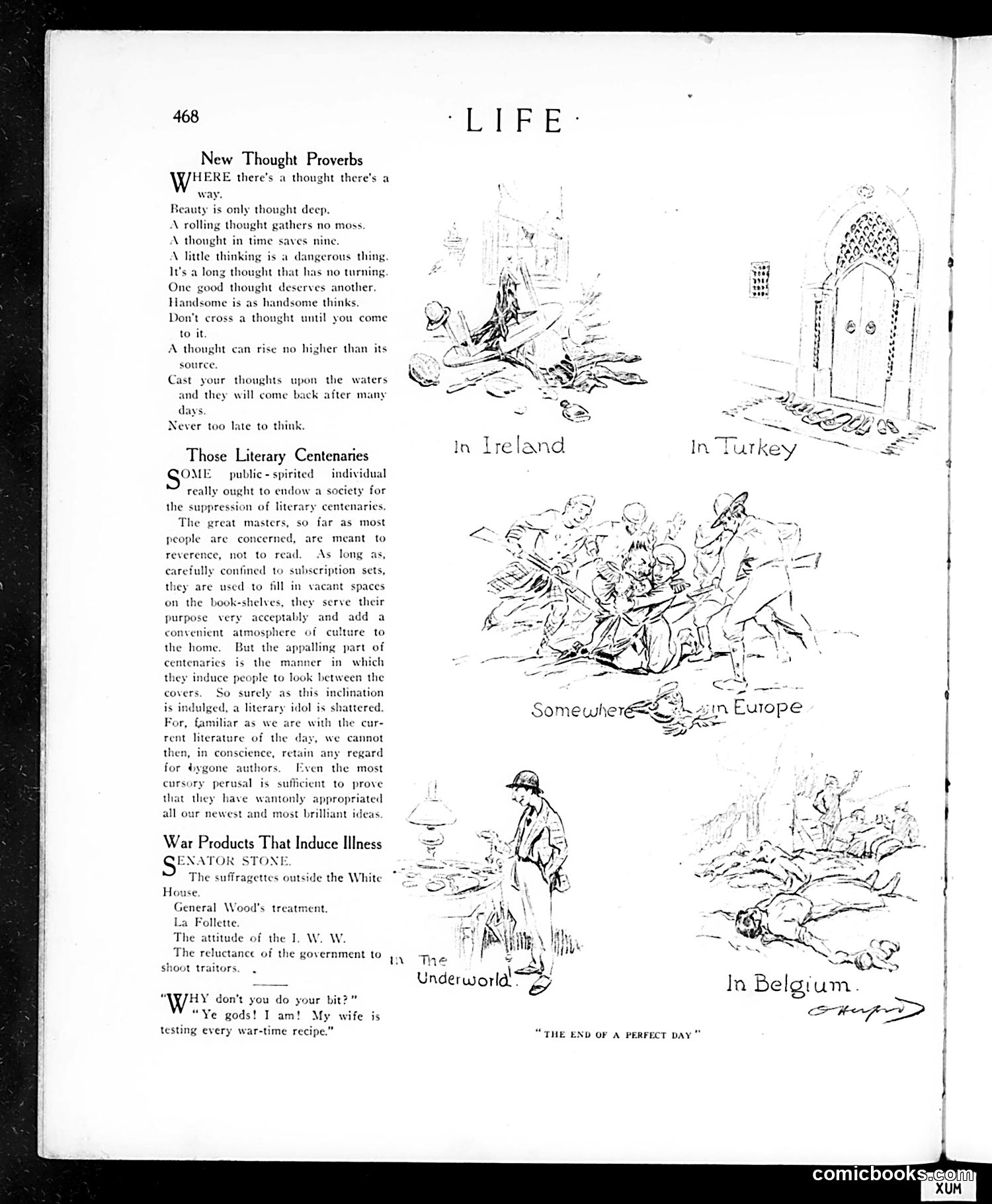
This satirical page from *Life* contains several distinct pieces mocking contemporary American attitudes during the World War I era. **"New Thought Proverbs"** parodies self-help philosophy by reversing famous sayings ("A rolling thought gathers no moss," "A thought in time saves nine"), satirizing the era's popular "New Thought" movement—a quasi-spiritual belief system emphasizing positive thinking. **"Those Literary Centenaries"** mocks the pretentious practice of celebrating deceased authors' anniversaries. The satire argues that literary celebrations encourage people to actually *read* classic authors, which ruins their reputations—a joke about how familiarity with old literature reveals it contains ideas we credit to ourselves. **"War Products That Induce Illness"** satirizes American home-front morale problems. It lists grievances (suffragettes, the IWW labor movement, government reluctance regarding "traitors") as causes of national illness, concluding with a joke about women testing wartime recipes as their contribution to the war effort—mocking both women's limited war roles and the government's focus on civilian rationing. The sketched scenes labeled "In Ireland," "In Turkey," etc., appear to depict wartime devastation abroad, ironically titled "The End of a Perfect Day."
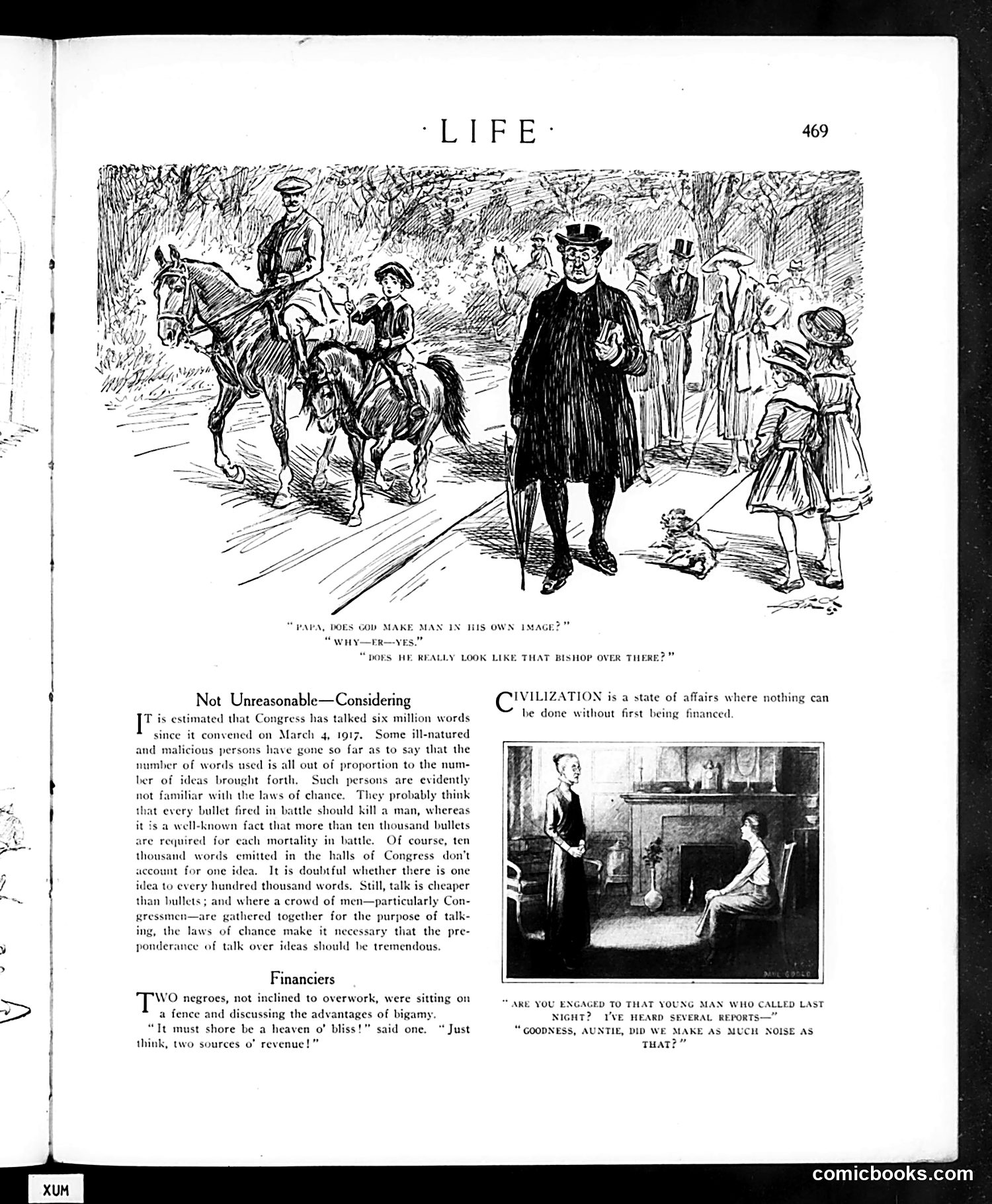
**Top Cartoon**: A child asks his father if God made man in His image, then points to a bishop nearby, asking if God "really look[s] like that." The joke mocks the bishop's appearance as unattractive or undignified—a common satirical attack on clergy, suggesting their physical form belies their supposedly elevated spiritual status. **"Not Unreasonable" Section**: This satirizes Congress's verbosity following America's entry into WWI (March 1917). It argues that Congress produces disproportionate talk relative to ideas—requiring thousands of words per actual idea, much like artillery requires thousands of bullets per casualty. The satire critiques legislative inefficiency and empty rhetoric. **"Financiers" Joke**: Two Black men discuss bigamy as economically advantageous ("two sources of revenue"). This reflects period stereotypes about both race and marriage, typical of early-20th-century magazine humor. **Bottom Photo Caption**: A woman jokes that her fiancé's visits make noise—implying impropriety or scandal, a mild social critique on propriety and engagement etiquette.
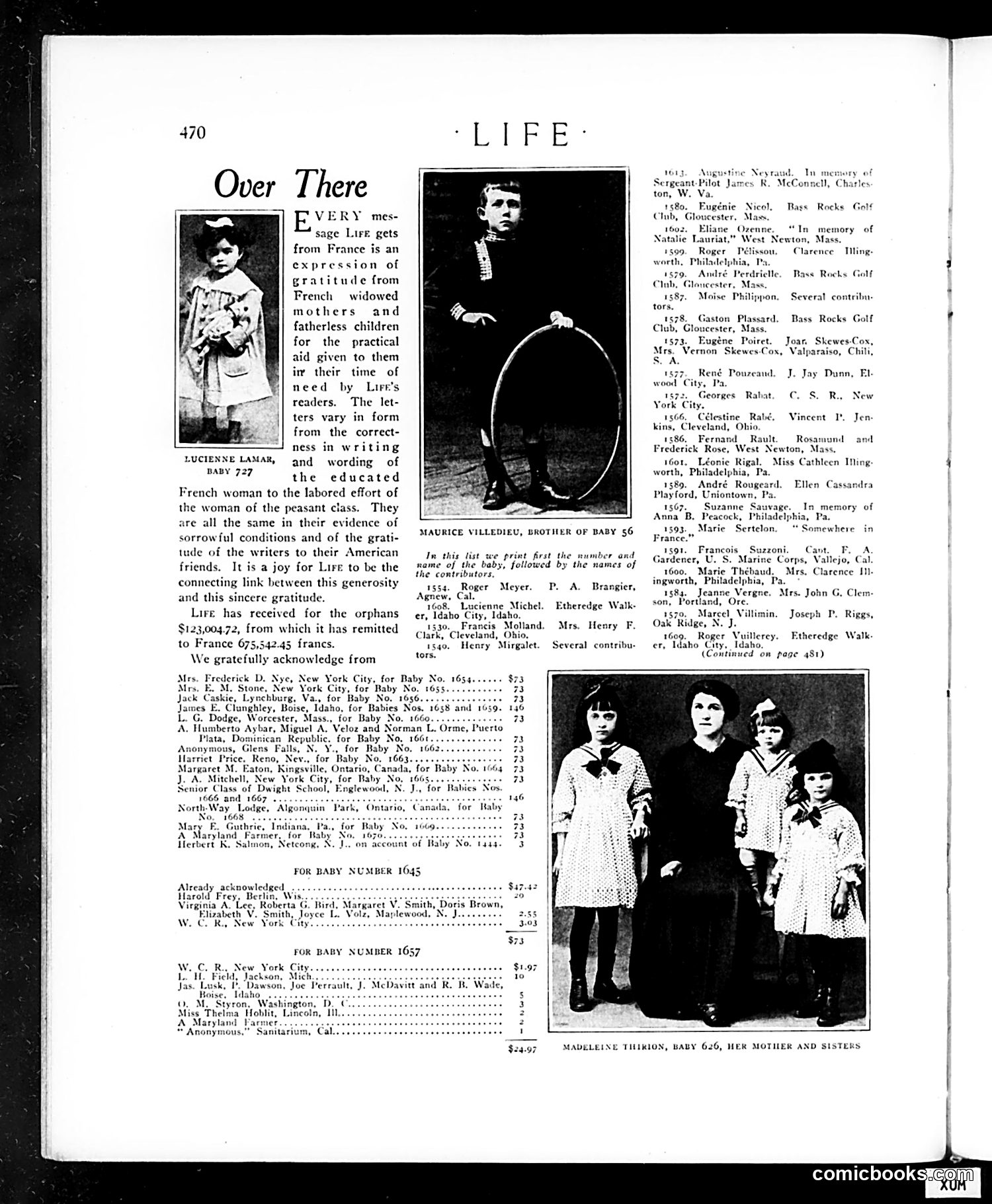
This page documents **Life magazine's charitable campaign** to support French orphans during World War I. The title "Over There" references the popular 1917 song about American soldiers in France. The article explains that Life receives grateful letters from French widows and bereaved families thanking American readers for financial aid. The photographs show a French boy (Maurice Villedieu) and a French girl with her siblings—beneficiaries of this American charitable support. The bulk of the page lists donors' names and amounts contributed to support specific orphans, numbered sequentially (Baby No. 1645, 1657, etc.). Donations range from $1.97 to $47.42. This reflects a common early-20th-century practice where American donors could directly sponsor individual foreign children, creating a personal connection to wartime relief efforts. The campaign had raised over $675,000 francs for French orphans by this point.
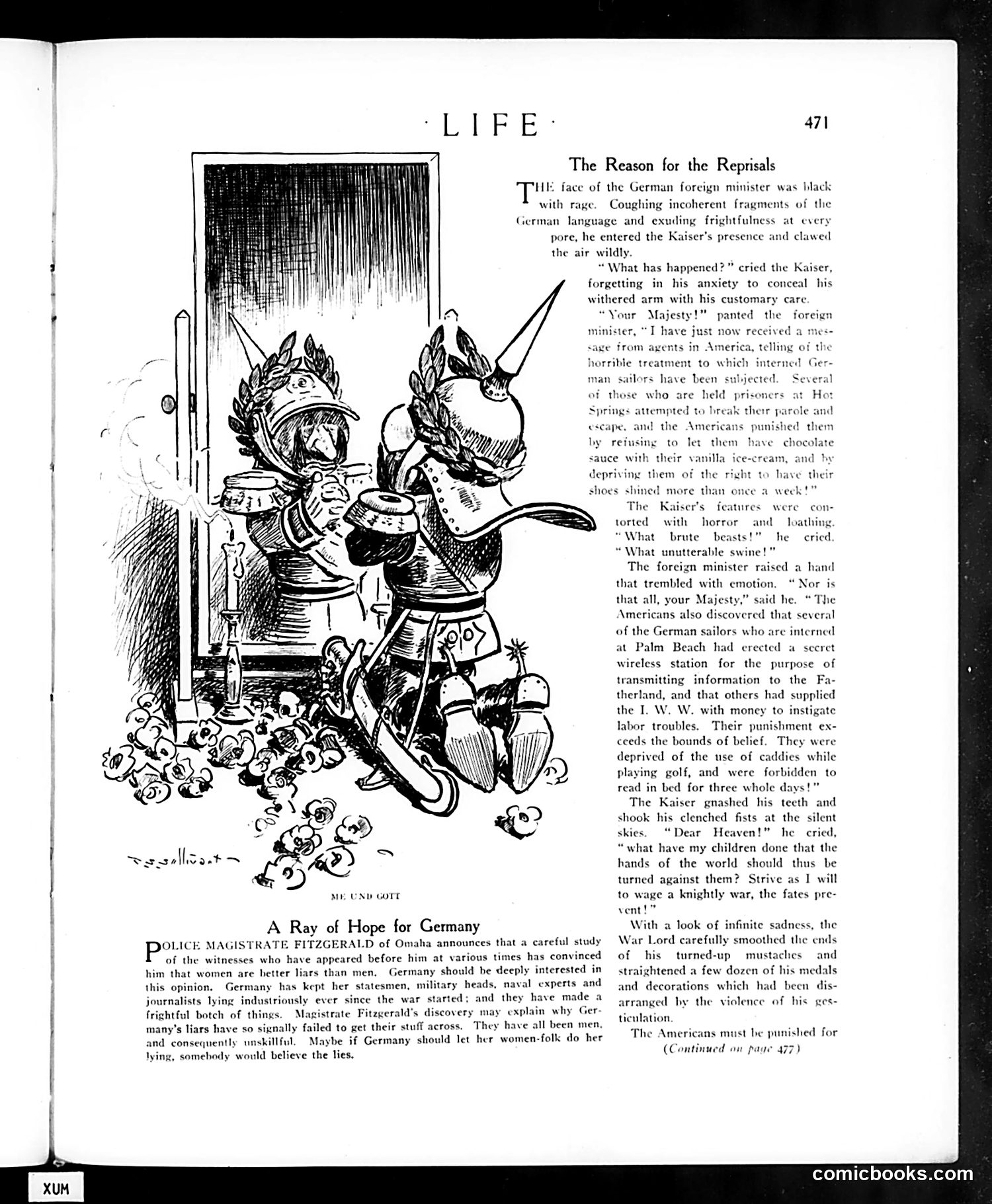
This is World War I-era satirical commentary mocking German propaganda claims about mistreated interned sailors. The cartoon depicts the Kaiser (identifiable by his distinctive spiked helmet and withered arm, which he unconsciously reveals) receiving outraged reports from his Foreign Minister about alleged American brutality toward German prisoners: denying them chocolate sauce on ice cream, limiting shoe shines to once weekly, and forbidding golf caddies. The satire's point is transparent: these trivial "atrocities" are absurdly exaggerated German complaints used to justify actual reprisals. The accompanying article extends the mockery, suggesting Germany's male propagandists have bungled their lies so badly that perhaps women should take over the lying. The cartoon ridicules German attempts to justify military actions through obviously fabricated victim narratives—a propaganda technique Life's readers would recognize as transparent wartime dishonesty.
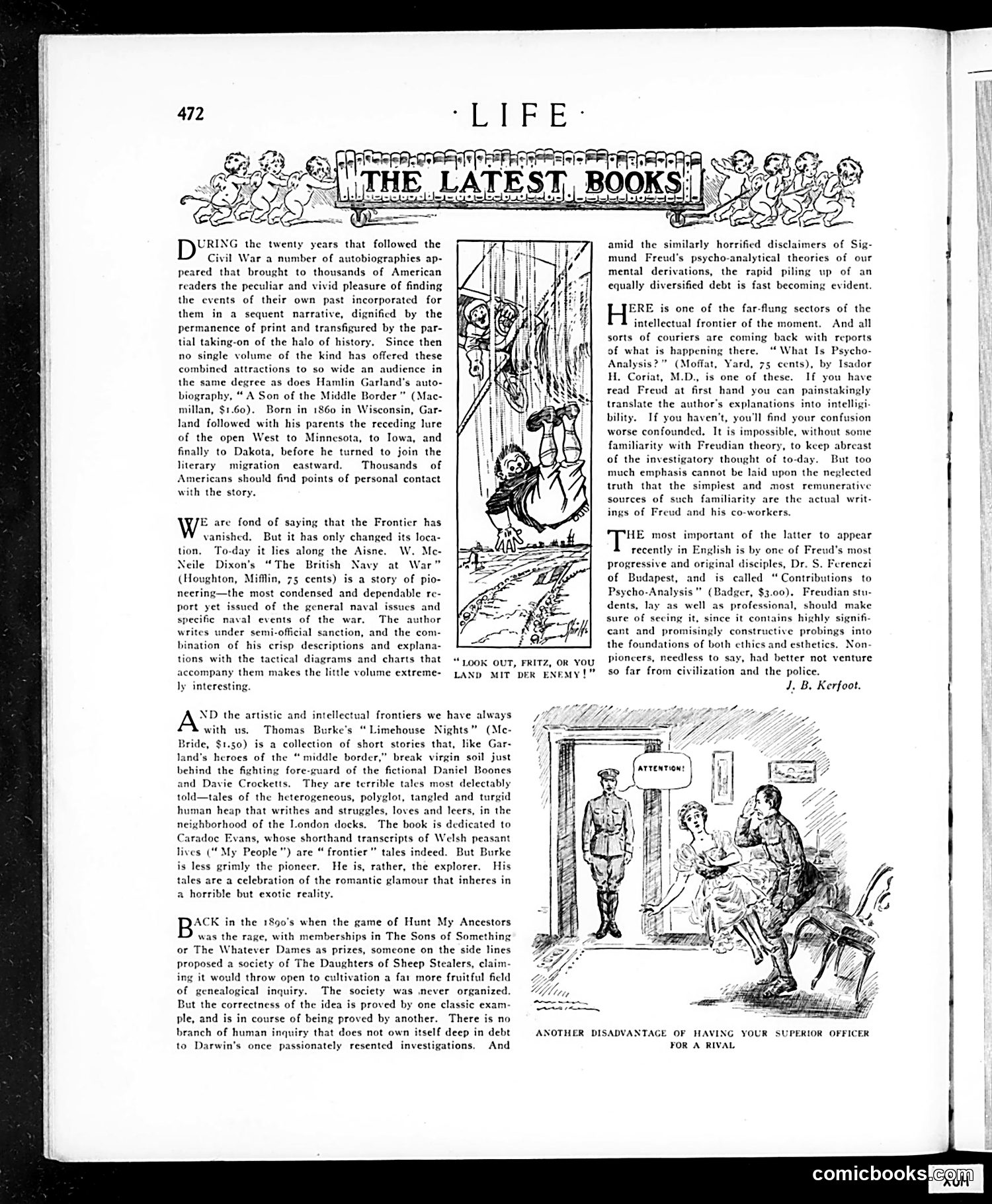
This book review page discusses recent publications following World War I. The upper cartoon depicts a German soldier ("Fritz") surrendering or being confronted, with the caption "LOOK OUT, FRITZ, OR YOU LAND MIT DER ENEMY!" — a humorous jab at German military defeat using faux-German English. The lower cartoon shows a military officer entering a room where a woman sits, captioned "ANOTHER DISADVANTAGE OF HAVING YOUR SUPERIOR OFFICER FOR A RIVAL" — satirizing the social awkwardness when romantic rivals have a hierarchical military relationship. The page reviews books including Hamlin Garland's autobiography and W. McNeile Dixon's account of naval warfare, celebrating American frontier spirit now redirected toward intellectual and literary pursuits. The writing emphasizes how even Freudian psychoanalysis represents a new "intellectual frontier," though the reviewer notes it remains difficult for lay readers to understand without prior knowledge.
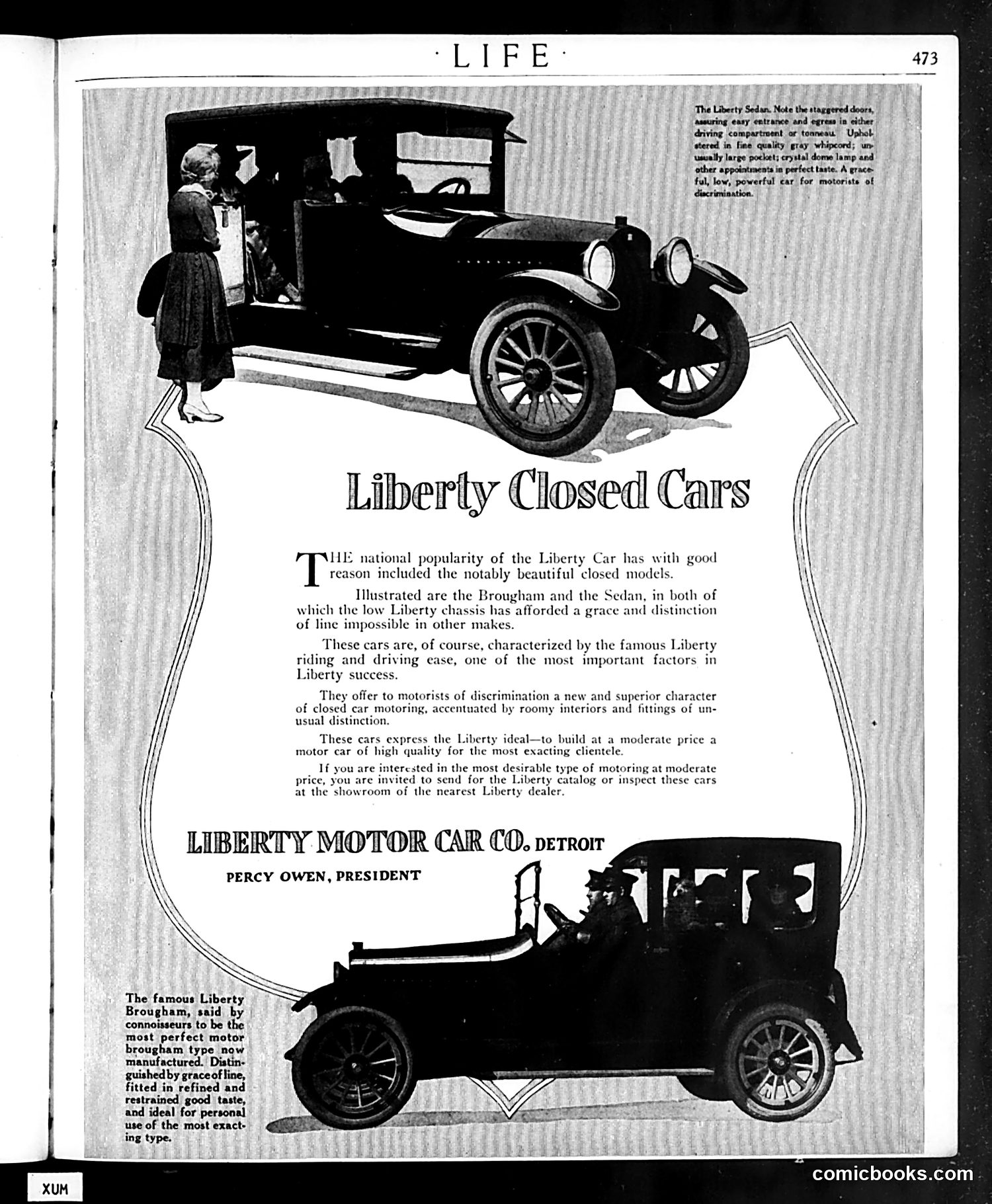
This is **not a cartoon or satire**—it's a straightforward automobile advertisement from Life magazine (page 473). The page promotes the Liberty Motor Car Company of Detroit, founded by Percy Owen. It showcases two vehicle models: the Brougham and the Sedan, emphasizing their closed-car design as a luxury feature. The advertisement targets affluent buyers seeking "high quality" vehicles at "moderate price." Key selling points include: - The famous "Liberty riding and driving ease" - Refined aesthetics and "grace of line" - Spacious interiors with upscale details (whipcord upholstery, crystal dome lamps) - The Sedan's innovative "staggered doors" for convenient entry/exit The woman illustrated represents the target customer demographic—middle-to-upper-class motorists valuing both practical comfort and elegant design. This reflects the era when closed cars were still relatively novel luxury items, distinct from open touring cars.
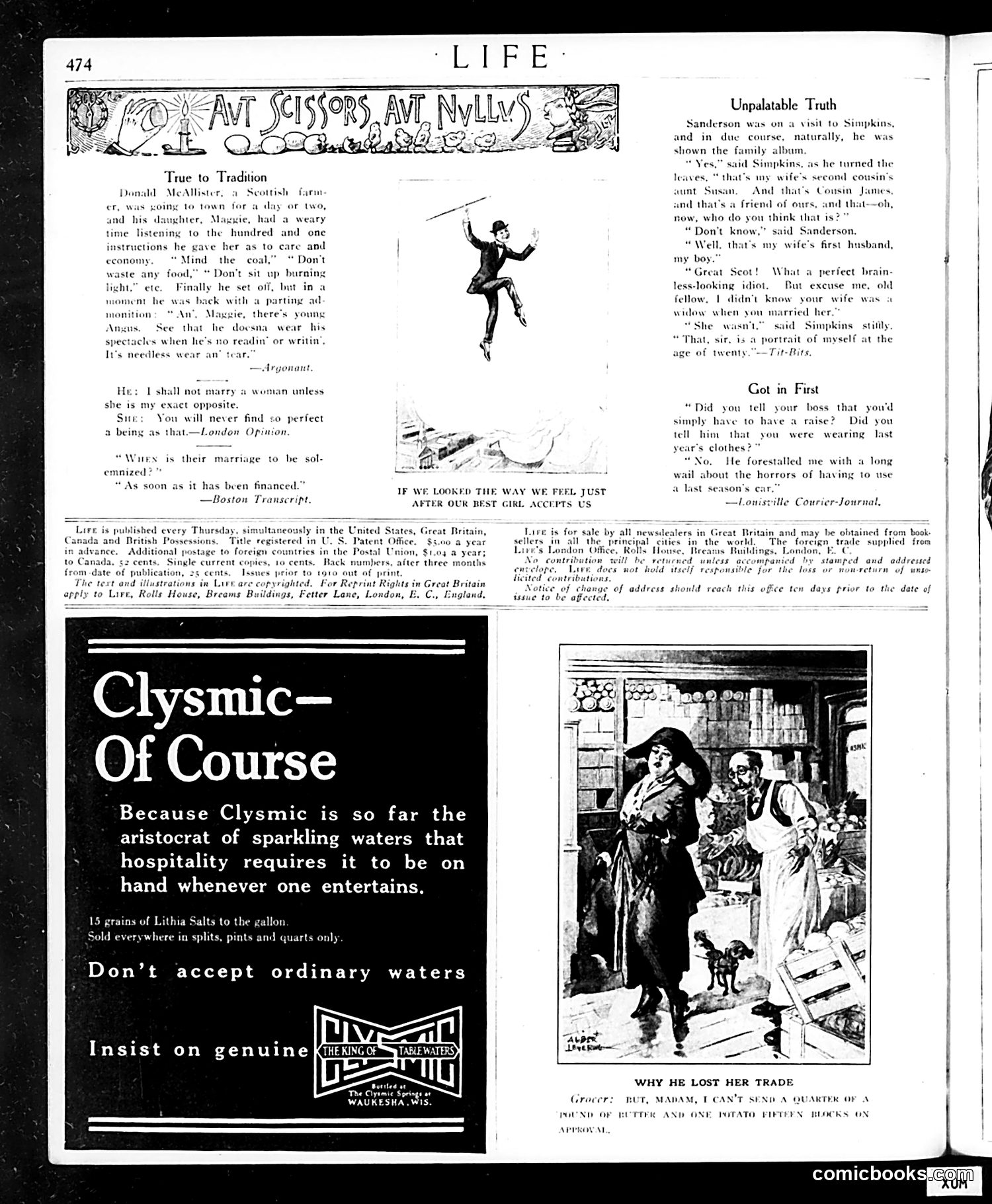
This page contains three satirical pieces typical of early 20th-century Life magazine humor: **"True to Tradition"** and companion jokes mock Scottish frugality and domestic absurdity. A Scottish farmer visits town hearing repeated warnings about waste ("Mind the coal," "Don't waste food"). The punchline—his wife's portrait is actually "a portrait of myself at the age of twenty"—jokes about Scottish stinginess: he couldn't afford a proper portrait, so he used his own younger image. **"Got in First"** satirizes workplace power dynamics: an employee plans to demand a raise, but his boss preemptively complains about financial hardship, preventing the request—the boss "got in first." **The bottom cartoon, "Why He Lost Her Trade,"** shows a grocer refusing a customer's request for credit ("approval") on butter and potatoes. The humor targets the tension between customer expectations and merchant policy during an era when small-shop credit was common. The **Clysmic water advertisement** is period marketing for a mineral water product, unrelated to the humor above.
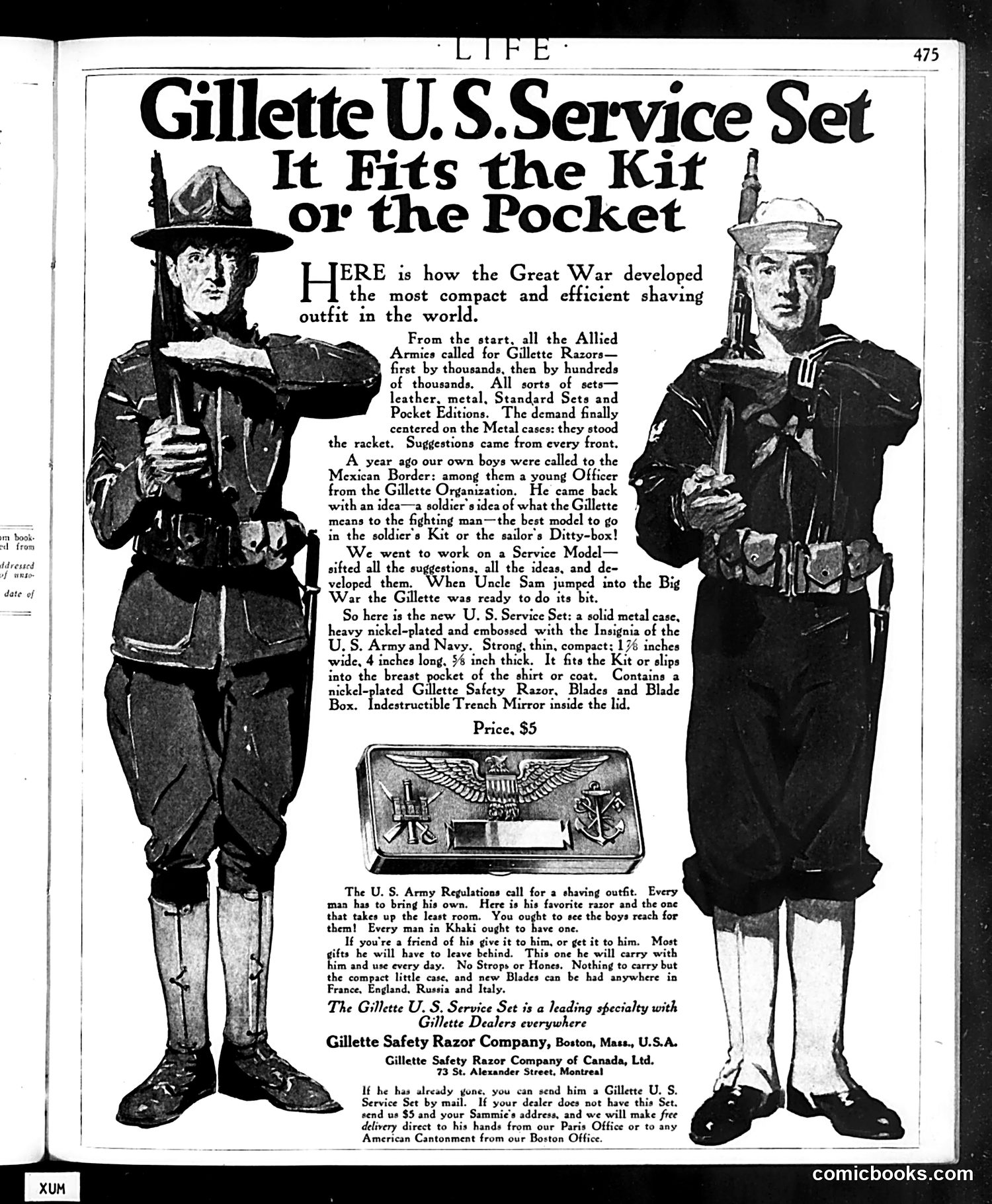
This is primarily a **World War I advertisement**, not satire. It depicts two soldiers—one American (left, in campaign hat) and one Allied soldier, likely British (right, in pith helmet)—as endorsements for a compact shaving kit designed for military use. The ad capitalizes on **patriotic sentiment** during America's WWI involvement. It claims the Gillette razor became the standard for Allied armies due to battlefield demand, and that a young Gillette officer on the Mexican Border helped develop this specific compact "Service Model" for soldiers' kits. The pitch targets gift-givers: buy this $5 set for servicemen who must travel light and can't carry much home. It emphasizes portability and that replacement blades are available "anywhere in France, England, Russia and Italy"—locations where American troops operated. This is **commercial propaganda** leveraging wartime patriotism to drive sales by positioning the product as essential military equipment endorsed by soldiers themselves.
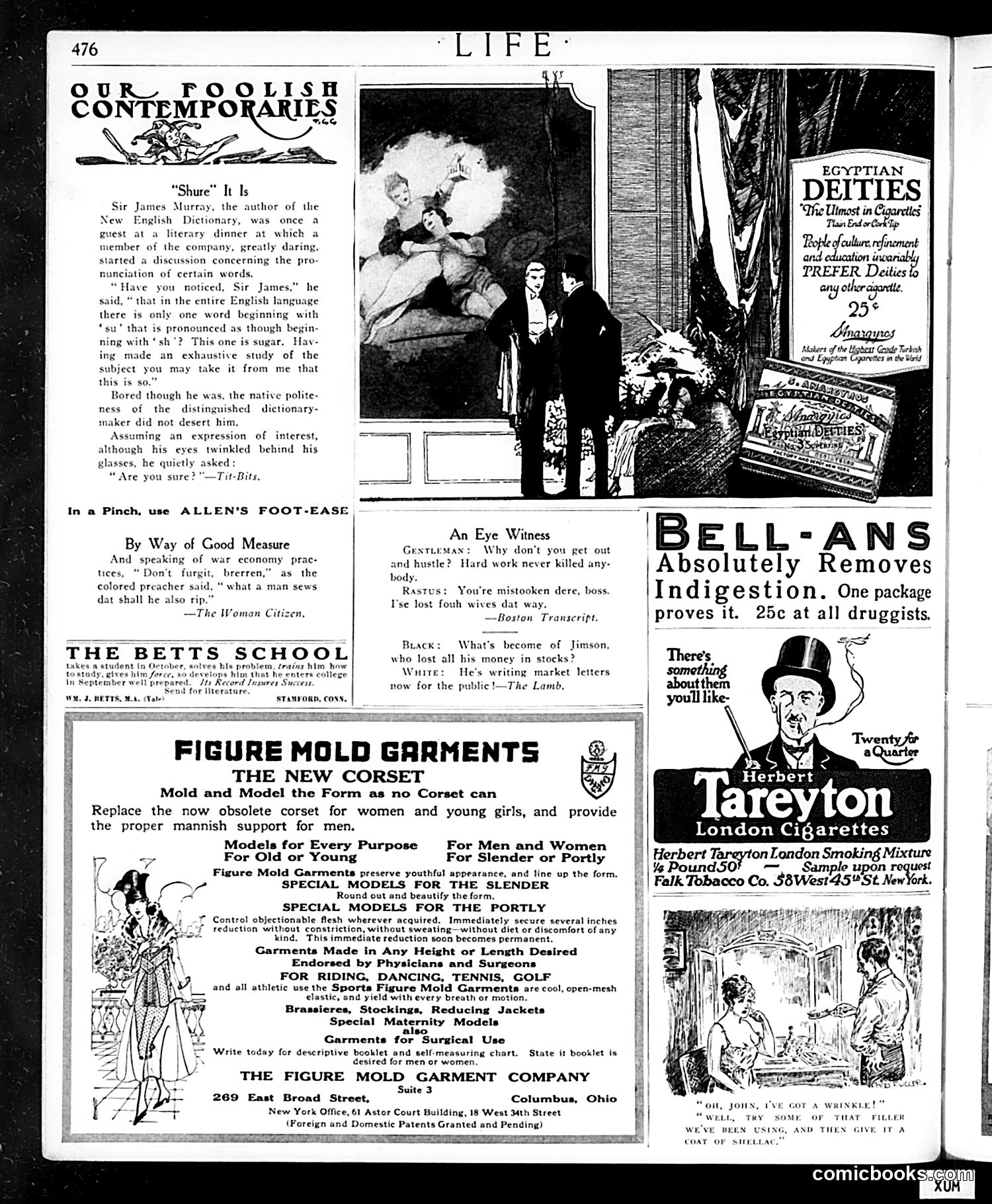
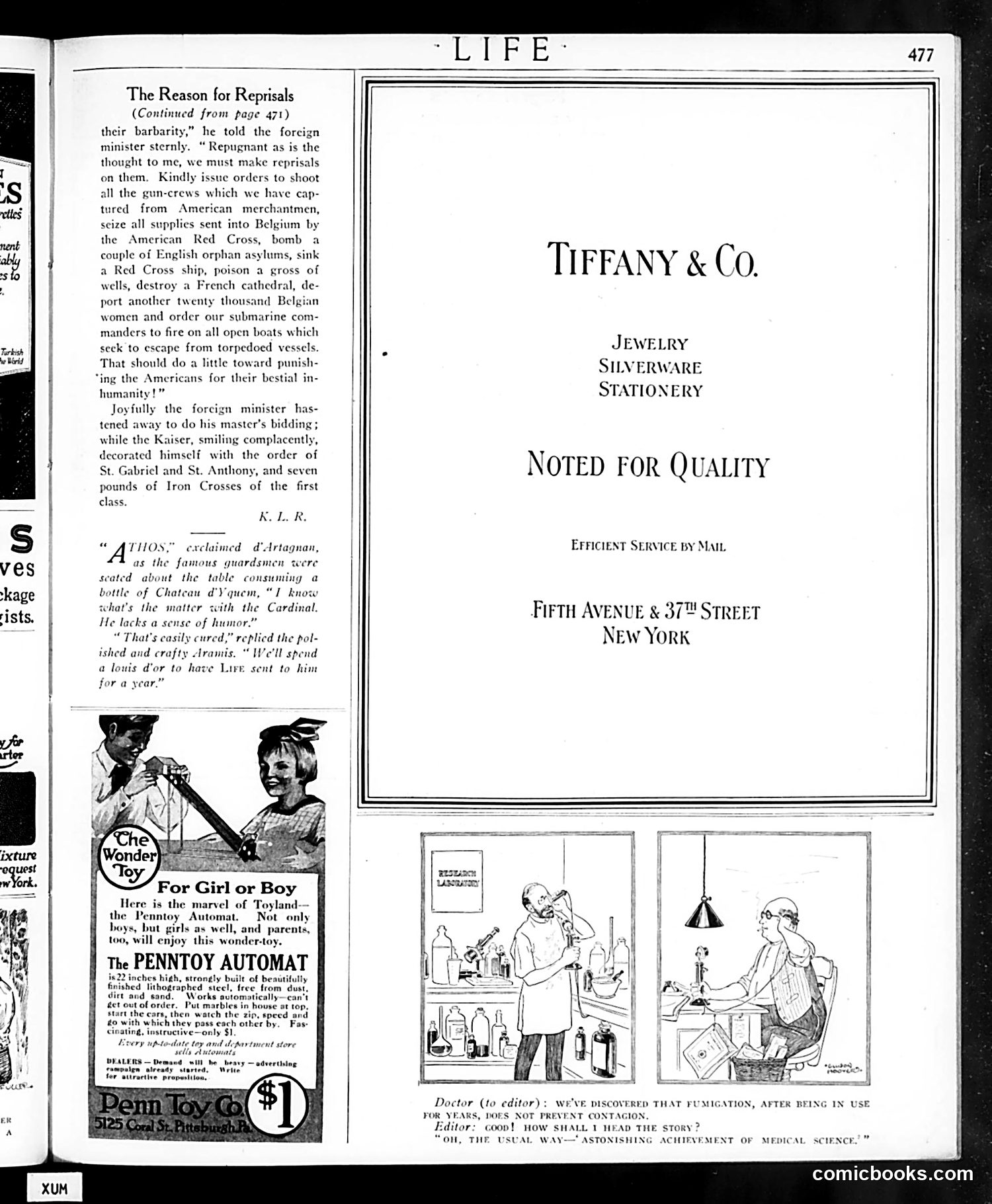
**Main Content: Political Satire** The left column contains a continuation of "The Reason for Reprisals," a biting satire on German militarism during World War I. A Kaiser figure justifies brutal retaliatory measures—executing American prisoners, bombing orphanages and cathedrals, deporting Belgian civilians, attacking rescue boats—as justified response to American actions. The satire exposes the absurdity and inhumanity of such "logic," mocking both the Kaiser's complacency and his decoration with medals afterward. **Bottom Cartoon: Medical Satire** A doctor tells an editor that fumigation doesn't prevent contagion after years of use. The editor responds he'll report it as an "astonishing achievement of medical science"—satirizing how news outlets sensationalize or misrepresent scientific findings for headlines, regardless of actual truth. **Right Side:** Tiffany & Co. advertisement (standard period content). The page reflects WWI-era American skepticism toward German militarism and contemporary frustration with media misrepresentation.
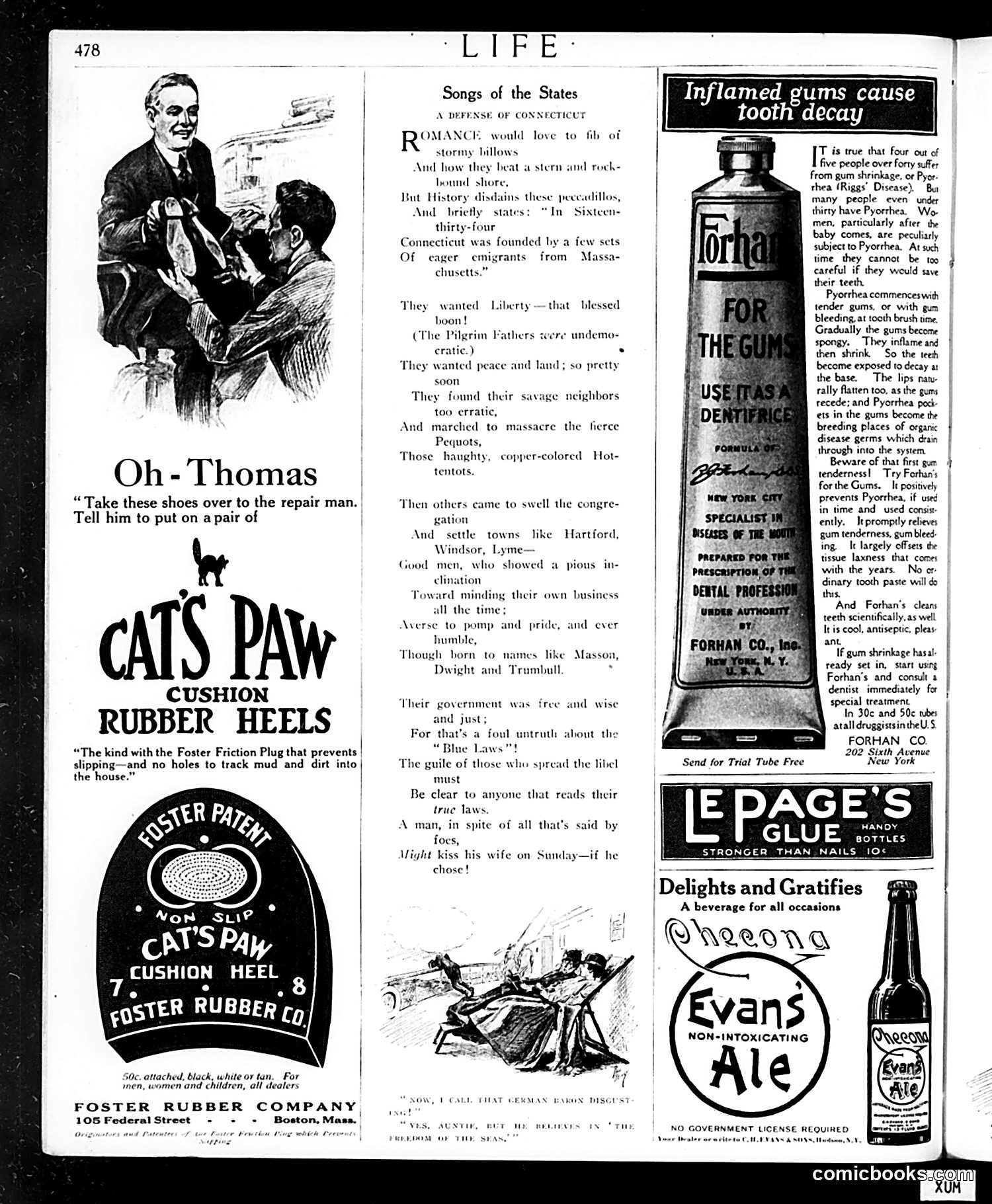
This page features a poem defending Connecticut's history against romanticized notions. The text humorously corrects misconceptions: Connecticut was founded by practical Massachusetts emigrants seeking liberty and peace, not by dramatic seafaring adventurers. The satire targets the "Blue Laws"—Connecticut's strict Puritan regulations—by ironically defending them. The poem's final couplet jokes that despite their reputation for severity, even these stern Puritans allowed a man to kiss his wife on Sunday if he chose, suggesting the laws were less restrictive than their fearsome reputation implied. The illustration labeled "Oh-Thomas" shows a man with shoes, likely referencing a specific contemporary figure or situation, though the connection isn't entirely clear from the visible text. The remainder of the page contains period advertisements (shoe cushions, dental products, ale) typical of *Life* magazine's satirical yet commercial format.
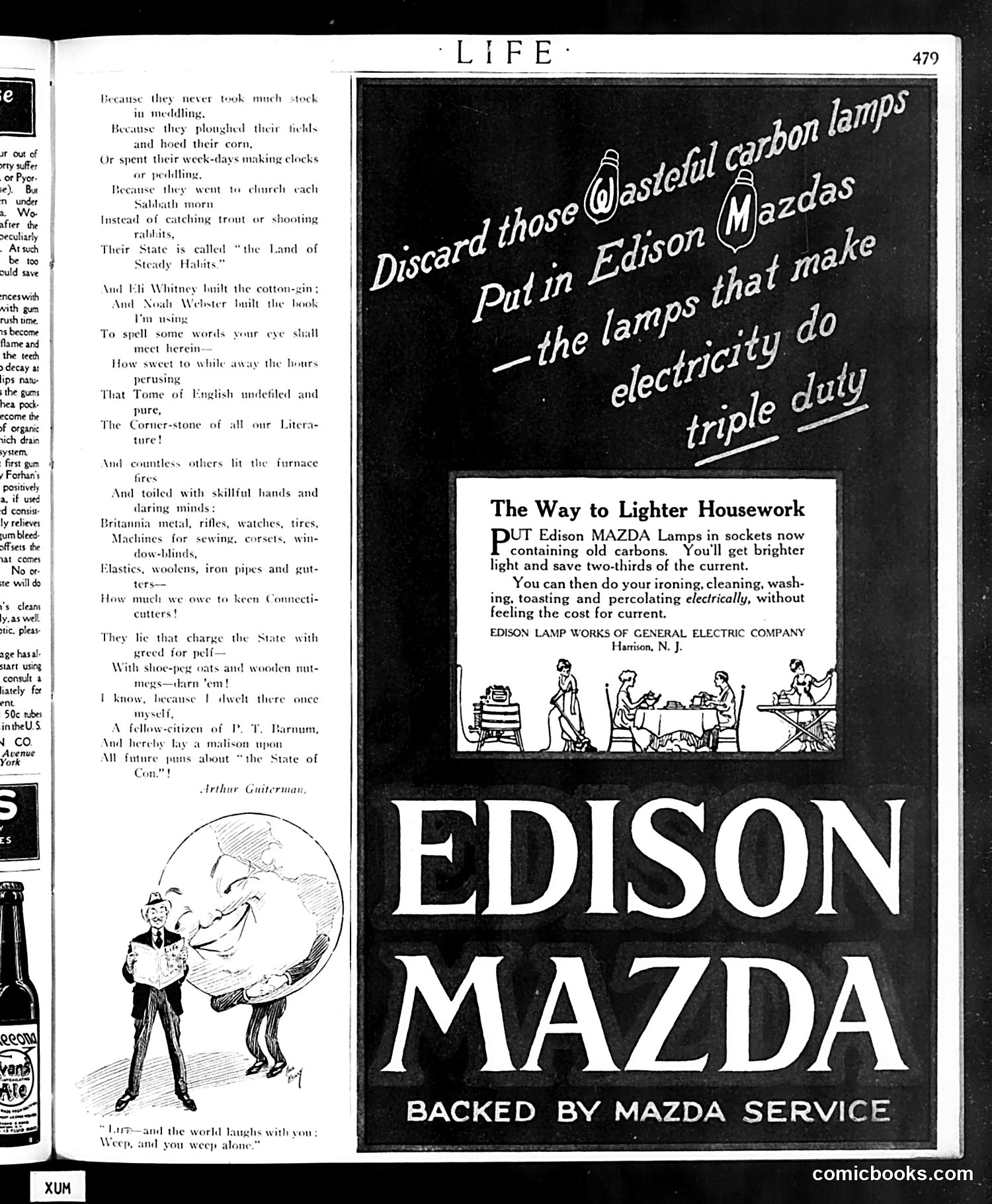
The page contains a satirical poem by Arthur Guiterman celebrating Connecticut's industrial heritage and virtuous character. It praises the state's founders and workers—referencing Eli Whitney (cotton gin), Noah Webster (dictionary), and P.T. Barnum—for their ingenuity and moral steadiness rather than frivolous pursuits. The poem defends Connecticut against charges of greed, specifically mocking historical scandals involving "shoe-peg oats and wooden nutmegs" (fraudulent exports that damaged the state's reputation). The accompanying cartoon below the poem (showing a caricatured figure) reinforces the satirical tone, though its specific subject is unclear from the visible portion. The Edison Mazda lamp advertisement positioned alongside promotes electrical efficiency for household tasks, exploiting the era's fascination with electrification as modernization—a ironic counterpoint to the poem's nostalgia for Connecticut's industrious past.
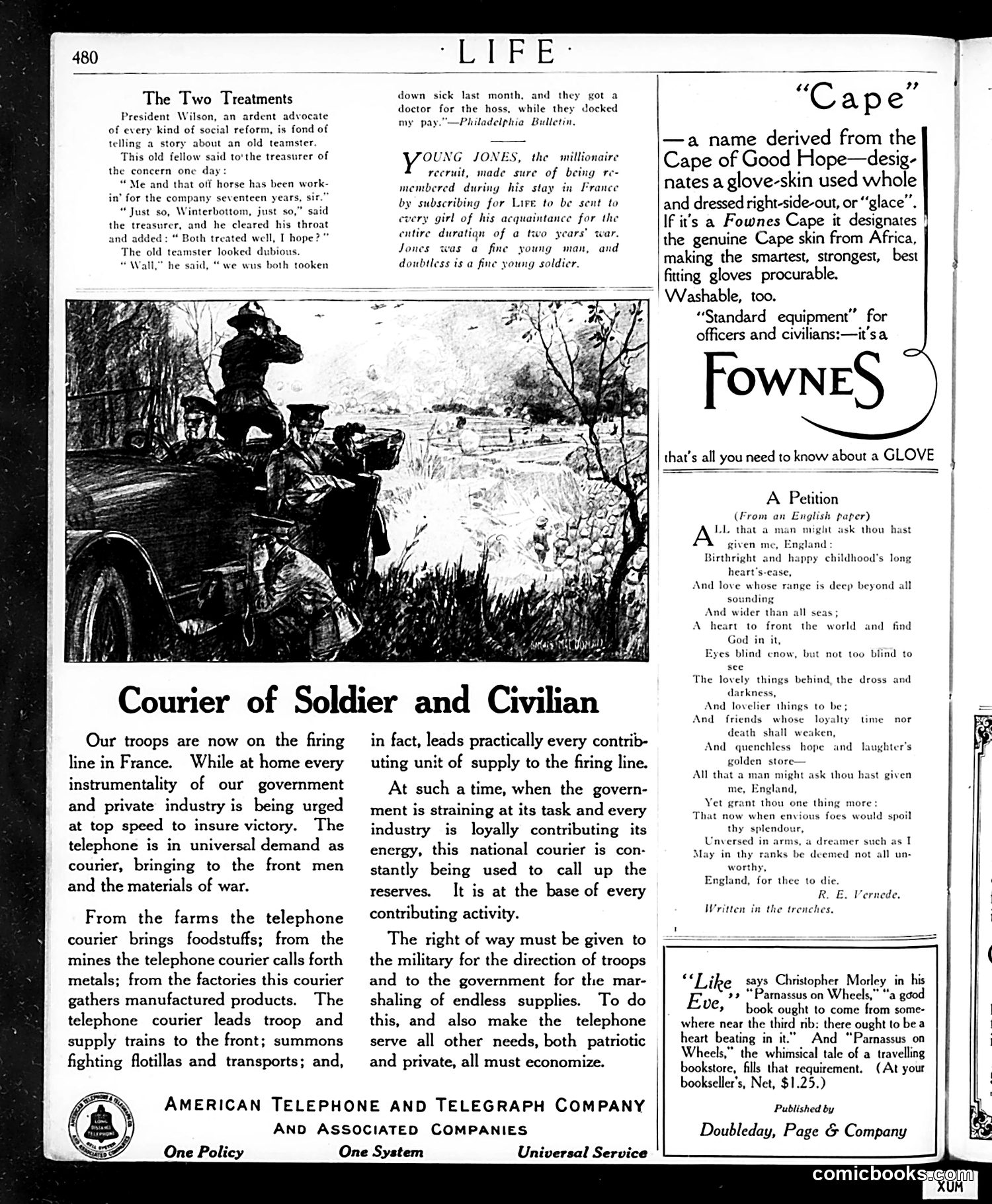
**"The Two Treatments"** (top left): A brief anecdote attributed to President Wilson about a teamster and his employer. The satire critiques unequal treatment of labor—the boss hired a doctor for the sick horse but docked the worker's pay when ill. It's a commentary on corporate hypocrisy regarding worker welfare, likely resonating during Wilson's era of Progressive reform rhetoric. **"Courier of Soldier and Civilian"** (center): A wartime advertisement for AT&T presenting the telephone as essential infrastructure for WWI victory. It appeals to patriotism while encouraging civilian phone economization to prioritize military communications. The accompanying illustration shows a mounted courier with supplies—connecting traditional military logistics to modern telephonic "couriers." **Right column**: Advertisements (Fownes gloves) and poetry ("A Petition" by R.E. Vernede, written in WWI trenches) expressing patriotic sacrifice. The page emphasizes wartime mobilization themes and sacrifice, typical of American magazine content during or immediately after WWI.
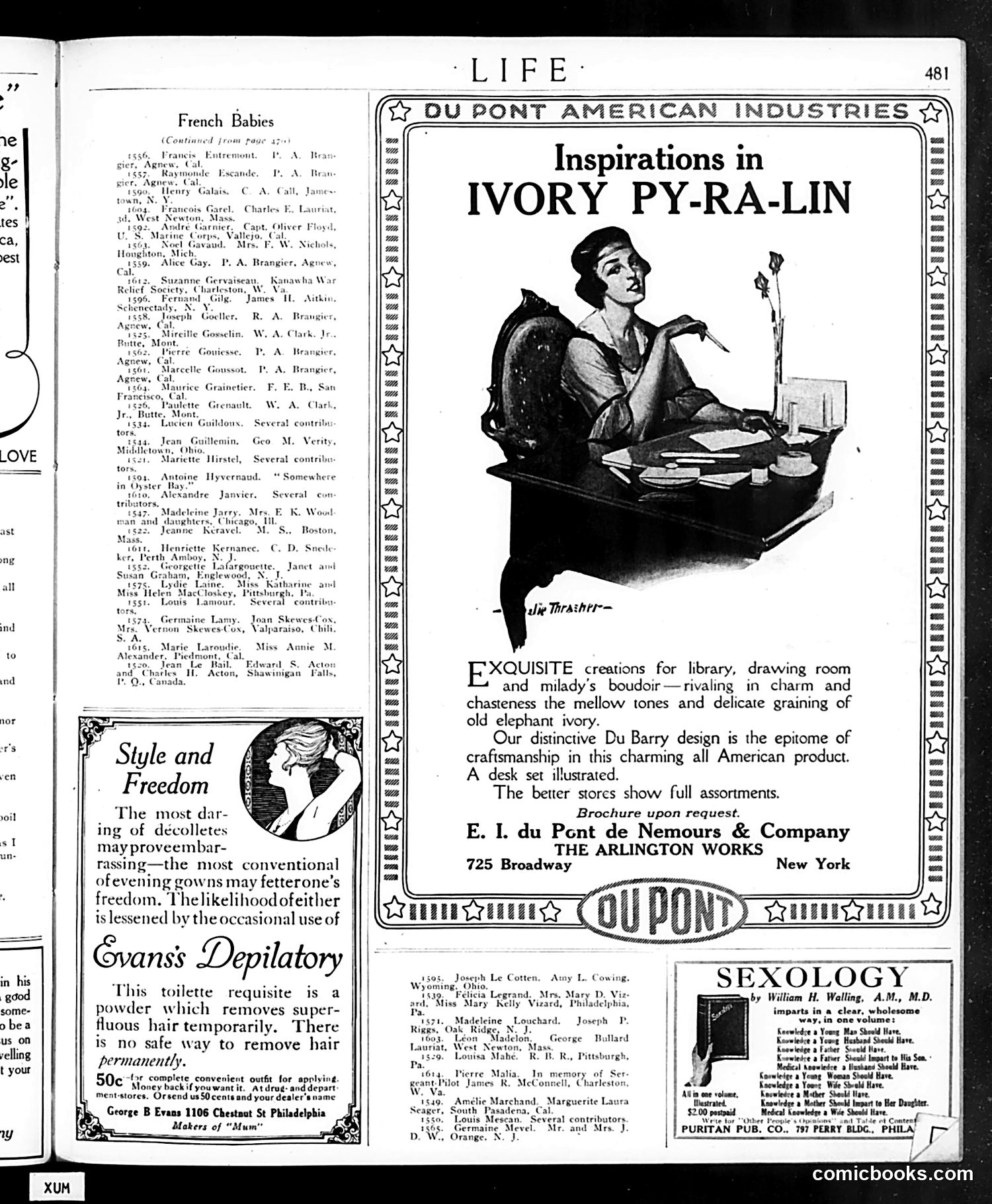
This page is primarily **advertising** rather than satire or political commentary. The main content features two advertisements: 1. **"Ivory Py-Ra-Lin" (Du Pont)**: An ad for desk accessories made from celluloid plastic designed to mimic elephant ivory. The illustration shows a woman at a desk, emphasizing luxury and refinement for "library, drawing room and milady's boudoir." This reflects early 20th-century consumer marketing of synthetic materials as affordable alternatives to expensive natural materials. 2. **Secondary ads** include Evans Depilatory powder and a "Sexology" instructional book—typical period advertisements addressing personal grooming and sex education. The left column lists contributors to a "French Babies" feature (continuing from a previous page), likely a charitable fundraising effort for French war orphans—a common Life magazine topic during/after World War I. This is a typical magazine page mixing editorial content with commercial advertisements, not political satire.
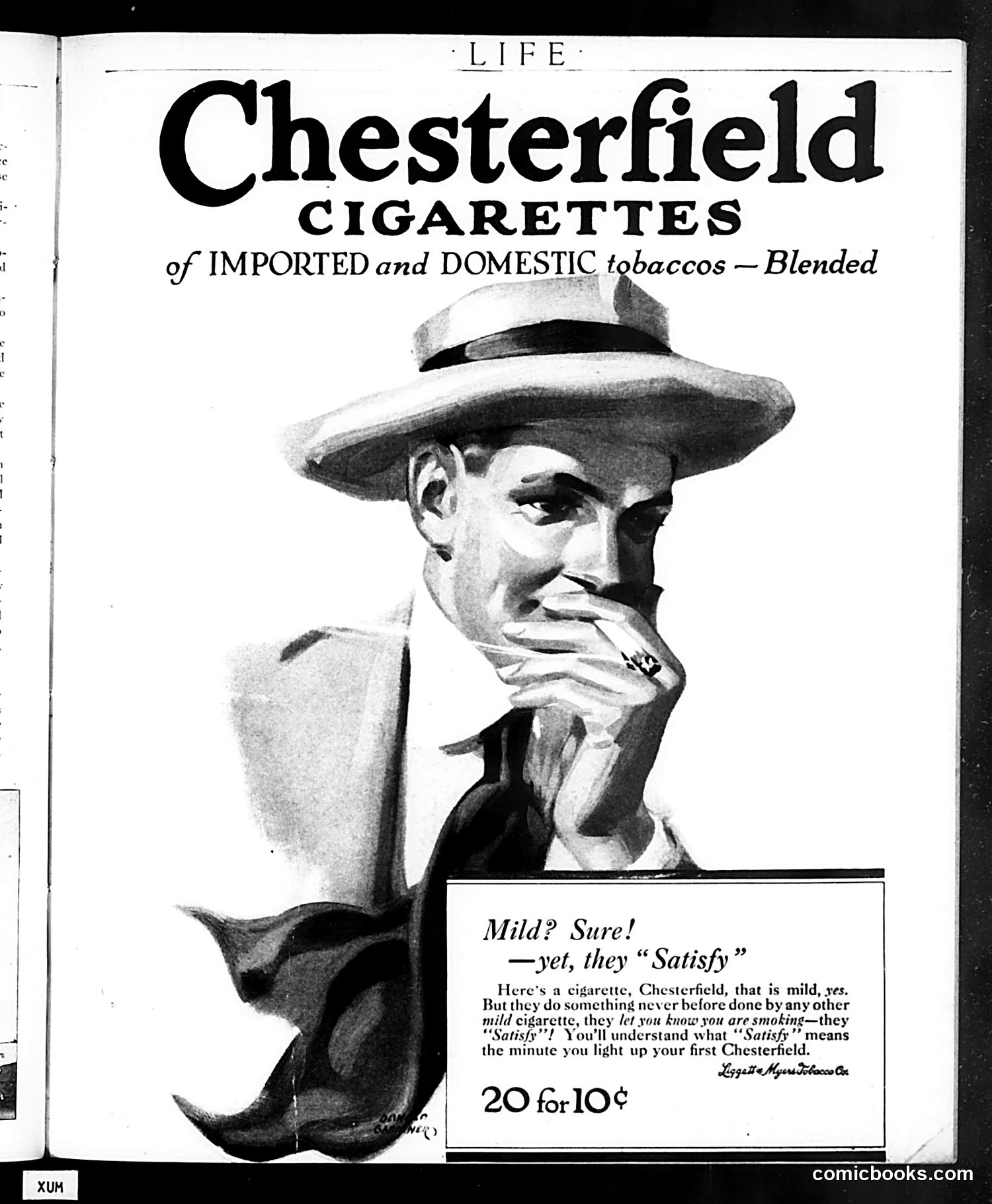
This is a **Chesterfield cigarette advertisement**, not political satire. The page features a stylized illustration of a sophisticated gentleman in a suit and wide-brimmed hat, smoking contentedly. The ad's appeal targets early-20th-century masculine identity and status anxiety. The key marketing angle is that Chesterfield cigarettes are "mild" yet still deliver a satisfying smoking experience—positioning them as refined and effective simultaneously. The phrase "let you know you are smoking" suggests other mild cigarettes lack presence or impact. The gentleman's appearance—well-dressed, composed, with a signet ring visible—communicates social aspiration and class. The price ("20 for 10¢") emphasizes affordability for middle-class consumers. This represents typical cigarette marketing of the era, before health warnings, emphasizing pleasure, sophistication, and the masculine experience of smoking.
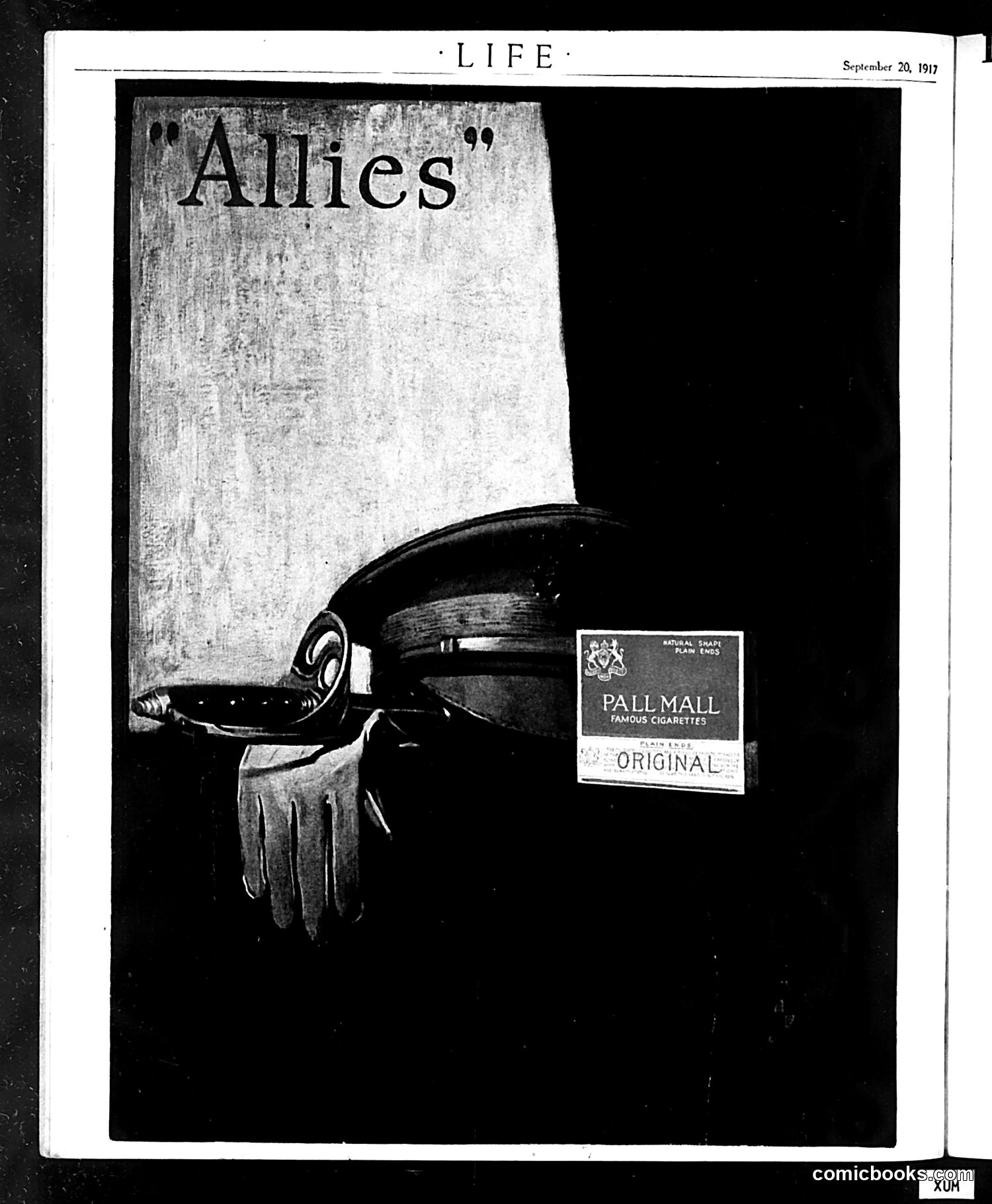
This is a wartime propaganda cover titled **"Allies"** featuring a military helmet (likely German, based on the spiked design) being stabbed or pierced by what appears to be a bayonet or sword held by a gloved hand. The image uses the helmet as a symbol of the enemy military. Published during America's involvement in World War I (1917-1918), the cover uses stark visual metaphor to encourage support for Allied forces against Germany. The piercing weapon represents Allied military strength and inevitable victory. Notably, this is also a **Pall Mall cigarette advertisement**, showing how wartime messaging was integrated into commercial media. The juxtaposition—selling cigarettes through patriotic warfare imagery—reflects early-20th-century advertising practices.