
Life, 1917-09-20 · page 10 of 40
Life — September 20, 1917 — page 10: what you’re looking at
What you’re looking at
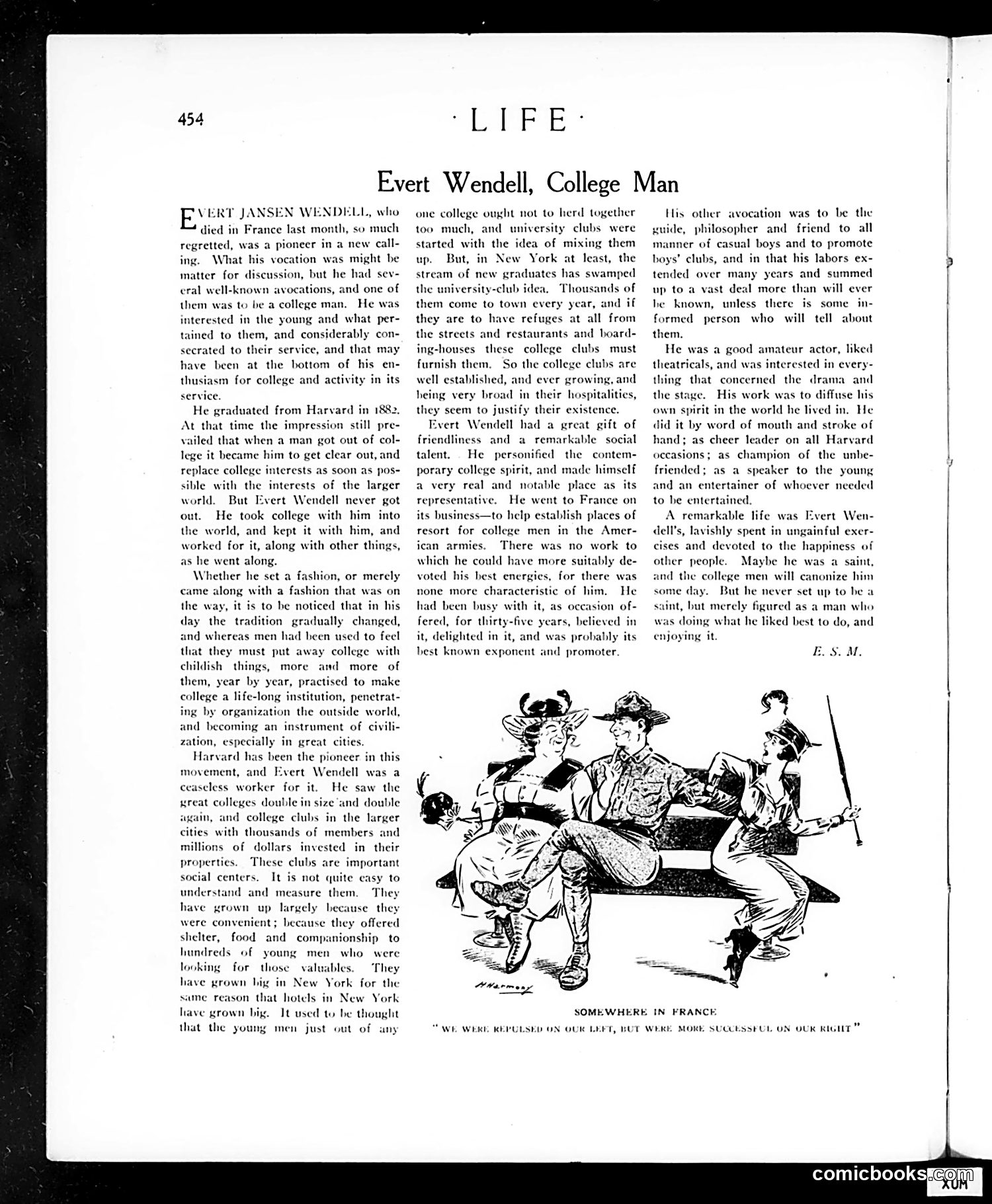
This page is an obituary/biography of Evert Jansen Wendell, a Harvard graduate (class 1882) who died in France. The text celebrates his lifelong dedication to college life and establishing social clubs for university students in major cities. The cartoon illustrates the caption "We were repulsed on our left, but were more successful on our right"—a humorous military reference showing college men in France engaged in what appears to be leisure activities (possibly dining or socializing) rather than serious combat. The joke satirizes the gap between military language and the actual comfortable social pursuits of college men abroad, suggesting they were more focused on enjoying themselves than actual wartime duties.
📄 Transcribed text from this page (OCR, searchable)
Machine-transcribed from the original scan — historical spelling and the odd misread are preserved.
* LAP E * Evert Wendell, College Man VERT JANS: WENDELL, who died in France last month, so much regretted, was a pioneer in a new call- ing. What his vocation was might be matter for discussion, but he had sev- eral well-known avocations, and one of them was to be a college man. He w: interested in the young and what per- tained to them, and considerably con- secrated to their service, and that may have been at the bottom of his en- thusiasm for college and activity in its service. He graduated from Harvard in 1882, At that time the impression still pre- led that when a man got out of col- lege it became him to get clear out, and replace college interests as soon as pos- sible with the interests of the larger world. But Evert Wendell never got out. He took college with him into the world, and kept it with him, and worked for it, along with other things, as he went along. Whether he set a fashion, or merely came along with a fashion that was on the way, it is to he noticed that in his day the tradition gradually changed, and whereas men had been used to feel that they must put away college with childish things, more and more of them, ir by year, practised to make college a life-long institution, penetrat- ing by organization the outside world, and becoming an instrument of civil zation, especially in great citi Harvard has been the pioneer in this movement, and Evert Wendell was a ceaseless worker for i He saw the great colleges double in size“and double again, and college clubs in the larger cities with thousands of members and millions of dollars invested in their properties. These clubs are important social centers. It is not quite easy to understand and measure them. They have grown up largely because they were convenient; because they offered shelter, food and companionship to hundreds of young men who were looking for those valuables. They have grown big in New York for the same reason that hotels in New York have grown big. It used tu be thought that the young men just out of any one college ought not to herd together too much, and university clubs were started with the idea of mixing them up. But, in New York at least, the stream of new graduates has swamped Thousands of the university-club id them come to town every year, and if they are to have refuges at all from the streets and restaurants and board- ing-houses these college clubs must furnish them, So the college clubs are well established, and ever growing, and heing very broad in their hospitalit they seem to justify their existence. Evert Wendell had a great gift of friendliness and a remarkable social talent. He personified the contem- porary college spirit, and made himself a very real and notable place as its representative. He went to France on its business—to help establish places of resort for college men in the Amer- ican armies. There was no work to which he could have more suitably de- voted his best energies, for there was s, none more characteristic of him. He had been busy with it, as occasion of- fered, for thirty-five years, believed in it, delighted in it, and was probably its best known exponent and promoter. His other avocation was to be the guide, philosopher and friend to all manner of casual boys and to promote boys’ clubs, and in that his labors ex- tended over many years and summed up to a vast deal more than will . he known, unless there is some in- formed person who will tell about them. He was a good amateur actor, liked theatricals, and was interested in every- thing that concerned the drama and the stage. His work was to diffuse his. own spirit in the world he lived in. He did it by word of mouth and stroke of hand; as cheer leader on all Harvard occasions; as champion of the unbe- friended; as a speaker to the young and an entertainer of whoever needed to be entertained, A remarkable life was Evert Wen- dell’s, lavishly spent in ungainful exer- cises and devoted to the happiness of other people. Maybe he was a saint, and the college men will canonize him some day. But he never set up to be saint, but merely figured as a man who was doing what he liked best to do, and enjoying it. SOMEWHERE IN FRANCE. “WE WEKE KEPULSED ON OUI LET, BUT WERE MORE SUCCESSFUL ON OUK RIGHT comicbooksgcony