
Life, 1917-09-20 · page 28 of 40
Life — September 20, 1917 — page 28: what you’re looking at
What you’re looking at
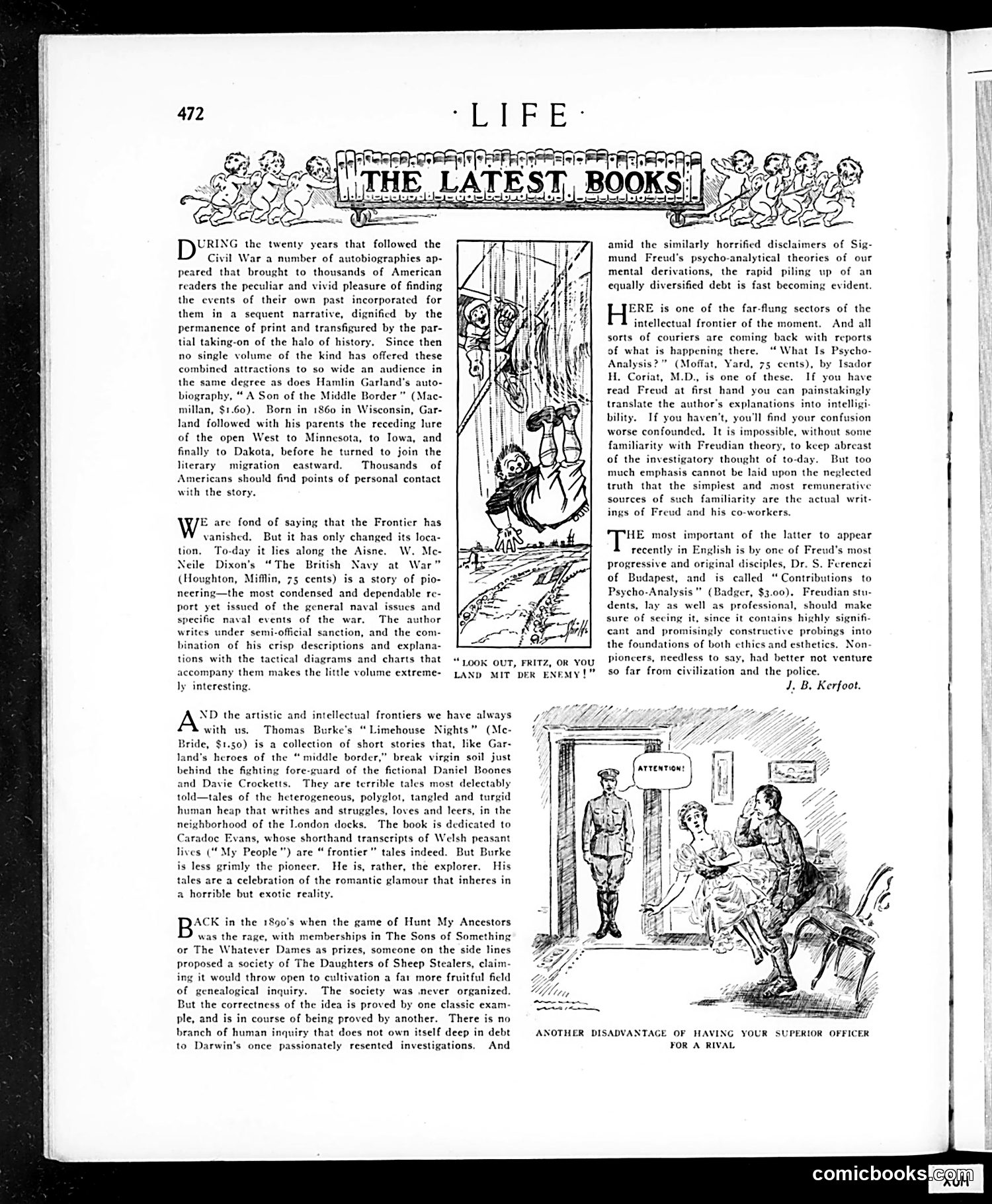
This book review page discusses recent publications following World War I. The upper cartoon depicts a German soldier ("Fritz") surrendering or being confronted, with the caption "LOOK OUT, FRITZ, OR YOU LAND MIT DER ENEMY!" — a humorous jab at German military defeat using faux-German English. The lower cartoon shows a military officer entering a room where a woman sits, captioned "ANOTHER DISADVANTAGE OF HAVING YOUR SUPERIOR OFFICER FOR A RIVAL" — satirizing the social awkwardness when romantic rivals have a hierarchical military relationship. The page reviews books including Hamlin Garland's autobiography and W. McNeile Dixon's account of naval warfare, celebrating American frontier spirit now redirected toward intellectual and literary pursuits. The writing emphasizes how even Freudian psychoanalysis represents a new "intellectual frontier," though the reviewer notes it remains difficult for lay readers to understand without prior knowledge.
📄 Transcribed text from this page (OCR, searchable)
Machine-transcribed from the original scan — historical spelling and the odd misread are preserved.
JRING the twenty years that followed the Civil War a number of autobiographies ap- peared that brought to thousands of American readers the peculiar and vivid pleasure of finding the events of their own past incorporated for them in a sequent narrative, dignified by the permanence of print and transfigured by the par- tial taking-on of the halo of history. Since then no single volume of the kind has offered these combined attractions to so wide an audience in the same degree as does Hamlin Garland’s auto- biography, “ A Son of the Middle Border" (Mac- millan, $1.60). Born in 1860 in Wisconsin, Gar- land followed with his parents the receding lure of the open West to Minnesota, to Iowa, and finally to Dakota, before he turned to join the literary migration eastward. Thousands of Americans should find points of personal contact with the story. E are fond of saying that the Frontier has vanished. But it has only changed its loca- tion, To-day it lies along the Aisne. W. Mc- Neile Dixon's “The British Navy at War” (Houghton, Mifflin, 75 cents) is a story of pio- neering—the most condensed and dependable re- port yet issued of the general naval issues and specific naval events of the war. The author writes under semi-official sanction, and the com- bination of his crisp descriptions and explana- tions with the ta rams and charts that accompany them makes the little volume extreme- ly interesting. LAND ND the artistic and intellectual frontiers we have always with us. Thomas Burke's “Limehouse Nights” (Me- Bride, $1.50) is a collection of short stories that, like Gar- land’s heroes of the “middle border,” break virgin soil just behind the fighting fore-guard of the fictional Daniel Boones and Davie Crocketts. They are terrible tales most delectably told—tales of the heterogeneous, polyglot, tangled and turgid human heap that writhes and struggles, loves and leers, in the borhood of the London docks. The book is dedicated to adoc Evans, whose shorthand transcripts of Welsh peasant lives ("My People”) are “ frontier” tales indeed. But Burke is less grimly the pioneer. He is, rather, the explorer. His tales are a celebration of the romantic glamour that inheres in a horrible but exotic reality. ACK in the 1890's when the game of Hunt My Ancestors was the rage, with memberships in The Sons of Something or The Whatever Dames as prizes, someone on the side lines proposed a society of The Daughters of Sheep Stealers, claim- ing it would throw open to cultivation a far more fruitful field of genealogical inquiry. The society was never organized. But the correctness of the idea is proved by one classic exam- ple, and is in course of being proved by another. There is no branch of human inquiry that does not own itself deep in debt to Darwin's once passionately resented investigations. And amid the similarly horrified disclaimers of Sig- mund Freud's psycho-analytical theories of our mental derivations, the rapid piling up of an equally diversified debt is fast becoming evident. ERE is one of the far-flung sectors of the intellectual frontier of the moment, And all sorts of couriers are coming back with reports of what is happening there. “What Is Psycho- Analysis?” (Moffat, Yard, 75 cents), by Isador H. Coriat, M.D., is one of these. If you have read Freud at first hand you can painstakingly translate the author's explanations into intellig bility. If you haven't, you'll find your confusion worse confounded. It is impossible, without some familiarity with Freudian theory, to keep abreast of the investigatory thought of to-day. But too much emphasis cannot be laid upon the neglected truth that the simpiest and most remunerative sources of such familiarity are the actual writ ings of Freud and his co-workers. HE most important of the latter to appear recently in English is by one of Freud's most progressive and original disciples, Dr. $. Ferencai of Budapest, and is called “Contributions to Psycho-Analysis" (Badger, $3.00), Freudian st dents, lay as well as professional, should make sure of secing it, since it contains highly signifi- cant and promisingly constructive probings into the foundations of both cthics and esthetics, Non- pioncers, needless to say, had better not venture so far from civilization and the police. J, B. Kerfoot. ANOTHER DISADVANTAGE OF HAVING YOUR SUPERIOR OFFICER FOR A RIVAL ~~: a a comicbooks Geri