
Life, 1917-09-20 · page 15 of 40
Life — September 20, 1917 — page 15: what you’re looking at
What you’re looking at
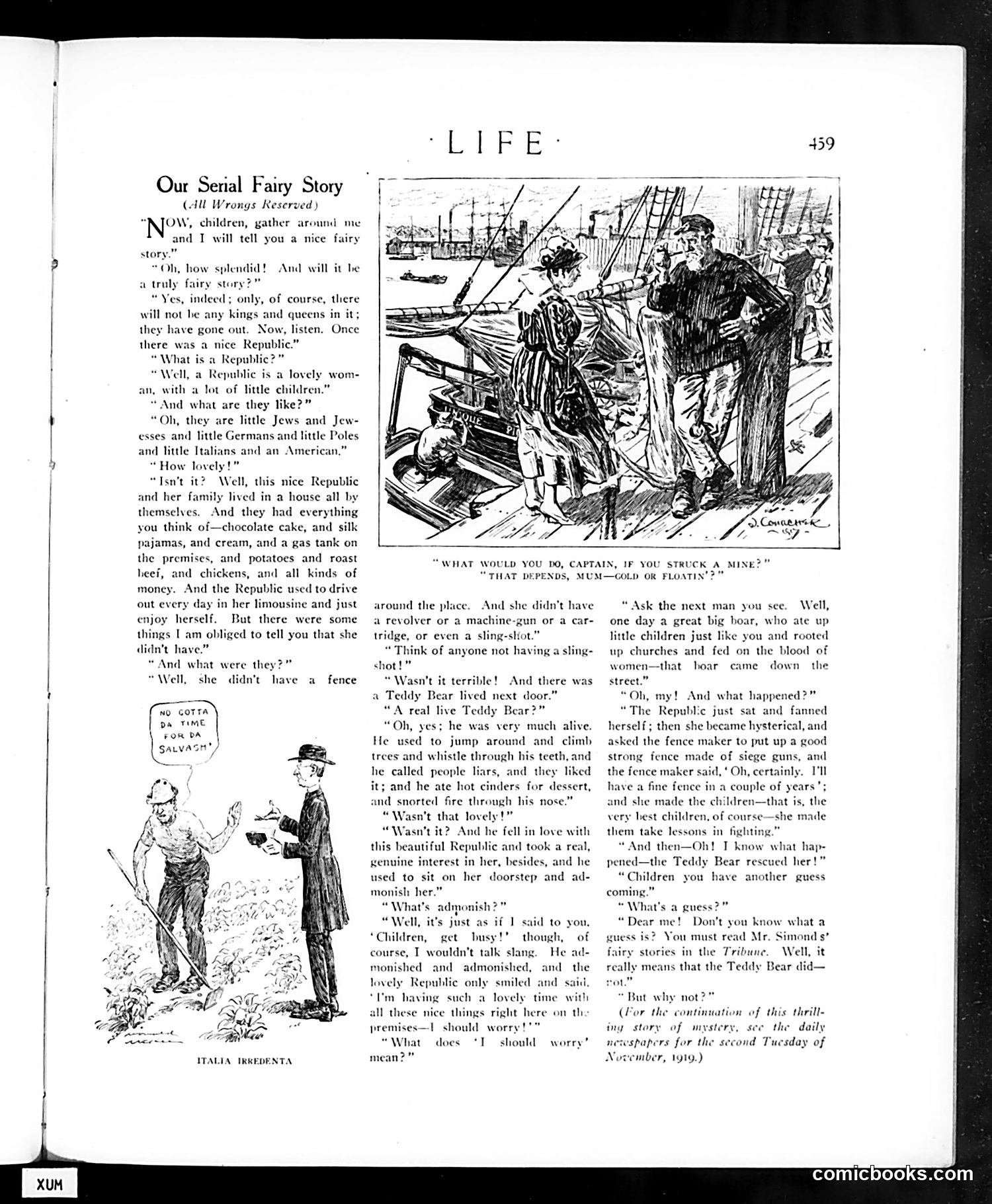
This satirical piece mocks utopian ideals through a fairy tale about a "nice Republic" — a community where diverse immigrants (Jews, Germans, Poles, Italians, Americans) live together in perfect harmony with abundant food and no crime. The joke's target appears to be naive progressivism or socialist utopianism popular in early 20th-century America. The story deliberately undercuts itself: characters keep noting the absence of typical problems (no fence, no weapons, no sling-shot), which—combined with the disclaimer "All Wrongs Reserved"—suggests the author sees such perfect societies as impossible fantasies. The accompanying illustrations show working-class figures and street scenes, grounding the satire in real urban immigrant life rather than idealistic fiction.
📄 Transcribed text from this page (OCR, searchable)
Machine-transcribed from the original scan — historical spelling and the odd misread are preserved.
Our Serial Fairy Story (All Wrongs Reserved) “KJOW, children, gather around and T will tell you a nice a truly fairy story?” “Yes, indeed ; only, of course, there will not he any kings and queens in it; they have gone out. Now, listen. Once there was a nice Republic.” “What is a Republic?” “Well, a Republic is a lovely wom- an, with a lot of little children.” “And what are they like?” “Oh, they are little Jews and Jew- esses and little Germans and little Poles. and little Italians and an American,” “How lovely “Isn't it? Well, this nice Republic and her family lived in a house all by themselves. And they had everything you think of—chocolate cake, and silk pajamas, and cream, and a gas tank on the premises, and potatoes and roast heef, and chickens, and all kinds of money. And the Republic used to drive out every day in her limousine and just enjoy herself. But there were some things I am obliged to tell you that she didn’t have.” “And what were they “Well, she didn't hav a fence NO GOTTA pa Time, For DA | Savasn’/ ITALIA IRREDENTA “THAT DEPENDS, MU And she didn’t have un or a car- around the place. a revolver or a machin tridge, or even a sling-sliot.” “Think of anyone not having a sling- shot!” “Wasn't it terrible! And there was a Teddy Bear lived next door. “A real live Teddy Bear? “Oh, yes; he was very much alive. He used to jump around and climb trees and whistle through his teeth, and he called people liars, and they liked it; and he ate hot cinders for dessert, and snorted fire through his nose.” “Wasn't that lovely!” “Wasn't it? And he fell in love with this beautiful Republic and took a real, genuine interest in her, besides, and he used to sit on her doorstep and ad- monish her.” “What's admonish?” “Well, it’s just as if 1 said to you. “Children, get busy!’ though, of course, T wouldn't talk slang. He ad- monished and admonished, and the lovely Republic only smiled and said, “I'm having such a lovely time with all these nice things right here on the premises—I should worry!" “What should mean?" does *T worry? —GCOLD OR FLOATIN’? “Ask the next man you see. Well, a great big boar, who ate up little children just like you and rooted up churches and fed on the blood of hoar came down the women—that street “Oh, my! And what happened?” “The Republic just and fanned herself; then she became hysterical, and asked the fence maker to put up a good strong fence made of siege guns, and the fence maker said, ‘Oh, certainly. I'll have a fine fence in a couple of years’; and she made the children—that is, the very hest children, of she made them take lessons inf “And then—Oh! T know what hap pened—the Teddy Bear rescued her “Children you have another guess coming. “What's a guess?" “D me! Don’t you know what a guess is? You must read Mr, Simond s’ fairy stories in the Tribune. Well, it really means that the Teddy Bear did— But why not?” (For the continuation of this thrill- ing story of mystery, see the daily ‘spapers for the second Tuesday of mber, 1919.) comicbooks.com