
Life, 1917-09-20 · page 3 of 40
Life — September 20, 1917 — page 3: what you’re looking at
What you’re looking at
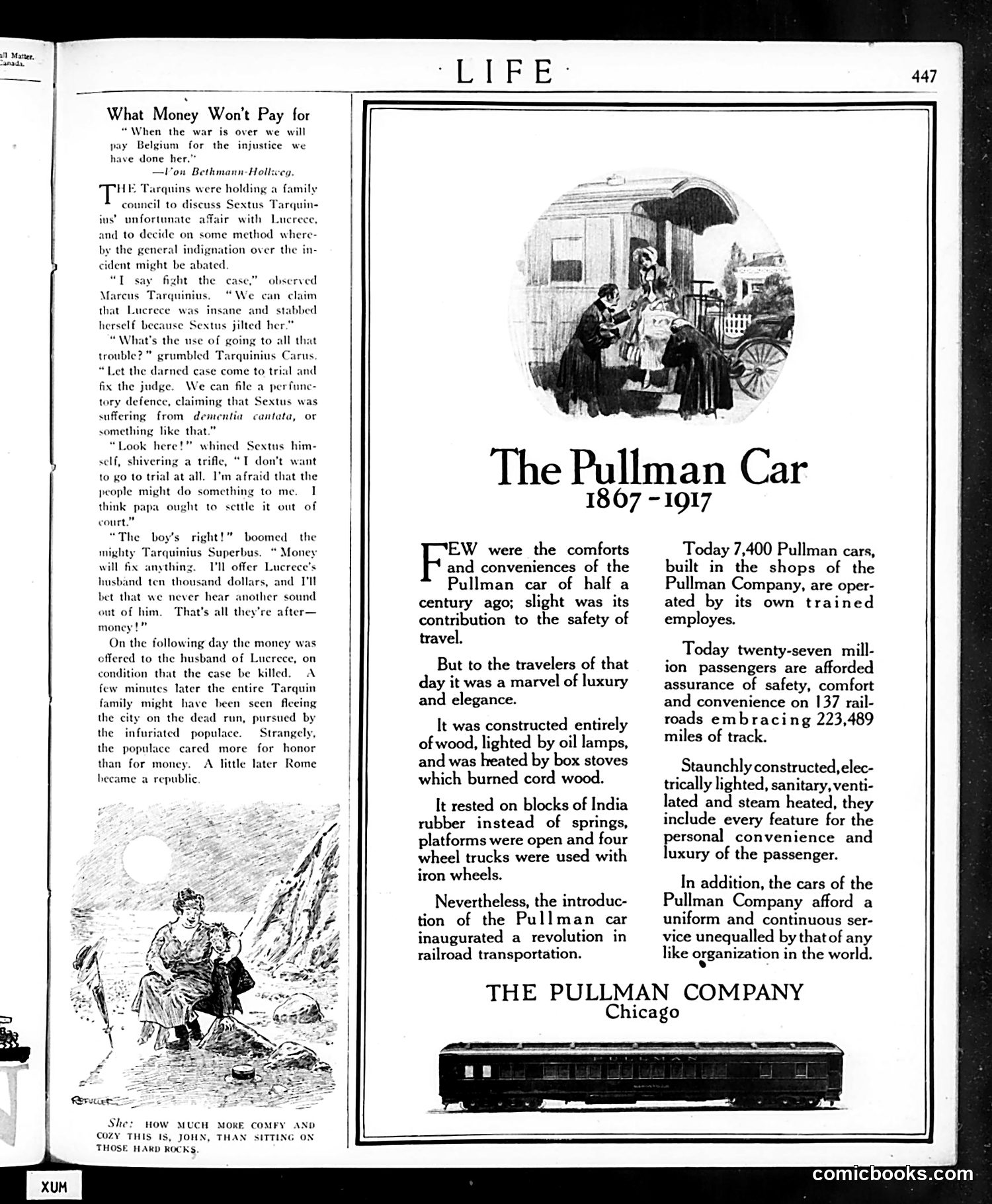
This page contains two distinct elements: **Left side:** A satirical story titled "What Money Won't Pay for" discussing a legal case involving characters named Sextus Tarquinius and Lucreece. The narrative concerns an "incident" and debates whether money can resolve it through legal settlement. A small illustration shows a woman seated on rocks. The story appears to reference classical Roman history, likely alluding to the legendary rape of Lucretia, using it as social commentary about justice and compensation. **Right side:** A Pullman Company advertisement for luxury railroad cars (1867-1917), highlighting their comfort, safety features, and widespread use across American rail networks. The juxtaposition suggests *Life* magazine's typical format: satirical commentary paired with contemporary advertising, though the thematic connection between legal justice and commercial luxury remains unclear.
📄 Transcribed text from this page (OCR, searchable)
Machine-transcribed from the original scan — historical spelling and the odd misread are preserved.
What Money Won't Pay for “When the war is over we will pay Belgium for the injustice we have done her.” —lon Bethmann-Hollweg. HE council to discuss Sextus Tarquin ins’ unfortunate afair with Lucre Parquins were holding a family and to decide on some method whe; by the general indignation over the in- cident might be abated. “Tsay fight’ the case,” observed Mareus that Lue: herself because Sextus jilted her.” “What's the use of going to all that trouble?” grumbled Tarquinius Carus “Let the darned case come to trial and fix the judge. We can file a perfune- tory defence, claiming that Sextus was suffering from dementia cantata, or quinius, “We can claim ¢ was insane and stabbed something like that “Look here!” whined Sextus him- self, shivering a trifle, “T don't want to go to trial at all. I'm afraid that the people might do something to me. 1 think papa ought to settle it out of court.” “The boy’s right!” boomed the mighty Tarquinius Superbus. “ Money will fix anything. I'll offer Lucrece’s husband ten thousand dollars, and I'll bet that we never hear another sound out of him. That's all they're after— money!” On the following day the mone offered to the husband of Lucre condition that the case be killed. A few minutes later the entire Tarquin family might have been seen fleeing the city on the dead run, pursued by the infuriated populace. Strangely, the populace cared more for honor than for money, A little later Rome became a republic. She: How MUCH MORE CoMFY AND COZY THIS IS, JOHN, THAN SITTING ON THOSE HARD ROCKS. The Pullman Car 1807 -1917 EW were the comforts and conveniences of the Pullman car of half a century ago; slight was its contribution to the safety of travel. But to the travelers of that day it was a marvel of luxury and elegance. It was constructed entirely of wood, lighted by oil lamps, and was heated by box stoves which burned cord wood. It rested on blocks of India rubber instead of springs, platforms were open and four wheel trucks were used with iron wheels. Nevertheless, the introduc- tion of the Pullman car inaugurated a revolution in railroad transportation. THE PULLMAN COMPANY Chicago Today 7,400 Pullman cars, built in the shops of the Pullman Company, are oper- ated by its own trained employes. Today twenty-seven mill- ion passengers are afforded assurance of safety, comfort and convenience on 137 rail- roads embracing 223,489 miles of track. Staunchly constructed, elec- trically lighted, sanitary, venti- lated and steam heated, they include every feature for the personal convenience and luxury of the passenger. In addition, the cars of the Pullman Company afford a uniform and continuous ser- vice unequalled by that of any like organization in the world. comicbooks.com