
Life, 1917-09-20 · page 36 of 40
Life — September 20, 1917 — page 36: what you’re looking at
What you’re looking at
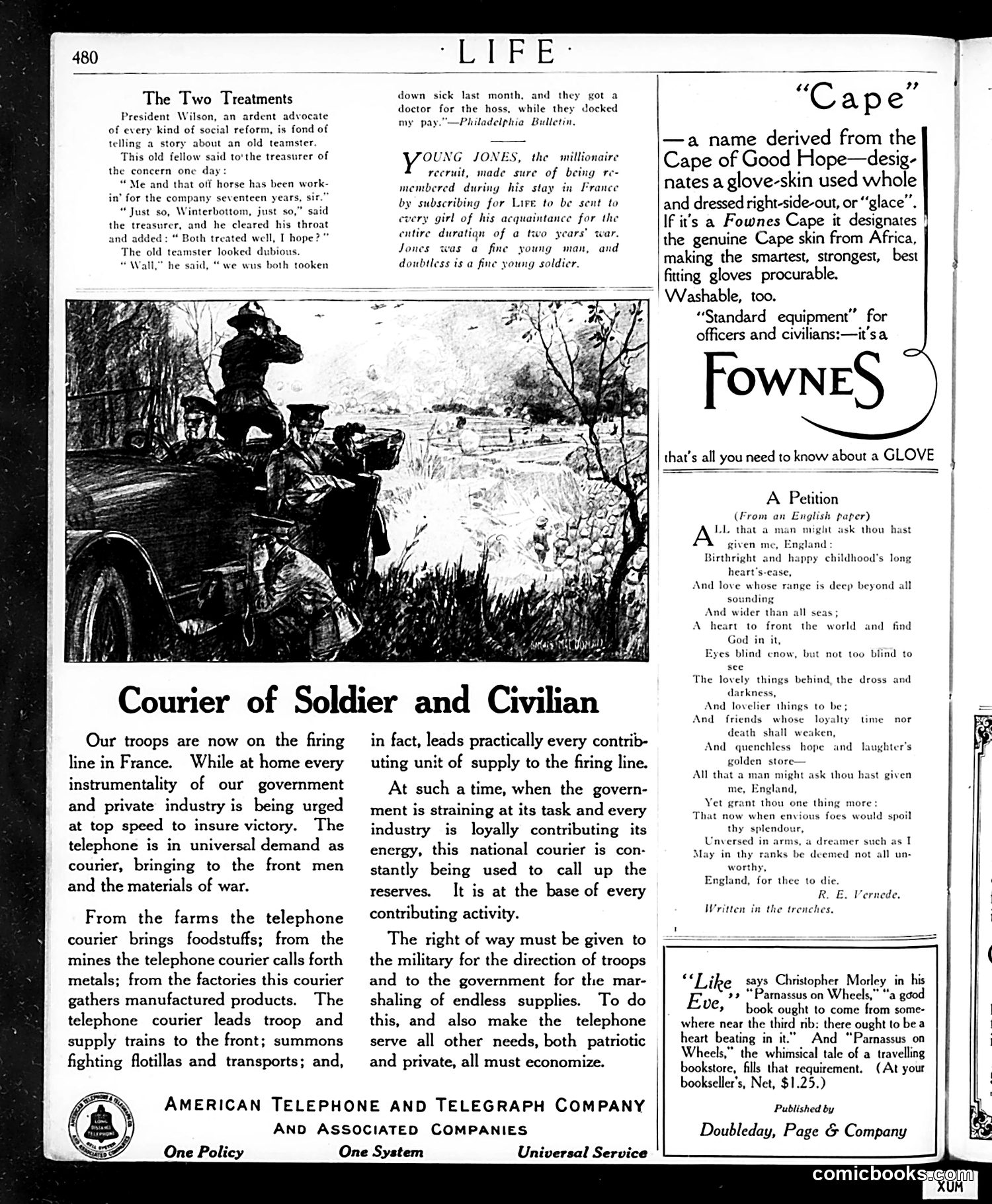
**"The Two Treatments"** (top left): A brief anecdote attributed to President Wilson about a teamster and his employer. The satire critiques unequal treatment of labor—the boss hired a doctor for the sick horse but docked the worker's pay when ill. It's a commentary on corporate hypocrisy regarding worker welfare, likely resonating during Wilson's era of Progressive reform rhetoric. **"Courier of Soldier and Civilian"** (center): A wartime advertisement for AT&T presenting the telephone as essential infrastructure for WWI victory. It appeals to patriotism while encouraging civilian phone economization to prioritize military communications. The accompanying illustration shows a mounted courier with supplies—connecting traditional military logistics to modern telephonic "couriers." **Right column**: Advertisements (Fownes gloves) and poetry ("A Petition" by R.E. Vernede, written in WWI trenches) expressing patriotic sacrifice. The page emphasizes wartime mobilization themes and sacrifice, typical of American magazine content during or immediately after WWI.
📄 Transcribed text from this page (OCR, searchable)
Machine-transcribed from the original scan — historical spelling and the odd misread are preserved.
The Two Treatments President Wilson, an ardent advocate of every kind of social reform, is fond of telling a story about an old teamster. This old fellow said to'the treasurer of the concern one day: “ Me and that off horse has been work- in’ for the company seventeen yea “Just so, Winterbottom, just so, the treasurer, and he cleared his throat and added: “ Both treated well, I hope?” The old teamster looked dubious. “Wall,” he said, “we wus both tooken _ LIFE: down sick last month, and they got a doctor for the hoss, while they docked my pay."—Philadelphia Bulletin, OUNG JONES, the millionaire recruit, made sure of being re- membered during his stay in France by subscribing for Lire to be sent to girl of his acquaintance for the entire duratiqn of a two years’ war. Jones was a fine young man, and doubtless isa fine young soldier. Courier of Soldier and Civilian Our troops are now on the firing line in France. While at home every instrumentality of our government and private industry is being urged at top speed to insure victory. The telephone is in universal demand as courier, bringing to the front men and the materials of war. From the farms the telephone courier brings foodstuffs; from the mines the telephone courier calls forth metals; from the factories this courier gathers manufactured products. The telephone courier leads troop and supply trains to the front; summons fighting flotillas and transports; and, One Policy in fact, leads practically every contrib- uting unit of supply to the firing line. At such a time, when the govern- ment is straining at its task and every industry is loyally contributing its energy, this national courier is con- stantly being used to call up the reserves. It is at the base of every contributing activity. The right of way must be given to the military for the direction of troops and to the government for the mar- shaling of endless supplies. To do this, and also make the telephone serve all other needs, both patriotic and private, all must economize. AMERICAN TELEPHONE AND TELEGRAPH COMPANY AND ASSOCIATED COMPANIES One System Universal Service “GC a p e” —a name derived from the Cape of Good Hope—desig- nates a glove-skin used whole and dressed right-side-out, or “glace”. If it's a Fownes Cape it designates ' the genuine Cape skin from Africa, | making the smartest, strongest, best fiting gloves procurable. Washable, too. “Standard equipment” for officers and civilians:—it’sa that’s all you need to know about a GLOVE A Petition (From an English paper) A that a man might ask thou hast given me, Birthright and happy childhood’s long sounding And wider than all seas; A heart to front the world and find God in it, Eyes blind cnow, but not too blind to see The lovely things behind, the dross and darkness, And lovelier things to be; And friends whose loyalty time nor death shall weaken, And quenchless hope and laughter’s golden store— All that a man might ask thou hast given ingland, Yet grant thou one thing more: That now when envious foes would spoil thy splendour, Unversed in a dreamer such as I May in thy ranks be deemed not all un- worthy, England, for thee to dic. R. E. Vernede. Written in the trenches, “Libe says Christopher Morley in his Ee fe Er Ma oa VEC, book ought to come from some- where near the third rib: there ought to bea heart beating in it.” And “Parnassus on Wheels,” the whimsical tale of a travelling bookstore, fills that requirement. (At your booksellers, Net, $1.25.) Published by Doubleday, Page & Company comicbooksseqmy