
Life, 1917-09-20 · page 23 of 40
Life — September 20, 1917 — page 23: what you’re looking at
What you’re looking at
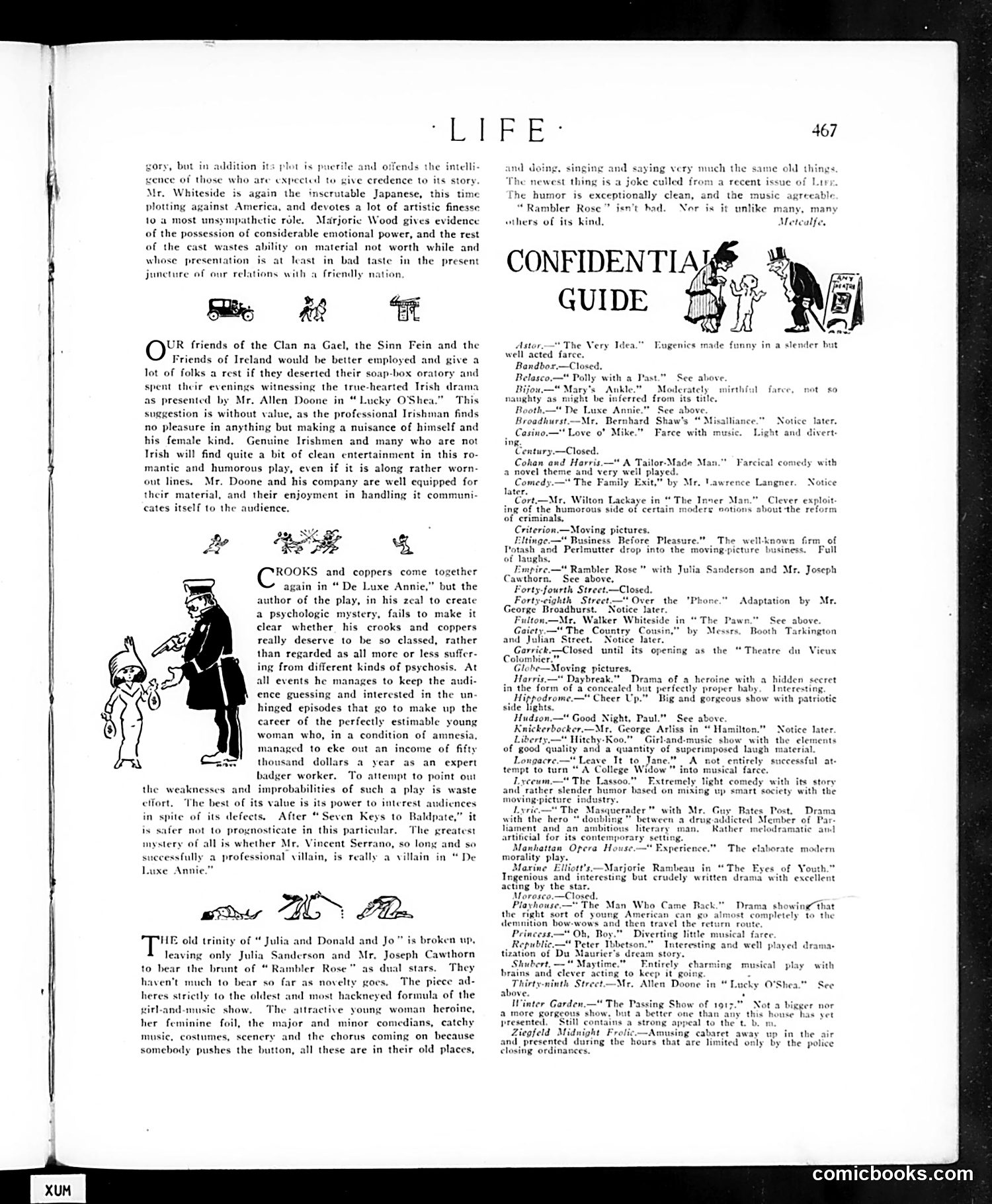
This page contains theatrical reviews rather than political cartoons. The critic discusses several Broadway productions from what appears to be the early 1910s. **Key Content:** The reviews critique plays including "Lucky O'Shea" (an Irish drama), "De Luxe Annie" (featuring crooks and police with psychological themes), and "Rambler Rose" (a girl-and-music show). **Satirical Points:** The critic mocks Irish-American activist groups ("Clan na Gael, the Sinn Fein") for their "soap-box oratory," suggesting they should instead enjoy wholesome Irish theatrical entertainment. There's also subtle critique of formulaic musical theater—the "girl-and-music show" that relies on predictable plot elements, attractive heroines, comedians, and chorus girls rather than originality. **Small decorative cartoons** appear throughout (showing figures in theatrical poses) but serve merely as design elements rather than conveying specific satirical messages. The page reflects early 20th-century American theater criticism and contemporary attitudes toward Irish-Americans and theatrical conventions.
📄 Transcribed text from this page (OCR, searchable)
Machine-transcribed from the original scan — historical spelling and the odd misread are preserved.
} 0 eee ol 467 ory, but in addition its plot is puerite and oifends the intelli xence of those who are expected to give credence to its story. Mr. Whiteside is again the inscrutable Japanese, this time plotting against America, and devotes a lot of artistic finesse io a most unsympathetic role. Marjorie Wood gives evidence of the possession of considerable emotional power, and the rest of the cast wastes ability on material not worth while and c presentation is at least in bad taste in the present whe ndly nation, rorelations with a fri UR friends of the Clan na Gael, the Sinn Fein and the Friends of Ireland would be better employed and give a lot of folks a rest if they deserted their soap-box oratory and spent their evenings witnessing the true-hearted Trish drama as presented by Mr. Allen Doone in “ Lucky O'Shea.” This suggestion is without value, as the professional Irishman finds no pleasure in anything but making a nuisance of himself and his female kind. Genuine Irishmen and many who are not Trish will find quite a bit of clean entertainment in this ro- mantic and humorous play, even if it is along rather worn- out lines. Mr. Doone and his company are well equipped for their material, and their enjoyment in handling it communi- cates itself the audience. a + 2 ROOKS and coppers come together again in “ De Luxe Annie,” but the author of the play, in his zeal to create a psychologic mystery, fails to make it clear whether his crooks and coppers really deserve to be so classed, rather than regarded as all more or less suffer- ing from different kinds of psychosis. At all events he manages to keep the audi- ence guessing and interested in the un- hinged episodes that go to make up the carcer of the perfectly estimable young woman who, in a condition of amnesia, managed to eke out an income of fifty thousand dollars a year as an expert badger worker. To attempt to point out the weaknesses an ities of such a play is waste ctfort. ‘The best of its value is its power to interest audiences in spite of its defects. After “Seven Keys to Baldpate,” it is safer not to prognosticate in this particular. The xr mystery of all is whether Mr. Vincent Serrano, so long and so successfully a professional villain, is really a villain in “ De Luxe Annie.” HE old trinity of “ Julia and Donald and Jo” is broken up, leaving only Julia Sanderson and Mr, Joseph Cawthorn to bear the brunt of “ Rambler Rose” as dual stars, They haven't much to bear so far as novelty goes. The piece ad- heres strictly to the oldest and most hackneyed formula of the irl-and-music show, The attractive young woman heroine, her feminine foil, the major and minor comedians, catchy music, costumes, scenery and the chorus coming on because somebody pushes the button, all these are in their old places, juncture of improbal test und doing, singin saying very much the same old things The newest thing is a joke culled from a recent issue of Lis The humor is exceptionally clean, and the music Rambler Rose” isn’t had. Nor is it unlike m: others of its kind. Metcalfe. Wis greea ny, many GUIDE Astor" Th well acted fare Bandbor.—Closed, Belasco.—" Polly with a Vast." See above ij lerately mirthfal farce, 1 nanghty as its title, Booth.—" De Luxe Annie." See above Broadhurst-—Mr, Bernhard Shaw's * Misalli , Casino.—" Love o? Mike.” Farce with mus ing. ¢ Very Idea." Eugenics made funny ina slender but "Notice later. Light and divert tury.—Closed Cohan and Harris.—" A Tailor-Made M. a novel theme and very weil played. Comedy.—* The Family Exit,” by Mr. Lawrence Langner. Notice later. Cort.—Mr, Wilton Lackaye in The Tr ing of the humorous side of certain mode of criminals, Criterion.—Moving pictures. Eltinge.—" Business Before Pleasure.” The wel Potash and Perlmutter drop into the moving-picture of laughs, Empire. —" Rambler Rose" with Julia S. Cawthorn. See above, Forty-fourth Street.—Closed. Forty-eighth Strect-—" Over the 'P’ George Broadhurst. Notice later. Fulton.—Mr. Walker Whiteside Gaicty—" The Country C and Julian Street. Notice later. Garrick.—Closed until its open Colombier Globe—Moving pictures. Harris,—" Daybreak with a hidd in the form of a concealed but perfectly proper baby. Intere Higpodrome—" Cheer Up.” Big and gorgeous show with patriotic side Nights. Farcical comedy with er Ma Clever explo potions about the refo wn firm of iness. Full derson and Mr. Joseph ne." Adaptation by Mr. in “The Pawn.” See above. 2 by Messrs, Booth Tarkington as the “Theatre du Vieux ight, Paul." See above. rliss in * Hamilton, Liberty, music show. w of good quality and a quantity of superimposed law gacre.—" Leave Tt to Jane.” A not entirely successful at- npt to turn “A College Widow" into musical farce. Lyceum.—" The Lassoo.” Extremely light comedy with its story and rather slender humor hased on mixing up smart society with the moving-picture i y Lyric.—" The Masquerader™ with Mr. Guy Rates Post. Dr: with the hero “doubling” between a drug-addi l Member of P. lament and an ambition literary man, Rather mel matic an artificial for its contemporary setting. Manhattan Opera House.—" Experience.” The elaborate modern morality play. Marine Elliott’s—Marjorie Rambeau in“ Th Ingenious and interesting but crudely written d acting by the star. Notice later. Eyes of Yor a with excellent Morosco.—Closed. Playhouse—" The Man Who Came Rack.” Drama showing“th the right sort of young American can go almost completely to the demnition bow-wows and then travel the r Princess. —" Ob, Boy." Diverting little musical faree "Peter Ibbetson.” Interesting and well played dramas tization of Du Maurier’s dream story. —"Maytime.” Entirely charm musical play with clever acting to keep it goin inth Strect—Mr. Allen Doone in “ Lucky O'Shea." See above. . Winter Garden. g Show of 1917." Not abi a more gorg. fer one than any this house presented. ains a strong appeal to the t. b. m Ziegfeld Midnight Frolic.—Amusing cabaret away up in the air and presented during the hours that are limited only by the police closing ordinances. has yet comicbooks.com