
A complete issue · 40 pages · 1917
Life — August 23, 1917
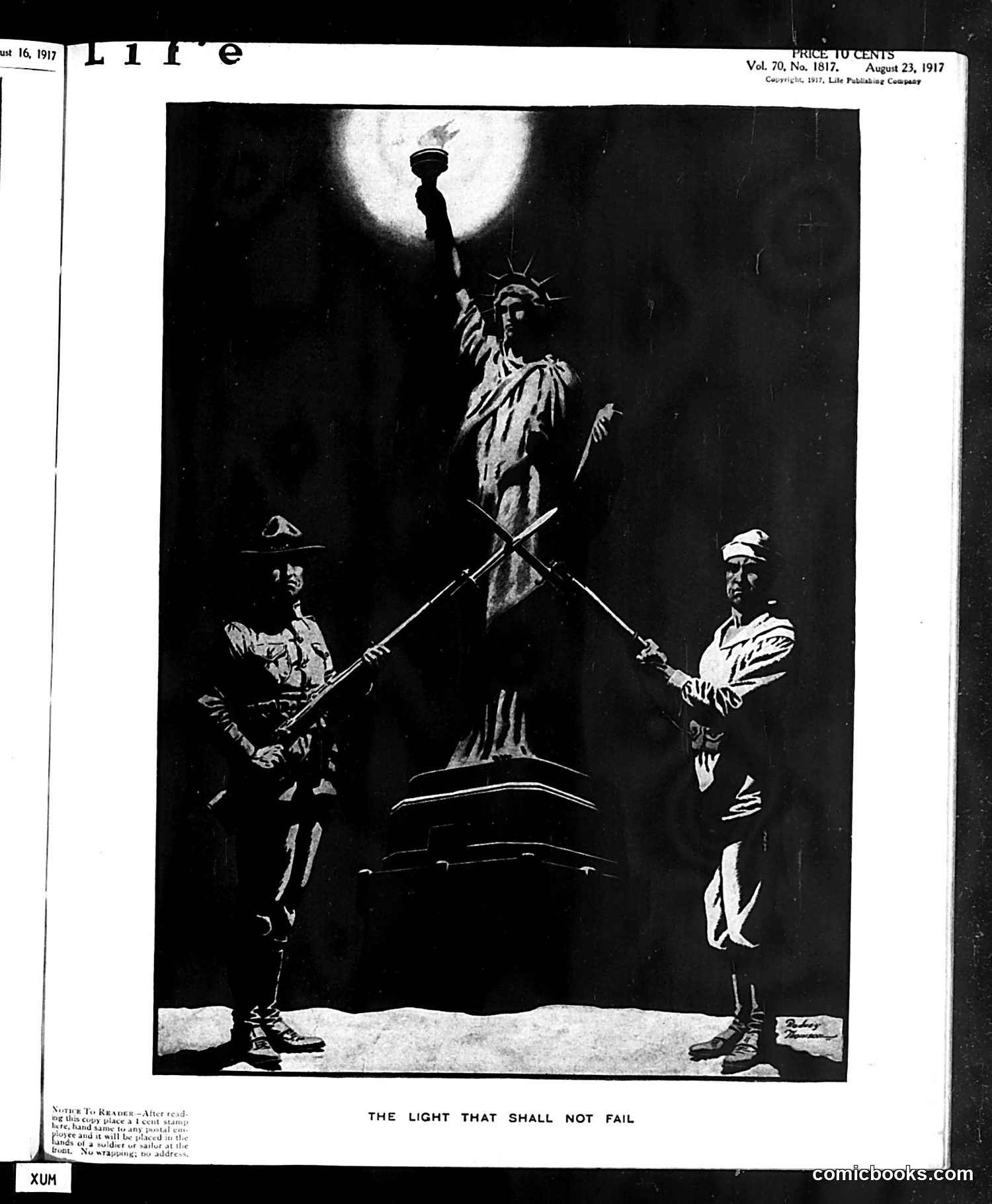
This Life magazine cover from August 23, 1917 depicts the Statue of Liberty illuminated above two soldiers holding crossed bayonets. The image appears to reference America's recent entry into World War I (April 1917). The cartoon's message is patriotic propaganda: the Statue of Liberty serves as a symbolic beacon of American ideals and freedom, guarded by vigilant soldiers. The "light that shall not fail" suggests American values will endure and ultimately triumph through military strength. The two soldiers likely represent the American Expeditionary Forces being deployed to Europe. This is typical wartime imagery—using the iconic statue to rally public support for the war effort by framing military sacrifice as defense of American liberty and democratic principles.
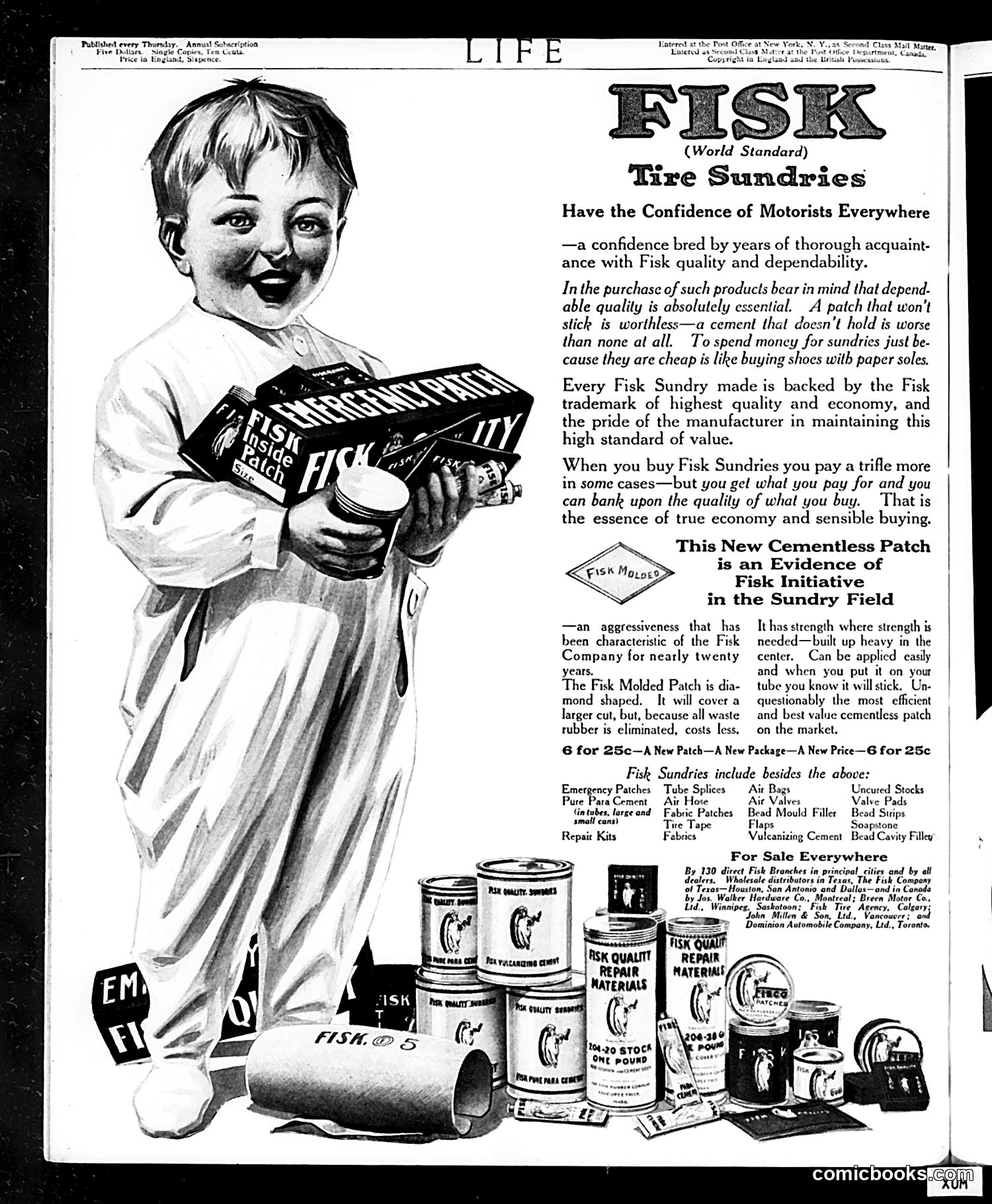
This page is primarily a **product advertisement**, not political satire. It promotes Fisk Tire Sundries—repair products for automobile tires including patches, cement, and repair kits. The only "cartoon" element is the illustration of a smiling baby holding a box of Fisk products, a common advertising device of the era. This isn't satire but rather a marketing image meant to convey innocence, reliability, and trustworthiness. The ad emphasizes Fisk's quality and economy, arguing that while their products cost slightly more, buyers "get what you pay for." This reflects early 20th-century consumer messaging prioritizing durability over cheap alternatives. The extensive product lineup shown below demonstrates the range of tire-repair supplies available to motorists—a significant concern when early automobiles were still relatively new and tire failures common.
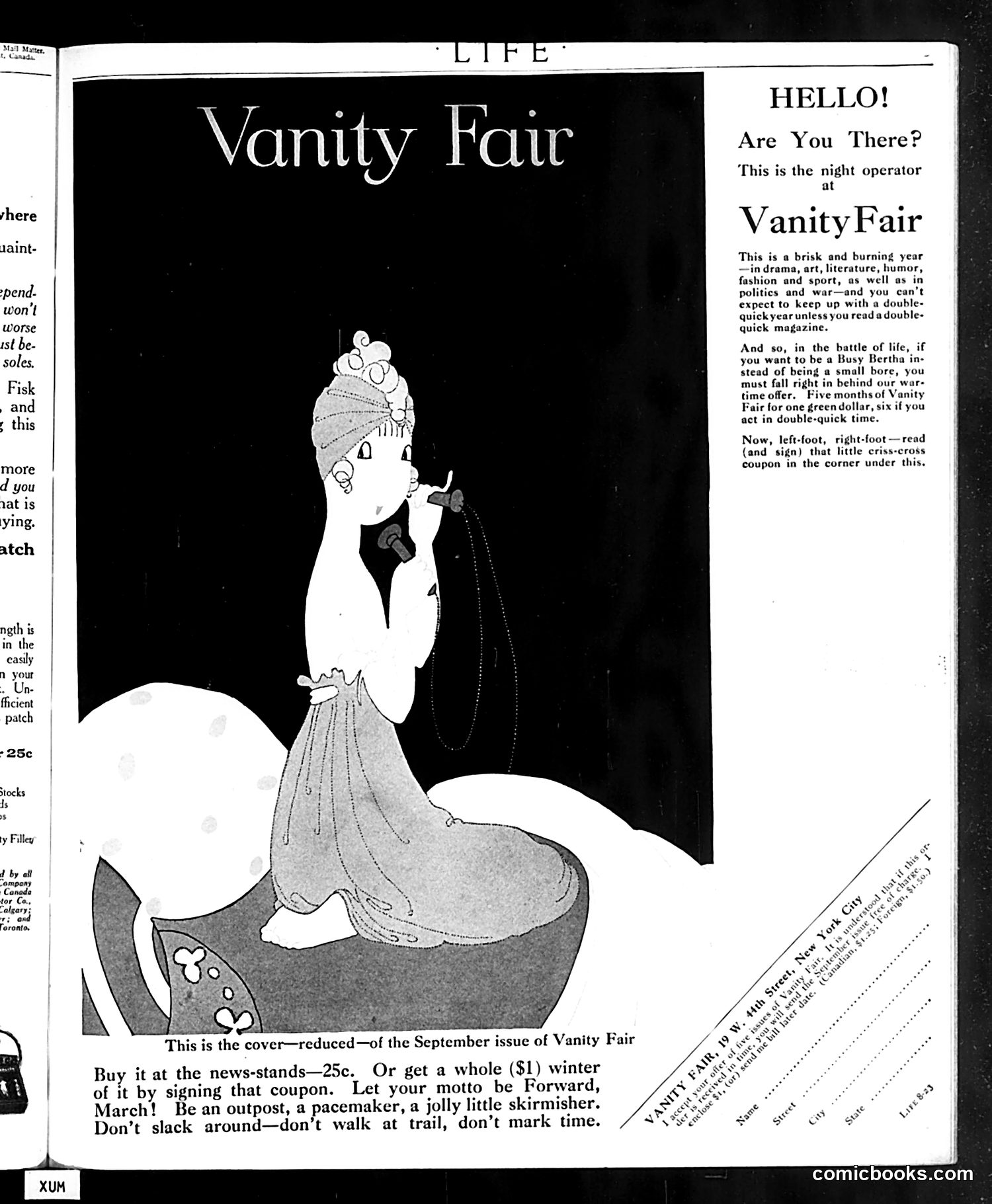
This is a **magazine advertisement** for Vanity Fair, not a political cartoon. The illustrated cover features a stylized woman in 1920s fashion—elaborate headpiece, long pearl necklace, and flowing gown—holding a telephone receiver. The "HELLO! Are You There?" greeting mimics a telephone operator's traditional greeting, making a playful pun: the ad positions Vanity Fair as your "night operator," connecting you to entertainment during wartime. The text emphasizes the magazine covers "drama, art, literature, humor, fashion and sport" while promising to keep readers engaged during the war years. The subscription offer—five months for one dollar—targets busy readers seeking quick, quality content. The overall design exemplifies Art Deco aesthetic popular in that era.
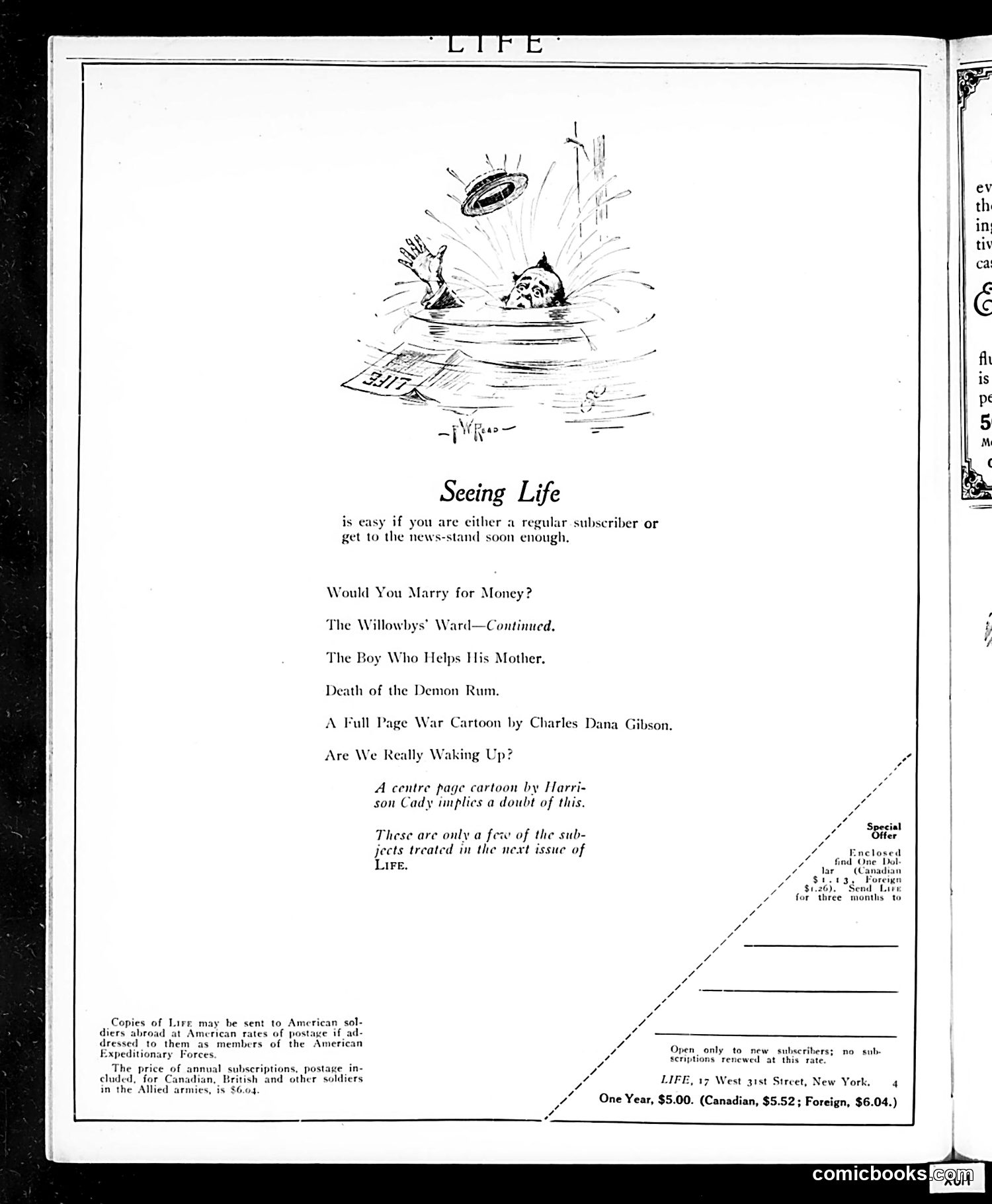
The main cartoon depicts a figure in water receiving what appears to be a UFO or flying object above, with a hat floating nearby. The caption "Seeing Life" plays on the magazine's title with a joke about subscription accessibility. The page primarily advertises **Life magazine's upcoming content**, listing articles like "Would You Marry for Money?" and "The Boy Who Helps His Mother," along with a war cartoon by Charles Dana Gibson. The satire appears gentle—mocking how people must either subscribe regularly or rush to newsstands to stay current with Life's content. The drowning figure humorously suggests the desperation readers feel to access the magazine. The bottom notes subscription pricing and that copies reach American soldiers abroad through the Expeditionary Forces.
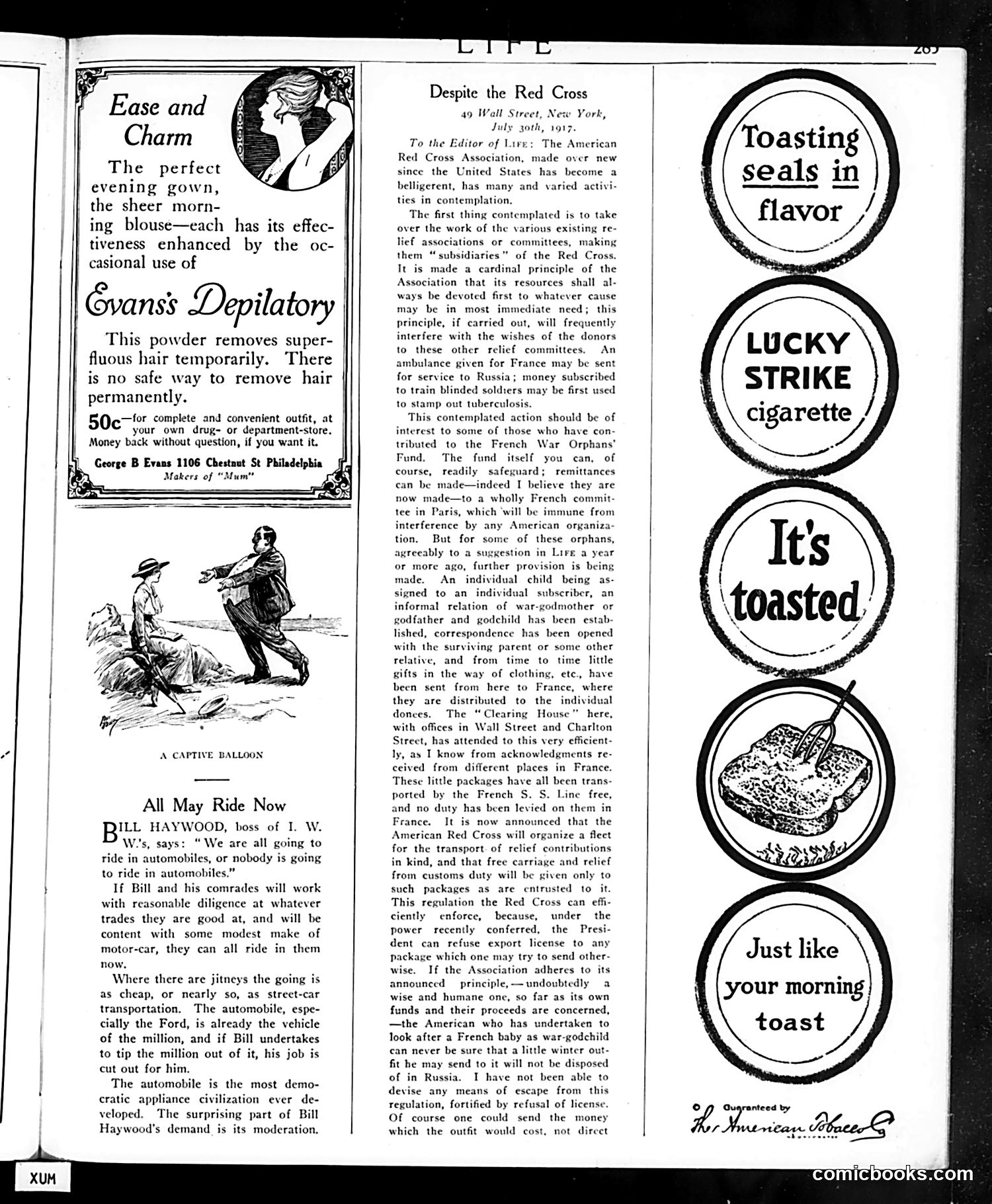
**Main Content**: A letter to Life's editor criticizing the American Red Cross's management of war relief during WWI. The writer argues the Red Cross should prioritize immediate needs over bureaucratic committees, and proposes establishing "war-godmothers" to directly support individual French war orphans. **Advertisements**: The page features period ads for Evanss Depilatory and Lucky Strike cigarettes. **Cartoon ("A Captive Balloon")**: A simple illustration showing two figures and a tethered balloon, accompanied by a brief Bill Haywood quote about automobiles becoming democratic transportation. **Historical Context**: This reflects 1917 American debates over Red Cross effectiveness and American charitable involvement in the ongoing World War I, predating U.S. official entry by several months.
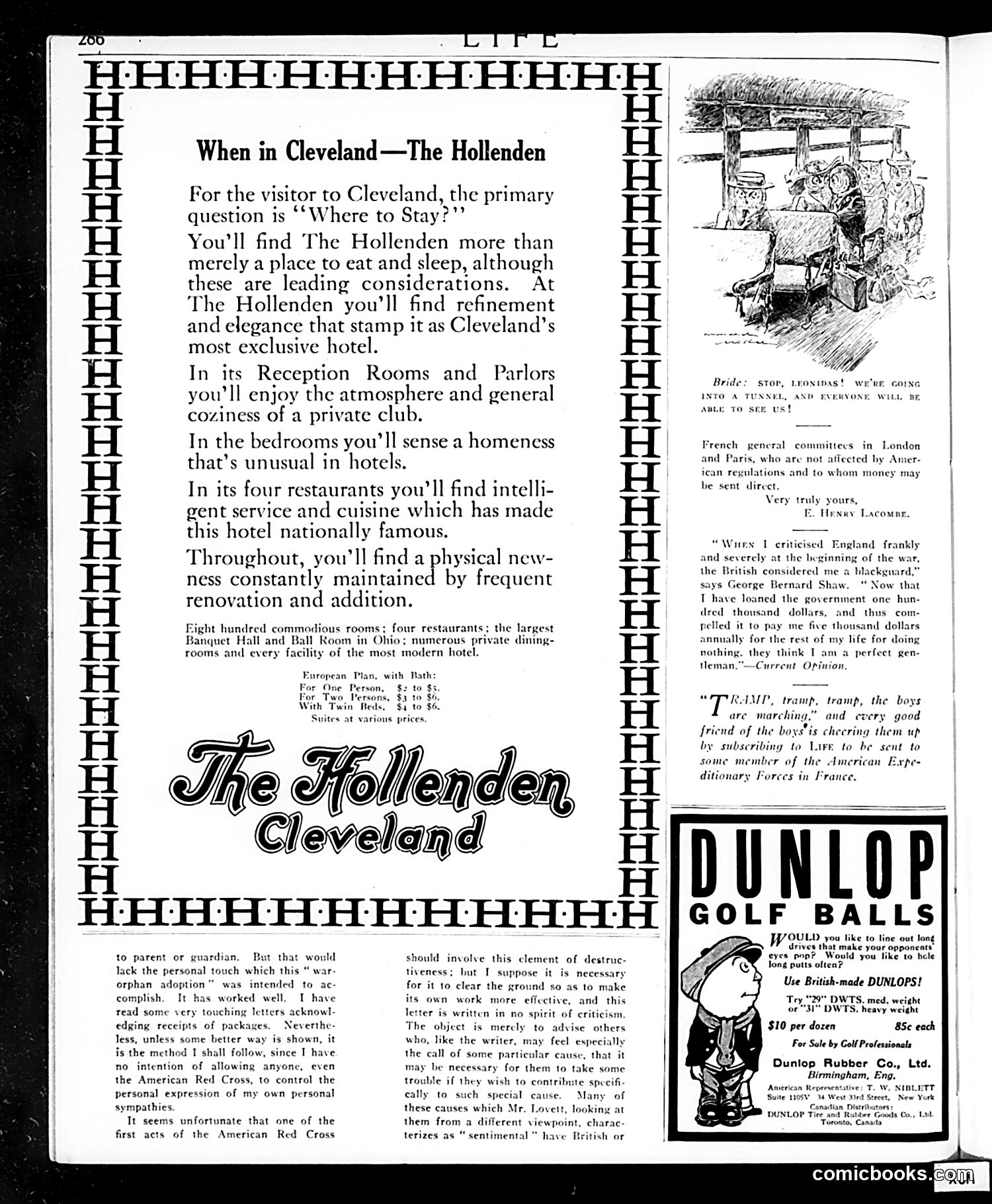
This page is primarily **advertising and editorial content**, not political satire. The main feature is a hotel advertisement for The Hollenden in Cleveland, describing its luxury amenities, restaurants, and 800 rooms. The accompanying sketch shows a couple at what appears to be a tunnel entrance with luggage. The right side contains **reader letters** and a **Dunlop Golf Balls advertisement** featuring a cartoon golfer. One letter references E. Henry Lacombe discussing French economists unaffected by American trade regulations. Another quotes someone defending their criticism of England during wartime, mentioning lending "one hundred thousand dollars" and paying "five thousand dollars annually." The page reflects **post-WWI American attitudes** toward international finance and transatlantic relations, but contains no coherent political cartoon narrative—it's a typical Life magazine page mixing advertisements, hotel promotions, and reader correspondence from approximately the 1920s era.
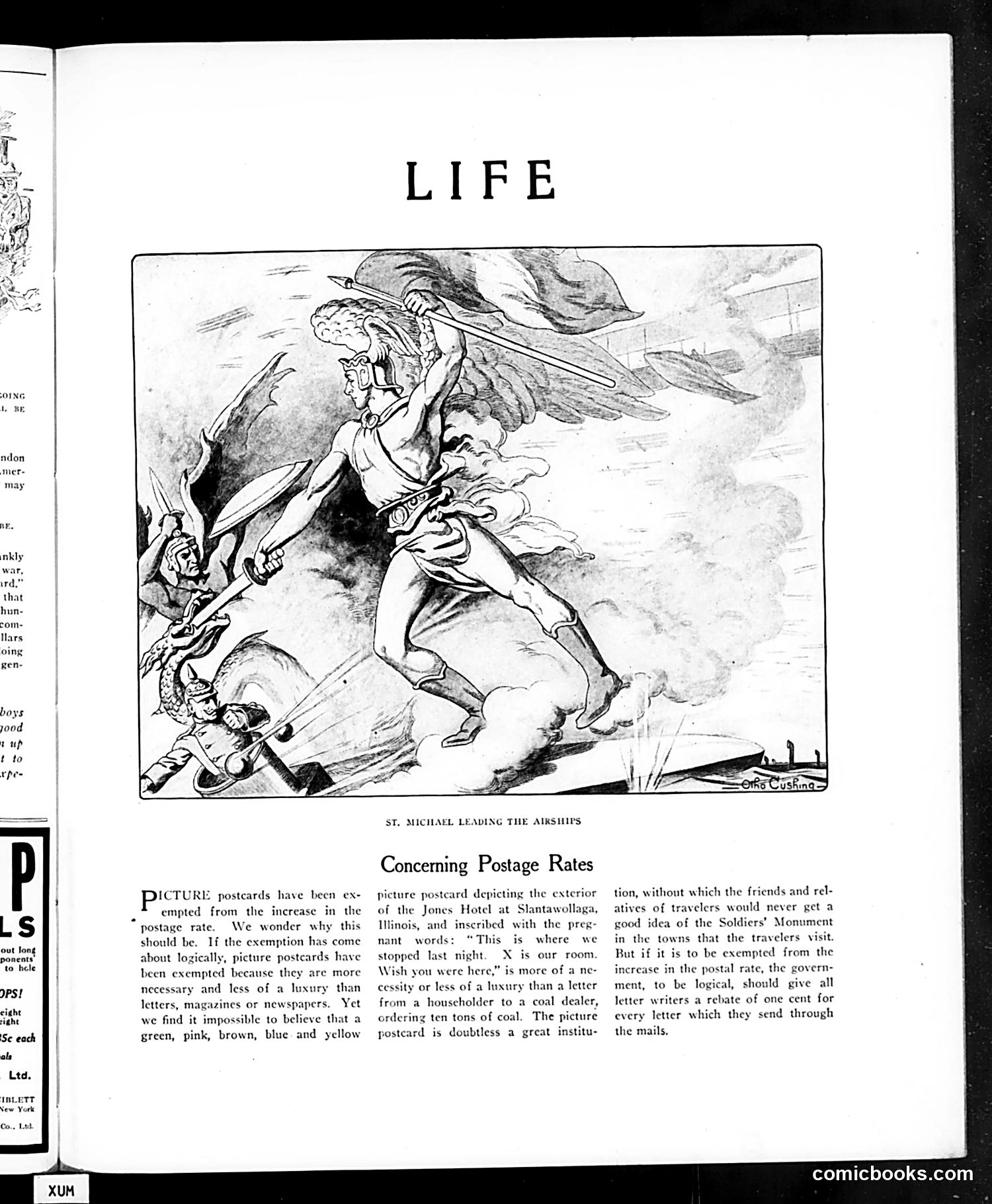
The page features an illustration titled "St. Michael Leading the Airships" depicting allegorical figures in combat. St. Michael (a traditional symbol of righteousness) appears to be battling demonic or evil forces, with airships visible in the background. The accompanying article, "Concerning Postage Rates," argues against exempting picture postcards from postal rate increases. The author contends that postcards are luxury items—less necessary than letters—and notes the irony that exempting them would burden letter-writers. The piece sarcastically suggests that if the government truly valued the postal rate increase, it should require a one-cent rebate on letters to offset postcard exemptions. The cartoon likely satirizes government hypocrisy or corruption regarding postal policy, with St. Michael symbolizing moral opposition to unfair practices.
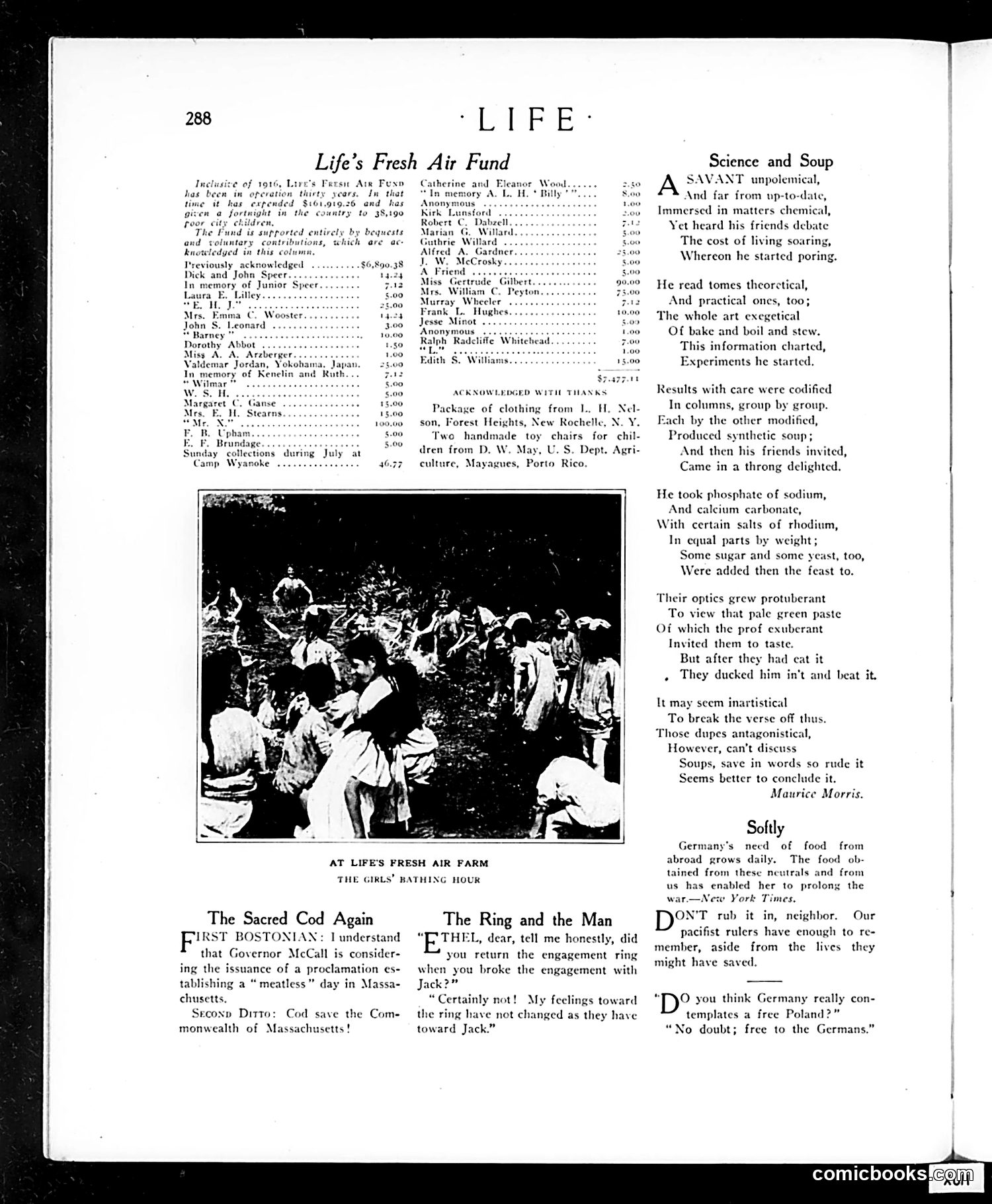
This page contains a humorous poem titled "Science and Soup" about a scientist conducting experiments with chemical compounds (phosphate of sodium, calcium carbonate, rhodium salts, sugar, and yeast). The joke is that his friends taste his concoction, react negatively ("They ducked him in't and beat it"), and the verse humorously concludes that breaking the poem's meter seems preferable to discussing such unpleasant soups. The accompanying photo shows a bathing scene at Life's Fresh Air Farm—a charitable facility. Below are two brief comedic dialogues: "The Sacred Cod Again" (a joke about Massachusetts protecting its codfish industry) and "The Ring and the Man" (a domestic humor piece about a broken engagement ring). The page satirizes both scientific pretension and domestic life, typical of Life magazine's light satirical humor.
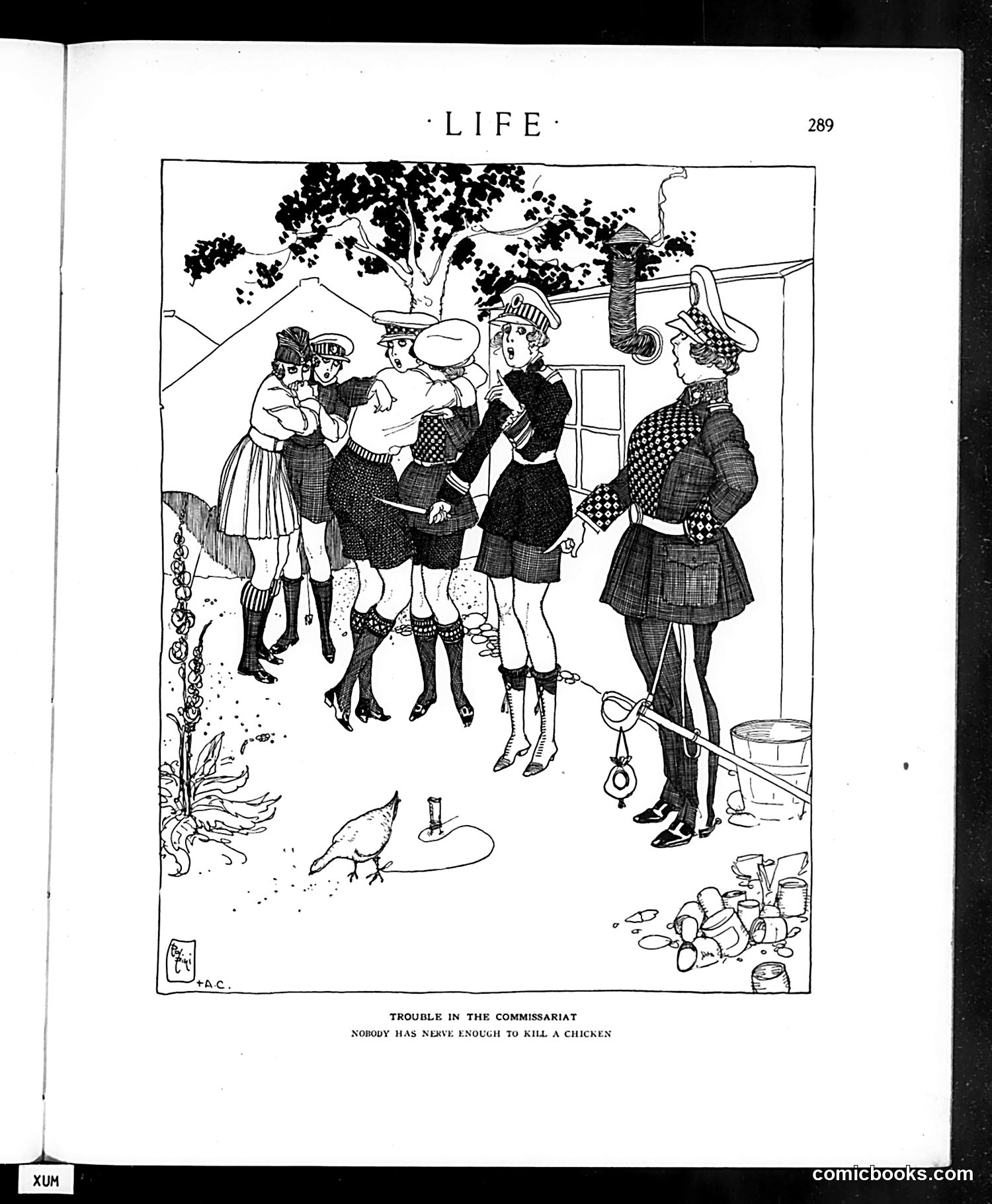
This cartoon satirizes military bureaucracy, specifically an officers' mess or commissary. The caption reads: "Nobody has nerve enough to kill a chicken." The joke depicts several uniformed officers gathered around a live chicken, apparently unable to proceed with killing it for food—suggesting either squeamishness or excessive regulation preventing decisive action. The scattered pots and kitchen equipment indicate this is a food-preparation area. The satire likely mocks military incompetence or overly rigid chain-of-command protocols that paralyze simple tasks. Alternatively, it may reference wartime food shortages or rationing where even obtaining a chicken creates bureaucratic complications. The specific historical context remains unclear without knowing the publication date, but the imagery suggests WWI or interwar-era military critique.
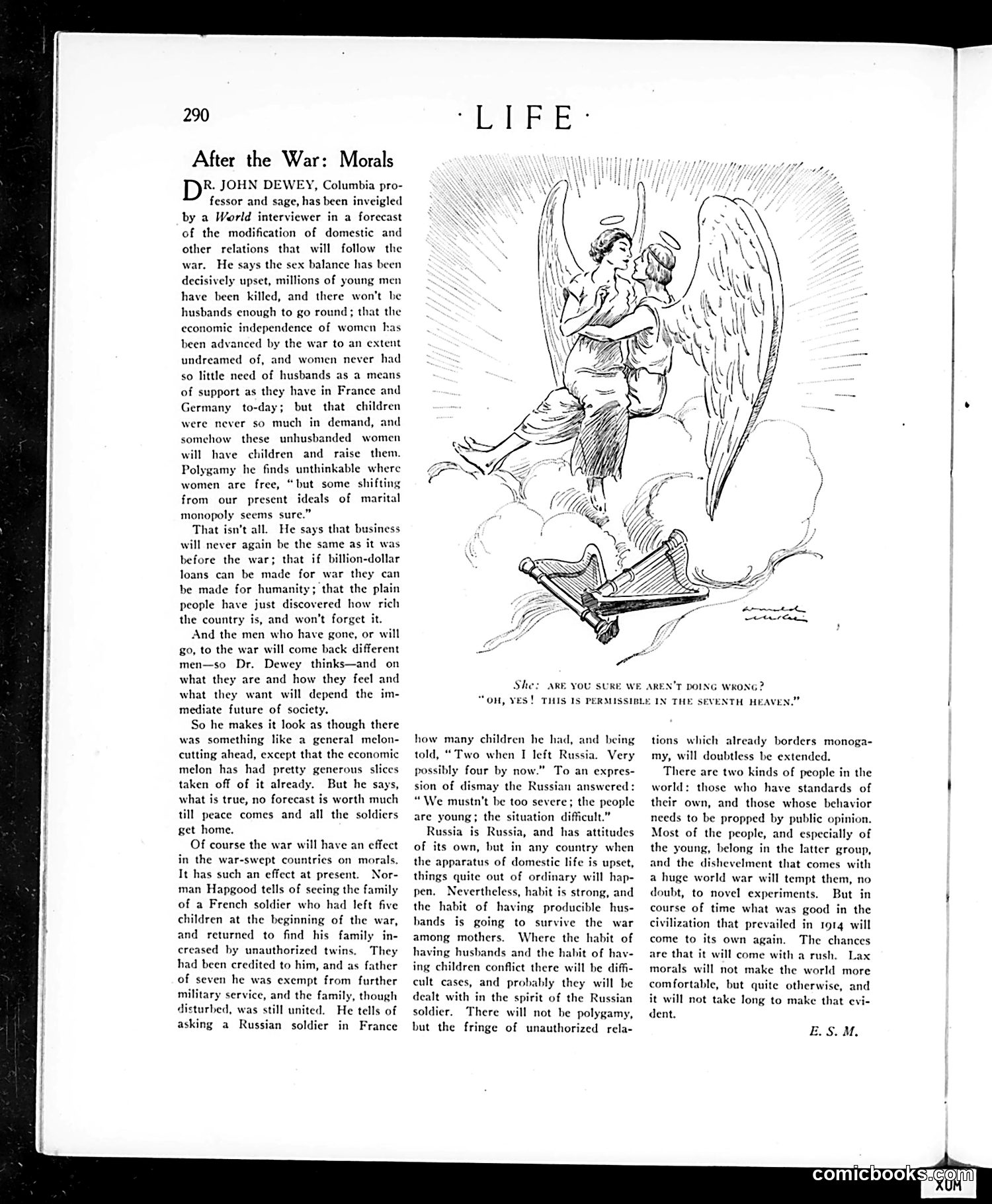
The illustration shows an angel holding a child in clouds, with a rifle below—clearly satirizing post-WWI morality debates. The caption reads: "She: ARE YOU SURE WE AREN'T DOING WRONG? / 'OH, YES! THIS IS PERMISSIBLE IN THE SEVENTH HEAVEN.'" The accompanying article discusses Dr. John Dewey's observations on how war has disrupted traditional family structures and moral values. It references concerns about increased infidelity, "unauthorized" children, and polygamy resulting from millions of dead soldiers and displaced men. The satire cuts both ways: the angel-and-child imagery ironically suggests that illicit relationships producing children might somehow be "permissible" even in heaven—mocking both religious hypocrisy and society's struggle to reconcile wartime chaos with traditional morality.
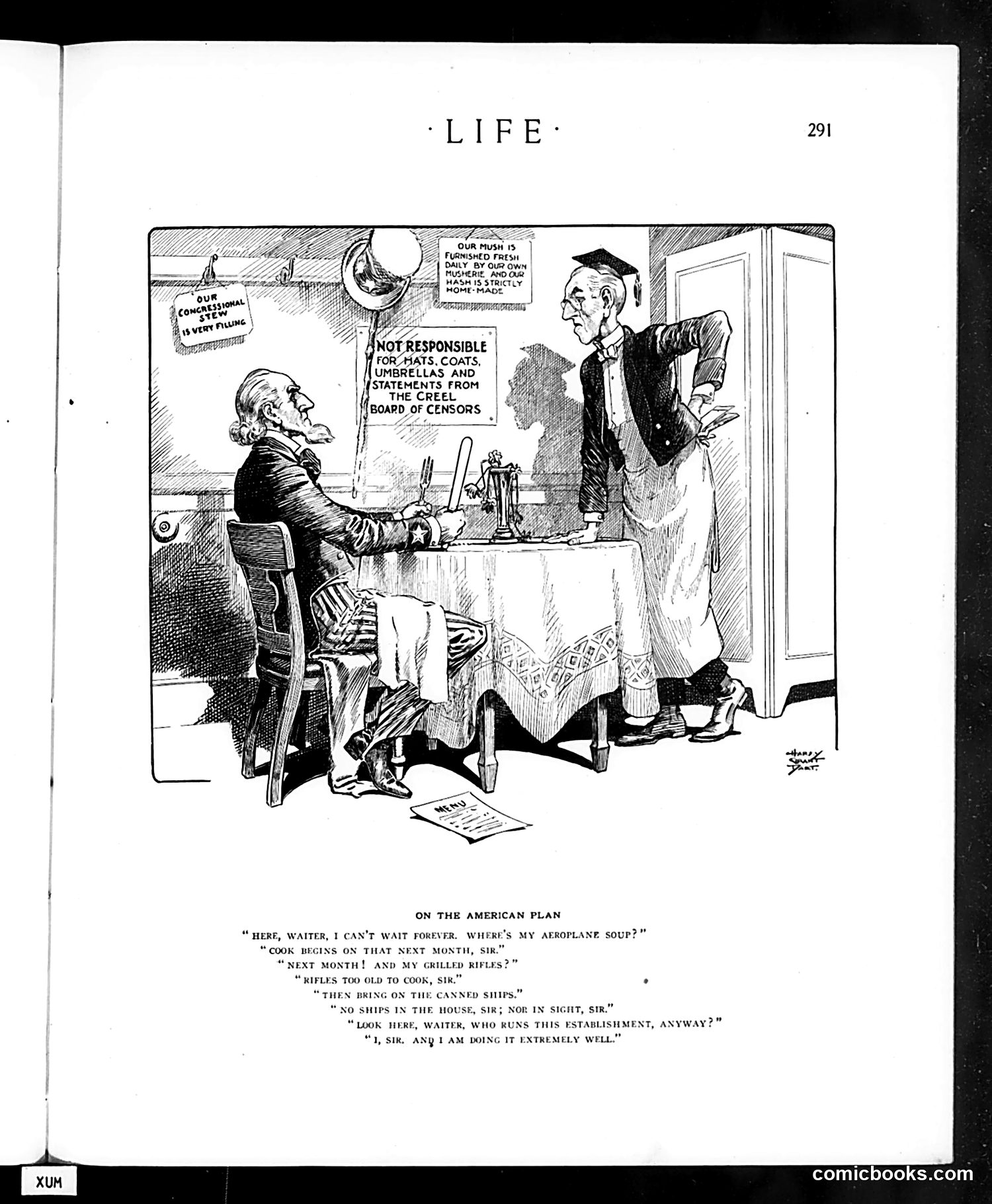
This satirical cartoon depicts a restaurant scene where an impatient customer complains to a waiter about delayed service. The humor targets American restaurant management's inefficiency during what appears to be wartime rationing. The customer demands his "aeroplane soup," but the cook won't begin cooking until next month. When asked about grilled rifles, the cook claims they're "too old." The waiter then suggests ordering "canned ships" instead—none of which are available. The establishment's sign reads: "Our Corned Beef is Extremely Fresh" and denies responsibility for "hats, coats, umbrellas and statements from the Creel Board of Censors." The joke satirizes food shortages, military procurement confusion, and government censorship during what appears to be World War I era America.
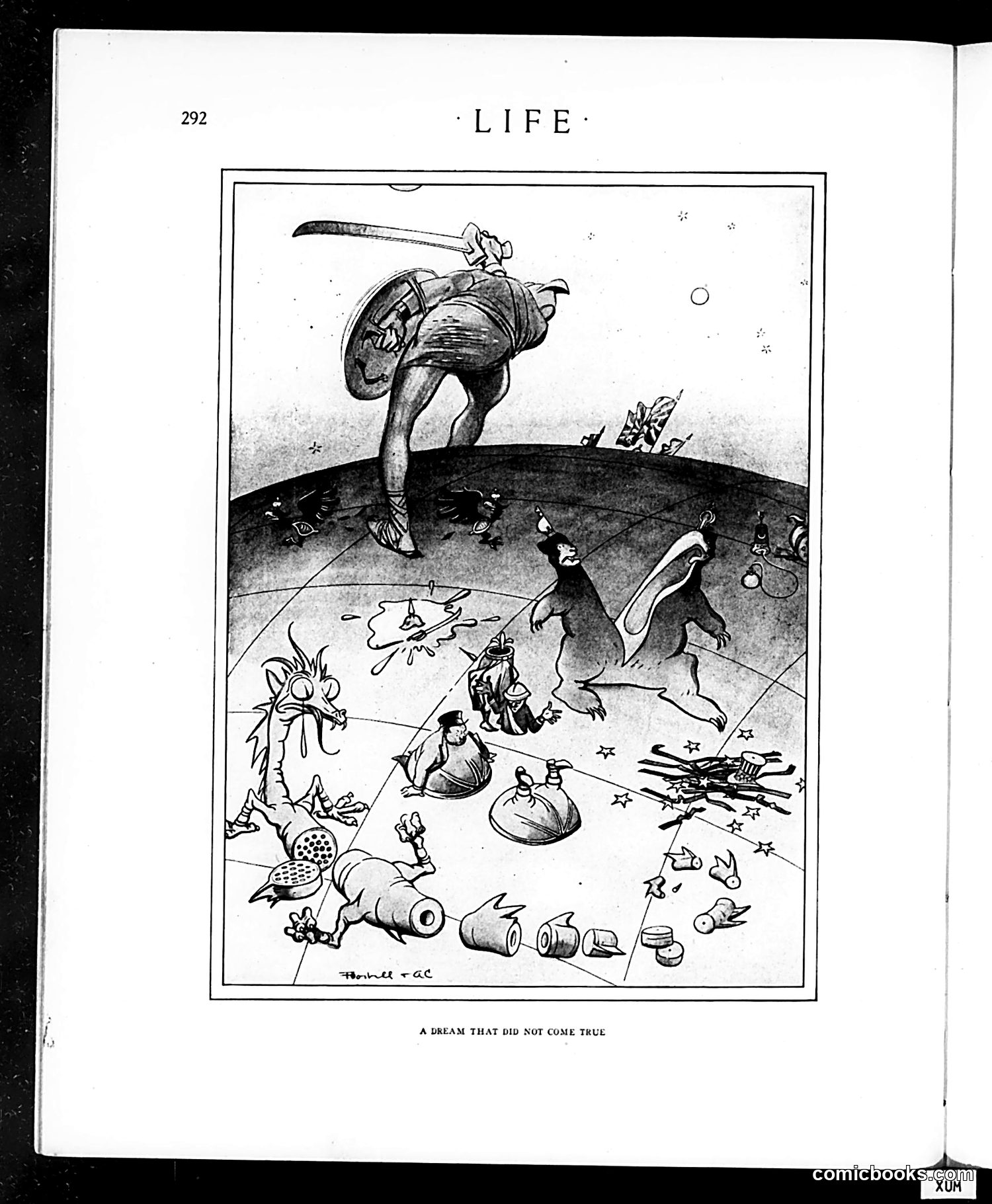
This satirical cartoon depicts a surreal underground or fantastical scene populated by grotesque figures and creatures. The page number (292) and "LIFE" masthead confirm this is from the American satirical magazine. The central figure appears to be a giant or mythological being looming above a chaotic underground realm filled with smaller figures, monsters, and scattered objects. The title "A Dream That Did Not Come True" suggests this illustrates a failed utopian vision or political aspiration rendered nightmarish. Without clearer visual identification of specific caricatured figures or legible dates, I cannot definitively identify which historical event, politician, or failed movement this references. The expressionistic style and fantastical imagery suggest early-to-mid 20th century satirical commentary, but the specific target remains unclear from the image alone.
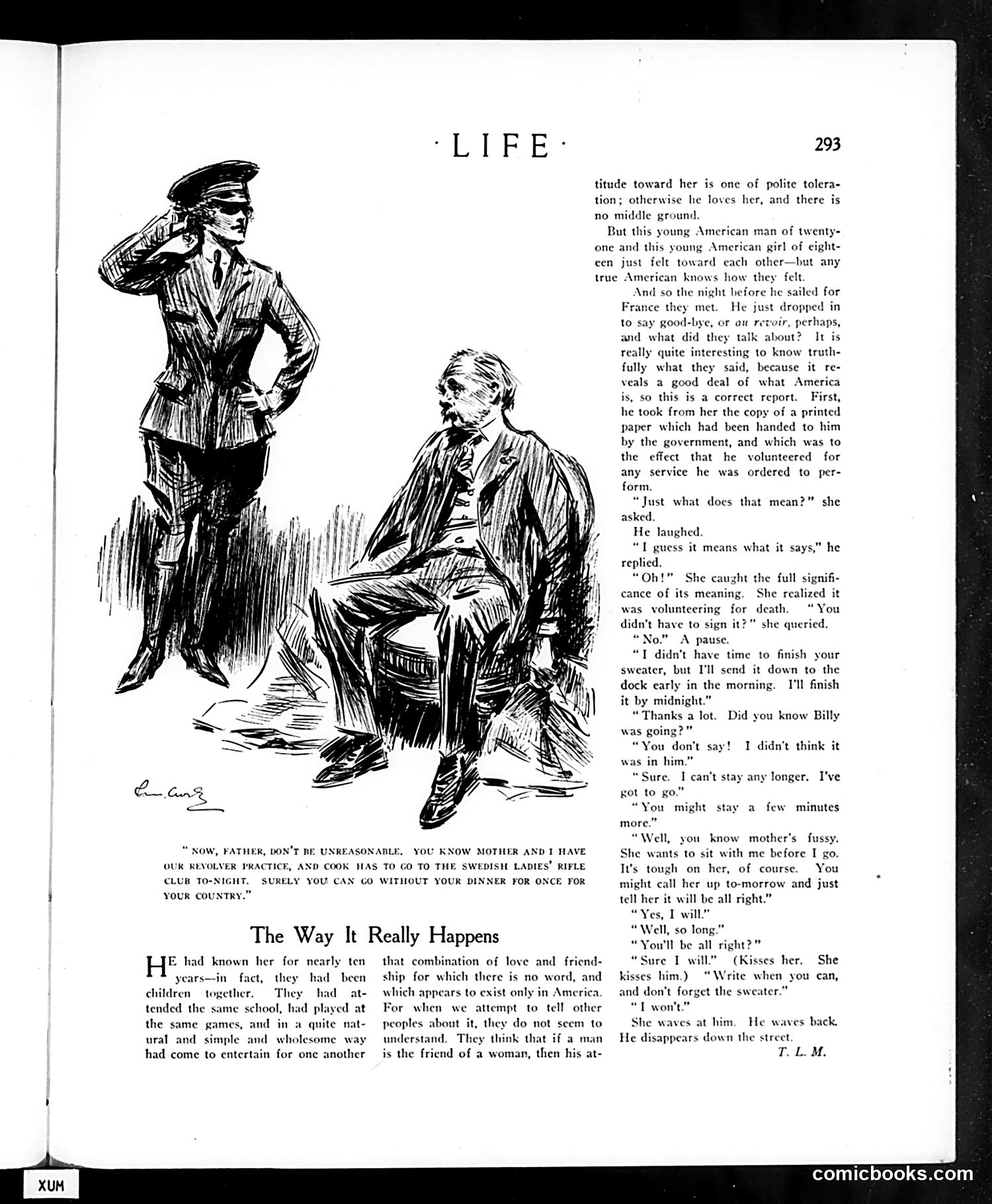
This illustration depicts a conversation between a young woman and an older man, likely her father. The narrative addresses American courtship customs and gender expectations of the early 20th century. The story reveals the couple's farewell before the young man sails to France—apparently to enlist or serve in military capacity. The father's quoted dialogue emphasizes masculine duty and self-sacrifice ("you know mother and I have our revolver practice...cook has to go to the Swedish Ladies' Rifle Club"). The satire mocks how American men romanticize military service while women must manage domestic anxieties. The young woman's pragmatism—insisting on finishing a sweater before he leaves—contrasts with the patriotic drama surrounding his departure, highlighting the disconnect between heroic ideals and daily reality.
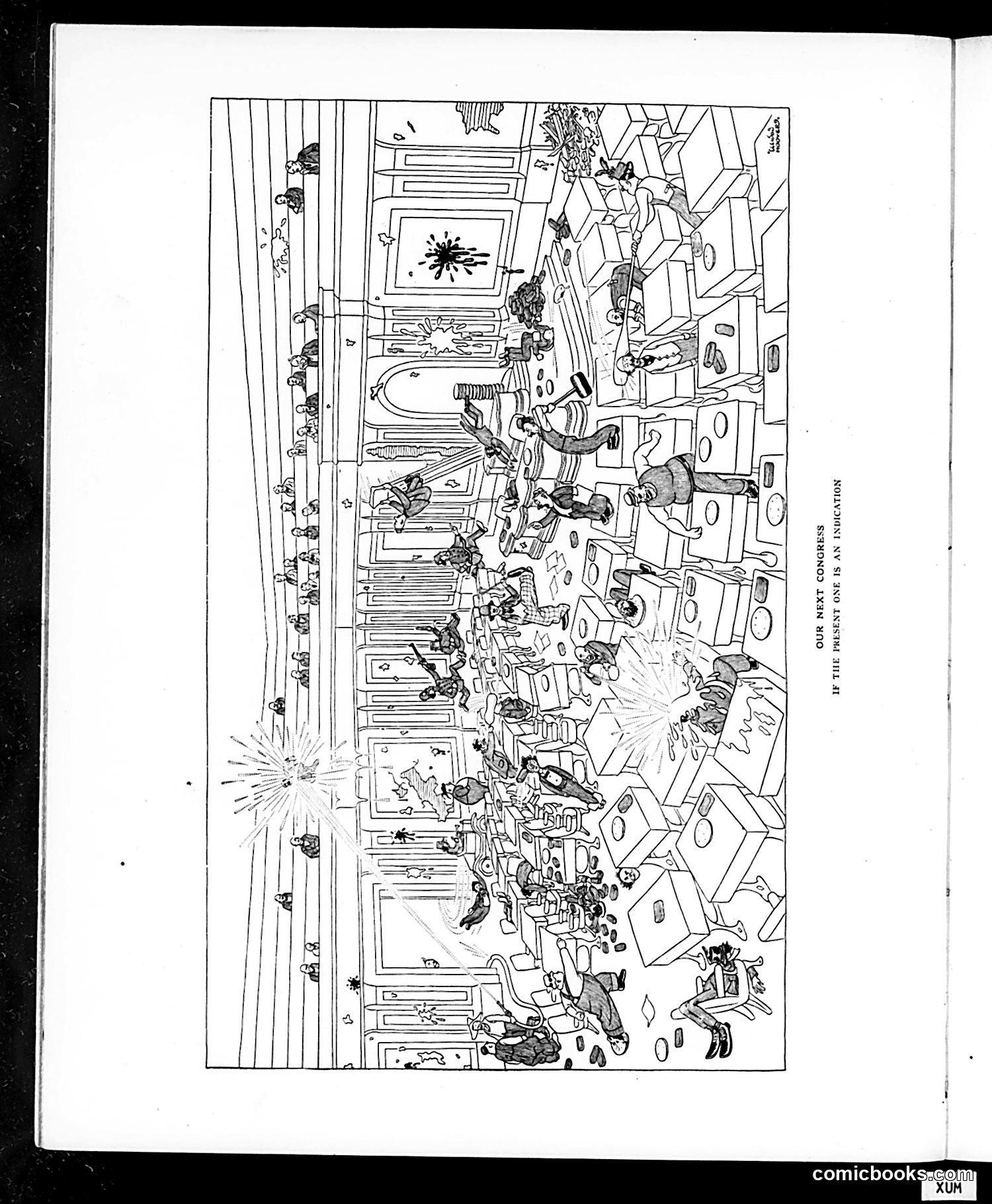
This page shows a single large cartoon titled "GREAT CONGRESS" with the subtitle "IT THE PARLIAMENT IS IN SESSION." The image is rotated 90 degrees, depicting what appears to be a chaotic legislative chamber filled with numerous figures engaged in animated debate or disorder. The cartoon satirizes parliamentary dysfunction—showing crowded, unruly proceedings typical of early 20th-century Life magazine's political commentary. The dense composition and frantic activity suggest incompetence or gridlock in government. Without clearer identifying labels or dates visible, I cannot definitively identify which specific congress or legislative moment this targets, though the style and format indicate it's critiquing general legislative inefficiency and chaos through exaggerated depiction.
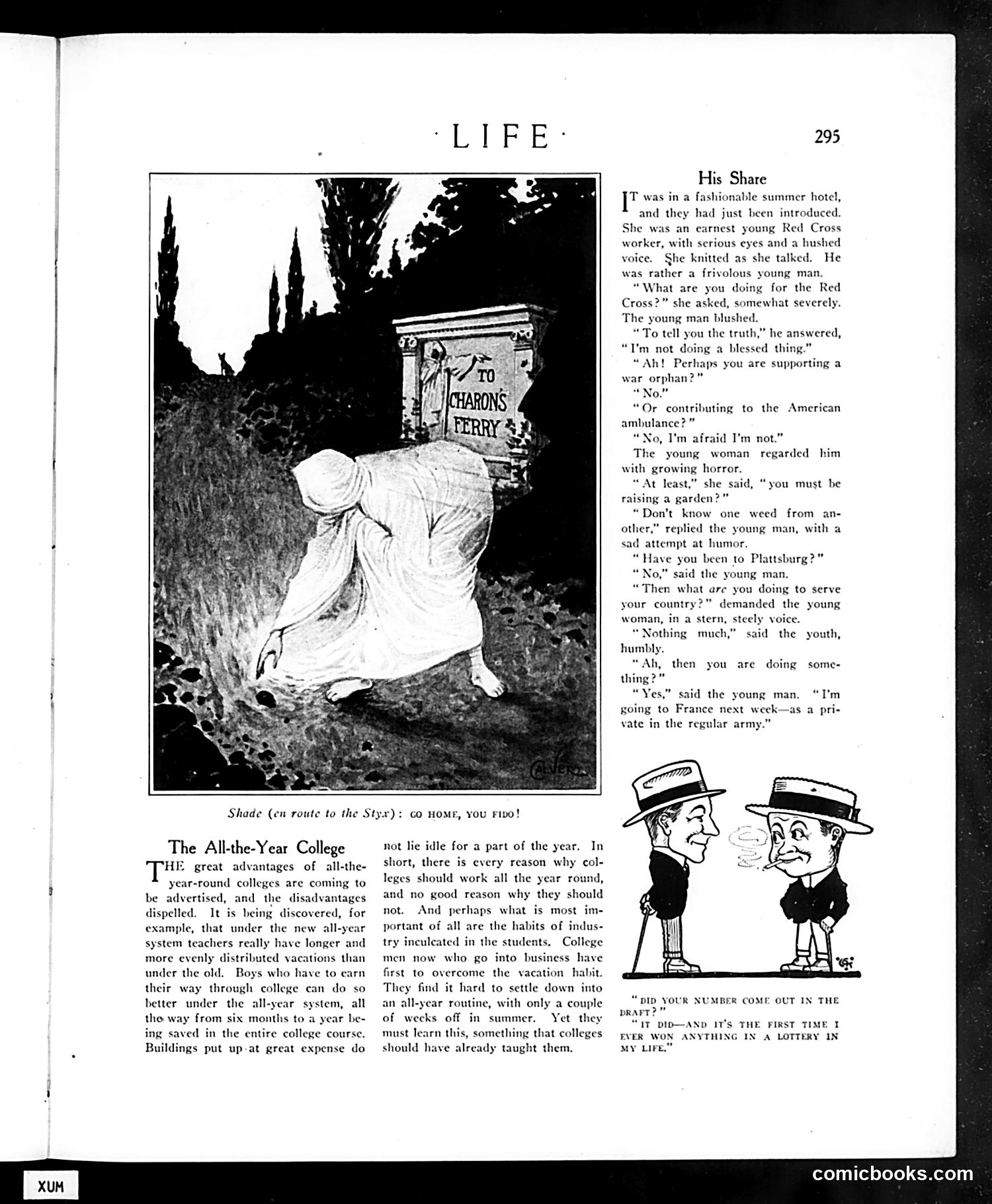
The main illustration depicts a woman (identified as a Red Cross worker by the text) kneeling in despair beside a sign reading "TO CHARON'S FERRY"—a classical reference to the mythological ferryman of the dead. This visualizes the conversation's subtext: a young man admits he's doing nothing for the war effort and is simply enlisting as a regular soldier, disappointing the patriotic woman who expected more substantial sacrifice or service. The cartoon critiques young men's perceived lack of patriotic commitment during WWI. The "Charon's Ferry" reference suggests death awaits—making the man's casual attitude toward military service appear callous or cowardly to civilian observers, particularly women involved in organized relief work.
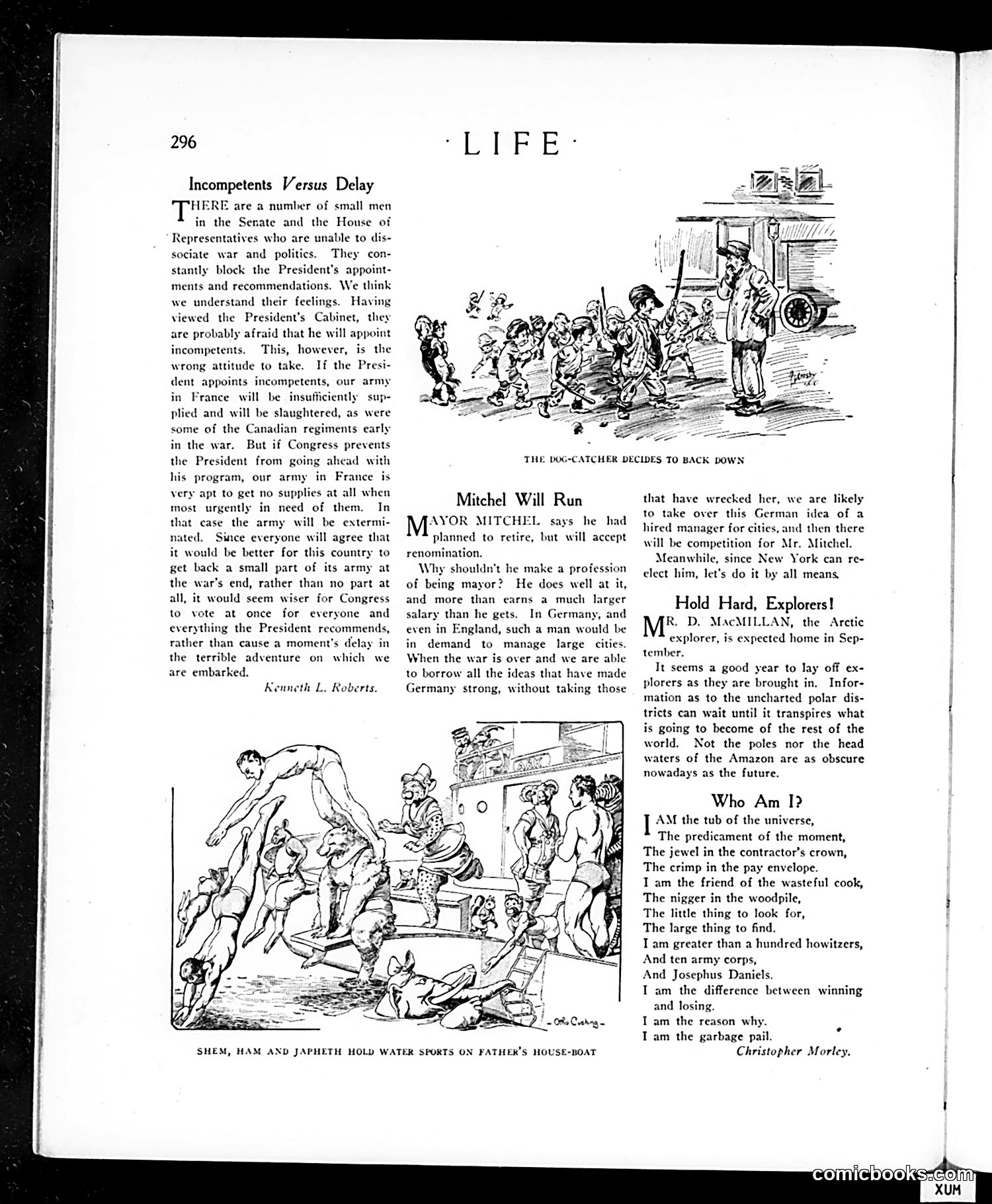
**"Incompetents Versus Delay"** (by Kenneth L. Roberts): This editorial argues Congress should stop blocking President Wilson's WWI appointments and military funding, fearing incompetent appointees. Roberts counters that delays in supplying troops are more dangerous than potential incompetence—soldiers need supplies *now*. The implicit critique: Congressional obstruction during wartime endangers soldiers more than bad appointments. **"Mitchel Will Run"**: Mayor John Purroy Mitchel of New York will seek reelection. The piece praises his administrative competence, suggesting post-war America should adopt Germany's model of professional city managers (rather than politicians). The irony—praising German management systems while fighting Germany—reflects WWI-era pragmatism about adopting enemy innovations. **"Who Am I?"** (by Christopher Morley): A poetic riddle where the answer is apparently "waste" or "inefficiency"—described as more damaging than weapons ("greater than a hundred howitzers"). Written during wartime, it criticizes civilian waste as undermining the war effort. All three pieces reflect 1917-18 anxieties about institutional competence and home-front commitment to the war.
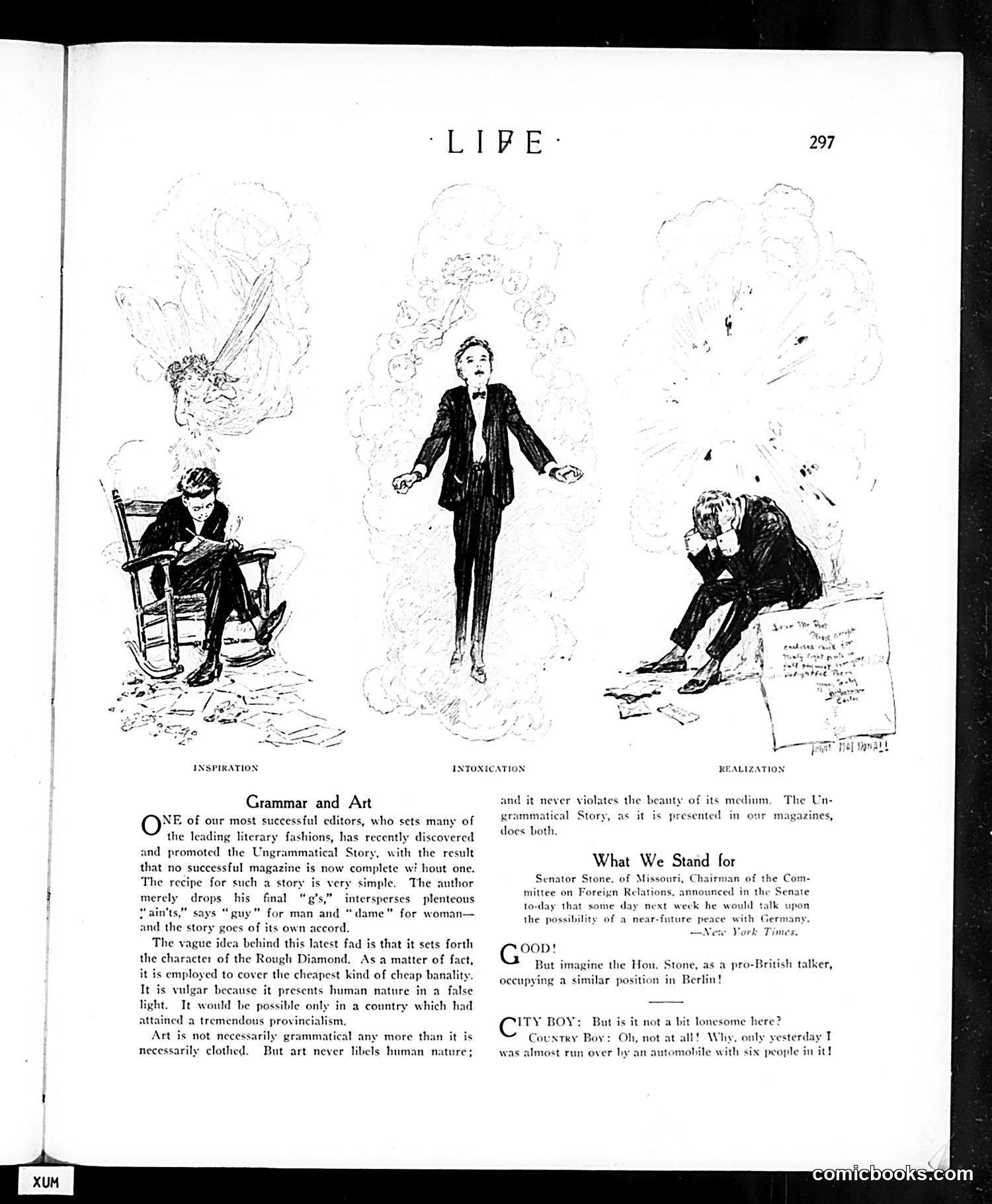
## The Cartoons The three sketch panels labeled "Inspiration," "Intoxication," and "Realization" satirize the "Ungrammatical Story" literary trend. They depict a writer's creative process: initial inspiration (seated, thinking), intoxication (floating mid-air, overwhelmed), and final realization (slumped, confronting his work). The visual joke shows how this trendy writing style produces chaos rather than art. ## The Editorial Content The article criticizes editors who've popularized deliberately ungrammatical fiction—dropping g's, using "dame" and "guy" instead of proper terms. The author argues this vulgar affectation, meant to portray "Rough Diamond" characters authentically, actually libels human nature and reflects American provincialism. Real art, the piece insists, never sacrifices grammatical or aesthetic standards. ## "What We Stand For" This brief section contrasts Senator Stone's (Missouri) public statements about future peace with Germany against the irony of imagining him holding similar pro-British views in Berlin—satirizing inconsistent diplomatic positioning.
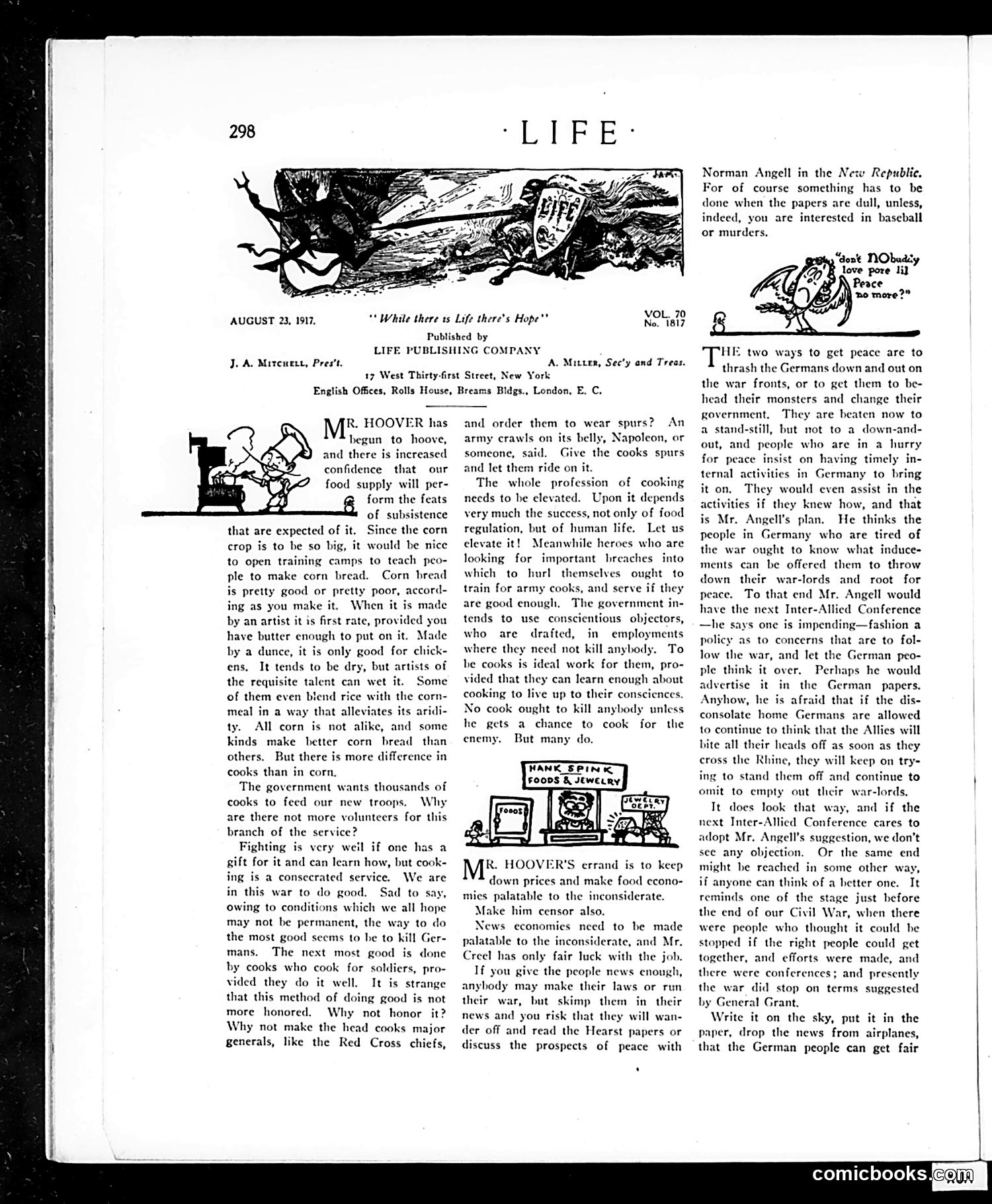
This page satirizes American home-front efforts during World War I, particularly food rationing under Herbert Hoover's direction. The main text argues that cooking for soldiers is as important as combat—"an army crawls on its belly"—and proposes elevating head cooks to major general rank with military honors. The cartoon (top left) appears to depict figures struggling with or promoting corn bread production, supporting the article's theme about utilizing the corn crop for soldier rations. The satire critiques both food management and news censorship: George Creel (head of wartime propaganda) is mentioned as struggling to make "news economies palatable to the inconsiderate" public. The piece implies that if people lack adequate information, they'll turn to Hearst papers (William Randolph Hearst, known for sensationalism) or discuss peace proposals by Norman Angell instead of supporting the war effort. The underlying point mocks how wartime requires dignifying unglamorous work while managing public opinion through controlled information.
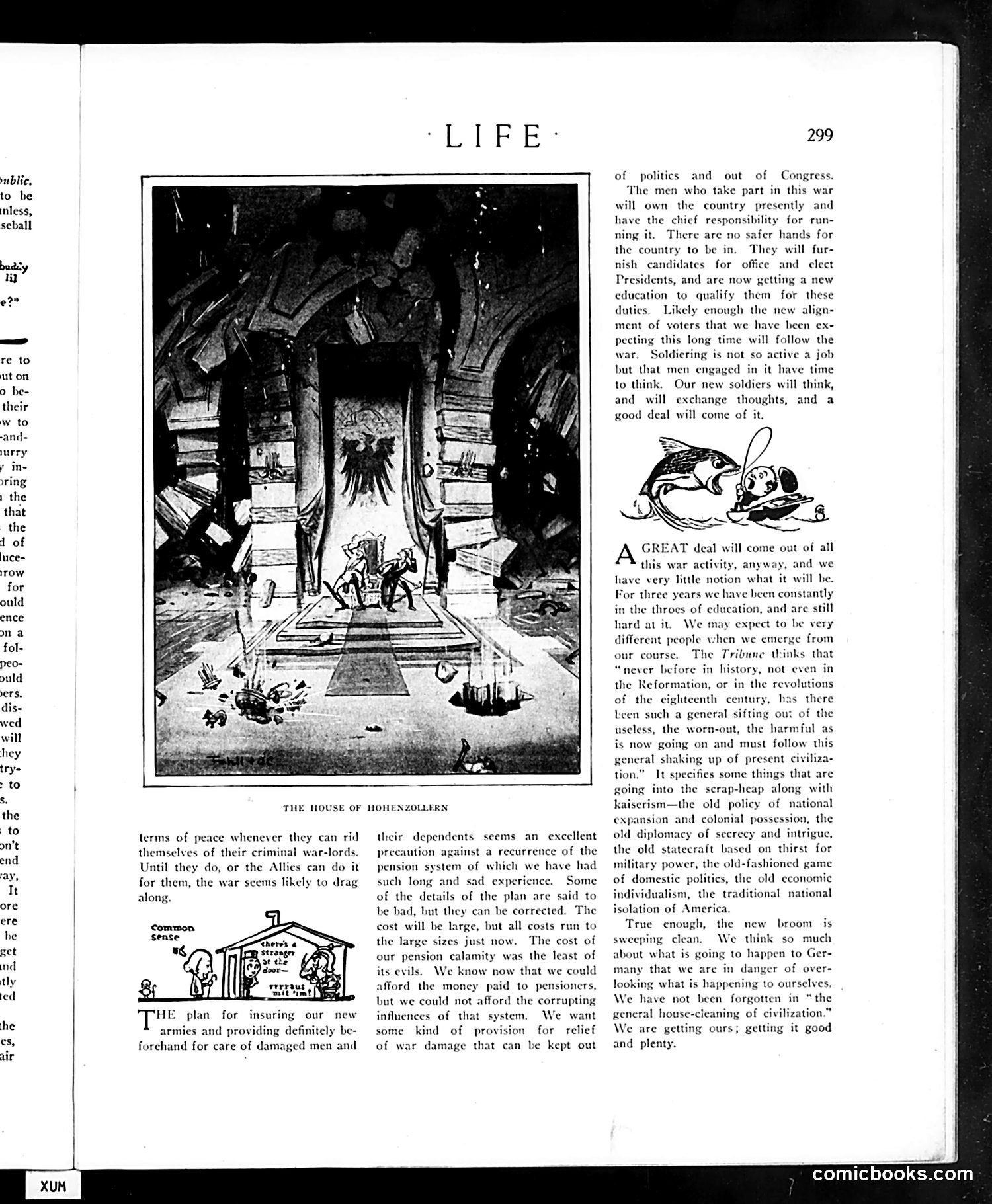
This page features a dramatic illustration labeled "The House of Hohenzollern" (the German imperial dynasty), depicting an ornate palace interior in ruins or decay—likely satirizing the collapse of German power during World War I. The accompanying text discusses post-war planning, particularly veterans' pensions and the transformative effect of the war on American society. The author argues that soldiers will become the nation's future leaders and voters, fundamentally reshaping American politics and values. The satire targets old-world systems being discarded: kaiserism, imperial colonialism, secret diplomacy, and "domestic politics" corruption. The final section suggests Americans shouldn't forget that war is reshaping *their* nation too—"We are getting ours; getting it good and plenty"—meaning America faces its own radical social upheaval alongside Germany's defeat. This reflects American optimism circa 1918 about post-war democratic renewal.
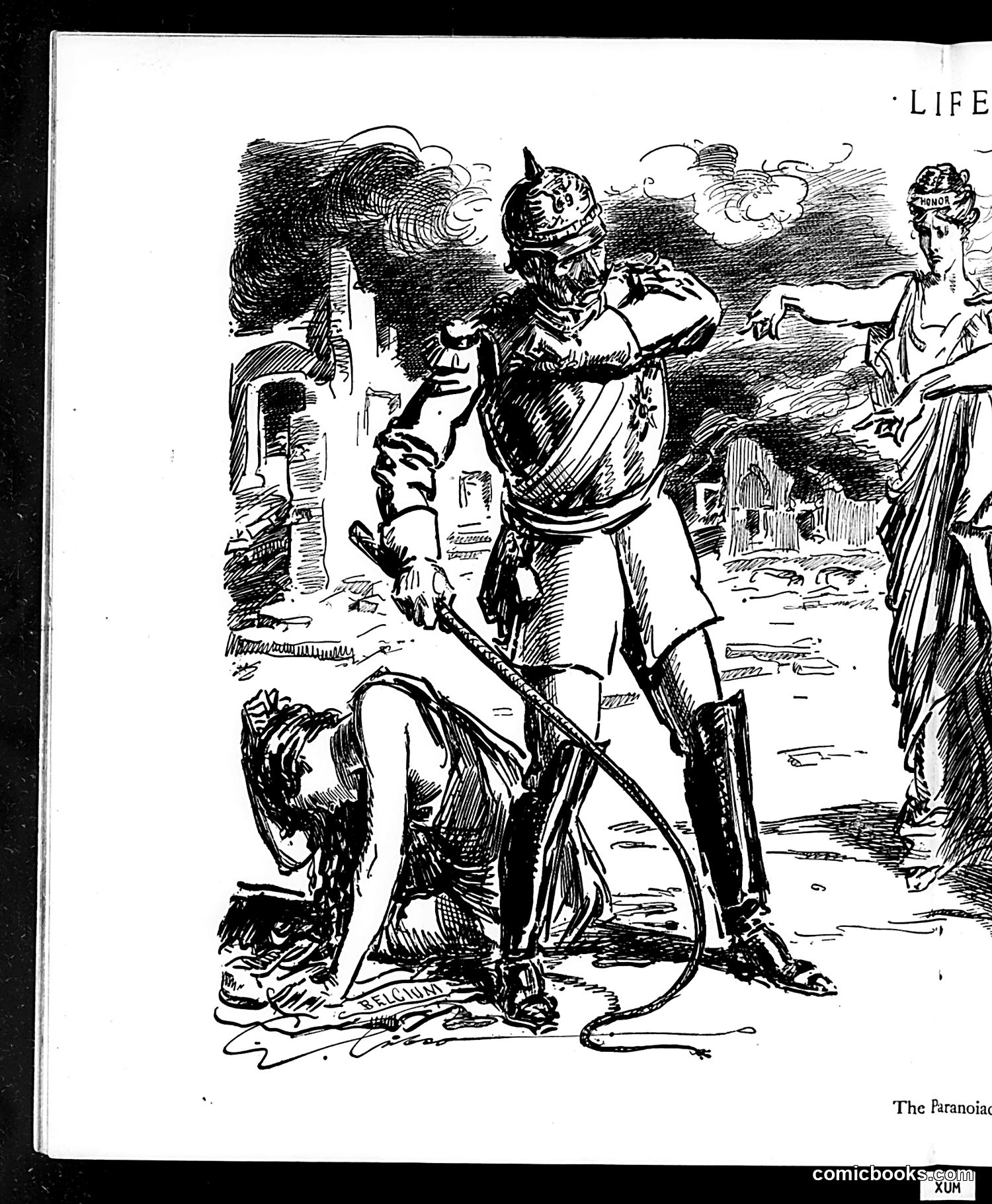
This political cartoon depicts a German military officer (identifiable by the spiked Prussian helmet and uniform) interrogating or threatening a kneeling civilian figure. The title "The Paranoiac" suggests the cartoon critiques German militarism and authoritarian behavior. The scene appears to satirize German paranoia or aggressive militarism during a period of international tension—likely early 20th century, given the Prussian military style. The power dynamic (uniformed officer standing over a subjugated civilian) and the threatening posture illustrate a satirical commentary on German imperial aggression or militaristic control. Without clearer OCR text or visible captions identifying specific historical events, the exact political moment remains uncertain, though the imagery clearly associates German military authority with paranoid, oppressive behavior toward civilians.
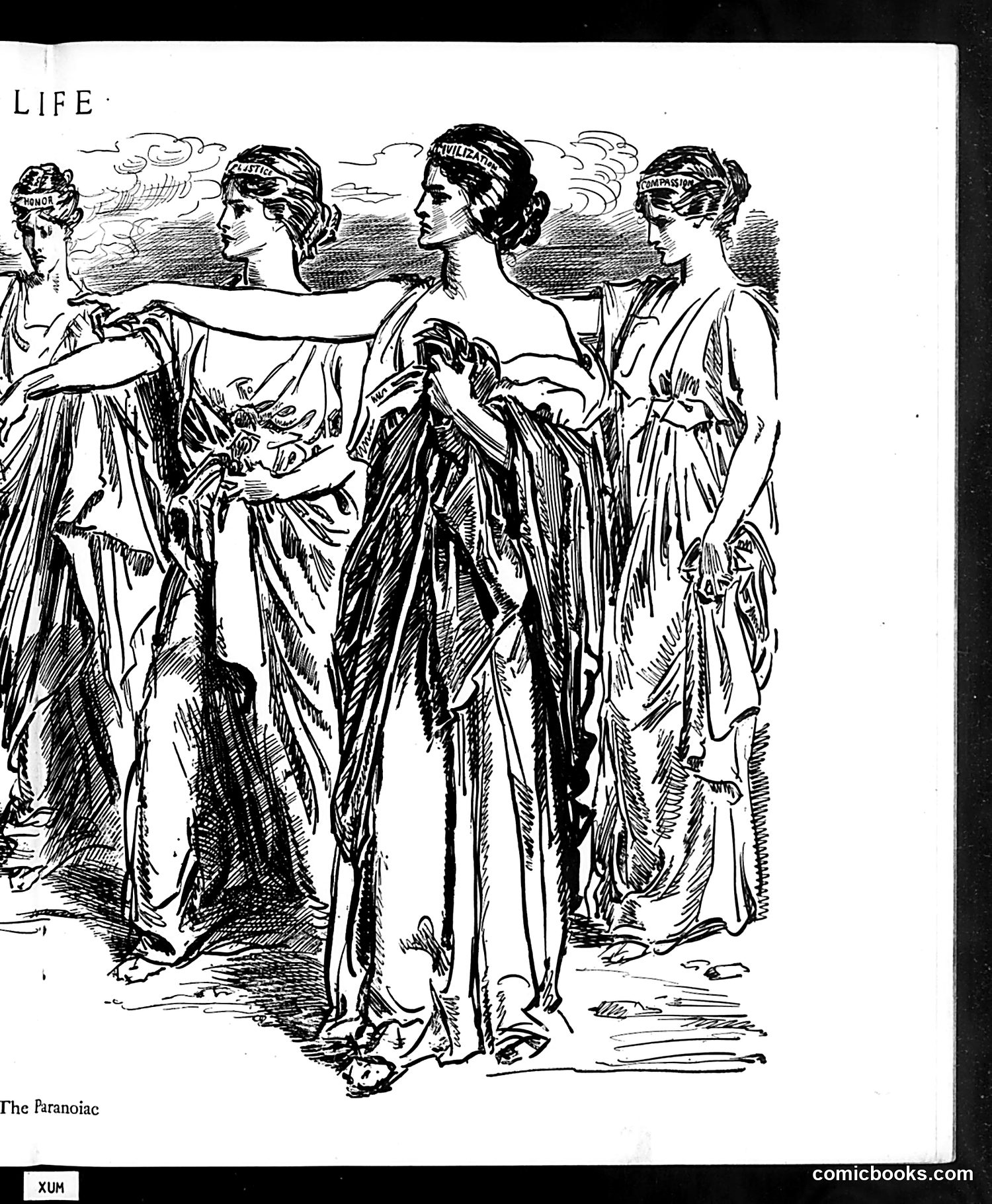
This political cartoon depicts four female allegorical figures in classical Greek dress, each wearing a headband labeled with different concepts: "Honor," "Civility," "Temperance," and what appears to be a fourth virtue (partially unclear). The central figure labeled "Civility" stands prominently in the middle. The title "The Paranoiac" suggests the cartoon critiques someone (likely a political figure of the era) suffering from paranoia—possibly seeing threats to these classical virtues where none exist, or conversely, being oblivious to their actual decline. Without additional context about the specific publication date, the exact political target remains unclear, though the imagery invokes traditional moral values under perceived threat—a common satirical device in early 20th-century American political commentary.
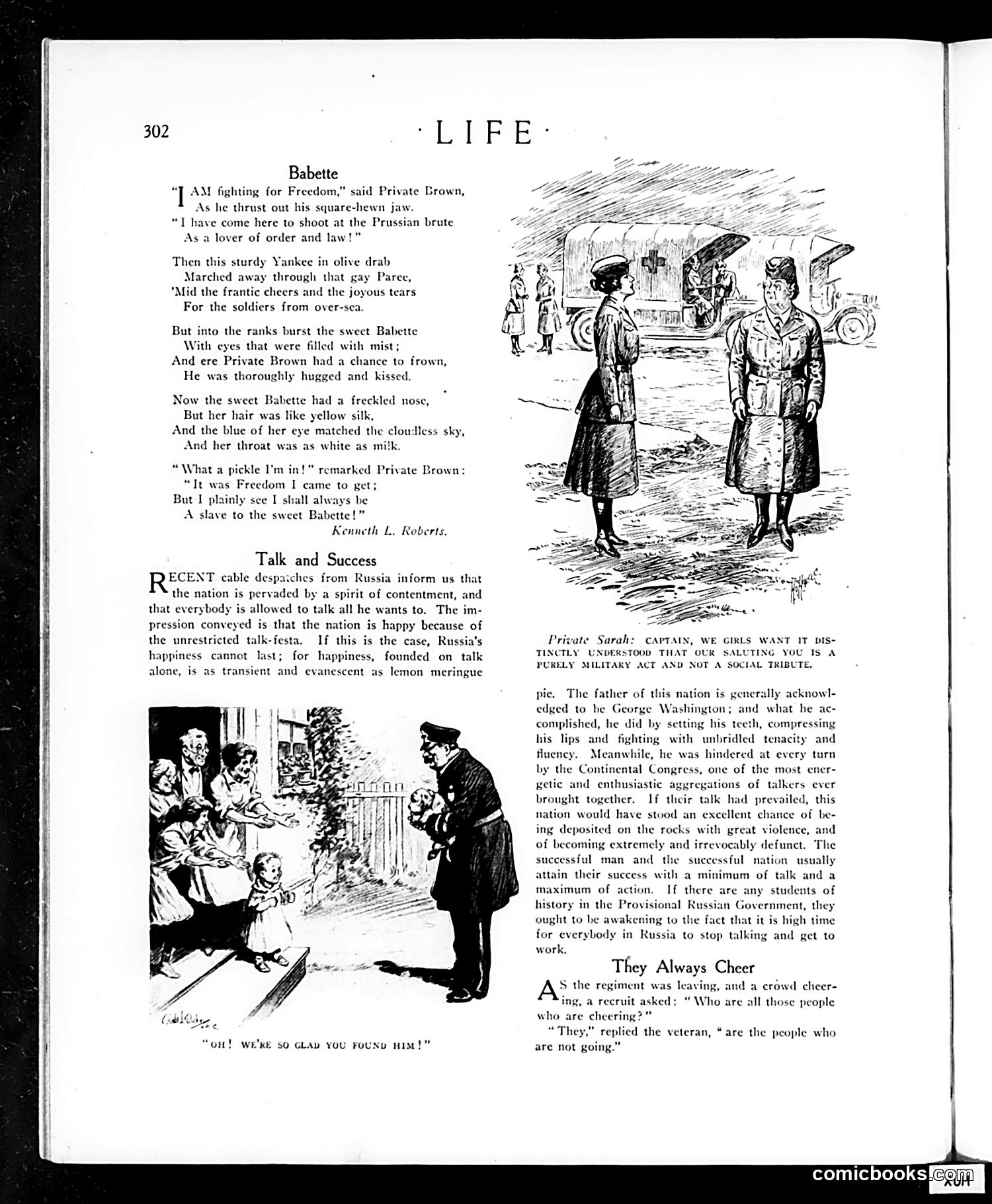
This page contains two satirical pieces from WWI-era Life magazine: **"Babette"** (poem by Kenneth L. Roberts): A romantic narrative mocking American soldiers in France. Private Brown arrives to fight Germans with patriotic fervor, only to be immediately distracted by a French girl who "hugs and kisses" him. The joke: he came seeking "Freedom" but becomes "a slave to the sweet Babette," satirizing soldiers' notorious romantic entanglements in Paris. **"Talk and Success":** A political commentary likely responding to Russia's 1917 revolution, mocking the new Russian government's emphasis on open discussion. The author argues that endless talk (like Russia's) prevents action and success. He contrasts this with George Washington's taciturn effectiveness, suggesting Russia should "stop talking and get to work"—implying the revolutionary government talks too much and accomplishes too little. **"They Always Cheer":** A brief joke about recruitment: those cheering soldiers' departures are civilians staying behind—dark humor about wartime sacrifice.
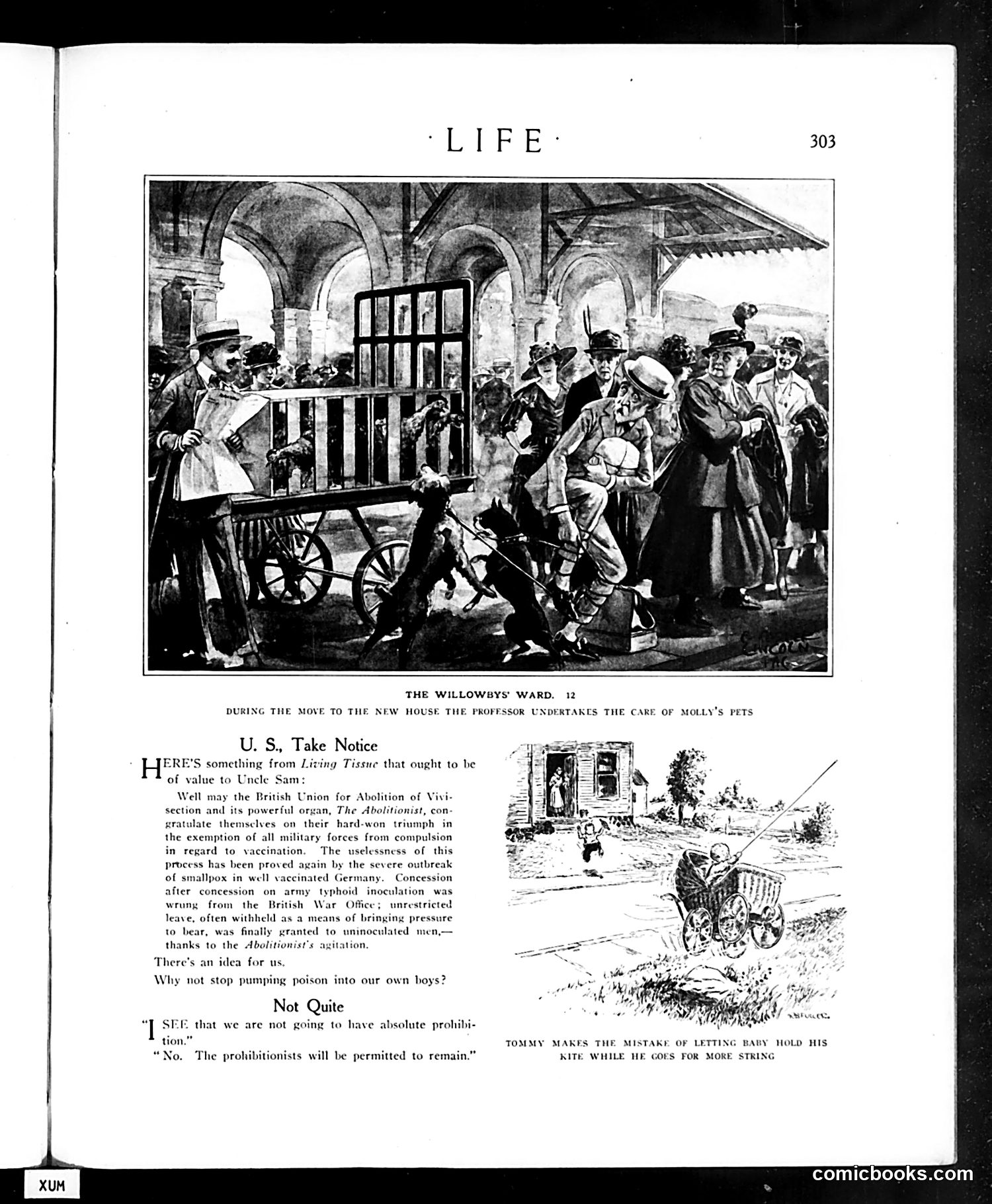
**Top Image:** A domestic comedy strip ("The Willowbys' Ward, 12") showing a professor managing pets during a house move—appears unrelated to the text below. **Main Content:** An anti-vaccination satire titled "U.S. Take Notice." The author argues that Britain's exemption of military forces from mandatory vaccination proved vaccination useless, citing a smallpox outbreak in vaccinated Germany. The piece sarcastically suggests America should stop "pumping poison into our own boys," mocking both anti-vaccination activists and those who granted military exemptions. **Context:** This reflects early 20th-century anti-vaccination sentiment in Britain (the Union for Abolition of Vivisection also opposed vaccination) and uses Germany's disease outbreak as "proof" vaccination fails—a misunderstanding of vaccination's actual effectiveness. **Bottom Item:** "Not Quite"—a brief joke about prohibition, suggesting prohibitionists will remain despite restrictions, likely referencing Prohibition-era debates. The page satirizes anti-vaccination pseudoscience while commenting on contemporary health and social policy controversies.
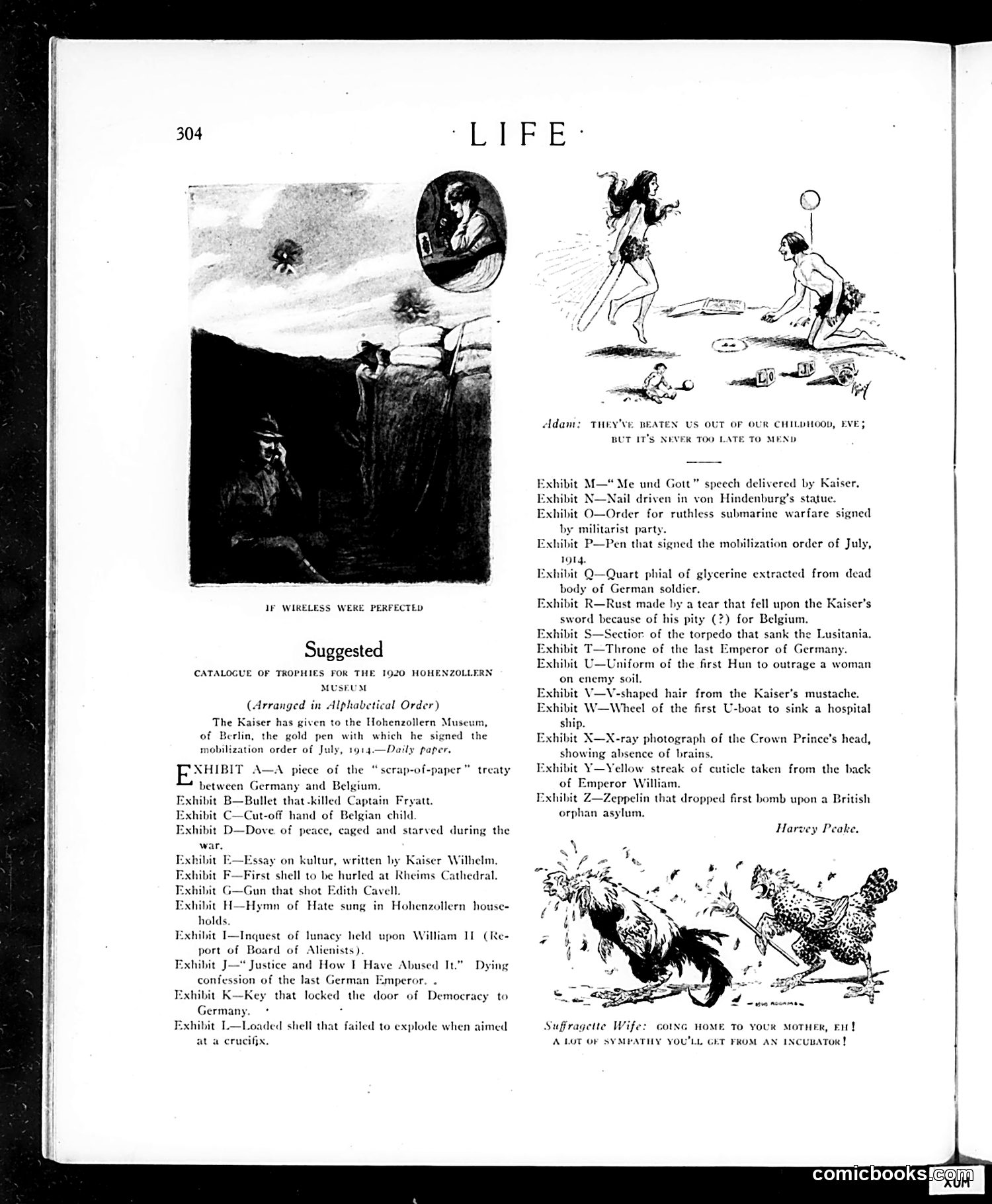
This post-WWI satirical piece proposes a darkly humorous "catalogue of trophies" for a fictional Hohenzollern Museum—a collection of objects representing German atrocities and Kaiser Wilhelm II's crimes. The satire works through an alphabetical list of increasingly absurd "exhibits," mixing real wartime horrors (the Lusitania sinking, Belgian child mutilation, Rheims Cathedral shelling) with grotesque invented items (a vial of glycerine from a dead German soldier, the Kaiser's mustache hairs). The X-ray "showing absence of brains" mocks the Crown Prince. The bottom cartoon shows children at play with the caption "They've beaten us out of our childhood, Eve; but it's never too late to mend"—suggesting generational trauma from the war. The suffragette joke references women's ongoing struggle for political recognition even after war's end. The overall message: Germany's leadership bears responsibility for systematic brutality, deserving public condemnation through this museum of shame.
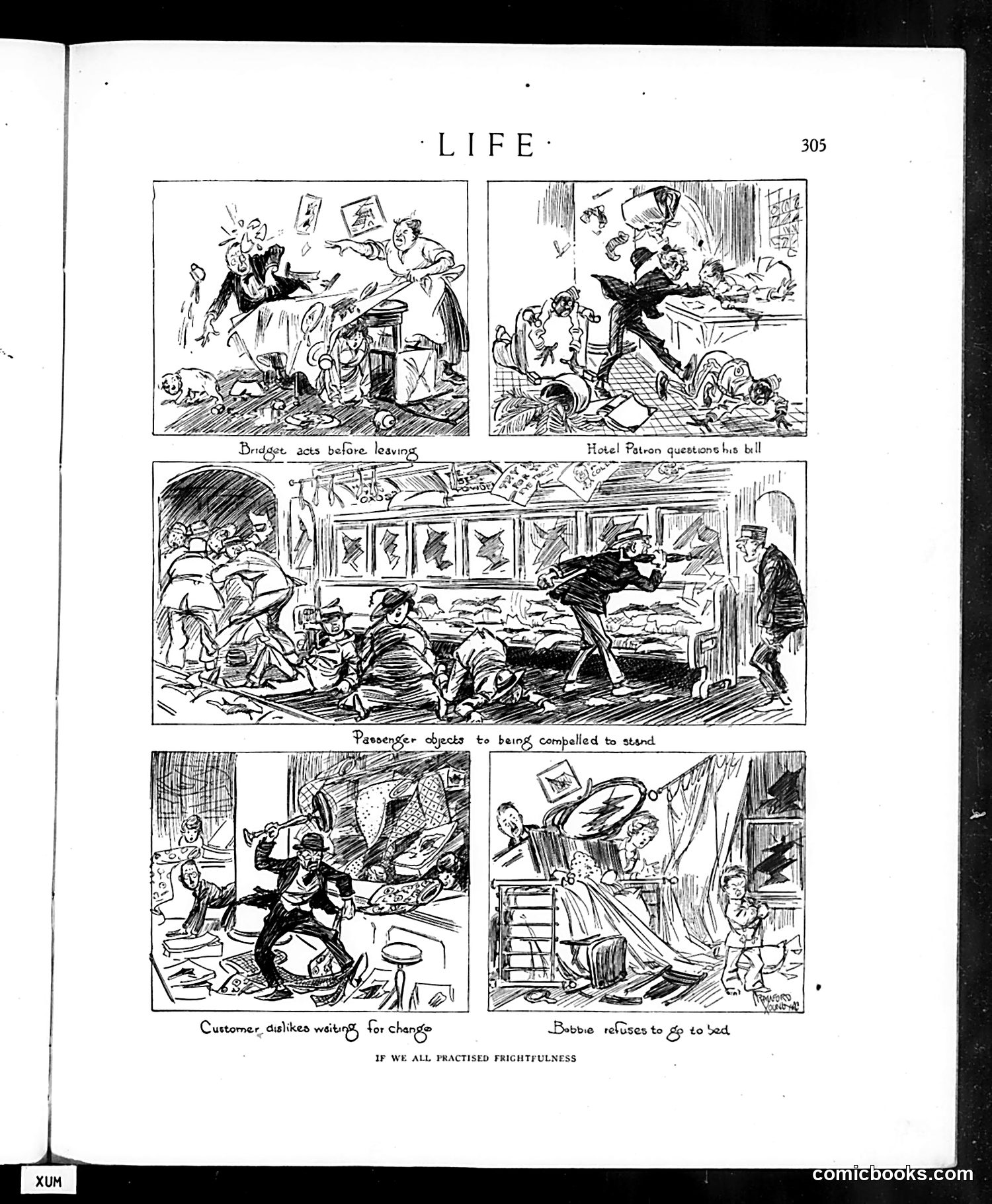
This page contains five comic panels depicting chaos and violence in everyday situations—a household in disarray, a hotel patron's violent complaint, passengers forced to stand on a crowded train, a customer intimidating a shopkeeper, and a child refusing bedtime. The title "If We All Practiced Frightfulness" suggests satire about German military tactics (Schrecklichkeit/"frightfulness" was a WWI-era concept). The humor lies in applying brutal intimidation to trivial civilian complaints: waiting for change, hotel bills, train crowding, and children's bedtime resistance. The satire mocks both aggressive behavior and the absurdity of escalating minor inconveniences to violence—suggesting that if everyone adopted aggressive intimidation tactics for petty grievances, society would collapse into absurdity. The page appears to advocate for restrained, reasonable conduct instead.
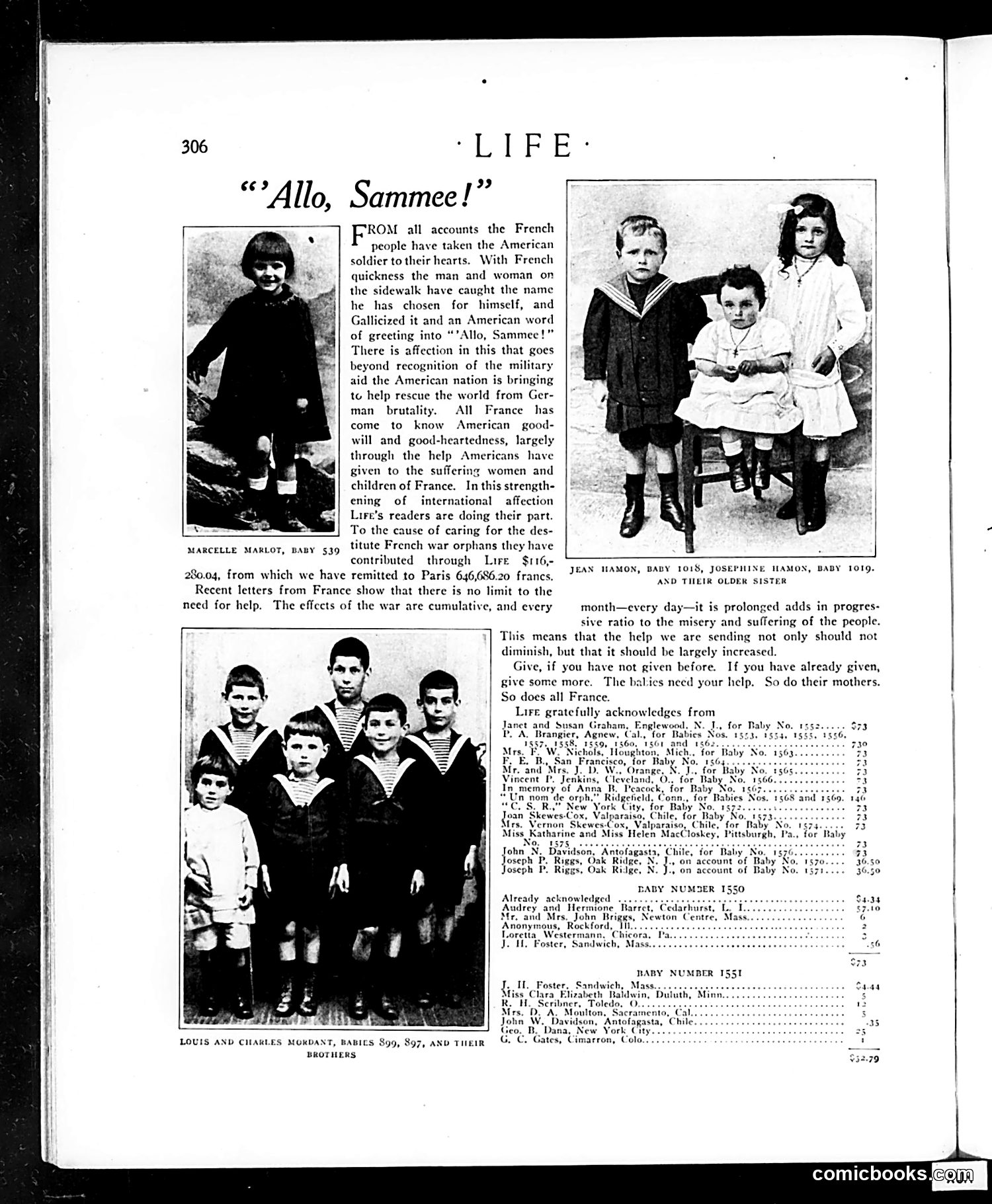
This is not a cartoon but a **fundraising article** for French war orphans during World War I. The page features photographs of French children aided by Life magazine's relief fund and solicits American donations. The title references the French public's affectionate nickname for American soldiers—"Sammee" (Sam), Gallicized from the American slang. The text emphasizes that French civilians have embraced American soldiers not just militarily but emotionally, creating goodwill beyond military strategy. The article appeals to readers' sentiments by highlighting American generosity toward "suffering women and children of France." It documents contributions already made ($116,280.04) and urges increased giving, stating needs are "cumulative" as war continues. The photographs show specific orphans sponsored through donations—each identified by number and donor name—personalizing the appeal and demonstrating where money goes.
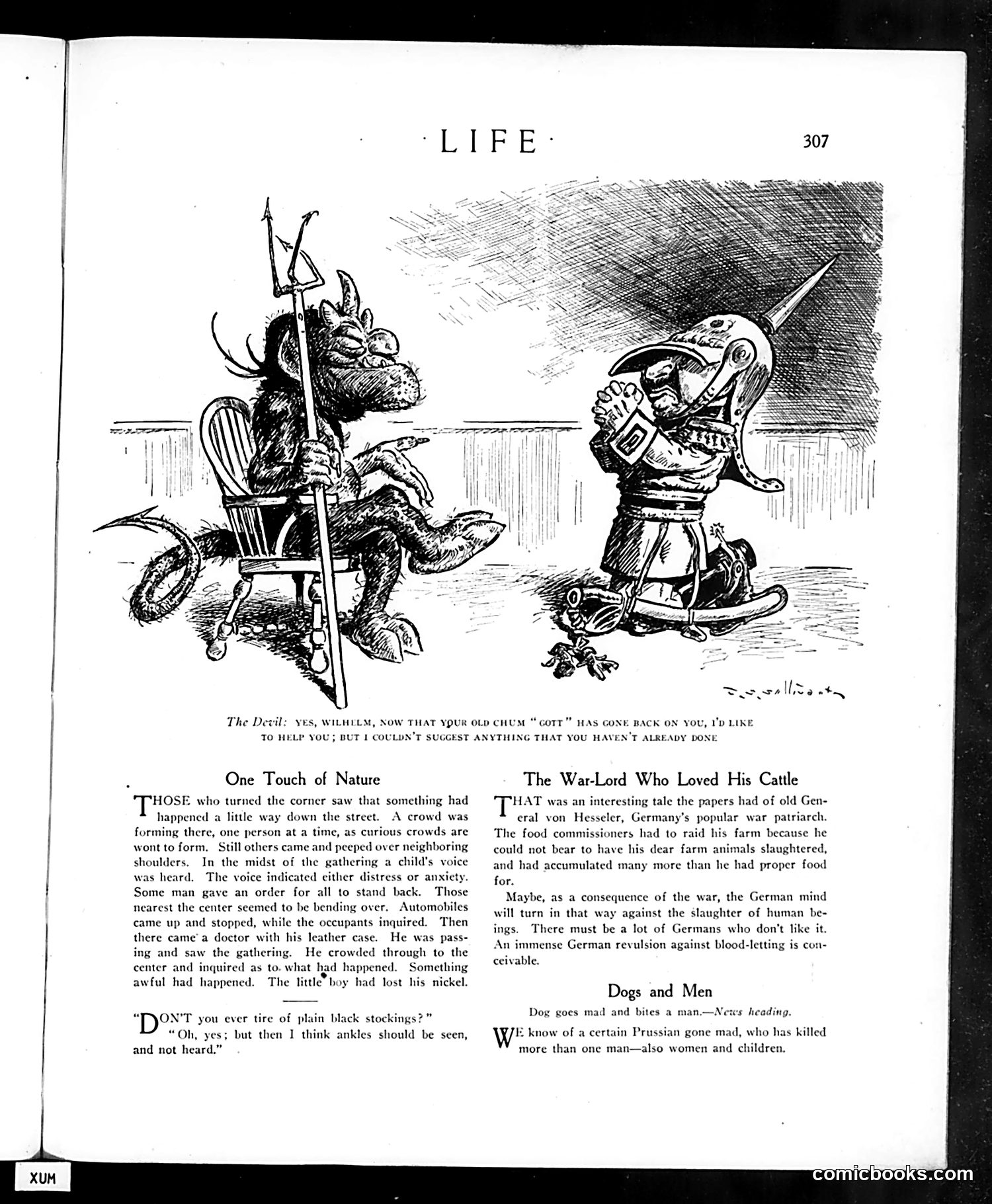
**The Devil Cartoon (top):** Depicts a grotesque demon-like figure seated on a throne confronting a military officer (appearing to be German, given the uniform). The devil offers cynical "help" to Wilhelm (the German leader), sarcastically noting he "couldn't suggest anything that you haven't already done." This is anti-German WWI propaganda, portraying Germany's military leadership as already deeply evil. **"The War-Lord Who Loved His Cattle":** References General von Hesseler, a real German general who allegedly hoarded farm animals rather than slaughter them for food during wartime. The piece sardonically suggests Germans might develop moral revulsion against killing—but only *after* committing atrocities against humans. The implicit criticism: German leadership showed more concern for livestock than for human life. **"Dogs and Men":** A brief satirical note contrasting a news headline about a rabid dog with Germany's systemic killing of civilians, positioning German military conduct as inhuman. All three items are wartime satire attacking German militarism and atrocities.
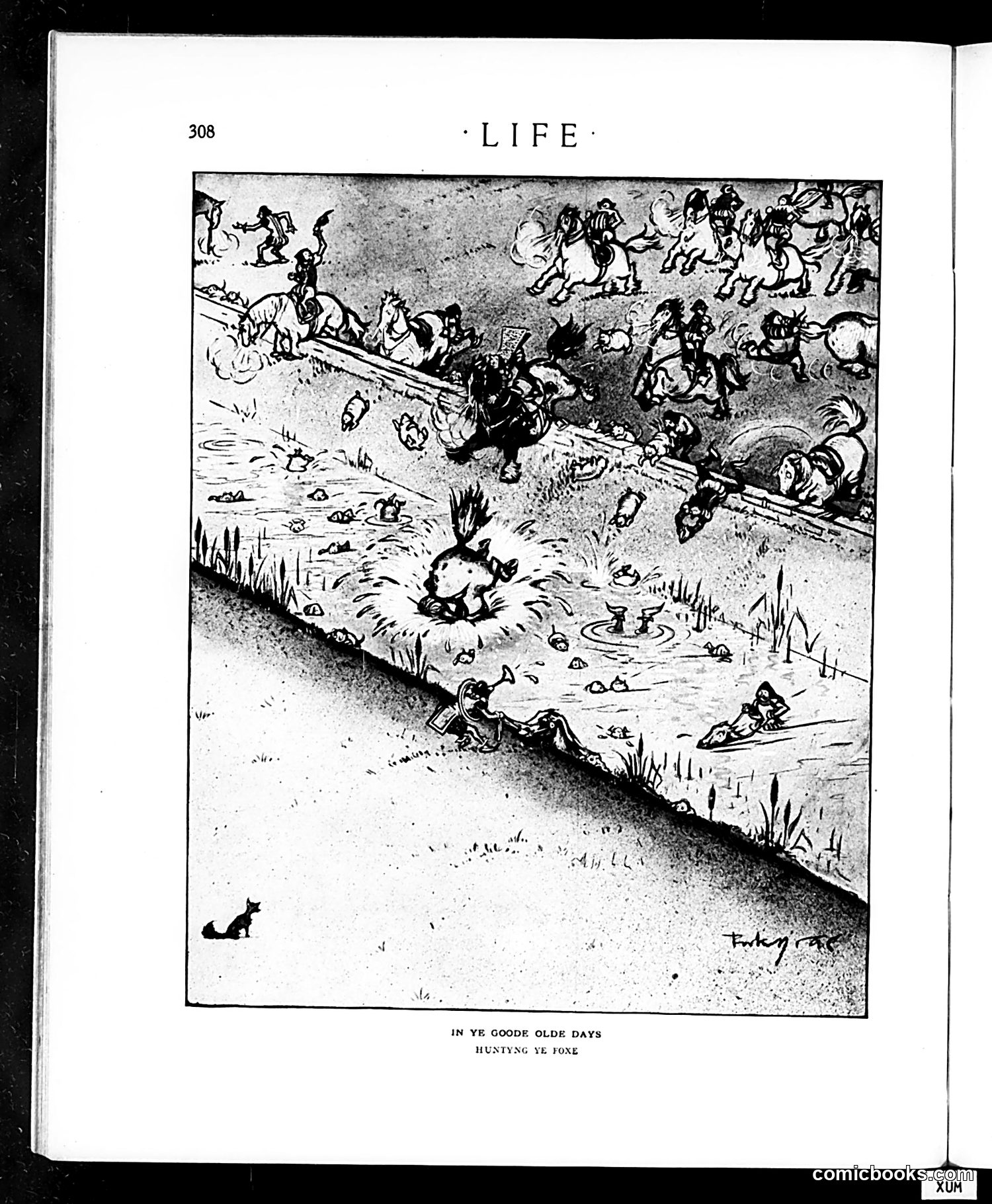
This cartoon satirizes fox hunting, a traditional aristocratic sport. The image depicts a chaotic medieval-style hunting scene with numerous mounted riders, dogs, and what appears to be a fox being pursued near water. The satire likely mocks either: 1. The romanticization of "the good old days" of aristocratic pastimes, or 2. The actual practice of fox hunting itself—portraying it as disorganized chaos rather than the dignified sport its practitioners claimed The deliberately archaic spelling ("ye goode olde," "huntyng") signals nostalgic parody. The scene's frenzy—with multiple figures tumbling, splashing, and scattering—contrasts sharply with any notion of elegant sporting tradition, suggesting the author viewed fox hunting (or nostalgic reverence for past practices) as absurd or worthy of ridicule.
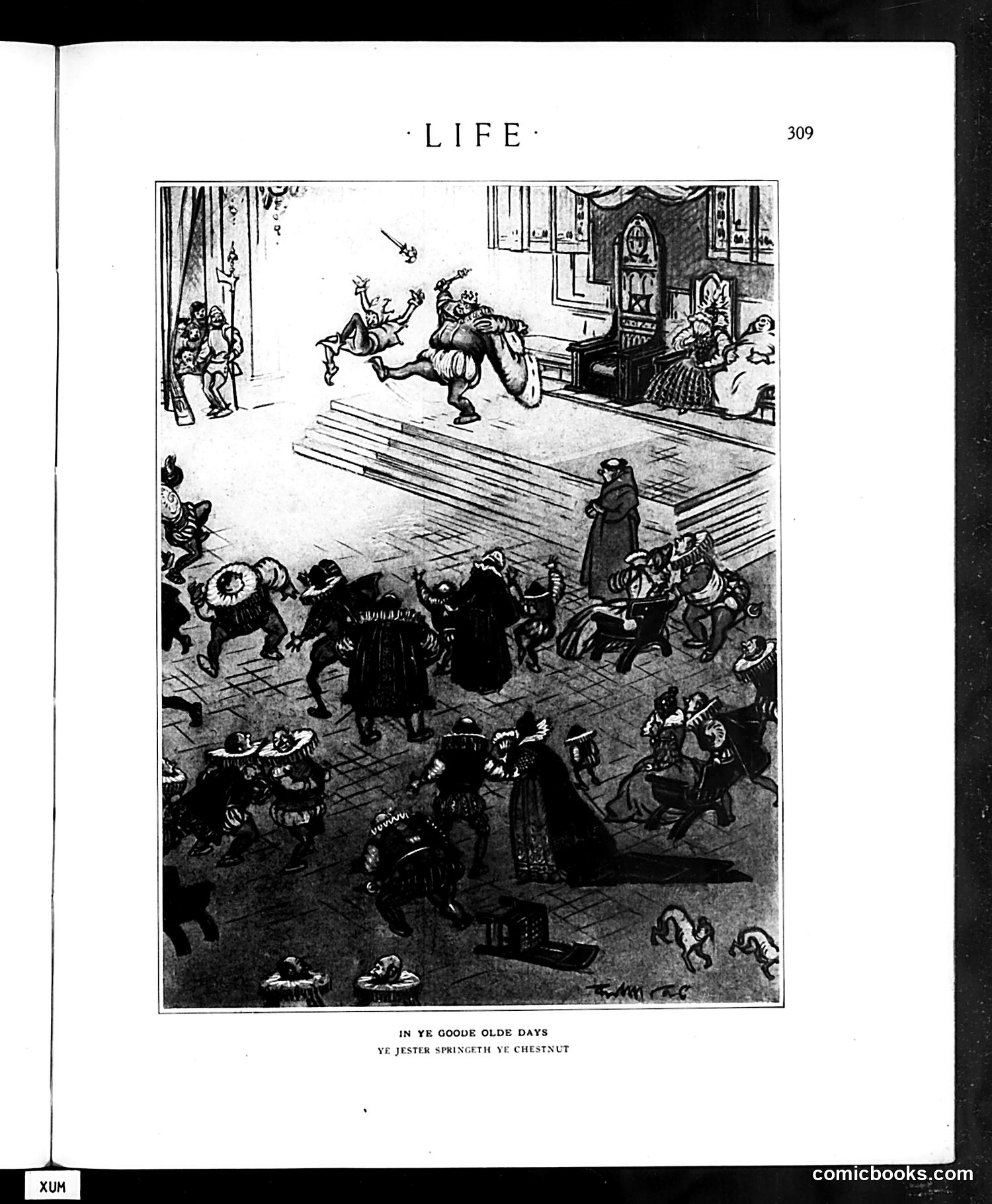
This is a historical satire cartoon depicting a medieval court scene. The caption "In Ye Goode Olde Days / Ye Jester Springeth Ye Chestnut" is a joke about recycled humor. A jester in the center performs for a gathered crowd of nobles and courtiers in what appears to be a grand hall. The phrase "springeth ye chestnut" is a playful, archaic-English way of saying "tells an old joke" (a "chestnut" being period slang for a tired, repeatedly-told joke). The satire works on two levels: it mocks both medieval entertainment and, by extension, modern comedians or performers who recycle stale material. The elaborate period setting underscores the timelessness of bad humor—even jesters in "ye olde days" told worn-out jokes. It's a clever commentary on the universal problem of unfunny comedians.
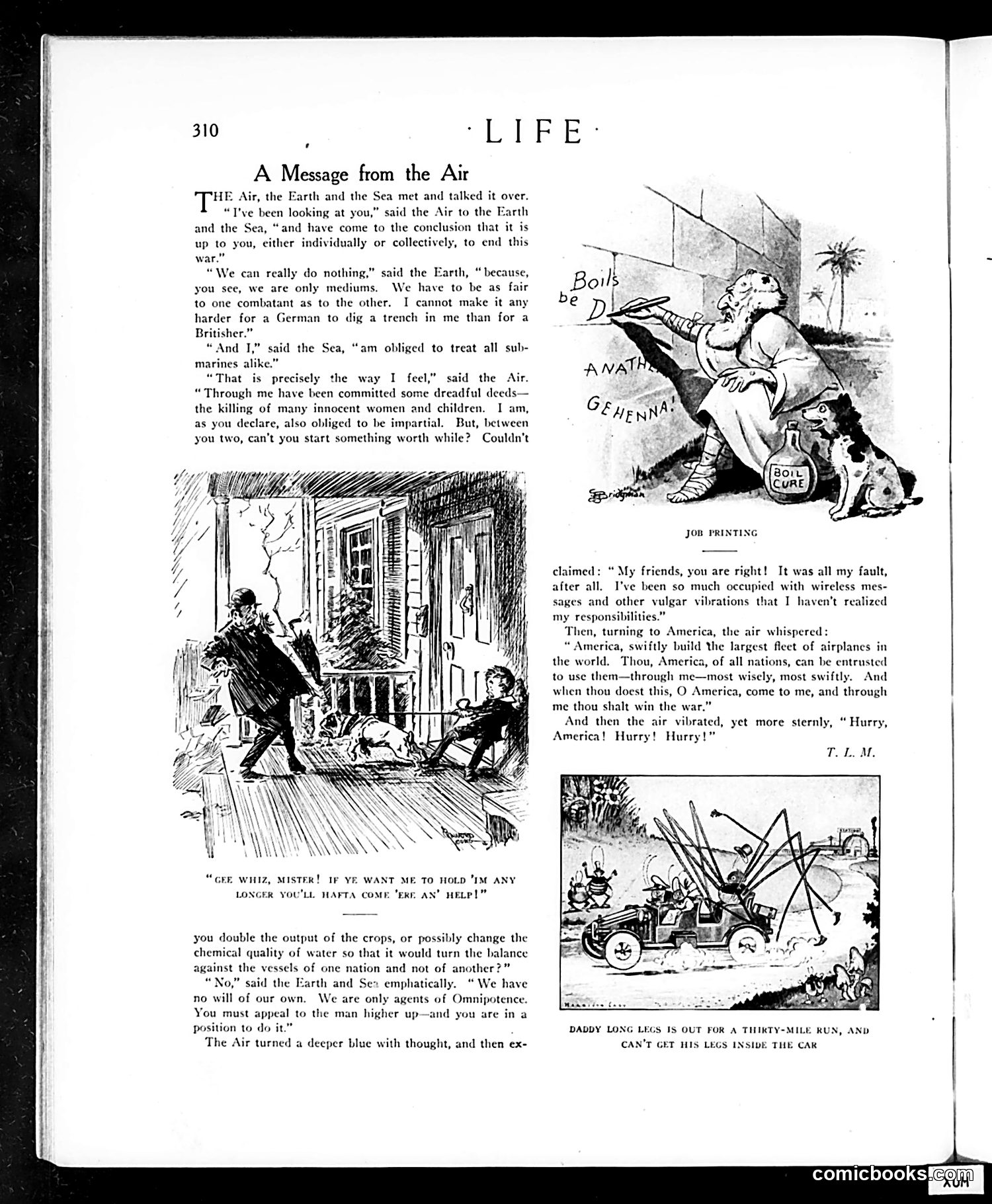
This allegorical piece uses personified natural elements (Air, Earth, Sea) to satirize World War I neutrality debates. The Earth and Sea claim they cannot favor either side—they are "only mediums" bound to impartiality. The Air, however, acknowledges complicity in wartime atrocities (aerial bombardment of civilians) but deflects responsibility to "the man higher up." The satire's punch: the Air then pivots to urge **America** to build the largest air fleet and enter the war, claiming only America can "wisely" use such power. This mocks the contradiction—entities claiming neutrality while actively advocating intervention. The repeated "Hurry, America! Hurry!" emphasizes propaganda pressure on the United States to abandon neutrality and join the Allied cause. The cartoons below (showing domestic scenes) appear unrelated.
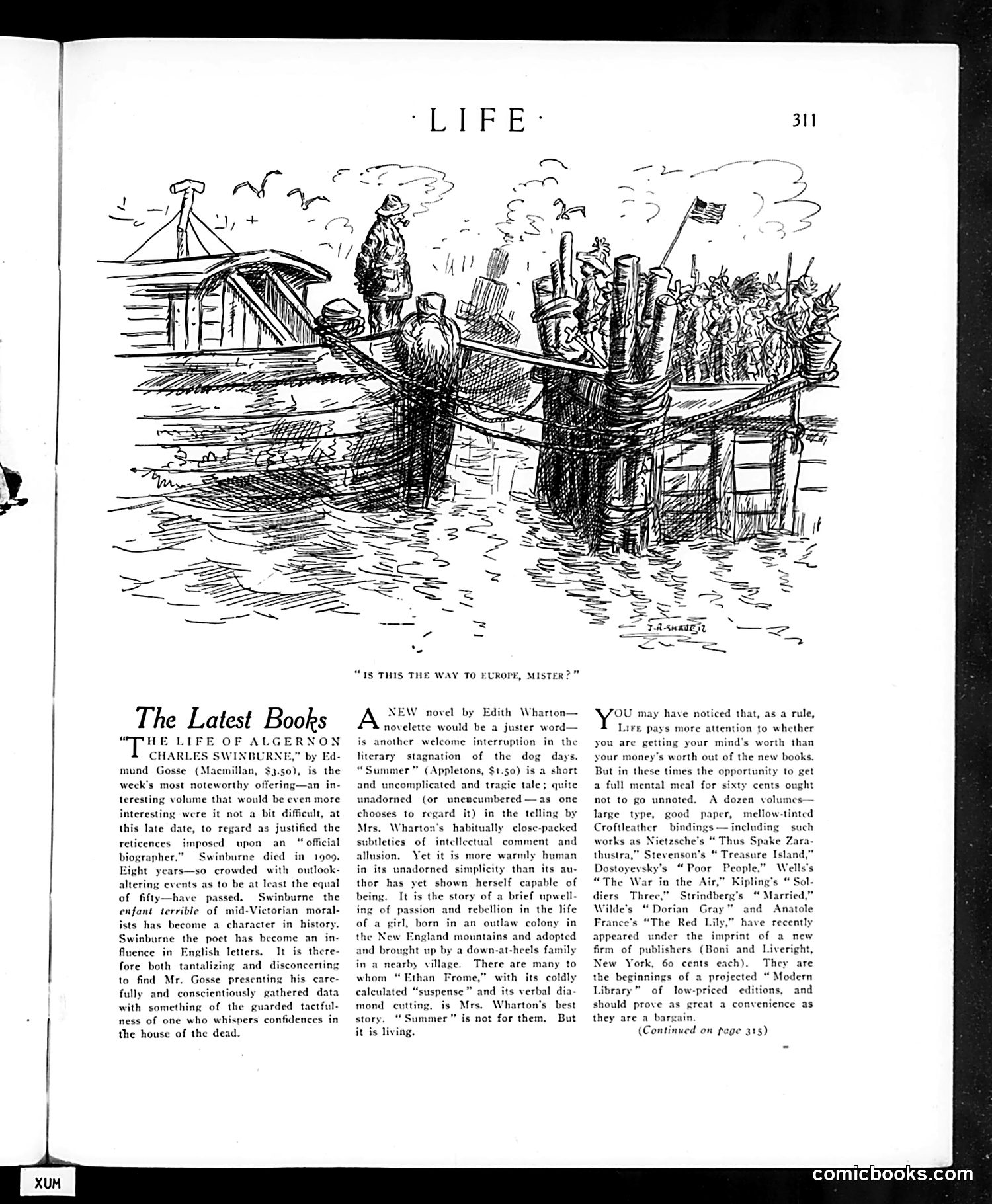
This cartoon depicts two figures at a dock or waterfront, apparently asking for directions to Europe. The sketch shows a man in working clothes gesturing toward the water while speaking to another figure. The humor appears to target **American isolationism or naïveté about European geography and distance**—the absurdity of someone asking directions to an entire continent as if it were a nearby destination. The cartoon likely reflects post-World War I American attitudes (the page references Swinburne's 1909 death, placing this around 1917-1920). The joke satirizes either American unfamiliarity with European affairs or the period's debates about American involvement in Europe's conflicts—mocking the simplistic notion that one could casually travel "to Europe" as a solution to problems. The accompanying book reviews discuss literary works and publishers, but are unrelated to the cartoon's message.
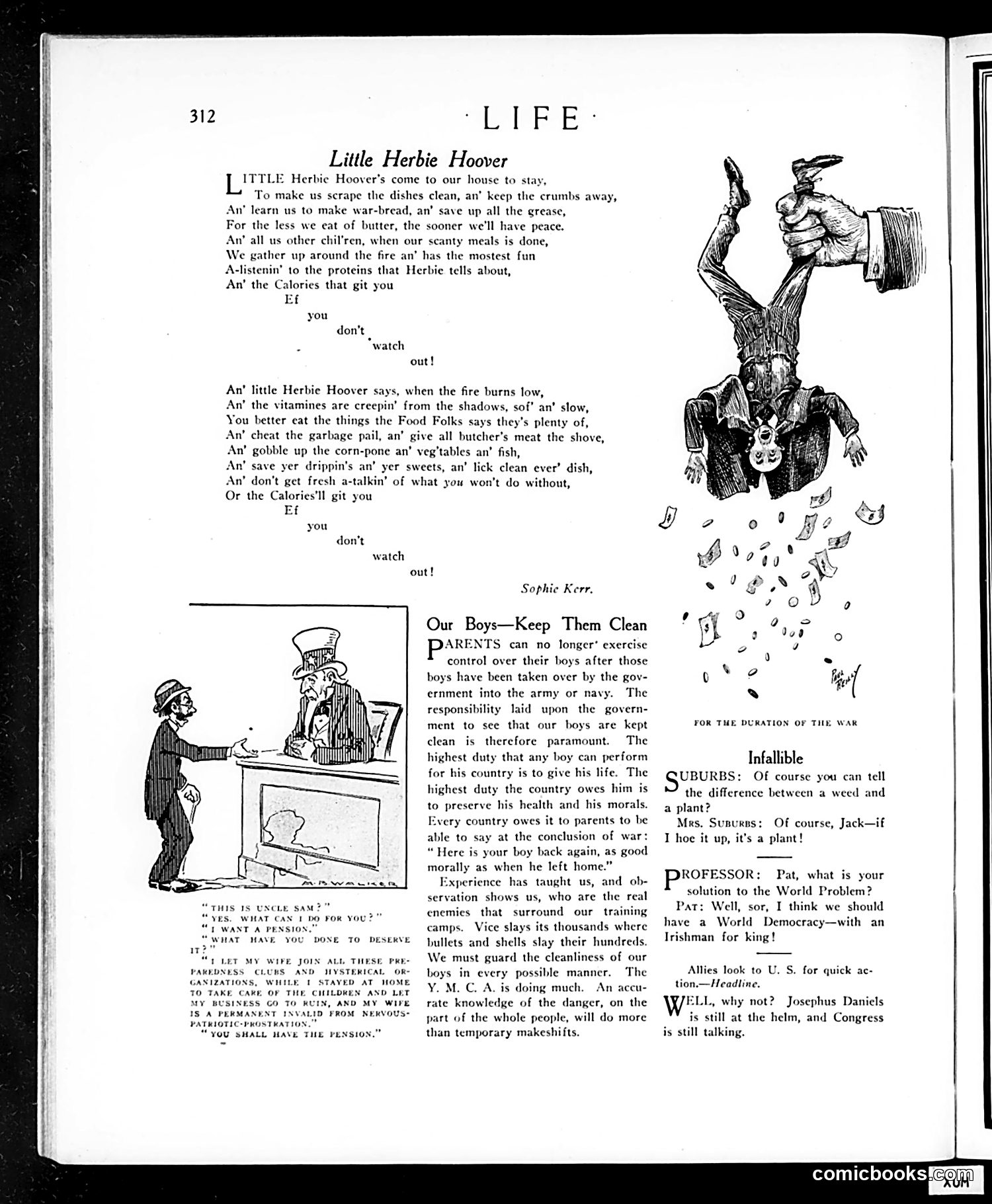
This page contains WWI-era satire targeting **Herbert Hoover** and wartime food conservation efforts. **"Little Herbie Hoover"** mocks Hoover's role as Food Administrator during World War I. The poem satirizes his campaign urging Americans to ration butter, meat, and other foods—using childlike vernacular to ridicule the earnest messaging. "Herbie" becomes a nagging character enforcing wartime sacrifice ("the Calories'll git you"). **The cartoon** shows Uncle Sam at a desk, where a man requests a pension for letting his wife join "preparedness clubs and hysterical organizations" while he stayed home ruining his business. Uncle Sam grants it—satirizing how such patriotic volunteering is rewarded while productive citizens suffer. **"Our Boys—Keep Them Clean"** addresses military morality, arguing the government must protect soldiers' health and virtue in training camps—a reference to widespread concern about vice near military bases. **The joke exchange** at bottom mocks simple reasoning: a housewife defines weeds pragmatically (anything she hoes up). An Irishman proposes "World Democracy" with himself as king—absurdist humor about solving post-war problems.
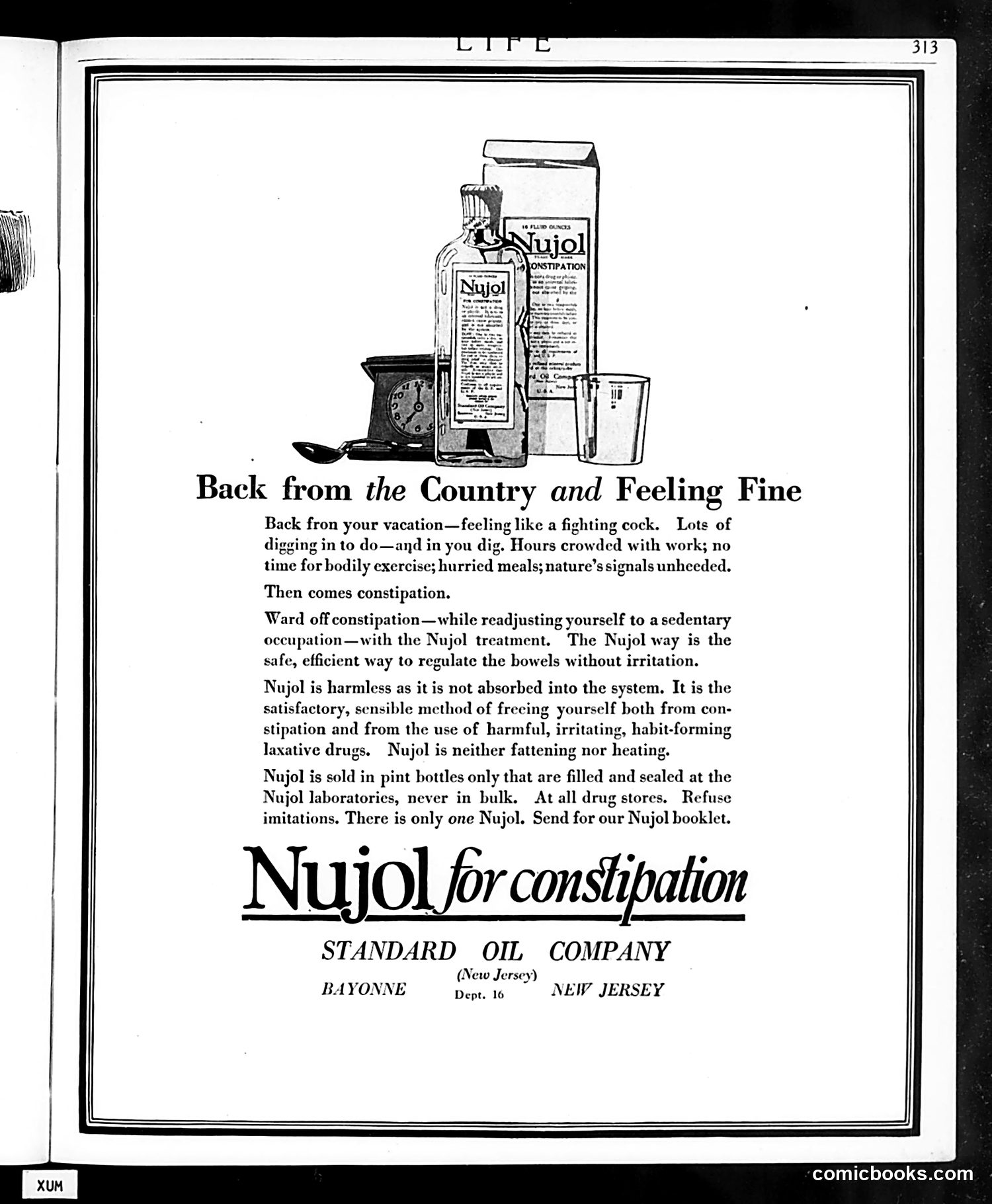
This is a **full-page advertisement**, not a cartoon or satire. It promotes Nujol, a mineral oil laxative made by Standard Oil Company (New Jersey), marketed from Bayonne, New Jersey. The ad addresses a relatable scenario for early 20th-century readers: returning from vacation to sedentary office work, rushed meals, and neglected exercise—leading to constipation. The colorful language ("feeling like a fighting cock") adds period charm. Nujol's pitch emphasizes it as a "safe, sensible" alternative to "harmful, irritating, habit-forming laxative drugs" of the era, claiming it's harmless because it isn't absorbed into the body. The ad stresses buying only official sealed bottles to avoid counterfeits. This reflects a time when such remedies were heavily advertised in mainstream publications and constipation was openly discussed in commercial messaging—a stark contrast to modern advertising sensibilities.
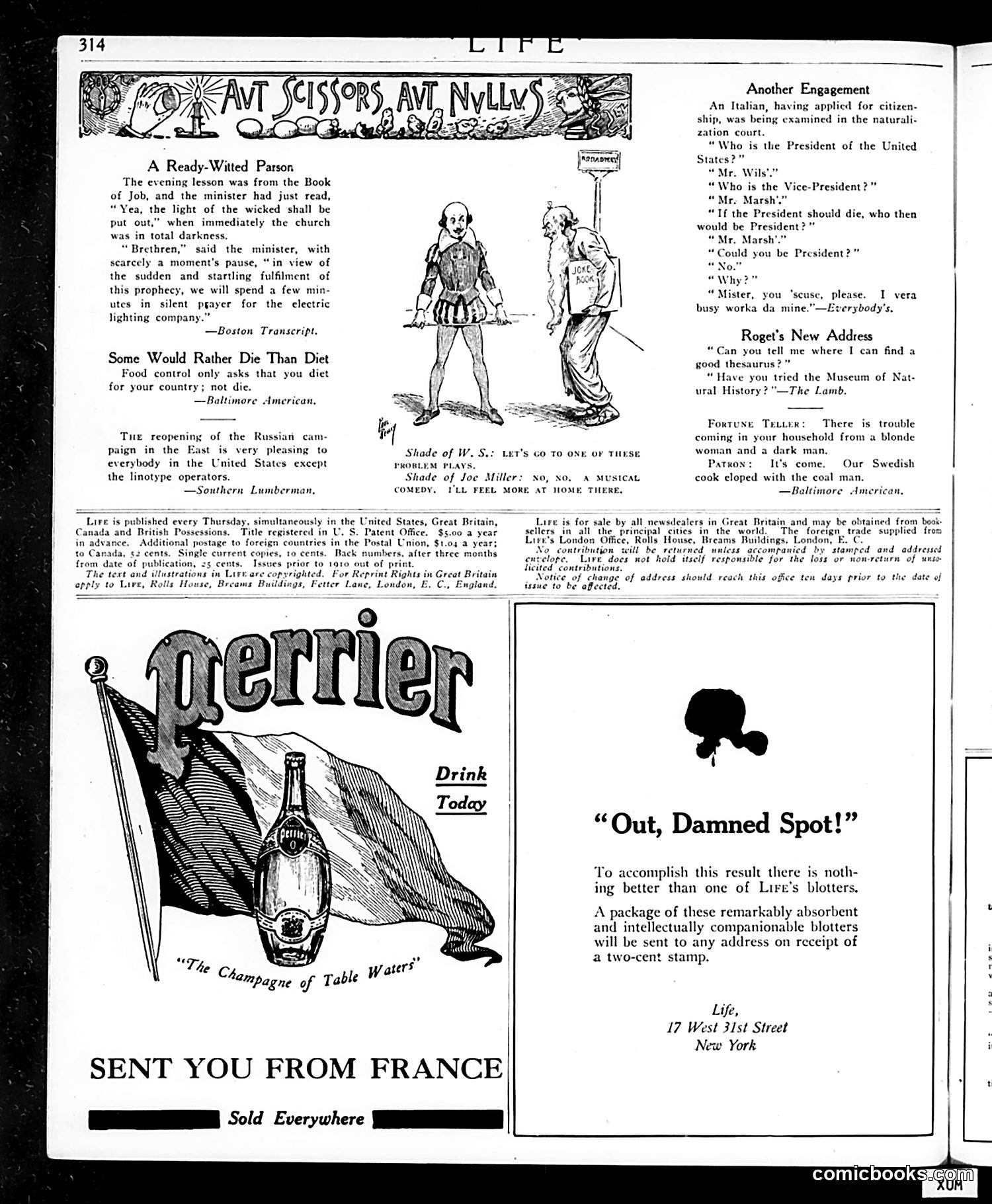
This page contains several short satirical pieces typical of Life's humor format: **"Another Engagement"** mocks naturalization exam questions through an Italian immigrant's responses. When asked if he could be President, he deflects: "I vera busy worka da mine"—satirizing both the absurdity of asking immigrants such questions and stereotyping immigrant speech patterns. **"A Ready-Witted Parson"** jokes about a minister whose church loses power mid-sermon while reading about wicked men's "light being put out." His quip—praying for the electric lighting company—is clever wordplay on the coincidence. **"Some Would Rather Die Than Diet"** comments on WWI-era food rationing, contrasting government requests to diet "for your country" with actual war deaths. The remaining items are brief puns ("Roget's New Address," "Fortune Teller"). **The Merrier advertisement** promotes French Perrier water as an elegant beverage. **"Out, Damned Spot!"** advertises Life's blotters—absorbent paper for ink spills—using a Macbeth reference. This is primarily a humor/advertising page from an early 20th-century satirical magazine.
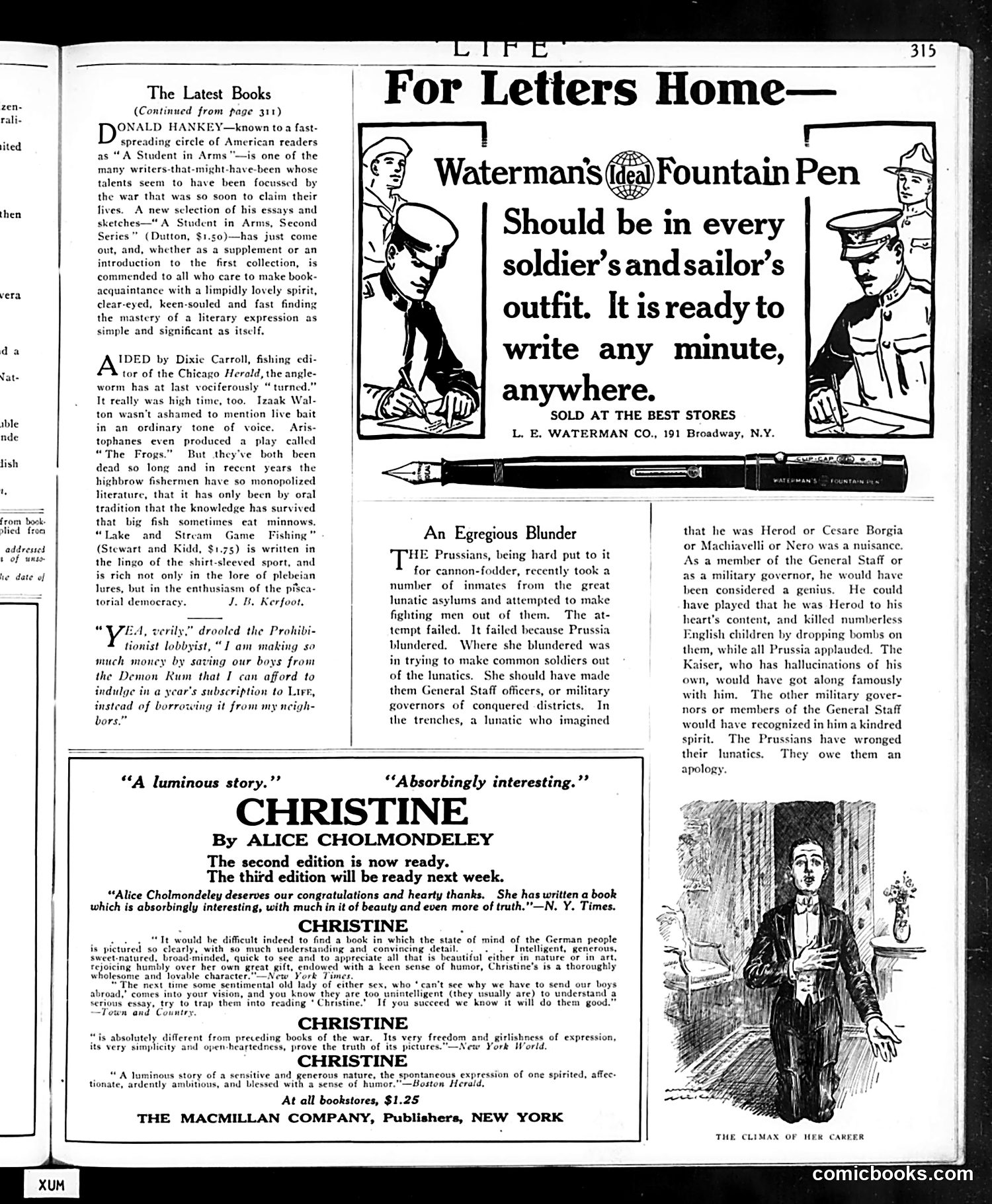
This page is primarily **book advertisements and reviews**, not political cartoons, though it contains satirical commentary. **Main Content:** The top features a **Waterman's Fountain Pen advertisement** targeting soldiers and sailors—typical WWI-era marketing linking consumer products to military service. **The Satire ("An Egregious Blunder"):** The brief article mocks the Prussian (German) military strategy of conscripting inmates from mental asylums as combat soldiers. The joke: these men failed as regular soldiers but would have succeeded as **German General Staff officers**—a cutting insult suggesting German military leadership was itself insane. This reflects American WWI-era propaganda portraying German command as incompetent and irrational. **Lower Section:** Large advertisements for Alice Cholmondeley's novel *Christine*, praised for depicting German character sympathetically despite wartime tensions—notable for presenting the enemy as human rather than purely villainous. The page reflects 1917-1918 American attitudes: mockery of enemy military leadership combined with selective appreciation for German culture and humanity.
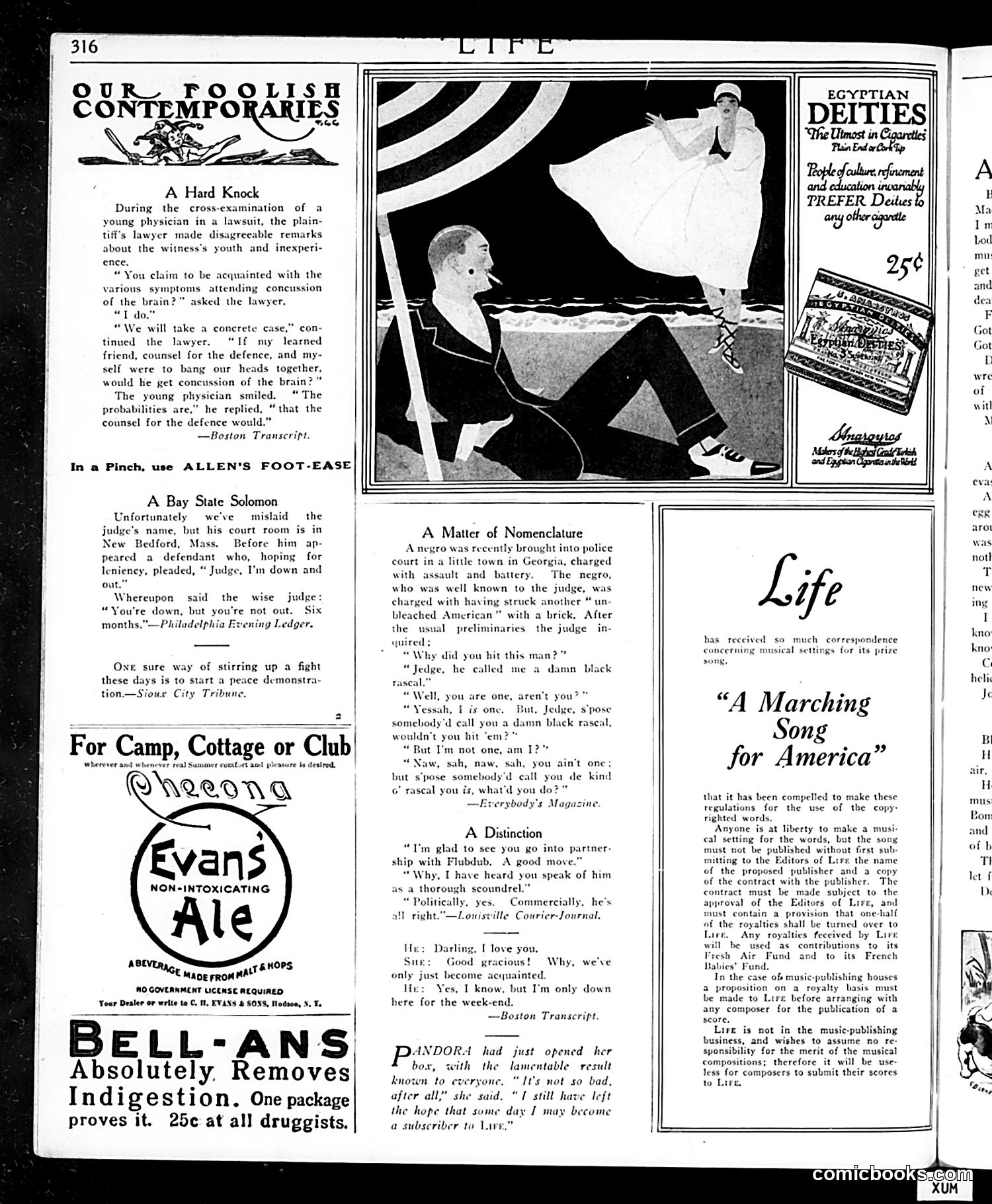
This page features short humorous anecdotes mocking human folly, typical of Life magazine's satirical format. **"A Hard Knock"**: A lawyer cross-examining a young physician insults his inexperience by asking if banging their heads together would cause brain concussion. The doctor replies the defense counsel would suffer it—implying the lawyer lacks brains. **"A Bay State Solomon"**: A judge tells a defendant he's "down but not out," offering hope despite his dire circumstances—wise judicial mercy. **"A Matter of Nomenclature"**: A Georgia courtroom scene where a Black defendant and judge debate racial slurs with dark irony. The judge calls the defendant a "rascal" while questioning why he hit a man who did the same, exposing the hypocrisy and casual racism of the judicial system. **"A Distinction"**: A businessman separates someone's personal morality from commercial reliability—claiming a man is politically dishonest but commercially trustworthy. The page also contains period advertisements (Evans Ale, Bell-Ans indigestion remedy) and a note about Life's "Marching Song for America" contest rules.
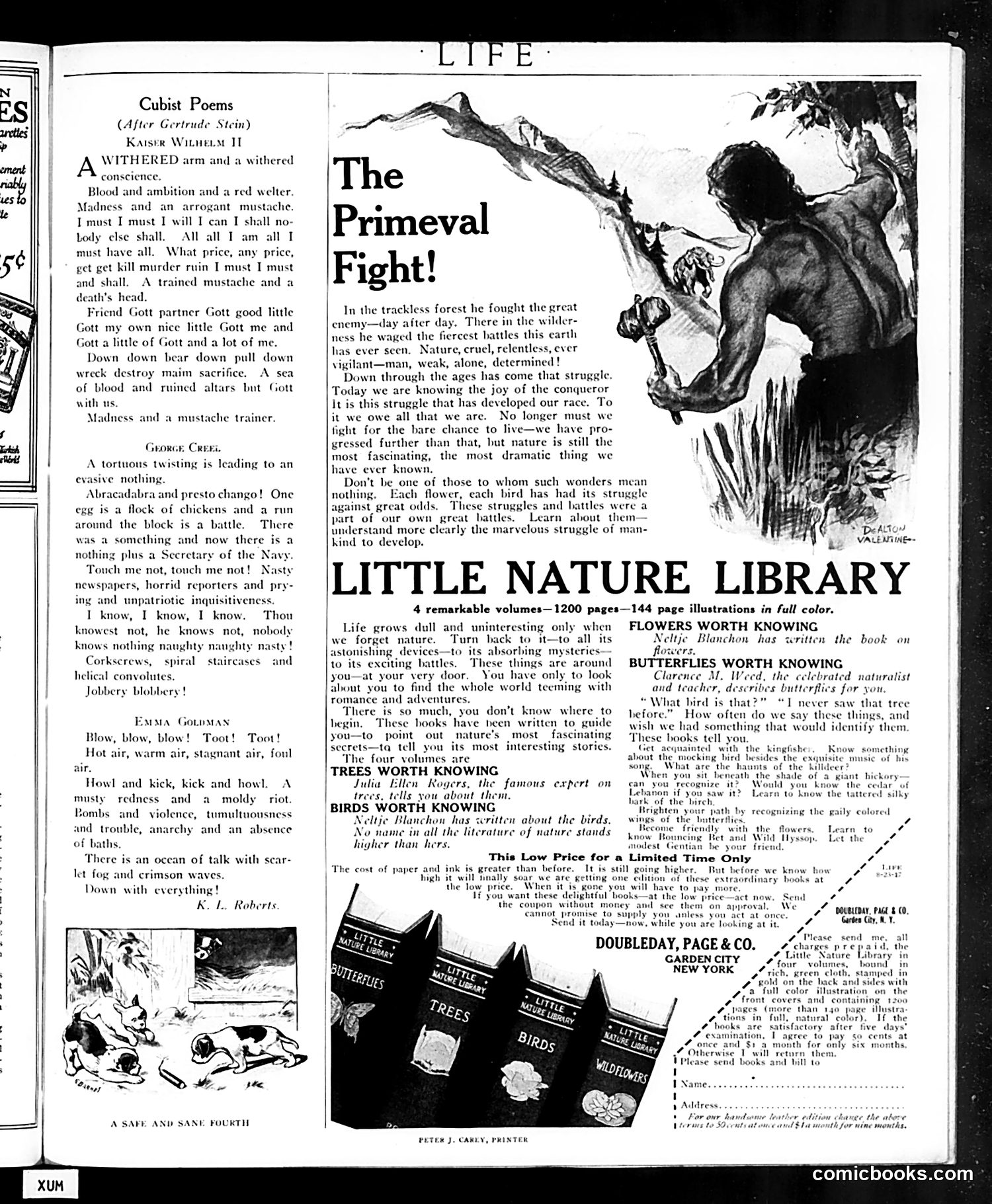
This page contains **Cubist poetry parodies** mocking German leadership during World War I, alongside a nature book advertisement. The poems attributed to various authors are satirical "Cubist" pieces (mimicking Gertrude Stein's fragmented style). The first, titled "Kaiser Wilhelm II," uses repetitive, broken language ("I must I must I will I can") and violent imagery ("wreck destroy maim sacrifice," "blood and ruined altars") to ridicule the German emperor as power-mad, ruthless, and mentally unstable—depicted as having "a withered arm and a withered conscience." Other poems mock German officials with similar absurdist techniques, attacking their competence and character through deliberately incoherent verse. The illustration "The Primeval Fight!" shows a man struggling against nature, metaphorically suggesting humans must fight to survive and develop—likely implying Germany's aggressive imperial ambitions as "natural" human competition (a popular justification for militarism). The juxtaposition of wartime political satire with educational advertising was typical of *Life* magazine's format during this period.
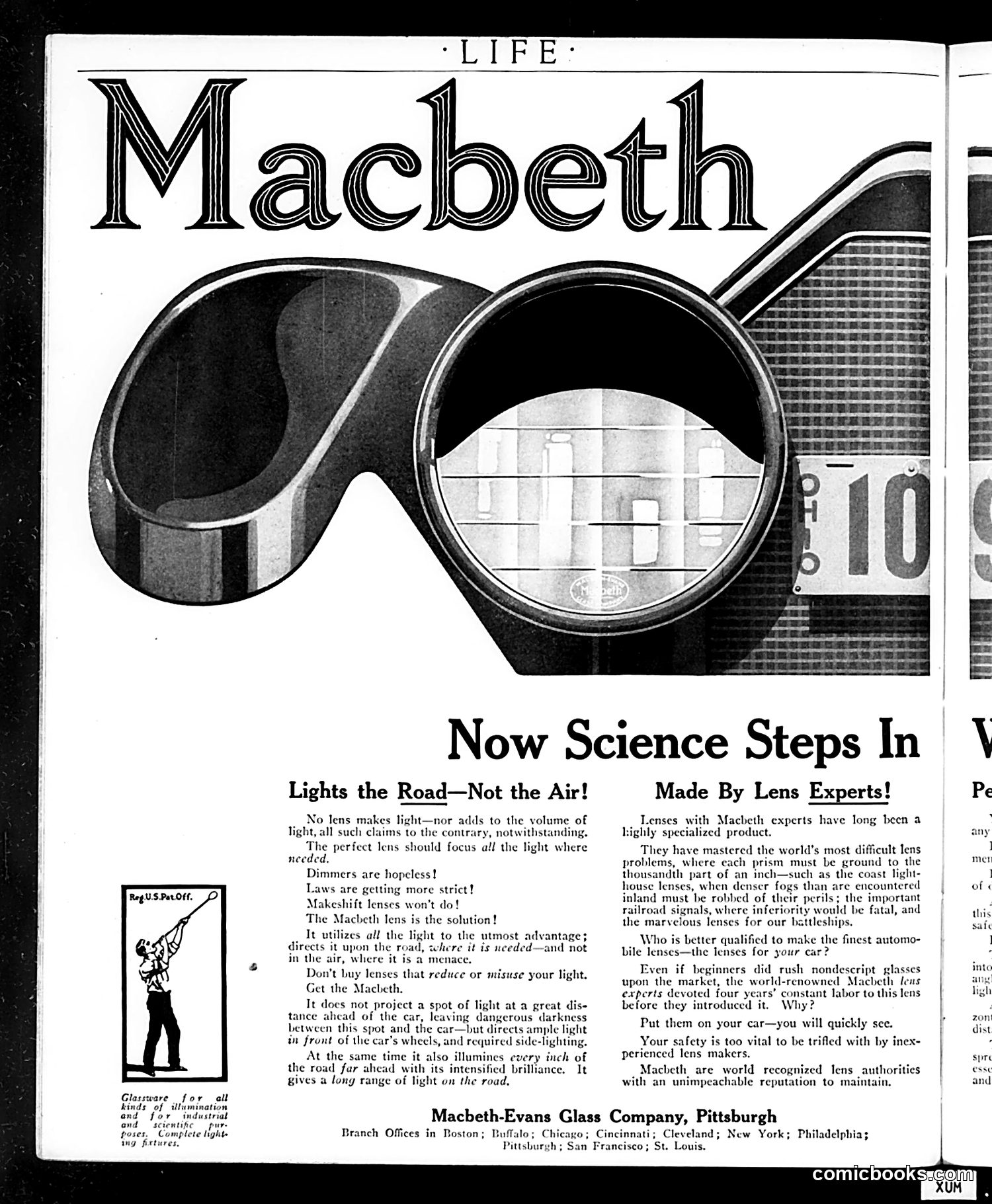
This is primarily a **full-page advertisement** for Macbeth-Evans Glass Company's automobile headlight lenses, not a political cartoon or satirical content. The small illustration in the lower left—labeled "Put US Pat Off"—appears to show a figure with a gun or similar implement, but its connection to the lens advertisement is unclear. It may be an unrelated magazine element or mascot. The advertising copy emphasizes that Macbeth lenses are superior because they focus light *on the road* rather than "in the air," addressing apparent safety concerns about automobile lighting. The text appeals to authority by noting the company's expertise in specialized optical work for lighthouses and battleships, positioning consumer car lenses as applying military-grade precision. The advertisement targets early automobile owners concerned about nighttime driving safety—a genuine practical issue as motorcar adoption increased. There is no discernible political satire on this page; it is commercial messaging using technical superiority claims.

This is a **product advertisement**, not a political cartoon. It promotes Macbeth-Evans Glass Company's automotive headlight lenses, particularly their "green glass visor" model. The ad emphasizes safety features: the green-tinted lens redirects light downward to illuminate the road while preventing dangerous glare that blinds oncoming drivers. The text stresses legal compliance ("Don't buy lenses the police won't let you use") and engineering precision (claiming 72 hours of labor per pair). For modern readers: This reflects early automotive safety concerns when headlight glare was genuinely hazardous. The "green glass" was marketed as both protective (reducing eye strain) and prestigious. Pricing ($5 standard, $4 for Ford models) suggests early 20th-century car accessories. The emphasis on compliance and safety standards indicates these were regulated products, addressing real traffic dangers from improved automobile lighting technology.
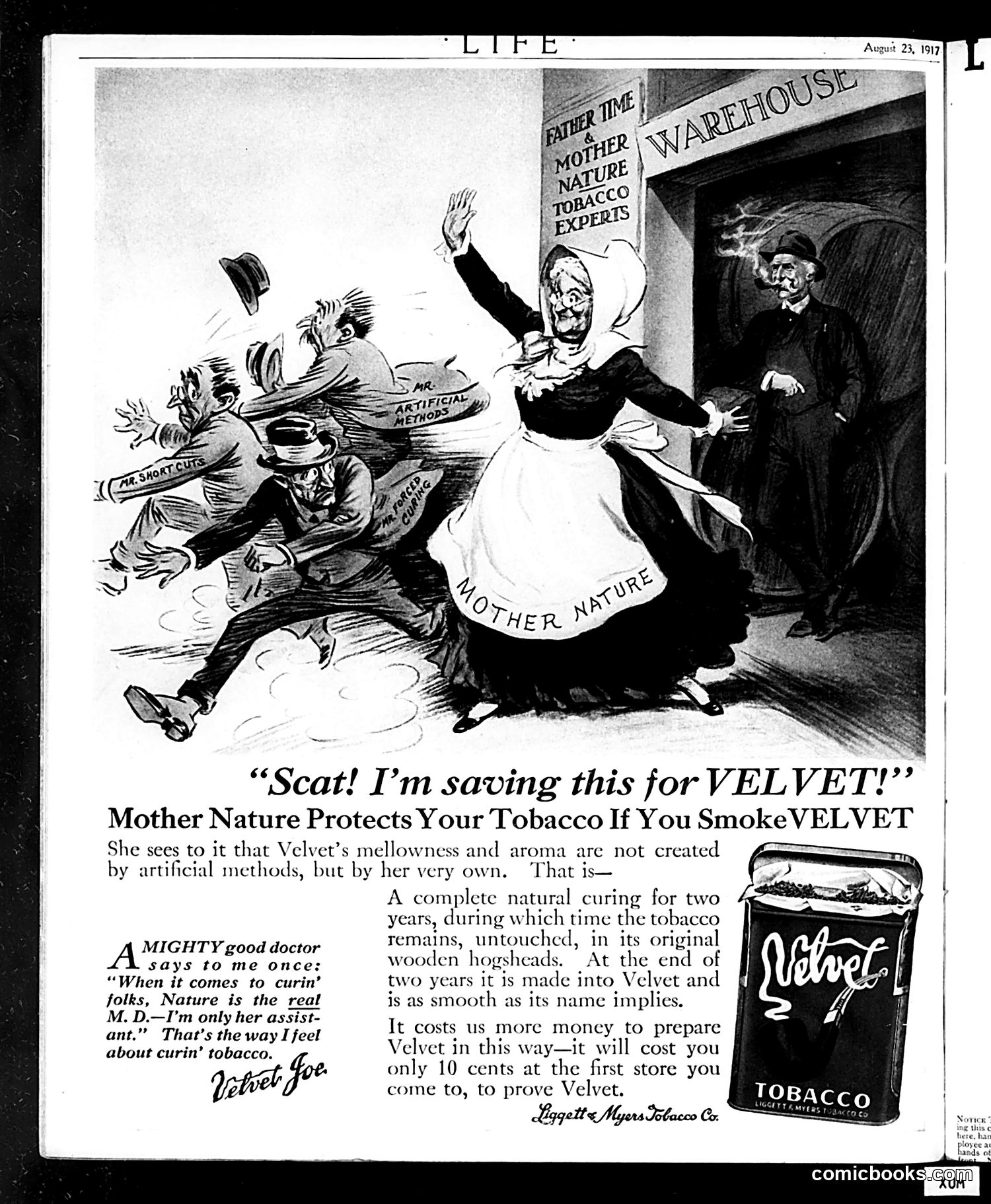
This is a **tobacco advertisement**, not political satire. The cartoon advertises Velvet brand tobacco using "Mother Nature" as a personified mascot. The imagery shows Mother Nature (depicted as an elderly woman in traditional dress) physically protecting tobacco from various "artificial methods"—represented by chaotic figures being chased away. These figures carry labels like "Artificial Method" and "Short Cuts," symbolizing industrial processing shortcuts competitors allegedly use. The advertisement's central claim is that Velvet uses only "natural curing for two years" in wooden hogsheads, without artificial additives, making it superior to competitors' products. The quote "Scat! I'm saving this for Velvet!" humorously portrays Mother Nature as actively defending the tobacco for this brand. A testimonial from a doctor reinforces the "natural is healthier" messaging popular in early 20th-century advertising. The price point—10 cents—targets working-class consumers. This represents pre-regulation tobacco marketing, when health claims were unsubstantiated and commonplace.