
Life, 1917-08-23 · page 10 of 40
Life — August 23, 1917 — page 10: what you’re looking at
What you’re looking at
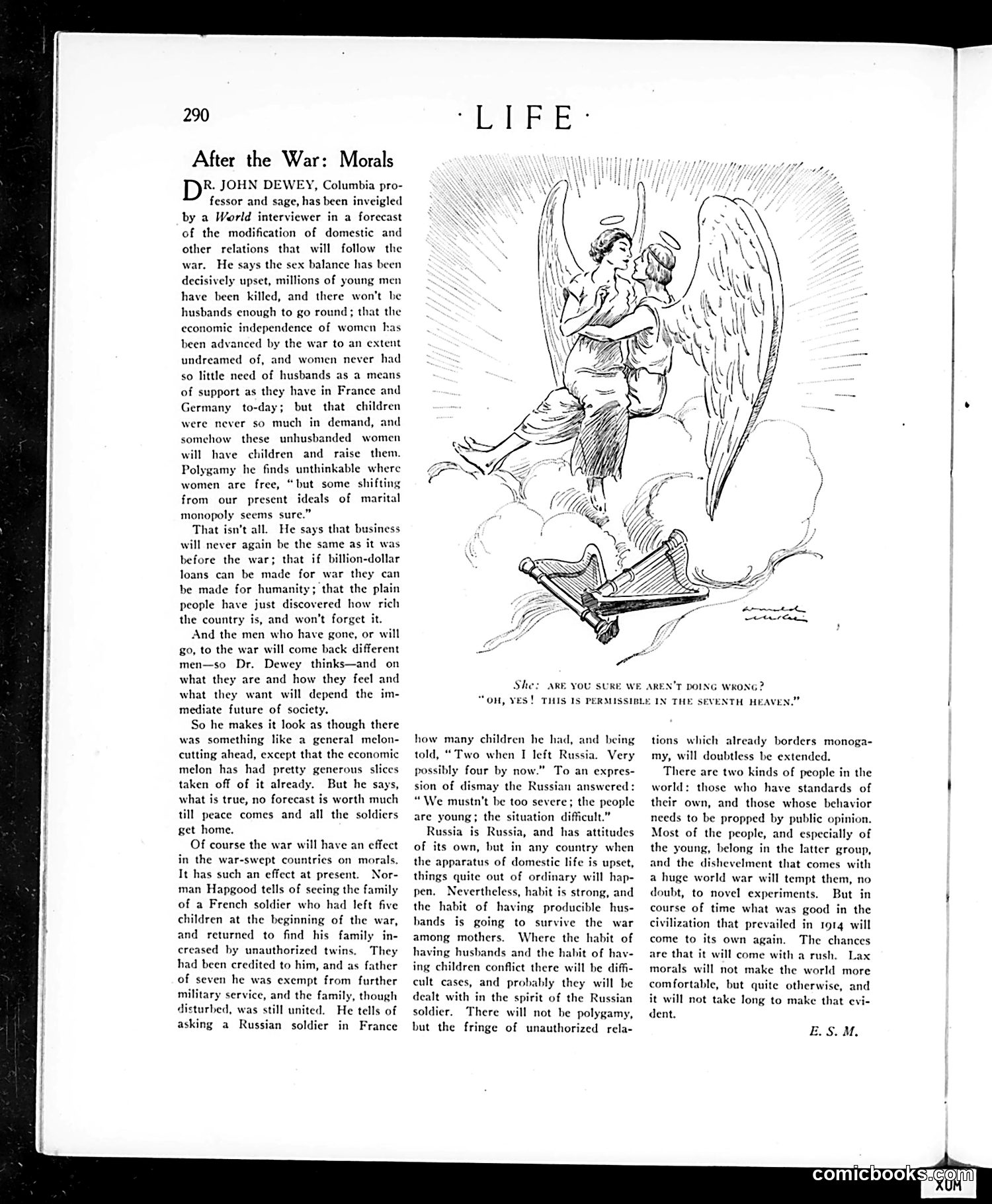
The illustration shows an angel holding a child in clouds, with a rifle below—clearly satirizing post-WWI morality debates. The caption reads: "She: ARE YOU SURE WE AREN'T DOING WRONG? / 'OH, YES! THIS IS PERMISSIBLE IN THE SEVENTH HEAVEN.'" The accompanying article discusses Dr. John Dewey's observations on how war has disrupted traditional family structures and moral values. It references concerns about increased infidelity, "unauthorized" children, and polygamy resulting from millions of dead soldiers and displaced men. The satire cuts both ways: the angel-and-child imagery ironically suggests that illicit relationships producing children might somehow be "permissible" even in heaven—mocking both religious hypocrisy and society's struggle to reconcile wartime chaos with traditional morality.
📄 Transcribed text from this page (OCR, searchable)
Machine-transcribed from the original scan — historical spelling and the odd misread are preserved.
290 After the War: Morals R. JOHN DEWEY, Columbia pro- fessor and sage, has been inveigled by a World interviewer in a forecast of the modification of domestic and other relations that will follow the balance has been war. He says the decisively upset, millions of young men have been killed, and there won't be husbands enough to go round; that the economic independence of women has been advanced by the war to an extent undreamed of, and women never had so little need of husbands as a means of support as they have in France and Germany to-day; but that children were never so much in demand, and somehow these unhusbanded women will have children and raise them. Polygamy he finds unthinkable where women are free, “but some shifting from our present ideals of marital monopoly seems sure.” That isn’t all. He says that business will never again be the same as it was before the war; that if billion-dollar loans can be made for war they can be made for humanity; that the plain people have just discovered how rich the country is, and won't forget it. And the men who have gone, or will go, to the war will come back different men—so Dr. Dewey thinks—and on what they are and how they feel and what they want will depend the im- mediate future of society. So he makes it look as though there was something like a general melon- cutting ahead, except that the economic melon has had pretty generous slices taken off of it already. But he says, what is true, no forecast is worth much till peace comes and all the soldiers get home. Of course the war will have an effect in the war-swept countries on morals. It has such an effect at present. Nor- man Hapgood tells of secing the family of a French soldier who had left five children at the beginning of the war, and returned to find his family in- creased by unauthorized twins. They had been credited to him, and as father of seven he was exempt from further military service, and the family, though disturbed, was still united. He tells of asking a Russian soldier in France Shes ARE YOU SURE WE AREN'T DOING WRONG? “OH, YES! THIS IS PERMISSIBLE IN THE SEVENTH HEAV! how many children he had, and being told, “Two when I left Russia. Very possibly four by now.” To an expres- sion of dismay the Russian answered: “We mustn't be too severe; the people are young; the situation difficult.” Russia is Russia, and has attitudes of its own, but in any country when the apparatus of domestic life is upset, things quite out of ordinary will hap- pen, Nevertheless, habit is strong, and the habit of having producible hus- bands is going to survive the war among mothers. Where the habit of having husbands and the habit of hav- ing children conflict there will be diffi- cult cases, and probably they will be dealt with in the spirit of the Russian soldier. There will not be polygamy, but the fringe of unauthorized rela- tions which already borders monoga- my, will doubtless be extended. There are two kinds of people in the world: those who have standards of their own, and those whose behavior needs to be propped by public opinion. Most of the people, and especially of the young, belong in the latter group, and the dishevelment that comes with a huge world war will tempt them, no doubt, to novel experiments. But in course of time what was good in the civilization that prevailed in 1914 will come to its own again. The chances are that it will come with a rush. Lax morals will not make the world more comfortable, but quite otherwise, and it will not take long to make that evi- dent. E.S.M. comicbook