
Life, 1917-08-23 · page 31 of 40
Life — August 23, 1917 — page 31: what you’re looking at
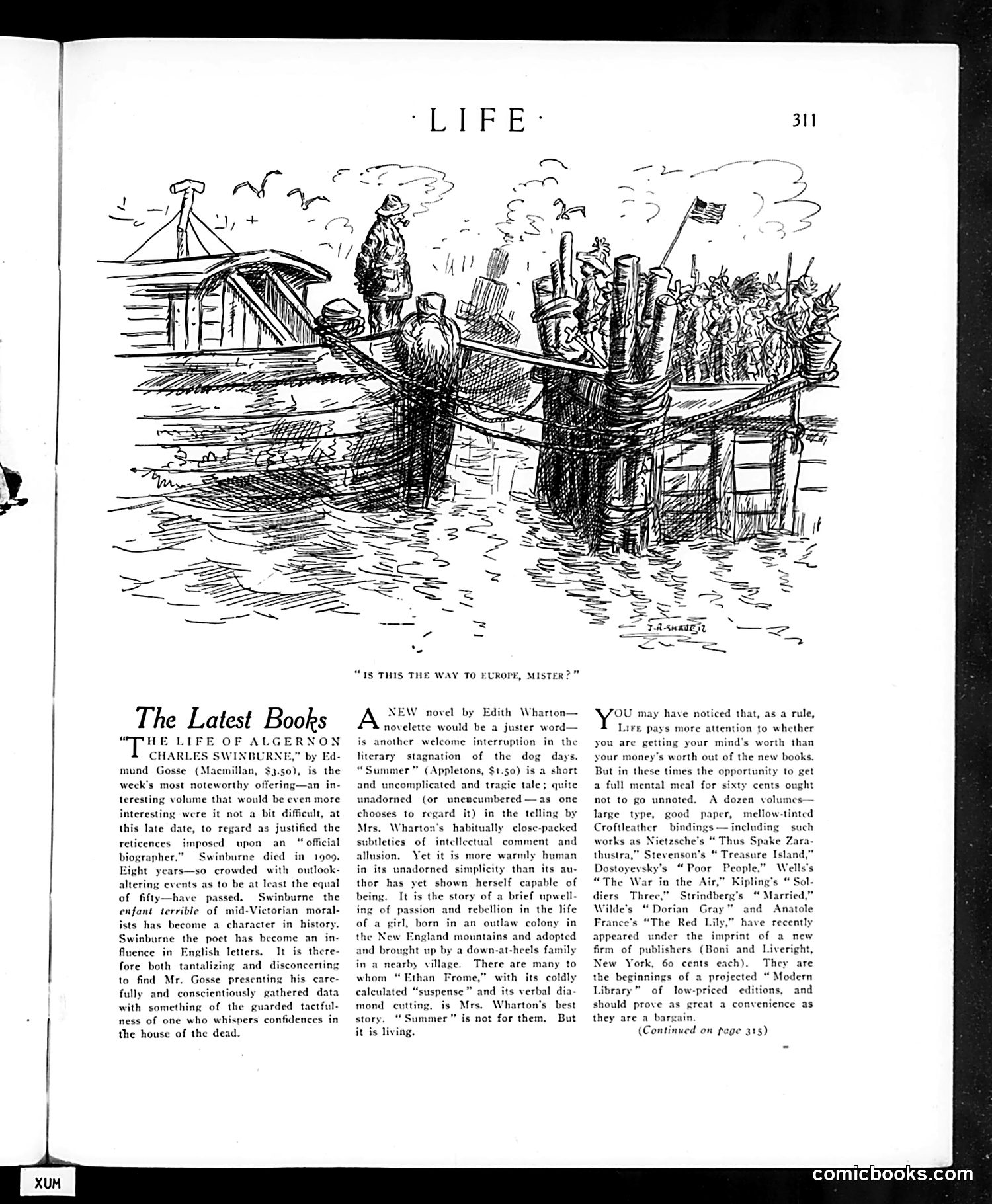
What you’re looking at
This cartoon depicts two figures at a dock or waterfront, apparently asking for directions to Europe. The sketch shows a man in working clothes gesturing toward the water while speaking to another figure. The humor appears to target **American isolationism or naïveté about European geography and distance**—the absurdity of someone asking directions to an entire continent as if it were a nearby destination. The cartoon likely reflects post-World War I American attitudes (the page references Swinburne's 1909 death, placing this around 1917-1920). The joke satirizes either American unfamiliarity with European affairs or the period's debates about American involvement in Europe's conflicts—mocking the simplistic notion that one could casually travel "to Europe" as a solution to problems. The accompanying book reviews discuss literary works and publishers, but are unrelated to the cartoon's message.
📄 Transcribed text from this page (OCR, searchable)
Machine-transcribed from the original scan — historical spelling and the odd misread are preserved.
The Latest Books HE LIFE OF ALG CHARLES SWINBURNE mund Gosse (Macmillan, $3.50), is the weck’s most noteworthy offer i teresting volume that would be even more interesting were it not a bit difficult, at this late date, to regard as justified the reticences imposed upon an “official biographer.” Swinburne died in 1909. ight years—so crowded with outlook- altering events as to be at least the equal of fifty—have passed. Swinburne the enfant terrible of mid-Victorian moral- ists has become a character in history. Swinburne the poet has become an in- fluence in English letters, It is there- fore both tantalizing and disconcerting to find Mr. Gosse presenting his care- fully and conscientiously gathered data with something of the guarded tactful ness of one who whispers confidences in the house of the dead. “Is THIS THE WAY TO EUROPE, MISTER?” A NEW novel by Edith Wharton— novelette would be a juster word— is another welcome interruption in the literary stagnation of the dog “Summer” (Appletons, $1.50) is a short and uncomplicated and tragic tale; quite unadorned (or unewcumbered —as one chooses to regard it) in the telling by Mrs. Wharton's habitually close-packed subtleties of intellectual comment and allusion, Yet it is more warmly human in its unadorned simplicity than its au- thor has yet shown herself capable of being. It is the story of a brief upwell- ing of passion and rebellion in the life of a girl, born in an outlaw colony in the New days. land mountains and adopted and brought up by a down-at-heels family in a nearby village. There are many to whom “Ethan Frome,” with its coldly calculated “suspense” and its verbal di cutting, is Mrs, Wharton's best story. “Summer” is not for them. But it is living. mond ‘OU may have noticed that, as a rule, Lire pays more attention to whether you are getting your mind's worth than your money's worth out of the new books. But in these times the opportunity to get a full mental meal for sixty cents ought not to go unnoted. A dozen volumes— large type, good paper, mellow-tinted Croftleather bindings —ineluding such works as Nietzsche's “ Thus Spake Zara- thustra,” Stevenson's “ Treasure Island, Dostoyevsky’s “Poor People,” Wells's “The War in the Air,” Kipling’s “ Sol- diers Three,” Strindberg’s “ Married,” Wilde's “Dorian Gra Anatole France’s “The Red Lily,” have recently appeared under the imprint of a new firm of publishers (Boni and Liveright, New York, 60 cents each). They are the beginnings of a projected “ Modern Library” of low-priced edi and should prove as great a convenience as they are a ba (Continued on p and comicbooks.com